
Jeremiah 32:35

Hebrew (Westminster Leningrad Codex) Jeremiah 32:35 appears in the Hebrew Old Testament. The text above is from the Westminster Leningrad Codex. Each word links to its Strong’s number, a concise gloss, and parsing drawn from the Open Scriptures Hebrew Bible morphology. Click any word for its full Brown-Driver-Briggs (BDB) entry.
Download image
Cite this verse

Jeremiah 32:35 (World English Bible). Public Domain. Lemma interlinear Bible study tool, https://lemma.gebible.app/v/jeremiah/32/35.

Show BibTeX & RIS
BibTeX
RIS
English Translation
They built the high places of Baal, which are in the valley of the son of Hinnom, to cause their sons and their daughters to pass through [the fire] to Molech; which I didn't command them, neither did it come into my mind, that they should do this abomination, to cause Judah to sin.
World English Bible · Public Domain
Download a study sheet

One document with this verse’s original text, its word-by-word gloss line, the meaning frame, cross-references with their text, attributed commentary, and full source and license credits — printable, and it pastes into notes with its structure intact.

This verse Autodidact and up

Study sheet (.html) Plain text (.txt)

A passage Seminary Student

Up to 50 verses in one chapter. A passage sheet keeps up to 6 commentary sources and 12 cross-references per verse, in the order this page ranks them, and says so on the sheet whenever that leaves anything out. Ask for a single verse and you get the Autodidact verse sheet above.

Everything on this page stays free to read, with no account — the sheet is a download of what is already on screen, not access to it.

Want to remove ads? Support Godless Engineer
Compare translations 3

The same verse in 3 English versions, stacked beneath the original-language interlinear above. Click any original word for its lexicon entry.

Each is an independent rendering of the whole verse — the interlinear is not word-aligned to these translations.

Highlighted words mark where these versions differ — a whole-verse word diff, not a word-by-word alignment.

  • World English Bible Public Domain
    They built the high places of Baal, which are in the valley of the son of Hinnom, to cause their sons and their daughters to pass through [the fire] to Molech; which I didn't command them, neither did it come into my mind, that they should do this abomination, to cause Judah to sin.
  • King James Version Public Domain
    And they built the high places of Baal, which are in the valley of the son of Hinnom, to cause their sons and their daughters to pass through the fire unto Molech; which I commanded them not, neither came it into my mind, that they should do this abomination, to cause Judah to sin.
  • unfoldingWord Literal Text CC BY-SA 4.0
    They built high places for Baal in the Valley of Ben Hinnom in order to put their sons and daughters in the fire for Molech. I did not command them. It never entered my mind that they should do this detestable thing and so cause Judah to sin.’

unfoldingWord Literal Text — © unfoldingWord, licensed CC BY-SA 4.0. Word-aligned USFM3 via Door43 (git.door43.org/unfoldingWord/en_ult).

Versions to compare (up to 4)

3 of 4 selected

Show all 18 translations

Every available English version of this verse, each an independent rendering of the whole verse.

  • World English Bible Public Domain
    They built the high places of Baal, which are in the valley of the son of Hinnom, to cause their sons and their daughters to pass through [the fire] to Molech; which I didn't command them, neither did it come into my mind, that they should do this abomination, to cause Judah to sin.
  • Berean Standard Bible Public Domain
    They have built the high places of Baal in the Valley of Hinnom to make their sons and daughters pass through the fire to Molech—something I never commanded them, nor had it ever entered My mind, that they should commit such an abomination and cause Judah to sin.
  • Majority Standard Bible Public Domain
    They have built the high places of Baal in the Valley of Ben-hinnom to make their sons and daughters pass through the fire to Molech—something I never commanded them, nor had it ever entered My mind, that they should commit such an abomination and cause Judah to sin.
  • King James Version Public Domain
    And they built the high places of Baal, which are in the valley of the son of Hinnom, to cause their sons and their daughters to pass through the fire unto Molech; which I commanded them not, neither came it into my mind, that they should do this abomination, to cause Judah to sin.
  • American Standard Version (1901) Public Domain
    And they built the high places of Baal, which are in the valley of the son of Hinnom, to cause their sons and their daughters to pass through `the fire' unto Molech; which I commanded them not, neither came it into my mind, that they should do this abomination, to cause Judah to sin.
  • Revised Version (1885) Public Domain
    And they built the high places of Baal, which are in the valley of the son of Hinnom, to cause their sons and their daughters to pass through the fire unto Molech; which I commanded them not, neither came it into my mind, that they should do this abomination; to cause Judah to sin.
  • Geneva Bible (1599) Public Domain
    And they built the hie places of Baal, which are in the valley of Ben-hinnom, to cause their sonnes and their daughters to passe through the fire vnto Molech, which I commanded them not, neither came it into my minde, that they should doe such abomination, to cause Iudah to sinne.
  • Douay-Rheims (1899) Public Domain
    And they have built the high places of Baal, which are in the valley of the son of Ennom, to consecrate their sons and their daughters to Moloch: which I commanded them not, neither entered it into my heart, that they should do this abomination, and cause Juda to sin.
  • Young's Literal Translation Public Domain
    And they build the high places of Baal, that `are' in the valley of the son of Hinnom, to cause their sons and their daughters to pass through to Molech, which I did not command them, nor did it come up on my heart to do this abomination, so as to cause Judah to sin.
  • Literal Standard Version CC BY-SA 4.0
    And they build the high places of Ba‘al that [are] in the Valley of the Son of Hinnom, to cause their sons and their daughters to pass through to Molech, which I did not command them, nor did it come up on My heart to do this abomination, so as to cause Judah to sin.
  • Unlocked Literal Bible CC BY-SA 4.0
    They built high places for Baal in the Valley of Ben Hinnom in order to put their sons and daughters in the fire for Molech. I did not command them. It never entered my mind that they should do this detestable thing and so cause Judah to sin.'
  • unfoldingWord Literal Text CC BY-SA 4.0
    They built high places for Baal in the Valley of Ben Hinnom in order to put their sons and daughters in the fire for Molech. I did not command them. It never entered my mind that they should do this detestable thing and so cause Judah to sin.’
  • Darby Bible Public Domain
    and they have built the high places of Baal, which are in the valley of the son of Hinnom, to cause to pass through [the fire] their sons and their daughters unto Molech: which I commanded them not, neither came it into my mind, that they should do this abomination, to cause Judah to sin.
  • World Messianic Bible Public Domain
    They built the high places of Baal, which are in the valley of the son of Hinnom, to cause their sons and their daughters to pass through fire to Molech, which I didn’t command them. It didn’t even come into my mind, that they should do this abomination, to cause Judah to sin.”
  • Webster's Bible Public Domain
    And they built the high places of Baal, which are in the valley of the son of Hinnom, to cause their sons and their daughters to pass through the fire to Molech; which I commanded them not, neither came it into my mind, that they should do this abomination, to cause Judah to sin.
  • Free Bible Version CC BY-SA 4.0
    They have built pagan shrines to Baal in the Valley of Hinnom so they could sacrifice their sons and daughters by burning them in the fire. This is something I never commanded. I never even thought of such a thing—doing something so awful and making the people of Judah guilty of sin.
  • Bible in Basic English Public Domain
    And they put up the high places of the Baal in the valley of the son of Hinnom, making their sons and their daughters go through the fire to Molech; which I did not give them orders to do, and it never came into my mind that they would do this disgusting thing, causing Judah to be turned out of the way.
  • JPS Tanakh (1917) Public Domain
    And they built the high places of Baal, which are in the valley of the son of Hinnom, to set apart their sons and their daughters unto Molech; which I commanded them not, neither came it into My mind, that they should do this abomination; to cause Judah to sin.

Literal Standard Version (2020), Covenant Press — licensed CC BY-SA 4.0. Text via the HelloAO Bible API (eBible.org). Unlocked Literal Bible (unfoldingWord) — licensed CC BY-SA 4.0. Text via the HelloAO Bible API (eBible.org). unfoldingWord Literal Text — © unfoldingWord, licensed CC BY-SA 4.0. Word-aligned USFM3 via Door43 (git.door43.org/unfoldingWord/en_ult). Free Bible Version, Dr. Jonathan Gallagher — licensed CC BY-SA 4.0. Text via the HelloAO Bible API (eBible.org).

Word by word

More ways to search: Search by grammar → Find every occurrence → Compare this word →

Practice this passage: Drill this verse → Learn its vocabulary →

לַמֹּלֶךְ֒
Môlek
H4432
“to/for the · Molech”
Preposition, Determined + Noun, Proper
Part of Speech
Preposition + Noun
Type
Proper
Full BDB Definition

Origin: from H4427

TWOT: 1199h

Molech = "king" - the god of the Ammonites and Phoenicians to whom some Israelites sacrificed their infants in the valley of Hinnom
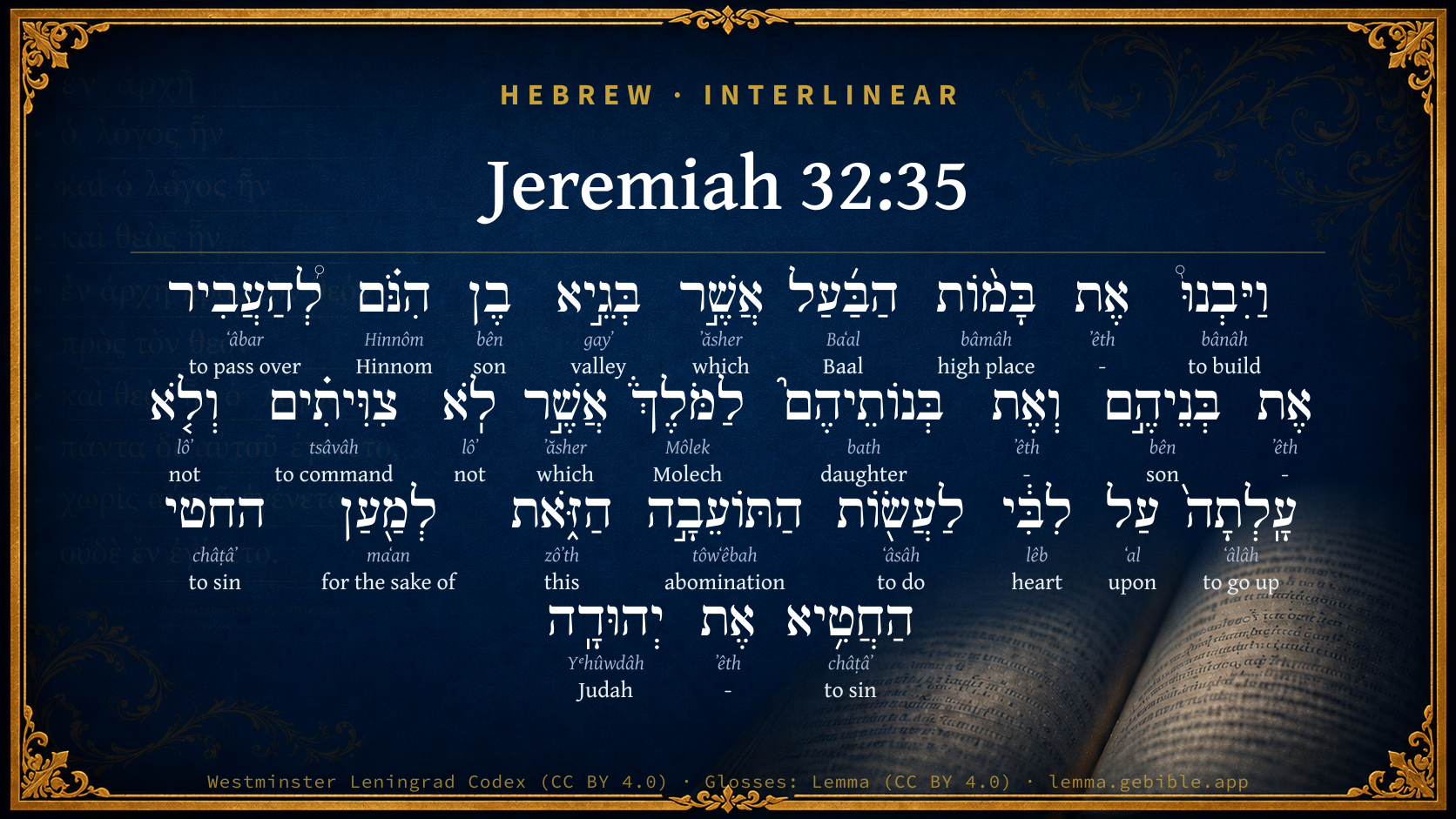
  1. וַיִּבְנוּ֩ bânâh H1129 “and · to build” Conjunction + Verb, Qal, Sequential Imperfect, 3rd Person, Masculine, Plural
  2. אֶת ʼêth H853 “-” Particle, Direct Object
  3. בָּמ֨וֹת bâmâh H1116 “high places of” Noun, Common, Feminine, Plural, Construct
  4. הַבַּ֜עַל Baʻal H1168 “the · Baal” Particle, Definite Article + Noun, Proper
  5. אֲשֶׁ֣ר ʼăsher H834 “which” Particle, Relative
  6. בְּגֵ֣יא gayʼ H1516 “in/at · valley of” Preposition + Noun, Common, Both, Singular, Construct
  7. בֶן bên H1121 “son” Noun, Proper
  8. הִנֹּ֗ם Hinnôm H2011 “Hinnom” Noun, Proper
  9. לְ֠הַעֲבִיר ʻâbar H5674 “to pass over” Preposition + Verb, Hiphil, Infinitive Construct
  10. אֶת ʼêth H853 “-” Particle, Direct Object
  11. בְּנֵיהֶ֣ם bên H1121 “sons · their” Noun, Common, Masculine, Plural, Construct + Suffix, Personal, 3rd Person, Masculine, Plural
  12. וְאֶת ʼêth H853 “and · -” Conjunction + Particle, Direct Object
  13. בְּנוֹתֵיהֶם֮ bath H1323 “daughters · their” Noun, Common, Feminine, Plural, Construct + Suffix, Personal, 3rd Person, Masculine, Plural
  14. אֲשֶׁ֣ר ʼăsher H834 “which” Particle, Relative
  15. לֹֽא lôʼ H3808 “not” Particle, Negative
  16. צִוִּיתִ֗ים tsâvâh H6680 “to command · them” Verb, Piel, Perfect, 1st Person, Common, Singular + Suffix, Personal, 3rd Person, Masculine, Plural
  17. וְלֹ֤א lôʼ H3808 “and · not” Conjunction + Particle, Negative
  18. עָֽלְתָה֙ ʻâlâh H5927 “to go up” Verb, Qal, Perfect, 3rd Person, Feminine, Singular
  19. עַל ʻal H5921 “upon” Preposition
  20. לִבִּ֔י lêb H3820 “heart · my” Noun, Common, Masculine, Singular, Construct + Suffix, Personal, 1st Person, Common, Singular
  21. לַעֲשׂ֖וֹת ʻâsâh H6213 “to do” Preposition + Verb, Qal, Infinitive Construct
  22. הַתּוֹעֵבָ֣ה tôwʻêbah H8441 “the · abomination” Particle, Definite Article + Noun, Common, Feminine, Singular, Absolute
  23. הַזֹּ֑את zôʼth H2063 “the · this” Particle, Definite Article + Pronoun, Demonstrative, Feminine, Singular
  24. לְמַ֖עַן maʻan H4616 “for the sake of” Preposition
  25. החטי châṭâʼ H2398 “to sin” Verb, Hiphil, Infinitive Construct
  26. הַחֲטִ֥יא châṭâʼ H2398 “to sin” Verb, Hiphil, Infinitive Construct
  27. אֶת ʼêth H853 “-” Particle, Direct Object
  28. יְהוּדָֽה Yᵉhûwdâh H3063 “Judah” Noun, Proper

About this verse

These counts appear in no published source. They are computed here, from the morphology-tagged text and Lemma’s own curated glosses. What Lemma adds →

29
words
22
distinct lemmas
Prophets
section

Notable vocabulary

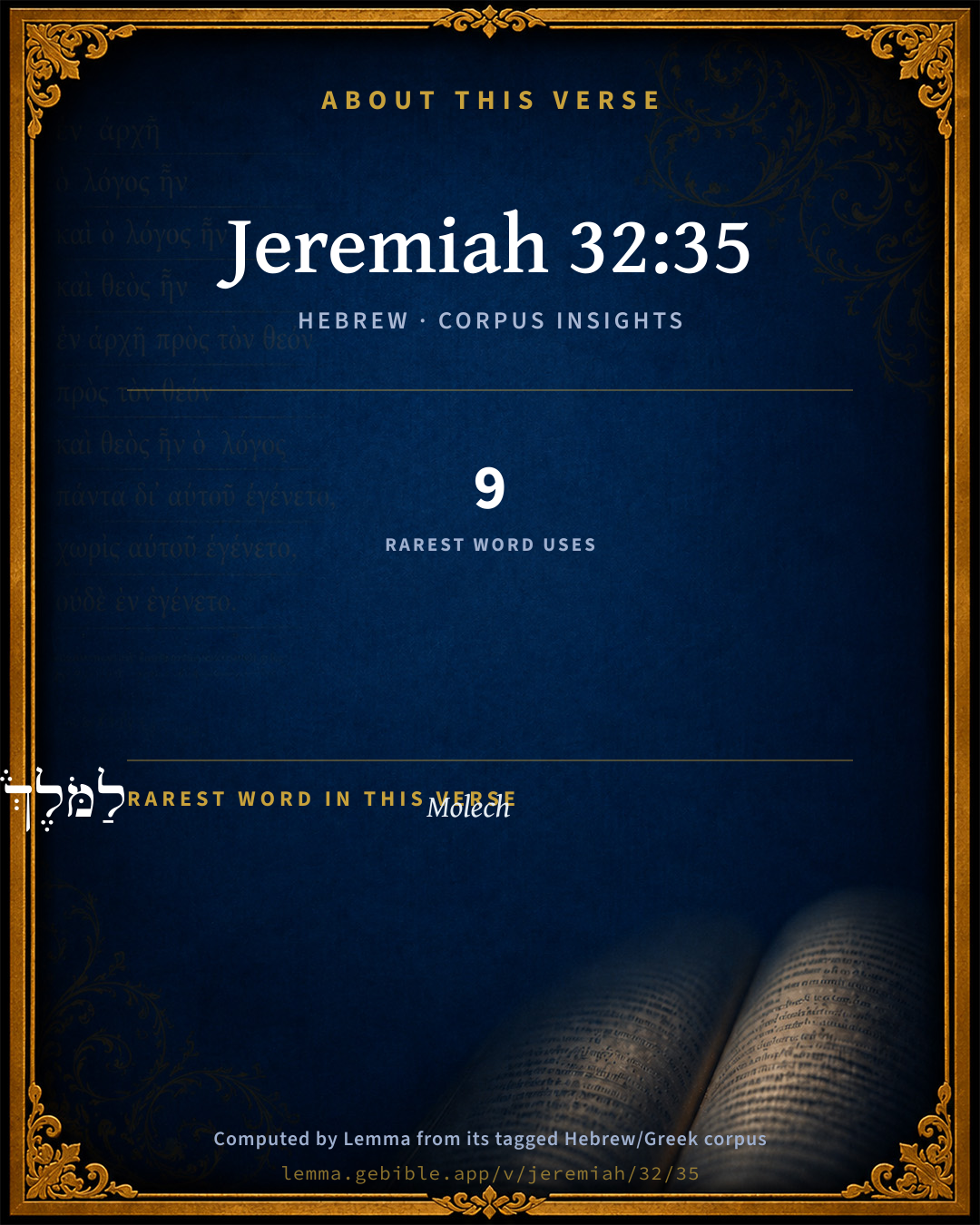
The rarest word here is לַמֹּלֶךְ֒ Molech H4432 — appearing just 9 times in the whole Hebrew Bible.

Shared distinctive vocabulary

לַמֹּלֶךְ֒ Molech H4432 occurs in 9 verses of the Hebrew Bible. Also found in:

Grammatical profile

  • 7 verbs
  • 11 nouns
  • 1 pronoun
  • 2 prepositions
  • 8 particles

Verb forms

  • וַיִּבְנוּ֩ Qal · Sequential Imperfect
  • לְ֠הַעֲבִיר Hiphil · Infinitive Construct
  • צִוִּיתִ֗ים Piel · Perfect
  • עָֽלְתָה֙ Qal · Perfect
  • לַעֲשׂ֖וֹת Qal · Infinitive Construct
  • החטי Hiphil · Infinitive Construct
  • הַחֲטִ֥יא Hiphil · Infinitive Construct

Repetition

Words recur within this verse — often emphatic in Hebrew:

  • בֶן son H1121 ×2
  • החטי to sin H2398 ×2
  • אֲשֶׁ֣ר which H834 ×2
  • לֹֽא not H3808 ×2

Cross-references

24

Topical passages linked to Jeremiah 32:35 in the Treasury of Scripture Knowledge — connected by theme and wording, ordered by reader-vote popularity; previews shown in the World English Bible.

  • Jeremiah 7:31 They have built the high places of Topheth, which is in the valley of the son of Hinnom, to burn their sons and their daughters in the fire; which I didn't command, neither came it into my mind.
  • Leviticus 18:21 "'You shall not give any of your children to sacrifice to Molech; neither shall you profane the name of your God: I am Yahweh.
  • 2 Chronicles 33:6 He also made his children to pass through the fire in the valley of the son of Hinnom; and he practiced sorcery, and used enchantments, and practiced sorcery, and dealt with those who had familiar spirits, and with wizards: he worked much evil in the sight of Yahweh, to provoke him to anger.
  • Leviticus 20:2–5 "Moreover, you shall tell the children of Israel, 'Anyone of the children of Israel, or of the strangers who live as foreigners in Israel, who gives any of his seed to Molech; he shall surely be put to death. The people of the land shall stone him with stones.
  • Jeremiah 19:5–6 and have built the high places of Baal, to burn their sons in the fire for burnt offerings to Baal; which I didn't command, nor spoke it, neither came it into my mind:
  • 1 Kings 16:19 for his sins which he sinned in doing that which was evil in the sight of Yahweh, in walking in the way of Jeroboam, and in his sin which he did, to make Israel to sin.
  • 2 Kings 23:10 He defiled Topheth, which is in the valley of the children of Hinnom, that no man might make his son or his daughter to pass through the fire to Molech.
  • 2 Chronicles 28:2–3 but he walked in the ways of the kings of Israel, and made also molten images for the Baals.
  • Isaiah 57:5 you who inflame yourselves among the oaks, under every green tree; who kill the children in the valleys, under the clefts of the rocks?
  • Ezekiel 16:20–21 Moreover you have taken your sons and your daughters, whom you have borne to me, and these have you sacrificed to them to be devoured. Were your prostitution a small matter,
  • Ezekiel 23:37 For they have committed adultery, and blood is in their hands; and with their idols have they committed adultery; and they have also caused their sons, whom they bore to me, to pass through [the fire] to them to be devoured.
  • Exodus 32:21 Moses said to Aaron, "What did these people do to you, that you have brought a great sin on them?"
  • Deuteronomy 18:10 There shall not be found with you anyone who makes his son or his daughter to pass through the fire, one who uses divination, one who practices sorcery, or an enchanter, or a sorcerer,
  • Deuteronomy 24:4 her former husband, who sent her away, may not take her again to be his wife, after that she is defiled; for that is abomination before Yahweh: and you shall not cause the land to sin, which Yahweh your God gives you for an inheritance.
  • 1 Kings 11:33 because that they have forsaken me, and have worshiped Ashtoreth the goddess of the Sidonians, Chemosh the god of Moab, and Milcom the god of the children of Ammon; and they have not walked in my ways, to do that which is right in my eyes, and [to keep] my statutes and my ordinances, as did David his father.
  • 1 Kings 14:16 He will give Israel up because of the sins of Jeroboam, which he has sinned, and with which he has made Israel to sin.
  • 1 Kings 15:26 He did that which was evil in the sight of Yahweh, and walked in the way of his father, and in his sin with which he made Israel to sin.
  • 1 Kings 15:30 for the sins of Jeroboam which he sinned, and with which he made Israel to sin, because of his provocation with which he provoked Yahweh, the God of Israel, to anger.
  • 1 Kings 21:22 and I will make your house like the house of Jeroboam the son of Nebat, and like the house of Baasha the son of Ahijah for the provocation with which you have provoked me to anger, and have made Israel to sin.
  • 2 Kings 3:3 Nevertheless he cleaved to the sins of Jeroboam the son of Nebat, with which he made Israel to sin; he didn't depart from it.
  • 2 Kings 21:11 Because Manasseh king of Judah has done these abominations, and has done wickedly above all that the Amorites did, who were before him, and has made Judah also to sin with his idols;
  • 2 Kings 23:15 Moreover the altar that was at Bethel, and the high place which Jeroboam the son of Nebat, who made Israel to sin, had made, even that altar and the high place he broke down; and he burned the high place and beat it to dust, and burned the Asherah.
  • 2 Chronicles 33:9 Manasseh seduced Judah and the inhabitants of Jerusalem, so that they did evil more than did the nations whom Yahweh destroyed before the children of Israel.
  • Psalms 106:37–38 Yes, they sacrificed their sons and their daughters to demons.

Cross-references courtesy of OpenBible.info (CC BY 4.0).

Hebrew and Greek witnesses Masoretic Hebrew ↔ Greek Septuagint

The same verse in the two great witnesses to the Old Testament, shown verse-for-verse.

These are two independent witnesses, not word-aligned to each other, and the Septuagint is shown in lemma (dictionary) form.

Hebrew Jeremiah 32:35 Masoretic · Westminster Leningrad Codex

וַיִּבְנוּ֩ אֶת בָּמ֨וֹת הַבַּ֜עַל אֲשֶׁ֣ר בְּגֵ֣יא בֶן הִנֹּ֗ם לְ֠הַעֲבִיר אֶת בְּנֵיהֶ֣ם וְאֶת בְּנוֹתֵיהֶם֮ לַמֹּלֶךְ֒ אֲשֶׁ֣ר לֹֽא צִוִּיתִ֗ים וְלֹ֤א עָֽלְתָה֙ עַל לִבִּ֔י לַעֲשׂ֖וֹת הַתּוֹעֵבָ֣ה הַזֹּ֑את לְמַ֖עַן החטי הַחֲטִ֥יא אֶת יְהוּדָֽה

They built the high places of Baal, which are in the valley of the son of Hinnom, to cause their sons and their daughters to pass through [the fire] to Molech; which I didn't command them, neither did it come into my mind, that they should do this abomination, to cause Judah to sin.

World English Bible · Public Domain

Greek LXX Structure differs

In the Septuagint, Jeremiah is about an eighth shorter than the Hebrew and arranges its material differently — the Oracles Against the Nations (Hebrew chapters 46–51) appear in the middle of the Greek book, after 25:13. Because the chapter and verse boundaries do not line up, a verse-for-verse comparison with the Hebrew is not shown.

A verse-for-verse comparison isn’t shown here because the chapters and verses don’t line up. Switch to the LXX edition with the MT / LXX toggle above to read the Greek directly.

Hebrew: Westminster Leningrad Codex (CC BY 4.0). Greek: Septuagint (public domain); English from a public-domain English Septuagint. How the Septuagint differs from the Hebrew →

Targum (Aramaic paraphrase)

1

The Targum is the ancient Jewish Aramaic paraphrase of the Hebrew Scriptures — an interpretive translation, not the Hebrew text itself. Onkelos (literal) and Pseudo-Jonathan (expansive) render the Torah, and Jonathan the Prophets. Coverage is partial: where no permissively-licensed English translation exists for a verse, only the Aramaic is shown. This is verse-level text, not a word-by-word alignment to the Hebrew.

  1. Targum Jonathan Prophets (Joshua–Malachi)
    וּבְנוֹ יַת בָּמַת בַּעֲלָא דִי בְחֵילַת בַּר הִנוֹם לְאַעְבָּרָא יַת בְּנֵיהוֹן וְיַת בְּנָתְהוֹן לְמוֹלָךְ דְלָא פַקְדֵית בְּאוֹרַיְתִי וְלָא רַעֲוָא קֳדָמַי לְמֶעְבַּד תּוֹעֶבְתָּא הָדָא בְּדִיל לְחַיָבָא יַת דְּבֵית יְהוּדָה:

    (no public-domain English translation for this verse)

    Targum Jonathan — Aramaic: “Mikraot Gedolot” (public domain). English: “Sefaria Community Translation” (CC0 1.0 (public-domain dedication)); “London "Chaldee Paraphrase," 1871” (public domain). Text via Sefaria.

Commentary

Notes on Jeremiah 32:35 from classic Christian and Jewish commentators (each source and its license shown beneath its notes). The classic Christian expositions comment on the surrounding passage and are grouped to its opening verse, so a note may address several verses; the Jewish commentaries on the Tanakh (Rashi and others) are per-verse, so they appear only where the commentator wrote on this verse.

Lemma curates 59 commentaries, every one of them public domain or Creative Commons licensed, each selected and text-cleaned for this edition rather than reprinted as found. About our sources →

Trapp's Complete Commentary

John Trapp

Jer 32:35 And they built the high places of Baal, which [are] in the valley of the son of Hinnom, to cause their sons and their daughters to pass through [the fire] unto Molech; which I commanded them not, neither came it into my mind, that they should do this abomination, to cause Judah to sin.

Ver. 35. And they built.] See Jer 7:31; Jer 19:5.

John Trapp, A Commentary or Exposition upon All the Books of the Old and New Testament (1647–1656) — public domain. Text from a community e-Sword module.

Geneva Bible (1599)

Geneva Bible translators

That is, the altars which were made to offer sacrifices upon to their idols.

Read 2 Kings 16:3.

Read Jer. 7:31; 2 Kings 21:4, 6.

Geneva Bible (1599) marginal notes — public domain. Text via Bolls.life.

Jamieson, Fausset & Brown

Robert Jamieson, A. R. Fausset & David Brown

cause . . . pass through . . . fire--By way of purification, they passed through with bare feet (Lev 18:21).

Molech--meaning "king"; the same as Milcom (Kg1 11:33).

I commanded . . . not--This cuts off from the superstitious the plea of a good intention. All "will-worship" exposes to God's wrath (Col 2:18, Col 2:23).

Jamieson, Fausset & Brown — Commentary Critical and Explanatory on the Whole Bible (1871) — public domain (CC PDM 1.0). Text via the HelloAO Bible API.

John Calvin's Commentaries

After having complained of the profanation of his own Temple, God now says that the Jews had sinned through another superstition, even because the valley of the son of Hinnom had become to them a temple instead of the true one. God had forbidden in the Law sacrifices to be offered except where he appointed,

“Thou shalt not do so to thy God, but thou shalt come to the place where he has put the memorial of his name.” (Deuteronomy 12:4, 5)

As God then had expressly testified that sacrifices are not acceptable to him except in one Temple, and on one altar, he shews here that the lawful worship had been corrupted by the Jews, even because they caused their sons and their daughters to pass through the fire in honor to Molech. And yet in a former passage he calls him Baal. Hence it appears, as we said yesterday, that the word Baal includes all kinds of idols. For the Jews, no doubt, while they worshipped their Baalim, ever wished to ascribe to the one true God the chief sovereignty, but, at the same time, they devised patrons for themselves, and hence was the multitude of their gods. But Molech was a particular deity, as we learn from other parts of Scripture.

We now, then, perceive the Prophet’s meaning, — that the Jews had not been satisfied with one kind of idolatry, but built high places or altars for themselves; for so do some explain במות, bemut: במה beme, means a high place, and is everywhere taken for the groves, as they were called, that is, tall trees. But as mention is tiere made of a valley, some think that the word high-places is not suitable here; therefore they render the word “altars.” As to the main point, God no doubt condenms the Jews here, because they had dared to set up a foreign mode of worship in the valley of Hinnom, when the Law expressly forbade it. The relative אשר asher, as I have said, may be applied to the altars as well as to Baal. But it seems to me a more suitable meaning, if we say that Baal himself, that is, the idol, was in the talley of Hinnom. Of the passing through the fire, I have spoken elsewhere — it was a kind of lustration. There is no doubt, however, but that some exceeded the moderation commonly observed, who wished to excel others in the fervor of their zeal; for they actually burned their sons and their daughters, which was a deed the most savage. But they yet thought that it was a service acceptable to God. Others performed their superstition in a milder manner, as they deemed it enough that their children should pass through the fire as a symbol of purification, as also the heathens were wont to purify themselves.

But the Prophet speaks of sons and of daughters, in order to shew that so great was the intemperate zeal of the Jews, that they not only prostituted themselves before their idols, but also contaminated their offspring with these defilements.

He at last says, that he had commanded no such thing, and that it never came to his mind We have said elsewhere, that whenever this manner of speaking occurs, God cuts off every handle from objectors, because the superstitious ever have something to allege as a pretense when they are summoned to an account. We know that the Papists, by pretending good intentions, confidently glory against God; and they think that this one pretense is sufficient to defend them against all reproofs; and they think also that the servants of God and the Prophets are too morose and scrupulous when such an excuse does not satisfy them. But God, that he might not tediously contend with the superstitious, assumes this principle, — that whatever they attempt beyond the Law is spurious, and that, therefore, the inventions of men cannot be defended by any disguise or pretense. Let us then know that true religion is always founded on obedience to God’s will; and hence everything devised by men, when there is no command of God, is not only frivolous, but also abominable, according to what was said yesterday respecting the work of the hands; and so here the command of God is set in opposition to all the inventions of men. But as such declarations often occur, I now touch but slightly on this passage.

This doctrine, however, ought to be especially noticed, that is, that there is no need of a long refutation when we undertake to expose fictitious modes of worship, which men devise for themselves according to their own notions, because, after all that they can say, God in one word gives this answer, that whatever he has not commanded in his Law, is vain and mischievous. He then says, that he had not commanded this, and that it had never entered into his mind.

God in the last clause transfers to himself what applies only to men; for it cannot be said with strict propriety of God, that this or that had not come to his mind. But here he rebukes the presumption of men, who dare to introduce this or that, and think that an acceptable worship of God which they themselves have presumptuously devised; for they seek thus to exalt their own wisdom above that of God himself. And we even find at this day that the Papists, when we shew that nothing has proceeded from the mouth of God of all the mass of observances in which they make religion to consist, do always allege that they do not without reason observe what has been commanded by the fathers, as though some things had come into the minds of men which had escaped God himself! We then see that God in this place exposes to ridicule the madness of those, who, relying on their own inventive wits, devise for themselves various kinds of worship; for they seek, as we have said, to be wiser than God himself. We now, then, perceive the force of the expression, when God says that it never came to his mind, because men boast that it had not been contrived without reason, and glory in their own acuteness, as though they were able to appoint a better thing than God himself.

He afterwards says, That they should do this abomination God now goes farther, and calls whatever he had not commanded an abomination. And this clause confirms what I have before said, that there is no need of long arguments when the question is respecting the inventions of men, for nothing can be approved of in the worship of God but what he has himself commanded. Whatever therefore has proceeded from the notions of men, is not only frivolous and useless, but it is also an abomination; for God so represents it in this place. It is therefore not enough at this day to repudiate and to treat with disdain the fictitious modes of worship in which the Papists so much glory; but if we would prove that we have a true zeal for religion, we must abominate all these fictitious things; for God has once for all declared them to be abominable.

He adds, that Judah might sin, or, that they might make Judah to sin: either is admissible, and there is a twofold reading. However this may be, he declares that those who build not on the Law, do nothing but sin, though they may think that they render to God the best service, even because they ought to have begun with this principle, — to do nothing but according to what the Law prescribes. It follows, —

John Calvin's Commentaries (1540-1563) — public domain. Text from the Calvin Translation Society English edition (1840s-50s) via the Christian Classics Ethereal Library (ccel.org). Calvin's coverage is partial (roughly two-thirds of the Bible); uncommented books and verses are honest gaps, never fabricated. The 19th-century editor's footnotes and remarks are omitted so the notes are faithfully Calvin's own voice.

John Gill's Exposition

And now therefore thus saith the Lord, the God of Israel,

concerning this city,.... Here begins the confirmation of the other part of the prophecy concerning the return of the Jews to their city and country, when they should again buy and possess fields and vineyards; which was thought impossible, supposing the destruction of the city; or however not easily reconcilable with it; but this is as strongly affirmed as the former; for though they had sinned so heinously, and had provoked the wrath of God to such a degree, that the destruction of their city was inevitable, of which they were now sensible themselves; "yet now, notwithstanding" (l), for so it is ushered in; and thus the words may be rendered, "thus saith the Lord, the God of Israel"; who is Jehovah, with whom nothing is impossible; and continues the covenant God of his own people, his spiritual Israel; for whose sake he does great and wonderful things; he says, "concerning this city", the city of Jerusalem, now besieged by the Chaldeans:

whereof ye say, it shall be delivered into the hand of the king of Babylon, by the sword, and by the famine, and by the pestilence; for, by these things, by the consumption that was made by them, they saw their case was desperate; and that there was no avoiding falling into the hands of the Chaldeans; wherefore, for the comfort of the Lord's own people among them, the following things are said; most of which respect the Gospel dispensation, either the beginning or latter end of it.

(l) "attamen num ideo", Schmidt.

John Gill's Exposition of the Whole Bible (1746–1763) — public domain (CC PDM 1.0). Text via the HelloAO Bible API.

Haydock's Catholic Bible Commentary

Consecrate. Hebrew, "make them pass" through or into the fire, to be consumed in honour of Moloc, 4 Kings xxi. 6. --- Heart. They perhaps meant to imitate Abraham, chap. vii. 31.

George Leo Haydock (1774–1849), Haydock's Catholic Family Bible and Commentary, 1859 edition — public domain. Excludes Psalms (Douay-Rheims chapter numbering differs from Protestant) and Deuterocanonical books (Catholic canon only).

Matthew Poole's English Annotations

See Poole "Jer 19:5", See Poole "Jer 19:6", where all passages we meet with here are fully opened.

Matthew Poole's English Annotations on the Holy Bible (1683–1685) — public domain. Text from a community e-Sword/MySword module.

Lesson kit

Teaching starters — assembled from the data on this page, not authored interpretation. Every prompt links to the verse data it draws on. Edit before teaching.

Jeremiah, in the Prophets, opens this verse with 29 words (22 distinct Hebrew lemmas). Its most distinctive word is Môlek (“Molech”). A historical commentator’s framing appears above. Read the whole chapter for the surrounding context.

Discussion questions

  1. The word Môlek carries the sense “Molech.” How does it shape the verse?
  2. Leviticus 18:21 shares the word «Molech» with this verse. How do the two illuminate each other?
  3. “son” occurs 2× in this one verse. What is the effect of the repetition?
  4. The translations on this page render this verse differently — a whole-verse word diff, not a word-by-word alignment. What might account for the different wordings?
  5. The verb «וַיִּבְנוּ֩» is Qal Sequential Imperfect. How does its form color the action?
  6. Reading how Trapp's Complete Commentary and Geneva Bible (1599) read this verse, where do the two commentators agree and where do they part?

Things to notice

Reading settings

Reading text

Shown beneath each verse's original-language words.

Old Testament
Old Testament edition

Read the OT as the Masoretic Hebrew (MT) or the Greek Septuagint (LXX).

English shown for the Greek Septuagint (in the Hebrew ↔ Greek comparison).

Comparing translations? Open the Compare panel on any verse page to stack up to four side by side.