
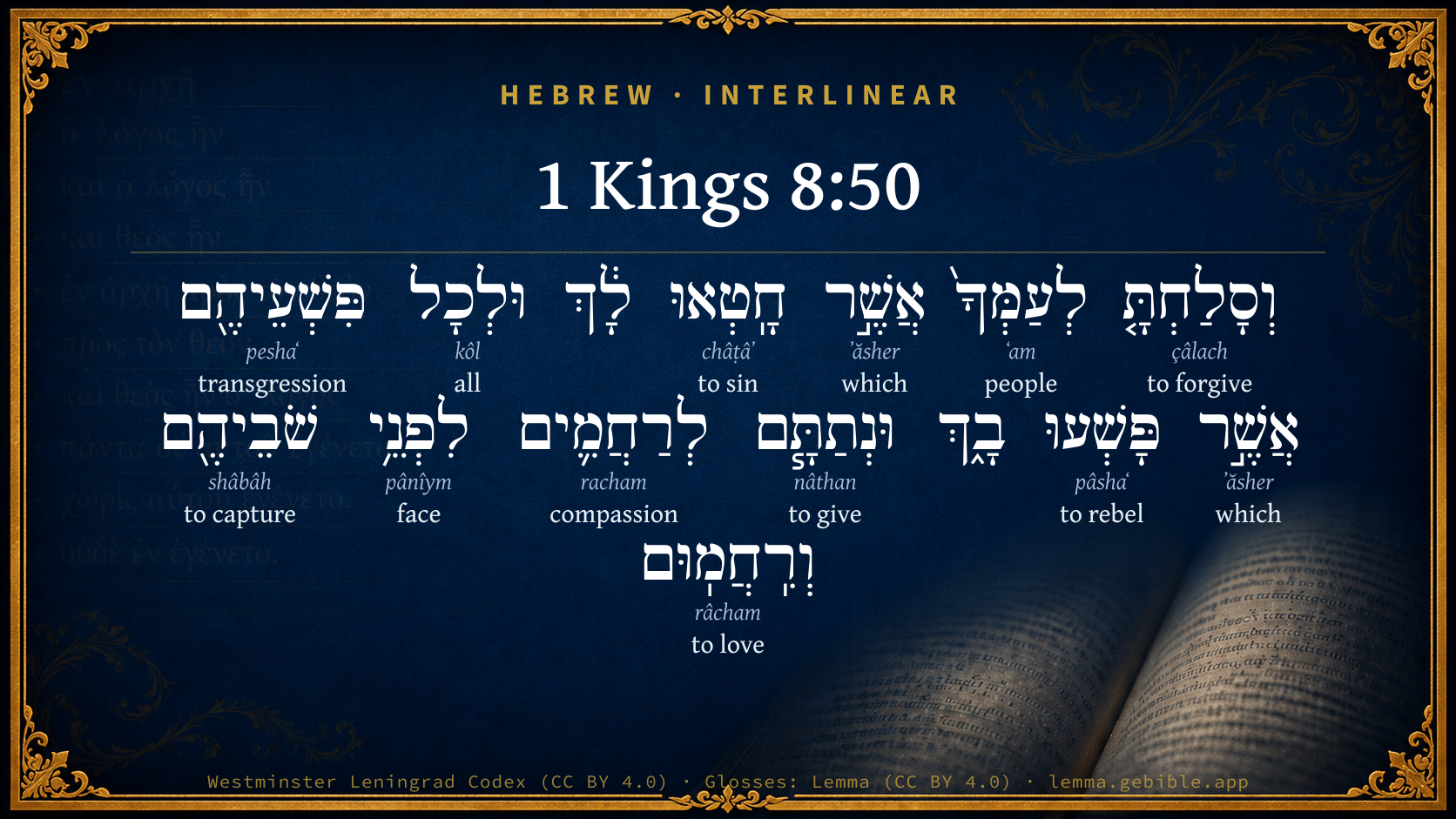
1 Kings 8:50

Hebrew (Westminster Leningrad Codex) 1 Kings 8:50 appears in the Hebrew Old Testament. The text above is from the Westminster Leningrad Codex. Each word links to its Strong’s number, a concise gloss, and parsing drawn from the Open Scriptures Hebrew Bible morphology. Click any word for its full Brown-Driver-Briggs (BDB) entry.
Download image
Cite this verse

1 Kings 8:50 (World English Bible). Public Domain. Lemma interlinear Bible study tool, https://lemma.gebible.app/v/1-kings/8/50.

Show BibTeX & RIS
BibTeX
RIS
English Translation
and forgive your people who have sinned against you, and all their transgressions in which they have transgressed against you; and give them compassion before those who carried them captive, that they may have compassion on them
World English Bible · Public Domain
Highlights
  • 1 first appearance in the Hebrew Bible
Full analysis ↓
Download a study sheet

One document with this verse’s original text, its word-by-word gloss line, the meaning frame, cross-references with their text, attributed commentary, and full source and license credits — printable, and it pastes into notes with its structure intact.

This verse Autodidact and up

Study sheet (.html) Plain text (.txt)

A passage Seminary Student

Up to 50 verses in one chapter. A passage sheet keeps up to 6 commentary sources and 12 cross-references per verse, in the order this page ranks them, and says so on the sheet whenever that leaves anything out. Ask for a single verse and you get the Autodidact verse sheet above.

Everything on this page stays free to read, with no account — the sheet is a download of what is already on screen, not access to it.

Want to remove ads? Support Godless Engineer
Compare translations 3

The same verse in 3 English versions, stacked beneath the original-language interlinear above. Click any original word for its lexicon entry.

Each is an independent rendering of the whole verse — the interlinear is not word-aligned to these translations.

Highlighted words mark where these versions differ — a whole-verse word diff, not a word-by-word alignment.

  • World English Bible Public Domain
    and forgive your people who have sinned against you, and all their transgressions in which they have transgressed against you; and give them compassion before those who carried them captive, that they may have compassion on them
  • King James Version Public Domain
    And forgive thy people that have sinned against thee, and all their transgressions wherein they have transgressed against thee, and give them compassion before them who carried them captive, that they may have compassion on them:
  • unfoldingWord Literal Text CC BY-SA 4.0
    And may you forgive your people who have sinned against you and all of their transgressions that they have transgressed against you. And may you give them compassion to the face of their captors, and may they have compassion on them.

unfoldingWord Literal Text — © unfoldingWord, licensed CC BY-SA 4.0. Word-aligned USFM3 via Door43 (git.door43.org/unfoldingWord/en_ult).

Versions to compare (up to 4)

3 of 4 selected

Show all 18 translations

Every available English version of this verse, each an independent rendering of the whole verse.

  • World English Bible Public Domain
    and forgive your people who have sinned against you, and all their transgressions in which they have transgressed against you; and give them compassion before those who carried them captive, that they may have compassion on them
  • Berean Standard Bible Public Domain
    May You forgive Your people who have sinned against You and all the transgressions they have committed against You, and may You grant them compassion in the eyes of their captors to show them mercy.
  • Majority Standard Bible Public Domain
    May You forgive Your people who have sinned against You and all the transgressions they have committed against You, and may You grant them compassion in the eyes of their captors to show them mercy.
  • King James Version Public Domain
    And forgive thy people that have sinned against thee, and all their transgressions wherein they have transgressed against thee, and give them compassion before them who carried them captive, that they may have compassion on them:
  • American Standard Version (1901) Public Domain
    and forgive thy people who have sinned against thee, and all their transgressions wherein they have transgressed against thee; and give them compassion before those who carried them captive, that they may have compassion on them;
  • Revised Version (1885) Public Domain
    and forgive thy people which have sinned against thee, and all their transgressions wherein they have transgressed against thee; and give them compassion before those who carried them captive, that they may have compassion on them:
  • Geneva Bible (1599) Public Domain
    And be mercifull vnto thy people that haue sinned against thee, and vnto all their iniquities (wherein they haue transgressed against thee) and cause that they, which led them away captiues, may haue pitie and compassion on them:
  • Douay-Rheims (1899) Public Domain
    And forgive thy people, that have sinned against thee, and all their iniquities, by which they have transgressed against thee: and give them mercy before them that have made them captives, that they may have compassion on them.
  • Young's Literal Translation Public Domain
    and hast forgiven Thy people who have sinned against Thee, even all their transgressions which they have transgressed against Thee, and hast given them mercies before their captors, and they have had mercy `on' them --
  • Literal Standard Version CC BY-SA 4.0
    and have forgiven Your people who have sinned against You, even all their transgressions which they have transgressed against You, and have given them mercies before their captors, and they have had mercy [on] them—
  • Unlocked Literal Bible CC BY-SA 4.0
    Forgive your people who have sinned against you, and all their transgressions that they have committed against you, and make them objects of compassion before their conquerors, and cause their conquerors to have compassion on them.
  • unfoldingWord Literal Text CC BY-SA 4.0
    And may you forgive your people who have sinned against you and all of their transgressions that they have transgressed against you. And may you give them compassion to the face of their captors, and may they have compassion on them.
  • Darby Bible Public Domain
    and forgive thy people their sin against thee, and all their transgressions whereby they have transgressed against thee, and give them to find compassion with those who carried them captive, that they may have compassion on them
  • World Messianic Bible Public Domain
    and forgive your people who have sinned against you, and all their transgressions in which they have transgressed against you; and give them compassion before those who carried them captive, that they may have compassion on them
  • Webster's Bible Public Domain
    And forgive thy people that have sinned against thee, and all their transgressions in which they have transgressed against thee, and give them compassion before them who carried them captive, that they may have compassion on them:
  • Free Bible Version CC BY-SA 4.0
    Forgive your people who have sinned against you, all the rebellious acts they have committed against you. Please make those who have captured them show mercy to them.
  • Bible in Basic English Public Domain
    Answering with forgiveness the people who have done wrong against you, and overlooking the evil which they have done against you; let those who made them prisoners be moved with pity for them, and have pity on them;
  • JPS Tanakh (1917) Public Domain
    and forgive Thy people who have sinned against Thee, and all their transgressions wherein they have transgressed against Thee; and give them compassion before those who carried them captive, that they may have compassion on them;

Literal Standard Version (2020), Covenant Press — licensed CC BY-SA 4.0. Text via the HelloAO Bible API (eBible.org). Unlocked Literal Bible (unfoldingWord) — licensed CC BY-SA 4.0. Text via the HelloAO Bible API (eBible.org). unfoldingWord Literal Text — © unfoldingWord, licensed CC BY-SA 4.0. Word-aligned USFM3 via Door43 (git.door43.org/unfoldingWord/en_ult). Free Bible Version, Dr. Jonathan Gallagher — licensed CC BY-SA 4.0. Text via the HelloAO Bible API (eBible.org).

Word by word

More ways to search: Search by grammar → Find every occurrence → Compare this word →

Practice this passage: Drill this verse → Learn its vocabulary →

פָּשְׁעוּ
pâshaʻ
H6586
“to rebel”
Verb, Qal, Perfect, 3rd Person, Common, Plural
Part of Speech
Verb
Stem
Qal
Form
Perfect
Person
3rd Person
Gender
Common
Number
Plural
Full BDB Definition

Origin: a primitive root [identical with H6585 through the idea of expansion]

TWOT: TWOT - 1846

to rebel, transgress, revolt - (Qal) - to rebel, revolt - to transgress - (Niphal) to be rebelled against
  1. וְסָלַחְתָּ֤ çâlach H5545 “and · to forgive” Conjunction + Verb, Qal, Sequential Perfect, 2nd Person, Masculine, Singular
  2. לְעַמְּךָ֙ ʻam H5971 “to/for · people · your” Preposition + Noun, Common, Masculine, Singular, Construct + Suffix, Personal, 2nd Person, Masculine, Singular
  3. אֲשֶׁ֣ר ʼăsher H834 “which” Particle, Relative
  4. חָֽטְאוּ châṭâʼ H2398 “to sin” Verb, Qal, Perfect, 3rd Person, Common, Plural
  5. וּלְכָל kôl H3605 “and · to/for · all of” Conjunction + Preposition + Noun, Common, Masculine, Singular, Construct
  6. פִּשְׁעֵיהֶ֖ם peshaʻ H6588 “transgressions · their” Noun, Common, Masculine, Plural, Construct + Suffix, Personal, 3rd Person, Masculine, Plural
  7. אֲשֶׁ֣ר ʼăsher H834 “which” Particle, Relative
  8. וּנְתַתָּ֧ם nâthan H5414 “and · to give · them” Conjunction + Verb, Qal, Sequential Perfect, 2nd Person, Masculine, Singular + Suffix, Personal, 3rd Person, Masculine, Plural
  9. לְרַחֲמִ֛ים racham H7356 “to/for · compassion” Preposition + Noun, Common, Masculine, Plural, Absolute
  10. לִפְנֵ֥י pânîym H6440 “to/for · face(s) of” Preposition + Noun, Common, Both, Plural, Construct
  11. שֹׁבֵיהֶ֖ם shâbâh H7617 “capturing · them” Verb, Qal, Participle Active, Masculine, Plural, Construct + Suffix, Personal, 3rd Person, Masculine, Plural
  12. וְרִֽחֲמֽוּם râcham H7355 “and · to love · them” Conjunction + Verb, Piel, Sequential Perfect, 3rd Person, Common, Plural + Suffix, Personal, 3rd Person, Masculine, Plural

About this verse

These counts appear in no published source. They are computed here, from the morphology-tagged text and Lemma’s own curated glosses. What Lemma adds →

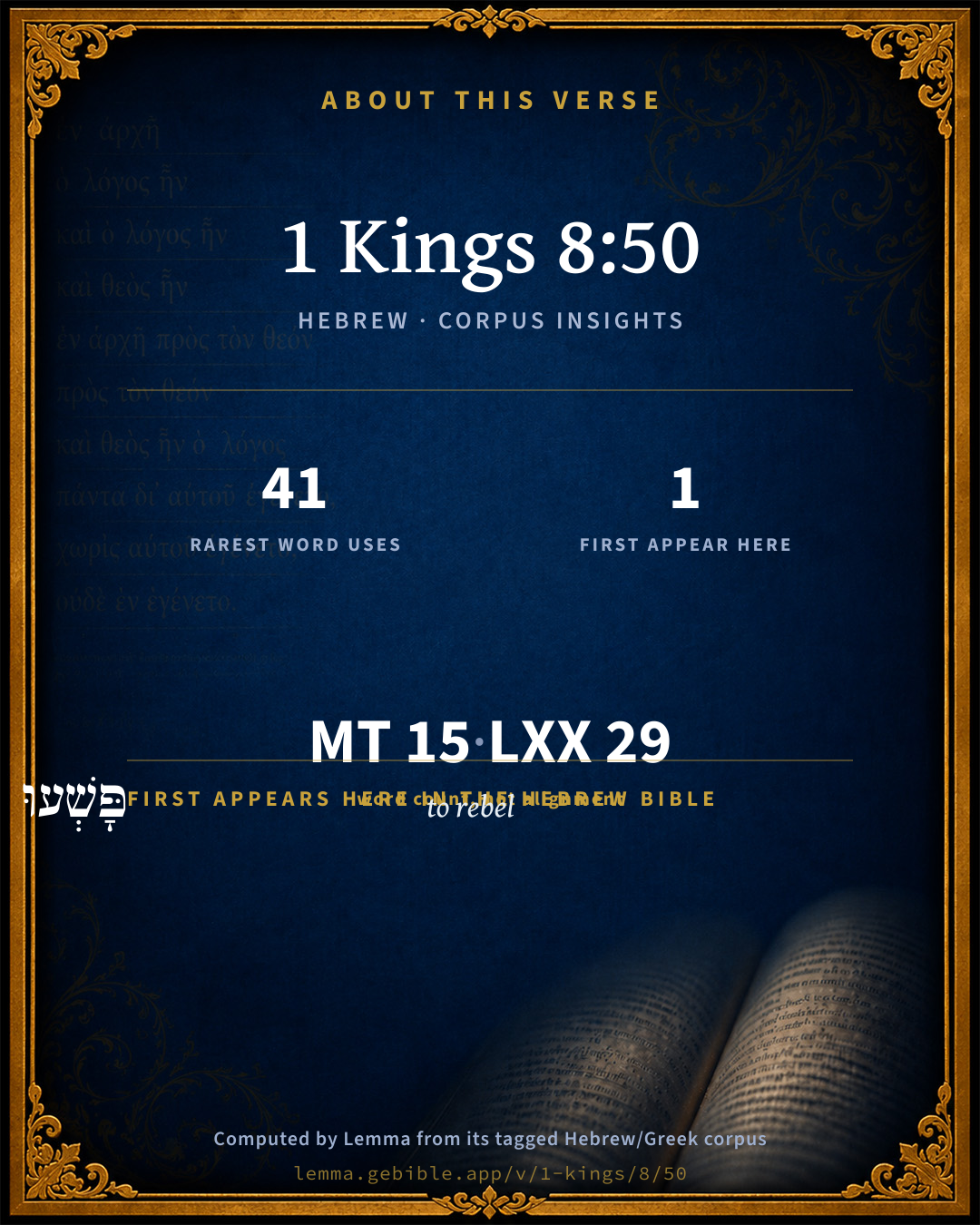
15
words
12
distinct lemmas
Historical
section

First appearance in Scripture

This word makes its first canonical appearance in the Hebrew Bible here:

  • פָּשְׁעוּ to rebel H6586

Shared distinctive vocabulary

פָּשְׁעוּ to rebel H6586 occurs in 37 verses of the Hebrew Bible. Also found in:

Grammatical profile

  • 6 verbs
  • 5 nouns
  • 2 prepositions
  • 2 particles

Verb forms

  • וְסָלַחְתָּ֤ Qal · Sequential Perfect
  • חָֽטְאוּ Qal · Perfect
  • פָּשְׁעוּ Qal · Perfect
  • וּנְתַתָּ֧ם Qal · Sequential Perfect
  • שֹׁבֵיהֶ֖ם Qal · Participle Active
  • וְרִֽחֲמֽוּם Piel · Sequential Perfect

Repetition

A word recurs within this verse — often emphatic in Hebrew:

  • אֲשֶׁ֣ר which H834 ×2

Hebrew & Septuagint length

In English translation the verse runs 37 words from the Hebrew and 47 from the Septuagint (LXX English) — closely comparable.

A rough comparison of the two English renderings, which tokenize alike — not a word-level alignment.

Word counts can differ between the Hebrew and the Greek without any difference in meaning — e.g. the Hebrew direct-object marker אֵת has no separate Greek word, and Greek often adds the article ὁ.

In the original languages it is 15 Hebrew tokens and 29 Greek tokens — but the two are counted differently (Hebrew bundles its prefixes and suffixes into one token; the Greek is in lemma form), so that isn’t a like-for-like length.

Cross-references

9

Topical passages linked to 1 Kings 8:50 in the Treasury of Scripture Knowledge — connected by theme and wording, ordered by reader-vote popularity; previews shown in the World English Bible.

  • Psalms 106:46 He made them also to be pitied By all those who carried them captive.
  • 2 Chronicles 30:9 For if you turn again to Yahweh, your brothers and your children shall find compassion before those who led them captive, and shall come again into this land: for Yahweh your God is gracious and merciful, and will not turn away his face from you, if you return to him.
  • Acts 7:10 and delivered him out of all his afflictions, and gave him favor and wisdom before Pharaoh, king of Egypt. He made him governor over Egypt and all his house.
  • Ezra 7:6 this Ezra went up from Babylon: and he was a ready scribe in the law of Moses, which Yahweh, the God of Israel, had given; and the king granted him all his request, according to the hand of Yahweh his God on him.
  • Ezra 7:27–28 Blessed be Yahweh, the God of our fathers, who has put such a thing as this in the king's heart, to beautify the house of Yahweh which is in Jerusalem;
  • Nehemiah 1:11 Lord, I beg you, let now your ear be attentive to the prayer of your servant, and to the prayer of your servants, who delight to fear your name; and please prosper your servant this day, and grant him mercy in the sight of this man. Now I was cup bearer to the king.
  • Nehemiah 2:4–8 Then the king said to me, For what do you make request? So I prayed to the God of heaven.
  • Proverbs 16:7 When a man's ways please Yahweh, He makes even his enemies to be at peace with him.
  • Daniel 1:9–10 Now God made Daniel to find kindness and compassion in the sight of the prince of the eunuchs.

Cross-references courtesy of OpenBible.info (CC BY 4.0).

Hebrew and Greek witnesses Masoretic Hebrew ↔ Greek Septuagint

The same verse in the two great witnesses to the Old Testament, shown verse-for-verse.

These are two independent witnesses, not word-aligned to each other, and the Septuagint is shown in lemma (dictionary) form.

Hebrew 1 Kings 8:50 Masoretic · Westminster Leningrad Codex

וְסָלַחְתָּ֤ לְעַמְּךָ֙ אֲשֶׁ֣ר חָֽטְאוּ לָ֔ךְ וּלְכָל פִּשְׁעֵיהֶ֖ם אֲשֶׁ֣ר פָּשְׁעוּ בָ֑ךְ וּנְתַתָּ֧ם לְרַחֲמִ֛ים לִפְנֵ֥י שֹׁבֵיהֶ֖ם וְרִֽחֲמֽוּם

and forgive your people who have sinned against you, and all their transgressions in which they have transgressed against you; and give them compassion before those who carried them captive, that they may have compassion on them

World English Bible · Public Domain

Greek LXX 1 Kings 8:50 Septuagint · lemma form

καί ἵλεως εἰμί ὁ ἀδικία αὐτός ὅς ἁμαρτάνω σύ καί κατά πᾶς ὁ ἀθέτημα αὐτός ὅς ἀθετέω σύ καί δίδωμι αὐτός εἰς οἰκτιρμός ἐνώπιον αἰχμαλωτεύω αὐτός καί οἰκτείρω αὐτός

and you shall be merciful to their unrighteousness wherein they have trespassed against you, and according to all their transgressions wherewith they have transgressed against you, and you shall cause them to be pitied before them that carried them captives, and they shall have compassion on them:

LXX2012 (modern English Septuagint) · Public Domain

Hebrew: Westminster Leningrad Codex (CC BY 4.0). Greek: Septuagint (public domain); English from LXX2012 (modern English Septuagint) (Public Domain). How the Septuagint differs from the Hebrew →

Targum (Aramaic paraphrase)

1

The Targum is the ancient Jewish Aramaic paraphrase of the Hebrew Scriptures — an interpretive translation, not the Hebrew text itself. Onkelos (literal) and Pseudo-Jonathan (expansive) render the Torah, and Jonathan the Prophets. Coverage is partial: where no permissively-licensed English translation exists for a verse, only the Aramaic is shown. This is verse-level text, not a word-by-word alignment to the Hebrew.

  1. Targum Jonathan Prophets (Joshua–Malachi)
    וְתִשְׁבּוֹק לְעַמָךְ דְחָבוּ קֳדָמָךְ וּלְכָל מְרָדֵיהוֹן דִי מְרָדוּ בָּךְ וּבְמֵימְרָךְ וְתִתְּנֵינוּן לְרַחֲמִין קֳדָם שׁוֹבֵיהוֹן וִירַחֲמוּן עֲלֵיהוֹן:

    (no public-domain English translation for this verse)

    Targum Jonathan — Aramaic: “Mikraot Gedolot” (public domain). English: “Sefaria Community Translation” (CC0 1.0 (public-domain dedication)); “London "Chaldee Paraphrase," 1871” (public domain). Text via Sefaria.

Commentary

Notes on 1 Kings 8:50 from classic Christian and Jewish commentators (each source and its license shown beneath its notes). The classic Christian expositions comment on the surrounding passage and are grouped to its opening verse, so a note may address several verses; the Jewish commentaries on the Tanakh (Rashi and others) are per-verse, so they appear only where the commentator wrote on this verse.

Lemma curates 59 commentaries, every one of them public domain or Creative Commons licensed, each selected and text-cleaned for this edition rather than reprinted as found. About our sources →

Trapp's Complete Commentary

John Trapp

1Ki 8:50 And forgive thy people that have sinned against thee, and all their transgressions wherein they have transgressed against thee, and give them compassion before them who carried them captive, that they may have compassion on them:

Ver. 50. And give them compassion.] This prayer was answered for the good of God’s poor people in Babylon, where they found much favour, and had at length leave to return; like as Jacob’s prayer {Gen 43:14} was abundantly answered when Joseph fell upon Benjamin’s neck weeping, &c.

John Trapp, A Commentary or Exposition upon All the Books of the Old and New Testament (1647–1656) — public domain. Text from a community e-Sword module.

Joseph Benson's Commentary

1Ki 8:50-51. That they may have compassion on them — Treat them mercifully while they continue their slaves, and give them liberty to return to their own land. God has the hearts of all men in his hands, and, can, when he pleaseth, turn the strongest stream the contrary way, and cause those to pity his people, who have been their most cruel persecutors. For they be thy people — How much soever they may sin against thee, or suffer from men, yet still remember they are thy peculiar people, received into covenant with thee, and taken under thy care and protection. And thine inheritance — From whom, more than from any other nation, thy rent and tribute of glory arises. Which thou broughtest from the furnace of iron — From cruel bondage, and painful labours. For he compares Egypt to a furnace in which iron and other metals are melted, or which, being made of iron, is more hot and terrible than one of brick and stone, to signify the misery and torment which the Israelites endured there.

Joseph Benson's Commentary on the Old and New Testaments (1811–1818) — public domain. Text from a community e-Sword module.

Geneva Bible (1599)

Geneva Bible translators

He understood by faith, that God of enemies would make friends unto them that did convert unto him.

Geneva Bible (1599) marginal notes — public domain. Text via Bolls.life.

Adam Clarke's Commentary

Verse 50. And give them compassion before them who carried them captive] He does not pray that they may be delivered out of that captivity, but that their enemies may use them well; and that they may, as formerly, be kept a separate and distinct people.

Adam Clarke's Commentary on the Bible (1810–1826) — public domain. Text from a community e-Sword/MySword module.

Ellicott's Commentary for English Readers

(50) Forgive . . . and give them compassion This prayer was singularly fulfilled at the captivity of Judah in Babylon, though we hear of no such thing in relation to the captivity of the “lost tribes” of Israel in Assyria. We see this in the exceptional favour of Nebuchadnezzar and of the Ahasuerus of the Book of Esther to the Jews in Babylon; we see it still more in the greater boon of restoration granted them by Cyrus and Darius, and the Artaxerxes of the Book of Nehemiah. Like the whole course of the fortunes of the Jews in their subsequent dispersion, these things,—however they may be accounted for—are certainly unique in history.

A Bible Commentary for English Readers, edited by Charles John Ellicott (1878–1897) — public domain. Text from a community e-Sword module.

The Cambridge Bible for Schools and Colleges

gen. ed. J. J. S. Perowne

50. give them compassion] So God stirred up the heart of Cyrus to permit Israel to return from Babylon (Ezr_1:1).

The Cambridge Bible for Schools and Colleges (gen. ed. J. J. S. Perowne; Cambridge University Press, 1878–1918) — public domain. Text from a community e-Sword module.

John Gill's Exposition

For they be thy people, and thine inheritance,.... Whom the Lord had chosen above all people, to be a special people to him, and to be his portion and possession; see Deu 7:6.

which thou broughtest forth out of Egypt, from the midst of the furnace of iron; hard and cruel bondage in Egypt: See Gill on Deu 4:20.

John Gill's Exposition of the Whole Bible (1746–1763) — public domain (CC PDM 1.0). Text via the HelloAO Bible API.

Albert Barnes' Notes on the Bible

Compassion ... - Not merely such compassion as Evil-Merodach showed toward Jehoiachin 2Ki 25:27-30; Jer 52:31-34, but such as Cyrus and Artaxerxes showed in allowing the captive Jews to return to their own land Ezr 1:3; Neh 2:6.

Albert Barnes' Notes on the Bible (1834–1885) — public domain. Text from a community e-Sword/MySword module.

Matthew Poole's English Annotations

i.e. May gently use them whilst they are there, and proclaim liberty to their captives to go to their own land.

Matthew Poole's English Annotations on the Holy Bible (1683–1685) — public domain. Text from a community e-Sword/MySword module.

The Pulpit Commentary

And forgive thy people that have sinned against thee, and all their transgressions wherein they have transgressed against thee, and give them compassion Heb. to compassion or bowels = tagcna, 2Co_6:12 Php_1:8 2:1, etc. before them who carried them captive, that they may have compassion on them. For the fulfilment of this prayer, (see Ezr_1:3, 7 6:13 Neh_2:6. Compare Psa_106:46)

In the three following verses we have a sort of general conclusion to the dedication prayer. It is hardly correct to say that these last words apply to all the preceding petitions the plea "they are thy people" manifestly cannot apply in the case of vers. 41-43. On the other hand, as little are they to be limited to the persons last mentioned in vers. 46-50, though it is highly probable they were suggested by the thought of the captives. They are manifestly in close connection with the preceding verses.

The Pulpit Commentary (1880–1919), ed. H.D.M. Spence-Jones & Joseph S. Exell — public domain. Text from a community e-Sword module.

Lesson kit

Teaching starters — assembled from the data on this page, not authored interpretation. Every prompt links to the verse data it draws on. Edit before teaching.

1 Kings, in the Historical, opens this verse with 15 words (12 distinct Hebrew lemmas). Its most distinctive word is pâshaʻ (“to rebel”). A historical commentator’s framing appears above. Read the whole chapter for the surrounding context.

Discussion questions

  1. The word pâshaʻ carries the sense “to rebel.” How does it shape the verse?
  2. The word “to rebel” first appears here in Scripture. What is being introduced at this debut?
  3. 1 Kings 12:19 shares the word «to rebel» with this verse. How do the two illuminate each other?
  4. “which” occurs 2× in this one verse. What is the effect of the repetition?
  5. These translations render this verse differently; the difference is in the English rendering, not the original. What questions does that raise?
  6. The verb «וְסָלַחְתָּ֤» is Qal Sequential Perfect. How does its form color the action?
  7. Reading how Trapp's Complete Commentary and Joseph Benson's Commentary read this verse, where do the two commentators agree and where do they part?

Things to notice

Reading settings

Reading text

Shown beneath each verse's original-language words.

Old Testament
Old Testament edition

Read the OT as the Masoretic Hebrew (MT) or the Greek Septuagint (LXX).

English shown for the Greek Septuagint (in the Hebrew ↔ Greek comparison).

Comparing translations? Open the Compare panel on any verse page to stack up to four side by side.