
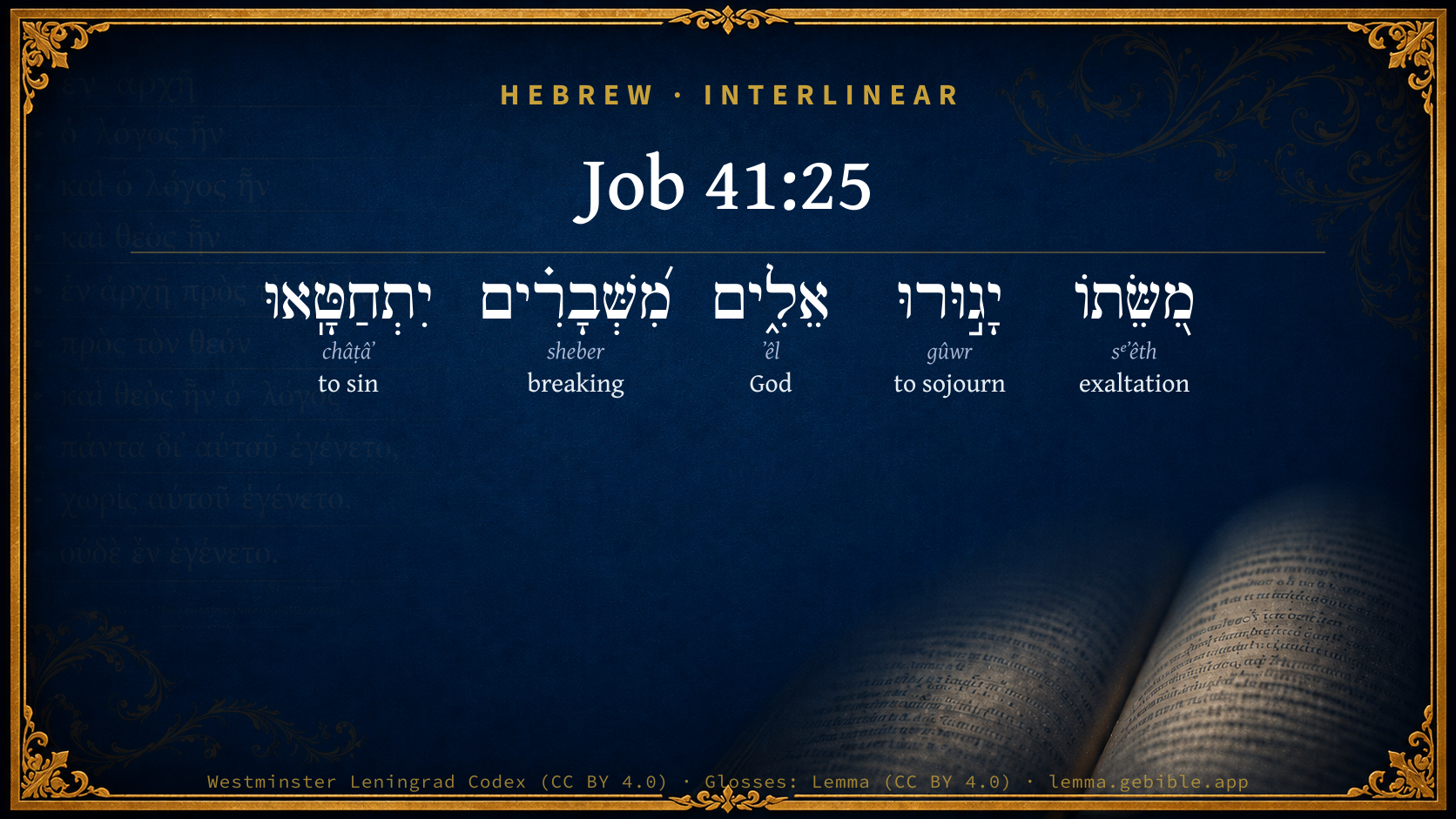
Job 41:25

Hebrew (Westminster Leningrad Codex) Job 41:25 appears in the Hebrew Old Testament. The text above is from the Westminster Leningrad Codex. Each word links to its Strong’s number, a concise gloss, and parsing drawn from the Open Scriptures Hebrew Bible morphology. Click any word for its full Brown-Driver-Briggs (BDB) entry.
Download image
Cite this verse

Job 41:25 (World English Bible). Public Domain. Lemma interlinear Bible study tool, https://lemma.gebible.app/v/job/41/25.

Show BibTeX & RIS
BibTeX
RIS
English Translation
When he raises himself up, the mighty are afraid. They retreat before his thrashing.
World English Bible · Public Domain
Download a study sheet

One document with this verse’s original text, its word-by-word gloss line, the meaning frame, cross-references with their text, attributed commentary, and full source and license credits — printable, and it pastes into notes with its structure intact.

This verse Autodidact and up

Study sheet (.html) Plain text (.txt)

A passage Seminary Student

Up to 50 verses in one chapter. A passage sheet keeps up to 6 commentary sources and 12 cross-references per verse, in the order this page ranks them, and says so on the sheet whenever that leaves anything out. Ask for a single verse and you get the Autodidact verse sheet above.

Everything on this page stays free to read, with no account — the sheet is a download of what is already on screen, not access to it.

Want to remove ads? Support Godless Engineer
Compare translations 3

The same verse in 3 English versions, stacked beneath the original-language interlinear above. Click any original word for its lexicon entry.

Each is an independent rendering of the whole verse — the interlinear is not word-aligned to these translations.

Highlighted words mark where these versions differ — a whole-verse word diff, not a word-by-word alignment.

  • World English Bible Public Domain
    When he raises himself up, the mighty are afraid. They retreat before his thrashing.
  • King James Version Public Domain
    When he raiseth up himself, the mighty are afraid: by reason of breakings they purify themselves.
  • unfoldingWord Literal Text CC BY-SA 4.0
    At its rising, the mighty fear; from its thrashings, they withdraw.

unfoldingWord Literal Text — © unfoldingWord, licensed CC BY-SA 4.0. Word-aligned USFM3 via Door43 (git.door43.org/unfoldingWord/en_ult).

Versions to compare (up to 4)

3 of 4 selected

Show all 18 translations

Every available English version of this verse, each an independent rendering of the whole verse.

  • World English Bible Public Domain
    When he raises himself up, the mighty are afraid. They retreat before his thrashing.
  • Berean Standard Bible Public Domain
    When Leviathan rises up, the mighty are terrified; they withdraw before his thrashing.
  • Majority Standard Bible Public Domain
    When Leviathan rises up, the mighty are terrified; they withdraw before his thrashing.
  • King James Version Public Domain
    When he raiseth up himself, the mighty are afraid: by reason of breakings they purify themselves.
  • American Standard Version (1901) Public Domain
    When he raiseth himself up, the mighty are afraid: By reason of consternation they are beside themselves.
  • Revised Version (1885) Public Domain
    When he raiseth himself up, the mighty are afraid: by reason of consternation they are beside themselves.
  • Geneva Bible (1599) Public Domain
    He beholdeth al hie things: he is a King ouer all the children of pride.
  • Douay-Rheims (1899) Public Domain
    He beholdeth every high thing, he is king over all the children of pride.
  • Young's Literal Translation Public Domain
    From his rising are the mighty afraid, From breakings they keep themselves free.
  • Literal Standard Version CC BY-SA 4.0
    The mighty are afraid at his rising, || From his breakings they keep themselves free.
  • Unlocked Literal Bible CC BY-SA 4.0
    When he raises himself up, even the gods become afraid; because of fear, they draw back.
  • unfoldingWord Literal Text CC BY-SA 4.0
    At its rising, the mighty fear; from its thrashings, they withdraw.
  • Darby Bible Public Domain
    When he raiseth himself up, the mighty are afraid: they are beside themselves with consternation.
  • World Messianic Bible Public Domain
    When he raises himself up, the mighty are afraid. They retreat before his thrashing.
  • Webster's Bible Public Domain
    \\41:34\\He beholdeth all high things: he is a king over all the children of pride.
  • Free Bible Version CC BY-SA 4.0
    When it rises, even the powerful are terrified; they retreat as it thrashes about.
  • Bible in Basic English Public Domain
    Everything which is high goes in fear of him; he is king over all the sons of pride.
  • JPS Tanakh (1917) Public Domain
    (41-17) When he raiseth himself up, the mighty are afraid; by reason of despair they are beside themselves.

Literal Standard Version (2020), Covenant Press — licensed CC BY-SA 4.0. Text via the HelloAO Bible API (eBible.org). Unlocked Literal Bible (unfoldingWord) — licensed CC BY-SA 4.0. Text via the HelloAO Bible API (eBible.org). unfoldingWord Literal Text — © unfoldingWord, licensed CC BY-SA 4.0. Word-aligned USFM3 via Door43 (git.door43.org/unfoldingWord/en_ult). Free Bible Version, Dr. Jonathan Gallagher — licensed CC BY-SA 4.0. Text via the HelloAO Bible API (eBible.org).

Word by word

More ways to search: Search by grammar → Find every occurrence → Compare this word →

Practice this passage: Drill this verse → Learn its vocabulary →

About this verse

These counts appear in no published source. They are computed here, from the morphology-tagged text and Lemma’s own curated glosses. What Lemma adds →

5
words
5
distinct lemmas
Wisdom
section

Notable vocabulary

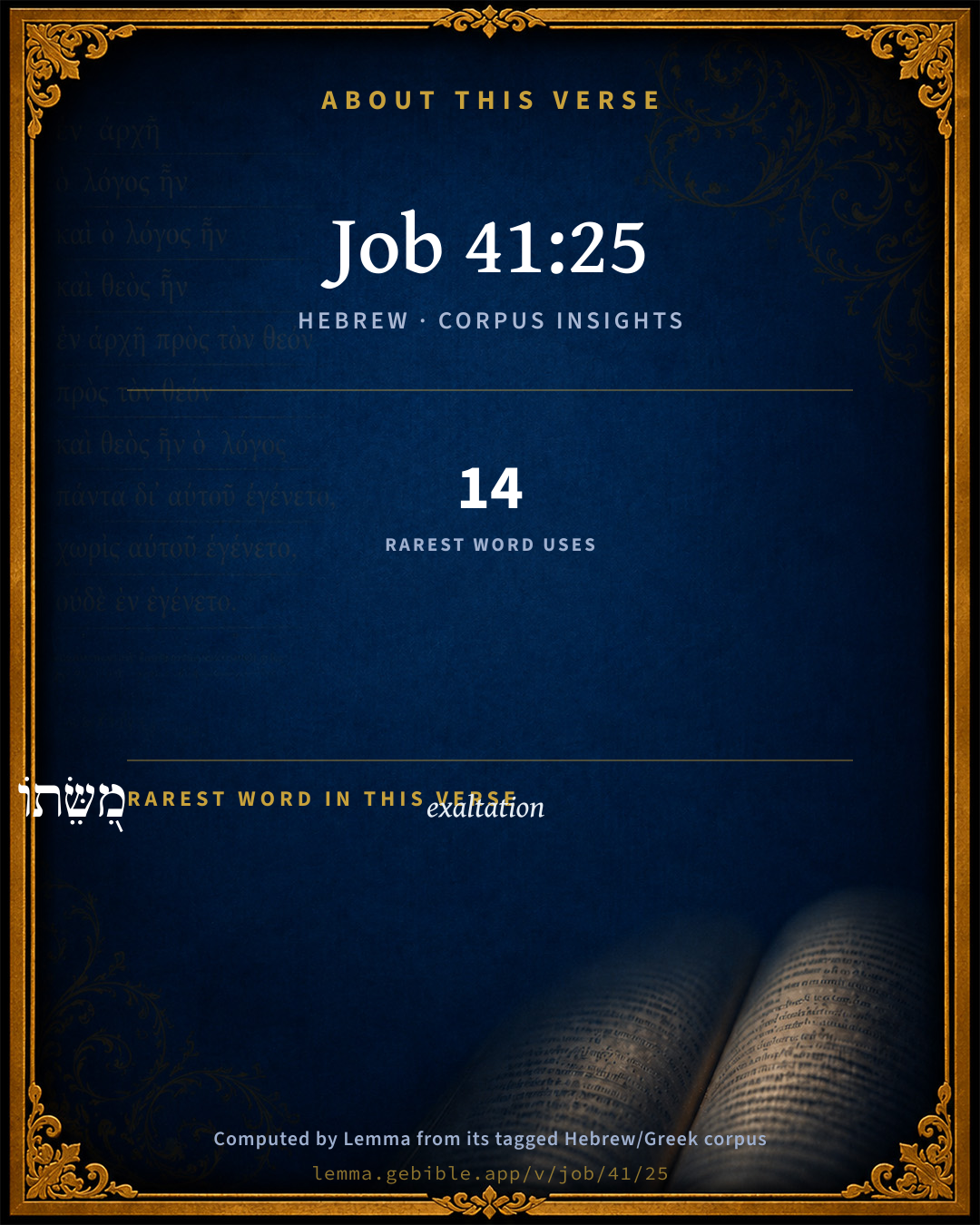
The rarest word here is מִ֭שֵּׂתוֹ exaltation H7613 — appearing just 14 times in the whole Hebrew Bible.

Shared distinctive vocabulary

מִ֭שֵּׂתוֹ exaltation H7613 occurs in 13 verses of the Hebrew Bible. Also found in:

Grammatical profile

  • 2 verbs
  • 3 nouns

Verb forms

  • יָג֣וּרוּ Qal · Imperfect
  • יִתְחַטָּֽאוּ Hithpael · Imperfect

Hebrew & Septuagint length

In English translation the verse runs 14 words from the Hebrew and 16 from the Septuagint (LXX English) — closely comparable.

A rough comparison of the two English renderings, which tokenize alike — not a word-level alignment.

Word counts can differ between the Hebrew and the Greek without any difference in meaning — e.g. the Hebrew direct-object marker אֵת has no separate Greek word, and Greek often adds the article ὁ.

Cross-references

2

Topical passages linked to Job 41:25 in the Treasury of Scripture Knowledge — connected by theme and wording, ordered by reader-vote popularity; previews shown in the World English Bible.

  • Psalms 107:28 Then they cry to Yahweh in their trouble, And he brings them out of their distress.
  • Jonah 1:4–6 But Yahweh sent out a great wind on the sea, and there was a mighty tempest on the sea, so that the ship was likely to break up.

Cross-references courtesy of OpenBible.info (CC BY 4.0).

Hebrew and Greek witnesses Masoretic Hebrew ↔ Greek Septuagint

The same verse in the two great witnesses to the Old Testament, shown verse-for-verse.

These are two independent witnesses, not word-aligned to each other, and the Septuagint is shown in lemma (dictionary) form.

Hebrew Job 41:25 Masoretic · Westminster Leningrad Codex

מִ֭שֵּׂתוֹ יָג֣וּרוּ אֵלִ֑ים מִ֝שְּׁבָרִ֗ים יִתְחַטָּֽאוּ

When he raises himself up, the mighty are afraid. They retreat before his thrashing.

World English Bible · Public Domain

Greek LXX Job 41:25 Septuagint · lemma form

οὐ εἰμί οὐδείς ἐπί ὁ γῆ ὅμοιος αὐτός ποιέω ἐν καταπαίζω ὑπό ὁ ἄγγελος ἐγώ

He beholds every high thing: and he is king of all that are in the waters.

LXX2012 (modern English Septuagint) · Public Domain

On this verse, Adam Clarke's Commentary discusses the Septuagint’s reading. Read the note in Commentary ↓

Hebrew: Westminster Leningrad Codex (CC BY 4.0). Greek: Septuagint (public domain); English from LXX2012 (modern English Septuagint) (Public Domain). How the Septuagint differs from the Hebrew →

Commentary

Notes on Job 41:25 from classic Christian and Jewish commentators (each source and its license shown beneath its notes). The classic Christian expositions comment on the surrounding passage and are grouped to its opening verse, so a note may address several verses; the Jewish commentaries on the Tanakh (Rashi and others) are per-verse, so they appear only where the commentator wrote on this verse.

Lemma curates 59 commentaries, every one of them public domain or Creative Commons licensed, each selected and text-cleaned for this edition rather than reprinted as found. About our sources →

Trapp's Complete Commentary

John Trapp

Job 41:25 When he raiseth up himself, the mighty are afraid: by reason of breakings they purify themselves.

Ver. 25. When he raiselh up himself, the mighty are afraid] When he shows himself like some moving mountain upon the surface of the water, the most assured pilots or passengers are seized with fear of death, and seek to make peace with God, as those mariners did, Jon 1:5-6, &c.

By reason of breakings] Broughton reads, of shiverings.

They purify themselves] Expiant se, they beg pardon of sin, and prepare to die. Others render it aberrant, they are dispirited; and know not what course to take. Others again, they purge downwards; their retentive faculty being weakened with fear, they let go their excrements; as Loper the traitor did, when he was upon his trial before the lords of the council; and as God somewhere in Ezekiel threateneth his rebels, that for fear of his displeasure they shall not be able to hold their water.

John Trapp, A Commentary or Exposition upon All the Books of the Old and New Testament (1647–1656) — public domain. Text from a community e-Sword module.

Joseph Benson's Commentary

Job 41:25. When he raiseth up himself — Showing himself upon the top of the waters; the mighty are afraid — Even the stout-hearted, who used to be above fear. By reason of breakings — By reason of their great danger and distress; which is expressed by this very word, Psa 60:2; Jon 1:4. They purify themselves — Those who ordinarily live in the neglect of God; they cry unto God in their trouble, and endeavour to purge their consciences from the guilt of their sins. Houbigant translates this verse, When he raiseth up himself, the mighty flee; the princes quit their purposed journey. But Heath interprets the last clause thus: for very terror they fall to the ground; and he observes, very properly, that the word

שׁבר, sheber, here used, strongly expresses the idea of terror; our English word shiver is thought to have been derived from it. Henry, who understands this, and all the other parts of this description, of the whale, thus paraphrases this verse: “When he raiseth up himself, like a moving mountain in the great waters, even the mighty are afraid, lest he overturn their ships, or do them some other mischief: by reason of the breakings he makes in the water, which threaten death, they purify themselves, confess their sins, betake themselves to their prayers, and get ready for death.” Dr. Young, who understands it of the crocodile, to which it is manifestly more applicable, interprets it thus:

“When late awaked, he rears him from the floods,

And stretching forth his stature to the clouds,

Writhes in the sun aloft his scaly height,

And strikes the distant hills with transient light;

Far round are fatal damps of terror spread,

The mighty fear, nor blush to own their dread.”

Joseph Benson's Commentary on the Old and New Testaments (1811–1818) — public domain. Text from a community e-Sword module.

Geneva Bible (1599)

Geneva Bible translators

He despiseth all other beasts and monsters, and is the proudest of all others.

Geneva Bible (1599) marginal notes — public domain. Text via Bolls.life.

Jamieson, Fausset & Brown

Robert Jamieson, A. R. Fausset & David Brown

he--the crocodile; a type of the awe which the Creator inspires when He rises in wrath.

breakings--namely, of the mind, that is, terror.

purify themselves--rather, "they wander from the way," that is, flee away bewildered [MAURER and UMBREIT].

Jamieson, Fausset & Brown — Commentary Critical and Explanatory on the Whole Bible (1871) — public domain (CC PDM 1.0). Text via the HelloAO Bible API.

Adam Clarke's Commentary

Verse 25. By reason of breakings they purify themselves.] No version, either ancient or modern, appears to have understood this verse; nor is its true sense known. The Septuagint have, "When he turns himself, he terrifies all the quadrupeds on the earth." The original is short and obscure: משברים יתחטאו mishshebarim yithchattau. Mr. Good takes the plural termination ים im, from the first word, of which he makes the noun ים yam, the sea, and thus translates it, "They are confounded at the tumult of the sea." In this I can find no more light than in our own. Mr. Heath has, "For very terror they fall to the ground." The translations of it are as unsatisfactory as they are various. I shall give both the verses from Coverdale: -

His herte is as harde as a stone; and as fast as the stythye (anvil) that the hammer man smyteth upon: when he goeth the mightiest off all are afrayed, and the waives hevy. The dull swell in the waters proclaims his advance; and when this is perceived, the stout-hearted tremble.

Adam Clarke's Commentary on the Bible (1810–1826) — public domain. Text from a community e-Sword/MySword module.

Ellicott's Commentary for English Readers

(25) By reason of breakings—i.e., the waves he makes in the water, or the breakings he makes among the plants and trees in the water.

They purify themselves—i.e., they are beside themselves; they are so overwhelmed with terror, that they take themselves off, as those who have to dwell apart for uncleanness.

A Bible Commentary for English Readers, edited by Charles John Ellicott (1878–1897) — public domain. Text from a community e-Sword module.

The Cambridge Bible for Schools and Colleges

gen. ed. J. J. S. Perowne

25. With his “firmness” of heart there naturally goes a corresponding courage and fierceness.

by reason of breakings] Rather, by reason of terrors they are beside themselves; lit. they lose themselves. The Geneva has: for fear they faint in themselves. The expression “lose themselves” seems more naturally said of mental confusion from terror, than of literally losing their way in their attempts to escape (Gesen.).

The Cambridge Bible for Schools and Colleges (gen. ed. J. J. S. Perowne; Cambridge University Press, 1878–1918) — public domain. Text from a community e-Sword module.

John Gill's Exposition

The sword of him that layeth at him cannot hold,.... It is either broken by striking at him, or however cannot pierce him and stick in him; but since a sword is not used in fishery, rather the harpagon or harpoon may be meant, which cannot enter into the crocodile, being so fenced with scales; but the whale being struck with it, it enters deep into his flesh, and is wounded by it; wherefore this and what follows in the next verses seems best to agree with the crocodile, or some other fish;

the spear, the dart, nor the habergeon; that is, neither of these can fasten upon him or enter into him: and yet it is certain that the whale, after he has been struck and wounded by the harping-iron, men approach nearer to him and thrust a long steeled lance or spear under his gills into his breast, and through the intestines, which dispatches him: darts are not made use of in the whale fishery; and as for crocodiles, as Peter Martyr says (c), they are not to be pierced with darts: the habergeon, or coat of mail, being a defensive piece of armour, seems not to be designed, as being never used in taking such creatures; rather therefore a javelin or hand dart may be intended; since, as Bochart observes, in the Arabic language such an one is expressed by this word.

(c) Apud Bochart. Hierozoic. par. 2. l. 5. c. 17. col. 785.

John Gill's Exposition of the Whole Bible (1746–1763) — public domain (CC PDM 1.0). Text via the HelloAO Bible API.

Albert Barnes' Notes on the Bible

When he raiseth up himself - When he rouses himself for an attack or in self-defense.

The mighty are afraid - The Vulgate renders this “anqels.” The meaning is, that he produces alarm on those who are unaccustomed to fear.

By reason of breakings they purify themselves - This, though a literal translation, conveys no very clear idea, and this rendering is not necessary. The word rendered “breakings” (שׁבר sheber) means properly “a breaking, breach, puncture”; “a breaking down, destruction”; and then it may mean “a breaking down of the mind, that is, terror.” This is evidently the meaning here. “By reason of the prostration of their courage, or the crushing of the mind by alarm.” The word rendered “purify themselves” (חטא châṭâ') means in the Qal, “to miss,” as a mark; “to sin; to err.” In the form of Hithpael, which occurs here, it means to miss one’s way; “to lose oneself;” and it may refer to the astonishment and terror by which one is led to miss his way in precipitate flight. “Gesenius.” The meaning then is, “They lose themselves from terror.” They know not where to turn themselves; they flee away with alarm; see Rosenmuller in loc.

Albert Barnes' Notes on the Bible (1834–1885) — public domain. Text from a community e-Sword/MySword module.

Haydock's Catholic Bible Commentary

He is king, &c. He is superior in strength to all that are great and strong amongst living creatures: mystically it is understood of the devil, who is king over all the proud. (Challoner) (St. Gregory xxxiv. 4., and 17.) (Worthington) --- Hence Job perceived that God has also now permitted this cruel foe to exercise a dominion over him, and to pull him from his high station, though innocent. (Haydock) --- This would henceforward be more frequently the order of Providence, and therefore he expresses his entire resignation, chap. xlii. (Houbigant) --- Pride: the strongest and fiercest animals. (Haydock) --- The crocodile has been seen encountering even the elephant, and gaining the victory. He is king of all fishes. Septuagint, "of all in the waters." Chaldean, "of all the sons of the mountains:" or Theodotion, "of arrogance." This may particularly denote the Egyptians, as the crocodile was one of their gods; and people are often styled after them, Numbers xxi. 29., and Jeremias xlviii. 46. (Calmet) --- Pharao even means "a crocodile," in Arabic. (Bochart, Anim. p. ii. b. v. 16.) --- He is styled simply, the proud, Psalm lxxxviii. 11. (Calmet) --- The pride of the Egyptians was notorious, Ezechiel xxxii. 12. (Calmet)

George Leo Haydock (1774–1849), Haydock's Catholic Family Bible and Commentary, 1859 edition — public domain. Excludes Psalms (Douay-Rheims chapter numbering differs from Protestant) and Deuterocanonical books (Catholic canon only).

Matthew Poole's English Annotations

When he raiseth up himself; showing himself upon the top of the waters. Or, because of his height, or greatness, or majesty; for he is represented as a king, Job 41:31. The mighty; even the stout-hearted mariners or passengers, who use to be above fear.

By reason of breakings; either,

1. Of the sea, caused by his motion, which dasheth the waves in pieces one against another. Or rather,

2. Of their mind and state; by reason of their great danger and distress; which is expressed by this very word, Psa 60:2; Jon 2:4.

They purify themselves; either,

1. Naturally; that being, the usual effect of great terror. See Eze 7:17. Or rather,

2. Morally, as this word is generally used. Those mariners who ordinarily live in a gross and general neglect of God, and of religion, are so affrighted with this imminent danger, that they cry unto God in their trouble, as is said in like case, Psa 107:28, and endeavour to purge their consciences from the guilt of their sins, by confessing and seemingly forsaking of them, and to make their peace with God, and obtain his favour and help, by their vows, and promises, and prayers.

Matthew Poole's English Annotations on the Holy Bible (1683–1685) — public domain. Text from a community e-Sword/MySword module.

Whedon's Commentary on the Bible

Daniel D. Whedon

25. By reason of breakings — The word שׁברים, from shabar, (Arabic shabara,) “to break,” blends the twofold effect of fear — the breaking down of the nervous force, the morale of the man, and the confounding, the bewildering, of the judgment. Among Orientals terror is expressed by verbs of breaking, as Bochartus has observed.

They purify themselves — יתחשׂאו— The meaning of the hithpael form of the verb hhatah is not essentially different from the kal form, commented upon in Job_5:24, (which see,) and may be read, they miss their way; or, according to Delitzsch and Zockler, miss their aim, so confused are these “heroes” by reason of overpowering fear. The word is spoken, says Gesenius, of those who wander from the way, driven into precipitate flight by excessive terror. (Thes., 465.) Like our own translators, who mystified the passage by rendering the word hhatah “purify,” Hengstenberg adopts this secondary meaning of “absolving,” and thinks that in their great fear they betake themselves to God as their only hope, “in other words, repeat a pater noster.” “Absolution (he says) is the means of obtaining help from God.” His views may serve as a gloss upon our Authorized Version, but will not help toward the interpretation of the passage.

Daniel D. Whedon (gen. ed.), Commentary on the Old and New Testaments (1874–1909) — public domain. Text from a community e-Sword module.

The Pulpit Commentary

When he raiseth up himself, the mighty are afraid. Egyptian historians said that one of their early kings had been slain by a crocodile (Manetho ap. Euseb., "Chronicles Can.," pars 1:20, p. 98). The worship paid to crocodiles in some parts of Egypt, and the hatred felt towards them in others, were probably alike inspired by fear. Aelian says that, in the districts where crocodiles were worshipped, it was not safe for any one to wash his feet or to draw water at the river, and that in the vicinity of some towns people did not dare to walk along the bank of the stream ("Nat. An.," 10:24). In modern times they have been known to precipitate men from the bank into the water by a sweep of their tail, and then to devour them at their leisure. By reason of breakings they purify themselves; rather, they are confounded. The "breakings" may by either the breakings forth of the animal from his lair among the Nile rushes, or his "breaking" of the weapons of his assailants.

The Pulpit Commentary (1880–1919), ed. H.D.M. Spence-Jones & Joseph S. Exell — public domain. Text from a community e-Sword module.

John Wesley's Explanatory Notes

Raiseth - Upon the top of the waters. Mighty - Even the stout- hearted. Breakings - By reason of their great danger and distress; which is expressed by this very word, Psalm lx, 2 Jonah ii, 4. Purify - Those who ordinarily live in the neglect of God, they cry unto God in their trouble, and endeavour to purge their consciences from the guilt of their sins.

John Wesley, Explanatory Notes Upon the Whole Bible (1754–1765) — public domain. Text via the GEBible commentary corpus.

unfoldingWord translationNotes

Door43 World Missions Community

he ... himself ... him

The words "he," "himself," and "him" refer to Leviathan.

the gods

Possible meanings are 1) "mighty people" or 2) "very strong people" .

He thinks of iron as if it were straw

"He thinks of weapons made of iron as if they were weapons made of straw." Straw would not get through his hide, and iron weapons do not get through his hide. (See: Simile)

of bronze as if it were rotten wood

You can make this clear by adding the omitted words. AT: "he thinks of weapons made of bronze as if they were weapons made of rotten wood" (See: Ellipsis and Simile)

translationWords

raise

false god

sword

spear

bow and arrow

bronze

unfoldingWord translationNotes — © Distant Shores Media and the Door43 World Missions Community, licensed CC BY-SA 4.0. Source: git.door43.org/Door43/en_tn.

Rashi

Rabbi Shlomo Yitzchaki (Rashi)

On the dust there is none that rules over him The “mem” [is vowelized] with a “hataf kamatz,” and it means his rule, that no creature rules over him, and it is a noun denoting a ruler. Therefore, the “mem” is vowelized with a “hataf kamatz.”

which is made Heb. העשו, like העשוי [the passive participle]. However, I know of no similar case [in Scripture]. It means one that was made without fear or dismay, that is not afraid of the creatures, as it is stated concerning the horse (above 39:22): “He scorns fear and is not dismayed.”

Rashi on the Tanakh — English translations: “The Judaica Press complete Tanach with Rashi, translated by A. J. Rosenberg” (CC BY 4.0); “Pentateuch with Rashi's commentary by M. Rosenbaum and A.M. Silbermann, 1929-1934” (public domain); “The Metsudah Tanach series, Lakewood, N.J” (CC BY 4.0); and “The Book of Joshua, Metsudah Publications, 1997” (CC BY 4.0). Text via Sefaria.

Lesson kit

Teaching starters — assembled from the data on this page, not authored interpretation. Every prompt links to the verse data it draws on. Edit before teaching.

Job, in the Wisdom, opens this verse with 5 words (5 distinct Hebrew lemmas). Its most distinctive word is sᵉʼêth (“exaltation”). A historical commentator’s framing appears above. Read the whole chapter for the surrounding context.

Discussion questions

  1. How does “exaltation” (sᵉʼêth) shape what this verse is saying?
  2. How does Genesis 4:7, which shares the word «exaltation», read alongside this verse?
  3. The translations on this page render this verse differently — a whole-verse word diff, not a word-by-word alignment. What might account for the different wordings?
  4. «יָג֣וּרוּ» is a Qal Imperfect verb. How does that grammatical form shape the action described?
  5. Compare how Trapp's Complete Commentary and Joseph Benson's Commentary read this verse. Where do they agree or differ?

Things to notice

Reading settings

Reading text

Shown beneath each verse's original-language words.

Old Testament
Old Testament edition

Read the OT as the Masoretic Hebrew (MT) or the Greek Septuagint (LXX).

English shown for the Greek Septuagint (in the Hebrew ↔ Greek comparison).

Comparing translations? Open the Compare panel on any verse page to stack up to four side by side.