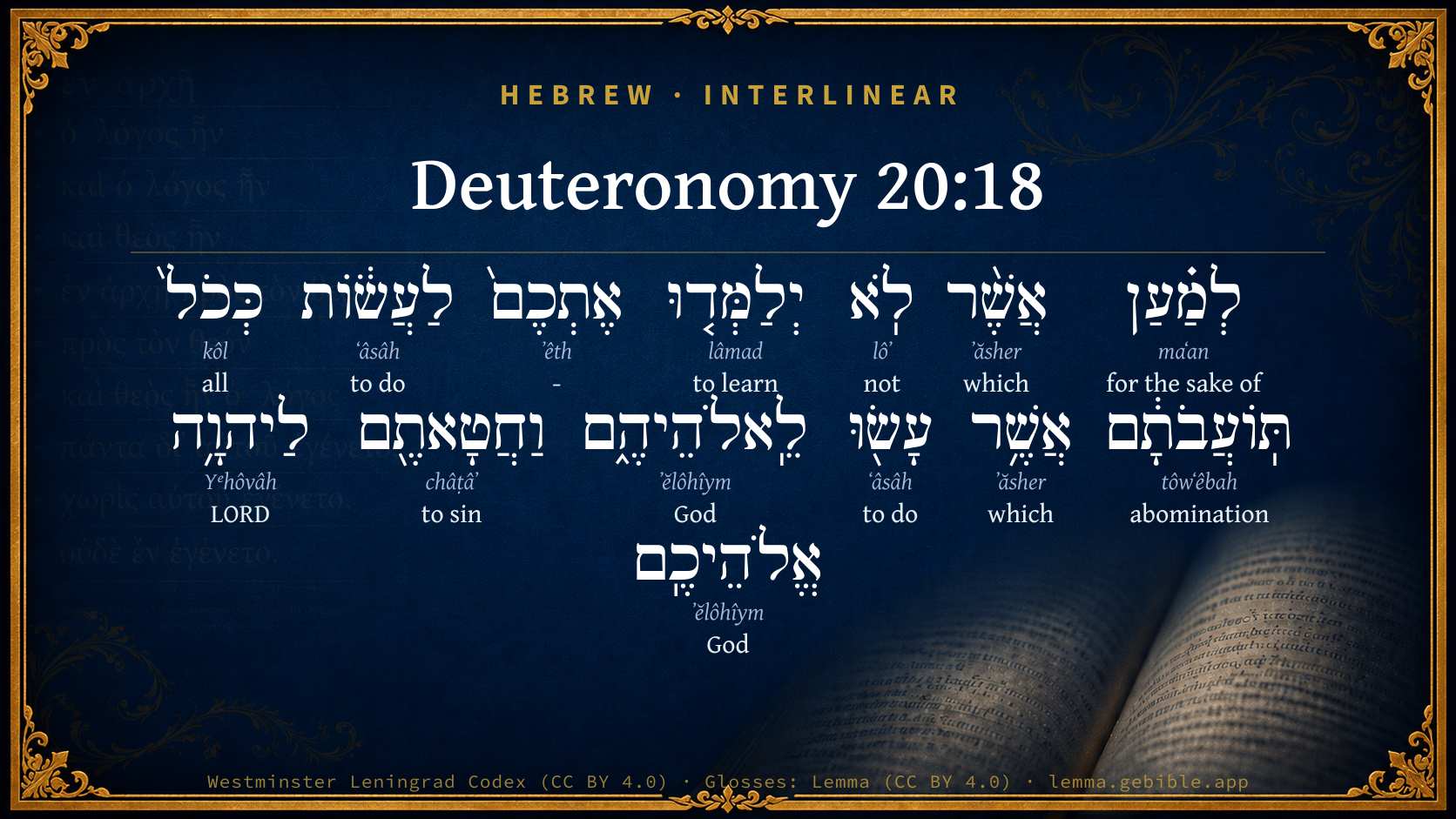
Deuteronomy 20:18

Hebrew (Westminster Leningrad Codex) Deuteronomy 20:18 appears in the Hebrew Old Testament. The text above is from the Westminster Leningrad Codex. Each word links to its Strong’s number, a concise gloss, and parsing drawn from the Open Scriptures Hebrew Bible morphology. Click any word for its full Brown-Driver-Briggs (BDB) entry.
Download image
Cite this verse

Deuteronomy 20:18 (World English Bible). Public Domain. Lemma interlinear Bible study tool, https://lemma.gebible.app/v/deuteronomy/20/18.

Show BibTeX & RIS
BibTeX
RIS
English Translation
that they not teach you to do after all their abominations, which they have done to their gods; so would you sin against Yahweh your God.
World English Bible · Public Domain
Download a study sheet

One document with this verse’s original text, its word-by-word gloss line, the meaning frame, cross-references with their text, attributed commentary, and full source and license credits — printable, and it pastes into notes with its structure intact.

This verse Autodidact and up

Study sheet (.html) Plain text (.txt)

A passage Seminary Student

Up to 50 verses in one chapter. A passage sheet keeps up to 6 commentary sources and 12 cross-references per verse, in the order this page ranks them, and says so on the sheet whenever that leaves anything out. Ask for a single verse and you get the Autodidact verse sheet above.

Everything on this page stays free to read, with no account — the sheet is a download of what is already on screen, not access to it.

Want to remove ads? Support Godless Engineer
Compare translations 3

The same verse in 3 English versions, stacked beneath the original-language interlinear above. Click any original word for its lexicon entry.

Each is an independent rendering of the whole verse — the interlinear is not word-aligned to these translations.

Highlighted words mark where these versions differ — a whole-verse word diff, not a word-by-word alignment.

  • World English Bible Public Domain
    that they not teach you to do after all their abominations, which they have done to their gods; so would you sin against Yahweh your God.
  • King James Version Public Domain
    That they teach you not to do after all their abominations, which they have done unto their gods; so should ye sin against the LORD your God.
  • unfoldingWord Literal Text CC BY-SA 4.0
    so that they do not teach you to do like any of their abominations that they do for their gods, for you will sin against Yahweh your God.

unfoldingWord Literal Text — © unfoldingWord, licensed CC BY-SA 4.0. Word-aligned USFM3 via Door43 (git.door43.org/unfoldingWord/en_ult).

Versions to compare (up to 4)

3 of 4 selected

Show all 18 translations

Every available English version of this verse, each an independent rendering of the whole verse.

  • World English Bible Public Domain
    that they not teach you to do after all their abominations, which they have done to their gods; so would you sin against Yahweh your God.
  • Berean Standard Bible Public Domain
    so that they cannot teach you to do all the detestable things they do for their gods, and so cause you to sin against the LORD your God.
  • Majority Standard Bible Public Domain
    so that they cannot teach you to do all the detestable things they do for their gods, and so cause you to sin against the LORD your God.
  • King James Version Public Domain
    That they teach you not to do after all their abominations, which they have done unto their gods; so should ye sin against the LORD your God.
  • American Standard Version (1901) Public Domain
    that they teach you not to do after all their abominations, which they have done unto their gods; so would ye sin against Jehovah your God.
  • Revised Version (1885) Public Domain
    that they teach you not to do after all their abominations, which they have done unto their gods; so should ye sin against the LORD your God.
  • Geneva Bible (1599) Public Domain
    That they teache you not to doe after all their abominations, which they haue done vnto their gods, and so ye should sinne against the Lord your God.
  • Douay-Rheims (1899) Public Domain
    Lest they teach you to do all the abominations which they have done to their gods: and you should sin against the Lord your God.
  • Young's Literal Translation Public Domain
    so that they teach you not to do according to all their abominations which they have done to their gods, and ye have sinned against Jehovah your God.
  • Literal Standard Version CC BY-SA 4.0
    so that they do not teach you to do according to all their abominations which they have done for their gods, and you have sinned against your God YHWH.
  • Unlocked Literal Bible CC BY-SA 4.0
    Do this so that they do not teach you to act in any of their abominable ways, as they have done with their gods. If you do, you will sin against Yahweh your God.
  • unfoldingWord Literal Text CC BY-SA 4.0
    so that they do not teach you to do like any of their abominations that they do for their gods, for you will sin against Yahweh your God.
  • Darby Bible Public Domain
    that they teach you not to do according to all their abominations, which they have done unto their gods, so that ye sin against Jehovah your God.
  • World Messianic Bible Public Domain
    that they not teach you to follow all their abominations, which they have done for their gods; so would you sin against the LORD your God.
  • Webster's Bible Public Domain
    That they may not teach you to do after all their abominations which they have done to their gods; so would ye sin against the LORD your God.
  • Free Bible Version CC BY-SA 4.0
    This is to prevent them from teaching you all the offensive things that they do in worshiping their gods, and by doing so make you sin against the Lord your God.
  • Bible in Basic English Public Domain
    So that you may not take them as your example and do all the disgusting things which they do in the worship of their gods, so sinning against the Lord your God.
  • JPS Tanakh (1917) Public Domain
    that they teach you not to do after all their abominations, which they have done unto their gods, and so ye sin against the LORD your God.

Literal Standard Version (2020), Covenant Press — licensed CC BY-SA 4.0. Text via the HelloAO Bible API (eBible.org). Unlocked Literal Bible (unfoldingWord) — licensed CC BY-SA 4.0. Text via the HelloAO Bible API (eBible.org). unfoldingWord Literal Text — © unfoldingWord, licensed CC BY-SA 4.0. Word-aligned USFM3 via Door43 (git.door43.org/unfoldingWord/en_ult). Free Bible Version, Dr. Jonathan Gallagher — licensed CC BY-SA 4.0. Text via the HelloAO Bible API (eBible.org).

Word by word

More ways to search: Search by grammar → Find every occurrence → Compare this word →

Practice this passage: Drill this verse → Learn its vocabulary →

יְלַמְּד֤וּ
lâmad
H3925
“to learn”
Verb, Piel, Imperfect, 3rd Person, Masculine, Plural
Part of Speech
Verb
Stem
Piel
Form
Imperfect
Person
3rd Person
Gender
Masculine
Number
Plural
Full BDB Definition

Origin: a primitive root

TWOT: 1116

to learn. teach, exercise in - (Qal) to learn - (Piel) to teach - (Pual) to be taught, be trained
  1. לְמַ֗עַן maʻan H4616 “for the sake of” Preposition
  2. אֲשֶׁ֨ר ʼăsher H834 “which” Particle, Relative
  3. לֹֽא lôʼ H3808 “not” Particle, Negative
  4. אֶתְכֶם֙ ʼêth H853 “- · you” Particle, Direct Object + Suffix, Personal, 2nd Person, Masculine, Plural
  5. לַעֲשׂ֔וֹת ʻâsâh H6213 “to do” Preposition + Verb, Qal, Infinitive Construct
  6. כְּכֹל֙ kôl H3605 “like/as · all of” Preposition + Noun, Common, Masculine, Singular, Construct
  7. תּֽוֹעֲבֹתָ֔ם tôwʻêbah H8441 “abominations · their” Noun, Common, Feminine, Plural, Construct + Suffix, Personal, 3rd Person, Masculine, Plural
  8. אֲשֶׁ֥ר ʼăsher H834 “which” Particle, Relative
  9. עָשׂ֖וּ ʻâsâh H6213 “to do” Verb, Qal, Perfect, 3rd Person, Common, Plural
  10. לֵֽאלֹהֵיהֶ֑ם ʼĕlôhîym H430 “to/for · God(s) · their” Preposition + Noun, Common, Masculine, Plural, Construct + Suffix, Personal, 3rd Person, Masculine, Plural
  11. וַחֲטָאתֶ֖ם châṭâʼ H2398 “and · to sin” Conjunction + Verb, Qal, Sequential Perfect, 2nd Person, Masculine, Plural
  12. לַיהוָ֥ה Yᵉhôvâh H3068 “to/for · LORD” Preposition + Noun, Proper
  13. אֱלֹהֵיכֶֽם ʼĕlôhîym H430 “God(s) · your” Noun, Common, Masculine, Plural, Construct + Suffix, Personal, 2nd Person, Masculine, Plural

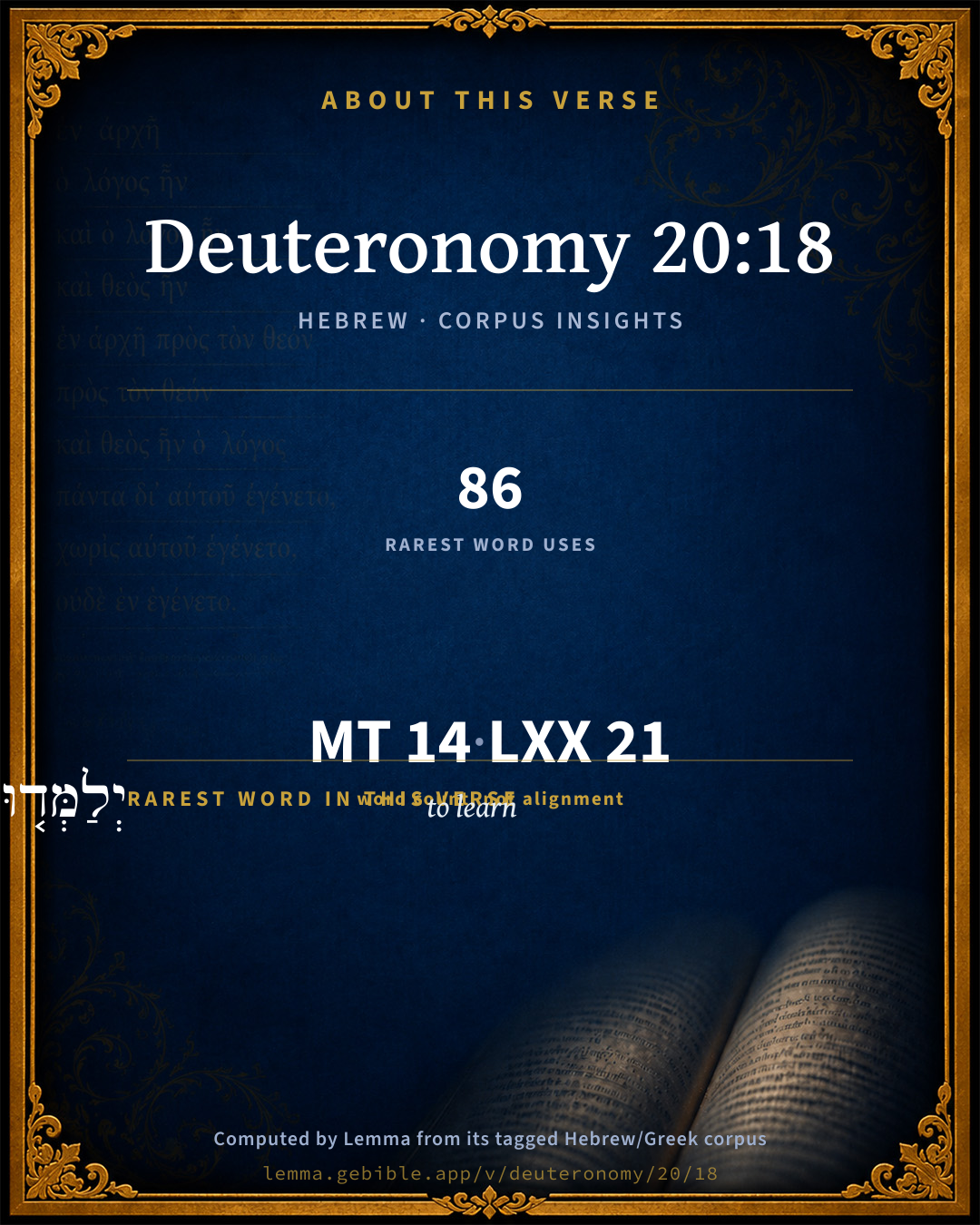
About this verse

These counts appear in no published source. They are computed here, from the morphology-tagged text and Lemma’s own curated glosses. What Lemma adds →

14
words
11
distinct lemmas
Pentateuch
section

Grammatical profile

  • 4 verbs
  • 5 nouns
  • 1 preposition
  • 4 particles

Verb forms

  • יְלַמְּד֤וּ Piel · Imperfect
  • לַעֲשׂ֔וֹת Qal · Infinitive Construct
  • עָשׂ֖וּ Qal · Perfect
  • וַחֲטָאתֶ֖ם Qal · Sequential Perfect

Repetition

Words recur within this verse — often emphatic in Hebrew:

  • לַעֲשׂ֔וֹת to do H6213 ×2
  • לֵֽאלֹהֵיהֶ֑ם God H430 ×2
  • אֲשֶׁ֨ר which H834 ×2

Hebrew & Septuagint length

In English translation the verse runs 26 words from the Hebrew and 27 from the Septuagint (LXX English) — closely comparable.

A rough comparison of the two English renderings, which tokenize alike — not a word-level alignment.

Word counts can differ between the Hebrew and the Greek without any difference in meaning — e.g. the Hebrew direct-object marker אֵת has no separate Greek word, and Greek often adds the article ὁ.

In the original languages it is 14 Hebrew tokens and 21 Greek tokens — but the two are counted differently (Hebrew bundles its prefixes and suffixes into one token; the Greek is in lemma form), so that isn’t a like-for-like length.

Cross-references

15

Topical passages linked to Deuteronomy 20:18 in the Treasury of Scripture Knowledge — connected by theme and wording, ordered by reader-vote popularity; previews shown in the World English Bible.

  • Deuteronomy 12:30–31 take heed to yourself that you not be ensnared to follow them, after that they are destroyed from before you; and that you not inquire after their gods, saying, How do these nations serve their gods? even so will I do likewise.
  • Exodus 23:33 They shall not dwell in your land, lest they make you sin against me, for if you serve their gods, it will surely be a snare to you."
  • Ephesians 5:11 Have no fellowship with the unfruitful works of darkness, but rather even reprove them.
  • Exodus 34:16 and you take of their daughters to your sons, and their daughters play the prostitute after their gods, and make your sons play the prostitute after their gods.
  • Deuteronomy 7:4–5 For he will turn away your son from following me, that they may serve other gods: so will the anger of Yahweh be kindled against you, and he will destroy you quickly.
  • Joshua 23:13 know for a certainty that Yahweh your God will no more drive these nations from out of your sight; but they shall be a snare and a trap to you, and a scourge in your sides, and thorns in your eyes, until you perish from off this good land which Yahweh your God has given you.
  • Psalms 106:34–40 They didn't destroy the peoples, As Yahweh commanded them,
  • 1 Corinthians 15:33 Don't be deceived! "Evil companionships corrupt good morals."
  • 2 Corinthians 6:17 Therefore, "'Come out from among them, And be separate,' says the Lord, 'Touch no unclean thing. I will receive you.
  • 2 Thessalonians 3:14 If any man doesn't obey our word in this letter, note that man, that you have no company with him, to the end that he may be ashamed.
  • Deuteronomy 18:19 It shall happen, that whoever will not listen to my words which he shall speak in my name, I will require it of him.
  • Judges 2:3 Therefore I also said, I will not drive them out from before you; but they shall be [as thorns] in your sides, and their gods shall be a snare to you.
  • 1 Timothy 6:5 constant friction of people of corrupt minds and destitute of the truth, who suppose that godliness is a means of gain. Withdraw yourself from such.
  • 2 Timothy 2:17–18 and their word will consume like gangrene, of whom is Hymenaeus and Philetus;
  • Revelation 18:3–5 For all the nations have drunk of the wine of the wrath of her sexual immorality, the kings of the earth committed sexual immorality with her, and the merchants of the earth grew rich from the abundance of her luxury."

Cross-references courtesy of OpenBible.info (CC BY 4.0).

Hebrew and Greek witnesses Masoretic Hebrew ↔ Greek Septuagint

The same verse in the two great witnesses to the Old Testament, shown verse-for-verse.

These are two independent witnesses, not word-aligned to each other, and the Septuagint is shown in lemma (dictionary) form.

Hebrew Deuteronomy 20:18 Masoretic · Westminster Leningrad Codex

לְמַ֗עַן אֲשֶׁ֨ר לֹֽא יְלַמְּד֤וּ אֶתְכֶם֙ לַעֲשׂ֔וֹת כְּכֹל֙ תּֽוֹעֲבֹתָ֔ם אֲשֶׁ֥ר עָשׂ֖וּ לֵֽאלֹהֵיהֶ֑ם וַחֲטָאתֶ֖ם לַיהוָ֥ה אֱלֹהֵיכֶֽם

that they not teach you to do after all their abominations, which they have done to their gods; so would you sin against Yahweh your God.

World English Bible · Public Domain

Greek LXX Deuteronomy 20:18 Septuagint · lemma form

ἵνα μή διδάσκω σύ ποιέω πᾶς ὁ βδέλυγμα αὐτός ὅσος ποιέω ὁ θεός αὐτός καί ἁμαρτάνω ἐναντίον κύριος ὁ θεός σύ

that they may not teach you to do all their abominations, which they did to their gods, and so you⌃ should sin before the Lord your God.

LXX2012 (modern English Septuagint) · Public Domain

Hebrew: Westminster Leningrad Codex (CC BY 4.0). Greek: Septuagint (public domain); English from LXX2012 (modern English Septuagint) (Public Domain). How the Septuagint differs from the Hebrew →

Targum (Aramaic paraphrase)

2

The Targum is the ancient Jewish Aramaic paraphrase of the Hebrew Scriptures — an interpretive translation, not the Hebrew text itself. Onkelos (literal) and Pseudo-Jonathan (expansive) render the Torah, and Jonathan the Prophets. Coverage is partial: where no permissively-licensed English translation exists for a verse, only the Aramaic is shown. This is verse-level text, not a word-by-word alignment to the Hebrew.

  1. Targum Onkelos Torah (Genesis–Deuteronomy)
    בְּדִיל דִי לָא יַלְפוּן יָתְכוֹן לְמֶעְבַּד כְּכָל תּוֹעֲבָתְהוֹן דִי עֲבָדוּ לְטַעֲוָתְהוֹן וּתְחוֹבוּן קֳדָם יְיָ אֱלָהֲכוֹן

    (no public-domain English translation for this verse)

    Targum Onkelos — Aramaic: “Onkelos Genesis” (public domain); “Onkelos Exodus” (public domain); “Onkelos Leviticus” (public domain); “Onkelos Numbers” (public domain); “Onkelos Deuteronomy” (public domain). English: “Sefaria Community Translation” (CC0 1.0 (public-domain dedication)); “J.W. Etheridge. The Targums of Onkelos and Jonathan Ben Uzziel on the Pentateuch. London: Longmans, Green, 1862” (public domain). Text via Sefaria.

  2. Targum Pseudo-Jonathan Torah (Genesis–Deuteronomy)
    מִן בִּגְלַל דְּלָא יַלְפוּן יַתְכוֹן לְמֶעֱבַד כְּכָל מְרַחֲקַתְהוֹן דְּעָבָדוּ לְטַעֲוַותְהוֹן וּתְחוֹבוּן קֳדָם יְיָ אֱלָהָכוֹן

    that they may not teach you to do after their abominations with which they have served their idols, and you sin before the Lord your God.

    Targum Pseudo-Jonathan — Aramaic: “Targum Jonathan on Genesis” (public domain); “Targum Jonathan on Exodus” (public domain); “Targum Jonathan on Leviticus” (public domain); “Targum Jonathan on Numbers” (public domain); “Targum Jonathan on Deuteronomy” (public domain). English: “The Targum of Jonathan ben Uzziel, trans. J. W. Etheridge, London, 1862” (public domain). Text via Sefaria.

Commentary

Notes on Deuteronomy 20:18 from classic Christian and Jewish commentators (each source and its license shown beneath its notes). The classic Christian expositions comment on the surrounding passage and are grouped to its opening verse, so a note may address several verses; the Jewish commentaries on the Tanakh (Rashi and others) are per-verse, so they appear only where the commentator wrote on this verse.

Lemma curates 59 commentaries, every one of them public domain or Creative Commons licensed, each selected and text-cleaned for this edition rather than reprinted as found. About our sources →

Joseph Benson's Commentary

Deu 20:18. That they teach you not to do after all their abominations — Here is the great reason for the aforesaid severe execution; they were most abominable idolaters, who offered their children to Moloch; they were magicians, wizards, necromancers, and guilty of all those abominations and filthy lusts mentioned Leviticus 18. So that God thought them not fit to live any longer upon the face of the earth; for had they been spared, after obstinately rejecting terms of peace, they would undoubtedly have sought to infect the Israelites with their filthy idolatry; and it was mercy to the human race in general not to suffer such a wicked, contagious generation to subsist. From the words here quoted, That they teach you not, &c., a Jewish writer justly observes, “If they repented and forsook their idolatry, the Israelites might let them live;” for then there was no such danger in sparing them. Accordingly Rahab, her father, mother, brethren, and all her kindred, were preserved alive, and so were the Hivites or Gibeonites, on condition of servitude, which they themselves offered, Jos 9:11-15. See Jos 11:11-20; Jer 18:7-8.

Joseph Benson's Commentary on the Old and New Testaments (1811–1818) — public domain. Text from a community e-Sword module.

The Cambridge Bible for Schools and Colleges

gen. ed. J. J. S. Perowne

18. The one Pl. passage in this law, see introd. note.

abominations] See on Deu_7:25, Deu_12:31, Deu_17:1.

19 f. Of Sparing the Fruit Trees in a Siege

In a prolonged siege, Israel, while eating of the besieged’s fruit-trees, shall not destroy them (Deu_20:19). Trees which do not yield food may be cut down for siege-works (Deu_20:20).—In the Sg. address.

The practice of cutting down the enemy’s fruit trees was common. Several Assyrian kings boast of it: cp. Tiglath Pileser iii. (quoted in E.B. 4512): ‘The plantations of palms which abutted on his rampart I cut down.’ Both Pompey and Titus cleared away the trees round Jerusalem, the latter for a distance of 90 stadia (Josephus VI. B.J. i. 1, viii. 1, v. B.J. iii. 2). Mohammed destroyed the palms of the Banu Nadir, and justified this in an oracle, Ḳuran lix. See also Doughty Ar. Des. i. 23.

On invading Moab Israel cut down the fruit-trees and stopped the wells, in obedience to a word of Jehovah by Elisha (2Ki_3:19; 2Ki_3:25). That prophet, therefore, and his biographer cannot have known of this law of D, which shows a real advance in the ethics of warfare.—Further on Sieges see O. C. Whitehouse art. ‘Siege’ in E.B.; Billerbeck, Festungsbau im Alten Orient.

The Cambridge Bible for Schools and Colleges (gen. ed. J. J. S. Perowne; Cambridge University Press, 1878–1918) — public domain. Text from a community e-Sword module.

John Gill's Exposition

That they teach you not to do after all their abominations,.... This is another reason why they were to be utterly destroyed, not only because of the abominations which they committed, but to prevent the Israelites being taught by them to do the same; wherefore, as before observed from Jarchi, such as became proselytes were suffered to live among them, because there was no danger of idolatry from them, which even proselytes of the gate renounced; and though all other abominations are included, yet this is particularly respected, as appears from the following clause:

which they have done unto their gods; to the honour of whom not only many superstitious rites and ceremonies were performed, and idolatrous actions committed, but acts of lewdness, and even unnatural uncleanness:

so should ye sin against the Lord your God; a sin the most provoking to him, as the sin of idolatry was; and cause his anger to rise to such a degree, as to suffer them to be carried captive from the land he gave them to inherit; and which afterwards, was the case, and that through learning the manners and customs of these people; see Psa 106:34.

John Gill's Exposition of the Whole Bible (1746–1763) — public domain (CC PDM 1.0). Text via the HelloAO Bible API.

Rashi

Rabbi Shlomo Yitzchaki (Rashi)

למען אשר לא ילמדו [BUT THOU SHALT DOOM THEM TO DESTRUCTION …] THAT THEY TEACH YOU NOT TO DO [AFTER THEIR ABOMINATIONS] — Consequently if they repent of their abominations and wish to become proselytes you are allowed to accept them as such (Sifrei Devarim 202:1).

Rashi on the Tanakh — English translations: “The Judaica Press complete Tanach with Rashi, translated by A. J. Rosenberg” (CC BY 4.0); “Pentateuch with Rashi's commentary by M. Rosenbaum and A.M. Silbermann, 1929-1934” (public domain); “The Metsudah Tanach series, Lakewood, N.J” (CC BY 4.0); and “The Book of Joshua, Metsudah Publications, 1997” (CC BY 4.0). Text via Sefaria.

Ramban (Nachmanides)

Rabbi Moshe ben Nachman (Ramban / Nachmanides)

THAT THEY TEACH YOU NOT TO DO AFTER ALL THEIR ABOMINATIONS, WHICH THEY HAVE DONE UNTO THEIR GODS. The purport thereof is that they will teach you to worship the Glorious Name with the burning of your sons and daughters and every abomination to the Eternal, which He hateth, and so ye sin against the Eternal your G-d Who has warned you against saying, How used these nations to serve their gods? even so will I do likewise. Now the Torah warned them, They shall not dwell in thy Land, lest they make thee sin against Me, for thou wilt serve their gods, for they will be a snare unto thee, which is an admonition against idolatry, for if you make a covenant with them and their gods, they will dwell in your Land and many of them will entice you to worship the idols. He added here to explain that thou shalt save alive nothing that breatheth, for even one of them that remains among you to serve you, will remind you of the worship of their gods and perhaps you will be persuaded to do so to the Glorious Name and you will sin against Him, blessed be He.

Ramban (Nachmanides) on the Tanakh — English translation: “Commentary on the Torah by Ramban (Nachmanides). Translated and annotated by Charles B. Chavel. New York, Shilo Pub. House, 1971-1976” (CC BY 4.0). Text via Sefaria.

Lesson kit

Teaching starters — assembled from the data on this page, not authored interpretation. Every prompt links to the verse data it draws on. Edit before teaching.

Deuteronomy, in the Pentateuch, opens this verse with 14 words (11 distinct Hebrew lemmas). Its most distinctive word is lâmad (“to learn”). A historical commentator’s framing appears above. Read the whole chapter for the surrounding context.

Discussion questions

  1. How does “to learn” (lâmad) shape what this verse is saying?
  2. Deuteronomy 12:30–31 shares this passage’s theme. How do the two illuminate each other?
  3. “to do” occurs 2× in this one verse. What is the effect of the repetition?
  4. These translations render this verse differently; the difference is in the English rendering, not the original. What questions does that raise?
  5. The verb «יְלַמְּד֤וּ» is Piel Imperfect. How does its form color the action?
  6. Reading how Joseph Benson's Commentary and The Cambridge Bible for Schools and Colleges read this verse, where do the two commentators agree and where do they part?

Things to notice

Reading settings

Reading text

Shown beneath each verse's original-language words.

Old Testament
Old Testament edition

Read the OT as the Masoretic Hebrew (MT) or the Greek Septuagint (LXX).

English shown for the Greek Septuagint (in the Hebrew ↔ Greek comparison).

Comparing translations? Open the Compare panel on any verse page to stack up to four side by side.