
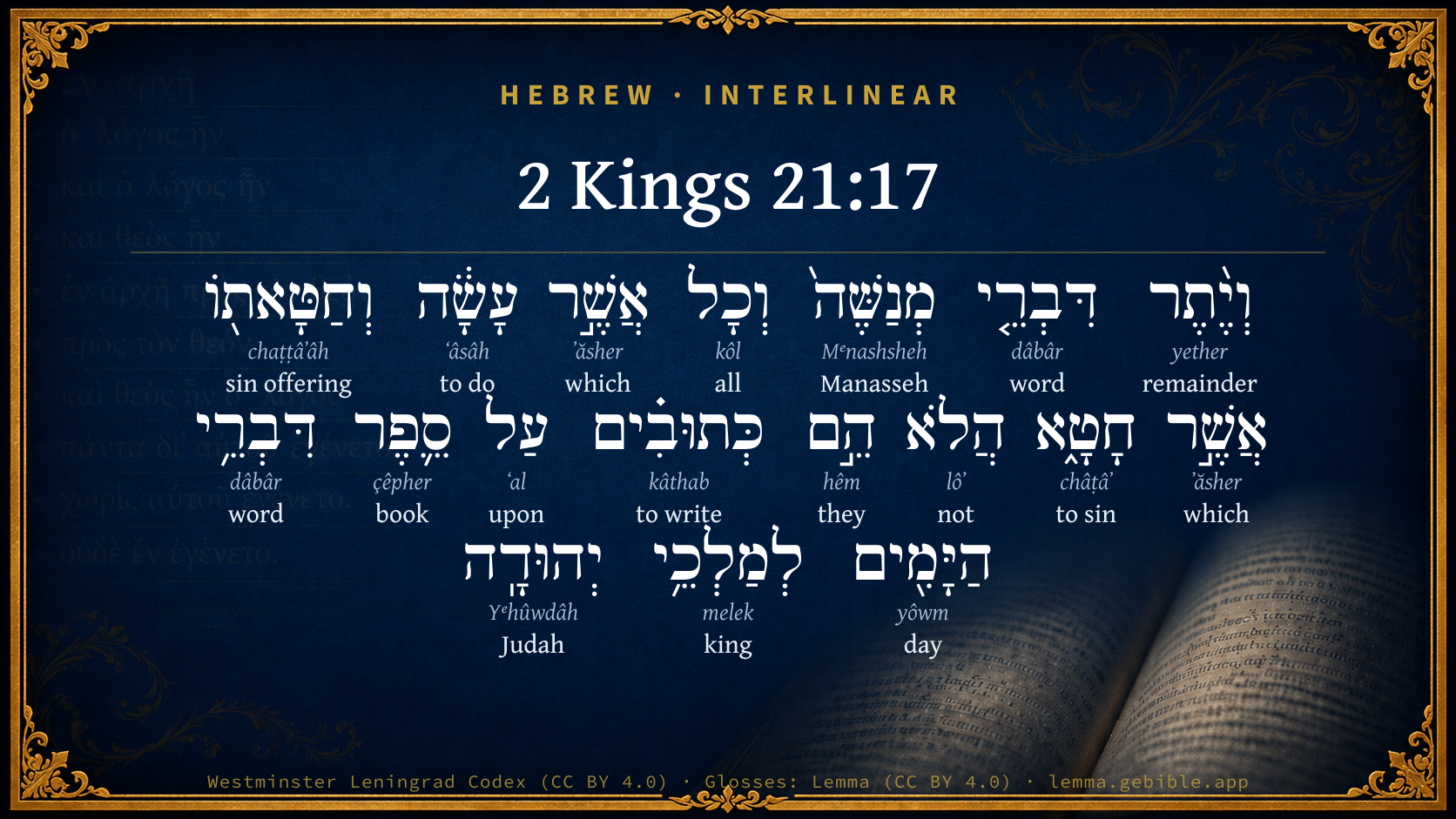
2 Kings 21:17

Hebrew (Westminster Leningrad Codex) 2 Kings 21:17 appears in the Hebrew Old Testament. The text above is from the Westminster Leningrad Codex. Each word links to its Strong’s number, a concise gloss, and parsing drawn from the Open Scriptures Hebrew Bible morphology. Click any word for its full Brown-Driver-Briggs (BDB) entry.
Download image
Cite this verse

2 Kings 21:17 (World English Bible). Public Domain. Lemma interlinear Bible study tool, https://lemma.gebible.app/v/2-kings/21/17.

Show BibTeX & RIS
BibTeX
RIS
English Translation
Now the rest of the acts of Manasseh, and all that he did, and his sin that he sinned, aren't they written in the book of the chronicles of the kings of Judah?
World English Bible · Public Domain
Download a study sheet

One document with this verse’s original text, its word-by-word gloss line, the meaning frame, cross-references with their text, attributed commentary, and full source and license credits — printable, and it pastes into notes with its structure intact.

This verse Autodidact and up

Study sheet (.html) Plain text (.txt)

A passage Seminary Student

Up to 50 verses in one chapter. A passage sheet keeps up to 6 commentary sources and 12 cross-references per verse, in the order this page ranks them, and says so on the sheet whenever that leaves anything out. Ask for a single verse and you get the Autodidact verse sheet above.

Everything on this page stays free to read, with no account — the sheet is a download of what is already on screen, not access to it.

Want to remove ads? Support Godless Engineer
Compare translations 3

The same verse in 3 English versions, stacked beneath the original-language interlinear above. Click any original word for its lexicon entry.

Each is an independent rendering of the whole verse — the interlinear is not word-aligned to these translations.

Highlighted words mark where these versions differ — a whole-verse word diff, not a word-by-word alignment.

  • World English Bible Public Domain
    Now the rest of the acts of Manasseh, and all that he did, and his sin that he sinned, aren't they written in the book of the chronicles of the kings of Judah?
  • King James Version Public Domain
    Now the rest of the acts of Manasseh, and all that he did, and his sin that he sinned, are they not written in the book of the chronicles of the kings of Judah?
  • unfoldingWord Literal Text CC BY-SA 4.0
    Now the rest of the matters of Manasseh and all that he did and his sin that he sinned, are they not written in the book of the matters of the days of the kings of Judah?

unfoldingWord Literal Text — © unfoldingWord, licensed CC BY-SA 4.0. Word-aligned USFM3 via Door43 (git.door43.org/unfoldingWord/en_ult).

Versions to compare (up to 4)

3 of 4 selected

Show all 18 translations

Every available English version of this verse, each an independent rendering of the whole verse.

  • World English Bible Public Domain
    Now the rest of the acts of Manasseh, and all that he did, and his sin that he sinned, aren't they written in the book of the chronicles of the kings of Judah?
  • Berean Standard Bible Public Domain
    As for the rest of the acts of Manasseh, along with all his accomplishments and the sin that he committed, are they not written in the Book of the Chronicles of the Kings of Judah?
  • Majority Standard Bible Public Domain
    As for the rest of the acts of Manasseh, along with all his accomplishments and the sin that he committed, are they not written in the Book of the Chronicles of the Kings of Judah?
  • King James Version Public Domain
    Now the rest of the acts of Manasseh, and all that he did, and his sin that he sinned, are they not written in the book of the chronicles of the kings of Judah?
  • American Standard Version (1901) Public Domain
    Now the rest of the acts of Manasseh, and all that he did, and his sin that he sinned, are they not written in the book of the chronicles of the kings of Judah?
  • Revised Version (1885) Public Domain
    Now the rest of the acts of Manasseh, and all that he did, and his sin that he sinned, are they not written in the book of the chronicles of the kings of Judah?
  • Geneva Bible (1599) Public Domain
    Concerning the rest of the actes of Manasseh, and all that hee did, and his sinne that he sinned, are they not written in the booke of the Chronicles of the Kings of Iudah?
  • Douay-Rheims (1899) Public Domain
    Now the rest of the acts of Manasses, and all that he did, end his sin which he sinned, are they not written in the book of the words of the days of the kings of Juda?
  • Young's Literal Translation Public Domain
    And the rest of the matters of Manasseh, and all that he did, and his sin that he sinned, are they not written on the book of the Chronicles of the kings of Judah?
  • Literal Standard Version CC BY-SA 4.0
    And the rest of the matters of Manasseh, and all that he did, and his sin that he sinned, are they not written on the scroll of the Chronicles of the Kings of Judah?
  • Unlocked Literal Bible CC BY-SA 4.0
    As for the other matters concerning Manasseh, all that he did, and the sin that he committed, are they not written in the book of the events of the kings of Judah?
  • unfoldingWord Literal Text CC BY-SA 4.0
    Now the rest of the matters of Manasseh and all that he did and his sin that he sinned, are they not written in the book of the matters of the days of the kings of Judah?
  • Darby Bible Public Domain
    And the rest of the acts of Manasseh, and all that he did, and his sin which he sinned, are they not written in the book of the chronicles of the kings of Judah?
  • World Messianic Bible Public Domain
    Now the rest of the acts of Manasseh, and all that he did, and his sin that he sinned, aren’t they written in the book of the chronicles of the kings of Judah?
  • Webster's Bible Public Domain
    Now the rest of the acts of Manasseh, and all that he did, and his sin that he sinned, are they not written in the book of the chronicles of the kings of Judah?
  • Free Bible Version CC BY-SA 4.0
    The rest of what happened in Manasseh's reign, all he did, as well as the sins he committed, are recorded in the Book of Chronicles of the Kings of Judah.
  • Bible in Basic English Public Domain
    Now the rest of the acts of Manasseh, and all he did, and his sins, are they not recorded in the book of the history of the kings of Judah?
  • JPS Tanakh (1917) Public Domain
    Now the rest of the acts of Manasseh, and all that he did, and his sin that he sinned, are they not written in the book of the chronicles of the kings of Judah?

Literal Standard Version (2020), Covenant Press — licensed CC BY-SA 4.0. Text via the HelloAO Bible API (eBible.org). Unlocked Literal Bible (unfoldingWord) — licensed CC BY-SA 4.0. Text via the HelloAO Bible API (eBible.org). unfoldingWord Literal Text — © unfoldingWord, licensed CC BY-SA 4.0. Word-aligned USFM3 via Door43 (git.door43.org/unfoldingWord/en_ult). Free Bible Version, Dr. Jonathan Gallagher — licensed CC BY-SA 4.0. Text via the HelloAO Bible API (eBible.org).

Word by word

More ways to search: Search by grammar → Find every occurrence → Compare this word →

Practice this passage: Drill this verse → Learn its vocabulary →

וְיֶ֨תֶר
yether
H3499
“and · remainder of”
Conjunction + Noun, Common, Masculine, Singular, Construct
Part of Speech
Conjunction + Noun
Type
Common
Gender
Masculine
Number
Singular
State
Construct
Full BDB Definition

Origin: from H3498

TWOT: 936a

remainder, excess, rest, remnant, excellence - remainder, remnant - remainder, rest, other part - excess - abundantly (adverb) - abundance, affluence - superiority, excellency
  1. דִּבְרֵ֤י dâbâr H1697 “words of” Noun, Common, Masculine, Plural, Construct
  2. מְנַשֶּׁה֙ Mᵉnashsheh H4519 “Manasseh” Noun, Proper
  3. וְכָל kôl H3605 “and · all of” Conjunction + Noun, Common, Masculine, Singular, Construct
  4. אֲשֶׁ֣ר ʼăsher H834 “which” Particle, Relative
  5. עָשָׂ֔ה ʻâsâh H6213 “to do” Verb, Qal, Perfect, 3rd Person, Masculine, Singular
  6. וְחַטָּאת֖וֹ chaṭṭâʼâh H2403 “and · sin offering · his” Conjunction + Noun, Common, Feminine, Singular, Construct + Suffix, Personal, 3rd Person, Masculine, Singular
  7. אֲשֶׁ֣ר ʼăsher H834 “which” Particle, Relative
  8. חָטָ֑א châṭâʼ H2398 “to sin” Verb, Qal, Perfect, 3rd Person, Masculine, Singular
  9. הֲלֹא lôʼ H3808 “not” Particle, Interrogative + Particle, Negative
  10. הֵ֣ם hêm H1992 “they” Pronoun, Personal, 3rd Person, Masculine, Plural
  11. כְּתוּבִ֗ים kâthab H3789 “written” Verb, Qal, Participle Passive, Masculine, Plural, Absolute
  12. עַל ʻal H5921 “upon” Preposition
  13. סֵ֛פֶר çêpher H5612 “book of” Noun, Common, Masculine, Singular, Construct
  14. דִּבְרֵ֥י dâbâr H1697 “words of” Noun, Common, Masculine, Plural, Construct
  15. הַיָּמִ֖ים yôwm H3117 “the · days” Particle, Definite Article + Noun, Common, Masculine, Plural, Absolute
  16. לְמַלְכֵ֥י melek H4428 “to/for · kings of” Preposition + Noun, Common, Masculine, Plural, Construct
  17. יְהוּדָֽה Yᵉhûwdâh H3063 “Judah” Noun, Proper

About this verse

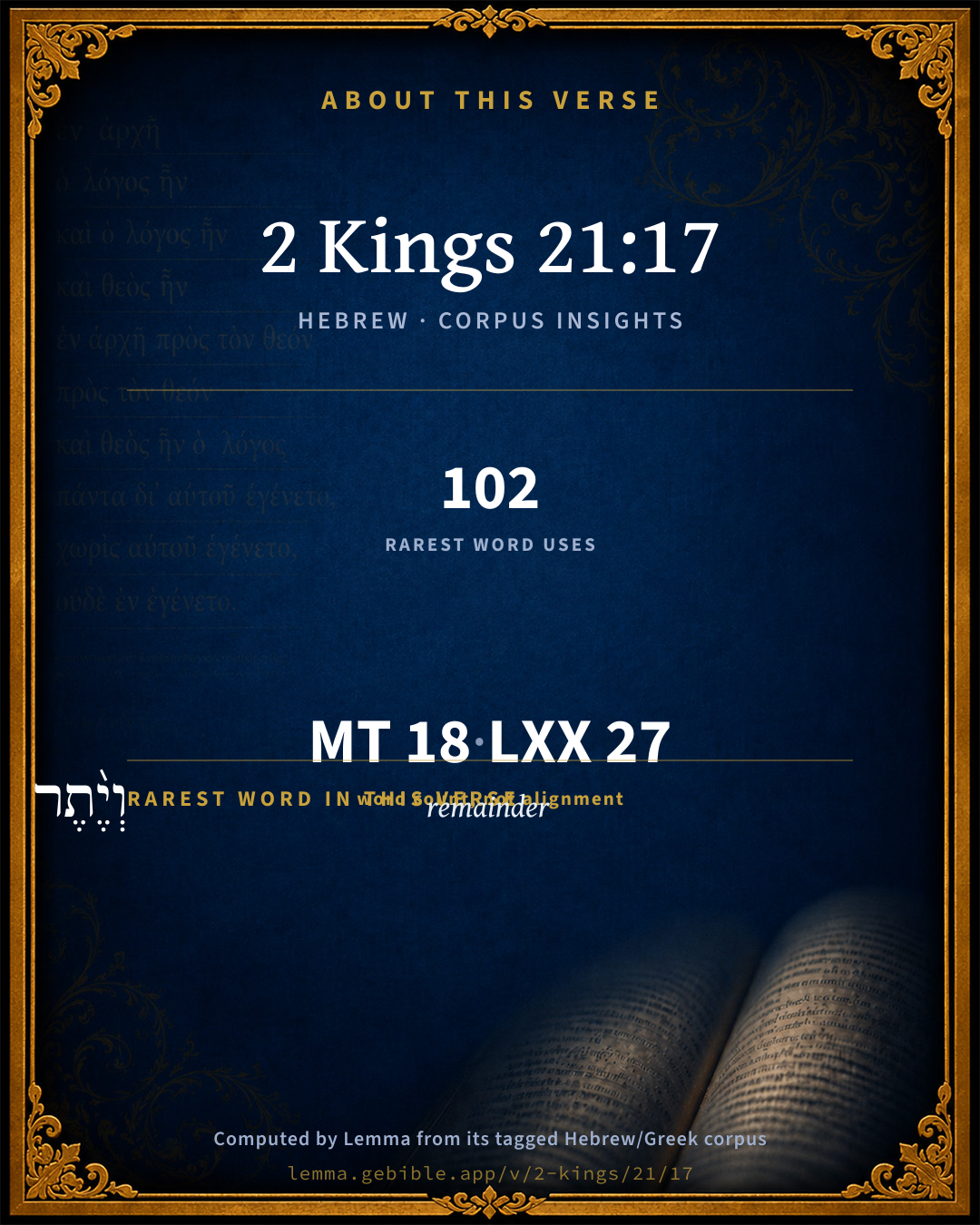
These counts appear in no published source. They are computed here, from the morphology-tagged text and Lemma’s own curated glosses. What Lemma adds →

18
words
16
distinct lemmas
Historical
section

Grammatical profile

  • 3 verbs
  • 10 nouns
  • 1 pronoun
  • 1 preposition
  • 3 particles

Verb forms

  • עָשָׂ֔ה Qal · Perfect
  • חָטָ֑א Qal · Perfect
  • כְּתוּבִ֗ים Qal · Participle Passive

Repetition

Words recur within this verse — often emphatic in Hebrew:

  • דִּבְרֵ֤י word H1697 ×2
  • אֲשֶׁ֣ר which H834 ×2

Hebrew & Septuagint length

In English translation the verse runs 33 words from the Hebrew and 35 from the Septuagint (LXX English) — closely comparable.

A rough comparison of the two English renderings, which tokenize alike — not a word-level alignment.

Word counts can differ between the Hebrew and the Greek without any difference in meaning — e.g. the Hebrew direct-object marker אֵת has no separate Greek word, and Greek often adds the article ὁ.

In the original languages it is 18 Hebrew tokens and 27 Greek tokens — but the two are counted differently (Hebrew bundles its prefixes and suffixes into one token; the Greek is in lemma form), so that isn’t a like-for-like length.

Cross-references

2

Topical passages linked to 2 Kings 21:17 in the Treasury of Scripture Knowledge — connected by theme and wording, ordered by reader-vote popularity; previews shown in the World English Bible.

  • 2 Kings 20:20–21 Now the rest of the acts of Hezekiah, and all his might, and how he made the pool, and the conduit, and brought water into the city, aren't they written in the book of the chronicles of the kings of Judah?
  • 2 Chronicles 33:1–20 Manasseh was twelve years old when he began to reign; and he reigned fifty-five years in Jerusalem.

Cross-references courtesy of OpenBible.info (CC BY 4.0).

Hebrew and Greek witnesses Masoretic Hebrew ↔ Greek Septuagint

The same verse in the two great witnesses to the Old Testament, shown verse-for-verse.

These are two independent witnesses, not word-aligned to each other, and the Septuagint is shown in lemma (dictionary) form.

Hebrew 2 Kings 21:17 Masoretic · Westminster Leningrad Codex

וְיֶ֨תֶר דִּבְרֵ֤י מְנַשֶּׁה֙ וְכָל אֲשֶׁ֣ר עָשָׂ֔ה וְחַטָּאת֖וֹ אֲשֶׁ֣ר חָטָ֑א הֲלֹא הֵ֣ם כְּתוּבִ֗ים עַל סֵ֛פֶר דִּבְרֵ֥י הַיָּמִ֖ים לְמַלְכֵ֥י יְהוּדָֽה

Now the rest of the acts of Manasseh, and all that he did, and his sin that he sinned, aren't they written in the book of the chronicles of the kings of Judah?

World English Bible · Public Domain

Greek LXX 2 Kings 21:17 Septuagint · lemma form

καί ὁ λοιπός ὁ λόγος μανασσῆς καί πᾶς ὅσος ποιέω καί ὁ ἁμαρτία αὐτός ὅς ἁμαρτάνω οὐ οὗτος γράφω ἐπί βιβλίον λόγος ὁ ἡμέρα ὁ βασιλεύς ιουδα

And the rest of the acts of Manasses, and all that he did, and his sin which he sinned, are not these things written in the book of the chronicles of the kings of Juda?

LXX2012 (modern English Septuagint) · Public Domain

Hebrew: Westminster Leningrad Codex (CC BY 4.0). Greek: Septuagint (public domain); English from LXX2012 (modern English Septuagint) (Public Domain). How the Septuagint differs from the Hebrew →

Targum (Aramaic paraphrase)

1

The Targum is the ancient Jewish Aramaic paraphrase of the Hebrew Scriptures — an interpretive translation, not the Hebrew text itself. Onkelos (literal) and Pseudo-Jonathan (expansive) render the Torah, and Jonathan the Prophets. Coverage is partial: where no permissively-licensed English translation exists for a verse, only the Aramaic is shown. This is verse-level text, not a word-by-word alignment to the Hebrew.

  1. Targum Jonathan Prophets (Joshua–Malachi)
    וּשְׁאָר פִּתְגָמֵי מְנַשֶׁה וְכָל דַעֲבַד וְחוֹבוֹהִי דְחָב הֲלָא אִינוּן כְּתִיבִין עַל סְפַר פִתְגָמֵי יוֹמַיָא לְמַלְכֵי דְבֵית יְהוּדָה:

    (no public-domain English translation for this verse)

    Targum Jonathan — Aramaic: “Mikraot Gedolot” (public domain). English: “Sefaria Community Translation” (CC0 1.0 (public-domain dedication)); “London "Chaldee Paraphrase," 1871” (public domain). Text via Sefaria.

Commentary

Notes on 2 Kings 21:17 from classic Christian and Jewish commentators (each source and its license shown beneath its notes). The classic Christian expositions comment on the surrounding passage and are grouped to its opening verse, so a note may address several verses; the Jewish commentaries on the Tanakh (Rashi and others) are per-verse, so they appear only where the commentator wrote on this verse.

Lemma curates 59 commentaries, every one of them public domain or Creative Commons licensed, each selected and text-cleaned for this edition rather than reprinted as found. About our sources →

Trapp's Complete Commentary

John Trapp

2Ki 21:17 Now the rest of the acts of Manasseh, and all that he did, and his sin that he sinned, [are] they not written in the book of the chronicles of the kings of Judah?

Ver. 17. And his sin that he sinned.] Those prodigies of sins afore mentioned, and hardly to be matched in any man, unless it were Nero, that bloody monster: after all which, Manasseh is a convert. Affliction tamed this wild ass, and stopped him in his career; yea, brought him home to God. The viper, when he is lashed, casteth up his poison; the traitor, when he is racked, telleth the truth, which else he had never uttered, &c.

John Trapp, A Commentary or Exposition upon All the Books of the Old and New Testament (1647–1656) — public domain. Text from a community e-Sword module.

Tyndale Open Study Notes

Tyndale Open Resources

21:17 everything he did: The Chronicler records that Manasseh was captured by an Assyrian king, probably when King Ashurbanipal resided in Babylon (about 650–648 BC). This experience humbled Manasseh and brought repentance. After his release, he attempted spiritual reforms, but they were too late in his reign to be effective (2 Chr 33:11-17).

Tyndale Open Study Notes — © Tyndale Open Resources, licensed CC BY-SA 4.0. Text via the HelloAO Bible API.

Adam Clarke's Commentary

Verse 17. Now the rest of the acts] In 2Ch 33:11, c., we read that the Assyrians took Manasseh, bound him with fetters, and took him to Babylon that there he repented, sought God, and was, we are not told how, restored to his kingdom; that he fortified the city of David, destroyed idolatry, restored the worship of the true God, and died in peace.

In 2Ch 33:18-19, His prayer unto God is particularly mentioned. What is called his prayer, is found in the Apocrypha, just before the first book of the Maccabees. There are some good sentiments in it; but whether it be that which was made by Manasseh is more than can be proved. Even the Romish Church have not received it among the canonical books.

Are they not written] There are several particulars referred to here, and in 2Ch 33:11-19, which are not found in any chronicles or books which now remain, and what the books of the seers were, mentioned in Chronicles, we cannot tell.

Adam Clarke's Commentary on the Bible (1810–1826) — public domain. Text from a community e-Sword/MySword module.

Ellicott's Commentary for English Readers

(17) Now the rest of the acts of Manasseh . . .—See 2Ch_33:11-19 for the story of his captivity, repentance, and restoration, which is now allowed by the best critics to be genuine history, though at one time it was the fashion to consider it an edifying fiction of the chronicler’s.

A Bible Commentary for English Readers, edited by Charles John Ellicott (1878–1897) — public domain. Text from a community e-Sword module.

The Cambridge Bible for Schools and Colleges

gen. ed. J. J. S. Perowne

17. the rest of the acts of Manasseh] The compiler of Kings says no word about Manasseh’s repentance, which forms a considerable part of his history in Chronicles (2Ch_33:12-19). There we read that in his distress he besought the Lord and the Lord heard him and brought him back out of Babylon. ‘Then Manasseh knew that the Lord he was God’. He also built parts of the walls of Jerusalem, and strengthened the cities of Judah. He took away the strange gods and built up the altar of the Lord. Mention is also made of his prayer, of which we have an apocryphal version preserved, and of the seers which spake unto him. There is quoted also as authority the history of Hozai (R.V.). Why the writer of Kings tells neither of Manasseh’s captivity nor of his repentance and return is not easy to understand. Perhaps as these events made no difference in the succession, and as he deals with the political rather than with the religious history of the nation, he preferred to omit any record of either the imprisonment of the king or his release.

The Cambridge Bible for Schools and Colleges (gen. ed. J. J. S. Perowne; Cambridge University Press, 1878–1918) — public domain. Text from a community e-Sword module.

John Gill's Exposition

Now the rest of the acts of Manasseh and all that he did,.... Both good and bad, for he repented, and was humbled, and did many good things afterwards, though not recorded in this book:

and his sin that he sinned; his idolatry:

are they not written in the book of the chronicles of the kings of Judah? in which were recorded the most memorable events of their reigns; and in the canonical book of Chronicles are many things concerning Manasseh, which are not written here; see Ch2 33:11.

John Gill's Exposition of the Whole Bible (1746–1763) — public domain (CC PDM 1.0). Text via the HelloAO Bible API.

Albert Barnes' Notes on the Bible

The writer of Kings relates in eighteen verses the history of 55 years, and consequently omits numerous facts of great importance in the life of Manasseh. Among the most remarkable of the facts omitted are the capture of Manasseh by the king of Assyria, his removal to Babylon, his repentance there, his restoration to his kingdom, and his religious reforms upon his return to it. These are recorded only in Chronicles (marginal reference, see the note). The writer of Kings probably considered the repentance of Manasseh but a half-repentance, followed by a half-reformation, which left untouched the root of the evil.

Albert Barnes' Notes on the Bible (1834–1885) — public domain. Text from a community e-Sword/MySword module.

Haydock's Catholic Bible Commentary

Sinned. It is rather wonderful that his repentance is not here noticed; but we find it mentioned [in] 2 Paralipomenon xxxiii. 12. (Haydock) --- He was probably taken prisoner by Thartan, general of Sargon, or Asarhaddon, who had reunited the two kingdoms of Assyria and Babylon, Isaias xx. 1. In prison Manasses composed a penitential prayer, which is not absolutely rejected by the Church, but left in the rank of Apocryphal writings; (Calmet) the authority of which is not clearly ascertained. (Haydock) --- The Greek church admits this prayer into her Euchologium, (Calmet) or Office-book. (Haydock) --- Being liberated, probably by Saosduchin, Manasses did all things well, only he left the high places, where the people had been accustomed to sacrifice to the Lord. Hozai wrote his history, 2 Paralipomenon xxxiii. 19.

George Leo Haydock (1774–1849), Haydock's Catholic Family Bible and Commentary, 1859 edition — public domain. Excludes Psalms (Douay-Rheims chapter numbering differs from Protestant) and Deuterocanonical books (Catholic canon only).

Whedon's Commentary on the Bible

Daniel D. Whedon

17. The rest of the acts of Manasseh — Besides what is here recorded of Manasseh, the parallel history in 2 Chronicles 33 informs us, that as a judgment for his sins he was captured by Assyrian warriors, bound with fetters, and carried to Babylon. There he humbled himself before God, and, in answer to prayer, was restored to his kingdom, whereupon he removed the signs of his idolatry, and sacrificed to Jehovah. He also fortified Jerusalem and strengthened the various cities of Judah. See notes on that chapter.

Daniel D. Whedon (gen. ed.), Commentary on the Old and New Testaments (1874–1909) — public domain. Text from a community e-Sword module.

The Pulpit Commentary

Now the rest of the acts of Manasseh. Important additions to the history of Manasseh are made by the writer of Chronicles. From him we learn that, after prophetical warnings had been in vain addressed to him and to his people, (2Ch_33:10) he was visited with a Divine judgment, an Assyrian army under "captains" being sent against him, who took him prisoner, and carried him to Babylon the city where Esarheddon, the successor of Sennacherib, and contemporary of Manasseh, ordinarily held his court. Here he remained for some considerable time "in affliction" (ver. 12), and, becoming convinced of sin and deeply penitent for his manifold transgressions, he turned to God in sincerity and truth, and being restored by the Assyrians to his kingdom, he put away the idolatrous practices and emblems which he had previously introduced, "repaired the altar of the Lord" which had gone to decay, and re-established, so far as he could, the worship of Jehovah (ver. 16). A special prophet, Hosai, seems to have chronicled his sins and his repentance in a work which survived the Captivity, and is twice quoted by the compiler of the Books of Chronicles. (2Ch_33:18, 2Ch_33:19) The submission of Manasseh to Esarhaddon is noted in the latter"s annals, about the year B.C. 680 (see "Eponym Canon," p. 139, line 13). Other "acts" of Manasseh were the fortification of Jerusalem "on the west side of Gihon in the valley" the strengthening of the defenses of Ophel, and the occupation with strong garrisons of the various fortresses within his dominions. He thus played his part of tributary ally to Assyria With zeal, placing the south-eastern frontier in an excellent condition to resist the assaults of Egypt. Manasseh outlived Esarhaddon, and was for many years contemporary with Asshur-bani-pal, his son, whose inscriptions, however, contain no mention of him. Most likely his name occurred on Cylinder C, line 3, which is now illegible (see G. Smith"s" History of Asshur-bani-pal," p. 31,line c). And all that he did, and his sin that he sinned, are they not written in the book of the chronicles of the kings of Judah? The "sin which he sinned" is probably his persecution, which was viewed as his worst sin. (see ver. 16; and comp. 2Ki_24:4)

The Pulpit Commentary (1880–1919), ed. H.D.M. Spence-Jones & Joseph S. Exell — public domain. Text from a community e-Sword module.

Lesson kit

Teaching starters — assembled from the data on this page, not authored interpretation. Every prompt links to the verse data it draws on. Edit before teaching.

2 Kings, in the Historical, opens this verse with 18 words (16 distinct Hebrew lemmas). Its most distinctive word is yether (“remainder”). A historical commentator’s framing appears above. Read the whole chapter for the surrounding context.

Discussion questions

  1. What does “remainder” (yether) contribute to the verse as a whole?
  2. How does 2 Kings 20:20–21, which shares this passage’s theme, read alongside this verse?
  3. What does the repetition of “word” (2× in this one verse) do in this verse?
  4. These translations render this verse differently; the difference is in the English rendering, not the original. What questions does that raise?
  5. «עָשָׂ֔ה» is a Qal Perfect verb. How does that grammatical form shape the action described?
  6. Compare how Trapp's Complete Commentary and Tyndale Open Study Notes read this verse. Where do they agree or differ?

Things to notice

Reading settings

Reading text

Shown beneath each verse's original-language words.

Old Testament
Old Testament edition

Read the OT as the Masoretic Hebrew (MT) or the Greek Septuagint (LXX).

English shown for the Greek Septuagint (in the Hebrew ↔ Greek comparison).

Comparing translations? Open the Compare panel on any verse page to stack up to four side by side.