
Isaiah 43:27

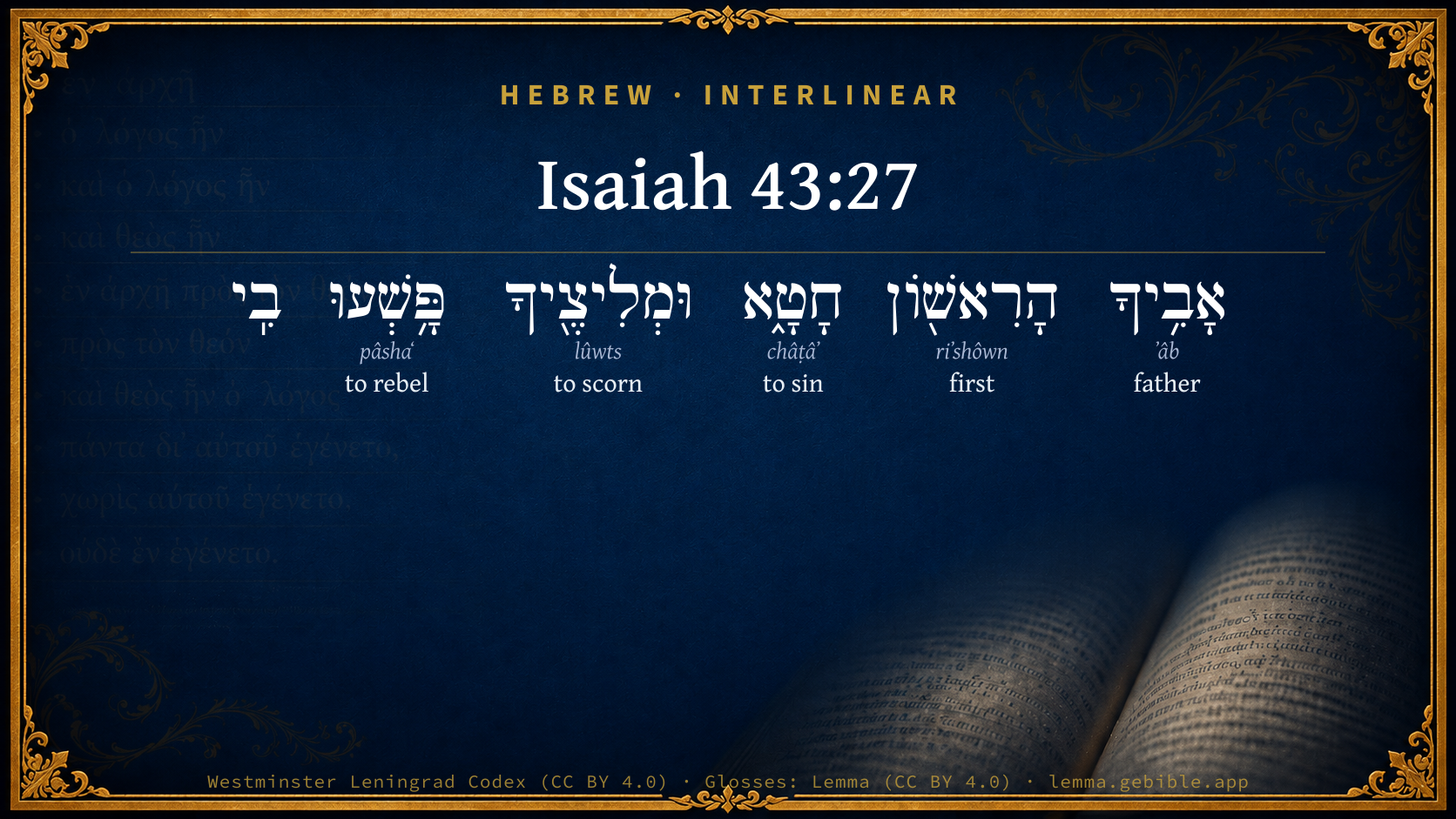
Hebrew (Westminster Leningrad Codex) Isaiah 43:27 appears in the Hebrew Old Testament. The text above is from the Westminster Leningrad Codex. Each word links to its Strong’s number, a concise gloss, and parsing drawn from the Open Scriptures Hebrew Bible morphology. Click any word for its full Brown-Driver-Briggs (BDB) entry.
Download image
Cite this verse

Isaiah 43:27 (World English Bible). Public Domain. Lemma interlinear Bible study tool, https://lemma.gebible.app/v/isaiah/43/27.

Show BibTeX & RIS
BibTeX
RIS
English Translation
Your first father sinned, and your teachers have transgressed against me.
World English Bible · Public Domain
Download a study sheet

One document with this verse’s original text, its word-by-word gloss line, the meaning frame, cross-references with their text, attributed commentary, and full source and license credits — printable, and it pastes into notes with its structure intact.

This verse Autodidact and up

Study sheet (.html) Plain text (.txt)

A passage Seminary Student

Up to 50 verses in one chapter. A passage sheet keeps up to 6 commentary sources and 12 cross-references per verse, in the order this page ranks them, and says so on the sheet whenever that leaves anything out. Ask for a single verse and you get the Autodidact verse sheet above.

Everything on this page stays free to read, with no account — the sheet is a download of what is already on screen, not access to it.

Want to remove ads? Support Godless Engineer
Compare translations 3

The same verse in 3 English versions, stacked beneath the original-language interlinear above. Click any original word for its lexicon entry.

Each is an independent rendering of the whole verse — the interlinear is not word-aligned to these translations.

Highlighted words mark where these versions differ — a whole-verse word diff, not a word-by-word alignment.

  • World English Bible Public Domain
    Your first father sinned, and your teachers have transgressed against me.
  • King James Version Public Domain
    Thy first father hath sinned, and thy teachers have transgressed against me.
  • unfoldingWord Literal Text CC BY-SA 4.0
    Your first father sinned, and your representatives transgressed against me.

unfoldingWord Literal Text — © unfoldingWord, licensed CC BY-SA 4.0. Word-aligned USFM3 via Door43 (git.door43.org/unfoldingWord/en_ult).

Versions to compare (up to 4)

3 of 4 selected

Show all 18 translations

Every available English version of this verse, each an independent rendering of the whole verse.

  • World English Bible Public Domain
    Your first father sinned, and your teachers have transgressed against me.
  • Berean Standard Bible Public Domain
    Your first father sinned, and your spokesmen rebelled against Me.
  • Majority Standard Bible Public Domain
    Your first father sinned, and your spokesmen rebelled against Me.
  • King James Version Public Domain
    Thy first father hath sinned, and thy teachers have transgressed against me.
  • American Standard Version (1901) Public Domain
    Thy first father sinned, and thy teachers have transgressed against me.
  • Revised Version (1885) Public Domain
    Thy first father sinned, and thine interpreters have transgressed against me.
  • Geneva Bible (1599) Public Domain
    Thy first father hath sinned, and thy teachers haue transgressed against me.
  • Douay-Rheims (1899) Public Domain
    Thy brat father sinned, and thy teachers have transgressed against me.
  • Young's Literal Translation Public Domain
    Thy first father sinned, And thine interpreters transgressed against me,
  • Literal Standard Version CC BY-SA 4.0
    Your first father sinned, || And your interpreters transgressed against Me,
  • Unlocked Literal Bible CC BY-SA 4.0
    Your first father sinned, and your leaders have transgressed against me.
  • unfoldingWord Literal Text CC BY-SA 4.0
    Your first father sinned, and your representatives transgressed against me.
  • Darby Bible Public Domain
    Thy first father hath sinned, and thy mediators have rebelled against me.
  • World Messianic Bible Public Domain
    Your first father sinned, and your teachers have transgressed against me.
  • Webster's Bible Public Domain
    Thy first father hath sinned, and thy teachers have transgressed against me.
  • Free Bible Version CC BY-SA 4.0
    Your very first father sinned, and your leaders rebelled against me.
  • Bible in Basic English Public Domain
    Your first father was a sinner, and your guides have gone against my word.
  • JPS Tanakh (1917) Public Domain
    Thy first father sinned, and thine intercessors have transgressed against Me.

Literal Standard Version (2020), Covenant Press — licensed CC BY-SA 4.0. Text via the HelloAO Bible API (eBible.org). Unlocked Literal Bible (unfoldingWord) — licensed CC BY-SA 4.0. Text via the HelloAO Bible API (eBible.org). unfoldingWord Literal Text — © unfoldingWord, licensed CC BY-SA 4.0. Word-aligned USFM3 via Door43 (git.door43.org/unfoldingWord/en_ult). Free Bible Version, Dr. Jonathan Gallagher — licensed CC BY-SA 4.0. Text via the HelloAO Bible API (eBible.org).

Word by word

More ways to search: Search by grammar → Find every occurrence → Compare this word →

Practice this passage: Drill this verse → Learn its vocabulary →

וּמְלִיצֶ֖יךָ
lûwts
H3887
“and · scorning · you”
Conjunction + Verb, Hiphil, Participle Active, Masculine, Plural, Construct + Suffix, Personal, 2nd Person, Masculine, Singular
Part of Speech
Conjunction + Verb
Stem
Hiphil
Form
Participle Active
Gender
Masculine
Number
Plural
State
Construct
Full BDB Definition

Origin: a primitive root

TWOT: 1113

to scorn, make mouths at, talk arrogantly - (Qal) - to boast - to scorn - (Hiphil) - to mock, deride - to interpret (language) - interpreter (participle) - ambassador (figuratively) - (Hithpalpel) to be inflated, scoff, act as a scorner, show oneself a mocker
  1. אָבִ֥יךָ ʼâb H1 “father · your” Noun, Common, Masculine, Singular, Construct + Suffix, Personal, 2nd Person, Masculine, Singular
  2. הָרִאשׁ֖וֹן riʼshôwn H7223 “the · first” Particle, Definite Article + Adjective, Ordinal number, Masculine, Singular, Absolute
  3. חָטָ֑א châṭâʼ H2398 “to sin” Verb, Qal, Perfect, 3rd Person, Masculine, Singular
  4. פָּ֥שְׁעוּ pâshaʻ H6586 “to rebel” Verb, Qal, Perfect, 3rd Person, Common, Plural

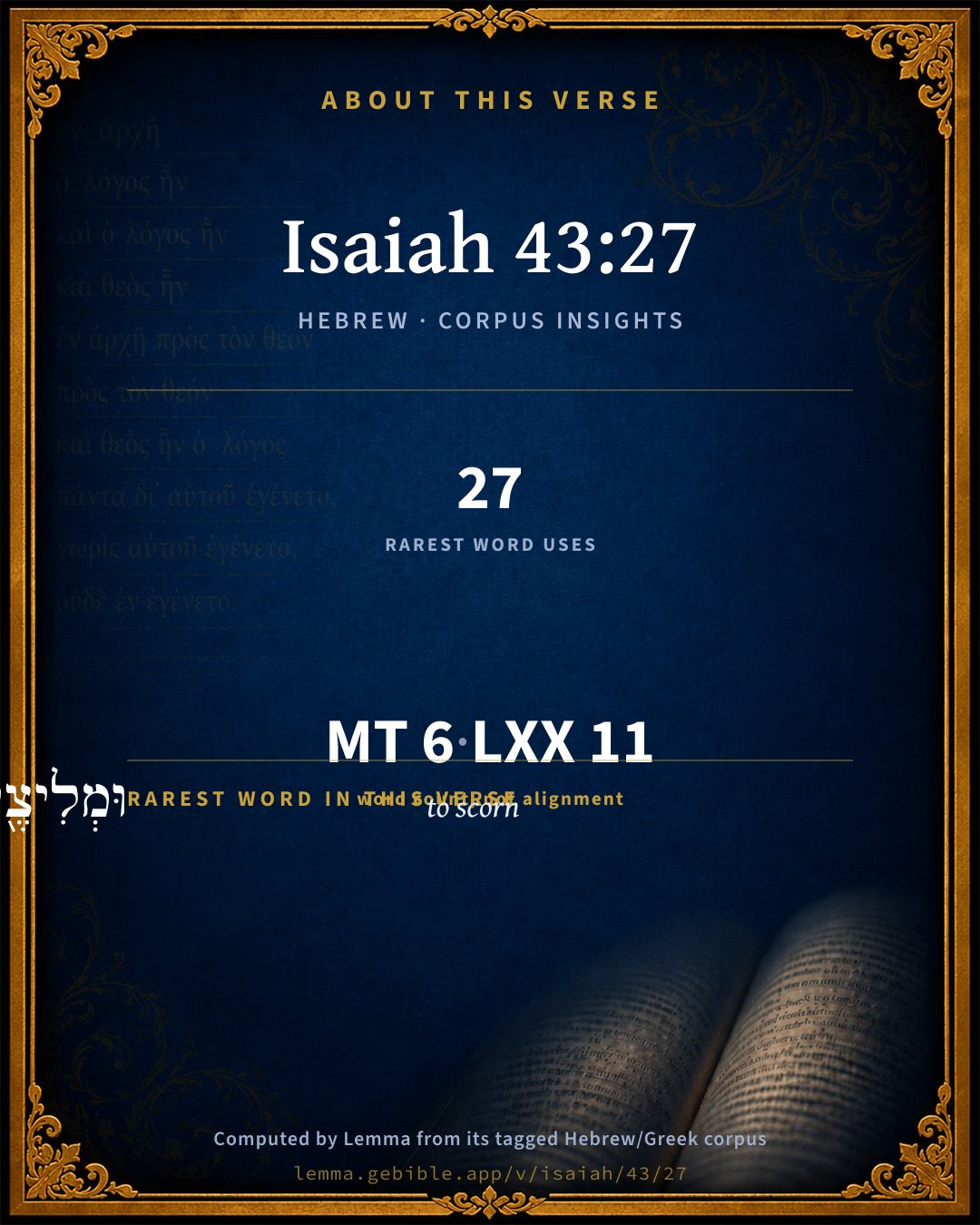
About this verse

These counts appear in no published source. They are computed here, from the morphology-tagged text and Lemma’s own curated glosses. What Lemma adds →

6
words
5
distinct lemmas
Prophets
section

Shared distinctive vocabulary

וּמְלִיצֶ֖יךָ to scorn H3887 occurs in 26 verses of the Hebrew Bible. Also found in:

Grammatical profile

  • 3 verbs
  • 1 noun
  • 1 adjective
  • 1 preposition

Verb forms

  • חָטָ֑א Qal · Perfect
  • וּמְלִיצֶ֖יךָ Hiphil · Participle Active
  • פָּ֥שְׁעוּ Qal · Perfect

Hebrew & Septuagint length

In English translation the verse runs 11 words from the Hebrew and 10 from the Septuagint (LXX English) — closely comparable.

A rough comparison of the two English renderings, which tokenize alike — not a word-level alignment.

Word counts can differ between the Hebrew and the Greek without any difference in meaning — e.g. the Hebrew direct-object marker אֵת has no separate Greek word, and Greek often adds the article ὁ.

In the original languages it is 6 Hebrew tokens and 11 Greek tokens — but the two are counted differently (Hebrew bundles its prefixes and suffixes into one token; the Greek is in lemma form), so that isn’t a like-for-like length.

Cross-references

25

Topical passages linked to Isaiah 43:27 in the Treasury of Scripture Knowledge — connected by theme and wording, ordered by reader-vote popularity; previews shown in the World English Bible.

  • Isaiah 28:7 Even these reel with wine, and stagger with strong drink; the priest and the prophet reel with strong drink, they are swallowed up of wine, they stagger with strong drink; they err in vision, they stumble in judgment.
  • Jeremiah 5:31 the prophets prophesy falsely, and the priests bear rule by their means; and my people love to have it so: and what will you do in the end of it?
  • Lamentations 4:13–14 [It is] because of the sins of her prophets, [and] the iniquities of her priests, That have shed the blood of the just in the midst of her.
  • Ezekiel 16:3 and say, Thus says the Lord Yahweh to Jerusalem: Your birth and your birth is of the land of the Canaanite; the Amorite was your father, and your mother was a Hittite.
  • Ezekiel 22:25–28 There is a conspiracy of her prophets in the midst of it, like a roaring lion ravening the prey: they have devoured souls; they take treasure and precious things; they have made her widows many in the midst of it.
  • Isaiah 3:12 As for my people, children are their oppressors, And women rule over them. My people, those who lead you cause you to err, And destroy the way of your paths.
  • Isaiah 56:10–12 His watchmen are blind, they are all without knowledge; they are all mute dogs, they can't bark; dreaming, lying down, loving to slumber.
  • Jeremiah 3:25 Let us lie down in our shame, and let our confusion cover us; for we have sinned against Yahweh our God, we and our fathers, from our youth even to this day; and we have not obeyed the voice of Yahweh our God.
  • Jeremiah 23:11–15 for both prophet and priest are profane; yes, in my house have I found their wickedness, says Yahweh.
  • Hosea 4:6 My people are destroyed for lack of knowledge. Because you have rejected knowledge, I will also reject you, That you may be no priest to me. Because you have your God's law, I will also forget your children.
  • Micah 3:11 Her leaders judge for bribes, And her priests teach for a price, And her prophets of it tell forturnes for money: Yet they lean on Yahweh, and say, Isn't Yahweh in the midst of us? No disaster will come on us.
  • Zechariah 1:4–6 Don't you be like your fathers, to whom the former prophets proclaimed, saying: Thus says Yahweh of hosts, 'Return now from your evil ways, and from your evil doings;' but they did not hear, nor listen to me, says Yahweh.
  • Malachi 2:4–8 You will know that I have sent this commandment to you, that my covenant may be with Levi," says Yahweh of Hosts.
  • Malachi 3:7 From the days of your fathers you have turned aside from my ordinances, and have not kept them. Return to me, and I will return to you," says Yahweh of Hosts. "But you say, 'How shall we return?'
  • Matthew 15:14 Leave them alone. They are blind guides of the blind. If the blind guide the blind, both will fall into a pit."
  • Matthew 27:1 Now when morning had come, all the chief priests and the elders of the people took counsel against Jesus to put him to death:
  • Matthew 27:41 Likewise the chief priests also mocking, with the scribes, the Pharisees, and the elders, said,
  • John 11:49–53 But a certain one of them, Caiaphas, being high priest that year, said to them, "You know nothing at all,
  • Acts 5:17–18 But the high priest rose up, and all those who were with him (which is the sect of the Sadducees), and they were filled with jealousy,
  • Acts 7:51 "You stiff-necked and uncircumcised in heart and ears, you always resist the Holy Spirit! As your fathers did, so you do.
  • Romans 5:12 Therefore, as sin entered into the world through one man, and death through sin; and so death passed to all men, because all sinned.
  • Numbers 32:14 Behold, you are risen up in your fathers' place, an increase of sinful men, to augment yet the fierce anger of Yahweh toward Israel.
  • Psalms 78:8 And might not be as their fathers, A stubborn and rebellious generation, A generation that didn't make their hearts loyal, Whose spirit was not steadfast with God.
  • Psalms 106:6–7 We have sinned with our fathers. We have committed iniquity. We have done wickedly.
  • Isaiah 9:15 The elder and the honorable man, he is the head; and the prophet who teaches lies, he is the tail.

Cross-references courtesy of OpenBible.info (CC BY 4.0).

Hebrew and Greek witnesses Masoretic Hebrew ↔ Greek Septuagint

The same verse in the two great witnesses to the Old Testament, shown verse-for-verse.

These are two independent witnesses, not word-aligned to each other, and the Septuagint is shown in lemma (dictionary) form.

Hebrew Isaiah 43:27 Masoretic · Westminster Leningrad Codex

אָבִ֥יךָ הָרִאשׁ֖וֹן חָטָ֑א וּמְלִיצֶ֖יךָ פָּ֥שְׁעוּ בִֽי

Your first father sinned, and your teachers have transgressed against me.

World English Bible · Public Domain

Greek LXX Isaiah 43:27 Septuagint · lemma form

ὁ πατήρ σύ πρῶτος καί ὁ ἄρχων αὐτός ἀνομέω εἰς ἐγώ

Your fathers first, and your princes have transgressed against me.

LXX2012 (modern English Septuagint) · Public Domain

On this verse, Albert Barnes' Notes on the Bible discusses the Septuagint’s reading. Read the note in Commentary ↓

Hebrew: Westminster Leningrad Codex (CC BY 4.0). Greek: Septuagint (public domain); English from LXX2012 (modern English Septuagint) (Public Domain). How the Septuagint differs from the Hebrew →

Targum (Aramaic paraphrase)

1

The Targum is the ancient Jewish Aramaic paraphrase of the Hebrew Scriptures — an interpretive translation, not the Hebrew text itself. Onkelos (literal) and Pseudo-Jonathan (expansive) render the Torah, and Jonathan the Prophets. Coverage is partial: where no permissively-licensed English translation exists for a verse, only the Aramaic is shown. This is verse-level text, not a word-by-word alignment to the Hebrew.

  1. Targum Jonathan Prophets (Joshua–Malachi)
    אֲבוּךְ קַדְמָאָה חָטָא וּמַלְפָךְ מְרַדוּ בְמֵימְרִי:

    Thy first father hath sinned, and thy teachers have rebelled against my WORD.

    Targum Jonathan — Aramaic: “Mikraot Gedolot” (public domain). English: “Sefaria Community Translation” (CC0 1.0 (public-domain dedication)); “London "Chaldee Paraphrase," 1871” (public domain). Text via Sefaria.

Commentary

Notes on Isaiah 43:27 from classic Christian and Jewish commentators (each source and its license shown beneath its notes). The classic Christian expositions comment on the surrounding passage and are grouped to its opening verse, so a note may address several verses; the Jewish commentaries on the Tanakh (Rashi and others) are per-verse, so they appear only where the commentator wrote on this verse.

Lemma curates 59 commentaries, every one of them public domain or Creative Commons licensed, each selected and text-cleaned for this edition rather than reprinted as found. About our sources →

Trapp's Complete Commentary

John Trapp

Isa 43:27 Thy first father hath sinned, and thy teachers have transgressed against me.

Ver. 27. Thy first father.] Adam, or Abraham, say some.

And thy teachers.] Heb., Thine interpreters, orators, ambassadors - that is, thy priests and prophets.

John Trapp, A Commentary or Exposition upon All the Books of the Old and New Testament (1647–1656) — public domain. Text from a community e-Sword module.

The Biblical Illustrator

Joseph S. Exell

Isa_43:27

Thy first father hath sinned

Israels sin

Its history from the first is a tissue of sins.

Thy first father sinned, and thy mediators have fallen away from Me. By the first father, Hitzig, Knobel, and others understand Adam; but Adam is the progenitor of mankind, not of Israel specially, and Adams guilt is mankinds guilt, not Israels. Either Abraham is meant (Hofmann, Stier, Hahn, and others), or Jacob-Israel (Ewald, Cheyne, yon Orelli), who has more to do with the sinful nature of the nation springing from him than Abraham (cf. Deu_26:5). The interpreters and mediators generally (2Ch_32:31; Job_33:23) are the prophets and priests, standing between Jehovah and Israel, and mediating the intercourse of both in word and act; even these for the most part have proved unfaithful to God, falling a prey to ungodly magic and false worship. Thus Israels sin was as ancient as its origin; and the apostasy has broken out even among those who, by reason of their offices, should be the best and holiest. (F. Delitzsch, D. D.)

Thy first father

To the unreflecting upon human nature it has not occurred that mankind might have been introduced to our world by other means than by being born of a woman. Every human being might have been a distinct creation. But the constitution given to the vegetable and to the animal kingdoms was given also to man; and as herbs and animals contain the seed of their own kind, and are propagated of each other, so man was made to be fruitful, to multiply, and to replenish the earth. Among other reasons for this constitution was the intention of securing (through the intimate and peculiar relationships it involves) a powerful influence of man upon man. Judging by the conjugal, paternal, and filial relationships, it is evident that God intended men to exert a considerable amount and a high kind of influence upon each other. But while the domestic bonds are the chief channels through which human influence is transmitted, there are other sources of power. Extraordinary talent, peculiar circumstances, great earnestness, and remarkable labours raise men to the guidance and control of their fellows. The position of the first man was in many respects singular. All other of the human kind have been born of each other. Even Eve was made out of man. Adam alone was created. Excepting Eve and Adam, every other human being has commenced existence an infant, and living, has passed from infancy through childhood and youth to manhood. And Adam was the first of human kind. Adam, moreover, according to the constitution given him, and by the fact of his creation, was the natural father of the human race. We shall treat the subject by discussing two questions.

I. WAS ADAM TO THE HUMAN FAMILY MORE THAN THEIR NATURAL PARENT? According to the historical and doctrinal statements of the Scriptures, Adam did sustain another and a more important relationship.

II. ADMITTING THAT ADAM WAS MORE THAN THE FIRST PARENT OF THE HUMAN FAMILY, WHAT WAS HE BESIDE? AND WHAT DID THIS RELATIONSHIP INVOLVE? As the first parent of the human race, and according to laws with which we are all familiar, Adam would exert a serious influence upon his whole posterity. But Adam was more than the first parent. He is called by the apostle Paul, the figure of him that was to come--literally, the type. Paul declared that Adam in his connection with mankind was the form, or the ensample, or the pattern of what Jesus Christ was to be to redeemed men; so that as Jesus Christ is the public representative and head of the saved of mankind, so Adam was the representative of the human race. What did the placing of Adam in this position involve?

1. By this arrangement the whole race is tried or proved by one man.

2. It pleased God to suspend upon the trial of one man the life and the death of the human race. Adams guilt must ever be his own--that cannot be anothers. Adams punishment must rest on his own head--that cannot be transferred to his posterity. But the results of Adam s conduct his posterity were to share. Awfully responsible was Adam s position! Gods reasons for the order of things are to us unsearchable. We may consider that the trial of a race in one man was more simple than the probation of every individual--we may see how (God foreknowing the apostasy of human nature) this mode of government admitted the immediate introduction of another and of a remedial dispensation--still, Gods ways in this dispensation are past finding out. The fact is declared; and the reason of this arrangement we must resolve into the sovereignty of God. One serious lesson fail not to learn--the extent of parental responsibility. Moral and intellectual and physical qualities are doubtless transmissible. Weakness and disease of body and evil dispositions of soul are conveyed from parent to child. Sow not, therefore, to the flesh. (S. Martin.)

The Biblical Illustrator, edited by Joseph S. Exell (c. 1880s–1900s) — public domain. Text from a community e-Sword module.

Joseph Benson's Commentary

Isa 43:27-28. Thy first father hath sinned — Some think that Urijah, who was high-priest in the time of Ahaz, is here especially meant: see 2Ki 16:10-11. But it is more probable that the expression is put for their forefathers collectively; and so he tells them, that as they were sinners, so also were all their progenitors, yea, even the best of them. Thus Lowth: “Your ancestors, reckoning from Adam downward, have been sinners, and you have trod in their steps:” see Eze 2:3; Eze 16:2, &c.; Ezr 9:7. And thy teachers have transgressed, &c. — Your prophets, priests, and teachers, who ought to have been guides to you, and intercessors for you with God, have led you into sin and error, and therefore you have no reason to fancy yourselves innocent. Therefore I have profaned the princes of the sanctuary — The highest and best of your priests, whose persons were most sacred, and therefore were supposed, by themselves and others, to be the farthest from danger. As they had made themselves profane, so have I dealt with them as such, without any regard to the sacredness and dignity of their functions. Have given Jacob to the curse, and Israel to reproaches — Have exposed them to contempt and destruction, and made them a proverb of execration and reproach to all the neighbouring nations.

Joseph Benson's Commentary on the Old and New Testaments (1811–1818) — public domain. Text from a community e-Sword module.

Tyndale Open Study Notes

Tyndale Open Resources

43:27 leaders: God held Israel’s and Judah’s kings especially responsible for leading the nation into sin (see 2 Kgs 21).

Tyndale Open Study Notes — © Tyndale Open Resources, licensed CC BY-SA 4.0. Text via the HelloAO Bible API.

Geneva Bible (1599)

Geneva Bible translators

Thine ancestors.

Thy Priests and thy Prophets.

Geneva Bible (1599) marginal notes — public domain. Text via Bolls.life.

Jamieson, Fausset & Brown

Robert Jamieson, A. R. Fausset & David Brown

first father--collectively for "most ancient ancestors," as the parallelism ("teachers") proves [MAURER]. Or, thy chief religious ministers or priests [GESENIUS]. Adam, the common father of all nations, can hardly be meant here, as it would have been irrelevant to mention his sin in an address to the Jews specially. Abraham is equally out of place here, as he is everywhere cited as an example of faithfulness, not of "sin." However, taking the passage in its ultimate application to the Church at large, Adam may be meant.

teachers--literally, "interpreters" between God and man, the priests (Job 33:23; Mal 2:7).

Jamieson, Fausset & Brown — Commentary Critical and Explanatory on the Whole Bible (1871) — public domain (CC PDM 1.0). Text via the HelloAO Bible API.

Adam Clarke's Commentary

Verse 27. Thy first father hath sinned] On this Kimchi speaks well: "How can ye say that ye have not sinned, seeing your first father, Adam, sinned; and man hath sin impressed on him through natural generation?"

Adam Clarke's Commentary on the Bible (1810–1826) — public domain. Text from a community e-Sword/MySword module.

Ellicott's Commentary for English Readers

(27) Thy first father hath sinned . . .—The words have been interpreted: (1) of Adam; (2) of Abraham; (3) of Jacob; (4) of the ancestors of Israel collectively; (5) of this or that high priest individually. (3) fits in best. (See Isa_43:28.)

Thy teachers.—Literally, thy interpreters (Job_33:23), or thy mediators. The term is used in 2Ch_32:31 of the “ambassadors “of the king of Babylon, and stands here for the priests and the prophets, who ought officially to have been the expounders of the Divine will.

A Bible Commentary for English Readers, edited by Charles John Ellicott (1878–1897) — public domain. Text from a community e-Sword module.

The Cambridge Bible for Schools and Colleges

gen. ed. J. J. S. Perowne

27. Thy first father] Undoubtedly Jacob, the eponymous hero of the nation, is meant (cf. Hos_12:3 f.), not Abraham (who is never spoken of in the later literature as sinful), nor the earliest ancestors collectively; still less Adam.

thy teachers] Lit. as R.V. thine interpreters (Gen_42:23), and hence “mediators” (as Job_33:23; 2Ch_32:31); used of the prophets only here. On the idea, see Jer_23:11 ff. If the representative ancestor and the spiritual leaders of Israel were such, what must the mass of the nation have been!

The Cambridge Bible for Schools and Colleges (gen. ed. J. J. S. Perowne; Cambridge University Press, 1878–1918) — public domain. Text from a community e-Sword module.

Albert Barnes' Notes on the Bible

Thy first father hath sinned - This is the argument on the side of God, to show that they were neither unjustly punished, nor punished with undue severity. The argument is, that their rulers and teachers had been guilty of crime, and that therefore it was right to bring all this vengeance upon the nation. Various interpretations have been given of the phrase ‘thy first father.’ A slight notice of them will lead to the correct exposition.

1. Many have supposed that Adam is referred to here. Thus Piscator, Calovius, and most of the fathers, understand it; and, among the Jews, Kimchi. But the objections to this are plain:

(a) Adam was not peculiarly the first father or ancestor of the Jews, but of the whole human race.

(b) The Jews never boasted, or gloried in him as the founder of their nation, but they always referred to Abraham under this appellation Mat 3:9; Joh 8:33, Joh 8:39.

(c) It would have been irrelevant to the design of the prophet to have referred to the sin of Adam in this case. God was vindicating his own cause and conduct in destroying their capital and temple, and in sending them as captives to a distant land. How would it prove that he was right in this, to say that Adam was a transgressor? How would it demonstrate his justice in these special inflictions of his anger to refer to the apostasy of the ancestor of the whole human race?

2. Others refer it to Abraham. This was the sentiment of Jerome, and of some others; and by those who maintain this opinion, it is supposed to refer to his doubting the truth of the promise Gen 15:8; or to the denial of his wife, and his sin in inducing her to say that she was his sister Gen 12:11; Gen 20:2; or to the fact that when young he was an idolater. But the obvious objection to this is, that Abraham is everywhere in the Scriptures proposed as an example of one eminently devoted to God; nor could it be said that these calamities had come upon them in consequence of his unfaithfulness, and his sins.

3. Others refer it to the rulers and princes individually. Thus Grotius refers it to Manasseh; Aben Ezra to Jeroboam, etc.

4. Others, as Vitringa, refer it to the high priest, and particularly to Uriah, who lived in the time of Ahaz, and particularly to the fact, that, in obedience to the command of Ahaz, he constructed an altar in Jerusalem like the one which he had seen and admired in Damascus 2Ki 16:10-16. The objection to this interpretation is, that no reason can be given for selecting this particular act from a number of similar abominations on the part of the priests and rulers, as the cause of the national calamities. It was only one instance out of many of the crimes which brought the national judgments upon them.

5. Others, as Gesenius, suppose that the word is to be taken collectively, not as referring to any particular individual, but to the high priests in general. It is not uncommon to give the name ‘father’ thus to a principal man among a people, and especially to one eminent in religious authority. The word ‘first’ here does not refer to time, but to rank; not the ancestor of the people, but the one having appropriately the title of father, who had the priority also in rank. The Septuagint renders it, Οἱ πατέρες ὑμῶν πρῶτοι Hoi pateres humōn prōtoi. It refers therefore, probably, to the character of the presiding officers in religion, and means that the priests, supreme in rank, and whose example was so important, had sinned; that there was irreligion at the very foundation of influence and authority; and that therefore it was necessary to bring these heavy judgments on the nation. No one acquainted with the history of the Jewish people in the times immediately preceding the captivity, can doubt that this was the character of the high priesthood.

(Gesenius and some others give the words a collective sense, as signifying either the succession of priests or ancestors in general. The interpretation which understands the phrase of Abraham, is supposed by some to be at variance with the uniform mention of that patriarch in terms of commendation. But these terms are perfectly consistent with the proposition that he was a sinner, which may here be the exact sense of חטא châṭâ'. To the application of the phrase to Adam, it has been objected, that he was not peculiarly the father of the Jews. To this it may be answered, that if the guilt of the national progenitor would prove the point in question, much more would it be established by the fact of their belonging to a guilty race. At the same time it may be considered as implied, that all their fathers, who had since lived, shared in the original depravity; and thus the same sense is obtained that would have been expressed by the collective explanation of first father, while the latter is still taken in its strict and full sense, as denoting the progenitor of all mankind. - Alexander)

And thy teachers - Margin, ‘Interpreters.’ The word used here (מלציך melı̂ytseykā) is derived from לוץ lûts. This word means to stammer, to speak unintelligibly; and then to speak in a foreign and barbarous language, and then to interpret, from the idea of speaking a foreign tongue. Hence, it may be used in the sense of an internuncius, or a messenger (2Ch 32:31; compare the notes at Job 33:23). That it refers here to the priests, there can be no doubt, and is properly applied to them because they sustained the office of interpreting his will to the people, and generally of acting as internuncii or messengers between God and them. The Septuagint renders it, ” Ἄρχοντρς Archontes - ‘Rulers.’

Albert Barnes' Notes on the Bible (1834–1885) — public domain. Text from a community e-Sword/MySword module.

Haydock's Catholic Bible Commentary

First father. Adam, (Lyranus) or rather Abraham sinned, by diffidence, (Genesis xv. 8.; St. Jerome) or was formerly an idolater, Josue xxiv. 2. (Genebrard, the year of the world 2049) (St. Augustine, City of God xvi. 12.) (Calmet) (Tirinus) --- Teachers. Literally, "interpreters," (Haydock) Moses and Aaron, Numbers xx. 9. (Calmet) --- All the patriarchs and teachers sinned, till Christ, the immaculate lamb, appeared. Adam engaged all in guilt. (Worthington)

George Leo Haydock (1774–1849), Haydock's Catholic Family Bible and Commentary, 1859 edition — public domain. Excludes Psalms (Douay-Rheims chapter numbering differs from Protestant) and Deuterocanonical books (Catholic canon only).

Matthew Poole's English Annotations

Thy first father; either,

1. Adam, from whom the guilt and filth of sin is propagated to thee; or rather,

2. Abraham, who might well be called the first father of the Israelites, because they all descended from him, had all their right and title to God’s ordinances and promises, and other special privileges, from God’s covenant made with Abraham and with his seed, and who is oft emphatically called their father, as Jos 24:2; Isa 51:2, &c. and the Jews gloried in and trusted to that relation which they had to Abraham, as we read, Mat 3:9; Joh 8:33, and elsewhere. And this agrees well with the foregoing context. For having sufficiently intimated that they had no merits of their own, he now addeth, that even their father Abraham, to whose merits they trusted, had no merits of his own, nor any occasion of boasting; for he also was a sinful man, and hath left some instances of his failings. Or the first father may be put collectively for their forefathers; and so he tells them, that as they were sinners, so also were all their progenitors, yea, even the best of them, Abraham, and David, and others, for whose sakes they expected to be pardoned and rewarded. And this indeed is usual with God, to upbraid the Israelites with the sins of their fathers.

Thy teachers; thy priests and prophets; who were their intercessors with God, and who were generally presumed to be the holiest part of that people; and therefore if these were transgressors, the people had no reason to fancy themselves to be innocent.

Matthew Poole's English Annotations on the Holy Bible (1683–1685) — public domain. Text from a community e-Sword/MySword module.

Whedon's Commentary on the Bible

Daniel D. Whedon

27. Not so worthy after all, (so seems the answer,) though coming from honourable ancestry.

Thy first father… sinned — Probably Abraham is meant; his sin was in the matter of Pharaoh and of Abimelech. Descent from him cannot screen you.

Thy teachers — Some think this means nothing except to sustain poetic parallelism: but the passage is probably meant to show that even such leaders, prophets, and priests as were made great account of by the nation, were stained with sin.

Daniel D. Whedon (gen. ed.), Commentary on the Old and New Testaments (1874–1909) — public domain. Text from a community e-Sword module.

The Pulpit Commentary

Thy first father hath sinned; rather, thy first father sinned; that is, "Thou hast no merits of thy own. Even thy first father, Abraham, sinned; (Gen_12:13, 18 17:17 20:2) and thy teachers have transgressed. Thy very priests and prophets have been full of imperfections have often sinned against me. Much more hast thou, my people generally, committed grievous offences. Thou must therefore throw thyself on my mercy."

The Pulpit Commentary (1880–1919), ed. H.D.M. Spence-Jones & Joseph S. Exell — public domain. Text from a community e-Sword module.

John Wesley's Explanatory Notes

Thy father - This may be put for their forefathers; and so he tells them, that as they were sinners, so also were their progenitors, yea even the best of them. Teachers - Thy priests and prophets; who were their intercessors with God: and if these were transgressors, the people had no reason to fancy themselves innocent.

John Wesley, Explanatory Notes Upon the Whole Bible (1754–1765) — public domain. Text via the GEBible commentary corpus.

Keil & Delitzsch

C. F. Keil & F. Delitzsch

But Israel has no such works; on the contrary, its history has been a string of sins from the very first. "Thy first forefather sinned, and thy mediators have fallen away from me." By the first forefather, Hitzig, Umbreit, and Knobel understand Adam; but Adam was the forefather of the human race, not of Israel; and the debt of Adam was the debt of mankind, and not of Israel. The reference is to Abraham, as the first of the three from whom the origin and election of Israel were dated; Abraham, whom Israel from the very first had called with pride "our father" (Mat 3:9). Even the history of Abraham was stained with sin, and did not shine in the light of meritorious works, but in that of grace, and of faith laying hold of grace. The melı̄tsı̄m, interpreters, and mediators generally (Ch2 32:31; Job 33:23), are the prophets and priests, who stood between Jehovah and Israel, and were the medium of intercourse between the two, both in word and deed. They also had for the most part become unfaithful to God, by resorting to ungodly soothsaying and false worship. Hence the sin of Israel was as old as its very earliest origin; and apostasy had spread even among those who ought to have been the best and most godly, because of the office they sustained.

Keil & Delitzsch — Biblical Commentary on the Old Testament (1861–1891) — public domain (CC PDM 1.0). Text via the HelloAO Bible API. (Old Testament only.)

J. A. Alexander on Isaiah

Joseph Addison Alexander

“Thy first father sinned, and thy interpreters rebelled against me.” It may be considered as implied, that all their fathers who had since lived shared in the original depravity, and thus the same sense is obtained that would have been expressed by the collective explanation of first father, while the latter is still taken in its strict and full sense as denoting the progenitor of all mankind. ‘Interpreters’, or organs of communication, is a title given elsewhere to ambassadors (2Ch 32:31) and to an interceding angel (Job 33:23). It here denotes all those who, under the theocracy, acted as organs of communication between God and the people, whether prophets, priests, or rulers. The idea therefore, is the same so often expressed elsewhere, that the people, and especially their leaders, were unfaithful and rebellious.

Joseph Addison Alexander, The Prophecies of Isaiah (1846–1847; New York: Scribner, 1870–1878) — public domain. Text from a community e-Sword module.

unfoldingWord translationNotes

Door43 World Missions Community

General Information:

Yahweh continues speaking to the people of Israel.

Your first father sinned

This refers to the founder of Israel and may represent either Abraham or Jacob.

I will hand Jacob over to complete destruction

Here to "hand over" represents putting someone under the power of another. The noun "destruction" can be translated with a verbal phrase. AT: "I will cause the enemy to completely destroy Jacob" (See: Metonymy and Abstract Nouns)

Israel to abusive humiliation

The verb may be supplied from the previous phrase, with which this phrase is parallel. The noun "humiliation" can be translated with a verbal phrase. AT: "I will allow the enemy to abuse and humiliate Israel" (See: Parallelism and Ellipsis and Abstract Nouns)

translationWords

ancestor

sin

transgress

defile

holy

hand

Jacob

Israel

unfoldingWord translationNotes — © Distant Shores Media and the Door43 World Missions Community, licensed CC BY-SA 4.0. Source: git.door43.org/Door43/en_tn.

Rashi

Rabbi Shlomo Yitzchaki (Rashi)

Your first father sinned by saying (Gen. 15:8), “How will I know...?”

and your intercessors transgressed against Me You have none among all the intercessors upon whose merit you rely, in whom I have not found transgression. Isaac loved My enemy [Esau].

Rashi on the Tanakh — English translations: “The Judaica Press complete Tanach with Rashi, translated by A. J. Rosenberg” (CC BY 4.0); “Pentateuch with Rashi's commentary by M. Rosenbaum and A.M. Silbermann, 1929-1934” (public domain); “The Metsudah Tanach series, Lakewood, N.J” (CC BY 4.0); and “The Book of Joshua, Metsudah Publications, 1997” (CC BY 4.0). Text via Sefaria.

Ibn Ezra

Rabbi Abraham ibn Ezra

Thy first father hath sinned. Jeroboam, when chosen by the Israelites, to be their king, without the consent of God.

ומליציך And thy interpreters. Either the princes, the interpreters of the king, are meant, or the Levites, the interpreters of the priests. Some explain אביך by thy teachers. Comp. 2 Kgs. 12:13; Gen. 4:21; 45:8, and מליציך by thy pupils. As to מליץ interpreter, comp. Gen. 42:23

Ibn Ezra on the Tanakh — English translations: “Sefaria Community Translation” (CC0 1.0 (public-domain dedication)); “Yalkut, Sifsei Chachomim Chumash, Metsudah Publications, 2009” (CC BY 4.0); and “Commentary of Ibn Ezra on Isaiah - trans. by M. Friedlander, 1873” (public domain). Text via Sefaria.

Lesson kit

Teaching starters — assembled from the data on this page, not authored interpretation. Every prompt links to the verse data it draws on. Edit before teaching.

Isaiah, in the Prophets, opens this verse with 6 words (5 distinct Hebrew lemmas). Its most distinctive word is lûwts (“to scorn”). A historical commentator’s framing appears above. Read the whole chapter for the surrounding context.

Discussion questions

  1. What does “to scorn” (lûwts) contribute to the verse as a whole?
  2. How does Genesis 42:23, which shares the word «to scorn», read alongside this verse?
  3. These translations render this verse differently. What is at stake in choosing one wording over another?
  4. «חָטָ֑א» is a Qal Perfect verb. How does that grammatical form shape the action described?
  5. Compare how Trapp's Complete Commentary and The Biblical Illustrator read this verse. Where do they agree or differ?

Things to notice

Reading settings

Reading text

Shown beneath each verse's original-language words.

Old Testament
Old Testament edition

Read the OT as the Masoretic Hebrew (MT) or the Greek Septuagint (LXX).

English shown for the Greek Septuagint (in the Hebrew ↔ Greek comparison).

Comparing translations? Open the Compare panel on any verse page to stack up to four side by side.