
Job 31:30

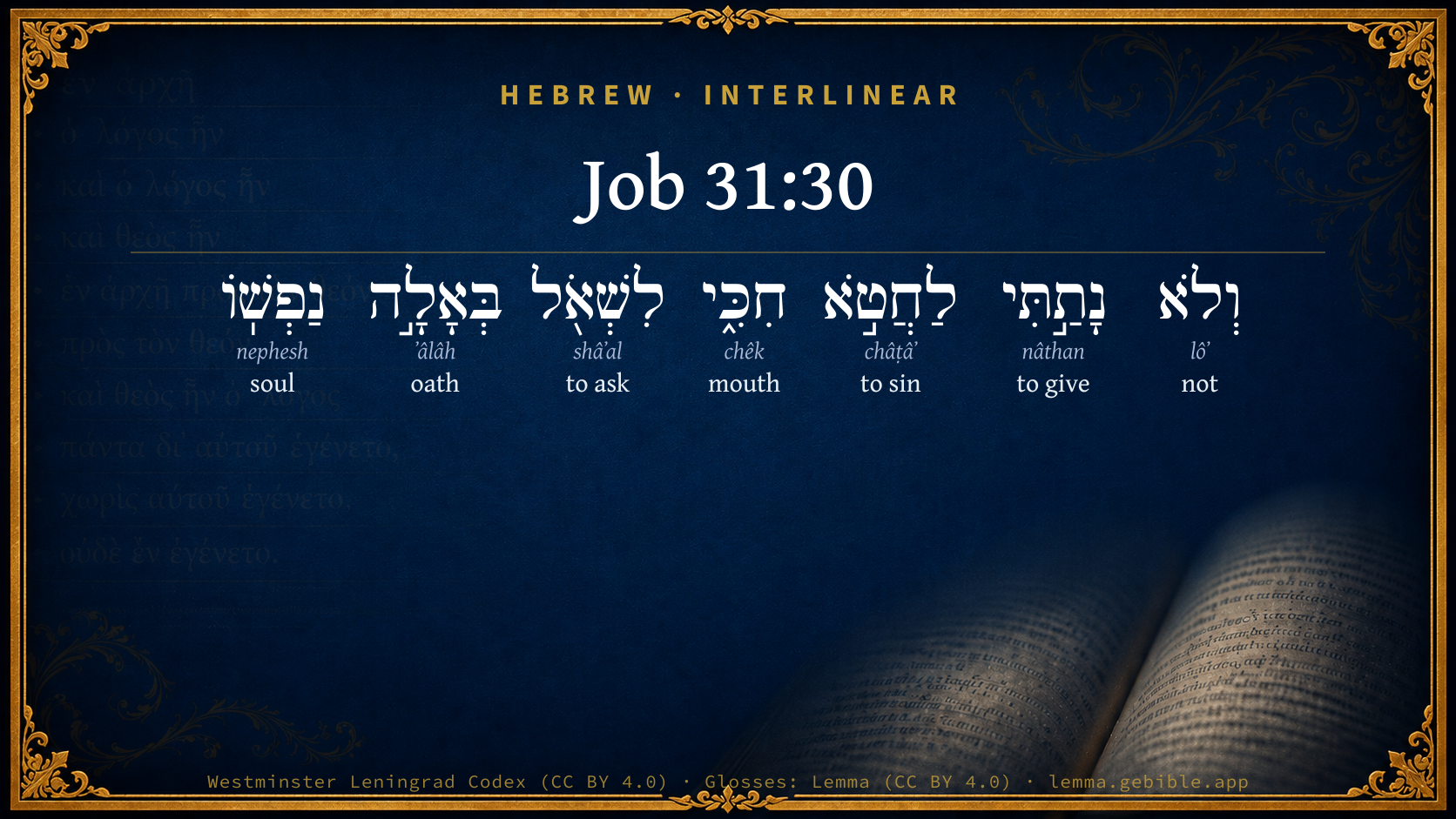
Hebrew (Westminster Leningrad Codex) Job 31:30 appears in the Hebrew Old Testament. The text above is from the Westminster Leningrad Codex. Each word links to its Strong’s number, a concise gloss, and parsing drawn from the Open Scriptures Hebrew Bible morphology. Click any word for its full Brown-Driver-Briggs (BDB) entry.
Download image
Cite this verse

Job 31:30 (World English Bible). Public Domain. Lemma interlinear Bible study tool, https://lemma.gebible.app/v/job/31/30.

Show BibTeX & RIS
BibTeX
RIS
English Translation
(Yes, I have not allowed my mouth to sin By asking his life with a curse);
World English Bible · Public Domain
Download a study sheet

One document with this verse’s original text, its word-by-word gloss line, the meaning frame, cross-references with their text, attributed commentary, and full source and license credits — printable, and it pastes into notes with its structure intact.

This verse Autodidact and up

Study sheet (.html) Plain text (.txt)

A passage Seminary Student

Up to 50 verses in one chapter. A passage sheet keeps up to 6 commentary sources and 12 cross-references per verse, in the order this page ranks them, and says so on the sheet whenever that leaves anything out. Ask for a single verse and you get the Autodidact verse sheet above.

Everything on this page stays free to read, with no account — the sheet is a download of what is already on screen, not access to it.

Want to remove ads? Support Godless Engineer
Compare translations 3

The same verse in 3 English versions, stacked beneath the original-language interlinear above. Click any original word for its lexicon entry.

Each is an independent rendering of the whole verse — the interlinear is not word-aligned to these translations.

Highlighted words mark where these versions differ — a whole-verse word diff, not a word-by-word alignment.

  • World English Bible Public Domain
    (Yes, I have not allowed my mouth to sin By asking his life with a curse);
  • King James Version Public Domain
    Neither have I suffered my mouth to sin by wishing a curse to his soul.
  • unfoldingWord Literal Text CC BY-SA 4.0
    For I have not caused my palate to sin by asking his life with a curse.

unfoldingWord Literal Text — © unfoldingWord, licensed CC BY-SA 4.0. Word-aligned USFM3 via Door43 (git.door43.org/unfoldingWord/en_ult).

Versions to compare (up to 4)

3 of 4 selected

Show all 18 translations

Every available English version of this verse, each an independent rendering of the whole verse.

  • World English Bible Public Domain
    (Yes, I have not allowed my mouth to sin By asking his life with a curse);
  • Berean Standard Bible Public Domain
    I have not allowed my mouth to sin by asking for his life with a curse—
  • Majority Standard Bible Public Domain
    I have not allowed my mouth to sin by asking for his life with a curse—
  • King James Version Public Domain
    Neither have I suffered my mouth to sin by wishing a curse to his soul.
  • American Standard Version (1901) Public Domain
    (Yea, I have not suffered by mouth to sin By asking his life with a curse);
  • Revised Version (1885) Public Domain
    (Yea, I suffered not my mouth to sin by asking his life with a curse;)
  • Geneva Bible (1599) Public Domain
    Neither haue I suffred my mouth to sinne, by wishing a curse vnto his soule.
  • Douay-Rheims (1899) Public Domain
    For I have not given my mouth to sin, by wishing a curse to his soul.
  • Young's Literal Translation Public Domain
    Yea, I have not suffered my mouth to sin, To ask with an oath his life.
  • Literal Standard Version CC BY-SA 4.0
    Indeed, I have not permitted my mouth to sin, || To ask with an oath his life.
  • Unlocked Literal Bible CC BY-SA 4.0
    Indeed, I have not even allowed my mouth to sin by asking for his life with a curse.
  • unfoldingWord Literal Text CC BY-SA 4.0
    For I have not caused my palate to sin by asking his life with a curse.
  • Darby Bible Public Domain
    (Neither have I suffered my mouth to sin by asking his life with a curse;)
  • World Messianic Bible Public Domain
    (I have certainly not allowed my mouth to sin by asking his life with a curse);
  • Webster's Bible Public Domain
    Neither have I suffered my mouth to sin by wishing a curse to his soul.
  • Free Bible Version CC BY-SA 4.0
    I have never allowed my mouth to sin by putting a curse on someone's life.
  • Bible in Basic English Public Domain
    (For I did not let my mouth give way to sin, in putting a curse on his life;)
  • JPS Tanakh (1917) Public Domain
    Yea, I suffered not my mouth to sin by asking his life with a curse.

Literal Standard Version (2020), Covenant Press — licensed CC BY-SA 4.0. Text via the HelloAO Bible API (eBible.org). Unlocked Literal Bible (unfoldingWord) — licensed CC BY-SA 4.0. Text via the HelloAO Bible API (eBible.org). unfoldingWord Literal Text — © unfoldingWord, licensed CC BY-SA 4.0. Word-aligned USFM3 via Door43 (git.door43.org/unfoldingWord/en_ult). Free Bible Version, Dr. Jonathan Gallagher — licensed CC BY-SA 4.0. Text via the HelloAO Bible API (eBible.org).

Word by word

More ways to search: Search by grammar → Find every occurrence → Compare this word →

Practice this passage: Drill this verse → Learn its vocabulary →

About this verse

These counts appear in no published source. They are computed here, from the morphology-tagged text and Lemma’s own curated glosses. What Lemma adds →

7
words
7
distinct lemmas
Wisdom
section

Notable vocabulary

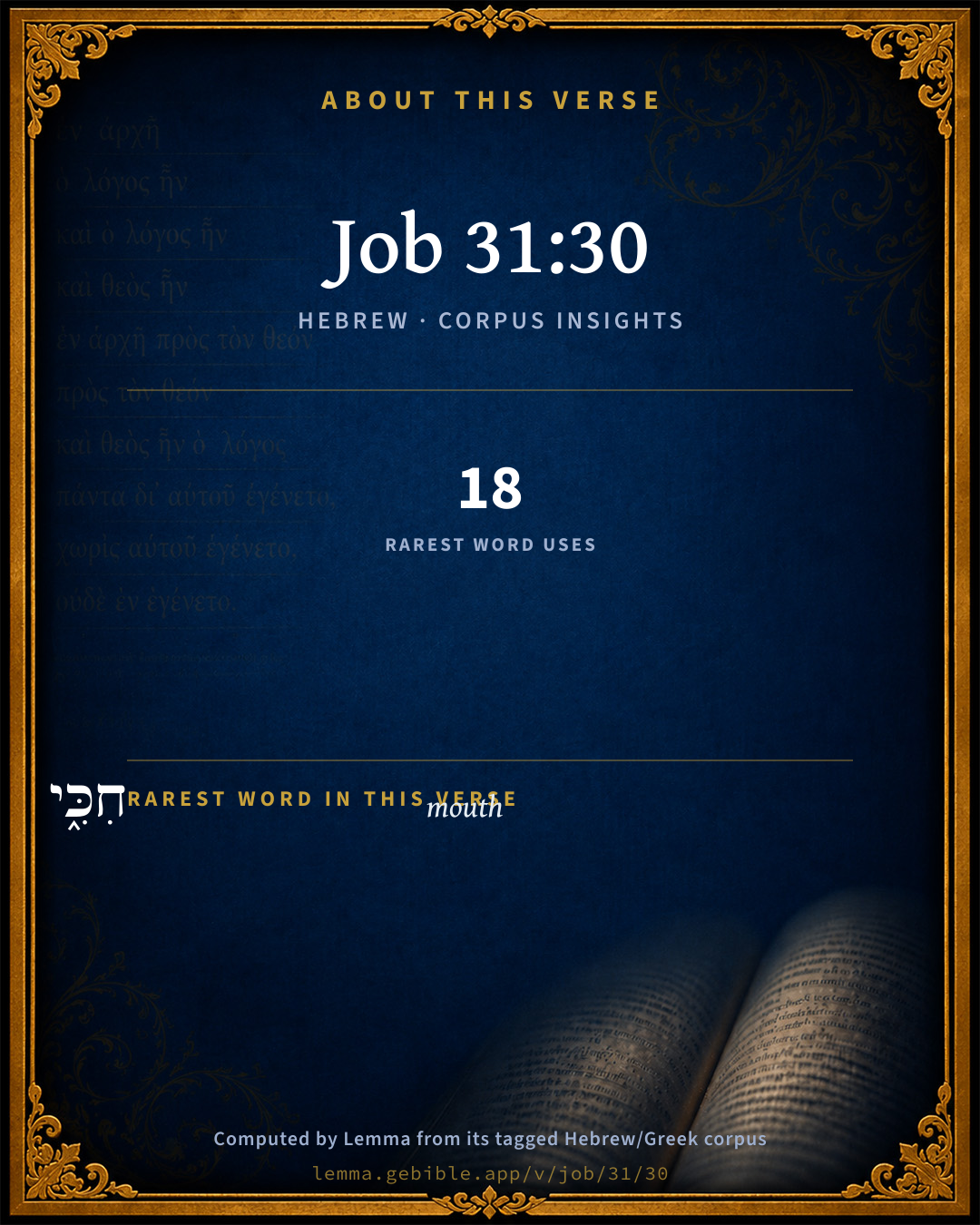
The rarest word here is חִכִּ֑י mouth H2441 — appearing just 18 times in the whole Hebrew Bible.

Shared distinctive vocabulary

חִכִּ֑י mouth H2441 occurs in 18 verses of the Hebrew Bible. Also found in:

Grammatical profile

  • 3 verbs
  • 3 nouns
  • 1 particle

Verb forms

  • נָתַ֣תִּי Qal · Perfect
  • לַחֲטֹ֣א Qal · Infinitive Construct
  • לִשְׁאֹ֖ל Qal · Infinitive Construct

Hebrew & Septuagint length

In English translation the verse runs 16 words from the Hebrew and 19 from the Septuagint (LXX English) — closely comparable.

A rough comparison of the two English renderings, which tokenize alike — not a word-level alignment.

Word counts can differ between the Hebrew and the Greek without any difference in meaning — e.g. the Hebrew direct-object marker אֵת has no separate Greek word, and Greek often adds the article ὁ.

Cross-references

11

Topical passages linked to Job 31:30 in the Treasury of Scripture Knowledge — connected by theme and wording, ordered by reader-vote popularity; previews shown in the World English Bible.

  • Romans 12:14 Bless those who persecute you; bless, and don't curse.
  • 1 Peter 3:9 not rendering evil for evil, or reviling for reviling; but instead blessing; knowing that to this were you called, that you may inherit a blessing.
  • Exodus 23:4–5 "If you meet your enemy's ox or his donkey going astray, you shall surely bring it back to him again.
  • Matthew 5:22 But I tell you, that everyone who is angry with his brother without a cause shall be in danger of the judgment; and whoever shall say to his brother, 'Raca!' shall be in danger of the council; and whoever shall say, 'You fool!' shall be in danger of the fire of Gehenna.
  • Matthew 5:43–44 "You have heard that it was said, 'You shall love your neighbor, and hate your enemy.'
  • James 3:9–10 With it we bless our God and Father, and with it we curse men, who are made in the image of God.
  • 1 Peter 2:22–23 who did not sin, "neither was deceit found in his mouth."
  • Ecclesiastes 5:2 Don't be rash with your mouth, and don't let your heart be hasty to utter anything before God; for God is in heaven, and you on earth. Therefore let your words be few.
  • Ecclesiastes 5:6 Don't allow your mouth to lead you into sin. Don't protest before the messenger that this was a mistake. Why should God be angry at your voice, and destroy the work of your hands?
  • Matthew 12:36 I tell you that every idle word that men speak, they will give account of it in the day of judgment.
  • James 3:6 And the tongue is a fire. The world of iniquity among our members is the tongue, which defiles the whole body, and sets on fire the course of nature, and is set on fire by Gehenna.

Cross-references courtesy of OpenBible.info (CC BY 4.0).

Hebrew and Greek witnesses Masoretic Hebrew ↔ Greek Septuagint

The same verse in the two great witnesses to the Old Testament, shown verse-for-verse.

These are two independent witnesses, not word-aligned to each other, and the Septuagint is shown in lemma (dictionary) form.

Hebrew Job 31:30 Masoretic · Westminster Leningrad Codex

וְלֹא נָתַ֣תִּי לַחֲטֹ֣א חִכִּ֑י לִשְׁאֹ֖ל בְּאָלָ֣ה נַפְשֽׁוֹ

(Yes, I have not allowed my mouth to sin By asking his life with a curse);

World English Bible · Public Domain

Greek LXX Job 31:30 Septuagint · lemma form

ἀκούω ἄρα ὁ οὖς ἐγώ ὁ κατάρα ἐγώ θρυλέω δέ ἄρα ὑπό λαός ἐγώ κακόω

let then my ear hear my curse, and let me be a byword among my people in my affliction.

LXX2012 (modern English Septuagint) · Public Domain

On this verse, Haydock's Catholic Bible Commentary discusses the Septuagint’s reading. Read the note in Commentary ↓

Hebrew: Westminster Leningrad Codex (CC BY 4.0). Greek: Septuagint (public domain); English from LXX2012 (modern English Septuagint) (Public Domain). How the Septuagint differs from the Hebrew →

Commentary

Notes on Job 31:30 from classic Christian and Jewish commentators (each source and its license shown beneath its notes). The classic Christian expositions comment on the surrounding passage and are grouped to its opening verse, so a note may address several verses; the Jewish commentaries on the Tanakh (Rashi and others) are per-verse, so they appear only where the commentator wrote on this verse.

Lemma curates 59 commentaries, every one of them public domain or Creative Commons licensed, each selected and text-cleaned for this edition rather than reprinted as found. About our sources →

Jamieson, Fausset & Brown

Robert Jamieson, A. R. Fausset & David Brown

mouth--literally, "palate." (See on Job 6:30).

wishing--literally, "so as to demand his (my enemy's) soul," that is, "life by a curse." This verse parenthetically confirms Job 31:30. Job in the patriarchal age of the promise, anterior to the law, realizes the Gospel spirit, which was the end of the law (compare Lev 19:18; Deu 23:6, with Mat 5:43-44).

Jamieson, Fausset & Brown — Commentary Critical and Explanatory on the Whole Bible (1871) — public domain (CC PDM 1.0). Text via the HelloAO Bible API.

Trapp's Complete Commentary

John Trapp

Job 31:30 Neither have I suffered my mouth to sin by wishing a curse to his soul.

Ver. 30. Neither have I suffered my mouth to sin] Heb. my palate; which is one of the nine instruments of speech. I have not so much as broken out into any passionate word against him; but when I was raging ripe I refrained, and forbore boisterous and blustering expressions, whereby some would have vented their choler in such a case. Nothing is more easy and ordinary than to curse an enemy; by prayer at least to turn him over to God to be punished; as David did Nabal, and it was soon done. But Job, out of private revenge, dared not do this, whatever David did out of a zeal of God’s glory, which wicked men sought to deface.

By wishing a curse to his soul] Heb. by asking his life by a curse. Job knew that cursing men are cursed men, Psa 109:18. If the prophets cursed their enemies at any time, as Elisha did the children at Bethel, and David oft in the Psalms, it was not livore vindictae, sed zelo iustitae, not out of a vindictive spirit, but by the instinct of God’s Holy Spirit, and out of zeal for God’s glory (Gorran.). Our rule is, "Bless them that persecute you: bless, and curse not," Rom 12:14. Render not evil for evil, or railing for railing; but contrariwise bless, knowing that we are thereunto called, that we should inherit a blessing, 1Pe 3:9. Epiphanius and Chrysostom falling out about Origen’s writings, wished a curse to one another; and it ocurred accordingly; the one died ere he came home, and the other was unbishoped.

John Trapp, A Commentary or Exposition upon All the Books of the Old and New Testament (1647–1656) — public domain. Text from a community e-Sword module.

Adam Clarke's Commentary

Verse 30. Neither have I suffered my mouth to sin] I have neither spoken evil of him, nor wished evil to him. How few of those called Christians can speak thus concerning their enemies; or those who have done them any mischief!

Adam Clarke's Commentary on the Bible (1810–1826) — public domain. Text from a community e-Sword/MySword module.

The Cambridge Bible for Schools and Colleges

gen. ed. J. J. S. Perowne

30. The verse, which is parenthetical, reads,

(Yea, I suffered not my mouth to sin,

To ask, with a curse, his life).

He was so far from rejoicing in the evil that befell his enemy that he had never permitted himself even in hasty anger to throw out an imprecation against him. On the obligation of love to enemies comp. Pro_24:17 seq., Pro_25:21 seq.

The Cambridge Bible for Schools and Colleges (gen. ed. J. J. S. Perowne; Cambridge University Press, 1878–1918) — public domain. Text from a community e-Sword module.

John Gill's Exposition

The stranger did not lodge in the street,.... By a stranger is not meant an unconverted man, that is a stranger to God and godliness, to Christ, and the way of salvation by him, to the Spirit of God and spiritual things, nor a good man, who is a stranger and pilgrim on earth; but one that is out of his nation and country, and at a distance from it, whether a good man or a bad man; these Job would not suffer to lie in the streets in the night season, exposed to the air and the inclemencies of it; see Jdg 19:15;

but I opened my doors to the traveller; even all the doors of his house, to denote his great liberality, that as many as would might enter it; and this was done by himself, or, however, by his order; and some think that it signifies that he was at his door, waiting and watching for travellers to invite them in, as Abraham and Lot, Gen 18:1; or his doors were opened "to the way" (i): as it may be rendered, to the roadside; his house was built by the wayside; or, however, the doors which lay towards that side were thrown open for travellers to come in at as they pleased, and when they would; so very hospitable and kind to strangers and travellers was Job, and so welcome were they to his house and the entertainment of it, see Heb 13:2.

(i) "ad semitam seu viam", Mercerus; "versus viam", Piscator, Michaelis; Ben Gersom.

John Gill's Exposition of the Whole Bible (1746–1763) — public domain (CC PDM 1.0). Text via the HelloAO Bible API.

Albert Barnes' Notes on the Bible

Neither have I suffered my mouth - Margin, as in Hebrew, palate. The word is often used for the mouth in general, and especially as the organ of the voice from the use and importance of the palate in speaking. Pro 8:7. “For my palate (חכי chikiy) speaketh truth.” It is used as the organ of taste, Job 12:11; compare Job 6:30; Psa 119:103.

By wishing a curse to his soul - It must have been an extraordinary degree of piety which would permit a man to say this with truth, that he had never harbored a wish of injury to an enemy. Few are the people, probably, even now, who could say this, and who are enabled to keep their minds free from every wish that calamities and woes may overtake those who are seeking their hurt. Yet this is the nature of true religion. It controls the heart, represses the angry and revengeful feelings, and creates in the soul an earnest desire for the happiness even of those who injure us.

Albert Barnes' Notes on the Bible (1834–1885) — public domain. Text from a community e-Sword/MySword module.

Haydock's Catholic Bible Commentary

For. Septuagint, "Then let mine ear hear my curse, and may I fall a prey to the whispers of my people."

George Leo Haydock (1774–1849), Haydock's Catholic Family Bible and Commentary, 1859 edition — public domain. Excludes Psalms (Douay-Rheims chapter numbering differs from Protestant) and Deuterocanonical books (Catholic canon only).

Matthew Poole's English Annotations

My mouth, Heb. my palate, which being one of the instruments of speech, is put for another, or for all the rest. The sense is, If any secret passion or desire of his hurt did arise in me, I forthwith suppressed it, and did not suffer it to grow and break forth into an imprecation of hurt to him.

Matthew Poole's English Annotations on the Holy Bible (1683–1685) — public domain. Text from a community e-Sword/MySword module.

Whedon's Commentary on the Bible

Daniel D. Whedon

30. Wishing a curse to his soul — Rather, demanding his life with a curse. See note, Job_3:8. Job denies that he has by any imprecation sought to enlist deity against his enemy. Tacitus, speaking of the interference of Piso with the offering of sacrifices for the recovery of Germanicus from dangerous illness, says, “Even the victims already at the altar were driven away, and the apparatus for sacrifice overturned,” etc. — Annals, 2:69. Compare 1Ki_3:11.

Daniel D. Whedon (gen. ed.), Commentary on the Old and New Testaments (1874–1909) — public domain. Text from a community e-Sword module.

The Pulpit Commentary

Neither have I suffered my mouth to sin by wishing a curse to his soul. Much less, Job means, have I gone beyond the thought to the word, and imprecated a curse upon him with my mouth, as the manner of most,hen is towards their enemies. (see 2Sa_16:5 1Sa_17:43 Neh_13:25 Psa_109:28 Jer_15:10, etc)

The Pulpit Commentary (1880–1919), ed. H.D.M. Spence-Jones & Joseph S. Exell — public domain. Text from a community e-Sword module.

Rashi

Rabbi Shlomo Yitzchaki (Rashi)

but I did not allow my palate to sin to provoke my enemy and to sue him for money that he does not owe me, in order to adjure him and to ask for the soul of my enemy with an oath.

Rashi on the Tanakh — English translations: “The Judaica Press complete Tanach with Rashi, translated by A. J. Rosenberg” (CC BY 4.0); “Pentateuch with Rashi's commentary by M. Rosenbaum and A.M. Silbermann, 1929-1934” (public domain); “The Metsudah Tanach series, Lakewood, N.J” (CC BY 4.0); and “The Book of Joshua, Metsudah Publications, 1997” (CC BY 4.0). Text via Sefaria.

Lesson kit

Teaching starters — assembled from the data on this page, not authored interpretation. Every prompt links to the verse data it draws on. Edit before teaching.

Job, in the Wisdom, opens this verse with 7 words (7 distinct Hebrew lemmas). Its most distinctive word is chêk (“mouth”). A historical commentator’s framing appears above. Read the whole chapter for the surrounding context.

Discussion questions

  1. What does “mouth” (chêk) contribute to the verse as a whole?
  2. Job 6:30 shares the word «mouth» with this verse. How do the two illuminate each other?
  3. These translations render this verse differently; the difference is in the English rendering, not the original. What questions does that raise?
  4. The verb «נָתַ֣תִּי» is Qal Perfect. How does its form color the action?
  5. Reading how Jamieson, Fausset & Brown and Trapp's Complete Commentary read this verse, where do the two commentators agree and where do they part?

Things to notice

Reading settings

Reading text

Shown beneath each verse's original-language words.

Old Testament
Old Testament edition

Read the OT as the Masoretic Hebrew (MT) or the Greek Septuagint (LXX).

English shown for the Greek Septuagint (in the Hebrew ↔ Greek comparison).

Comparing translations? Open the Compare panel on any verse page to stack up to four side by side.