
1 Kings 16:13

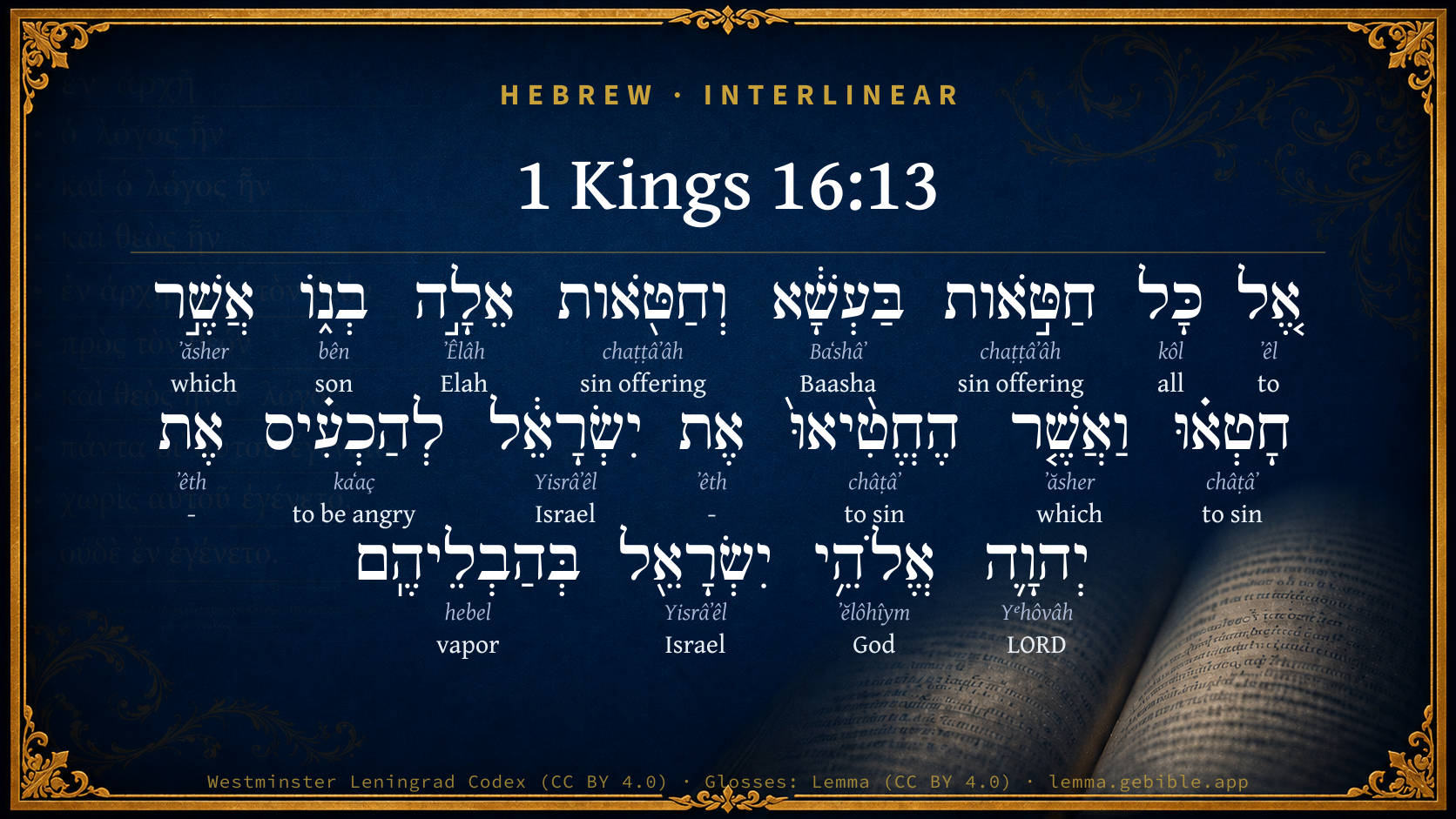
Hebrew (Westminster Leningrad Codex) 1 Kings 16:13 appears in the Hebrew Old Testament. The text above is from the Westminster Leningrad Codex. Each word links to its Strong’s number, a concise gloss, and parsing drawn from the Open Scriptures Hebrew Bible morphology. Click any word for its full Brown-Driver-Briggs (BDB) entry.
Download image
Cite this verse

1 Kings 16:13 (World English Bible). Public Domain. Lemma interlinear Bible study tool, https://lemma.gebible.app/v/1-kings/16/13.

Show BibTeX & RIS
BibTeX
RIS
English Translation
for all the sins of Baasha, and the sins of Elah his son, which they sinned, and with which they made Israel to sin, to provoke Yahweh, the God of Israel, to anger with their vanities.
World English Bible · Public Domain
Download a study sheet

One document with this verse’s original text, its word-by-word gloss line, the meaning frame, cross-references with their text, attributed commentary, and full source and license credits — printable, and it pastes into notes with its structure intact.

This verse Autodidact and up

Study sheet (.html) Plain text (.txt)

A passage Seminary Student

Up to 50 verses in one chapter. A passage sheet keeps up to 6 commentary sources and 12 cross-references per verse, in the order this page ranks them, and says so on the sheet whenever that leaves anything out. Ask for a single verse and you get the Autodidact verse sheet above.

Everything on this page stays free to read, with no account — the sheet is a download of what is already on screen, not access to it.

Want to remove ads? Support Godless Engineer
Compare translations 3

The same verse in 3 English versions, stacked beneath the original-language interlinear above. Click any original word for its lexicon entry.

Each is an independent rendering of the whole verse — the interlinear is not word-aligned to these translations.

Highlighted words mark where these versions differ — a whole-verse word diff, not a word-by-word alignment.

  • World English Bible Public Domain
    for all the sins of Baasha, and the sins of Elah his son, which they sinned, and with which they made Israel to sin, to provoke Yahweh, the God of Israel, to anger with their vanities.
  • King James Version Public Domain
    For all the sins of Baasha, and the sins of Elah his son, by which they sinned, and by which they made Israel to sin, in provoking the LORD God of Israel to anger with their vanities.
  • unfoldingWord Literal Text CC BY-SA 4.0
    concerning all of the sins of Baasha and the sins of Elah his son that they sinned, and because they caused Israel to sin, provoking Yahweh, the God of Israel, with their vapors.

unfoldingWord Literal Text — © unfoldingWord, licensed CC BY-SA 4.0. Word-aligned USFM3 via Door43 (git.door43.org/unfoldingWord/en_ult).

Versions to compare (up to 4)

3 of 4 selected

Show all 18 translations

Every available English version of this verse, each an independent rendering of the whole verse.

  • World English Bible Public Domain
    for all the sins of Baasha, and the sins of Elah his son, which they sinned, and with which they made Israel to sin, to provoke Yahweh, the God of Israel, to anger with their vanities.
  • Berean Standard Bible Public Domain
    This happened because of all the sins Baasha and his son Elah had committed and had caused Israel to commit, provoking the LORD, the God of Israel, to anger with their worthless idols.
  • Majority Standard Bible Public Domain
    This happened because of all the sins Baasha and his son Elah had committed and had caused Israel to commit, provoking the LORD, the God of Israel, to anger with their worthless idols.
  • King James Version Public Domain
    For all the sins of Baasha, and the sins of Elah his son, by which they sinned, and by which they made Israel to sin, in provoking the LORD God of Israel to anger with their vanities.
  • American Standard Version (1901) Public Domain
    for all the sins of Baasha, and the sins of Elah his son, which they sinned, and wherewith they made Israel to sin, to provoke Jehovah, the God of Israel, to anger with their vanities.
  • Revised Version (1885) Public Domain
    for all the sins of Baasha, and the sins of Elah his son, which they sinned, and wherewith they made Israel to sin, to provoke the LORD, the God of Israel, to anger with their vanities.
  • Geneva Bible (1599) Public Domain
    For all the sinnes of Baasha, and sinnes of Elah his sonne, which they sinned and made Israel to sinne, and prouoked the Lord God of Israel with their vanities.
  • Douay-Rheims (1899) Public Domain
    For all the sins of Baasa, and the sins of Ela his son, who sinned, and made Israel to sin, provoking the Lord the God of Israel with their vanities.
  • Young's Literal Translation Public Domain
    concerning all the sins of Baasha, and the sins of Elah his son, that they sinned, and that they caused Israel to sin to provoke Jehovah, God of Israel, with their vanities.
  • Literal Standard Version CC BY-SA 4.0
    concerning all the sins of Baasha, and the sins of his son Elah, that they sinned, and that they caused Israel to sin to provoke YHWH, God of Israel, with their vanities.
  • Unlocked Literal Bible CC BY-SA 4.0
    for all the sins of Baasha and the sins of Elah his son that they committed, and by which they had led Israel to sin, so that they provoked Yahweh, the God of Israel, to anger with their idols.
  • unfoldingWord Literal Text CC BY-SA 4.0
    concerning all of the sins of Baasha and the sins of Elah his son that they sinned, and because they caused Israel to sin, provoking Yahweh, the God of Israel, with their vapors.
  • Darby Bible Public Domain
    for all the sins of Baasha, and the sins of Elah his son, which they sinned and wherewith they made Israel to sin, provoking Jehovah the God of Israel to anger with their vanities.
  • World Messianic Bible Public Domain
    for all the sins of Baasha, and the sins of Elah his son, which they sinned and with which they made Israel to sin, to provoke the LORD, the God of Israel, to anger with their vanities.
  • Webster's Bible Public Domain
    For all the sins of Baasha, and the sins of Elah his son, by which they sinned, and by which they made Israel to sin, in provoking the LORD God of Israel to anger with their vanities.
  • Free Bible Version CC BY-SA 4.0
    This was because of all the sins Baasha and his son Elah had committed and had made Israel to commit. Their worship of their useless idols had angered the Lord, the God of Israel.
  • Bible in Basic English Public Domain
    Because of all the sins of Baasha, and the sins of Elah his son, which they did and made Israel do, moving the Lord, the God of Israel, to wrath by their foolish acts.
  • JPS Tanakh (1917) Public Domain
    for all the sins of Baasa, and the sins of Elah his son, which they sinned, and wherewith they made Israel to sin, to provoke the LORD, the God of Israel, with their vanities.

Literal Standard Version (2020), Covenant Press — licensed CC BY-SA 4.0. Text via the HelloAO Bible API (eBible.org). Unlocked Literal Bible (unfoldingWord) — licensed CC BY-SA 4.0. Text via the HelloAO Bible API (eBible.org). unfoldingWord Literal Text — © unfoldingWord, licensed CC BY-SA 4.0. Word-aligned USFM3 via Door43 (git.door43.org/unfoldingWord/en_ult). Free Bible Version, Dr. Jonathan Gallagher — licensed CC BY-SA 4.0. Text via the HelloAO Bible API (eBible.org).

Word by word

More ways to search: Search by grammar → Find every occurrence → Compare this word →

Practice this passage: Drill this verse → Learn its vocabulary →

אֵלָ֣ה
ʼÊlâh
H425
“Elah”
Noun, Proper
Part of Speech
Noun
Type
Proper
Full BDB Definition

Origin: the same as H424

TWOT: None

Elah = "An oak" - an Edomite chief - a king of Israel for two years, son of Baasha - the father of king Hoshea of Israel - a son of Caleb - son of Uzzi
  1. אֶ֚ל ʼêl H413 “to” Preposition
  2. כָּל kôl H3605 “all of” Noun, Common, Masculine, Singular, Construct
  3. חַטֹּ֣אות chaṭṭâʼâh H2403 “sin offerings of” Noun, Common, Feminine, Plural, Construct
  4. בַּעְשָׁ֔א Baʻshâʼ H1201 “Baasha” Noun, Proper
  5. וְחַטֹּ֖אות chaṭṭâʼâh H2403 “and · sin offerings of” Conjunction + Noun, Common, Feminine, Plural, Construct
  6. בְנ֑וֹ bên H1121 “son · his” Noun, Common, Masculine, Singular, Construct + Suffix, Personal, 3rd Person, Masculine, Singular
  7. אֲשֶׁ֣ר ʼăsher H834 “which” Particle, Relative
  8. חָטְא֗וּ châṭâʼ H2398 “to sin” Verb, Qal, Perfect, 3rd Person, Common, Plural
  9. וַאֲשֶׁ֤ר ʼăsher H834 “and · which” Conjunction + Particle, Relative
  10. הֶחֱטִ֨יאוּ֙ châṭâʼ H2398 “to sin” Verb, Hiphil, Perfect, 3rd Person, Common, Plural
  11. אֶת ʼêth H853 “-” Particle, Direct Object
  12. יִשְׂרָאֵ֔ל Yisrâʼêl H3478 “Israel” Noun, Proper
  13. לְהַכְעִ֗יס kaʻaç H3707 “to be angry” Preposition + Verb, Hiphil, Infinitive Construct
  14. אֶת ʼêth H853 “-” Particle, Direct Object
  15. יְהוָ֛ה Yᵉhôvâh H3068 “LORD” Noun, Proper
  16. אֱלֹהֵ֥י ʼĕlôhîym H430 “God(s) of” Noun, Common, Masculine, Plural, Construct
  17. יִשְׂרָאֵ֖ל Yisrâʼêl H3478 “Israel” Noun, Proper
  18. בְּהַבְלֵיהֶֽם hebel H1892 “in/at · vanities · their” Preposition + Noun, Common, Masculine, Plural, Construct + Suffix, Personal, 3rd Person, Masculine, Plural

About this verse

These counts appear in no published source. They are computed here, from the morphology-tagged text and Lemma’s own curated glosses. What Lemma adds →

19
words
14
distinct lemmas
Historical
section

Notable vocabulary

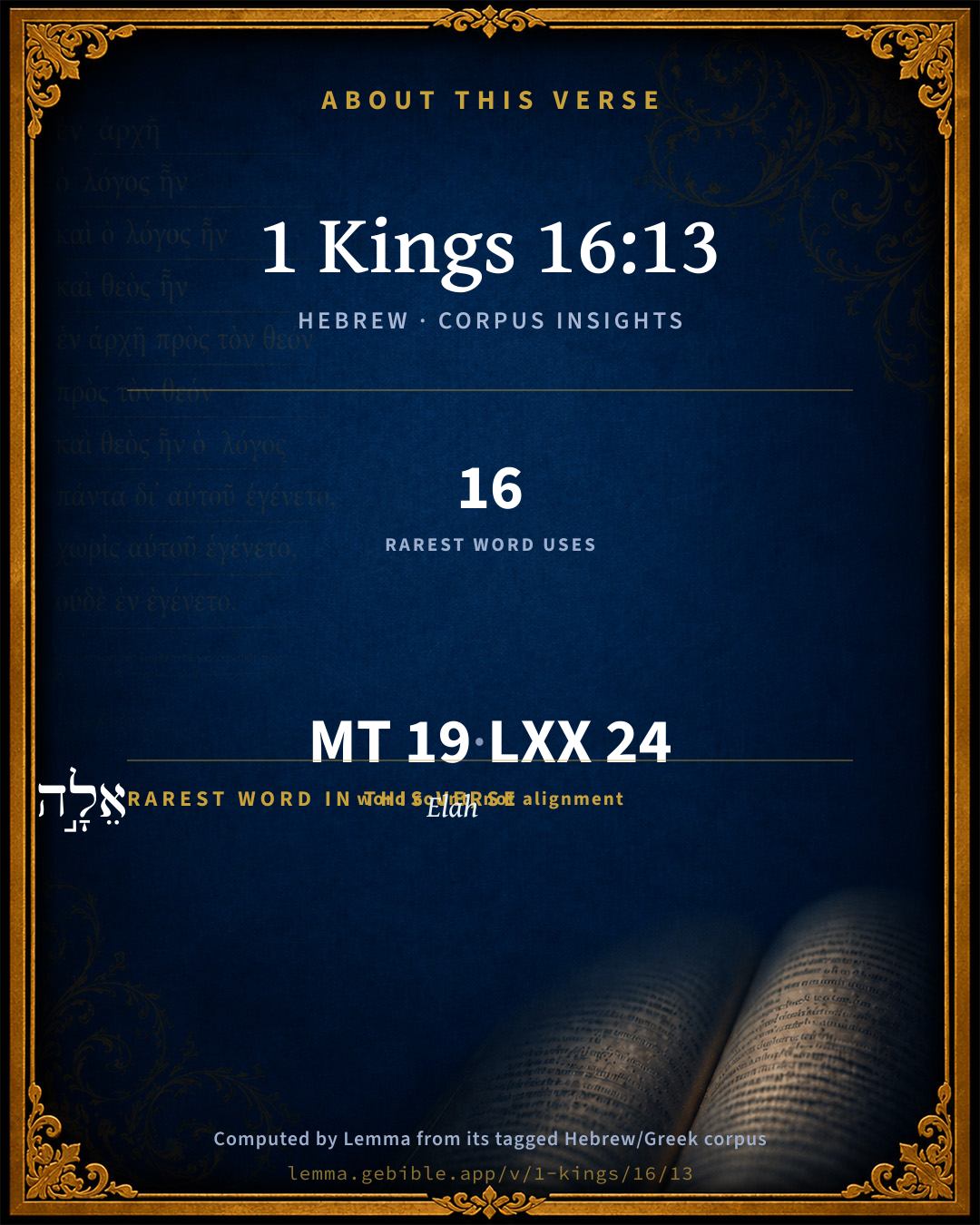
The rarest word here is אֵלָ֣ה Elah H425 — appearing just 16 times in the whole Hebrew Bible.

Shared distinctive vocabulary

אֵלָ֣ה Elah H425 occurs in 15 verses of the Hebrew Bible. Also found in:

Grammatical profile

  • 3 verbs
  • 11 nouns
  • 1 preposition
  • 4 particles

Verb forms

  • חָטְא֗וּ Qal · Perfect
  • הֶחֱטִ֨יאוּ֙ Hiphil · Perfect
  • לְהַכְעִ֗יס Hiphil · Infinitive Construct

Repetition

Words recur within this verse — often emphatic in Hebrew:

  • חַטֹּ֣אות sin offering H2403 ×2
  • חָטְא֗וּ to sin H2398 ×2
  • יִשְׂרָאֵ֔ל Israel H3478 ×2
  • אֲשֶׁ֣ר which H834 ×2

Hebrew & Septuagint length

In English translation the verse runs 36 words from the Hebrew and 27 from the Septuagint (LXX English) — closely comparable.

A rough comparison of the two English renderings, which tokenize alike — not a word-level alignment.

Word counts can differ between the Hebrew and the Greek without any difference in meaning — e.g. the Hebrew direct-object marker אֵת has no separate Greek word, and Greek often adds the article ὁ.

In the original languages it is 19 Hebrew tokens and 24 Greek tokens — but the two are counted differently (Hebrew bundles its prefixes and suffixes into one token; the Greek is in lemma form), so that isn’t a like-for-like length.

Cross-references

12

Topical passages linked to 1 Kings 16:13 in the Treasury of Scripture Knowledge — connected by theme and wording, ordered by reader-vote popularity; previews shown in the World English Bible.

  • Deuteronomy 32:21 They have moved me to jealousy with that which is not God; They have provoked me to anger with their vanities: I will move them to jealousy with those who are not a people; I will provoke them to anger with a foolish nation.
  • 1 Samuel 12:21 and don't turn aside; for [then would you go] after vain things which can't profit nor deliver, for they are vain.
  • 1 Kings 15:30 for the sins of Jeroboam which he sinned, and with which he made Israel to sin, because of his provocation with which he provoked Yahweh, the God of Israel, to anger.
  • Isaiah 41:29 Behold, all of them, their works are vanity [and] nothing; their molten images are wind and confusion.
  • Jeremiah 10:15 They are vanity, a work of delusion: in the time of their visitation they shall perish.
  • 2 Kings 17:15 They rejected his statutes, and his covenant that he made with their fathers, and his testimonies which he testified to them; and they followed vanity, and became vain, and [went] after the nations that were round about them, concerning whom Yahweh had charged those who they should not do like them.
  • Jeremiah 10:3–5 For the customs of the peoples are vanity; for one cuts a tree out of the forest, the work of the hands of the workman with the axe.
  • Jeremiah 10:8 But they are together brutish and foolish: the instruction of idols! it is but a stock.
  • Jonah 2:8 Those who regard lying vanities forsake their own mercy.
  • Romans 1:21–23 Because, knowing God, they didn't glorify him as God, neither gave thanks, but became vain in their reasoning, and their senseless heart was darkened.
  • 1 Corinthians 8:4 Therefore concerning the eating of things sacrificed to idols, we know that no idol is anything in the world, and that there is no other God but one.
  • 1 Corinthians 10:19–20 What am I saying then? That a thing sacrificed to idols is anything, or that an idol is anything?

Cross-references courtesy of OpenBible.info (CC BY 4.0).

Hebrew and Greek witnesses Masoretic Hebrew ↔ Greek Septuagint

The same verse in the two great witnesses to the Old Testament, shown verse-for-verse.

These are two independent witnesses, not word-aligned to each other, and the Septuagint is shown in lemma (dictionary) form.

Hebrew 1 Kings 16:13 Masoretic · Westminster Leningrad Codex

אֶ֚ל כָּל חַטֹּ֣אות בַּעְשָׁ֔א וְחַטֹּ֖אות אֵלָ֣ה בְנ֑וֹ אֲשֶׁ֣ר חָטְא֗וּ וַאֲשֶׁ֤ר הֶחֱטִ֨יאוּ֙ אֶת יִשְׂרָאֵ֔ל לְהַכְעִ֗יס אֶת יְהוָ֛ה אֱלֹהֵ֥י יִשְׂרָאֵ֖ל בְּהַבְלֵיהֶֽם

for all the sins of Baasha, and the sins of Elah his son, which they sinned, and with which they made Israel to sin, to provoke Yahweh, the God of Israel, to anger with their vanities.

World English Bible · Public Domain

Greek LXX 1 Kings 16:13 Septuagint · lemma form

περί πᾶς ὁ ἁμαρτία βαασα καί ηλα ὁ υἱός αὐτός ὡς ἐκἁμαρτάνω ὁ ἰσραήλ ὁ παραὀργίζω κύριος ὁ θεός ἰσραήλ ἐν ὁ μάταιος αὐτός

for all the sins of Baasa and Ela his son, as he led Israel astray to sin, to provoke the Lord God of Israel with their vanities.

LXX2012 (modern English Septuagint) · Public Domain

On this verse, The Cambridge Bible for Schools and Colleges discusses the Septuagint’s reading. Read the note in Commentary ↓

Hebrew: Westminster Leningrad Codex (CC BY 4.0). Greek: Septuagint (public domain); English from LXX2012 (modern English Septuagint) (Public Domain). How the Septuagint differs from the Hebrew →

Targum (Aramaic paraphrase)

1

The Targum is the ancient Jewish Aramaic paraphrase of the Hebrew Scriptures — an interpretive translation, not the Hebrew text itself. Onkelos (literal) and Pseudo-Jonathan (expansive) render the Torah, and Jonathan the Prophets. Coverage is partial: where no permissively-licensed English translation exists for a verse, only the Aramaic is shown. This is verse-level text, not a word-by-word alignment to the Hebrew.

  1. Targum Jonathan Prophets (Joshua–Malachi)
    עַל כָּל חוֹבֵי בַעְשָׁא וְחוֹבֵי אֵלָה בְרֵיהּ דִי חָבוּ וְדִי חַיִבוּ יַת יִשְׂרָאֵל לְאַרְגָזָא קֳדָם יְיָ אֱלָהָא דְיִשְׂרָאֵל בְּטַעֲוַתְהוֹן:

    (no public-domain English translation for this verse)

    Targum Jonathan — Aramaic: “Mikraot Gedolot” (public domain). English: “Sefaria Community Translation” (CC0 1.0 (public-domain dedication)); “London "Chaldee Paraphrase," 1871” (public domain). Text via Sefaria.

Commentary

Notes on 1 Kings 16:13 from classic Christian and Jewish commentators (each source and its license shown beneath its notes). The classic Christian expositions comment on the surrounding passage and are grouped to its opening verse, so a note may address several verses; the Jewish commentaries on the Tanakh (Rashi and others) are per-verse, so they appear only where the commentator wrote on this verse.

Lemma curates 59 commentaries, every one of them public domain or Creative Commons licensed, each selected and text-cleaned for this edition rather than reprinted as found. About our sources →

Trapp's Complete Commentary

John Trapp

1Ki 16:13 For all the sins of Baasha, and the sins of Elah his son, by which they sinned, and by which they made Israel to sin, in provoking the LORD God of Israel to anger with their vanities.

Ver. 13. And by which they made others to sin.] Height of place ever addeth two wings to sin, example and scandal, whereby it soareth higher and flieth much further.

John Trapp, A Commentary or Exposition upon All the Books of the Old and New Testament (1647–1656) — public domain. Text from a community e-Sword module.

Adam Clarke's Commentary

Verse 13. For all the sins of Baasha] We see why it was that God permitted such judgments to fall on this family. Baasha was a grievous offender, and so also was his son Elah; and they caused the people to sin; and they provoked God to anger by their idolatries.

Adam Clarke's Commentary on the Bible (1810–1826) — public domain. Text from a community e-Sword/MySword module.

Ellicott's Commentary for English Readers

(13) Vanities—that is, idols (as in Deu_32:21; 1Sa_12:21; Psa_31:6; Isa_41:29; Jer. viii 19; &c.): not only the idols of Dan and Bethel, but the worse abominations which grew up under cover of these. In the Old Testament generally the contempt for idolatry and false worship as a gross folly, wasting faith on unrealities, is at least as strong as the condemnation of them, as outraging God’s law, and connected with sensual or bloody rites. (See, for example, the utter scorn of Isa_44:9-20; Psa_115:4-8.)

A Bible Commentary for English Readers, edited by Charles John Ellicott (1878–1897) — public domain. Text from a community e-Sword module.

The Cambridge Bible for Schools and Colleges

gen. ed. J. J. S. Perowne

13. by which they sinned, and by which they made] R.V. which they sinned and wherewith they made, as in other places. The LXX. has nothing to represent ‘by which they sinned.’

vanities] This word is often employed in the Old Testament of false gods, and the worship paid to them. The idea is that such a deity is nothing, and such prayers can have no result.

The Cambridge Bible for Schools and Colleges (gen. ed. J. J. S. Perowne; Cambridge University Press, 1878–1918) — public domain. Text from a community e-Sword module.

John Gill's Exposition

And Omri went up from Gibbethon, and all Israel with him,.... He, and the army under him, broke up the siege of that place, and marched to Tirzah; which, according, to Bunting (c) were thirty six miles distant from each other: and they besieged Tirzah; the royal city, in which Zimri was.

(c) Travels, &c. p. 162.

John Gill's Exposition of the Whole Bible (1746–1763) — public domain (CC PDM 1.0). Text via the HelloAO Bible API.

Albert Barnes' Notes on the Bible

Their vanities - The “calves.” The Hebrews call an idol by terms signifying “emptiness,” “vapor,” or “nothingness.” (Compare marginal references.)

Albert Barnes' Notes on the Bible (1834–1885) — public domain. Text from a community e-Sword/MySword module.

Haydock's Catholic Bible Commentary

Vanities; idols. (Haydock) --- They raised fresh altars; or, by their example, encouraged the people to persevere in their impiety. (Menochius)

George Leo Haydock (1774–1849), Haydock's Catholic Family Bible and Commentary, 1859 edition — public domain. Excludes Psalms (Douay-Rheims chapter numbering differs from Protestant) and Deuterocanonical books (Catholic canon only).

Matthew Poole's English Annotations

i.e. Idols, oft called vanities, as Deu 32:21; 1Sa 12:21; Jer 14:22, because they are but imaginary deities, and mere nothings, 1Co 8:4, having nothing at all of a God in them, and nothing of power to do either good or hurt.

Matthew Poole's English Annotations on the Holy Bible (1683–1685) — public domain. Text from a community e-Sword/MySword module.

The Pulpit Commentary

For la, corresponds with the l of ver. 7 = propter; (cf. 1Ki_14:5 1Ki_21:22) all the sins of Baasha, and the sins of Elah his son, by which they sinned, and by which they made Israel to sin, in provoking the Lord God of Israel to anger the formula of 1Ki_15:30, etc. with their vanities. The calves, not idols, are referred to here. Cf. Deu_32:21; 1Co_8:4. The same idea is embodied in the word Bethaven; (Hos_4:15 Hos_5:8)

The Pulpit Commentary (1880–1919), ed. H.D.M. Spence-Jones & Joseph S. Exell — public domain. Text from a community e-Sword module.

John Wesley's Explanatory Notes

Vanities - Idols called vanities; because they are but imaginary deities, and mere nothings; having no power to do either good or hurt.

John Wesley, Explanatory Notes Upon the Whole Bible (1754–1765) — public domain. Text via the GEBible commentary corpus.

Lesson kit

Teaching starters — assembled from the data on this page, not authored interpretation. Every prompt links to the verse data it draws on. Edit before teaching.

1 Kings, in the Historical, opens this verse with 19 words (14 distinct Hebrew lemmas). Its most distinctive word is ʼÊlâh (“Elah”). A historical commentator’s framing appears above. Read the whole chapter for the surrounding context.

Discussion questions

  1. What does “Elah” (ʼÊlâh) contribute to the verse as a whole?
  2. Genesis 36:41 shares the word «Elah» with this verse. How do the two illuminate each other?
  3. “sin offering” occurs 2× in this one verse. What is the effect of the repetition?
  4. These translations render this verse differently; the difference is in the English rendering, not the original. What questions does that raise?
  5. The verb «חָטְא֗וּ» is Qal Perfect. How does its form color the action?
  6. Reading how Trapp's Complete Commentary and Adam Clarke's Commentary read this verse, where do the two commentators agree and where do they part?

Things to notice

Reading settings

Reading text

Shown beneath each verse's original-language words.

Old Testament
Old Testament edition

Read the OT as the Masoretic Hebrew (MT) or the Greek Septuagint (LXX).

English shown for the Greek Septuagint (in the Hebrew ↔ Greek comparison).

Comparing translations? Open the Compare panel on any verse page to stack up to four side by side.