
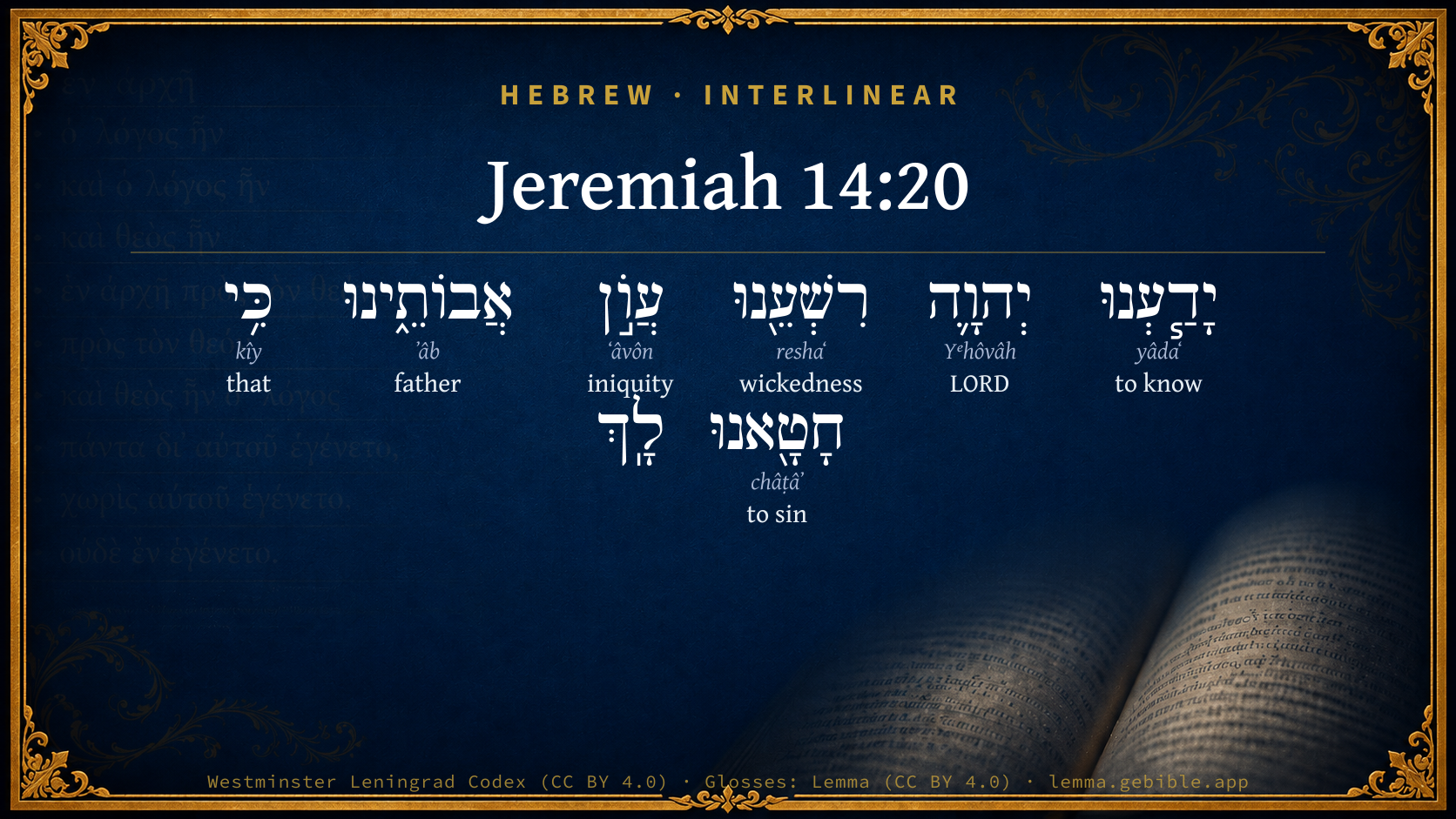
Jeremiah 14:20

Hebrew (Westminster Leningrad Codex) Jeremiah 14:20 appears in the Hebrew Old Testament. The text above is from the Westminster Leningrad Codex. Each word links to its Strong’s number, a concise gloss, and parsing drawn from the Open Scriptures Hebrew Bible morphology. Click any word for its full Brown-Driver-Briggs (BDB) entry.
Download image
Cite this verse

Jeremiah 14:20 (World English Bible). Public Domain. Lemma interlinear Bible study tool, https://lemma.gebible.app/v/jeremiah/14/20.

Show BibTeX & RIS
BibTeX
RIS
English Translation
We acknowledge, Yahweh, our wickedness, and the iniquity of our fathers; for we have sinned against you.
World English Bible · Public Domain
Download a study sheet

One document with this verse’s original text, its word-by-word gloss line, the meaning frame, cross-references with their text, attributed commentary, and full source and license credits — printable, and it pastes into notes with its structure intact.

This verse Autodidact and up

Study sheet (.html) Plain text (.txt)

A passage Seminary Student

Up to 50 verses in one chapter. A passage sheet keeps up to 6 commentary sources and 12 cross-references per verse, in the order this page ranks them, and says so on the sheet whenever that leaves anything out. Ask for a single verse and you get the Autodidact verse sheet above.

Everything on this page stays free to read, with no account — the sheet is a download of what is already on screen, not access to it.

Want to remove ads? Support Godless Engineer
Compare translations 3

The same verse in 3 English versions, stacked beneath the original-language interlinear above. Click any original word for its lexicon entry.

Each is an independent rendering of the whole verse — the interlinear is not word-aligned to these translations.

Highlighted words mark where these versions differ — a whole-verse word diff, not a word-by-word alignment.

  • World English Bible Public Domain
    We acknowledge, Yahweh, our wickedness, and the iniquity of our fathers; for we have sinned against you.
  • King James Version Public Domain
    We acknowledge, O LORD, our wickedness, and the iniquity of our fathers: for we have sinned against thee.
  • unfoldingWord Literal Text CC BY-SA 4.0
    We know, Yahweh, our wickedness, the iniquity of our fathers, for we have sinned against you.

unfoldingWord Literal Text — © unfoldingWord, licensed CC BY-SA 4.0. Word-aligned USFM3 via Door43 (git.door43.org/unfoldingWord/en_ult).

Versions to compare (up to 4)

3 of 4 selected

Show all 18 translations

Every available English version of this verse, each an independent rendering of the whole verse.

  • World English Bible Public Domain
    We acknowledge, Yahweh, our wickedness, and the iniquity of our fathers; for we have sinned against you.
  • Berean Standard Bible Public Domain
    We acknowledge our wickedness, O LORD, the guilt of our fathers; indeed, we have sinned against You.
  • Majority Standard Bible Public Domain
    We acknowledge our wickedness, O LORD, the guilt of our fathers; indeed, we have sinned against You.
  • King James Version Public Domain
    We acknowledge, O LORD, our wickedness, and the iniquity of our fathers: for we have sinned against thee.
  • American Standard Version (1901) Public Domain
    We acknowledge, O Jehovah, our wickedness, and the iniquity of our fathers; for we have sinned against thee.
  • Revised Version (1885) Public Domain
    We acknowledge, O LORD, our wickedness, and the iniquity of our fathers: for we have sinned against thee.
  • Geneva Bible (1599) Public Domain
    We acknowledge, O Lord, our wickednesse and the iniquitie of our fathers: for we haue sinned against thee.
  • Douay-Rheims (1899) Public Domain
    We acknowledge, O Lord, our wickedness, the iniquities of our fathers, because we have sinned against thee.
  • Young's Literal Translation Public Domain
    We have known, O Jehovah, our wickedness, The iniquity of our fathers, For we have sinned against Thee.
  • Literal Standard Version CC BY-SA 4.0
    We have known, O YHWH, our wickedness, || The iniquity of our fathers, || For we have sinned against You.
  • Unlocked Literal Bible CC BY-SA 4.0
    We admit, Yahweh, our offenses, the iniquity of our ancestors, for we have sinned against you.
  • unfoldingWord Literal Text CC BY-SA 4.0
    We know, Yahweh, our wickedness, the iniquity of our fathers, for we have sinned against you.
  • Darby Bible Public Domain
    Jehovah, we acknowledge our wickedness, the iniquity of our fathers; for we have sinned against thee.
  • World Messianic Bible Public Domain
    We acknowledge, LORD, our wickedness, and the iniquity of our fathers; for we have sinned against you.
  • Webster's Bible Public Domain
    We acknowledge, O LORD, our wickedness, and the iniquity of our fathers; for we have sinned against thee.
  • Free Bible Version CC BY-SA 4.0
    Lord, we admit our wickedness, the guilt of our forefathers as well as our own sins against you.
  • Bible in Basic English Public Domain
    We are conscious, O Lord, of our sin and of the wrongdoing of our fathers: we have done evil against you.
  • JPS Tanakh (1917) Public Domain
    We acknowledge, O LORD, our wickedness, even the iniquity of our fathers; for we have sinned against Thee.

Literal Standard Version (2020), Covenant Press — licensed CC BY-SA 4.0. Text via the HelloAO Bible API (eBible.org). Unlocked Literal Bible (unfoldingWord) — licensed CC BY-SA 4.0. Text via the HelloAO Bible API (eBible.org). unfoldingWord Literal Text — © unfoldingWord, licensed CC BY-SA 4.0. Word-aligned USFM3 via Door43 (git.door43.org/unfoldingWord/en_ult). Free Bible Version, Dr. Jonathan Gallagher — licensed CC BY-SA 4.0. Text via the HelloAO Bible API (eBible.org).

Word by word

More ways to search: Search by grammar → Find every occurrence → Compare this word →

Practice this passage: Drill this verse → Learn its vocabulary →

About this verse

These counts appear in no published source. They are computed here, from the morphology-tagged text and Lemma’s own curated glosses. What Lemma adds →

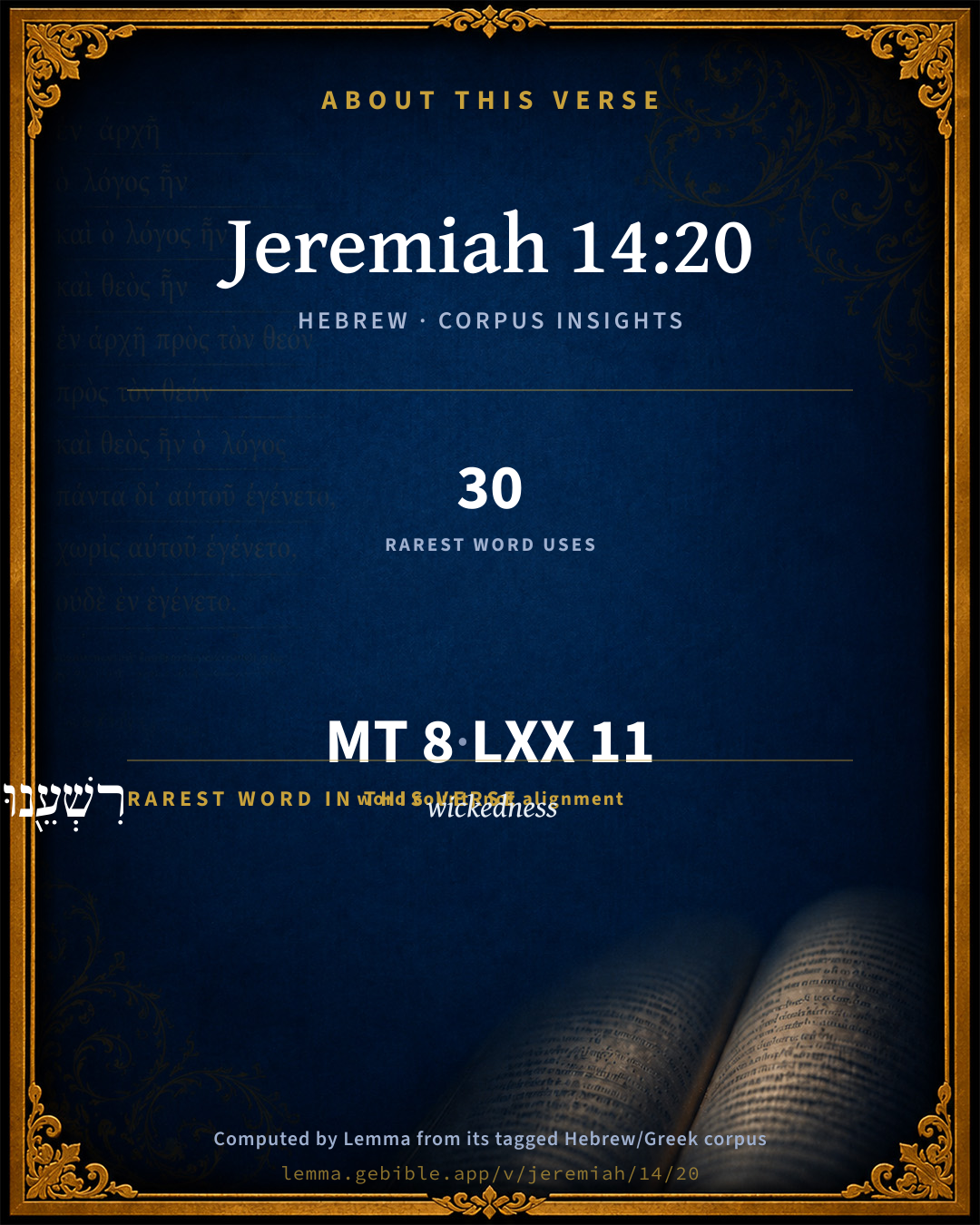
8
words
7
distinct lemmas
Prophets
section

Shared distinctive vocabulary

רִשְׁעֵ֖נוּ wickedness H7562 occurs in 29 verses of the Hebrew Bible. Also found in:

Grammatical profile

  • 2 verbs
  • 4 nouns
  • 1 preposition
  • 1 conjunction

Verb forms

  • יָדַ֧עְנוּ Qal · Perfect
  • חָטָ֖אנוּ Qal · Perfect

Hebrew & Septuagint length

In the original languages it is 8 Hebrew tokens and 11 Greek tokens — but the two are counted differently (Hebrew bundles its prefixes and suffixes into one token; the Greek is in lemma form), so that isn’t a like-for-like length.

Cross-references

14

Topical passages linked to Jeremiah 14:20 in the Treasury of Scripture Knowledge — connected by theme and wording, ordered by reader-vote popularity; previews shown in the World English Bible.

  • Psalms 32:5 I acknowledged my sin to you. I didn't hide my iniquity. I said, I will confess my transgressions to Yahweh, And you forgave the iniquity of my sin. Selah.
  • Jeremiah 3:25 Let us lie down in our shame, and let our confusion cover us; for we have sinned against Yahweh our God, we and our fathers, from our youth even to this day; and we have not obeyed the voice of Yahweh our God.
  • Luke 15:18–21 I will get up and go to my father, and will tell him, "Father, I have sinned against heaven, and in your sight.
  • 1 John 1:7–9 But if we walk in the light, as he is in the light, we have fellowship with one another, and the blood of Jesus Christ, his Son, cleanses us from all sin.
  • Leviticus 26:40–42 "'If they confess their iniquity, and the iniquity of their fathers, in their trespass which they trespassed against me, and also that, because they walked contrary to me,
  • Psalms 51:3–4 For I know my transgressions. My sin is constantly before me.
  • Psalms 106:6–48 We have sinned with our fathers. We have committed iniquity. We have done wickedly.
  • Jeremiah 3:13 Only acknowledge your iniquity, that you have transgressed against Yahweh your God, and have scattered your ways to the strangers under every green tree, and you have not obeyed my voice, says Yahweh.
  • Daniel 9:5–8 we have sinned, and have dealt perversely, and have done wickedly, and have rebelled, even turning aside from your precepts and from your ordinances;
  • 2 Samuel 12:13 David said to Nathan, "I have sinned against Yahweh." Nathan said to David, "Yahweh also has put away your sin. You will not die.
  • 2 Samuel 24:10 David's heart struck him after that he had numbered the people. David said to Yahweh, I have sinned greatly in that which I have done: but now, Yahweh, put away, I beg you, the iniquity of your servant; for I have done very foolishly.
  • Ezra 9:6–7 and I said, my God, I am ashamed and blush to lift up my face to you, my God; for our iniquities are increased over our head, and our guiltiness is grown up to the heavens.
  • Nehemiah 9:2 The seed of Israel separated themselves from all foreigners, and stood and confessed their sins, and the iniquities of their fathers.
  • Job 33:27 He sings before men, and says, 'I have sinned, and perverted that which was right, And it didn't profit me.

Cross-references courtesy of OpenBible.info (CC BY 4.0).

Hebrew and Greek witnesses Masoretic Hebrew ↔ Greek Septuagint

The same verse in the two great witnesses to the Old Testament, shown verse-for-verse.

These are two independent witnesses, not word-aligned to each other, and the Septuagint is shown in lemma (dictionary) form.

Hebrew Jeremiah 14:20 Masoretic · Westminster Leningrad Codex

יָדַ֧עְנוּ יְהוָ֛ה רִשְׁעֵ֖נוּ עֲוֺ֣ן אֲבוֹתֵ֑ינוּ כִּ֥י חָטָ֖אנוּ לָֽךְ

We acknowledge, Yahweh, our wickedness, and the iniquity of our fathers; for we have sinned against you.

World English Bible · Public Domain

Greek LXX Structure differs

In the Septuagint, Jeremiah is about an eighth shorter than the Hebrew and arranges its material differently — the Oracles Against the Nations (Hebrew chapters 46–51) appear in the middle of the Greek book, after 25:13. Because the chapter and verse boundaries do not line up, a verse-for-verse comparison with the Hebrew is not shown.

A verse-for-verse comparison isn’t shown here because the chapters and verses don’t line up. Switch to the LXX edition with the MT / LXX toggle above to read the Greek directly.

Hebrew: Westminster Leningrad Codex (CC BY 4.0). Greek: Septuagint (public domain); English from a public-domain English Septuagint. How the Septuagint differs from the Hebrew →

Targum (Aramaic paraphrase)

1

The Targum is the ancient Jewish Aramaic paraphrase of the Hebrew Scriptures — an interpretive translation, not the Hebrew text itself. Onkelos (literal) and Pseudo-Jonathan (expansive) render the Torah, and Jonathan the Prophets. Coverage is partial: where no permissively-licensed English translation exists for a verse, only the Aramaic is shown. This is verse-level text, not a word-by-word alignment to the Hebrew.

  1. Targum Jonathan Prophets (Joshua–Malachi)
    יְדַעְנָא יְיָ חוֹבָנָא וְחוֹבֵי אֲבָהָתָנָא אֲרֵי חַבְנָא קָדָמָךְ:

    (no public-domain English translation for this verse)

    Targum Jonathan — Aramaic: “Mikraot Gedolot” (public domain). English: “Sefaria Community Translation” (CC0 1.0 (public-domain dedication)); “London "Chaldee Paraphrase," 1871” (public domain). Text via Sefaria.

Commentary

Notes on Jeremiah 14:20 from classic Christian and Jewish commentators (each source and its license shown beneath its notes). The classic Christian expositions comment on the surrounding passage and are grouped to its opening verse, so a note may address several verses; the Jewish commentaries on the Tanakh (Rashi and others) are per-verse, so they appear only where the commentator wrote on this verse.

Lemma curates 59 commentaries, every one of them public domain or Creative Commons licensed, each selected and text-cleaned for this edition rather than reprinted as found. About our sources →

Trapp's Complete Commentary

John Trapp

Jer 14:20 We acknowledge, O LORD, our wickedness, [and] the iniquity of our fathers: for we have sinned against thee.

Ver. 20. We acknowledge, O Lord, our wickedness.] We, the better sort of us, do so. And so the saints have ever done in their interdealings with God, falling low at his footstool for pardoning and prevailing mercy.

John Trapp, A Commentary or Exposition upon All the Books of the Old and New Testament (1647–1656) — public domain. Text from a community e-Sword module.

The Biblical Illustrator

Joseph S. Exell

Jer_14:20

We acknowledge, O Lord, our wickedness.

Frank acknowledgment of guilt

Next to the merit of not sinning is confessing sin. A learned man has said, The three hardest words in the English language are--I was mistaken. Frederick the Great wrote to the Senate: I have just lost a great battle, and it was entirely my own fault. Goldsmith said, This confession displayed more greatness than all his victories. Such a prompt acknowledgment of his fault recalls Bacons course in more trying circumstances. I do plainly and ingenuously confess, said the great Chancellor, that I am guilty of corruption, and so renounce all defence. I beseech your lordships to be merciful to a broken reed. (A. T. Pierson.)

True repentance avails with God

When a man undertakes to repent towards his fellowmen, it is repenting straight up a precipice; when he repents towards law it is repenting in a crocodiles jaws; when he repents towards public sentiment, it is throwing himself into a thicket of brambles and thorns; but when he repents towards God, he repents towards all love and delicacy. God receives the soul, as the sea the bather, to return it again, purer and whiter than He took it. (H. W. Beecher.)

The Biblical Illustrator, edited by Joseph S. Exell (c. 1880s–1900s) — public domain. Text from a community e-Sword module.

Geneva Bible (1599)

Geneva Bible translators

He teacheth the Church a form of prayer to humble themselves to God by true repentance, which is the only means to avoid this famine, which was the beginning of God’s plagues.

Geneva Bible (1599) marginal notes — public domain. Text via Bolls.life.

Jamieson, Fausset & Brown

Robert Jamieson, A. R. Fausset & David Brown

(Dan 9:8).

Jamieson, Fausset & Brown — Commentary Critical and Explanatory on the Whole Bible (1871) — public domain (CC PDM 1.0). Text via the HelloAO Bible API.

Adam Clarke's Commentary

Verse 20. We acknowledge, O Lord, our wickedness] This the prophet did in behalf of the people; but, alas! they did not join him.

Adam Clarke's Commentary on the Bible (1810–1826) — public domain. Text from a community e-Sword/MySword module.

John Calvin's Commentaries

The Prophet here prescribes no doubt to the Jews the way of appeasing God. He before uttered a prayer, partly in order to reprove the people for their wicked obstinacy, and partly to shew to the godly and the elect that there remained some hope. But now he uses a simple form of prayer, when he says, O Lord, we know, etc Hardly one in a thousand then did know; but the Prophet does not assume the character of the whole people; and why not? He doubtless knew that the faithful among the people were very few; but he dictates for posterity a right form of prayer, so that they might iu exile know that this one thing only remained for them — to confess their sins, as otherwise they could not obtain pardon.

He therefore says, We know our wickedness and the iniquity of our fathers; for we have done wickedly against thee We have already explained the Prophet’s meaning in these few words, — that when God puts forth his hand against us, there is no hope of salvation, except we repent. But confession is here put for repentance. Hypocrites are indeed very free in confessing their sins; but the Prophet speaks here of real confession; and by stating a part for the whole, everything included in repentance, as I have said, is intended. But the object here is to shew, that they were humbly to seek forgiveness, which could not be done, except they condemned themselves before God, and thus anticipated his judgment.

He speaks of the iniquity of the fathers, not that the faithful seek associates, here and there, for the sake of extenuating their guilt; but it was an aggravation of their sins, when they confessed that they were not only guilty themselves before God, but that they had brought from the womb what was, as it were, hereditary, so that they deserved death because they were the descendants of ungodly parents. Whilst hypocrites allege the examples of fathers, they think themselves thus absolved, or at least not so culpable, because they had learnt what they practice from their childhood, because a bad education had led them astray. But the faithful are of a far different mind; for they confess themselves worthy of God’s vengeance, though he inquired not into the wickedness of their fathers; and they think also that God acts justly, when he executes vengeance on account of their fathers’ sins, being thus worthy of a twofold vengeance.

We now then understand what the Prophet means; and hence we learn how foolishly the Papists set up this shield against God; that is, by having the word fathers often on their lips; for they ought on the contrary to confess the wickedness and iniquities of their fathers, according to what is more fully enlarged upon in the ninth chapter of Daniel (Daniel 9), where he confesses that he himself and the fathers and kings had done wickedly. And in these words we may also notice, that it was not some slight fault that Jeremiah refers to when he said, “We acknowledge our iniquity and the iniquity of our fathers;” he mentions first the iniquity of the living; then the iniquity of their fathers, and adds, in the third place, “We have acted wickedly against thee.” We hence see that he did not formally acknowledge some slight faults, but he confesses most plainly, that they were all ungodly and transgressors of God’s law, and were worthy, not merely of a moderate chastisement, but of dreadful perdition, as they had thus provoked the wrath of God.

John Calvin's Commentaries (1540-1563) — public domain. Text from the Calvin Translation Society English edition (1840s-50s) via the Christian Classics Ethereal Library (ccel.org). Calvin's coverage is partial (roughly two-thirds of the Bible); uncommented books and verses are honest gaps, never fabricated. The 19th-century editor's footnotes and remarks are omitted so the notes are faithfully Calvin's own voice.

Ellicott's Commentary for English Readers

(20) And the iniquity.—The insertion of the conjunction weakens the force of the original. The wickedness which Israel confesses is the iniquity of its fathers, inherited, accepted, on the way to be perpetuated.

A Bible Commentary for English Readers, edited by Charles John Ellicott (1878–1897) — public domain. Text from a community e-Sword module.

The Cambridge Bible for Schools and Colleges

gen. ed. J. J. S. Perowne

20–22. In these vv. three pleas are urged on behalf of the people: (i) their contrition, (ii) God’s honour, (iii) their hopelessness of any other aid.

The Cambridge Bible for Schools and Colleges (gen. ed. J. J. S. Perowne; Cambridge University Press, 1878–1918) — public domain. Text from a community e-Sword module.

John Gill's Exposition

We acknowledge, O Lord, our wickedness, and the iniquity of our fathers,.... This is said by the prophet, in the name of the few faithful that were among this people, who were sensible of their own sins, the sins of their ancestors, and which they ingenuously confess; their fathers had sinned, and they had imitated them, and continued in the same, and therefore might justly expect the displeasure of the Lord, and his controversy with them:

for we have sinned against thee; Jer 14:7.

John Gill's Exposition of the Whole Bible (1746–1763) — public domain (CC PDM 1.0). Text via the HelloAO Bible API.

Matthew Poole's English Annotations

That is, both we and our fathers have sinned against thee, and have given thee a right to punish and destroy its; we desire not to cover or cloak our sin, we own and acknowledge it.

Matthew Poole's English Annotations on the Holy Bible (1683–1685) — public domain. Text from a community e-Sword/MySword module.

The Pulpit Commentary

Our wickedness, and the iniquity of our fathers. There is a mysterious connection between the sin of the past and of the present. So in another prophet we read, "Your iniquities and the iniquities of your fathers together will I requite.

Ver. 20 Jer_15:1. Prayer for mercy rejected.

I THE PRAYER IS BASED ON URGENT PLEAS.

1. A complete confession of sin. (Ver. 20) It is acknowledged as hereditary, bug as also personal. Therefore all claims must rest on Divine considerations, since no ground for prayer can be found in anything human.

2. The plea of the Name of God. This is a plea all men can urge. The character, the honor, and the glory of God are suggested by his Name. For the sake of what he is, and the glory that his mercy will reflect, we may plead for pardon. By his love we beg for his forgiveness.

3. The plea of disgrace to the throne of Gods glory. This is a more special plea. The temple was the house of God, wherein his glory was manifested. To destroy it was to put an end to the manifestation of Divine glory associated with it. God"s glory is reflected on his Church. If the Church is humiliated, disgrace falls on the throne of God"s glory. Yet, note, it is only the throne that is directly disgraced, not the glory itself. The tarnished mirror can no longer reflect the radiance of the sun; this is a discredit to the mirror, but not directly to the sun, since there is no diminution of the sun"s brightness. Still, indirectly, dishonor is done to the original source of glory. The sun is less admired if its light is less reflected. God is less honored if his glory is less manifested.

4. Plea of the Divine covenant. This is the most special plea. God has made promises. To the fulfillment of these his faithfulness is bound. He has made a covenant with his own people. They who have accepted the covenant plead its special claims. The Christian has not only the universal mercy of God to trust in; he has the special promises of the gospel, the assurance of the privileges of God"s restored Children.

II NEVERTHELESS THE PRAYER IS REJECTED.

1. Intercession is useless for those who will not repent and seek mercy for themselves. The prayer was that of the prophet on behalf of his impenitent countrymen. The intercession of good men is recognized as powerful. Their character adds weight to their intercession. (Jam_5:16) But not only must Jeremiah"s prayer be rejected, even Moses the founder of the nation and Samuel the father of the prophets could not prevail in the present case. The intercession of one greater than Moses, of Christ himself, will not save those who are obstinately hardened against returning to God.

2. The Name of God includes reference to his justice as wall as his mercy. For his Name"s sake he must vindicate the fight. The one-sided view of God which excludes all reference to his wrath is dishonoring. Even a man who can never feel righteous indignation is weak and imperfect. For a judge to acquit all criminals would be fatal to justice.

3. The throne of God"s glory is more dishonored by sin than by external disaster. The Jews feared discredit to the temple in its desecration by the heathen. It was more desecrated by their corrupt practices in it. To make the temple a den of thieves is more dishonoring than to overthrow it so as not to leave one stone upon another. The sins of Christ"s Church are more dishonoring to his Name than her sufferings, her willing subservience to the spirit of the world more humiliating than her apparent lowly condition when trampled under the feet of persecutors. The pure martyred Church is a glory to Christ, the corrupt prosperous Church a shame to his Name.

4. God"s covenant has human conditions. He condescends to bind himself to bless us so long as we fulfill our obligations to submit to him. Disobedience breaks the covenant. The faithless Christian cannot urge the pleas of the privileges of the gospel.

The Pulpit Commentary (1880–1919), ed. H.D.M. Spence-Jones & Joseph S. Exell — public domain. Text from a community e-Sword module.

Lesson kit

Teaching starters — assembled from the data on this page, not authored interpretation. Every prompt links to the verse data it draws on. Edit before teaching.

Jeremiah, in the Prophets, opens this verse with 8 words (7 distinct Hebrew lemmas). Its most distinctive word is reshaʻ (“wickedness”). A historical commentator’s framing appears above. Read the whole chapter for the surrounding context.

Discussion questions

  1. How does “wickedness” (reshaʻ) shape what this verse is saying?
  2. Deuteronomy 9:27 shares the word «wickedness» with this verse. How do the two illuminate each other?
  3. These translations render this verse differently; the difference is in the English rendering, not the original. What questions does that raise?
  4. The verb «יָדַ֧עְנוּ» is Qal Perfect. How does its form color the action?
  5. Reading how Trapp's Complete Commentary and The Biblical Illustrator read this verse, where do the two commentators agree and where do they part?

Things to notice

Reading settings

Reading text

Shown beneath each verse's original-language words.

Old Testament
Old Testament edition

Read the OT as the Masoretic Hebrew (MT) or the Greek Septuagint (LXX).

English shown for the Greek Septuagint (in the Hebrew ↔ Greek comparison).

Comparing translations? Open the Compare panel on any verse page to stack up to four side by side.