
Jeremiah 40:3

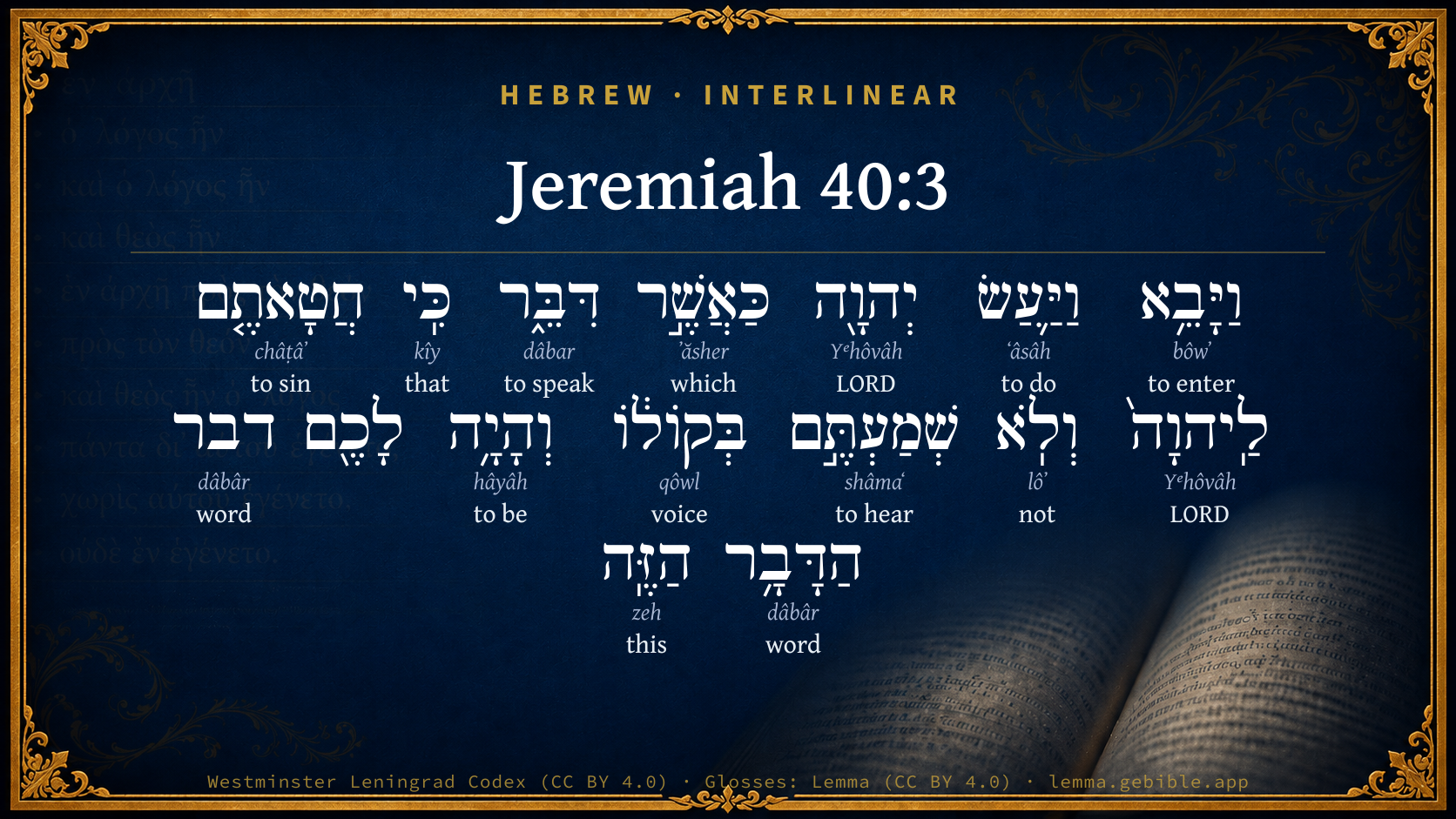
Hebrew (Westminster Leningrad Codex) Jeremiah 40:3 appears in the Hebrew Old Testament. The text above is from the Westminster Leningrad Codex. Each word links to its Strong’s number, a concise gloss, and parsing drawn from the Open Scriptures Hebrew Bible morphology. Click any word for its full Brown-Driver-Briggs (BDB) entry.
Download image
Cite this verse

Jeremiah 40:3 (World English Bible). Public Domain. Lemma interlinear Bible study tool, https://lemma.gebible.app/v/jeremiah/40/3.

Show BibTeX & RIS
BibTeX
RIS
English Translation
and Yahweh has brought it, and done according as he spoke: because you have sinned against Yahweh, and have not obeyed his voice, therefore this thing is come on you.
World English Bible · Public Domain
Download a study sheet

One document with this verse’s original text, its word-by-word gloss line, the meaning frame, cross-references with their text, attributed commentary, and full source and license credits — printable, and it pastes into notes with its structure intact.

This verse Autodidact and up

Study sheet (.html) Plain text (.txt)

A passage Seminary Student

Up to 50 verses in one chapter. A passage sheet keeps up to 6 commentary sources and 12 cross-references per verse, in the order this page ranks them, and says so on the sheet whenever that leaves anything out. Ask for a single verse and you get the Autodidact verse sheet above.

Everything on this page stays free to read, with no account — the sheet is a download of what is already on screen, not access to it.

Want to remove ads? Support Godless Engineer
Compare translations 3

The same verse in 3 English versions, stacked beneath the original-language interlinear above. Click any original word for its lexicon entry.

Each is an independent rendering of the whole verse — the interlinear is not word-aligned to these translations.

Highlighted words mark where these versions differ — a whole-verse word diff, not a word-by-word alignment.

  • World English Bible Public Domain
    and Yahweh has brought it, and done according as he spoke: because you have sinned against Yahweh, and have not obeyed his voice, therefore this thing is come on you.
  • King James Version Public Domain
    Now the LORD hath brought it, and done according as he hath said: because ye have sinned against the LORD, and have not obeyed his voice, therefore this thing is come upon you.
  • unfoldingWord Literal Text CC BY-SA 4.0
    So Yahweh brought it about. He did just as he had decreed, since you people sinned against him and did not obey his voice. That is why this thing has happened to you people.

unfoldingWord Literal Text — © unfoldingWord, licensed CC BY-SA 4.0. Word-aligned USFM3 via Door43 (git.door43.org/unfoldingWord/en_ult).

Versions to compare (up to 4)

3 of 4 selected

Show all 18 translations

Every available English version of this verse, each an independent rendering of the whole verse.

  • World English Bible Public Domain
    and Yahweh has brought it, and done according as he spoke: because you have sinned against Yahweh, and have not obeyed his voice, therefore this thing is come on you.
  • Berean Standard Bible Public Domain
    and now the LORD has fulfilled it; He has done just as He said. Because you people have sinned against the LORD and have not obeyed His voice, this thing has happened to you.
  • Majority Standard Bible Public Domain
    and now the LORD has fulfilled it; He has done just as He said. Because you people have sinned against the LORD and have not obeyed His voice, this thing has happened to you.
  • King James Version Public Domain
    Now the LORD hath brought it, and done according as he hath said: because ye have sinned against the LORD, and have not obeyed his voice, therefore this thing is come upon you.
  • American Standard Version (1901) Public Domain
    and Jehovah hath brought it, and done according as he spake: because ye have sinned against Jehovah, and have not obeyed his voice, therefore this thing is come upon you.
  • Revised Version (1885) Public Domain
    and the LORD hath brought it, and done according as he spake; because ye have sinned against the LORD, and have not obeyed his voice, therefore this thing is come upon you.
  • Geneva Bible (1599) Public Domain
    Nowe the Lord hath brought it, and done according as he hath said: because ye haue sinned against the Lord, and haue not obeyed his voyce, therefore this thing is come vpon you.
  • Douay-Rheims (1899) Public Domain
    And he hath brought it: and the Lord hath done as he hath said: because you have sinned against the Lord, and have not hearkened to his voice, and this word is come upon you.
  • Young's Literal Translation Public Domain
    and Jehovah bringeth `it' in, and doth as He spake, because ye have sinned against Jehovah, and have not hearkened to His voice, even this thing hath been to you.
  • Literal Standard Version CC BY-SA 4.0
    and YHWH brings [it] in, and does as He spoke, because you have sinned against YHWH, and have not listened to His voice, even this thing has been to you.
  • Unlocked Literal Bible CC BY-SA 4.0
    So Yahweh brought it about. He did just as he had decreed, since you people sinned against him and did not obey his voice. That is why this thing has happened to you people.
  • unfoldingWord Literal Text CC BY-SA 4.0
    So Yahweh brought it about. He did just as he had decreed, since you people sinned against him and did not obey his voice. That is why this thing has happened to you people.
  • Darby Bible Public Domain
    and Jehovah hath brought [it about] and done according as he said; for ye have sinned against Jehovah, and have not hearkened unto his voice, therefore this thing is come upon you.
  • World Messianic Bible Public Domain
    and the LORD has brought it, and done according as he spoke. Because you have sinned against the LORD, and have not obeyed his voice, therefore this thing has come on you.
  • Webster's Bible Public Domain
    Now the LORD hath brought it, and done according as he hath said: because ye have sinned against the LORD, and have not obeyed his voice, therefore this thing is come upon you.
  • Free Bible Version CC BY-SA 4.0
    and now the Lord has made it happen—he has done just what he said he would. This happened to you people because you sinned against the Lord and did not obey what he said.
  • Bible in Basic English Public Domain
    *** and the Lord has made it come, and has done as he said; because of your sin against the Lord in not giving ear to his voice; and that is why this thing has come on you.
  • JPS Tanakh (1917) Public Domain
    and the LORD hath brought it, and done according as He spoke; because ye have sinned against the LORD, and have not hearkened to His voice, therefore this thing is come upon you.

Literal Standard Version (2020), Covenant Press — licensed CC BY-SA 4.0. Text via the HelloAO Bible API (eBible.org). Unlocked Literal Bible (unfoldingWord) — licensed CC BY-SA 4.0. Text via the HelloAO Bible API (eBible.org). unfoldingWord Literal Text — © unfoldingWord, licensed CC BY-SA 4.0. Word-aligned USFM3 via Door43 (git.door43.org/unfoldingWord/en_ult). Free Bible Version, Dr. Jonathan Gallagher — licensed CC BY-SA 4.0. Text via the HelloAO Bible API (eBible.org).

Word by word

More ways to search: Search by grammar → Find every occurrence → Compare this word →

Practice this passage: Drill this verse → Learn its vocabulary →

חֲטָאתֶ֤ם
châṭâʼ
H2398
“to sin”
Verb, Qal, Perfect, 2nd Person, Masculine, Plural
Part of Speech
Verb
Stem
Qal
Form
Perfect
Person
2nd Person
Gender
Masculine
Number
Plural
Full BDB Definition

Origin: a primitive root

TWOT: 638

to sin, miss, miss the way, go wrong, incur guilt, forfeit, purify from uncleanness - (Qal) - to miss - to sin, miss the goal or path of right and duty - to incur guilt, incur penalty by sin, forfeit - (Piel) - to bear loss - to make a sin-offering - to purify from sin - to purify from uncleanness - (Hiphil) - to miss the mark - to induce to sin, cause to sin - to bring into guilt or condemnation or punishment - (Hithpael) - to miss oneself, lose oneself, wander from the way - to purify oneself from uncleanness
  1. וַיָּבֵ֥א bôwʼ H935 “and · to enter” Conjunction + Verb, Hiphil, Sequential Imperfect, 3rd Person, Masculine, Singular
  2. וַיַּ֛עַשׂ ʻâsâh H6213 “and · to do” Conjunction + Verb, Qal, Sequential Imperfect, 3rd Person, Masculine, Singular
  3. יְהוָ֖ה Yᵉhôvâh H3068 “LORD” Noun, Proper
  4. כַּאֲשֶׁ֣ר ʼăsher H834 “like/as · which” Preposition + Particle, Relative
  5. דִּבֵּ֑ר dâbar H1696 “to speak” Verb, Piel, Perfect, 3rd Person, Masculine, Singular
  6. כִּֽי kîy H3588 “that” Conjunction
  7. לַֽיהוָה֙ Yᵉhôvâh H3068 “to/for · LORD” Preposition + Noun, Proper
  8. וְלֹֽא lôʼ H3808 “and · not” Conjunction + Particle, Negative
  9. שְׁמַעְתֶּ֣ם shâmaʻ H8085 “to hear” Verb, Qal, Perfect, 2nd Person, Masculine, Plural
  10. בְּקוֹל֔וֹ qôwl H6963 “in/at · voice · his” Preposition + Noun, Common, Masculine, Singular, Construct + Suffix, Personal, 3rd Person, Masculine, Singular
  11. וְהָיָ֥ה hâyâh H1961 “and · to be” Conjunction + Verb, Qal, Perfect, 3rd Person, Masculine, Singular
  12. דבר dâbâr H1697 “word” Noun, Common, Masculine, Singular, Absolute
  13. הַדָּבָ֥ר dâbâr H1697 “the · word” Particle, Definite Article + Noun, Common, Masculine, Singular, Absolute
  14. הַזֶּֽה zeh H2088 “the · this” Particle, Definite Article + Pronoun, Demonstrative, Masculine, Singular

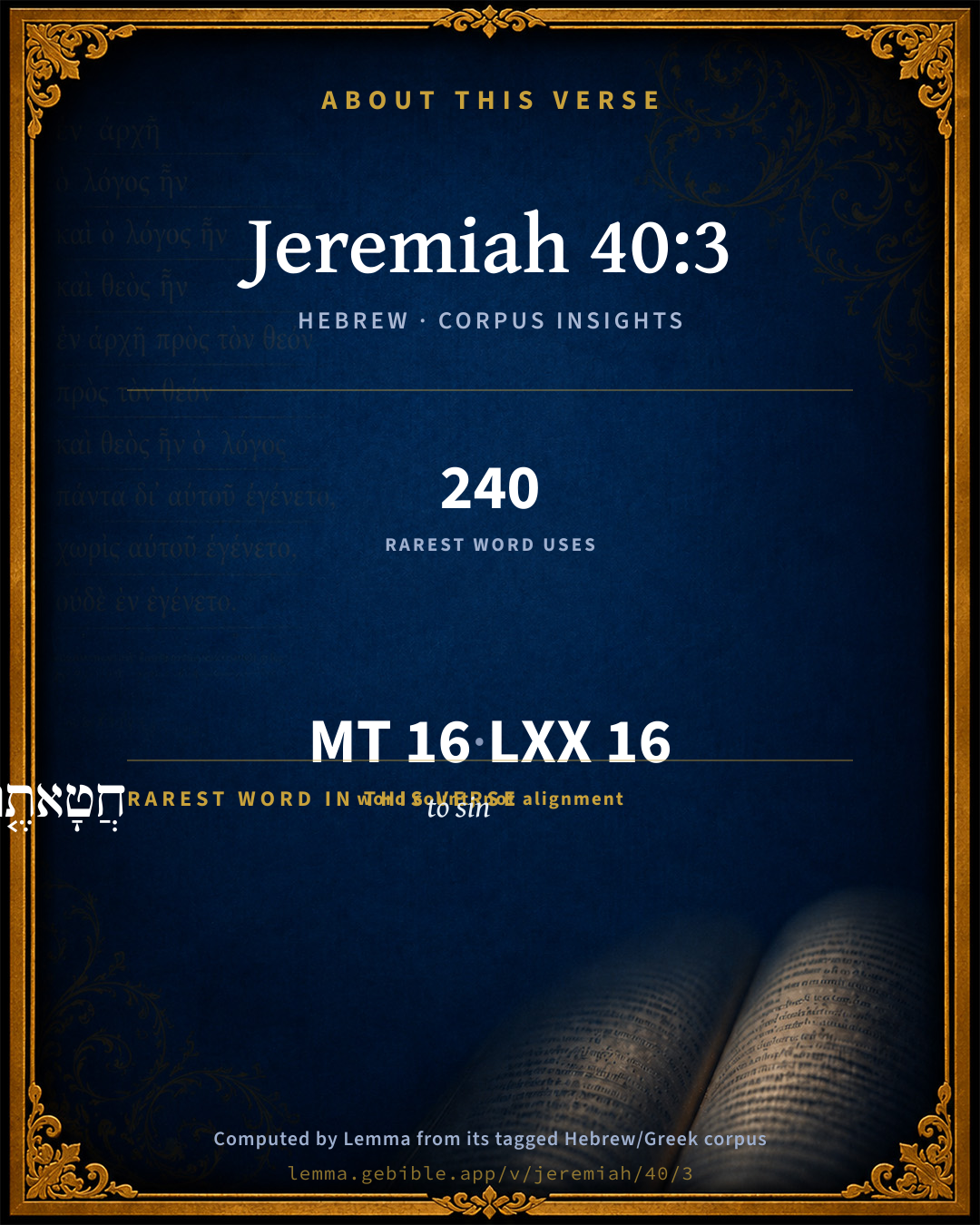
About this verse

These counts appear in no published source. They are computed here, from the morphology-tagged text and Lemma’s own curated glosses. What Lemma adds →

16
words
13
distinct lemmas
Prophets
section

Grammatical profile

  • 6 verbs
  • 5 nouns
  • 1 pronoun
  • 1 preposition
  • 1 conjunction
  • 2 particles

Verb forms

  • וַיָּבֵ֥א Hiphil · Sequential Imperfect
  • וַיַּ֛עַשׂ Qal · Sequential Imperfect
  • דִּבֵּ֑ר Piel · Perfect
  • חֲטָאתֶ֤ם Qal · Perfect
  • שְׁמַעְתֶּ֣ם Qal · Perfect
  • וְהָיָ֥ה Qal · Perfect

Repetition

Words recur within this verse — often emphatic in Hebrew:

  • יְהוָ֖ה LORD H3068 ×2
  • דבר word H1697 ×2

Hebrew & Septuagint length

In the original languages it is 16 Hebrew tokens and 16 Greek tokens — but the two are counted differently (Hebrew bundles its prefixes and suffixes into one token; the Greek is in lemma form), so that isn’t a like-for-like length.

Cross-references

7

Topical passages linked to Jeremiah 40:3 in the Treasury of Scripture Knowledge — connected by theme and wording, ordered by reader-vote popularity; previews shown in the World English Bible.

  • Romans 2:5 But according to your hardness and unrepentant heart you are treasuring up for yourself wrath in the day of wrath, revelation, and of the righteous judgment of God;
  • Jeremiah 50:7 All who found them have devoured them; and their adversaries said, We are not guilty, because they have sinned against Yahweh, the habitation of righteousness, even Yahweh, the hope of their fathers.
  • Daniel 9:11–12 Yes, all Israel have transgressed your law, even turning aside, that they should not obey your voice: therefore has the curse been poured out on us, and the oath that is written in the law of Moses the servant of God; for we have sinned against him.
  • Deuteronomy 29:25 Then men shall say, Because they forsook the covenant of Yahweh, the God of their fathers, which he made with them when he brought them forth out of the land of Egypt,
  • Nehemiah 9:28 But after they had rest, they did evil again before you; therefore left you them in the hand of their enemies, so that they had the dominion over them: yet when they returned, and cried to you, you heard from heaven; and many times did you deliver them according to your mercies,
  • Nehemiah 9:33 However you are just in all that is come on us; for you have dealt truly, but we have done wickedly;
  • Romans 3:19 Now we know that whatever things the law says, it speaks to those who are under the law, that every mouth may be closed, and all the world may be brought under the judgment of God.

Cross-references courtesy of OpenBible.info (CC BY 4.0).

Hebrew and Greek witnesses Masoretic Hebrew ↔ Greek Septuagint

The same verse in the two great witnesses to the Old Testament, shown verse-for-verse.

These are two independent witnesses, not word-aligned to each other, and the Septuagint is shown in lemma (dictionary) form.

Hebrew Jeremiah 40:3 Masoretic · Westminster Leningrad Codex

וַיָּבֵ֥א וַיַּ֛עַשׂ יְהוָ֖ה כַּאֲשֶׁ֣ר דִּבֵּ֑ר כִּֽי חֲטָאתֶ֤ם לַֽיהוָה֙ וְלֹֽא שְׁמַעְתֶּ֣ם בְּקוֹל֔וֹ וְהָיָ֥ה לָכֶ֖ם דבר הַדָּבָ֥ר הַזֶּֽה

and Yahweh has brought it, and done according as he spoke: because you have sinned against Yahweh, and have not obeyed his voice, therefore this thing is come on you.

World English Bible · Public Domain

Greek LXX Structure differs

In the Septuagint, Jeremiah is about an eighth shorter than the Hebrew and arranges its material differently — the Oracles Against the Nations (Hebrew chapters 46–51) appear in the middle of the Greek book, after 25:13. Because the chapter and verse boundaries do not line up, a verse-for-verse comparison with the Hebrew is not shown.

A verse-for-verse comparison isn’t shown here because the chapters and verses don’t line up. Switch to the LXX edition with the MT / LXX toggle above to read the Greek directly.

Hebrew: Westminster Leningrad Codex (CC BY 4.0). Greek: Septuagint (public domain); English from a public-domain English Septuagint. How the Septuagint differs from the Hebrew →

Targum (Aramaic paraphrase)

1

The Targum is the ancient Jewish Aramaic paraphrase of the Hebrew Scriptures — an interpretive translation, not the Hebrew text itself. Onkelos (literal) and Pseudo-Jonathan (expansive) render the Torah, and Jonathan the Prophets. Coverage is partial: where no permissively-licensed English translation exists for a verse, only the Aramaic is shown. This is verse-level text, not a word-by-word alignment to the Hebrew.

  1. Targum Jonathan Prophets (Joshua–Malachi)
    וְאַיְתֵי וְקַיֵם יְיָ כְּמָא דְמַלֵיל אֲרֵי חַבְתּוּן קֳדָם יְיָ וְלָא קַבֵּילְתּוּן לְמֵימְרֵיהּ וַהֲוָה לְכוֹן פִּתְגָמָא הָדֵין:

    (no public-domain English translation for this verse)

    Targum Jonathan — Aramaic: “Mikraot Gedolot” (public domain). English: “Sefaria Community Translation” (CC0 1.0 (public-domain dedication)); “London "Chaldee Paraphrase," 1871” (public domain). Text via Sefaria.

Commentary

Notes on Jeremiah 40:3 from classic Christian and Jewish commentators (each source and its license shown beneath its notes). The classic Christian expositions comment on the surrounding passage and are grouped to its opening verse, so a note may address several verses; the Jewish commentaries on the Tanakh (Rashi and others) are per-verse, so they appear only where the commentator wrote on this verse.

Lemma curates 59 commentaries, every one of them public domain or Creative Commons licensed, each selected and text-cleaned for this edition rather than reprinted as found. About our sources →

Trapp's Complete Commentary

John Trapp

Jer 40:3 Now the LORD hath brought [it], and done according as he hath said: because ye have sinned against the LORD, and have not obeyed his voice, therefore this thing is come upon you.

Ver. 3. Now the Lord hath brought it, and done according.] A bad man, we see, may speak piously. Samuel himself could not have spoken more gravely, severely, divinely, than the fiend did to Saul. {1Sa 28:13-20} Well then may lewd men be good preachers, &c.

John Trapp, A Commentary or Exposition upon All the Books of the Old and New Testament (1647–1656) — public domain. Text from a community e-Sword module.

The Biblical Illustrator

Joseph S. Exell

Jer_40:3

And have not obeyed His voice.

Unheeding warnings lead to ruin

If I were in a boat on the river in the rapids, it would not be necessary to insure my destruction that I should enter into violent controversy with those who would urge me from the shore to take heed and come to land. All I should have to do would be to shut my ears to their entreaty, and leave myself alone; the current would do the rest. Neglect of the Gospel is thus just as perilous as the open rejection of it. Indeed half the evils of our daily life in temporal things are caused by neglect, and countless are the souls who put off the seeking of the kingdom of God, and the righteousness thereof. (W. Bates.)

The Biblical Illustrator, edited by Joseph S. Exell (c. 1880s–1900s) — public domain. Text from a community e-Sword module.

Geneva Bible (1599)

Geneva Bible translators

God moved this infidel to speak this to declare the great blindness and obstinacy of the Jews, which could not feel that which this heathen man confessed.

Geneva Bible (1599) marginal notes — public domain. Text via Bolls.life.

Jamieson, Fausset & Brown

Robert Jamieson, A. R. Fausset & David Brown

ye--(See on Jer 40:1). His address is directed to the Jews as well as to Jeremiah. God makes the very heathen testify for Him against them (Deu 29:24-25).

Jamieson, Fausset & Brown — Commentary Critical and Explanatory on the Whole Bible (1871) — public domain (CC PDM 1.0). Text via the HelloAO Bible API.

John Calvin's Commentaries

But before he says this, he administers reproof to the people, and says, Jehovah thy God hath spoken evil on this city; and he hath brought it, and made it to come. Here Nebuzar-adan undertook the prophetic office, and spoke in high terms of God’s righteous vengeance on the people. There is no doubt but that God had raised up such a teacher to the Jews; for they had for forty years and more obstinately rejected celestial truth. God had not ceased kindly to invite them to repentance, and to promise them pardon and salvation, provided they repented. As then God had not ceased for so long a time, and continually to address them according to his paternal goodness, and at the same time had spoken to the deaf, they deserved to hear such a preacher as Nebuzaradan, who now contumeliously upbraided them, that they had brought this evil on themselves, because they had been disobedient and rebellious against God, as they had not obeyed his word.

There is here a remarkable example set before us, so that we may learn, that when God addresses us by his servants, we ought immediately to render obedience to him; let us learn to fear when he threatens us, and learn to entertain hope when he offers his favor to us. For if we reject the Prophets when they are sent to us, other teachers will arise, who will deride us, and though they may be themselves ungodly, they will yet upbraid us with our impiety. This then is the doctrine we ought to gather from this passage, in which we see that Nebuzaradan, as though gifted with the prophetic spirit, severely rebuked the people. He, indeed, addressed Jeremiah, and seems to have included him with the people, when he said, Thy God hath spoken — because ye have sinned and have been rebellious. But Nebuzaradan, no doubt, thus highly commended the faithfulness of Jeremiah, because he had been true and faithful in his vocation and office, he then did not make him as one of the people, nor did he mean that he had sinned with others, or had been rebellious against God. But, in the first, place, he addressed Jeremiah, Thy God, he said; and this was expressed by way of honor, even that God was the God of Jeremiah; for though the people boasted that they were holy, yet Nebuzaradan here indirectly condemned their foolish boastings, since he inti-mated that Jeremiah alone was worthy of being deemed one of God’s servants, as though he had said, that the Jews were unworthy of the honor of glorying in God’s name, or of professing it: Thy God then hath spoken The rest tomorrow.

John Calvin's Commentaries (1540-1563) — public domain. Text from the Calvin Translation Society English edition (1840s-50s) via the Christian Classics Ethereal Library (ccel.org). Calvin's coverage is partial (roughly two-thirds of the Bible); uncommented books and verses are honest gaps, never fabricated. The 19th-century editor's footnotes and remarks are omitted so the notes are faithfully Calvin's own voice.

John Gill's Exposition

Now the Lord hath brought it, and done according as he hath said,.... As he purposed, so it came to pass; as he foretold by his prophet, so it was brought about by his providence. This Heathen captain acknowledges the hand of the Lord in all this; and suggests, that his master, the king of Babylon, himself, and the rest of the generals, were only instruments the Lord made use of; which is very piously as well as wisely said; and more is here acknowledged by him than by the Jews themselves; who were not willing to believe that God had determined evil against them, or would bring it on them; at least, this they did not care to believe and own before, whatever they did now; he goes on to observe the cause of all this:

because ye have sinned against the Lord, and have not obeyed his voice,

therefore this thing is come upon you; meaning not Jeremiah particularly, but his countrymen; and perhaps he might turn himself to, and address, the captives that were before him. Here he vindicates the justice of God; and ascribes the ruin of this people, not to the valour of Nebuchadnezzar and his captains; nor to the strength, and courage, and skilfulness of his army; or to any righteousness and merits of the king of Babylon; or to the justness of his cause; but to the sins of the people.

John Gill's Exposition of the Whole Bible (1746–1763) — public domain (CC PDM 1.0). Text via the HelloAO Bible API.

Haydock's Catholic Bible Commentary

You, people of Juda. (Haydock) --- This pagan acknowledges that God had punished his people, (chap. xviii. 16.; Calmet) as Titus did at the last siege. (Josephus) (Haydock) --- He acknowledges the justice of God. (Worthington)

George Leo Haydock (1774–1849), Haydock's Catholic Family Bible and Commentary, 1859 edition — public domain. Excludes Psalms (Douay-Rheims chapter numbering differs from Protestant) and Deuterocanonical books (Catholic canon only).

Matthew Poole's English Annotations

This pagan commander could see that which the blind Jews would not understand: they said, Wherefore is this great evil come upon us? Nebuzar-adan knew wherefore, and gives God the glory of his master’s victory, as also of his own faithfulness, saying God had but done what he said, brought the evil which he had pronounced against that city; he also acknowledgeth God’s justice, that this evil was come upon them because of their sins. Thus the men of Tyre and Sidon, and of Nineveh, (according to our Savour’s words,) shall rise up in judgment against the Jews that lived in our Saviour’s time, and Nebuzar-adan another day shall rise up in judgment against those Jews that lived in Jeremiah’s time, and shall condemn them.

Matthew Poole's English Annotations on the Holy Bible (1683–1685) — public domain. Text from a community e-Sword/MySword module.

The Pulpit Commentary

The Lord hath brought it, etc. The colouring of the speech is that of a Jewish prophet. (comp. Isa_36:10)

The Pulpit Commentary (1880–1919), ed. H.D.M. Spence-Jones & Joseph S. Exell — public domain. Text from a community e-Sword module.

unfoldingWord translationNotes

Door43 World Missions Community

this thing

"this disaster"

But now look!

Nebuzaradan says this to bring Jeremiah's attention to the present moment.

it is good in your eyes

"Eyes" here is a metonym for what the person thinks. AT: "it is what you consider to be right" (See: Metonymy)

translationWords

people group

sin

obey

voice

good

unfoldingWord translationNotes — © Distant Shores Media and the Door43 World Missions Community, licensed CC BY-SA 4.0. Source: git.door43.org/Door43/en_tn.

Lesson kit

Teaching starters — assembled from the data on this page, not authored interpretation. Every prompt links to the verse data it draws on. Edit before teaching.

Jeremiah, in the Prophets, opens this verse with 16 words (13 distinct Hebrew lemmas). Its most distinctive word is châṭâʼ (“to sin”). A historical commentator’s framing appears above. Read the whole chapter for the surrounding context.

Discussion questions

  1. What does “to sin” (châṭâʼ) contribute to the verse as a whole?
  2. Romans 2:5 shares this passage’s theme. How do the two illuminate each other?
  3. “LORD” occurs 2× in this one verse. What is the effect of the repetition?
  4. These translations render this verse differently; the difference is in the English rendering, not the original. What questions does that raise?
  5. The verb «וַיָּבֵ֥א» is Hiphil Sequential Imperfect. How does its form color the action?
  6. Reading how Trapp's Complete Commentary and The Biblical Illustrator read this verse, where do the two commentators agree and where do they part?

Things to notice

Reading settings

Reading text

Shown beneath each verse's original-language words.

Old Testament
Old Testament edition

Read the OT as the Masoretic Hebrew (MT) or the Greek Septuagint (LXX).

English shown for the Greek Septuagint (in the Hebrew ↔ Greek comparison).

Comparing translations? Open the Compare panel on any verse page to stack up to four side by side.