Leviticus 4:22

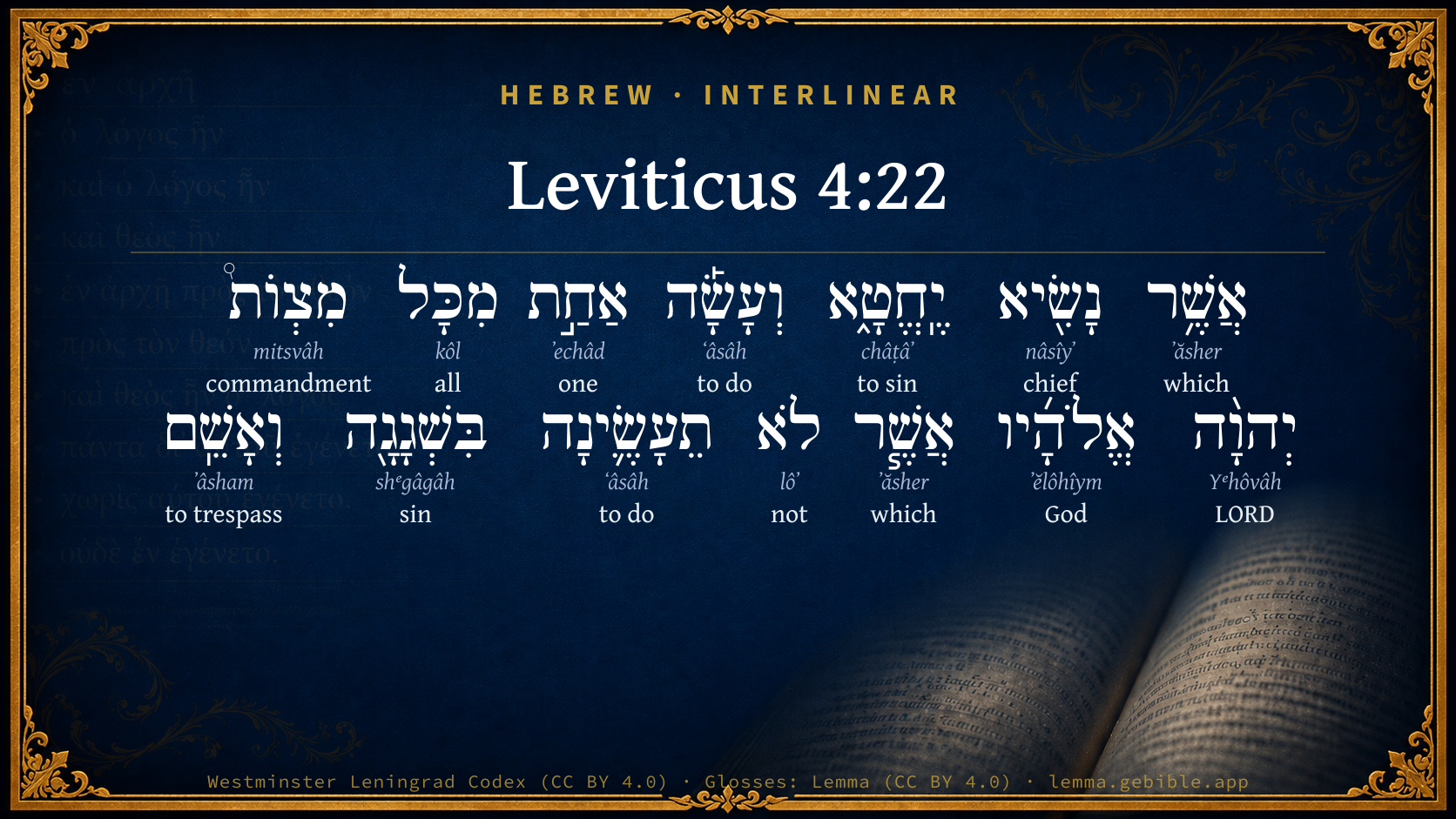
Hebrew (Westminster Leningrad Codex) Leviticus 4:22 appears in the Hebrew Old Testament. The text above is from the Westminster Leningrad Codex. Each word links to its Strong’s number, a concise gloss, and parsing drawn from the Open Scriptures Hebrew Bible morphology. Click any word for its full Brown-Driver-Briggs (BDB) entry.
Download image
Cite this verse

Leviticus 4:22 (World English Bible). Public Domain. Lemma interlinear Bible study tool, https://lemma.gebible.app/v/leviticus/4/22.

Show BibTeX & RIS
BibTeX
RIS
English Translation
"'When a ruler sins, and unwittingly does any one of all the things which Yahweh his God has commanded not to be done, and is guilty;
World English Bible · Public Domain
Download a study sheet

One document with this verse’s original text, its word-by-word gloss line, the meaning frame, cross-references with their text, attributed commentary, and full source and license credits — printable, and it pastes into notes with its structure intact.

This verse Autodidact and up

Study sheet (.html) Plain text (.txt)

A passage Seminary Student

Up to 50 verses in one chapter. A passage sheet keeps up to 6 commentary sources and 12 cross-references per verse, in the order this page ranks them, and says so on the sheet whenever that leaves anything out. Ask for a single verse and you get the Autodidact verse sheet above.

Everything on this page stays free to read, with no account — the sheet is a download of what is already on screen, not access to it.

Want to remove ads? Support Godless Engineer
Compare translations 3

The same verse in 3 English versions, stacked beneath the original-language interlinear above. Click any original word for its lexicon entry.

Each is an independent rendering of the whole verse — the interlinear is not word-aligned to these translations.

Highlighted words mark where these versions differ — a whole-verse word diff, not a word-by-word alignment.

  • World English Bible Public Domain
    "'When a ruler sins, and unwittingly does any one of all the things which Yahweh his God has commanded not to be done, and is guilty;
  • King James Version Public Domain
    When a ruler hath sinned, and done somewhat through ignorance against any of the commandments of the LORD his God concerning things which should not be done, and is guilty;
  • unfoldingWord Literal Text CC BY-SA 4.0
    When a leader sins and does by mistake one from all the commands of Yahweh his God that shall not be done, and he becomes guilty,

unfoldingWord Literal Text — © unfoldingWord, licensed CC BY-SA 4.0. Word-aligned USFM3 via Door43 (git.door43.org/unfoldingWord/en_ult).

Versions to compare (up to 4)

3 of 4 selected

Show all 18 translations

Every available English version of this verse, each an independent rendering of the whole verse.

  • World English Bible Public Domain
    "'When a ruler sins, and unwittingly does any one of all the things which Yahweh his God has commanded not to be done, and is guilty;
  • Berean Standard Bible Public Domain
    When a leader sins unintentionally and does what is prohibited by any of the commandments of the LORD his God, he incurs guilt.
  • Majority Standard Bible Public Domain
    When a leader sins unintentionally and does what is prohibited by any of the commandments of the LORD his God, he incurs guilt.
  • King James Version Public Domain
    When a ruler hath sinned, and done somewhat through ignorance against any of the commandments of the LORD his God concerning things which should not be done, and is guilty;
  • American Standard Version (1901) Public Domain
    When a ruler sinneth, and doeth unwittingly any one of all the things which Jehovah his God hath commanded not to be done, and is guilty;
  • Revised Version (1885) Public Domain
    When a ruler sinneth, and doeth unwittingly any one of all the things which the LORD his God hath commanded not to be done, and is guilty;
  • Geneva Bible (1599) Public Domain
    When a ruler shall sinne, and do through ignorance against any of the commandements of the Lord his God, which should not be done, and shall offend,
  • Douay-Rheims (1899) Public Domain
    If a prince shall sin, and through ignorance do any one of the things that the law of the Lord forbiddeth,
  • Young's Literal Translation Public Domain
    `When a prince doth sin, and hath done `something against' one of all the commands of Jehovah his God `regarding things' which are not to be done, through ignorance, and hath been guilty --
  • Literal Standard Version CC BY-SA 4.0
    When a prince sins, and has done [something against] one of all the commands of his God YHWH [regarding things] which are not to be done, through ignorance, and has been guilty,
  • Unlocked Literal Bible CC BY-SA 4.0
    When a ruler sins without intending to sin, doing any one of all the things that Yahweh his God has commanded not to be done, and he is guilty,
  • unfoldingWord Literal Text CC BY-SA 4.0
    When a leader sins and does by mistake one from all the commands of Yahweh his God that shall not be done, and he becomes guilty,
  • Darby Bible Public Domain
    When a prince sinneth and through inadvertence doeth [somewhat against] any of all the commandments of Jehovah his God [in things] which should not be done, and is guilty;
  • World Messianic Bible Public Domain
    “‘When a ruler sins, and unwittingly does any one of all the things which the LORD his God has commanded not to be done, and is guilty,
  • Webster's Bible Public Domain
    When a ruler hath sinned, and done somewhat through ignorance against any of the commandments of the LORD his God concerning things which should not be done, and is guilty;
  • Free Bible Version CC BY-SA 4.0
    If a leader sins unintentionally and does what is not permitted by any of the commandments of the Lord his God, he is guilty.
  • Bible in Basic English Public Domain
    If a ruler does wrong, and in error does any of the things which, by the order of the Lord his God, are not to be done, causing sin to come on him;
  • JPS Tanakh (1917) Public Domain
    When a ruler sinneth, and doeth through error any one of all the things which the LORD his God hath commanded not to be done, and is guilty:

Literal Standard Version (2020), Covenant Press — licensed CC BY-SA 4.0. Text via the HelloAO Bible API (eBible.org). Unlocked Literal Bible (unfoldingWord) — licensed CC BY-SA 4.0. Text via the HelloAO Bible API (eBible.org). unfoldingWord Literal Text — © unfoldingWord, licensed CC BY-SA 4.0. Word-aligned USFM3 via Door43 (git.door43.org/unfoldingWord/en_ult). Free Bible Version, Dr. Jonathan Gallagher — licensed CC BY-SA 4.0. Text via the HelloAO Bible API (eBible.org).

Word by word

More ways to search: Search by grammar → Find every occurrence → Compare this word →

Practice this passage: Drill this verse → Learn its vocabulary →

בִּשְׁגָגָ֖ה
shᵉgâgâh
H7684
“in/at · sin”
Preposition + Noun, Common, Feminine, Singular, Absolute
Part of Speech
Preposition + Noun
Type
Common
Gender
Feminine
Number
Singular
State
Absolute
Full BDB Definition

Origin: from H7683

TWOT: 2324a

sin, sin of error or inadvertence, inadvertent sin - error
  1. אֲשֶׁ֥ר ʼăsher H834 “which” Particle, Relative
  2. נָשִׂ֖יא nâsîyʼ H5387 “chief” Noun, Common, Masculine, Singular, Absolute
  3. יֶֽחֱטָ֑א châṭâʼ H2398 “to sin” Verb, Qal, Imperfect, 3rd Person, Masculine, Singular
  4. וְעָשָׂ֡ה ʻâsâh H6213 “and · to do” Conjunction + Verb, Qal, Sequential Perfect, 3rd Person, Masculine, Singular
  5. אַחַ֣ת ʼechâd H259 “one” Adjective, Cardinal number, Feminine, Singular, Absolute
  6. מִכָּל kôl H3605 “from · all of” Preposition + Noun, Common, Masculine, Singular, Construct
  7. מִצְוֺת֩ mitsvâh H4687 “commandments of” Noun, Common, Feminine, Plural, Construct
  8. יְהוָ֨ה Yᵉhôvâh H3068 “LORD” Noun, Proper
  9. אֱלֹהָ֜יו ʼĕlôhîym H430 “God(s) · his” Noun, Common, Masculine, Plural, Construct + Suffix, Personal, 3rd Person, Masculine, Singular
  10. אֲשֶׁ֧ר ʼăsher H834 “which” Particle, Relative
  11. לֹא lôʼ H3808 “not” Particle, Negative
  12. תֵעָשֶׂ֛ינָה ʻâsâh H6213 “to do” Verb, Niphal, Imperfect, 3rd Person, Feminine, Plural
  13. וְאָשֵֽׁם ʼâsham H816 “and · to trespass” Conjunction + Verb, Qal, Sequential Perfect, 3rd Person, Masculine, Singular

About this verse

These counts appear in no published source. They are computed here, from the morphology-tagged text and Lemma’s own curated glosses. What Lemma adds →

14
words
12
distinct lemmas
Pentateuch
section

Notable vocabulary

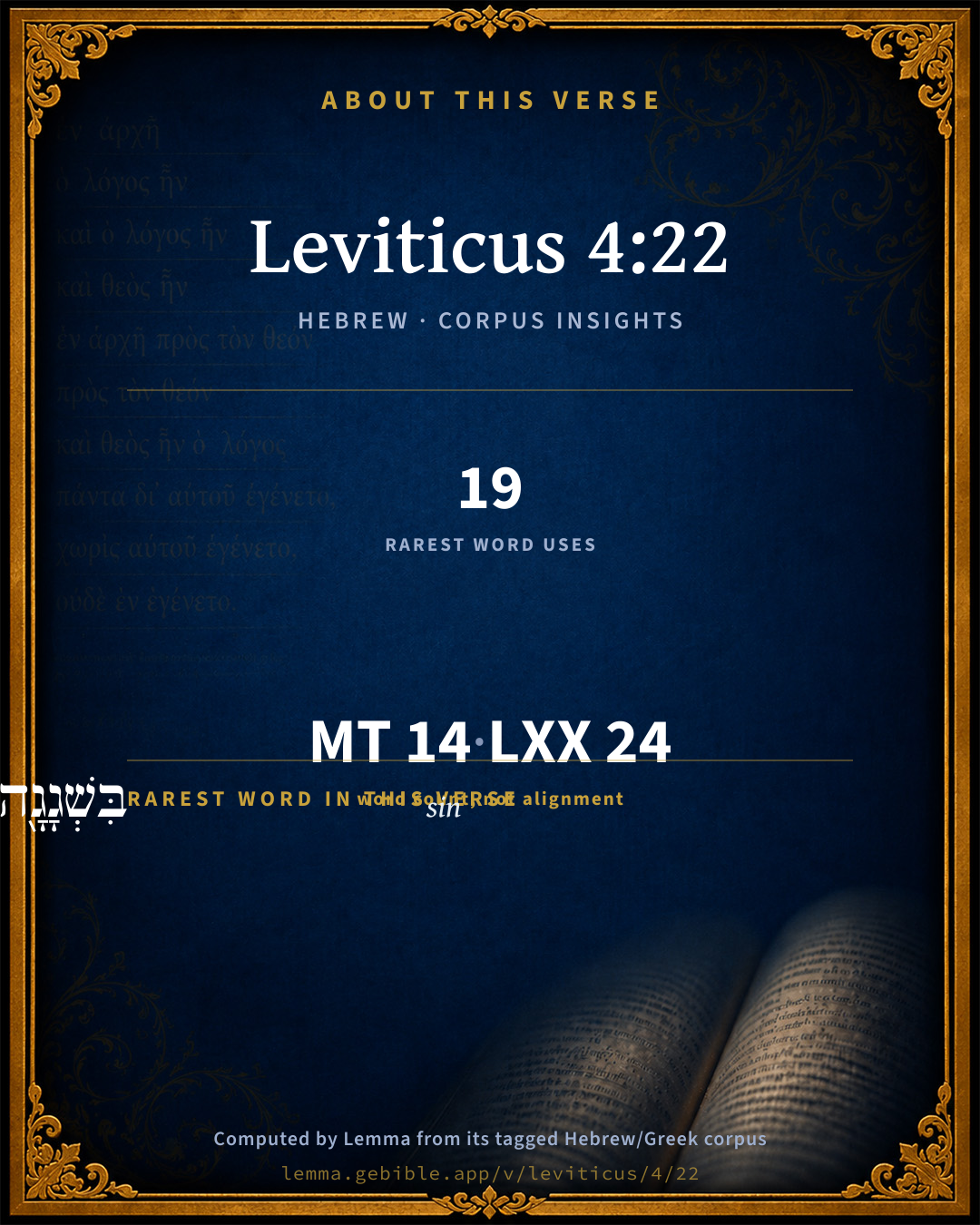
The rarest word here is בִּשְׁגָגָ֖ה sin H7684 — appearing just 19 times in the whole Hebrew Bible.

Shared distinctive vocabulary

בִּשְׁגָגָ֖ה sin H7684 occurs in 18 verses of the Hebrew Bible. Also found in:

Grammatical profile

  • 4 verbs
  • 6 nouns
  • 1 adjective
  • 3 particles

Verb forms

  • יֶֽחֱטָ֑א Qal · Imperfect
  • וְעָשָׂ֡ה Qal · Sequential Perfect
  • תֵעָשֶׂ֛ינָה Niphal · Imperfect
  • וְאָשֵֽׁם Qal · Sequential Perfect

Repetition

Words recur within this verse — often emphatic in Hebrew:

  • וְעָשָׂ֡ה to do H6213 ×2
  • אֲשֶׁ֥ר which H834 ×2

Hebrew & Septuagint length

In English translation the verse runs 26 words from the Hebrew and 32 from the Septuagint (LXX English) — closely comparable.

A rough comparison of the two English renderings, which tokenize alike — not a word-level alignment.

Word counts can differ between the Hebrew and the Greek without any difference in meaning — e.g. the Hebrew direct-object marker אֵת has no separate Greek word, and Greek often adds the article ὁ.

In the original languages it is 14 Hebrew tokens and 24 Greek tokens — but the two are counted differently (Hebrew bundles its prefixes and suffixes into one token; the Greek is in lemma form), so that isn’t a like-for-like length.

Cross-references

8

Topical passages linked to Leviticus 4:22 in the Treasury of Scripture Knowledge — connected by theme and wording, ordered by reader-vote popularity; previews shown in the World English Bible.

  • Leviticus 4:2 "Speak to the children of Israel, saying, 'If anyone sins unintentionally, in any of the things which Yahweh has commanded not to be done, and does any one of them:
  • Leviticus 4:13 "'If the whole congregation of Israel sins, and the thing is hidden from the eyes of the assembly, and they have done any of the things which Yahweh has commanded not to be done, and are guilty;
  • Exodus 18:21 Moreover you shall provide out of all the people able men, such as fear God: men of truth, hating unjust gain; and place such over them, to be rulers of thousands, rulers of hundreds, rulers of fifties, and rulers of tens.
  • Leviticus 4:27 "'If anyone of the common people sins unwittingly, in doing any of the things which Yahweh has commanded not to be done, and is guilty;
  • Numbers 16:2 and they rose up before Moses, with certain of the children of Israel, two hundred fifty princes of the congregation, called to the assembly, men of renown;
  • Numbers 31:13 Moses, and Eleazar the priest, and all the princes of the congregation, went forth to meet them outside of the camp.
  • 2 Samuel 21:1–3 There was a famine in the days of David three years, year after year; and David sought the face of Yahweh. Yahweh said, It is for Saul, and for his bloody house, because he put to death the Gibeonites.
  • 2 Samuel 24:10–17 David's heart struck him after that he had numbered the people. David said to Yahweh, I have sinned greatly in that which I have done: but now, Yahweh, put away, I beg you, the iniquity of your servant; for I have done very foolishly.

Cross-references courtesy of OpenBible.info (CC BY 4.0).

Hebrew and Greek witnesses Masoretic Hebrew ↔ Greek Septuagint

The same verse in the two great witnesses to the Old Testament, shown verse-for-verse.

These are two independent witnesses, not word-aligned to each other, and the Septuagint is shown in lemma (dictionary) form.

Hebrew Leviticus 4:22 Masoretic · Westminster Leningrad Codex

אֲשֶׁ֥ר נָשִׂ֖יא יֶֽחֱטָ֑א וְעָשָׂ֡ה אַחַ֣ת מִכָּל מִצְוֺת֩ יְהוָ֨ה אֱלֹהָ֜יו אֲשֶׁ֧ר לֹא תֵעָשֶׂ֛ינָה בִּשְׁגָגָ֖ה וְאָשֵֽׁם

"'When a ruler sins, and unwittingly does any one of all the things which Yahweh his God has commanded not to be done, and is guilty;

World English Bible · Public Domain

Greek LXX Leviticus 4:22 Septuagint · lemma form

ἐάν δέ ὁ ἄρχων ἁμαρτάνω καί ποιέω εἷς ἀπό πᾶς ὁ ἐντολή κύριος ὁ θεός αὐτός ὅς οὐ ποιέω ἀκουσίως καί ἁμαρτάνω καί πλημμελέω

And if a ruler sin, and break one of all the commands of the Lord his God, doing the thing which ought not to be done, unwillingly, and shall sin and trespass,

LXX2012 (modern English Septuagint) · Public Domain

Hebrew: Westminster Leningrad Codex (CC BY 4.0). Greek: Septuagint (public domain); English from LXX2012 (modern English Septuagint) (Public Domain). How the Septuagint differs from the Hebrew →

Targum (Aramaic paraphrase)

2

The Targum is the ancient Jewish Aramaic paraphrase of the Hebrew Scriptures — an interpretive translation, not the Hebrew text itself. Onkelos (literal) and Pseudo-Jonathan (expansive) render the Torah, and Jonathan the Prophets. Coverage is partial: where no permissively-licensed English translation exists for a verse, only the Aramaic is shown. This is verse-level text, not a word-by-word alignment to the Hebrew.

  1. Targum Onkelos Torah (Genesis–Deuteronomy)
    אִם רַבָּא יֵחוֹב וְיַעְבֵּד חַד מִכָּל פִּקוּדַיָא דַיְיָ אֱלָהֵיהּ דְלָא כַשְׁרִין לְאִתְעֲבָדָא בְּשָׁלוּ וְיֵחוֹב

    (no public-domain English translation for this verse)

    Targum Onkelos — Aramaic: “Onkelos Genesis” (public domain); “Onkelos Exodus” (public domain); “Onkelos Leviticus” (public domain); “Onkelos Numbers” (public domain); “Onkelos Deuteronomy” (public domain). English: “Sefaria Community Translation” (CC0 1.0 (public-domain dedication)); “J.W. Etheridge. The Targums of Onkelos and Jonathan Ben Uzziel on the Pentateuch. London: Longmans, Green, 1862” (public domain). Text via Sefaria.

  2. Targum Pseudo-Jonathan Torah (Genesis–Deuteronomy)
    בְּזִימְנָא דְרַבָּא בְּעַמָא יֵיחוֹב וְיַעֲבֵיד חַד מִן כָּל פִּקוּדַיָא דַיְיָ אֱלָהֵיהּ דְלָא כַשְׁרִין לְאִתְעֲבָדָא בְּשָׁלוּ וְיִתְחַיֵיב

    At what time the ruler of his people shall have sinned, and done against any of the commandments of the Lord his God that which ought not to have been done, and he hath sinned through ignorance;

    Targum Pseudo-Jonathan — Aramaic: “Targum Jonathan on Genesis” (public domain); “Targum Jonathan on Exodus” (public domain); “Targum Jonathan on Leviticus” (public domain); “Targum Jonathan on Numbers” (public domain); “Targum Jonathan on Deuteronomy” (public domain). English: “The Targum of Jonathan ben Uzziel, trans. J. W. Etheridge, London, 1862” (public domain). Text via Sefaria.

Commentary

Notes on Leviticus 4:22 from classic Christian and Jewish commentators (each source and its license shown beneath its notes). The classic Christian expositions comment on the surrounding passage and are grouped to its opening verse, so a note may address several verses; the Jewish commentaries on the Tanakh (Rashi and others) are per-verse, so they appear only where the commentator wrote on this verse.

Lemma curates 59 commentaries, every one of them public domain or Creative Commons licensed, each selected and text-cleaned for this edition rather than reprinted as found. About our sources →

Matthew Henry's Commentary

Observe here, 1. That God takes notice of and is displeased with the sins of rulers. Those who have power to call others to account are themselves accountable to the ruler of rulers; for, as high as they are, there is a higher than they. This is intimated in that the commandment transgressed is here said to be the commandment of the Lord his God, Lev 4:22. He is a prince to others, but let him know the Lord is a God to him. 2. The sin of the ruler which he committed through ignorance is supposed afterwards to come to his knowledge (Lev 4:23), which must be either by the check of his own conscience or by the reproof of his friends, both which we should all, even the best and greatest, not only submit to, but be thankful for. What we have done amiss we should be very desirous to come to the knowledge of. That which I see not, teach thou me, and show me wherein I have erred, are prayers we should put up to God every day, that though through ignorance we fall into sin we may not through ignorance lie still in it. 3. The sin-offering for a ruler was to be a kid of the goats, not a bullock, as for the priest and the whole congregation; nor was the blood of his sin-offering to be brought into the tabernacle, as of the other two, but it was all bestowed upon the brazen altar (Lev 4:25); nor was the flesh of it to be burnt, as that of the other two, without the camp, which intimated that the sin of a ruler, though worse than that of a common person, yet was not so heinous, nor of such pernicious consequence, as the sin of the high priest, or of the whole congregation. A kid of the goats was sufficient to be offered for a ruler, but a bullock for a tribe, to intimate that the ruler, though major singulis - greater than each, was minor universis - less than the whole. It is bad when great men give bad examples, but worse when all men follow them. 4. It is promised that the atonement shall be accepted and the sin forgiven (Lev 4:26), that is, if he repent and reform; for otherwise God swore concerning Eli, a judge in Israel, that the iniquity of his house should not be purged with sacrifice nor offering for ever, Sa1 3:14.

Matthew Henry's Commentary on the Whole Bible (1708–1710) — public domain (CC PDM 1.0). Text via the HelloAO Bible API.

Ellicott's Commentary for English Readers

(22) When a ruler hath sinned.—The third instance adduced is that of a ruler sinning inadvertently (Lev_4:22-26). As the word here translated “ruler” is used for a king (1Ki_11:34; Eze_34:24; Eze_46:2), the head of a tribe (Num_1:4-16) or of the division of a tribe (Num_34:18), opinions differ as to the exact position of the personage here meant. Now, in comparing the phrase used with regard to the sin of ignorance in the case of the high priest, the congregation, and any one of the people, it will be seen that in all the three instances it is simply described as a sin “against any commandments of the Lord”(comp. Lev_4:2; Lev_4:13; Lev_4:27), whereas in the case of the ruler, we have the exceptional phrase, “against any of the commandments of the Lord his God.” Hence the interpretation obtained during the second Temple that the addition of the phrase his God, which shows a peculiar relationship to his God, denotes here one over whom God alone is exalted—the sovereign who is only responsible to his God.

And is guilty.—Rather, and acknowledges his guilt, as the Authorised Version rightly translates it in Hos_5:15. (Comp. also Zec_11:5.) This sense is not only required by the disjunctive particle or, with which the next verse begins, but by the fact that the declaration in the present rendering, “When men sin they are guilty,” is a truism. The sinner is guilty whether he sins advertently or inadvertently. The case here supposed is that the prince had himself come to the knowledge that what he had done was a sin, and had acknowledged it as such.

A Bible Commentary for English Readers, edited by Charles John Ellicott (1878–1897) — public domain. Text from a community e-Sword module.

Trapp's Complete Commentary

John Trapp

Lev 4:22 When a ruler hath sinned, and done [somewhat] through ignorance [against] any of the commandments of the LORD his God [concerning things] which should not be done, and is guilty;

Ver. 22. When a ruler hath sinned.] Great men’s sins do more hurt, (1.) By imitation; for, Vita principis censura est, imo Cynosura; according to these glasses most men dress themselves: (2.) By imputation; for, plectuntur achivi; the poor people pay for it; as they did for David’s, whether ignorance or infirmity, in omitting that duty enjoined; {Exo 30:12-15} thence the plague. {2Sa 24:13-17}

John Trapp, A Commentary or Exposition upon All the Books of the Old and New Testament (1647–1656) — public domain. Text from a community e-Sword module.

Matthew Poole's English Annotations

A ruler, to wit, of the people, or a civil magistrate.

Through ignorance; either not knowing it to be sin, or not observing and considering it till it be done. See before on Lev 4:22.

Matthew Poole's English Annotations on the Holy Bible (1683–1685) — public domain. Text from a community e-Sword/MySword module.

The Biblical Illustrator

Joseph S. Exell

Lev_4:22-26

When a ruler hath sinned.

A lesson for politicians

While there are many in our parliaments and like governing bodies in Christendom who cast their every vote with the fear of God before their eyes, yet, if there be any truth in the general opinion of men upon this subject, there are many in such places who, in their voting, have before their eyes the fear of party more than the fear of God; and who, when a question comes before them, first of all consider, not what would the law of absolute righteousness, the law of God, require, but how will a vote, one way or the other, in this matter, be likely to affect their party? Such certainly need to be emphatically reminded of this part of the law of the sin-offering, which held the civil ruler specially responsible to God for the execution of his trust. For so it is still; God has not abdicated His throne in favour of the people, nor will He waive His crown-rights out of deference to the political necessities of a party. Nor is it only those who sin in this particular way who need the reminder of their personal responsibility to God. All need it who either are or may be called to places of greater or less governmental responsibility; and it is those who are the most worthy of such trust who will be the first to acknowledge their need of this warning. For in all times those who have been lifted to positions of political power have been under peculiar temptation to forget God, and become reckless of their obligation to Him as His ministers. But under the conditions of modern life, in many countries of Christendom, this is true as perhaps never before. For now it has come to pass that, in most modern communities, those who make and execute laws hold their tenure of office at the pleasure of a motley army of voters, Protestants and Romanists, Jews, atheists, and what not, a large part of whom care not the least for the will of God in civil government, as revealed in Scripture. Under such conditions, the place of the civil ruler becomes one of such special trial and temptation that we do well to remember in our intercessions, with peculiar sympathy, all who in such positions are seeking to serve supremely, not their party but their God, and so best serve their country. It is no wonder that the temptation too often to many becomes overpowering to silence conscience with plausible sophistries, and to use their office to carry out in legislation, instead of the will of God, the will of the people, or, rather, of that particular party which put them in power. Yet the great principle affirmed in this law of the sin-offering stands, and will stand for ever, and to it all will do well to take heed; namely, that God will hold the civil ruler responsible, and more heavily responsible than any private person, for any sin he may commit, and especially for any violation of law in any matter committed to his trust. And there is abundant reason for this. For the powers that be are ordained of God, and in His providence are placed in authority; not as the modern notion is, for the purpose of executing the will of the constituents, whatever that will may be, but rather the unchangeable will of the Most Holy God, the Ruler of all nations, so far as revealed, concerning the civil and social relations of men. Nor must it be forgotten that this eminent responsibility attaches, to them, not only in their official acts, but in all their acts as individuals. No distinction is made as to the sin for which the ruler must bring his sin-offering, whether public and official or private and personal. Of whatsoever kind the sin may be, if committed by a ruler, God holds him specially responsible, as being a ruler, and reckons the guilt of that sin, even if a private offence, to be heavier than if it had been committed by one of the common people. And this, for the evident reason that his exalted position gives his example double influence and effect. (S. H. Kellogg, D. D.)

Sins of the great

Judges and magistrates are the physicians of the state, and sins are the diseases of it. What skills it, whether a gangrene begin at the head or the heel, seeing both ways it will kill, if the part that is diseased be not out off; except this be the difference, that the head being nearer the heart, a gangrene in the head will kill sooner than that which is in the heel. Even so will the sins of great ones overthrow a state sooner than those of the meaner sort; therefore wise was that advice of Sigismund the Emperor, when upon a motion to reform the Church, one said, Let us begin at the minorities. Nay rather, saith the Emperor, let us begin at the majorities; for if the great ones be good, the meaner cannot be easily ill, but be the mean ones never so good, the great will be nothing the better.

The influence of a rulers sin on others

Nourshivan the Just, being one day a-hunting, would have eaten of the game which he had killed, but from the consideration that, after dressing it, his attendants had no salt to give it relish. He sent at last to buy some at the next village, but with severe injunctions not to take it without paying for it. What would be the harm, said one of his courtiers, if the king did not pay for a little salt? Nourshivan answered, If a king gathers an apple in the garden of one of his subjects, on the morrow the courtiers cut down all the trees.

The Biblical Illustrator, edited by Joseph S. Exell (c. 1880s–1900s) — public domain. Text from a community e-Sword module.

Joseph Benson's Commentary

Lev 4:22; Lev 4:24. A ruler — Of the people, or a civil magistrate. Where they kill the burnt-offering — So called by way of eminence, to wit, the daily burnt-offering. It is a sin-offering — And therefore to be killed where the burnt-offering is killed; whereby it is distinguished from the peace- offerings, which were killed elsewhere.

Joseph Benson's Commentary on the Old and New Testaments (1811–1818) — public domain. Text from a community e-Sword module.

Whedon's Commentary on the Bible

Daniel D. Whedon

SIN OF A PRINCE, Lev_4:22-26.

22. A ruler — This term signifies any high political officer, especially the heads of the tribes, or phylarchs. The rabbins generally understand that under the monarchy it referred only to the king. The ritual for a prince is like that for the priest and for the congregation, except that the victim was a kid of the goats, and that the fat was burned as was that of the peace offering. Instead of being burnt without the camp, the flesh was to be eaten by the priest. Lev_6:26.

Daniel D. Whedon (gen. ed.), Commentary on the Old and New Testaments (1874–1909) — public domain. Text from a community e-Sword module.

Keil & Delitzsch

C. F. Keil & F. Delitzsch

The sin of a ruler. - Lev 4:22. אשׁר: ὅτε, when. נשׂיא is the head of a tribe, or of a division of a tribe (Num 3:24, Num 3:30, Num 3:35).

Lev 4:23-26

"If (או, see Ges. 155, 2) his sin is made known to him," i.e., if any one called his attention to the fact that he had transgressed a commandment of God, he was to bring a he-goat without blemish, and, having laid his hand upon it, to slay it at the place of burnt-offering; after which the priest was to put some of the blood upon the horns of the altar of burnt-offering, and pour out the rest of the blood at the foot of the altar, and then to burn the whole of the fat upon the altar, as in the case of the peaceoffering (see Lev 3:3-4), and thus to make atonement for the prince on account of his sin. עזים שׂעיר, or שׂעיר alone (lit., hairy, shaggy, Gen 27:11), is the buck-goat, which is frequently mentioned as the animal sacrificed as a sin-offering: e.g., that of the tribe-princes (Num 7:16., Lev 15:24), and that of the nation at the yearly festivals (Lev 16:9, Lev 16:15; Lev 23:19; Num 28:15, Num 28:22, Num 28:30; Num 29:5, Num 29:16.) and at the consecration of the tabernacle (Lev 9:3, Lev 9:15; Lev 10:16). It is distinguished in Num 7:16. from the attudim, which were offered as peace-offerings, and frequently occur in connection with oxen, rams, and lambs as burnt-offerings and thank-offerings (Psa 50:9, Psa 50:13; Psa 66:15; Isa 1:11; Isa 34:6; Eze 39:18). According to Knobel, עזים שׂעיר, or שׂעיר, was an old he-goat, the hair of which grew longer with age, particularly about the neck and back, and עזים שׂעירת (Lev 4:28; Lev 5:16) an old she-goat; whilst עתּוּד was the younger he-goat, which leaped upon the does (Gen 31:10, Gen 31:12), and served for slaughtering like lambs, sheep, and goats (Deu 32:14; Jer 51:40). But as the עזים שׂעיר was also slaughtered for food (Gen 37:31), and the skins of quite young he-goats are called שׂעירת (Gen 27:23), the difference between שׂעיר and עתּוּד is hardly to be sought in the age, but more probably, as Bochart supposes, in some variety of species, in which case seir and seirak might denote the rough-haired, shaggy kind of goat, and attud the buck-goat of stately appearance.

Keil & Delitzsch — Biblical Commentary on the Old Testament (1861–1891) — public domain (CC PDM 1.0). Text via the HelloAO Bible API. (Old Testament only.)

Tyndale Open Study Notes

Tyndale Open Resources

4:22-35 The sin offerings described in this passage atoned for laypersons, whether leaders or other Israelite citizens. These offerings could be eaten (contrast 4:3-21), and they involved lesser animals. The blood of the offering was disposed of in the courtyard of the Tabernacle and not carried to the Holy Place. As with the peace offering (ch 3), the fat and certain internal organs were burned on the altar. However, the rest of the meat from these offerings was given to the priest as food for himself and the males in his family (6:29), and it was to be eaten in a holy place (6:26; cp. 10:16-20). A lay leader was to offer a male goat (4:23), while a common layperson could offer a female goat or lamb. The animal’s lesser size and cost reflected the lesser influence of the common Israelite and, probably, their financial situation. Economic considerations allowed those who were poor to bring a pair of doves or young pigeons (5:7-8; 12:6, 8; cp. Luke 2:24). The desperately poor could offer two quarts of flour (Lev 5:11).

4:22 Israel’s leaders included the elders (see 4:15), tribal heads, and family heads (see Num 1:16, 44; 1 Kgs 8:1).

Tyndale Open Study Notes — © Tyndale Open Resources, licensed CC BY-SA 4.0. Text via the HelloAO Bible API.

Jamieson, Fausset & Brown

Robert Jamieson, A. R. Fausset & David Brown

When a ruler hath sinned, and done somewhat through ignorance against any of the commandments--Whatever was the form of government, the king, judge, or subordinate, was the party concerned in this law. The trespass of such a civil functionary being less serious in its character and consequences than that either of the high priest or the congregation, a sin offering of inferior value was required--"a kid of the goats"; and neither was the blood carried into the sanctuary, but applied only to the altar of burnt offering; nor was the carcass taken without the camp; it was eaten by the priests-in-waiting.

Jamieson, Fausset & Brown — Commentary Critical and Explanatory on the Whole Bible (1871) — public domain (CC PDM 1.0). Text via the HelloAO Bible API.

Adam Clarke's Commentary

Verse 22. When a ruler hath sinned] Under the term נשיא nasi, it is probable that any person is meant who held any kind of political dignity among the people, though the rabbins generally understand it of the king.

A kid of the goats was the sacrifice in this case, the rites nearly the same as in the preceding cases, only the fat was burnt as that of the peace-offering. See Le 4:26, and Le 3:5.

Adam Clarke's Commentary on the Bible (1810–1826) — public domain. Text from a community e-Sword/MySword module.

The Cambridge Bible for Schools and Colleges

gen. ed. J. J. S. Perowne

22–26. The Sin-Offering for the ruler, a he-goat

The blood in this case is not brought into the tent of meeting but put upon the horns of the altar of Burnt-Offering, and poured out at the base of the altar. The fat and inwards are removed and burnt on the altar as in the two preceding cases. An ordinary priest officiates.

The Cambridge Bible for Schools and Colleges (gen. ed. J. J. S. Perowne; Cambridge University Press, 1878–1918) — public domain. Text from a community e-Sword module.

John Gill's Exposition

Or if his sin wherein he hath sinned come to his knowledge,.... Or rather, "and if his sin", &c. (m) either by means of others informing him of it, or of himself calling to mind what he has done, and considering it to be a transgression of the law:

he shall bring his offering, a kid of the goats, a male without blemish; his offering was to be a "kid of the goats", a fat and a large one; because, as Baal Hatturim observes, he ate fat things every day; and to distinguish it from the offering of one of the common people; and "without blemish"; as all sacrifices were, that they might be typical of the offering of Christ without spot.

(m) Sept. "et postea", V. L. & Noldius, p. 3. No. 23.

John Gill's Exposition of the Whole Bible (1746–1763) — public domain (CC PDM 1.0). Text via the HelloAO Bible API.

Albert Barnes' Notes on the Bible

Ruler - Either the head of a tribe Num 1:4-16, or the head of a division of a tribe (Num 34:18; compare Jos 22:30).

Albert Barnes' Notes on the Bible (1834–1885) — public domain. Text from a community e-Sword/MySword module.

Haydock's Catholic Bible Commentary

A prince. King, magistrate, general, chief of a tribe, or great family; in a word, one elevated above the rest (Nasi); as appears, Numbers i. 4. and vii. 2.

George Leo Haydock (1774–1849), Haydock's Catholic Family Bible and Commentary, 1859 edition — public domain. Excludes Psalms (Douay-Rheims chapter numbering differs from Protestant) and Deuterocanonical books (Catholic canon only).

The Pulpit Commentary

Vers. 22-26. The case of a ruler or nobleman. The clause, Or if his sin... come to his knowledge, should be rather translated, If perhaps his sin come to his knowledge. He is to offer a kid of the goats, or rather a he-goat. The blood is not to be carried into the tabernacle, as in the two previous cases, but put upon the horns of the altar of burnt offering, which stood outside in the court, and, as a consequence of the blood not having been taken into the tabernacle, the flesh is not to be burnt outside the camp, but to be eaten by the priests in the court of the tabernacle. (see Lev_6:26)

Vers. 22-35. The sin offering of the rider and of any of the people.

As in the preceding paragraph we have lessons from the relation of sin offering to communities, here we are reminded

I THAT INDIVIDUALS ARE RESPONSIBLE TO GOD. We have:

1. The responsibility of the ruler.

(1) Rulers stand related to subjects. Their influence is extensive in proportion to the elevation of their rank. The Jews construe this law to relate to the king; but the term for ruler (ay nasi) is not so restricted in Scripture. (see Num_10:4) This law was in force 400 years before there existed a king in Israel.

(2) As rulers of subjects they stand related to God. (Pro_8:15, 16 2Sa_23:3) Note: here only, the commandment transgressed is said to be the "commandment of the Lord his God" (verse 22). This is to remind him that if he rules others, God rules him, and will call him to account for the manner in which he uses his authority.

(3) The individual is not sunk in the office. Men are too apt to forget this, particularly so when they sit in conclave. So far from neutralizing, it makes individuality more conspicuous, and should render it more intense.

2. The responsibility of the private person.

(1) Subjects stand related to rulers. They have relative as well as personal duties. They have public as well as private interests and obligations.

(2) They stand as subjects to rulers in relation to God. This is recognized in his laws. (See Exo_22:28; the margin construes the term rendered "gods," by "judges." Magistrates are here presented as representatives of the Elohim.) They are to respect and sustain authority in righteousness. (1Ti_6:1) To pray for those in authority. (1Ti_2:1, 1Ti_2:2)

(3) The individual is not sunk in the subject. None are too obscure to be noticed by God; too insignificant to escape his inquisition.

II THAT SIN OFFERING IS PROVIDED FOR INDIVIDUALS.

1. It is appointed for the ruler (verses 22-26).

(1) He has to bring a "kid of the goats," not a bullock, which was required from the priest and from the congregation. The blood of the kid was to be sprinkled simply upon the horns of the altar of burnt offering, whereas the blood of the bullock was also sprinkled upon the altar of incense and the vail. A further difference was that whereas the bodies of the beasts offered for the priest and for the congregation were burnt without the camp, the kid of the ruler was treated as the peace offering.

(2) These differences show that the sin of the ruler, though so heinous as not to be forgiven without sacrifice, was yet not so heinous as that of the priest. More is expected from men of religious profession. Nor was the sin of the ruler regarded as so heinous as that of the congregation. "It is bad when great men give ill examples, but worse when all men follow them" (Matthew Henry).

2. It is appointed for the common person (verses 27-35).

(1) Whereas the offering of the ruler is defined to be "a kid of the goats," that of the private individual may be either a kid or a lamb. As he has more liberty in his sacrifice, so has he in his conduct. Freedom is limited in the ratio of elevation. The humble should not be envious of the great.

(2) The offering of the private person was to be a female, which was proper to one having no authority; whereas, and for the opposite reason, the ruler had to bring a male.

(3) These differences go to show that the sin of a ruler is more serious than that of a common person. If his privileges are greater, so are his responsibilities. If his position is elevated, his influence, for good or evil, is proportionately great.

III THAT SIN OFFERING IS DISCRIMINATIVE.

1. As to the nature of the sin.

(1) It is for sin against God. It seems to have nothing to do immediately with sins against our fellows or against society. These, of course, may be constructively viewed as offenses also against God. If this were more considered, men would be more respectful to their fellows, who are "made after the image of God". (see Jam_3:9)

(2) It is for sin against his negative commandments. This is the teaching of verses 2, 15, 22, 27.

(3) It is for sin ignorantly committed against them. (see Joh_16:2, 3 Act_3:17 1Co_2:8) Ignorance is no plea for mercy without sacrifice. It is a plea for mercy with a sacrifice. (see Luk_23:34 1Ti_1:13)

2. As to the time of the offering.

(1) "And is guilty," viz. before the punishment of his sin has come upon him. If he discover his sin in time and bring his sin offering, it may avert that punishment. Men should never try to hide their sins from their own souls. On the contrary, they should diligently seek to discover them. We should plead the sin sacrifice for those we have not discovered. (see Psa_19:12 Psa_139:23, 24 1Jn_1:7)

(2) "Or if his sin, wherein he hath sinned, come to his knowledge," viz. by the punishment of it overtaking him. (see 1Sa_31:1) When calamity comes we must not too readily relegate it to the category of mere physical sequence, but confess the hand of God. Timely sacrifice may stay a plague. (see 2Sa_24:25)

3. For obstinate infidelity there is no mercy.

(1) This is what Paul, alluding to the sin offering, calls willful sin. (Heb_10:26) His argument goes to show that the Great Sacrifice of Calvary is the anti-type of that offering.

(2) The Law had no provision of mercy for presumptuous sins, whether the precept outraged were negative or positive. (see Num_15:27-31) An awful instance of the severity of the Law is described in Num_15:32-36. This instance is referred to by Paul, who goes on to state that the gospel has its corresponding law of extremity, but with a "much sorer punishment". (Heb_10:28, Heb_10:29) If the extreme penalty of the Mosaic Law was the infliction of death upon the body, what punishment can be "much sorer" but the "destruction of both body and soul in hell"? J.A.M. (Mat_10:28)

Vers. 22-26. A ruler can sin through ignorance, and requires atonement.

I OFFICIAL POSITION IS MORAL RESPONSIBILITY. Whether the office be inherited or appointed, the ruler is in a special relation to God and to the people. He must jealously guard his office, and the mere exalted he is, the more he should preserve a conscience void of offense towards God and towards man.

II THE RULER SHOULD SET THE EXAMPLE of respecting the requirements of God"s Law. If the people see their natural leaders and official superiors confessing sin and seeking atonement, religious reverence and obedience will spread through all classes. Fearful curse of wicked rulers. Those in high positions should search their lives and hearts, lest, by their neglect, or ignorance, or sin of any kind, they bring Divine displeasure on the people.

III The sacrifice is not the same for the ruler as for the man. An OFFICIAL POSITION IS NOT TO HIDE AN INDIVIDUAL AND PERSONAL ACCOUNTABILITY. Too often sins are committed in office, of which men would be ashamed if their own names were connected with them. We may distinguish the official from the personal, but we must remember that God requires both to be pure and holy. R.

The Pulpit Commentary (1880–1919), ed. H.D.M. Spence-Jones & Joseph S. Exell — public domain. Text from a community e-Sword module.

Kretzmann's Popular Commentary

Paul E. Kretzmann

For a Ruler

v. 22. When a ruler, one of the princes of the people, hath sinned, and done somewhat through ignorance against any of the commandments of the Lord, his God, concerning things which should not be done, and is guilty;

v. 23. or if his sin wherein he hath sinned come to his knowledge, if someone point out to him his deviation from the exact line of God’s will, he shall bring his offering, a kid of the goats, a Male without blemish, a sacrifice which later, Num 15:24, is enumerated with that of the whole congregation;

v. 24. and he shall lay his hand up on the head of the goat, as the substitute victim, and kill it in the place where they kill the burnt offering before the Lord; it is a sin-offering.

v. 25. And the priest shall take of the blood of the sin-offering with his finger, and put it up on the horns of the altar of burnt offering, and shall pour out his blood at the bottom of the altar of burnt offering. In this case the ceremonies of sprinkling before the veil of the Most Holy Place and of smearing the blood on the horns of the golden altar of incense were omitted.

v. 26. And he shall burn all his fat upon the altar, as the fat of the sacrifice of peace-offerings, Lev 3:5;and the priest shall make an atonement for him as concerning his sin, and it shall be forgiven him. The ordinance concerning the disposition of the flesh is given Lev 6:26-29.

Paul E. Kretzmann, Popular Commentary of the Bible (1921–1924) — public domain. Text from a community e-Sword module.

unfoldingWord translationNotes

Door43 World Missions Community

God has commanded not to be done

This can be stated in active form. AT: "God has commanded the people not to do" (See: Active or Passive)

then his sin which he has committed is made known to him

This can be stated in active form. AT: "then he realizes that he has sinned" (See: Active or Passive)

translationWords

rule

sin

Yahweh

God

command

guilt

sacrifice

goat

blemish

unfoldingWord translationNotes — © Distant Shores Media and the Door43 World Missions Community, licensed CC BY-SA 4.0. Source: git.door43.org/Door43/en_tn.

Rashi

Rabbi Shlomo Yitzchaki (Rashi)

אשר נשיא יחטא — The word אשר is connected in meaning with ‎‎‏אשרי “happy”. Happy is the generation whose prince (king) takes care to bring an atonement sacrifice even for an inadvertent act of his; how much the more certain is it that he will do penance for his wilful sins (Sifra, Vayikra Dibbura d'Chovah, Section 5 1; Horayot 10b)

Rashi on the Tanakh — English translations: “The Judaica Press complete Tanach with Rashi, translated by A. J. Rosenberg” (CC BY 4.0); “Pentateuch with Rashi's commentary by M. Rosenbaum and A.M. Silbermann, 1929-1934” (public domain); “The Metsudah Tanach series, Lakewood, N.J” (CC BY 4.0); and “The Book of Joshua, Metsudah Publications, 1997” (CC BY 4.0). Text via Sefaria.

Ramban (Nachmanides)

Rabbi Moshe ben Nachman (Ramban / Nachmanides)

ASHER’ A PRINCE SINNETH. “The word asher is [here] derived from the expression ashrei (happy). Happy is the generation whose prince brings an offering for atonement [even] for his error. [Torath Kohanim]. 5:1. 23. ‘O’ HIS SIN BE KNOWN TO HIM — ‘if’ his sin be known to him. There are many verses where the word o (or) is used in the sense of im (if), and conversely where im is used in the sense of o. Similarly, ‘o’ it be known that the ox was wont to gore [means ‘if’ it be known, and the word o which ordinarily means ‘or’ is here used in the sense of ‘im,’ meaning ‘if’].” Thus the language of Rashi.Rabbi Abraham ibn Ezra commented: “The sense of asher nasi yechta is as if the expression were inverted, making it read: asher yechta nasi (if ‘he who sins is the prince’), and it is connected with [the section] above, And if the whole congregation of Israel shall err. It is thus as if He had stated here: ‘and if he who sins is the prince [and he knows it of himself], or his sin be made known to him by others.’ Scripture, however, adopts a short form of expression, [omitting to state ‘that he knows the sin himself,’ or that it was made known to him ‘through others’], but the meaning is that either it becomes known to the prince by himself that he sinned, ‘o hoda eilav’ (or it be made known to him) — i.e., that another man who saw him doing it informed him of it. The grammatical form of hoda is then a past causative [like hodi’a — a man ‘informed’ him], this being similar to ‘v’heitzar lecha’ [the meaning of which is as if it said ‘v’heitzir lecha’ in the causative, i.e., and he will besiege thee]. The subject, however, is missing [for it should have said here, or ‘another man’ inform him, and there it should have stated, and ‘the enemy’ will besiege thee], just as ‘asher’ bore her to Levi” [which should have read ‘asher ishto’ (whose wife) bore her to Levi]. [All these are the words of Ibn Ezra.].But there is no need for all this, since the uses of the word asher are many. In some cases it indicates time, such as: ‘ka’asher’ (when) Joseph came unto his brethren; ‘ka’asher’ (when) they had eaten up the corn, 43:2. and the like. Similarly, here too [asher is like ka’asher and indicates time]: ‘when’ a prince sinneth, with the kaf of cognizance [which would make it ka’asher — “when”] missing. So also, The blessing, ‘asher’ ye shall hearken unto the commandments of the Eternal, means ‘ka’asher’ (when) ye shall hearken. ‘Asher’ ye have seen the Egyptians today, ye shall see them again no more, means ‘ka’asher’ (when) ye have seen them [today ye shall see them no more]. Seven days thou shalt eat unleavened bread ‘asher’ I commanded thee, 34:18. means ‘ka’asher’ (when) I commanded thee. At times this word [asher] is missing [not a kaf but] a beth. Thus: And also Maacah his mother he [King Asa of Judah] removed from being queen, ‘asher’ she made an abominable image for an Asherah means ‘ba’asher’ she made an abominable image for an Asherah, which denotes “because,” just like, ‘ba’asher’ (because) thou art his wife. The expression o hoda eilav [is thus not a causative, as Ibn Ezra would have it, which would make it to mean “or that it was made known to him by another person;” rather, it] refers to the guilt, stating that when a person will do any one of all the things which the Eternal his G-d hath commanded not to be done, and is guilty, and deserving of punishment, or it be known to him and he will achieve atonement by means of an offering. The sense of the verse is thus: “he will either be guilty [and deserving of punishment], or bring an offering and he will be forgiven.” The reason for the expression: the Eternal his G-d, is to state that even though he is the king, and the lord upon whom there is no fear of mortal man, he is yet to fear the Eternal his G-d, for it is He who is the Lord of lords. Similarly, that he (the king) may learn to fear the Eternal his G-d, 17:19. means that the king is to take to heart [the knowledge] that there is a Supreme One above him, Who is his G-d and in Whose power is his life and kingdom.

Ramban (Nachmanides) on the Tanakh — English translation: “Commentary on the Torah by Ramban (Nachmanides). Translated and annotated by Charles B. Chavel. New York, Shilo Pub. House, 1971-1976” (CC BY 4.0). Text via Sefaria.

Lesson kit

Teaching starters — assembled from the data on this page, not authored interpretation. Every prompt links to the verse data it draws on. Edit before teaching.

Leviticus, in the Pentateuch, opens this verse with 14 words (12 distinct Hebrew lemmas). Its most distinctive word is shᵉgâgâh (“sin”). A historical commentator’s framing appears above. Read the whole chapter for the surrounding context.

Discussion questions

  1. What does “sin” (shᵉgâgâh) contribute to the verse as a whole?
  2. Leviticus 4:2 shares the word «sin» with this verse. How do the two illuminate each other?
  3. “to do” occurs 2× in this one verse. What is the effect of the repetition?
  4. These translations render this verse differently. What is at stake in choosing one wording over another?
  5. The verb «יֶֽחֱטָ֑א» is Qal Imperfect. How does its form color the action?
  6. Reading how Matthew Henry's Commentary and Ellicott's Commentary for English Readers read this verse, where do the two commentators agree and where do they part?

Things to notice

Reading settings

Reading text

Shown beneath each verse's original-language words.

Old Testament
Old Testament edition

Read the OT as the Masoretic Hebrew (MT) or the Greek Septuagint (LXX).

English shown for the Greek Septuagint (in the Hebrew ↔ Greek comparison).

Comparing translations? Open the Compare panel on any verse page to stack up to four side by side.