Exodus 23:33

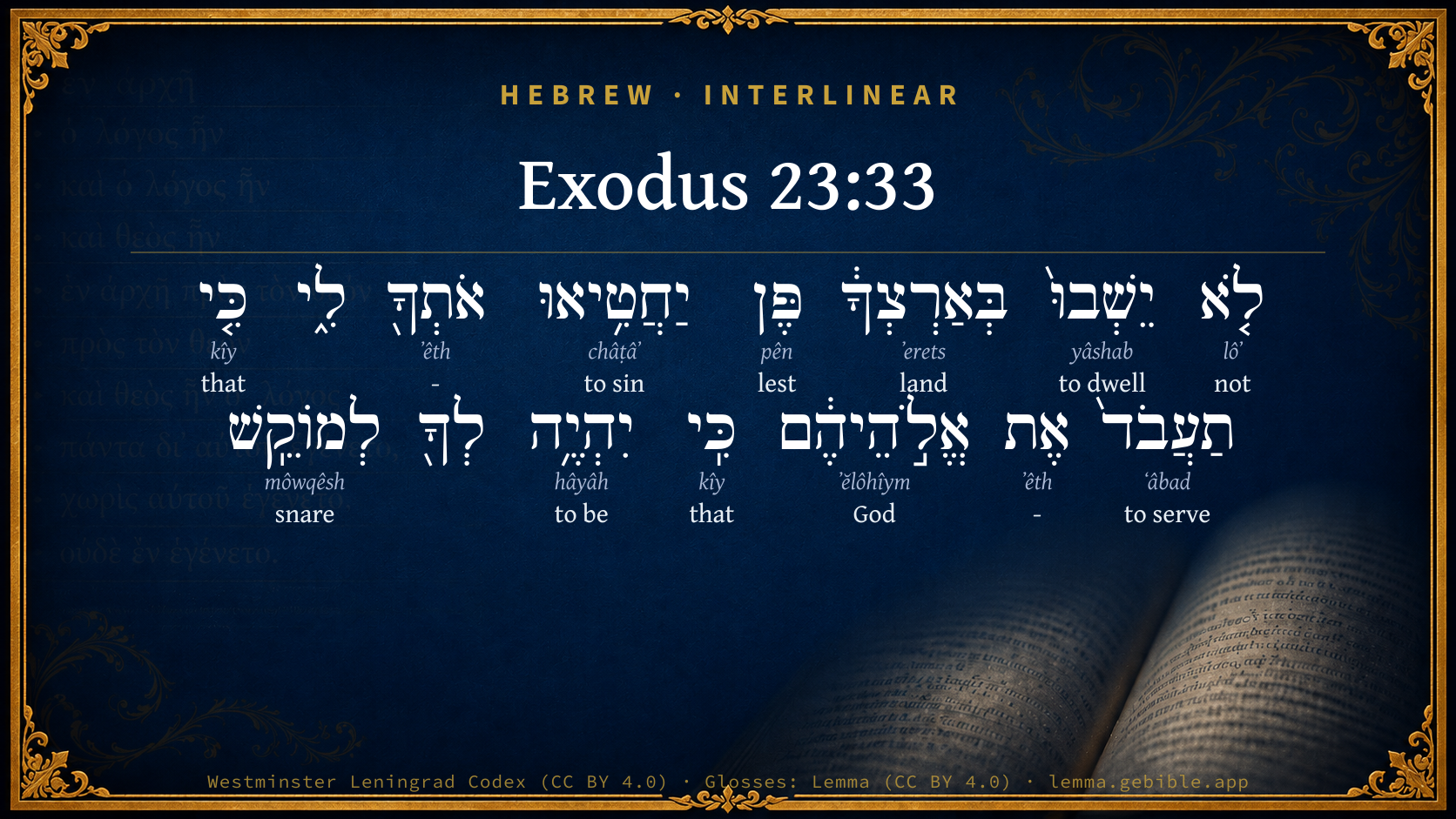
Hebrew (Westminster Leningrad Codex) Exodus 23:33 appears in the Hebrew Old Testament. The text above is from the Westminster Leningrad Codex. Each word links to its Strong’s number, a concise gloss, and parsing drawn from the Open Scriptures Hebrew Bible morphology. Click any word for its full Brown-Driver-Briggs (BDB) entry.
Download image
Cite this verse

Exodus 23:33 (World English Bible). Public Domain. Lemma interlinear Bible study tool, https://lemma.gebible.app/v/exodus/23/33.

Show BibTeX & RIS
BibTeX
RIS
English Translation
They shall not dwell in your land, lest they make you sin against me, for if you serve their gods, it will surely be a snare to you."
World English Bible · Public Domain
Download a study sheet

One document with this verse’s original text, its word-by-word gloss line, the meaning frame, cross-references with their text, attributed commentary, and full source and license credits — printable, and it pastes into notes with its structure intact.

This verse Autodidact and up

Study sheet (.html) Plain text (.txt)

A passage Seminary Student

Up to 50 verses in one chapter. A passage sheet keeps up to 6 commentary sources and 12 cross-references per verse, in the order this page ranks them, and says so on the sheet whenever that leaves anything out. Ask for a single verse and you get the Autodidact verse sheet above.

Everything on this page stays free to read, with no account — the sheet is a download of what is already on screen, not access to it.

Want to remove ads? Support Godless Engineer
Compare translations 3

The same verse in 3 English versions, stacked beneath the original-language interlinear above. Click any original word for its lexicon entry.

Each is an independent rendering of the whole verse — the interlinear is not word-aligned to these translations.

Highlighted words mark where these versions differ — a whole-verse word diff, not a word-by-word alignment.

  • World English Bible Public Domain
    They shall not dwell in your land, lest they make you sin against me, for if you serve their gods, it will surely be a snare to you."
  • King James Version Public Domain
    They shall not dwell in thy land, lest they make thee sin against me: for if thou serve their gods, it will surely be a snare unto thee.
  • unfoldingWord Literal Text CC BY-SA 4.0
    They shall not live in your land, lest they cause you to sin against me; for you will serve their gods. Surely it will become a snare for you.’”

unfoldingWord Literal Text — © unfoldingWord, licensed CC BY-SA 4.0. Word-aligned USFM3 via Door43 (git.door43.org/unfoldingWord/en_ult).

Versions to compare (up to 4)

3 of 4 selected

Show all 18 translations

Every available English version of this verse, each an independent rendering of the whole verse.

  • World English Bible Public Domain
    They shall not dwell in your land, lest they make you sin against me, for if you serve their gods, it will surely be a snare to you."
  • Berean Standard Bible Public Domain
    They must not remain in your land, lest they cause you to sin against Me. For if you serve their gods, it will surely be a snare to you.”
  • Majority Standard Bible Public Domain
    They must not remain in your land, lest they cause you to sin against Me. For if you serve their gods, it will surely be a snare to you.”
  • King James Version Public Domain
    They shall not dwell in thy land, lest they make thee sin against me: for if thou serve their gods, it will surely be a snare unto thee.
  • American Standard Version (1901) Public Domain
    They shall not dwell in thy land, lest they make thee sin against me; for if thou serve their gods, it will surely be a snare unto thee.
  • Revised Version (1885) Public Domain
    They shall not dwell in thy land, lest they make thee sin against me: for if thou serve their gods, it will surely be a snare unto thee.
  • Geneva Bible (1599) Public Domain
    Neither shall they dwell in thy lande, least they make thee sinne against me: for if thou serue their gods, surely it shall be thy destruction.
  • Douay-Rheims (1899) Public Domain
    Let them not dwell in thy land, lest perhaps thy make thee sin against me, if thou serve their god: which undoubtedly will be a scandal to thee.
  • Young's Literal Translation Public Domain
    they do not dwell in thy land, lest they cause thee to sin against Me when thou servest their gods, when it becometh a snare to thee.'
  • Literal Standard Version CC BY-SA 4.0
    they do not dwell in your land, lest they cause you to sin against Me when you serve their gods, when it becomes a snare to you.”
  • Unlocked Literal Bible CC BY-SA 4.0
    They must not live in your land, or they would make you sin against me. If you worship their gods, this will surely become a trap for you.'”
  • unfoldingWord Literal Text CC BY-SA 4.0
    They shall not live in your land, lest they cause you to sin against me; for you will serve their gods. Surely it will become a snare for you.’”
  • Darby Bible Public Domain
    They shall not dwell in thy land, lest they make thee sin against me; for if thou serve their gods, it is sure to be a snare unto thee.
  • World Messianic Bible Public Domain
    They shall not dwell in your land, lest they make you sin against me, for if you serve their gods, it will surely be a snare to you.”
  • Webster's Bible Public Domain
    They shall not dwell in thy land, lest they make thee to sin against me: for if thou shalt serve their gods, it will surely be a snare to thee.
  • Free Bible Version CC BY-SA 4.0
    They must not be allowed to stay in your land, otherwise they will lead you to sin against me. For if you worship their gods, they will definitely become a trap for you.”
  • Bible in Basic English Public Domain
    Let them not go on living in your land, or they will make you do evil against me: for if you give worship to their gods, it will certainly be a cause of sin to you.
  • JPS Tanakh (1917) Public Domain
    They shall not dwell in thy land — lest they make thee sin against Me, for thou wilt serve their gods — for they will be a snare unto thee.

Literal Standard Version (2020), Covenant Press — licensed CC BY-SA 4.0. Text via the HelloAO Bible API (eBible.org). Unlocked Literal Bible (unfoldingWord) — licensed CC BY-SA 4.0. Text via the HelloAO Bible API (eBible.org). unfoldingWord Literal Text — © unfoldingWord, licensed CC BY-SA 4.0. Word-aligned USFM3 via Door43 (git.door43.org/unfoldingWord/en_ult). Free Bible Version, Dr. Jonathan Gallagher — licensed CC BY-SA 4.0. Text via the HelloAO Bible API (eBible.org).

Word by word

More ways to search: Search by grammar → Find every occurrence → Compare this word →

Practice this passage: Drill this verse → Learn its vocabulary →

לְמוֹקֵֽשׁ
môwqêsh
H4170
“to/for · snare”
Preposition + Noun, Common, Masculine, Singular, Absolute
Part of Speech
Preposition + Noun
Type
Common
Gender
Masculine
Number
Singular
State
Absolute
Full BDB Definition

Origin: from H3369

TWOT: 906c

bait, lure, snare
  1. לֹ֤א lôʼ H3808 “not” Particle, Negative
  2. יֵשְׁבוּ֙ yâshab H3427 “to dwell” Verb, Qal, Imperfect, 3rd Person, Masculine, Plural
  3. בְּאַרְצְךָ֔ ʼerets H776 “in/at · land · your” Preposition + Noun, Common, Both, Singular, Construct + Suffix, Personal, 2nd Person, Masculine, Singular
  4. פֶּן pên H6435 “lest” Conjunction
  5. יַחֲטִ֥יאוּ châṭâʼ H2398 “to sin” Verb, Hiphil, Imperfect, 3rd Person, Masculine, Plural
  6. אֹתְךָ֖ ʼêth H853 “- · you” Particle, Direct Object + Suffix, Personal, 2nd Person, Masculine, Singular
  7. כִּ֤י kîy H3588 “that” Conjunction
  8. תַעֲבֹד֙ ʻâbad H5647 “to serve” Verb, Qal, Imperfect, 2nd Person, Masculine, Singular
  9. אֶת ʼêth H853 “-” Particle, Direct Object
  10. אֱלֹ֣הֵיהֶ֔ם ʼĕlôhîym H430 “God(s) · their” Noun, Common, Masculine, Plural, Construct + Suffix, Personal, 3rd Person, Masculine, Plural
  11. כִּֽי kîy H3588 “that” Conjunction
  12. יִהְיֶ֥ה hâyâh H1961 “to be” Verb, Qal, Imperfect, 3rd Person, Masculine, Singular

About this verse

These counts appear in no published source. They are computed here, from the morphology-tagged text and Lemma’s own curated glosses. What Lemma adds →

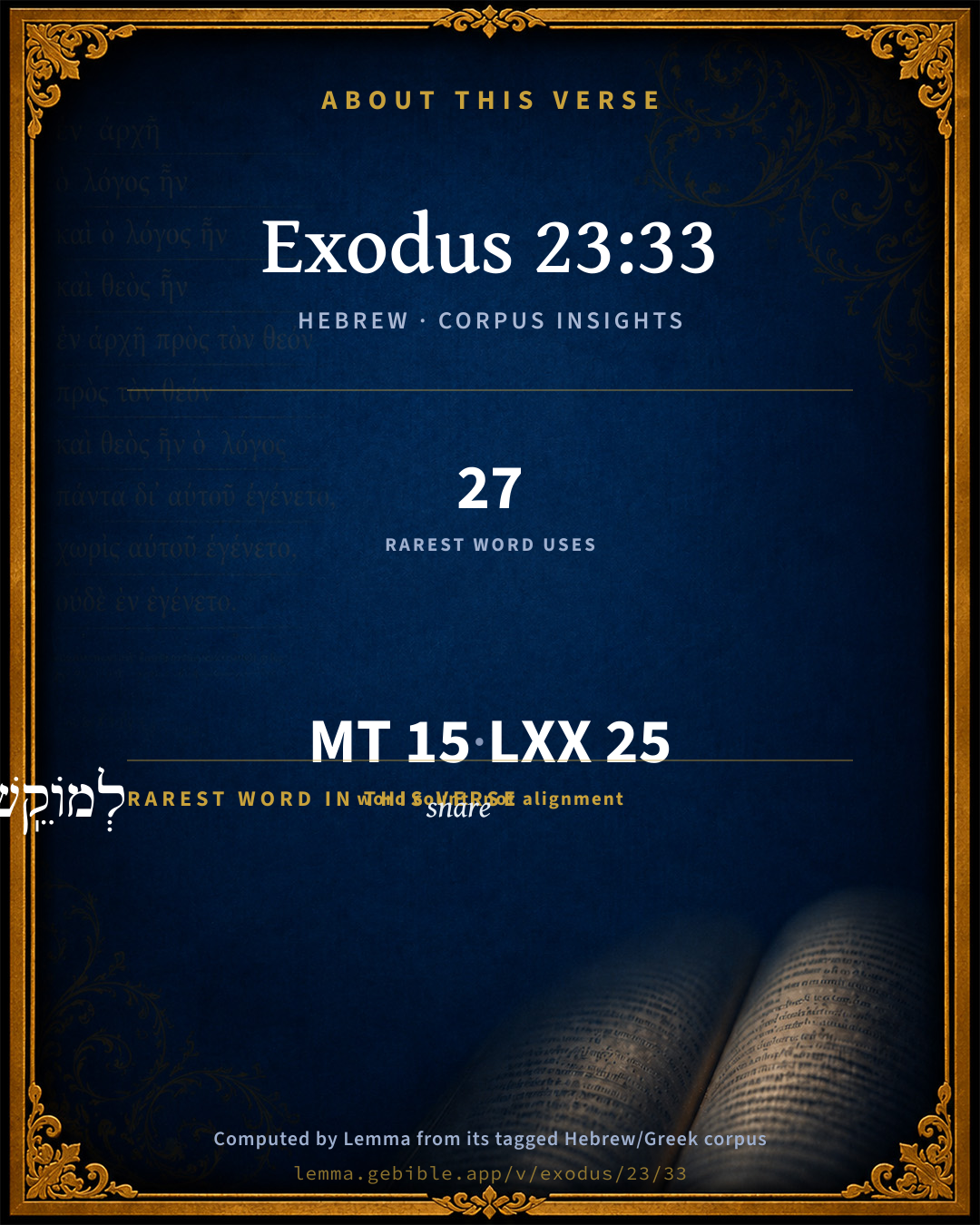
15
words
11
distinct lemmas
Pentateuch
section

Shared distinctive vocabulary

לְמוֹקֵֽשׁ snare H4170 occurs in 27 verses of the Hebrew Bible. Also found in:

Grammatical profile

  • 4 verbs
  • 3 nouns
  • 2 prepositions
  • 3 conjunctions
  • 3 particles

Verb forms

  • יֵשְׁבוּ֙ Qal · Imperfect
  • יַחֲטִ֥יאוּ Hiphil · Imperfect
  • תַעֲבֹד֙ Qal · Imperfect
  • יִהְיֶ֥ה Qal · Imperfect

Repetition

A word recurs within this verse — often emphatic in Hebrew:

  • כִּ֤י that H3588 ×2

Hebrew & Septuagint length

In English translation the verse runs 28 words from the Hebrew and 30 from the Septuagint (LXX English) — closely comparable.

A rough comparison of the two English renderings, which tokenize alike — not a word-level alignment.

Word counts can differ between the Hebrew and the Greek without any difference in meaning — e.g. the Hebrew direct-object marker אֵת has no separate Greek word, and Greek often adds the article ὁ.

In the original languages it is 15 Hebrew tokens and 25 Greek tokens — but the two are counted differently (Hebrew bundles its prefixes and suffixes into one token; the Greek is in lemma form), so that isn’t a like-for-like length.

Cross-references

11

Topical passages linked to Exodus 23:33 in the Treasury of Scripture Knowledge — connected by theme and wording, ordered by reader-vote popularity; previews shown in the World English Bible.

  • Psalms 106:36 They served their idols, Which became a snare to them.
  • Deuteronomy 7:16 You shall consume all the peoples who Yahweh your God shall deliver to you; your eye shall not pity them: neither shall you serve their gods; for that will be a snare to you.
  • Exodus 34:12 Be careful, lest you make a covenant with the inhabitants of the land where you are going, lest it be for a snare in the midst of you:
  • Joshua 23:13 know for a certainty that Yahweh your God will no more drive these nations from out of your sight; but they shall be a snare and a trap to you, and a scourge in your sides, and thorns in your eyes, until you perish from off this good land which Yahweh your God has given you.
  • Judges 2:3 Therefore I also said, I will not drive them out from before you; but they shall be [as thorns] in your sides, and their gods shall be a snare to you.
  • Deuteronomy 12:30 take heed to yourself that you not be ensnared to follow them, after that they are destroyed from before you; and that you not inquire after their gods, saying, How do these nations serve their gods? even so will I do likewise.
  • 1 Samuel 18:21 Saul said, I will give her to him, that she may be a snare to him, and that the hand of the Philistines may be against him. Therefore Saul said to David, You shall this day be my son-in-law a second time.
  • 1 Kings 14:16 He will give Israel up because of the sins of Jeroboam, which he has sinned, and with which he has made Israel to sin.
  • 2 Chronicles 33:9 Manasseh seduced Judah and the inhabitants of Jerusalem, so that they did evil more than did the nations whom Yahweh destroyed before the children of Israel.
  • 2 Timothy 2:26 and they may recover themselves out of the devil's snare, having been taken captive by him to his will.
  • Deuteronomy 7:2–3 and when Yahweh your God shall deliver them up before you, and you shall strike them; then you shall utterly destroy them: you shall make no covenant with them, nor show mercy to them;

Cross-references courtesy of OpenBible.info (CC BY 4.0).

Hebrew and Greek witnesses Masoretic Hebrew ↔ Greek Septuagint

The same verse in the two great witnesses to the Old Testament, shown verse-for-verse.

These are two independent witnesses, not word-aligned to each other, and the Septuagint is shown in lemma (dictionary) form.

Hebrew Exodus 23:33 Masoretic · Westminster Leningrad Codex

לֹ֤א יֵשְׁבוּ֙ בְּאַרְצְךָ֔ פֶּן יַחֲטִ֥יאוּ אֹתְךָ֖ לִ֑י כִּ֤י תַעֲבֹד֙ אֶת אֱלֹ֣הֵיהֶ֔ם כִּֽי יִהְיֶ֥ה לְךָ֖ לְמוֹקֵֽשׁ

They shall not dwell in your land, lest they make you sin against me, for if you serve their gods, it will surely be a snare to you."

World English Bible · Public Domain

Greek LXX Exodus 23:33 Septuagint · lemma form

καί οὐ ἐν καταἵημι ἐν ὁ γῆ σύ ἵνα μή ἁμαρτάνω σύ ποιέω πρός ἐγώ ἐάν γάρ δουλεύω ὁ θεός αὐτός οὗτος εἰμί σύ πρόσκομμα

And they shall not dwell in your land, lest they cause you to sin against me; for if you should serve their gods, these will be an offense to you.

LXX2012 (modern English Septuagint) · Public Domain

Hebrew: Westminster Leningrad Codex (CC BY 4.0). Greek: Septuagint (public domain); English from LXX2012 (modern English Septuagint) (Public Domain). How the Septuagint differs from the Hebrew →

Targum (Aramaic paraphrase)

2

The Targum is the ancient Jewish Aramaic paraphrase of the Hebrew Scriptures — an interpretive translation, not the Hebrew text itself. Onkelos (literal) and Pseudo-Jonathan (expansive) render the Torah, and Jonathan the Prophets. Coverage is partial: where no permissively-licensed English translation exists for a verse, only the Aramaic is shown. This is verse-level text, not a word-by-word alignment to the Hebrew.

  1. Targum Onkelos Torah (Genesis–Deuteronomy)
    לָא יֵתְבוּן בְּאַרְעָךְ דִילְמָא יְחַיְבוּן יָתָךְ קֳדָמָי אֲרֵי תִפְלַח יָת טַעֲוָתְהוֹן אֲרֵי יְהוֹן לָךְ לְתַקְלָא:

    (no public-domain English translation for this verse)

    Targum Onkelos — Aramaic: “Onkelos Genesis” (public domain); “Onkelos Exodus” (public domain); “Onkelos Leviticus” (public domain); “Onkelos Numbers” (public domain); “Onkelos Deuteronomy” (public domain). English: “Sefaria Community Translation” (CC0 1.0 (public-domain dedication)); “J.W. Etheridge. The Targums of Onkelos and Jonathan Ben Uzziel on the Pentateuch. London: Longmans, Green, 1862” (public domain). Text via Sefaria.

  2. Targum Pseudo-Jonathan Torah (Genesis–Deuteronomy)
    לָא תַעֲבֵיד לְהוֹן שְׁכוּנַן בְּאַרְעָךְ דִּלְמָא יַטְעִינָךְ וִיחַיְיבוּן יָתָךְ קֳדָמַי אֲרוּם תִּפְלַח יַת טַעֲוַותְהוֹן אֲרוּם יְהוֹן לָךְ לְתוּקְלָא

    Thou shalt not let them dwell in thy land, lest they cause thee to err, and to sin before Me, when thou dost worship their idols; for they will be a stumbling-block to thee.

    Targum Pseudo-Jonathan — Aramaic: “Targum Jonathan on Genesis” (public domain); “Targum Jonathan on Exodus” (public domain); “Targum Jonathan on Leviticus” (public domain); “Targum Jonathan on Numbers” (public domain); “Targum Jonathan on Deuteronomy” (public domain). English: “The Targum of Jonathan ben Uzziel, trans. J. W. Etheridge, London, 1862” (public domain). Text via Sefaria.

Commentary

Notes on Exodus 23:33 from classic Christian and Jewish commentators (each source and its license shown beneath its notes). The classic Christian expositions comment on the surrounding passage and are grouped to its opening verse, so a note may address several verses; the Jewish commentaries on the Tanakh (Rashi and others) are per-verse, so they appear only where the commentator wrote on this verse.

Lemma curates 59 commentaries, every one of them public domain or Creative Commons licensed, each selected and text-cleaned for this edition rather than reprinted as found. About our sources →

Trapp's Complete Commentary

John Trapp

Exo 23:33 They shall not dwell in thy land, lest they make thee sin against me: for if thou serve their gods, it will surely be a snare unto thee.

Ver. 33. A snare.] See Deu 7:16 Jos 23:13 Jdg 2:3.

John Trapp, A Commentary or Exposition upon All the Books of the Old and New Testament (1647–1656) — public domain. Text from a community e-Sword module.

Tyndale Open Study Notes

Tyndale Open Resources

23:33 they will cause you to sin against me: The Canaanites were to be destroyed because there could be no truce between a holy God and sin. Furthermore, the continuance of God’s revelation, which was to culminate in the incarnation of Jesus Christ, depended on the survival of that revelation through the people of Israel. If they fell back into paganism, that could not happen.

Tyndale Open Study Notes — © Tyndale Open Resources, licensed CC BY-SA 4.0. Text via the HelloAO Bible API.

Geneva Bible (1599)

Geneva Bible translators

Hebrew, offense or snare.

Geneva Bible (1599) marginal notes — public domain. Text via Bolls.life.

Adam Clarke's Commentary

Verse 33. They shall not dwell in thy land] They must be utterly expelled. The land was the Lord's, and he had given it to the progenitors of this people, to Abraham, Isaac, and Jacob. The latter being obliged to leave it because of a famine, God is now conducting back his posterity, who alone had a Divine and natural right to it, and therefore their seeking to possess the inheritance of their fathers can be only criminal in the sight of those who are systematically opposed to the thing, because it is a part of Divine revelation.

WHAT a pity that the Mosaic Law should be so little studied! What a number of just and equal laws, pious and humane institutions, useful and instructive ordinances, does it contain! Everywhere we see the purity and benevolence of God always working to prevent crimes and make the people happy! But what else can be expected from that God who is love, whose tender mercies are over all his works, and who hateth nothing that he has made? Reader, thou art not straitened in him, be not straitened in thy own bowels. Learn from him to be just, humane, kind, and merciful. Love thy enemy, and do good to him that hates thee. Jesus is with thee; hear and obey his voice; provoke him not, and he will be an enemy to thine enemies, and an adversary to thine adversaries. Believe, love, obey; and the road to the kingdom of God is plain before thee. Thou shalt inherit the good land, and be established in it for ever and ever.

Adam Clarke's Commentary on the Bible (1810–1826) — public domain. Text from a community e-Sword/MySword module.

Ellicott's Commentary for English Readers

(33) They shall not dwell in thy land.—Individuals might remain if they became proselytes, as Urijah the Hittite, Araunah the Jebusite, &c.; and the Gibeonites remained en masse, but in a servile condition. What was forbidden was the co-existence of friendly but independent heathen communities with Israel within the limits of Canaan. This would have been a perpetual “snare” to the Israelites, and would have continually led them into idolatry; as we find that it did during the period of the early Judges. (See Jdg_1:27-36; Jdg_2:11-13; Jdg_3:5-7.)

A Bible Commentary for English Readers, edited by Charles John Ellicott (1878–1897) — public domain. Text from a community e-Sword module.

Haydock's Catholic Bible Commentary

Scandal. If you have any society with these nations, it will turn to your ruin, which was but too literally manifested afterwards.

George Leo Haydock (1774–1849), Haydock's Catholic Family Bible and Commentary, 1859 edition — public domain. Excludes Psalms (Douay-Rheims chapter numbering differs from Protestant) and Deuterocanonical books (Catholic canon only).

Matthew Poole's English Annotations

For if thou serve; or, for thou wilt serve; this will be the fruit of thy cohabitation with them, thou wilt thereby be drawn to idolatry.

It will surely, or, and assuredly this will be a snare; an occasion of further sin and utter ruin.

Matthew Poole's English Annotations on the Holy Bible (1683–1685) — public domain. Text from a community e-Sword/MySword module.

Whedon's Commentary on the Bible

Daniel D. Whedon

33. They shall not dwell in thy land — The reason given is apparent. Israel’s mission and the Mosaic dispensation were not a ministry of evangelization, but of conservation of fundamental principles of divine truth. The idolatries of the world and the hardness of human hearts made it necessary first to call a select people out from the nations, and train that peculiar people so that in fulness of time there might go out from them into all the world the saving light and truth of God’s holy revelation.

Daniel D. Whedon (gen. ed.), Commentary on the Old and New Testaments (1874–1909) — public domain. Text from a community e-Sword module.

The Pulpit Commentary

They shall not dwell in the land. This law did not, of course, affect proselytes; nor was it considered to preclude the continuance in the land of the enslaved Gibeonites. It forbade any Canaanite communities being suffered to remain within the limits of Palestine on friendly terms with the Hebrews. The precaution was undoubtedly a wise one.

The Pulpit Commentary (1880–1919), ed. H.D.M. Spence-Jones & Joseph S. Exell — public domain. Text from a community e-Sword module.

Rashi

Rabbi Shlomo Yitzchaki (Rashi)

כי תעבד וגו׳ FOR IF THOU SERVE etc. — Both particles כי in this verse have the meaning of אשר “that”. It has this meaning in several passages. This is really the sense of the Aramaic word אי (Hebrew אם) which itself is one of the four meanings in which כי is used (cf. Gittin 90a. where the four usages of כי are given). In fact we find אם (‎אי) used in many passages in the sense of אשר, e. g., (Leviticus 2:14) ואם תקריב where it certainly should not be translated “if” — but ”when thou offer an offering of thy first-fruits”, for this offering is not optional but is obligatory (cf. Rashi on that verse).

Rashi on the Tanakh — English translations: “The Judaica Press complete Tanach with Rashi, translated by A. J. Rosenberg” (CC BY 4.0); “Pentateuch with Rashi's commentary by M. Rosenbaum and A.M. Silbermann, 1929-1934” (public domain); “The Metsudah Tanach series, Lakewood, N.J” (CC BY 4.0); and “The Book of Joshua, Metsudah Publications, 1997” (CC BY 4.0). Text via Sefaria.

Ramban (Nachmanides)

Rabbi Moshe ben Nachman (Ramban / Nachmanides)

KI’ (FOR) THOU WILT SERVE THEIR GODS, ‘KI’ (FOR) THEY WILL BE A SNARE UNTO THEE. “Both words ki here have the meaning of asher (that), as meaning “for,” as explained further on. — The J.P.S. translation using the words “for” follows thus Ramban’s interpretation. and we find this in many places. This is the meaning of the [Aramaic word] ie which is one of the four usages of the word ki as we find in many places, and this [Aramaic word ie is the Hebrew] im which in many verses has the meaning of asher (that), etc.” Thus far is Rashi’s language. But it is not so. would mean “when that,” and the second ki would mean only “that” — thus: “lest they make you sin against Me when that you serve their gods that will be a snare against you” (Mizrachi). The two identical Hebrew words thus have different meanings in the same verse. Instead, the meaning of the verse is: “They shall not dwell in thy land for they will be a snare unto thee lest they make thee sin against Me, for you will serve their gods.” Similarly He said, Take heed to thyself, lest thou make a covenant with the inhabitants of the land whither thou goest, lest they be a snare in the midst of thee. The meaning of this verse is that their dwelling in your land will be a snare unto you and a source of stumbling, lest they make you sin against Me through their evil ways and their corrupt doings, for you will serve their gods when they will persuade and beguile you to do so.

Ramban (Nachmanides) on the Tanakh — English translation: “Commentary on the Torah by Ramban (Nachmanides). Translated and annotated by Charles B. Chavel. New York, Shilo Pub. House, 1971-1976” (CC BY 4.0). Text via Sefaria.

Lesson kit

Teaching starters — assembled from the data on this page, not authored interpretation. Every prompt links to the verse data it draws on. Edit before teaching.

Exodus, in the Pentateuch, opens this verse with 15 words (11 distinct Hebrew lemmas). Its most distinctive word is môwqêsh (“snare”). A historical commentator’s framing appears above. Read the whole chapter for the surrounding context.

Discussion questions

  1. The word môwqêsh carries the sense “snare.” How does it shape the verse?
  2. How does Exodus 10:7, which shares the word «snare», read alongside this verse?
  3. What does the repetition of “that” (2× in this one verse) do in this verse?
  4. These translations render this verse differently; the difference is in the English rendering, not the original. What questions does that raise?
  5. «יֵשְׁבוּ֙» is a Qal Imperfect verb. How does that grammatical form shape the action described?
  6. Compare how Trapp's Complete Commentary and Tyndale Open Study Notes read this verse. Where do they agree or differ?

Things to notice

Reading settings

Reading text

Shown beneath each verse's original-language words.

Old Testament
Old Testament edition

Read the OT as the Masoretic Hebrew (MT) or the Greek Septuagint (LXX).

English shown for the Greek Septuagint (in the Hebrew ↔ Greek comparison).

Comparing translations? Open the Compare panel on any verse page to stack up to four side by side.