
Leviticus 5:13

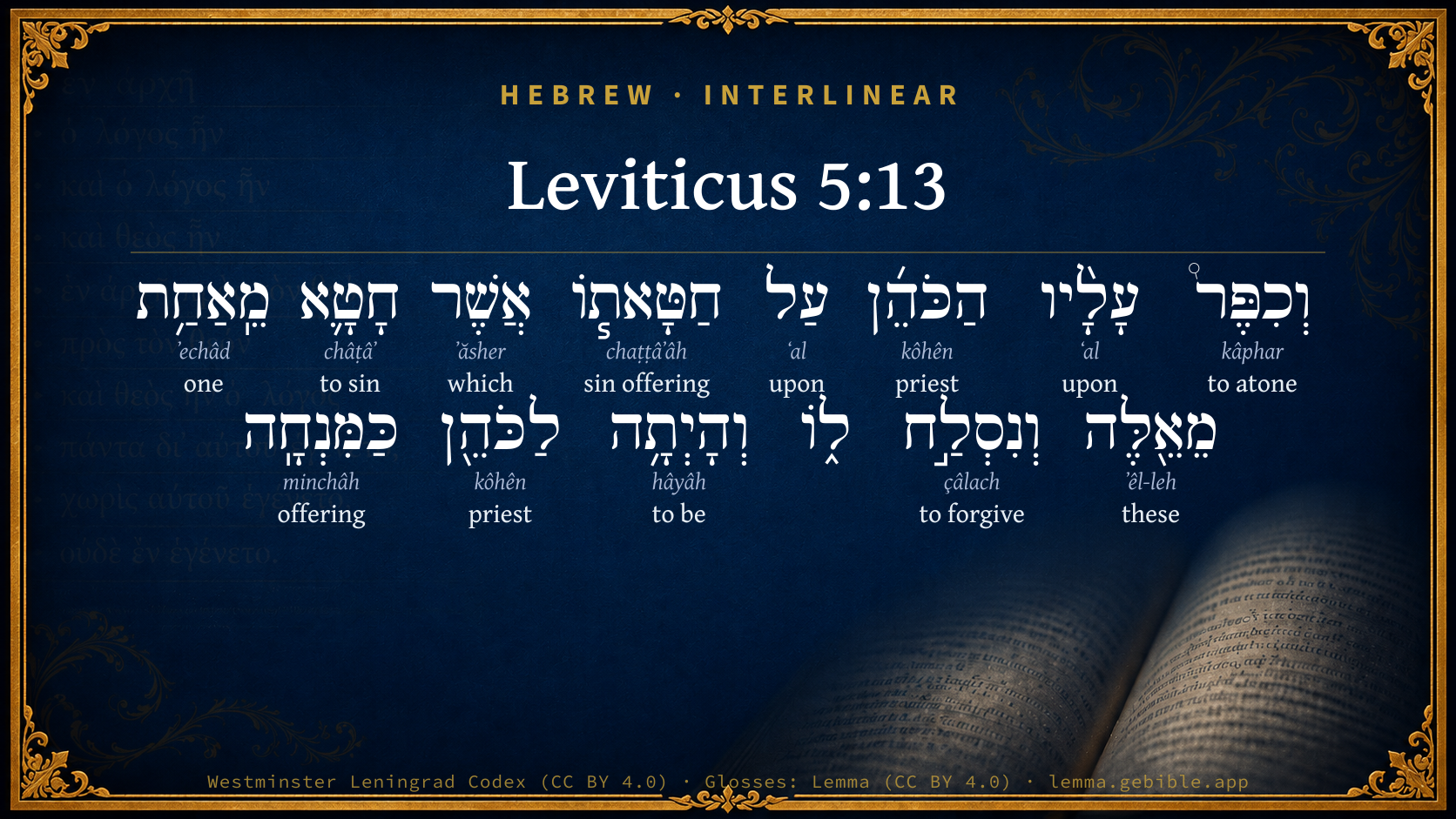
Hebrew (Westminster Leningrad Codex) Leviticus 5:13 appears in the Hebrew Old Testament. The text above is from the Westminster Leningrad Codex. Each word links to its Strong’s number, a concise gloss, and parsing drawn from the Open Scriptures Hebrew Bible morphology. Click any word for its full Brown-Driver-Briggs (BDB) entry.
Download image
Cite this verse

Leviticus 5:13 (World English Bible). Public Domain. Lemma interlinear Bible study tool, https://lemma.gebible.app/v/leviticus/5/13.

Show BibTeX & RIS
BibTeX
RIS
English Translation
The priest shall make atonement for him concerning his sin that he has sinned in any of these things, and he will be forgiven; and the rest shall be the priest's, as the meal offering.'"
World English Bible · Public Domain
Download a study sheet

One document with this verse’s original text, its word-by-word gloss line, the meaning frame, cross-references with their text, attributed commentary, and full source and license credits — printable, and it pastes into notes with its structure intact.

This verse Autodidact and up

Study sheet (.html) Plain text (.txt)

A passage Seminary Student

Up to 50 verses in one chapter. A passage sheet keeps up to 6 commentary sources and 12 cross-references per verse, in the order this page ranks them, and says so on the sheet whenever that leaves anything out. Ask for a single verse and you get the Autodidact verse sheet above.

Everything on this page stays free to read, with no account — the sheet is a download of what is already on screen, not access to it.

Want to remove ads? Support Godless Engineer
Compare translations 3

The same verse in 3 English versions, stacked beneath the original-language interlinear above. Click any original word for its lexicon entry.

Each is an independent rendering of the whole verse — the interlinear is not word-aligned to these translations.

Highlighted words mark where these versions differ — a whole-verse word diff, not a word-by-word alignment.

  • World English Bible Public Domain
    The priest shall make atonement for him concerning his sin that he has sinned in any of these things, and he will be forgiven; and the rest shall be the priest's, as the meal offering.'"
  • King James Version Public Domain
    And the priest shall make an atonement for him as touching his sin that he hath sinned in one of these, and it shall be forgiven him: and the remnant shall be the priest's, as a meat offering.
  • unfoldingWord Literal Text CC BY-SA 4.0
    And the priest shall make atonement for him, for his sin that he sinned from one of these, and it will be forgiven to him. And it shall be for the priest, like the grain offering.’”

unfoldingWord Literal Text — © unfoldingWord, licensed CC BY-SA 4.0. Word-aligned USFM3 via Door43 (git.door43.org/unfoldingWord/en_ult).

Versions to compare (up to 4)

3 of 4 selected

Show all 18 translations

Every available English version of this verse, each an independent rendering of the whole verse.

  • World English Bible Public Domain
    The priest shall make atonement for him concerning his sin that he has sinned in any of these things, and he will be forgiven; and the rest shall be the priest's, as the meal offering.'"
  • Berean Standard Bible Public Domain
    In this way the priest will make atonement for him for any of these sins he has committed, and he will be forgiven. The remainder will belong to the priest, like the grain offering.”
  • Majority Standard Bible Public Domain
    In this way the priest will make atonement for him for any of these sins he has committed, and he will be forgiven. The remainder will belong to the priest, like the grain offering.”
  • King James Version Public Domain
    And the priest shall make an atonement for him as touching his sin that he hath sinned in one of these, and it shall be forgiven him: and the remnant shall be the priest's, as a meat offering.
  • American Standard Version (1901) Public Domain
    And the priest shall make atonement for him as touching his sin that he hath sinned in any of these things, and he shall be forgiven: and `the remnant' shall be the priest's, as the meal-offering.
  • Revised Version (1885) Public Domain
    And the priest shall make atonement for him as touching his sin that he hath sinned in any of these things, and he shall be forgiven: and the remnant shall be the priest’s, as the meal offering.
  • Geneva Bible (1599) Public Domain
    So the Priest shall make an atonement for him, as touching his sinne that he hath committed in one of these poyntes, and it shall bee forgiuen him: and the remnant shalbe the Priests, as the meate offring.
  • Douay-Rheims (1899) Public Domain
    Praying for him and making atonement: but the part that is left, he himself shall have for a gift.
  • Young's Literal Translation Public Domain
    `And the priest hath made atonement for him, for his sin which he hath sinned against one of these, and it hath been forgiven him, and `the remnant' hath been to the priest, like the present.'
  • Literal Standard Version CC BY-SA 4.0
    And the priest has made atonement for him, for his sin which he has sinned against one of these, and it has been forgiven him, and [the remnant] has been for the priest, like the present.”
  • Unlocked Literal Bible CC BY-SA 4.0
    The priest will make atonement for any sin that the person has committed, and that person will be forgiven. The leftovers from the offering will belong to the priest, as with the grain offering.'”
  • unfoldingWord Literal Text CC BY-SA 4.0
    And the priest shall make atonement for him, for his sin that he sinned from one of these, and it will be forgiven to him. And it shall be for the priest, like the grain offering.’”
  • Darby Bible Public Domain
    And the priest shall make atonement for him concerning his sin which he hath sinned in one of these, and it shall be forgiven him; and it shall be the priest's, as the oblation.
  • World Messianic Bible Public Domain
    The priest shall make atonement for him concerning his sin that he has sinned in any of these things, and he will be forgiven; and the rest shall be the priest’s, as the meal offering.’”
  • Webster's Bible Public Domain
    And the priest shall make an atonement for him as concerning his sin that he hath sinned in one of these, and it shall be forgiven him: and the remnant shall be the priest's, as a meat-offering.
  • Free Bible Version CC BY-SA 4.0
    This is how the priest will make right any of these sins you have committed, and you will be forgiven. The rest of the offering will belong to the priest, just like the grain offering.”
  • Bible in Basic English Public Domain
    And the priest will take away his sin and he will have forgiveness: and the rest of the offering will be the priest's, in the same way as the meal offering.
  • JPS Tanakh (1917) Public Domain
    And the priest shall make atonement for him as touching his sin that he hath sinned in any of these things, and he shall be forgiven; and the remnant shall be the priest's, as the meal-offering.

Literal Standard Version (2020), Covenant Press — licensed CC BY-SA 4.0. Text via the HelloAO Bible API (eBible.org). Unlocked Literal Bible (unfoldingWord) — licensed CC BY-SA 4.0. Text via the HelloAO Bible API (eBible.org). unfoldingWord Literal Text — © unfoldingWord, licensed CC BY-SA 4.0. Word-aligned USFM3 via Door43 (git.door43.org/unfoldingWord/en_ult). Free Bible Version, Dr. Jonathan Gallagher — licensed CC BY-SA 4.0. Text via the HelloAO Bible API (eBible.org).

Word by word

More ways to search: Search by grammar → Find every occurrence → Compare this word →

Practice this passage: Drill this verse → Learn its vocabulary →

וְנִסְלַ֣ח
çâlach
H5545
“and · to forgive”
Conjunction + Verb, Niphal, Sequential Perfect, 3rd Person, Masculine, Singular
Part of Speech
Conjunction + Verb
Stem
Niphal
Form
Sequential Perfect
Person
3rd Person
Gender
Masculine
Number
Singular
Full BDB Definition

Origin: a primitive root

TWOT: 1505

to forgive, pardon - (Qal) to forgive, pardon - (Niphal) to be forgiven
  1. וְכִפֶּר֩ kâphar H3722 “and · to atone” Conjunction + Verb, Piel, Sequential Perfect, 3rd Person, Masculine, Singular
  2. עָלָ֨יו ʻal H5921 “upon · him” Preposition + Suffix, Personal, 3rd Person, Masculine, Singular
  3. הַכֹּהֵ֜ן kôhên H3548 “the · priest” Particle, Definite Article + Noun, Common, Masculine, Singular, Absolute
  4. עַל ʻal H5921 “upon” Preposition
  5. חַטָּאת֧וֹ chaṭṭâʼâh H2403 “sin offering · his” Noun, Common, Feminine, Singular, Construct + Suffix, Personal, 3rd Person, Masculine, Singular
  6. אֲשֶׁר ʼăsher H834 “which” Particle, Relative
  7. חָטָ֛א châṭâʼ H2398 “to sin” Verb, Qal, Perfect, 3rd Person, Masculine, Singular
  8. מֵֽאַחַ֥ת ʼechâd H259 “from · one” Preposition + Adjective, Cardinal number, Feminine, Singular, Absolute
  9. מֵאֵ֖לֶּה ʼêl-leh H428 “from · these” Preposition + Pronoun, Demonstrative, Common, Plural
  10. וְהָיְתָ֥ה hâyâh H1961 “and · to be” Conjunction + Verb, Qal, Sequential Perfect, 3rd Person, Feminine, Singular
  11. לַכֹּהֵ֖ן kôhên H3548 “to/for the · priest” Preposition, Determined + Noun, Common, Masculine, Singular, Absolute
  12. כַּמִּנְחָֽה minchâh H4503 “like/as the · offering” Preposition, Determined + Noun, Common, Feminine, Singular, Absolute

About this verse

These counts appear in no published source. They are computed here, from the morphology-tagged text and Lemma’s own curated glosses. What Lemma adds →

14
words
11
distinct lemmas
Pentateuch
section

Shared distinctive vocabulary

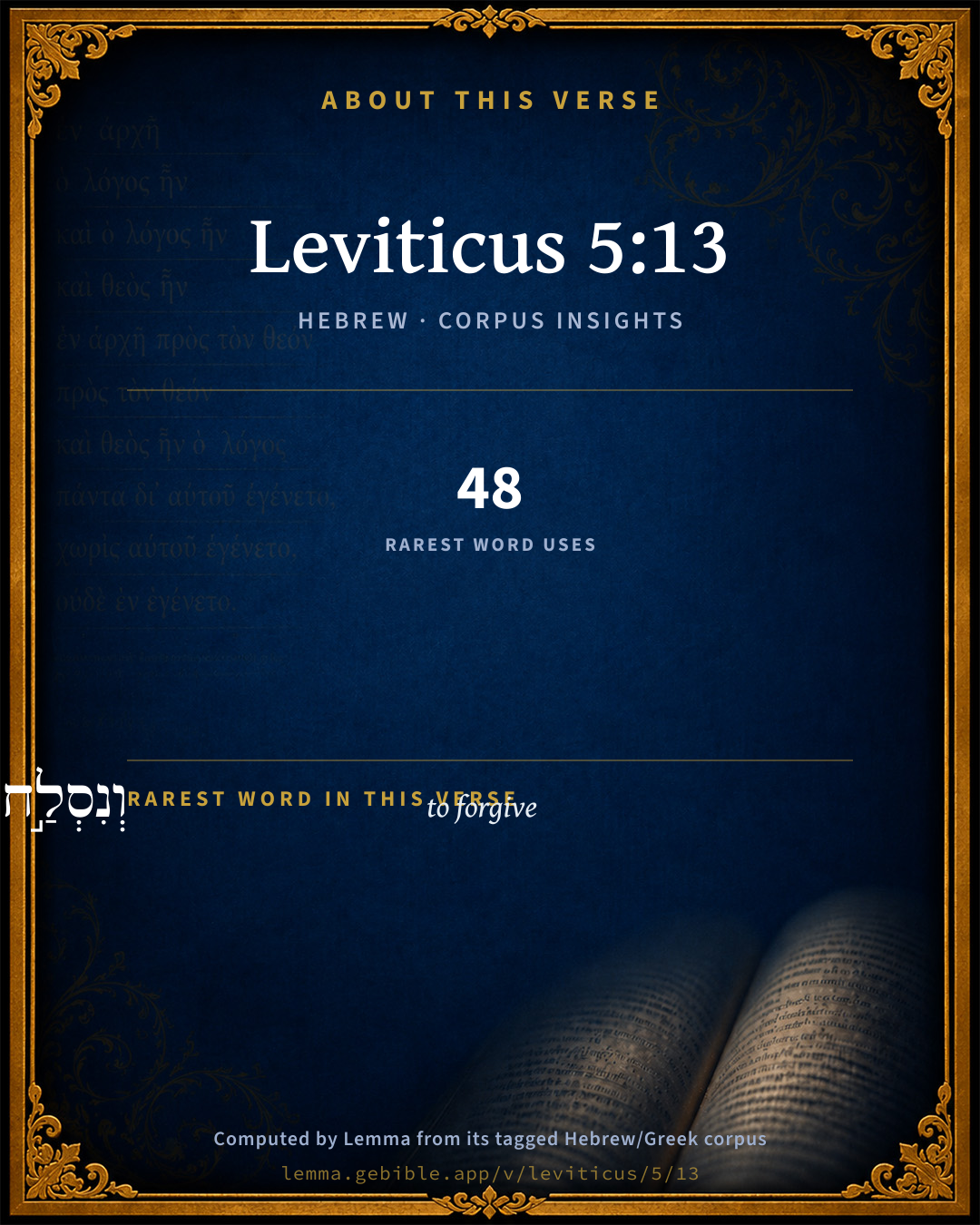
וְנִסְלַ֣ח to forgive H5545 occurs in 45 verses of the Hebrew Bible. Also found in:

Grammatical profile

  • 4 verbs
  • 4 nouns
  • 1 adjective
  • 1 pronoun
  • 3 prepositions
  • 1 particle

Verb forms

  • וְכִפֶּר֩ Piel · Sequential Perfect
  • חָטָ֛א Qal · Perfect
  • וְנִסְלַ֣ח Niphal · Sequential Perfect
  • וְהָיְתָ֥ה Qal · Sequential Perfect

Repetition

Words recur within this verse — often emphatic in Hebrew:

  • עָלָ֨יו upon H5921 ×2
  • הַכֹּהֵ֜ן priest H3548 ×2

Hebrew & Septuagint length

In English translation the verse runs 35 words from the Hebrew and 41 from the Septuagint (LXX English) — closely comparable.

A rough comparison of the two English renderings, which tokenize alike — not a word-level alignment.

Word counts can differ between the Hebrew and the Greek without any difference in meaning — e.g. the Hebrew direct-object marker אֵת has no separate Greek word, and Greek often adds the article ὁ.

Cross-references

10

Topical passages linked to Leviticus 5:13 in the Treasury of Scripture Knowledge — connected by theme and wording, ordered by reader-vote popularity; previews shown in the World English Bible.

  • Leviticus 2:3 That which is left of the meal offering shall be Aaron's and his sons'. It is a most holy thing of the offerings of Yahweh made by fire.
  • Leviticus 4:26 All its fat he shall burn on the altar, like the fat of the sacrifice of peace offerings; and the priest shall make atonement for him concerning his sin, and he will be forgiven.
  • Leviticus 2:10 That which is left of the meal offering shall be Aaron's and his sons'. It is a thing most holy of the offerings of Yahweh made by fire.
  • Leviticus 4:20 Thus shall he do with the bull; as he did with the bull of the sin offering, so shall he do with this; and the priest shall make atonement for them, and they shall be forgiven.
  • Leviticus 4:31 All its fat he shall take away, like the fat is taken away from off of the sacrifice of peace offerings; and the priest shall burn it on the altar for a sweet savor to Yahweh; and the priest shall make atonement for him, and he will be forgiven.
  • Leviticus 5:6 and he shall bring his trespass offering to Yahweh for his sin which he has sinned, a female from the flock, a lamb or a goat, for a sin offering; and the priest shall make atonement for him concerning his sin.
  • Leviticus 7:6 Every male among the priests may eat of it. It shall be eaten in a holy place. It is most holy.
  • 1 Samuel 2:28 and did I choose him out of all the tribes of Israel to be my priest, to go up to my altar, to burn incense, to wear an ephod before me? and did I give to the house of your father all the offerings of the children of Israel made by fire?
  • Hosea 4:8 They feed on the sin of my people, And set their heart on their iniquity.
  • 1 Corinthians 9:13 Don't you know that those who serve around sacred things eat from the things of the temple, and those who wait on the altar have their portion with the altar?

Cross-references courtesy of OpenBible.info (CC BY 4.0).

Hebrew and Greek witnesses Masoretic Hebrew ↔ Greek Septuagint

The same verse in the two great witnesses to the Old Testament, shown verse-for-verse.

These are two independent witnesses, not word-aligned to each other, and the Septuagint is shown in lemma (dictionary) form.

Hebrew Leviticus 5:13 Masoretic · Westminster Leningrad Codex

וְכִפֶּר֩ עָלָ֨יו הַכֹּהֵ֜ן עַל חַטָּאת֧וֹ אֲשֶׁר חָטָ֛א מֵֽאַחַ֥ת מֵאֵ֖לֶּה וְנִסְלַ֣ח ל֑וֹ וְהָיְתָ֥ה לַכֹּהֵ֖ן כַּמִּנְחָֽה

The priest shall make atonement for him concerning his sin that he has sinned in any of these things, and he will be forgiven; and the rest shall be the priest's, as the meal offering.'"

World English Bible · Public Domain

Greek LXX Leviticus 5:13 Septuagint · lemma form

καί ἐκἱλάσκομαι περί αὐτός ὁ ἱερεύς περί ὁ ἁμαρτία αὐτός ὅς ἁμαρτάνω ἐπί εἷς οὗτος καί ἀποἵημι αὐτός ὁ δέ καταλείπω εἰμί ὁ ἱερεύς ὡς ὁ θυσία ὁ σεμίδαλις

And the priest shall make atonement for him for his sin, which he has sinned in one of these things, and it shall be forgiven him; and that which is left shall be the priest's, as an offering of fine flour.

LXX2012 (modern English Septuagint) · Public Domain

On this verse, The Cambridge Bible for Schools and Colleges discusses the Septuagint’s reading. Read the note in Commentary ↓

Hebrew: Westminster Leningrad Codex (CC BY 4.0). Greek: Septuagint (public domain); English from LXX2012 (modern English Septuagint) (Public Domain). How the Septuagint differs from the Hebrew →

Targum (Aramaic paraphrase)

2

The Targum is the ancient Jewish Aramaic paraphrase of the Hebrew Scriptures — an interpretive translation, not the Hebrew text itself. Onkelos (literal) and Pseudo-Jonathan (expansive) render the Torah, and Jonathan the Prophets. Coverage is partial: where no permissively-licensed English translation exists for a verse, only the Aramaic is shown. This is verse-level text, not a word-by-word alignment to the Hebrew.

  1. Targum Onkelos Torah (Genesis–Deuteronomy)
    וִיכַפֵּר עֲלוֹהִי כַהֲנָא עַל חוֹבְתֵהּ דִי חָב מֵחֲדָא מֵאִלֵין וְיִשְׁתְּבֵק לֵהּ וּתְהֵי לְכַהֲנָא כְּמִנְחָתָא

    (no public-domain English translation for this verse)

    Targum Onkelos — Aramaic: “Onkelos Genesis” (public domain); “Onkelos Exodus” (public domain); “Onkelos Leviticus” (public domain); “Onkelos Numbers” (public domain); “Onkelos Deuteronomy” (public domain). English: “Sefaria Community Translation” (CC0 1.0 (public-domain dedication)); “J.W. Etheridge. The Targums of Onkelos and Jonathan Ben Uzziel on the Pentateuch. London: Longmans, Green, 1862” (public domain). Text via Sefaria.

  2. Targum Pseudo-Jonathan Torah (Genesis–Deuteronomy)
    וִיכַפֵּר עֲלוֹי כַּהֲנָא עַל חוֹבְתֵיהּ דְחַב מֵחַד מֵאִלֵין וְיִשְׁתְּבֵיק לֵיהּ וּתְהֵי לְכַהֲנָא כְּמִנְחָתָא

    And the priest shall atone for his sin that he hath sinned, and it shall be forgiven him. And the remainder shall be a mincha to the priest.

    Targum Pseudo-Jonathan — Aramaic: “Targum Jonathan on Genesis” (public domain); “Targum Jonathan on Exodus” (public domain); “Targum Jonathan on Leviticus” (public domain); “Targum Jonathan on Numbers” (public domain); “Targum Jonathan on Deuteronomy” (public domain). English: “The Targum of Jonathan ben Uzziel, trans. J. W. Etheridge, London, 1862” (public domain). Text via Sefaria.

Commentary

Notes on Leviticus 5:13 from classic Christian and Jewish commentators (each source and its license shown beneath its notes). The classic Christian expositions comment on the surrounding passage and are grouped to its opening verse, so a note may address several verses; the Jewish commentaries on the Tanakh (Rashi and others) are per-verse, so they appear only where the commentator wrote on this verse.

Lemma curates 59 commentaries, every one of them public domain or Creative Commons licensed, each selected and text-cleaned for this edition rather than reprinted as found. About our sources →

Trapp's Complete Commentary

John Trapp

Lev 5:13 And the priest shall make an atonement for him as touching his sin that he hath sinned in one of these, and it shall be forgiven him: and [the remnant] shall be the priest’s, as a meat offering.

Ver. 13. And it shall be forgiven him.] See a like promise made to our ministry, Jas 5:15.

John Trapp, A Commentary or Exposition upon All the Books of the Old and New Testament (1647–1656) — public domain. Text from a community e-Sword module.

Tyndale Open Study Notes

Tyndale Open Resources

5:13 making them right: See study notes on 1:4; 4:20. • rest of the flour: See study note on 2:3.

Tyndale Open Study Notes — © Tyndale Open Resources, licensed CC BY-SA 4.0. Text via the HelloAO Bible API.

Ellicott's Commentary for English Readers

(13) As touching his sin that he had sinned in one of these.—That is, in one of the three sins specified in Lev_5:1-4 of this chapter. (See Lev_5:5.)

And the remnant shall be the priest’s.—Better, and it shall belong to the priest. The word remnant is not in the original, and is better left out, since with the exception of the handful which he took out to burn upon the altar, the whole tenth part of the ephah of fine flour belonged to the priest. At the time of Christ, this only took place when the offerer was a layman. But when a priest committed the offence and brought the offering in question, the whole tenth part of the ephah of flour was burnt on the altar, as was done in the case of the meat offering.

A Bible Commentary for English Readers, edited by Charles John Ellicott (1878–1897) — public domain. Text from a community e-Sword module.

The Cambridge Bible for Schools and Colleges

gen. ed. J. J. S. Perowne

13. the remnant shall be the priest’s] ‘the remnant’ is not expressed in Heb. but is supplied by the LXX. It might be supposed that a priest would not be so extremely poor as to bring this offering; tradition however provided that if he did, the whole was to be burnt on the altar, according to Lev_6:23.

The Cambridge Bible for Schools and Colleges (gen. ed. J. J. S. Perowne; Cambridge University Press, 1878–1918) — public domain. Text from a community e-Sword module.

John Gill's Exposition

And the priest shall make an atonement for him,.... By burning the handful of flour brought by him, as an emblem of the painful sufferings of Christ, whereby he made atonement for the sins of his people:

as touching his sin that he hath sinned in one of these; for whatsoever sin he had committed in any of the above cases, Lev 5:1,

and it shall be forgiven him; upon the foot of the atonement made; See Gill on Lev 5:10,

and the remnant shall be the priest's as a meat offering; the whole tenth part of an ephah of fine flour was the priest's, excepting the handful he took and burnt, just as in the case of a common meat offering, Lev 2:3.

John Gill's Exposition of the Whole Bible (1746–1763) — public domain (CC PDM 1.0). Text via the HelloAO Bible API.

Matthew Poole's English Annotations

As it was in the meat-offering, where all, except one handful, fell to the share of the priests. See Lev 2:3; 7:9. And this is the rather mentioned here, because in the foregoing sacrifices, Lev 4:3; 13, &c., the priest had no part reserved for him.

Matthew Poole's English Annotations on the Holy Bible (1683–1685) — public domain. Text from a community e-Sword/MySword module.

John Wesley's Explanatory Notes

As a meal offering - As it was in the meal-offering, where all, except one handful, fell to the share of the priests. And this is the rather mentioned here, because in the foregoing sacrifices, chap. iv, 3, &c. chap. iv, 13, &c. the priest had no part reserved for him.

John Wesley, Explanatory Notes Upon the Whole Bible (1754–1765) — public domain. Text via the GEBible commentary corpus.

Rashi

Rabbi Shlomo Yitzchaki (Rashi)

‎אשר חטא על חטאתו [AND THE PRIEST SHALL MAKE EXPIATION ON HIS BEHALF] FOR THE SIN THAT HE HATH SINNED — Here Scripture varies the expression, for in the case of affluence (v. 6) and narrow means (v. 10) it is stated, “[and the priest shall make expiation for him] מחטאתו”, whilst here, in the case of utter destitution, it is stated מחטאתו) על חטאתו may mean: something from his sin-offering, i. e., a part of it, whilst על חטאתו implies something in addition to his sin-offering)! Our Rabbis from the niceties of the text derived from here the law that if one sinned whilst he was a rich man and set apart money for a she-lamb or a she-goat (the sacrifice prescribed for a well-to-do person; cf. v. 6), but then became impoverished somewhat, he has only to bring (purchase) from a part of it (the money) two turtledoves (or two young pigeons, the offering prescribed for the poor) and may retain the balance for his own use: if, being a poor mạn, he has set apart money for two turtledoves and then was reduced to even greater poverty, he has only to bring from a part of it a tenth of an ephah of flour; hence the use of the word מחטאתו in the sense explained above. If, on the other hand, being only of moderate means, he has set apart money only for a tenth of an ephah of flour, but became rich afterwards, he must add to it and bring the offering prescribed for a rich man. For this reason it is stated here על חטאתו — in addition to what was intended for his sin-offering (Keritot 27b).

מאחת מאלה [AND THE PRIEST SHALL MAKE EXPIATION FOR HIM] BY MEANS OF ONE OF THESE — i. e. by means of one of the three expiating sacrifices mentioned in this section: either by means of the offering prescribed for affluence or by that for poverty or by that for utter destitution (i. e., in the case of the offerings brought for each of the three sins mentioned above (vv. 1, 2—3 and 4) the offering must be brought according to the circumstances of the wrong-doer). But why is this stated? (i. e., why does it not merely state‎ אשר חטא ונסלח לו ‎ חטאתו הכהן על ‎וכפר עליו‎ since the different sacrifices have been mentioned previously)? But Scripture uses this term “by means of one of these”, because I might think that the most serious sins amongst them (i. e. those mentioned in vv. 2—3, which, if done wilfully, are subject to the penalty of כרת) should be atoned for by a she-lamb or a she-goat: the lighter ones (v. 1) by a fowl, and the lightest of all (v. 4) by a tenth part of an ephah of flour! Scripture, however, states, “[and he shall make expiation for him] by one of these” — in order to put on the same level the light sins with the most serious with regard to the duty of offering a she-lamb or a she-goat, if he (the offender) possesses the means. And, on the other hand, to put on the same level the most serious sins with the lighter in respect to the duty of bringing a tenth part of an ephah of flour as an offering in case of utter destitution (Sifra, Vayikra Dibbura d'Chovah, Chapter 19 10).

והיתה לכהן כמנחה AND IT SHALL BE THE PRIEST’S, JUST AS A MEAL-OFFERING — This is intended to teach with regard to the meal-offering of a sinner (i. e. a meal-offering brought as an expiation for the sins mentioned above) that what is left of it after the קמץ has been burnt may be eaten by the priests just as the remains of the free-will offering (cf. Leviticus 2:3). This is what the statement means according to its literal sense. Our Rabbis, however, explained והיתה לכהן to imply: that if this sinner be a priest, then it shall be as any other meal-offering brought as a free-will offering by a priest which comes under the law: (Leviticus 6:16) “[For every meal-offering of the priest] shall be wholly burnt; it shall not be eaten”. (The words are to be construed thus:והיתה לכהן, but if it be a priest’s, כמנחה then it shall be exactly like any voluntary meal-offering that he brings) (cf. Sifra, Vayikra Dibbura d'Chovah, Chapter 19 11; Menachot 73b).

Rashi on the Tanakh — English translations: “The Judaica Press complete Tanach with Rashi, translated by A. J. Rosenberg” (CC BY 4.0); “Pentateuch with Rashi's commentary by M. Rosenbaum and A.M. Silbermann, 1929-1934” (public domain); “The Metsudah Tanach series, Lakewood, N.J” (CC BY 4.0); and “The Book of Joshua, Metsudah Publications, 1997” (CC BY 4.0). Text via Sefaria.

Lesson kit

Teaching starters — assembled from the data on this page, not authored interpretation. Every prompt links to the verse data it draws on. Edit before teaching.

Leviticus, in the Pentateuch, opens this verse with 14 words (11 distinct Hebrew lemmas). Its most distinctive word is çâlach (“to forgive”). A historical commentator’s framing appears above. Read the whole chapter for the surrounding context.

Discussion questions

  1. What does “to forgive” (çâlach) contribute to the verse as a whole?
  2. How does Exodus 34:9, which shares the word «to forgive», read alongside this verse?
  3. What does the repetition of “upon” (2× in this one verse) do in this verse?
  4. These translations render this verse differently. What is at stake in choosing one wording over another?
  5. «וְכִפֶּר֩» is a Piel Sequential Perfect verb. How does that grammatical form shape the action described?
  6. Compare how Trapp's Complete Commentary and Tyndale Open Study Notes read this verse. Where do they agree or differ?

Things to notice

Reading settings

Reading text

Shown beneath each verse's original-language words.

Old Testament
Old Testament edition

Read the OT as the Masoretic Hebrew (MT) or the Greek Septuagint (LXX).

English shown for the Greek Septuagint (in the Hebrew ↔ Greek comparison).

Comparing translations? Open the Compare panel on any verse page to stack up to four side by side.