
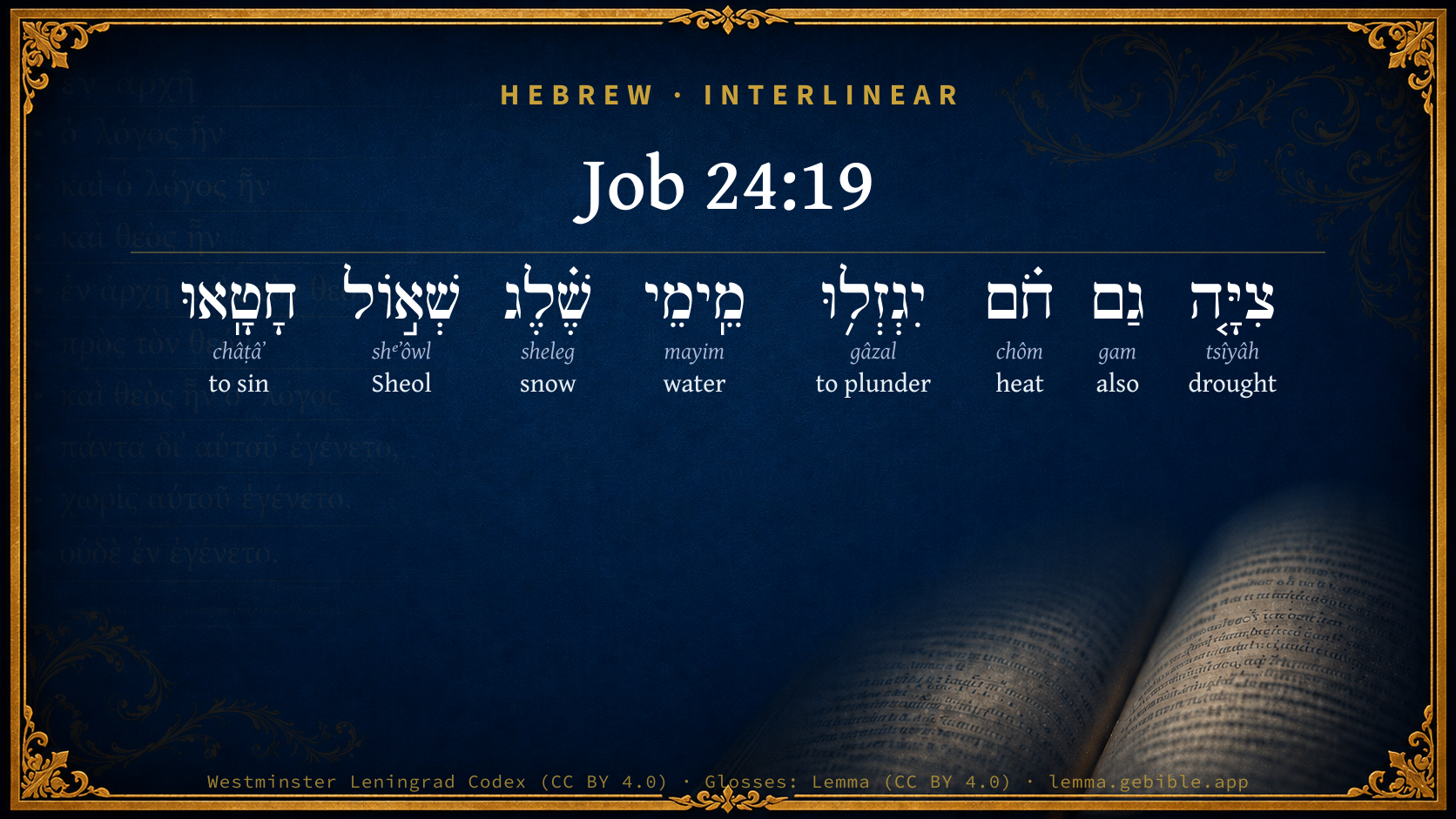
Job 24:19

Hebrew (Westminster Leningrad Codex) Job 24:19 appears in the Hebrew Old Testament. The text above is from the Westminster Leningrad Codex. Each word links to its Strong’s number, a concise gloss, and parsing drawn from the Open Scriptures Hebrew Bible morphology. Click any word for its full Brown-Driver-Briggs (BDB) entry.
Download image
Cite this verse

Job 24:19 (World English Bible). Public Domain. Lemma interlinear Bible study tool, https://lemma.gebible.app/v/job/24/19.

Show BibTeX & RIS
BibTeX
RIS
English Translation
Drought and heat consume the snow waters; So does Sheol those who have sinned.
World English Bible · Public Domain
Highlights
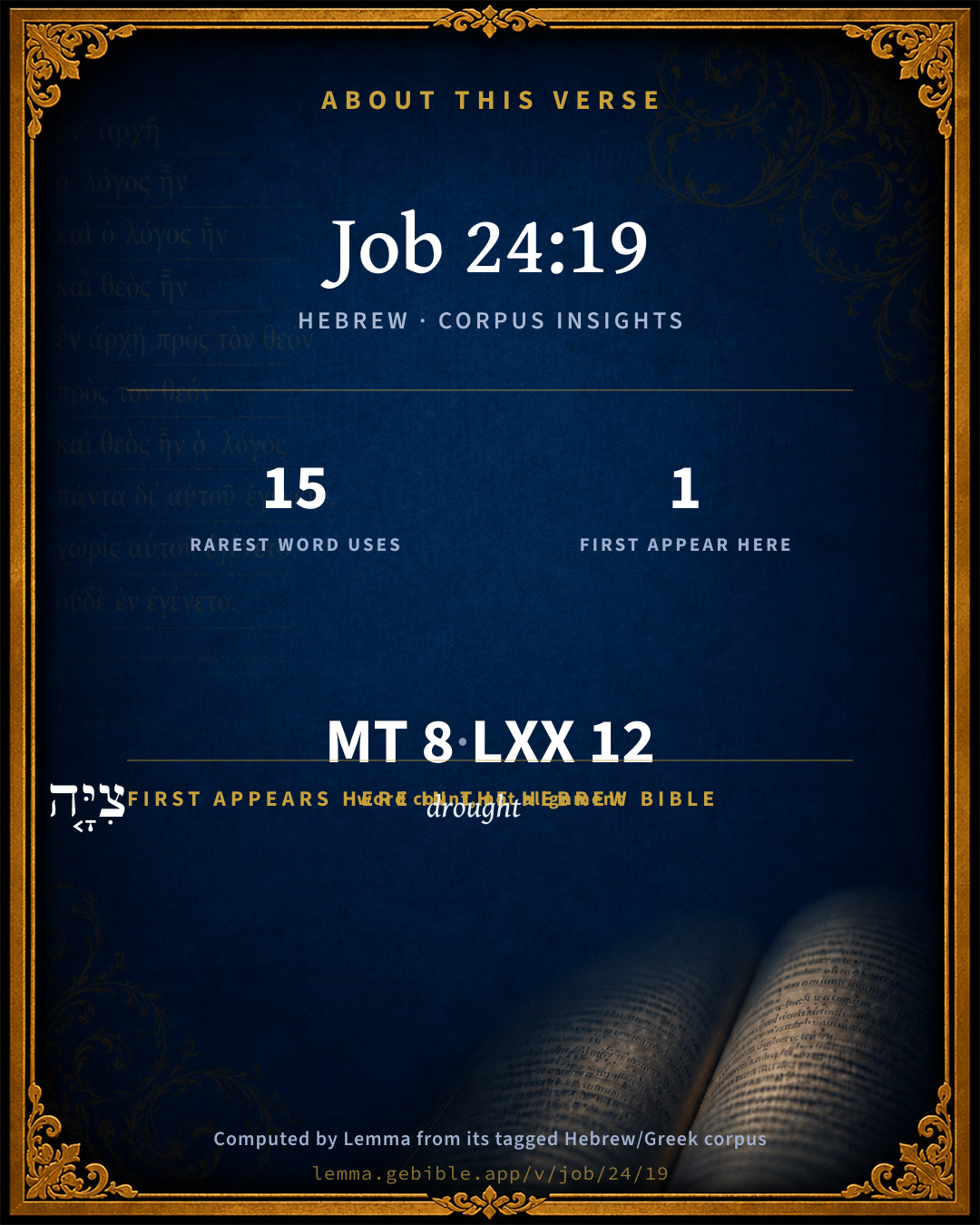
  • 1 first appearance in the Hebrew Bible
Full analysis ↓
Download a study sheet

One document with this verse’s original text, its word-by-word gloss line, the meaning frame, cross-references with their text, attributed commentary, and full source and license credits — printable, and it pastes into notes with its structure intact.

This verse Autodidact and up

Study sheet (.html) Plain text (.txt)

A passage Seminary Student

Up to 50 verses in one chapter. A passage sheet keeps up to 6 commentary sources and 12 cross-references per verse, in the order this page ranks them, and says so on the sheet whenever that leaves anything out. Ask for a single verse and you get the Autodidact verse sheet above.

Everything on this page stays free to read, with no account — the sheet is a download of what is already on screen, not access to it.

Want to remove ads? Support Godless Engineer
Compare translations 3

The same verse in 3 English versions, stacked beneath the original-language interlinear above. Click any original word for its lexicon entry.

Each is an independent rendering of the whole verse — the interlinear is not word-aligned to these translations.

Highlighted words mark where these versions differ — a whole-verse word diff, not a word-by-word alignment.

  • World English Bible Public Domain
    Drought and heat consume the snow waters; So does Sheol those who have sinned.
  • King James Version Public Domain
    Drought and heat consume the snow waters: so doth the grave those which have sinned.
  • unfoldingWord Literal Text CC BY-SA 4.0
    Drought and heat strip away the waters of snow; Sheol, have sinned.

unfoldingWord Literal Text — © unfoldingWord, licensed CC BY-SA 4.0. Word-aligned USFM3 via Door43 (git.door43.org/unfoldingWord/en_ult).

Versions to compare (up to 4)

3 of 4 selected

Show all 18 translations

Every available English version of this verse, each an independent rendering of the whole verse.

  • World English Bible Public Domain
    Drought and heat consume the snow waters; So does Sheol those who have sinned.
  • Berean Standard Bible Public Domain
    As drought and heat consume the melting snow, so Sheol steals those who have sinned.
  • Majority Standard Bible Public Domain
    As drought and heat consume the melting snow, so Sheol steals those who have sinned.
  • King James Version Public Domain
    Drought and heat consume the snow waters: so doth the grave those which have sinned.
  • American Standard Version (1901) Public Domain
    Drought and heat consume the snow waters: `So doth' Sheol `those that' have sinned.
  • Revised Version (1885) Public Domain
    Drought and heat consume the snow waters: so doth Sheol those which have sinned.
  • Geneva Bible (1599) Public Domain
    As the dry ground and heate consume the snowe waters, so shall the graue the sinners.
  • Douay-Rheims (1899) Public Domain
    Let him pass from the snow waters to excessive heat, and his sin even to hell.
  • Young's Literal Translation Public Domain
    Drought -- also heat -- consume snow-waters, Sheol `those who' have sinned.
  • Literal Standard Version CC BY-SA 4.0
    Drought—also heat—consume snow-waters, || Sheol—[those who] have sinned.
  • Unlocked Literal Bible CC BY-SA 4.0
    As drought and heat melt away the snow into waters, so Sheol takes away those who have sinned.
  • unfoldingWord Literal Text CC BY-SA 4.0
    Drought and heat strip away the waters of snow; Sheol, have sinned.
  • Darby Bible Public Domain
    Drought and heat consume snow waters; so doth Sheol those that have sinned.
  • World Messianic Bible Public Domain
    Drought and heat consume the snow waters, so does Sheol those who have sinned.
  • Webster's Bible Public Domain
    Drouth and heat consume the snow-waters: so doth the grave those who have sinned.
  • Free Bible Version CC BY-SA 4.0
    Just as heat and drought dry up snowmelt, so Sheol takes away those who have sinned.
  • Bible in Basic English Public Domain
    Snow waters become dry with the heat: so do sinners go down into the underworld.
  • JPS Tanakh (1917) Public Domain
    Drought and heat consume the snow waters; so doth the nether-world those that have sinned.

Literal Standard Version (2020), Covenant Press — licensed CC BY-SA 4.0. Text via the HelloAO Bible API (eBible.org). Unlocked Literal Bible (unfoldingWord) — licensed CC BY-SA 4.0. Text via the HelloAO Bible API (eBible.org). unfoldingWord Literal Text — © unfoldingWord, licensed CC BY-SA 4.0. Word-aligned USFM3 via Door43 (git.door43.org/unfoldingWord/en_ult). Free Bible Version, Dr. Jonathan Gallagher — licensed CC BY-SA 4.0. Text via the HelloAO Bible API (eBible.org).

Word by word

More ways to search: Search by grammar → Find every occurrence → Compare this word →

Practice this passage: Drill this verse → Learn its vocabulary →

About this verse

These counts appear in no published source. They are computed here, from the morphology-tagged text and Lemma’s own curated glosses. What Lemma adds →

8
words
8
distinct lemmas
Wisdom
section

Notable vocabulary

The rarest word here is חֹ֗ם heat H2527 — appearing just 15 times in the whole Hebrew Bible.

First appearance in Scripture

This word makes its first canonical appearance in the Hebrew Bible here:

  • צִיָּ֤ה drought H6723

Shared distinctive vocabulary

חֹ֗ם heat H2527 occurs in 13 verses of the Hebrew Bible. Also found in:

Grammatical profile

  • 2 verbs
  • 5 nouns
  • 1 adverb

Verb forms

  • יִגְזְל֥וּ Qal · Imperfect
  • חָטָֽאוּ Qal · Perfect

Hebrew & Septuagint length

In English translation the verse runs 14 words from the Hebrew and 16 from the Septuagint (LXX English) — closely comparable.

A rough comparison of the two English renderings, which tokenize alike — not a word-level alignment.

Word counts can differ between the Hebrew and the Greek without any difference in meaning — e.g. the Hebrew direct-object marker אֵת has no separate Greek word, and Greek often adds the article ὁ.

In the original languages it is 8 Hebrew tokens and 12 Greek tokens — but the two are counted differently (Hebrew bundles its prefixes and suffixes into one token; the Greek is in lemma form), so that isn’t a like-for-like length.

Cross-references

11

Topical passages linked to Job 24:19 in the Treasury of Scripture Knowledge — connected by theme and wording, ordered by reader-vote popularity; previews shown in the World English Bible.

  • Psalms 49:14 They are appointed as a flock for Sheol. Death shall be their shepherd. The upright shall have dominion over them in the morning. Their beauty shall decay in Sheol, Far from their mansion.
  • Job 21:13 They spend their days in prosperity. In an instant they go down to Sheol.
  • Proverbs 14:32 The wicked is brought down in his calamity, But in death, the righteous has a refuge.
  • Luke 16:22 It happened that the beggar died, and that he was carried away by the angels to Abraham's bosom. The rich man also died, and was buried.
  • Psalms 68:2 As smoke is driven away, So drive them away. As wax melts before the fire, So let the wicked perish at the presence of God.
  • Ecclesiastes 9:4–6 For to him who is joined with all the living there is hope; for a living dog is better than a dead lion.
  • Luke 12:20 "But God said to him, 'You foolish one, tonight your soul is required of you. The things which you have prepared--whose will they be?'
  • Job 6:15–17 My brothers have dealt deceitfully as a brook, As the channel of brooks that pass away;
  • Job 21:23 One dies in his full strength, Being wholly at ease and quiet.
  • Job 21:32–34 Yet shall he be borne to the grave, Men shall keep watch over the tomb.
  • Psalms 58:8–9 Let them be like a snail which melts and passes away, Like the stillborn child, who has not seen the sun.

Cross-references courtesy of OpenBible.info (CC BY 4.0).

Hebrew and Greek witnesses Masoretic Hebrew ↔ Greek Septuagint

The same verse in the two great witnesses to the Old Testament, shown verse-for-verse.

These are two independent witnesses, not word-aligned to each other, and the Septuagint is shown in lemma (dictionary) form.

Hebrew Job 24:19 Masoretic · Westminster Leningrad Codex

צִיָּ֤ה גַם חֹ֗ם יִגְזְל֥וּ מֵֽימֵי שֶׁ֗לֶג שְׁא֣וֹל חָטָֽאוּ

Drought and heat consume the snow waters; So does Sheol those who have sinned.

World English Bible · Public Domain

Greek LXX Job 24:19 Septuagint · lemma form

ἀναφαίνω δέ ὁ φυτόν αὐτός ἐπί γῆ ξηρός ἀγκαλίς γάρ ὀρφανός ἁρπάζω

Let them be withered upon the earth; for they have plundered the sheaves of the fatherless.

LXX2012 (modern English Septuagint) · Public Domain

On this verse, Haydock's Catholic Bible Commentary discusses the Septuagint’s reading. Read the note in Commentary ↓

Hebrew: Westminster Leningrad Codex (CC BY 4.0). Greek: Septuagint (public domain); English from LXX2012 (modern English Septuagint) (Public Domain). How the Septuagint differs from the Hebrew →

Commentary

Notes on Job 24:19 from classic Christian and Jewish commentators (each source and its license shown beneath its notes). The classic Christian expositions comment on the surrounding passage and are grouped to its opening verse, so a note may address several verses; the Jewish commentaries on the Tanakh (Rashi and others) are per-verse, so they appear only where the commentator wrote on this verse.

Lemma curates 59 commentaries, every one of them public domain or Creative Commons licensed, each selected and text-cleaned for this edition rather than reprinted as found. About our sources →

Trapp's Complete Commentary

John Trapp

Job 24:19 Drought and heat consume the snow waters: [so doth] the grave [those which] have sinned.

Ver. 19. Drought and heat consume the snow waters] Here also brevity hath bred obscurity. Snow waters, as they are more subtile, so they sooner sink into the dry earth; so die the wicked, quickly and easily. See Job 21:13; Job 21:31. There are that read the whole verse thus, In the drought and heat they rob, and in the snow waters; they sin to the grave; that is, they rob (and run into other flagitious practices) in all weather, summer and winter, and never stop till they die. They persist in their sins (saith Calvin) wherein they have been muzzled up, even to their grave. This is a good sense. Luther tells of one filthy adulterer, so set upon that sin that he was heard to utter these abominable words, If I were sure to live here for ever, and that I might still be carried from one brothel house to another, I would never desire any other heaven than that. Vae dementiae, et impietati. This beastly man breathed out his wretched soul between two harlots. Once I knew a most odious adulterer of seventy years old (saith another great divine, Mr Dan. Roger) who having wasted his flesh and state with harlots, and lying near death, was requested thus, Potter, call upon God; he replied, with his ordinary oaths, Pox (boils) and wounds, is this a time to pray? I knew (saith a third reverend man, Mr Bolton), a great swearer, who coming to his death bed, Satan so filled his heart with a maddened and enraged greediness after sin, that though himself swore as fast and as furiously as he could, yet (as though he had been already among the bannings and blasphemies of hell) he desperately desired the bystanders to help him with oaths, and to swear for him. Athenaeus reporteth of one covetous mammonist, that at the hour of his death he devoured many pieces of gold, and sewed the rest in his coat, commanding that they should be all buried with him. And our chroniclers write of King Edward I that he adjured his son and nobles, that if he died in his expedition against Bruce, king of Scots, they should not inter his corpse, but carry it about Scotland, till they had avenged him on that usurper (Dan. Hist. 201).

John Trapp, A Commentary or Exposition upon All the Books of the Old and New Testament (1647–1656) — public domain. Text from a community e-Sword module.

Joseph Benson's Commentary

Job 24:19. Drought and heat consume the snow-waters — As the snow, though it doth for a time lie upon the ground, yet at last is dissolved into water by the heat of the season, and that water is quickly swallowed up by the earth when it is dry and thirsty; so ungodly sinners, though they live and prosper for a season, yet at last shall go into the grave, which will consume them, together with all their hopes and comforts; their merry life is followed by a sad and ofttimes sudden death; not with such a death as the godly die, which perfects them, and brings them to happiness, but with a consuming and never-dying death.

Joseph Benson's Commentary on the Old and New Testaments (1811–1818) — public domain. Text from a community e-Sword module.

Geneva Bible (1599)

Geneva Bible translators

As the dry ground is never full with waters, so will they never cease sinning till they come to the grave.

Geneva Bible (1599) marginal notes — public domain. Text via Bolls.life.

Jamieson, Fausset & Brown

Robert Jamieson, A. R. Fausset & David Brown

Arabian image; melted snow, as contrasted with the living fountain, quickly dries up in the sunburnt sand, not leaving a trace behind (Job 6:16-18). The Hebrew is terse and elliptical to express the swift and utter destruction of the godless; (so) "the grave--they have sinned!"

Jamieson, Fausset & Brown — Commentary Critical and Explanatory on the Whole Bible (1871) — public domain (CC PDM 1.0). Text via the HelloAO Bible API.

Adam Clarke's Commentary

Verse 19. Drought and heat consume the snow-waters] The public cisterns or large tanks which had been filled with water by the melting of the snow on the mountains, and which water was stored for the irrigation of their lands, had been entirely exhausted by the intensity of the heat, and the long continuance of drought.

So doth the grave those which have sinned.] For this whole paragraph we have only two words in the original; viz., שאול חטאו sheol chatau, "the pit, they have sinned;" which Mr. Good translates: - "They fall to their lowest depth."

I believe the meaning to be, - even the deepest tanks, which held most water, and retained it longest, had become exhausted; so that expectation and succour were cut off from this as well as from every other quarter.

I have elsewhere shown that שאול sheol signifies, not only hell and the grave, but any deep pit; and, also, that חטא chata signifies to miss the mark. Mr. Good, properly aware of these acceptations of the original words, has translated as above; and it is the only ground on which any consistent meaning can be given to the original.

Adam Clarke's Commentary on the Bible (1810–1826) — public domain. Text from a community e-Sword/MySword module.

Ellicott's Commentary for English Readers

(19) So doth the grave those which have sinned.—Job had already spoken of the sudden death of the wicked as a blessing (Job_9:23; Job_21:13), as compared with the lingering torture he himself was called upon to undergo.

A Bible Commentary for English Readers, edited by Charles John Ellicott (1878–1897) — public domain. Text from a community e-Sword module.

The Cambridge Bible for Schools and Colleges

gen. ed. J. J. S. Perowne

19. As the fierce heat and drought evaporate the abundant waters of the dissolving winter snow, leaving no trace of them, so doth Sheol engulf the sinners, that they disappear without a remnant from the world; comp. ch. Job_6:15 seq., Job_14:11; Isa_5:14.

The Cambridge Bible for Schools and Colleges (gen. ed. J. J. S. Perowne; Cambridge University Press, 1878–1918) — public domain. Text from a community e-Sword module.

John Gill's Exposition

Drought and heat consume the snow waters,.... Melt the snow into water, and dry up that, which is done easily, quickly, and suddenly:

so doth the grave those which have sinned; all have sinned, but some are more notorious sinners than others, as those here meant; and all die and are laid in the grave, and are consumed; hence the grave is called the pit of corruption and destruction, because bodies are corrupted and destroyed in it, and which is the case of all, both good and bad men; but the metaphor here used to express it by, of the consumption of snow water by drought and heat, denotes either that the death of these persons is sudden and violent, and in such a manner are brought to the grave, consumed there; that they die a sudden death, and before their time, and do not live out half the days, which, according to the course of nature, they might have lived, or it was expected by them and others they would; whereas they are "snatched away", as the word signifies, as suddenly and violently as snow waters are by the drought and heat; or else that their death is quick, quiet, and easy, as snow is quickly dissolved, and the water as soon and as easily dried up by the drought and heat; they do not lie long under torturing diseases, but are at once taken away, and scarce feel any pain; they die in their full strength, wholly at ease and quiet; which sense well answers Job's scope and design, see Job 21:23. Some render the words, "in the drought and heat they rob, and in the snow waters" (z); that is, they rob at all times and seasons of the year, summer and winter; and this is their constant trade and employ; they are always at it, let the weather be what it will: and "they sin unto the grave", or "hell" (a); they continue in their wicked course of life as long as they live, until they are brought to the grave; they live and die in sin.

(z) "deficit"; so some in Simeon, Bar Tzemach. (a) "ad infernum usque peccarunt", Schmidt; "usque ad sepulchrum", Mercerus; some in Drusius.

John Gill's Exposition of the Whole Bible (1746–1763) — public domain (CC PDM 1.0). Text via the HelloAO Bible API.

Albert Barnes' Notes on the Bible

Drought and heat consume the snow-waters - Margin, “violently take;” see the notes at Job 6:17. The word rendered “consume,” and in the margin “violently take” (יגזלו yı̂gâzelû), means properly to strip off, as skin from the flesh; and then to pluck or tear away by force; to strip, to spoil, to rob. The meaning here is, that the heat seems to seize and carry away the snow waters - to bear them off, as a plunderer does spoil. There is much poetic beauty in this image. The “snow-waters” here mean the waters that are produced by the melting of the snow on the hills, and which swell the rivulets in the valleys below. Those waters, Job says, are borne along in rivulets over the burning sands, until the drought and heat absorb them all, and they vanish away; see the beautiful description of this which Job gives in Job 6:15-18. Those waters vanish away silently and gently. The stream becomes smaller and smaller as it winds along in the desert until it all disappears. So Job says it is with these wicked people whom he is describing. Instead of being violently cut off; instead of being hurried out of life by some sudden and dreadful judgment, as his friends maintained, they were suffered to linger on calmly and peaceably - as the stream glides on gently in the desert - until they quietly disappear by death - as the waters sink gently in the sands or evaporate in the air. The whole description is that of a peaceful death as contradistinguished from one of violence.

So doth the grave those who have sinned - There is a wonderful terseness and energy in the original words here, which is very feebly expressed by our translation. The Hebrew is (חטאו שׁאול she'ôl châṭâ'û) “the grave, they have sinned.” The sense is correctly expressed in the common version. The meaning is, that they who have sinned die in the same quiet and gentle manner with which waters vanish in the desert. By those who have sinned, Job means those to whom he had just referred - robbers, adulterers, murderers, etc., and the sense of the whole is, that they died a calm and peaceful death; see the notes at Job 21:13, where he advances the same sentiment as here.

Albert Barnes' Notes on the Bible (1834–1885) — public domain. Text from a community e-Sword/MySword module.

Haydock's Catholic Bible Commentary

Let. Hebrew, "Drought and heat consume the snow waters; so doth the grave those which have sinned." (Protestants) (Challoner) (Haydock) --- The wicked die quickly, and without a lingering illness. (Piscator) --- What foundation, therefore, has the hell of cold as well as of fire? says Amama. St. Jerome (in Matthew x.) observes, "We read very plainly in the Book of Job that there is a double gehenna, both of too much heat and of too much cold;" the latter occasions the gnashing of teeth, Matthew viii. (Denis the Carthusian) --- "In this world people pass through a medium or temperate state. But in hell, they pass from the excess of tormenting cold to that of burning fire; they will know no medium, because in this life they proceeded from one vice to another, even to the heat of lust. (Albertus Magnus.) (Haydock) --- Therefore they are punished with torments of a contrary nature. (Worthington) --- They go from the coldness of infidelity to the heat of heresy; (St. Gregory) from one calamity to another. (Sa) --- Septuagint, " For they have torn away the arm of the orphans. Then his or their sin has been remembered, and, like a dew-drop, he has disappeared. (Haydock)

George Leo Haydock (1774–1849), Haydock's Catholic Family Bible and Commentary, 1859 edition — public domain. Excludes Psalms (Douay-Rheims chapter numbering differs from Protestant) and Deuterocanonical books (Catholic canon only).

Matthew Poole's English Annotations

As the snow, though it doth for a time lie upon the ground, yet at last is dissolved into water by the heat of the season, and that water quickly swallowed up by the earth when it is dry and thirsty; so ungodly sinners, though they live and prosper for a season, yet at last they shall go into the grave, which will consume them, together with all their hopes and comforts; their jolly life is attended with a sad, and ofttimes sudden and violent, death; not with such a death as the godly die, which perfects them and brings them to happiness, but with a consuming and never-dying death.

Matthew Poole's English Annotations on the Holy Bible (1683–1685) — public domain. Text from a community e-Sword/MySword module.

Whedon's Commentary on the Bible

Daniel D. Whedon

19. Consume the snow waters — The thought of the first clause of the preceding verse Job now proceeds to illustrate by an emblematic proverb. Travellers speak of mountain streams which have their rise in beds of snow, and which, as they descend into the plains, glide gently through the sands, each day becoming smaller, until at last the rivulet yields to the hot sky above and the parched sands beneath, and disappears in the arid wastes. See Job_6:17. Thus the grave (sheol) swallows up those that have sinned. “Job concedes to his friends that the wicked perish in their turn. But he cannot see in this a divine chastisement, for this is the common lot of men.” — Renan.

Daniel D. Whedon (gen. ed.), Commentary on the Old and New Testaments (1874–1909) — public domain. Text from a community e-Sword module.

The Pulpit Commentary

Drought and heat consume the snow waters; so doth the grave those which have sinned. This rendering is further confirmed by the next verse. Accepting it, we must suppose Job to pass at this point to the consideration of the ultimate end of the wicked, though in ver. 21 he returns to the consideration of their ill doings. The heat and drought of summer, he says, consume and dry up all the water which comes from the melting of the winter"s snows. So does Sheol, or the grave, absorb, and as it were consume, the wicked.

The death-penalty of sin.

Job admits this as freely as his friends. Sin must lead to the grave. It may not do this so swiftly as the friends assume; nor may the course thither be what they anticipate. But, in the long run, a man"s sin must be his death.

I THE SPECIFIC PENALTY OF SIN IS DEATH. Sin may fulfil, and more than fulfil, some of its promises first; but the end is death. This dreadful fact, which is made clear to us from the story of Adam and Eve, throughout the whole of the Old and New Testaments, is obscured by popular conceptions of the future. The Church has regarded pain as the main consequence of sin. The gruesome medieval hell has been presented to the trembling sinner as the goal of his evil course. Now suffering, bitter and grievous, is in store for the impenitent, for Christ speaks of "wailing and gnashing of teeth." But suffering is not the only end of sin. Much more frequent than any references to the suffering of the wicked are the Scripture warnings of death and destruction. Whatever interpretation we put upon these warnings whether we take them as denoting absolute extinction of being, pure annihilation, or whether we regard them as pointing to some corrupting, dissolving influence they mean something else than keen, wakeful pain.

II THE DEATH-PENALTY IS A NATURAL CONSEQUENCE OF SIN. Job tells us that the effect is like that of drought and heat consuming the snow-waters. No destroying angel need be sent forth with flaming sword to cut down the army of sinners. They are their own destroyers. The sword is in their own conduct. This is often seen in the physical effects of vice, which sows seeds of disease, and hastens premature decay. It is always present in the moral consequences of evil. The spiritual nature is diseased, corrupted, lowered. Powers and faculties fade and wither away. The true self shrinks and shrivels. Existence in the body on earth becomes a living death. When the life of the body is gone it is difficult to see what life is left, for this life seemed to be all that was possessed.

III THE DEATH-PENALTY CAN ONLY BE AVOIDED BY THE GENERATION OF A NEW LIFE. Sentence has gone out against us; the sentence is in our own constitution. Here is the difficulty. If it were external, an external process might abolish it; but seeing that it is internal, it must be dealt with internally. No mere decree of pardon will be sufficient, for the poison is in the blood, the death is already at work there. A simple order of forgiveness can do nothing. The pressing need is for an antidote within. Nay, the old self has been so injured and corrupted by sin, that a new life is needed. We are beyond cure; we are like lepers who have lost limbs in their disease. Healing is not enough; a new creation is necessary. Now, this is just what Christ effects. He does not only give external pardon, he is not satisfied to manipulate legal points; he regenerates. He says, "Ye must be born again; (Joh_3:3) and St. Paul tells us that he that is in Christ Jesus is a new creature. W.F.A. (2Co_5:17)

The Pulpit Commentary (1880–1919), ed. H.D.M. Spence-Jones & Joseph S. Exell — public domain. Text from a community e-Sword module.

Scofield Reference Notes

C. I. Scofield

grave

Heb. "Sheol," (See Scofield "Hab 2:5")

The Scofield Reference Bible (1917 edition), notes by C. I. Scofield — public domain. Text from a community e-Sword module.

Rashi

Rabbi Shlomo Yitzchaki (Rashi)

Dryness and heat they steal away Because of their evil, they caused for themselves that the world should change for one year from its six seasons: sowing, reaping, heat, cold, summer, and winter.

snow water Like: and snow water. This too they stole from the world, because they sinned so that they descended to the grave. In some words, the “vavin” are missing, like (Jer. 11:19), “And I was like a lamb, a bull,” which is interpreted as, a lamb and a bull. There are many more in Machbereth Menachem ben Saruk (p. 26).

Rashi on the Tanakh — English translations: “The Judaica Press complete Tanach with Rashi, translated by A. J. Rosenberg” (CC BY 4.0); “Pentateuch with Rashi's commentary by M. Rosenbaum and A.M. Silbermann, 1929-1934” (public domain); “The Metsudah Tanach series, Lakewood, N.J” (CC BY 4.0); and “The Book of Joshua, Metsudah Publications, 1997” (CC BY 4.0). Text via Sefaria.

Lesson kit

Teaching starters — assembled from the data on this page, not authored interpretation. Every prompt links to the verse data it draws on. Edit before teaching.

Job, in the Wisdom, opens this verse with 8 words (8 distinct Hebrew lemmas). Its most distinctive word is chôm (“heat”). A historical commentator’s framing appears above. Read the whole chapter for the surrounding context.

Discussion questions

  1. What does “heat” (chôm) contribute to the verse as a whole?
  2. This is the first place “drought” appears in Scripture (first appears here). What does its debut here establish?
  3. How does Genesis 8:22, which shares the word «heat», read alongside this verse?
  4. These translations render this verse differently. What is at stake in choosing one wording over another?
  5. «יִגְזְל֥וּ» is a Qal Imperfect verb. How does that grammatical form shape the action described?
  6. Compare how Trapp's Complete Commentary and Joseph Benson's Commentary read this verse. Where do they agree or differ?

Things to notice

Reading settings

Reading text

Shown beneath each verse's original-language words.

Old Testament
Old Testament edition

Read the OT as the Masoretic Hebrew (MT) or the Greek Septuagint (LXX).

English shown for the Greek Septuagint (in the Hebrew ↔ Greek comparison).

Comparing translations? Open the Compare panel on any verse page to stack up to four side by side.