
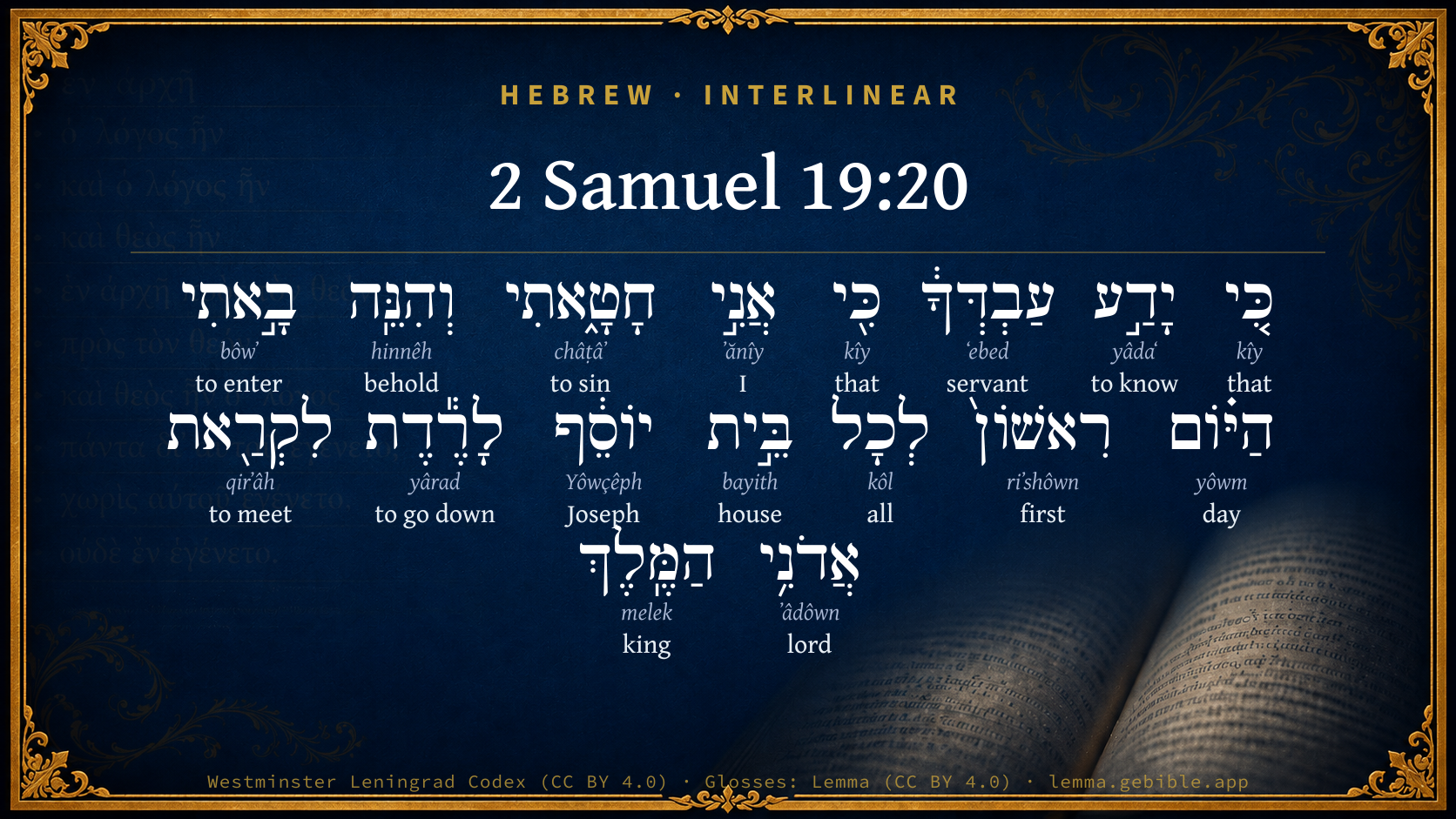
2 Samuel 19:20

Hebrew (Westminster Leningrad Codex) 2 Samuel 19:20 appears in the Hebrew Old Testament. The text above is from the Westminster Leningrad Codex. Each word links to its Strong’s number, a concise gloss, and parsing drawn from the Open Scriptures Hebrew Bible morphology. Click any word for its full Brown-Driver-Briggs (BDB) entry.
Download image
Cite this verse

2 Samuel 19:20 (World English Bible). Public Domain. Lemma interlinear Bible study tool, https://lemma.gebible.app/v/2-samuel/19/20.

Show BibTeX & RIS
BibTeX
RIS
English Translation
For your servant does know that I have sinned: therefore, behold, I am come this day the first of all the house of Joseph to go down to meet my lord the king.
World English Bible · Public Domain
Download a study sheet

One document with this verse’s original text, its word-by-word gloss line, the meaning frame, cross-references with their text, attributed commentary, and full source and license credits — printable, and it pastes into notes with its structure intact.

This verse Autodidact and up

Study sheet (.html) Plain text (.txt)

A passage Seminary Student

Up to 50 verses in one chapter. A passage sheet keeps up to 6 commentary sources and 12 cross-references per verse, in the order this page ranks them, and says so on the sheet whenever that leaves anything out. Ask for a single verse and you get the Autodidact verse sheet above.

Everything on this page stays free to read, with no account — the sheet is a download of what is already on screen, not access to it.

Want to remove ads? Support Godless Engineer
Compare translations 3

The same verse in 3 English versions, stacked beneath the original-language interlinear above. Click any original word for its lexicon entry.

Each is an independent rendering of the whole verse — the interlinear is not word-aligned to these translations.

Highlighted words mark where these versions differ — a whole-verse word diff, not a word-by-word alignment.

  • World English Bible Public Domain
    For your servant does know that I have sinned: therefore, behold, I am come this day the first of all the house of Joseph to go down to meet my lord the king.
  • King James Version Public Domain
    For thy servant doth know that I have sinned: therefore, behold, I am come the first this day of all the house of Joseph to go down to meet my lord the king.
  • unfoldingWord Literal Text CC BY-SA 4.0
    For your servant knows that I, I have sinned, and behold, I have come today, the first of all of the house of Joseph to come down to meet my lord the king.”

unfoldingWord Literal Text — © unfoldingWord, licensed CC BY-SA 4.0. Word-aligned USFM3 via Door43 (git.door43.org/unfoldingWord/en_ult).

Versions to compare (up to 4)

3 of 4 selected

Show all 18 translations

Every available English version of this verse, each an independent rendering of the whole verse.

  • World English Bible Public Domain
    For your servant does know that I have sinned: therefore, behold, I am come this day the first of all the house of Joseph to go down to meet my lord the king.
  • Berean Standard Bible Public Domain
    For your servant knows that I have sinned, so here I am today as the first of all the house of Joseph to come down to meet my lord the king.”
  • Majority Standard Bible Public Domain
    For your servant knows that I have sinned, so here I am today as the first of all the house of Joseph to come down to meet my lord the king.”
  • King James Version Public Domain
    For thy servant doth know that I have sinned: therefore, behold, I am come the first this day of all the house of Joseph to go down to meet my lord the king.
  • American Standard Version (1901) Public Domain
    For thy servant doth know that I have sinned: therefore, behold, I am come this day the first of all the house of Joseph to go down to meet my lord the king.
  • Revised Version (1885) Public Domain
    For thy servant doth know that I have sinned: therefore, behold, I am come this day the first of all the house of Joseph to go down to meet my lord the king.
  • Geneva Bible (1599) Public Domain
    For thy seruant doeth knowe, that I haue done amisse: therefore beholde, I am the first this day of al the house of Ioseph, that am come to goe downe to meete my lord the King.
  • Douay-Rheims (1899) Public Domain
    For I thy servant acknowledge my sin: and therefore I am come this day the first of all the house of Joseph, and am come down to meet my lord the king.
  • Young's Literal Translation Public Domain
    for thy servant hath known that I have sinned; and lo, I have come to-day, first of all the house of Joseph, to go down to meet my lord the king.'
  • Literal Standard Version CC BY-SA 4.0
    for your servant has known that I have sinned; and behold, I have come today, first of all the house of Joseph, to go down to meet my lord the king.”
  • Unlocked Literal Bible CC BY-SA 4.0
    For your servant knows that I have sinned. See, that is why I have come today as the first from all the family of Joseph to come down to meet my master the king.”
  • unfoldingWord Literal Text CC BY-SA 4.0
    For your servant knows that I, I have sinned, and behold, I have come today, the first of all of the house of Joseph to come down to meet my lord the king.”
  • Darby Bible Public Domain
    For thy servant knows that I have sinned; and behold, I am come the first this day of all the house of Joseph to go down to meet my lord the king.
  • World Messianic Bible Public Domain
    For your servant knows that I have sinned. Therefore behold, I have come today as the first of all the house of Joseph to go down to meet my lord the king.”
  • Webster's Bible Public Domain
    For thy servant doth know that I have sinned: therefore behold, I have come the first this day of all the house of Joseph to go down to meet my lord the king.
  • Free Bible Version CC BY-SA 4.0
    I, your servant, recognize that I have sinned. But look! Today I'm the first from any of the tribes of Joseph to come down and meet Your Majesty.”
  • Bible in Basic English Public Domain
    For your servant is conscious of his sin: and so, as you see, I have come today, the first of all the sons of Joseph, for the purpose of meeting my lord the king.
  • JPS Tanakh (1917) Public Domain
    (19-21) For thy servant doth know that I have sinned; therefore, behold, I am come this day the first of all the house of Joseph to go down to meet my lord the king.'

Literal Standard Version (2020), Covenant Press — licensed CC BY-SA 4.0. Text via the HelloAO Bible API (eBible.org). Unlocked Literal Bible (unfoldingWord) — licensed CC BY-SA 4.0. Text via the HelloAO Bible API (eBible.org). unfoldingWord Literal Text — © unfoldingWord, licensed CC BY-SA 4.0. Word-aligned USFM3 via Door43 (git.door43.org/unfoldingWord/en_ult). Free Bible Version, Dr. Jonathan Gallagher — licensed CC BY-SA 4.0. Text via the HelloAO Bible API (eBible.org).

Word by word

More ways to search: Search by grammar → Find every occurrence → Compare this word →

Practice this passage: Drill this verse → Learn its vocabulary →

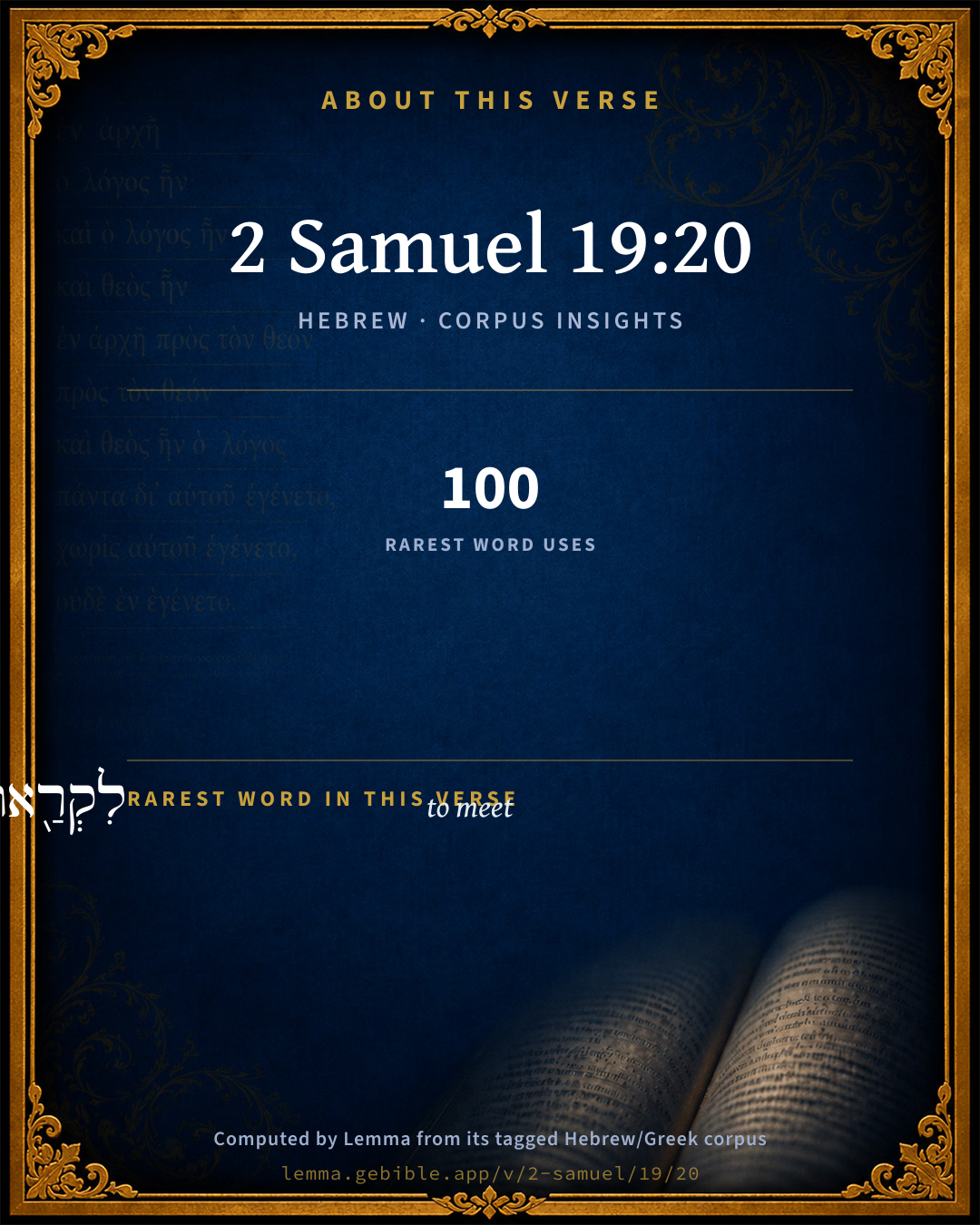
לִקְרַ֖את
qirʼâh
H7125
“to meet”
Preposition + Verb, Qal, Infinitive Construct
Part of Speech
Preposition + Verb
Stem
Qal
Form
Infinitive Construct
Full BDB Definition

Origin: from H7122

TWOT: 2064

to encounter, befall, meet - (Qal) - to meet, encounter - to befall (figuratively)
  1. כִּ֚י kîy H3588 “that” Conjunction
  2. יָדַ֣ע yâdaʻ H3045 “to know” Verb, Qal, Perfect, 3rd Person, Masculine, Singular
  3. עַבְדְּךָ֔ ʻebed H5650 “servant · your” Noun, Common, Masculine, Singular, Construct + Suffix, Personal, 2nd Person, Masculine, Singular
  4. כִּ֖י kîy H3588 “that” Conjunction
  5. אֲנִ֣י ʼănîy H589 “I” Pronoun, Personal, 1st Person, Common, Singular
  6. חָטָ֑אתִי châṭâʼ H2398 “to sin” Verb, Qal, Perfect, 1st Person, Common, Singular
  7. וְהִנֵּֽה hinnêh H2009 “and · behold” Conjunction + Particle, Demonstrative
  8. בָ֣אתִי bôwʼ H935 “to enter” Verb, Qal, Perfect, 1st Person, Common, Singular
  9. הַיּ֗וֹם yôwm H3117 “the · day” Particle, Definite Article + Noun, Common, Masculine, Singular, Absolute
  10. רִאשׁוֹן֙ riʼshôwn H7223 “first” Adjective, Adjective, Masculine, Singular, Absolute
  11. לְכָל kôl H3605 “to/for · all of” Preposition + Noun, Common, Masculine, Singular, Construct
  12. בֵּ֣ית bayith H1004 “house of” Noun, Common, Masculine, Singular, Construct
  13. יוֹסֵ֔ף Yôwçêph H3130 “Joseph” Noun, Proper
  14. לָרֶ֕דֶת yârad H3381 “to go down” Preposition + Verb, Qal, Infinitive Construct
  15. אֲדֹנִ֥י ʼâdôwn H113 “lord · my” Noun, Common, Masculine, Singular, Construct + Suffix, Personal, 1st Person, Common, Singular
  16. הַמֶּֽלֶךְ melek H4428 “the · king” Particle, Definite Article + Noun, Common, Masculine, Singular, Absolute

About this verse

These counts appear in no published source. They are computed here, from the morphology-tagged text and Lemma’s own curated glosses. What Lemma adds →

17
words
16
distinct lemmas
Historical
section

Grammatical profile

  • 5 verbs
  • 7 nouns
  • 1 adjective
  • 1 pronoun
  • 2 conjunctions
  • 1 particle

Verb forms

  • יָדַ֣ע Qal · Perfect
  • חָטָ֑אתִי Qal · Perfect
  • בָ֣אתִי Qal · Perfect
  • לָרֶ֕דֶת Qal · Infinitive Construct
  • לִקְרַ֖את Qal · Infinitive Construct

Repetition

A word recurs within this verse — often emphatic in Hebrew:

  • כִּ֚י that H3588 ×2

Hebrew & Septuagint length

In English translation the verse runs 33 words from the Hebrew and 31 from the Septuagint (LXX English) — closely comparable.

A rough comparison of the two English renderings, which tokenize alike — not a word-level alignment.

Word counts can differ between the Hebrew and the Greek without any difference in meaning — e.g. the Hebrew direct-object marker אֵת has no separate Greek word, and Greek often adds the article ὁ.

Cross-references

11

Topical passages linked to 2 Samuel 19:20 in the Treasury of Scripture Knowledge — connected by theme and wording, ordered by reader-vote popularity; previews shown in the World English Bible.

  • Genesis 48:14 Israel stretched out his right hand, and laid it on Ephraim's head, who was the younger, and his left hand on Manasseh's head, guiding his hands knowingly, for Manasseh was the firstborn.
  • Genesis 48:20 He blessed them that day, saying, "In you will Israel bless, saying, 'God make you as Ephraim and as Manasseh'" He set Ephraim before Manasseh.
  • 2 Samuel 16:5 When king David came to Bahurim, behold, a man of the family of the house of Saul came out, whose name was Shimei, the son of Gera. He came out, and cursed still as he came.
  • 2 Samuel 19:9 All the people were at strife throughout all the tribes of Israel, saying, The king delivered us out of the hand of our enemies, and he saved us out of the hand of the Philistines; and now he is fled out of the land from Absalom.
  • 1 Kings 12:20 It happened, when all Israel heard that Jeroboam was returned, that they sent and called him to the congregation, and made him king over all Israel: there was none who followed the house of David, but the tribe of Judah only.
  • 1 Kings 12:25 Then Jeroboam built Shechem in the hill-country of Ephraim, and lived therein; and he went out from there, and built Penuel.
  • Psalms 78:34–37 When he killed them, then they inquired after him. They returned and sought God earnestly.
  • Jeremiah 22:23 Inhabitant of Lebanon, who makes your nest in the cedars, how greatly to be pitied shall you be when pangs come on you, the pain as of a woman in travail!
  • Hosea 4:15–17 "Though you, Israel, play the prostitute, Yet don't let Judah offend; And don't come to Gilgal, Neither go up to Beth Aven, Nor swear, 'As Yahweh lives.'
  • Hosea 5:3 I know Ephraim, And Israel is not hidden from me; For now, Ephraim, you have played the prostitute. Israel is defiled.
  • Hosea 5:15 I will go and return to my place, until they acknowledge their offense, And seek my face. In their affliction they will seek me earnestly."

Cross-references courtesy of OpenBible.info (CC BY 4.0).

Hebrew and Greek witnesses Masoretic Hebrew ↔ Greek Septuagint

The same verse in the two great witnesses to the Old Testament, shown verse-for-verse.

These are two independent witnesses, not word-aligned to each other, and the Septuagint is shown in lemma (dictionary) form.

Hebrew 2 Samuel 19:20 Masoretic · Westminster Leningrad Codex

כִּ֚י יָדַ֣ע עַבְדְּךָ֔ כִּ֖י אֲנִ֣י חָטָ֑אתִי וְהִנֵּֽה בָ֣אתִי הַיּ֗וֹם רִאשׁוֹן֙ לְכָל בֵּ֣ית יוֹסֵ֔ף לָרֶ֕דֶת לִקְרַ֖את אֲדֹנִ֥י הַמֶּֽלֶךְ

For your servant does know that I have sinned: therefore, behold, I am come this day the first of all the house of Joseph to go down to meet my lord the king.

World English Bible · Public Domain

Greek LXX 2 Samuel 19:20 Septuagint · lemma form

καί εἶπον πρός ὁ βασιλεύς μή διαλογίζομαι ὁ κύριος ἐγώ ἀνομία καί μή μιμνήσκω ὅσος ἀδικέω ὁ παῖς σύ ἐν ὁ ἡμέρα ὅς ὁ κύριος ἐγώ ὁ βασιλεύς ἐκπορεύομαι ἐκ ἰερουσαλήμ ὁ τίθημι ὁ βασιλεύς εἰς ὁ καρδία αὐτός

For your servant knows that I have sinned: and, behold, I am come today before all Israel and the house of Joseph, to go down and meet my lord the king.

LXX2012 (modern English Septuagint) · Public Domain

On this verse, Haydock's Catholic Bible Commentary discusses the Septuagint’s reading. Read the note in Commentary ↓

Hebrew: Westminster Leningrad Codex (CC BY 4.0). Greek: Septuagint (public domain); English from LXX2012 (modern English Septuagint) (Public Domain). How the Septuagint differs from the Hebrew →

Targum (Aramaic paraphrase)

1

The Targum is the ancient Jewish Aramaic paraphrase of the Hebrew Scriptures — an interpretive translation, not the Hebrew text itself. Onkelos (literal) and Pseudo-Jonathan (expansive) render the Torah, and Jonathan the Prophets. Coverage is partial: where no permissively-licensed English translation exists for a verse, only the Aramaic is shown. This is verse-level text, not a word-by-word alignment to the Hebrew.

  1. Targum Jonathan Prophets (Joshua–Malachi)
    וַאֲמַר לְמַלְכָּא לָא יַחְשׁוֹב עֲלַי דִלִי רִבּוֹנִי חוֹבָא וְלָא תִדְכַּר יַת דִי סְרַח עַבְדָךְ בְּיוֹמָא דִי גְלָא רִבּוֹנִי מַלְכָּא מִירוּשְׁלֵם לְשַׁוָאָה מַלְכָּא עַל לִבֵּיהּ:

    (no public-domain English translation for this verse)

    Targum Jonathan — Aramaic: “Mikraot Gedolot” (public domain). English: “Sefaria Community Translation” (CC0 1.0 (public-domain dedication)); “London "Chaldee Paraphrase," 1871” (public domain). Text via Sefaria.

Commentary

Notes on 2 Samuel 19:20 from classic Christian and Jewish commentators (each source and its license shown beneath its notes). The classic Christian expositions comment on the surrounding passage and are grouped to its opening verse, so a note may address several verses; the Jewish commentaries on the Tanakh (Rashi and others) are per-verse, so they appear only where the commentator wrote on this verse.

Lemma curates 59 commentaries, every one of them public domain or Creative Commons licensed, each selected and text-cleaned for this edition rather than reprinted as found. About our sources →

Trapp's Complete Commentary

John Trapp

2Sa 19:20 For thy servant doth know that I have sinned: therefore, behold, I am come the first this day of all the house of Joseph to go down to meet my lord the king.

Ver. 20. For thy servant doth know that I have sinned.] Thus the fox taken in a toil looketh pitifully, but it is only that he may get out. This confession was merely extorted by fear of punishment: it came not like water out of a spring, with a voluntary freeness, but like water out of a still, which is forced with fire.

I am come the first this day.] That in me first thou mightest show forth all longsuffering for a pattern to them which shall hereafter submit to thy mercy and clemency, {1Ti 1:16} which in a king is no small commendation, and to his delinquent subjects no small encouragement.

Of all the house of Joseph.] Joseph and Benjamin were so near akin that their tribes are spoken of as if one and the same.

John Trapp, A Commentary or Exposition upon All the Books of the Old and New Testament (1647–1656) — public domain. Text from a community e-Sword module.

Tyndale Open Study Notes

Tyndale Open Resources

19:20 I know how much I sinned: Shimei’s repentance might have been genuine, or he might simply have been backpedaling in a desperate attempt to save his life. David’s concern for Absalom’s safety had shown that David was not a self-promoting, bloodthirsty throne-stealer, as Shimei had thought; and Absalom had not replaced him (16:8), as Shimei had charged. • in all Israel (literally in all the house of Joseph): Just as Jacob’s name could stand for all Israel (e.g., Num 24:19; Isa 10:20), Joseph’s name could stand for all the northern tribes (e.g., see study notes on Amos 5:6; Zech 10:6).

Tyndale Open Study Notes — © Tyndale Open Resources, licensed CC BY-SA 4.0. Text via the HelloAO Bible API.

Geneva Bible (1599)

Geneva Bible translators

By Joseph he meaneth Ephraim, Manasseh and Benjamin (whereof he was) because these three were under one standard, Num. 2:18.

Geneva Bible (1599) marginal notes — public domain. Text via Bolls.life.

Jamieson, Fausset & Brown

Robert Jamieson, A. R. Fausset & David Brown

I am come the first . . . of all the house of Joseph--that is, before all the rest of Israel (Psa 77:15; Psa 80:1; Psa 81:5; Zac 10:6).

Jamieson, Fausset & Brown — Commentary Critical and Explanatory on the Whole Bible (1871) — public domain (CC PDM 1.0). Text via the HelloAO Bible API.

Adam Clarke's Commentary

Verse 20. For thy servant doth know that I have sinned] This was all he could do; his subsequent conduct alone could prove his sincerity. On such an avowal as this David could not but grant him his life.

Adam Clarke's Commentary on the Bible (1810–1826) — public domain. Text from a community e-Sword/MySword module.

Ellicott's Commentary for English Readers

(20) The house of Joseph.—Shimei was not strictly of “the house of Joseph,” but of Benjamin; and it is plain that Joseph, as the name of the most prominent member, stands for all the tribes outside of Judah. This usage is well recognised at a later time (see 1Ch_5:1-2; Amo_5:15), and it has hence been argued that it indicates a late date for the composition of the book; but it is also found in Psa_80:1-2; Psa_81:5 (the date of which it would be rash to attempt to fix), in the reign of Solomon, 1Ki_11:28, and probably very early in Jdg_1:35. There is no reason why the expression may not have been used at the earliest date when there began to be a certain separation and distinction between Judah and the other tribes, which was soon after the conquest of Canaan.

A Bible Commentary for English Readers, edited by Charles John Ellicott (1878–1897) — public domain. Text from a community e-Sword module.

The Cambridge Bible for Schools and Colleges

gen. ed. J. J. S. Perowne

20. the house of Joseph] The ten tribes of Israel as distinguished from Judah are thus named from Ephraim, the most powerful tribe among them (Gen_48:5). Cp. Psa_78:67-68; 1Ki_11:28; Amo_5:6. Shimei the Benjamite claims to be the first representative of Israel to welcome the king.

The Cambridge Bible for Schools and Colleges (gen. ed. J. J. S. Perowne; Cambridge University Press, 1878–1918) — public domain. Text from a community e-Sword module.

John Gill's Exposition

For thy servant doth know that I have sinned,.... He was sensible of it, and sorry for it, and publicly acknowledged it before all the men he brought with him, and before all the servants of David; and as a token of the sincerity of his repentance, and as an earnest of his future fidelity, he made this early submission:

therefore, behold, I am come the first this day of all the house of Joseph, to go down to meet my lord the king; but why does he make mention of the house of Joseph, when he was of the tribe of Benjamin? Kimchi says that Benjamin, Ephraim, and Manasseh, were called the house of Joseph; and it may be observed that it is sometimes used for all Israel, as in Psa 80:1; and he was the first of them that came, inasmuch as he came along with the men of Judah, who came first of all to fetch the king back; or Joseph may stand for the tribes of Israel, as distinct from Judah, and he was the first of them; some of the Jewish writers think he makes mention of the name of Joseph, because as the brethren of Joseph used him ill, and he returned good to them; so though he had used David ill, he hoped he would do as Joseph did, return good for evil; and others represent him as suggesting hereby to David, that all Israel had used him ill, and he worse than them all; and now he was come first, and they were all waiting what he would do to him, that if he received him kindly, all would come and make their peace with him.

John Gill's Exposition of the Whole Bible (1746–1763) — public domain (CC PDM 1.0). Text via the HelloAO Bible API.

Albert Barnes' Notes on the Bible

This is the first time that the “house of Joseph,” or “Joseph,” stands for all the ten tribes of which Ephraim was the head and leader. While Saul of Benjamin was king, or while Mahanaim was the capital of his son’s kingdom, it was not natural so to name them, nor does it seem so at first sight in the mouth of Shimei the Benjamite. But it is very possible that he used the phrase for the purpose of exculpating himself and his own tribe from having taken the initiative in the rebellion, anti of insinuating that they were drawn away by the preponderating influence of the great house of Joseph. On the other hand, the phrase may be an indication that the passage was written after the separation of the kingdom of Israel, when the phrase was a common one.

Albert Barnes' Notes on the Bible (1834–1885) — public domain. Text from a community e-Sword/MySword module.

Haydock's Catholic Bible Commentary

Joseph. Semei was a Benjamite: but Joseph designates all the Israelites, except those of Juda, (Worthington) as these two possessed the birth-right of Ruben, 1 Paralipomenon v. 1. (Menochius) See Psalm lxxix. 1., and Zacharias x. 6. --- But we may translate with the Septuagint, "before all the house of Joseph." (Chaldean, Syriac, &c.) (Calmet)

George Leo Haydock (1774–1849), Haydock's Catholic Family Bible and Commentary, 1859 edition — public domain. Excludes Psalms (Douay-Rheims chapter numbering differs from Protestant) and Deuterocanonical books (Catholic canon only).

Matthew Poole's English Annotations

Thy servant doth know that I have sinned; I do not excuse my sin, but with grief and shame confess it; in which case the Lord thy God is ready to pardon offenders, and so I trust wilt thou be.

I am come the first; the sense of my former sin now hath, and whilst I live will, make me the first and most forward in all acts of duty and service to thy majesty.

Of all the house of Joseph.

Object. He was a Benjamite, 2Sa 16:5. How then doth he make himself one of the house of Joseph?

Answ. The house of Joseph is here put, either,

1. For the ten tribes, which are oft distinguished from Judah, and then they are called the house of Joseph, as Zec 10:6. But this distinction was not made before the division of the people into two kingdoms; and even after that division Benjamin was constantly reckoned with Judah, and not with Joseph or Ephraim. Or,

2. For all the tribes of Israel, who are called the children of Joseph, Psa 77:15; compare Psa 80:1; 81:5; as well they might, not only because of Joseph’s eminency, (the most eminent persons and things being oft put for the rest of the kind,) and because the rights of primogeniture were in a great part devolved upon him, 1Ch 5:1; but also because Joseph had been as a father to them, and had nourished them all like children, as is expressed in the Hebrew text, Gen 47:12. But in this sense this was not true, for the house of Judah came before him, 2Sa 19:15.

Or rather,

3. For all the tribes except Judah, which are conveniently called the house of Joseph for the reasons now mentioned, and are fitly distinguished from Judah, because the rights of the first-born were divided between Judah and Joseph, 1Ch 5:2. And though Benjamin, after the division of the kingdoms, was fitly joined with Judah, because then they adhered to that tribe; yet before that time it was more conveniently joined with Joseph, because they marched under the standard of the house of Joseph, or of Ephraim, Num 10:22-24; whence it is that Ephraim, Benjamin, and Manasseh are put together, Psa 80:2.

Matthew Poole's English Annotations on the Holy Bible (1683–1685) — public domain. Text from a community e-Sword/MySword module.

Whedon's Commentary on the Bible

Daniel D. Whedon

20. The house of Joseph — This designation is here used as synonymous with all Israel. In poetical and oratorical style this was a common term for Israel. Compare Psa_77:15; Psa_80:1; Psa_81:5. It probably grew out of the fact that Joseph received the rights of primogeniture which Reuben by transgression lost. 1Ch_5:1-2.

Daniel D. Whedon (gen. ed.), Commentary on the Old and New Testaments (1874–1909) — public domain. Text from a community e-Sword module.

The Pulpit Commentary

The first.., of all the house of Joseph. Shimei, who was a Benjamite, could not have thus claimed to be the representative of the northern tribes, had he remained on the western bank, where "half the people of Israel" were assembled. Strictly, "the house of Joseph" signified the tribe of Ephraim, (Jud_1:22, 35; and comp. Psa_78:67) and in this sense Shimei did not belong to it. But Ephraim claimed a supremacy over all Israel; and one cause of the opposition to David certainly was the transference of the leadership to the tribe of Judah. Even the long reign of Solomon failed to weld the tribes together, and as soon as the reins of power fell into the weak hands of Rehobeam, an Ephraimite. Jeroboam, whom Solomon had made "ruler ever all the charge of the house of Joseph", (1Ki_11:28) quickly wrested the ten tribes from him. In Amo_5:6 "the house of Joseph" signifies all the northern tribes, for the reason given in 1Ch_5:1, 1Ch_5:2; and such is its sense here. And Shimei compressed many powerful arguments in the phrase. For as a Benjamite he offered David the allegiance of the tribe which had given Israel its first king; while, as an Israelite, he professed also to represent the leading house of Ephraim, and all the northern tribes which usually followed its bidding.

The Pulpit Commentary (1880–1919), ed. H.D.M. Spence-Jones & Joseph S. Exell — public domain. Text from a community e-Sword module.

John Wesley's Explanatory Notes

House of Joseph - The house of Joseph is here put for all the tribes, except Judah, which are fitly distinguished from Judah, because the rights of the first-born were divided between Judah and Joseph, 1 Chron. v, 2. And though Benjamin, after the division of the kingdoms was fitly joined with Judah, because then they adhered to that tribe; yet before that time it was joined with Joseph, because they marched under the standard of the house of Joseph, or of Ephraim, Num. x, 22, 23, 24. Whence it is, that Ephraim, Benjamin, and Manasseh, are put together, Psalm lxxx, 2.

John Wesley, Explanatory Notes Upon the Whole Bible (1754–1765) — public domain. Text via the GEBible commentary corpus.

Keil & Delitzsch

C. F. Keil & F. Delitzsch

"For thy servant knoweth (i.e., I know) that I have sinned, and behold I have come to-day the first of the whole house of Joseph, to go to meet my lord the king." By "the whole house of Joseph" we are to understand the rest of the tribes with the exception of Judah, who are called "all Israel" in Sa2 19:12. There is no reason for the objection taken by Thenius and Bttcher to the expression בּית־יוסף. This rendering of the lxx (παντὸς Ἰσραὴλ καὶ οἴκου Ἰωσήφ) does not prove that כּלישׂראל was the original reading, but only that the translator thought it necessary to explain οἴκου Ἰωσήφ by adding the gloss παντὸς Ἰσραὴλ; and the assertion that it was only in the oratorical style of a later period, when the kingdom had been divided, that Joseph became the party name of all that were not included in Judah, is overthrown by Kg1 11:28. The designation of the tribes that opposed Judah by the name of the leading tribe (Joseph: Jos 16:1) was as old as the jealousy between these tribes and Judah, which did not commence with the division of the kingdom, but was simply confirmed thereby into a permanent distinction. Shimei's prayer for the forgiveness of his sin was no more a proof of sincere repentance than the reason which he adduced in support of his petition, namely that he was the first of all the house of Joseph to come and meet David. Shimei's only desire was to secure impunity for himself. Abishai therefore replied (Sa2 19:21), "Shall not Shimei be put to death for this (זאת תּחת, for this, which he has just said and done), because he hath cursed the anointed of Jehovah?" (vid., Sa2 16:5.). But David answered (Sa2 19:22), "What have I to do with you, ye sons of Zeruiah (cf. Sa2 16:10), for ye become opponents to me to-day?" שׂטן, an opponent, who places obstacles in the way (Num 22:22); here it signifies one who would draw away to evil. "Should any one be put to death in Israel to-day? for do I not know that I am this day king over Israel?" The reason assigned by David here for not punishing the blasphemer as he had deserved, by taking away his life, would have been a very laudable one if the king had really forgiven him. But as David when upon his deathbed charged his successor to punish Shimei for this cursing (Kg1 2:8-9), the favour shown him here was only a sign of David's weakness, which was not worthy of imitation, the more especially as the king swore unto him (Sa2 19:24) that he should not die.

Keil & Delitzsch — Biblical Commentary on the Old Testament (1861–1891) — public domain (CC PDM 1.0). Text via the HelloAO Bible API. (Old Testament only.)

Lesson kit

Teaching starters — assembled from the data on this page, not authored interpretation. Every prompt links to the verse data it draws on. Edit before teaching.

2 Samuel, in the Historical, opens this verse with 17 words (16 distinct Hebrew lemmas). Its most distinctive word is qirʼâh (“to meet”). A historical commentator’s framing appears above. Read the whole chapter for the surrounding context.

Discussion questions

  1. The word qirʼâh carries the sense “to meet.” How does it shape the verse?
  2. How does Genesis 48:14, which shares this passage’s theme, read alongside this verse?
  3. What does the repetition of “that” (2× in this one verse) do in this verse?
  4. These translations render this verse differently. What is at stake in choosing one wording over another?
  5. «יָדַ֣ע» is a Qal Perfect verb. How does that grammatical form shape the action described?
  6. Compare how Trapp's Complete Commentary and Tyndale Open Study Notes read this verse. Where do they agree or differ?

Things to notice

Reading settings

Reading text

Shown beneath each verse's original-language words.

Old Testament
Old Testament edition

Read the OT as the Masoretic Hebrew (MT) or the Greek Septuagint (LXX).

English shown for the Greek Septuagint (in the Hebrew ↔ Greek comparison).

Comparing translations? Open the Compare panel on any verse page to stack up to four side by side.