
1 Kings 22:52

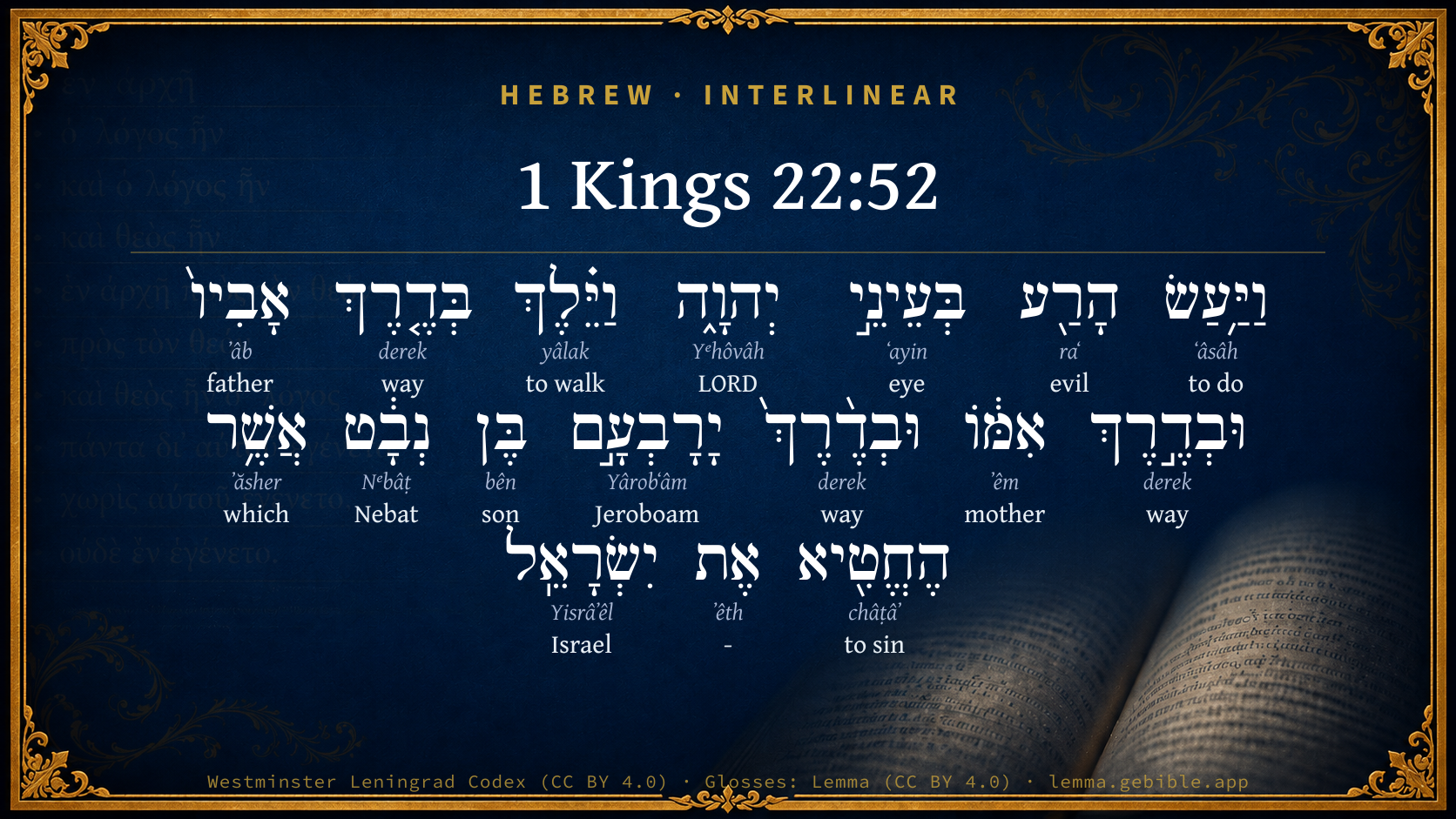
Hebrew (Westminster Leningrad Codex) 1 Kings 22:52 appears in the Hebrew Old Testament. The text above is from the Westminster Leningrad Codex. Each word links to its Strong’s number, a concise gloss, and parsing drawn from the Open Scriptures Hebrew Bible morphology. Click any word for its full Brown-Driver-Briggs (BDB) entry.
Download image
Cite this verse

1 Kings 22:52 (World English Bible). Public Domain. Lemma interlinear Bible study tool, https://lemma.gebible.app/v/1-kings/22/52.

Show BibTeX & RIS
BibTeX
RIS
English Translation
He did that which was evil in the sight of Yahweh, and walked in the way of his father, and in the way of his mother, and in the way of Jeroboam the son of Nebat, in which he made Israel to sin.
World English Bible · Public Domain
Download a study sheet

One document with this verse’s original text, its word-by-word gloss line, the meaning frame, cross-references with their text, attributed commentary, and full source and license credits — printable, and it pastes into notes with its structure intact.

This verse Autodidact and up

Study sheet (.html) Plain text (.txt)

A passage Seminary Student

Up to 50 verses in one chapter. A passage sheet keeps up to 6 commentary sources and 12 cross-references per verse, in the order this page ranks them, and says so on the sheet whenever that leaves anything out. Ask for a single verse and you get the Autodidact verse sheet above.

Everything on this page stays free to read, with no account — the sheet is a download of what is already on screen, not access to it.

Want to remove ads? Support Godless Engineer
Compare translations 3

The same verse in 3 English versions, stacked beneath the original-language interlinear above. Click any original word for its lexicon entry.

Each is an independent rendering of the whole verse — the interlinear is not word-aligned to these translations.

Highlighted words mark where these versions differ — a whole-verse word diff, not a word-by-word alignment.

  • World English Bible Public Domain
    He did that which was evil in the sight of Yahweh, and walked in the way of his father, and in the way of his mother, and in the way of Jeroboam the son of Nebat, in which he made Israel to sin.
  • King James Version Public Domain
    And he did evil in the sight of the LORD, and walked in the way of his father, and in the way of his mother, and in the way of Jeroboam the son of Nebat, who made Israel to sin:
  • unfoldingWord Literal Text CC BY-SA 4.0
    And he did evil in the eyes of Yahweh. And he walked in the way of his father and in the way of his mother and in the way of Jeroboam, the son of Nebat, who caused Israel to sin.

unfoldingWord Literal Text — © unfoldingWord, licensed CC BY-SA 4.0. Word-aligned USFM3 via Door43 (git.door43.org/unfoldingWord/en_ult).

Versions to compare (up to 4)

3 of 4 selected

Show all 18 translations

Every available English version of this verse, each an independent rendering of the whole verse.

  • World English Bible Public Domain
    He did that which was evil in the sight of Yahweh, and walked in the way of his father, and in the way of his mother, and in the way of Jeroboam the son of Nebat, in which he made Israel to sin.
  • Berean Standard Bible Public Domain
    And he did evil in the sight of the LORD and walked in the ways of his father and mother and of Jeroboam son of Nebat, who had caused Israel to sin.
  • Majority Standard Bible Public Domain
    And he did evil in the sight of the LORD and walked in the ways of his father and mother and of Jeroboam son of Nebat, who had caused Israel to sin.
  • King James Version Public Domain
    And he did evil in the sight of the LORD, and walked in the way of his father, and in the way of his mother, and in the way of Jeroboam the son of Nebat, who made Israel to sin:
  • American Standard Version (1901) Public Domain
    And he did that which was evil in the sight of Jehovah, and walked in the way of his father, and in the way of his mother, and in the way of Jeroboam the son of Nebat, wherein he made Israel to sin.
  • Revised Version (1885) Public Domain
    And he did that which was evil in the sight of the LORD, and walked in the way of his father, and in the way of his mother, and in the way of Jeroboam the son of Nebat, wherein he made Israel to sin.
  • Geneva Bible (1599) Public Domain
    But he did euill in the sight of the Lord, and walked in the way of his father, and in the way of his mother, and in the way of Ieroboam the sonne of Nebat, which made Israel to sinne.
  • Douay-Rheims (1899) Public Domain
    And Ochozias the son of Achab began to reign over Israel in Samaria, in the seventeenth gear of Josaphat king of Juda, and he reigned over Israel two years,
  • Young's Literal Translation Public Domain
    and doth the evil thing in the eyes of Jehovah, and walketh in the way of his father, and in the way of his mother, and in the way of Jeroboam son of Nebat who caused Israel to sin,
  • Literal Standard Version CC BY-SA 4.0
    and does evil in the eyes of YHWH, and walks in the way of his father, and in the way of his mother, and in the way of Jeroboam son of Nebat who caused Israel to sin,
  • Unlocked Literal Bible CC BY-SA 4.0
    He did what was evil in the sight of Yahweh and walked in the way of his father, in the way of his mother, and in the way of Jeroboam son of Nebat, by which he led Israel to sin.
  • unfoldingWord Literal Text CC BY-SA 4.0
    And he did evil in the eyes of Yahweh. And he walked in the way of his father and in the way of his mother and in the way of Jeroboam, the son of Nebat, who caused Israel to sin.
  • Darby Bible Public Domain
    And he did evil in the sight of Jehovah, and walked in the way of his father, and in the way of his mother, and in the way of Jeroboam the son of Nebat, who made Israel to sin.
  • World Messianic Bible Public Domain
    He did that which was evil in the LORD’s sight, and walked in the way of his father, and in the way of his mother, and in the way of Jeroboam the son of Nebat, in which he made Israel to sin.
  • Webster's Bible Public Domain
    \\22:51\\Ahaziah the son of Ahab began to reign over Israel in Samaria the seventeenth year of Jehoshaphat king of Judah, and reigned two years over Israel.
  • Free Bible Version CC BY-SA 4.0
    He did what was evil in the Lord's sight and followed the ways of his father and mother, and of Jeroboam, son of Nebat, who had made Israel sin.
  • Bible in Basic English Public Domain
    He did evil in the eyes of the Lord, going in the ways of his father and his mother, and in the ways of Jeroboam, the son of Nebat, who made Israel do evil.
  • JPS Tanakh (1917) Public Domain
    (22-53) And he did that which was evil in the sight of the LORD, and walked in the way of his father, and in the way of his mother, and in the way of Jeroboam the son of Nebat, wherein he made Israel to sin.

Literal Standard Version (2020), Covenant Press — licensed CC BY-SA 4.0. Text via the HelloAO Bible API (eBible.org). Unlocked Literal Bible (unfoldingWord) — licensed CC BY-SA 4.0. Text via the HelloAO Bible API (eBible.org). unfoldingWord Literal Text — © unfoldingWord, licensed CC BY-SA 4.0. Word-aligned USFM3 via Door43 (git.door43.org/unfoldingWord/en_ult). Free Bible Version, Dr. Jonathan Gallagher — licensed CC BY-SA 4.0. Text via the HelloAO Bible API (eBible.org).

Word by word

More ways to search: Search by grammar → Find every occurrence → Compare this word →

Practice this passage: Drill this verse → Learn its vocabulary →

נְבָ֔ט
Nᵉbâṭ
H5028
“Nebat”
Noun, Proper
Part of Speech
Noun
Type
Proper
Full BDB Definition

Origin: from H5027

TWOT: None

Nebat = "aspect" - an Ephraimite of Zereda, father of king Jeroboam I of the northern kingdom of Israel
  1. וַיַּ֥עַשׂ ʻâsâh H6213 “and · to do” Conjunction + Verb, Qal, Sequential Imperfect, 3rd Person, Masculine, Singular
  2. הָרַ֖ע raʻ H7451 “the · evil” Particle, Definite Article + Adjective, Adjective, Masculine, Singular, Absolute
  3. בְּעֵינֵ֣י ʻayin H5869 “in/at · eyes of” Preposition + Noun, Common, Both, Dual, Construct
  4. יְהוָ֑ה Yᵉhôvâh H3068 “LORD” Noun, Proper
  5. וַיֵּ֗לֶךְ yâlak H3212 “and · to walk” Conjunction + Verb, Qal, Sequential Imperfect, 3rd Person, Masculine, Singular
  6. בְּדֶ֤רֶךְ derek H1870 “in/at · way of” Preposition + Noun, Common, Both, Singular, Construct
  7. אָבִיו֙ ʼâb H1 “father · his” Noun, Common, Masculine, Singular, Construct + Suffix, Personal, 3rd Person, Masculine, Singular
  8. וּבְדֶ֣רֶךְ derek H1870 “and · in/at · way of” Conjunction + Preposition + Noun, Common, Both, Singular, Construct
  9. אִמּ֔וֹ ʼêm H517 “mother · his” Noun, Common, Feminine, Singular, Construct + Suffix, Personal, 3rd Person, Masculine, Singular
  10. וּבְדֶ֨רֶךְ֙ derek H1870 “and · in/at · way of” Conjunction + Preposition + Noun, Common, Both, Singular, Construct
  11. יָרָבְעָ֣ם Yârobʻâm H3379 “Jeroboam” Noun, Proper
  12. בֶּן bên H1121 “son of” Noun, Common, Masculine, Singular, Construct
  13. אֲשֶׁ֥ר ʼăsher H834 “which” Particle, Relative
  14. הֶחֱטִ֖יא châṭâʼ H2398 “to sin” Verb, Hiphil, Perfect, 3rd Person, Masculine, Singular
  15. אֶת ʼêth H853 “-” Particle, Direct Object
  16. יִשְׂרָאֵֽל Yisrâʼêl H3478 “Israel” Noun, Proper

About this verse

These counts appear in no published source. They are computed here, from the morphology-tagged text and Lemma’s own curated glosses. What Lemma adds →

17
words
15
distinct lemmas
Historical
section

Notable vocabulary

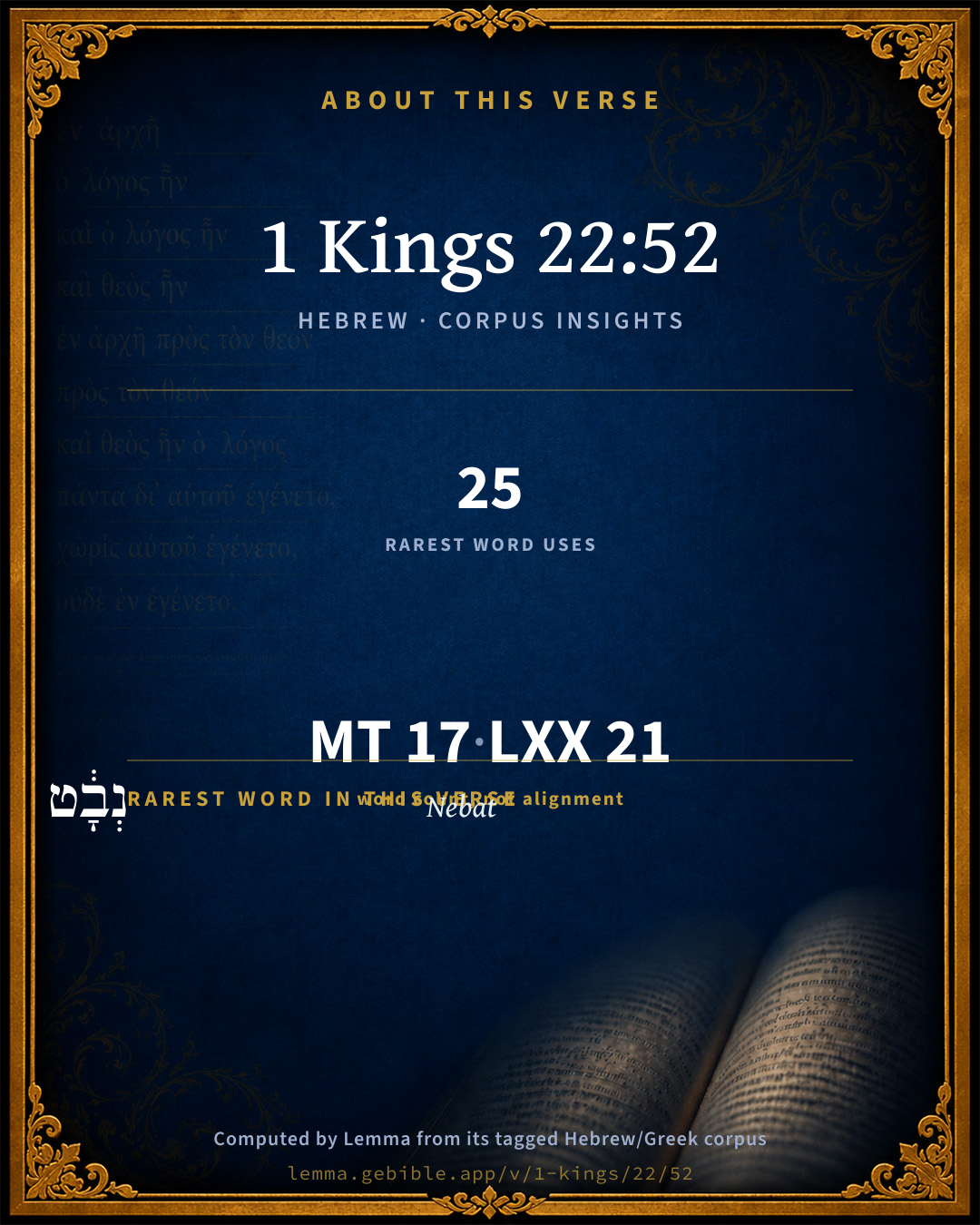
The rarest word here is נְבָ֔ט Nebat H5028 — appearing just 25 times in the whole Hebrew Bible.

Shared distinctive vocabulary

נְבָ֔ט Nebat H5028 occurs in 25 verses of the Hebrew Bible. Also found in:

Grammatical profile

  • 3 verbs
  • 11 nouns
  • 1 adjective
  • 2 particles

Verb forms

  • וַיַּ֥עַשׂ Qal · Sequential Imperfect
  • וַיֵּ֗לֶךְ Qal · Sequential Imperfect
  • הֶחֱטִ֖יא Hiphil · Perfect

Repetition

A word recurs within this verse — often emphatic in Hebrew:

  • בְּדֶ֤רֶךְ way H1870 ×3

Hebrew & Septuagint length

In English translation the verse runs 43 words from the Hebrew and 30 from the Septuagint (LXX English) — the Septuagint runs noticeably shorter here. See the side-by-side →

A rough comparison of the two English renderings, which tokenize alike — not a word-level alignment.

Word counts can differ between the Hebrew and the Greek without any difference in meaning — e.g. the Hebrew direct-object marker אֵת has no separate Greek word, and Greek often adds the article ὁ.

In the original languages it is 17 Hebrew tokens and 21 Greek tokens — but the two are counted differently (Hebrew bundles its prefixes and suffixes into one token; the Greek is in lemma form), so that isn’t a like-for-like length.

Cross-references

13

Topical passages linked to 1 Kings 22:52 in the Treasury of Scripture Knowledge — connected by theme and wording, ordered by reader-vote popularity; previews shown in the World English Bible.

  • 1 Kings 15:26 He did that which was evil in the sight of Yahweh, and walked in the way of his father, and in his sin with which he made Israel to sin.
  • 1 Kings 21:25 (But there was none like Ahab, who did sell himself to do that which was evil in the sight of Yahweh, whom Jezebel his wife stirred up.
  • 1 Kings 12:28–33 Whereupon the king took counsel, and made two calves of gold; and he said to them, It is too much for you to go up to Jerusalem: see your gods, Israel, which brought you up out of the land of Egypt.
  • 1 Kings 14:9–16 but have done evil above all who were before you, and have gone and made you other gods, and molten images, to provoke me to anger, and have cast me behind your back:
  • 1 Kings 15:34 He did that which was evil in the sight of Yahweh, and walked in the way of Jeroboam, and in his sin with which he made Israel to sin.
  • 1 Kings 16:30–33 Ahab the son of Omri did that which was evil in the sight of Yahweh above all that were before him.
  • 2 Kings 1:2–7 Ahaziah fell down through the lattice in his upper chamber that was in Samaria, and was sick: and he sent messengers, and said to them, Go, inquire of Baal Zebub, the god of Ekron, whether I shall recover of this sickness.
  • 2 Kings 3:3 Nevertheless he cleaved to the sins of Jeroboam the son of Nebat, with which he made Israel to sin; he didn't depart from it.
  • 2 Kings 8:27 He walked in the way of the house of Ahab, and did that which was evil in the sight of Yahweh, as did the house of Ahab; for he was the son-in-law of the house of Ahab.
  • 2 Kings 9:22 It happened, when Joram saw Jehu, that he said, Is it peace, Jehu? He answered, What peace, so long as the prostitution of your mother Jezebel and her witchcraft abound?
  • 2 Chronicles 22:3 He also walked in the ways of the house of Ahab; for his mother was his counselor to do wickedly.
  • Mark 6:24 She went out, and said to her mother, "What shall I ask?" She said, "The head of John the Baptizer."
  • Revelation 3:20 Behold, I stand at the door and knock. If anyone hears my voice and opens the door, then I will come in to him, and will dine with him, and he with me.

Cross-references courtesy of OpenBible.info (CC BY 4.0).

Hebrew and Greek witnesses Masoretic Hebrew ↔ Greek Septuagint

The same verse in the two great witnesses to the Old Testament, shown verse-for-verse.

Here the Septuagint runs noticeably shorter than the Hebrew — LXX2012 (modern English Septuagint) 30 words vs World English Bible 43. A rough length comparison of the two English translations, not a word-level alignment — read both below.

These are two independent witnesses, not word-aligned to each other, and the Septuagint is shown in lemma (dictionary) form.

Hebrew 1 Kings 22:52 Masoretic · Westminster Leningrad Codex

וַיַּ֥עַשׂ הָרַ֖ע בְּעֵינֵ֣י יְהוָ֑ה וַיֵּ֗לֶךְ בְּדֶ֤רֶךְ אָבִיו֙ וּבְדֶ֣רֶךְ אִמּ֔וֹ וּבְדֶ֨רֶךְ֙ יָרָבְעָ֣ם בֶּן נְבָ֔ט אֲשֶׁ֥ר הֶחֱטִ֖יא אֶת יִשְׂרָאֵֽל

He did that which was evil in the sight of Yahweh, and walked in the way of his father, and in the way of his mother, and in the way of Jeroboam the son of Nebat, in which he made Israel to sin.

World English Bible · Public Domain

Greek LXX 1 Kings 22:52 Septuagint · lemma form

καί οχοζιας υἱός αχααβ βασιλεύω ἐπί ἰσραήλ ἐν σαμαρεία ἐν ἔτος ἑπτακαιδέκατος ιωσαφατ βασιλεύς ιουδα καί βασιλεύω ἐν ἰσραήλ ἔτος δύο

And Ochozias son of Achaab reigned over Israel in Samaria: in the seventeenth year of Josaphat king of Juda, Ochozias son of Achaab reigned over Israel in Samaria two years.

LXX2012 (modern English Septuagint) · Public Domain

Hebrew: Westminster Leningrad Codex (CC BY 4.0). Greek: Septuagint (public domain); English from LXX2012 (modern English Septuagint) (Public Domain). How the Septuagint differs from the Hebrew →

Targum (Aramaic paraphrase)

1

The Targum is the ancient Jewish Aramaic paraphrase of the Hebrew Scriptures — an interpretive translation, not the Hebrew text itself. Onkelos (literal) and Pseudo-Jonathan (expansive) render the Torah, and Jonathan the Prophets. Coverage is partial: where no permissively-licensed English translation exists for a verse, only the Aramaic is shown. This is verse-level text, not a word-by-word alignment to the Hebrew.

  1. Targum Jonathan Prophets (Joshua–Malachi)
    אֲחַזְיָהוּ בַּר אַחְאָב מְלַךְ עַל יִשְׂרָאֵל בְּשֹׁמְרוֹן בִּשְׁנַת שְׁבַע עַסְרֵי לִיהוֹשָׁפָט מַלְכָּא שִׁבְטָא דְבֵית יְהוּדָה וּמְלַךְ עַל יִשְׂרָאֵל תַּרְתֵּין שְׁנִין:

    (no public-domain English translation for this verse)

    Targum Jonathan — Aramaic: “Mikraot Gedolot” (public domain). English: “Sefaria Community Translation” (CC0 1.0 (public-domain dedication)); “London "Chaldee Paraphrase," 1871” (public domain). Text via Sefaria.

Commentary

Notes on 1 Kings 22:52 from classic Christian and Jewish commentators (each source and its license shown beneath its notes). The classic Christian expositions comment on the surrounding passage and are grouped to its opening verse, so a note may address several verses; the Jewish commentaries on the Tanakh (Rashi and others) are per-verse, so they appear only where the commentator wrote on this verse.

Lemma curates 59 commentaries, every one of them public domain or Creative Commons licensed, each selected and text-cleaned for this edition rather than reprinted as found. About our sources →

Trapp's Complete Commentary

John Trapp

1Ki 22:52 And he did evil in the sight of the LORD, and walked in the way of his father, and in the way of his mother, and in the way of Jeroboam the son of Nebat, who made Israel to sin:

Ver. 52. And walked in the way of his father, and in the way of his mother.] So did Nero, of whom, while he was young, his father Domitius was wont to say, that no good child could be born of so bad parents as himself and his wife Agrippina were.

John Trapp, A Commentary or Exposition upon All the Books of the Old and New Testament (1647–1656) — public domain. Text from a community e-Sword module.

The Biblical Illustrator

Joseph S. Exell

1Ki_22:52

Jeroboam the son of Nebat, who made Israel to sin.

Jeroboam

We have here--

I. A bad man.

1. He was low in origin. Son of one of Solomons servants, whom the king, finding industrious, made a ruler. His evil character soon became manifest.

2. He formed the ambitious design of usurping the throne. When his design was discovered, he fled to Egypt.

3. At Solomons death he returned to Jerusalem, proclaimed himself king, and was followed by the ten tribes.

4. He was, notwithstanding, a mighty man of valour. We have--

II. A bad man raised up by God for a specific purpose. This purpose was the fulfilment of the curse pronounced on David. Some of Gods most powerful agents are the wicked. The grandest of His designs have been accomplished by the vilest of the earth.

III. An instrument of God using his position for evil. The son of Nebat, who made Israel to sin. This is the description always given to him afterwards. There is no more terrible epithet to be applied to man. Fearful is the condition of him who steps up to the height of his ambition on the blood of immortal souls.

IV. A crafty, wise man profiting by the folly of another. Rehoboam and Jeroboam were both bad, but Rehoboam lacked the craft and skill of his enemy. Had Rehoboam taken the advice of the wise man, he might have held his position and his kingdom. He missed his chance, and Jeroboam seized the opportunity. It is the tide taken at the turn that enables the wise to surmount all difficulties. (Homilist.)

The extent of mans responsibility for the sins of his neighbour

I. With respect to parents. In the workings of Gods providence it shall be so arranged that wicked parents shall entail on their children the consequences of their sins. We see that it is the Divine economy that parents are, in a great measure, accountable for the sins of their children. In a physical sense we have this truth daily proved before our eyes; for we see the sad effects of disease haunting, as it were, a family in consequence of the dissipation and wickedness of a father or mother. We likewise see children reduced to poverty, and thrown amid various temptations which, so to speak, do not properly belong to them--would not have been theirs, that is, but for the evil course of parents, who by extravagance, or worse, have made beggars of their children. Apply it now practically to the courses of business and pleasure, and see where your duty lies. In respect of business, it is clear that no parent must follow any unlawful calling, because by this he is at all times setting before his Children the examples of open wickedness. But he must also see that, in choosing an occupation or business for his children, he choose one not only lawful in itself, but which will not be the means of tempting the child to commit wickedness. You are responsible to God for the education of your children. If they grow up ignorant, who can be to blame but yourselves? And you are responsible too for the right education of your children; not merely that they shall be taught the simple rudiments of everyday instruction, but that they be taught the beginning of wisdom, which is the fear of the Lord. You are commanded in Gods Word to bring them up in the nurture and admonition of the Lord. Then, again, in respect of pleasure, who but you are answerable that you provide for your children proper amusements? If you lead worldly lives, and lead your children into all kinds of evil gaiety and dissipation, who is answerable? The providing of lawful amusements for young people--lawful, that is, according to the Word of God--is a most important part of education; for every one knows the soul-destroying evils which result from wrong amusements.

II. Masters. The responsibility of the servant is very great that he obey his master; but, of course, the responsibility of the master towards the servant is of a higher degree, because authority is his; and it is in his power to use his influence for good or evil. The servant is bidden to obey the master in all things lawful. But servants are not always judges of what is lawful, and what not. Masters have it in their power, with the greater number of their servants, to make them do What is wrong. Then with respect to pleasure. Surely a master is most responsible that his servants do not with his knowledge indulge in any unlawful amusements. The servant under his roof is a part and parcel of his family; and, while it s his duty to say with Joshua, As for me and my house we will serve the Lord, he must take care that the Sabbath is not broken by his servants taking unlawful pleasure on that day, any more than by doing their business.

III. And now, apply this subject to superiors. If one man by his influence, or his authority, of whatever kind it may be, throws an obstruction in the heavenward way of his neighbour, leads him astray by temptation, or deceives him by his conduct, or compels him to do what is wrong, he then surely is in that most fearful position of the man by whom an offence has come to his neighbour, and against whom the woe of God is denounced. If in matters of business we in any way cause others to do what is wrong; if by our example we indirectly make them commit sin, or by Our precept say that in business honesty and truth are of little or no consequence, or by our authority we make those under us tell lies for our advantage, or do what is dishonest, we then put stumbling-blocks in our neighbours way, and the woe of the Almighty is hanging over our heads. (R. H. Davis.)

The Biblical Illustrator, edited by Joseph S. Exell (c. 1880s–1900s) — public domain. Text from a community e-Sword module.

The Cambridge Bible for Schools and Colleges

gen. ed. J. J. S. Perowne

52. did evil [R.V. did that which was evil] As often before.

the way of his mother] i.e. He tried to put down the worship of Jehovah altogether, as Jezebel had done.

who [R.V. wherein he] made Israel to sin] On a similar change, cf. above 1Ki_16:30.

The Cambridge Bible for Schools and Colleges (gen. ed. J. J. S. Perowne; Cambridge University Press, 1878–1918) — public domain. Text from a community e-Sword module.

John Gill's Exposition

Which evil was idolatry:

and walked in the way of his father; his father Ahab, who worshipped Baal:

and in the way of his mother; his mother Jezebel, who was still living, and served Baal and Astarte, the deities of her country:

and in the way of Jeroboam the son of Nebat; who set up and worshipped the golden calves:

who made Israel to sin; by the worship of the same, into which he drew them by his example and authority.

John Gill's Exposition of the Whole Bible (1746–1763) — public domain (CC PDM 1.0). Text via the HelloAO Bible API.

Albert Barnes' Notes on the Bible

In the way of his mother - In this phrase, which does not occur anywhere else, we see the strong feeling of the writer as to the influence of Jezebel (compare 1Ki 16:31).

Verses 1Ki 22:51-53. It would be of advantage if these verses were transferred to the Second Book of Kings, which would thus open with the commencement of Ahaziah’s reign. The division of the books does not proceed from the author. See the introduction to the Book of Kings

Albert Barnes' Notes on the Bible (1834–1885) — public domain. Text from a community e-Sword/MySword module.

Haydock's Catholic Bible Commentary

Years, not complete; as the first is comprized in the reign of Achab, and the last in that of Joram, 4 Kings iii. 1. (Usher, the year of the world 3108.) --- Yet, his very short reign was memorable for many disasters; the revolt of the dependant king of Moad, the ruin of his navy, &c., that he might thus be reclaimed from his evil ways. (Salien, the year before Christ 915.) --- Houbigant allows this king two full years; and rejects the notion of his being associated by his father, as he does on other similar occasion, where the Scripture is silent. He makes Ochozias commence in the 19th, and end in the 22d of Josaphat, and not in the second of Joram, 4 Kings i. 17. The Hebrew and Greek copies vary. (Haydock)

George Leo Haydock (1774–1849), Haydock's Catholic Family Bible and Commentary, 1859 edition — public domain. Excludes Psalms (Douay-Rheims chapter numbering differs from Protestant) and Deuterocanonical books (Catholic canon only).

Matthew Poole's English Annotations

Which clause seems here added, to show how little the authority and example of parents or ancestors is to be valued where it is opposed to the will and word of God.

Matthew Poole's English Annotations on the Holy Bible (1683–1685) — public domain. Text from a community e-Sword/MySword module.

The Pulpit Commentary

And he did evil in the sight of the Lord, and walked in the way of his father (1Ki_16:30-33; cf. 2Ki_3:2) and in the way of his mother The powerful influence of Jezebel, even after Ahab"s death, is hinted at here. It was to her that idolatry owed its position in Israel, and in the way of Jeroboam the son of Nebat the calf worship and idolatry existed side by side, who made Israel to sin.

The Pulpit Commentary (1880–1919), ed. H.D.M. Spence-Jones & Joseph S. Exell — public domain. Text from a community e-Sword module.

John Wesley's Explanatory Notes

In the way - Which seems added, to shew, how little the example of parents, or ancestors, is to be valued where it is opposed to the will and word of God.

John Wesley, Explanatory Notes Upon the Whole Bible (1754–1765) — public domain. Text via the GEBible commentary corpus.

Rashi

Rabbi Shlomo Yitzchaki (Rashi)

In the seventeenth year of Yehoshofot. Some wonder about this verse, because it is stated concerning Achov that he reigned twenty-two [years], and concerning Yehoshofot it is stated, that he became king “in the fourth year of Achov,” thus resulting that Achov’s [rule] ended in the nineteenth year of Yehoshofot[’s rule], but here it states that Achazyahu became king in the seventeenth year of Yehoshofot[’s rule]. However, I searched and found in Divrei Hayomim concerning the kings of Yisroel, that [Scripture] is not exact in the number of their years, and if one became king at the end of a year, he counts it at the beginning, but he does not count it elsewhere. Therefore I say that, “in the fourth year of Achov,” that is mentioned in reference to when Yehoshofot became king, does not count with it Achov’s first year [of kingship]. And so you find in the majority [of cases]. Also, the year in which Yehoshofot became king is not included in these seventeen years.

Rashi on the Tanakh — English translations: “The Judaica Press complete Tanach with Rashi, translated by A. J. Rosenberg” (CC BY 4.0); “Pentateuch with Rashi's commentary by M. Rosenbaum and A.M. Silbermann, 1929-1934” (public domain); “The Metsudah Tanach series, Lakewood, N.J” (CC BY 4.0); and “The Book of Joshua, Metsudah Publications, 1997” (CC BY 4.0). Text via Sefaria.

Lesson kit

Teaching starters — assembled from the data on this page, not authored interpretation. Every prompt links to the verse data it draws on. Edit before teaching.

1 Kings, in the Historical, opens this verse with 17 words (15 distinct Hebrew lemmas). Its most distinctive word is Nᵉbâṭ (“Nebat”). The Greek Septuagint runs shorter here. A historical commentator’s framing appears above. Read the whole chapter for the surrounding context.

Discussion questions

  1. The word Nᵉbâṭ carries the sense “Nebat.” How does it shape the verse?
  2. 1 Kings 11:26 shares the word «Nebat» with this verse. How do the two illuminate each other?
  3. “way” occurs 3× in this one verse. What is the effect of the repetition?
  4. Compared with the Hebrew, the Septuagint runs shorter here. What questions does that raise?
  5. The translations on this page render this verse differently — a whole-verse word diff, not a word-by-word alignment. What might account for the different wordings?
  6. The verb «וַיַּ֥עַשׂ» is Qal Sequential Imperfect. How does its form color the action?
  7. Reading how Trapp's Complete Commentary and The Biblical Illustrator read this verse, where do the two commentators agree and where do they part?

Things to notice

Reading settings

Reading text

Shown beneath each verse's original-language words.

Old Testament
Old Testament edition

Read the OT as the Masoretic Hebrew (MT) or the Greek Septuagint (LXX).

English shown for the Greek Septuagint (in the Hebrew ↔ Greek comparison).

Comparing translations? Open the Compare panel on any verse page to stack up to four side by side.