Judges 10:15

Hebrew (Westminster Leningrad Codex) Judges 10:15 appears in the Hebrew Old Testament. The text above is from the Westminster Leningrad Codex. Each word links to its Strong’s number, a concise gloss, and parsing drawn from the Open Scriptures Hebrew Bible morphology. Click any word for its full Brown-Driver-Briggs (BDB) entry.
Download image
Cite this verse

Judges 10:15 (World English Bible). Public Domain. Lemma interlinear Bible study tool, https://lemma.gebible.app/v/judges/10/15.

Show BibTeX & RIS
BibTeX
RIS
English Translation
The children of Israel said to Yahweh, We have sinned: do you to us whatever seems good to you; only deliver us, we pray you, this day.
World English Bible · Public Domain
Download a study sheet

One document with this verse’s original text, its word-by-word gloss line, the meaning frame, cross-references with their text, attributed commentary, and full source and license credits — printable, and it pastes into notes with its structure intact.

This verse Autodidact and up

Study sheet (.html) Plain text (.txt)

A passage Seminary Student

Up to 50 verses in one chapter. A passage sheet keeps up to 6 commentary sources and 12 cross-references per verse, in the order this page ranks them, and says so on the sheet whenever that leaves anything out. Ask for a single verse and you get the Autodidact verse sheet above.

Everything on this page stays free to read, with no account — the sheet is a download of what is already on screen, not access to it.

Want to remove ads? Support Godless Engineer
Compare translations 3

The same verse in 3 English versions, stacked beneath the original-language interlinear above. Click any original word for its lexicon entry.

Each is an independent rendering of the whole verse — the interlinear is not word-aligned to these translations.

Highlighted words mark where these versions differ — a whole-verse word diff, not a word-by-word alignment.

  • World English Bible Public Domain
    The children of Israel said to Yahweh, We have sinned: do you to us whatever seems good to you; only deliver us, we pray you, this day.
  • King James Version Public Domain
    And the children of Israel said unto the LORD, We have sinned: do thou unto us whatsoever seemeth good unto thee; deliver us only, we pray thee, this day.
  • unfoldingWord Literal Text CC BY-SA 4.0
    But the sons of Israel said to Yahweh, “We have sinned. You do to us according to all of the good in your eyes. Only please deliver us this day.”

unfoldingWord Literal Text — © unfoldingWord, licensed CC BY-SA 4.0. Word-aligned USFM3 via Door43 (git.door43.org/unfoldingWord/en_ult).

Versions to compare (up to 4)

3 of 4 selected

Show all 18 translations

Every available English version of this verse, each an independent rendering of the whole verse.

  • World English Bible Public Domain
    The children of Israel said to Yahweh, We have sinned: do you to us whatever seems good to you; only deliver us, we pray you, this day.
  • Berean Standard Bible Public Domain
    “We have sinned,” the Israelites said to the LORD. “Deal with us as You see fit; but please deliver us today!”
  • Majority Standard Bible Public Domain
    “We have sinned,” the Israelites said to the LORD. “Deal with us as You see fit; but please deliver us today!”
  • King James Version Public Domain
    And the children of Israel said unto the LORD, We have sinned: do thou unto us whatsoever seemeth good unto thee; deliver us only, we pray thee, this day.
  • American Standard Version (1901) Public Domain
    And the children of Israel said unto Jehovah, We have sinned: do thou unto us whatsoever seemeth good unto thee; only deliver us, we pray thee, this day.
  • Revised Version (1885) Public Domain
    And the children of Israel said unto the LORD, We have sinned: do thou unto us whatsoever seemeth good unto thee; only deliver us, we pray thee, this day.
  • Geneva Bible (1599) Public Domain
    And the children of Israel sayde vnto the Lord, We haue sinned: doe thou vnto vs whatsoeuer please thee: onely we pray thee to deliuer vs this day.
  • Douay-Rheims (1899) Public Domain
    And the children of Israel said to the Lord: We have sinned, do thou unto us whatsoever pleaseth thee: only deliver us this time.
  • Young's Literal Translation Public Domain
    And the sons of Israel say unto Jehovah, `We have sinned, do Thou to us according to all that is good in Thine eyes; only deliver us, we pray Thee, this day.'
  • Literal Standard Version CC BY-SA 4.0
    And the sons of Israel say to YHWH, “We have sinned, do to us according to all that is good in Your eyes; only please deliver us this day.”
  • Unlocked Literal Bible CC BY-SA 4.0
    The people of Israel said to Yahweh, “We have sinned. Do to us whatever seems good to you. Only please, rescue us this day.”
  • unfoldingWord Literal Text CC BY-SA 4.0
    But the sons of Israel said to Yahweh, “We have sinned. You do to us according to all of the good in your eyes. Only please deliver us this day.”
  • Darby Bible Public Domain
    And the people of Israel said to the LORD, "We have sinned; do to us whatever seems good to thee; only deliver us, we pray thee, this day."
  • World Messianic Bible Public Domain
    The children of Israel said to the LORD, “We have sinned! Do to us whatever seems good to you; only deliver us, please, today.”
  • Webster's Bible Public Domain
    And the children of Israel said to the LORD, We have sinned: do thou to us whatever seemeth good to thee; deliver us only, we pray thee, this day.
  • Free Bible Version CC BY-SA 4.0
    The Israelites said to the Lord, “We have sinned! Treat us in whatever way you think you should, only please save us now!”
  • Bible in Basic English Public Domain
    And the children of Israel said to the Lord, We are sinners; do to us whatever seems good to you: only give us salvation this day.
  • JPS Tanakh (1917) Public Domain
    And the children of Israel said unto the LORD: 'We have sinned; do Thou unto us whatsoever seemeth good unto Thee; only deliver us, we pray Thee, this day.'

Literal Standard Version (2020), Covenant Press — licensed CC BY-SA 4.0. Text via the HelloAO Bible API (eBible.org). Unlocked Literal Bible (unfoldingWord) — licensed CC BY-SA 4.0. Text via the HelloAO Bible API (eBible.org). unfoldingWord Literal Text — © unfoldingWord, licensed CC BY-SA 4.0. Word-aligned USFM3 via Door43 (git.door43.org/unfoldingWord/en_ult). Free Bible Version, Dr. Jonathan Gallagher — licensed CC BY-SA 4.0. Text via the HelloAO Bible API (eBible.org).

Word by word

More ways to search: Search by grammar → Find every occurrence → Compare this word →

Practice this passage: Drill this verse → Learn its vocabulary →

אַ֛ךְ
ʼak
H389
“surely”
Particle, Accusative
Part of Speech
Particle
Type
Accusative
Full BDB Definition

Origin: akin to H403

TWOT: 84

indeed, surely (emphatic) - howbeit, only, but, yet (restrictive)
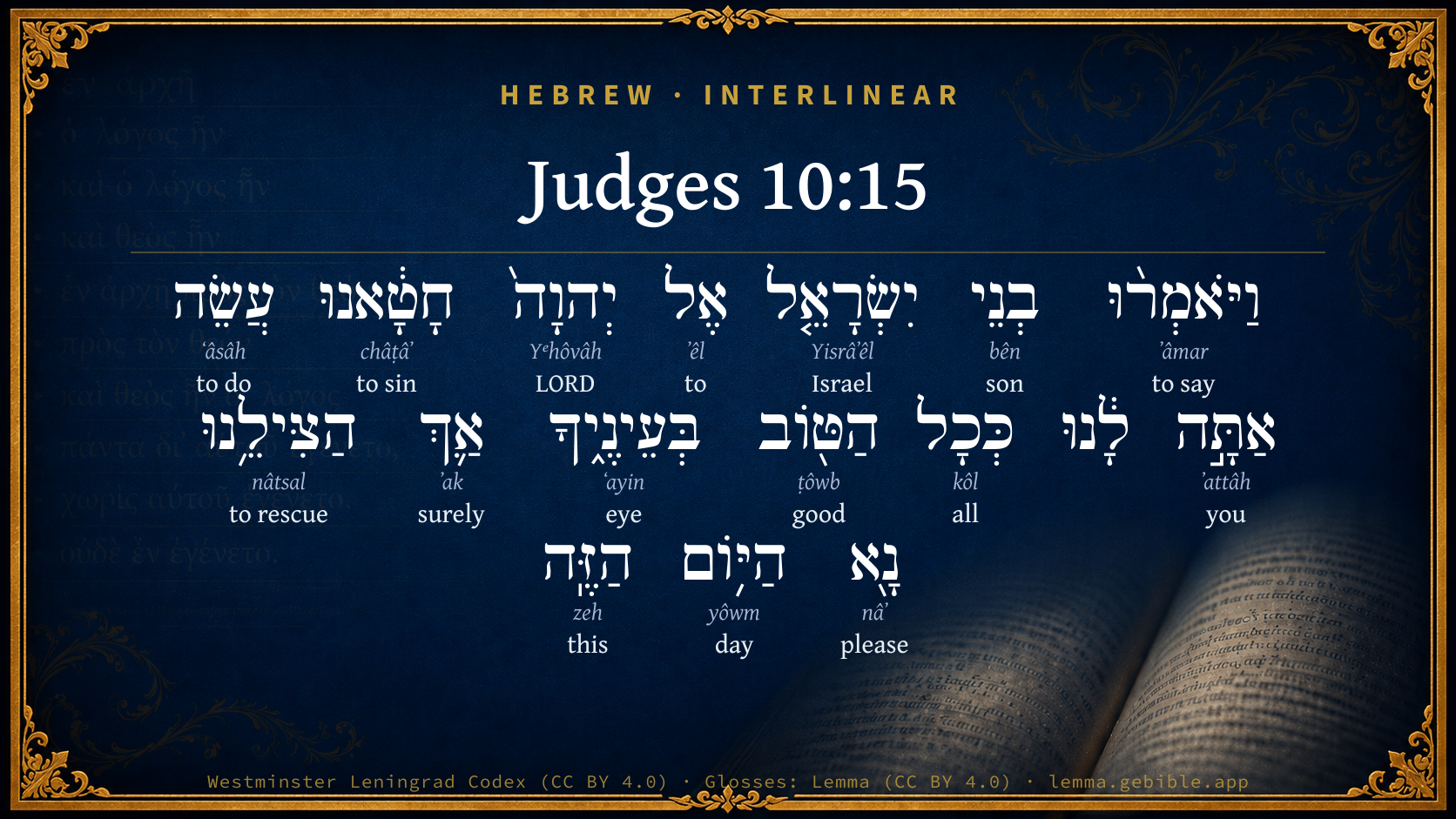
  1. וַיֹּאמְר֨וּ ʼâmar H559 “and · to say” Conjunction + Verb, Qal, Sequential Imperfect, 3rd Person, Masculine, Plural
  2. בְנֵי bên H1121 “sons of” Noun, Common, Masculine, Plural, Construct
  3. יִשְׂרָאֵ֤ל Yisrâʼêl H3478 “Israel” Noun, Proper
  4. אֶל ʼêl H413 “to” Preposition
  5. יְהוָה֙ Yᵉhôvâh H3068 “LORD” Noun, Proper
  6. חָטָ֔אנוּ châṭâʼ H2398 “to sin” Verb, Qal, Perfect, 1st Person, Common, Plural
  7. עֲשֵׂה ʻâsâh H6213 “do” Verb, Qal, Imperative, 2nd Person, Masculine, Singular
  8. אַתָּ֣ה ʼattâh H859 “you” Pronoun, Personal, 2nd Person, Masculine, Singular
  9. כְּכָל kôl H3605 “like/as · all of” Preposition + Noun, Common, Masculine, Singular, Construct
  10. הַטּ֖וֹב ṭôwb H2896 “the · good” Particle, Definite Article + Adjective, Adjective, Masculine, Singular, Absolute
  11. בְּעֵינֶ֑יךָ ʻayin H5869 “in/at · eyes · your” Preposition + Noun, Common, Both, Dual, Construct + Suffix, Personal, 2nd Person, Masculine, Singular
  12. הַצִּילֵ֥נוּ nâtsal H5337 “rescue · us” Verb, Hiphil, Imperative, 2nd Person, Masculine, Singular + Suffix, Personal, 1st Person, Common, Plural
  13. נָ֖א nâʼ H4994 “please” Particle, Exhortation
  14. הַיּ֥וֹם yôwm H3117 “the · day” Particle, Definite Article + Noun, Common, Masculine, Singular, Absolute
  15. הַזֶּֽה zeh H2088 “the · this” Particle, Definite Article + Pronoun, Demonstrative, Masculine, Singular

About this verse

These counts appear in no published source. They are computed here, from the morphology-tagged text and Lemma’s own curated glosses. What Lemma adds →

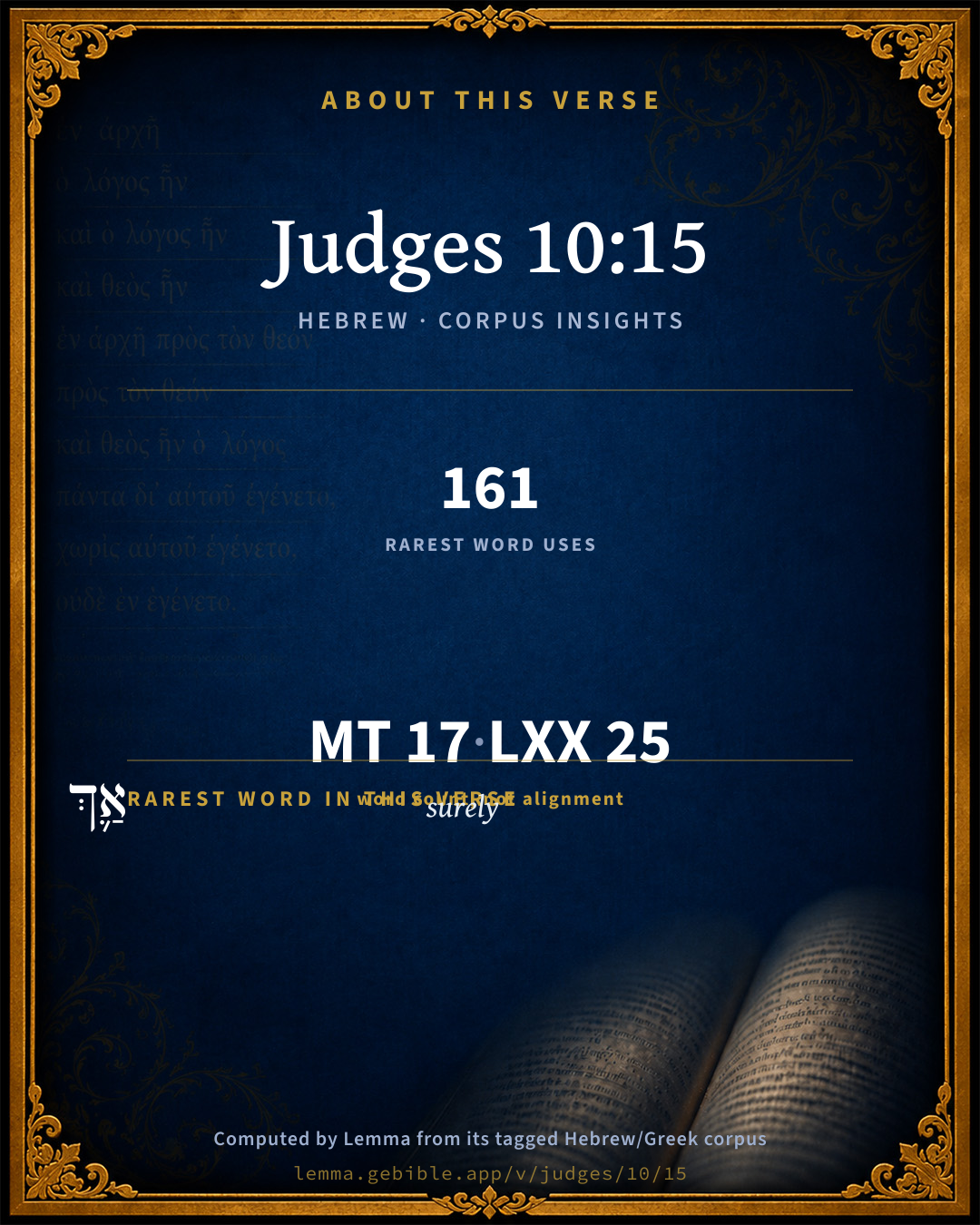
17
words
16
distinct lemmas
Historical
section

Grammatical profile

  • 4 verbs
  • 6 nouns
  • 1 adjective
  • 2 pronouns
  • 2 prepositions
  • 2 particles

Verb forms

  • וַיֹּאמְר֨וּ Qal · Sequential Imperfect
  • חָטָ֔אנוּ Qal · Perfect
  • עֲשֵׂה Qal · Imperative
  • הַצִּילֵ֥נוּ Hiphil · Imperative

Hebrew & Septuagint length

In English translation the verse runs 27 words from the Hebrew and 30 from the Septuagint (LXX English) — closely comparable.

A rough comparison of the two English renderings, which tokenize alike — not a word-level alignment.

Word counts can differ between the Hebrew and the Greek without any difference in meaning — e.g. the Hebrew direct-object marker אֵת has no separate Greek word, and Greek often adds the article ὁ.

In the original languages it is 17 Hebrew tokens and 25 Greek tokens — but the two are counted differently (Hebrew bundles its prefixes and suffixes into one token; the Greek is in lemma form), so that isn’t a like-for-like length.

Cross-references

13

Topical passages linked to Judges 10:15 in the Treasury of Scripture Knowledge — connected by theme and wording, ordered by reader-vote popularity; previews shown in the World English Bible.

  • 1 Samuel 3:18 Samuel told him every whit, and hid nothing from him. He said, It is Yahweh: let him do what seems him good.
  • 2 Samuel 15:26 but if he say thus, I have no delight in you; behold, here am I, let him do to me as seems good to him.
  • Joshua 9:25 Now, behold, we are in your hand: as it seems good and right to you to do to us, do.
  • 2 Samuel 24:14 David said to Gad, I am in a great strait: let us fall now into the hand of Yahweh; for his mercies are great; and let me not fall into the hand of man.
  • Proverbs 28:13 He who conceals his sins doesn't prosper, But whoever confesses and renounces them finds mercy.
  • 1 John 1:8–10 If we say that we have no sin, we deceive ourselves, and the truth is not in us.
  • 2 Samuel 10:12 Be of good courage, and let us play the man for our people, and for the cities of our God: and Yahweh do that which seems him good.
  • Jonah 3:9 Who knows whether God will not turn and repent, and turn away from his fierce anger, so that we might not perish?"
  • 2 Samuel 12:13 David said to Nathan, "I have sinned against Yahweh." Nathan said to David, "Yahweh also has put away your sin. You will not die.
  • 2 Samuel 24:10 David's heart struck him after that he had numbered the people. David said to Yahweh, I have sinned greatly in that which I have done: but now, Yahweh, put away, I beg you, the iniquity of your servant; for I have done very foolishly.
  • Job 33:27 He sings before men, and says, 'I have sinned, and perverted that which was right, And it didn't profit me.
  • Job 34:31–32 "For has any said to God, 'I am guilty, but I will not offend any more.
  • Jonah 2:4 I said, 'I have been banished from your sight; Yet I will look again toward your holy temple.'

Cross-references courtesy of OpenBible.info (CC BY 4.0).

Hebrew and Greek witnesses Masoretic Hebrew ↔ Greek Septuagint

The same verse in the two great witnesses to the Old Testament, shown verse-for-verse.

These are two independent witnesses, not word-aligned to each other, and the Septuagint is shown in lemma (dictionary) form.

Hebrew Judges 10:15 Masoretic · Westminster Leningrad Codex

וַיֹּאמְר֨וּ בְנֵי יִשְׂרָאֵ֤ל אֶל יְהוָה֙ חָטָ֔אנוּ עֲשֵׂה אַתָּ֣ה לָ֔נוּ כְּכָל הַטּ֖וֹב בְּעֵינֶ֑יךָ אַ֛ךְ הַצִּילֵ֥נוּ נָ֖א הַיּ֥וֹם הַזֶּֽה

The children of Israel said to Yahweh, We have sinned: do you to us whatever seems good to you; only deliver us, we pray you, this day.

World English Bible · Public Domain

Greek LXX Judges 10:15 Septuagint · lemma form

καί εἶπον ὁ υἱός ἰσραήλ πρός κύριος ἁμαρτάνω ποιέω σύ ἐγώ κατά πᾶς ὁ ἀγαθός ἐν ὀφθαλμός σύ πλήν ἐκαἱρέω ἐγώ ἐν ὁ ἡμέρα οὗτος

And the children of Israel said to the Lord, We have sinned: do you to us according to all that is good in your eyes; only deliver us this day.

LXX2012 (modern English Septuagint) · Public Domain

Hebrew: Westminster Leningrad Codex (CC BY 4.0). Greek: Septuagint (public domain); English from LXX2012 (modern English Septuagint) (Public Domain). How the Septuagint differs from the Hebrew →

Targum (Aramaic paraphrase)

1

The Targum is the ancient Jewish Aramaic paraphrase of the Hebrew Scriptures — an interpretive translation, not the Hebrew text itself. Onkelos (literal) and Pseudo-Jonathan (expansive) render the Torah, and Jonathan the Prophets. Coverage is partial: where no permissively-licensed English translation exists for a verse, only the Aramaic is shown. This is verse-level text, not a word-by-word alignment to the Hebrew.

  1. Targum Jonathan Prophets (Joshua–Malachi)
    וַאֲמַרוּ בְנֵי יִשְׂרָאֵל קֳדָם יְיָ חַבְנָא עֲבֵיד אַתְּ לָנָא כְּכָל דְתַקִין קֳדָמָךְ בְּרַם שֵׁיזַבְנָא כְעַן יוֹמָא דֵין:

    (no public-domain English translation for this verse)

    Targum Jonathan — Aramaic: “Mikraot Gedolot” (public domain). English: “Sefaria Community Translation” (CC0 1.0 (public-domain dedication)); “London "Chaldee Paraphrase," 1871” (public domain). Text via Sefaria.

Commentary

Notes on Judges 10:15 from classic Christian and Jewish commentators (each source and its license shown beneath its notes). The classic Christian expositions comment on the surrounding passage and are grouped to its opening verse, so a note may address several verses; the Jewish commentaries on the Tanakh (Rashi and others) are per-verse, so they appear only where the commentator wrote on this verse.

Lemma curates 59 commentaries, every one of them public domain or Creative Commons licensed, each selected and text-cleaned for this edition rather than reprinted as found. About our sources →

Trapp's Complete Commentary

John Trapp

Jdg 10:15 And the children of Israel said unto the LORD, We have sinned: do thou unto us whatsoever seemeth good unto thee; deliver us only, we pray thee, this day.

Ver. 15. We have sinned: do thou unto us.] They do not yet despair, but put themselves into the hands of divine justice, in hope of mercy; they make a total resignation of all that they are and have to God; they pray on, and put away the evil of their doings from before his eyes. {Jdg 10:16} An excellent pattern of repentance for all to imitate.

John Trapp, A Commentary or Exposition upon All the Books of the Old and New Testament (1647–1656) — public domain. Text from a community e-Sword module.

Joseph Benson's Commentary

Jdg 10:15. Do thou unto us, &c. — Do not give us up into the hands of these cruel men, but do thou chastise us with thine own hand as much as thou pleasest, if we be not more faithful and constant to thee than we have hitherto been.

Joseph Benson's Commentary on the Old and New Testaments (1811–1818) — public domain. Text from a community e-Sword module.

Geneva Bible (1599)

Geneva Bible translators

That is, from this present danger.

Geneva Bible (1599) marginal notes — public domain. Text via Bolls.life.

Adam Clarke's Commentary

Verse 15. We have sinned] The reprehension of this people was kind, pointed, and solemn; and their repentance deep. And they gave proofs that their repentance was genuine, by putting away all their idols: but they were ever fickle and uncertain.

Adam Clarke's Commentary on the Bible (1810–1826) — public domain. Text from a community e-Sword/MySword module.

Ellicott's Commentary for English Readers

(15) Deliver us only, we pray thee, this day.—The invariable cry of the soul in trouble. With the former half of the verse comp. 1Sa_3:18; 1Sa_15:26.

A Bible Commentary for English Readers, edited by Charles John Ellicott (1878–1897) — public domain. Text from a community e-Sword module.

The Cambridge Bible for Schools and Colleges

gen. ed. J. J. S. Perowne

15. For the submission to Jehovah’s will cf. 1Sa_3:18, 2Sa_15:26.

The Cambridge Bible for Schools and Colleges (gen. ed. J. J. S. Perowne; Cambridge University Press, 1878–1918) — public domain. Text from a community e-Sword module.

John Gill's Exposition

And the children of Israel said unto the Lord, we have sinned,.... By serving other gods particularly; and they seemed to have a true sense of their sin, and their confessions of it to be ingenuous, by what follows:

do thou unto us whatsoever seemeth good unto thee; inflict what punishment he would upon them, as famine or pestilence, they could not but own it would be just and righteous, and what their sins deserved:

deliver us only, we pray thee, this day; out of the hands of men; they chose rather to fall into the hands of God; and however he thought fit to deal with them, they entreated that this once he would save them out of the hands of their enemies.

John Gill's Exposition of the Whole Bible (1746–1763) — public domain (CC PDM 1.0). Text via the HelloAO Bible API.

Haydock's Catholic Bible Commentary

Time. They are willing to suffer from the hand of God, (2 Kings xxiv. 14,) if they prove inconstant any more. (Menochius)

George Leo Haydock (1774–1849), Haydock's Catholic Family Bible and Commentary, 1859 edition — public domain. Excludes Psalms (Douay-Rheims chapter numbering differs from Protestant) and Deuterocanonical books (Catholic canon only).

Matthew Poole's English Annotations

Do not give us up into the hands of these cruel men, but do thou chastise us with thine own hand as much as thou pleasest, to wit, if we be not more faithful and constant to thee than we have hitherto been.

Matthew Poole's English Annotations on the Holy Bible (1683–1685) — public domain. Text from a community e-Sword/MySword module.

Whedon's Commentary on the Bible

Daniel D. Whedon

15. We have sinned — Now their repentance becomes deeper and profounder. They had before (Jdg_10:10) confessed their sins, but had not forsaken them. Now, brought into deep humiliation by the divine threat, (Jdg_10:13.) they are ready to do or receive whatsoever seemeth good unto Jehovah.

Daniel D. Whedon (gen. ed.), Commentary on the Old and New Testaments (1874–1909) — public domain. Text from a community e-Sword module.

The Pulpit Commentary

Vers. 15, 16. "Works meet for repentance.

A wonderful summary; an evangelical anticipation.

I IN WHAT THESE CONSIST.

1. Heartfelt sorrow and confession of sin.

2. Absolute yielding of oneself into the hands of God.

3. Forsaking the sins that have deceived and destroyed.

4. Serving Jehovah with new obedience and zeal.

II How THESE APPEAL TO THE MIND OF GOD. "His soul was grieved for (literally, endured no longer) the misery of Israel." The alternate hardening and melting of God"s soul an accommodation to man"s conceptions and feelings; yet with a reality corresponding to them in the Divine nature. They have a disciplinary effect, and their succession is impressive. So God "repents." To our heavenly Father the proofs of our sincerity are an irresistible petition. He welcomes the first signs of true repentance, and leads it forth into saving faith. The truly repentant were never yet rejected. In working this repentance in their minds he began to answer their prayer even whilst rejecting it. M.

Vers. 15, 16. Repentance.

I REPENTANCE INVOLVES CONFESSION OF SIN. The people admit their guilt to themselves and declare it frankly to God.

1. We must confess sin. We cannot turn from sin till we are conscious of sin. God will not forgive our sin till we confess our guilt. These two things, the self-knowledge and the self-revelation before God, which are implied in confession, must be found in true repentance. Pride would simply forget the past, but this cannot be forgotten till it is forgiven, nor forgiven till it is confessed. (1Jn_1:9)

2. The confession must be to God; because

1. it is against God that sin is committed;

2. he alone can forgive sin;

3. we have no warrant for believing that he delegates this Divine prerogative to any human deputy.

II REPENTANCE INVOLVES SUBMISSION TO GOD. No repentance is complete which does not involve self-renunciation. This is necessary,

(1) because, since sin arises from self-will and rebellion against the will of God, the return from sin must be marked by a return to obedience;

(2) because the penitent is conscious of his utter ill desert, and of his absolute dependence on the mercy of God, so that he dares claim nothing but what God may think fit to give him, and knows that at the worst this can be no harder than what he merits; and

(3) because repentance involves the admission that while we were sinful and foolish in forsaking God, he was always good to us, and will never do for us anything short of what is best. Repentance thus recognises again the despised fatherhood of God, and willingly trusts to his grace.

III REPENTANCE INVOLVES PRACTICAL AMENDMENT. The children of Israel put away the strange gods from among them, and served the Lord. If repentance is genuine it will show itself in conduct it will bring forth fruits. (Mat_3:8) This does not imply

1. That we must complete the reformation of our own lives before God will forgive us, because

1. that is impossible; (Jer_13:23) and

2. the very object of the gospel is to do thisi.e. to save us from our sins. (Act_3:26)

2. Neither does it imply that any measure of reformation will be regarded as penance, as sacrifice, as a meritorious work securing forgiveness, since the essence of forgiveness lies in its freeness. But it implies that the genuineness of repentance must be tested by its effects. Repentance is not a mere feeling of grief; it is not seated in the emotions, but in the will. It is a change of desire, and the wish to do better. This is active, and must manifest itself in conduct. The conduct will be twofold:

1. the giving up of old evil ways, and

2. the commencement of the service of God.

IV REPENTANCE IS FOLLOWED BY TOKENS OF GOD"S MERCY. When the people repented God could no longer endure their misery. He never willingly afflicts. (Lam_3:33) He only waits for our repentance to show his compassion. It is possible then because

(1) there is no longer the necessity for continued chastisement;

(2) the justice and righteousness of God no longer require him to look upon us in wrath; and

(3) we shall not be injured by the kindness which fails upon us in our humiliation, but rather healed and strengthened for a better life by the influence of God"s love. A.

The Pulpit Commentary (1880–1919), ed. H.D.M. Spence-Jones & Joseph S. Exell — public domain. Text from a community e-Sword module.

John Wesley's Explanatory Notes

Do thou unto us - Do not give us up into the hands of these cruel men, but do thou chastise us with thine own hand as much as thou pleasest; if we be not more faithful and constant to thee, than we have hitherto been.

John Wesley, Explanatory Notes Upon the Whole Bible (1754–1765) — public domain. Text via the GEBible commentary corpus.

unfoldingWord translationNotes

Door43 World Missions Community

foreign gods among them

You can make explicit the implicit meaning of this statement. AT: "foreign gods whose images they possessed" (See: Assumed Knowledge and Implicit Information)

Yahweh could bear Israel's misery no longer

Here Israel refers to the people of Israel. AT: "And Yahweh did not want the people of Israel to suffer any longer" (See: Metonymy)

translationWords

Israel

Yahweh

sin

turn

false god

worship

unfoldingWord translationNotes — © Distant Shores Media and the Door43 World Missions Community, licensed CC BY-SA 4.0. Source: git.door43.org/Door43/en_tn.

Lesson kit

Teaching starters — assembled from the data on this page, not authored interpretation. Every prompt links to the verse data it draws on. Edit before teaching.

Judges, in the Historical, opens this verse with 17 words (16 distinct Hebrew lemmas). Its most distinctive word is ʼak (“surely”). A historical commentator’s framing appears above. Read the whole chapter for the surrounding context.

Discussion questions

  1. How does “surely” (ʼak) shape what this verse is saying?
  2. How does 1 Samuel 3:18, which shares this passage’s theme, read alongside this verse?
  3. The translations on this page render this verse differently — a whole-verse word diff, not a word-by-word alignment. What might account for the different wordings?
  4. «וַיֹּאמְר֨וּ» is a Qal Sequential Imperfect verb. How does that grammatical form shape the action described?
  5. Compare how Trapp's Complete Commentary and Joseph Benson's Commentary read this verse. Where do they agree or differ?

Things to notice

Reading settings

Reading text

Shown beneath each verse's original-language words.

Old Testament
Old Testament edition

Read the OT as the Masoretic Hebrew (MT) or the Greek Septuagint (LXX).

English shown for the Greek Septuagint (in the Hebrew ↔ Greek comparison).

Comparing translations? Open the Compare panel on any verse page to stack up to four side by side.