Exodus 10:16

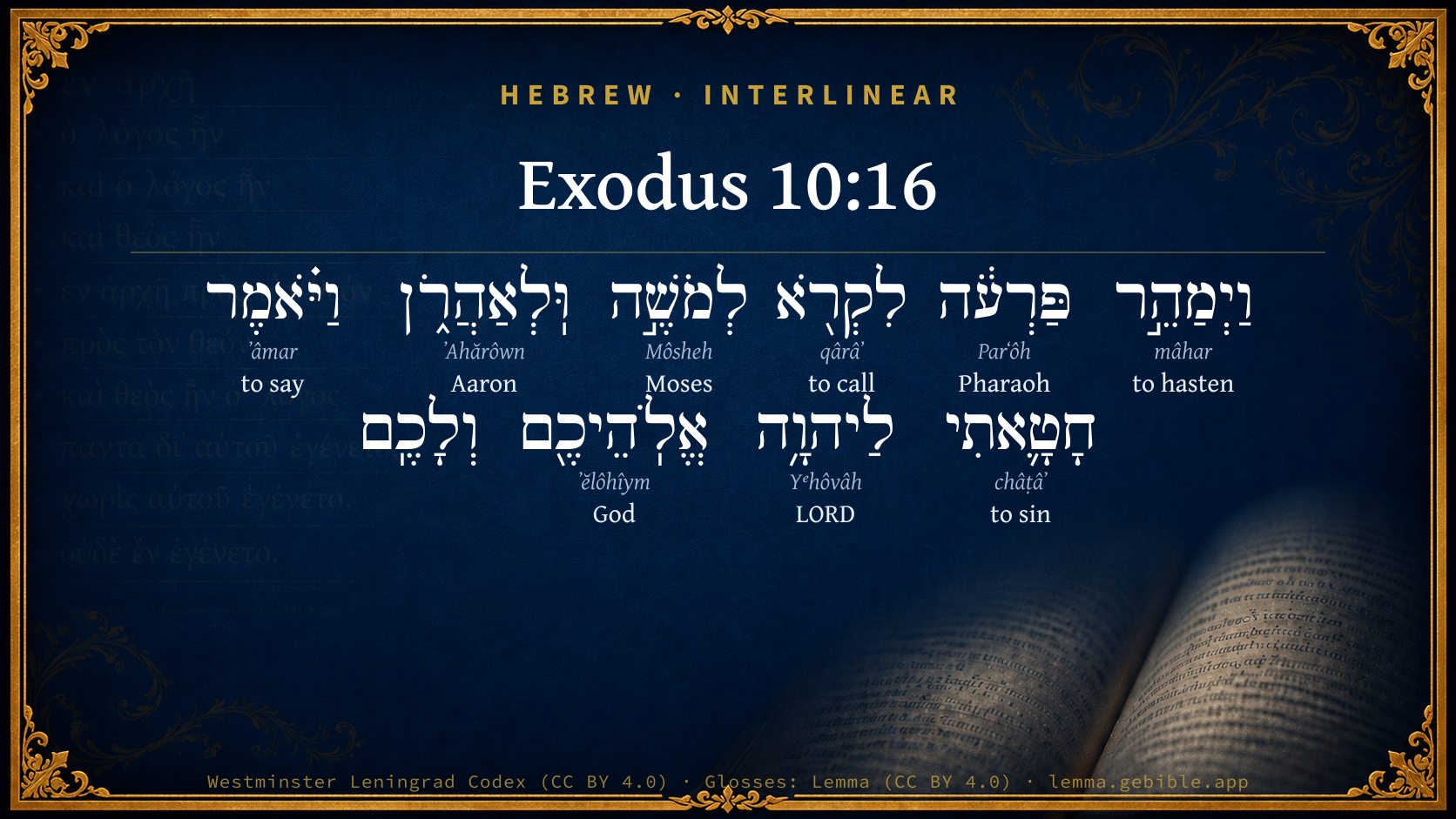
Hebrew (Westminster Leningrad Codex) Exodus 10:16 appears in the Hebrew Old Testament. The text above is from the Westminster Leningrad Codex. Each word links to its Strong’s number, a concise gloss, and parsing drawn from the Open Scriptures Hebrew Bible morphology. Click any word for its full Brown-Driver-Briggs (BDB) entry.
Download image
Cite this verse

Exodus 10:16 (World English Bible). Public Domain. Lemma interlinear Bible study tool, https://lemma.gebible.app/v/exodus/10/16.

Show BibTeX & RIS
BibTeX
RIS
English Translation
Then Pharaoh called for Moses and Aaron in haste, and he said, "I have sinned against Yahweh your God, and against you.
World English Bible · Public Domain
Download a study sheet

One document with this verse’s original text, its word-by-word gloss line, the meaning frame, cross-references with their text, attributed commentary, and full source and license credits — printable, and it pastes into notes with its structure intact.

This verse Autodidact and up

Study sheet (.html) Plain text (.txt)

A passage Seminary Student

Up to 50 verses in one chapter. A passage sheet keeps up to 6 commentary sources and 12 cross-references per verse, in the order this page ranks them, and says so on the sheet whenever that leaves anything out. Ask for a single verse and you get the Autodidact verse sheet above.

Everything on this page stays free to read, with no account — the sheet is a download of what is already on screen, not access to it.

Want to remove ads? Support Godless Engineer
Compare translations 3

The same verse in 3 English versions, stacked beneath the original-language interlinear above. Click any original word for its lexicon entry.

Each is an independent rendering of the whole verse — the interlinear is not word-aligned to these translations.

Highlighted words mark where these versions differ — a whole-verse word diff, not a word-by-word alignment.

  • World English Bible Public Domain
    Then Pharaoh called for Moses and Aaron in haste, and he said, "I have sinned against Yahweh your God, and against you.
  • King James Version Public Domain
    Then Pharaoh called for Moses and Aaron in haste; and he said, I have sinned against the LORD your God, and against you.
  • unfoldingWord Literal Text CC BY-SA 4.0
    And Pharaoh hurried to call for Moses and for Aaron and said, “I have sinned against Yahweh your God and against you.

unfoldingWord Literal Text — © unfoldingWord, licensed CC BY-SA 4.0. Word-aligned USFM3 via Door43 (git.door43.org/unfoldingWord/en_ult).

Versions to compare (up to 4)

3 of 4 selected

Show all 18 translations

Every available English version of this verse, each an independent rendering of the whole verse.

  • World English Bible Public Domain
    Then Pharaoh called for Moses and Aaron in haste, and he said, "I have sinned against Yahweh your God, and against you.
  • Berean Standard Bible Public Domain
    Pharaoh quickly summoned Moses and Aaron and said, “I have sinned against the LORD your God and against you.
  • Majority Standard Bible Public Domain
    Pharaoh quickly summoned Moses and Aaron and said, “I have sinned against the LORD your God and against you.
  • King James Version Public Domain
    Then Pharaoh called for Moses and Aaron in haste; and he said, I have sinned against the LORD your God, and against you.
  • American Standard Version (1901) Public Domain
    Then Pharaoh called for Moses and Aaron in haste; and he said, I have sinned against Jehovah your God, and against you.
  • Revised Version (1885) Public Domain
    Then Pharaoh called for Moses and Aaron in haste; and he said, I have sinned against the LORD your God, and against you.
  • Geneva Bible (1599) Public Domain
    Therefore Pharaoh called for Moses and Aaron in haste, and sayde, I haue sinned against the Lord your God, and against you.
  • Douay-Rheims (1899) Public Domain
    Wherefore Pharao in haste called Moses and Aaron, and said to them: I have sinned against the Lord your God, and against you.
  • Young's Literal Translation Public Domain
    And Pharaoh hasteth to call for Moses and for Aaron, and saith, `I have sinned against Jehovah your God, and against you,
  • Literal Standard Version CC BY-SA 4.0
    And Pharaoh hurries to call for Moses and for Aaron and says, “I have sinned against your God YHWH, and against you,
  • Unlocked Literal Bible CC BY-SA 4.0
    Then Pharaoh quickly summoned Moses and Aaron and said, “I have sinned against Yahweh your God and against you.
  • unfoldingWord Literal Text CC BY-SA 4.0
    And Pharaoh hurried to call for Moses and for Aaron and said, “I have sinned against Yahweh your God and against you.
  • Darby Bible Public Domain
    And Pharaoh called Moses and Aaron in haste; and he said, I have sinned against Jehovah your God, and against you.
  • World Messianic Bible Public Domain
    Then Pharaoh called for Moses and Aaron in haste, and he said, “I have sinned against the LORD your God, and against you.
  • Webster's Bible Public Domain
    Then Pharaoh called for Moses and Aaron in haste; and he said, I have sinned against the LORD your God, and against you.
  • Free Bible Version CC BY-SA 4.0
    Pharaoh called urgently for Moses and Aaron and said, “I have sinned against the Lord your God and against you.
  • Bible in Basic English Public Domain
    Then Pharaoh quickly sent for Moses and Aaron, and said, I have done evil against the Lord your God and against you.
  • JPS Tanakh (1917) Public Domain
    Then Pharaoh called for Moses and Aaron in haste; and he said: 'I have sinned against the LORD your God, and against you.

Literal Standard Version (2020), Covenant Press — licensed CC BY-SA 4.0. Text via the HelloAO Bible API (eBible.org). Unlocked Literal Bible (unfoldingWord) — licensed CC BY-SA 4.0. Text via the HelloAO Bible API (eBible.org). unfoldingWord Literal Text — © unfoldingWord, licensed CC BY-SA 4.0. Word-aligned USFM3 via Door43 (git.door43.org/unfoldingWord/en_ult). Free Bible Version, Dr. Jonathan Gallagher — licensed CC BY-SA 4.0. Text via the HelloAO Bible API (eBible.org).

Word by word

More ways to search: Search by grammar → Find every occurrence → Compare this word →

Practice this passage: Drill this verse → Learn its vocabulary →

וַיְמַהֵ֣ר
mâhar
H4116
“and · to hasten”
Conjunction + Verb, Piel, Sequential Imperfect, 3rd Person, Masculine, Singular
Part of Speech
Conjunction + Verb
Stem
Piel
Form
Sequential Imperfect
Person
3rd Person
Gender
Masculine
Number
Singular
Full BDB Definition

Origin: a primitive root

TWOT: 1152

(Qal) to hasten - (Niphal) to be hurried, be anxious - hasty, precipitate, impetuous - (Piel) - to hasten, make haste - hasten (used as adverb with another verb) - to hasten, prepare quickly, do quickly, bring quickly
  1. פַּרְעֹ֔ה Parʻôh H6547 “Pharaoh” Noun, Proper
  2. לִקְרֹ֖א qârâʼ H7121 “to call” Preposition + Verb, Qal, Infinitive Construct
  3. לְמֹשֶׁ֣ה Môsheh H4872 “to/for · Moses” Preposition + Noun, Proper
  4. וּֽלְאַהֲרֹ֑ן ʼAhărôwn H175 “and · to/for · Aaron” Conjunction + Preposition + Noun, Proper
  5. וַיֹּ֗אמֶר ʼâmar H559 “and · to say” Conjunction + Verb, Qal, Sequential Imperfect, 3rd Person, Masculine, Singular
  6. חָטָ֛אתִי châṭâʼ H2398 “to sin” Verb, Qal, Perfect, 1st Person, Common, Singular
  7. לַיהוָ֥ה Yᵉhôvâh H3068 “to/for · LORD” Preposition + Noun, Proper
  8. אֱלֹֽהֵיכֶ֖ם ʼĕlôhîym H430 “God(s) · your” Noun, Common, Masculine, Plural, Construct + Suffix, Personal, 2nd Person, Masculine, Plural

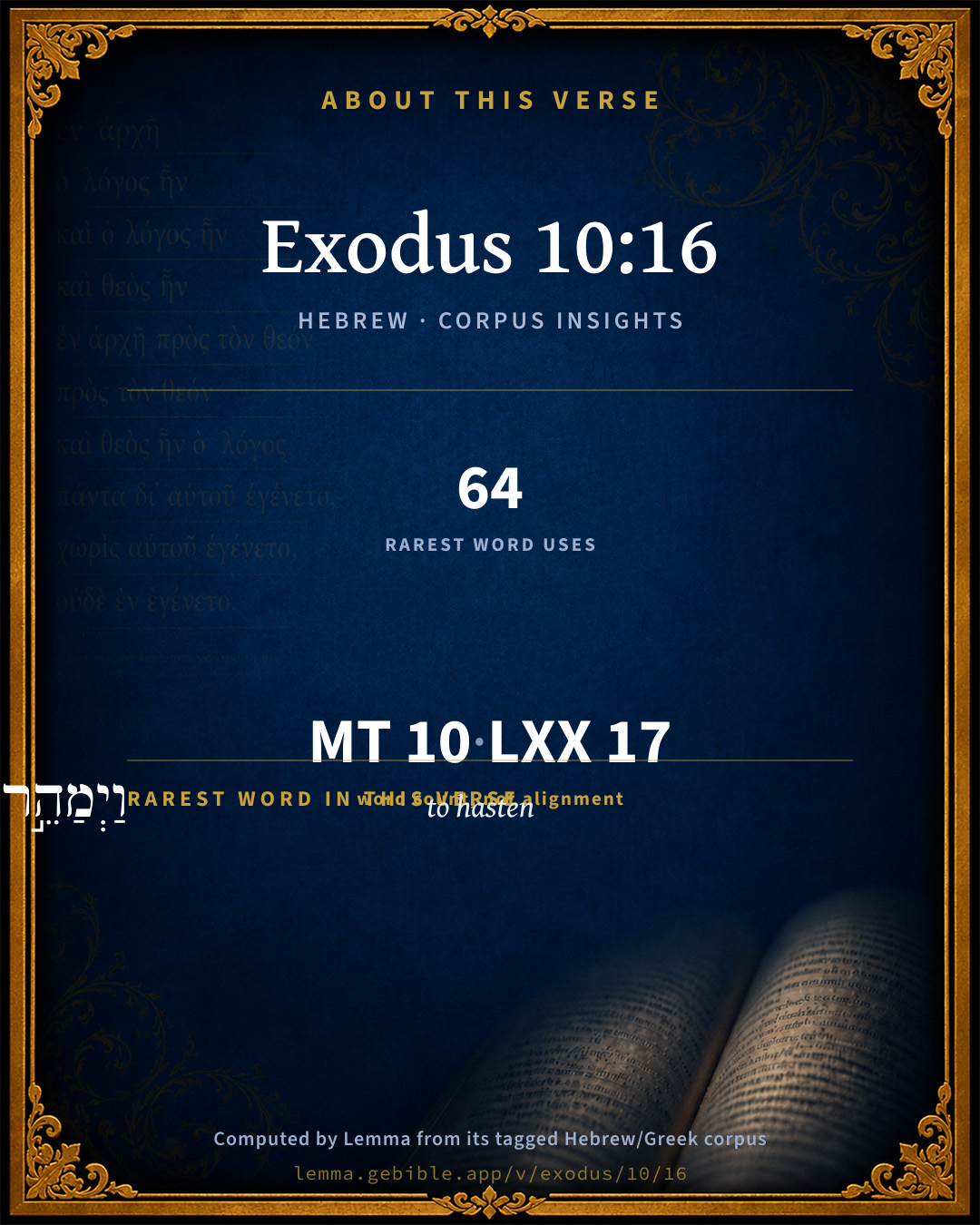
About this verse

These counts appear in no published source. They are computed here, from the morphology-tagged text and Lemma’s own curated glosses. What Lemma adds →

10
words
9
distinct lemmas
Pentateuch
section

Grammatical profile

  • 4 verbs
  • 5 nouns
  • 1 preposition

Verb forms

  • וַיְמַהֵ֣ר Piel · Sequential Imperfect
  • לִקְרֹ֖א Qal · Infinitive Construct
  • וַיֹּ֗אמֶר Qal · Sequential Imperfect
  • חָטָ֛אתִי Qal · Perfect

Hebrew & Septuagint length

In English translation the verse runs 22 words from the Hebrew and 20 from the Septuagint (LXX English) — closely comparable.

A rough comparison of the two English renderings, which tokenize alike — not a word-level alignment.

Word counts can differ between the Hebrew and the Greek without any difference in meaning — e.g. the Hebrew direct-object marker אֵת has no separate Greek word, and Greek often adds the article ὁ.

In the original languages it is 10 Hebrew tokens and 17 Greek tokens — but the two are counted differently (Hebrew bundles its prefixes and suffixes into one token; the Greek is in lemma form), so that isn’t a like-for-like length.

Cross-references

10

Topical passages linked to Exodus 10:16 in the Treasury of Scripture Knowledge — connected by theme and wording, ordered by reader-vote popularity; previews shown in the World English Bible.

  • Exodus 9:27 Pharaoh sent, and called for Moses and Aaron, and said to them, "I have sinned this time. Yahweh is righteous, and I and my people are wicked.
  • Numbers 21:7 The people came to Moses, and said, We have sinned, because we have spoken against Yahweh, and against you; pray to Yahweh, that he take away the serpents from us. Moses prayed for the people.
  • Numbers 22:34 Balaam said to the angel of Yahweh, I have sinned; for I didn't know that you stood in the way against me: now therefore, if it displease you, I will get me back again.
  • 1 Samuel 15:24 Saul said to Samuel, I have sinned; for I have transgressed the commandment of Yahweh, and your words, because I feared the people, and obeyed their voice.
  • 1 Samuel 15:30 Then he said, I have sinned: yet honor me now, Please, before the elders of my people, and before Israel, and turn again with me, that I may worship Yahweh your God.
  • 1 Samuel 26:21 Then said Saul, I have sinned: return, my son David; for I will no more do you harm, because my life was precious in your eyes this day: behold, I have played the fool, and have erred exceedingly.
  • 2 Samuel 19:20 For your servant does know that I have sinned: therefore, behold, I am come this day the first of all the house of Joseph to go down to meet my lord the king.
  • Job 34:31–32 "For has any said to God, 'I am guilty, but I will not offend any more.
  • Proverbs 28:13 He who conceals his sins doesn't prosper, But whoever confesses and renounces them finds mercy.
  • Matthew 27:4 saying, "I have sinned in that I betrayed innocent blood." But they said, "What is that to us? You see to it."

Cross-references courtesy of OpenBible.info (CC BY 4.0).

Hebrew and Greek witnesses Masoretic Hebrew ↔ Greek Septuagint

The same verse in the two great witnesses to the Old Testament, shown verse-for-verse.

These are two independent witnesses, not word-aligned to each other, and the Septuagint is shown in lemma (dictionary) form.

Hebrew Exodus 10:16 Masoretic · Westminster Leningrad Codex

וַיְמַהֵ֣ר פַּרְעֹ֔ה לִקְרֹ֖א לְמֹשֶׁ֣ה וּֽלְאַהֲרֹ֑ן וַיֹּ֗אמֶר חָטָ֛אתִי לַיהוָ֥ה אֱלֹֽהֵיכֶ֖ם וְלָכֶֽם

Then Pharaoh called for Moses and Aaron in haste, and he said, "I have sinned against Yahweh your God, and against you.

World English Bible · Public Domain

Greek LXX Exodus 10:16 Septuagint · lemma form

κατασπεύδω δέ φαραώ καλέω μωυσῆς καί ααρων λέγω ἁμαρτάνω ἐναντίον κύριος ὁ θεός σύ καί εἰς σύ

And Pharao hasted to call Moses and Aaron, saying, I have sinned before the Lord your God, and against you;

LXX2012 (modern English Septuagint) · Public Domain

Hebrew: Westminster Leningrad Codex (CC BY 4.0). Greek: Septuagint (public domain); English from LXX2012 (modern English Septuagint) (Public Domain). How the Septuagint differs from the Hebrew →

Targum (Aramaic paraphrase)

2

The Targum is the ancient Jewish Aramaic paraphrase of the Hebrew Scriptures — an interpretive translation, not the Hebrew text itself. Onkelos (literal) and Pseudo-Jonathan (expansive) render the Torah, and Jonathan the Prophets. Coverage is partial: where no permissively-licensed English translation exists for a verse, only the Aramaic is shown. This is verse-level text, not a word-by-word alignment to the Hebrew.

  1. Targum Onkelos Torah (Genesis–Deuteronomy)
    וְאוֹחִי פַרְעֹה לְמִקְרֵי לְמשֶׁה וּלְאַהֲרֹן וַאֲמַר חָבִית קֳדָם יְיָ אֱלָהֲכוֹן וּלְכוֹן:

    (no public-domain English translation for this verse)

    Targum Onkelos — Aramaic: “Onkelos Genesis” (public domain); “Onkelos Exodus” (public domain); “Onkelos Leviticus” (public domain); “Onkelos Numbers” (public domain); “Onkelos Deuteronomy” (public domain). English: “Sefaria Community Translation” (CC0 1.0 (public-domain dedication)); “J.W. Etheridge. The Targums of Onkelos and Jonathan Ben Uzziel on the Pentateuch. London: Longmans, Green, 1862” (public domain). Text via Sefaria.

  2. Targum Pseudo-Jonathan Torah (Genesis–Deuteronomy)
    וְאוֹחֵי פַּרְעה וּשְׁדַר פּוּלִין לְמִקְרֵי לְמשֶׁה וּלְאַהֲרן וַאֲמַר חָבִית קֳדָם יְיָ אֱלָהָכוֹן וּלְכוֹן

    And Pharoh made haste, and sent certain to call Mosheh and Aharon. And he said, I have sinned before the Lord your God and against you.

    Targum Pseudo-Jonathan — Aramaic: “Targum Jonathan on Genesis” (public domain); “Targum Jonathan on Exodus” (public domain); “Targum Jonathan on Leviticus” (public domain); “Targum Jonathan on Numbers” (public domain); “Targum Jonathan on Deuteronomy” (public domain). English: “The Targum of Jonathan ben Uzziel, trans. J. W. Etheridge, London, 1862” (public domain). Text via Sefaria.

Commentary

Notes on Exodus 10:16 from classic Christian and Jewish commentators (each source and its license shown beneath its notes). The classic Christian expositions comment on the surrounding passage and are grouped to its opening verse, so a note may address several verses; the Jewish commentaries on the Tanakh (Rashi and others) are per-verse, so they appear only where the commentator wrote on this verse.

Lemma curates 59 commentaries, every one of them public domain or Creative Commons licensed, each selected and text-cleaned for this edition rather than reprinted as found. About our sources →

Trapp's Complete Commentary

John Trapp

Exo 10:16 Then Pharaoh called for Moses and Aaron in haste; and he said, I have sinned against the LORD your God, and against you.

Ver. 16. I have sinned against the Lord.] A fair confession, but forced and extorted. Thus the toad, if beaten on the belly, will vomit up his venom, and the malefactor on the rack will utter all. But as water heated, if taken off the fire will soon return to its natural coldness, yea, become colder after heating than before; {a} so hypocrites’ heats are not kindly, from the Spirit, but violent, from the outward fire of God’s judgments: therefore when that is out, these are gone.

{a} Aristot., Meteor., i. 12.

John Trapp, A Commentary or Exposition upon All the Books of the Old and New Testament (1647–1656) — public domain. Text from a community e-Sword module.

The Biblical Illustrator

Joseph S. Exell

Exo_10:16-19

Intreat the Lord your God.

Lessons

1. Gods hasty judgments may work hasty passions in sinners, though no repentance.

2. Vengeance may make persecutors call in Gods servants for help as hastily as they drove them out.

3. Double confession of sin may hypocrites make under plagues, yet not in truth.

4. Proud persecutors may be forced to confess their guilt against men as well as against God (Exo_5:16).

5. Hypocritical oppressors may desire forgiveness of Gods people under plagues, as if they would sin no more.

6. Wicked persecutors under judgment are earnest with Gods servants to intercede earnestly for them.

7. It is only death which wicked sinners deprecate.

8. Hypocrites pretend upon deliverance from death, as if they would sin no more, or desire no more mercy (Exo_10:17). (G. Hughes, B. D.)

A false repentance

I. It proceeds from the impulse of the moment, and not from conscientious conviction.

II. It is marked by selfish terror, and not by a godly sorrow for sin.

III. It craves forgiveness of an immediate offence, rather than a thorough cleansing of the heart.

IV. It confides in the intercession of a fellow-mortal, rather than in the personal humbling of the soul before God. Christ is the only Mediator.

V. It regards God more as a terrible Deity whose wrath is to be appeased, than as the Infinite Father whose love is better than life.

VI. it expresses a promise of amendment which is falsified by previous dissemblings.

Lessons:

1. To be sure that our repentance is genuine.

2. To bring forth fruit meet for repentance in daily conduct.

3. Not to pass a hasty judgment on the repentance of men. Half the Revivalists of the day would have called Pharaoh a true convert; time tests conversion. (J. S. Exell, M. A.)

Pharaohs imperfect repentances

Dear children, when any one confesses with sincerity, I have sinned; when he says this to God, and not merely to man, be sure that he is never rejected. But let us observe what was wanting in the repentance of Pharaoh.

1. Belief in God, He called Him the Lord your God. He spoke of Him as of a stranger. Now, it is impossible that any person or child can love the Lord until he feels himself reconciled to Him by faith, until he can call Him the Lord my God.

2. Pharaoh had humbled himself before men, rather than before God.

3. He besought the prayers of others, instead of praying for himself.

4. He asked the forgiveness of the servants of God, instead of seeking pardon from God Himself. If he had said, like David, I acknowledge my sin unto the Lord, he might have added like him, And Thou forgavest the iniquity of my sin.

5. Pharaoh did not concern himself about the salvation of his soul. He intreated, not that he might be delivered from sin, but only that this death should be taken away from him; he did not think of eternity, but only of the plague under which he was suffering.

6. Lastly, remark that the king still cherished secret designs in his heart; his submission was not unreserved. We have begun as it were to repent; but as long as we are not willing to renounce all, to follow Jesus, our repentance is of no avail. Pharaoh said, Go ye, serve the Lord, only let your flocks and herds be stayed. His heart was not yet submissive, thus his repentance was vain. (Prof. Gaussen.)

The Biblical Illustrator, edited by Joseph S. Exell (c. 1880s–1900s) — public domain. Text from a community e-Sword module.

The Preacher's Complete Homiletical Commentary

Joseph S. Exell (gen. ed.)

MAIN HOMILETICS OF THE PARAGRAPH.—Exo_10:16-20

A FALSE REPENTANCE

Pharaoh had driven Moses and Aaron from his presence, but now he recalls them in great haste, and with much respect. The day will come when all rebellious souls will be glad to engage the intercessions of the good; even though they may despise them now. Hence the plague of locusts made a great impression upon the king, and he became very anxious for its removal. A False Repentance:—

I. It proceeds from the impulse of the moment, and not from conscientious conviction. This token of repentance was the outcome of impulse. The king was awe-stricken by the plague of locusts, and for the moment was bowed in repentant mood. His confessions of sin were prompted by the feeling of the hour, and would be silenced by the removal of the plague. His repentance was not a matter of deep conviction. His soul felt no agony for sin. It had no vision of an offended God, of a broken law, or of a woful destiny to come. It saw only a temporary retribution. A truly penitent spirit will look through all the pain that occasions its grief to that Being who alone can pardon its sin. Conviction rather than impulse must mark the commencement of a new life, and can alone give it permanent reality. The repentance of impulse is but of short duration.

II. It is marked by selfish terror, and not by a godly sorrow for sin. Pharaoh evinces a slavish dread, and a fear of death. He had no thought about the sin he had committed. He was not filled with genuine sorrow on account of his wilful rejection of the Divine claims. His cries were those of a despairing soul; they were not the utterances of a contrite heart. He felt the force of the retribution that rested upon him. He had no means whereby to escape it. Death was before him. He saw little hope of mercy; in fact, mercy in the true sense of the word he did not seek. And a false repentance has always a large element of terror in it, and that sorrow for sin, which is so true and refreshing, is unknown to it.

III. It craves forgiveness of an immediate offence rather than a thorough cleansing of the heart. Pharaoh sought the forgiveness of his sin this once; he did not ask for the purification of his moral nature. He had spent a long life in sin, he had been guilty of continued opposition to God, and his repentance ought to have had reference to his entire life. But he cared not for the cleansing of his soul, he only wanted the removal of the plague. A false repentance only contemplates the sin that is nearest the trouble that has come upon the sinner, and which seems to have brought it. It does not imagine that the cleansing of the heart is the first condition of freedom from retribution. One plague may be removed, but if the soul is unchanged in its mood, another will succeed it. The heart must be pure before the plague will cease, before heaven will smile upon the soul.

IV. It confides in the intercession of a fellow-mortal rather than in the personal humbling of the soul before God. Pharaoh asked Moses to pray for him, but was not much inclined to pray for himself. False repentance always substitutes the petitions of others for its own pleadings with the Almighty. It has more faith in the supplications of the good than in its own selfish prayers. In the work of repentance the soul must be intensely personal. It must think for itself. It must feel for itself. It must pray for itself. The ministers of God may direct and aid a soul in the hour of sorrow for sin, but beyond this they are useless. The soul must come direct to God if it seeks mercy. Christ is the only mediator. A human priest usurps the Divine prerogative.

V. It regards God more as a terrible Deity whose wrath is to be appeased, than as the Infinite Father whose love is better than life. Pharaoh regarded the great God as a Despot whose wrath he had awakened, and whose retribution he had invited. He saw the Divine character through the medium of retribution. He beheld not the mercy of the Infinite. A false repentance always has wrong notions of the character and government of God. It sees the tyrant where it ought to see the Father. It sees the despot where it ought to see the Judge.

VI. It expresses a promise of amendment which is falsified by previous dissemblings. A false repentance is always loud in its promises of reformation, which are generally falsified by the subsequent conduct of the sinner. Some men have appeared penitent so often that it is difficult to know when their sorrow is real and whether it is likely to be abiding. Repentance is such a beautiful thing that Satan is sure to try to imitate it, and satisfy men with its counterfeit if he can so delude them. LESSONS:

1. To be sure that our repentance is genuine.

2. To bring forth fruit meet for repentance in daily conduct.

3. Not to pass a hasty judgment on the repentance of men. Half the Revivalists of the day would have called Pharaoh a true convert; time tests conversion.

SUGGESTIVE COMMENTS ON THE VERSES

Exo_10:15-17. Vengeance may make persecutors call in God’s servants for help as hastily as they drove them out.

Double confession of sin many hypocrites make under plagues, yet not in truth.

Proud persecutors may be forced to acknowledge their guilt against man and God.

It is only death which troubled sinners deprecate.

Exo_10:18-20. The winds are in the hand of God. God spares the wicked in answer to the prayer of the good.

God can make winds take away plagues as well as bring them.

Miraculous is God’s healing, as well as plaguing, at the desires of His servants.

Judgments of removing and heart hardening from God may be coupled together in the wicked.

The Preacher's Complete Homiletical Commentary (gen. ed. Joseph S. Exell; Funk & Wagnalls, c. 1892) — public domain (pre-1929). A full-Bible homiletical/sermon-outline anthology covering 65 of 66 books (2 John is absent from the source module). Text from a community e-Sword module.

Geneva Bible (1599)

Geneva Bible translators

The wicked in their miseries seek to God’s ministers for help, albeit they hate and detest them.

Geneva Bible (1599) marginal notes — public domain. Text via Bolls.life.

Ellicott's Commentary for English Readers

(16) Pharaoh called for Moses and Aaron in haste.—Heb., hasted to call for Moses and Aaron. The expression “hasted to call” is new, and marks extreme urgency. The visitation of the locusts was felt as far more severe than any previous one. It entirely destroyed all the remaining harvest, both of grain and fruit, and must have produced a terrible famine, had it not been for the Egyptian institution of granaries (Gen_41:35; Gen_41:48, &c).

I have sinned . . . —Comp. Exo_9:27. This confession is an improvement upon the former one: (1) as acknowledging a double fault—“against the Lord and against you; “and (2) as free from any attempt to put the blame, either wholly or in part, upon others. It was probably sincere at the time; but the feeling from which it sprang was short-lived.

A Bible Commentary for English Readers, edited by Charles John Ellicott (1878–1897) — public domain. Text from a community e-Sword module.

The Cambridge Bible for Schools and Colleges

gen. ed. J. J. S. Perowne

16, 17. Such terrible ravages move the Pharaoh to confess his sin, in stronger terms than before (Exo_9:27); he prays for forgiveness, and for a fourth time intreats for the removal of the plague (cf. Exo_8:8; Exo_8:28 Exo_9:28).

The Cambridge Bible for Schools and Colleges (gen. ed. J. J. S. Perowne; Cambridge University Press, 1878–1918) — public domain. Text from a community e-Sword module.

John Gill's Exposition

Then Pharaoh called for Moses and Aaron in haste,.... Or, "hastened to call them" (t); sent messengers in all haste to fetch them, and desire them to come as soon as possible to him. Thus he who a few hours ago drove them from his presence, in a hurry, sends for them to come to him with all speed, which the present circumstances he was in required:

and he said to Moses and Aaron: when they were brought into his presence:

I have sinned against the Lord your God, and against you; against the Lord by disobeying his command, in refusing to let Israel go, when he had so often required it of him; and against Moses and Aaron his ambassadors, whom he had treated with contempt, and had drove them from his presence with disgrace; and against the people of Israel, whom they personated, by retaining them, and using them so ill as he had. This confession did not arise from a true sense of sin, as committed against God, nor indeed does he in it own Jehovah to be his God, only the God of Moses and Aaron, or of the Israelites; but from the fright he was in, and fear of punishment continued upon him, to the utter ruin of him and his people.

(t) "et festinavit ad vocandum", Montanus; "festinavit accersere", Junius & Tremellius, Piscator.

John Gill's Exposition of the Whole Bible (1746–1763) — public domain (CC PDM 1.0). Text via the HelloAO Bible API.

Matthew Poole's English Annotations

Pharaoh called for them, because this kind of plague in itself was most pernicious, whereby whole countries had been wasted, and grievous famines and pestilences caused, and was mightily aggravated by the vengeance of God, and by the peculiar quality of these locusts, which did not only fall upon their herbs and fruits, as they use to do, but invade their very houses, Exo 10:6, infect their meats, fill their beds, poison them with their stink and with their venomous bitings, whereby they killed many men, as it is written in Wis 16:19.

Against you; by contempt of your great and terrible works, by breach of my promise made to you, and by my denial of your just desires and commands given to me in his name, whom I now find and feel to be the almighty and sovereign God.

Matthew Poole's English Annotations on the Holy Bible (1683–1685) — public domain. Text from a community e-Sword/MySword module.

Whedon's Commentary on the Bible

Daniel D. Whedon

16, 17. Then Pharaoh called for Moses and Aaron in haste — This awful destruction humbles him to more earnest entreaty than ever before, and it seems to him that if “this death only” be removed, no more dreadful judgment can be inflicted by Jehovah.

Daniel D. Whedon (gen. ed.), Commentary on the Old and New Testaments (1874–1909) — public domain. Text from a community e-Sword module.

The Pulpit Commentary

Then Pharaoh called for Moses and Aaron in haste. Literally, as in the margin, "hasted to call for M. and A." He had made similar appeals before, (Exo_8:8, 25 9:27) but never with such haste and urgency. Evidently, the locusts were felt as a severer infliction than any previous one. I have sinned. So, after the plague of hail; (Exo_9:27) but here we have the further acknowledgment, against the Lord your God and against you; "against the Lord," in disobeying his commands; "against. you," in making you premises and then refusing to keep them. (Exo_8:15, Exo_8:32; Exo_9:34, Exo_9:35)

Vers. 16-20. The agency of nature used by God both in inflicting and removing judgments.

God"s footsteps are not known. Since Eden was lost to us it has pleased him, for inscrutable reasons, to withdraw himself behind the screen of nature, and to work out his purposes in the main, through natural agencies. He punishes idleness and imprudence by poverty and contempt; intemperance and uncleanness, by disease; inordinate ambition, by collapse of schemes, loss of battles, deposition, exile, early death. Civil government is one of the agencies which he uses for punishing a whole class of offences; hygienic laws are another. It is comparatively seldom that he descends visibly to judgment, as when he burnt up the cities of the plains. So, even when he was miraculously punishing Egypt and Pharaoh, he used, as far as was possible, the agency of nature. Frog, mosquitoes, beetles, thunder, hail, locusts, worked his will natural agents, suited to the season and the country only known by faith to have come at his bidding, and departed when he gave the order. And he brought the locusts and took them away, by a wind. So the temporal punishments of the wicked came constantly along the ordinary channels of life, rash speculation producing bankruptcy; profligacy, disease; dishonesty, distrust; ill-temper, general aversion. Men curse their ill-luck when calamity comes on them, and attribute to chance what is really the doing of God"s retributive hand. The east wind, they say, brought the locusts on them; but they do not ask who brought the east wind out of his treasury. God uses natural means also to remove judgments. "A wind takes the locusts away." A severe winter stops a pestilence. An invasion of their own territory recalls devastating hordes to its defence, and frees the land which they were ravaging. Reaction sets in when revolution goes too far, and the guillotine makes short work of the revolutionists. Want stimulates industry, and industry removes the pressure of want. Even when men"s prayers are manifestly answered by the cessation of thought, or rain, or the recovery from sickness of one given over by the physicians, the change comes about in a natural way. A little cloud rises up out of the deep, and overspreads the heavens, and the drought is gone. The wind shifts a few points, and the "plague of rain" ceases. The fever abates, little by little, the patient finds that he can take nourishment; so the crisis is past, and nature, or "the strength of his constitution," as men say, has saved him. The changes are natural ones; but God, who is behind nature, has caused the changes, and, as much as miracles, they are his work.

The Pulpit Commentary (1880–1919), ed. H.D.M. Spence-Jones & Joseph S. Exell — public domain. Text from a community e-Sword module.

Keil & Delitzsch

C. F. Keil & F. Delitzsch

This plague, which even Pliny calls Deorum irae pestis, so terrified Pharaoh, that he sent for Moses and Aaron in haste, confessed his sin against Jehovah and them, and entreated them but this once more to procure, through their intercession with Jehovah their God, the forgiveness of his sin and the removal of "this death." He called the locusts death, as bringing death and destruction, and ruining the country. Mors etiam agrorum est et herbarum atque arborum, as Bochart observes with references to Gen 47:19; Job 14:8; Psa 78:46.

Keil & Delitzsch — Biblical Commentary on the Old Testament (1861–1891) — public domain (CC PDM 1.0). Text via the HelloAO Bible API. (Old Testament only.)

unfoldingWord translationNotes

Door43 World Missions Community

this time

"once again"

take this death away from me

The word "death" here refers to the destruction by the locusts of all plants in Egypt, which would eventually lead to the deaths of people because there were no crops. The full meaning of this statement can be made explicit. AT: "stop this destruction that will lead to our deaths" (See: Metonymy and Assumed Knowledge and Implicit Information)

translationWords

sin

forgive

pray

die

unfoldingWord translationNotes — © Distant Shores Media and the Door43 World Missions Community, licensed CC BY-SA 4.0. Source: git.door43.org/Door43/en_tn.

Ibn Ezra

Rabbi Abraham ibn Ezra

Pharaoh hurriedly called. That is, he sent messengers. Pharaoh added the conciliatory words, “I have sinned,” because earlier he had sent them away disrespectfully.

Ibn Ezra on the Tanakh — English translations: “Sefaria Community Translation” (CC0 1.0 (public-domain dedication)); “Yalkut, Sifsei Chachomim Chumash, Metsudah Publications, 2009” (CC BY 4.0); and “Commentary of Ibn Ezra on Isaiah - trans. by M. Friedlander, 1873” (public domain). Text via Sefaria.

Lesson kit

Teaching starters — assembled from the data on this page, not authored interpretation. Every prompt links to the verse data it draws on. Edit before teaching.

Exodus, in the Pentateuch, opens this verse with 10 words (9 distinct Hebrew lemmas). Its most distinctive word is mâhar (“to hasten”). A historical commentator’s framing appears above. Read the whole chapter for the surrounding context.

Discussion questions

  1. The word mâhar carries the sense “to hasten.” How does it shape the verse?
  2. Exodus 9:27 shares this passage’s theme. How do the two illuminate each other?
  3. These translations render this verse differently; the difference is in the English rendering, not the original. What questions does that raise?
  4. The verb «וַיְמַהֵ֣ר» is Piel Sequential Imperfect. How does its form color the action?
  5. Reading how Trapp's Complete Commentary and The Biblical Illustrator read this verse, where do the two commentators agree and where do they part?

Things to notice

Reading settings

Reading text

Shown beneath each verse's original-language words.

Old Testament
Old Testament edition

Read the OT as the Masoretic Hebrew (MT) or the Greek Septuagint (LXX).

English shown for the Greek Septuagint (in the Hebrew ↔ Greek comparison).

Comparing translations? Open the Compare panel on any verse page to stack up to four side by side.