
Proverbs 14:21

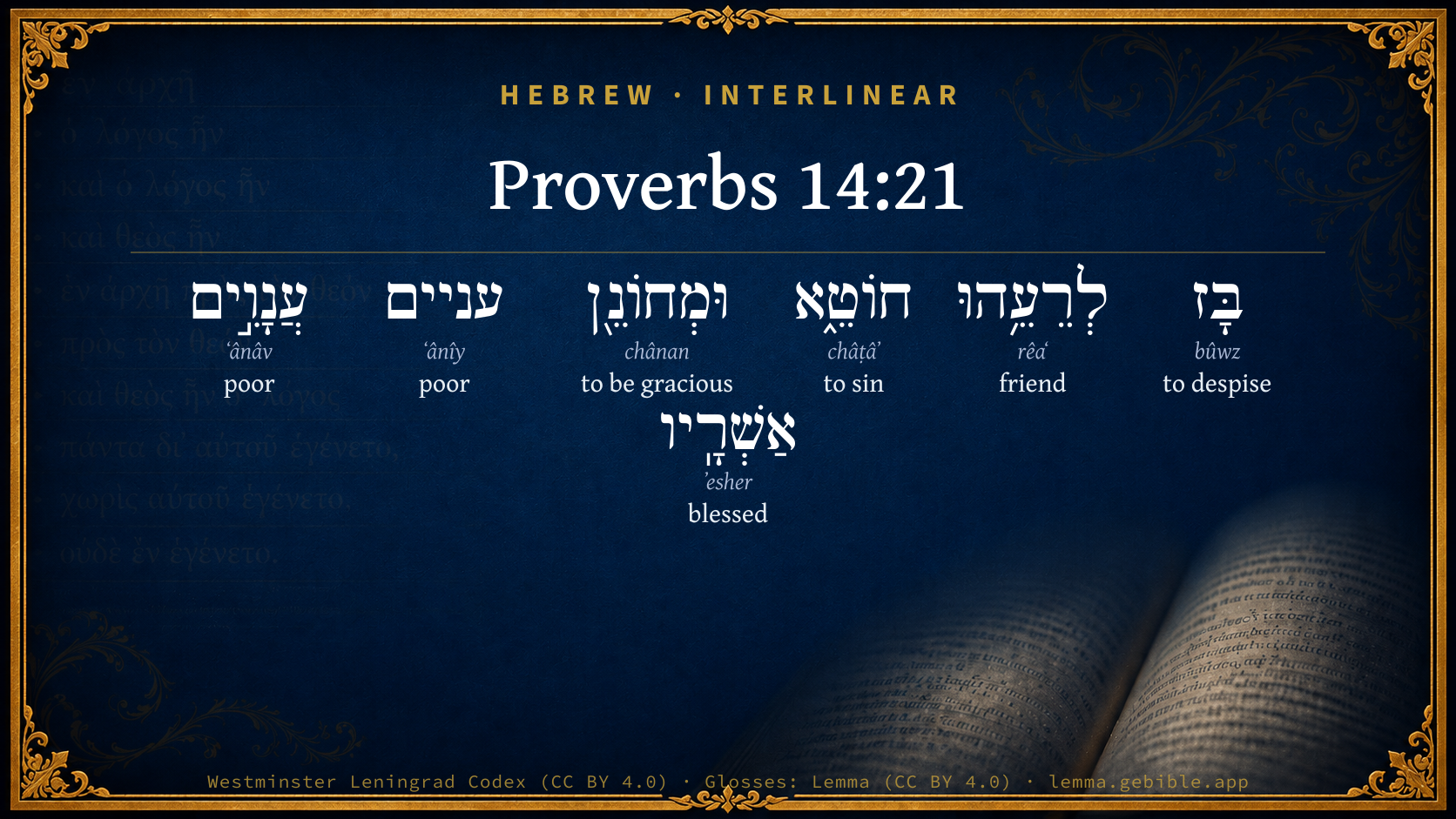
Hebrew (Westminster Leningrad Codex) Proverbs 14:21 appears in the Hebrew Old Testament. The text above is from the Westminster Leningrad Codex. Each word links to its Strong’s number, a concise gloss, and parsing drawn from the Open Scriptures Hebrew Bible morphology. Click any word for its full Brown-Driver-Briggs (BDB) entry.
Download image
Cite this verse

Proverbs 14:21 (World English Bible). Public Domain. Lemma interlinear Bible study tool, https://lemma.gebible.app/v/proverbs/14/21.

Show BibTeX & RIS
BibTeX
RIS
English Translation
He who despises his neighbor sins, But blessed is he who has pity on the poor.
World English Bible · Public Domain
Download a study sheet

One document with this verse’s original text, its word-by-word gloss line, the meaning frame, cross-references with their text, attributed commentary, and full source and license credits — printable, and it pastes into notes with its structure intact.

This verse Autodidact and up

Study sheet (.html) Plain text (.txt)

A passage Seminary Student

Up to 50 verses in one chapter. A passage sheet keeps up to 6 commentary sources and 12 cross-references per verse, in the order this page ranks them, and says so on the sheet whenever that leaves anything out. Ask for a single verse and you get the Autodidact verse sheet above.

Everything on this page stays free to read, with no account — the sheet is a download of what is already on screen, not access to it.

Want to remove ads? Support Godless Engineer
Compare translations 3

The same verse in 3 English versions, stacked beneath the original-language interlinear above. Click any original word for its lexicon entry.

Each is an independent rendering of the whole verse — the interlinear is not word-aligned to these translations.

Highlighted words mark where these versions differ — a whole-verse word diff, not a word-by-word alignment.

  • World English Bible Public Domain
    He who despises his neighbor sins, But blessed is he who has pity on the poor.
  • King James Version Public Domain
    He that despiseth his neighbour sinneth: but he that hath mercy on the poor, happy is he.
  • unfoldingWord Literal Text CC BY-SA 4.0
    The one despising his neighbor sins, but the one who shows favor to the lowly, happy he.

unfoldingWord Literal Text — © unfoldingWord, licensed CC BY-SA 4.0. Word-aligned USFM3 via Door43 (git.door43.org/unfoldingWord/en_ult).

Versions to compare (up to 4)

3 of 4 selected

Show all 18 translations

Every available English version of this verse, each an independent rendering of the whole verse.

  • World English Bible Public Domain
    He who despises his neighbor sins, But blessed is he who has pity on the poor.
  • Berean Standard Bible Public Domain
    He who despises his neighbor sins, but blessed is he who shows kindness to the poor.
  • Majority Standard Bible Public Domain
    He who despises his neighbor sins, but blessed is he who shows kindness to the poor.
  • King James Version Public Domain
    He that despiseth his neighbour sinneth: but he that hath mercy on the poor, happy is he.
  • American Standard Version (1901) Public Domain
    He that despiseth his neighbor sinneth; But he that hath pity on the poor, happy is he.
  • Revised Version (1885) Public Domain
    He that despiseth his neighbour sinneth: but he that hath pity on the poor, happy is he.
  • Geneva Bible (1599) Public Domain
    The sinner despiseth his neighbour: but he that hath mercie on the poore, is blessed.
  • Douay-Rheims (1899) Public Domain
    He that despiseth his neighbour, sinneth: but he that sheweth mercy to the poor, shall be blessed. He that believeth in the Lord, loveth mercy.
  • Young's Literal Translation Public Domain
    Whoso is despising his neighbour sinneth, Whoso is favouring the humble, O his happiness.
  • Literal Standard Version CC BY-SA 4.0
    Whoever is despising his neighbor sins, || Whoever is favoring the humble, || O his blessedness.
  • Unlocked Literal Bible CC BY-SA 4.0
    The one who shows contempt for his neighbor is sinning, but the one who shows favor to the poor is blessed.
  • unfoldingWord Literal Text CC BY-SA 4.0
    The one despising his neighbor sins, but the one who shows favor to the lowly, happy he.
  • Darby Bible Public Domain
    He that despiseth his neighbour sinneth; but he that is gracious to the afflicted, happy is he.
  • World Messianic Bible Public Domain
    He who despises his neighbor sins, but he who has pity on the poor is blessed.
  • Webster's Bible Public Domain
    He that despiseth his neighbor sinneth: but he that hath mercy on the poor, happy is he.
  • Free Bible Version CC BY-SA 4.0
    People who look down on their neighbors are sinners, but those who are kind to the poor are blessed.
  • Bible in Basic English Public Domain
    He who has no respect for his neighbour is a sinner, but he who has pity for the poor is happy.
  • JPS Tanakh (1917) Public Domain
    He that despiseth his neighbour sinneth; but he that is gracious unto the humble, happy is he.

Literal Standard Version (2020), Covenant Press — licensed CC BY-SA 4.0. Text via the HelloAO Bible API (eBible.org). Unlocked Literal Bible (unfoldingWord) — licensed CC BY-SA 4.0. Text via the HelloAO Bible API (eBible.org). unfoldingWord Literal Text — © unfoldingWord, licensed CC BY-SA 4.0. Word-aligned USFM3 via Door43 (git.door43.org/unfoldingWord/en_ult). Free Bible Version, Dr. Jonathan Gallagher — licensed CC BY-SA 4.0. Text via the HelloAO Bible API (eBible.org).

Word by word

More ways to search: Search by grammar → Find every occurrence → Compare this word →

Practice this passage: Drill this verse → Learn its vocabulary →

About this verse

These counts appear in no published source. They are computed here, from the morphology-tagged text and Lemma’s own curated glosses. What Lemma adds →

7
words
7
distinct lemmas
Wisdom
section

Notable vocabulary

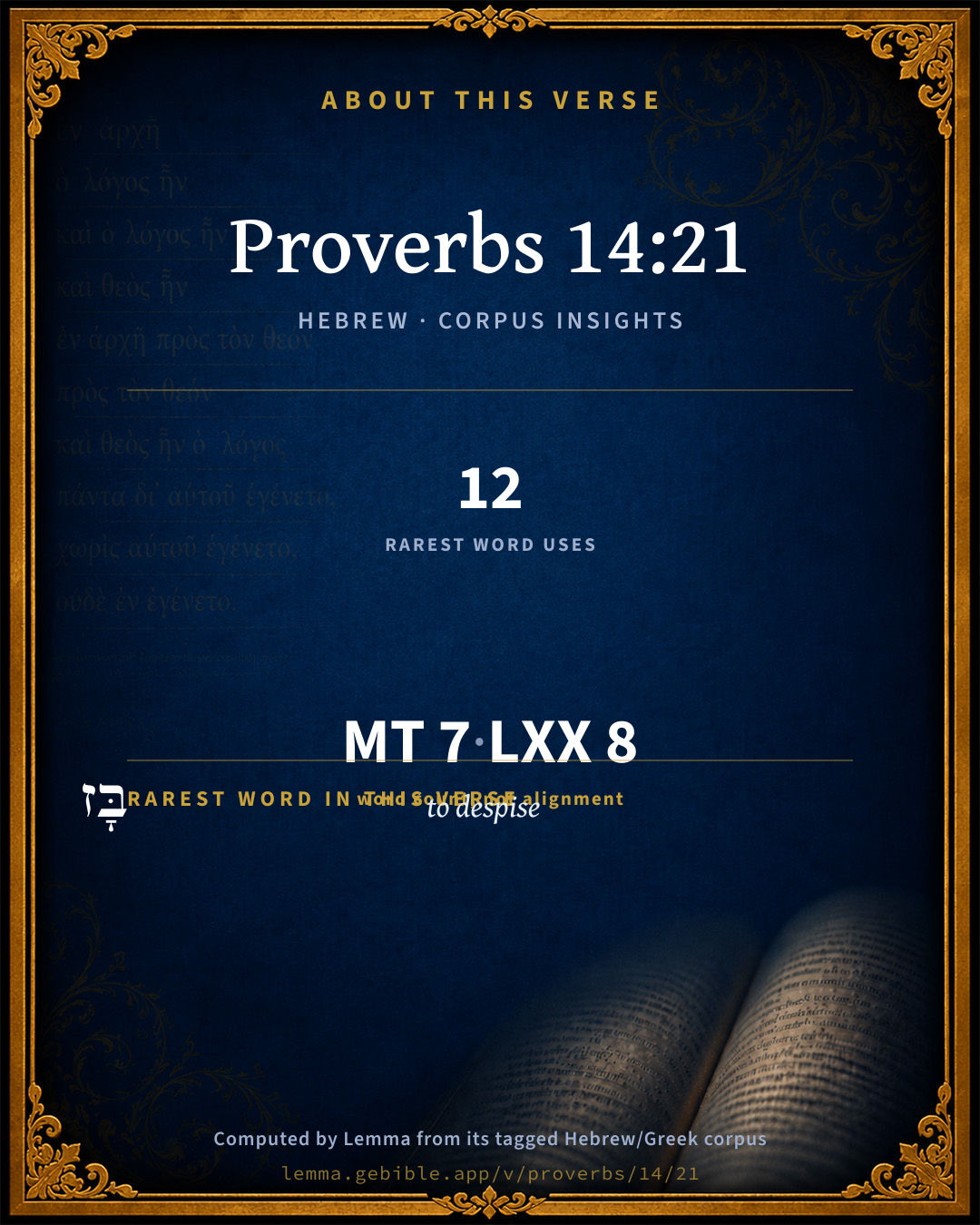
The rarest word here is בָּז to despise H936 — appearing just 12 times in the whole Hebrew Bible.

Shared distinctive vocabulary

בָּז to despise H936 occurs in 11 verses of the Hebrew Bible. Also found in:

Grammatical profile

  • 3 verbs
  • 2 nouns
  • 2 adjectives

Verb forms

  • בָּז Qal · Participle Active
  • חוֹטֵ֑א Qal · Participle Active
  • וּמְחוֹנֵ֖ן Poel · Participle Active

Hebrew & Septuagint length

In English translation the verse runs 16 words from the Hebrew and 17 from the Septuagint (LXX English) — closely comparable.

A rough comparison of the two English renderings, which tokenize alike — not a word-level alignment.

Word counts can differ between the Hebrew and the Greek without any difference in meaning — e.g. the Hebrew direct-object marker אֵת has no separate Greek word, and Greek often adds the article ὁ.

In the original languages it is 7 Hebrew tokens and 8 Greek tokens — but the two are counted differently (Hebrew bundles its prefixes and suffixes into one token; the Greek is in lemma form), so that isn’t a like-for-like length.

Cross-references

24

Topical passages linked to Proverbs 14:21 in the Treasury of Scripture Knowledge — connected by theme and wording, ordered by reader-vote popularity; previews shown in the World English Bible.

  • Proverbs 11:12 One who despises his neighbor is void of wisdom, But a man of understanding holds his peace.
  • Proverbs 19:17 He who has pity on the poor lends to Yahweh; He will reward him.
  • Proverbs 28:27 One who gives to the poor has no lack; But one who closes his eyes will have many curses.
  • Proverbs 17:5 Whoever mocks the poor reproaches his Maker. He who is glad at calamity shall not be unpunished.
  • 1 John 3:17–22 But whoever has the world's goods, and sees his brother in need, and closes his heart of compassion against him, how does the love of God remain in him?
  • Proverbs 14:31 He who oppresses the poor shows contempt for his Maker, But he who is kind to the needy honors him.
  • Proverbs 18:3 When wickedness comes, contempt also comes, And with shame comes disgrace.
  • Job 31:13–15 "If I have despised the cause of my man-servant Or of my maid-servant, When they contended with me;
  • Job 35:5–6 Look to the heavens, and see. See the skies, which are higher than you.
  • Psalms 22:24 For he has not despised nor abhorred the affliction of the afflicted, Neither has he hidden his face from him; But when he cried to him, he heard.
  • Psalms 41:1–2 Blessed is he who considers the poor: Yahweh will deliver him in the day of evil.
  • Psalms 112:5 It is well with the man who deals graciously and lends. He will maintain his cause in judgment.
  • Psalms 112:9 He has dispersed, he has given to the poor. His righteousness endures forever. His horn will be exalted with honor.
  • Proverbs 11:24–25 There is one who scatters, and increases yet more. There is one who withholds more than is appropriate, but gains poverty.
  • Ecclesiastes 11:1–2 Cast your bread on the waters; For you shall find it after many days.
  • Isaiah 58:7–12 Isn't it to deal your bread to the hungry, and that you bring the poor who are cast out to your house? when you see the naked, that you cover him; and that you not hide yourself from your own flesh?
  • Daniel 4:27 Therefore, O king, let my counsel be acceptable to you, and break off your sins by righteousness, and your iniquities by showing mercy to the poor; if there may be a lengthening of your tranquillity.
  • Matthew 25:34–46 Then the King will tell those on his right hand, 'Come, blessed of my Father, inherit the Kingdom prepared for you from the foundation of the world;
  • Acts 20:35 In all things I gave you an example, that so laboring you ought to help the weak, and to remember the words of the Lord Jesus, that he himself said, 'It is more blessed to give than to receive.'"
  • Hebrews 6:12 that you won't be sluggish, but imitators of those who through faith and patience inherited the promises.
  • James 2:5–6 Listen, my beloved brothers. Didn't God choose those who are poor in this world to be rich in faith, and heirs of the Kingdom which he promised to those who love him?
  • James 2:14–16 What good is it, my brothers, if a man says he has faith, but has no works? Can faith save him?
  • Luke 6:30–36 Give to everyone who asks you, and don't ask him who takes away your goods to give them back again.
  • Luke 18:9 He spoke also this parable to certain people who were convinced of their own righteousness, and who despised all others.

Cross-references courtesy of OpenBible.info (CC BY 4.0).

Hebrew and Greek witnesses Masoretic Hebrew ↔ Greek Septuagint

The same verse in the two great witnesses to the Old Testament, shown verse-for-verse.

These are two independent witnesses, not word-aligned to each other, and the Septuagint is shown in lemma (dictionary) form.

Hebrew Proverbs 14:21 Masoretic · Westminster Leningrad Codex

בָּז לְרֵעֵ֥הוּ חוֹטֵ֑א וּמְחוֹנֵ֖ן עניים עֲנָוִ֣ים אַשְׁרָֽיו

He who despises his neighbor sins, But blessed is he who has pity on the poor.

World English Bible · Public Domain

Greek LXX Proverbs 14:21 Septuagint · lemma form

ὁ ἀτιμάζω πένης ἁμαρτάνω ἐλεέω δέ πτωχός μακαριστός

He that dishonors the needy sins: but he that has pity on the poor is most blessed.

LXX2012 (modern English Septuagint) · Public Domain

On this verse, Keil & Delitzsch discusses the Septuagint’s reading. Read the note in Commentary ↓

Hebrew: Westminster Leningrad Codex (CC BY 4.0). Greek: Septuagint (public domain); English from LXX2012 (modern English Septuagint) (Public Domain). How the Septuagint differs from the Hebrew →

Commentary

Notes on Proverbs 14:21 from classic Christian and Jewish commentators (each source and its license shown beneath its notes). The classic Christian expositions comment on the surrounding passage and are grouped to its opening verse, so a note may address several verses; the Jewish commentaries on the Tanakh (Rashi and others) are per-verse, so they appear only where the commentator wrote on this verse.

Lemma curates 59 commentaries, every one of them public domain or Creative Commons licensed, each selected and text-cleaned for this edition rather than reprinted as found. About our sources →

Trapp's Complete Commentary

John Trapp

Pro 14:21 He that despiseth his neighbour sinneth: but he that hath mercy on the poor, happy [is] he.

Ver. 21. He that despiseth his neighbour sinneth.] His poor neighbour. Where the hedge is low the beast will easily break over. None usually are so trampled on with the feet of pride and contempt, by the great bulls of Bashan, as the necessitous and afflicted. Hence "poor" and "afflicted" are set together; {Zep 3:12} so are "to want" and "to be abased." {Php 4:11} This is a great sin, saith Solomon; it is to commit sin and to "be convinced of the law" as transgressors, saith St James. {Pro 3:9}

But he that hath mercy on the poor, happy is he.] His sins shall be remitted, his necessities relieved, and the blessings of God multiplied upon him, even a μυριομακαριστης. See my "Common Place of Alms."

John Trapp, A Commentary or Exposition upon All the Books of the Old and New Testament (1647–1656) — public domain. Text from a community e-Sword module.

The Biblical Illustrator

Joseph S. Exell

Pro_14:21

He that hath mercy on the poor, happy is he.

London poverty

The problems presented by poverty are recurrent. Wisdom as well as courage is required by those who would confront them successfully. Civilisation tends to the separation of men, but Christianity can bring them together till they constitute a true brotherhood, in which the strong shall help to bear the burdens which are crushing the weak. It is a wholesome sign that such questions as this are being more closely considered, and more boldly treated than they formerly were, especially by Christian people. If dogmatic Christianity seems weaker, practical Christianity is stronger. There is, undoubtedly, much to discourage pity when we attempt to know the condition of the poor, and to do them service for Christs sake. We meet with improvidence, drink, and imposture. We do not palliate such wickedness and folly, but would use it rather as an argument for considering the poor, for discriminating between things that differ, so that pity and generosity may flow in the right direction. Scripture lays down the principles which should guide us. Under Judaism the enactments which tended to prevent or relieve poverty are very prominent. The privileges of gleaners, the precepts which forbade the withholding of wages, and the laws against usury, are specimens. The Year of Jubilee was remarkable social institution. That year poverty was suffered to put forth its claims in Gods name, and was sure of a fair hearing. Judaism did but foreshadow the work of Jesus, who came to establish righteousness, and to proclaim brotherhood between men and between nations. He was listened to most eagerly by the poor. He was born among them, was all through His life one of them--understood their habits and feelings, was at home in their houses, and taught truth in a way that they could comprehend. We admit that we cannot reach an ideal state of society in the world so long as sin exists. But we are not to fold our hands--waiting for a coming millennium--thinking that of necessity things must be as they are. Christ our Saviour is the worlds rightful king, and He means to conquer it for Himself, through the righteousness and mercifulness of His people. Still, the law of love holds good, and if we follow our Lord, we shall go forth to seek and to save those that are lost. And they need saving--from misery, from degradation, and from despair. Consideration of the moral effects of poverty will lead us to deeper pity of the poor. A poor man has not the gracious home influence that most of us enjoy. The temptation to envy must come with tremendous power to a poor man. What can be done to alter for the better a state of things which every Christian ought to think of pitifully and prayerfully? We have something to do in forming public opinion on this question, so that anything which is within the sphere of legislation may be done. Charity also has its claims upon our thoughts and generosity. And above all, the good news of the Kingdom is needed of these our brethren. (A. Rowland, LL.B., B.A}

The Biblical Illustrator, edited by Joseph S. Exell (c. 1880s–1900s) — public domain. Text from a community e-Sword module.

Joseph Benson's Commentary

Pro 14:21. He that despiseth his neighbour — That doth not pity and relieve the poor, as this is explained in the next clause; sinneth — And therefore shall be punished for his inhumanity, which is opposed to his being happy, in the next branch; but he that hath mercy on the poor — That shows his compassion for them by his bounty to them; happy is he — He doth a worthy action, and shall be blessed in his deed.

Joseph Benson's Commentary on the Old and New Testaments (1811–1818) — public domain. Text from a community e-Sword module.

Keil & Delitzsch

C. F. Keil & F. Delitzsch

21 Whoever despiseth his neighbour committeth sin;

But whoever hath compassion on the suffering - blessings on him!

One should regard every human being, especially such as God has placed near to him, as a being having the same origin, as created in the image of God, and of the same lofty destination, and should consider himself as under obligation to love him. He who despiseth his neighbour (write בּז with Metheg, and vid., regarding the constr. with dat. object. Pro 6:30, cf. Pro 11:12; Pro 13:13) sins in this respect, that he raises himself proudly and unwarrantably above him; that the honour and love he shows to him he measures not by the rule of duty and of necessity, but according to that which is pleasing to himself; and in that he refuses to him that which according to the ordinance of God he owes him. In Pro 14:21 the Chethı̂b עניּים and the Kerı̂ ענוים (vid., at Psa 9:13) interchange in an inexplicable way; עני is the bowed down (cf. Arab. ma'nuww, particularly of the prisoner, from 'ana, fut. ya'nw, to bow, bend), ענו (Arab. 'anin, with the art. âl'niy, from the intrans. 'aniya, to be bowed down) the patient bearer who in the school of suffering has learned humility and meekness. One does not see why the Kerı̂ here exchanges that passive idea for this ethical one, especially since, in proving himself to be מחונן (compassionate) (for which elsewhere the part. Kal חונן, Pro 14:31; Pro 19:17; Pro 28:8), one must be determined only by the needy condition of his neighbour, and not by his (the neighbour's) moral worthiness, the want of which ought to make him twofold more an object of our compassion. All the old translators, from the lxx to the Venet. and Luther, on this account adopt the Chethı̂b.

Keil & Delitzsch — Biblical Commentary on the Old Testament (1861–1891) — public domain (CC PDM 1.0). Text via the HelloAO Bible API. (Old Testament only.)

Tyndale Open Study Notes

Tyndale Open Resources

14:21 blessed are those who help the poor: See also 3:27-28; 11:24; 28:27; 29:7, 14.

Tyndale Open Study Notes — © Tyndale Open Resources, licensed CC BY-SA 4.0. Text via the HelloAO Bible API.

Matthew Henry's Commentary

See here how men's character and condition are measured and judged of by their conduct towards their poor neighbours. 1. Those that look upon them with contempt have here assigned them a bad character, and their condition will be accordingly: He that despises his neighbour because he is low in the world, because he is of a mean extraction, rustic education, and makes but a mean figure, that thinks it below him to take notice of him, converse with him, or concern himself about him, and sets him with the dogs of his flock, is a sinner, is guilty of a sin, is in the way to worse, and shall be dealt with as a sinner; unhappy is he. 2. Those that look upon them with compassion are here said to be in a good condition, according to their character: He that has mercy on the poor, is ready to do all the good offices he can to him, and thereby puts an honour upon him, happy is he; he does that which is pleasing to God, which he himself will afterwards reflect upon with great satisfaction, for which the loins of the poor will bless him, and which will be abundantly recompensed in the resurrection of the just.

Matthew Henry's Commentary on the Whole Bible (1708–1710) — public domain (CC PDM 1.0). Text via the HelloAO Bible API.

Jamieson, Fausset & Brown

Robert Jamieson, A. R. Fausset & David Brown

For such contempt of the poor is contrasted as sinful with the virtuous compassion of the good.

Jamieson, Fausset & Brown — Commentary Critical and Explanatory on the Whole Bible (1871) — public domain (CC PDM 1.0). Text via the HelloAO Bible API.

Adam Clarke's Commentary

Verse 21. He that despiseth his neighbor sinneth] To despise a man because he has some natural blemish is unjust, cruel, and wicked. He is not the author of his own imperfections; they did not occur through his fault or folly; and if he could, he would not retain them. It is, therefore, unjust and wicked to despise him for what is not his fault, but his misfortune.

But he that hath mercy on the poor] Who reproaches no man for his poverty or scanty intellect, but divides his bread with the hungry-happy is he; the blessing of God, and of them that were ready to perish, shall come upon him.

Adam Clarke's Commentary on the Bible (1810–1826) — public domain. Text from a community e-Sword/MySword module.

John Gill's Exposition

He that despiseth his neighbour sinneth,.... He that despiseth his neighbour in his heart, speaks slightly of him, overlooks him, is not friendly to him, will neither converse with him, nor relieve him in his necessity; for it seems to be understood of his poor neighbour; and so the Septuagint and Arabic versions render it, "he that despiseth the poor"; that despises him for his poverty; because of his pedigree and education, and the low circumstances he is in; or on account of his weakness and incapacity, or any outward circumstance that attends him; such an one sins very greatly, is guilty of a heinous sin; and he will be reckoned and dealt with as a sinner, and be condemned and punished, and so be unhappy and miserable;

but he that hath mercy on the poor, happy is he; or,

"that gives to the poor,''

as the Targum; who has compassion on him in his distress, and shows it by relieving him: he that shows favour to the meek and humble ones, as the word (s) may be rendered, and as they generally are that are in affliction and poverty, for these tend to humble men; and such who regard them in their low estate are "happy" or blessed; they are blessed in things temporal and spiritual, and both here and hereafter; see Psa 41:1.

(s) "modestorum", Montanus, Mercerus; "mansuetos", Cocceius.

John Gill's Exposition of the Whole Bible (1746–1763) — public domain (CC PDM 1.0). Text via the HelloAO Bible API.

Haydock's Catholic Bible Commentary

He....mercy, is not found in Hebrew, Greek, or Latin manuscripts. (Calmet)

George Leo Haydock (1774–1849), Haydock's Catholic Family Bible and Commentary, 1859 edition — public domain. Excludes Psalms (Douay-Rheims chapter numbering differs from Protestant) and Deuterocanonical books (Catholic canon only).

Matthew Poole's English Annotations

That despiseth his neighbour; that doth not pity and relieve the poor, as this is explained in the next clause; the word neighbour being here generally taken for any man, as it is most commonly used in Scripture; which not relieving him proceeds from a contempt of his person.

Sinneth; and therefore shall be punished for his inhumanity, which is opposed to his being happy in the next clause.

That hath mercy; that showeth his compassion by his bounty and relief.

Happy is he; he doth a worthy action, and shall be blessed in his deed.

Matthew Poole's English Annotations on the Holy Bible (1683–1685) — public domain. Text from a community e-Sword/MySword module.

Whedon's Commentary on the Bible

Daniel D. Whedon

21. Sinneth — Misses, blunders. Although one proverb frequently seems to have no relation either to a preceding or a succeeding one, yet in this case the conclusion can hardly be resisted that this proverb was intended to be the sequel to the preceding one. The 20th verse states the fact; the 21st verse, the moral character of the fact.

Daniel D. Whedon (gen. ed.), Commentary on the Old and New Testaments (1874–1909) — public domain. Text from a community e-Sword module.

The Pulpit Commentary

He that despiseth his neighbour sinneth. Taken in connection with the preceding verse, this teaches that it is a sin to despise and shun a man because he is poor or of low estate; such a one has a claim for love and pity, and it is a crime to withhold them from him for selfish considerations. The Christian view is taught by the parable of the good Samaritan. But he that hath mercy on the poor, happy is he; hail to him! (Pro_16:20) Contempt is contrasted with mercy, sin with blessing. "Blessed are the merciful," said Christ: (Mat_5:7) "for they shall obtain mercy;" and St. Paul preserves another precious word, "It is mere blessed to give than to receive". (Act_20:35) The merciful disposition, which shows itself in works of mercy, is a proof that the soul is in union with God, whose mercy is over all his works, whose mercy endureth forever, and therefore such a soul is blessed. "The poor," wrote James Howell, "are God"s receivers, and the angels are his auditors" ("Five Hundred New Sayings"). The Vulgate here appends a line absent from the Hebrew and the ether versions, "He who believeth in the Lord loveth mercy." The true believer is charitable and bountiful, knowing that he will not hereby impoverish himself, but lay up a rich store of blessing; he acts thus not from mere philanthropy, but from higher motives: he has the grace of charity which springs from and rests upon his faith in God.

The sin of contempt.

We are in danger of despising our neighbours. The rich despise the poor, the learned despise the ignorant, the strong and healthy despise the weak and ailing, the devout despise the irreverent. But we are wrong in doing this. There is, indeed, one thing which may draw down a strong and even intense reprobation moral baseness, meanness, a cruel and heartless selfishness, or a slavish abandonment to vice. But even there we may not wholly despise our neighbour; unmitigated contempt is always wrong, always a mistake. For

I WE ARE ALL THE CHILDREN OF GOD. Are we not all his offspring, the creatures of one Creator, the children of one Father? Does it become us to despise our own brethren, our own sisters? Inasmuch as we are "members one of another," of one family, we are bound to let another feeling than that of contempt take the deepest place in our heart when we think of men and women, whoever they may be, whatever they may have been.

II SELF-GLORIFICATION IS EXCLUDED. What makes us to differ from others? Whence came our superiority in wealth, in knowledge, in strength, in virtue? Did it not come, ultimately, from God? Trace things to their source, and we find that all "boasting is excluded." It is by the favour and the grace of God that we are who and what we are. Not a haughty contemptuousness, but a humble thankfulness, becomes us, if we stand higher than our neighbour.

III NO MAN IS WHOLLY DESPICABLE. He may have some things about his character which we deplore and which we condemn, on account of which we do well to remonstrate with him and to make him feel that we have withdrawn our regard and confidence. But no man is wholly to be despised.

1. Much of what is bad or sad about him may be the consequence of misfortune. What did he inherit? Who were his earliest counsellors? What were his adverse influences? Against what hurtful and damaging forces has he had to contend? How few and how weak have been his privileges? how many his privations?

2. There is the germ of goodness in him. There is no man, even among the most depraved, who has not in him that on which wisdom and love may lay their merciful hold, and by which the man himself may be redeemed. Many marvellous and most cheering facts prove that the worst among the bad may be recovered the most profane, besotted, impure, dishonest. The Christian thought and faith is that all men are within the reach both of the mercy and the redeeming love of God. Let Divine truth be spoken to them as it may be spoken; let Divine and human love embrace them and lay its fatherly or brotherly hand upon them; let the Divine Spirit breathe upon them, and from the lowest depths of guilt and shame they may rise to noble heights of purity and honour. C.

The Pulpit Commentary (1880–1919), ed. H.D.M. Spence-Jones & Joseph S. Exell — public domain. Text from a community e-Sword module.

John Wesley's Explanatory Notes

Despiseth - That does not pity and relieve the poor.

John Wesley, Explanatory Notes Upon the Whole Bible (1754–1765) — public domain. Text via the GEBible commentary corpus.

Bridges on Proverbs

Charles Bridges

The last proverb shewed the general standard of selfishness. Here we see its positive sinfulness. Some men are so high, that they cannot see their lower brother. Yet infinitely precious and honoured may be this despised one in the Savior’s eyes as the purchase of his blood. And what a span is the distance between him and his most elevated fellow-creature, compared with the infinite space between him and his God! Yet doth he "that dwelleth on high," instead of despising, write his name upon him, "raise him from the dust, and lift him out of the dunghill, that he may set him with the princes of his people." (Psa 113:7-8 .) The plain command is — "Honour all men" (1Pe 2:17 ), not all with equal measure; but in all honour our own nature, the remains, however defaced, of the image of God. To look therefore upon the meanest, as if he were made to be despised, shews a want of wisdom, and a want of heart. (Pro 11:12 .) ’Because we think we over-top him, therefore to think we may overlook him,’†1 and neglect to have mercy on him (Pro 21:13 . Jas 2:16 ) — this is reflecting on God’s own Providence (Pro 14:31 ); forgetting his example (2Co 8:9 ); setting up our own judgment against his; sinning against his law of love. (Jas 2:1-9 .) And most fearfully will he visit this sin at the day of recompense. (Job 31:13-15 . Mat 25:42-45 .)

But oh! the felicities of him that hath mercy on the poor;†2 "hoping for nothing again" (Luk 6:35 ); constrained by love to Christ and his fellow-sinners! ’He shall be happy beyond expression.’†3 Does not every exercise of love enlarge our own happiness? (Pro 11:17 .) Do we not ourselves richly feed on the bread, with which we "feed the hungry?" (Isa 58:7 .) And will not the great day declare and honour every act of love for our Divine Master? (Mat 25:35-40 .)

Footnotes:

†1 Bishop Sanderson on Rom 14:3 .

†2 Compare Psa 41:3 ; Psa 112:9 . Jer 22:16 . Dan 4:27 . Mat 5:7 .

†3 Scott. ’At qui miseretur inopum, O beatitudines illius!’ — Schultens. Holden also marks the peculiar emphasis of this pronoun.

Charles Bridges, An Exposition of the Book of Proverbs (1846) — public domain. Text from a community e-Sword module.

Kretzmann's Popular Commentary

Paul E. Kretzmann

v. 21. He that despiseth his neighbor sinneth, that is, he who neglects a friend to whom he owes love, especially if he is in need; but he that hath mercy on the poor, showing true compassion to the poor and wretched, happy is he, since he himself may expect benefit from his act.

Paul E. Kretzmann, Popular Commentary of the Bible (1921–1924) — public domain. Text from a community e-Sword module.

unfoldingWord translationNotes

Door43 World Missions Community

The one ... the one

"The person ... the person"

the poor

"poor people"

Do not those who plot evil go astray?

The assumed answer to this question is "yes." AT: "Those who plot evil will go astray." (See: Rhetorical Question)

who plot evil

"who make evil plans" or "who make plans to do evil things"

those who plan to do good will receive covenant faithfulness and trustworthiness

The abstract nouns "faithfulness" and "trustworthiness" can be stated as "faithful" and "trustworthy." AT: "God will show himself to be trustworthy and faithful to his covenant to those who plan to do what is good" (See: Abstract Nouns)

translationWords

contempt

neighbor

sin

favor

evil

astray

covenant faithfulness

trust

unfoldingWord translationNotes — © Distant Shores Media and the Door43 World Missions Community, licensed CC BY-SA 4.0. Source: git.door43.org/Door43/en_tn.

Lesson kit

Teaching starters — assembled from the data on this page, not authored interpretation. Every prompt links to the verse data it draws on. Edit before teaching.

Proverbs, in the Wisdom, opens this verse with 7 words (7 distinct Hebrew lemmas). Its most distinctive word is bûwz (“to despise”). A historical commentator’s framing appears above. Read the whole chapter for the surrounding context.

Discussion questions

  1. What does “to despise” (bûwz) contribute to the verse as a whole?
  2. How does Proverbs 1:7, which shares the word «to despise», read alongside this verse?
  3. The translations on this page render this verse differently — a whole-verse word diff, not a word-by-word alignment. What might account for the different wordings?
  4. «בָּז» is a Qal Participle Active verb. How does that grammatical form shape the action described?
  5. Compare how Trapp's Complete Commentary and The Biblical Illustrator read this verse. Where do they agree or differ?

Things to notice

Reading settings

Reading text

Shown beneath each verse's original-language words.

Old Testament
Old Testament edition

Read the OT as the Masoretic Hebrew (MT) or the Greek Septuagint (LXX).

English shown for the Greek Septuagint (in the Hebrew ↔ Greek comparison).

Comparing translations? Open the Compare panel on any verse page to stack up to four side by side.