
Numbers 6:11

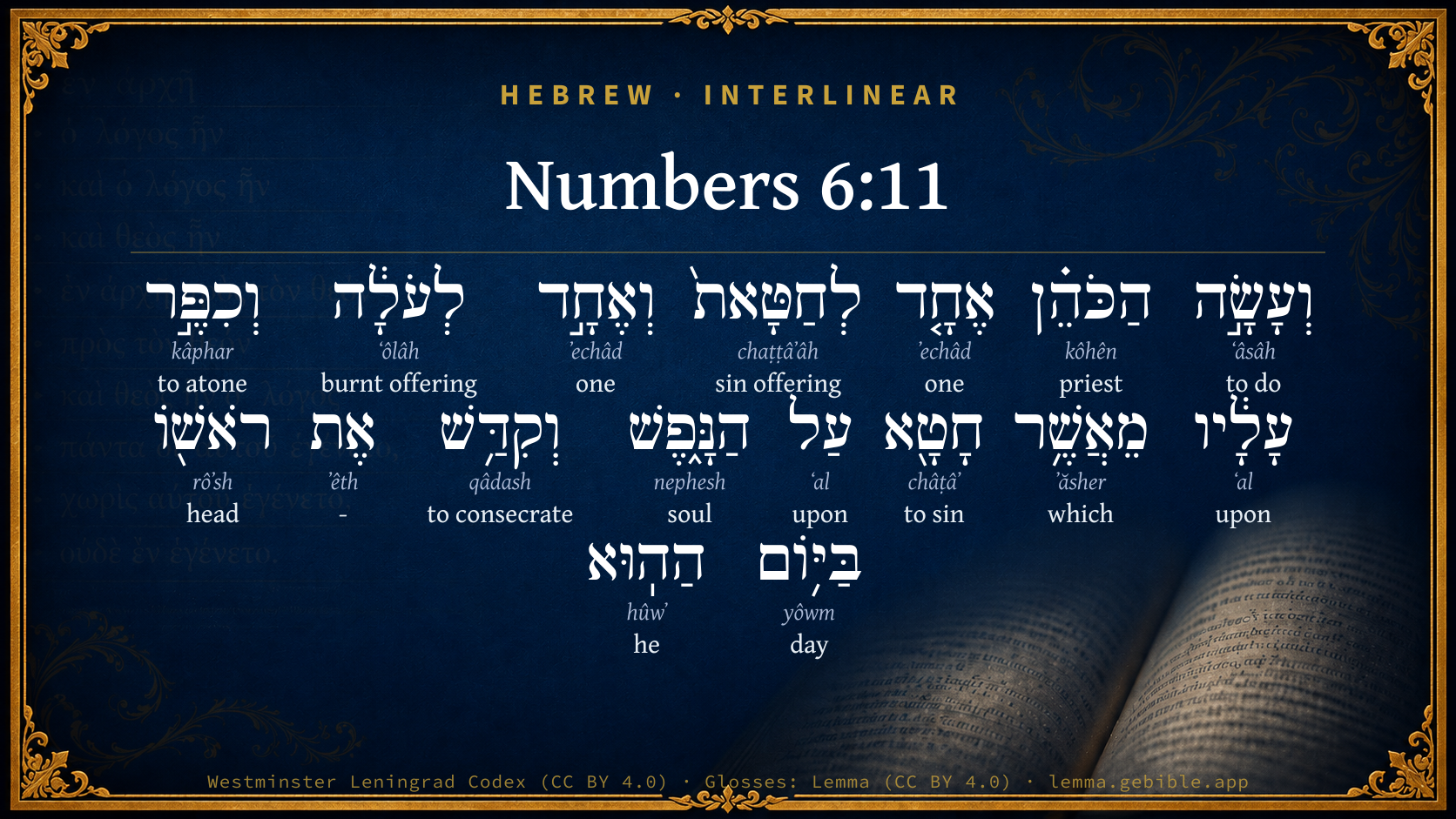
Hebrew (Westminster Leningrad Codex) Numbers 6:11 appears in the Hebrew Old Testament. The text above is from the Westminster Leningrad Codex. Each word links to its Strong’s number, a concise gloss, and parsing drawn from the Open Scriptures Hebrew Bible morphology. Click any word for its full Brown-Driver-Briggs (BDB) entry.
Download image
Cite this verse

Numbers 6:11 (World English Bible). Public Domain. Lemma interlinear Bible study tool, https://lemma.gebible.app/v/numbers/6/11.

Show BibTeX & RIS
BibTeX
RIS
English Translation
The priest shall offer one for a sin offering, and the other for a burnt offering, and make atonement for him, because he sinned by reason of the dead, and shall make his head holy that same day.
World English Bible · Public Domain
Download a study sheet

One document with this verse’s original text, its word-by-word gloss line, the meaning frame, cross-references with their text, attributed commentary, and full source and license credits — printable, and it pastes into notes with its structure intact.

This verse Autodidact and up

Study sheet (.html) Plain text (.txt)

A passage Seminary Student

Up to 50 verses in one chapter. A passage sheet keeps up to 6 commentary sources and 12 cross-references per verse, in the order this page ranks them, and says so on the sheet whenever that leaves anything out. Ask for a single verse and you get the Autodidact verse sheet above.

Everything on this page stays free to read, with no account — the sheet is a download of what is already on screen, not access to it.

Want to remove ads? Support Godless Engineer
Compare translations 3

The same verse in 3 English versions, stacked beneath the original-language interlinear above. Click any original word for its lexicon entry.

Each is an independent rendering of the whole verse — the interlinear is not word-aligned to these translations.

Highlighted words mark where these versions differ — a whole-verse word diff, not a word-by-word alignment.

  • World English Bible Public Domain
    The priest shall offer one for a sin offering, and the other for a burnt offering, and make atonement for him, because he sinned by reason of the dead, and shall make his head holy that same day.
  • King James Version Public Domain
    And the priest shall offer the one for a sin offering, and the other for a burnt offering, and make an atonement for him, for that he sinned by the dead, and shall hallow his head that same day.
  • unfoldingWord Literal Text CC BY-SA 4.0
    And the priest shall make one for a sin offering and one for a burnt offering, and he shall make atonement for him from what he sinned upon the person. And he shall consecrate his head on that day.

unfoldingWord Literal Text — © unfoldingWord, licensed CC BY-SA 4.0. Word-aligned USFM3 via Door43 (git.door43.org/unfoldingWord/en_ult).

Versions to compare (up to 4)

3 of 4 selected

Show all 18 translations

Every available English version of this verse, each an independent rendering of the whole verse.

  • World English Bible Public Domain
    The priest shall offer one for a sin offering, and the other for a burnt offering, and make atonement for him, because he sinned by reason of the dead, and shall make his head holy that same day.
  • Berean Standard Bible Public Domain
    And the priest is to offer one as a sin offering and the other as a burnt offering to make atonement for him, because he has sinned by being in the presence of the dead body. On that day he must consecrate his head again.
  • Majority Standard Bible Public Domain
    And the priest is to offer one as a sin offering and the other as a burnt offering to make atonement for him, because he has sinned by being in the presence of the dead body. On that day he must consecrate his head again.
  • King James Version Public Domain
    And the priest shall offer the one for a sin offering, and the other for a burnt offering, and make an atonement for him, for that he sinned by the dead, and shall hallow his head that same day.
  • American Standard Version (1901) Public Domain
    and the priest shall offer one for a sin-offering, and the other for a burnt-offering, and make atonement for him, for that he sinned by reason of the dead, and shall hallow his head that same day.
  • Revised Version (1885) Public Domain
    and the priest shall offer one for a sin offering, and the other for a burnt offering, and make atonement for him, for that he sinned by reason of the dead, and shall hallow his head that same day.
  • Geneva Bible (1599) Public Domain
    Then the Priest shall prepare the one for a sinne offering, and the other for a burnt offering, and shall make an atonement for him, because he sinned by the dead: so shall he halowe his head the same day,
  • Douay-Rheims (1899) Public Domain
    And the priest shall offer one for sin, and the other for a holocaust, and shall pray for him, for that he hath sinned by the dead: and he shall sanctify his head that day:
  • Young's Literal Translation Public Domain
    and the priest hath prepared one for a sin-offering, and one for a burnt-offering, and hath made atonement for him, because of that which he hath sinned by the body, and he hath hallowed his head on that day;
  • Literal Standard Version CC BY-SA 4.0
    and the priest has prepared one for a sin-offering and one for a burnt-offering, and has made atonement for him because of that which he has sinned by the body, and he has hallowed his head on that day;
  • Unlocked Literal Bible CC BY-SA 4.0
    The priest must offer one bird as a sin offering and the other as a burnt offering. These will atone for him because he sinned by being near the dead body. He must consecrate his head again on that day.
  • unfoldingWord Literal Text CC BY-SA 4.0
    And the priest shall make one for a sin offering and one for a burnt offering, and he shall make atonement for him from what he sinned upon the person. And he shall consecrate his head on that day.
  • Darby Bible Public Domain
    And the priest shall offer one for a sin-offering, and the other for a burnt-offering, and make an atonement for him, for that he sinned by the dead person; and he shall hallow his head that same day.
  • World Messianic Bible Public Domain
    The priest shall offer one for a sin offering, and the other for a burnt offering, and make atonement for him, because he sinned by reason of the dead, and shall make his head holy that same day.
  • Webster's Bible Public Domain
    And the priest shall offer the one for a sin-offering, and the other for a burnt-offering, and make an atonement for him, for that he sinned by the dead, and shall hallow his head that same day.
  • Free Bible Version CC BY-SA 4.0
    The priest will offer one as a sin offering and the other as a burnt offering to make them right, because they became guilty by being near the dead body. On that day they must re-dedicate themselves and let their hair grow again.
  • Bible in Basic English Public Domain
    And the priest will give one for a sin-offering and the other for a burned offering to take away the sin which came on him on account of the dead, and he will make his head holy that same day.
  • JPS Tanakh (1917) Public Domain
    And the priest shall prepare one for a sin-offering, and the other for a burnt-offering, and make atonement for him, for that he sinned by reason of the dead; and he shall hallow his head that same day.

Literal Standard Version (2020), Covenant Press — licensed CC BY-SA 4.0. Text via the HelloAO Bible API (eBible.org). Unlocked Literal Bible (unfoldingWord) — licensed CC BY-SA 4.0. Text via the HelloAO Bible API (eBible.org). unfoldingWord Literal Text — © unfoldingWord, licensed CC BY-SA 4.0. Word-aligned USFM3 via Door43 (git.door43.org/unfoldingWord/en_ult). Free Bible Version, Dr. Jonathan Gallagher — licensed CC BY-SA 4.0. Text via the HelloAO Bible API (eBible.org).

Word by word

More ways to search: Search by grammar → Find every occurrence → Compare this word →

Practice this passage: Drill this verse → Learn its vocabulary →

וְכִפֶּ֣ר
kâphar
H3722
“and · to atone”
Conjunction + Verb, Piel, Sequential Perfect, 3rd Person, Masculine, Singular
Part of Speech
Conjunction + Verb
Stem
Piel
Form
Sequential Perfect
Person
3rd Person
Gender
Masculine
Number
Singular
Full BDB Definition

Origin: a primitive root

TWOT: 1023 , 1024 , 1025 , 1026

to cover, purge, make an atonement, make reconciliation, cover over with pitch - (Qal) to coat or cover with pitch - (Piel) - to cover over, pacify, propitiate - to cover over, atone for sin, make atonement for - to cover over, atone for sin and persons by legal rites - (Pual) - to be covered over - to make atonement for - (Hithpael) to be covered
  1. וְעָשָׂ֣ה ʻâsâh H6213 “and · to do” Conjunction + Verb, Qal, Sequential Perfect, 3rd Person, Masculine, Singular
  2. הַכֹּהֵ֗ן kôhên H3548 “the · priest” Particle, Definite Article + Noun, Common, Masculine, Singular, Absolute
  3. אֶחָ֤ד ʼechâd H259 “one” Adjective, Cardinal number, Masculine, Singular, Absolute
  4. לְחַטָּאת֙ chaṭṭâʼâh H2403 “to/for · sin offering” Preposition + Noun, Common, Feminine, Singular, Absolute
  5. וְאֶחָ֣ד ʼechâd H259 “and · one” Conjunction + Adjective, Cardinal number, Masculine, Singular, Absolute
  6. לְעֹלָ֔ה ʻôlâh H5930 “to/for · burnt offering” Preposition + Noun, Common, Feminine, Singular, Absolute
  7. עָלָ֔יו ʻal H5921 “upon · him” Preposition + Suffix, Personal, 3rd Person, Masculine, Singular
  8. מֵאֲשֶׁ֥ר ʼăsher H834 “from · which” Preposition + Particle, Relative
  9. חָטָ֖א châṭâʼ H2398 “to sin” Verb, Qal, Perfect, 3rd Person, Masculine, Singular
  10. עַל ʻal H5921 “upon” Preposition
  11. הַנָּ֑פֶשׁ nephesh H5315 “the · soul” Particle, Definite Article + Noun, Common, Both, Singular, Absolute
  12. וְקִדַּ֥שׁ qâdash H6942 “and · to consecrate” Conjunction + Verb, Piel, Sequential Perfect, 3rd Person, Masculine, Singular
  13. אֶת ʼêth H853 “-” Particle, Direct Object
  14. רֹאשׁ֖וֹ rôʼsh H7218 “head · his” Noun, Common, Masculine, Singular, Construct + Suffix, Personal, 3rd Person, Masculine, Singular
  15. בַּיּ֥וֹם yôwm H3117 “in/at the · day” Preposition, Determined + Noun, Common, Masculine, Singular, Absolute
  16. הַהֽוּא hûwʼ H1931 “the · he” Particle, Definite Article + Pronoun, Personal, 3rd Person, Masculine, Singular

About this verse

These counts appear in no published source. They are computed here, from the morphology-tagged text and Lemma’s own curated glosses. What Lemma adds →

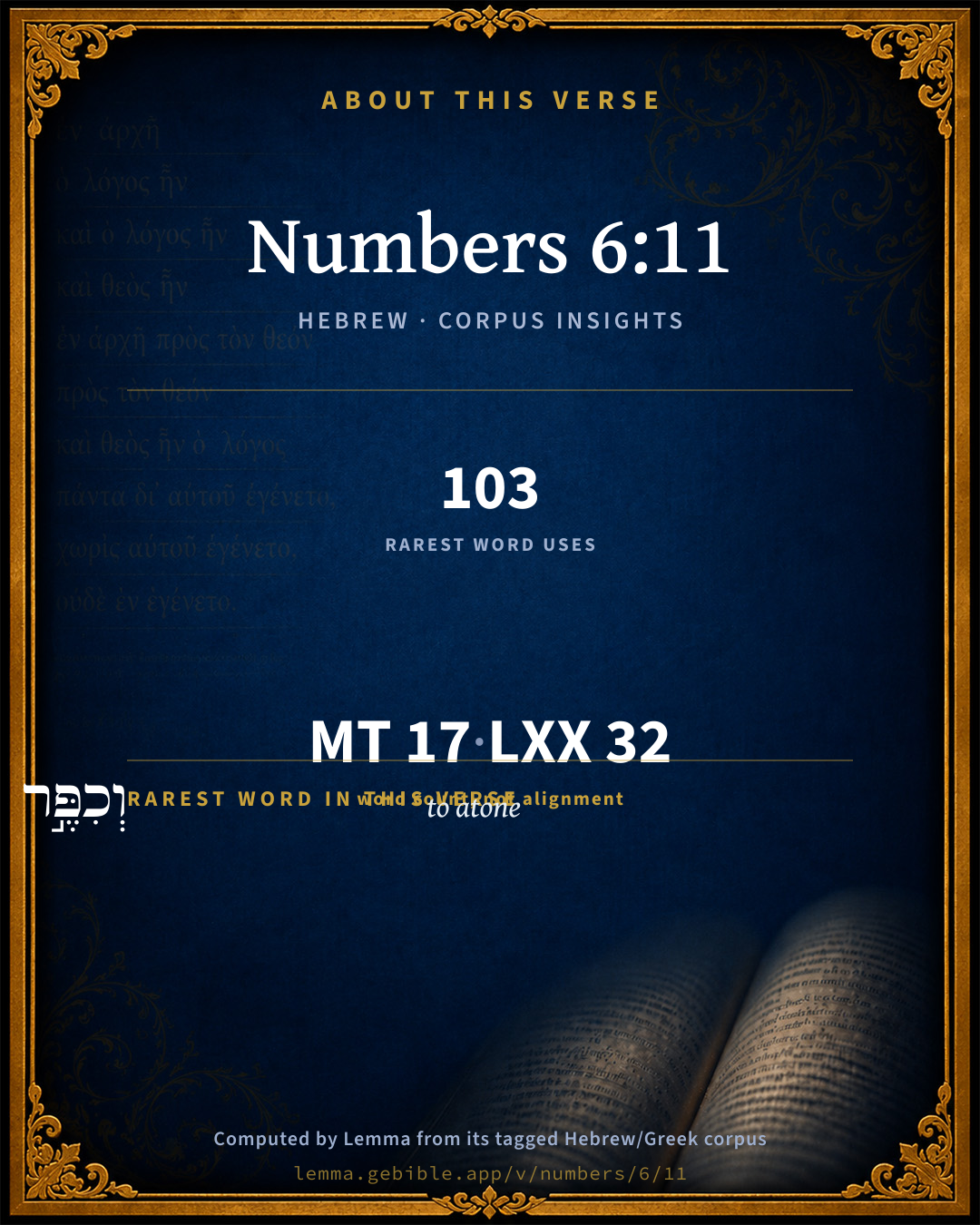
17
words
15
distinct lemmas
Pentateuch
section

Grammatical profile

  • 4 verbs
  • 6 nouns
  • 2 adjectives
  • 1 pronoun
  • 2 prepositions
  • 2 particles

Verb forms

  • וְעָשָׂ֣ה Qal · Sequential Perfect
  • וְכִפֶּ֣ר Piel · Sequential Perfect
  • חָטָ֖א Qal · Perfect
  • וְקִדַּ֥שׁ Piel · Sequential Perfect

Repetition

Words recur within this verse — often emphatic in Hebrew:

  • אֶחָ֤ד one H259 ×2
  • עָלָ֔יו upon H5921 ×2

Hebrew & Septuagint length

In English translation the verse runs 38 words from the Hebrew and 44 from the Septuagint (LXX English) — closely comparable.

A rough comparison of the two English renderings, which tokenize alike — not a word-level alignment.

Word counts can differ between the Hebrew and the Greek without any difference in meaning — e.g. the Hebrew direct-object marker אֵת has no separate Greek word, and Greek often adds the article ὁ.

In the original languages it is 17 Hebrew tokens and 32 Greek tokens — but the two are counted differently (Hebrew bundles its prefixes and suffixes into one token; the Greek is in lemma form), so that isn’t a like-for-like length.

Cross-references

2

Topical passages linked to Numbers 6:11 in the Treasury of Scripture Knowledge — connected by theme and wording, ordered by reader-vote popularity; previews shown in the World English Bible.

  • Leviticus 5:8–10 He shall bring them to the priest, who shall first offer the one which is for the sin offering, and wring off its head from its neck, but shall not sever it completely.
  • Leviticus 14:30–31 He shall offer one of the turtledoves, or of the young pigeons, such as he is able to afford,

Cross-references courtesy of OpenBible.info (CC BY 4.0).

Hebrew and Greek witnesses Masoretic Hebrew ↔ Greek Septuagint

The same verse in the two great witnesses to the Old Testament, shown verse-for-verse.

These are two independent witnesses, not word-aligned to each other, and the Septuagint is shown in lemma (dictionary) form.

Hebrew Numbers 6:11 Masoretic · Westminster Leningrad Codex

וְעָשָׂ֣ה הַכֹּהֵ֗ן אֶחָ֤ד לְחַטָּאת֙ וְאֶחָ֣ד לְעֹלָ֔ה וְכִפֶּ֣ר עָלָ֔יו מֵאֲשֶׁ֥ר חָטָ֖א עַל הַנָּ֑פֶשׁ וְקִדַּ֥שׁ אֶת רֹאשׁ֖וֹ בַּיּ֥וֹם הַהֽוּא

The priest shall offer one for a sin offering, and the other for a burnt offering, and make atonement for him, because he sinned by reason of the dead, and shall make his head holy that same day.

World English Bible · Public Domain

Greek LXX Numbers 6:11 Septuagint · lemma form

καί ποιέω ὁ ἱερεύς εἷς περί ἁμαρτία καί εἷς εἰς ὁλοκαύτωμα καί ἐκἱλάσκομαι περί αὐτός ὁ ἱερεύς περί ὅς ἁμαρτάνω περί ὁ ψυχή καί ἁγιάζω ὁ κεφαλή αὐτός ἐν ἐκεῖνος ὁ ἡμέρα

And the priest shall offer one for a sin-offering; and the other for a whole burnt offering; and the priest shall make atonement for him in the things wherein he sinned respecting the dead body, and he shall sanctify his head in that day,

LXX2012 (modern English Septuagint) · Public Domain

On this verse, The Pulpit Commentary discusses the Septuagint’s reading. Read the note in Commentary ↓

Hebrew: Westminster Leningrad Codex (CC BY 4.0). Greek: Septuagint (public domain); English from LXX2012 (modern English Septuagint) (Public Domain). How the Septuagint differs from the Hebrew →

Targum (Aramaic paraphrase)

2

The Targum is the ancient Jewish Aramaic paraphrase of the Hebrew Scriptures — an interpretive translation, not the Hebrew text itself. Onkelos (literal) and Pseudo-Jonathan (expansive) render the Torah, and Jonathan the Prophets. Coverage is partial: where no permissively-licensed English translation exists for a verse, only the Aramaic is shown. This is verse-level text, not a word-by-word alignment to the Hebrew.

  1. Targum Onkelos Torah (Genesis–Deuteronomy)
    וְיַעְבֵּד כַּהֲנָא חַד לְחַטָאתָא וְחַד לַעֲלָתָא וִיכַפֵּר עֲלוֹהִי מִדְחָב עַל מִתָא וִיקַדַשׁ יָת רֵישֵׁהּ בְּיוֹמָא הַּהוּא

    (no public-domain English translation for this verse)

    Targum Onkelos — Aramaic: “Onkelos Genesis” (public domain); “Onkelos Exodus” (public domain); “Onkelos Leviticus” (public domain); “Onkelos Numbers” (public domain); “Onkelos Deuteronomy” (public domain). English: “Sefaria Community Translation” (CC0 1.0 (public-domain dedication)); “J.W. Etheridge. The Targums of Onkelos and Jonathan Ben Uzziel on the Pentateuch. London: Longmans, Green, 1862” (public domain). Text via Sefaria.

  2. Targum Pseudo-Jonathan Torah (Genesis–Deuteronomy)
    וְיַעֲבֵד כַּהֲנָא חַד חַטָאתָא וְחַד לַעֲלָתָא וִיכַפֵּר עֲלוֹי מַאן דְחַב עַל דְאִסְתָּאַב לְמִיתָא וִיקַדֵשׁ יַת רֵישֵׁיהּ בְּיוֹמָא הַהוּא

    And the priest shall make one a sin offering, and one a burnt offering, and atone for him on account of that in which he hath sinned, in defiling himself by the dead: and he shall consecrate his head on that day.

    Targum Pseudo-Jonathan — Aramaic: “Targum Jonathan on Genesis” (public domain); “Targum Jonathan on Exodus” (public domain); “Targum Jonathan on Leviticus” (public domain); “Targum Jonathan on Numbers” (public domain); “Targum Jonathan on Deuteronomy” (public domain). English: “The Targum of Jonathan ben Uzziel, trans. J. W. Etheridge, London, 1862” (public domain). Text via Sefaria.

Commentary

Notes on Numbers 6:11 from classic Christian and Jewish commentators (each source and its license shown beneath its notes). The classic Christian expositions comment on the surrounding passage and are grouped to its opening verse, so a note may address several verses; the Jewish commentaries on the Tanakh (Rashi and others) are per-verse, so they appear only where the commentator wrote on this verse.

Lemma curates 59 commentaries, every one of them public domain or Creative Commons licensed, each selected and text-cleaned for this edition rather than reprinted as found. About our sources →

Trapp's Complete Commentary

John Trapp

Num 6:11 And the priest shall offer the one for a sin offering, and the other for a burnt offering, and make an atonement for him, for that he sinned by the dead, and shall hallow his head that same day.

Ver. 11. For that he sinned by the dead.] Heb., By a soul. See on Num 5:2.

John Trapp, A Commentary or Exposition upon All the Books of the Old and New Testament (1647–1656) — public domain. Text from a community e-Sword module.

Joseph Benson's Commentary

Num 6:11-12. A sin-offering — Because such a pollution was, though not his sin, yet the chastisement of his sin. He sinned by the dead — That is, contracted a ceremonial uncleanness, which is called sinning, because it was a type of sin, and a violation of a law, though through ignorance and inadvertency. Hallow his head — Begin again to hallow or consecrate it.

The days of his separation — As many days as he had before vowed to God. Lost — Hebrew, fall to the ground; that is, be void, or of none effect.

Joseph Benson's Commentary on the Old and New Testaments (1811–1818) — public domain. Text from a community e-Sword module.

Geneva Bible (1599)

Geneva Bible translators

By being present where the dead was.

Geneva Bible (1599) marginal notes — public domain. Text via Bolls.life.

Ellicott's Commentary for English Readers

(11) And the priest shall offer . . . —The word which is here rendered “offer” (asah), like the Greek poiein, means literally “do.” Its sacrificial signification, however, in this place, is entirely dependent upon the context.

By the dead.—i.e., by reason of, or on account of the dead body with which he had been brought in contact.

A Bible Commentary for English Readers, edited by Charles John Ellicott (1878–1897) — public domain. Text from a community e-Sword module.

The Cambridge Bible for Schools and Colleges

gen. ed. J. J. S. Perowne

11. a sin-offering] A form of sacrifice not mentioned in the historical or prophetical books. Its purpose was the removal of defilement, separation from all that was not holy. It was thus used at the consecration of places (Exo_29:36, Lev_8:14 f.), and of persons—priests (Exo_29:14, Lev_4:3; Lev_8:2; Lev_8:14 &c.), and Levites (Num_8:8; Num_8:12); and also to make atonement for inadvertent transgressions (Num_15:24; Num_15:27, Lev_4:2; Lev_4:13 &c.), and for ceremonial uncleanness (here, Lev_12:6; Lev_12:8; Lev_14:19; Lev_15:15).

Before the exile the sin-offering appears only as a fine levied by the priests at the sanctuary (2Ki_12:16).

a burnt-offering] A very ancient rite, expressing self-dedication to God.

hallow his head] It had become free from pollution on the previous day, but needed re-hallowing for the purposes of the vow.

The Cambridge Bible for Schools and Colleges (gen. ed. J. J. S. Perowne; Cambridge University Press, 1878–1918) — public domain. Text from a community e-Sword module.

John Gill's Exposition

And he shall consecrate unto the Lord the days of his separation,.... He was to begin his account again, from the time of his shaving his head, and devote as many days to the service of the Lord as what he had vowed before:

and shall bring a lamb of the first year for a trespass offering; we see how much trouble and expense were brought by a single act of pollution, and that involuntary too; how much more need is there of an atoning sacrifice for the sins of men, even for all of them, and for which only the sacrifice of Christ is sufficient?

but the days that were before shall be lost; which were before the pollution, how near soever the time of Nazariteship being at an end was, whether his vow was for thirty days, or a hundred, or a whole year; be it what it will, and the pollution happened on the last of those days, all were lost; he was obliged to begin again, and go through the whole time he at first vowed; and this was the case if he drank the least quantity of wine, or shaved ever so little of the hair of his head, or was any ways polluted by the dead; and this severity, as it may seem, was used to make him cautious that he broke not his vow by any means:

because his separation was defiled; in the case instanced in, by the dead, but it was the same if he broke the law of Nazariteship in any of the other articles of it.

John Gill's Exposition of the Whole Bible (1746–1763) — public domain (CC PDM 1.0). Text via the HelloAO Bible API.

Haydock's Catholic Bible Commentary

Sinned. Contracting a legal uncleanness. --- That day, and commence his vow. (Menochius)

George Leo Haydock (1774–1849), Haydock's Catholic Family Bible and Commentary, 1859 edition — public domain. Excludes Psalms (Douay-Rheims chapter numbering differs from Protestant) and Deuterocanonical books (Catholic canon only).

Matthew Poole's English Annotations

Shall offer, Heb. make, which is oft put for sacrificing or offering, as Exo 29:36;1Ch 21:23, compared with 2Sa 24:22.

For a sin-offering, because such a pollution was, though not his sin, yet the chastisement of his sin, and had an appearance of sin, to wit, of negligence in not standing sufficiently upon his guard, which in such persons was in a manner equivalent to a sin. For that he sinned, i.e. contracted a ceremonial uncleanness, which is called sinning, because it was a type of sin, and a violation of a law, though through ignorance and inadvertency, as many other sins were.

Shall hallow; begin again to hallow or consecrate it.

Matthew Poole's English Annotations on the Holy Bible (1683–1685) — public domain. Text from a community e-Sword/MySword module.

Whedon's Commentary on the Bible

Daniel D. Whedon

11. Sin offering — See Leviticus 4, notes. Moral and ceremonial impurities are treated alike in the Levitical law.

Burnt offering — See Leviticus i, notes.

Atonement — See Lev_1:4; Lev_4:20, notes. It is equivalent to the covering up or concealing of that which God cannot allow in his presence. In Hebrew phraseology, to atone is to remove or annihilate. Atonement is the basal notion and essential characteristic of every bloody sacrifice in Mosaism. But we have no proof that the Hebrews saw in the typical atonement the great expiation made by the coming Antitype. The type, to one ignorant of the antitype, predicts and elucidates nothing. Though nowhere in the Old Testament is faith in an atoning Messiah required as the condition of pardon, yet faith in a priestly atonement involving blood was certainly the condition of both pardon and pretty in Mosaism. Thus was foreshadowed the necessity of a satisfaction of the ethical nature of both God and man, in the justification of sinners.

Sinned — An act without the concurrence of the will cannot be properly called sin, yet it may be in the eye of the law such a “missing of the mark” as may need an atonement.

By the dead — Literally, upon the nephesh, or soul. See Num_5:2, note.

Hallow his head — “Begin again the count of his Nazariteship.” — Jarchi.

Daniel D. Whedon (gen. ed.), Commentary on the Old and New Testaments (1874–1909) — public domain. Text from a community e-Sword module.

The Pulpit Commentary

For that he sinned by the dead. This is one of the cases in which the law seemed to teach plainly that an outward, accidental, and involuntary defilement was sin, and had need to be atoned for. The opposite principle was declared by our Lord. (Mar_7:18-23) The Septuagint has here the strange reading peri wn hmarte peri thv quchv . Shall hallow his head. By dedicating again to God the free growth of his hair.

The Pulpit Commentary (1880–1919), ed. H.D.M. Spence-Jones & Joseph S. Exell — public domain. Text from a community e-Sword module.

John Wesley's Explanatory Notes

A sin-offering - Because such a pollution was, though not his sin, yet the chastisement of his sin. He sinned - That is, contracted a ceremonial uncleanness, which is called sinning, because it was a type of sin, and a violation of a law, tho' through ignorance and inadvertency. Hallow - Begin again to hallow or consecrate it.

John Wesley, Explanatory Notes Upon the Whole Bible (1754–1765) — public domain. Text via the GEBible commentary corpus.

Scofield Reference Notes

C. I. Scofield

atonement

(See Scofield "Exo 29:33").

The Scofield Reference Bible (1917 edition), notes by C. I. Scofield — public domain. Text from a community e-Sword module.

Rashi

Rabbi Shlomo Yitzchaki (Rashi)

מאשר חטא על הנפש [AND THE PRIEST … MAKE EXPIATION FOR HIM] FOR THAT HE HATH SINNED BY THE DEAD — i.e., that he has not been on his guard against defilement by a corpse. — R. Eleazer ha-Kappar said, “his sin consists in that he has afflicted himself by abstaining from the enjoyment of wine (Sifrei Bamidbar 30; Nazir 19a).

וקדש את ראשו AND HE SHALL HALLOW HIS HEAD [THAT SAME DAY] by beginning again the counting of his Nazaritehood (i.e., he resumes his Nazaritehood).

Rashi on the Tanakh — English translations: “The Judaica Press complete Tanach with Rashi, translated by A. J. Rosenberg” (CC BY 4.0); “Pentateuch with Rashi's commentary by M. Rosenbaum and A.M. Silbermann, 1929-1934” (public domain); “The Metsudah Tanach series, Lakewood, N.J” (CC BY 4.0); and “The Book of Joshua, Metsudah Publications, 1997” (CC BY 4.0). Text via Sefaria.

Ramban (Nachmanides)

Rabbi Moshe ben Nachman (Ramban / Nachmanides)

AND THE PRIEST SHALL PREPARE ONE FOR A SIN-OFFERING. The reason why a Nazirite must bring a sin-offering when the days of his Naziritehood are fulfilled has not been explained. In accordance with the plain meaning of Scripture, [it is because] this man sins against his soul on the day of completion of his Naziritehood; for until now he was separated in sanctity and the service of G-d, and he should therefore have remained separated forever, continuing all his life consecrated and sanctified to his G-d, as it is said, And I raised up of your sons for prophets, and of your young men for Nazirites, where Scripture compares the Nazirite to a prophet, and as it is written, All the days of his Naziritehood he is holy unto the Eternal. Thus [when he completes his Naziritehood and returns to his normal life] he requires atonement, since he goes back to be defiled by [material] desires of the world.

Ramban (Nachmanides) on the Tanakh — English translation: “Commentary on the Torah by Ramban (Nachmanides). Translated and annotated by Charles B. Chavel. New York, Shilo Pub. House, 1971-1976” (CC BY 4.0). Text via Sefaria.

Lesson kit

Teaching starters — assembled from the data on this page, not authored interpretation. Every prompt links to the verse data it draws on. Edit before teaching.

Numbers, in the Pentateuch, opens this verse with 17 words (15 distinct Hebrew lemmas). Its most distinctive word is kâphar (“to atone”). A historical commentator’s framing appears above. Read the whole chapter for the surrounding context.

Discussion questions

  1. The word kâphar carries the sense “to atone.” How does it shape the verse?
  2. Leviticus 5:8–10 shares this passage’s theme. How do the two illuminate each other?
  3. “one” occurs 2× in this one verse. What is the effect of the repetition?
  4. These translations render this verse differently. What is at stake in choosing one wording over another?
  5. The verb «וְעָשָׂ֣ה» is Qal Sequential Perfect. How does its form color the action?
  6. Reading how Trapp's Complete Commentary and Joseph Benson's Commentary read this verse, where do the two commentators agree and where do they part?

Things to notice

Reading settings

Reading text

Shown beneath each verse's original-language words.

Old Testament
Old Testament edition

Read the OT as the Masoretic Hebrew (MT) or the Greek Septuagint (LXX).

English shown for the Greek Septuagint (in the Hebrew ↔ Greek comparison).

Comparing translations? Open the Compare panel on any verse page to stack up to four side by side.