Leviticus 6:3

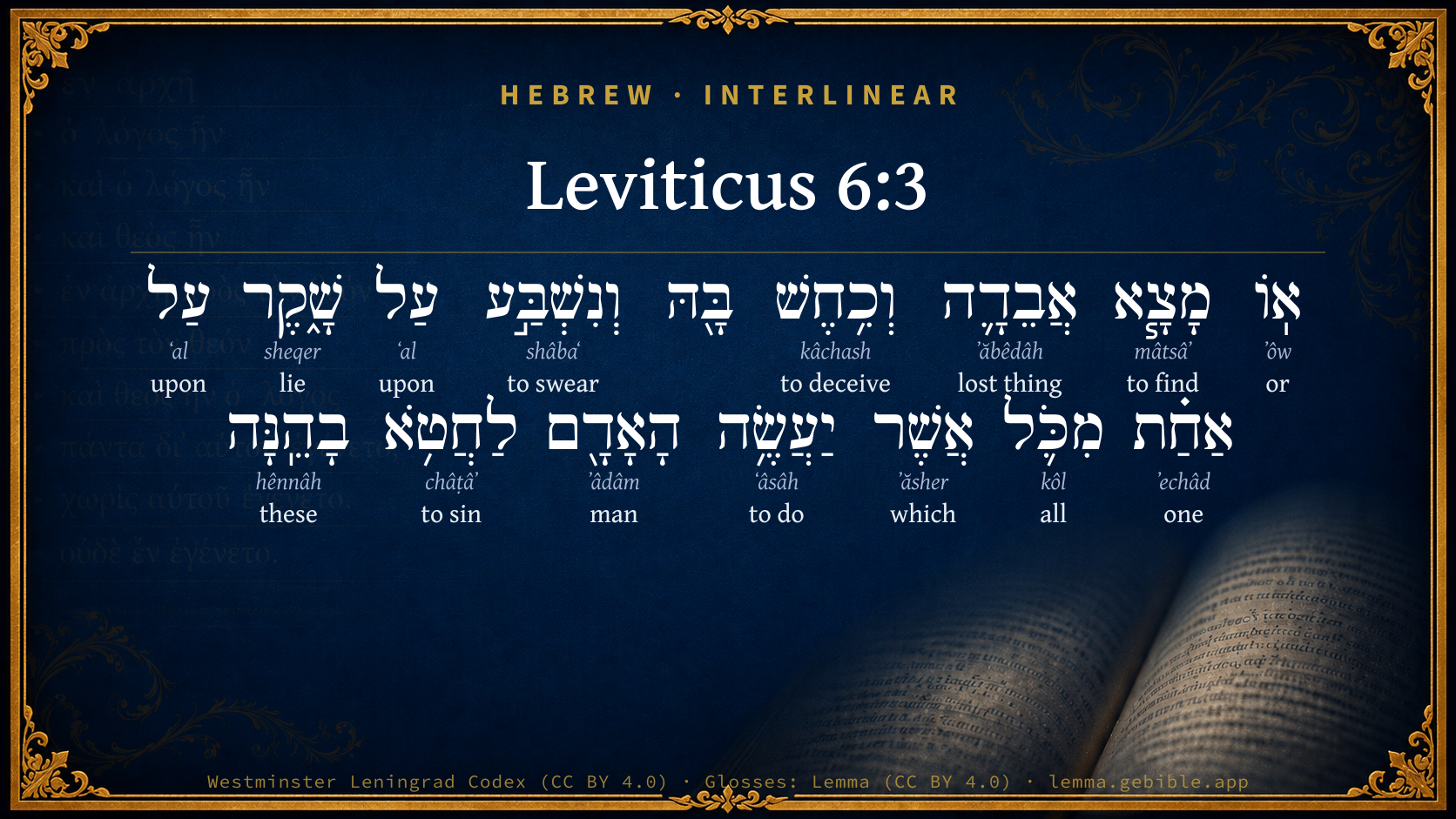
Hebrew (Westminster Leningrad Codex) Leviticus 6:3 appears in the Hebrew Old Testament. The text above is from the Westminster Leningrad Codex. Each word links to its Strong’s number, a concise gloss, and parsing drawn from the Open Scriptures Hebrew Bible morphology. Click any word for its full Brown-Driver-Briggs (BDB) entry.
Download image
Cite this verse

Leviticus 6:3 (World English Bible). Public Domain. Lemma interlinear Bible study tool, https://lemma.gebible.app/v/leviticus/6/3.

Show BibTeX & RIS
BibTeX
RIS
English Translation
or has found that which was lost, and dealt falsely therein, and swearing to a lie; in any of all these things that a man does, sinning therein;
World English Bible · Public Domain
Download a study sheet

One document with this verse’s original text, its word-by-word gloss line, the meaning frame, cross-references with their text, attributed commentary, and full source and license credits — printable, and it pastes into notes with its structure intact.

This verse Autodidact and up

Study sheet (.html) Plain text (.txt)

A passage Seminary Student

Up to 50 verses in one chapter. A passage sheet keeps up to 6 commentary sources and 12 cross-references per verse, in the order this page ranks them, and says so on the sheet whenever that leaves anything out. Ask for a single verse and you get the Autodidact verse sheet above.

Everything on this page stays free to read, with no account — the sheet is a download of what is already on screen, not access to it.

Want to remove ads? Support Godless Engineer
Compare translations 3

The same verse in 3 English versions, stacked beneath the original-language interlinear above. Click any original word for its lexicon entry.

Each is an independent rendering of the whole verse — the interlinear is not word-aligned to these translations.

Highlighted words mark where these versions differ — a whole-verse word diff, not a word-by-word alignment.

  • World English Bible Public Domain
    or has found that which was lost, and dealt falsely therein, and swearing to a lie; in any of all these things that a man does, sinning therein;
  • King James Version Public Domain
    Or have found that which was lost, and lieth concerning it, and sweareth falsely; in any of all these that a man doeth, sinning therein:
  • unfoldingWord Literal Text CC BY-SA 4.0
    or he finds lost property and he denies it or he swears upon falsehood regarding one from all that which humanity does to sin by them—

unfoldingWord Literal Text — © unfoldingWord, licensed CC BY-SA 4.0. Word-aligned USFM3 via Door43 (git.door43.org/unfoldingWord/en_ult).

Versions to compare (up to 4)

3 of 4 selected

Show all 18 translations

Every available English version of this verse, each an independent rendering of the whole verse.

  • World English Bible Public Domain
    or has found that which was lost, and dealt falsely therein, and swearing to a lie; in any of all these things that a man does, sinning therein;
  • Berean Standard Bible Public Domain
    or finds lost property and lies about it and swears falsely, or if he commits any such sin that a man might commit—
  • Majority Standard Bible Public Domain
    or finds lost property and lies about it and swears falsely, or if he commits any such sin that a man might commit—
  • King James Version Public Domain
    Or have found that which was lost, and lieth concerning it, and sweareth falsely; in any of all these that a man doeth, sinning therein:
  • American Standard Version (1901) Public Domain
    or have found that which was lost, and deal falsely therein, and swear to a lie; in any of all these things that a man doeth, sinning therein;
  • Revised Version (1885) Public Domain
    or have found that which was lost, and deal falsely thereto, and swear to a lie; in any of all these that a man doeth, sinning therein:
  • Geneva Bible (1599) Public Domain
    Or hath found that which was lost, and denieth it, and sweareth falsely, for any of these things that a man doeth, wherein he sinneth:
  • Douay-Rheims (1899) Public Domain
    Or shall find a thing lost, and denying it, shall also swear falsely, or shall do any other of the many things, wherein men are wont to sin:
  • Young's Literal Translation Public Domain
    or hath found a lost thing, and hath lied concerning it, and hath sworn to a falsehood, concerning one of all `these' which man doth, sinning in them:
  • Literal Standard Version CC BY-SA 4.0
    or has found a lost thing, and has lied concerning it, and has sworn to a falsehood, concerning one of all [these] which man does, sinning in them:
  • Unlocked Literal Bible CC BY-SA 4.0
    or he has found something that his neighbor lost and lies about it, or if he swears falsely, or in any matters like these by which people sin,
  • unfoldingWord Literal Text CC BY-SA 4.0
    or he finds lost property and he denies it or he swears upon falsehood regarding one from all that which humanity does to sin by them—
  • Darby Bible Public Domain
    or have found what was lost, and denieth it, and sweareth falsely in anything of all that man doeth, sinning therein;
  • World Messianic Bible Public Domain
    or has found that which was lost, and lied about it, and swearing to a lie—in any of these things that a man sins in his actions—
  • Webster's Bible Public Domain
    \\6:10\\And the priest shall put on his linen garment, and his linen breeches shall he put upon his flesh, and take up the ashes which the fire hath consumed with the burnt-offering on the altar, and he shall put them beside the altar.
  • Free Bible Version CC BY-SA 4.0
    You may have found property someone lost, and you lied and made false statements about it, or you have sinned in other ways that people do in such situations.
  • Bible in Basic English Public Domain
    And the priest is to put on his linen robes and his linen trousers, and take up what is over of the offering after it has been burned on the altar, and put it by the side of the altar.
  • JPS Tanakh (1917) Public Domain
    (5-22) or have found that which was lost, and deal falsely therein, and swear to a lie; in any of all these that a man doeth, sinning therein;

Literal Standard Version (2020), Covenant Press — licensed CC BY-SA 4.0. Text via the HelloAO Bible API (eBible.org). Unlocked Literal Bible (unfoldingWord) — licensed CC BY-SA 4.0. Text via the HelloAO Bible API (eBible.org). unfoldingWord Literal Text — © unfoldingWord, licensed CC BY-SA 4.0. Word-aligned USFM3 via Door43 (git.door43.org/unfoldingWord/en_ult). Free Bible Version, Dr. Jonathan Gallagher — licensed CC BY-SA 4.0. Text via the HelloAO Bible API (eBible.org).

Word by word

More ways to search: Search by grammar → Find every occurrence → Compare this word →

Practice this passage: Drill this verse → Learn its vocabulary →

אֲבֵדָ֛ה
ʼăbêdâh
H9
“lost thing”
Noun, Common, Feminine, Singular, Absolute
Part of Speech
Noun
Type
Common
Gender
Feminine
Number
Singular
State
Absolute
Full BDB Definition

Origin: from H6

TWOT: 2b

a lost thing, something lost
  1. אֽוֹ ʼôw H176 “or” Conjunction
  2. מָצָ֧א mâtsâʼ H4672 “to find” Verb, Qal, Perfect, 3rd Person, Masculine, Singular
  3. וְכִ֥חֶשׁ kâchash H3584 “and · to deceive” Conjunction + Verb, Piel, Sequential Perfect, 3rd Person, Masculine, Singular
  4. וְנִשְׁבַּ֣ע shâbaʻ H7650 “and · to swear” Conjunction + Verb, Niphal, Sequential Perfect, 3rd Person, Masculine, Singular
  5. עַל ʻal H5921 “upon” Preposition
  6. שָׁ֑קֶר sheqer H8267 “lie” Noun, Common, Masculine, Singular, Absolute
  7. עַל ʻal H5921 “upon” Preposition
  8. אַחַ֗ת ʼechâd H259 “one” Adjective, Cardinal number, Feminine, Singular, Absolute
  9. מִכֹּ֛ל kôl H3605 “from · all” Preposition + Noun, Common, Masculine, Singular, Absolute
  10. אֲשֶׁר ʼăsher H834 “which” Particle, Relative
  11. יַעֲשֶׂ֥ה ʻâsâh H6213 “to do” Verb, Qal, Imperfect, 3rd Person, Masculine, Singular
  12. הָאָדָ֖ם ʼâdâm H120 “the · man” Particle, Definite Article + Noun, Common, Masculine, Singular, Absolute
  13. לַחֲטֹ֥א châṭâʼ H2398 “to sin” Preposition + Verb, Qal, Infinitive Construct
  14. בָהֵֽנָּה hênnâh H2007 “in/at · these” Preposition + Pronoun, Personal, 3rd Person, Feminine, Plural

About this verse

These counts appear in no published source. They are computed here, from the morphology-tagged text and Lemma’s own curated glosses. What Lemma adds →

16
words
14
distinct lemmas
Pentateuch
section

Notable vocabulary

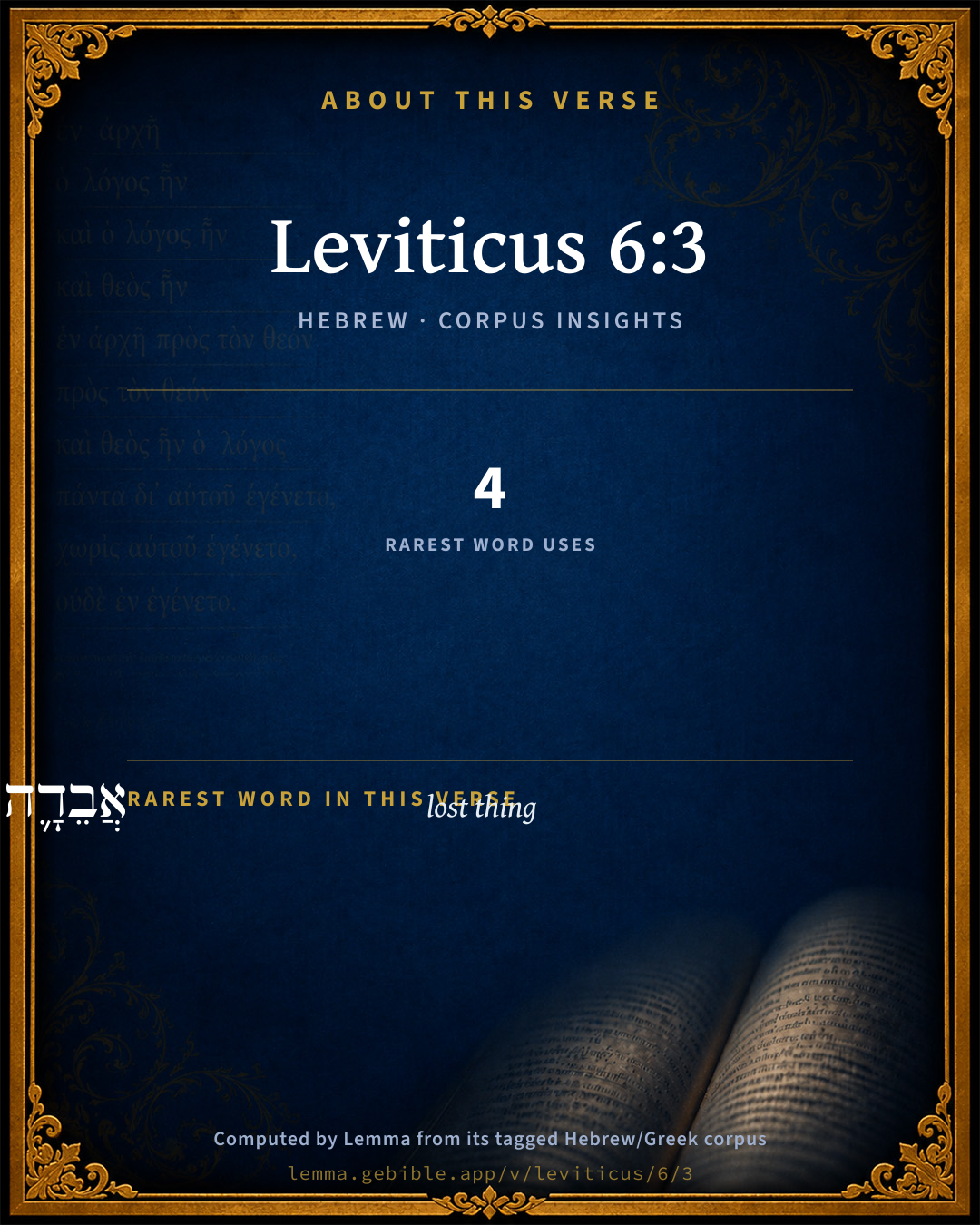
The rarest word here is אֲבֵדָ֛ה lost thing H9 — appearing just 4 times in the whole Hebrew Bible.

Shared distinctive vocabulary

אֲבֵדָ֛ה lost thing H9 occurs in 4 verses of the Hebrew Bible. Also found in:

Grammatical profile

  • 5 verbs
  • 4 nouns
  • 1 adjective
  • 1 pronoun
  • 3 prepositions
  • 1 conjunction
  • 1 particle

Verb forms

  • מָצָ֧א Qal · Perfect
  • וְכִ֥חֶשׁ Piel · Sequential Perfect
  • וְנִשְׁבַּ֣ע Niphal · Sequential Perfect
  • יַעֲשֶׂ֥ה Qal · Imperfect
  • לַחֲטֹ֥א Qal · Infinitive Construct

Repetition

A word recurs within this verse — often emphatic in Hebrew:

Hebrew & Septuagint length

In English translation the verse runs 28 words from the Hebrew and 35 from the Septuagint (LXX English) — closely comparable.

A rough comparison of the two English renderings, which tokenize alike — not a word-level alignment.

Word counts can differ between the Hebrew and the Greek without any difference in meaning — e.g. the Hebrew direct-object marker אֵת has no separate Greek word, and Greek often adds the article ὁ.

Cross-references

9

Topical passages linked to Leviticus 6:3 in the Treasury of Scripture Knowledge — connected by theme and wording, ordered by reader-vote popularity; previews shown in the World English Bible.

  • Exodus 23:4 "If you meet your enemy's ox or his donkey going astray, you shall surely bring it back to him again.
  • Leviticus 19:12 "'You shall not swear by my name falsely, and profane the name of your God. I am Yahweh.
  • Exodus 22:9–11 For every matter of trespass, whether it be for ox, for donkey, for sheep, for clothing, or for any kind of lost thing, about which one says, 'This is mine,' the cause of both parties shall come before God. He whom God condemns shall pay double to his neighbor.
  • Deuteronomy 22:1–4 You shall not see your brother's ox or his sheep go astray, and hide yourself from them: you shall surely bring them again to your brother.
  • Proverbs 30:9 Lest I be full, deny you, and say, 'Who is Yahweh?' Or lest I be poor, and steal, And so dishonor the name of my God.
  • Jeremiah 5:2 Though they say, As Yahweh lives; surely they swear falsely.
  • Jeremiah 7:9 Will you steal, murder, and commit adultery, and swear falsely, and burn incense to Baal, and walk after other gods that you have not known,
  • Zechariah 5:4 I will cause it to go out," says Yahweh of Hosts, "and it will enter into the house of the thief, and into the house of him who swears falsely by my name; and it will remain in the midst of his house, and will destroy it with its timber and its stones."
  • Malachi 3:5 I will come near to you to judgment; and I will be a swift witness against the sorcerers, and against the adulterers, and against the perjurers, and against those who oppress the hireling in his wages, the widow, and the fatherless, and who deprive the foreigner of justice, and don't fear me," says Yahweh of Hosts.

Cross-references courtesy of OpenBible.info (CC BY 4.0).

Hebrew and Greek witnesses Masoretic Hebrew ↔ Greek Septuagint

The same verse in the two great witnesses to the Old Testament, shown verse-for-verse.

These are two independent witnesses, not word-aligned to each other, and the Septuagint is shown in lemma (dictionary) form.

Hebrew Leviticus 6:3 Masoretic · Westminster Leningrad Codex

אֽוֹ מָצָ֧א אֲבֵדָ֛ה וְכִ֥חֶשׁ בָּ֖הּ וְנִשְׁבַּ֣ע עַל שָׁ֑קֶר עַל אַחַ֗ת מִכֹּ֛ל אֲשֶׁר יַעֲשֶׂ֥ה הָאָדָ֖ם לַחֲטֹ֥א בָהֵֽנָּה

or has found that which was lost, and dealt falsely therein, and swearing to a lie; in any of all these things that a man does, sinning therein;

World English Bible · Public Domain

Greek LXX Leviticus 6:3 Septuagint · lemma form

καί ἐνδύω ὁ ἱερεύς χιτών λινοῦς καί περισκελής λινοῦς ἐνδύω περί ὁ σῶμα αὐτός καί ἀποαἱρέω ὁ κατακάρπωσις ὅς ἄν κατα ἀναἁλίσκω ὁ πῦρ ὁ ὁλοκαύτωσις ἀπό ὁ θυσιαστήριον καί παρατίθημι αὐτός ἔχω ὁ θυσιαστήριον

or has found that which was lost, and shall have lied concerning it, and shall have sworn unjustly concerning any one of all the things, whatever a man may do, so as to sin hereby;

LXX2012 (modern English Septuagint) · Public Domain

Hebrew: Westminster Leningrad Codex (CC BY 4.0). Greek: Septuagint (public domain); English from LXX2012 (modern English Septuagint) (Public Domain). How the Septuagint differs from the Hebrew →

Targum (Aramaic paraphrase)

2

The Targum is the ancient Jewish Aramaic paraphrase of the Hebrew Scriptures — an interpretive translation, not the Hebrew text itself. Onkelos (literal) and Pseudo-Jonathan (expansive) render the Torah, and Jonathan the Prophets. Coverage is partial: where no permissively-licensed English translation exists for a verse, only the Aramaic is shown. This is verse-level text, not a word-by-word alignment to the Hebrew.

  1. Targum Onkelos Torah (Genesis–Deuteronomy)
    וְיַלְבֵּשׁ כַּהֲנָא לְבוּשִׁין דְבוּץ וּמִכְנְסִין דְבוּץ יַלְבֵּשׁ עַל בִּסְרֵהּ וְיַפְרֵשׁ יָת קִטְמָא דִי תֵיכוּל אֶשָׁתָא יָת עֲלָתָא עַל מַדְבְּחָא וִישַׁוִנֵהּ בִּסְטַּר מַדְבְּחָא

    (no public-domain English translation for this verse)

    Targum Onkelos — Aramaic: “Onkelos Genesis” (public domain); “Onkelos Exodus” (public domain); “Onkelos Leviticus” (public domain); “Onkelos Numbers” (public domain); “Onkelos Deuteronomy” (public domain). English: “Sefaria Community Translation” (CC0 1.0 (public-domain dedication)); “J.W. Etheridge. The Targums of Onkelos and Jonathan Ben Uzziel on the Pentateuch. London: Longmans, Green, 1862” (public domain). Text via Sefaria.

  2. Targum Pseudo-Jonathan Torah (Genesis–Deuteronomy)
    וְיִלְבּוֹשׁ כַּהֲנָא לְבוּשִׁין דְבוּץ וְאַוַורְקְטִין דְבוּץ יִלְבּוֹשׁ עַל בִּישְרֵיהּ וְיִפְרוֹשׁ יַת קִיטְמָא דְתֵיכוּל אֵישָׁתָא יַת עֲלָתָא עַל מַדְבְּחָא וִישַׁוִינֵיהּ בִּצְטַר מַדְבְּחָא

    And the priest shall dress himself in vestments of linen, and put drawers of linen upon his flesh; and shall separate the ashes which the fire (maketh) in consuming the burnt offering upon the altar, and shall place them at the side of the altar.

    Targum Pseudo-Jonathan — Aramaic: “Targum Jonathan on Genesis” (public domain); “Targum Jonathan on Exodus” (public domain); “Targum Jonathan on Leviticus” (public domain); “Targum Jonathan on Numbers” (public domain); “Targum Jonathan on Deuteronomy” (public domain). English: “The Targum of Jonathan ben Uzziel, trans. J. W. Etheridge, London, 1862” (public domain). Text via Sefaria.

Commentary

Notes on Leviticus 6:3 from classic Christian and Jewish commentators (each source and its license shown beneath its notes). The classic Christian expositions comment on the surrounding passage and are grouped to its opening verse, so a note may address several verses; the Jewish commentaries on the Tanakh (Rashi and others) are per-verse, so they appear only where the commentator wrote on this verse.

Lemma curates 59 commentaries, every one of them public domain or Creative Commons licensed, each selected and text-cleaned for this edition rather than reprinted as found. About our sources →

Trapp's Complete Commentary

John Trapp

Lev 6:3 Or have found that which was lost, and lieth concerning it, and sweareth falsely; in any of all these that a man doeth, sinning therein:

Ver. 3. And lieth concerning it, and sweareth falsely.] Through inordinate love of money, that "root of all evil"; {a} but such money shall perish with them. {Zec 5:3}

{a} Quid non mortalia pectora cogit auri sacra fames? ηη φιλοχρηματιη μητηρ κακοτητος απασης.

John Trapp, A Commentary or Exposition upon All the Books of the Old and New Testament (1647–1656) — public domain. Text from a community e-Sword module.

Joseph Benson's Commentary

Lev 6:3. Sweareth falsely — His oath being required, seeing there was no other way of discovery left. And is guilty — Makes his guilt manifest by his voluntary confession upon remorse; whereby he reapeth this benefit, that he only restores the principal with the addition of a fifth part; whereas, if he were convicted of his fault, he was to pay in some cases five-fold, in some four-fold, in others double.

Joseph Benson's Commentary on the Old and New Testaments (1811–1818) — public domain. Text from a community e-Sword module.

Geneva Bible (1599)

Geneva Bible translators

Wherein he cannot but sin: or, wherein a man accustometh to sin by perjury or such like thing.

Geneva Bible (1599) marginal notes — public domain. Text via Bolls.life.

Adam Clarke's Commentary

Verse 3. Have found that which was lost] The Roman lawyers laid it down as a sound maxim of jurisprudence, "that he who found any property and applied it to his own use, should be considered as a thief whether he knew the owner or not; for in their view the crime was not lessened, supposing the finder was totally ignorant of the right owner." Qui alienum quid jacens lucri faciendi causa sustulit, furti obstringitur, sive scit, cujus sit, sive ignoravit; nihil enim ad furtum minuendum, facit, quod, cujus sit, ignoret. - DIGESTOR, lib. xlvii., TIT. ii., de furtis, Leg. xliii., sec. 4. On this subject every honest man must say, that the man who finds any lost property, and does not make all due inquiry to find out the owner, should, in sound policy, be treated as a thief. It is said of the Dyrbaeans, a people who inhabited the tract between Bactria and India, that if they met with any lost property, even on the public road, they never even touched it. This was actually the case in this kingdom in the time of Alfred the Great, about A. D. 888; so that golden bracelets hung up on the public roads were untouched by the finger of rapine. One of Solon's laws was, Take not up what you laid not down. How easy to act by this principle in case of finding lost property: "This is not mine, and it would be criminal to convert it to my use unless the owner be dead and his family extinct." When all due inquiry is made, if no owner can be found, the lost property may be legally considered to be the property of the finder.

Adam Clarke's Commentary on the Bible (1810–1826) — public domain. Text from a community e-Sword/MySword module.

Ellicott's Commentary for English Readers

(3) Or have found.—The fifth instance adduced is of property which was neither entrusted nor exacted but accidentally found. For the law on lost property, see Exo_23:4; Deu_22:1-3.

And sweareth falsely.—This refers to all the five instances specified—that is, if he denies with an oath that property had been entrusted to him, that he had robbed, or exacted, or found anything.

A Bible Commentary for English Readers, edited by Charles John Ellicott (1878–1897) — public domain. Text from a community e-Sword module.

The Cambridge Bible for Schools and Colleges

gen. ed. J. J. S. Perowne

3. that which was lost] See Exo_22:8-9.

The two characteristics of the Guilt-Offering are (1) the sacrifice is the same for all classes, (2) restitution is required in full, together with a fifth part more.

The Cambridge Bible for Schools and Colleges (gen. ed. J. J. S. Perowne; Cambridge University Press, 1878–1918) — public domain. Text from a community e-Sword module.

John Gill's Exposition

Or have found that which was lost, and lieth concerning it,.... Who having found anything lost, at once concludes it his own, and converts it to his own use, never inquiring after the proprietor of it, or taking any method to get knowledge of him, and restore it to him; but so far from that, being suspected of finding it, and charged with it denies it: Maimonides (k) gives a reason why a lost thing should be restored, not only because so to do is a virtue in itself praiseworthy, but because it has a reciprocal utility; for if you do not restore another's lost things, neither will your own be restored to you:

and sweareth falsely; which is to be understood, not of the last case only, but of all the rest, or of anyone of them, as it follows:

in any of all these that a man doeth, sinning therein; by unfaithfulness in a trust, cheating, defrauding, lying, and false swearing.

(k) Moreh Nevochim, par. 3. c. 40.

John Gill's Exposition of the Whole Bible (1746–1763) — public domain (CC PDM 1.0). Text via the HelloAO Bible API.

Haydock's Catholic Bible Commentary

Lost. We acquire no title to the thing by finding it. The Roman law, as well as divines, condemn those who appropriate the thing found to their own use, as guilty of theft, whether they knew to whom it belonged or not; and Plato greatly commends the law of Solon, "Take not what thou didst not put down," a rule which the Dyrbeans and the people of Biblos rigorously observed. We may, however, take up what is lost, (Calmet) and endeavour to find the owner, who must indemnify us for our trouble; and, if we never find him, we are directed to give the price to the poor, for the owner’s welfare. (Haydock)

George Leo Haydock (1774–1849), Haydock's Catholic Family Bible and Commentary, 1859 edition — public domain. Excludes Psalms (Douay-Rheims chapter numbering differs from Protestant) and Deuterocanonical books (Catholic canon only).

Matthew Poole's English Annotations

Sweareth falsely; his oath being required, seeing there was no other way of discovery left.

Matthew Poole's English Annotations on the Holy Bible (1683–1685) — public domain. Text from a community e-Sword/MySword module.

Whedon's Commentary on the Bible

Daniel D. Whedon

3. Found… lost — The Roman code was evidently the voice of the same Divine Legislator speaking the same words through nature as he spake to Moses in the tabernacle. By that code he who found and appropriated any property was punished as a thief, whether he knew the owner or not. A brief statute of Solon was, “Take not up what you laid not down.”

Property as a natural right, without which civilization would be annihilated and the human race become extinct, finds ample safeguards in the Holy Scriptures.

Sweareth falsely — Avarice is the mother of lying and perjury.

Daniel D. Whedon (gen. ed.), Commentary on the Old and New Testaments (1874–1909) — public domain. Text from a community e-Sword module.

The Pulpit Commentary

Or have found that which was lost. Cf. Deu_22:2, Deu_22:3, "Thou shalt bring it unto thine own house, and it shall be with thee until thy brother seek after it, and thou shalt restore it to him again. In like manner shalt thou do with his ass; and so shalt thou do with his raiment; and with all lost thing of thy brother"s, which he hath lost, and thou hast found, shalt thou do likewise." And sweareth falsely. By previous legislation it had been appointed that, in case of a doubt arising as to what had become of property delivered to another to keep, there should be "an oath of the Lord between them both, that" the latter "hath not put his hand unto his neighbour"s goods; and the owner of it shall accept thereof, and he shall not make it good". (Exo_22:11) This opened the way to false swearing where men were dishonest. Sinning therein. Wrong to man is sin against God in every ease, but a special sin against God is committed when an appeal has been made to him by oath, and the oath has been false.

Swearing falsely

is in an especial manner a sin against God, because in an oath an appeal is directly made to God, and if the thing sworn to is false, God is called to witness to a thing as true which the swearer knows to be false. It is also in an especial manner a sin against society, as mutual truth-telling is the very bond of social trust. When the moral and religious tone of a nation stands high, "an oath for confirmation is the end of all strife", (Heb_6:16) and on the other hand, when either a disbelief in God"s providence or a casuistical theology saps the confidence placed in promises confirmed by oaths, society is perilously near its dissolution (see Bishop Sanderson"s "Obligation of Oaths"). The sanctity of an oath is guarded by a special commandment in the Decalogue.

Sin a germ as well as a fruit.

It is contemplated by the Supreme Legislator, that if a man once cherish a dishonest thought, he will probably go beyond fraud to falsehood ("and lieth"), and, when necessary, from falsehood to perjury ("and sweareth falsely"). This is true to life. Sin is not only the consequence of the evil that came before it, but it is the cause of more sin which is to follow; it is not only the child but the parent of wrong. Learn that

I NO MAN WHO SINS CAN TELL HOW FAR HIS SIN WILL TAKE HIM. Hazael, Gehazi, Ahab, Judas, etc.; "facilis descensus Averni.

II IT IS IN THE NATURE OF SIN TO TEMPT TO FURTHER SIN. The instances with which we are familiar are not remarkable exceptions; they are illustrations of a principle at work everywhere and always. "There"s not a crime but takes its change out still in crime, when once rung on the counter of this world;" dishonesty naturally, if not necessarily, leads to lying, and lying to perjury. One sin is the germ of another, and is sure to bear fruit.

III IT IS A PART OF THE PENALTY OF SIN THAT IT SHOULD DO SO. We sometimes think that sin carries no penalty; so it seemed to the Psalmist, (Ps 73) but he was wrong, as he owned (verse 15). It not only ends disastrously ("then understood I their end"), but it results in certain, immediate, spiritual injury. On the day in which the forbidden fruit is eaten, we do die, in the soul.

IV THIS FACT OF THE DIFFUSIVENESS OF SIN HELPS TO EXPLAIN THE EXCEEDING EVIL OF IT IN THE SIGHT OF GOD. It may well be accounted "an evil and bitter thing," a thing which he "hates," which he "abhors," etc.

These considerations furnish

(1) a very strong reason for repentance, etc; and

(2) an equally strong inducement for the cultivation of holiness in the heart and life of the good. C.

The Pulpit Commentary (1880–1919), ed. H.D.M. Spence-Jones & Joseph S. Exell — public domain. Text from a community e-Sword module.

John Wesley's Explanatory Notes

Swear falsely - His oath being required, seeing there was no other way of discovery left.

John Wesley, Explanatory Notes Upon the Whole Bible (1754–1765) — public domain. Text via the GEBible commentary corpus.

Rashi

Rabbi Shlomo Yitzchaki (Rashi)

מדו בד HIS LINEN ROBE — this is what is elsewhere termed the כתונת, the undercoat; and why then is it here called מדו? To intimate that it (the כתונת) must be made to his measure (מדו from מדד to “measure”) (Sifra, Tzav, Chapter 2 1; Yoma 23b).

על בשרו [AND LINEN DRAWERS HE SHALL PUT] UPON HIS FLESH — This implies that nothing should interpose between them (cf. Sifra, Tzav, Chapter 2 3; Zevachim 19a).

והרים את הדשן AND HE SHALL TAKE UP THE ASHES — He raked a full pan of ashes from the innermost consumed mass of ashes and deposited them at the east side of the כבש (the inclined plane leading up to the altar) (Sifra, Tzav, Chapter 1 4 Yoma 20a; cf. Jerusalem Talmud Yoma 2:1).

העולה‎ את ‎‏ אשר תאכל האש‎הדשן ‎ [HE SHALL TAKE OUT] THOSE ASHES INTO WHICH THE FIRE HATH CONSUMED THE BURNT OFFERING — and thus has made it into ashes; from those ashes he shall take out a תרומה, a portion, ושמו אצל המזבח AND PUT IT BESIDE THE ALTAR.

[על המזבח [THE BURNT OFFERING] ON THE ALTAR — This implies that if he (the priest) finds any limbs of the burnt offering that were not yet consumed he shall put them back on the altar after having raked the coals hither and thither and having taken from the innermost ashes, because it states, העולה על המזבח ‎את ‎which implies: the burnt offering (i.e.so long as it can be called an עולה and not דשן) must be ‎on the altar] (Sifra, Tzav, Chapter 1 5; Yoma 45b; cf. Rashi there s. v. ‎אשר תאכל ‎ את העולה‎).

Rashi on the Tanakh — English translations: “The Judaica Press complete Tanach with Rashi, translated by A. J. Rosenberg” (CC BY 4.0); “Pentateuch with Rashi's commentary by M. Rosenbaum and A.M. Silbermann, 1929-1934” (public domain); “The Metsudah Tanach series, Lakewood, N.J” (CC BY 4.0); and “The Book of Joshua, Metsudah Publications, 1997” (CC BY 4.0). Text via Sefaria.

Ramban (Nachmanides)

Rabbi Moshe ben Nachman (Ramban / Nachmanides)

AND THE PRIEST SHALL PUT ON ‘MIDO’ (HIS GARMENT OF) LINEN. “This is a reference to the k’toneth (tunic). Why then does Scripture here call it mido [which means ‘his measure’]? It is to indicate that the tunic is to be made to his measure. AND HIS LINEN BREECHES SHALL HE PUT UPON HIS FLESH — that there should be nothing interposing between them.” This is Rashi’s language.Now the [daily] removal of the ashes [from the altar, which is the subject-matter of this verse], must be done with the priest wearing the [four] garments of priesthood, as no Service can be performed with only two of the [four] garments! However, He mentioned only these two garments because of new points that are added here to them, namely, that the tunic must be made to the priest’s measure. This means to say that if it was raised [above his feet], being so short that it did not reach his feet, and he performed therein one of the acts of offering, his Service is invalid. It further teaches that there must be nothing intervening between the breeches and his flesh. But the law requires equally that the priest who removes the ashes from the altar should wear all [four] priestly garments, for since Scripture mentioned that the removing of the ashes must be done with priestly garments, we know [automatically] that it requires four for the common priest and eight for the High Priest. So also is it explained in the second chapter of Tractate Yoma and in Torath Kohanim: 2:1. “Why does Scripture repeat the term yilbash [‘he shall put on’ — ‘V’lavash hakohein’ (and the priest shall put on) his linen garment, and his linen breeches ‘yilbash’ (he shall put) upon his flesh]? It is to include the turban and the belt” [which the priest is also to put on for the removing of the ashes].Now Onkelos translated the word mido as levushin [“garments” — as opposed to Rashi’s interpretation, according to which it refers only to one garment, the tunic]. It would appear then that according to Onkelos, the word mido is a term which includes all of the priest’s garments, as if the verse were stating, “and the priest shall put on linen garments.” Similarly we are to understand the expressions: ‘madav’ (his clothes) rent; that cometh down upon the collar ‘midothav’, which means upon the edge of his garments; girded with ‘mido’ (his apparel) of war, which means his garments. This then will be in accordance with the opinion of the Sage who says (Exodus 39:28, Vol. II, p. 614). that the belt of the common priest was unlike the belt of the High Priest. as an inclusive term for “all” the priest’s garments, and the verse states, and the priest shall put on ‘mido’ (his ‘garments’ of) linen, Onkelos accordingly must agree with Rabbi Dosa that the belt of the common priest was unlike that of the High Priest, as the belt of the common priest was only of linen. Hence it states that the common priest shall put on all his garments of linen which includes the belt.

Ramban (Nachmanides) on the Tanakh — English translation: “Commentary on the Torah by Ramban (Nachmanides). Translated and annotated by Charles B. Chavel. New York, Shilo Pub. House, 1971-1976” (CC BY 4.0). Text via Sefaria.

Lesson kit

Teaching starters — assembled from the data on this page, not authored interpretation. Every prompt links to the verse data it draws on. Edit before teaching.

Leviticus, in the Pentateuch, opens this verse with 16 words (14 distinct Hebrew lemmas). Its most distinctive word is ʼăbêdâh (“lost thing”). A historical commentator’s framing appears above. Read the whole chapter for the surrounding context.

Discussion questions

  1. The word ʼăbêdâh carries the sense “lost thing.” How does it shape the verse?
  2. How does Exodus 22:9, which shares the word «lost thing», read alongside this verse?
  3. What does the repetition of “upon” (2× in this one verse) do in this verse?
  4. These translations render this verse differently; the difference is in the English rendering, not the original. What questions does that raise?
  5. «מָצָ֧א» is a Qal Perfect verb. How does that grammatical form shape the action described?
  6. Compare how Trapp's Complete Commentary and Joseph Benson's Commentary read this verse. Where do they agree or differ?

Things to notice

Reading settings

Reading text

Shown beneath each verse's original-language words.

Old Testament
Old Testament edition

Read the OT as the Masoretic Hebrew (MT) or the Greek Septuagint (LXX).

English shown for the Greek Septuagint (in the Hebrew ↔ Greek comparison).

Comparing translations? Open the Compare panel on any verse page to stack up to four side by side.