
Leviticus 5:7

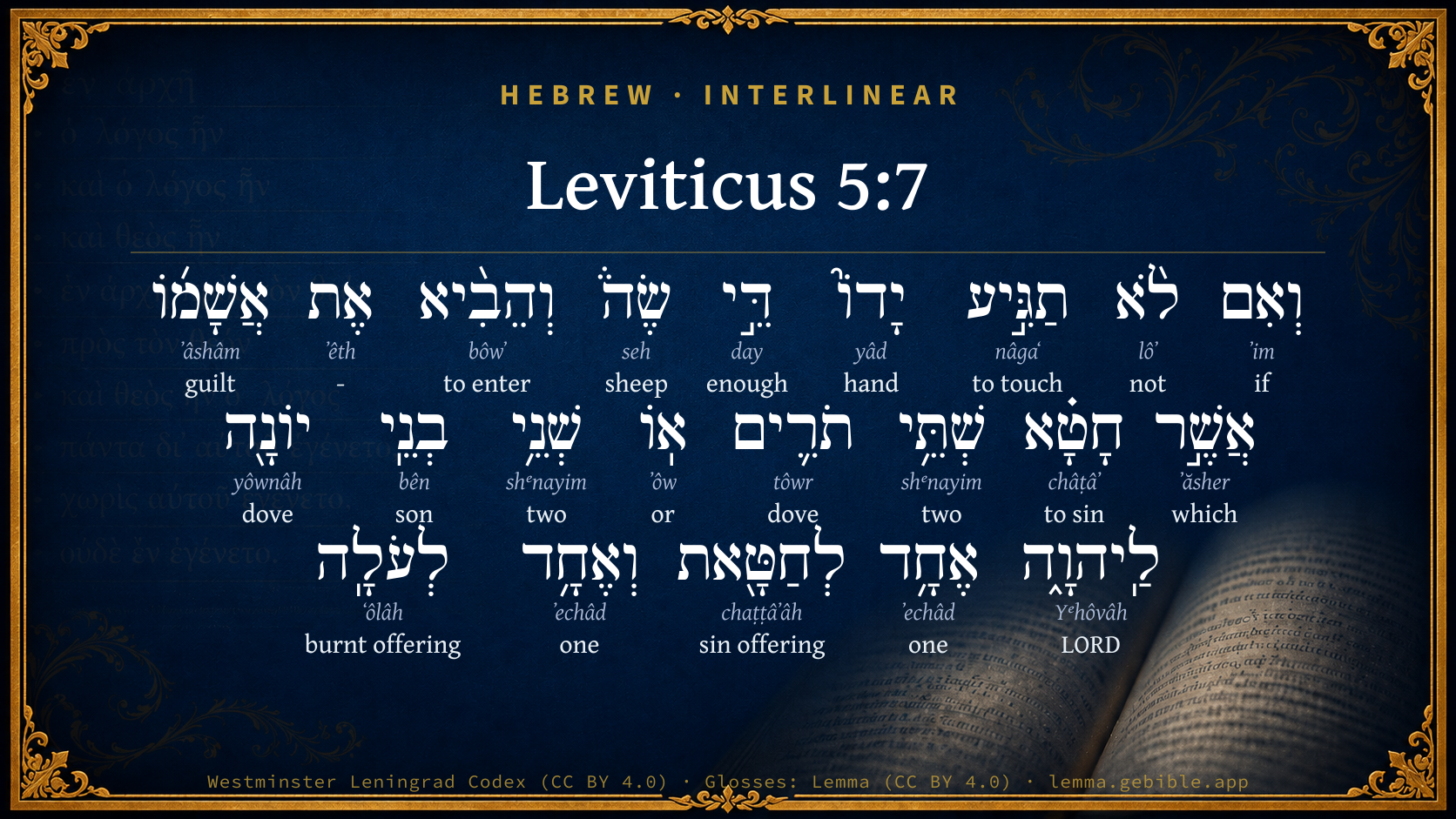
Hebrew (Westminster Leningrad Codex) Leviticus 5:7 appears in the Hebrew Old Testament. The text above is from the Westminster Leningrad Codex. Each word links to its Strong’s number, a concise gloss, and parsing drawn from the Open Scriptures Hebrew Bible morphology. Click any word for its full Brown-Driver-Briggs (BDB) entry.
Download image
Cite this verse

Leviticus 5:7 (World English Bible). Public Domain. Lemma interlinear Bible study tool, https://lemma.gebible.app/v/leviticus/5/7.

Show BibTeX & RIS
BibTeX
RIS
English Translation
"'If he can't afford a lamb, then he shall bring his trespass offering for that in which he has sinned, two turtledoves, or two young pigeons, to Yahweh; one for a sin offering, and the other for a burnt offering.
World English Bible · Public Domain
Download a study sheet

One document with this verse’s original text, its word-by-word gloss line, the meaning frame, cross-references with their text, attributed commentary, and full source and license credits — printable, and it pastes into notes with its structure intact.

This verse Autodidact and up

Study sheet (.html) Plain text (.txt)

A passage Seminary Student

Up to 50 verses in one chapter. A passage sheet keeps up to 6 commentary sources and 12 cross-references per verse, in the order this page ranks them, and says so on the sheet whenever that leaves anything out. Ask for a single verse and you get the Autodidact verse sheet above.

Everything on this page stays free to read, with no account — the sheet is a download of what is already on screen, not access to it.

Want to remove ads? Support Godless Engineer
Compare translations 3

The same verse in 3 English versions, stacked beneath the original-language interlinear above. Click any original word for its lexicon entry.

Each is an independent rendering of the whole verse — the interlinear is not word-aligned to these translations.

Highlighted words mark where these versions differ — a whole-verse word diff, not a word-by-word alignment.

  • World English Bible Public Domain
    "'If he can't afford a lamb, then he shall bring his trespass offering for that in which he has sinned, two turtledoves, or two young pigeons, to Yahweh; one for a sin offering, and the other for a burnt offering.
  • King James Version Public Domain
    And if he be not able to bring a lamb, then he shall bring for his trespass, which he hath committed, two turtledoves, or two young pigeons, unto the LORD; one for a sin offering, and the other for a burnt offering.
  • unfoldingWord Literal Text CC BY-SA 4.0
    But if his hand does not reach the sufficiency of a sheep, then he shall bring his guilt offering because he sinned— two doves or two sons of a pigeon to Yahweh, one for a sin offering and one for a burnt offering.

unfoldingWord Literal Text — © unfoldingWord, licensed CC BY-SA 4.0. Word-aligned USFM3 via Door43 (git.door43.org/unfoldingWord/en_ult).

Versions to compare (up to 4)

3 of 4 selected

Show all 18 translations

Every available English version of this verse, each an independent rendering of the whole verse.

  • World English Bible Public Domain
    "'If he can't afford a lamb, then he shall bring his trespass offering for that in which he has sinned, two turtledoves, or two young pigeons, to Yahweh; one for a sin offering, and the other for a burnt offering.
  • Berean Standard Bible Public Domain
    If, however, he cannot afford a lamb, he may bring to the LORD as restitution for his sin two turtledoves or two young pigeons—one as a sin offering and the other as a burnt offering.
  • Majority Standard Bible Public Domain
    If, however, he cannot afford a lamb, he may bring to the LORD as restitution for his sin two turtledoves or two young pigeons—one as a sin offering and the other as a burnt offering.
  • King James Version Public Domain
    And if he be not able to bring a lamb, then he shall bring for his trespass, which he hath committed, two turtledoves, or two young pigeons, unto the LORD; one for a sin offering, and the other for a burnt offering.
  • American Standard Version (1901) Public Domain
    And if his means suffice not for a lamb, then he shall bring his trespass-offering for that wherein he hath sinned, two turtle-doves, or two young pigeons, unto Jehovah; one for a sin-offering, and the other for a burnt-offering.
  • Revised Version (1885) Public Domain
    And if his means suffice not for a lamb, then he shall bring his guilt offering for that wherein he hath sinned, two turtledoves, or two young pigeons, unto the LORD; one for a sin offering, and the other for a burnt offering.
  • Geneva Bible (1599) Public Domain
    But if he be not able to bring a sheepe, he shall bring for his trespas which he hath committed, two turtle doues, or two yong pigeons vnto the Lord, one for a sinne offring, and the other for a burnt offring.
  • Douay-Rheims (1899) Public Domain
    But if he be not able to offer a beast, let him offer two turtles, or two young pigeons to the Lord, one for sin, and the other for a holocaust,
  • Young's Literal Translation Public Domain
    `And if his hand reach not to the sufficiency of a lamb, then he hath brought in his guilt-offering -- he who hath sinned -- two turtle-doves or two young pigeons to Jehovah, one for a sin-offering, and one for a burnt-offering;
  • Literal Standard Version CC BY-SA 4.0
    And if his hand does not reach to the sufficiency of a lamb, then he has brought in his guilt-offering—he who has sinned—two turtle-doves or two young pigeons to YHWH, one for a sin-offering and one for a burnt-offering;
  • Unlocked Literal Bible CC BY-SA 4.0
    If he cannot afford to buy a lamb, then he can bring as his guilt offering for his sin two doves or two young pigeons to Yahweh, one for a sin offering and the other for a burnt offering.
  • unfoldingWord Literal Text CC BY-SA 4.0
    But if his hand does not reach the sufficiency of a sheep, then he shall bring his guilt offering because he sinned— two doves or two sons of a pigeon to Yahweh, one for a sin offering and one for a burnt offering.
  • Darby Bible Public Domain
    And if his hand be not able to bring what is so much as a sheep, then he shall bring for his trespass which he hath sinned two turtle-doves or two young pigeons, to Jehovah; one for a sin-offering, and the other for a burnt-offering.
  • World Messianic Bible Public Domain
    “‘If he can’t afford a lamb, then he shall bring his trespass offering for that in which he has sinned, two turtledoves, or two young pigeons, to the LORD; one for a sin offering, and the other for a burnt offering.
  • Webster's Bible Public Domain
    And if he shall not be able to bring a lamb, then he shall bring for his trespass which he hath committed, two turtle-doves, or two young pigeons, to the LORD; one for a sin-offering, and the other for a burnt-offering.
  • Free Bible Version CC BY-SA 4.0
    If you can't afford a lamb, you may offer to the Lord as compensation for your sin two turtledoves or two young pigeons, one as a sin offering and one as a burnt offering.
  • Bible in Basic English Public Domain
    And if he has not money enough for a lamb, then let him give, for his offering to the Lord, two doves or two young pigeons; one for a sin-offering and one for a burned offering.
  • JPS Tanakh (1917) Public Domain
    And if his means suffice not for a lamb, then he shall bring his forfeit for that wherein he hath sinned, two turtle-doves, or two young pigeons, unto the LORD: one for a sin-offering, and the other for a burnt-offering.

Literal Standard Version (2020), Covenant Press — licensed CC BY-SA 4.0. Text via the HelloAO Bible API (eBible.org). Unlocked Literal Bible (unfoldingWord) — licensed CC BY-SA 4.0. Text via the HelloAO Bible API (eBible.org). unfoldingWord Literal Text — © unfoldingWord, licensed CC BY-SA 4.0. Word-aligned USFM3 via Door43 (git.door43.org/unfoldingWord/en_ult). Free Bible Version, Dr. Jonathan Gallagher — licensed CC BY-SA 4.0. Text via the HelloAO Bible API (eBible.org).

Word by word

More ways to search: Search by grammar → Find every occurrence → Compare this word →

Practice this passage: Drill this verse → Learn its vocabulary →

תֹרִ֛ים
tôwr
H8449
“doves”
Noun, Common, Both, Plural, Absolute
Part of Speech
Noun
Type
Common
Gender
Both
Number
Plural
State
Absolute
Full BDB Definition

Origin: probably the same as H8447

TWOT: 2500c

dove, turtledove
  1. וְאִם ʼim H518 “and · if” Conjunction + Conjunction
  2. לֹ֨א lôʼ H3808 “not” Particle, Negative
  3. תַגִּ֣יע nâgaʻ H5060 “to touch” Verb, Hiphil, Imperfect, 3rd Person, Feminine, Singular
  4. יָדוֹ֮ yâd H3027 “hand · his” Noun, Common, Both, Singular, Construct + Suffix, Personal, 3rd Person, Masculine, Singular
  5. דֵּ֣י day H1767 “enough of” Noun, Common, Masculine, Singular, Construct
  6. שֶׂה֒ seh H7716 “sheep” Noun, Common, Both, Singular, Absolute
  7. וְהֵבִ֨יא bôwʼ H935 “and · to enter” Conjunction + Verb, Hiphil, Sequential Perfect, 3rd Person, Masculine, Singular
  8. אֶת ʼêth H853 “-” Particle, Direct Object
  9. אֲשָׁמ֜וֹ ʼâshâm H817 “guilt · his” Noun, Common, Masculine, Singular, Construct + Suffix, Personal, 3rd Person, Masculine, Singular
  10. אֲשֶׁ֣ר ʼăsher H834 “which” Particle, Relative
  11. חָטָ֗א châṭâʼ H2398 “to sin” Verb, Qal, Perfect, 3rd Person, Masculine, Singular
  12. שְׁתֵּ֥י shᵉnayim H8147 “two” Adjective, Cardinal number, Feminine, Dual, Construct
  13. אֽוֹ ʼôw H176 “or” Conjunction
  14. שְׁנֵ֥י shᵉnayim H8147 “two” Adjective, Cardinal number, Masculine, Dual, Construct
  15. בְנֵֽי bên H1121 “sons of” Noun, Common, Masculine, Plural, Construct
  16. יוֹנָ֖ה yôwnâh H3123 “dove” Noun, Common, Feminine, Singular, Absolute
  17. לַֽיהוָ֑ה Yᵉhôvâh H3068 “to/for · LORD” Preposition + Noun, Proper
  18. אֶחָ֥ד ʼechâd H259 “one” Adjective, Cardinal number, Masculine, Singular, Absolute
  19. לְחַטָּ֖את chaṭṭâʼâh H2403 “to/for · sin offering” Preposition + Noun, Common, Feminine, Singular, Absolute
  20. וְאֶחָ֥ד ʼechâd H259 “and · one” Conjunction + Adjective, Cardinal number, Masculine, Singular, Absolute
  21. לְעֹלָֽה ʻôlâh H5930 “to/for · burnt offering” Preposition + Noun, Common, Feminine, Singular, Absolute

About this verse

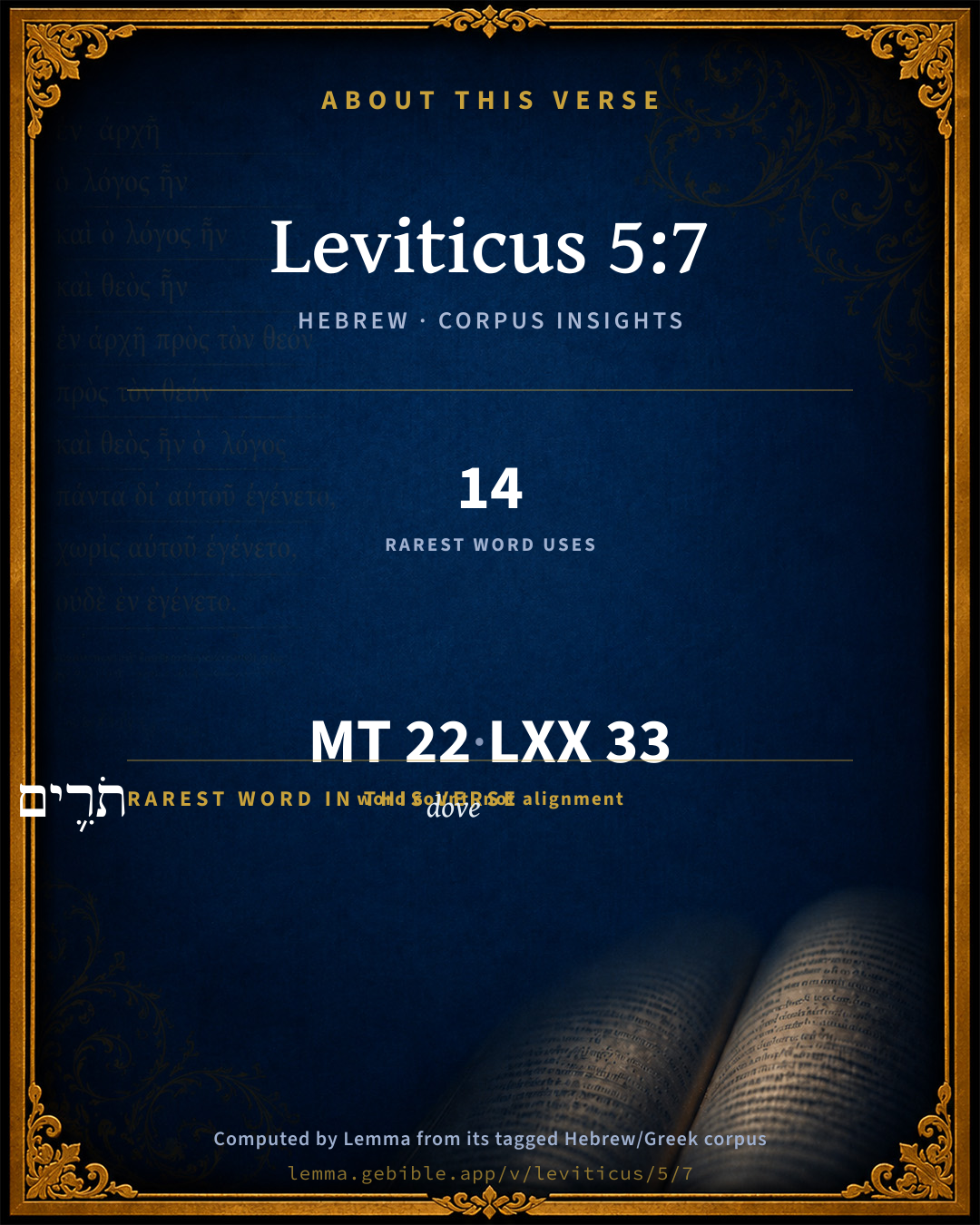
These counts appear in no published source. They are computed here, from the morphology-tagged text and Lemma’s own curated glosses. What Lemma adds →

22
words
20
distinct lemmas
Pentateuch
section

Notable vocabulary

The rarest word here is תֹרִ֛ים dove H8449 — appearing just 14 times in the whole Hebrew Bible.

Shared distinctive vocabulary

תֹרִ֛ים dove H8449 occurs in 14 verses of the Hebrew Bible. Also found in:

Grammatical profile

  • 3 verbs
  • 10 nouns
  • 4 adjectives
  • 2 conjunctions
  • 3 particles

Verb forms

  • תַגִּ֣יע Hiphil · Imperfect
  • וְהֵבִ֨יא Hiphil · Sequential Perfect
  • חָטָ֗א Qal · Perfect

Repetition

Words recur within this verse — often emphatic in Hebrew:

  • שְׁתֵּ֥י two H8147 ×2
  • אֶחָ֥ד one H259 ×2

Hebrew & Septuagint length

In English translation the verse runs 40 words from the Hebrew and 37 from the Septuagint (LXX English) — closely comparable.

A rough comparison of the two English renderings, which tokenize alike — not a word-level alignment.

Word counts can differ between the Hebrew and the Greek without any difference in meaning — e.g. the Hebrew direct-object marker אֵת has no separate Greek word, and Greek often adds the article ὁ.

In the original languages it is 22 Hebrew tokens and 33 Greek tokens — but the two are counted differently (Hebrew bundles its prefixes and suffixes into one token; the Greek is in lemma form), so that isn’t a like-for-like length.

Cross-references

16

Topical passages linked to Leviticus 5:7 in the Treasury of Scripture Knowledge — connected by theme and wording, ordered by reader-vote popularity; previews shown in the World English Bible.

  • Leviticus 12:8 If she cannot afford a lamb, then she shall take two turtledoves, or two young pigeons; the one for a burnt offering, and the other for a sin offering: and the priest shall make atonement for her, and she shall be clean.'"
  • Leviticus 14:21–22 "If he is poor, and can't afford so much, then he shall take one male lamb for a trespass offering to be waved, to make atonement for him, and one tenth of an ephah of fine flour mingled with oil for a meal offering, and a log of oil;
  • Leviticus 5:8–9 He shall bring them to the priest, who shall first offer the one which is for the sin offering, and wring off its head from its neck, but shall not sever it completely.
  • Leviticus 14:31 even such as he is able to afford, the one for a sin offering, and the other for a burnt offering, with the meal offering. The priest shall make atonement for him who is to be cleansed before Yahweh."
  • Matthew 3:16 Jesus, when he was baptized, went up directly from the water: and behold, the heavens were opened to him. He saw the Spirit of God descending as a dove, and coming on him.
  • Matthew 10:16 "Behold, I send you out as sheep in the midst of wolves. Therefore be wise as serpents, and harmless as doves.
  • 2 Corinthians 8:12 For if the readiness is there, it is acceptable according to what you have, not according to what you don't have.
  • Hebrews 10:6–10 In whole burnt offerings and sacrifices for sin you had no pleasure.
  • Leviticus 1:14–15 "'If his offering to Yahweh is a burnt offering of birds, then he shall offer his offering of turtledoves, or of young pigeons.
  • Leviticus 5:11 "'But if he can't afford two turtledoves, or two young pigeons, then he shall bring his offering for that in which he has sinned, the tenth part of an ephah of fine flour for a sin offering. He shall put no oil on it, neither shall he put any frankincense on it, for it is a sin offering.
  • Leviticus 9:3 You shall speak to the children of Israel, saying, 'Take a male goat for a sin offering; and a calf and a lamb, both a year old, without blemish, for a burnt offering;
  • Leviticus 15:14–15 "'On the eighth day he shall take two turtledoves, or two young pigeons, and come before Yahweh to the door of the Tent of Meeting, and give them to the priest:
  • Leviticus 15:30 The priest shall offer the one for a sin offering, and the other for a burnt offering; and the priest shall make atonement for her before Yahweh for the uncleanness of her discharge.
  • Leviticus 16:5 He shall take from the congregation of the children of Israel two male goats for a sin offering, and one ram for a burnt offering
  • Luke 2:24 and to offer a sacrifice according to that which is said in the law of the Lord, "A pair of turtledoves, or two young pigeons."
  • James 2:5–6 Listen, my beloved brothers. Didn't God choose those who are poor in this world to be rich in faith, and heirs of the Kingdom which he promised to those who love him?

Cross-references courtesy of OpenBible.info (CC BY 4.0).

Hebrew and Greek witnesses Masoretic Hebrew ↔ Greek Septuagint

The same verse in the two great witnesses to the Old Testament, shown verse-for-verse.

These are two independent witnesses, not word-aligned to each other, and the Septuagint is shown in lemma (dictionary) form.

Hebrew Leviticus 5:7 Masoretic · Westminster Leningrad Codex

וְאִם לֹ֨א תַגִּ֣יע יָדוֹ֮ דֵּ֣י שֶׂה֒ וְהֵבִ֨יא אֶת אֲשָׁמ֜וֹ אֲשֶׁ֣ר חָטָ֗א שְׁתֵּ֥י תֹרִ֛ים אֽוֹ שְׁנֵ֥י בְנֵֽי יוֹנָ֖ה לַֽיהוָ֑ה אֶחָ֥ד לְחַטָּ֖את וְאֶחָ֥ד לְעֹלָֽה

"'If he can't afford a lamb, then he shall bring his trespass offering for that in which he has sinned, two turtledoves, or two young pigeons, to Yahweh; one for a sin offering, and the other for a burnt offering.

World English Bible · Public Domain

Greek LXX Leviticus 5:7 Septuagint · lemma form

ἐάν δέ μή ἰσχύω ὁ χείρ αὐτός ὁ ἱκανός εἰς ὁ πρόβατον φέρω περί ὁ ἁμαρτία αὐτός ὅς ἁμαρτάνω δύο τρυγών ἤ δύο νεοσσός περιστερά κύριος εἷς περί ἁμαρτία καί εἷς εἰς ὁλοκαύτωμα

And if he can’t afford a sheep, he shall bring for his sin which he has sinned, two turtledoves or two young pigeons to the Lord; one for a sin-offering, and the other for a burnt offering.

LXX2012 (modern English Septuagint) · Public Domain

Hebrew: Westminster Leningrad Codex (CC BY 4.0). Greek: Septuagint (public domain); English from LXX2012 (modern English Septuagint) (Public Domain). How the Septuagint differs from the Hebrew →

Targum (Aramaic paraphrase)

2

The Targum is the ancient Jewish Aramaic paraphrase of the Hebrew Scriptures — an interpretive translation, not the Hebrew text itself. Onkelos (literal) and Pseudo-Jonathan (expansive) render the Torah, and Jonathan the Prophets. Coverage is partial: where no permissively-licensed English translation exists for a verse, only the Aramaic is shown. This is verse-level text, not a word-by-word alignment to the Hebrew.

  1. Targum Onkelos Torah (Genesis–Deuteronomy)
    וְאִם לָא תִמְטֵי יְדֵהּ כְּמִסַת שֵׂיתָא וְיַיְתִי יָת חוֹבְתֵהּ דִי חָב תַּרְתֵּין שַׁפְנִינִין אוֹ תְרֵין בְּנֵי יוֹנָה קֳדָם יְיָ חַד לְחַטָאתָא וְחַד לַעֲלָתָא

    (no public-domain English translation for this verse)

    Targum Onkelos — Aramaic: “Onkelos Genesis” (public domain); “Onkelos Exodus” (public domain); “Onkelos Leviticus” (public domain); “Onkelos Numbers” (public domain); “Onkelos Deuteronomy” (public domain). English: “Sefaria Community Translation” (CC0 1.0 (public-domain dedication)); “J.W. Etheridge. The Targums of Onkelos and Jonathan Ben Uzziel on the Pentateuch. London: Longmans, Green, 1862” (public domain). Text via Sefaria.

  2. Targum Pseudo-Jonathan Torah (Genesis–Deuteronomy)
    וְאִין לָא תֶאֱרַע יְדֵיהּ כְּמֵיסַת לְמַיְיתַיָא אִימְרָא וְיַיְתֵי יַת קָרְבַּן אַשְׁמֵיהּ דְחַב תְּרֵין שַׁפְנִינִין רַבְרְבִין אוֹ תְּרֵין גוֹזְלִין בְּנֵי יוֹנַיָא קֳדָם יְיָ חַד לְחַטָאתָא וְחַד לַעֲלָתָא

    But if his hand find not sufficiency to bring a lamb, let him bring, as an offering for the trespass that he hath committed, two large turtle doves or two young pigeons before the Lord; one for a sin offering, and one for a burnt sacrifice.

    Targum Pseudo-Jonathan — Aramaic: “Targum Jonathan on Genesis” (public domain); “Targum Jonathan on Exodus” (public domain); “Targum Jonathan on Leviticus” (public domain); “Targum Jonathan on Numbers” (public domain); “Targum Jonathan on Deuteronomy” (public domain). English: “The Targum of Jonathan ben Uzziel, trans. J. W. Etheridge, London, 1862” (public domain). Text via Sefaria.

Commentary

Notes on Leviticus 5:7 from classic Christian and Jewish commentators (each source and its license shown beneath its notes). The classic Christian expositions comment on the surrounding passage and are grouped to its opening verse, so a note may address several verses; the Jewish commentaries on the Tanakh (Rashi and others) are per-verse, so they appear only where the commentator wrote on this verse.

Lemma curates 59 commentaries, every one of them public domain or Creative Commons licensed, each selected and text-cleaned for this edition rather than reprinted as found. About our sources →

Matthew Henry's Commentary

Provision is here made for the poor of God's people, and the pacifying of their consciences under the sense of guilt. Those that were not able to bring a lamb might bring for a sin-offering a pair of turtle-doves or two young pigeons; nay, if any were so extremely poor that they were not able to procure these so often as they would have occasion, they might bring a pottle of fine flour, and this should be accepted. Thus the expense of the sin-offering was brought lower than that of any other offering, to teach us that no man's poverty shall ever be a bar in the way of his pardon. The poorest of all may have atonement made for them, if it be not their own fault. Thus the poor are evangelized; and no man shall say that he had not wherewithal to bear the charges of a journey to heaven. Now,

I. If the sinner brought two doves, one was to be offered for a sin-offering and the other for a burnt-offering, Lev 5:7. Observe, 1. Before he offered the burnt-offering, which was for the honour and praise of God, he must offer the sin-offering, to make atonement. We must first see to it that our peace be made with God, and then we may expect that our services for his glory will be accepted. The sin-offering must make way for the burnt-offering. 2. After the sin-offering, which made atonement, came the burnt-offering, as an acknowledgment of the great mercy of God in appointing and accepting the atonement.

II. If he brought fine flour, a handful of it was to be offered, but without either oil or frankincense (Lev 5:11), not only because this would make it too costly for the poor, for whose comfort this sacrifice was appointed, but because it was a sin-offering, and therefore, to show the loathsomeness of the sin for which it was offered, it must not be made grateful either to the taste by oil or to the smell by frankincense. The unsavouriness of the offering was to intimate that the sinner must never relish his sin again as he had done. God by these sacrifices did speak, 1. Comfort to those that had offended, that they might not despair, nor pine away in their iniquity; but, peace being thus made for them with God, they might have peace in him. 2. Caution likewise not to offend any more, remembering what an expensive troublesome thing it was to make atonement.

Matthew Henry's Commentary on the Whole Bible (1708–1710) — public domain (CC PDM 1.0). Text via the HelloAO Bible API.

Trapp's Complete Commentary

John Trapp

Lev 5:7 And if he be not able to bring a lamb, then he shall bring for his trespass, which he hath committed, two turtledoves, or two young pigeons, unto the LORD; one for a sin offering, and the other for a burnt offering.

Ver. 7. Two turtle doves.] {See Trapp on "Lev 1:14"}

John Trapp, A Commentary or Exposition upon All the Books of the Old and New Testament (1647–1656) — public domain. Text from a community e-Sword module.

Joseph Benson's Commentary

Lev 5:7. Not able — Through poverty. And this exception was allowed also in other sin-offerings. For a sin-offering — Which was for that particular sin, and therefore offered first before the burnt-offering, which was for sins in general; to teach us not to rest in general confessions and repentance, but distinctly and particularly, as far as we can, to search out, and confess, and loathe, and leave our particular sins, without which God will not accept our other religious services.

Joseph Benson's Commentary on the Old and New Testaments (1811–1818) — public domain. Text from a community e-Sword module.

Tyndale Open Study Notes

Tyndale Open Resources

5:7-13 The poor also needed to secure atonement and reconciliation. Birds (5:7) were permitted for those too poor to afford a lamb (cp. 1:14-17). Although an animal offering was typically required for atonement (17:11), God in his grace allowed the bloodless offering of flour if the worshiper could not even afford two birds (5:11).

5:7 The sin offerings included both a portion as a burnt offering and a portion that was first offered, then given to the priests (cp. 4:22-35; 6:24-30). Because of their small size, two birds were required—one for each type of offering.

Tyndale Open Study Notes — © Tyndale Open Resources, licensed CC BY-SA 4.0. Text via the HelloAO Bible API.

Geneva Bible (1599)

Geneva Bible translators

Hebrew, if his hand cannot touch, meaning for his poverty.

Geneva Bible (1599) marginal notes — public domain. Text via Bolls.life.

Adam Clarke's Commentary

Verse 7. If he be not able to bring a lamb] See the conclusion of Clarke's note on "Le 1:16".

Adam Clarke's Commentary on the Bible (1810–1826) — public domain. Text from a community e-Sword/MySword module.

Ellicott's Commentary for English Readers

(7) And if he be not able to bring.—The only exception to this general rule was poverty. The poor man who was unable to bring a sheep or she-goat, might bring two turtle-doves, as these were plentiful and cheap in Palestine. (See Lev_1:14.) We have seen in the preceding verse that in the case of the trespass offering, as in that of the sin offering, the fat parts, or the choicest portion, had to be consumed on the altar, being “the bread of Jehovah,” and that the residue was the perquisite of the priests. As the fat parts of the dove, or the portion for the altar, could not be separated from the bird, and as the burning of it wholly would destroy the character of the trespass offering, and make it into a whole burnt offering, two doves were brought. One represented the portion for the Lord, and hence was burnt on the altar, whilst the flesh of the other became the perquisite of the officiating priest.

A Bible Commentary for English Readers, edited by Charles John Ellicott (1878–1897) — public domain. Text from a community e-Sword module.

The Cambridge Bible for Schools and Colleges

gen. ed. J. J. S. Perowne

7. The similarity between this alternative offering for a poor man and that of Lev_1:14-17 is obvious.

The Cambridge Bible for Schools and Colleges (gen. ed. J. J. S. Perowne; Cambridge University Press, 1878–1918) — public domain. Text from a community e-Sword module.

John Gill's Exposition

And if he be not able to bring a lamb,.... He is not possessed of a lamb, nor able to purchase one:

then he shall bring for his trespass which he hath committed, two turtledoves, or two young pigeons, unto the Lord; either the one or the other; these were common, and in great plenty in the land of Israel, as Maimonides (y) observes, which was the reason of their being ordered, since to be had cheap. The turtledoves were larger, as the Targum of Jonathan calls them, being older, and the pigeons lesser, being young; or the one were grown, and not little, and the other little, and not grown, as the Jewish writers (z) observe; and either of them were proper emblems of Christ in his purity, innocence, and meekness, by whom an atonement is made both for the rich and poor:

one for a sin offering, and the other for a burnt offering; one of the turtle doves or pigeons, whichsoever were brought, was offered up as a sin offering, and the other that remained was offered up as a burnt offering; so that the poor man had two sorts of offerings out of what he brought, when the rich had but one; and may denote the completeness of his sacrifice, and the full atonement made by it.

(y) Moreh Nevochim, par. 3. c. 46. (z) Maimon & Bartenora in Misn. Cholin, c. 1. sect. 5.

John Gill's Exposition of the Whole Bible (1746–1763) — public domain (CC PDM 1.0). Text via the HelloAO Bible API.

Matthew Poole's English Annotations

If he be not able, through poverty, as Lev 4:11. And this exception was allowed also in other sin-offerings.

Two young pigeons, of which see Lev 1:14.

One for a sin-offering, which was for that particular sin, and therefore is offered first before the burnt-offering, which was for sins in general to teach us not to rest in general confessions and repentances for sin, as hypocrites commonly do, but distinctly and particularly, as far as we can, to search out, and confess, and loathe, and leave our particular sins, without which God will not accept our other religious services. Note that the burnt-offering was for the expiation of sin as well as the sin-offering, Lev 1:4, only that was for sin in general, and this for particular sins.

Matthew Poole's English Annotations on the Holy Bible (1683–1685) — public domain. Text from a community e-Sword/MySword module.

Whedon's Commentary on the Bible

Daniel D. Whedon

7. Not able to bring a lamb — For the adjustment of the Divine requirements to human ability, see Lev_1:14, note.

One for a sin offering — This brings the sinner into reconciliation with God.

The other for a burnt offering — This typifies the complete consecration of the reconciled sinner, soul, body, and spirit, unto Him who hath redeemed him with his precious blood. The sin sacrifice symbolically brings the penitent offerer into the state of justification, and the whole burnt sacrifice, in like manner, initiates him into entire sanctification.

Daniel D. Whedon (gen. ed.), Commentary on the Old and New Testaments (1874–1909) — public domain. Text from a community e-Sword module.

The Pulpit Commentary

Vers. 7-13. If he be not able to bring a lamb. Sin offerings being not voluntary sacrifices but required of all that were guilty, and the four last-named cases being of common occurrence amongst the poor and ignorant, two concessions are made to poverty: two birds (one to be offered with the ritual of the sin offering, the other with that of the burnt offering), or even some flour (either three pints and a half or three quarts and a half, according as we adopt the larger or smaller estimate of the amount of the ephah), are allowed when the offerer cannot provide a lamb or a kid. There is thus typically set forth the freedom with which acceptance through the great propitiation is offered to all without respect of persons. The non-bloody substitute, being permitted only as an exception for the benefit of the very poor and only in the four cases above specified, does not invalidate the general rule that without the shedding of blood there is no remission of sin.

Vers. 7-13. The sacrifices to be offered as sin offerings are specified, nor may they be multiplied. They do not differ according to the heinousness of the offense which they are to atone for, but according to the means of the offerer. The moral reason of this was probably to prevent the idea arising that the costliness of the sacrifice might compensate for the greater sin, and that men might sin the more if they were willing to Fay for it by more sacrifices. The difference in the sacrifice appointed for each class might serve to point out that a sin is greater in a man of prominent position than in a man of less influence, owing to its effects upon a larger circle. The concession made to the poor shows that none are to be shut out from communion with God for their want of worldly means. The expiation must be made, that the sinner may recover his covenant relations with God; but it shall be of such a nature that none shall be prevented from making it by their poverty. Here then is a foreshadowing of the free grace of God in the gospel dispensation. "Ho, every one that thirsteth, come ye to the waters, and he that hath no money; come ye, buy and eat; yea, come, buy wine and. milk without money and without price". (Isa_55:1) "Let him that is athirst come. And whosoever will, let him take the water of life freely". (Rev_22:17)

The Pulpit Commentary (1880–1919), ed. H.D.M. Spence-Jones & Joseph S. Exell — public domain. Text from a community e-Sword module.

John Wesley's Explanatory Notes

Not able - Through poverty. And this exception was allowed also in other sin-offerings. For a sin-offering - Which was for that particular sin, and therefore offered first: before the burnt- offering, which was for sins in general; to teach us not to rest in general confessions and repentance, but distinctly and particularly, as far as we can, to search out, and confess, and loath, and leave our particular sins, without which God will not accept our other religious services.

John Wesley, Explanatory Notes Upon the Whole Bible (1754–1765) — public domain. Text via the GEBible commentary corpus.

unfoldingWord translationNotes

Door43 World Missions Community

If he cannot afford to buy a lamb

"If he does not have enough money to buy a lamb"

he will wring off its head from its neck but will not remove it

"he will kill it by twisting its head and breaking its neck, but he will not remove the head"

translationWords

lamb

guilt offering

sin

dove

Yahweh

sin offering

burnt offering

priest

blood

altar

unfoldingWord translationNotes — © Distant Shores Media and the Door43 World Missions Community, licensed CC BY-SA 4.0. Source: git.door43.org/Door43/en_tn.

Ramban (Nachmanides)

Rabbi Moshe ben Nachman (Ramban / Nachmanides)

AND IF HIS MEANS SUFFICE NOT FOR A LAMB. Scripture has been lenient towards these sinners by allowing them to bring an offering of either higher or lower value. It is possible that the reason for the leniency with regard to the offering in the case of oaths [i.e., the “oath of testimony” and the “oath of utterance”, as explained above] is because the punishment is not excision [were they to be done wilfully]. In the case of defilement of the Sanctuary and the holy food [He mitigated the obligation of the offering] because the person who did it erred whilst engaged in performing a religious duty, for the priest who eats the holy food or enters into the Sanctuary to prostrate himself or to bring an offering is engaged in performing a religious duty, and his intention is towards Heaven. Therefore even though he sinned on account of having forgotten his state of uncleanness, Scripture gave him more ways of atonement.Rabbi Abraham ibn Ezra commented that the reason why one [of the two birds brought by the poor man in the offering of higher or lower value] was a burnt-offering, is so that it should be offered on the altar in lieu of the fats of the animal sin-offering [brought by the affluent person]. He has explained it well.

Ramban (Nachmanides) on the Tanakh — English translation: “Commentary on the Torah by Ramban (Nachmanides). Translated and annotated by Charles B. Chavel. New York, Shilo Pub. House, 1971-1976” (CC BY 4.0). Text via Sefaria.

Ibn Ezra

Rabbi Abraham ibn Ezra

If his means are not sufficient (lit. if his hand does not reach). The hand performs every type of work, and it acquires; thus, this refers to someone who has nothing.

Ibn Ezra on the Tanakh — English translations: “Sefaria Community Translation” (CC0 1.0 (public-domain dedication)); “Yalkut, Sifsei Chachomim Chumash, Metsudah Publications, 2009” (CC BY 4.0); and “Commentary of Ibn Ezra on Isaiah - trans. by M. Friedlander, 1873” (public domain). Text via Sefaria.

Lesson kit

Teaching starters — assembled from the data on this page, not authored interpretation. Every prompt links to the verse data it draws on. Edit before teaching.

Leviticus, in the Pentateuch, opens this verse with 22 words (20 distinct Hebrew lemmas). Its most distinctive word is tôwr (“dove”). A historical commentator’s framing appears above. Read the whole chapter for the surrounding context.

Discussion questions

  1. The word tôwr carries the sense “dove.” How does it shape the verse?
  2. Genesis 15:9 shares the word «dove» with this verse. How do the two illuminate each other?
  3. “two” occurs 2× in this one verse. What is the effect of the repetition?
  4. The translations on this page render this verse differently — a whole-verse word diff, not a word-by-word alignment. What might account for the different wordings?
  5. The verb «תַגִּ֣יע» is Hiphil Imperfect. How does its form color the action?
  6. Reading how Matthew Henry's Commentary and Trapp's Complete Commentary read this verse, where do the two commentators agree and where do they part?

Things to notice

Reading settings

Reading text

Shown beneath each verse's original-language words.

Old Testament
Old Testament edition

Read the OT as the Masoretic Hebrew (MT) or the Greek Septuagint (LXX).

English shown for the Greek Septuagint (in the Hebrew ↔ Greek comparison).

Comparing translations? Open the Compare panel on any verse page to stack up to four side by side.