1 Kings 14:16

Hebrew (Westminster Leningrad Codex) 1 Kings 14:16 appears in the Hebrew Old Testament. The text above is from the Westminster Leningrad Codex. Each word links to its Strong’s number, a concise gloss, and parsing drawn from the Open Scriptures Hebrew Bible morphology. Click any word for its full Brown-Driver-Briggs (BDB) entry.
Download image
Cite this verse

1 Kings 14:16 (World English Bible). Public Domain. Lemma interlinear Bible study tool, https://lemma.gebible.app/v/1-kings/14/16.

Show BibTeX & RIS
BibTeX
RIS
English Translation
He will give Israel up because of the sins of Jeroboam, which he has sinned, and with which he has made Israel to sin.
World English Bible · Public Domain
Download a study sheet

One document with this verse’s original text, its word-by-word gloss line, the meaning frame, cross-references with their text, attributed commentary, and full source and license credits — printable, and it pastes into notes with its structure intact.

This verse Autodidact and up

Study sheet (.html) Plain text (.txt)

A passage Seminary Student

Up to 50 verses in one chapter. A passage sheet keeps up to 6 commentary sources and 12 cross-references per verse, in the order this page ranks them, and says so on the sheet whenever that leaves anything out. Ask for a single verse and you get the Autodidact verse sheet above.

Everything on this page stays free to read, with no account — the sheet is a download of what is already on screen, not access to it.

Want to remove ads? Support Godless Engineer
Compare translations 3

The same verse in 3 English versions, stacked beneath the original-language interlinear above. Click any original word for its lexicon entry.

Each is an independent rendering of the whole verse — the interlinear is not word-aligned to these translations.

Highlighted words mark where these versions differ — a whole-verse word diff, not a word-by-word alignment.

  • World English Bible Public Domain
    He will give Israel up because of the sins of Jeroboam, which he has sinned, and with which he has made Israel to sin.
  • King James Version Public Domain
    And he shall give Israel up because of the sins of Jeroboam, who did sin, and who made Israel to sin.
  • unfoldingWord Literal Text CC BY-SA 4.0
    And he will give Israel up on account of the sins of Jeroboam that he sinned and that he caused Israel to sin.”

unfoldingWord Literal Text — © unfoldingWord, licensed CC BY-SA 4.0. Word-aligned USFM3 via Door43 (git.door43.org/unfoldingWord/en_ult).

Versions to compare (up to 4)

3 of 4 selected

Show all 18 translations

Every available English version of this verse, each an independent rendering of the whole verse.

  • World English Bible Public Domain
    He will give Israel up because of the sins of Jeroboam, which he has sinned, and with which he has made Israel to sin.
  • Berean Standard Bible Public Domain
    So He will give Israel over on account of the sins Jeroboam has committed and has caused Israel to commit.”
  • Majority Standard Bible Public Domain
    So He will give Israel over on account of the sins Jeroboam has committed and has caused Israel to commit.”
  • King James Version Public Domain
    And he shall give Israel up because of the sins of Jeroboam, who did sin, and who made Israel to sin.
  • American Standard Version (1901) Public Domain
    And he will give Israel up because of the sins of Jeroboam, which he hath sinned, and wherewith he hath made Israel to sin.
  • Revised Version (1885) Public Domain
    And he shall give Israel up because of the sins of Jeroboam, which he hath sinned, and wherewith he hath made Israel to sin.
  • Geneva Bible (1599) Public Domain
    And he shall giue Israel vp, because of the sinnes of Ieroboam, who did sinne, and made Israel to sinne.
  • Douay-Rheims (1899) Public Domain
    And the Lord shall give up Israel for the sins of Jeroboam, who hath sinned, and made Israel to sin.
  • Young's Literal Translation Public Domain
    and He giveth up Israel because of the sins of Jeroboam that he sinned, and that he caused Israel to sin.'
  • Literal Standard Version CC BY-SA 4.0
    and He gives up Israel because of the sins of Jeroboam that he sinned, and that he caused Israel to sin.”
  • Unlocked Literal Bible CC BY-SA 4.0
    He will give Israel up because of the sins of Jeroboam, the sins that he has committed, and through which he has led Israel to sin.”
  • unfoldingWord Literal Text CC BY-SA 4.0
    And he will give Israel up on account of the sins of Jeroboam that he sinned and that he caused Israel to sin.”
  • Darby Bible Public Domain
    And he will give Israel up because of the sins of Jeroboam, wherewith he has sinned, and made Israel to sin.
  • World Messianic Bible Public Domain
    He will give Israel up because of the sins of Jeroboam, which he has sinned, and with which he has made Israel to sin.”
  • Webster's Bible Public Domain
    And he will give up Israel because of the sins of Jeroboam, who sinned, and who made Israel to sin.
  • Free Bible Version CC BY-SA 4.0
    He will abandon Israel because of the sins of Jeroboam, those that he committed himself, and those he made Israel commit.”
  • Bible in Basic English Public Domain
    And he will give Israel up because of the sins which Jeroboam has done and made Israel do.
  • JPS Tanakh (1917) Public Domain
    And He will give Israel up because of the sins of Jeroboam, which he hath sinned, and wherewith he hath made Israel to sin.'

Literal Standard Version (2020), Covenant Press — licensed CC BY-SA 4.0. Text via the HelloAO Bible API (eBible.org). Unlocked Literal Bible (unfoldingWord) — licensed CC BY-SA 4.0. Text via the HelloAO Bible API (eBible.org). unfoldingWord Literal Text — © unfoldingWord, licensed CC BY-SA 4.0. Word-aligned USFM3 via Door43 (git.door43.org/unfoldingWord/en_ult). Free Bible Version, Dr. Jonathan Gallagher — licensed CC BY-SA 4.0. Text via the HelloAO Bible API (eBible.org).

Word by word

More ways to search: Search by grammar → Find every occurrence → Compare this word →

Practice this passage: Drill this verse → Learn its vocabulary →

בִּגְלַ֞ל
gâlâl
H1558
“in/at · on account of of”
Preposition + Noun, Common, Masculine, Singular, Construct
Part of Speech
Preposition + Noun
Type
Common
Gender
Masculine
Number
Singular
State
Construct
Full BDB Definition

Origin: from H1556

TWOT: 352

on account of, for the sake of
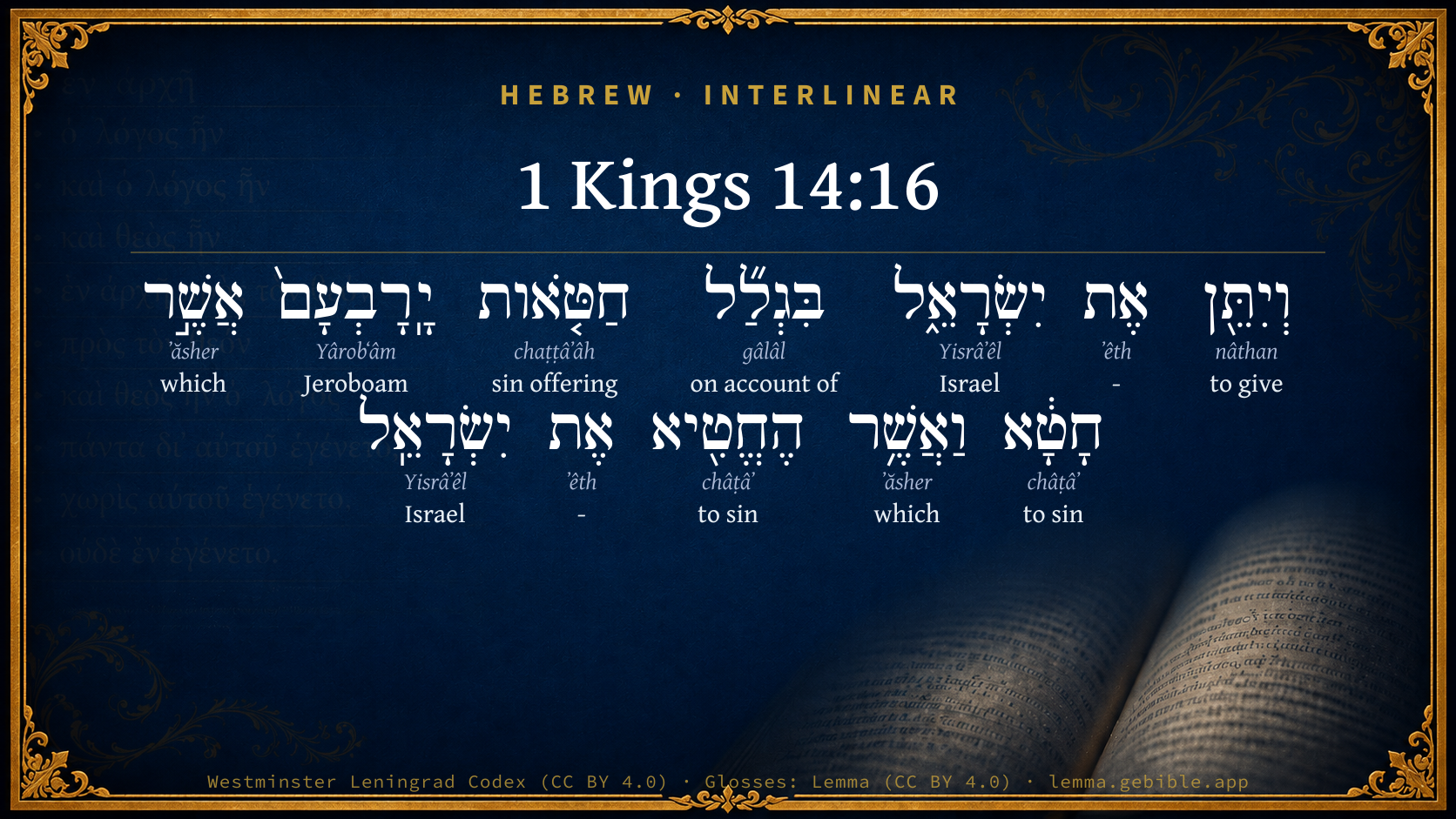
  1. וְיִתֵּ֖ן nâthan H5414 “and · to give” Conjunction + Verb, Qal, Imperfect, 3rd Person, Masculine, Singular
  2. אֶת ʼêth H853 “-” Particle, Direct Object
  3. יִשְׂרָאֵ֑ל Yisrâʼêl H3478 “Israel” Noun, Proper
  4. חַטֹּ֤אות chaṭṭâʼâh H2403 “sin offerings of” Noun, Common, Feminine, Plural, Construct
  5. יָֽרָבְעָם֙ Yârobʻâm H3379 “Jeroboam” Noun, Proper
  6. אֲשֶׁ֣ר ʼăsher H834 “which” Particle, Relative
  7. חָטָ֔א châṭâʼ H2398 “to sin” Verb, Qal, Perfect, 3rd Person, Masculine, Singular
  8. וַאֲשֶׁ֥ר ʼăsher H834 “and · which” Conjunction + Particle, Relative
  9. הֶחֱטִ֖יא châṭâʼ H2398 “to sin” Verb, Hiphil, Perfect, 3rd Person, Masculine, Singular
  10. אֶת ʼêth H853 “-” Particle, Direct Object
  11. יִשְׂרָאֵֽל Yisrâʼêl H3478 “Israel” Noun, Proper

About this verse

These counts appear in no published source. They are computed here, from the morphology-tagged text and Lemma’s own curated glosses. What Lemma adds →

12
words
8
distinct lemmas
Historical
section

Notable vocabulary

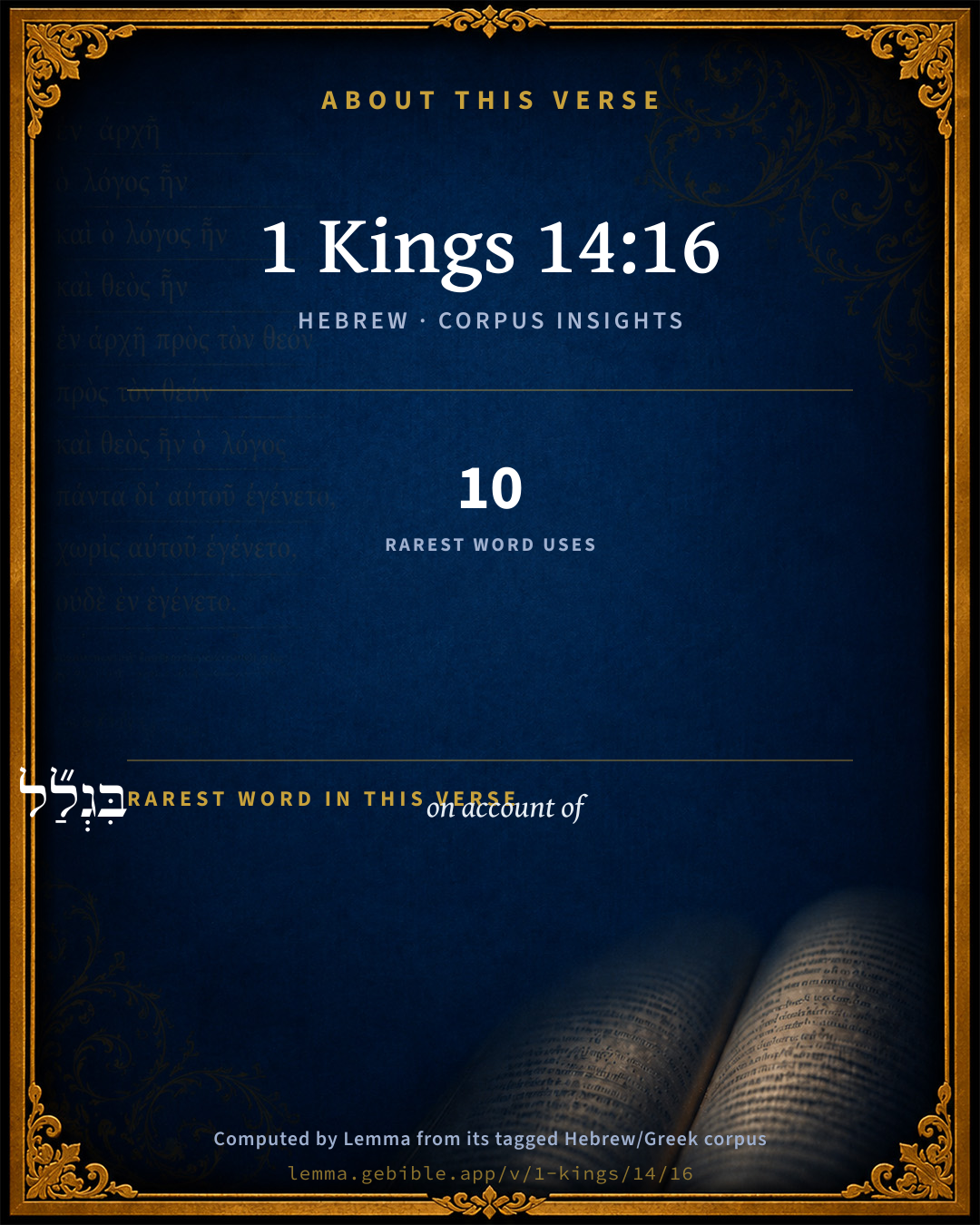
The rarest word here is בִּגְלַ֞ל on account of H1558 — appearing just 10 times in the whole Hebrew Bible.

Shared distinctive vocabulary

בִּגְלַ֞ל on account of H1558 occurs in 10 verses of the Hebrew Bible. Also found in:

Grammatical profile

  • 3 verbs
  • 5 nouns
  • 4 particles

Verb forms

  • וְיִתֵּ֖ן Qal · Imperfect
  • חָטָ֔א Qal · Perfect
  • הֶחֱטִ֖יא Hiphil · Perfect

Repetition

Words recur within this verse — often emphatic in Hebrew:

  • יִשְׂרָאֵ֑ל Israel H3478 ×2
  • חָטָ֔א to sin H2398 ×2
  • אֲשֶׁ֣ר which H834 ×2

Cross-references

16

Topical passages linked to 1 Kings 14:16 in the Treasury of Scripture Knowledge — connected by theme and wording, ordered by reader-vote popularity; previews shown in the World English Bible.

  • 1 Kings 13:34 This thing became sin to the house of Jeroboam, even to cut it off, and to destroy it from off the surface of the earth.
  • 1 Kings 15:30 for the sins of Jeroboam which he sinned, and with which he made Israel to sin, because of his provocation with which he provoked Yahweh, the God of Israel, to anger.
  • 1 Kings 15:34 He did that which was evil in the sight of Yahweh, and walked in the way of Jeroboam, and in his sin with which he made Israel to sin.
  • 1 Kings 16:2 Because I exalted you out of the dust, and made you prince over my people Israel, and you have walked in the way of Jeroboam, and have made my people Israel to sin, to provoke me to anger with their sins;
  • 1 Kings 12:30 This thing became a sin; for the people went [to worship] before the one, even to Dan.
  • Exodus 32:21 Moses said to Aaron, "What did these people do to you, that you have brought a great sin on them?"
  • Exodus 32:35 Yahweh struck the people, because they made the calf, which Aaron made.
  • Psalms 81:12 So I let them go after the stubbornness of their hearts, That they might walk in their own counsels.
  • Isaiah 40:24 Yes, they have not been planted; yes, they have not been sown; yes, their stock has not taken root in the earth: moreover he blows on them, and they wither, and the whirlwind takes them away as stubble.
  • Jeremiah 5:31 the prophets prophesy falsely, and the priests bear rule by their means; and my people love to have it so: and what will you do in the end of it?
  • Hosea 5:11–12 Ephraim is oppressed, He is crushed in judgment; Because he is intent in his pursuit of idols.
  • Hosea 9:11–12 As for Ephraim, their glory will fly away like a bird. There will be no birth, none with child, and no conception.
  • Hosea 9:16–17 Ephraim is struck. Their root has dried up. They will bear no fruit. Even though they bring forth, yet I will kill the beloved ones of their womb."
  • Micah 6:16 For the statutes of Omri are kept, And all the works of the house of Ahab. You walk in their counsels, That I may make you a ruin, And her inhabitants a hissing; And you will bear the reproach of my people."
  • Matthew 18:7 "Woe to the world because of occasions of stumbling! For it must be that the occasions come, but woe to that person through whom the occasion comes!
  • Romans 14:13 Therefore let's not judge one another any more, but judge this rather, that no man put a stumbling block in his brother's way, or an occasion for falling.

Cross-references courtesy of OpenBible.info (CC BY 4.0).

Hebrew and Greek witnesses Masoretic Hebrew ↔ Greek Septuagint

The same verse in the two great witnesses to the Old Testament, shown verse-for-verse.

These are two independent witnesses, not word-aligned to each other, and the Septuagint is shown in lemma (dictionary) form.

Hebrew 1 Kings 14:16 Masoretic · Westminster Leningrad Codex

וְיִתֵּ֖ן אֶת יִשְׂרָאֵ֑ל בִּגְלַ֞ל חַטֹּ֤אות יָֽרָבְעָם֙ אֲשֶׁ֣ר חָטָ֔א וַאֲשֶׁ֥ר הֶחֱטִ֖יא אֶת יִשְׂרָאֵֽל

He will give Israel up because of the sins of Jeroboam, which he has sinned, and with which he has made Israel to sin.

World English Bible · Public Domain

Hebrew: Westminster Leningrad Codex (CC BY 4.0). Greek: Septuagint (public domain); English from a public-domain English Septuagint. How the Septuagint differs from the Hebrew →

Targum (Aramaic paraphrase)

1

The Targum is the ancient Jewish Aramaic paraphrase of the Hebrew Scriptures — an interpretive translation, not the Hebrew text itself. Onkelos (literal) and Pseudo-Jonathan (expansive) render the Torah, and Jonathan the Prophets. Coverage is partial: where no permissively-licensed English translation exists for a verse, only the Aramaic is shown. This is verse-level text, not a word-by-word alignment to the Hebrew.

  1. Targum Jonathan Prophets (Joshua–Malachi)
    וְיִמְסַר יַת יִשְׂרָאֵל בְּדִיל חוֹבֵי יָרָבְעָם דְחַב וּדְחַיֵיב יַת יִשְׂרָאֵל:

    (no public-domain English translation for this verse)

    Targum Jonathan — Aramaic: “Mikraot Gedolot” (public domain). English: “Sefaria Community Translation” (CC0 1.0 (public-domain dedication)); “London "Chaldee Paraphrase," 1871” (public domain). Text via Sefaria.

Commentary

Notes on 1 Kings 14:16 from classic Christian and Jewish commentators (each source and its license shown beneath its notes). The classic Christian expositions comment on the surrounding passage and are grouped to its opening verse, so a note may address several verses; the Jewish commentaries on the Tanakh (Rashi and others) are per-verse, so they appear only where the commentator wrote on this verse.

Lemma curates 59 commentaries, every one of them public domain or Creative Commons licensed, each selected and text-cleaned for this edition rather than reprinted as found. About our sources →

Trapp's Complete Commentary

John Trapp

1Ki 14:16 And he shall give Israel up because of the sins of Jeroboam, who did sin, and who made Israel to sin.

Ver. 16. And he shall give Israel up because of the sins of Jeroboam.] Whereunto they consented, being "carried away unto those dumb idols, even as they were led." {1Co 12:2}

John Trapp, A Commentary or Exposition upon All the Books of the Old and New Testament (1647–1656) — public domain. Text from a community e-Sword module.

The Biblical Illustrator

Joseph S. Exell

1Ki_14:16

Jeroboam, who did sin, and who made Israel to sin.

The sin of making others to sin

1. Here we see the tendency of sin to produce sin--to go on propagating sin; here is the connection between the first sinner, who sets the thing in motion--a connection, clear to the eye of God--between him and the very lass result. The Bible does not create this--that book is not accountable for it; for if you had not the Bible, or if you put it out of the question altogether, there is still the fact in the nature of things. People nowadays are perpetually wanting us to keep away from the supernatural revelation, and to take our stand on the natural. Very well. Let us now look at it in that way. I mean to say it is just the natural course of things. Whether there is a God or not, does not alter the question. Put that aside for the moment, and just hear the reality as seen amongst us. The thing is an obvious, absolute fact, wherever it came from, that bad men make bad men--the corrupt produces corruption, and the evil thought, word, or act exerts an influence and propagates itself. Take a man that is dead and buried, and who has been in his grave a hundred years, and you can conceive of his mind coming actually into direct contact with the minds of the present generation, and producing a corrupting influence upon them. Well, then, imagine a man--picture to yourselves the writer of a popular book, aiming to overturn the faith of the young, the indiscreet, and unlearned. Supposing such a man to write such a book which continues to be circulated from generation to generation; copies of it are multiplied and sent forth. Young minds come into contact with it; these minds are corrupted by it; they are defiled and led away from the faith, giving up their confidence in God, and perhaps seduced to what is immoral. Do you not see that though he has been dead two or three hundred years, this author has still a living presence in society? His mind is coming into contact with other living minds; and thus, though dead, he yet speaketh--speaketh against God--speaketh with blasphemy--speaketh to corrupt--and men are thereby corrupted, and taught to blaspheme, and he is thus living, speaking, and operating till the present day by the printing and publication of that work.

2. I want you to see, in the next place, that there is no help for this. On purely natural principles it cannot be helped. If you could get all the readers of Tom Paine to give up their bad books, and agree that they should all be burned, would it not be a miracle? I should like you to try to get that done! But you must do more than that--you must not only destroy the books, but you must annihilate all the impressions on their memories and their hearts that this mans books have made, if you are to stop the evil influence he has set in motion by sinning and teaching others to sin.

3. If a bad man--a man that has sinned himself, and that has taught others to sin, seduced the innocent, sapped the foundations of virtue, destroyed the religious faith of men--supposing such a one to come to a better mind; supposing his heart is changed, and he becomes a penitent believer. He could never undo what he had done for the great mass of those on whom he had exerted a bad influence; and when he wanted to undo what he had done, and exert a good influence, they would just receive his words with mockery, and would go in the way he had led them at first. But even this could not be done. You know that it would be impossible for a man who has exerted a bad influence on others to collect them together and thus to reason with them. No! Before he comes to that better mind, some who were his associates, and whom he has influenced for evil, are dead and beyond his reach. Others are gone to the other side of the globe; and they are beyond his reach. He cannot find where these multitudes are; and they, because of what he did, have influenced others, and others have influenced again; and the thing has gone on, and it is not for him to know its ramifications and its consequences. Now this is the course of nature, and you cannot help it.

4. Now I want you again to make a supposition for the sake of argument. Supposing that there should be a future life; and supposing that, after death, the souls of men are awakened into a new life, with all the recollections of this--with all the memories of this? The only difference, in all probability, is that they would be delivered from what here darkens the judgment--from what here misleads the mind--and from what here hides a man from himself--and what hides from him the characteristics and properties of his sin. Suppose that he will waken into another life--that he will see things as they are in themselves, and see people as they are; and, perhaps, be able to see and to trace the connection between his sin and the sinning of others? Suppose that he will be able to see and trace the influence on generation after generation, of the evil that he did, and of the influence which he set in motion? Supposing that he should waken up, in this other life, to a moral perception of what he did while alive, and what he continues to do by the influences he then set in motion, and which continued to be a power in the world after he had departed? Well, now; only think of a man waking up to that! Where is it to end, supposing the human spirit does wake up to that? You must take your choice; that, I believe, is the real fact of the case. You must take your choice, looking at nature, at the course of things, at the real, awful, terrible facts of our existence! You must take your choice between two things--either that there is nothing but nature, or that there is a fixed course of things, and we must look forward, both in this world and in the next; and, depend upon it, nature never deceives with respect to those great instincts that she has planted In all her creatures. There is not an instinct, in all animated being, which has not an appropriate good. I only state this. Take your choice. You must believe either that nature is all you have, or you must believe that God in His mercy and grace, and looking down on our condition in its natural state of sin, has done something above nature to reach us--to lead us up--to give us hope!

5. The Gospel comes to destroy the spiritual consequences of your sin, and, through repentance, and faith in God, to give you a hope in mercy, and to save your souls; but as long as you continue unfaithful, you continue subject to the course of nature; and any consequences of sin which you have brought on yourself must be taken to the grave with you, and the Gospel will not help you out of it. If you ruin your health by vice, or your character by crime, you may repent, and God will save you, and the interposition of His grace will sanctify your soul, and you may get to heaven; but it will not give you health, nor will it destroy the consequences which sin has brought on your body--it will not set you in society where you were befog--you will still be remembered as having been a criminal and dishonest man, as long as you live; and though people may rejoice at your conversion, and hope for the best, you will never stand where you once did stand in society. Never! There is another thing I am obliged to submit to. I do not understand it. It is a matter of faith, and I say I do not know how it can be, but I believe that it is, in some way or other. That is to say, I believe this--that a very great sinner, who has led a great many into sin, and been the means of the utter destruction and corruption of many, influentially--well, it is a great mystery, but I believe the Gospel is such, that the grace of God can so operate that that soul may hereafter enjoy repose! It is wonderful to think it; but I believe the Gospel makes a provision for it--I believe that it is within the resources of Gods omnipotent mercy, that that soul may be happy in God, notwithstanding the consequences of its sin are going on injuring others! He will go to the grave mourning over that; but then his soul will enter into repose, though these consequences still remain going on. (T. Binney.)

The Biblical Illustrator, edited by Joseph S. Exell (c. 1880s–1900s) — public domain. Text from a community e-Sword module.

Geneva Bible (1599)

Geneva Bible translators

The people shall not be excused when they do evil at the commandment of their governors.

Geneva Bible (1599) marginal notes — public domain. Text via Bolls.life.

The Cambridge Bible for Schools and Colleges

gen. ed. J. J. S. Perowne

16. and he shall give Israel up] i.e. Into the hands of their enemies.

who did sin, and who made Israel to sin] It is better with R.V. to take the relative as refering to ‘the sin.’ Render, which he hath sinned and wherewith he hath made Israel to sin.

The Cambridge Bible for Schools and Colleges (gen. ed. J. J. S. Perowne; Cambridge University Press, 1878–1918) — public domain. Text from a community e-Sword module.

John Gill's Exposition

And Jeroboam's wife arose, and departed, Upon this speech of the prophet's to her:

and came to Tirzah; where Jeroboam now had his court, and where their son now was; it was a royal city in the time of the Canaanites, and is commonly placed in the tribe of Manasseh, and was a very pleasant one, as its name signifies, to which there is an allusion, Sol 6:4; see Gill on Jos 12:24,

and when she came to the threshold of the door, the child died: just as she was about to step over the threshold of the royal palace, which seems to have been at the entering of the city of Tirzah, Kg1 14:12.

John Gill's Exposition of the Whole Bible (1746–1763) — public domain (CC PDM 1.0). Text via the HelloAO Bible API.

Haydock's Catholic Bible Commentary

Sin. This is the common effect of evil example in kings. Plus exemplo quam peccato nocent. (Cicero, Leg. iii.) "As it is esteemed a sort of service to imitate the customs and vices of the king; they laid aside all piety, lest they might seem to upbraid the king with his impiety, if they should live in a virtuous manner." (Lactantius v. 6.) The crimes of kings are seldom confined to their own persons. (Calmet)

George Leo Haydock (1774–1849), Haydock's Catholic Family Bible and Commentary, 1859 edition — public domain. Excludes Psalms (Douay-Rheims chapter numbering differs from Protestant) and Deuterocanonical books (Catholic canon only).

Matthew Poole's English Annotations

To wit, by his invention, and making of the occasion of their sin, the calves; by his example, by encouraging those, and only those, that worshipped the calves; and by his authority, requiring and compelling them to do it. This is mentioned as a monstrous aggravation of his wickedness, that he was not content with his own sin, but was the great author and chief cause of drawing others into sin, and of corrupting and undoing the whole kingdom; which therefore God would never forgive him, nor forget him, but upon all occasions mentions him with this eternal brand of infamy upon him.

Matthew Poole's English Annotations on the Holy Bible (1683–1685) — public domain. Text from a community e-Sword/MySword module.

The Pulpit Commentary

And he shall or, that he should give Israel up because of the sins of Jeroboam, who did sin, and who made Israel to sin. These words became almost a formula (1Ki_15:33, 34 16:2, 19, etc.)

The Pulpit Commentary (1880–1919), ed. H.D.M. Spence-Jones & Joseph S. Exell — public domain. Text from a community e-Sword module.

John Wesley's Explanatory Notes

Who made, &c. - By his invention, and making the occasion of their sin, the calves; by his example, encouraging those and only those that worshipped the calves; and by his authority requiring and compelling them to do it. This is mentioned as a monstrous aggravation of his wickedness, that he was not content with his own sin, but was the great author of drawing others into sin, and of corrupting and undoing the whole kingdom, which therefore God would never forgive him, but upon all occasions mentions him with this eternal brand of infamy upon him.

John Wesley, Explanatory Notes Upon the Whole Bible (1754–1765) — public domain. Text via the GEBible commentary corpus.

Lesson kit

Teaching starters — assembled from the data on this page, not authored interpretation. Every prompt links to the verse data it draws on. Edit before teaching.

1 Kings, in the Historical, opens this verse with 12 words (8 distinct Hebrew lemmas). Its most distinctive word is gâlâl (“on account of”). A historical commentator’s framing appears above. Read the whole chapter for the surrounding context.

Discussion questions

  1. How does “on account of” (gâlâl) shape what this verse is saying?
  2. How does Genesis 12:13, which shares the word «on account of», read alongside this verse?
  3. What does the repetition of “Israel” (2× in this one verse) do in this verse?
  4. The translations on this page render this verse differently — a whole-verse word diff, not a word-by-word alignment. What might account for the different wordings?
  5. «וְיִתֵּ֖ן» is a Qal Imperfect verb. How does that grammatical form shape the action described?
  6. Compare how Trapp's Complete Commentary and The Biblical Illustrator read this verse. Where do they agree or differ?

Things to notice

Reading settings

Reading text

Shown beneath each verse's original-language words.

Old Testament
Old Testament edition

Read the OT as the Masoretic Hebrew (MT) or the Greek Septuagint (LXX).

English shown for the Greek Septuagint (in the Hebrew ↔ Greek comparison).

Comparing translations? Open the Compare panel on any verse page to stack up to four side by side.