
1 Kings 16:19

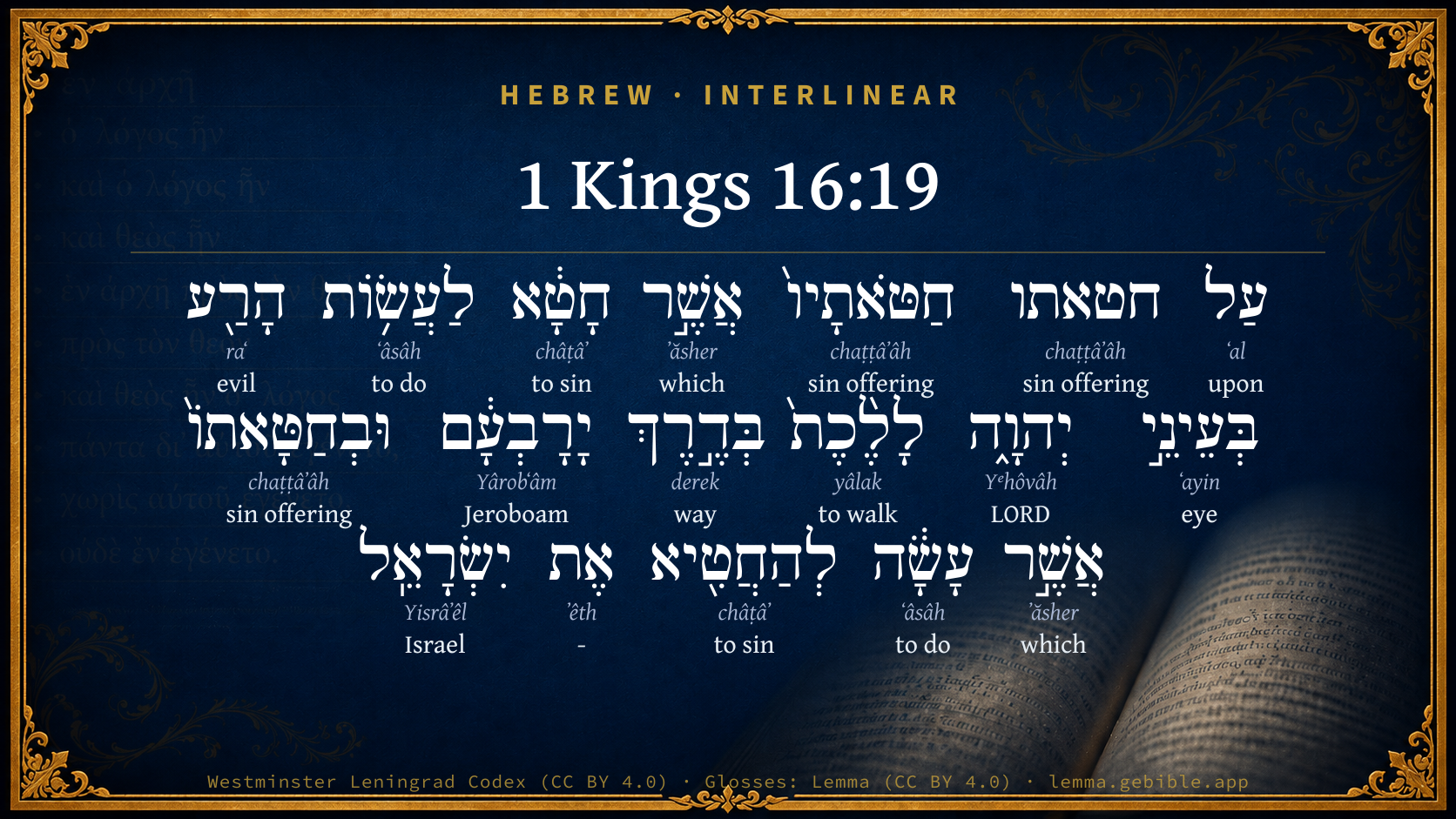
Hebrew (Westminster Leningrad Codex) 1 Kings 16:19 appears in the Hebrew Old Testament. The text above is from the Westminster Leningrad Codex. Each word links to its Strong’s number, a concise gloss, and parsing drawn from the Open Scriptures Hebrew Bible morphology. Click any word for its full Brown-Driver-Briggs (BDB) entry.
Download image
Cite this verse

1 Kings 16:19 (World English Bible). Public Domain. Lemma interlinear Bible study tool, https://lemma.gebible.app/v/1-kings/16/19.

Show BibTeX & RIS
BibTeX
RIS
English Translation
for his sins which he sinned in doing that which was evil in the sight of Yahweh, in walking in the way of Jeroboam, and in his sin which he did, to make Israel to sin.
World English Bible · Public Domain
Download a study sheet

One document with this verse’s original text, its word-by-word gloss line, the meaning frame, cross-references with their text, attributed commentary, and full source and license credits — printable, and it pastes into notes with its structure intact.

This verse Autodidact and up

Study sheet (.html) Plain text (.txt)

A passage Seminary Student

Up to 50 verses in one chapter. A passage sheet keeps up to 6 commentary sources and 12 cross-references per verse, in the order this page ranks them, and says so on the sheet whenever that leaves anything out. Ask for a single verse and you get the Autodidact verse sheet above.

Everything on this page stays free to read, with no account — the sheet is a download of what is already on screen, not access to it.

Want to remove ads? Support Godless Engineer
Compare translations 3

The same verse in 3 English versions, stacked beneath the original-language interlinear above. Click any original word for its lexicon entry.

Each is an independent rendering of the whole verse — the interlinear is not word-aligned to these translations.

Highlighted words mark where these versions differ — a whole-verse word diff, not a word-by-word alignment.

  • World English Bible Public Domain
    for his sins which he sinned in doing that which was evil in the sight of Yahweh, in walking in the way of Jeroboam, and in his sin which he did, to make Israel to sin.
  • King James Version Public Domain
    For his sins which he sinned in doing evil in the sight of the LORD, in walking in the way of Jeroboam, and in his sin which he did, to make Israel to sin.
  • unfoldingWord Literal Text CC BY-SA 4.0
    because of his sin that he sinned by doing evil in the eyes of Yahweh, by walking in the way of Jeroboam and in his sin that he did, causing Israel to sin.

unfoldingWord Literal Text — © unfoldingWord, licensed CC BY-SA 4.0. Word-aligned USFM3 via Door43 (git.door43.org/unfoldingWord/en_ult).

Versions to compare (up to 4)

3 of 4 selected

Show all 18 translations

Every available English version of this verse, each an independent rendering of the whole verse.

  • World English Bible Public Domain
    for his sins which he sinned in doing that which was evil in the sight of Yahweh, in walking in the way of Jeroboam, and in his sin which he did, to make Israel to sin.
  • Berean Standard Bible Public Domain
    because of the sins he had committed, doing evil in the sight of the LORD and following the example of Jeroboam and the sin he had committed and had caused Israel to commit.
  • Majority Standard Bible Public Domain
    because of the sins he had committed, doing evil in the sight of the LORD and following the example of Jeroboam and the sin he had committed and had caused Israel to commit.
  • King James Version Public Domain
    For his sins which he sinned in doing evil in the sight of the LORD, in walking in the way of Jeroboam, and in his sin which he did, to make Israel to sin.
  • American Standard Version (1901) Public Domain
    for his sins which he sinned in doing that which was evil in the sight of Jehovah, in walking in the way of Jeroboam, and in his sin which he did, to make Israel to sin.
  • Revised Version (1885) Public Domain
    for his sins which he sinned in doing that which was evil in the sight of the LORD, in walking in the way of Jeroboam, and in his sin which he did, to make Israel to sin.
  • Geneva Bible (1599) Public Domain
    For his sinnes which hee sinned, in doing that which is euil in the sight of the Lord, in walking in the way of Ieroboam, and in his sinnes which he did, causing Israel to sinne.
  • Douay-Rheims (1899) Public Domain
    In his sins, which he had sinned, doing evil before the Lord, and walking in the way of Jeroboam, and in his sin, wherewith he made Israel to sin.
  • Young's Literal Translation Public Domain
    for his sins that he sinned, to do the evil thing in the eyes of Jehovah, to walk in the way of Jeroboam, and in his sin that he did, to cause Israel to sin;
  • Literal Standard Version CC BY-SA 4.0
    for his sins that he sinned, to do evil in the eyes of YHWH, to walk in the way of Jeroboam, and in his sin that he did, to cause Israel to sin;
  • Unlocked Literal Bible CC BY-SA 4.0
    This was for the sins that he had committed in doing what was evil in the sight of Yahweh, by walking in the way of Jeroboam and in the sin that he had committed, so as to lead Israel to sin.
  • unfoldingWord Literal Text CC BY-SA 4.0
    because of his sin that he sinned by doing evil in the eyes of Yahweh, by walking in the way of Jeroboam and in his sin that he did, causing Israel to sin.
  • Darby Bible Public Domain
    and he died for his sins which he sinned in doing evil in the sight of Jehovah, in walking in the way of Jeroboam, and in his sin which he did, making Israel to sin.
  • World Messianic Bible Public Domain
    for his sins which he sinned in doing that which was evil in the LORD’s sight, in walking in the way of Jeroboam, and in his sin which he did to make Israel to sin.
  • Webster's Bible Public Domain
    For his sins which he sinned in doing evil in the sight of the LORD, in walking in the way of Jeroboam, and in his sin which he did, to make Israel to sin.
  • Free Bible Version CC BY-SA 4.0
    He did evil in the Lord's sight and followed the way of Jeroboam and his sin which he had made Israel commit.
  • Bible in Basic English Public Domain
    Because of his sin in doing evil in the eyes of the Lord, in going in the way of Jeroboam and in his sin which he made Israel do.
  • JPS Tanakh (1917) Public Domain
    for his sins which he sinned in doing that which was evil in the sight of the LORD, in walking in the way of Jeroboam, and in his sin which he did, to make Israel to sin.

Literal Standard Version (2020), Covenant Press — licensed CC BY-SA 4.0. Text via the HelloAO Bible API (eBible.org). Unlocked Literal Bible (unfoldingWord) — licensed CC BY-SA 4.0. Text via the HelloAO Bible API (eBible.org). unfoldingWord Literal Text — © unfoldingWord, licensed CC BY-SA 4.0. Word-aligned USFM3 via Door43 (git.door43.org/unfoldingWord/en_ult). Free Bible Version, Dr. Jonathan Gallagher — licensed CC BY-SA 4.0. Text via the HelloAO Bible API (eBible.org).

Word by word

More ways to search: Search by grammar → Find every occurrence → Compare this word →

Practice this passage: Drill this verse → Learn its vocabulary →

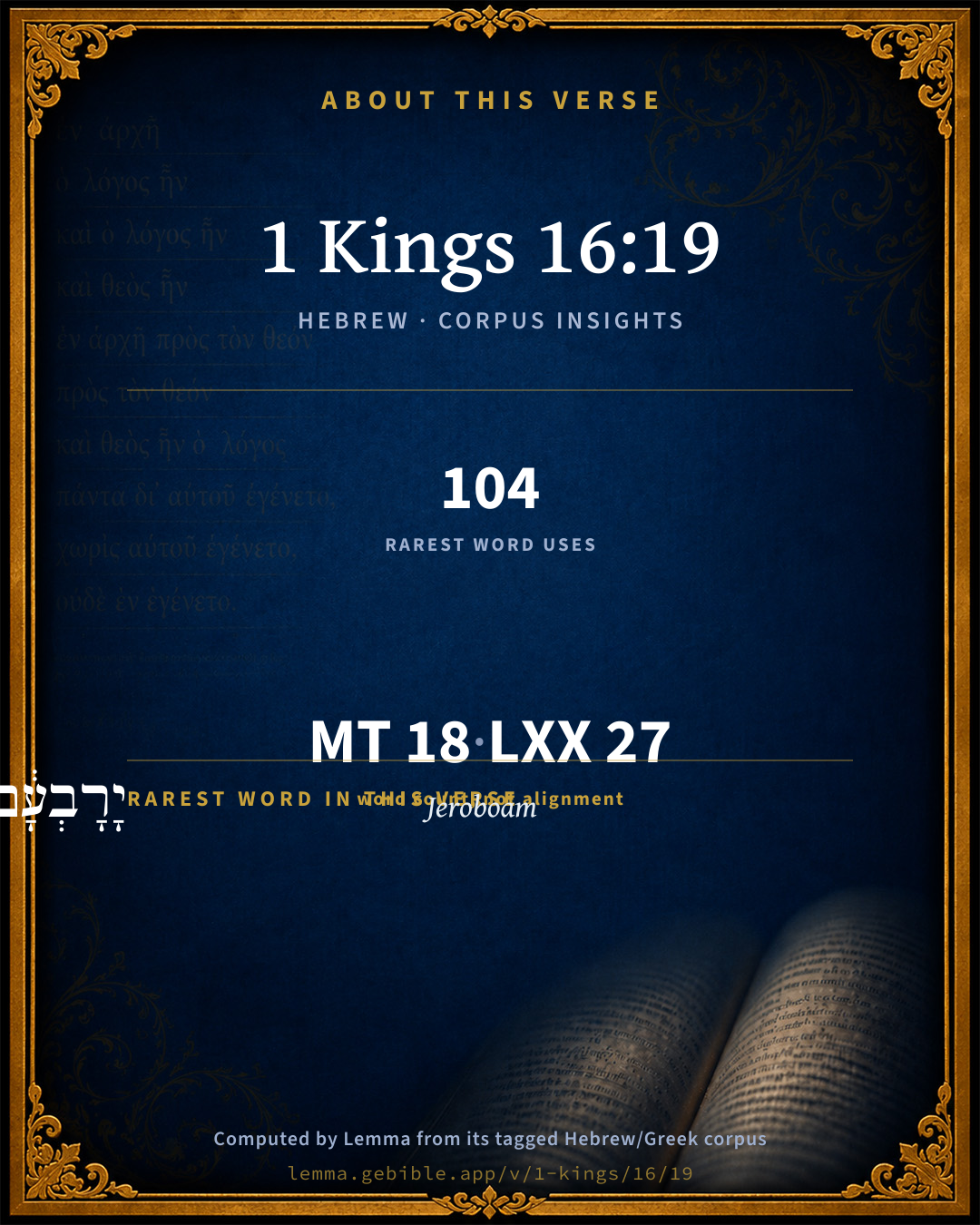
יָרָבְעָ֔ם
Yârobʻâm
H3379
“Jeroboam”
Noun, Proper
Part of Speech
Noun
Type
Proper
Full BDB Definition

Origin: from H7378 and H5971

TWOT: None

Jeroboam = "the people will contend" - the first king of the northern kingdom of Israel when the kingdom split at the death of Solomon and the 10 tribes split off from Judah and Benjamin and the kingdom under Solomon's son Rehoboam; idolatry was introduced at the beginning of his reign - the 8th king of the northern kingdom of Israel, son of Joash, and
  1. עַל ʻal H5921 “upon” Preposition
  2. חטאתו chaṭṭâʼâh H2403 “sin offering · his” Noun, Common, Feminine, Singular, Construct + Suffix, Personal, 3rd Person, Masculine, Singular
  3. חַטֹּאתָיו֙ chaṭṭâʼâh H2403 “sin offerings · his” Noun, Common, Feminine, Plural, Construct + Suffix, Personal, 3rd Person, Masculine, Singular
  4. אֲשֶׁ֣ר ʼăsher H834 “which” Particle, Relative
  5. חָטָ֔א châṭâʼ H2398 “to sin” Verb, Qal, Perfect, 3rd Person, Masculine, Singular
  6. לַעֲשׂ֥וֹת ʻâsâh H6213 “to do” Preposition + Verb, Qal, Infinitive Construct
  7. הָרַ֖ע raʻ H7451 “the · evil” Particle, Definite Article + Adjective, Adjective, Masculine, Singular, Absolute
  8. בְּעֵינֵ֣י ʻayin H5869 “in/at · eyes of” Preposition + Noun, Common, Both, Dual, Construct
  9. יְהוָ֑ה Yᵉhôvâh H3068 “LORD” Noun, Proper
  10. לָלֶ֨כֶת֙ yâlak H3212 “to walk” Preposition + Verb, Qal, Infinitive Construct
  11. בְּדֶ֣רֶךְ derek H1870 “in/at · way of” Preposition + Noun, Common, Both, Singular, Construct
  12. וּבְחַטָּאתוֹ֙ chaṭṭâʼâh H2403 “and · in/at · sin offering · his” Conjunction + Preposition + Noun, Common, Feminine, Singular, Construct + Suffix, Personal, 3rd Person, Masculine, Singular
  13. אֲשֶׁ֣ר ʼăsher H834 “which” Particle, Relative
  14. עָשָׂ֔ה ʻâsâh H6213 “to do” Verb, Qal, Perfect, 3rd Person, Masculine, Singular
  15. לְהַחֲטִ֖יא châṭâʼ H2398 “to sin” Preposition + Verb, Hiphil, Infinitive Construct
  16. אֶת ʼêth H853 “-” Particle, Direct Object
  17. יִשְׂרָאֵֽל Yisrâʼêl H3478 “Israel” Noun, Proper

About this verse

These counts appear in no published source. They are computed here, from the morphology-tagged text and Lemma’s own curated glosses. What Lemma adds →

18
words
13
distinct lemmas
Historical
section

Grammatical profile

  • 5 verbs
  • 8 nouns
  • 1 adjective
  • 1 preposition
  • 3 particles

Verb forms

  • חָטָ֔א Qal · Perfect
  • לַעֲשׂ֥וֹת Qal · Infinitive Construct
  • לָלֶ֨כֶת֙ Qal · Infinitive Construct
  • עָשָׂ֔ה Qal · Perfect
  • לְהַחֲטִ֖יא Hiphil · Infinitive Construct

Repetition

Words recur within this verse — often emphatic in Hebrew:

  • חטאתו sin offering H2403 ×3
  • חָטָ֔א to sin H2398 ×2
  • לַעֲשׂ֥וֹת to do H6213 ×2
  • אֲשֶׁ֣ר which H834 ×2

Hebrew & Septuagint length

In English translation the verse runs 36 words from the Hebrew and 41 from the Septuagint (LXX English) — closely comparable.

A rough comparison of the two English renderings, which tokenize alike — not a word-level alignment.

Word counts can differ between the Hebrew and the Greek without any difference in meaning — e.g. the Hebrew direct-object marker אֵת has no separate Greek word, and Greek often adds the article ὁ.

In the original languages it is 18 Hebrew tokens and 27 Greek tokens — but the two are counted differently (Hebrew bundles its prefixes and suffixes into one token; the Greek is in lemma form), so that isn’t a like-for-like length.

Cross-references

9

Topical passages linked to 1 Kings 16:19 in the Treasury of Scripture Knowledge — connected by theme and wording, ordered by reader-vote popularity; previews shown in the World English Bible.

  • 1 Kings 15:26 He did that which was evil in the sight of Yahweh, and walked in the way of his father, and in his sin with which he made Israel to sin.
  • 1 Kings 12:28 Whereupon the king took counsel, and made two calves of gold; and he said to them, It is too much for you to go up to Jerusalem: see your gods, Israel, which brought you up out of the land of Egypt.
  • 1 Kings 14:16 He will give Israel up because of the sins of Jeroboam, which he has sinned, and with which he has made Israel to sin.
  • 1 Kings 15:34 He did that which was evil in the sight of Yahweh, and walked in the way of Jeroboam, and in his sin with which he made Israel to sin.
  • 1 Kings 15:30 for the sins of Jeroboam which he sinned, and with which he made Israel to sin, because of his provocation with which he provoked Yahweh, the God of Israel, to anger.
  • 1 Kings 16:7 Moreover by the prophet Jehu the son of Hanani came the word of Yahweh against Baasha, and against his house, both because of all the evil that he did in the sight of Yahweh, to provoke him to anger with the work of his hands, in being like the house of Jeroboam, and because he struck him.
  • 1 Kings 16:13 for all the sins of Baasha, and the sins of Elah his son, which they sinned, and with which they made Israel to sin, to provoke Yahweh, the God of Israel, to anger with their vanities.
  • Psalms 9:16 Yahweh has made himself known. He has executed judgment. The wicked is snared by the work of his own hands. Meditation. Selah.
  • Psalms 58:9–11 Before your pots can feel the heat of the thorns, He will sweep away the green and the burning alike.

Cross-references courtesy of OpenBible.info (CC BY 4.0).

Hebrew and Greek witnesses Masoretic Hebrew ↔ Greek Septuagint

The same verse in the two great witnesses to the Old Testament, shown verse-for-verse.

These are two independent witnesses, not word-aligned to each other, and the Septuagint is shown in lemma (dictionary) form.

Hebrew 1 Kings 16:19 Masoretic · Westminster Leningrad Codex

עַל חטאתו חַטֹּאתָיו֙ אֲשֶׁ֣ר חָטָ֔א לַעֲשׂ֥וֹת הָרַ֖ע בְּעֵינֵ֣י יְהוָ֑ה לָלֶ֨כֶת֙ בְּדֶ֣רֶךְ יָרָבְעָ֔ם וּבְחַטָּאתוֹ֙ אֲשֶׁ֣ר עָשָׂ֔ה לְהַחֲטִ֖יא אֶת יִשְׂרָאֵֽל

for his sins which he sinned in doing that which was evil in the sight of Yahweh, in walking in the way of Jeroboam, and in his sin which he did, to make Israel to sin.

World English Bible · Public Domain

Greek LXX 1 Kings 16:19 Septuagint · lemma form

ὑπέρ ὁ ἁμαρτία αὐτός ὅς ποιέω ὁ ποιέω ὁ πονηρός ἐνώπιον κύριος πορεύομαι ἐν ὁδός ιεροβοαμ υἱός ναβατ καί ἐν ὁ ἁμαρτία αὐτός ὡς ἐκἁμαρτάνω ὁ ἰσραήλ

Because of his sins which he committed, doing that which was evil in the sight of the Lord, so as to walk in the way of Jeroboam the son of Nabat, and in his sins wherein he caused Israel to sin.

LXX2012 (modern English Septuagint) · Public Domain

Hebrew: Westminster Leningrad Codex (CC BY 4.0). Greek: Septuagint (public domain); English from LXX2012 (modern English Septuagint) (Public Domain). How the Septuagint differs from the Hebrew →

Targum (Aramaic paraphrase)

1

The Targum is the ancient Jewish Aramaic paraphrase of the Hebrew Scriptures — an interpretive translation, not the Hebrew text itself. Onkelos (literal) and Pseudo-Jonathan (expansive) render the Torah, and Jonathan the Prophets. Coverage is partial: where no permissively-licensed English translation exists for a verse, only the Aramaic is shown. This is verse-level text, not a word-by-word alignment to the Hebrew.

  1. Targum Jonathan Prophets (Joshua–Malachi)
    עַל כָּל חוֹבַיָא דִי חַב לְמֶעְבַד דְבִישׁ קֳדָם יְיָ לְמֵיזַל בְּאוֹרַח יָרָבְעָם וּבְחוֹבֵיהּ דִי עֲבַד לְחַיָבָא יַת יִשְׂרָאֵל:

    (no public-domain English translation for this verse)

    Targum Jonathan — Aramaic: “Mikraot Gedolot” (public domain). English: “Sefaria Community Translation” (CC0 1.0 (public-domain dedication)); “London "Chaldee Paraphrase," 1871” (public domain). Text via Sefaria.

Commentary

Notes on 1 Kings 16:19 from classic Christian and Jewish commentators (each source and its license shown beneath its notes). The classic Christian expositions comment on the surrounding passage and are grouped to its opening verse, so a note may address several verses; the Jewish commentaries on the Tanakh (Rashi and others) are per-verse, so they appear only where the commentator wrote on this verse.

Lemma curates 59 commentaries, every one of them public domain or Creative Commons licensed, each selected and text-cleaned for this edition rather than reprinted as found. About our sources →

Trapp's Complete Commentary

John Trapp

1Ki 16:19 For his sins which he sinned in doing evil in the sight of the LORD, in walking in the way of Jeroboam, and in his sin which he did, to make Israel to sin.

Ver. 19. In doing evil.] So active was this man in a quick despatch of the deeds of darkness.

John Trapp, A Commentary or Exposition upon All the Books of the Old and New Testament (1647–1656) — public domain. Text from a community e-Sword module.

Joseph Benson's Commentary

1Ki 16:19. For his sins which he sinned — Though he lived but a very short time after he usurped the crown, yet he gave sufficient demonstration of his resolution to continue the idolatry of Jeroboam; and therefore he was abandoned by God. Add to this, the whole course of his life seems to have been wicked, and this is justly charged upon him because of his impenitency.

Joseph Benson's Commentary on the Old and New Testaments (1811–1818) — public domain. Text from a community e-Sword module.

Keil & Delitzsch

C. F. Keil & F. Delitzsch

Kg1 16:19 is connected with ויּמת in Kg1 16:18 : "and so died for his sins," i.e., as a punishment for them.

Keil & Delitzsch — Biblical Commentary on the Old Testament (1861–1891) — public domain (CC PDM 1.0). Text via the HelloAO Bible API. (Old Testament only.)

Jamieson, Fausset & Brown

Robert Jamieson, A. R. Fausset & David Brown

For his sins which he sinned--This violent end was a just retribution for his crimes. "His walking in the ways of Jeroboam" might have been manifested either by the previous course of his life, or by his decrees published on his ascension, when he made a strong effort to gain popularity by announcing his continued support of the calf worship.

Jamieson, Fausset & Brown — Commentary Critical and Explanatory on the Whole Bible (1871) — public domain (CC PDM 1.0). Text via the HelloAO Bible API.

Ellicott's Commentary for English Readers

(19) In walking in the way of Jeroboam.—The use here of this constantly-recurring phrase probably indicates only the historian’s sense of the curse lying on the whole kingdom from its idolatry, which Zimri did not attempt to repudiate; unless, perhaps, his conspiracy had clothed itself under pretence of a righteous zeal for the fulfilment of the prophecy of Jehu (1Ki_16:3-4), and had thrown off the religious pretence after the deed was done. For except in this way, he had no time for “walking in the way of Jeroboam.”

A Bible Commentary for English Readers, edited by Charles John Ellicott (1878–1897) — public domain. Text from a community e-Sword module.

The Cambridge Bible for Schools and Colleges

gen. ed. J. J. S. Perowne

19. in doing evil] See on 1Ki_15:34. There must have been in Zimri’s conduct some very prominent acts to indicate adhesion to the worship of the calves; otherwise in a reign of seven days he would hardly have been coupled with Jeroboam as leading the people into sin. Perhaps he endeavoured to win popularity in this way, so as to have on his side the bulk of the nation before the action of the army in the field became known.

did make Israel sin] R.V. to sin. There can be no reason for varying a phrase so stereotyped as this.

The Cambridge Bible for Schools and Colleges (gen. ed. J. J. S. Perowne; Cambridge University Press, 1878–1918) — public domain. Text from a community e-Sword module.

John Gill's Exposition

And he bought the hill of Samaria of Shemer, for two talents of silver,.... A talent of silver, according to Brerewood (f), was of our money three hundred and seventy five pounds, so that this hill was purchased at seven hundred and fifty pounds:

and built on the hill, and called the name of the city which he built, after the name of Shemer, owner of the hill, Samaria; its name from him was Shomeron, which is the Hebrew name for Samaria; which, according to Bunting (g) was six miles from Tirzah, and ever after the royal seat of the kings of Israel.

(f) De Ponder. & Pret. c. 4. (g) Ut supra, (Travels, &c.) p. 163.

John Gill's Exposition of the Whole Bible (1746–1763) — public domain (CC PDM 1.0). Text via the HelloAO Bible API.

Albert Barnes' Notes on the Bible

Zimri’s death illustrates the general moral which the writer of Kings draws from the whole history of the Israelite monarchs. that a curse was upon them on account of their persistence in Jeroboam’s sin, which, sooner or later, brought each royal house to a bloody end.

Albert Barnes' Notes on the Bible (1834–1885) — public domain. Text from a community e-Sword/MySword module.

Haydock's Catholic Bible Commentary

To sin. Zambri had sufficient time, in seven days, (Haydock) to manifest his evil dispositions, of which he had perhaps given proof before. (Calmet)

George Leo Haydock (1774–1849), Haydock's Catholic Family Bible and Commentary, 1859 edition — public domain. Excludes Psalms (Douay-Rheims chapter numbering differs from Protestant) and Deuterocanonical books (Catholic canon only).

Matthew Poole's English Annotations

For his sins, i.e. this befell him for his sins.

Walking in the way of Jeroboam; which he might do, either before his reign, in the whole course of his life, which is justly charged upon him, because of his impenitency; or in the seven days of his reign; in which he had time enough to publish his intentions or decrees about the continuance of the worship of the calves; or to sacrifice to them for his good success, either already obtained, or further desired.

Matthew Poole's English Annotations on the Holy Bible (1683–1685) — public domain. Text from a community e-Sword/MySword module.

The Pulpit Commentary

For his sins which he sinned in doing evil in the sight of the Lord, in walking in the way of Jeroboam, and in his sin which he did, to make Israel to sin. It is quite clear that in his reign of one week Zimri cannot have done much to show his complicity in the schism of Jeroboam, and it is probable that the sacred writer means that his character and antecedents were such as to prove that all his sympathies were with the irreligious party. Bahr thinks that he had "formerly displayed much partiality for the calf worship." But it is quite as likely that the idea in the historian"s mind was that all these events were the bitter fruits of Jeroboam"s misguided and impious policy, into the spirit of which, Zimri, like his predecessors, had been baptized. It is interesting to remember here the aspect these repeated revolutions and assassinations would wear to the kingdom of Judah, then enjoying quietness and prosperity under Asa. We cannot doubt for a moment that they were regarded as so many manifestations of the righteous judgment of God, and as the outcomes of that spirit of insubordination and impiety which, in their eyes, had brought about both the division of the kingdom and the schism in the church.

The Pulpit Commentary (1880–1919), ed. H.D.M. Spence-Jones & Joseph S. Exell — public domain. Text from a community e-Sword module.

John Wesley's Explanatory Notes

For his sins - This befell him for his sins. In walking, &c. - This he might do, either before his reign, in the whole course of his life, which is justly charged upon him, because of his impenitency: or during his short reign; in which, he had time enough to publish his intentions, about the worship of the calves; or to sacrifice to them, for his good success.

John Wesley, Explanatory Notes Upon the Whole Bible (1754–1765) — public domain. Text via the GEBible commentary corpus.

Lesson kit

Teaching starters — assembled from the data on this page, not authored interpretation. Every prompt links to the verse data it draws on. Edit before teaching.

1 Kings, in the Historical, opens this verse with 18 words (13 distinct Hebrew lemmas). Its most distinctive word is Yârobʻâm (“Jeroboam”). A historical commentator’s framing appears above. Read the whole chapter for the surrounding context.

Discussion questions

  1. The word Yârobʻâm carries the sense “Jeroboam.” How does it shape the verse?
  2. 1 Kings 15:26 shares this passage’s theme. How do the two illuminate each other?
  3. “sin offering” occurs 3× in this one verse. What is the effect of the repetition?
  4. These translations render this verse differently; the difference is in the English rendering, not the original. What questions does that raise?
  5. The verb «חָטָ֔א» is Qal Perfect. How does its form color the action?
  6. Reading how Trapp's Complete Commentary and Joseph Benson's Commentary read this verse, where do the two commentators agree and where do they part?

Things to notice

Reading settings

Reading text

Shown beneath each verse's original-language words.

Old Testament
Old Testament edition

Read the OT as the Masoretic Hebrew (MT) or the Greek Septuagint (LXX).

English shown for the Greek Septuagint (in the Hebrew ↔ Greek comparison).

Comparing translations? Open the Compare panel on any verse page to stack up to four side by side.