
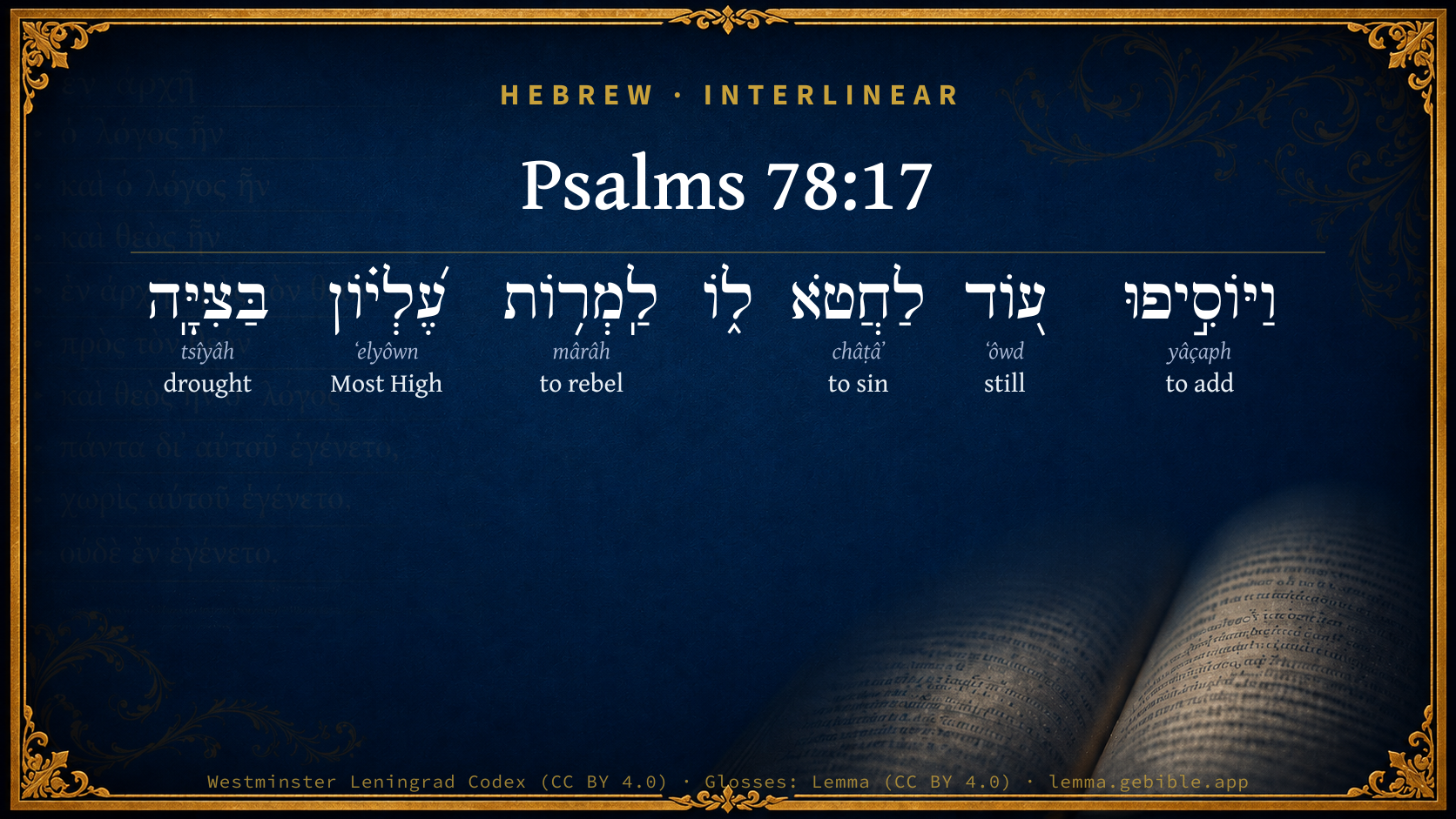
Psalms 78:17

Hebrew (Westminster Leningrad Codex) Psalms 78:17 appears in the Hebrew Old Testament. The text above is from the Westminster Leningrad Codex. Each word links to its Strong’s number, a concise gloss, and parsing drawn from the Open Scriptures Hebrew Bible morphology. Click any word for its full Brown-Driver-Briggs (BDB) entry.
Download image
Cite this verse

Psalms 78:17 (World English Bible). Public Domain. Lemma interlinear Bible study tool, https://lemma.gebible.app/v/psalms/78/17.

Show BibTeX & RIS
BibTeX
RIS
English Translation
Yet they still went on to sin against him, To rebel against the Most High in the desert.
World English Bible · Public Domain
Download a study sheet

One document with this verse’s original text, its word-by-word gloss line, the meaning frame, cross-references with their text, attributed commentary, and full source and license credits — printable, and it pastes into notes with its structure intact.

This verse Autodidact and up

Study sheet (.html) Plain text (.txt)

A passage Seminary Student

Up to 50 verses in one chapter. A passage sheet keeps up to 6 commentary sources and 12 cross-references per verse, in the order this page ranks them, and says so on the sheet whenever that leaves anything out. Ask for a single verse and you get the Autodidact verse sheet above.

Everything on this page stays free to read, with no account — the sheet is a download of what is already on screen, not access to it.

Want to remove ads? Support Godless Engineer
Compare translations 3

The same verse in 3 English versions, stacked beneath the original-language interlinear above. Click any original word for its lexicon entry.

Each is an independent rendering of the whole verse — the interlinear is not word-aligned to these translations.

Highlighted words mark where these versions differ — a whole-verse word diff, not a word-by-word alignment.

  • World English Bible Public Domain
    Yet they still went on to sin against him, To rebel against the Most High in the desert.
  • King James Version Public Domain
    And they sinned yet more against him by provoking the most High in the wilderness.
  • unfoldingWord Literal Text CC BY-SA 4.0
    And they added still to sin against him, to rebel against the Most High in the dry land.

unfoldingWord Literal Text — © unfoldingWord, licensed CC BY-SA 4.0. Word-aligned USFM3 via Door43 (git.door43.org/unfoldingWord/en_ult).

Versions to compare (up to 4)

3 of 4 selected

Show all 18 translations

Every available English version of this verse, each an independent rendering of the whole verse.

  • World English Bible Public Domain
    Yet they still went on to sin against him, To rebel against the Most High in the desert.
  • Berean Standard Bible Public Domain
    But they continued to sin against Him, rebelling in the desert against the Most High.
  • Majority Standard Bible Public Domain
    But they continued to sin against Him, rebelling in the desert against the Most High.
  • King James Version Public Domain
    And they sinned yet more against him by provoking the most High in the wilderness.
  • American Standard Version (1901) Public Domain
    Yet went they on still to sin against him, To rebel against the Most High in the desert.
  • Revised Version (1885) Public Domain
    Yet went they on still to sin against him, to rebel against the Most High in the desert.
  • Geneva Bible (1599) Public Domain
    Yet they sinned stil against him, and prouoked the Highest in the wildernesse,
  • Douay-Rheims (1899) Public Domain
    And they added yet more sin against him: they provoked the most High to wrath in the place without water.
  • Young's Literal Translation Public Domain
    And they add still to sin against Him, To provoke the Most High in the dry place.
  • Literal Standard Version CC BY-SA 4.0
    And they still add to sin against Him, || To provoke the Most High in the dry place.
  • Unlocked Literal Bible CC BY-SA 4.0
    Yet they continued to sin against him, rebelling against the Most High in the wilderness.
  • unfoldingWord Literal Text CC BY-SA 4.0
    And they added still to sin against him, to rebel against the Most High in the dry land.
  • Darby Bible Public Domain
    Yet they still went on sinning against him, provoking the Most High in the desert;
  • World Messianic Bible Public Domain
    Yet they still went on to sin against him, to rebel against the Most High in the desert.
  • Webster's Bible Public Domain
    And they sinned yet more against him by provoking the Most High in the wilderness.
  • Free Bible Version CC BY-SA 4.0
    But they repeatedly sinned against him, rebelling against the Most High in the desert.
  • Bible in Basic English Public Domain
    And they went on sinning against him even more, turning away from the Most High in the waste land;
  • JPS Tanakh (1917) Public Domain
    Yet went they on still to sin against Him, to rebel against the Most High in the desert.

Literal Standard Version (2020), Covenant Press — licensed CC BY-SA 4.0. Text via the HelloAO Bible API (eBible.org). Unlocked Literal Bible (unfoldingWord) — licensed CC BY-SA 4.0. Text via the HelloAO Bible API (eBible.org). unfoldingWord Literal Text — © unfoldingWord, licensed CC BY-SA 4.0. Word-aligned USFM3 via Door43 (git.door43.org/unfoldingWord/en_ult). Free Bible Version, Dr. Jonathan Gallagher — licensed CC BY-SA 4.0. Text via the HelloAO Bible API (eBible.org).

Word by word

More ways to search: Search by grammar → Find every occurrence → Compare this word →

Practice this passage: Drill this verse → Learn its vocabulary →

About this verse

These counts appear in no published source. They are computed here, from the morphology-tagged text and Lemma’s own curated glosses. What Lemma adds →

7
words
6
distinct lemmas
Wisdom
section

Notable vocabulary

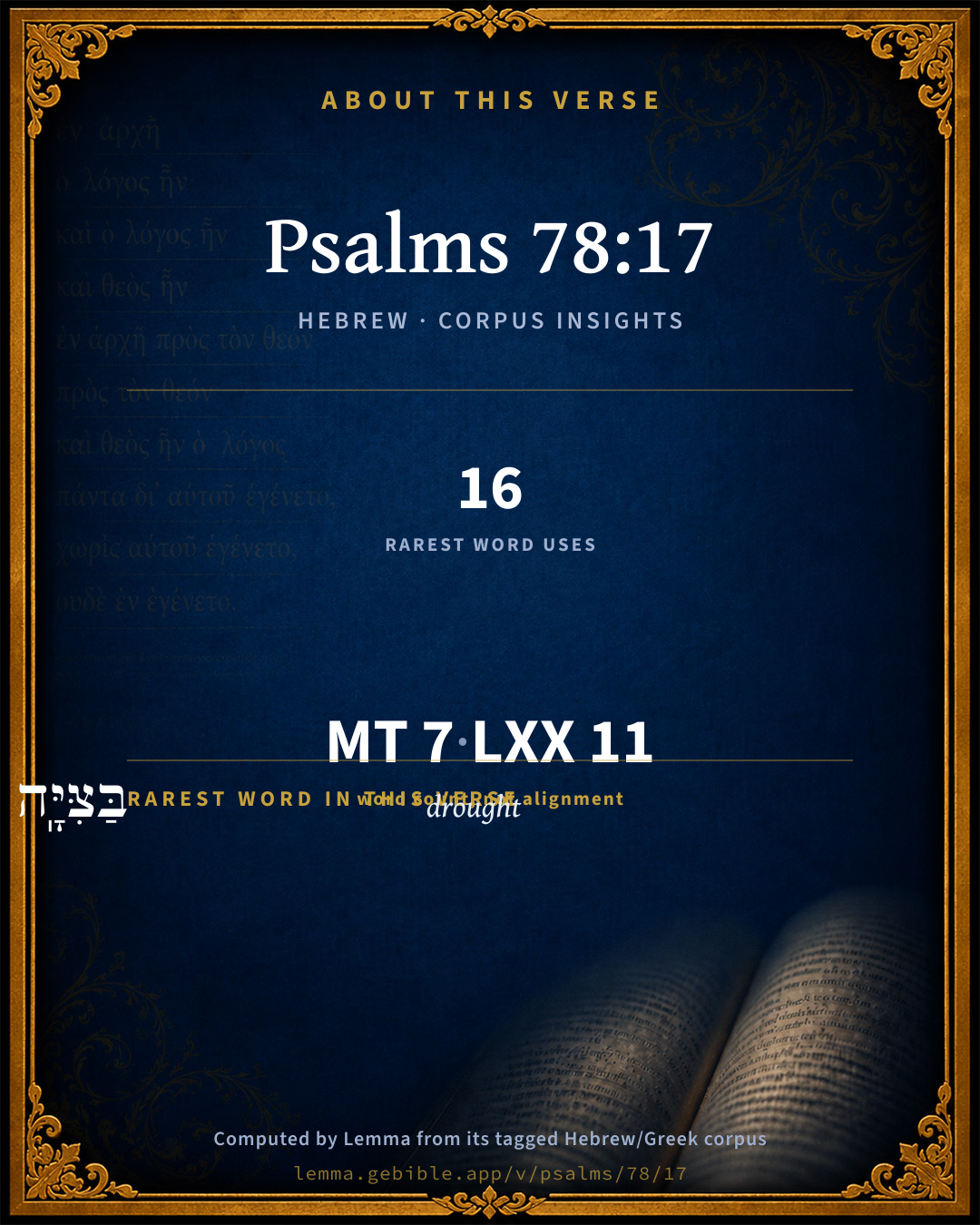
The rarest word here is בַּצִּיָּֽה drought H6723 — appearing just 16 times in the whole Hebrew Bible.

Shared distinctive vocabulary

בַּצִּיָּֽה drought H6723 occurs in 16 verses of the Hebrew Bible. Also found in:

Grammatical profile

  • 3 verbs
  • 1 noun
  • 1 adjective
  • 1 preposition
  • 1 adverb

Verb forms

  • וַיּוֹסִ֣יפוּ Hiphil · Sequential Imperfect
  • לַחֲטֹא Qal · Infinitive Construct
  • לַֽמְר֥וֹת Hiphil · Infinitive Construct

Hebrew & Septuagint length

In English translation the verse runs 18 words from the Hebrew and 15 from the Septuagint (LXX English) — closely comparable.

A rough comparison of the two English renderings, which tokenize alike — not a word-level alignment.

Word counts can differ between the Hebrew and the Greek without any difference in meaning — e.g. the Hebrew direct-object marker אֵת has no separate Greek word, and Greek often adds the article ὁ.

In the original languages it is 7 Hebrew tokens and 11 Greek tokens — but the two are counted differently (Hebrew bundles its prefixes and suffixes into one token; the Greek is in lemma form), so that isn’t a like-for-like length.

Cross-references

7

Topical passages linked to Psalms 78:17 in the Treasury of Scripture Knowledge — connected by theme and wording, ordered by reader-vote popularity; previews shown in the World English Bible.

  • Isaiah 63:10 But they rebelled, and grieved his holy Spirit: therefore he was turned to be their enemy, [and] himself fought against them.
  • Hebrews 3:16–19 For who, when they heard, rebelled? No, didn't all those who came out of Egypt by Moses?
  • Deuteronomy 9:8 Also in Horeb you provoked Yahweh to wrath, and Yahweh was angry with you to destroy you.
  • Deuteronomy 9:12–22 Yahweh said to me, Arise, get you down quickly from hence; for your people whom you have brought forth out of Egypt have corrupted themselves; they have quickly turned aside out of the way which I commanded them; they have made them a molten image.
  • Psalms 95:8–10 Don't harden your heart, as at Meribah, As in the day of Massah in the wilderness,
  • Psalms 106:13–32 They soon forgot his works. They didn't wait for his counsel,
  • Psalms 78:32 For all this they still sinned, And didn't believe in his wondrous works.

Cross-references courtesy of OpenBible.info (CC BY 4.0).

Hebrew and Greek witnesses Masoretic Hebrew ↔ Greek Septuagint

The same verse in the two great witnesses to the Old Testament, shown verse-for-verse.

You’re reading Greek Psalm 77 (Hebrew Psalm 78). The Septuagint counts the superscription, so verse numbers can differ from the Hebrew — chapter-level alignment, not verse-by-verse. Numbering follows Rahlfs.

These are two independent witnesses, not word-aligned to each other, and the Septuagint is shown in lemma (dictionary) form.

Hebrew Psalms 78:17 Masoretic · Westminster Leningrad Codex

וַיּוֹסִ֣יפוּ ע֭וֹד לַחֲטֹא ל֑וֹ לַֽמְר֥וֹת עֶ֝לְי֗וֹן בַּצִּיָּֽה

Yet they still went on to sin against him, To rebel against the Most High in the desert.

World English Bible · Public Domain

Greek LXX Greek Psalm 77:17 Septuagint · lemma form

καί προςτίθημι ἔτι ὁ ἁμαρτάνω αὐτός παραπικραίνω ὁ ὕψιστος ἐν ἄνυδρος

And they sinned yet more against him; they provoked the Most High in the wilderness.

LXX2012 (modern English Septuagint) · Public Domain

Hebrew: Westminster Leningrad Codex (CC BY 4.0). Greek: Septuagint (public domain); English from LXX2012 (modern English Septuagint) (Public Domain). How the Septuagint differs from the Hebrew →

Commentary

Notes on Psalms 78:17 from classic Christian and Jewish commentators (each source and its license shown beneath its notes). The classic Christian expositions comment on the surrounding passage and are grouped to its opening verse, so a note may address several verses; the Jewish commentaries on the Tanakh (Rashi and others) are per-verse, so they appear only where the commentator wrote on this verse.

Lemma curates 59 commentaries, every one of them public domain or Creative Commons licensed, each selected and text-cleaned for this edition rather than reprinted as found. About our sources →

The Cambridge Bible for Schools and Colleges

gen. ed. J. J. S. Perowne

17. Yet went they on still to sin against him,

Rebelling against the Most High in the land of drought.

Both the occasions referred to in Psa_78:15-16 were connected with murmuring. The names of Massah and Meribah preserved the memory of Israel’s sin in tempting God and striving with Him. And to these sins they added other sins. Note how the words ‘rebel’ and ‘tempt’ recur like a refrain at the beginning of each division of the Psalm (Psa_78:17-18; Psalms 40, 41; Psalms 56). Cp. Psa_95:9; Psa_106:7; Psa_106:14; Psa_106:33; Psa_106:43; Exo_17:2; Exo_17:7; Num_14:22; Num_20:10; Num_20:24; Deu_1:26; Deu_1:43; Deu_6:16; Deu_9:23; Deu_33:8; &c. The two words sum up Israel’s behaviour: they rebelled against God by constant disobedience to His revealed Will; they tempted Him, by sceptical doubts of His goodness, and insolent demands that He should prove His power.

17–31. In spite of these miracles of mercy they sinned yet more, and tempted God in their unbelief, so that while He supplied their wants He was compelled to punish them for their sin. The order is logical not chronological. The first murmurings for food (Exodus 16) preceded the giving of the water: and the narratives of Exodus 16 and Numbers 11 are fused into one.

The Cambridge Bible for Schools and Colleges (gen. ed. J. J. S. Perowne; Cambridge University Press, 1878–1918) — public domain. Text from a community e-Sword module.

Trapp's Complete Commentary

John Trapp

Psa 78:17 And they sinned yet more against him by provoking the most High in the wilderness.

Ver. 17. And they sinned yet more against him] The better he was to them the worse were they toward him, as if God had hired them to be wicked; and this was ordinary with them, and is still among us. Oh the Divine patience!

By provoking the most High in the wilderness] In terra arida ubi Deo indies indigebant, ibi peccabant, saith Aben Ezra here. This was another aggravation of their sin.

John Trapp, A Commentary or Exposition upon All the Books of the Old and New Testament (1647–1656) — public domain. Text from a community e-Sword module.

The Biblical Illustrator

Joseph S. Exell

Psa_78:17

And they sinned yet more against Him by provoking the Most High in the wilderness.

Sin multiplying with mercies

The more copiously the showers of mercies fell upon the Jew in the wilderness, the more abounding his sins.

I. This is a lamentably common character. Seeds of sin innumerable are imbedded in every depraved heart; and the sunbeams and showers of mercy often develop them into harvests, whose ripened grains fall down into the soul to be multiplied again, etc.

II. This is a monstrously unnatural character. The eternal design and the essential tendency of Divine goodness are to quicken all intelligent spirits into gratitude and virtue, to waken them into hallelujahs. The goodness of God should lead to repentance. Man is somehow denaturalized, dehumanized; he pursues a course hostile to the constitution of things.

III. This is a tremendously guilty character. It is treasuring up wrath against the day of wrath. (Homilist.)

The Biblical Illustrator, edited by Joseph S. Exell (c. 1880s–1900s) — public domain. Text from a community e-Sword module.

The Treasury of David

Charles H. Spurgeon

Ver. 17. And they sinned yet more against him. Outdoing their former sins, going into greater deeps of evil: the more they had the more loudly they clamoured for more, and murmured because they had not every luxury that pampered appetites could desire. It was bad enough to mistrust their God for necessaries, but to revolt against him in a greedy rage for superfluities was far worse. Ever is it the nature of the disease of sin to proceed from bad to worse; men never weary of sinning, but rather increase their speed in the race of iniquity. In the case before us the goodness of God was abused into a reason for greater sin. Had not the Lord been so good they would not have been so bad. If he had wrought fewer miracles before, they would not have been so inexcusable in their unbelief, so wanton in their idolatry.

By provoking the most High in the wilderness. Although they were in a position of obvious dependence upon God for everything, being in a desert where the soil could yield them no support, yet they were graceless enough to provoke their benefactor. At one time they provoked his jealousy by their hankering after false gods, anon they excited his wrath by their challenges of his power, their slanders against his love, their rebellions against his will. He was all bounty of love, and they all superfluity of naughtiness. They were favoured above all nations, and yet none were more ill favoured. For them the heavens dropped manna, and they returned murmurs; the rocks gave them rivers, and they replied with floods of wickedness. Herein, as in a mirror, we see ourselves. Israel in the wilderness acted out, as in a drama, all the story of man's conduct towards his God.

Ver. 17. And they sinned yet more against him. He does not say that they sinned only, but that they sinned against God.

And they sinned yet more against him, namely, God. Against what God? Against him who had delivered them by great and unheard of wonders out of Egypt, who had led them as free men across the Red Sea with a dry foot, who had continued to lead and to protect them will pillars of cloud and fire by day and night, and had given them to drink abundantly of water drawn from the arid rock. Against this God they had added sin to sin. Simply to sin is human, and happens to the saints even after they have received grace: but to sin against God argues a singular degree of impiety. To sin against God is to injure and dishonour him in things immediately pertaining to himself. So they sinned against God, because after so many distinguished proofs and testimonies of his care made manifest to them, they continued to think and speak evil against him. All sins indeed, of whatever class they may be, are done against God, because they are opposed to his will; but those which are committed peculiarly against God, are certainly greater than others. Such are those wrought against his name, goodness, providence, power, truth, and worship, and against those things which specially concern him, whatever they may be. So we read of the sins of the sons of Eli, 1Sa 2:24-25: "It is no good report that I hear: ye make the Lord's people to transgress. If one man sin against another, the judge shall judge him; but if a man sin against the Lord, who shall intreat for him?" Musculus.

Ver. 17. They sinned yet more. Their sin was not murmuring only, sinful as that is, but uncontrolled desire. And for what was that desire? It was for meat. They had grown so weary of the bread of heaven which God so mercifully provided; and they wanted something in addition--something, too, which was not absolutely necessary to their existence. When they murmured for water at Massah, they murmured for something needful. Their sin then was in murmuring, instead of praying. But here they lusted for something unnecessary, and this was an aggravation of their sin. And thus the psalmist, evidently comparing this sin with the murmuring at Massah, says, "They sinned yet more against him." George Wagner, in "The Wanderings of the Children of Israel."

Ver. 17. Sin in its progress feeds upon divine mercies to aid its advance, as also every other surrounding circumstance.

Ver. 17-21.

I. They tempted God's patience; Ps 78:17.

II. They tempted God's wisdom; Ps 78:18.

III. They tempted God's power; Ps 78:19-20.

IV. They tempted God's wrath; Ps 78:21. E. G. Gange, of Bristol.

Psalms 78:18*

Ver. 17-21.

I. They tempted God's patience; Ps 78:17.

II. They tempted God's wisdom; Ps 78:18.

III. They tempted God's power; Ps 78:19-20.

IV. They tempted God's wrath; Ps 78:21. E. G. Gange, of Bristol.

Ver. 17-21.

I. They tempted God's patience; Ps 78:17.

II. They tempted God's wisdom; Ps 78:18.

III. They tempted God's power; Ps 78:19-20.

IV. They tempted God's wrath; Ps 78:21. E. G. Gange, of Bristol.

Ver. 17-21.

I. They tempted God's patience; Ps 78:17.

II. They tempted God's wisdom; Ps 78:18.

III. They tempted God's power; Ps 78:19-20.

IV. They tempted God's wrath; Ps 78:21. E. G. Gange, of Bristol.

Ver. 17-21.

I. They tempted God's patience; Ps 78:17.

II. They tempted God's wisdom; Ps 78:18.

III. They tempted God's power; Ps 78:19-20.

IV. They tempted God's wrath; Ps 78:21. E. G. Gange, of Bristol.

Charles H. Spurgeon's The Treasury of David (1869–1885) — public domain. Psalms only. Text from a community e-Sword/MySword module.

Joseph Benson's Commentary

Psa 78:17-20. And they sinned yet more — Hebrew, ויוסיפו עוד לחשׂאלו, They added yet to sin against him. All these miraculous works did not alter their depraved nature; but it broke out into new and greater provocations; in the wilderness — In that very place where they were under such strong and singular obligations to obedience, both for the great things which God had then and there done for them, and from their dependance upon his favour and help for their safety and subsistence; where, indeed, without his singular providence, they had all perished. This was certainly a great aggravation of their sin and folly. And they tempted God — Desired a new trial and proof of his power, as the next verse shows. See Num 11:4. By asking meat for their lust — Not for their necessary subsistence, for which they had in manna, but out of an inordinate and luxurious appetite. Yea, they spake against God, &c. — At last they openly declared and manifested that distrust of his power which was in their hearts, saying, Can God furnish a table? — Is he able to provide, not only bare support and sustenance, but variety of nourishing and pleasant food, here in this barren wilderness? Behold, he smote the rock, &c. — It is true he hath brought water out of a rock for us in abundance; but can he give bread also? — Not such light food as this manna is, but more substantial bread, here where no corn grows? Can he provide flesh for his people? — Can he make an ample provision for all this multitude of such flesh as this place does not afford? They should have said, Lord, if thou wilt thou canst. For is any thing too hard for Omnipotence? When once the ordinary powers of nature are exceeded, and God has made bare his arm, and put forth his almighty power, we must conclude nothing is impossible with him.

Joseph Benson's Commentary on the Old and New Testaments (1811–1818) — public domain. Text from a community e-Sword module.

J. A. Alexander on Psalms

Joseph Addison Alexander

17. (Psa 78:17) And they continued still to sin against him, to rebel against the Highest in the desert. What ought to have been the effect of these divine interpositions, is clearly implied in this description of the actual effect. The very means which should have made them more obedient made them more rebellious. The last word in Hebrew means a desert, properly so called, a dry land, and may here be used to suggest the idea, that they foolishly and wickedly provoked God in the very situation where they were most dependent on him for protection and supplies. The extent of this dependence is implied in the use of a divine name signifying sovereignty, supremacy.

Joseph Addison Alexander, The Psalms Translated and Explained (1850) — public domain. Text from a community e-Sword module.

Tyndale Open Study Notes

Tyndale Open Resources

78:17-31 Israel rebelled in the wilderness despite God’s abundant provision.

Tyndale Open Study Notes — © Tyndale Open Resources, licensed CC BY-SA 4.0. Text via the HelloAO Bible API.

Geneva Bible (1599)

Geneva Bible translators

Their wicked malice could be overcome by no benefits, which were great and many.

Geneva Bible (1599) marginal notes — public domain. Text via Bolls.life.

John Calvin's Commentaries

17. Yet they continued still to sin against him. The prophet, having briefly declared how God, by a continual succession of benefits, had clearly manifested the greatness of his love towards the children of Abraham, now adds, that after having been laid under such deep and solemn obligations to him, they, as was natural to them, and according to their customary way, wickedly rebelled against him. In the first place, he accuses them of having provoked him grievously, by pertinaciously adding iniquity to iniquity; and then he points out the particular kind of the provocation with which they were chargeable. By the word provoke, he intimates, that it was no light offense which they had committed, but wickedness so heinous and aggravated as not to be endured. From the place in which it was committed, he aggravates the enormity of the sin. It was in the very wilderness, whilst the remembrance of their deliverance was yet fresh in their memory, and where they had every day full in their view tokens of the presence of God, and where even necessity itself should have constrained them to yield a true and holy obedience — it was in that place, and under these circumstances, that they repressed not their insolence and unbridled appetite. It was then, certainly, a proof of monstrous infatuation for them to act in such a wanton and disgraceful manner as they did, at the very time when their want of all things should have proved the best remedy for keeping them under restraint, and to do this even in the presence of God, who presented before them such manifestations of his glory as filled them with terror, and who allured them so kindly and tenderly to himself.

John Calvin's Commentaries (1540-1563) — public domain. Text from the Calvin Translation Society English edition (1840s-50s) via the Christian Classics Ethereal Library (ccel.org). Calvin's coverage is partial (roughly two-thirds of the Bible); uncommented books and verses are honest gaps, never fabricated. The 19th-century editor's footnotes and remarks are omitted so the notes are faithfully Calvin's own voice.

Ellicott's Commentary for English Readers

(17) They sinned yet more and more.—This implies the discontent which had already shown itself before the miraculous supply of water.

A Bible Commentary for English Readers, edited by Charles John Ellicott (1878–1897) — public domain. Text from a community e-Sword module.

John Gill's Exposition

And they tempted God in their heart,.... Which is desperately wicked, and from whence all impiety flows; they entertained hard thoughts of God; they inwardly fretted at their present circumstances, and secretly repined and murmured against God, and wished for things they should not; not being contented with what they had, and thankful for them, as they ought to have been:

by asking meat for their lust; or, "for their soul"; such as their souls lusted after, and their sensitive appetites craved; for they were not satisfied with the bread they had, which was sufficient for their sustenance and support; they wanted food for pleasure and wantonness; to ask for daily bread is right, but to ask for more to consume on our lusts is wrong, Jam 4:3.

John Gill's Exposition of the Whole Bible (1746–1763) — public domain (CC PDM 1.0). Text via the HelloAO Bible API.

Albert Barnes' Notes on the Bible

And they sinned yet more against him - literally, “They added to sin against him.” The idea is, that his mercies, and the proofs of his presence were only made the occasion of greater sin on their part. This may have been in two ways;

(1) their sin was thus more aggravated, as being committed against greater light; and

(2) they evinced more and more their depravity, in proportion as he bestowed mercies on them - not an uncommon thing with people.

By provoking the Most High - literally, “embittering.” They rebelled against him. They refused to submit to him. They forgot his mercies. Compare Deu 9:22.

In the wilderness - literally, “in the dry place;” in the desert. In the very place where they were most manifestly dependent on him - where there were no natural streams of water - where their needs were met by a miraculous supply - even there did they provoke him, and rebel against him. If he had simply stopped that miraculous supply of water they must have perished. But sinners forget how dependent they are on God, when they sin against him. On what can they rely, if he withdraws from them, and leaves them to themselves?

Albert Barnes' Notes on the Bible (1834–1885) — public domain. Text from a community e-Sword/MySword module.

Matthew Poole's English Annotations

Where they had such strong and singular obligations to obedience, both from the great things which God had then and there done for them, and from their dependence upon God’s favour and help for their safety and subsistence. This was a great aggravation of their sin and folly.

Matthew Poole's English Annotations on the Holy Bible (1683–1685) — public domain. Text from a community e-Sword/MySword module.

The Pulpit Commentary

And they sinned yet more against him by provoking the Most High in the wilderness. The two provocations of a demand for bread (Exo_16:3) and a demand for flesh (Num_11:4) are joined together in the present passage, as the two occasions of giving water are in vers. 15, 16. Only the second of these two provocations was subsequent to the (first) giving of water; but the psalmist does not allow himself to be bound by considerations of strict chronological accuracy. He is a poet, and not an historian; though at present he is treating of history.

The Pulpit Commentary (1880–1919), ed. H.D.M. Spence-Jones & Joseph S. Exell — public domain. Text from a community e-Sword module.

John Wesley's Explanatory Notes

Wilderness - Where they had such singular obligations to obedience. This was a great aggravation of their sins.

John Wesley, Explanatory Notes Upon the Whole Bible (1754–1765) — public domain. Text via the GEBible commentary corpus.

unfoldingWord translationNotes

Door43 World Missions Community

They challenged God

They wanted God to prove that he could do what he said he would do before they would believe him.

in their hearts

"with their whole hearts"

to satisfy their appetites

"so they could eat as much as they desired"

translationWords

sin

rebel

Most High

heart

unfoldingWord translationNotes — © Distant Shores Media and the Door43 World Missions Community, licensed CC BY-SA 4.0. Source: git.door43.org/Door43/en_tn.

Rashi

Rabbi Shlomo Yitzchaki (Rashi)

to provoke Heb. למרות, to provoke, as (Deut. 9:7): “you have been provoking (ממרים).”

Rashi on the Tanakh — English translations: “The Judaica Press complete Tanach with Rashi, translated by A. J. Rosenberg” (CC BY 4.0); “Pentateuch with Rashi's commentary by M. Rosenbaum and A.M. Silbermann, 1929-1934” (public domain); “The Metsudah Tanach series, Lakewood, N.J” (CC BY 4.0); and “The Book of Joshua, Metsudah Publications, 1997” (CC BY 4.0). Text via Sefaria.

Lesson kit

Teaching starters — assembled from the data on this page, not authored interpretation. Every prompt links to the verse data it draws on. Edit before teaching.

Psalms, in the Wisdom, opens this verse with 7 words (6 distinct Hebrew lemmas). Its most distinctive word is tsîyâh (“drought”). A historical commentator’s framing appears above. Read the whole chapter for the surrounding context.

Discussion questions

  1. How does “drought” (tsîyâh) shape what this verse is saying?
  2. How does Job 24:19, which shares the word «drought», read alongside this verse?
  3. These translations render this verse differently. What is at stake in choosing one wording over another?
  4. «וַיּוֹסִ֣יפוּ» is a Hiphil Sequential Imperfect verb. How does that grammatical form shape the action described?
  5. Compare how The Cambridge Bible for Schools and Colleges and Trapp's Complete Commentary read this verse. Where do they agree or differ?

Things to notice

Reading settings

Reading text

Shown beneath each verse's original-language words.

Old Testament
Old Testament edition

Read the OT as the Masoretic Hebrew (MT) or the Greek Septuagint (LXX).

English shown for the Greek Septuagint (in the Hebrew ↔ Greek comparison).

Comparing translations? Open the Compare panel on any verse page to stack up to four side by side.