
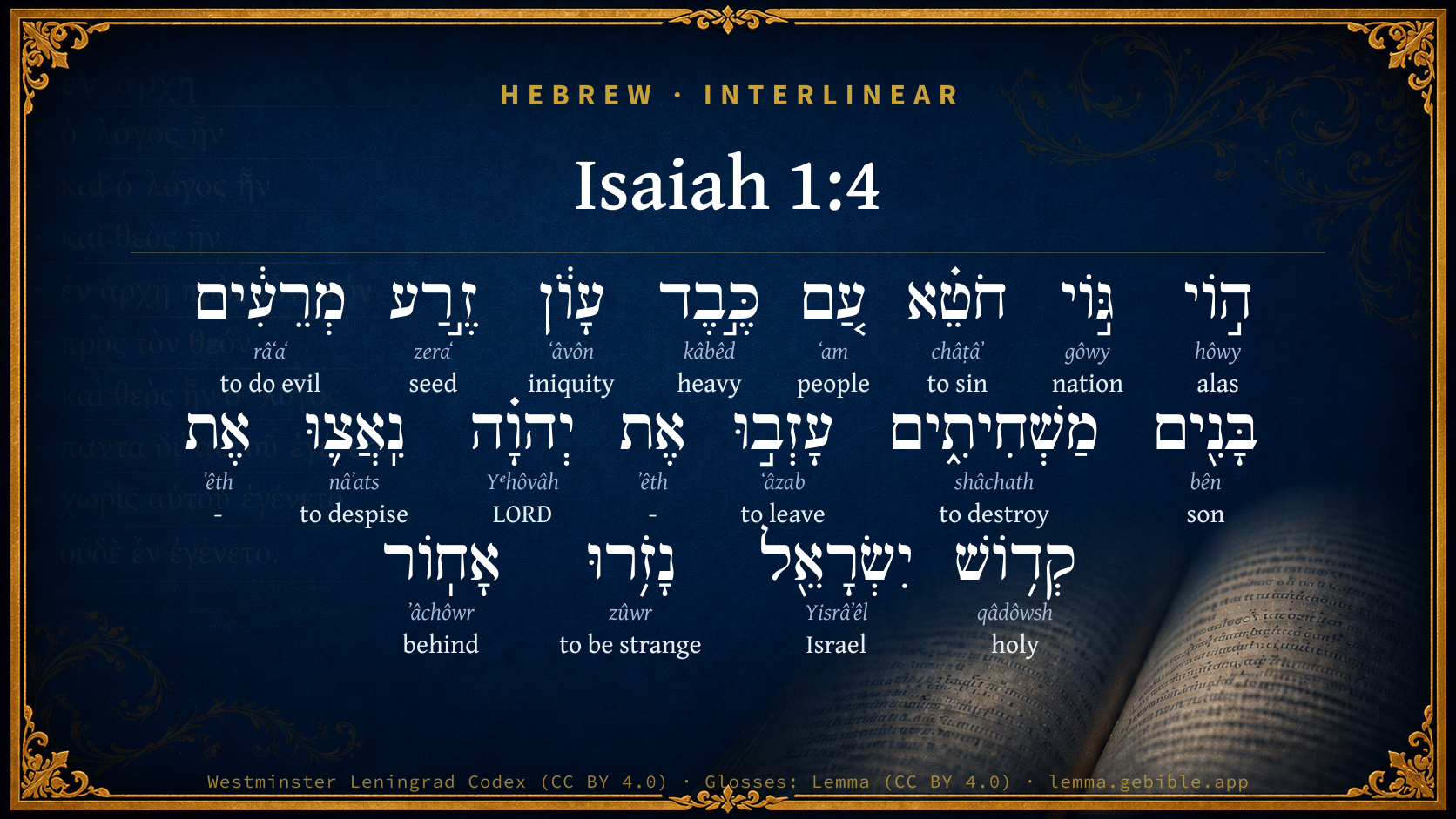
Isaiah 1:4

Hebrew (Westminster Leningrad Codex) Isaiah 1:4 appears in the Hebrew Old Testament. The text above is from the Westminster Leningrad Codex. Each word links to its Strong’s number, a concise gloss, and parsing drawn from the Open Scriptures Hebrew Bible morphology. Click any word for its full Brown-Driver-Briggs (BDB) entry.
Download image
Cite this verse

Isaiah 1:4 (World English Bible). Public Domain. Lemma interlinear Bible study tool, https://lemma.gebible.app/v/isaiah/1/4.

Show BibTeX & RIS
BibTeX
RIS
English Translation
Ah sinful nation, A people loaded with iniquity, A seed of evil-doers, Children who deal corruptly! They have forsaken Yahweh. They have despised the Holy One of Israel. They are estranged and backward.
World English Bible · Public Domain
Download a study sheet

One document with this verse’s original text, its word-by-word gloss line, the meaning frame, cross-references with their text, attributed commentary, and full source and license credits — printable, and it pastes into notes with its structure intact.

This verse Autodidact and up

Study sheet (.html) Plain text (.txt)

A passage Seminary Student

Up to 50 verses in one chapter. A passage sheet keeps up to 6 commentary sources and 12 cross-references per verse, in the order this page ranks them, and says so on the sheet whenever that leaves anything out. Ask for a single verse and you get the Autodidact verse sheet above.

Everything on this page stays free to read, with no account — the sheet is a download of what is already on screen, not access to it.

Want to remove ads? Support Godless Engineer
Compare translations 3

The same verse in 3 English versions, stacked beneath the original-language interlinear above. Click any original word for its lexicon entry.

Each is an independent rendering of the whole verse — the interlinear is not word-aligned to these translations.

Highlighted words mark where these versions differ — a whole-verse word diff, not a word-by-word alignment.

  • World English Bible Public Domain
    Ah sinful nation, A people loaded with iniquity, A seed of evil-doers, Children who deal corruptly! They have forsaken Yahweh. They have despised the Holy One of Israel. They are estranged and backward.
  • King James Version Public Domain
    Ah sinful nation, a people laden with iniquity, a seed of evildoers, children that are corrupters: they have forsaken the LORD, they have provoked the Holy One of Israel unto anger, they are gone away backward.
  • unfoldingWord Literal Text CC BY-SA 4.0
    Woe! A sinning nation, a people heavy of iniquity, seed of evildoers, sons acting corruptly! They have forsaken Yahweh, they have despised the Holy of Israel, they have turned away backward.

unfoldingWord Literal Text — © unfoldingWord, licensed CC BY-SA 4.0. Word-aligned USFM3 via Door43 (git.door43.org/unfoldingWord/en_ult).

Versions to compare (up to 4)

3 of 4 selected

Show all 18 translations

Every available English version of this verse, each an independent rendering of the whole verse.

  • World English Bible Public Domain
    Ah sinful nation, A people loaded with iniquity, A seed of evil-doers, Children who deal corruptly! They have forsaken Yahweh. They have despised the Holy One of Israel. They are estranged and backward.
  • Berean Standard Bible Public Domain
    Alas, O sinful nation, a people laden with iniquity, a brood of evildoers, children of depravity! They have forsaken the LORD; they have despised the Holy One of Israel and turned their backs on Him.
  • Majority Standard Bible Public Domain
    Alas, O sinful nation, a people laden with iniquity, a brood of evildoers, children who act corruptly! They have forsaken the LORD; they have despised the Holy One of Israel and turned their backs on Him.
  • King James Version Public Domain
    Ah sinful nation, a people laden with iniquity, a seed of evildoers, children that are corrupters: they have forsaken the LORD, they have provoked the Holy One of Israel unto anger, they are gone away backward.
  • American Standard Version (1901) Public Domain
    Ah sinful nation, a people laden with iniquity, a seed of evil-doers, children that deal corruptly! they have forsaken Jehovah, they have despised the Holy One of Israel, they are estranged `and gone' backward.
  • Revised Version (1885) Public Domain
    Ah sinful nation, a people laden with iniquity, a seed of evil-doers, children that deal corruptly: they have forsaken the LORD, they have despised the Holy One of Israel, they are estranged and gone backward.
  • Geneva Bible (1599) Public Domain
    Ah, sinfull nation, a people laden with iniquitie: a seede of the wicked, corrupt children: they haue forsaken the Lord: they haue prouoked the holy one of Israel to anger: they are gone backewarde.
  • Douay-Rheims (1899) Public Domain
    Woe to the sinful nation, a people laden with iniquity, a wicked seed, ungracious children: they have forsaken the Lord, they have blasphemed the Holy One of Israel, they are gone away backwards.
  • Young's Literal Translation Public Domain
    Ah, sinning nation, a people heavy `with' iniquity, A seed of evil doers, sons -- corrupters! They have forsaken Jehovah, They have despised the Holy One of Israel, They have gone away backward.
  • Literal Standard Version CC BY-SA 4.0
    Oh, sinning nation, a people heavy [with] iniquity, || A seed of evildoers, sons—corrupters! They have forsaken YHWH, || They have despised the Holy One of Israel, || They have gone away backward.
  • Unlocked Literal Bible CC BY-SA 4.0
    Woe! Nation, sinners, a people weighed down with iniquity, offspring of evildoers, sons who act corruptly! They have abandoned Yahweh, they have despised the Holy One of Israel, they have estranged themselves from him.
  • unfoldingWord Literal Text CC BY-SA 4.0
    Woe! A sinning nation, a people heavy of iniquity, seed of evildoers, sons acting corruptly! They have forsaken Yahweh, they have despised the Holy of Israel, they have turned away backward.
  • Darby Bible Public Domain
    Ah sinful nation, a people laden with iniquity, a seed of evildoers, children that corrupt themselves! They have forsaken Jehovah; they have despised the Holy One of Israel; they are turned away backward.
  • World Messianic Bible Public Domain
    Ah sinful nation, a people loaded with iniquity, offspring of evildoers, children who deal corruptly! They have forsaken the LORD. They have despised the Holy One of Israel. They are estranged and backward.
  • Webster's Bible Public Domain
    Ah sinful nation, a people laden with iniquity, a seed of evil-doers, children that are corrupters: they have forsaken the LORD, they have provoked the Holy One of Israel to anger, they are gone away backward.
  • Free Bible Version CC BY-SA 4.0
    What a sinful nation—a people carrying such a load of guilt, an evil generation, corrupt children! They have abandoned the Lord. They have despised Israel's Holy One. They have become strangers. They have gone backwards.
  • Bible in Basic English Public Domain
    O nation full of sin, a people weighted down with crime, a generation of evil-doers, false-hearted children: they have gone away from the Lord, they have no respect for the Holy One of Israel, their hearts are turned back from him.
  • JPS Tanakh (1917) Public Domain
    Ah sinful nation, a people laden with iniquity, a seed of evil-doers, children that deal corruptly; they have forsaken the LORD, they have contemned the Holy One of Israel, they are turned away backward.

Literal Standard Version (2020), Covenant Press — licensed CC BY-SA 4.0. Text via the HelloAO Bible API (eBible.org). Unlocked Literal Bible (unfoldingWord) — licensed CC BY-SA 4.0. Text via the HelloAO Bible API (eBible.org). unfoldingWord Literal Text — © unfoldingWord, licensed CC BY-SA 4.0. Word-aligned USFM3 via Door43 (git.door43.org/unfoldingWord/en_ult). Free Bible Version, Dr. Jonathan Gallagher — licensed CC BY-SA 4.0. Text via the HelloAO Bible API (eBible.org).

Word by word

More ways to search: Search by grammar → Find every occurrence → Compare this word →

Practice this passage: Drill this verse → Learn its vocabulary →

נִֽאֲצ֛וּ
nâʼats
H5006
“to despise”
Verb, Piel, Perfect, 3rd Person, Common, Plural
Part of Speech
Verb
Stem
Piel
Form
Perfect
Person
3rd Person
Gender
Common
Number
Plural
Full BDB Definition

Origin: a primitive root

TWOT: 1274

to spurn, contemn, despise, abhor - (Qal) to spurn, contemn - (Piel) - to spurn - to cause to contemn - (Hiphil) to spurn - (Hithpolel) to be contemned
  1. ה֣וֹי hôwy H1945 “alas” Particle, Interjection
  2. גּ֣וֹי gôwy H1471 “nation” Noun, Common, Masculine, Singular, Absolute
  3. חֹטֵ֗א châṭâʼ H2398 “sinning” Verb, Qal, Participle Active, Masculine, Singular, Absolute
  4. עַ֚ם ʻam H5971 “people” Noun, Common, Masculine, Singular, Absolute
  5. כֶּ֣בֶד kâbêd H3515 “heavy of” Adjective, Adjective, Masculine, Singular, Construct
  6. עָוֺ֔ן ʻâvôn H5771 “iniquity” Noun, Common, Both, Singular, Absolute
  7. זֶ֣רַע zeraʻ H2233 “seed of” Noun, Common, Masculine, Singular, Construct
  8. מְרֵעִ֔ים râʻaʻ H7489 “doing evil” Verb, Hiphil, Participle Active, Masculine, Plural, Absolute
  9. בָּנִ֖ים bên H1121 “sons” Noun, Common, Masculine, Plural, Absolute
  10. מַשְׁחִיתִ֑ים shâchath H7843 “destroying” Verb, Hiphil, Participle Active, Masculine, Plural, Absolute
  11. עָזְב֣וּ ʻâzab H5800 “to leave” Verb, Qal, Perfect, 3rd Person, Common, Plural
  12. אֶת ʼêth H853 “-” Particle, Direct Object
  13. יְהוָ֗ה Yᵉhôvâh H3068 “LORD” Noun, Proper
  14. אֶת ʼêth H853 “-” Particle, Direct Object
  15. קְד֥וֹשׁ qâdôwsh H6918 “holy of” Adjective, Adjective, Masculine, Singular, Construct
  16. יִשְׂרָאֵ֖ל Yisrâʼêl H3478 “Israel” Noun, Proper
  17. נָזֹ֥רוּ zûwr H2114 “to be strange” Verb, Niphal, Perfect, 3rd Person, Common, Plural
  18. אָחֽוֹר ʼâchôwr H268 “behind” Noun, Common, Masculine, Singular, Absolute

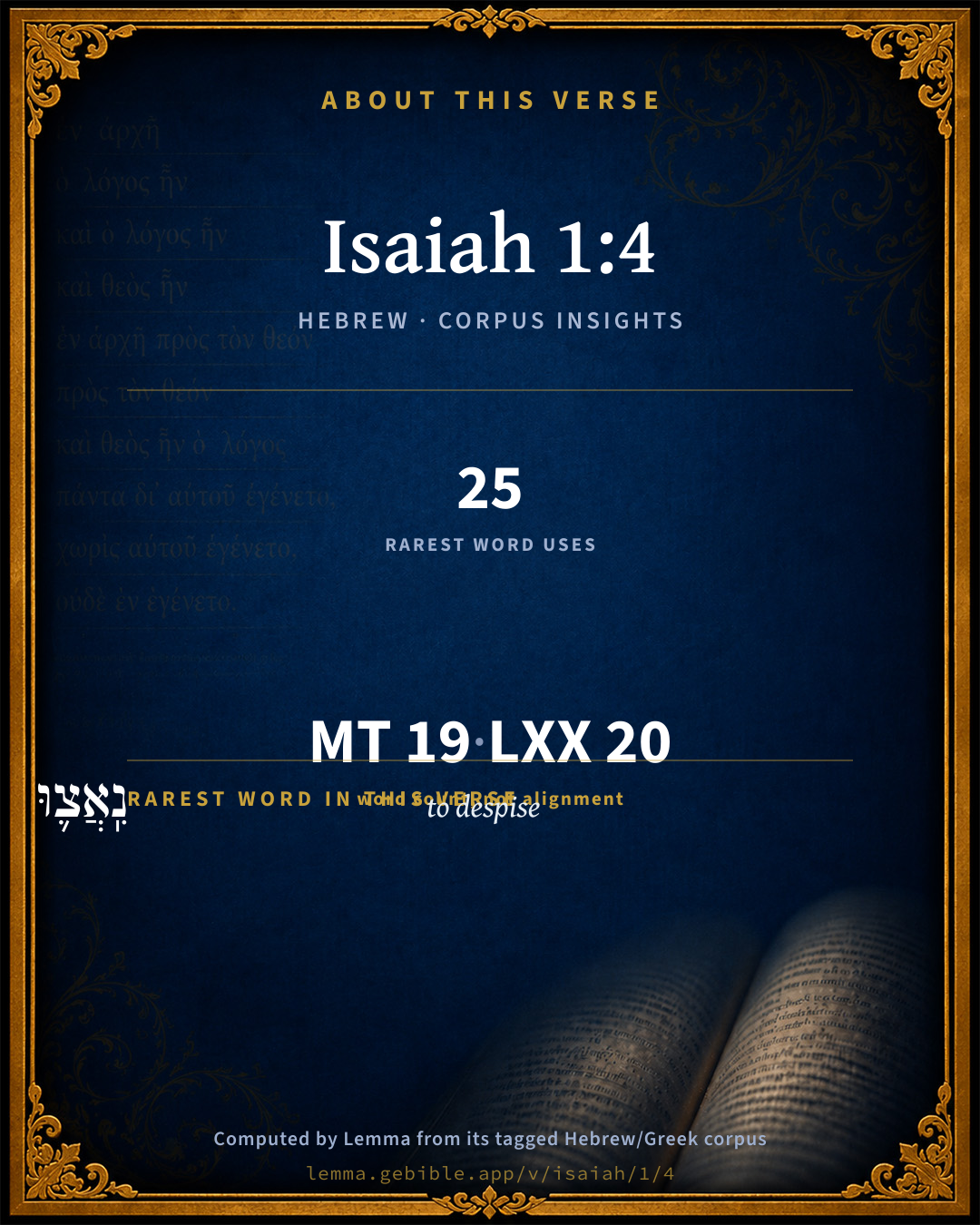
About this verse

These counts appear in no published source. They are computed here, from the morphology-tagged text and Lemma’s own curated glosses. What Lemma adds →

19
words
18
distinct lemmas
Prophets
section

Notable vocabulary

The rarest word here is נִֽאֲצ֛וּ to despise H5006 — appearing just 25 times in the whole Hebrew Bible.

Shared distinctive vocabulary

נִֽאֲצ֛וּ to despise H5006 occurs in 24 verses of the Hebrew Bible. Also found in:

Grammatical profile

  • 6 verbs
  • 8 nouns
  • 2 adjectives
  • 3 particles

Verb forms

  • חֹטֵ֗א Qal · Participle Active
  • מְרֵעִ֔ים Hiphil · Participle Active
  • מַשְׁחִיתִ֑ים Hiphil · Participle Active
  • עָזְב֣וּ Qal · Perfect
  • נִֽאֲצ֛וּ Piel · Perfect
  • נָזֹ֥רוּ Niphal · Perfect

Hebrew & Septuagint length

In English translation the verse runs 33 words from the Hebrew and 25 from the Septuagint (LXX English) — closely comparable.

A rough comparison of the two English renderings, which tokenize alike — not a word-level alignment.

Word counts can differ between the Hebrew and the Greek without any difference in meaning — e.g. the Hebrew direct-object marker אֵת has no separate Greek word, and Greek often adds the article ὁ.

In the original languages it is 19 Hebrew tokens and 20 Greek tokens — but the two are counted differently (Hebrew bundles its prefixes and suffixes into one token; the Greek is in lemma form), so that isn’t a like-for-like length.

Cross-references

47

Topical passages linked to Isaiah 1:4 in the Treasury of Scripture Knowledge — connected by theme and wording, ordered by reader-vote popularity; previews shown in the World English Bible.

  • Isaiah 5:24 Therefore as the tongue of fire devours the stubble, And as the dry grass sinks down in the flame, So their root shall be as rottenness, And their blossom shall go up as dust; Because they have rejected the law of Yahweh of Hosts, And despised the word of the Holy One of Israel.
  • Jeremiah 2:17 Haven't you procured this to yourself, in that you have forsaken Yahweh your God, when he led you by the way?
  • Jeremiah 2:13 For my people have committed two evils: they have forsaken me, the spring of living waters, and hewed them out cisterns, broken cisterns, that can hold no water.
  • Romans 8:7 because the mind of the flesh is hostile towards God; for it is not subject to God's law, neither indeed can it be.
  • Isaiah 5:19 Who say, "Let him make speed, let him hasten his work, that we may see it; And let the counsel of the Holy One of Israel draw near and come, That we may know it!"
  • Jeremiah 2:19 Your own wickedness shall correct you, and your backsliding shall reprove you: know therefore and see that it is an evil thing and a bitter, that you have forsaken Yahweh your God, and that my fear is not in you, says the Lord, Yahweh of Hosts.
  • Jeremiah 7:19 Do they provoke me to anger? says Yahweh; [do they] not [provoke] themselves, to the confusion of their own faces?
  • Matthew 3:7 But when he saw many of the Pharisees and Sadducees coming for his baptism, he said to them, "You offspring of vipers, who warned you to flee from the wrath to come?
  • Acts 7:51–52 "You stiff-necked and uncircumcised in heart and ears, you always resist the Holy Spirit! As your fathers did, so you do.
  • Genesis 13:13 Now the men of Sodom were exceedingly wicked and sinners against Yahweh.
  • Numbers 32:14 Behold, you are risen up in your fathers' place, an increase of sinful men, to augment yet the fierce anger of Yahweh toward Israel.
  • Deuteronomy 29:25 Then men shall say, Because they forsook the covenant of Yahweh, the God of their fathers, which he made with them when he brought them forth out of the land of Egypt,
  • Deuteronomy 31:16 Yahweh said to Moses, Behold, you shall sleep with your fathers; and this people will rise up, and play the prostitute after the strange gods of the land, where they go to be among them, and will forsake me, and break my covenant which I have made with them.
  • Deuteronomy 32:19 Yahweh saw [it], and abhorred [them], Because of the provocation of his sons and his daughters.
  • Judges 10:10 The children of Israel cried to Yahweh, saying, We have sinned against you, even because we have forsaken our God, and have served the Baals.
  • Psalms 58:3 The wicked go astray from the womb. They are wayward as soon as they are born, speaking lies.
  • Psalms 78:8 And might not be as their fathers, A stubborn and rebellious generation, A generation that didn't make their hearts loyal, Whose spirit was not steadfast with God.
  • Psalms 78:40 How often they rebelled against him in the wilderness, And grieved him in the desert!
  • Psalms 89:18 For our shield belongs to Yahweh; Our king to the Holy One of Israel.
  • Isaiah 1:23 Your princes are rebellious, and companions of thieves. Everyone loves bribes, and follows after rewards. They don't judge the fatherless, Neither does the cause of the widow come to them.
  • Isaiah 3:8 For Jerusalem is ruined, and Judah is fallen; Because their tongue and their doings are against Yahweh, To provoke the eyes of his glory.
  • Isaiah 10:6 I will send him against a profane nation, and against the people of my wrath will I give him a charge, to take the spoil, and to take the prey, and to tread them down like the mire of the streets.
  • Isaiah 14:20 You shall not be joined with them in burial, because you have destroyed your land, you have killed your people; the seed of evil-doers shall not be named forever.
  • Isaiah 29:19 The humble also shall increase their joy in Yahweh, and the poor among men shall rejoice in the Holy One of Israel.
  • Isaiah 30:9 For it is a rebellious people, lying children, children who will not hear the law of Yahweh;
  • Isaiah 30:11–12 get out of the way, turn aside out of the path, cause the Holy One of Israel to cease from before us."
  • Isaiah 30:15 For thus said the Lord Yahweh, the Holy One of Israel, In returning and rest shall you be saved; in quietness and in confidence shall be your strength. You would not:
  • Isaiah 37:23 Whom have you defied and blasphemed? and against whom have you exalted your voice and lifted up your eyes on high? [even] against the Holy One of Israel.
  • Isaiah 41:14 Don't be afraid, you worm Jacob, and you men of Israel; I will help you, says Yahweh, and your Redeemer is the Holy One of Israel.
  • Isaiah 41:16 You shall winnow them, and the wind shall carry them away, and the whirlwind shall scatter them; and you shall rejoice in Yahweh, you shall glory in the Holy One of Israel.
  • Isaiah 41:20 that they may see, and know, and consider, and understand together, that the hand of Yahweh has done this, and the Holy One of Israel has created it.
  • Isaiah 57:3–4 But draw near here, you sons of the sorceress, the seed of the adulterer and the prostitute.
  • Isaiah 65:3 a people who provoke me to my face continually, sacrificing in gardens, and burning incense on bricks;
  • Jeremiah 2:5 thus says Yahweh, What unrighteousness have your fathers found in me, that they have gone far from me, and have walked after vanity, and are become vain?
  • Jeremiah 2:31 Generation, see the word of Yahweh. Have I been a wilderness to Israel? or a land of thick darkness? why say my people, We are broken loose; we will come no more to you?
  • Jeremiah 2:33 How trimmest you your way to seek love! therefore even the wicked women have you taught your ways.
  • Jeremiah 7:26 yet they didn't listen to me, nor inclined their ear, but made their neck stiff: they did worse than their fathers.
  • Jeremiah 16:11–12 Then shall you tell them, Because your fathers have forsaken me, says Yahweh, and have walked after other gods, and have served them, and have worshiped them, and have forsaken me, and have not kept my law;
  • Jeremiah 50:29 Call together the archers against Babylon, all those who bend the bow; encamp against her round about; let none of it escape: recompense her according to her work; according to all that she has done, do to her; for she has been proud against Yahweh, against the Holy One of Israel.
  • Jeremiah 51:5 For Israel is not forsaken, nor Judah, of his God, of Yahweh of Hosts; though their land is full of guilt against the Holy One of Israel.
  • Ezekiel 16:33 They give gifts to all prostitutes; but you give your gifts to all your lovers, and bribe them, that they may come to you on every side for your prostitution.
  • Matthew 11:28 "Come to me, all you who labor and are heavily burdened, and I will give you rest.
  • Matthew 23:33 You serpents, you offspring of vipers, how will you escape the judgment of Gehenna?
  • 1 Corinthians 10:22 Or do we provoke the Lord to jealousy? Are we stronger than he?
  • Colossians 1:24 Now I rejoice in my sufferings for your sake, and fill up on my part that which is lacking of the afflictions of Christ in my flesh for his body's sake, which is the assembly;
  • Isaiah 12:6 Cry aloud and shout, you inhabitant of Zion; for great in the midst of you is the Holy One of Israel!"
  • Revelation 18:5 for her sins have reached to the sky, and God has remembered her iniquities.

Cross-references courtesy of OpenBible.info (CC BY 4.0).

Hebrew and Greek witnesses Masoretic Hebrew ↔ Greek Septuagint

The same verse in the two great witnesses to the Old Testament, shown verse-for-verse.

These are two independent witnesses, not word-aligned to each other, and the Septuagint is shown in lemma (dictionary) form.

Hebrew Isaiah 1:4 Masoretic · Westminster Leningrad Codex

ה֣וֹי גּ֣וֹי חֹטֵ֗א עַ֚ם כֶּ֣בֶד עָוֺ֔ן זֶ֣רַע מְרֵעִ֔ים בָּנִ֖ים מַשְׁחִיתִ֑ים עָזְב֣וּ אֶת יְהוָ֗ה נִֽאֲצ֛וּ אֶת קְד֥וֹשׁ יִשְׂרָאֵ֖ל נָזֹ֥רוּ אָחֽוֹר

Ah sinful nation, A people loaded with iniquity, A seed of evil-doers, Children who deal corruptly! They have forsaken Yahweh. They have despised the Holy One of Israel. They are estranged and backward.

World English Bible · Public Domain

Greek LXX Isaiah 1:4 Septuagint · lemma form

οὐαί ἔθνος ἁμαρτωλός λαός πλήρης ἁμαρτία σπέρμα πονηρός υἱός ἄνομος ἐν καταλείπω ὁ κύριος καί παραὀργίζω ὁ ἅγιος ὁ ἰσραήλ

Ah sinful nation, a people full of sins, an evil seed, lawless children: you⌃ have forsaken the Lord, and provoked the Holy One of Israel.

LXX2012 (modern English Septuagint) · Public Domain

On this verse, The Cambridge Bible for Schools and Colleges discusses the Septuagint’s reading. Read the note in Commentary ↓

Hebrew: Westminster Leningrad Codex (CC BY 4.0). Greek: Septuagint (public domain); English from LXX2012 (modern English Septuagint) (Public Domain). How the Septuagint differs from the Hebrew →

Targum (Aramaic paraphrase)

1

The Targum is the ancient Jewish Aramaic paraphrase of the Hebrew Scriptures — an interpretive translation, not the Hebrew text itself. Onkelos (literal) and Pseudo-Jonathan (expansive) render the Torah, and Jonathan the Prophets. Coverage is partial: where no permissively-licensed English translation exists for a verse, only the Aramaic is shown. This is verse-level text, not a word-by-word alignment to the Hebrew.

  1. Targum Jonathan Prophets (Joshua–Malachi)
    וַי עַל דְאִתְקְרִיאוּ עַם קַדִישׁ וַחֲטוֹ כְּנִישָׁא בְחִירָא וְאַסְגִיאוּ חוֹבִין אִתְכְּנִיאוּ בְזַרְעָא רְחִימָא וְאַבְאִישׁוּ אִתְאַמַר לְהוֹן בְּנִין חֲבִיבִין וְחַבִּילוּ אוֹרְחָתְהוֹן שְׁבַקוּ יַת פּוּלְחָנָא דַייָ קָצוּ בְּדַחֲלַת קַדִישָׁא דְיִשְׂרָאֵל וּבְדִיל עוֹבְדֵיהוֹן בִּישַׁיָא אִסְתְּחֲרוּ וַהֲווֹ לְאַחוֹרָא:

    Woe to those who are called a holy people, because they have sinned; a chosen congregation, but they have multiplied sins; they are surnamed a beloved seed, but they have done evil; they are called beloved sons, but they have corrupted their paths; they have forsaken the worship of the Lord; they abhorred the fear of the Holy One of Israel, and because their works are evil they are turned away, and they are turned back.

    Targum Jonathan — Aramaic: “Mikraot Gedolot” (public domain). English: “Sefaria Community Translation” (CC0 1.0 (public-domain dedication)); “London "Chaldee Paraphrase," 1871” (public domain). Text via Sefaria.

Commentary

Notes on Isaiah 1:4 from classic Christian and Jewish commentators (each source and its license shown beneath its notes). The classic Christian expositions comment on the surrounding passage and are grouped to its opening verse, so a note may address several verses; the Jewish commentaries on the Tanakh (Rashi and others) are per-verse, so they appear only where the commentator wrote on this verse.

Lemma curates 59 commentaries, every one of them public domain or Creative Commons licensed, each selected and text-cleaned for this edition rather than reprinted as found. About our sources →

Trapp's Complete Commentary

John Trapp

Isa 1:4 Ah sinful nation, a people laden with iniquity, a seed of evildoers, children that are corrupters: they have forsaken the LORD, they have provoked the Holy One of Israel unto anger, they are gone away backward.

Ver. 4. Ah sinflul notion.] Hoi goi chote. He beginneth his complaint with a sigh, as well he might, when he saw that the better God was to them, the worse they were to him; like springs of water, which are then coldest when the sun is hottest; like the Thracian flint, which is said to burn with water, and to be quenched with oil, or like that country where drought maketh dirt, and rain dust. {a} Ah gens peccatrix! Oh, thou that art wholly made up of mischief, as Aaron once said of their forefathers in the wilderness, that they were "wholly set upon wickedness," {Exo 32:22} and as the prophet saith, "What is the transgression of Jacob? is it not Samaria? and what are the high places of Judah? are they not Jerusalem?" {Mic 1:5}

A people laden with iniquity] Great and grievous offenders, {b} guilty of many and mighty (or long) sins, {Amo 5:12} quorum amplitudine praegravanfur, yet not sensible of their burden; not heavyladen, {as Mat 11:28} nor labouring to be delivered of that hedgehog that woundeth and teareth them in their tender inside.

A seed of evildoers.] A race of rebels, a seed of serpents: Mali corvi malum ovum: such as were as good at resisting the Holy Ghost as ever their fathers had been; {Act 7:51} generation after generation they held it out, and were no changelings then, neither are to this day.

Children that are corrupters.] Or, Destroyers, dingthrifts, ασωτοι quasi ασωστοι, destroy goods, such as the Roman prodigal, who gloried that of a large patrimony left him by his parents, he had now left himself nothing praeter coelum et caenum; or that other in the Gospel, who had drawn much of his portion through his throat, and spent the rest on harlots. Lo! such ill husbands for their souls were these Jews here spoken of, seipsis assidue facti deteriores, while they woefully wasted their time and strength in the pursuit of their lusts: "cursed children." {2Pe 2:14}

They have forsaken the Lord.] Which is such a foul enormity, as good Jeremiah thinks the very heaven sweateth at, and the earth groaneth under. {Jer 2:12-13}

They have provoked unto anger.] As if they had a mind to wrestle a fall, and try masteries with him. The Vulgate rendereth it, They have blasphemed. {See Trapp on "Isa 1:2"}

They are gone away backward.] A lienaverunt se retrorsum, certatim exardescentes in apostasiam; as the moon when fullest of light getteth farther off from the sun. They had turned upon God the back and not the face, by a shameful apostasy, even then when they frequently trod his courts, {Isa 1:12} and departed not thence, haply, any otherwise than the Jews at this day do, out of their synagogues with their faces still toward the ark, like crabs going backward.

{a} Siccitas dat lutum, imbres pulverem. - Plin,

{b} Gens quae non nisi peccare didicit. - Scult. Secura et petulans. - Piscat. Luk 15:30.

John Trapp, A Commentary or Exposition upon All the Books of the Old and New Testament (1647–1656) — public domain. Text from a community e-Sword module.

The Biblical Illustrator

Joseph S. Exell

Isa_1:4

Ah, sinful nation

Gods indignation against sin

The word ah is not an interjection, indicating a mere sighing of pity or regret; the word should not be spelt as it is here, the letters should be reversed, it should be ha, and pronounced as expressive of indignation.

God does not merely sigh over human iniquity, looking upon it as a lapse, an unhappy thing, a circumstance that ought to have been otherwise; His tone is poignant, judicial, indignant, for not only is His heart wounded, but His righteousness is outraged, and the security of His universe is threatened,--for the universe stands in plumb line, in strict geometry, and whoever trifles with the plumb, with the uprightness, tampers with the security of the universe. (J. Parker, D. D.)

A sinning nation

The original words used in reference to Gods ancient people are a sinning nation, which denotes a nation sinning habitually. There are three ways in which a nation becomes sinful.

I. WHEN THE GREAT BODY OF THE PEOPLE CONSENT TO OR APPROVE OF THE SINS OF FORMER GENERATIONS. Thus Christ said to the Jews, Truly ye bear witness that ye allow the deeds of your fathers.

II. WHEN THE GREAT BODY OF THE PEOPLE CONSENT TO THE SINS OF THEIR RULERS. Thus the Jews were a sinful nation, because they approved of the deeds of their rulers in killing the prophets and in crucifying Christ, and these sins are expressly charged against them, and were visited upon them nationally.

III. WHEN THE GENERALITY OF THE PEOPLE ARE LIVING IN THEIR OWN REASONS. Such was the state of the Jews when Isaiah charged them with contempt of God, hypocrisy and manifold habitual transgressions. (Original Secession Magazine.)

Savonarola and Florence

Florence, in the days of Lorenzo the Magnificent, had become practically a pagan city. She had fallen from Christ as Jerusalem from Jehovah. One of her historians descants upon her as being hopeless morally, full of debauchery, cruelty, and corruption, violating oaths, betraying trusts, believing in nothing but Greek manuscripts, coins and statues, and caring for nothing but pleasures. It was into such a city, to which Isaiahs prelude would almost literally apply, that Savonarola came. Seeing, as he expressed it, the world turned upside down, he traversed the streets and wandered along the banks of the Arno, musing and weeping over the great misery of the world, and the iniquities of men, and the enormous wickedness of the people of Italy. Then, after a time of probation at the convent of San Marco, he burst upon the Florentines as a prophet of fiery eloquence and uncompromising virtue, of a fearless character, and with Divine insight akin to that of his great prototype, Isaiah of Jerusalem. Through internal troubles, and assaults from without, he warned the people and their rulers, endeavouring to turn their hearts to God, and to stay them upon Him. To the priests he said, that the false and lukewarm among them, the dumb dogs that could not bark, had perverted the people, and prejudiced them against the truth. Before all, the wicked priests and servants of the Church are the guilty causes of this corruption as also of the coming calamities. He cried aloud to the populace, Thou knowest, thou knowest, O Florence, that I would have thee a spiritual State. I have always shown thee clearly that a kingdom is only strong in proportion as it is spiritual, by being more closely related to God. Thus faithfully and boldly spoke out Savonarola what was in him from the Holy Spirit. (F. Sessions.)

Corrupters

Corrupters

Sons that are as cankerworms; sons that throw poison into pellucid water streams; sons that suggest evil thoughts to opening minds. (J. Parker, D. D.)

The force of example

Have fellowship with the lame and you will learn to limp. (Latin Adage.)

The corrupt are corrupters

One rotten apple will infect the store; the putrid grape corrupts the whole cluster. (F. Jacox.)

Companionship in evil

Men love not to be found singular, especially where the singularity lies in the rugged and severe paths of virtue: company causes confidence, and gives both credit and defence, credit to the crime, and defence to the criminal (R. South, D. D.)

The contagion of character

Do you see, said Dr. Arnold to an assistant master who had recently come to Rugby, those two boys walking together? I never saw them together before; you should make an especial point of observing the company they keep;--nothing so tells the changes in a boys character. (F. Jacox.)

Bad company injurious

He that lies down with dogs shall rise up with fleas. (Spanish proverb.)

Leading others astray

A father bade his son set up some bricks endways, in regular line a short distance apart. Now, said he, knock down the first brick. The boy obeyed, and all the others fell with it. Now, said the father, raise the last brick and see if the others will rise with it. But no, once down, they must be raised singly. Said the father, I have given you this object lesson to teach you how easy it is for one to lead others astray, but how difficult for him to restore them, however sincere his repentance may be. (Sunday School Chronicle.)

They have forsaken the Lord

A specific and terrible indictment

What have they done? They have done three things. It is no general accusation that is lodged against Judah and Jerusalem, and through them against all the nations of the earth; it is a specific indictment, glittering with detail.

I. THEY HAVE FORSAKEN THE LORD. By so much their action is negative; they have ceased to attend the altar; they have neglected to read the Italy writing; they have turned their backs upon that towards which they once looked with open face and radiant eye.

II. THEY HAVE PROVOKED THE HOLY ONE OF ISRAEL UNTO ANGER. Observe how the intensity increases, how the aggravation deepens and blackens; they have grown bold in sin; they have thrown challenges in the face of God; they have defied Him to hurl His thunderbolts and His lightnings upon them.

III. THEY ARE GONE AWAY BACKWARD. They forsook, they provoked, they apostatised. Sin has its logical course as well as holiness. Men do not stand still at the point of forsaking God: having for a little while forsaken Him, they will find it almost necessary to provoke Him, that they may justify themselves to themselves and to others, saying, Even provocation cannot awaken the judgment of heaven with any sign of impatience; and having provoked the Holy One of Israel, the next point will be universal apostasy, a thorough off-casting of the last traces and semblances of religion. See if this be not so in the history of the individual mind. (J. Parker, D. D.)

Moral gravitation

There is a law of gravitation, spiritual as well as physical, and now the man who has begun by forsaking will end by going backward, his whole life thrown out of order, decentralised; and he perpetrates the irony of walking backwards, and his crab-like action will bring him to the pit. (J. Parker, D. D.)

The Holy One of Israel

The Holy One of Israel

That is, He who shows Himself holy in Israel. (Prof. T. K. Cheyne.)

The Biblical Illustrator, edited by Joseph S. Exell (c. 1880s–1900s) — public domain. Text from a community e-Sword module.

Joseph Benson's Commentary

Isa 1:4. Ah, sinful nation — The prophet bemoans those who would not bemoan themselves; and he speaks with a holy indignation at their degeneracy, and with a dread of the consequences of it. A people laden with iniquity — Laden, not with the sense of sin, as those described Mat 11:28, but with the guilt and bondage of sin. A seed of evil- doers — The children of wicked parents, whose guilt they inherit, and whose evil example they follow; children that are corrupted — Hebrew, משׁחיתים, that corrupt, namely, themselves, or their ways, or others, by their counsel and example: or, that destroy themselves and their land by their wickedness. They have forsaken the Lord — Not indeed in profession, but in practice, and therefore in reality, neglecting or corrupting his worship, and refusing to be subject and obedient to him. They have provoked the Holy One, &c. — They have lived as if it were their great design and business to provoke him. They are gone away backward — Instead of proceeding forward, and growing in grace, which was their duty, they are fallen from their former professions, and have become more wicked than ever.

Joseph Benson's Commentary on the Old and New Testaments (1811–1818) — public domain. Text from a community e-Sword module.

The Preacher's Complete Homiletical Commentary

Joseph S. Exell (gen. ed.)

INIQUITY A BURDEN

Isa_1:4. A people laden with iniquity.

A very surprising description: “A people laden with iniquity.” On account of their punctilious and costly observance of the Mosaic ritual (see Isa_1:11-15), the Jews imagined that they deserved the commendation of Heaven; but God pronounced them to be “a people laden with iniquity.” Men often form very different estimates of the same thing; e.g., buyer and seller (Pro_20:14). There is often as marked a difference between the divine and human estimates of character (Luk_18:11; Rev_3:17). This is so because God and men judge by different standards; men take into account only their occasional good actions; God judges by that feature of their character which is predominant [195] So judging, He condemned those most “religious” Jews. What is His estimate of us?

[195] Men are to be estimated, as Johnson says, by the mass of character. A block of tin may have a grain of silver, but still it is tin; and a block of silver may have an alloy of tin, but still it is silver. The mass of Elijah’s character was excellence; yet he was not without the alloy. The mass of Jehu’s character was base; yet he had a portion of zeal which was directed by God to great ends.—Cecil.

A very instructive description: “A people laden with iniquity.” The conception is that of a nation that has gone on adding sin to sin, as a man gathering sticks in the forest adds fagot to fagot, until he staggers beneath the load; that which was eagerly sought after becomes an oppressive burden. How true this is! There are many national burdens; despotism, an incapable government, excessive taxation, &c., but the worst and most oppressive of all is a nation’s iniquities.

The iniquities of a nation constitute a burden that impede it—

1. In its pursuit of material prosperity. With what desperate intensity this English nation toils! and for what end? Chiefly that it may accumulate wealth. How greatly it is impeded in this pursuit by its costly government! But how much more by its costly vices! On strong drink alone this nation expends a larger sum than the whole amount both of imperial and local taxation—more than one hundred millions annually! Other vices that are nameless, how much they cost, and what a hindrance they are to the nation in its pursuit of wealth!

2. In its pursuit of social happiness. What a crushing burden of sorrow the nation’s iniquities impose upon it!

3. In its pursuit of moral and intellectual improvement. According to a monkish legend, the church of St. Brannock’s, in Braunton, Devon, could not be erected on its original site, because as fast as the builders reared up the walls by day, by night the stones were carried away by invisible hands. A like contest goes on in our own land. The nation’s virtues are toiling to elevate the national character morally and intellectually, using as their instruments the school, the church, the press; but as fast as the virtues build, the vices pull down. In all these respects the nation’s iniquities constitute its heaviest burden.

Consequently,

1. To give a legal sanction to vices, or to connive at what promotes them, for the sake of certain additions to the national revenues, is suicidal folly of the grossest kind.

2. Those are the truest national benefactors who do most to abate the national iniquities. The palm for truest patriotism must be awarded, not to “active politicians,” but to faithful preachers, Sunday-school teachers, temperance reformers, &c.

3. Vices of all kinds should be branded, not only as sins against God, but as treasons against society; and all good men should, in self-defence, as well as in a spirit of enlightened patriotism, band themselves together for their overthrow. That is a mistaken spirituality which leads some good men to leave imperial and local affairs in the hands of the worldly and the vicious. We are bound to labour as well as to pray that God’s will may be done “on earth as it is in heaven,” and that “His kingdom” may come in our own land [198]

[198] As Christians are to think of living for awhile in the world, it is not unreasonable for them to be affected with its occurrences and changes. Some plead for a kind of abstracted and sublimated devotion, which the circumstances they are placed in by their Creator render equally impracticable and absurd. They are never to notice the affairs of government, or the measures of administration; war, or peace; liberty, or slavery; plenty, or scarcity,—all is to be equally indifferent to them; they are to leave these carnal and worldly things to others. But have they not bodies? Have they not families? Is religion founded on the ruins of humanity? When a man becomes a Christian, does he cease to be a member of civil society? Allowing that he be not the owner of the ship, but only a passenger in it, has he nothing to awaken his concern in the voyage! If he be only a traveller towards a belter country, is he to be told that because he is at an inn which he is soon to leave, it should not excite any emotion in him whether it be invaded by robbers or consumed by flames before the morning! In the peace thereof ye shall have peace: and are not Christians to provide things honest in the sight of all men? Are they to detach themselves while here from the interests of their fellow-creatures; or to rejoice with them that rejoice, and weep with them that weep? Is not religion variously affected by public transactions? Can a Christian, for instance, be indifferent to the cause of freedom, even on a pious principle? Does not civil liberty necessarily include religious? and is it not necessary to the exertions of ministers, and the spreading of the gospel?—Jay.

That which is true of nations is true also of individuals; the heaviest burdens which men can take upon themselves are vices. Vices lay upon men a burden—

1. Of expense. Even so-called “indulgences” are costly; many professing Christians spend more annually on tobacco than they give to the cause of missions. Vices keep millions poor all their lives [201]

2. Of discredit.

3. Of sorrow, clouding all the present.

4. Of fear, darkening all the future.

[201] “What are you going to take that for?” said an old labourer to a young one who was about to drink a glass of ale. “To make me work,” was the reply. “Yes,” answered the old man, “you are right; that is just what it will do for a certainty: I began to drink ale when I was about your age, and it has made me work until now!”

There is this terrific feature about the burden of iniquity—there is none so hard to be got rid of. It is hard to inspire a nation or a man with the desire to get rid of it. How nations and men hug their vices, notwithstanding the miseries they entail! It is still harder to accomplish the desire! Society is full of men who stagger and groan under this burden, from which they strive in vain to free themselves. In them the fable of Sinbad, unable to rid himself of the old man whom he has taken upon his shoulders, has a melancholy realisation. These men feel themselves to be helpless, and their case would indeed be hopeless were it not that God has laid help for us on One who is mighty to save. Cry to Him, ye burdened ones, and obtain release!

TRANSMITTED DEPRAVITY

Isa_1:4. A seed of evil-doers, children that are corrupters.

Transmitted depravity is—

I. A doctrine of Scripture.

II. A fact in human life [204] Application.—

1. God will not fail to make allowance for it in dealing with us.

2. We should make allowance for it in judging our fellow-men. Our censures should be mingled with compassion.

3. By self-restraint and a life of virtue we should endeavour as far as is possible to cut off from our children this sad entail. A bias towards good may be transmitted as well as a bias towards evil [207]

4. In the education of our children, we should be especially solicitous to check and prevent the development of the faults we have transmitted to them, that so, though they are “a seed of evil-doers,” they may not themselves be “corrupters.”

[204] As colour and favour, and proportion of hair and face and lineament, and as diseases and infirmities of the body, so, commonly, the liabilities and dispositions and tempers of the mind and affections become hereditary, and run in the blood. An evil bird hatches an evil egg, and one viper will breed a generation of vipers. Most sins pass along from the father to the son, and so downward, by a kind of lineal descent, from predecessors to posterity, and that for the most part with advantage and increase, whole families being tainted with the special vices of their stock. John the Baptist speaks of “a generation of vipers;” and if we should but observe the condition of some families in a long line of succession, might we not espy here and there even whole generations of drunkards, and generations of swearers, and generations of idolaters, and generations of worldlings, and generations of seditious, and of envious, and of riotous, and of haughty, and of unclean persons, and of sinners in other kinds.—Sanderson, 1587–1662.

[207] Where children are the children of Christian parents, as they were children of Christian parents, the presumptions are that they will turn out right; not without parental training, but, that being implied, the presumptions are that they will, by the force of natural law, tend in that direction. All the presumptions are that the children of moral and sensible parents will become moral and sensible. Only the grossest neglect and the most culpable exposure to temptation will overrule the presumption and likelihood that the children of good parents will be good. There may be opposing influences; there may be temptations and perversions that shall interrupt the natural course of things; but this does not invalidate the truth that there is a great law by which like produces like. And I say that under this law the Christian parent has a right to this comforting presumption—“My children have all the chances in their favour by reason of the moral constitution which they have inherited.”

I know multitudes of families in which the moral element is hereditary; and it is not surprising that the children of those families are moral. Moral qualities are as transmissible as mental traits or physical traits. The same principle applies to every part of the human constitution. And where families have been from generation to generation God-fearing, passion-restraining, truth-telling, and conscience-obeying, the chances are ninety-nine in every hundred in favour of the children.—Beecher.

Original or birth sin is not merely a doctrine in religion, it is a fact in man’s world acknowledged by all, whether religious or not. Let a man be providing for an unborn child: in case of distribution of worldly property, he will take care to bind him by conditions and covenants which shall guard against his fraudulently helping himself to that which he is to hold for or to apportion to another. He never saw that child; he does not know but that child may be the most pure and perfect of men; but he knows it will not be safe to put temptation in his way, because he knows he will be born in sin, and liable to sin, and sure to commit sin.—Alford, 1810–1871.

FORSAKING THE LORD

Isa_1:4. They have forsaken the Lord.

How many souls are guilty of forsaking the Lord? They forsake Him by yielding to what are called “little sins” [210] Then they are further removed from Him by habitual wickedness.

[210] There is many a man who evinces, for a time, a steadfast attention to religion, walking with all care in the path of God’s commandments, &c., but who, after awhile, declines from spirituality, and is dead, though he may yet have a name to live. But how does it commonly happen that such a man falls away from the struggle for salvation? Is it ordinarily through some one powerful and undisguised assault that he is turned from the faith, or over one huge obstacle that he falls not to rise again? Not so. It is almost invariably through little things. He fails to take notice of little things, and they accumulate into great. He allows himself in little things, and thus forms a strong habit. He relaxes in little things, and thus in time loosens every bond. Because it is a little thing, he counts it of little moment, utterly forgetting that millions are made up of units, that immensity is constituted of atoms. Because it is only a stone, a pebble, against which his foot strikes, he makes light of the hindrance; not caring that he is contracting a habit of stumbling, or of observing that whenever he trips there must be some diminution in the speed with which he runs the way of God’s commandments, and that, however slowly, these diminutions are certainly bringing him to a stand.

The astronomer tells us, that, because they move in a resisting medium, which perhaps in a million of years destroys the millionth part of their velocity, the heavenly bodies will at length cease from their mighty march. May not, then, the theologian assure us that little roughnesses in the way, each retarding us, though in an imperceptible degree, will eventually destroy the onward movement, however vigorous and direct it may at one time have seemed? Would to God that we could persuade you of the peril of little offences! We are not half as much afraid of your hurting the head against a rock, as of your hurting the foot against a stone. There is a sort of continued attrition, resulting from our necessary intercourse with the world, which of itself deadens the movements of the soul; there is, moreover, a continued temptation to yield in little points, under the notion of conciliating; to indulge in little things, to forego little strictnesses, to omit little duties; and all with the idea that what looks so light cannot be of real moment. And by these littles, thousands, tens of thousands, perish If they do not come actually and openly to a stand, they stumble and stumble on, getting more and more careless, nearer and nearer to indifference, lowering the Christian standards, suffering religion to be peeled away by inches, persuading themselves that they can spare without injury such inconsiderable bits, and not perceiving that in stripping the bark they stop the sap.—Melvill.

I. This conduct is surprising. Is it not most surprising that men should forsake the great God, their Creator and Benefactor? He is all-powerful. He is all-wise. He is all-loving. The soul cannot have a better helper in difficulty, or a truer and wiser friend in sorrow. From the Godward aspect of the case nothing is more surprising than that man should forsake God; but from the manward aspect of things this is not surprising, for man is carnal, and the carnal mind is enmity against God. Satan draws the soul from God. It chases a phantom into the great darkness, and finds in the end that it has wandered from the Infinite Being.

II. This conduct is criminal. We should esteem it criminal to forsake a parent, to forsake a benefactor, to forsake a master. But this offence is small compared with that of the soul when it wanders from the Lord. It exhibits insubordination. It rejects the Supreme Moral Ruler of the universe. It exhibits ingratitude. It forsakes its Redeemer. It exhibits folly, for away from Christ the soul cannot obtain true rest.

III. This conduct is inexcusable. The soul can give no true reason, or valid excuse, for such unholy conduct. The Lord has dealt bountifully with it, and therefore it has no ground of complaint. He is attractive in character. He is winning in disposition. He is kindly in the discipline of life. He gives holy influences to draw the soul to Himself. Hence man has no excuse for forsaking God.

IV. This conduct is common. The world of humanity has forsaken God. One by one souls are returning, and are being welcomed to Christ and to heaven. Many agencies are at work for the return of souls to the heavenly kingdom. Let us seek to make them efficient. Let us pray that they may be successful. Have you forsaken God?—J. S. Exell.

The Preacher's Complete Homiletical Commentary (gen. ed. Joseph S. Exell; Funk & Wagnalls, c. 1892) — public domain (pre-1929). A full-Bible homiletical/sermon-outline anthology covering 65 of 66 books (2 John is absent from the source module). Text from a community e-Sword module.

MacLaren's Expositions of Holy Scripture

Alexander MacLaren

Isaiah

THE GREAT SUIT: JEHOVAH VERSUS JUDAH

Isa 1:1 - Isa 1:9; Isa 1:16 - Isa 1:20.

The first bars of the great overture to Isaiah’s great oratorio are here sounded. These first chapters give out the themes which run through all the rest of his prophecies. Like most introductions, they were probably written last, when the prophet collected and arranged his life’s labours. The text deals with the three great thoughts, the leit-motifs that are sounded over and over again in the prophet’s message.

First comes the great indictment {Isa 1:2 - Isa 1:4}. A true prophet’s words are of universal application, even when they are most specially addressed to a particular audience. Just because this indictment was so true of Judah, is it true of all men, for it is not concerned with details peculiar to a long-past period and state of society, but with the broad generalities common to us all. As another great teacher in Old Testament times said, ‘I will not reprove thee for thy sacrifices or thy burnt-offerings, to have been continually before me.’ Isaiah has nothing to say about ritual or ceremonial omissions, which to him were but surface matters after all, but he sets in blazing light the foundation facts of Judah’s {and every man’s} distorted relation to God. And how lovingly, as well as sternly, God speaks through him! That divine lament which heralds the searching indictment is not unworthy to be the very words of the Almighty Lover of all men, sorrowing over His prodigal and fugitive sons. Nor is its deep truth less than its tenderness. For is not man’s sin blackest when seen against the bright background of God’s fatherly love? True, the fatherhood that Isaiah knew referred to God’s relation to the nation rather than to the individual, but the great truth which is perfectly revealed by the Perfect Son was in part shown to the prophet. The east was bright with the unrisen sun, and the tinted clouds that hovered above the place of its rising seemed as if yearning to open and let him through. Man’s neglect of God’s benefits puts him below the animals that ‘know’ the hand that feeds and governs them. Some men think it a token of superior ‘culture’ and advanced views to throw off allegiance to God. It is a token that they have less intelligence than their dog.

There is something very beautiful and pathetic in the fact that Judah is not directly addressed, but that Isa 1:2 - Isa 1:4 are a divine soliloquy. They might rather be called a father’s lament than an indictment. The forsaken father is, as it were, sadly brooding over his erring child’s sins, which are his father’s sorrows and his own miseries. In Isa 1:4 the black catalogue of the prodigal’s doings begins on the surface with what we call ‘moral’ delinquencies, and then digs deeper to disclose the root of these in what we call ‘religious’ relations perverted. The two are inseparably united, for no man who is wrong with God can be right with duty or with men. Notice, too, how one word flashes into clearness the sad truth of universal experience-that ‘iniquity,’ however it may delude us into fancying that by it we throw off the burden of conscience and duty, piles heavier weights on our backs. The doer of iniquity is ‘laden with iniquity.’ Notice, too, how the awful entail of evil from parents to children is adduced-shall we say as aggravating, or as lessening, the guilt of each generation? Isaiah’s contemporaries are ‘a seed of evil-doers,’ spring from such, and in their turn are ‘children that are corrupters.’ The fatal bias becomes stronger as it passes down. Heredity is a fact, whether you call it original sin or not.

But the bitter fountain of all evil lies in distorted relations to God. ‘They have forsaken the Lord’; that is why they ‘do corruptly.’ They have ‘despised the Holy One of Israel’; that is why they are ‘laden with iniquity.’ Alienated hearts separate from Him. To forsake Him is to despise Him. To go from Him is to go ‘away backward.’ Whatever may have been our inheritance of evil, we each go further from Him. And this fatherly lament over Judah is indeed a wail over every child of man. Does it not echo in the ‘pearl of parables,’ and may we not suppose that it suggested that supreme revelation of man’s misery and God’s love?

After the indictment comes the sentence {Isa 1:5 - Isa 1:8}. Perhaps ‘sentence’ is not altogether accurate, for these verses do not so much decree a future as describe a present, and the deep tone of pitying wonder sounds through them as they tell of the bitter harvest sown by sin. The penetrating question, ‘Why will ye be still stricken, that ye revolt more and more?’ brings out the solemn truth that all which men gain by rebellion against God is chastisement. The ox that ‘kicks against the pricks’ only makes its own hocks bleed. We aim at some imagined good, and we get-blows. No rational answer to that stern ‘Why?’ is possible. Every sin is an act of unreason, essentially an absurdity. The consequences of Judah’s sin are first darkly drawn under the metaphor of a man desperately wounded in some fight, and far away from physicians or nurses, and then the metaphor is interpreted by the plain facts of hostile invasion, flaming cities, devastated fields. It destroys the coherence of the verses to take the gruesome picture of the wounded man as a description of men’s sins; it is plainly a description of the consequences of their sins. In accordance with the Old Testament point of view, Isaiah deals with national calamities as the punishment of national sins. He does not touch on the far worse results of individual sins on individual character. But while we are not to ignore his doctrine that nations are individual entities, and that ‘righteousness exalteth a nation’ in our days as well as in his, the Christian form of his teaching is that men lay waste their own lives and wound their own souls by every sin. The fugitive son comes down to be a swine-herd, and cannot get enough even of the swine’s food to stay his hunger.

The note of pity sounds very clearly in the pathetic description of the deserted ‘daughter of Zion.’ Jerusalem stands forlorn and defenceless, like a frail booth in a vineyard, hastily run up with boughs, and open to fierce sunshine or howling winds. Once ‘beautiful for situation, the joy of the whole earth, . . . the city of the great King’-and now!

Isa 1:9 breaks the solemn flow of the divine Voice, but breaks it as it desires to be broken. For in it hearts made soft and penitent by the Voice, breathe out lowly acknowledgment of widespread sin, and see God’s mercy in the continuance of ‘a very small remnant’ of still faithful ones. There is a little island not yet submerged by the sea of iniquity, and it is to Him, not to themselves, that the ‘holy seed’ owe their being kept from following the multitude to do evil. What a smiting comparison for the national pride that is-’as Sodom,’ ‘like unto Gomorrah’!

After the sentence comes pardon. Isa 1:16 - Isa 1:17 properly belong to the paragraph omitted from the text, and close the stern special word to the ‘rulers’ which, in its severe tone, contrasts so strongly with the wounded love and grieved pity of the preceding verses. Moral amendment is demanded of these high-placed sinners and false guides. It is John the Baptist’s message in an earlier form, and it clears the way for the evangelical message. Repentance and cleansing of life come first.

But these stern requirements, if taken alone, kindle despair. ‘Wash you, make you clean’-easy to say, plainly necessary, and as plainly hopelessly above my reach. If that is all that a prophet has to say to me, he may as well say nothing. For what is the use of saying ‘Arise and walk’ to the man who has been lame from his mother’s womb? How can a foul body be washed clean by filthy hands? Ancient or modern preachers of a self-wrought-out morality exhort to impossibilities, and unless they follow their preaching of an unattainable ideal as Isaiah followed his, they are doomed to waste their words. He cried, ‘Make you clean,’ but he immediately went on to point to One who could make clean, could turn scarlet into snowy white, crimson into the lustrous purity of the unstained fleeces of sheep in green pastures. The assurance of God’s forgiveness which deals with guilt, and of God’s cleansing which deals with inclination and habit, must be the foundation of our cleansing ourselves from filthiness of flesh and spirit. The call to repentance needs the promise of pardon and divine help to purifying in order to become a gospel. And the call to ‘repentance toward God, and faith toward our Lord Jesus Christ,’ is what we all, who are ‘laden with iniquity,’ and have forsaken the Lord, need, if ever we are to cease to do evil and learn to do well.

As with one thunder-clap the prophecy closes, pealing forth the eternal alternative set before every soul of man. Willing obedience to our Father God secures all good, the full satisfaction of our else hungry and ravenous desires. To refuse and rebel is to condemn ourselves to destruction. And no man can avert that consequence, or break the necessary connection between goodness and blessedness, ‘for the mouth of the Lord hath spoken it,’ and what He speaks stands fast for ever and ever.

Alexander MacLaren, Expositions of Holy Scripture (1904–1910) — public domain. Text from a community e-Sword module.

Tyndale Open Study Notes

Tyndale Open Resources

1:4 The expression Holy One of Israel is frequently used in Isaiah as a title for the Lord. God is the righteous and just King of heaven and earth (6:3-5), the incomparable God (40:25), and the Redeemer of his people (43:14). It was a terrible and foolish sin for Judah to reject him.

Tyndale Open Study Notes — © Tyndale Open Resources, licensed CC BY-SA 4.0. Text via the HelloAO Bible API.

Geneva Bible (1599)

Geneva Bible translators

They were not only wicked as were their fathers, but utterly corrupt, and by their evil example infected others.

That is, him that sanctifieth Israel.

Geneva Bible (1599) marginal notes — public domain. Text via Bolls.life.

Jamieson, Fausset & Brown

Robert Jamieson, A. R. Fausset & David Brown

people--the peculiar designation of God's elect nation (Hos 1:10), that they should be "laden with iniquity" is therefore the more monstrous. Sin is a load (Psa 38:4; Mat 11:28).

seed--another appellation of God's elect (Gen 12:7; Jer 2:21), designed to be a "holy seed" (Isa 6:13), but, awful to say, "evildoers!"

children--by adoption (Hos 11:1), yet "evildoers"; not only so, but "corrupters" of others (Gen 6:12); the climax. So "nation--people--seed children."

provoked--literally, "despised," namely, so as to provoke (Pro 1:30-31).

Holy One of Israel--the peculiar heinousness of their sin, that it was against their God (Amo 3:2).

gone . . . backward--literally, "estranged" (Psa 58:3).

Jamieson, Fausset & Brown — Commentary Critical and Explanatory on the Whole Bible (1871) — public domain (CC PDM 1.0). Text via the HelloAO Bible API.

Adam Clarke's Commentary

Verse 4. Ah sinful nation - "Degenerate"] Five MSS., one of them ancient, read משחתים moschathim, without the first י yod, in hophal corrupted, not corrupters. See the same word in the same form, and in the same sense, Pr 25:26.

Are corrupters - "Are estranged"] Thirty-two MSS., five ancient, and two editions, read נזורו nazoru; which reading determines the word to be from the root זור zur, to alienate, not from נזר nazar, to separate; so Kimchi understands it. See also Annotat. in Noldium, 68.

They are gone away backward - "They have turned their backs upon him."] So Kimchi explains it: "they have turned unto him the back and not the face." See Jer 2:27; Jer 7:24. I have been forced to render this line paraphrastically; as the verbal translation, "they are estranged backward," would have been unintelligible.

Adam Clarke's Commentary on the Bible (1810–1826) — public domain. Text from a community e-Sword/MySword module.

Ellicott's Commentary for English Readers

(4) Ah, sinful nation . . .—The Hebrew interjection is, like our English “Ha!” the expression of indignation rather than of pity.

A seed of evildoers, children that are corrupters.—The first phrase in the Hebrew idiom does not mean “the progeny of evil-doers,” but those who, as a seed or brood, are made up of such. (Comp. Isa_14:20; Isa_65:23.) The word “children” (better, as in Isa_1:2, sons) once more emphasises the guilt of those who ought to have been obedient.

They have forsaken the Lord . . .—The three verbs paint the several stages of the growth in evil. Men first forsake, then spurn, then openly apostatise. (Comp. Luk_16:13). In the “Holy One of Israel” we have the Divine name on which Isaiah most delights to dwell, and which had been impressed on his mind by the Trisagion, which accompanied his first call to the office of a prophet (Isa_6:3). The thought expressed by the name is that all ideas of consecration, purity, and holiness are gathered up in God. The term occurs fourteen times in the first part of Isaiah, and sixteen times in the second. A corrupt people needed to be reminded ever more and more of the truth which the name asserted.

A Bible Commentary for English Readers, edited by Charles John Ellicott (1878–1897) — public domain. Text from a community e-Sword module.

The Cambridge Bible for Schools and Colleges

gen. ed. J. J. S. Perowne

4. seed (i.e. race or brood, consisting) of evildoers] Cf. Mat_3:7, “brood of vipers.” The indef. art. should be omitted in this clause and the preceding.

children … corrupters] better: sons that deal corruptly (R.V.); lit. “that corrupt [sc. their way]” as Gen_6:12.

provoked … unto anger] R.V., rightly, despised.

Holy One of Israel] i.e. “the Holy One who is Israel’s God.” Holiness was the aspect of the divine nature impressed on Isaiah’s mind in his inaugural vision, and this phrase, common in his writings and apparently coined by him, sums up his fundamental conception of God in relation to Israel (see Introd., p. lii, and on ch. 6 below).

they are gone away backward] A pregnant construction, to be rendered as in R.V.: they are estranged [and gone] backward. The words are wanting in the LXX.

4–9. The prophet speaks.

The Cambridge Bible for Schools and Colleges (gen. ed. J. J. S. Perowne; Cambridge University Press, 1878–1918) — public domain. Text from a community e-Sword module.

John Gill's Exposition

Ah sinful nation,..... Or "sinning nation" (y); that was continually sinning, doing nothing else but sin, the reverse of what they were chosen to be, Deu 7:6. These words are said, either as calling and crying to them, to cause them to hear and hearken to what is said, as Aben Ezra and Kimchi observe, and as is used in Isa 55:1 or by way of complaint and lamentation, as Jarchi thinks, because of their general and continued wickedness, see Kg1 13:30, or by way of threatening, as in Isa 1:24 and so the Targum paraphrases it,

"woe to them who are called a holy people, and have sinned:''

and so the Vulgate Latin and Arabic versions render it, "woe to the sinning nation"; their ruin is at hand:

a people laden with iniquity; full of sin; they multiplied offences, as in the Chaldee paraphrase: they were "heavy" with them, as the word (z) signifies, yet felt not, nor complained of, the burden of them:

a seed of evil doers; this is not said of their fathers, but of themselves, as Jarchi observes; they had been planted a right seed, but now were degenerate, a wicked generation of men.

Children that are corrupters; of themselves and others, by their words and actions; who had corrupted their ways, as the Targum adds; and so Kimchi and Aben Ezra.

They have forsaken the Lord; the worship of the Lord, as the Targum interprets it; the ways and ordinances of God, forsook the assembling of themselves together, neglected the hearing of the word, and attendance on the worship of the Lord's house:

they have provoked the Holy One of Israel to anger; by their numerous sins, both of omission and commission:

they are gone away backward; were become backsliders and revolters, had apostatized from God and his worship, turned their backs on him, and cast his law behind them. The characters here given not only agree with the Jews in the times of Isaiah, but also with those in the times of Christ and his apostles, Mat 12:39.

(y) "gens peccatrix", Sept. V. L. Syr. Ar. (z) "gravi iniquitate", V. L.

John Gill's Exposition of the Whole Bible (1746–1763) — public domain (CC PDM 1.0). Text via the HelloAO Bible API.

Albert Barnes' Notes on the Bible

Ah! sinful nation - The word rendered ‘ah!’ - הוי hôy - is not a mere exclamation, expressing astonishment. It is rather an interjection denouncing threatening, or punishment. ‘Wo to the sinful nation.’ Vulgate, ‘Vae genti peccatrici.’ The corruption pertained to the nation, and not merely to a part. It had become general.

Laden with iniquity - The word translated “laden” - כבד kebed - denotes properly anything “heavy,” or burdensome; from כבד kâbad, “to be heavy.” It means that they were oppressed, and borne down with the “weight” of their sins. Thus we say, Sin sits “heavy” on the conscience. Thus Cain said, ‘My punishment is greater than I can bear;’ Gen 4:13. The word is applied to an “employment” as being burdensome; Exo 18:18 : ‘This thing is too “heavy” for thee.’ Num 11:14 : ‘I am not able to bear eli this people alone; it is too “heavy” for me.’ It is applied also to a “famine,” as being heavy, severe, distressing. Gen 12:10 : ‘For the famine was “grievous” (כבד kâbed, heavy) in the land;’ Gen 41:31. It is also applied to “speech,” as being heavy, dull, unintelligible. Exo 4:10 : ‘I am slow (heavy כבד kebad) of speech, and of a slow (heavy כבד kebad) tongue.’ It is not applied to sin in the Scriptures, except in this place, or except in the sense of making atonement for it. The idea however, is very striking - that of a nation - an entire people, bowed and crushed under the enormous weight of accumulated crimes. To pardon iniquity, or to atone for it, is represented by bearing it, as if it were a heavy burden. Exo 28:38, Exo 28:43, ‘That Aaron may bear the iniquity of the holy things.’ Lev 10:17 : ‘God hath given it you to bear the iniquity of the congregation.’ Lev 22:9; Lev 16:22; Num 18:1; Isa 53:6 : ‘Jehovah hath laid on him the iniquity of us all.’ Isa 53:11 : ‘He shall bear their iniquities.’ 1Pe 2:24 : ‘Who his own self bare our sins in his own body on the tree.’

A seed - זרע zera‛, from זרע zâra‛, to sow, to scatter, to disperse. It is applied to seed sown in a field; Jdg 6:3; Gen 1:11-12; Gen 47:23; to plants set out, or engrafted; or to planting, or transplanting a nation. Isa 17:10 : ‘And thou shalt set it (תזרענוּ tizerâ‛enû shalt sow, or plant it) with strange slips.’ Hence, it is applied to children, posterity, descendants, from the resemblance to seed sown, and to a harvest springing up, and spreading. The word is applied by way of eminence to the Jews, as being the seed or posterity of Abraham, according to the promise that his seed should be as the stars of heaven; Gen 12:7; Gen 13:15-16; Gen 15:5, Gen 15:18; Gen 17:7, ...

Children - Hebrew sons - the same word that is used in Isa 1:2. They were the adopted people or sons of God, but they had now become corrupt.

That are corrupters - mashchiytiym - משׁחיתים mashechı̂ythı̂ym, from שׁחת shachath, to destroy, to lay waste, as an invading army does a city or country; Jos 22:33; Gen 19:13. To destroy a vineyard; Jer 12:10. To break down walls; Eze 26:4. Applied to conduct, it means to destroy, or lay waste virtuous principles; to break down the barriers to vice; to corrupt the morals. Gen 6:12 : ‘And God looked upon the earth, and it was corrupt - נשׁחתה nı̂shechâthâh; for all flesh had corrupted his way - השׁחית hı̂shechı̂yth - upon the earth;’ Deu 4:16; Deu 31:29; Jdg 2:19. They were not merely corrupt themselves, but they corrupted others by their example. This is always the case. When people become infidels and profligates themselves, they seek to make as many more as possible. The Jews did this by their wicked lives. The same charge is often brought against them; see Jdg 2:12; Zep 3:7.

They have provoked - Hebrew נאצוּ nı̂'ătsû ‘They have despised the Holy One;’ compare Pro 1:30; Pro 5:12; Pro 15:5. Vulgate, ‘They have blasphemed.’ Septuagint, παρωργίσατε parōrgisate. ‘You have provoked him to anger.’ The meaning is, that they had so despised him, as to excite his indignation.

The Holy One of Israel - God; called the Holy One of Israel because he was revealed to them as their God, or they were taught to regard him as the sacred object of their worship.

They are gone away backward - Lowth: ‘They have turned their backs upon him.’ The word rendered “they are gone away,” נזרוּ nâzorû, from זור zûr, means properly, to become estranged; to be alienated. Job 19:13 : ‘Mine acquaintance are verily estranged from me.’ It means especially that declining from God, or that alienation, which takes place when people commit sin; Psa 78:30.

Albert Barnes' Notes on the Bible (1834–1885) — public domain. Text from a community e-Sword/MySword module.

Matthew Poole's English Annotations

Ah: this particle implies both his wonder, and anger, and grief, and shame that they were such.

Laden with iniquity, Heb. of heaviness of iniquity, i.e. of heavy or great sins; for heavy is commonly put for great or grievous, as Isa 21:15; 30:27. Laden not with the sense of sin, as Mat 11:28, but with the guilt and bondage of sin.

A seed of evil-doers; the children of wicked parents, whose guilt they inherit, and whose evil example they follow.

That are corrupters, Heb. that corrupt, to wit, themselves, or their ways, or others by their counsel and example. Or, that destroy themselves and their land by their wickedness.

They have forsaken the Lord, not in profession, but in practice and reality, neglecting or corrupting his worship, refusing his yoke and conduct. They have provoked the Holy One of Israel unto anger; they have lived as if it were their great design and business to provoke him.

They are gone away backward; instead of proceeding forward, and growing in grace, which was their duty, they are all fallen from their former professions, and grown worse and worse, and have impudently turned their backs upon me.

Matthew Poole's English Annotations on the Holy Bible (1683–1685) — public domain. Text from a community e-Sword/MySword module.

Whedon's Commentary on the Bible

Daniel D. Whedon

4. Ah — The exclamation denotes mental pain, and answers to our word alas! The adjective of the text is an active participle in the Hebrew.

Seed of evildoers — Offspring of wicked immediate ancestors.

Children… corrupters — From a word of a reflexive form, hence corrupting themselves. Deu_4:16; Deu_4:25. The word denotes violence, moral self-violence, and is used of the antediluvians who “corrupted” their way, so as to compel God to destroy them. Gen_6:12-13. All the phrases here express intense feeling.

Holy One of Israel — This phrase is used by Isaiah more than by any other prophet. It is used in all parts of this collection of the prophecies, and is a proof of one authorship of the whole. It means Him “whose name is holy,” (Isa_57:15,) essentially holy; who deigned to choose Israel, and dwell with him: but he forsook God, and turned his back, not his face, to him. Such is the thought stated in the words, they are gone away backward.

Daniel D. Whedon (gen. ed.), Commentary on the Old and New Testaments (1874–1909) — public domain. Text from a community e-Sword module.

The Pulpit Commentary

Ah sinful nation. These are the words of Isaiah, not of Jehovah. The prophet, having delivered God"s message in vers. 2 and 3, proceeds to impress and enforce it on the people by remarks of his own. He begins with a lamentation over their wickedness and impenitence; "Ah sinful nation!" or "Alas for the sinful nation! "the nation called to be holy, (Exo_19:6 Lev_20:26, etc.) but sunk in sin and wickedness. How sad their condition! How almost hopeless! Laden with iniquity; literally, heavy with guilt. But our version well expresses the sense. As the psalmist says, "My sins have gone up over my head, and are like a sore burden, toe heavy for me to bear". (Psa_38:4; cf. Mat_11:28) A seed of evil-doers. Not descendants of evil-doors, but "an evil-doing seed, "or "race". (sperma ponhron , LXX; comp. Isa_14:20 Isa_61:9 Isa_65:23) Children that are corrupters; literally, sons that do corruptly. It is not their corrupting of others, though that might follow, but the corruption that was in themselves, which is spoken of. The corruption was both moral and doctrinal (see ver. 21). In corroboration of the fact, see 2Ch_27:2. They have forsaken the Lord. Not by renouncing his worship, which they still continued (see vers. 11-15), but by reducing it to a formality. The people "honored him with their lips, while their hearts were far from him". (Isa_29:13) They have provoked to anger; rather, despised (Revised Version), or scorched (Kay, Cheyne), or rejected with disdain (Lowth), in allusion to their disobeying his commandments (see vers. 21-23). The Holy One of Israel. This title of God is a favorite one with Isaiah, (see Isa_5:19, 24 10:17, 20 12:6 17:7 29:19, 23 30:11, 12, 15 31:1 37:23 41:14, 16, 20 43:3, 14 45:11 49:7 54:5 55:5 60:9, 14) and is very rarely used by the other sacred writers. We find it thrice in the Psalms; (Psa_71:22 Psa_78:41 Psa_89:18) once in Kings, (2Ki_19:22) but then in the mouth of Isaiah; twice in Jeremiah; (Jer_1:2-9 Jer_51:5) and once in Ezekiel. (Eze_39:7) According to Isaiah"s conception of God, holiness is the most essential element of his nature. (see Isa_6:3, Isa_6:5, Isa_6:7) They are gone away backward; literally, they are estranged backwards; or, as Bishop Lowth paraphrases, "they are estranged from him; they have turned their back upon him." Instead of looking to God, and following after him, they "followed a multitude to do evil." (Exo_23:2)

Vers. 4-9. The prophet"s enforcement of God"s charge.

God"s words are so weighty, that they may well be few; the preacher"s enforcement of them must needs be, comparatively speaking, lengthy. Isaiah, in addressing his erring countrymen, aimed at producing in them

I CONVICTION OF DIN. For this purpose, he begins with an array of seven charges (ver. 4), varying, as it were, the counts of the indictment:

(1) they are a sinful nation;

(2) they are laden with guilt;

(3) they are a race of evil-doers;

(4) they are children that act corruptly;

(5) they have forsaken Jehovah;

(6) they have scorned him;

(7) they have estranged themselves from him, and, as it were, turned away from him and gone backward.

The first four are general, and seem to be little more than rhetorical variations of one and the same theme. We may learn from them that rhetorical variation is allowable, nay, proper, since different words catch hold of different persons, rouse them, touch them to the quick, are effectual to the producing of repentance. The last three charges are particular, and to some extent different, each exceeding the last in heinousness, and thus rising in the way of climax desertion, insult, complete estrangement. Metaphor is then called in to work on the imagination, and through the imagination on the conscience: the nation is depicted as a diseased and stricken body, a mass of sores and corruption (vers. 5, 6).

II FEAR OF PUNISHMENT. Undoubtedly fear is a low motive in religion some think it altogether an unworthy one. But while human nature remains such as it is, while the mass of men are incapable of being stirred by the higher motives, appeal must be made to the lower ones. The prophet, therefore, reminds his people of God"s judgments in the past (ver. 7), threatens them with further judgments in the future (ver. 5), and ends the paragraph by suggesting that his people have barely escaped the most terrible of all judgments a destruction like that of Sodom and Gomorrah.

HOMILIES BY W.M. STATHAM"Children that are corrupters.

Here we have a broad light on the mission of Isaiah the prophet. The holy nation had become evil. Plants are more poison-spreading in their corruption than forest trees. It is an old proverb, "The corruption of the best is the worst." "Children that are corrupt." How solemn the emphasis of the prophet"s adjuration! Hear, O heavens, and give ear, O earth: for the Lord hath spoken, I have nourished and brought up children, and they have rebelled against me.

I THE MEASURE OF LIFE IS THE MEASURE OF CORRUPTION. Even physically it is so.

The horse does not breed such corruption as man. The body, God"s most perfect work, must in its corpse state be buried quickly. Israel was a privileged people. They had the Law and the prophets and the glory; but their rottenness was complete: From the sole of the foot even unto the head there is no soundness in it; but wounds, and bruises, and putrefying sores" (ver. 6). Such, then, is the revealed philosophy concerning evil the richer the life the more rotten the corruption.

II THE MEASURE OF OPPORTUNITY IS THE MEASURE OF RESPONSIBILITY. "The whole head is sick, and the whole heart faint." But in head and heart they had been "nourished and brought up as children." And as children their character ought to have reflected the Father"s image. "Ye are my witnesses," saith the Lord. But Israel had become vain, proud, carnal, self-seeking, idolatrous. They imagined themselves elected to the enjoyment of privilege instead of to the use and responsibility of privilege. Hence they sought to become a "vortex" instead of a "fountain." And evil had spread through them. Their lofty position had made the leaven of their influence wider. Alas! the "children" were "corrupters! W.M.S.

The course of sin.

It is true that both righteousness and sin have very varied manifestations, the course of one good or one bad man"s life differing widely from that of another. Yet there is a logical and moral order in which both holiness and iniquity pursue their path from their beginning to their end. The course of sin is not indicated by the sequence of these accusations, but the different steps are included in the prophetic denunciation.

I IT BEGINS IN THE WITHDRAWAL OF THE SOUL FROM GOD. The first movement in the soul"s downward course is to "forsake the Lord to withdraw itself from him. At first it has no intention to take up an attitude of positive rebellion; it does not say to itself, "I will not have this One to reign over me." But it withholds its thoughts, its affection, its consultation of his revealed will, its activity and contribution in the field of Christian work. It fails to "magnify" him in its own mind and sphere; it "follows afar off;" it loses its hold on him, and its joy in him. It allows an increasing distance to be placed between itself and him.

II IT SHOWS ITSELF IN WRONG-DOING. They who withhold from God the reverence and the obedience which are his due soon become "a seed of evil-doers." Morality rests on religion as on its only solid basis. Without a sense of religious obligation as individual and national histories abundantly testify moral principles will soon decline and disappear. When God is forgotten and his will is disregarded, life becomes darkened with evil deeds, it is stained with vice and crime.

III IT PASSES INTO DELIBERATE DISLOYALTY TO HIM. "They are gone away backward;" or, "they have turned their backs upon him." The outcome of irreligion and iniquity is presumptuous infidelity, unblushing atheism: man turns his back on God.

IV IT BRINGS DOWN THE HIGH DISPLEASURE OF THE HOLY ONE. "They have provoked the Holy One of Israel unto anger." We read that God is "angry with the wicked every day"; (Psa_7:11) that sin "grieves him at his heart". (Gen_6:6) The Divine emotion is doubtless different, in some respects, from that with which we are familiar, but there is enough resemblance between a holy man and the Holy One of Israel for us to say that such grief and anger as we feel when we look upon shameful sin and shocking crime God himself feels in an infinitely greater degree. It is a thought as true as it is terrible that, when we forsake, disobey, and disavow the Lord, his high and awful wrath is directed against our souls.

V IT RESULTS IN THE HEAVIEST OF ALL PENALTIES THAT CAN BE BORNE. A people laden with iniquity." Sin, "when it is finished," when it has run its course and done its work, triumphs over the sinner; it may seem at first to be a power under his feet, and then to be a pleasure to his heart; but it ends in being a crushing weight upon his head. It becomes an insupportable burden; he becomes a soul "laden with iniquity.

1. Iniquity itself, ever growing and spreading, covers the entire surface of his life.

2. The effect of sin is to dwarf and shrivel his whole nature. A man who has given away to sin (notably to such a hateful vice as intemperance, or licentiousness, or gambling) suffers like a man who., all his. life bears a burdensome weight upon his shoulders. He "bears his iniquity." His soul is dominated, damaged, tyrannized, by it. He is the miserable, pitiable slave of his own sin; it bears him down to the very ground in feebleness and humiliation. Yet there is one aspect of the course of sin which is even worse.

VI IT CULMINATES IN THE PERPETRATION OF SPIRITUAL MISCHIEF. The people laden with iniquity are "children that are corrupters." The very darkest aspect of evil is that it communicates itself on every hand. It is a terribly infectious thing. Every corrupt man is a corrupter of souls. Who shall estimate the evil which one false life starts and spreads? Who shall calculate the distance, in space or time, which the consequences of one wrong action travel?

1. What need of mercy!

2. What need of Divine direction and guardianship! C.

The Pulpit Commentary (1880–1919), ed. H.D.M. Spence-Jones & Joseph S. Exell — public domain. Text from a community e-Sword module.

John Wesley's Explanatory Notes

A seed - The children of wicked parents, whose guilt they inherit, and whose evil example they follow. Corrupters - Hebrew. that corrupt themselves, or others by their counsel and example. Backward - Instead of proceeding forward and growing in grace.

John Wesley, Explanatory Notes Upon the Whole Bible (1754–1765) — public domain. Text via the GEBible commentary corpus.

Keil & Delitzsch

C. F. Keil & F. Delitzsch

"Woe upon the sinful nation, the guilt-laden people, the miscreant race, the children acting corruptly! They have forsaken Jehovah, blasphemed Israel's Holy One, turned away backwards." The distinction sometimes drawn between hoi (with He) and oi (with Aleph) - as equivalent to oh! and woe! - cannot be sustained. Hoi is an exclamation of pain, with certain doubtful exceptions; and in the case before us it is not so much a denunciation of woe (vae genti, as the Vulgate renders it), as a lamentation (vae gentem) filled with wrath. The epithets which follow point indirectly to that which Israel ought to have been, according to the choice and determination of God, and plainly declare what it had become through its own choice and ungodly self-determination. (1.) According to the choice and determination of God, Israel was to be a holy nation (goi kadosh, Exo 19:6); but it was a sinful nation - gens peccatrix, as it is correctly rendered by the Vulgate. חטא is not a participle here, but rather a participial adjective in the sense of what was habitual. It is the singular in common use for the plural חטאי, sinners, the singular of which was not used. Holy and Sinful are glaring contrasts: for kadosh, so far as its radical notion is concerned (assuming, that is to say, that this is to be found in kad and not in dosh: see Psalter, i. 588, 9), signifies that which is separated from what is common, unclean, or sinful, and raised above it. The alliteration in hoi goi implies that the nation, as sinful, was a nation of woe. (2.) In the thorah Israel was called not only "a holy nation," but also "the people of Jehovah" (Num 17:6, Eng. ver. Num 16:41), the people chosen and blessed of Jehovah; but now it had become "a people heavy with iniquity." Instead of the most natural expression, a people bearing heavy sins; the sin, or iniquity, i.e., the weight carried, is attributed to the people themselves upon whom the weight rested, according to the common figurative idea, that whoever carries a heavy burden is so much heavier himself (cf., gravis oneribus, Cicero). עון (sin regarded as crookedness and perversity, whereas חטא suggests the idea of going astray and missing the way) is the word commonly used wherever the writer intends to describe sin in the mass (e.g., Isa 33:24; Gen 15:16; Gen 19:15), including the guilt occasioned by it. The people of Jehovah had grown into a people heavily laden with guilt. So crushed, so altered into the very opposite, had Israel's true nature become. It is with deliberate intention that we have rendered גּוי a nation (Nation), and עם(am a people (Volk): for, according to Malbim's correct definition of the distinction between the two, the former is used to denote the mass, as linked together by common descent, language, and country; the latter the people as bound together by unity of government (see, for example, Psa 105:13). Consequently we always read of the people of the Lord, not the nation of the Lord; and there are only two instances in which goi is attached to a suffix relating to the ruler, and then it relates to Jehovah alone (Zep 2:9; Psa 106:5).

(3.) Israel bore elsewhere the honourable title of the seed of the patriarch (Isa 41:8; Isa 45:19; cf., Gen 21:12); but in reality it was a seed of evil-doers (miscreants). This does not mean that it was descended from evil-doers; but the genitive is used in the sense of a direct apposition to zera (seed), as in Isa 65:23 (cf., Isa 61:9; Isa 6:13, and Ges. 116, 5), and the meaning is a seed which consists of evil-doers, and therefore is apparently descended from evil-doers instead of from patriarchs. This last thought is not implied in the genitive, but in the idea of "seed;" which is always a compact unit, having one origin, and bearing the character of its origin in itself. The rendering brood of evil-doers, however it may accord with the sense, would be inaccurate; for "seed of evil-doers" is just the same as "house of evil-doers" in Isa 31:2. The singular of the noun מרעים is מרע , with the usual sharpening in the case of gutturals in the verbs (' '(, מרע with patach, מרע with kametz in pause (Isa 9:16, which see) - a noun derived from the hiphil participle. (4.) Those who were of Israel were "children of Jehovah" through the act of God (Deu 14:1); but in their own acts they were "children acting destructively (bânim mashchithim), so that what the thorah feared and predicted had now occurred (Deu 4:16, Deu 4:25; Deu 31:29). In all these passages we find the hiphil, and in the parallel passage of the great song (Deu 32:5) the piel - both of them conjugations which contain within themselves the object of the action indicated (Ges. 53, 2): to do what is destructive, i.e., so to act as to become destructive to one's self and to others. It is evident from Isa 1:2, that the term children is to be understood as indicating their relation to Jehovah (cf., Isa 30:1, Isa 30:9). The four interjectional clauses are followed by three declaratory clauses, which describe Israel's apostasy as total in every respect, and complete the mournful seven. There was apostasy in heart: "They have forsaken Jehovah." There was apostasy in words: "They blaspheme the Holy One of Israel." The verb literally means to sting, then to mock or treat scornfully; the use of it to denote blasphemy is antiquated Mosaic (Deu 31:20; Num 14:11, Num 14:23; Num 16:30). It is with intention that God is designated here as "the Holy One of Israel,"a name which constitutes the keynote of all Isaiah's prophecy (see at Isa 6:3). It was sin to mock at anything holy; it was a double sin to mock at God, the Holy One; but it was a threefold sin for Israel to mock at God the Holy One, who had set Himself to be the sanctifier of Israel, and required that as He was Israel's sanctification, He should also be sanctified by Israel according to His holiness (Lev 19:2, etc.). And lastly, there was also apostasy in action: "they have turned away backwards;" or, as the Vulgate renders it, abalienati sunt. נזור is the reflective of זוּר, related to נור and סוּר, for which it is the word commonly used in the Targum. The niphal, which is only met with here, indicates the deliberate character of their estrangement from God; and the expression is rendered still more emphatic by the introduction of the word "backwards" (achor, which is used emphatically in the place of מאחריו). In all their actions they ought to have followed Jehovah; but they had turned their backs upon Him, and taken the way selected by themselves.

Keil & Delitzsch — Biblical Commentary on the Old Testament (1861–1891) — public domain (CC PDM 1.0). Text via the HelloAO Bible API. (Old Testament only.)

J. A. Alexander on Isaiah

Joseph Addison Alexander

As the foregoing verses render prominent the false position of Israel with respect to God, considered first as a father and then as a master, (compare Mal 1:6) so this brings into view their moral state in general, resulting from that alienation, and still represented as inseparable from it. The Prophet speaks again in his own person, and expresses wonder, pity, and indignation at the state to which his people had reduced themselves. “Ah, sinful nation”, literally nation sinning, (i.e., habitually), which is the force here of the active participle, people heavy with iniquity, weighed down by guilt as an oppressive burden, “a seed of evildoers”, (i.e., the offspring of wicked parents), “sons corrupting themselves”, (i.e., doing worse than their fathers), in which sense the same verb issued, (Jdg 2:19). The evil-doers are of course not the Patriarchs or Fathers of the nation, but the intervening wicked generations. As the first clause tells us what they were, so the second tells us what they did, by what acts they had merited the character just given. “They have forsaken Jehovah”, a phrase descriptive of iniquity in general, but peculiarly expressive of the breach of covenant obligations. “They have treated with contempt the Holy One of Israel”, a title almost peculiar to Isaiah, and expressing a twofold aggravation of their sin; first that He was infinitely excellent; and then, that He was theirs, their own peculiar God. “They are alienated back again”. The verb denotes estrangement from God, the adverb retrocession or backsliding into a former state.

Joseph Addison Alexander, The Prophecies of Isaiah (1846–1847; New York: Scribner, 1870–1878) — public domain. Text from a community e-Sword module.

unfoldingWord translationNotes

Door43 World Missions Community

General Information:

Isaiah speaks to the people of Judah in the form of a poem. (See: Parallelism)

Nation, sinners

Possible meanings are 1) Isaiah is saying two different things about them. AT: "Nation of Israel, you sinners" or 2) he is saying only one thing about them. AT: "Nation of sinners"

a people weighed down with iniquity

Something very heavy that a person might carry is a metaphor for their many sins. AT: "their sin is like a heavy bag on their shoulders that makes it hard for them to walk" (See: Metaphor)

offspring of evildoers

The word "offspring" is a metaphor for people who do what others have done. AT: "people who do the same evil they see others doing" (See: Metaphor)

act corruptly

do evil deeds

They have abandoned Yahweh

"They have gone away from Yahweh"

have despised

"have refused to obey" or "have refused to respect"

Israel

Judah is part of what had been the nation of Israel.

they have estranged themselves from him

Though at one time they were friends, they now treat him as though they do not know him.

translationWords

woe

nation

sin

iniquity

offspring

evil

corrupt

Yahweh

Holy One

unfoldingWord translationNotes — © Distant Shores Media and the Door43 World Missions Community, licensed CC BY-SA 4.0. Source: git.door43.org/Door43/en_tn.

Rashi

Rabbi Shlomo Yitzchaki (Rashi)

Woe Every instance of הוֹי in Scripture is an expression of complaining and lamenting, like a person who sighs from his heart and cries, “Alas!” There are, however, several, which are an expression of a cry, the vocative voice, e.g., “Ho, ho, flee from the land of the north” (Zech. 2:10), which the Targum renders, אַכְלוּ, an expression of announcing. Woe There is a reason to cry about a holy nation that turned into a sinful nation, and a people referred to by the expression, “for you are a holy people” (Deut. 7:6), turned into a people with iniquity.

a people heavy with iniquity The heaviness of iniquity. The word denotes a person who is heavy, pesant in French, ponderous. The word כֶבֶד is a substantive of heaviness, pesantoma in French, and is in the construct state, and is connected with the word עָוֹן, iniquity.

evildoing seed And they were seed whom the Lord blessed (Isa. 61:9). Similarly, they were children of the Holy One, blessed be He, and they became corrupt.

they provoked Heb. נִאֲצוּ, they angered.

they drew backwards [The root נְזִירָה,] wherever it appears, is only an expression of separation. Similarly, Scripture states: “And they shall separate (וְיִנָּזְרוּ) from the holy things of the children of Israel” (Lev. 22:2), “the one separated (נְזִיר) from his brothers” (Gen. 49:26). Here too, they drew away from being near the Omnipresent.

Rashi on the Tanakh — English translations: “The Judaica Press complete Tanach with Rashi, translated by A. J. Rosenberg” (CC BY 4.0); “Pentateuch with Rashi's commentary by M. Rosenbaum and A.M. Silbermann, 1929-1934” (public domain); “The Metsudah Tanach series, Lakewood, N.J” (CC BY 4.0); and “The Book of Joshua, Metsudah Publications, 1997” (CC BY 4.0). Text via Sefaria.

Ibn Ezra

Rabbi Abraham ibn Ezra

הוי. Some consider the ה as a substitute for א, and explain אוי ═ הוי, ‘woe;’ comp. אדורם and הדורם, N. pr. (2 Chr. 10:18; 1 Kings 12:18); איך and היך, how (1 Chr. 13:12; 2 Sam. 6:9); but I think that it is a sign of the vocative case (derived from the verb היה ‘to be’), and that the passage must be rendered, O sinful people, etc.; comp. הוי הוי ונסו, Ho, ho, flee (Zach. 2:10), הוי ציון המלטי O Zion, deliver thyself (Ibid. 11). The second person is, therefore, used in the next verse, Why should ye be stricken any more.

כֶבֶד Laden with. An adjective in the construct state; comp. עֶרֶל לב ועֶרֶל בשר, uncircumcised in heart and uncircumcised in flesh (Ez. 44:9).

Seed of evil doers. They and their forefathers have been wicked; or, their father was an Amorite, their mother a Hittite (Ez. 16:3), as I shall explain.

משחיתים Corrupters. That corrupt their soul or their way.

They have forsaken the Lord, that is, the service of the Lord.

נאצו They have provoked unto anger.

נזורו. They are gone away. Root נזר ‘to separate’; comp. וינזרו that they separate themselves (Lev. 22:2). נָזוֹרוּ is formed like יָבׂלוּ ‘ they could ’ (Exod. 8:14). Many take it as Niphal of זור ‘ to separate ’; comp. נָכוֹנוּ ‘ they are prepared ’ (Prov. 19:29); Niphal of כּוּן, ‘ to stand.

Ibn Ezra on the Tanakh — English translations: “Sefaria Community Translation” (CC0 1.0 (public-domain dedication)); “Yalkut, Sifsei Chachomim Chumash, Metsudah Publications, 2009” (CC BY 4.0); and “Commentary of Ibn Ezra on Isaiah - trans. by M. Friedlander, 1873” (public domain). Text via Sefaria.

Lesson kit

Teaching starters — assembled from the data on this page, not authored interpretation. Every prompt links to the verse data it draws on. Edit before teaching.

Isaiah, in the Prophets, opens this verse with 19 words (18 distinct Hebrew lemmas). Its most distinctive word is nâʼats (“to despise”). A historical commentator’s framing appears above. Read the whole chapter for the surrounding context.

Discussion questions

  1. The word nâʼats carries the sense “to despise.” How does it shape the verse?
  2. Numbers 14:11 shares the word «to despise» with this verse. How do the two illuminate each other?
  3. The translations on this page render this verse differently — a whole-verse word diff, not a word-by-word alignment. What might account for the different wordings?
  4. The verb «חֹטֵ֗א» is Qal Participle Active. How does its form color the action?
  5. Reading how Trapp's Complete Commentary and The Biblical Illustrator read this verse, where do the two commentators agree and where do they part?

Things to notice

Reading settings

Reading text

Shown beneath each verse's original-language words.

Old Testament
Old Testament edition

Read the OT as the Masoretic Hebrew (MT) or the Greek Septuagint (LXX).

English shown for the Greek Septuagint (in the Hebrew ↔ Greek comparison).

Comparing translations? Open the Compare panel on any verse page to stack up to four side by side.