
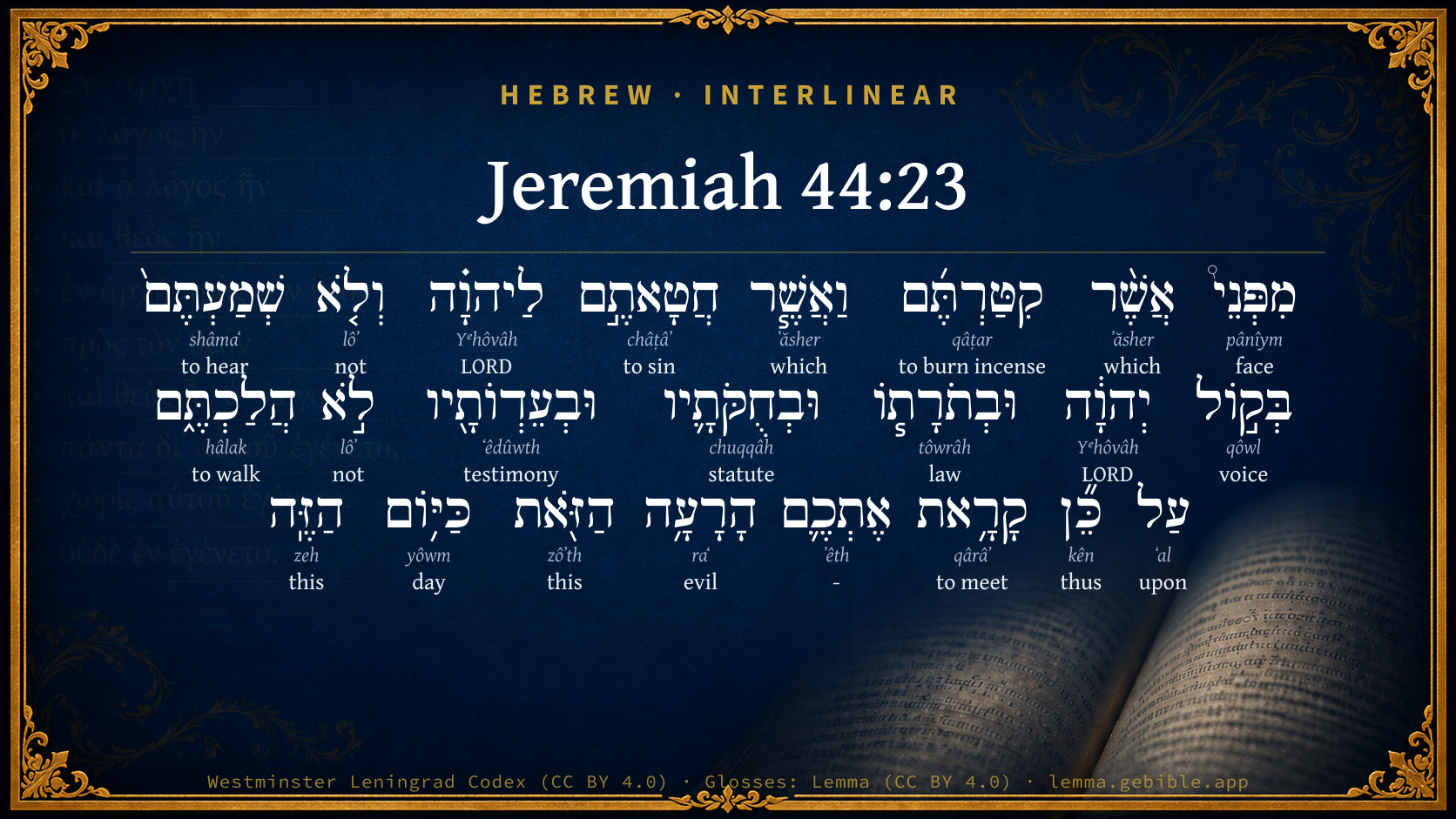
Jeremiah 44:23

Hebrew (Westminster Leningrad Codex) Jeremiah 44:23 appears in the Hebrew Old Testament. The text above is from the Westminster Leningrad Codex. Each word links to its Strong’s number, a concise gloss, and parsing drawn from the Open Scriptures Hebrew Bible morphology. Click any word for its full Brown-Driver-Briggs (BDB) entry.
Download image
Cite this verse

Jeremiah 44:23 (World English Bible). Public Domain. Lemma interlinear Bible study tool, https://lemma.gebible.app/v/jeremiah/44/23.

Show BibTeX & RIS
BibTeX
RIS
English Translation
Because you have burned incense, and because you have sinned against Yahweh, and have not obeyed the voice of Yahweh, nor walked in his law, nor in his statutes, nor in his testimonies; therefore this evil is happened to you, as it is this day.
World English Bible · Public Domain
Download a study sheet

One document with this verse’s original text, its word-by-word gloss line, the meaning frame, cross-references with their text, attributed commentary, and full source and license credits — printable, and it pastes into notes with its structure intact.

This verse Autodidact and up

Study sheet (.html) Plain text (.txt)

A passage Seminary Student

Up to 50 verses in one chapter. A passage sheet keeps up to 6 commentary sources and 12 cross-references per verse, in the order this page ranks them, and says so on the sheet whenever that leaves anything out. Ask for a single verse and you get the Autodidact verse sheet above.

Everything on this page stays free to read, with no account — the sheet is a download of what is already on screen, not access to it.

Want to remove ads? Support Godless Engineer
Compare translations 3

The same verse in 3 English versions, stacked beneath the original-language interlinear above. Click any original word for its lexicon entry.

Each is an independent rendering of the whole verse — the interlinear is not word-aligned to these translations.

Highlighted words mark where these versions differ — a whole-verse word diff, not a word-by-word alignment.

  • World English Bible Public Domain
    Because you have burned incense, and because you have sinned against Yahweh, and have not obeyed the voice of Yahweh, nor walked in his law, nor in his statutes, nor in his testimonies; therefore this evil is happened to you, as it is this day.
  • King James Version Public Domain
    Because ye have burned incense, and because ye have sinned against the LORD, and have not obeyed the voice of the LORD, nor walked in his law, nor in his statutes, nor in his testimonies; therefore this evil is happened unto you, as at this day.
  • unfoldingWord Literal Text CC BY-SA 4.0
    Because you burned incense and sinned against Yahweh, and because you would not listen to his voice, his law, his statutes, or his covenant decrees, this disaster against you has happened as at this present day.”

unfoldingWord Literal Text — © unfoldingWord, licensed CC BY-SA 4.0. Word-aligned USFM3 via Door43 (git.door43.org/unfoldingWord/en_ult).

Versions to compare (up to 4)

3 of 4 selected

Show all 18 translations

Every available English version of this verse, each an independent rendering of the whole verse.

  • World English Bible Public Domain
    Because you have burned incense, and because you have sinned against Yahweh, and have not obeyed the voice of Yahweh, nor walked in his law, nor in his statutes, nor in his testimonies; therefore this evil is happened to you, as it is this day.
  • Berean Standard Bible Public Domain
    Because you burned incense and sinned against the LORD, and did not obey the voice of the LORD or walk in His instruction, His statutes, and His testimonies, this disaster has befallen you, as you see today.”
  • Majority Standard Bible Public Domain
    Because you burned incense and sinned against the LORD and did not obey the voice of the LORD or walk in His instruction, His statutes, and His testimonies, this disaster has befallen you, as you see today.”
  • King James Version Public Domain
    Because ye have burned incense, and because ye have sinned against the LORD, and have not obeyed the voice of the LORD, nor walked in his law, nor in his statutes, nor in his testimonies; therefore this evil is happened unto you, as at this day.
  • American Standard Version (1901) Public Domain
    Because ye have burned incense, and because ye have sinned against Jehovah, and have not obeyed the voice of Jehovah, nor walked in his law, nor in his statutes, nor in his testimonies; therefore this evil is happened unto you, as it is this day.
  • Revised Version (1885) Public Domain
    Because ye have burned incense, and because ye have sinned against the LORD, and have not obeyed the voice of the LORD, nor walked in his law, nor in his statutes, nor in his testimonies; therefore this evil is happened unto you, as it is this day.
  • Geneva Bible (1599) Public Domain
    Because ye haue burnt incense and because ye haue sinned against the Lord, and haue not obeyed the voyce of the Lord, nor walked in his Lawe, nor in his statutes, nor in his testimonies, therefore this plague is come vpon you, as appeareth this day.
  • Douay-Rheims (1899) Public Domain
    Because you have sacrificed to idols, and have sinned against the Lord: and have not obeyed the voice of the Lord, and have not walked in his law, and in his commandments, and in his testimonies: therefore are these evils come upon you, as at this day.
  • Young's Literal Translation Public Domain
    `Because that ye have made perfume, and because ye have sinned against Jehovah, and have not hearkened to the voice of Jehovah, and in His law, and in His statutes, and in His testimonies ye have not walked, therefore hath this evil met you as `at' this day.'
  • Literal Standard Version CC BY-SA 4.0
    Because that you have made incense, and because you have sinned against YHWH, and have not listened to the voice of YHWH, and have not walked in His law, and in His statutes, and in His testimonies, therefore this calamity has met you as [at] this day.”
  • Unlocked Literal Bible CC BY-SA 4.0
    Because you burned incense and sinned against Yahweh, and because you would not listen to his voice, his law, his statutes, or his covenant decrees, this disaster against you has happened as at this present day.”
  • unfoldingWord Literal Text CC BY-SA 4.0
    Because you burned incense and sinned against Yahweh, and because you would not listen to his voice, his law, his statutes, or his covenant decrees, this disaster against you has happened as at this present day.”
  • Darby Bible Public Domain
    Because ye have burned incense, and because ye have sinned against Jehovah, and have not hearkened unto the voice of Jehovah, nor walked in his law, nor in his statutes, nor in his testimonies; therefore this evil hath come upon you, as at this day.
  • World Messianic Bible Public Domain
    Because you have burned incense and because you have sinned against the LORD, and have not obeyed the LORD’s voice, nor walked in his law, nor in his statutes, nor in his testimonies; therefore this evil has happened to you, as it is today.”
  • Webster's Bible Public Domain
    Because ye have burned incense, and because ye have sinned against the LORD, and have not obeyed the voice of the LORD, nor walked in his law, nor in his statutes, nor in his testimonies; therefore this evil hath happened to you, as at this day.
  • Free Bible Version CC BY-SA 4.0
    As you can see today, the disaster you've experienced happened because you burned incense to other gods and sinned against the Lord, refusing to listen to the Lord or to follow his instructions, his rules, and his regulations.”
  • Bible in Basic English Public Domain
    Because you have been burning perfumes, and sinning against the Lord, and have not given ear to the voice of the Lord, or gone in the way of his law or his rules or his orders; for this reason this evil has come on you, as it is today.
  • JPS Tanakh (1917) Public Domain
    Because ye have offered, and because ye have sinned against the LORD, and have not hearkened to the voice of the LORD, nor walked in His law, nor in His statutes, nor in His testimonies; therefore this evil is happened unto you, as at this day.'

Literal Standard Version (2020), Covenant Press — licensed CC BY-SA 4.0. Text via the HelloAO Bible API (eBible.org). Unlocked Literal Bible (unfoldingWord) — licensed CC BY-SA 4.0. Text via the HelloAO Bible API (eBible.org). unfoldingWord Literal Text — © unfoldingWord, licensed CC BY-SA 4.0. Word-aligned USFM3 via Door43 (git.door43.org/unfoldingWord/en_ult). Free Bible Version, Dr. Jonathan Gallagher — licensed CC BY-SA 4.0. Text via the HelloAO Bible API (eBible.org).

Word by word

More ways to search: Search by grammar → Find every occurrence → Compare this word →

Practice this passage: Drill this verse → Learn its vocabulary →

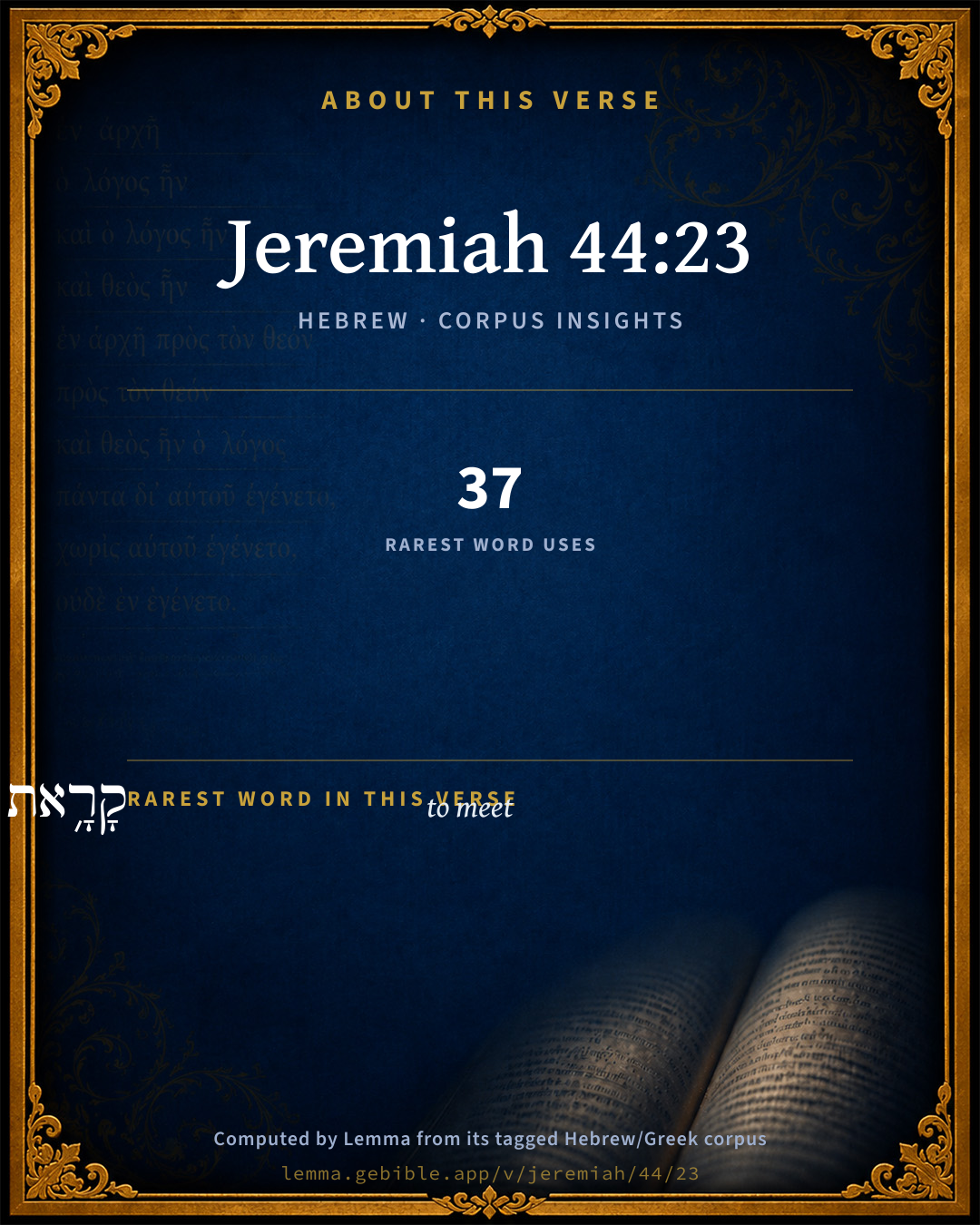
קָרָ֥את
qârâʼ
H7122
“to meet”
Verb, Qal, Perfect, 3rd Person, Feminine, Singular
Part of Speech
Verb
Stem
Qal
Form
Perfect
Person
3rd Person
Gender
Feminine
Number
Singular
Full BDB Definition

Origin: a primitive root, to encounter, whether accidentally or in a hostile manner

TWOT: 2064

to encounter, befall, meet - (Qal) - to meet, encounter - to befall (figuratively) - (Niphal) to meet, meet unexpectedly - (Hiphil) to cause to meet
  1. מִפְּנֵי֩ pânîym H6440 “from · face(s) of” Preposition + Noun, Common, Both, Plural, Construct
  2. אֲשֶׁ֨ר ʼăsher H834 “which” Particle, Relative
  3. קִטַּרְתֶּ֜ם qâṭar H6999 “to burn incense” Verb, Piel, Perfect, 2nd Person, Masculine, Plural
  4. וַאֲשֶׁ֧ר ʼăsher H834 “and · which” Conjunction + Particle, Relative
  5. חֲטָאתֶ֣ם châṭâʼ H2398 “to sin” Verb, Qal, Perfect, 2nd Person, Masculine, Plural
  6. לַיהוָ֗ה Yᵉhôvâh H3068 “to/for · LORD” Preposition + Noun, Proper
  7. וְלֹ֤א lôʼ H3808 “and · not” Conjunction + Particle, Negative
  8. שְׁמַעְתֶּם֙ shâmaʻ H8085 “to hear” Verb, Qal, Perfect, 2nd Person, Masculine, Plural
  9. בְּק֣וֹל qôwl H6963 “in/at · voice of” Preposition + Noun, Common, Masculine, Singular, Construct
  10. יְהוָ֔ה Yᵉhôvâh H3068 “LORD” Noun, Proper
  11. וּבְתֹרָת֧וֹ tôwrâh H8451 “and · in/at · law · his” Conjunction + Preposition + Noun, Common, Feminine, Singular, Construct + Suffix, Personal, 3rd Person, Masculine, Singular
  12. וּבְחֻקֹּתָ֛יו chuqqâh H2708 “and · in/at · statutes · his” Conjunction + Preposition + Noun, Common, Both, Plural, Construct + Suffix, Personal, 3rd Person, Masculine, Singular
  13. וּבְעֵדְוֺתָ֖יו ʻêdûwth H5715 “and · in/at · testimonies · his” Conjunction + Preposition + Noun, Common, Feminine, Plural, Construct + Suffix, Personal, 3rd Person, Masculine, Singular
  14. לֹ֣א lôʼ H3808 “not” Particle, Negative
  15. הֲלַכְתֶּ֑ם hâlak H1980 “to walk” Verb, Qal, Perfect, 2nd Person, Masculine, Plural
  16. עַל ʻal H5921 “upon” Preposition
  17. כֵּ֞ן kên H3651 “thus” Particle, Demonstrative
  18. אֶתְכֶ֛ם ʼêth H853 “- · you” Particle, Direct Object + Suffix, Personal, 2nd Person, Masculine, Plural
  19. הָרָעָ֥ה raʻ H7451 “the · evil” Particle, Definite Article + Noun, Common, Feminine, Singular, Absolute
  20. הַזֹּ֖את zôʼth H2063 “the · this” Particle, Definite Article + Pronoun, Demonstrative, Feminine, Singular
  21. כַּיּ֥וֹם yôwm H3117 “like/as the · day” Preposition, Determined + Noun, Common, Masculine, Singular, Absolute
  22. הַזֶּֽה zeh H2088 “the · this” Particle, Definite Article + Pronoun, Demonstrative, Masculine, Singular

About this verse

These counts appear in no published source. They are computed here, from the morphology-tagged text and Lemma’s own curated glosses. What Lemma adds →

23
words
20
distinct lemmas
Prophets
section

Shared distinctive vocabulary

קָרָ֥את to meet H7122 occurs in 35 verses of the Hebrew Bible. Also found in:

Grammatical profile

  • 5 verbs
  • 9 nouns
  • 2 pronouns
  • 1 preposition
  • 6 particles

Verb forms

  • קִטַּרְתֶּ֜ם Piel · Perfect
  • חֲטָאתֶ֣ם Qal · Perfect
  • שְׁמַעְתֶּם֙ Qal · Perfect
  • הֲלַכְתֶּ֑ם Qal · Perfect
  • קָרָ֥את Qal · Perfect

Repetition

Words recur within this verse — often emphatic in Hebrew:

  • לַיהוָ֗ה LORD H3068 ×2
  • אֲשֶׁ֨ר which H834 ×2
  • וְלֹ֤א not H3808 ×2

Cross-references

16

Topical passages linked to Jeremiah 44:23 in the Treasury of Scripture Knowledge — connected by theme and wording, ordered by reader-vote popularity; previews shown in the World English Bible.

  • 1 Kings 9:9 and they shall answer, Because they forsook Yahweh their God, who brought forth their fathers out of the land of Egypt, and laid hold on other gods, and worshiped them, and served them: therefore has Yahweh brought all this evil on them.
  • Daniel 9:11–12 Yes, all Israel have transgressed your law, even turning aside, that they should not obey your voice: therefore has the curse been poured out on us, and the oath that is written in the law of Moses the servant of God; for we have sinned against him.
  • Nehemiah 13:18 Didn't your fathers do thus, and did not our God bring all this evil on us, and on this city? yet you bring more wrath on Israel by profaning the Sabbath.
  • Psalms 119:150 They draw near who follow after wickedness. They are far from your law.
  • 2 Chronicles 36:16 but they mocked the messengers of God, and despised his words, and scoffed at his prophets, until the wrath of Yahweh arose against his people, until there was no remedy.
  • Psalms 78:56 Yet they tempted and rebelled against the Most High God, And didn't keep his testimonies;
  • Psalms 119:155 Salvation is far from the wicked, For they don't seek your statutes.
  • Jeremiah 7:13–15 Now, because you have done all these works, says Yahweh, and I spoke to you, rising up early and speaking, but you didn't hear; and I called you, but you didn't answer:
  • Jeremiah 32:31–33 For this city has been to me a provocation of my anger and of my wrath from the day that they built it even to this day; that I should remove it from before my face,
  • Jeremiah 40:3 and Yahweh has brought it, and done according as he spoke: because you have sinned against Yahweh, and have not obeyed his voice, therefore this thing is come on you.
  • Jeremiah 44:8 in that you provoke me to anger with the works of your hands, burning incense to other gods in the land of Egypt, where you are gone to sojourn; that you may be cut off, and that you may be a curse and a reproach among all the nations of the earth?
  • Jeremiah 44:18 But since we left off burning incense to the queen of the sky, and pouring out drink-offerings to her, we have wanted all things, and have been consumed by the sword and by the famine.
  • Jeremiah 44:21 The incense that you burned in the cities of Judah, and in the streets of Jerusalem, you and your fathers, your kings and your princes, and the people of the land, didn't Yahweh remember them, and didn't it come into his mind?
  • Lamentations 1:8 Jerusalem has grievously sinned; therefore she is become as an unclean thing; All who honored her despise her, because they have seen her nakedness: Yes, she sighs, and turns backward.
  • 1 Corinthians 10:20 But I say that the things which the Gentiles sacrifice, they sacrifice to demons, and not to God, and I don't desire that you would have communion with demons.
  • 2 Corinthians 6:16 What agreement has a temple of God with idols? For you are a temple of the living God. Even as God said, "I will dwell in them, and walk in them; and I will be their God, and they will be my people."

Cross-references courtesy of OpenBible.info (CC BY 4.0).

Hebrew and Greek witnesses Masoretic Hebrew ↔ Greek Septuagint

The same verse in the two great witnesses to the Old Testament, shown verse-for-verse.

These are two independent witnesses, not word-aligned to each other, and the Septuagint is shown in lemma (dictionary) form.

Hebrew Jeremiah 44:23 Masoretic · Westminster Leningrad Codex

מִפְּנֵי֩ אֲשֶׁ֨ר קִטַּרְתֶּ֜ם וַאֲשֶׁ֧ר חֲטָאתֶ֣ם לַיהוָ֗ה וְלֹ֤א שְׁמַעְתֶּם֙ בְּק֣וֹל יְהוָ֔ה וּבְתֹרָת֧וֹ וּבְחֻקֹּתָ֛יו וּבְעֵדְוֺתָ֖יו לֹ֣א הֲלַכְתֶּ֑ם עַל כֵּ֞ן קָרָ֥את אֶתְכֶ֛ם הָרָעָ֥ה הַזֹּ֖את כַּיּ֥וֹם הַזֶּֽה

Because you have burned incense, and because you have sinned against Yahweh, and have not obeyed the voice of Yahweh, nor walked in his law, nor in his statutes, nor in his testimonies; therefore this evil is happened to you, as it is this day.

World English Bible · Public Domain

Greek LXX Structure differs

In the Septuagint, Jeremiah is about an eighth shorter than the Hebrew and arranges its material differently — the Oracles Against the Nations (Hebrew chapters 46–51) appear in the middle of the Greek book, after 25:13. Because the chapter and verse boundaries do not line up, a verse-for-verse comparison with the Hebrew is not shown.

A verse-for-verse comparison isn’t shown here because the chapters and verses don’t line up. Switch to the LXX edition with the MT / LXX toggle above to read the Greek directly.

Hebrew: Westminster Leningrad Codex (CC BY 4.0). Greek: Septuagint (public domain); English from a public-domain English Septuagint. How the Septuagint differs from the Hebrew →

Targum (Aramaic paraphrase)

1

The Targum is the ancient Jewish Aramaic paraphrase of the Hebrew Scriptures — an interpretive translation, not the Hebrew text itself. Onkelos (literal) and Pseudo-Jonathan (expansive) render the Torah, and Jonathan the Prophets. Coverage is partial: where no permissively-licensed English translation exists for a verse, only the Aramaic is shown. This is verse-level text, not a word-by-word alignment to the Hebrew.

  1. Targum Jonathan Prophets (Joshua–Malachi)
    מִן קֳדָם דְאַסֵיקְתּוּן בּוּסְמִין וּדְחַבְתּוּן קֳדָם יְיָ וְלָא קַבֵּילְתּוּן לְמֵימְרָא דַייָ וּבְאוֹרַיְתֵיהּ וּבִקְיָמוֹהִי וּבְסָהִדְוָתֵיהּ לָא הֲלֵיכְתּוּן עַל כֵּן עַרְעַת יַתְכוֹן בִּישְׁתָא הָדָא כְּיוֹמָא הָדֵין:

    (no public-domain English translation for this verse)

    Targum Jonathan — Aramaic: “Mikraot Gedolot” (public domain). English: “Sefaria Community Translation” (CC0 1.0 (public-domain dedication)); “London "Chaldee Paraphrase," 1871” (public domain). Text via Sefaria.

Commentary

Notes on Jeremiah 44:23 from classic Christian and Jewish commentators (each source and its license shown beneath its notes). The classic Christian expositions comment on the surrounding passage and are grouped to its opening verse, so a note may address several verses; the Jewish commentaries on the Tanakh (Rashi and others) are per-verse, so they appear only where the commentator wrote on this verse.

Lemma curates 59 commentaries, every one of them public domain or Creative Commons licensed, each selected and text-cleaned for this edition rather than reprinted as found. About our sources →

John Gill's Exposition

And because ye have burnt incense,.... Not to Jehovah, but to the queen of heaven; which they owned they did, and determined they would; asserting it was better with them when they did it than when they omitted it; for which reason the prophet particularly mentions it, and assigns it as the cause of the present ruin and destruction of their land, city, and temple:

and because ye have sinned against the Lord; by worshipping idols; all sin is against the Lord, but especially idolatry:

and have not obeyed the voice of the Lord; by his prophets, who cautioned them against idolatry, reproved them for it, and told them what would be the consequence of it; but this they hearkened not unto, which was an aggravation of their sin:

nor walked in his law; the moral law, according to it; which is a rule of walk and conversation:

nor in his statutes, nor in his testimonies; as not in the moral law, so neither in the ceremonial law, and the rites of that; nor in the judicial law, and the testifications of the will of God in either of them:

therefore this evil is happened unto you, as at this day: that is, the desolation on their land, as in Jer 44:23; See Gill on Jer 44:23.

John Gill's Exposition of the Whole Bible (1746–1763) — public domain (CC PDM 1.0). Text via the HelloAO Bible API.

Trapp's Complete Commentary

John Trapp

Jer 44:23 Because ye have burned incense, and because ye have sinned against the LORD, and have not obeyed the voice of the LORD, nor walked in his law, nor in his statutes, nor in his testimonies; therefore this evil is happened unto you, as at this day.

Ver. 23. Because ye have burnt incense, &c.] See Jer 42:21; Jer 43:7.

John Trapp, A Commentary or Exposition upon All the Books of the Old and New Testament (1647–1656) — public domain. Text from a community e-Sword module.

Keil & Delitzsch

C. F. Keil & F. Delitzsch

Jer 44:23 is an emphatic and brief repetition of what has already been said. קראת is for קראה, as in Deu 31:29; cf. Gesenius, 74, note 1; Ewald, 194, b.

Keil & Delitzsch — Biblical Commentary on the Old Testament (1861–1891) — public domain (CC PDM 1.0). Text via the HelloAO Bible API. (Old Testament only.)

Jamieson, Fausset & Brown

Robert Jamieson, A. R. Fausset & David Brown

law--the moral precepts.

statutes--the ceremonial.

testimonies--the judicial (Dan 9:11-12).

Jamieson, Fausset & Brown — Commentary Critical and Explanatory on the Whole Bible (1871) — public domain (CC PDM 1.0). Text via the HelloAO Bible API.

John Calvin's Commentaries

He at length explains more clearly, in other words, the same thing, on account of your incense, he says, and because ye have done wickedly, etc. By naming incense especially, stating a part for the whole, he refers to all false and corrupt modes of worship, as it was stated yesterday; but he declares all of them to have been abominable. Then he says, Ye have acted impiously against God He now exaggerates their sin, for they had despised all godly admonitions, ye have not hearkened, he says, to the voice of Jehovah I apply this to the discourses of the Prophets, by which God continued to exhort them to repentance; for he daily and constantly addressed them, in order to restore them to the way of salvation. Then the Prophet condemns them, because they hearkened not to the words of the Prophets.

Then he adds, Nor walked in his Law, nor in his statutes, nor in his testimonies, he shews by these words, that even if Prophets had not been sent, one after the other, the Law ought to have been sufficient for them. But he was not content with mentioning the Law only, but added, statutes and testimonies: by which words he intimates, as we said yesterday, that the doctrine of the Law was clear and plain.

he at length adds, Therefore has all this evil happened to you, as it appears at this day. The Prophet, in short, intimates that their guilt was sufficiently proved, because God had been so angry with them, and they had been so severely afflicted; for if his judgments are right, it follows that the punishment he inflicted on the Jews was right. It may also be hence inferred, that they had been rebellious, because they had perverted and corrupted his true worship.

John Calvin's Commentaries (1540-1563) — public domain. Text from the Calvin Translation Society English edition (1840s-50s) via the Christian Classics Ethereal Library (ccel.org). Calvin's coverage is partial (roughly two-thirds of the Bible); uncommented books and verses are honest gaps, never fabricated. The 19th-century editor's footnotes and remarks are omitted so the notes are faithfully Calvin's own voice.

Matthew Poole's English Annotations

There is in these verses nothing of difficulty, nor any new phrases to be opened. That which is observable is, that though the prophet was but one against many, yet he feareth not their faces: the substance of what he saith is this, that they interpreted God’s voice in his providences toward their country directly contrary to the true sense of it. They concluded that their omission of late to burn incense to the sun, moon, and stars was the cause why it was so ill with them; as if these were animate beings, and the Supreme Being, whereas they were but creatures. Or as if it were the will of the Supreme Being to be adored and worshipped in them, or before statues and images represented by them, whereas the will of God was directly contrary: and as he in the second commandment had forbidden any such worship, because he was a jealous God; so he had for the breach of that commandment, by their burning incense to these creatures, burned up their houses and temple, and brought their nation into that misery into which they were come: from whence may be observed how ill an argument for any religious worship antiquity is, unless we by it mean what is most ancient; as also that prescription in that which is false in the worship of God justifieth none. Nor is it a good conclusion that those who lived nearest to the primitive institution are most likely to have done best, as having the best means to know what is truly primitive. Idolatry was as old as Laban, and the worst of idolatry (offering children to Molech) was older than the Levitical law, if not as old as Serug. In matters of worship the word of God is a sufficient rule, we need not plead antiquity, nor the practice of our fathers. Error is not capable of being justified by tradition or prescription.

Matthew Poole's English Annotations on the Holy Bible (1683–1685) — public domain. Text from a community e-Sword/MySword module.

Lesson kit

Teaching starters — assembled from the data on this page, not authored interpretation. Every prompt links to the verse data it draws on. Edit before teaching.

Jeremiah, in the Prophets, opens this verse with 23 words (20 distinct Hebrew lemmas). Its most distinctive word is qârâʼ (“to meet”). A historical commentator’s framing appears above. Read the whole chapter for the surrounding context.

Discussion questions

  1. The word qârâʼ carries the sense “to meet.” How does it shape the verse?
  2. Genesis 42:4 shares the word «to meet» with this verse. How do the two illuminate each other?
  3. “LORD” occurs 2× in this one verse. What is the effect of the repetition?
  4. These translations render this verse differently; the difference is in the English rendering, not the original. What questions does that raise?
  5. The verb «קִטַּרְתֶּ֜ם» is Piel Perfect. How does its form color the action?
  6. Reading how John Gill's Exposition and Trapp's Complete Commentary read this verse, where do the two commentators agree and where do they part?

Things to notice

Reading settings

Reading text

Shown beneath each verse's original-language words.

Old Testament
Old Testament edition

Read the OT as the Masoretic Hebrew (MT) or the Greek Septuagint (LXX).

English shown for the Greek Septuagint (in the Hebrew ↔ Greek comparison).

Comparing translations? Open the Compare panel on any verse page to stack up to four side by side.