
2 Kings 21:11

Hebrew (Westminster Leningrad Codex) 2 Kings 21:11 appears in the Hebrew Old Testament. The text above is from the Westminster Leningrad Codex. Each word links to its Strong’s number, a concise gloss, and parsing drawn from the Open Scriptures Hebrew Bible morphology. Click any word for its full Brown-Driver-Briggs (BDB) entry.
Download image
Cite this verse

2 Kings 21:11 (World English Bible). Public Domain. Lemma interlinear Bible study tool, https://lemma.gebible.app/v/2-kings/21/11.

Show BibTeX & RIS
BibTeX
RIS
English Translation
Because Manasseh king of Judah has done these abominations, and has done wickedly above all that the Amorites did, who were before him, and has made Judah also to sin with his idols;
World English Bible · Public Domain
Download a study sheet

One document with this verse’s original text, its word-by-word gloss line, the meaning frame, cross-references with their text, attributed commentary, and full source and license credits — printable, and it pastes into notes with its structure intact.

This verse Autodidact and up

Study sheet (.html) Plain text (.txt)

A passage Seminary Student

Up to 50 verses in one chapter. A passage sheet keeps up to 6 commentary sources and 12 cross-references per verse, in the order this page ranks them, and says so on the sheet whenever that leaves anything out. Ask for a single verse and you get the Autodidact verse sheet above.

Everything on this page stays free to read, with no account — the sheet is a download of what is already on screen, not access to it.

Want to remove ads? Support Godless Engineer
Compare translations 3

The same verse in 3 English versions, stacked beneath the original-language interlinear above. Click any original word for its lexicon entry.

Each is an independent rendering of the whole verse — the interlinear is not word-aligned to these translations.

Highlighted words mark where these versions differ — a whole-verse word diff, not a word-by-word alignment.

  • World English Bible Public Domain
    Because Manasseh king of Judah has done these abominations, and has done wickedly above all that the Amorites did, who were before him, and has made Judah also to sin with his idols;
  • King James Version Public Domain
    Because Manasseh king of Judah hath done these abominations, and hath done wickedly above all that the Amorites did, which were before him, and hath made Judah also to sin with his idols:
  • unfoldingWord Literal Text CC BY-SA 4.0
    “Because Manasseh, the king of Judah, has done these evil abominations more than all that the Amorite did who to his face, and he has also made Judah sin with his idols,

unfoldingWord Literal Text — © unfoldingWord, licensed CC BY-SA 4.0. Word-aligned USFM3 via Door43 (git.door43.org/unfoldingWord/en_ult).

Versions to compare (up to 4)

3 of 4 selected

Show all 18 translations

Every available English version of this verse, each an independent rendering of the whole verse.

  • World English Bible Public Domain
    Because Manasseh king of Judah has done these abominations, and has done wickedly above all that the Amorites did, who were before him, and has made Judah also to sin with his idols;
  • Berean Standard Bible Public Domain
    “Since Manasseh king of Judah has committed all these abominations, acting more wickedly than the Amorites who preceded him, and with his idols has caused Judah to sin,
  • Majority Standard Bible Public Domain
    “Since Manasseh king of Judah has committed all these abominations, acting more wickedly than the Amorites who preceded him, and with his idols has caused Judah to sin,
  • King James Version Public Domain
    Because Manasseh king of Judah hath done these abominations, and hath done wickedly above all that the Amorites did, which were before him, and hath made Judah also to sin with his idols:
  • American Standard Version (1901) Public Domain
    Because Manasseh king of Judah hath done these abominations, and hath done wickedly above all that the Amorites did, that were before him, and hath made Judah also to sin with his idols;
  • Revised Version (1885) Public Domain
    Because Manasseh king of Judah hath done these abominations, and hath done wickedly above all that the Amorites did, which were before him, and hath made Judah also to sin with his idols:
  • Geneva Bible (1599) Public Domain
    Because that Manasseh King of Iudah hath done such abominations, and hath wrought more wickedly then al that the Amorites (which were before him) did, and hath made Iudah sinne also with his idoles,
  • Douay-Rheims (1899) Public Domain
    Because Manasses king of Juda hath done these most wicked abominations, beyond all that the Amorrhites did before him, and hath made Juda also to sin with his filthy doings:
  • Young's Literal Translation Public Domain
    `Because that Manasseh king of Judah hath done these abominations -- he hath done evil above all that the Amorites have done who `are' before him, and causeth also Judah to sin by his idols;
  • Literal Standard Version CC BY-SA 4.0
    “Because that Manasseh king of Judah has done these abominations—he has done evil above all that the Amorites have done who [are] before him, and also causes Judah to sin by his idols—
  • Unlocked Literal Bible CC BY-SA 4.0
    “Because Manasseh king of Judah has done these disgusting things, and has acted wickedly more than all that the Amorites who were before him did, and has also made Judah sin with his idols,
  • unfoldingWord Literal Text CC BY-SA 4.0
    “Because Manasseh, the king of Judah, has done these evil abominations more than all that the Amorite did who to his face, and he has also made Judah sin with his idols,
  • Darby Bible Public Domain
    Because Manasseh king of Judah hath done these abominations, and hath done wickedly above all that the Amorites did, who were before him, and hath made Judah also to sin with his idols;
  • World Messianic Bible Public Domain
    “Because Manasseh king of Judah has done these abominations, and has done wickedly above all that the Amorites did, who were before him, and has also made Judah to sin with his idols;
  • Webster's Bible Public Domain
    Because Manasseh king of Judah hath done these abominations, and hath done wickedly above all that the Amorites did, who were before him, and hath made Judah also to sin with his idols:
  • Free Bible Version CC BY-SA 4.0
    “Since Manasseh, king of Judah, has committed all these disgusting sins, doing even more evil things than the Amorites who lived before him, and by his encouragement of idol worship has made Judah sin,
  • Bible in Basic English Public Domain
    Because Manasseh, king of Judah, has done these disgusting things, doing more evil than all the Amorites before him, and making Judah do evil with his false gods,
  • JPS Tanakh (1917) Public Domain
    'Because Manasseh king of Judah hath done these abominations, and hath done wickedly above all that the Amorites did, that were before him, and hath made Judah also to sin with his idols;

Literal Standard Version (2020), Covenant Press — licensed CC BY-SA 4.0. Text via the HelloAO Bible API (eBible.org). Unlocked Literal Bible (unfoldingWord) — licensed CC BY-SA 4.0. Text via the HelloAO Bible API (eBible.org). unfoldingWord Literal Text — © unfoldingWord, licensed CC BY-SA 4.0. Word-aligned USFM3 via Door43 (git.door43.org/unfoldingWord/en_ult). Free Bible Version, Dr. Jonathan Gallagher — licensed CC BY-SA 4.0. Text via the HelloAO Bible API (eBible.org).

Word by word

More ways to search: Search by grammar → Find every occurrence → Compare this word →

Practice this passage: Drill this verse → Learn its vocabulary →

בְּגִלּוּלָֽיו
gillûwl
H1544
“in/at · idols · his”
Preposition + Noun, Common, Masculine, Plural, Construct + Suffix, Personal, 3rd Person, Masculine, Singular
Part of Speech
Preposition + Noun
Type
Common
Gender
Masculine
Number
Plural
State
Construct
Full BDB Definition

Origin: from H1556

TWOT: 353h

idols
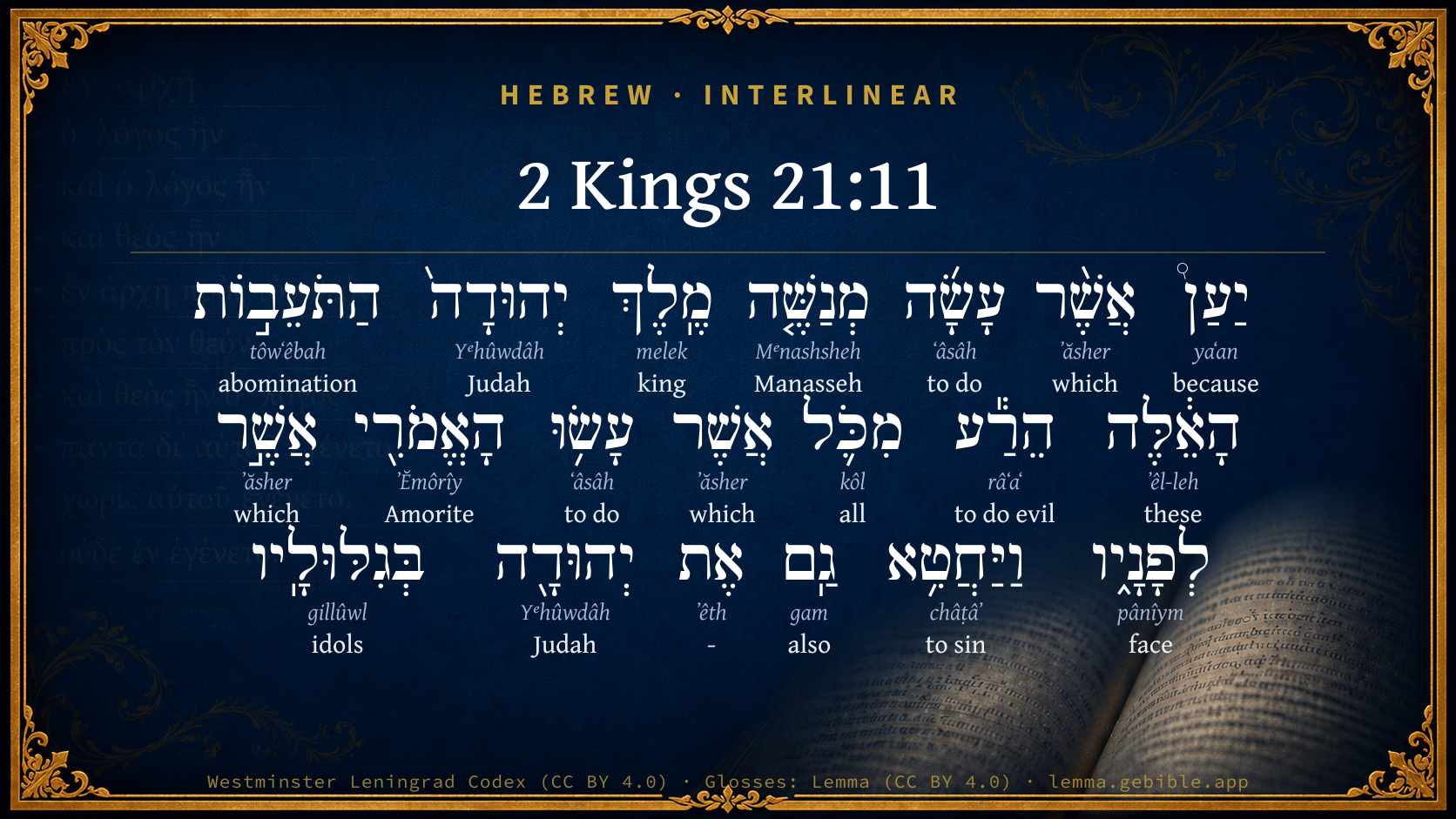
  1. יַעַן֩ yaʻan H3282 “because” Conjunction
  2. אֲשֶׁ֨ר ʼăsher H834 “which” Particle, Relative
  3. עָשָׂ֜ה ʻâsâh H6213 “to do” Verb, Qal, Perfect, 3rd Person, Masculine, Singular
  4. מְנַשֶּׁ֤ה Mᵉnashsheh H4519 “Manasseh” Noun, Proper
  5. מֶֽלֶךְ melek H4428 “king of” Noun, Common, Masculine, Singular, Construct
  6. יְהוּדָה֙ Yᵉhûwdâh H3063 “Judah” Noun, Proper
  7. הַתֹּעֵב֣וֹת tôwʻêbah H8441 “the · abominations” Particle, Definite Article + Noun, Common, Feminine, Plural, Absolute
  8. הָאֵ֔לֶּה ʼêl-leh H428 “the · these” Particle, Definite Article + Pronoun, Demonstrative, Common, Plural
  9. הֵרַ֕ע râʻaʻ H7489 “to do evil” Verb, Hiphil, Perfect, 3rd Person, Masculine, Singular
  10. מִכֹּ֛ל kôl H3605 “from · all” Preposition + Noun, Common, Masculine, Singular, Absolute
  11. אֲשֶׁר ʼăsher H834 “which” Particle, Relative
  12. עָשׂ֥וּ ʻâsâh H6213 “to do” Verb, Qal, Perfect, 3rd Person, Common, Plural
  13. הָאֱמֹרִ֖י ʼĔmôrîy H567 “the · Amorite” Particle, Definite Article + Noun, Gentilic, Masculine, Singular, Absolute
  14. אֲשֶׁ֣ר ʼăsher H834 “which” Particle, Relative
  15. לְפָנָ֑יו pânîym H6440 “to/for · face(s) · his” Preposition + Noun, Common, Both, Plural, Construct + Suffix, Personal, 3rd Person, Masculine, Singular
  16. וַיַּחֲטִ֥א châṭâʼ H2398 “and · to sin” Conjunction + Verb, Hiphil, Sequential Imperfect, 3rd Person, Masculine, Singular
  17. גַֽם gam H1571 “also” Adverb
  18. אֶת ʼêth H853 “-” Particle, Direct Object
  19. יְהוּדָ֖ה Yᵉhûwdâh H3063 “Judah” Noun, Proper

About this verse

These counts appear in no published source. They are computed here, from the morphology-tagged text and Lemma’s own curated glosses. What Lemma adds →

20
words
16
distinct lemmas
Historical
section

Shared distinctive vocabulary

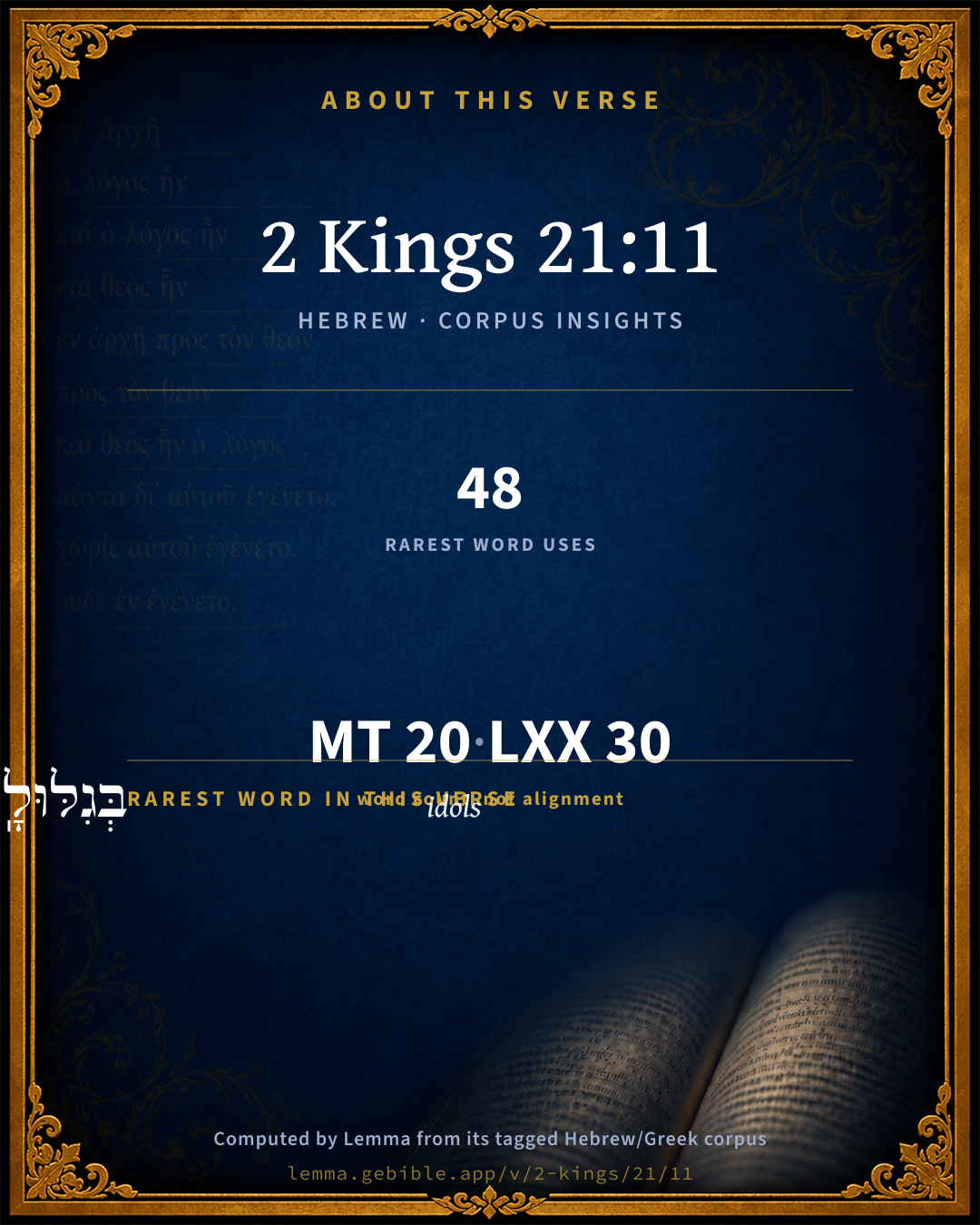
בְּגִלּוּלָֽיו idols H1544 occurs in 45 verses of the Hebrew Bible. Also found in:

Grammatical profile

  • 4 verbs
  • 9 nouns
  • 1 pronoun
  • 1 conjunction
  • 1 adverb
  • 4 particles

Verb forms

  • עָשָׂ֜ה Qal · Perfect
  • הֵרַ֕ע Hiphil · Perfect
  • עָשׂ֥וּ Qal · Perfect
  • וַיַּחֲטִ֥א Hiphil · Sequential Imperfect

Repetition

Words recur within this verse — often emphatic in Hebrew:

  • עָשָׂ֜ה to do H6213 ×2
  • יְהוּדָה֙ Judah H3063 ×2
  • אֲשֶׁ֨ר which H834 ×3

Hebrew & Septuagint length

In English translation the verse runs 33 words from the Hebrew and 33 from the Septuagint (LXX English) — the same length.

A rough comparison of the two English renderings, which tokenize alike — not a word-level alignment.

Word counts can differ between the Hebrew and the Greek without any difference in meaning — e.g. the Hebrew direct-object marker אֵת has no separate Greek word, and Greek often adds the article ὁ.

In the original languages it is 20 Hebrew tokens and 30 Greek tokens — but the two are counted differently (Hebrew bundles its prefixes and suffixes into one token; the Greek is in lemma form), so that isn’t a like-for-like length.

Cross-references

14

Topical passages linked to 2 Kings 21:11 in the Treasury of Scripture Knowledge — connected by theme and wording, ordered by reader-vote popularity; previews shown in the World English Bible.

  • 1 Kings 21:26 He did very abominably in following idols, according to all that the Amorites did, whom Yahweh cast out before the children of Israel.)
  • 2 Kings 24:3–4 Surely at the commandment of Yahweh came this on Judah, to remove them out of his sight, for the sins of Manasseh, according to all that he did,
  • 2 Kings 21:9 But they didn't listen: and Manasseh seduced them to do that which is evil more than did the nations whom Yahweh destroyed before the children of Israel.
  • Jeremiah 15:4 I will cause them to be tossed back and forth among all the kingdoms of the earth, because of Manasseh, the son of Hezekiah, king of Judah, for that which he did in Jerusalem.
  • Genesis 15:16 In the fourth generation they will come here again, for the iniquity of the Amorite is not yet full."
  • 1 Kings 14:16 He will give Israel up because of the sins of Jeroboam, which he has sinned, and with which he has made Israel to sin.
  • 1 Kings 15:30 for the sins of Jeroboam which he sinned, and with which he made Israel to sin, because of his provocation with which he provoked Yahweh, the God of Israel, to anger.
  • 1 Kings 16:19 for his sins which he sinned in doing that which was evil in the sight of Yahweh, in walking in the way of Jeroboam, and in his sin which he did, to make Israel to sin.
  • 2 Kings 21:2 He did that which was evil in the sight of Yahweh, after the abominations of the nations whom Yahweh cast out before the children of Israel.
  • 2 Kings 21:16 Moreover Manasseh shed innocent blood very much, until he had filled Jerusalem from one end to another; besides his sin with which he made Judah to sin, in doing that which was evil in the sight of Yahweh.
  • 2 Kings 21:21 He walked in all the way that his father walked in, and served the idols that his father served, and worshiped them:
  • 2 Kings 23:26–27 Notwithstanding, Yahweh didn't turn from the fierceness of his great wrath, with which his anger was kindled against Judah, because of all the provocation with which Manasseh had provoked him.
  • Ezekiel 16:3 and say, Thus says the Lord Yahweh to Jerusalem: Your birth and your birth is of the land of the Canaanite; the Amorite was your father, and your mother was a Hittite.
  • Ezekiel 16:45 You are the daughter of your mother, who loathes her husband and her children; and you are the sister of your sisters, who loathed their husbands and their children: your mother was a Hittite, and your father an Amorite.

Cross-references courtesy of OpenBible.info (CC BY 4.0).

Hebrew and Greek witnesses Masoretic Hebrew ↔ Greek Septuagint

The same verse in the two great witnesses to the Old Testament, shown verse-for-verse.

These are two independent witnesses, not word-aligned to each other, and the Septuagint is shown in lemma (dictionary) form.

Hebrew 2 Kings 21:11 Masoretic · Westminster Leningrad Codex

יַעַן֩ אֲשֶׁ֨ר עָשָׂ֜ה מְנַשֶּׁ֤ה מֶֽלֶךְ יְהוּדָה֙ הַתֹּעֵב֣וֹת הָאֵ֔לֶּה הֵרַ֕ע מִכֹּ֛ל אֲשֶׁר עָשׂ֥וּ הָאֱמֹרִ֖י אֲשֶׁ֣ר לְפָנָ֑יו וַיַּחֲטִ֥א גַֽם אֶת יְהוּדָ֖ה בְּגִלּוּלָֽיו

Because Manasseh king of Judah has done these abominations, and has done wickedly above all that the Amorites did, who were before him, and has made Judah also to sin with his idols;

World English Bible · Public Domain

Greek LXX 2 Kings 21:11 Septuagint · lemma form

ἀντί ὅς ὅσος ποιέω μανασσῆς ὁ βασιλεύς ιουδα ὁ βδέλυγμα οὗτος ὁ πονηρός ἀπό πᾶς ὅς ποιέω ὁ ἀμορραῖος ὁ ἔμπροσθεν καί ἐκἁμαρτάνω καί γέ ἰουδά ἐν ὁ εἴδωλον αὐτός

Forasmuch as Manasses the king of Juda has wrought all these evil abominations, beyond all that the Amorite did, who lived before him, and has led Juda also into sin by their idols,

LXX2012 (modern English Septuagint) · Public Domain

Hebrew: Westminster Leningrad Codex (CC BY 4.0). Greek: Septuagint (public domain); English from LXX2012 (modern English Septuagint) (Public Domain). How the Septuagint differs from the Hebrew →

Targum (Aramaic paraphrase)

1

The Targum is the ancient Jewish Aramaic paraphrase of the Hebrew Scriptures — an interpretive translation, not the Hebrew text itself. Onkelos (literal) and Pseudo-Jonathan (expansive) render the Torah, and Jonathan the Prophets. Coverage is partial: where no permissively-licensed English translation exists for a verse, only the Aramaic is shown. This is verse-level text, not a word-by-word alignment to the Hebrew.

  1. Targum Jonathan Prophets (Joshua–Malachi)
    חֲלַף דַעֲבַד מְנַשֶׁה מֶלֶךְ שִׁבְטָא דְבֵית יְהוּדָה יַת תּוֹעֲבָתָא הָאִלֵין אַבְאִישׁ מִכֹּל דַעֲבָדוּ אֱמוֹרָאֵי דְקֳדָמוֹהִי וְחַיֵב אַף יַת דְבֵית יְהוּדָה בְּפוּלְחַן טַעֲוָתֵיהּ:

    (no public-domain English translation for this verse)

    Targum Jonathan — Aramaic: “Mikraot Gedolot” (public domain). English: “Sefaria Community Translation” (CC0 1.0 (public-domain dedication)); “London "Chaldee Paraphrase," 1871” (public domain). Text via Sefaria.

Commentary

Notes on 2 Kings 21:11 from classic Christian and Jewish commentators (each source and its license shown beneath its notes). The classic Christian expositions comment on the surrounding passage and are grouped to its opening verse, so a note may address several verses; the Jewish commentaries on the Tanakh (Rashi and others) are per-verse, so they appear only where the commentator wrote on this verse.

Lemma curates 59 commentaries, every one of them public domain or Creative Commons licensed, each selected and text-cleaned for this edition rather than reprinted as found. About our sources →

Trapp's Complete Commentary

John Trapp

2Ki 21:11 Because Manasseh king of Judah hath done these abominations, [and] hath done wickedly above all that the Amorites did, which [were] before him, and hath made Judah also to sin with his idols:

Ver. 11. Above all that the Amorites did.] Noluit solita peccare, et puduit eum non esse impudentem. {a} Such a profligate wicked person was Julian the apostate called by some Idolian: and Pope John XII, of whom Luitprand writeth that he ordained ministers in a stable, drank a health to the devil, called to Jove, Venus, and other heathen deities for help at his dice playing, died in his harlot’s embracings, being struck to death by the devil, &c. {b}

{a} Senec.

{b} Basil., lib. vi cap. 7.

John Trapp, A Commentary or Exposition upon All the Books of the Old and New Testament (1647–1656) — public domain. Text from a community e-Sword module.

Joseph Benson's Commentary

2Ki 21:11-12. Manasseh hath done wickedly, above what the Amorites did — The Canaanitish nations; all so called from one eminent part of them, Gen 15:16. And hath made Judah to sin with his idols — By his example, encouragement, counsel, authority, and command. Therefore I am bringing evil upon Jerusalem — It will come, and it is at no great distance. Whosoever heareth of it, both his ears shall tingle — The report of it shall fill men’s minds with terror and amazement.

Joseph Benson's Commentary on the Old and New Testaments (1811–1818) — public domain. Text from a community e-Sword module.

Tyndale Open Study Notes

Tyndale Open Resources

21:11 The Amorites were the pre-Israelite inhabitants of the land, known for their wickedness. • Manasseh practiced the idolatry of the Amorites as Ahab had done (1 Kgs 21:26).

Tyndale Open Study Notes — © Tyndale Open Resources, licensed CC BY-SA 4.0. Text via the HelloAO Bible API.

Ellicott's Commentary for English Readers

(11) And hath done.—The and is not in the Hebrew, though the Syriac and Arabic supply it. It is not wanted, for the sense is, namely, because he hath done wickedly, &c.

The Amorites.—A general designation of the native races of Canaan, just as in Homer Achaeans. Danaans, &c., in turn represent the Greeks. (See Amo_2:9,’ Eze_16:3; and comp. 1Ki_21:26.)

A Bible Commentary for English Readers, edited by Charles John Ellicott (1878–1897) — public domain. Text from a community e-Sword module.

The Cambridge Bible for Schools and Colleges

gen. ed. J. J. S. Perowne

11. all that the Amorites] The Amorites are put for the inhabitants of Canaan generally, though strictly the Amorites, with the Hittites and the Jebusites, were the mountaineer portion of the people, whilst the Canaanites dwelt by the sea and by the Jordan. See Num_13:29.

The Cambridge Bible for Schools and Colleges (gen. ed. J. J. S. Perowne; Cambridge University Press, 1878–1918) — public domain. Text from a community e-Sword module.

John Gill's Exposition

Because Manasseh king of Judah hath done these abominations,.... Before named, Kg2 21:3,

and hath done wickedly above all that the Amorites did that were before him; one of the seven nations of Canaan, a principal of them, and which is put for all the rest:

and hath made Judah also to sin with his idols: the worship of them, as the Targum; which he did both by his edicts, and by his example.

John Gill's Exposition of the Whole Bible (1746–1763) — public domain (CC PDM 1.0). Text via the HelloAO Bible API.

Haydock's Catholic Bible Commentary

Doings. Hebrew, "idols," ver. 2. See chap. xvii. 12. (Haydock)

George Leo Haydock (1774–1849), Haydock's Catholic Family Bible and Commentary, 1859 edition — public domain. Excludes Psalms (Douay-Rheims chapter numbering differs from Protestant) and Deuterocanonical books (Catholic canon only).

Matthew Poole's English Annotations

Above all that the Amorites did, i.e. the Canaanitish nations, all so called from one eminent part of them. See Poole "Gen 15:16".

Hath made Judah also to sin with his idols; by his example, encouragement, counsel, authority, and command.

Matthew Poole's English Annotations on the Holy Bible (1683–1685) — public domain. Text from a community e-Sword/MySword module.

The Pulpit Commentary

Because Manasseh King of Judah hath done these abominations (comp. ver. 2), and hath done wickedly above all that the Amorites did, which were before him (comp. ver. 9). The "Amorites" are put here (as in Gen_15:16; 1Ki_21:26; and Amo_2:9, Amo_2:10) for the Canaanitish nations generally. Next to the Hittites, they were the most important of the seven nations. And hath made Judah also to sin with his idols (see the comment on ver. 9).

The Pulpit Commentary (1880–1919), ed. H.D.M. Spence-Jones & Joseph S. Exell — public domain. Text from a community e-Sword module.

Lesson kit

Teaching starters — assembled from the data on this page, not authored interpretation. Every prompt links to the verse data it draws on. Edit before teaching.

2 Kings, in the Historical, opens this verse with 20 words (16 distinct Hebrew lemmas). Its most distinctive word is gillûwl (“idols”). A historical commentator’s framing appears above. Read the whole chapter for the surrounding context.

Discussion questions

  1. What does “idols” (gillûwl) contribute to the verse as a whole?
  2. How does Leviticus 26:30, which shares the word «idols», read alongside this verse?
  3. What does the repetition of “to do” (2× in this one verse) do in this verse?
  4. These translations render this verse differently; the difference is in the English rendering, not the original. What questions does that raise?
  5. «עָשָׂ֜ה» is a Qal Perfect verb. How does that grammatical form shape the action described?
  6. Compare how Trapp's Complete Commentary and Joseph Benson's Commentary read this verse. Where do they agree or differ?

Things to notice

Reading settings

Reading text

Shown beneath each verse's original-language words.

Old Testament
Old Testament edition

Read the OT as the Masoretic Hebrew (MT) or the Greek Septuagint (LXX).

English shown for the Greek Septuagint (in the Hebrew ↔ Greek comparison).

Comparing translations? Open the Compare panel on any verse page to stack up to four side by side.