
Leviticus 5:11

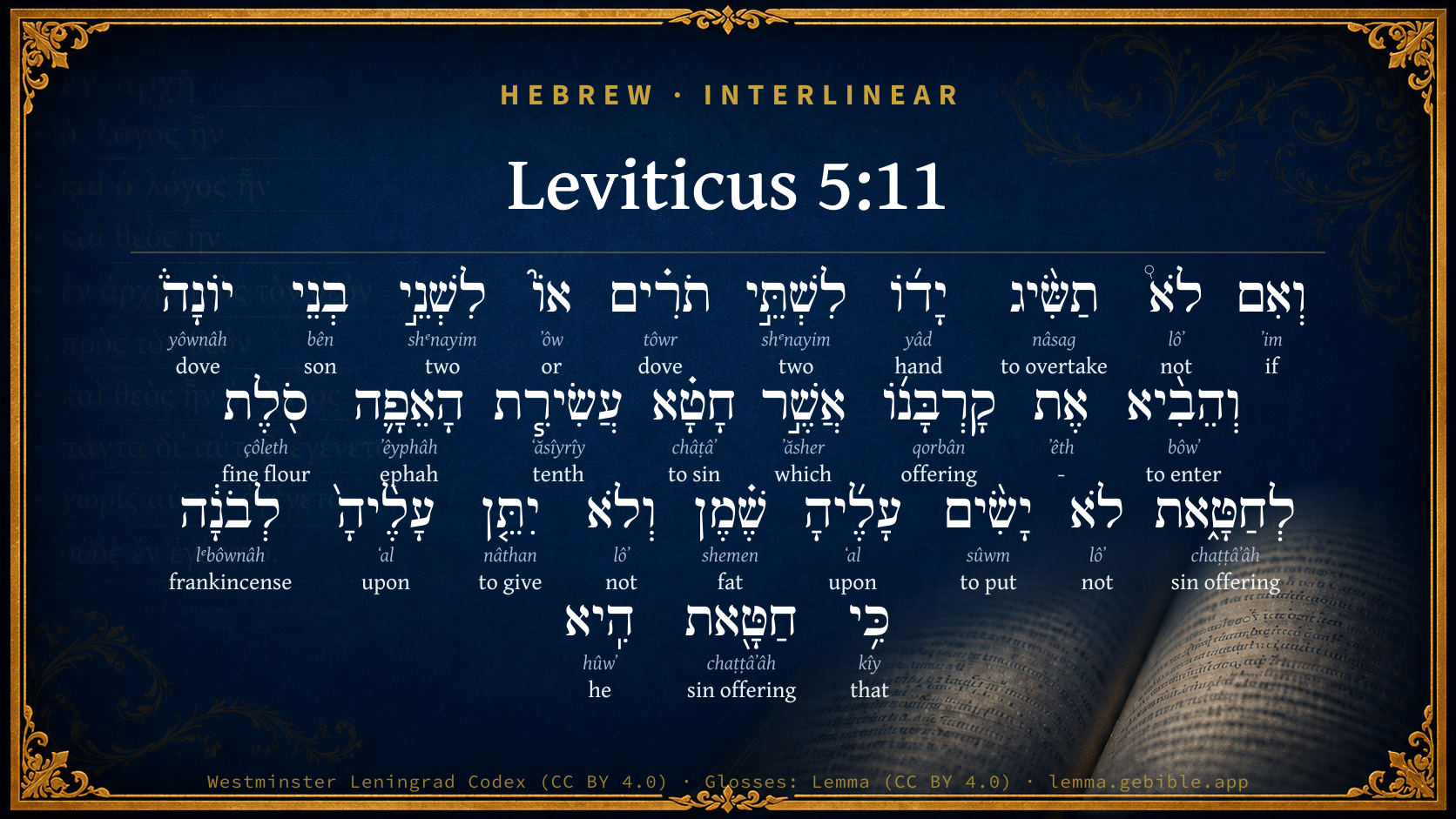
Hebrew (Westminster Leningrad Codex) Leviticus 5:11 appears in the Hebrew Old Testament. The text above is from the Westminster Leningrad Codex. Each word links to its Strong’s number, a concise gloss, and parsing drawn from the Open Scriptures Hebrew Bible morphology. Click any word for its full Brown-Driver-Briggs (BDB) entry.
Download image
Cite this verse

Leviticus 5:11 (World English Bible). Public Domain. Lemma interlinear Bible study tool, https://lemma.gebible.app/v/leviticus/5/11.

Show BibTeX & RIS
BibTeX
RIS
English Translation
"'But if he can't afford two turtledoves, or two young pigeons, then he shall bring his offering for that in which he has sinned, the tenth part of an ephah of fine flour for a sin offering. He shall put no oil on it, neither shall he put any frankincense on it, for it is a sin offering.
World English Bible · Public Domain
Download a study sheet

One document with this verse’s original text, its word-by-word gloss line, the meaning frame, cross-references with their text, attributed commentary, and full source and license credits — printable, and it pastes into notes with its structure intact.

This verse Autodidact and up

Study sheet (.html) Plain text (.txt)

A passage Seminary Student

Up to 50 verses in one chapter. A passage sheet keeps up to 6 commentary sources and 12 cross-references per verse, in the order this page ranks them, and says so on the sheet whenever that leaves anything out. Ask for a single verse and you get the Autodidact verse sheet above.

Everything on this page stays free to read, with no account — the sheet is a download of what is already on screen, not access to it.

Want to remove ads? Support Godless Engineer
Compare translations 3

The same verse in 3 English versions, stacked beneath the original-language interlinear above. Click any original word for its lexicon entry.

Each is an independent rendering of the whole verse — the interlinear is not word-aligned to these translations.

Highlighted words mark where these versions differ — a whole-verse word diff, not a word-by-word alignment.

  • World English Bible Public Domain
    "'But if he can't afford two turtledoves, or two young pigeons, then he shall bring his offering for that in which he has sinned, the tenth part of an ephah of fine flour for a sin offering. He shall put no oil on it, neither shall he put any frankincense on it, for it is a sin offering.
  • King James Version Public Domain
    But if he be not able to bring two turtledoves, or two young pigeons, then he that sinned shall bring for his offering the tenth part of an ephah of fine flour for a sin offering; he shall put no oil upon it, neither shall he put any frankincense thereon: for it is a sin offering.
  • unfoldingWord Literal Text CC BY-SA 4.0
    But if his hand does not reach two doves or two sons of a pigeon, then he shall bring his offering that he sinned, a tenth of an ephah of flour for a sin offering. He shall not place oil on it, and he shall not place incense on it, for it a sin offering.

unfoldingWord Literal Text — © unfoldingWord, licensed CC BY-SA 4.0. Word-aligned USFM3 via Door43 (git.door43.org/unfoldingWord/en_ult).

Versions to compare (up to 4)

3 of 4 selected

Show all 18 translations

Every available English version of this verse, each an independent rendering of the whole verse.

  • World English Bible Public Domain
    "'But if he can't afford two turtledoves, or two young pigeons, then he shall bring his offering for that in which he has sinned, the tenth part of an ephah of fine flour for a sin offering. He shall put no oil on it, neither shall he put any frankincense on it, for it is a sin offering.
  • Berean Standard Bible Public Domain
    But if he cannot afford two turtledoves or two young pigeons, he may bring a tenth of an ephah of fine flour as a sin offering. He must not put olive oil or frankincense on it, because it is a sin offering.
  • Majority Standard Bible Public Domain
    But if he cannot afford two turtledoves or two young pigeons, he may bring a tenth of an ephah of fine flour as a sin offering. He must not put olive oil or frankincense on it, because it is a sin offering.
  • King James Version Public Domain
    But if he be not able to bring two turtledoves, or two young pigeons, then he that sinned shall bring for his offering the tenth part of an ephah of fine flour for a sin offering; he shall put no oil upon it, neither shall he put any frankincense thereon: for it is a sin offering.
  • American Standard Version (1901) Public Domain
    But if his means suffice not for two turtle-doves, or two young pigeons, then he shall bring his oblation for that wherein he hath sinned, the tenth part of an ephah of fine flour for a sin-offering: he shall put no oil upon it, neither shall he put any frankincense thereon; for it is a sin-offering.
  • Revised Version (1885) Public Domain
    But if his means suffice not for two turtledoves, or two young pigeons, then he shall bring his oblation for that wherein he hath sinned, the tenth part of an ephah of fine flour for a sin offering; he shall put no oil upon it, neither shall he put any frankincense thereon: for it is a sin offering.
  • Geneva Bible (1599) Public Domain
    But if he be not able to bring two turtle doues, or two yong pigeons, then he that hath sinned, shall bring for his offring, the tenth parte of an Ephah of fine floure for a sinne offring, he shall put none oyle thereto, neither put any incense thereon: for it is a sinne offering.
  • Douay-Rheims (1899) Public Domain
    And if his hand be not able to offer two turtles, or two young pigeons, he shall offer for his sin the tenth part of an ephi of flour. He shall not put oil upon it, nor put any frankincense thereon, because it is for sin:
  • Young's Literal Translation Public Domain
    `And if his hand reach not to two turtle-doves, or to two young pigeons, then he hath brought in his offering -- he who hath sinned -- a tenth of an ephah of flour for a sin-offering; he putteth no oil on it, nor doth he put on it frankincense, for it `is' a sin-offering,
  • Literal Standard Version CC BY-SA 4.0
    And if his hand does not reach to two turtle-doves, or to two young pigeons, then he has brought in his offering—he who has sinned—a tenth of an ephah of flour for a sin-offering; he puts no oil on it, nor does he put frankincense on it, for it [is] a sin-offering,
  • Unlocked Literal Bible CC BY-SA 4.0
    But if he cannot afford to buy two doves or two young pigeons, then he must bring as his sacrifice for his sin a tenth of an ephah of fine flour for a sin offering. He must not put oil or any incense on it, for it is a sin offering.
  • unfoldingWord Literal Text CC BY-SA 4.0
    But if his hand does not reach two doves or two sons of a pigeon, then he shall bring his offering that he sinned, a tenth of an ephah of flour for a sin offering. He shall not place oil on it, and he shall not place incense on it, for it a sin offering.
  • Darby Bible Public Domain
    But if his hand cannot attain to two turtle-doves, or two young pigeons, then he that sinned shall bring for his offering the tenth part of an ephah of fine flour for a sin-offering: he shall put no oil on it, neither shall he put frankincense thereon; for it is a sin-offering.
  • World Messianic Bible Public Domain
    “‘But if he can’t afford two turtledoves or two young pigeons, then he shall bring as his offering for that in which he has sinned, one tenth of an efah of fine flour for a sin offering. He shall put no oil on it, and he shall not put any frankincense on it, for it is a sin offering.
  • Webster's Bible Public Domain
    But if he shall not be able to bring two turtle-doves, or two young pigeons; then he that sinned shall bring for his offering the tenth part of an ephah of fine flour for a sin-offering; he shall put no oil upon it, neither shall he put any frankincense upon it: for it is a sin-offering.
  • Free Bible Version CC BY-SA 4.0
    If you can't afford two turtledoves or two young pigeons you may bring a tenth of an ephah of the best flour as a sin offering. Don't put olive oil or frankincense on it, because it is a sin offering.
  • Bible in Basic English Public Domain
    But if he has not enough money for two doves or two young pigeons, then let him give, for the sin he has done, the tenth part of an ephah of the best meal, for a sin-offering; let him put no oil on it, and no perfume, for it is a sin-offering.
  • JPS Tanakh (1917) Public Domain
    But if his means suffice not for two turtledoves, or two young pigeons, then he shall bring his offering for that wherein he hath sinned, the tenth part of an ephah of fine flour for a sin-offering; he shall put no oil upon it, neither shall he put any frankincense thereon; for it is a sin-offering.

Literal Standard Version (2020), Covenant Press — licensed CC BY-SA 4.0. Text via the HelloAO Bible API (eBible.org). Unlocked Literal Bible (unfoldingWord) — licensed CC BY-SA 4.0. Text via the HelloAO Bible API (eBible.org). unfoldingWord Literal Text — © unfoldingWord, licensed CC BY-SA 4.0. Word-aligned USFM3 via Door43 (git.door43.org/unfoldingWord/en_ult). Free Bible Version, Dr. Jonathan Gallagher — licensed CC BY-SA 4.0. Text via the HelloAO Bible API (eBible.org).

Word by word

More ways to search: Search by grammar → Find every occurrence → Compare this word →

Practice this passage: Drill this verse → Learn its vocabulary →

תֹרִ֗ים
tôwr
H8449
“doves”
Noun, Common, Both, Plural, Absolute
Part of Speech
Noun
Type
Common
Gender
Both
Number
Plural
State
Absolute
Full BDB Definition

Origin: probably the same as H8447

TWOT: 2500c

dove, turtledove
  1. וְאִם ʼim H518 “and · if” Conjunction + Conjunction
  2. לֹא֩ lôʼ H3808 “not” Particle, Negative
  3. תַשִּׂ֨יג nâsag H5381 “to overtake” Verb, Hiphil, Imperfect, 3rd Person, Feminine, Singular
  4. יָד֜וֹ yâd H3027 “hand · his” Noun, Common, Both, Singular, Construct + Suffix, Personal, 3rd Person, Masculine, Singular
  5. לִשְׁתֵּ֣י shᵉnayim H8147 “to/for · two” Preposition + Adjective, Cardinal number, Feminine, Dual, Construct
  6. אוֹ֮ ʼôw H176 “or” Conjunction
  7. לִשְׁנֵ֣י shᵉnayim H8147 “to/for · two” Preposition + Adjective, Cardinal number, Masculine, Dual, Construct
  8. בְנֵי bên H1121 “sons of” Noun, Common, Masculine, Plural, Construct
  9. יוֹנָה֒ yôwnâh H3123 “dove” Noun, Common, Feminine, Singular, Absolute
  10. וְהֵבִ֨יא bôwʼ H935 “and · to enter” Conjunction + Verb, Hiphil, Sequential Perfect, 3rd Person, Masculine, Singular
  11. אֶת ʼêth H853 “-” Particle, Direct Object
  12. קָרְבָּנ֜וֹ qorbân H7133 “offering · his” Noun, Common, Masculine, Singular, Construct + Suffix, Personal, 3rd Person, Masculine, Singular
  13. אֲשֶׁ֣ר ʼăsher H834 “which” Particle, Relative
  14. חָטָ֗א châṭâʼ H2398 “to sin” Verb, Qal, Perfect, 3rd Person, Masculine, Singular
  15. עֲשִׂירִ֧ת ʻăsîyrîy H6224 “tenth” Adjective, Ordinal number, Feminine, Singular, Construct
  16. הָאֵפָ֛ה ʼêyphâh H374 “the · ephah” Particle, Definite Article + Noun, Common, Feminine, Singular, Absolute
  17. סֹ֖לֶת çôleth H5560 “fine flour” Noun, Common, Feminine, Singular, Absolute
  18. לְחַטָּ֑את chaṭṭâʼâh H2403 “to/for · sin offering” Preposition + Noun, Common, Feminine, Singular, Absolute
  19. לֹא lôʼ H3808 “not” Particle, Negative
  20. יָשִׂ֨ים sûwm H7760 “to put” Verb, Qal, Imperfect, 3rd Person, Masculine, Singular
  21. עָלֶ֜יהָ ʻal H5921 “upon · her” Preposition + Suffix, Personal, 3rd Person, Feminine, Singular
  22. שֶׁ֗מֶן shemen H8081 “fat” Noun, Common, Masculine, Singular, Absolute
  23. וְלֹא lôʼ H3808 “and · not” Conjunction + Particle, Negative
  24. יִתֵּ֤ן nâthan H5414 “to give” Verb, Qal, Imperfect, 3rd Person, Masculine, Singular
  25. עָלֶ֨יהָ֙ ʻal H5921 “upon · her” Preposition + Suffix, Personal, 3rd Person, Feminine, Singular
  26. לְבֹנָ֔ה lᵉbôwnâh H3828 “frankincense” Noun, Common, Feminine, Singular, Absolute
  27. כִּ֥י kîy H3588 “that” Conjunction
  28. חַטָּ֖את chaṭṭâʼâh H2403 “sin offering” Noun, Common, Feminine, Singular, Absolute
  29. הִֽיא hûwʼ H1931 “he” Pronoun, Personal, 3rd Person, Feminine, Singular

About this verse

These counts appear in no published source. They are computed here, from the morphology-tagged text and Lemma’s own curated glosses. What Lemma adds →

30
words
25
distinct lemmas
Pentateuch
section

Notable vocabulary

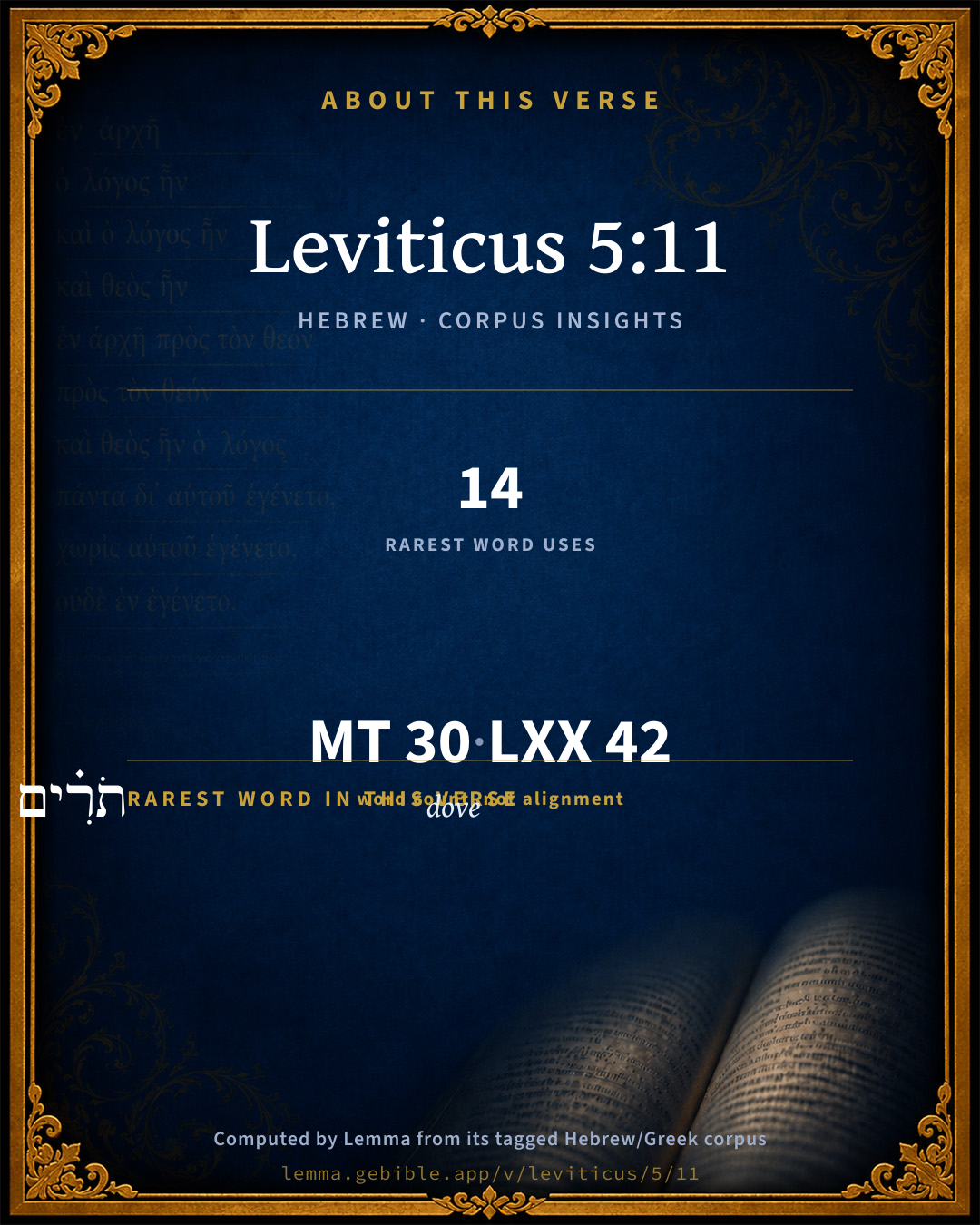
The rarest word here is תֹרִ֗ים dove H8449 — appearing just 14 times in the whole Hebrew Bible.

Shared distinctive vocabulary

תֹרִ֗ים dove H8449 occurs in 14 verses of the Hebrew Bible. Also found in:

Grammatical profile

  • 5 verbs
  • 11 nouns
  • 3 adjectives
  • 1 pronoun
  • 2 prepositions
  • 3 conjunctions
  • 5 particles

Verb forms

  • תַשִּׂ֨יג Hiphil · Imperfect
  • וְהֵבִ֨יא Hiphil · Sequential Perfect
  • חָטָ֗א Qal · Perfect
  • יָשִׂ֨ים Qal · Imperfect
  • יִתֵּ֤ן Qal · Imperfect

Repetition

Words recur within this verse — often emphatic in Hebrew:

  • לִשְׁתֵּ֣י two H8147 ×2
  • לְחַטָּ֑את sin offering H2403 ×2
  • עָלֶ֜יהָ upon H5921 ×2
  • לֹא֩ not H3808 ×3

Hebrew & Septuagint length

In English translation the verse runs 58 words from the Hebrew and 54 from the Septuagint (LXX English) — closely comparable.

A rough comparison of the two English renderings, which tokenize alike — not a word-level alignment.

Word counts can differ between the Hebrew and the Greek without any difference in meaning — e.g. the Hebrew direct-object marker אֵת has no separate Greek word, and Greek often adds the article ὁ.

In the original languages it is 30 Hebrew tokens and 42 Greek tokens — but the two are counted differently (Hebrew bundles its prefixes and suffixes into one token; the Greek is in lemma form), so that isn’t a like-for-like length.

Cross-references

16

Topical passages linked to Leviticus 5:11 in the Treasury of Scripture Knowledge — connected by theme and wording, ordered by reader-vote popularity; previews shown in the World English Bible.

  • Numbers 5:15 then the man shall bring his wife to the priest, and shall bring her offering for her: the tenth part of an ephah of barley meal. He shall pour no oil on it, nor put frankincense on it, for it is a meal offering of jealousy, a meal offering of memorial, bringing iniquity to memory.
  • Leviticus 2:1–2 "'When anyone offers an offering of a meal offering to Yahweh, his offering shall be of fine flour; and he shall pour oil on it, and put frankincense on it.
  • Exodus 16:18 When they measured it with an omer, he who gathered much had nothing over, and he who gathered little had no lack. They gathered every man according to his eating.
  • Exodus 16:36 Now an omer is the tenth part of an ephah.
  • Leviticus 2:4–5 "'When you offer an offering of a meal offering baked in the oven, it shall be unleavened cakes of fine flour mixed with oil, or unleavened wafers anointed with oil.
  • Leviticus 2:15–16 You shall put oil on it, and lay frankincense on it: it is a meal offering.
  • Leviticus 5:6 and he shall bring his trespass offering to Yahweh for his sin which he has sinned, a female from the flock, a lamb or a goat, for a sin offering; and the priest shall make atonement for him concerning his sin.
  • Leviticus 5:9 He shall sprinkle some of the blood of the sin offering on the side of the altar; and the rest of the blood shall be drained out at the base of the altar. It is a sin offering.
  • Leviticus 5:12 He shall bring it to the priest, and the priest shall take his handful of it as the memorial portion, and burn it on the altar, on the offerings of Yahweh made by fire. It is a sin offering.
  • Numbers 7:13 and his offering was: one silver platter, the weight of which was one hundred thirty shekels, one silver bowl of seventy shekels, after the shekel of the sanctuary; both of them full of fine flour mixed with oil for a meal offering;
  • Numbers 7:19–89 He offered for his offering: one silver platter, the weight of which was one hundred thirty shekels, one silver bowl of seventy shekels, after the shekel of the sanctuary; both of them full of fine flour mixed with oil for a meal offering;
  • Numbers 15:4–9 then shall he who offers his offering offer to Yahweh a meal-offering of a tenth part [of an ephah] of fine flour mixed with the fourth part of a hin of oil:
  • Psalms 22:1–21 My God, my God, why have you forsaken me? Why are you so far from helping me, and from the words of my groaning?
  • Psalms 69:1–21 Save me, God, For the waters have come up to my neck!
  • Isaiah 53:2–10 For he grew up before him as a tender plant, and as a root out of a dry ground: he has no form nor comeliness; and when we see him, there is no beauty that we should desire him.
  • 2 Corinthians 5:21 For him who knew no sin he made to be sin on our behalf; so that in him we might become the righteousness of God.

Cross-references courtesy of OpenBible.info (CC BY 4.0).

Hebrew and Greek witnesses Masoretic Hebrew ↔ Greek Septuagint

The same verse in the two great witnesses to the Old Testament, shown verse-for-verse.

These are two independent witnesses, not word-aligned to each other, and the Septuagint is shown in lemma (dictionary) form.

Hebrew Leviticus 5:11 Masoretic · Westminster Leningrad Codex

וְאִם לֹא֩ תַשִּׂ֨יג יָד֜וֹ לִשְׁתֵּ֣י תֹרִ֗ים אוֹ֮ לִשְׁנֵ֣י בְנֵי יוֹנָה֒ וְהֵבִ֨יא אֶת קָרְבָּנ֜וֹ אֲשֶׁ֣ר חָטָ֗א עֲשִׂירִ֧ת הָאֵפָ֛ה סֹ֖לֶת לְחַטָּ֑את לֹא יָשִׂ֨ים עָלֶ֜יהָ שֶׁ֗מֶן וְלֹא יִתֵּ֤ן עָלֶ֨יהָ֙ לְבֹנָ֔ה כִּ֥י חַטָּ֖את הִֽיא

"'But if he can't afford two turtledoves, or two young pigeons, then he shall bring his offering for that in which he has sinned, the tenth part of an ephah of fine flour for a sin offering. He shall put no oil on it, neither shall he put any frankincense on it, for it is a sin offering.

World English Bible · Public Domain

Greek LXX Leviticus 5:11 Septuagint · lemma form

ἐάν δέ μή εὑρίσκω αὐτός ὁ χείρ ζεῦγος τρυγών ἤ δύο νεοσσός περιστερά καί φέρω ὁ δῶρον αὐτός περί ὅς ἁμαρτάνω ὁ δέκατος ὁ οιφι σεμίδαλις περί ἁμαρτία οὐ ἐπιχέω ἐπί αὐτός ἔλαιον οὐδέ ἐπιτίθημι ἐπί αὐτός λίβανος ὅτι περί ἁμαρτία εἰμί

And if he can’t afford a pair of turtledoves, or two young pigeons, then shall he bring as his gift for his sin, the tenth part of an ephah of fine flour for a sin-offering; he shall not pour oil upon it, nor shall he put frankincense upon it, because it is a sin-offering.

LXX2012 (modern English Septuagint) · Public Domain

Hebrew: Westminster Leningrad Codex (CC BY 4.0). Greek: Septuagint (public domain); English from LXX2012 (modern English Septuagint) (Public Domain). How the Septuagint differs from the Hebrew →

Targum (Aramaic paraphrase)

2

The Targum is the ancient Jewish Aramaic paraphrase of the Hebrew Scriptures — an interpretive translation, not the Hebrew text itself. Onkelos (literal) and Pseudo-Jonathan (expansive) render the Torah, and Jonathan the Prophets. Coverage is partial: where no permissively-licensed English translation exists for a verse, only the Aramaic is shown. This is verse-level text, not a word-by-word alignment to the Hebrew.

  1. Targum Onkelos Torah (Genesis–Deuteronomy)
    וְאִם לָא תַדְבֵּק יְדֵהּ לְתַרְתֵּין שַׁפְנִינִין אוֹ לִתְרֵין בְּנֵי יוֹנָה וְיַיְתִי יָת קֻרְבָּנֵהּ דִי חָב חַד מִן עַסְרָא בִתְלַת סְאִין סֻלְתָּא לְחַטָּאתָא לָא יְשַׁוִי עֲלַהּ מִשְׁחָא וְלָא יִתֵּן עֲלַהּ לְבֻנְתָּא אֲרֵי חַטָאתָא הִיא

    (no public-domain English translation for this verse)

    Targum Onkelos — Aramaic: “Onkelos Genesis” (public domain); “Onkelos Exodus” (public domain); “Onkelos Leviticus” (public domain); “Onkelos Numbers” (public domain); “Onkelos Deuteronomy” (public domain). English: “Sefaria Community Translation” (CC0 1.0 (public-domain dedication)); “J.W. Etheridge. The Targums of Onkelos and Jonathan Ben Uzziel on the Pentateuch. London: Longmans, Green, 1862” (public domain). Text via Sefaria.

  2. Targum Pseudo-Jonathan Torah (Genesis–Deuteronomy)
    וְאִין לָא תֶאֱרַע יְדֵיהּ כְּמֵיסַת לְמַיְיתָיָא תְּרֵין שַׁפְנִינִין רַבְרְבִין אוֹ תְּרֵין גוֹזָלִין בְּנֵי יוֹנַיָא וְיַיְתֵי יַת קוּרְבָּנֵיהּ דְחַב חַד מִן עַשְרָא בִּתְלַת סְאִין סְמִידָא לְחַטָאתָא לָא יִשְׁוֵי עֲלָהּ מִשְׁחָא וְלָא יִתֵּן עֲלָהּ לְבוֹנְתָּא אֲרוּם חַטָאתָא הוּא

    But if his hand find not sufficiency to bring two large turtle doves or two young pigeons, let him bring as an oblation for sin a tenth part of three sein of flour for a sin offering; but let him not put oil thereon nor frankincense, for it is a sin offering.

    Targum Pseudo-Jonathan — Aramaic: “Targum Jonathan on Genesis” (public domain); “Targum Jonathan on Exodus” (public domain); “Targum Jonathan on Leviticus” (public domain); “Targum Jonathan on Numbers” (public domain); “Targum Jonathan on Deuteronomy” (public domain). English: “The Targum of Jonathan ben Uzziel, trans. J. W. Etheridge, London, 1862” (public domain). Text via Sefaria.

Commentary

Notes on Leviticus 5:11 from classic Christian and Jewish commentators (each source and its license shown beneath its notes). The classic Christian expositions comment on the surrounding passage and are grouped to its opening verse, so a note may address several verses; the Jewish commentaries on the Tanakh (Rashi and others) are per-verse, so they appear only where the commentator wrote on this verse.

Lemma curates 59 commentaries, every one of them public domain or Creative Commons licensed, each selected and text-cleaned for this edition rather than reprinted as found. About our sources →

The Cambridge Bible for Schools and Colleges

gen. ed. J. J. S. Perowne

11. he shall put no oil upon it] as in the jealousy offering (Num_5:15).

11–13. A further concession in the case of extreme poverty: 1/10th of an ephah of fine flour is allowed as a substitute for the animal sacrifice. This is treated as a Meal-Offering but described as a Sin-Offering (Lev_5:11-12). See Rob.-Sm. Rel. Sem.2 p. 242, note 3, with a reference by Frazer to an instance where an offering of rice is called ‘eating the soul of the rice,’ so that the rice is viewed as a living creature. For approximate amount of an ephah see on Lev_6:20.

The Cambridge Bible for Schools and Colleges (gen. ed. J. J. S. Perowne; Cambridge University Press, 1878–1918) — public domain. Text from a community e-Sword module.

Trapp's Complete Commentary

John Trapp

Lev 5:11 But if he be not able to bring two turtledoves, or two young pigeons, then he that sinned shall bring for his offering the tenth part of an ephah of fine flour for a sin offering; he shall put no oil upon it, neither shall he put [any] frankincense thereon: for it [is] a sin offering.

Ver. 11. But if he be not able.] So low doth the Most High stoop to man’s meanness, that he will accept of a very small present from him that would bring a better, if it were in the power of his hand. Lycurgus enjoined his Lacedemonians to offer small sacrifices; for God, said he, respecteth more the internal devotion, than the external oblation.

John Trapp, A Commentary or Exposition upon All the Books of the Old and New Testament (1647–1656) — public domain. Text from a community e-Sword module.

Joseph Benson's Commentary

Lev 5:11. The tenth part of an ephah — About six pints. He shall put no oil, neither frankincense — Either as a fit expression of his sorrow for his sins, in the sense whereof, he was to abstain from things pleasant; or to signify, that by his sins he deserved to be utterly deprived both of the oil of gladness, the gifts, graces, and comforts of the Holy Ghost, and of God’s gracious acceptance of his prayers and sacrifices, which is signified by incense, Psa 141:2.

Joseph Benson's Commentary on the Old and New Testaments (1811–1818) — public domain. Text from a community e-Sword module.

Tyndale Open Study Notes

Tyndale Open Resources

5:11 The sin offering was not to be adorned with olive oil or . . . frankincense. These were required for the grain offering, which was the individual’s gift to the Lord (see 2:1), given to express worship. The sin offering made atonement; its purpose was to obtain forgiveness, requiring that the offering be completely unadorned.

Tyndale Open Study Notes — © Tyndale Open Resources, licensed CC BY-SA 4.0. Text via the HelloAO Bible API.

Geneva Bible (1599)

Geneva Bible translators

Which was about a pottle.

As in the meat offering, Lev. 2:1.

Geneva Bible (1599) marginal notes — public domain. Text via Bolls.life.

Adam Clarke's Commentary

Verse 11. Tenth part of an ephah] About three quarts. The ephah contained a little more than seven gallons and a half.

Adam Clarke's Commentary on the Bible (1810–1826) — public domain. Text from a community e-Sword/MySword module.

Ellicott's Commentary for English Readers

(11) But if he be not able.—The benign consideration for the poor, and the desire not to mulct them too heavily for their frailties, are here still more evinced in the statute before us. If anyone is so impoverished that the offering of two birds would press too heavily upon him, he might bring the tenth part of an ephah of fine flour, a little less than half a gallon.

For it is a sin offering.—That is, because it is a sin offering, and not a Minchah or meat offering (see Lev_2:1), therefore it shall have no oil or frankincense, otherwise its distinguishing features as such would be destroyed.

A Bible Commentary for English Readers, edited by Charles John Ellicott (1878–1897) — public domain. Text from a community e-Sword module.

John Gill's Exposition

But if he be not able to bring two turtledoves, or two young pigeons,.... Which is supposing a man to be in the poorest circumstances he can well be; and such is the grace and goodness of God, that he has provided for the atonement and forgiveness of the poorest, as well as of the rich:

then he that hath sinned shall bring for his offering the tenth part of an ephah of fine flour for a sin offering; which is an omer, Exo 16:36 and is as much as a man can eat in one day, as Aben Ezra remarks:

he shall put no oil upon it, neither shall he put any frankincense thereon; to distinguish it from the common meat offering, which had both, Lev 3:1 and to make it as easy, and as little chargeable to the poor as possible, both oil and frankincense being things of value; and some think that these were prohibited, to show that atonement and forgiveness, and even the salvation of men, are not owing to grace in them, comparable to oil, or to their prayers, signified by frankincense, and so to any or all of their duties, but to Christ alone, and his atoning sacrifice: or these were forbidden, because emblems of joy and gladness, and therefore not so proper at a confession of sin, and humiliation for it: or rather to show how disagreeable and offensive sin was to the Lord, being contrary to grace, of which oil was an emblem, and far from being acceptable to him, which frankincense might signify; and therefore being prohibited, might denote how unacceptable, yea nauseous, sin is to him; which agrees with the reason given:

for it is a sin offering, and therefore must not be honoured, as Jarchi, or must have everything removed from it that is beautiful and amiable, as Ben Gersom, such as oil and frankincense.

John Gill's Exposition of the Whole Bible (1746–1763) — public domain (CC PDM 1.0). Text via the HelloAO Bible API.

Haydock's Catholic Bible Commentary

Ephi, or a gomor, which is the tenth part of three pecks and three pints, English. (Arbuthnot.) --- For sin, and therefore to shew how odious sin is to God, he will not allow any frankincense to be offered. (Menochius)

George Leo Haydock (1774–1849), Haydock's Catholic Family Bible and Commentary, 1859 edition — public domain. Excludes Psalms (Douay-Rheims chapter numbering differs from Protestant) and Deuterocanonical books (Catholic canon only).

Matthew Poole's English Annotations

The tenth part of an ephah, about a pottle of our measure. See Exo 16:36.

He shall put no oil upon it, neither shall he put any frankincense thereon; either to distinguish these from the meat-offerings, Lev 2:1; or as a fit expression of their true sorrow for their sins, in the sense whereof they were to abstain from things pleasant and delightful; see Num 5:15; or to signify that by his sins he deserved to be utterly deprived both of the oil of gladness, the gifts, graces, and comforts of the Holy Ghost, and of God’s gracious acceptance of his prayers and sacrifices, which is signified by incense, Psa 141:2; or to teach them how evil a thing sin was, how hateful to God, and how uncomfortable to themselves.

Matthew Poole's English Annotations on the Holy Bible (1683–1685) — public domain. Text from a community e-Sword/MySword module.

Whedon's Commentary on the Bible

Daniel D. Whedon

11. Turtledoves… pigeons — See chap. 1, notes, also Introduction, (4)

The tenth… ephah… flour — The most impoverished person was supposed to be able to present three quarts of sifted wheat or barley flour for the disburdening of his conscience.

No oil… neither… frankincense — The addition of these would make a mincha, or bread offering, Lev_2:2, a eucharistic sacrifice, which could be offered only by one in a state of acceptance with God. The sinner must secure pardon before he offers praise. Says Kurtz: “Oil and incense symbolized the Spirit of God and the prayers of the faithful; the meat offering, always good works; but these are then only good works and acceptable to God when they proceed from the soil of a heart truly sanctified. The sin offering, however, was pre-eminently the atonement offering; the idea of atonement came out so prominently that no room was left for others. The consecration of the person, and the presentation of his good works, to the Lord, had to be reserved for another stage in the sacrificial institute.” How strikingly this corroborates the Wesleyan doctrine of entire sanctification as a work distinct from justification. Jesus, the great Sin Offering, so fills the vision of the penitent sinner that there is no room for the consideration of his other office, by which he is made unto the believer “wisdom, and righteousness, and sanctification.”

Daniel D. Whedon (gen. ed.), Commentary on the Old and New Testaments (1874–1909) — public domain. Text from a community e-Sword module.

John Wesley's Explanatory Notes

The tenth part of an ephah - About six pints. He shall put no oil, neither frankincense - Either to distinguish these from the meal-offerings, chap. ii, 1, or as a fit expression of their sorrow for their sins, in the sense whereof they were to abstain from things pleasant; or to signify that by his sins he deserved to be utterly deprived both of the oil of gladness, the gifts, graces and comforts of the Holy Ghost; and of God's gracious acceptance of his prayers and sacrifices, which is signified by incense, Psalm 1xli, 2.

John Wesley, Explanatory Notes Upon the Whole Bible (1754–1765) — public domain. Text via the GEBible commentary corpus.

unfoldingWord translationNotes

Door43 World Missions Community

a tenth of an ephah

An ephah is 22 liters. A tenth of an ephah is about two liters. (See: Biblical Volume)

a tenth

This is one part out of ten equal parts. (See: Fractions)

translationWords

dove

sacrifice

sin

tenth

sin offering

oil

incense

unfoldingWord translationNotes — © Distant Shores Media and the Door43 World Missions Community, licensed CC BY-SA 4.0. Source: git.door43.org/Door43/en_tn.

Rashi

Rabbi Shlomo Yitzchaki (Rashi)

כי חטאת הוא [HE SHALL PUT NO OIL UPON IT, NEITHER SHALL HE PUT ANY FRANKINCENSE THEREON:] FOR IT IS A SIN-OFFERING — a sinner’s offering, and therefore it is not proper that his offering should be embellished by oil and frankincense (Menachot 6a).

Rashi on the Tanakh — English translations: “The Judaica Press complete Tanach with Rashi, translated by A. J. Rosenberg” (CC BY 4.0); “Pentateuch with Rashi's commentary by M. Rosenbaum and A.M. Silbermann, 1929-1934” (public domain); “The Metsudah Tanach series, Lakewood, N.J” (CC BY 4.0); and “The Book of Joshua, Metsudah Publications, 1997” (CC BY 4.0). Text via Sefaria.

Lesson kit

Teaching starters — assembled from the data on this page, not authored interpretation. Every prompt links to the verse data it draws on. Edit before teaching.

Leviticus, in the Pentateuch, opens this verse with 30 words (25 distinct Hebrew lemmas). Its most distinctive word is tôwr (“dove”). A historical commentator’s framing appears above. Read the whole chapter for the surrounding context.

Discussion questions

  1. The word tôwr carries the sense “dove.” How does it shape the verse?
  2. How does Genesis 15:9, which shares the word «dove», read alongside this verse?
  3. What does the repetition of “two” (2× in this one verse) do in this verse?
  4. The translations on this page render this verse differently — a whole-verse word diff, not a word-by-word alignment. What might account for the different wordings?
  5. «תַשִּׂ֨יג» is a Hiphil Imperfect verb. How does that grammatical form shape the action described?
  6. Compare how The Cambridge Bible for Schools and Colleges and Trapp's Complete Commentary read this verse. Where do they agree or differ?

Things to notice

Reading settings

Reading text

Shown beneath each verse's original-language words.

Old Testament
Old Testament edition

Read the OT as the Masoretic Hebrew (MT) or the Greek Septuagint (LXX).

English shown for the Greek Septuagint (in the Hebrew ↔ Greek comparison).

Comparing translations? Open the Compare panel on any verse page to stack up to four side by side.