
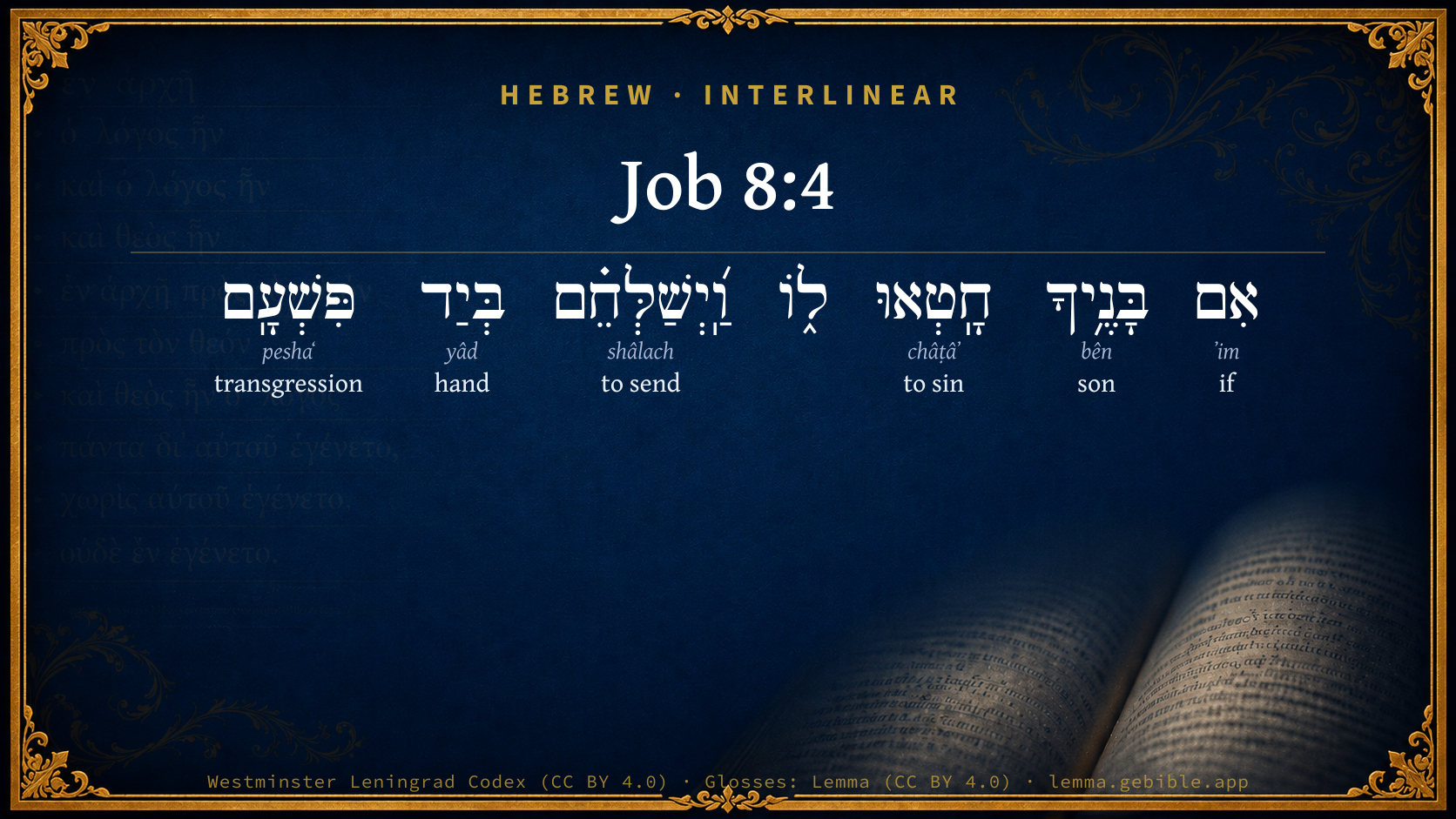
Job 8:4

Hebrew (Westminster Leningrad Codex) Job 8:4 appears in the Hebrew Old Testament. The text above is from the Westminster Leningrad Codex. Each word links to its Strong’s number, a concise gloss, and parsing drawn from the Open Scriptures Hebrew Bible morphology. Click any word for its full Brown-Driver-Briggs (BDB) entry.
Download image
Cite this verse

Job 8:4 (World English Bible). Public Domain. Lemma interlinear Bible study tool, https://lemma.gebible.app/v/job/8/4.

Show BibTeX & RIS
BibTeX
RIS
English Translation
If your children have sinned against him, He has delivered them into the hand of their disobedience;
World English Bible · Public Domain
Download a study sheet

One document with this verse’s original text, its word-by-word gloss line, the meaning frame, cross-references with their text, attributed commentary, and full source and license credits — printable, and it pastes into notes with its structure intact.

This verse Autodidact and up

Study sheet (.html) Plain text (.txt)

A passage Seminary Student

Up to 50 verses in one chapter. A passage sheet keeps up to 6 commentary sources and 12 cross-references per verse, in the order this page ranks them, and says so on the sheet whenever that leaves anything out. Ask for a single verse and you get the Autodidact verse sheet above.

Everything on this page stays free to read, with no account — the sheet is a download of what is already on screen, not access to it.

Want to remove ads? Support Godless Engineer
Compare translations 3

The same verse in 3 English versions, stacked beneath the original-language interlinear above. Click any original word for its lexicon entry.

Each is an independent rendering of the whole verse — the interlinear is not word-aligned to these translations.

Highlighted words mark where these versions differ — a whole-verse word diff, not a word-by-word alignment.

  • World English Bible Public Domain
    If your children have sinned against him, He has delivered them into the hand of their disobedience;
  • King James Version Public Domain
    If thy children have sinned against him, and he have cast them away for their transgression;
  • unfoldingWord Literal Text CC BY-SA 4.0
    If your children sinned against him, then he put them in the hand of their sins.

unfoldingWord Literal Text — © unfoldingWord, licensed CC BY-SA 4.0. Word-aligned USFM3 via Door43 (git.door43.org/unfoldingWord/en_ult).

Versions to compare (up to 4)

3 of 4 selected

Show all 18 translations

Every available English version of this verse, each an independent rendering of the whole verse.

  • World English Bible Public Domain
    If your children have sinned against him, He has delivered them into the hand of their disobedience;
  • Berean Standard Bible Public Domain
    When your children sinned against Him, He gave them over to their rebellion.
  • Majority Standard Bible Public Domain
    When your children sinned against Him, He gave them over to their rebellion.
  • King James Version Public Domain
    If thy children have sinned against him, and he have cast them away for their transgression;
  • American Standard Version (1901) Public Domain
    If thy children have sinned against him, And he hath delivered them into the hand of their transgression;
  • Revised Version (1885) Public Domain
    If thy children have sinned against him, and he have delivered them into the hand of their transgression:
  • Geneva Bible (1599) Public Domain
    If thy sonnes haue sinned against him, and he hath sent them into the place of their iniquitie,
  • Douay-Rheims (1899) Public Domain
    Although thy children have sinned against him, and he hath left them in the hand of their iniquity:
  • Young's Literal Translation Public Domain
    If thy sons have sinned before Him, And He doth send them away, By the hand of their transgression,
  • Literal Standard Version CC BY-SA 4.0
    If your sons have sinned before Him, || And He sends them away, || By the hand of their transgression,
  • Unlocked Literal Bible CC BY-SA 4.0
    Your children have sinned against him; we know this, for he gave them into the hand of their sins.
  • unfoldingWord Literal Text CC BY-SA 4.0
    If your children sinned against him, then he put them in the hand of their sins.
  • Darby Bible Public Domain
    If thy children have sinned against him, he hath also given them over into the hand of their transgression.
  • World Messianic Bible Public Domain
    If your children have sinned against him, he has delivered them into the hand of their disobedience.
  • Webster's Bible Public Domain
    If thy children have sinned against him, and he hath cast them away for their transgression;
  • Free Bible Version CC BY-SA 4.0
    Your children must have sinned against him, and so they deserved the punishment he inflicted on them.
  • Bible in Basic English Public Domain
    If your children have done evil against him, then their punishment is from his hand.
  • JPS Tanakh (1917) Public Domain
    If thy children sinned against Him, He delivered them into the hand of their transgression.

Literal Standard Version (2020), Covenant Press — licensed CC BY-SA 4.0. Text via the HelloAO Bible API (eBible.org). Unlocked Literal Bible (unfoldingWord) — licensed CC BY-SA 4.0. Text via the HelloAO Bible API (eBible.org). unfoldingWord Literal Text — © unfoldingWord, licensed CC BY-SA 4.0. Word-aligned USFM3 via Door43 (git.door43.org/unfoldingWord/en_ult). Free Bible Version, Dr. Jonathan Gallagher — licensed CC BY-SA 4.0. Text via the HelloAO Bible API (eBible.org).

Word by word

More ways to search: Search by grammar → Find every occurrence → Compare this word →

Practice this passage: Drill this verse → Learn its vocabulary →

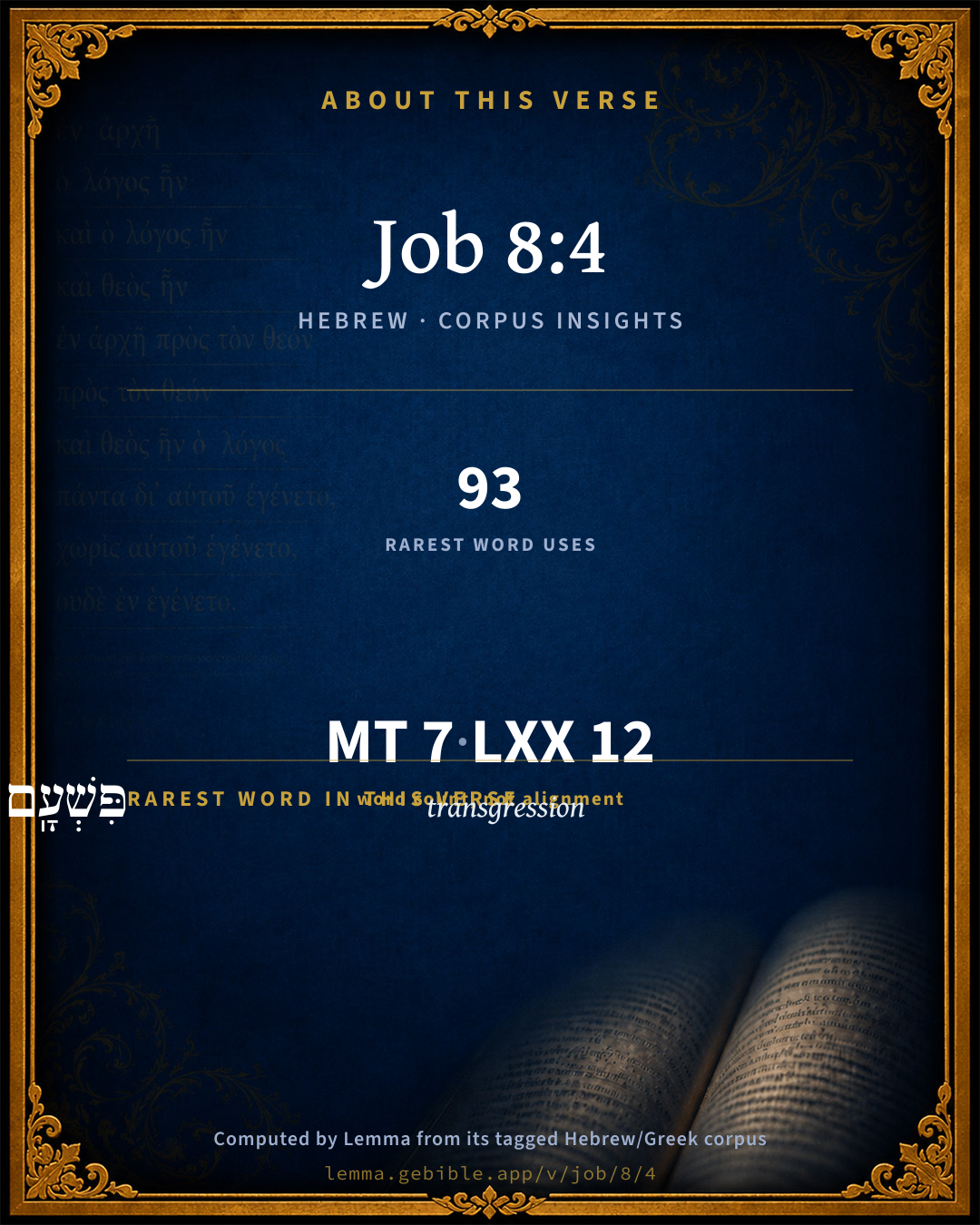
פִּשְׁעָֽם
peshaʻ
H6588
“transgression · their”
Noun, Common, Masculine, Singular, Construct + Suffix, Personal, 3rd Person, Masculine, Plural
Part of Speech
Noun
Type
Common
Gender
Masculine
Number
Singular
State
Construct
Full BDB Definition

Origin: from H6586

TWOT: 1846a

transgression, rebellion - transgression (against individuals) - transgression (nation against nation) - transgression (against God) - in general - as recognised by sinner - as God deals with it - as God forgives - guilt of transgression - punishment for transgression - offering for transgression
  1. אִם ʼim H518 “if” Conjunction
  2. בָּנֶ֥יךָ bên H1121 “sons · your” Noun, Common, Masculine, Plural, Construct + Suffix, Personal, 2nd Person, Masculine, Singular
  3. חָֽטְאוּ châṭâʼ H2398 “to sin” Verb, Qal, Perfect, 3rd Person, Common, Plural
  4. וַֽ֝יְשַׁלְּחֵ֗ם shâlach H7971 “and · to send · them” Conjunction + Verb, Piel, Sequential Imperfect, 3rd Person, Masculine, Singular + Suffix, Personal, 3rd Person, Masculine, Plural
  5. בְּיַד yâd H3027 “in/at · hand of” Preposition + Noun, Common, Both, Singular, Construct

About this verse

These counts appear in no published source. They are computed here, from the morphology-tagged text and Lemma’s own curated glosses. What Lemma adds →

7
words
6
distinct lemmas
Wisdom
section

Grammatical profile

  • 2 verbs
  • 3 nouns
  • 1 preposition
  • 1 conjunction

Verb forms

  • חָֽטְאוּ Qal · Perfect
  • וַֽ֝יְשַׁלְּחֵ֗ם Piel · Sequential Imperfect

Hebrew & Septuagint length

In English translation the verse runs 17 words from the Hebrew and 16 from the Septuagint (LXX English) — closely comparable.

A rough comparison of the two English renderings, which tokenize alike — not a word-level alignment.

Word counts can differ between the Hebrew and the Greek without any difference in meaning — e.g. the Hebrew direct-object marker אֵת has no separate Greek word, and Greek often adds the article ὁ.

In the original languages it is 7 Hebrew tokens and 12 Greek tokens — but the two are counted differently (Hebrew bundles its prefixes and suffixes into one token; the Greek is in lemma form), so that isn’t a like-for-like length.

Cross-references

6

Topical passages linked to Job 8:4 in the Treasury of Scripture Knowledge — connected by theme and wording, ordered by reader-vote popularity; previews shown in the World English Bible.

  • Job 1:5 It was so, when the days of their feasting had run their course, that Job sent and sanctified them, and rose up early in the morning, and offered burnt offerings according to the number of them all. For Job said, "It may be that my sons have sinned, and renounced God in their hearts." Thus did Job continually.
  • Job 1:18–19 While he was still speaking, there came also another, and said, "Your sons and your daughters were eating and drinking wine in their eldest brother's house,
  • Job 5:4 His children are far from safety, They are crushed in the gate. Neither is there any to deliver them,
  • Genesis 19:13–25 for we will destroy this place, because the cry of them is grown great before Yahweh. Yahweh has sent us to destroy it."
  • Job 18:16–19 His roots shall be dried up beneath, Above shall his branch be cut off.
  • Genesis 13:13 Now the men of Sodom were exceedingly wicked and sinners against Yahweh.

Cross-references courtesy of OpenBible.info (CC BY 4.0).

Hebrew and Greek witnesses Masoretic Hebrew ↔ Greek Septuagint

The same verse in the two great witnesses to the Old Testament, shown verse-for-verse.

These are two independent witnesses, not word-aligned to each other, and the Septuagint is shown in lemma (dictionary) form.

Hebrew Job 8:4 Masoretic · Westminster Leningrad Codex

אִם בָּנֶ֥יךָ חָֽטְאוּ ל֑וֹ וַֽ֝יְשַׁלְּחֵ֗ם בְּיַד פִּשְׁעָֽם

If your children have sinned against him, He has delivered them into the hand of their disobedience;

World English Bible · Public Domain

Greek LXX Job 8:4 Septuagint · lemma form

εἰ ὁ υἱός σύ ἁμαρτάνω ἐναντίον αὐτός ἀποστέλλω ἐν χείρ ἀνομία αὐτός

If your sons have sinned before him, he has cast them away because of their transgression.

LXX2012 (modern English Septuagint) · Public Domain

Hebrew: Westminster Leningrad Codex (CC BY 4.0). Greek: Septuagint (public domain); English from LXX2012 (modern English Septuagint) (Public Domain). How the Septuagint differs from the Hebrew →

Commentary

Notes on Job 8:4 from classic Christian and Jewish commentators (each source and its license shown beneath its notes). The classic Christian expositions comment on the surrounding passage and are grouped to its opening verse, so a note may address several verses; the Jewish commentaries on the Tanakh (Rashi and others) are per-verse, so they appear only where the commentator wrote on this verse.

Lemma curates 59 commentaries, every one of them public domain or Creative Commons licensed, each selected and text-cleaned for this edition rather than reprinted as found. About our sources →

The Cambridge Bible for Schools and Colleges

gen. ed. J. J. S. Perowne

4. The construction of the English version is possible, which makes the whole of Job_8:4 the supposition or protasis and begins the second member of the sentence with Job_8:5. But more probably Job_8:4 is complete in itself: if thy children have sinned so (or, then) he hath, &c.

cast them away for] Rather lit., he hath sent them away, or, let them go, into the hand of their transgression. The idea is that evil carries its own retribution with it, and that a sinner is destroyed by the very sin which he commits, a common idea in the Book, cf. ch. Job_4:8, Job_15:31; Job_15:35, Job_18:7-8, Job_20:12 seq. Though Bildad puts his reference to the children of Job hypothetically there is great harshness in the allusion, and we may understand how the father would smart under it from his own reference later in the Book to the time when his children were yet alive: “When my boys were about me,” ch. Job_29:5. A wiser and more human-hearted Teacher than Bildad has instructed us from the instances of the affliction of blindness (Joh_9:2-3) and the accident in the tower of Siloam (Luk_13:4) that calamity is no proof of guilt in those on whom it falls, and that evil may serve in the hand of God wider uses than the chastisement of individuals. This is the very lesson of the Book of Job, though it seems that men in the days of our Lord had not yet learned it. The verse refers back to ch. Job_1:19, and is evidence that the Prologue forms an integral part of the Book.

4–7. In opposition to Job’s impious principle Bildad brings forward his doctrine of the Divine rectitude on both its sides, the one illustrated in the fate of Job’s children (Job_8:4), the other, as he hopes, to be illustrated in the history of Job himself (Job_8:5-7).

The Cambridge Bible for Schools and Colleges (gen. ed. J. J. S. Perowne; Cambridge University Press, 1878–1918) — public domain. Text from a community e-Sword module.

Trapp's Complete Commentary

John Trapp

Job 8:4 If thy children have sinned against him, and he have cast them away for their transgression;

Ver. 4. If thy children have sinned against him] As what man is he that liveth and sinneth not? But Bildad meant that Job’s children had heinously sinned, had been grievous sinners against their own souls (as afterwards were Korah and his accomplices), had not sinned common sins, and therefore died not common deaths; indeed, they died early and suddenly, and eating and drinking (wherein there might be some excess), and before sacrifice offered for them, as formerly; all this was sad, and moved Job more than anything else. But did it therefore follow that God had cast them away? &c.

And he have cast them away for their transgression] Or, and he have expelled or abandoned them into the hand (so the Hebrews hath it elegantly) of their transgressions or rebellions, as so many executioners. Some render it thus, He hath driven them out of the world for their transgression. The Chaldee paraphrast goeth further, interpreting hand here for place (Pagnin.). If God have sent them, saith he, into the place of their wickedness, that is, into hell prepared for the wicked. Now surely, saith Lavater, Inhumanissimus fuit Bildad, qui ista calamitosissimo obiecere non dubitabat, Bildad was a most unmerciful man, who doubted not to lay these things in the dish of him that was before so heavily afflicted, and to heap more load upon him who was ready to sink under his burden; but he did it, say some, of a good intent, to bring Job to a sense of his sin, and to put him in hope of appeasing God s wrath, who had yet spared his life that he might make his peace, and not suddenly slain him, as he had done them; and therefore he assureth him in the following verses, as Eliphaz had done before, that all things shall go well with him if he repent. Albeit thy children have sinned, &c., yet

John Trapp, A Commentary or Exposition upon All the Books of the Old and New Testament (1647–1656) — public domain. Text from a community e-Sword module.

Joseph Benson's Commentary

Job 8:4. If thy children have sinned against him — If thou wast innocent, thy children, upon whom a great part of these calamities fell, might be guilty; and therefore God is not unrighteous in these proceedings. And he have cast them away — Hebrew, hath expelled, or cast them out; (namely, out of the world, or out of his favour; as a man gives his wife a bill of divorce, of which the same word is used;) for their transgression — Hebrew, by the hand, that is, by means of, their wickedness. Bildad argued in this way according to the maxim which he had entertained: but it does not appear that he had any foundation for judging thus of them.

Joseph Benson's Commentary on the Old and New Testaments (1811–1818) — public domain. Text from a community e-Sword module.

Geneva Bible (1599)

Geneva Bible translators

That is, hath rewarded them according to their iniquity: meaning, that Job ought to be warned by the example of his children, that he offend not God.

Geneva Bible (1599) marginal notes — public domain. Text via Bolls.life.

Jamieson, Fausset & Brown

Robert Jamieson, A. R. Fausset & David Brown

If--Rather, "Since thy children have sinned against Him, and (since) He has cast them away (Hebrew, by the hand of) for their transgressions, (yet) if thou wouldst seek unto God, &c., if thou wert pure, &c., surely [even] now He would awake for thee." UMBREIT makes the apodosis to, "since thy children," &c., begin at "He has cast them away." Also, instead of "for," "He gave them up to (literally, into the hand of) their own guilt." Bildad expresses the justice of God, which Job had arraigned. Thy children have sinned; God leaves them to the consequence of their sin; most cutting to the heart of the bereaved father.

Jamieson, Fausset & Brown — Commentary Critical and Explanatory on the Whole Bible (1871) — public domain (CC PDM 1.0). Text via the HelloAO Bible API.

Adam Clarke's Commentary

Verse 4. If thy children have sinned] I know thy children have been cut off by a terrible judgment; but was it not because by transgression they had filled up the measure of their iniquity?

And he have cast them away] Has sent them off, says the Targum, to the place of their transgression-to that punishment due to their sins.

Adam Clarke's Commentary on the Bible (1810–1826) — public domain. Text from a community e-Sword/MySword module.

Ellicott's Commentary for English Readers

(4) And he have cast them away.—Literally, then he sent them away. By means of their transgression; it became their destruction.

A Bible Commentary for English Readers, edited by Charles John Ellicott (1878–1897) — public domain. Text from a community e-Sword module.

John Gill's Exposition

If thou wouldest seek unto God betimes,.... Here Bildad seems to think more mildly, and speak more kindly to Job, that though he had sinned, yet not in so gross a manner as his children, since he was spared, and they were not; and therefore if he would apply himself to God, and supplicate his grace and mercy, and live a godly life, it might yet be well with him, and he be restored to his former or to better circumstances; his sense is, that he would advise him, as Eliphaz had done before, Job 5:8; to seek unto God "by prayer", as the Targum adds, and of which it is explained in the next clause, and that he would do this "betimes", or "in the morning" (n); which is a proper time for prayer, and was one of the seasons good men in former times made use of for that purpose; see Psa 5:3; or that he would seek him in the first place, and above all things, take the first opportunity to do it, without any procrastination of it, and that with eagerness and earnestness, with his whole heart and soul; for God is a rewarder of them that diligently seek him, and those that seek him early shall find him:

and make thy supplication to the Almighty: not pleading any merit of his own, as deserving of any blessing on account of what he had done; but ask what he should as a favour, as a free gift, in a way of grace and mercy, as the word (o) signifies; call for the pity of the Almighty, as Broughton renders it.

(n) "mane quaesieris", Pagninus, Piscator, Mercerus. (o) So Schmidt in loc.

John Gill's Exposition of the Whole Bible (1746–1763) — public domain (CC PDM 1.0). Text via the HelloAO Bible API.

Albert Barnes' Notes on the Bible

If thy children have sinned against him - Bildad here assumes that the children of Job had been wicked, and had been cut off in their sins. This must have cut him to the quick, for there was nothing which a bereaved father would feel more acutely than this. The meaning here is somewhat weakened by the word “if.” The Hebrew אם 'ı̂m is rather to be taken in the sense of “since” - assuming it as an indisputable point, or taking it for granted. It was not a supposition that if they should now do it, certain other consequences would follow; but the idea is, that since they had been cut off in their sins, if Job would even now seek God with a proper spirit, he might be restored to prosperity, though his beginning should be small; Job 8:7.

And he have cast them away - Bildad supposes that they had been disowned by God, and had been put to death.

For their transgression - Margin, in the hand of their. The Hebrew is, by the hand of their transgression; i. e, their sin has been the cause of it, or it has been by the instrumentality of their sin. What foundation Bildad had for this opinion, derived from the life and character of the sons of Job, we have no means of ascertaining. The probability is, however, that he had learned in general that they had been cut off; and that, on the general principle which he maintained, that God deals with men in this life according to their character, he inferred that they must have been distinguished for wickedness. Men not unfrequently argue in this way when sudden calamity comes upon others.

Albert Barnes' Notes on the Bible (1834–1885) — public domain. Text from a community e-Sword/MySword module.

Haydock's Catholic Bible Commentary

Iniquity, and suffered them to perish. (Calmet)

George Leo Haydock (1774–1849), Haydock's Catholic Family Bible and Commentary, 1859 edition — public domain. Excludes Psalms (Douay-Rheims chapter numbering differs from Protestant) and Deuterocanonical books (Catholic canon only).

Matthew Poole's English Annotations

What though thou wast in a great measure innocent, thy children, upon whom a great part of these calamities fell, might be guilty of great sins; and therefore God is not unrighteous in these proceedings.

He hath cast them away, expelled, or cast them out, (to wit, out of the world, or out of his favour; as a man gives his wife a bill of divorce, of which this word is used,) by means (Heb. by the hand, which is oft so used) of their wickedness. Or, hath left them in the hand of their sin, to wit, to be punished by it and for it. Compare Num 32:23, Your sin shall find you out.

Matthew Poole's English Annotations on the Holy Bible (1683–1685) — public domain. Text from a community e-Sword/MySword module.

Whedon's Commentary on the Bible

Daniel D. Whedon

4. If — The hypothetical way of putting the case by no means deadens the stroke dealt by the following word, thy children. Compare the delicate and impersonal allusion of Eliphaz in Job_5:4. And — Better, then. Thus the verse is complete in itself.

For their transgression — Then hath he given them into the hand of their transgression, as in margin. Divine wisdom has ordained that wickedness should be its own punishment. The law is as unerring as that of gravitation. The retributive sting may be concealed, but it is none the less the endowment of evil. From the moment of transgression the elements of evil bestir themselves to punish, though the stroke be delayed.

Daniel D. Whedon (gen. ed.), Commentary on the Old and New Testaments (1874–1909) — public domain. Text from a community e-Sword module.

The Pulpit Commentary

If thy children have sinned against him. Bildad assumes this absolutely; Eliphaz had only hinted at it. (Job_10:4) Both presume to know what could be known only to the Searcher of hearts. And he have cast them away for their transgression; literally, and he have delivered them into the hand of their transgressions abandoned them, that is, to the consequences of their wrong-doing. The allusion is, of course, to the fact recorded in Job_1:19.

The Pulpit Commentary (1880–1919), ed. H.D.M. Spence-Jones & Joseph S. Exell — public domain. Text from a community e-Sword module.

John Wesley's Explanatory Notes

If - If thou wast innocent, thy children, upon whom a great part of these calamities fell, might be guilty; and therefore God is not unrighteous in these proceedings.

John Wesley, Explanatory Notes Upon the Whole Bible (1754–1765) — public domain. Text via the GEBible commentary corpus.

unfoldingWord translationNotes

Door43 World Missions Community

for he gave them into the hand of their sins

Here "hand" represents the power or results of sin. Bildad implies that God killed Job's children because of their sin. AT: "for God caused the consequences of your children's sins to kill them" (See: Metonymy and Assumed Knowledge and Implicit Information)

But suppose you diligently sought God and presented your request to the Almighty

Bildad is saying what would have happened if Job had correctly spoken to God, but Bildad does not believe that Job really did this. (See: Hypothetical Situations)

diligently sought God ... presented your request to the Almighty

These two phrases both refer to Job asking God for help or pleading with God for mercy. (See: Doublet)

diligently sought God

"earnestly asked God for help"

translationWords

children

sin

God

Almighty

unfoldingWord translationNotes — © Distant Shores Media and the Door43 World Missions Community, licensed CC BY-SA 4.0. Source: git.door43.org/Door43/en_tn.

Rashi

Rabbi Shlomo Yitzchaki (Rashi)

He sent them away in the hands of their transgression Through their transgression. (The transgression) became the agent to carry them off.

Rashi on the Tanakh — English translations: “The Judaica Press complete Tanach with Rashi, translated by A. J. Rosenberg” (CC BY 4.0); “Pentateuch with Rashi's commentary by M. Rosenbaum and A.M. Silbermann, 1929-1934” (public domain); “The Metsudah Tanach series, Lakewood, N.J” (CC BY 4.0); and “The Book of Joshua, Metsudah Publications, 1997” (CC BY 4.0). Text via Sefaria.

Lesson kit

Teaching starters — assembled from the data on this page, not authored interpretation. Every prompt links to the verse data it draws on. Edit before teaching.

Job, in the Wisdom, opens this verse with 7 words (6 distinct Hebrew lemmas). Its most distinctive word is peshaʻ (“transgression”). A historical commentator’s framing appears above. Read the whole chapter for the surrounding context.

Discussion questions

  1. How does “transgression” (peshaʻ) shape what this verse is saying?
  2. How does Job 1:5, which shares this passage’s theme, read alongside this verse?
  3. These translations render this verse differently; the difference is in the English rendering, not the original. What questions does that raise?
  4. «חָֽטְאוּ» is a Qal Perfect verb. How does that grammatical form shape the action described?
  5. Compare how The Cambridge Bible for Schools and Colleges and Trapp's Complete Commentary read this verse. Where do they agree or differ?

Things to notice

Reading settings

Reading text

Shown beneath each verse's original-language words.

Old Testament
Old Testament edition

Read the OT as the Masoretic Hebrew (MT) or the Greek Septuagint (LXX).

English shown for the Greek Septuagint (in the Hebrew ↔ Greek comparison).

Comparing translations? Open the Compare panel on any verse page to stack up to four side by side.