
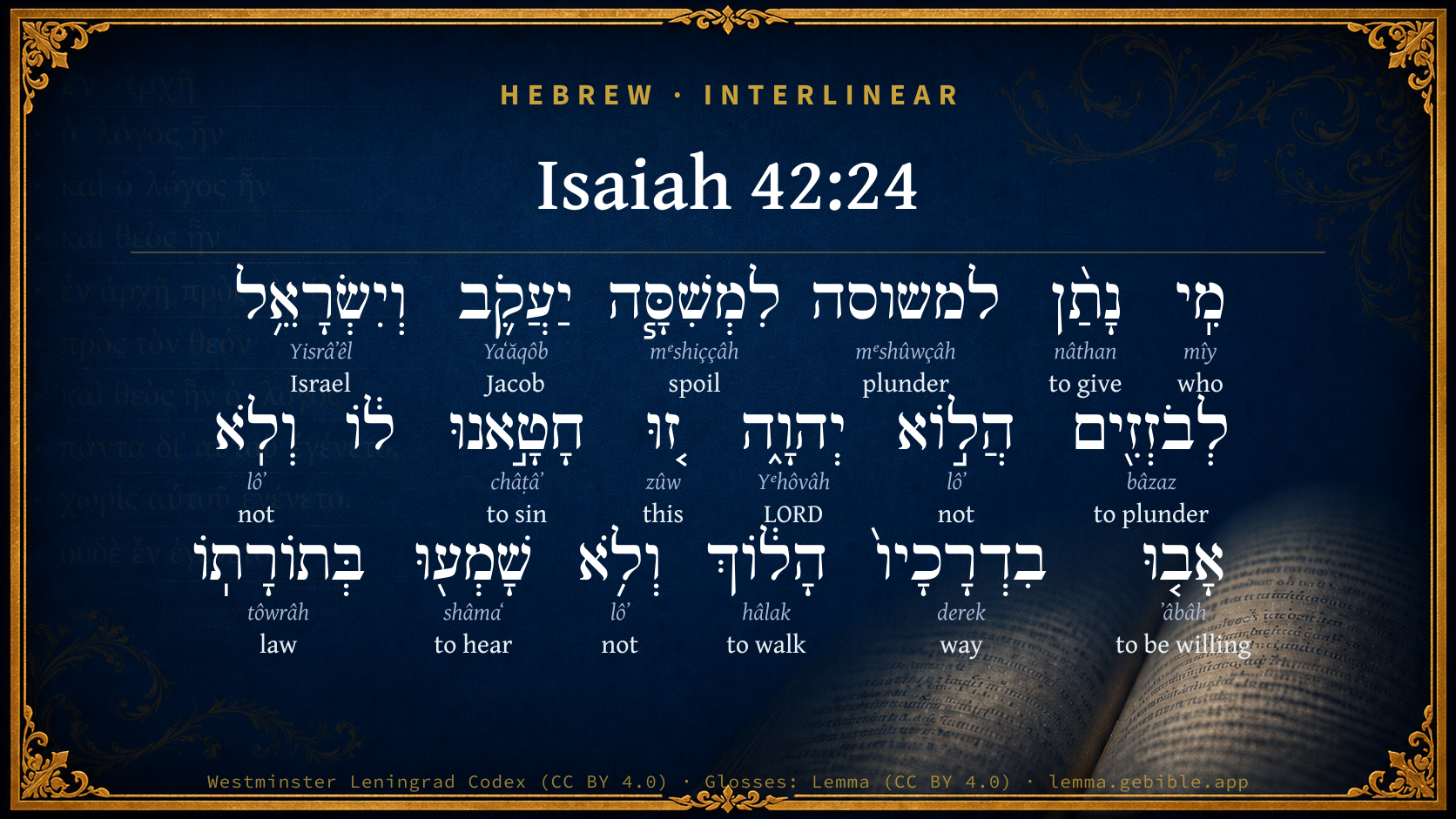
Isaiah 42:24

Hebrew (Westminster Leningrad Codex) Isaiah 42:24 appears in the Hebrew Old Testament. The text above is from the Westminster Leningrad Codex. Each word links to its Strong’s number, a concise gloss, and parsing drawn from the Open Scriptures Hebrew Bible morphology. Click any word for its full Brown-Driver-Briggs (BDB) entry.
Download image
Cite this verse

Isaiah 42:24 (World English Bible). Public Domain. Lemma interlinear Bible study tool, https://lemma.gebible.app/v/isaiah/42/24.

Show BibTeX & RIS
BibTeX
RIS
English Translation
Who gave Jacob for a spoil, and Israel to the robbers? Didn't Yahweh? he against whom we have sinned, and in whose ways they would not walk, neither were they obedient to his law.
World English Bible · Public Domain
Highlights
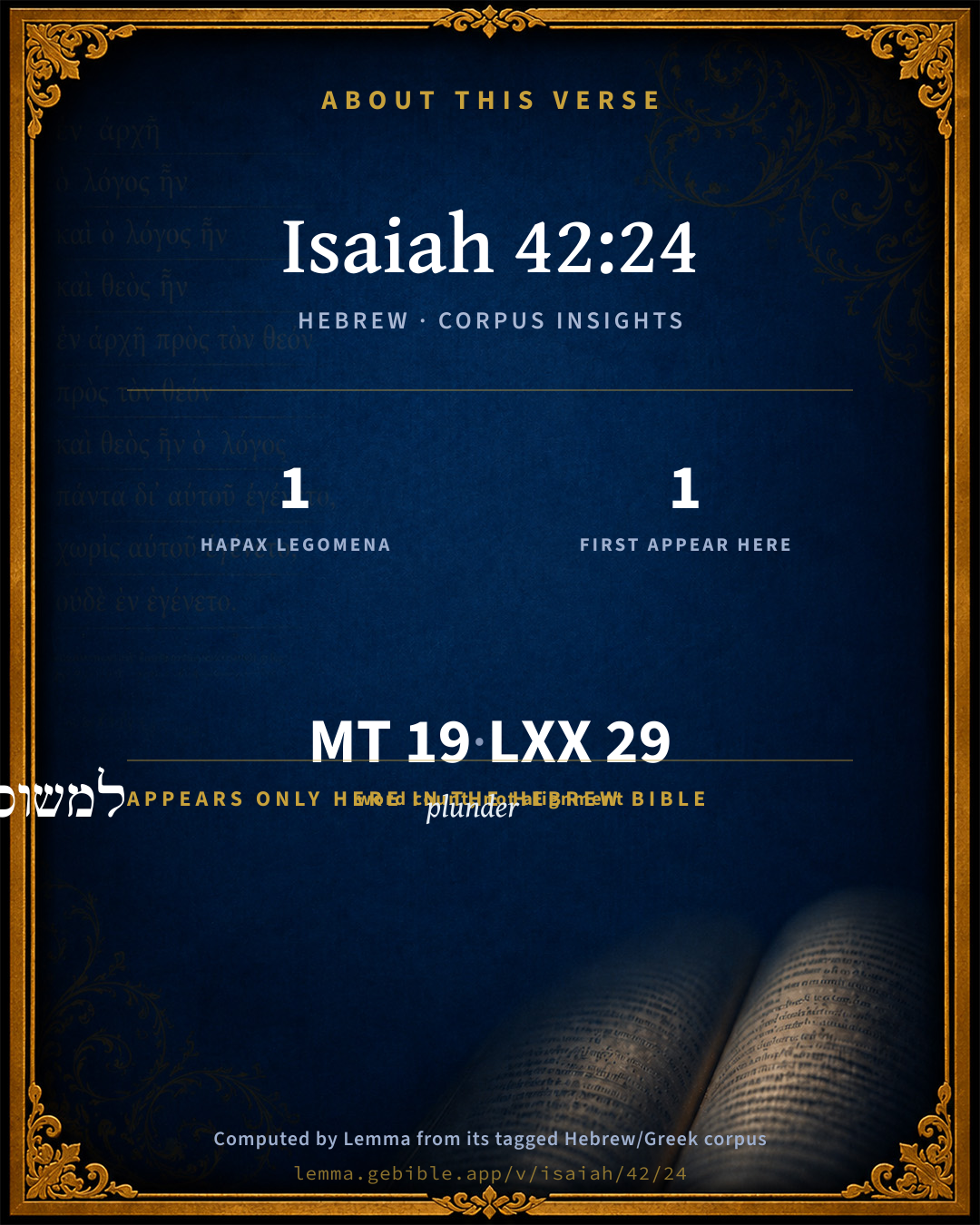
  • 1 hapax legomenon — only here in the Hebrew Bible
  • 1 first appearance in the Hebrew Bible
Full analysis ↓
Download a study sheet

One document with this verse’s original text, its word-by-word gloss line, the meaning frame, cross-references with their text, attributed commentary, and full source and license credits — printable, and it pastes into notes with its structure intact.

This verse Autodidact and up

Study sheet (.html) Plain text (.txt)

A passage Seminary Student

Up to 50 verses in one chapter. A passage sheet keeps up to 6 commentary sources and 12 cross-references per verse, in the order this page ranks them, and says so on the sheet whenever that leaves anything out. Ask for a single verse and you get the Autodidact verse sheet above.

Everything on this page stays free to read, with no account — the sheet is a download of what is already on screen, not access to it.

Want to remove ads? Support Godless Engineer
Compare translations 3

The same verse in 3 English versions, stacked beneath the original-language interlinear above. Click any original word for its lexicon entry.

Each is an independent rendering of the whole verse — the interlinear is not word-aligned to these translations.

Highlighted words mark where these versions differ — a whole-verse word diff, not a word-by-word alignment.

  • World English Bible Public Domain
    Who gave Jacob for a spoil, and Israel to the robbers? Didn't Yahweh? he against whom we have sinned, and in whose ways they would not walk, neither were they obedient to his law.
  • King James Version Public Domain
    Who gave Jacob for a spoil, and Israel to the robbers? did not the LORD, he against whom we have sinned? for they would not walk in his ways, neither were they obedient unto his law.
  • unfoldingWord Literal Text CC BY-SA 4.0
    Who gave Jacob to the looter and Israel to the plunderers? not Yahweh, whom, we sinned against him, and they were not willing to walk in his ways, and they did not hear his law?

unfoldingWord Literal Text — © unfoldingWord, licensed CC BY-SA 4.0. Word-aligned USFM3 via Door43 (git.door43.org/unfoldingWord/en_ult).

Versions to compare (up to 4)

3 of 4 selected

Show all 18 translations

Every available English version of this verse, each an independent rendering of the whole verse.

  • World English Bible Public Domain
    Who gave Jacob for a spoil, and Israel to the robbers? Didn't Yahweh? he against whom we have sinned, and in whose ways they would not walk, neither were they obedient to his law.
  • Berean Standard Bible Public Domain
    Who gave Jacob up for spoil, and Israel to the plunderers? Was it not the LORD, against whom we have sinned? They were unwilling to walk in His ways, and they would not obey His law.
  • Majority Standard Bible Public Domain
    Who gave Jacob up for spoil, and Israel to the plunderers? Was it not the LORD, against whom we have sinned? They were unwilling to walk in His ways, and they would not obey His law.
  • King James Version Public Domain
    Who gave Jacob for a spoil, and Israel to the robbers? did not the LORD, he against whom we have sinned? for they would not walk in his ways, neither were they obedient unto his law.
  • American Standard Version (1901) Public Domain
    Who gave Jacob for a spoil, and Israel to the robbers? did not Jehovah? he against whom we have sinned, and in whose ways they would not walk, neither were they obedient unto his law.
  • Revised Version (1885) Public Domain
    Who gave Jacob for a spoil, and Israel to the robbers? did not the LORD? he against whom we have sinned, and in whose ways they would not walk, neither were they obedient unto his law.
  • Geneva Bible (1599) Public Domain
    Who gaue Iaakob for a spoyle, and Israel to the robbers? Did not ye Lord, because we haue sinned against him? for they woulde not walke in his waies, neither be obedient vnto his Lawe.
  • Douay-Rheims (1899) Public Domain
    Who hath given Jacob for a spoil, and Israel to robbers? hath not the Lord himself, against whom we have sinned? And they would not walk in his ways, and they have not hearkened to his law.
  • Young's Literal Translation Public Domain
    Who hath given Jacob for a spoil, And Israel to the spoilers? Is it not Jehovah -- He against whom we sinned? Yea, they have not been willing in His ways to walk, Nor have they hearkened to His law.
  • Literal Standard Version CC BY-SA 4.0
    Who has given Jacob for a spoil, || And Israel to the spoilers? Is it not YHWH—He against whom we sinned? Indeed, they have not been willing to walk in His ways, || Nor have they listened to His law.
  • Unlocked Literal Bible CC BY-SA 4.0
    Who gave Jacob over to the robber, and Israel to the looters? Was it not Yahweh, against whom we have sinned, in whose ways they refused to walk, and whose law they refused to obey?
  • unfoldingWord Literal Text CC BY-SA 4.0
    Who gave Jacob to the looter and Israel to the plunderers? not Yahweh, whom, we sinned against him, and they were not willing to walk in his ways, and they did not hear his law?
  • Darby Bible Public Domain
    Who gave Jacob for a spoil, and Israel to the robbers? Did not Jehovah, he against whom we have sinned? And they would not walk in his ways, neither did they hearken unto his law.
  • World Messianic Bible Public Domain
    Who gave Jacob as plunder, and Israel to the robbers? Didn’t the LORD, he against whom we have sinned? For they would not walk in his ways, and they disobeyed his law.
  • Webster's Bible Public Domain
    Who gave Jacob for a spoil, and Israel to the robbers? did not the LORD, he against whom we have sinned? for they would not walk in his ways, neither were they obedient to his law.
  • Free Bible Version CC BY-SA 4.0
    Who let Jacob be taken as loot; who let Israel be taken by robbers? Wasn't it the Lord who we sinned against? The people weren't willing to follow his ways, and they refused to obey his law.
  • Bible in Basic English Public Domain
    Who gave up Jacob to those who took away his goods, and Israel to his attackers? Did not the Lord? he against whom they did wrong, and in whose ways they would not go, turning away from his teaching.
  • JPS Tanakh (1917) Public Domain
    Who gave Jacob for a spoil, and Israel to the robbers? Did not the LORD? He against whom we have sinned, and in whose ways they would not walk, neither were they obedient unto His law.

Literal Standard Version (2020), Covenant Press — licensed CC BY-SA 4.0. Text via the HelloAO Bible API (eBible.org). Unlocked Literal Bible (unfoldingWord) — licensed CC BY-SA 4.0. Text via the HelloAO Bible API (eBible.org). unfoldingWord Literal Text — © unfoldingWord, licensed CC BY-SA 4.0. Word-aligned USFM3 via Door43 (git.door43.org/unfoldingWord/en_ult). Free Bible Version, Dr. Jonathan Gallagher — licensed CC BY-SA 4.0. Text via the HelloAO Bible API (eBible.org).

Word by word

More ways to search: Search by grammar → Find every occurrence → Compare this word →

Practice this passage: Drill this verse → Learn its vocabulary →

למשוסה
mᵉshûwçâh
H4882
“to/for · plunder”
Preposition + Noun, Common, Feminine, Singular, Absolute
Part of Speech
Preposition + Noun
Type
Common
Gender
Feminine
Number
Singular
State
Absolute
Full BDB Definition

Origin: from an unused root meaning to plunder

TWOT: 2426a

booty, spoil, plunder
  1. מִֽי mîy H4310 “who” Particle, Interrogative
  2. נָתַ֨ן nâthan H5414 “to give” Verb, Qal, Perfect, 3rd Person, Masculine, Singular
  3. לִמְשִׁסָּ֧ה mᵉshiççâh H4933 “to/for · spoil” Preposition + Noun, Common, Feminine, Singular, Absolute
  4. יַעֲקֹ֛ב Yaʻăqôb H3290 “Jacob” Noun, Proper
  5. וְיִשְׂרָאֵ֥ל Yisrâʼêl H3478 “and · Israel” Conjunction + Noun, Proper
  6. לְבֹזְזִ֖ים bâzaz H962 “to/for · plundering” Preposition + Verb, Qal, Participle Active, Masculine, Plural, Absolute
  7. הֲל֣וֹא lôʼ H3808 “not” Particle, Interrogative + Particle, Negative
  8. יְהוָ֑ה Yᵉhôvâh H3068 “LORD” Noun, Proper
  9. ז֚וּ zûw H2098 “this” Particle, Relative
  10. חָטָ֣אנוּ châṭâʼ H2398 “to sin” Verb, Qal, Perfect, 1st Person, Common, Plural
  11. וְלֹֽא lôʼ H3808 “and · not” Conjunction + Particle, Negative
  12. אָב֤וּ ʼâbâh H14 “to be willing” Verb, Qal, Perfect, 3rd Person, Common, Plural
  13. בִדְרָכָיו֙ derek H1870 “in/at · ways · his” Preposition + Noun, Common, Both, Plural, Construct + Suffix, Personal, 3rd Person, Masculine, Singular
  14. הָל֔וֹךְ hâlak H1980 “to walk” Verb, Qal, Infinitive Absolute
  15. וְלֹ֥א lôʼ H3808 “and · not” Conjunction + Particle, Negative
  16. שָׁמְע֖וּ shâmaʻ H8085 “to hear” Verb, Qal, Perfect, 3rd Person, Common, Plural
  17. בְּתוֹרָתֽוֹ tôwrâh H8451 “in/at · law · his” Preposition + Noun, Common, Feminine, Singular, Construct + Suffix, Personal, 3rd Person, Masculine, Singular

About this verse

These counts appear in no published source. They are computed here, from the morphology-tagged text and Lemma’s own curated glosses. What Lemma adds →

19
words
16
distinct lemmas
Prophets
section

Notable vocabulary

1 hapax legomenon — a word that appears only here in the entire Hebrew Bible:

  • למשוסה plunder H4882

First appearance in Scripture

This word makes its first canonical appearance in the Hebrew Bible here:

  • למשוסה plunder H4882

Shared distinctive vocabulary

לִמְשִׁסָּ֧ה spoil H4933 occurs in 6 verses of the Hebrew Bible. Also found in:

Grammatical profile

  • 6 verbs
  • 7 nouns
  • 1 preposition
  • 5 particles

Verb forms

  • נָתַ֨ן Qal · Perfect
  • לְבֹזְזִ֖ים Qal · Participle Active
  • חָטָ֣אנוּ Qal · Perfect
  • אָב֤וּ Qal · Perfect
  • הָל֔וֹךְ Qal · Infinitive Absolute
  • שָׁמְע֖וּ Qal · Perfect

Repetition

A word recurs within this verse — often emphatic in Hebrew:

  • הֲל֣וֹא not H3808 ×3

Hebrew & Septuagint length

In English translation the verse runs 34 words from the Hebrew and 39 from the Septuagint (LXX English) — closely comparable.

A rough comparison of the two English renderings, which tokenize alike — not a word-level alignment.

Word counts can differ between the Hebrew and the Greek without any difference in meaning — e.g. the Hebrew direct-object marker אֵת has no separate Greek word, and Greek often adds the article ὁ.

In the original languages it is 19 Hebrew tokens and 29 Greek tokens — but the two are counted differently (Hebrew bundles its prefixes and suffixes into one token; the Greek is in lemma form), so that isn’t a like-for-like length.

Cross-references

22

Topical passages linked to Isaiah 42:24 in the Treasury of Scripture Knowledge — connected by theme and wording, ordered by reader-vote popularity; previews shown in the World English Bible.

  • Deuteronomy 28:49 Yahweh will bring a nation against you from far, from the end of the earth, as the eagle flies; a nation whose language you shall not understand;
  • Deuteronomy 32:30 How should one chase a thousand, Two put ten thousand to flight, Except their Rock had sold them, Yahweh had delivered them up?
  • Judges 2:14 The anger of Yahweh was kindled against Israel, and he delivered them into the hands of spoilers who despoiled them; and he sold them into the hands of their enemies round about, so that they could not any longer stand before their enemies.
  • Judges 3:8 Therefore the anger of Yahweh was kindled against Israel, and he sold them into the hand of Cushan Rishathaim king of Mesopotamia: and the children of Israel served Cushan Rishathaim eight years.
  • Judges 10:7 The anger of Yahweh was kindled against Israel, and he sold them into the hand of the Philistines, and into the hand of the children of Ammon.
  • 2 Chronicles 15:6 They were broken in pieces, nation against nation, and city against city; for God did vex them with all adversity.
  • 2 Chronicles 36:17 Therefore he brought on them the king of the Chaldeans, who killed their young men with the sword in the house of their sanctuary, and had no compassion on young man or virgin, old man or gray-headed: he gave them all into his hand.
  • Nehemiah 9:26–27 Nevertheless they were disobedient, and rebelled against you, and cast your law behind their back, and killed your prophets that testified against them to turn them again to you, and they committed awful blasphemies.
  • Psalms 106:40–42 Therefore Yahweh burned with anger against his people. He abhorred his inheritance.
  • Isaiah 10:5–6 Ho Assyrian, the rod of my anger, the staff in whose hand is my indignation!
  • Isaiah 30:15 For thus said the Lord Yahweh, the Holy One of Israel, In returning and rest shall you be saved; in quietness and in confidence shall be your strength. You would not:
  • Isaiah 45:7 I form the light, and create darkness; I make peace, and create evil. I am Yahweh, who does all these things.
  • Isaiah 47:6 I was angry with my people, I profaned my inheritance, and gave them into your hand: you did show them no mercy; on the aged have you very heavily laid your yoke.
  • Isaiah 50:1–2 Thus says Yahweh, Where is the bill of your mother's divorce, with which I have put her away? or which of my creditors is it to whom I have sold you? Behold, for your iniquities were you sold, and for your transgressions was your mother put away.
  • Isaiah 59:1–2 Behold, Yahweh's hand is not shortened, that it can't save; neither his ear heavy, that it can't hear:
  • Isaiah 63:10 But they rebelled, and grieved his holy Spirit: therefore he was turned to be their enemy, [and] himself fought against them.
  • Jeremiah 5:15 Behold, I will bring a nation on you from far, house of Israel, says Yahweh: it is a mighty nation, it is an ancient nation, a nation whose language you don't know, neither understand what they say.
  • Jeremiah 25:8–9 Therefore thus says Yahweh of Hosts: Because you have not heard my words,
  • Lamentations 1:14 The yoke of my transgressions is bound by his hand; They are knit together, they are come up on my neck; he has made my strength to fail: The Lord has delivered me into their hands, against whom I am not able to stand.
  • Lamentations 1:18 Yahweh is righteous; for I have rebelled against his commandment: Please hear all you peoples, and see my sorrow: My virgins and my young men are gone into captivity.
  • Amos 3:6 Does the trumpet alarm sound in a city, Without the people being afraid? Does evil happen to a city, And Yahweh hasn't done it?
  • Matthew 22:7 When the king heard that, he was angry, and he sent his armies, destroyed those murderers, and burned their city.

Cross-references courtesy of OpenBible.info (CC BY 4.0).

Hebrew and Greek witnesses Masoretic Hebrew ↔ Greek Septuagint

The same verse in the two great witnesses to the Old Testament, shown verse-for-verse.

These are two independent witnesses, not word-aligned to each other, and the Septuagint is shown in lemma (dictionary) form.

Hebrew Isaiah 42:24 Masoretic · Westminster Leningrad Codex

מִֽי נָתַ֨ן למשוסה לִמְשִׁסָּ֧ה יַעֲקֹ֛ב וְיִשְׂרָאֵ֥ל לְבֹזְזִ֖ים הֲל֣וֹא יְהוָ֑ה ז֚וּ חָטָ֣אנוּ ל֔וֹ וְלֹֽא אָב֤וּ בִדְרָכָיו֙ הָל֔וֹךְ וְלֹ֥א שָׁמְע֖וּ בְּתוֹרָתֽוֹ

Who gave Jacob for a spoil, and Israel to the robbers? Didn't Yahweh? he against whom we have sinned, and in whose ways they would not walk, neither were they obedient to his law.

World English Bible · Public Domain

Greek LXX Isaiah 42:24 Septuagint · lemma form

τίς δίδωμι εἰς διαρπαγή ἰακώβ καί ἰσραήλ ὁ προνομεύω αὐτός οὐ ὁ θεός ὅς ἁμαρτάνω αὐτός καί οὐ βούλομαι ἐν ὁ ὁδός αὐτός πορεύομαι οὐδέ ἀκούω ὁ νόμος αὐτός

For what did he give to Jacob up to spoil, and Israel to them that plundered him? Did not God do it against whom they sinned? and they would not walk in his ways, nor listen to his law.

LXX2012 (modern English Septuagint) · Public Domain

On this verse, Adam Clarke's Commentary discusses the Septuagint’s reading. Read the note in Commentary ↓

Hebrew: Westminster Leningrad Codex (CC BY 4.0). Greek: Septuagint (public domain); English from LXX2012 (modern English Septuagint) (Public Domain). How the Septuagint differs from the Hebrew →

Targum (Aramaic paraphrase)

1

The Targum is the ancient Jewish Aramaic paraphrase of the Hebrew Scriptures — an interpretive translation, not the Hebrew text itself. Onkelos (literal) and Pseudo-Jonathan (expansive) render the Torah, and Jonathan the Prophets. Coverage is partial: where no permissively-licensed English translation exists for a verse, only the Aramaic is shown. This is verse-level text, not a word-by-word alignment to the Hebrew.

  1. Targum Jonathan Prophets (Joshua–Malachi)
    מַן מְסַר לַעֲדֵי יַעֲקֹב וְיִשְׂרָאֵל לִבְזוֹזִין הֲלָא יְיָ מִן קֳדָם דְחָבוּ קֳדָמוֹהִי וְלָא אֲבוּ לְמֵיהָךְ בְּאוֹרְחָן דְתַקְנָן קֳדָמוֹהִי וְלָא קַבִּילוּ אוּלְפָן אוֹרַיְתֵהּ:

    Who delivered Jacob for a spoil, and Israel to the robbers? Was it not the Lord? Because they have sinned against Him; and they would not walk in His righteous paths before Him, neither would they receive the instruction of His law.

    Targum Jonathan — Aramaic: “Mikraot Gedolot” (public domain). English: “Sefaria Community Translation” (CC0 1.0 (public-domain dedication)); “London "Chaldee Paraphrase," 1871” (public domain). Text via Sefaria.

Commentary

Notes on Isaiah 42:24 from classic Christian and Jewish commentators (each source and its license shown beneath its notes). The classic Christian expositions comment on the surrounding passage and are grouped to its opening verse, so a note may address several verses; the Jewish commentaries on the Tanakh (Rashi and others) are per-verse, so they appear only where the commentator wrote on this verse.

Lemma curates 59 commentaries, every one of them public domain or Creative Commons licensed, each selected and text-cleaned for this edition rather than reprinted as found. About our sources →

The Cambridge Bible for Schools and Colleges

gen. ed. J. J. S. Perowne

24, 25. The enigma of Israel’s history is that Jehovah its God has given it over to its enemies,—a truth which the nation as a whole has never yet laid to heart.

for a spoil] A better reading (which is probably that intended by the consonantal text) is to the spoiler. (Cf. ch. Isa_10:13.)

did not the Lord] The whole of this answer is regarded by Duhm and Cheyne as spurious. Its removal gets rid of an awkward alternation of persons, and enables us to read Isa_42:25 as a continuation of the question in the first part of Isa_42:24. But Duhm goes too far when he objects to the substance of the answer, on the ground that so explicit a confession of sin is improbable before ch. Isa_43:1 ff. The two last clauses are to be translated as relatives, and in whose ways they would not walk (so R.V.), and whose law they would not obey.

The Cambridge Bible for Schools and Colleges (gen. ed. J. J. S. Perowne; Cambridge University Press, 1878–1918) — public domain. Text from a community e-Sword module.

Trapp's Complete Commentary

John Trapp

Isa 42:24 Who gave Jacob for a spoil, and Israel to the robbers? did not the LORD, he against whom we have sinned? for they would not walk in his ways, neither were they obedient unto his law.

Ver. 24. Who gave Jacob for a spoil?] Omnia magno adfectu sunt pronuncianda, debentque singula membra huius orationis expendi. This is a very remarkable passage. Let us cry out, "Oh the severity!" and beware. Cavebimus autem si pavebimus. Moreover, we will beware if we are terrified.

John Trapp, A Commentary or Exposition upon All the Books of the Old and New Testament (1647–1656) — public domain. Text from a community e-Sword module.

Jamieson, Fausset & Brown

Robert Jamieson, A. R. Fausset & David Brown

Who--Their calamity was not the work of chance, but God's immediate act for their sins.

Jacob . . . Israel . . . we--change from the third to the first person; Isaiah first speaking to them as a prophet, distinct from them; then identifying himself with them, and acknowledging His share in the nation's sins (compare Jos 5:1).

Jamieson, Fausset & Brown — Commentary Critical and Explanatory on the Whole Bible (1871) — public domain (CC PDM 1.0). Text via the HelloAO Bible API.

Adam Clarke's Commentary

Verse 24. We have sinned - "They have sinned"] For חטאנו chatanu, "we have sinned," first person; the Septuagint and Chaldee read חטאו chateu, "they have sinned," in the third person.

Adam Clarke's Commentary on the Bible (1810–1826) — public domain. Text from a community e-Sword/MySword module.

Ellicott's Commentary for English Readers

(24) Who gave Jacob for a spoil . . .?—The sufferers, whether in the nearer or more distant exile, are reminded that they have brought their sufferings upon themselves, and that it is Jehovah who sends them in the wrath which, as aiming at their restoration, is but another aspect of His love.

A Bible Commentary for English Readers, edited by Charles John Ellicott (1878–1897) — public domain. Text from a community e-Sword module.

John Gill's Exposition

Therefore he hath poured upon him the fury of his anger,.... The Lord was angry with these people for their rejection of the Messiah, and contempt of his Gospel; and therefore his wrath came upon them to the uttermost, not in some small drops, but in great abundance, to the utter ruin of their nation, city, and temple. Josephus says (e),

"the Romans came to subdue Palestine, but their coming was the pouring out of the heat of the wrath of the Lord:''

and the strength of battle; or "war"; all the miseries and calamities that are the effects of war. The Targum is,

"he hath brought upon them the strength of his warriors;''

the Roman soldiers:

and it hath set him on fire round about, yet he knew not; and it burned him, yet he laid it not to heart; the Roman army set fire first to the lower part of the city of Jerusalem, and then the higher (f), and wholly consumed it; and yet this has not to this day brought this people to lay it to heart, to consider and observe the true reason of it, their rejection of the Messiah.

(e) Josephus apud Forerium in loc. (f) Josephus de Bello Jud. l. 7. c. 7. sect. 2. and c. 8. sect. 5.

Next: Isaiah Chapter 43

John Gill's Exposition of the Whole Bible (1746–1763) — public domain (CC PDM 1.0). Text via the HelloAO Bible API.

Albert Barnes' Notes on the Bible

Who gave Jacob for a spoil? - Who gave up the Jewish people to be plundered? The object of this verse is, to bring distinctly before them the fact that it was Yahweh, the God of their fathers, and of their nation, who had brought this calamity upon them. It was not the work of chance, but it was the immediate and direct act of God on account of their sins. Probably, as a people, they were not disposed to believe this; and the prophet, therefore, takes occasion to calf their attention particularly to this fact.

Albert Barnes' Notes on the Bible (1834–1885) — public domain. Text from a community e-Sword/MySword module.

Haydock's Catholic Bible Commentary

We. Septuagint, "they have sinned," which seems preferable. (Haydock)

George Leo Haydock (1774–1849), Haydock's Catholic Family Bible and Commentary, 1859 edition — public domain. Excludes Psalms (Douay-Rheims chapter numbering differs from Protestant) and Deuterocanonical books (Catholic canon only).

Matthew Poole's English Annotations

Do not flatter yourselves with a conceit of impunity, because you are a people whom God hath favoured and endowed with many and great privileges, which the Jews were very prone to do, as we see, Jer 7:4, &c., and elsewhere; for as God hath punished you formerly, doubt not but if you continue to sin, he will proceed in punishing you more and more for your sins.

Matthew Poole's English Annotations on the Holy Bible (1683–1685) — public domain. Text from a community e-Sword/MySword module.

The Pulpit Commentary

Jacob... Israel, (comp. Isa_40:27 Isa_41:8, 14 43:1, etc.) He against whom we have sinned. The prophet identifies himself with his people in loving sympathy, just as Daniel does in Dan_9:5-15, and Ezra in Ezr_9:6-15, of their respective books. (comp. also Isa_59:9-13)

Vers. 24, 25. Ineffective judgments.

God has even burned Israel, and "yet he]aid it not to heart." There is immediate reference to the sufferings of the people during the Captivity. It did seem strange that such manifest Divine judgments were not duly considered and properly effective in securing humiliation for national sin and penitential return to God. The secret of the failure of the Divine judgments then is the great secret of failure still; it is this when men fall into trouble they persist in looking only at the second causes, which are the mere occasions, and will not recognize the true and only cause, or recognize God"s hand in them. It has been so in all ages. One of the most striking instances is that of the Roman siege of Jerusalem under Titus. Distinctly foretold as a Divine judgment on the nation for its rejection of Messiah, the Jews to this day will not so regard it. To them it is still only a national calamity, and so it has been hitherto ineffective in the production of a due sense of national sin. So many sides and aspects of this subject have been treated, that we only give a brief outline of the topics which may be wisely and helpfully considered.

I ALL SUFFERING IS DIVINE JUDGMENT. Whatever else may be said of it, its explanations are never exhausted until the Divine purpose in it is explained. The connection of a particular judgment with a particular individual it may be unwise for us to attempt to trace. But we can always see the judgment aspect of race, national, or family calamities; and we know that God can show the judgment clement in each man"s woe.

II ALL JUDGMENT IS CORRECTIVE. It is a Father"s rod. No father chastises save for correction, and with a view to the profit of the corrected.

III ALL JUDGMENTS ARE WITHIN STRICT LIMITATIONS, They are precise to individual cases. Sometimes light, sometimes heavy. Sometimes brief, sometimes long-continued. Always in exact adaptation. There is never any exaggeration, any overdoing, in God"s judgments. They are just adequate to the ends sought. They take due count of reasonable response from those to whom they are sent.

IV ALL DESPISED JUDGMENTS MUST BE RENEWED IN SEVERER FORMS, Because they create new and more serious conditions, and these must be adequately met. God can never permit effective and successful resistance and rebellion. If a man will not bend, he must break. Heavier judgments must grind him to powder. R.T.

The Pulpit Commentary (1880–1919), ed. H.D.M. Spence-Jones & Joseph S. Exell — public domain. Text from a community e-Sword module.

J. A. Alexander on Isaiah

Joseph Addison Alexander

“Who has given Jacob for a prey, and Israel to spoilers? Has not Jehovah, against whom we have sinned, and they were not willing in His ways to walk, and did not hearken to His law?” This was what they were to bear in mind, viz. that what they suffered was ordained of God and on account of their iniquities. The errors of which this verse is the negation are those of supposing that they suffered without fault, and that they suffered, as it were, in spite of God’s protection, or because He was unable to prevent it. The interrogation makes the statement more emphatic: Who else can be imagined to have done it, or for what other cause except our sins? The change of person in the last clause is a common Hebrew idiom and does not seem to be significant. If the Prophet identifies himself with the people in the first phrase, he cannot be supposed to exclude himself in that which follows. This verse is strictly applicable to the sufferings of the Jews in Babylon, and it was no doubt so applied by them; but in itself it is a general declaration which has been often verified and was especially exemplified in ancient Israel, viz. that the sufferings even of God’s people are the consequence of sin.

Joseph Addison Alexander, The Prophecies of Isaiah (1846–1847; New York: Scribner, 1870–1878) — public domain. Text from a community e-Sword module.

Rashi

Rabbi Shlomo Yitzchaki (Rashi)

This, that we sinned against Him This is what caused the plunder and the spoiling, what we sinned against Him.

and they did not want Our forefathers did not want to go in His ways.

Rashi on the Tanakh — English translations: “The Judaica Press complete Tanach with Rashi, translated by A. J. Rosenberg” (CC BY 4.0); “Pentateuch with Rashi's commentary by M. Rosenbaum and A.M. Silbermann, 1929-1934” (public domain); “The Metsudah Tanach series, Lakewood, N.J” (CC BY 4.0); and “The Book of Joshua, Metsudah Publications, 1997” (CC BY 4.0). Text via Sefaria.

Ibn Ezra

Rabbi Abraham ibn Ezra

Who gave Jacob, etc. Then the people will confess and say: who has given us for a spoil? Certainly the Lord, it is He (זה═זו this), against whom we have sinned, and in whose ways our forefathers refused to walk.

Ibn Ezra on the Tanakh — English translations: “Sefaria Community Translation” (CC0 1.0 (public-domain dedication)); “Yalkut, Sifsei Chachomim Chumash, Metsudah Publications, 2009” (CC BY 4.0); and “Commentary of Ibn Ezra on Isaiah - trans. by M. Friedlander, 1873” (public domain). Text via Sefaria.

Lesson kit

Teaching starters — assembled from the data on this page, not authored interpretation. Every prompt links to the verse data it draws on. Edit before teaching.

Isaiah, in the Prophets, opens this verse with 19 words (16 distinct Hebrew lemmas). Its most distinctive word is mᵉshûwçâh (“plunder”). A historical commentator’s framing appears above. Read the whole chapter for the surrounding context.

Discussion questions

  1. The word mᵉshûwçâh carries the sense “plunder.” How does it shape the verse?
  2. 1 word here appears nowhere else in the Hebrew Bible. Why might the author reach for such rare wording?
  3. This is the first place “plunder” appears in Scripture (first appears here). What does its debut here establish?
  4. How does 2 Kings 21:14, which shares the word «spoil», read alongside this verse?
  5. What does the repetition of “not” (3× in this one verse) do in this verse?
  6. These translations render this verse differently; the difference is in the English rendering, not the original. What questions does that raise?
  7. «נָתַ֨ן» is a Qal Perfect verb. How does that grammatical form shape the action described?
  8. Compare how The Cambridge Bible for Schools and Colleges and Trapp's Complete Commentary read this verse. Where do they agree or differ?

Things to notice

  • 1 word in this verse appears nowhere else in the Hebrew Bible.
  • 1 word makes its first canonical appearance in Scripture here.
  • This verse counts 19 Hebrew ↔ 29 Greek words.
  • These translations choose different wording for 16 words in this verse.
  • “not” occurs 3× in this single verse.

Reading settings

Reading text

Shown beneath each verse's original-language words.

Old Testament
Old Testament edition

Read the OT as the Masoretic Hebrew (MT) or the Greek Septuagint (LXX).

English shown for the Greek Septuagint (in the Hebrew ↔ Greek comparison).

Comparing translations? Open the Compare panel on any verse page to stack up to four side by side.