
Job 35:6

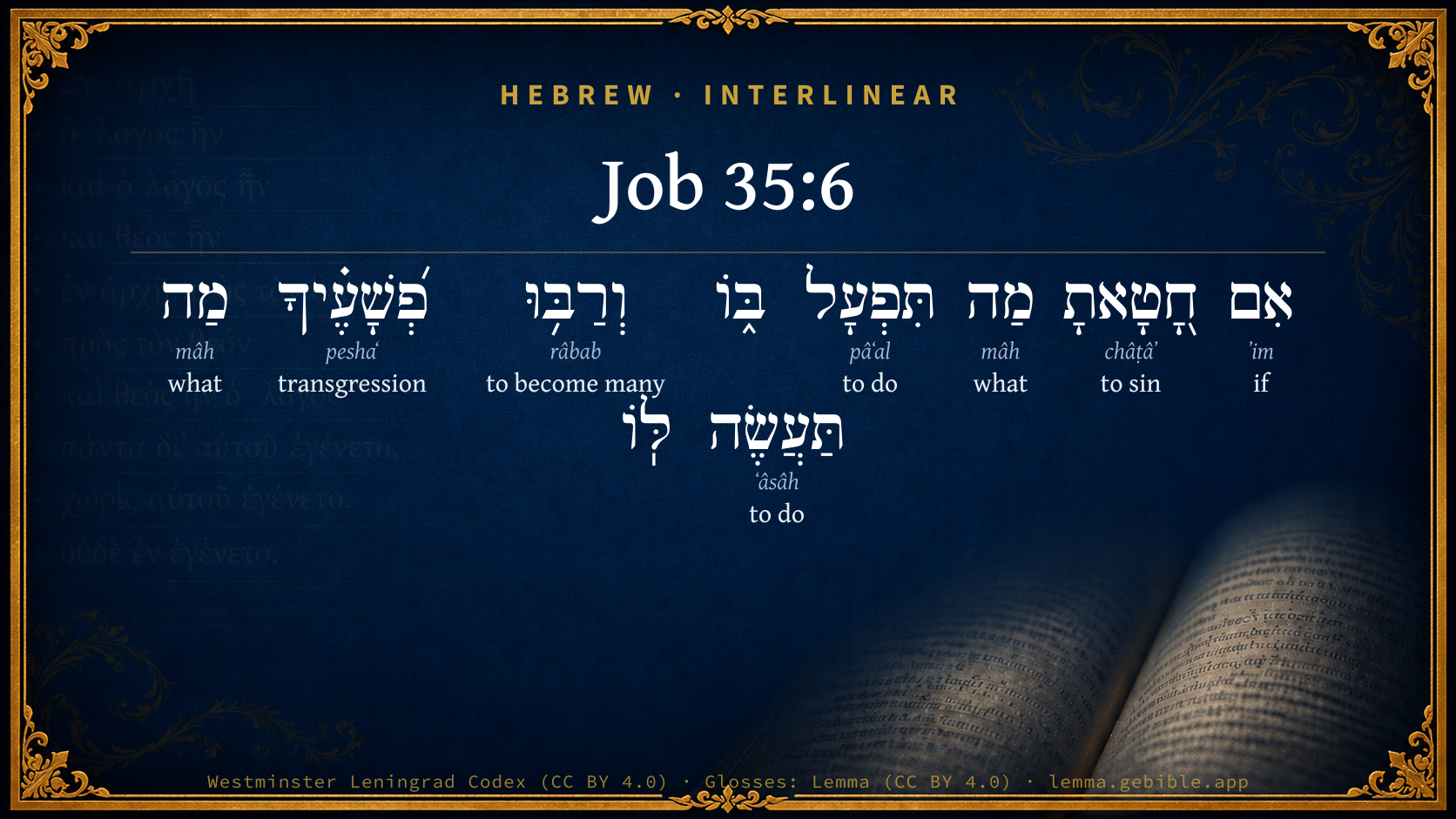
Hebrew (Westminster Leningrad Codex) Job 35:6 appears in the Hebrew Old Testament. The text above is from the Westminster Leningrad Codex. Each word links to its Strong’s number, a concise gloss, and parsing drawn from the Open Scriptures Hebrew Bible morphology. Click any word for its full Brown-Driver-Briggs (BDB) entry.
Download image
Cite this verse

Job 35:6 (World English Bible). Public Domain. Lemma interlinear Bible study tool, https://lemma.gebible.app/v/job/35/6.

Show BibTeX & RIS
BibTeX
RIS
English Translation
If you have sinned, what effect do you have against him? If your transgressions are multiplied, what do you do to him?
World English Bible · Public Domain
Download a study sheet

One document with this verse’s original text, its word-by-word gloss line, the meaning frame, cross-references with their text, attributed commentary, and full source and license credits — printable, and it pastes into notes with its structure intact.

This verse Autodidact and up

Study sheet (.html) Plain text (.txt)

A passage Seminary Student

Up to 50 verses in one chapter. A passage sheet keeps up to 6 commentary sources and 12 cross-references per verse, in the order this page ranks them, and says so on the sheet whenever that leaves anything out. Ask for a single verse and you get the Autodidact verse sheet above.

Everything on this page stays free to read, with no account — the sheet is a download of what is already on screen, not access to it.

Want to remove ads? Support Godless Engineer
Compare translations 3

The same verse in 3 English versions, stacked beneath the original-language interlinear above. Click any original word for its lexicon entry.

Each is an independent rendering of the whole verse — the interlinear is not word-aligned to these translations.

Highlighted words mark where these versions differ — a whole-verse word diff, not a word-by-word alignment.

  • World English Bible Public Domain
    If you have sinned, what effect do you have against him? If your transgressions are multiplied, what do you do to him?
  • King James Version Public Domain
    If thou sinnest, what doest thou against him? or if thy transgressions be multiplied, what doest thou unto him?
  • unfoldingWord Literal Text CC BY-SA 4.0
    If you sin, what do you accomplish against him? Or your transgressions multiply, what do you do to him?

unfoldingWord Literal Text — © unfoldingWord, licensed CC BY-SA 4.0. Word-aligned USFM3 via Door43 (git.door43.org/unfoldingWord/en_ult).

Versions to compare (up to 4)

3 of 4 selected

Show all 18 translations

Every available English version of this verse, each an independent rendering of the whole verse.

  • World English Bible Public Domain
    If you have sinned, what effect do you have against him? If your transgressions are multiplied, what do you do to him?
  • Berean Standard Bible Public Domain
    If you sin, what do you accomplish against Him? If you multiply your transgressions, what do you do to Him?
  • Majority Standard Bible Public Domain
    If you sin, what do you accomplish against Him? If you multiply your transgressions, what do you do to Him?
  • King James Version Public Domain
    If thou sinnest, what doest thou against him? or if thy transgressions be multiplied, what doest thou unto him?
  • American Standard Version (1901) Public Domain
    If thou hast sinned, what effectest thou against him? And if thy transgressions be multiplied, what doest thou unto him?
  • Revised Version (1885) Public Domain
    If thou hast sinned, what doest thou against him? and if thy transgressions be multiplied, what doest thou unto him.
  • Geneva Bible (1599) Public Domain
    If thou sinnest, what doest thou against him, yea, when thy sinnes be many, what doest thou vnto him?
  • Douay-Rheims (1899) Public Domain
    If thou sin, what shalt thou hurt him? and if thy iniquities be multiplied, what shalt thou do against him?
  • Young's Literal Translation Public Domain
    If thou hast sinned, what dost thou against Him? And thy transgressions have been multiplied, What dost thou to Him?
  • Literal Standard Version CC BY-SA 4.0
    If you have sinned, what do you do against Him? And your transgressions have been multiplied, || What do you do to Him?
  • Unlocked Literal Bible CC BY-SA 4.0
    If you have sinned, what harm do you do to God? If your transgressions pile up high, what do you do to him?
  • unfoldingWord Literal Text CC BY-SA 4.0
    If you sin, what do you accomplish against him? Or your transgressions multiply, what do you do to him?
  • Darby Bible Public Domain
    If thou sinnest, what doest thou against him? If thy transgressions be multiplied, what doest thou unto him?
  • World Messianic Bible Public Domain
    If you have sinned, what effect do you have against him? If your transgressions are multiplied, what do you do to him?
  • Webster's Bible Public Domain
    If thou sinnest, what doest thou against him? or if thy transgressions are multiplied, what doest thou to him?
  • Free Bible Version CC BY-SA 4.0
    If you sin, how does that harm God? How do your many sins affect God?
  • Bible in Basic English Public Domain
    If you have done wrong, is he any the worse for it? and if your sins are great in number, what is it to him?
  • JPS Tanakh (1917) Public Domain
    If thou hast sinned, what doest thou against Him? And if thy transgressions be multiplied, what doest thou unto Him?

Literal Standard Version (2020), Covenant Press — licensed CC BY-SA 4.0. Text via the HelloAO Bible API (eBible.org). Unlocked Literal Bible (unfoldingWord) — licensed CC BY-SA 4.0. Text via the HelloAO Bible API (eBible.org). unfoldingWord Literal Text — © unfoldingWord, licensed CC BY-SA 4.0. Word-aligned USFM3 via Door43 (git.door43.org/unfoldingWord/en_ult). Free Bible Version, Dr. Jonathan Gallagher — licensed CC BY-SA 4.0. Text via the HelloAO Bible API (eBible.org).

Word by word

More ways to search: Search by grammar → Find every occurrence → Compare this word →

Practice this passage: Drill this verse → Learn its vocabulary →

וְרַבּ֥וּ
râbab
H7231
“and · to become many”
Conjunction + Verb, Qal, Perfect, 3rd Person, Common, Plural
Part of Speech
Conjunction + Verb
Stem
Qal
Form
Perfect
Person
3rd Person
Gender
Common
Number
Plural
Full BDB Definition

Origin: a primitive root

TWOT: 2099

to be or become many, be or become much, be or become great - (Qal) - to be or become many - to be or become great - to be long (of journey) - (Pual) ten thousands
  1. אִם ʼim H518 “if” Conjunction
  2. חָ֭טָאתָ châṭâʼ H2398 “to sin” Verb, Qal, Perfect, 2nd Person, Masculine, Singular
  3. מַה mâh H4100 “what” Particle, Interrogative
  4. תִּפְעָל pâʻal H6466 “to do” Verb, Qal, Imperfect, 2nd Person, Masculine, Singular
  5. פְ֝שָׁעֶ֗יךָ peshaʻ H6588 “transgressions · your” Noun, Common, Masculine, Plural, Construct + Suffix, Personal, 2nd Person, Masculine, Singular
  6. מַה mâh H4100 “what” Particle, Interrogative
  7. תַּעֲשֶׂה ʻâsâh H6213 “to do” Verb, Qal, Imperfect, 2nd Person, Masculine, Singular

About this verse

These counts appear in no published source. They are computed here, from the morphology-tagged text and Lemma’s own curated glosses. What Lemma adds →

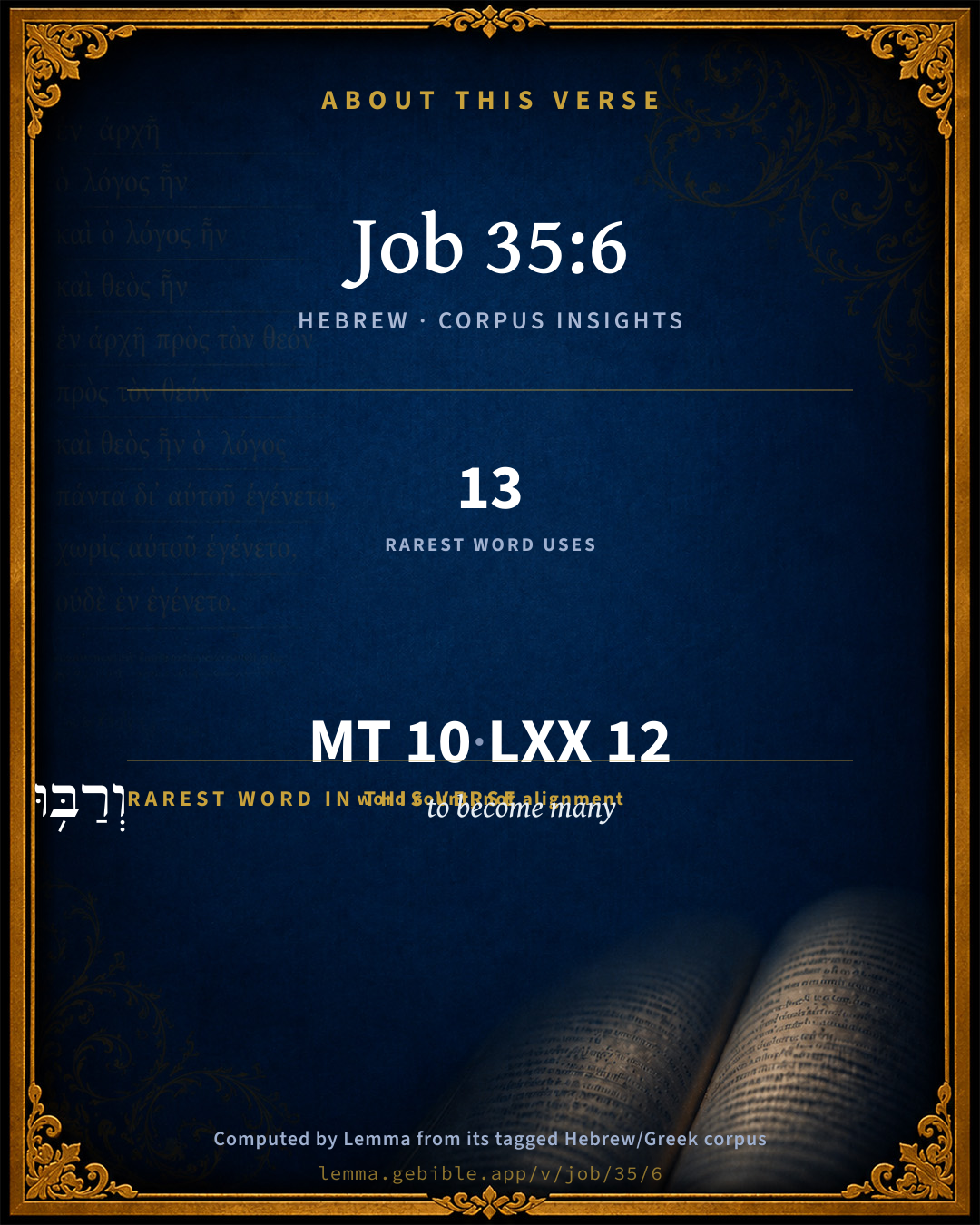
10
words
7
distinct lemmas
Wisdom
section

Notable vocabulary

The rarest word here is וְרַבּ֥וּ to become many H7231 — appearing just 13 times in the whole Hebrew Bible.

Shared distinctive vocabulary

וְרַבּ֥וּ to become many H7231 occurs in 13 verses of the Hebrew Bible. Also found in:

Grammatical profile

  • 4 verbs
  • 1 noun
  • 2 prepositions
  • 1 conjunction
  • 2 particles

Verb forms

  • חָ֭טָאתָ Qal · Perfect
  • תִּפְעָל Qal · Imperfect
  • וְרַבּ֥וּ Qal · Perfect
  • תַּעֲשֶׂה Qal · Imperfect

Repetition

A word recurs within this verse — often emphatic in Hebrew:

Hebrew & Septuagint length

In English translation the verse runs 22 words from the Hebrew and 11 from the Septuagint (LXX English) — the Septuagint runs noticeably shorter here. See the side-by-side →

A rough comparison of the two English renderings, which tokenize alike — not a word-level alignment.

Word counts can differ between the Hebrew and the Greek without any difference in meaning — e.g. the Hebrew direct-object marker אֵת has no separate Greek word, and Greek often adds the article ὁ.

In the original languages it is 10 Hebrew tokens and 12 Greek tokens — but the two are counted differently (Hebrew bundles its prefixes and suffixes into one token; the Greek is in lemma form), so that isn’t a like-for-like length.

Cross-references

3

Topical passages linked to Job 35:6 in the Treasury of Scripture Knowledge — connected by theme and wording, ordered by reader-vote popularity; previews shown in the World English Bible.

  • Jeremiah 7:19 Do they provoke me to anger? says Yahweh; [do they] not [provoke] themselves, to the confusion of their own faces?
  • Proverbs 8:36 But he who sins against me wrongs his own soul. All those who hate me love death."
  • Proverbs 9:12 If you are wise, you are wise for yourself. If you mock, you alone will bear it.

Cross-references courtesy of OpenBible.info (CC BY 4.0).

Hebrew and Greek witnesses Masoretic Hebrew ↔ Greek Septuagint

The same verse in the two great witnesses to the Old Testament, shown verse-for-verse.

Here the Septuagint runs noticeably shorter than the Hebrew — LXX2012 (modern English Septuagint) 11 words vs World English Bible 22. A rough length comparison of the two English translations, not a word-level alignment — read both below.

These are two independent witnesses, not word-aligned to each other, and the Septuagint is shown in lemma (dictionary) form.

Hebrew Job 35:6 Masoretic · Westminster Leningrad Codex

אִם חָ֭טָאתָ מַה תִּפְעָל בּ֑וֹ וְרַבּ֥וּ פְ֝שָׁעֶ֗יךָ מַה תַּעֲשֶׂה לּֽוֹ

If you have sinned, what effect do you have against him? If your transgressions are multiplied, what do you do to him?

World English Bible · Public Domain

Greek LXX Job 35:6 Septuagint · lemma form

εἰ ἁμαρτάνω τίς πράσσω εἰ δέ καί πολύς ἀνομέω τίς δύναμαι ποιέω

and if too you have transgressed much, what can you perform?

LXX2012 (modern English Septuagint) · Public Domain

Hebrew: Westminster Leningrad Codex (CC BY 4.0). Greek: Septuagint (public domain); English from LXX2012 (modern English Septuagint) (Public Domain). How the Septuagint differs from the Hebrew →

Commentary

Notes on Job 35:6 from classic Christian and Jewish commentators (each source and its license shown beneath its notes). The classic Christian expositions comment on the surrounding passage and are grouped to its opening verse, so a note may address several verses; the Jewish commentaries on the Tanakh (Rashi and others) are per-verse, so they appear only where the commentator wrote on this verse.

Lemma curates 59 commentaries, every one of them public domain or Creative Commons licensed, each selected and text-cleaned for this edition rather than reprinted as found. About our sources →

Trapp's Complete Commentary

John Trapp

Job 35:6 If thou sinnest, what doest thou against him? or [if] thy transgressions be multiplied, what doest thou unto him?

Ver. 6. If thou sinnest, what dost thou against him?] What more than show thy teeth? or shoot at a rock, where the arrow rebounds upon thee? In the sack of Constantinople the image of the crucifix was taken down by the Turks, and a Turk’s cap put upon the head thereof, and so set up, and shot at with their arrows; and afterwards, in great derision, carried about in the camp, as it were in procession, with drums playing before it, railing and spitting at it, and calling it the God of the Christians. But what was all this to Christ? He that sitteth in the heavens ( extra iactum) laughed at them, the Lord had them in derision, Psa 2:4. Do wicked sinners, when they work hardest against God, as the word here signifieth, and take greatest pains to go to hell; do they, I say, provoke the Lord to anger? Etsi naviter peccas. "Do they not provoke themselves to the confusion of their own faces?" Jer 7:19. And, nay we not well say to such, as Ulysses’s companions said to him, when he would needs provoke Polydamas,

Sχετλιε τιπτ εθελεις ερεθιζεμεν αγριον ανδρα (Hom. Odys.).

God can easily get him a name in the utter overthrow of a rabble of rebels conspiring against him, as at the flood, tower of Babel, Sodom, Egypt, Moab, &c., who were trodden down under him, as straw is trodden down for the dunghill, Isa 25:10. And in the next verse, "The Lord shall spread forth his hands in the midst of them, as he that swimmeth spreadeth forth his hands to swim" (that is, with greatest facility; for violent strokes rather sink than support a swimmer): "and he shall bring down their pride together with the spoils of their hands. And the fortress of the high fort of their walls shall he bring down, lay low, and bring to the ground, even to the dust," Isa 25:11-12.

John Trapp, A Commentary or Exposition upon All the Books of the Old and New Testament (1647–1656) — public domain. Text from a community e-Sword module.

The Biblical Illustrator

Joseph S. Exell

Job_35:6-8

If thou sinnest, what doest thou against Him?

Does man influence, God

Elihu, in these words, brings out his views of God in the form of questions, which views are of an Epicurean character. He looks upon God as a being so far above human concerns and conduct as not to be influenced by them. There are those now who have sympathy with these sentiments. They say God is too high and too great to be affected by the sin or righteousness of man. The doctrine of the Bible is, that mans conduct does influence God as well as man.

I. Answer the two questions that Elihu, in his scepticism, propounds.

1. If thou sinnest, what doest thou against Him? or if thy transgressions be multiplied, what doest thou unto Him? A man that lives in sin, and multiplies his transgressions--

(1) Sets God at defiance as his Sovereign Ruler.

(2) Violates His laws.

(3) Rivals God.

(4) Opposes Gods nature.

(5) Casts off His fear and restrains prayer.

(6) Rejects His mercy, grace, truth, and love.

If God was an Epicurean God, mans sins may not affect Him; but all His revelations of Himself to us go to show that He is our Father, Sovereign, Saviour; that He hates sin; that He loves the sinner. Hence our sins do influence Him. The Bible abounds with illustrations of these particulars.

2. If thou be righteous, what givest thou Him? or what receiveth He of thine hand? A righteous man (truly such in the scriptural sense) gives to the Almighty--

(1) Praise for what He is.

(2) Thanks for what He does.

(3) Obedience to His laws.

(4) Submission to His will.

(5) Himself a living sacrifice (Rom_12:1).

(6) Love for love. We love Him because He first loved us.

(7) His testimony. He is His witness.

Numerous illustrations of these particulars also may easily be collected from the Old and New Testament. The second part of this text, Elihu has no doubt about. Neither have those sceptics in our day, who sympathise with him in his former sentiments.

1. Thy wickedness may hurt, or injure a man as thou art. As to the hurt your wickedness may do your fellow, it may depend much upon the nature of the wickedness and the character, relations, and circumstances of your fellow man. One form of wickedness affects one man in one way, and another a different way. For instance, lying will hurt where swearing may not; and drunkenness where dishonesty may not. This thought more particularly applies to example. But look at the particular in its general application. Thy slander may hurt another mans character. Thy false accusation may hurt his feelings and reputation. Thy theft or dishonesty may hurt his property or circumstances. Thy calumny or detraction may injure his influence for good upon others. Humanity is one body--one family--one society; and it is impossible for one member to do wickedly without affecting in some way or other, to some degree or other, the rest.

2. Thy righteousness may profit the son of man. On the same principle that wickedness hurts our fellow men, righteousness is a benefit to them. If the term righteousness here be understood in a broad sense, as right-doing according to the moral instinct, it is profitable to man in a world like this, where human nature is so prone to wrong-doing. If the term be understood as the righteousness which is by faith in Jesus Christ--as received from Him in justification, and as wrought in Him in good works, according to His Spirit--it is still more profitable to man. This may be shown in the terms used to designate such:--the light of the world. Light is good and useful in darkness;--the salt of the earth. Salt is good and profitable in many ways. Righteousness implies truthfulness, honesty, goodness, purity, humility, benevolence, temperance, brotherly kindness, charity; and each of these is profitable in its influence on our fellow men. As wheat, fruit, flowers, vegetables, etc., in the natural world are profitable to man; so are the fruits and flowers of righteousness in the moral world. Learn--

1. Your responsibility to individuals and society in respect to your conduct towards them.

2. Your responsibility to God in respect to wicked or righteous conduct before Him.

3. The necessity of having a new nature within in order to live righteously before God and man. (J. Bate.)

The Biblical Illustrator, edited by Joseph S. Exell (c. 1880s–1900s) — public domain. Text from a community e-Sword module.

Geneva Bible (1599)

Geneva Bible translators

Neither doth thy sin hurt God, nor thy justice profit him: for he will be glorified without thee.

Geneva Bible (1599) marginal notes — public domain. Text via Bolls.life.

Jamieson, Fausset & Brown

Robert Jamieson, A. R. Fausset & David Brown

what doest--how canst thou affect Him?

unto him--that can hurt Him? (Jer 7:19; Pro 8:36).

Jamieson, Fausset & Brown — Commentary Critical and Explanatory on the Whole Bible (1871) — public domain (CC PDM 1.0). Text via the HelloAO Bible API.

Adam Clarke's Commentary

Verse 6. If thou sinnest] God is not benefited by thy righteousness, nor injured by thy iniquity, howsoever multiplied it may be.

Adam Clarke's Commentary on the Bible (1810–1826) — public domain. Text from a community e-Sword/MySword module.

John Gill's Exposition

Thy wickedness may hurt a man as thou art,.... But not God: a man may hurt himself by his wickedness; his body, by bringing various diseases upon it, through debauchery and intemperance; his family and estate, by wasting it; his soul, for every sin is a wrong and injury to a man's soul, and exposes it to ruin and destruction: and sin does even a good man harm, since it breaks in upon his peace, and hinders his communion with God; and the wickedness of men may harm others like themselves, frail, mortal, sinful creatures, and easily led aside by ill examples; as well as there are many sins which do injury to the persons, families, and estates of others, as murder, adultery, theft, &c. and since sin is harmful to others, God resents it, and punishes for it, though, strictly speaking, it cannot harm him in the sense before given;

and thy righteousness may profit the son of man; may profit a man himself (, Job 35:3), and others, but neither for justification before God; but godliness is profitable to a man's self, both for this life and that to come, and good works are profitable to other men; for what reasons they are to be performed and maintained, see Ti1 4:8. Some are of real and direct profit to men, as acts of beneficence to them, and all as being examples to them; but then no works of righteousness can be profitable to God, they adding nothing to him; which is what Elihu undertook to answer to.

John Gill's Exposition of the Whole Bible (1746–1763) — public domain (CC PDM 1.0). Text via the HelloAO Bible API.

Albert Barnes' Notes on the Bible

If thou sinnest, what doest thou against him? - This should not be interpreted as designed to justify sin, or as saying that there is no evil in it, or that God does not regard it. That is not the point or scope of the remark of Elihu. His object is to show that God is not influenced in his treatment of his creatures as people are in their treatment of each other. He has no “interest” in being partial, or in treating them otherwise than they deserve. If they sin against him his happiness is not so marred that he is under any inducement to interpose “by passion,” or in any other way than that which is “right.”

Albert Barnes' Notes on the Bible (1834–1885) — public domain. Text from a community e-Sword/MySword module.

Matthew Poole's English Annotations

Thy sins do him no hurt, and therefore thy righteousness brings him no benefit, as it follows.

Matthew Poole's English Annotations on the Holy Bible (1683–1685) — public domain. Text from a community e-Sword/MySword module.

Whedon's Commentary on the Bible

Daniel D. Whedon

6, 7. What receiveth he of thine hand — Independent and above all human conduct, he is under obligations to none; a point that had been reached before in the argument. “The all-sufficient One does not need man, and it is therefore foolish in us to demand, and fume, and murmur.” “When God crowns our merits, he crowns solely his own gifts.” — St. Augustine. See notes on Job_7:20; Job_22:2-3.

Daniel D. Whedon (gen. ed.), Commentary on the Old and New Testaments (1874–1909) — public domain. Text from a community e-Sword module.

The Pulpit Commentary

If thou sinnest, what doest thou against him? Man"s sins against God cannot injure him, diminish from his power, or lower his dignity. They can only injure the sinner himself. God does not.punish them because they harm him, but because they are discords in the harmony of his moral universe. Or even if thy transgressions be multiplied; i.e. if thou persistest in a long course of sin, and addest "rebellion" to transgression, and self-complacency to rebellion, and "multipliest thy words against God" (Job_34:37) even then, what doest thou unto him? what hurt dost thou inflict upon him? None.

The Pulpit Commentary (1880–1919), ed. H.D.M. Spence-Jones & Joseph S. Exell — public domain. Text from a community e-Sword module.

unfoldingWord translationNotes

Door43 World Missions Community

Connecting Statement:

Elihu continues speaking.

If you have sinned ... what do you do to him?

These two lines share similar meanings. The second line intensifies the meaning of the first line. (See: Parallelism)

If you have sinned, what harm do you do to God?

Elihu asks this question to emphasize that Job's sins cannot actually do anything to God. AT: "If you have sinned, you have not done any harm to God." (See: Rhetorical Question)

If your transgressions pile up high, what do you do to him?

Elihu speaks of "transgressions" as if they were objects, and of committing many transgressions as if it were piling those objects one on top of the other. He asks this question to emphasize that Job does nothing to God by his transgressions. AT: "If you committed a great many transgressions, you still do nothing to him." (See: Metaphor and Rhetorical Question)

If you are righteous, what can you give to him? What will he receive from your hand?

The two rhetorical questions mean basically the same thing, that Job's righteousness adds nothing to God. AT: "If you are righteous, that does not enable you to give anything to him, and there is nothing that he will receive from your hand." (See: Rhetorical Question and Parallelism)

receive from your hand

Here the word "hand" represents Job. AT: "receive from you" (See: Synecdoche)

another son of man

"another human-being" or "another person"

translationWords

transgress

receive

hand

Son of Man

unfoldingWord translationNotes — © Distant Shores Media and the Door43 World Missions Community, licensed CC BY-SA 4.0. Source: git.door43.org/Door43/en_tn.

Lesson kit

Teaching starters — assembled from the data on this page, not authored interpretation. Every prompt links to the verse data it draws on. Edit before teaching.

Job, in the Wisdom, opens this verse with 10 words (7 distinct Hebrew lemmas). Its most distinctive word is râbab (“to become many”). The Greek Septuagint runs shorter here. A historical commentator’s framing appears above. Read the whole chapter for the surrounding context.

Discussion questions

  1. The word râbab carries the sense “to become many.” How does it shape the verse?
  2. How does Genesis 6:1, which shares the word «to become many», read alongside this verse?
  3. What does the repetition of “what” (2× in this one verse) do in this verse?
  4. The Septuagint runs shorter here than the Hebrew. What might account for the difference?
  5. The translations on this page render this verse differently — a whole-verse word diff, not a word-by-word alignment. What might account for the different wordings?
  6. «חָ֭טָאתָ» is a Qal Perfect verb. How does that grammatical form shape the action described?
  7. Compare how Trapp's Complete Commentary and The Biblical Illustrator read this verse. Where do they agree or differ?

Things to notice

Reading settings

Reading text

Shown beneath each verse's original-language words.

Old Testament
Old Testament edition

Read the OT as the Masoretic Hebrew (MT) or the Greek Septuagint (LXX).

English shown for the Greek Septuagint (in the Hebrew ↔ Greek comparison).

Comparing translations? Open the Compare panel on any verse page to stack up to four side by side.