
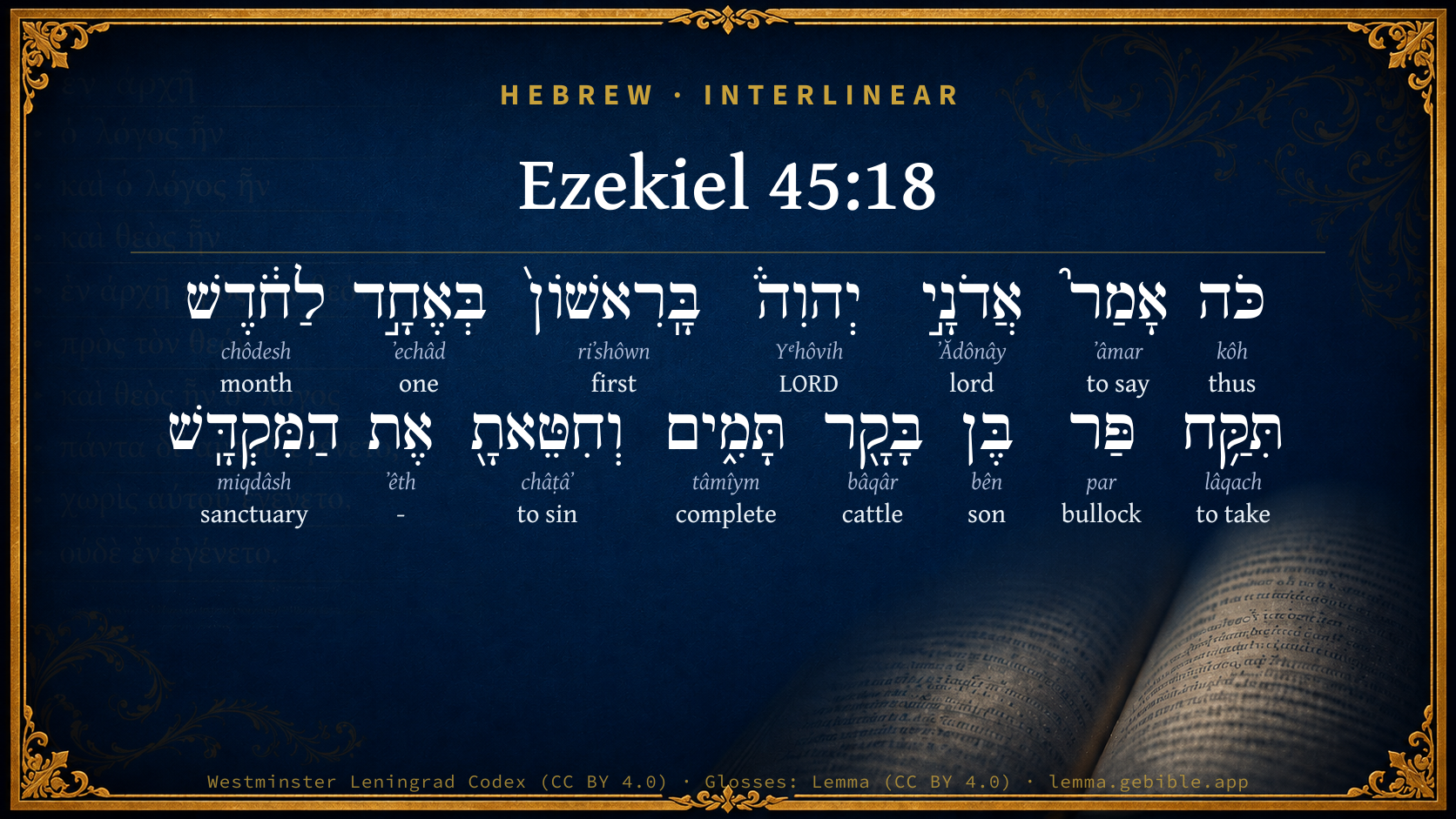
Ezekiel 45:18

Hebrew (Westminster Leningrad Codex) Ezekiel 45:18 appears in the Hebrew Old Testament. The text above is from the Westminster Leningrad Codex. Each word links to its Strong’s number, a concise gloss, and parsing drawn from the Open Scriptures Hebrew Bible morphology. Click any word for its full Brown-Driver-Briggs (BDB) entry.
Download image
Cite this verse

Ezekiel 45:18 (World English Bible). Public Domain. Lemma interlinear Bible study tool, https://lemma.gebible.app/v/ezekiel/45/18.

Show BibTeX & RIS
BibTeX
RIS
English Translation
Thus says the Lord Yahweh: In the first [month], in the first [day] of the month, you shall take a young bull without blemish; and you shall cleanse the sanctuary.
World English Bible · Public Domain
Download a study sheet

One document with this verse’s original text, its word-by-word gloss line, the meaning frame, cross-references with their text, attributed commentary, and full source and license credits — printable, and it pastes into notes with its structure intact.

This verse Autodidact and up

Study sheet (.html) Plain text (.txt)

A passage Seminary Student

Up to 50 verses in one chapter. A passage sheet keeps up to 6 commentary sources and 12 cross-references per verse, in the order this page ranks them, and says so on the sheet whenever that leaves anything out. Ask for a single verse and you get the Autodidact verse sheet above.

Everything on this page stays free to read, with no account — the sheet is a download of what is already on screen, not access to it.

Want to remove ads? Support Godless Engineer
Compare translations 3

The same verse in 3 English versions, stacked beneath the original-language interlinear above. Click any original word for its lexicon entry.

Each is an independent rendering of the whole verse — the interlinear is not word-aligned to these translations.

Highlighted words mark where these versions differ — a whole-verse word diff, not a word-by-word alignment.

  • World English Bible Public Domain
    Thus says the Lord Yahweh: In the first [month], in the first [day] of the month, you shall take a young bull without blemish; and you shall cleanse the sanctuary.
  • King James Version Public Domain
    Thus saith the Lord GOD; In the first month, in the first day of the month, thou shalt take a young bullock without blemish, and cleanse the sanctuary:
  • unfoldingWord Literal Text CC BY-SA 4.0
    The Lord Yahweh says this: In the first month, on the first day of the month, you will take an unblemished bull from the herd and perform a sin offering for the sanctuary.

unfoldingWord Literal Text — © unfoldingWord, licensed CC BY-SA 4.0. Word-aligned USFM3 via Door43 (git.door43.org/unfoldingWord/en_ult).

Versions to compare (up to 4)

3 of 4 selected

Show all 18 translations

Every available English version of this verse, each an independent rendering of the whole verse.

  • World English Bible Public Domain
    Thus says the Lord Yahweh: In the first [month], in the first [day] of the month, you shall take a young bull without blemish; and you shall cleanse the sanctuary.
  • Berean Standard Bible Public Domain
    This is what the Lord GOD says: ‘On the first day of the first month you are to take a young bull without blemish and purify the sanctuary.
  • Majority Standard Bible Public Domain
    This is what the Lord GOD says: ‘On the first day of the first month you are to take a young bull without blemish and purify the sanctuary.
  • King James Version Public Domain
    Thus saith the Lord GOD; In the first month, in the first day of the month, thou shalt take a young bullock without blemish, and cleanse the sanctuary:
  • American Standard Version (1901) Public Domain
    Thus saith the Lord Jehovah: In the first `month', in the first `day' of the month, thou shalt take a young bullock without blemish; and thou shalt cleanse the sanctuary.
  • Revised Version (1885) Public Domain
    Thus saith the Lord GOD: In the first month, in the first day of the month, thou shalt take a young bullock without blemish; and thou shalt cleanse the sanctuary.
  • Geneva Bible (1599) Public Domain
    Thus sayth the Lord God, In the first moneth, in the first day of the moneth, thou shalt take a yong bullocke without blemish and clense the Sanctuarie.
  • Douay-Rheims (1899) Public Domain
    Thus saith the Lord God: In the first month, the first of the month, thou shalt take a calf of the herd without blemish, and thou shalt expiate the sanctuary.
  • Young's Literal Translation Public Domain
    `Thus said the Lord Jehovah: In the first `month', in the first of the month, thou dost take a bullock, a son of the herd, a perfect one, and hast cleansed the sanctuary:
  • Literal Standard Version CC BY-SA 4.0
    Thus said Lord YHWH: “In the first [month], on the first of the month, you take a bullock, a son of the herd, a perfect one, and have cleansed the sanctuary:
  • Unlocked Literal Bible CC BY-SA 4.0
    The Lord Yahweh says this: In the first month, on the first day of the month, you will take an unblemished bull from the herd and perform a sin offering for the sanctuary.
  • unfoldingWord Literal Text CC BY-SA 4.0
    The Lord Yahweh says this: In the first month, on the first day of the month, you will take an unblemished bull from the herd and perform a sin offering for the sanctuary.
  • Darby Bible Public Domain
    Thus saith the Lord Jehovah: In the first [month], on the first of the month, thou shalt take a young bullock, without blemish, and thou shalt purge the sanctuary.
  • World Messianic Bible Public Domain
    “‘The Lord GOD says: “In the first month, on the first day of the month, you shall take a young bull without defect, and you shall cleanse the sanctuary.
  • Webster's Bible Public Domain
    Thus saith the Lord GOD; In the first month, in the first day of the month, thou shalt take a young bullock without blemish, and cleanse the sanctuary:
  • Free Bible Version CC BY-SA 4.0
    This is what the Lord God says: On the first day of the first month you are to sacrifice a young bull that has no defects to purify the sanctuary.
  • Bible in Basic English Public Domain
    This is what the Lord has said: In the first month, on the first day of the month, you are to take a young ox without any mark on him, and you are to make the holy place clean.
  • JPS Tanakh (1917) Public Domain
    Thus saith the Lord GOD: In the first month, in the first day of the month, thou shalt take a young bullock without blemish; and thou shalt purify the sanctuary.

Literal Standard Version (2020), Covenant Press — licensed CC BY-SA 4.0. Text via the HelloAO Bible API (eBible.org). Unlocked Literal Bible (unfoldingWord) — licensed CC BY-SA 4.0. Text via the HelloAO Bible API (eBible.org). unfoldingWord Literal Text — © unfoldingWord, licensed CC BY-SA 4.0. Word-aligned USFM3 via Door43 (git.door43.org/unfoldingWord/en_ult). Free Bible Version, Dr. Jonathan Gallagher — licensed CC BY-SA 4.0. Text via the HelloAO Bible API (eBible.org).

Word by word

More ways to search: Search by grammar → Find every occurrence → Compare this word →

Practice this passage: Drill this verse → Learn its vocabulary →

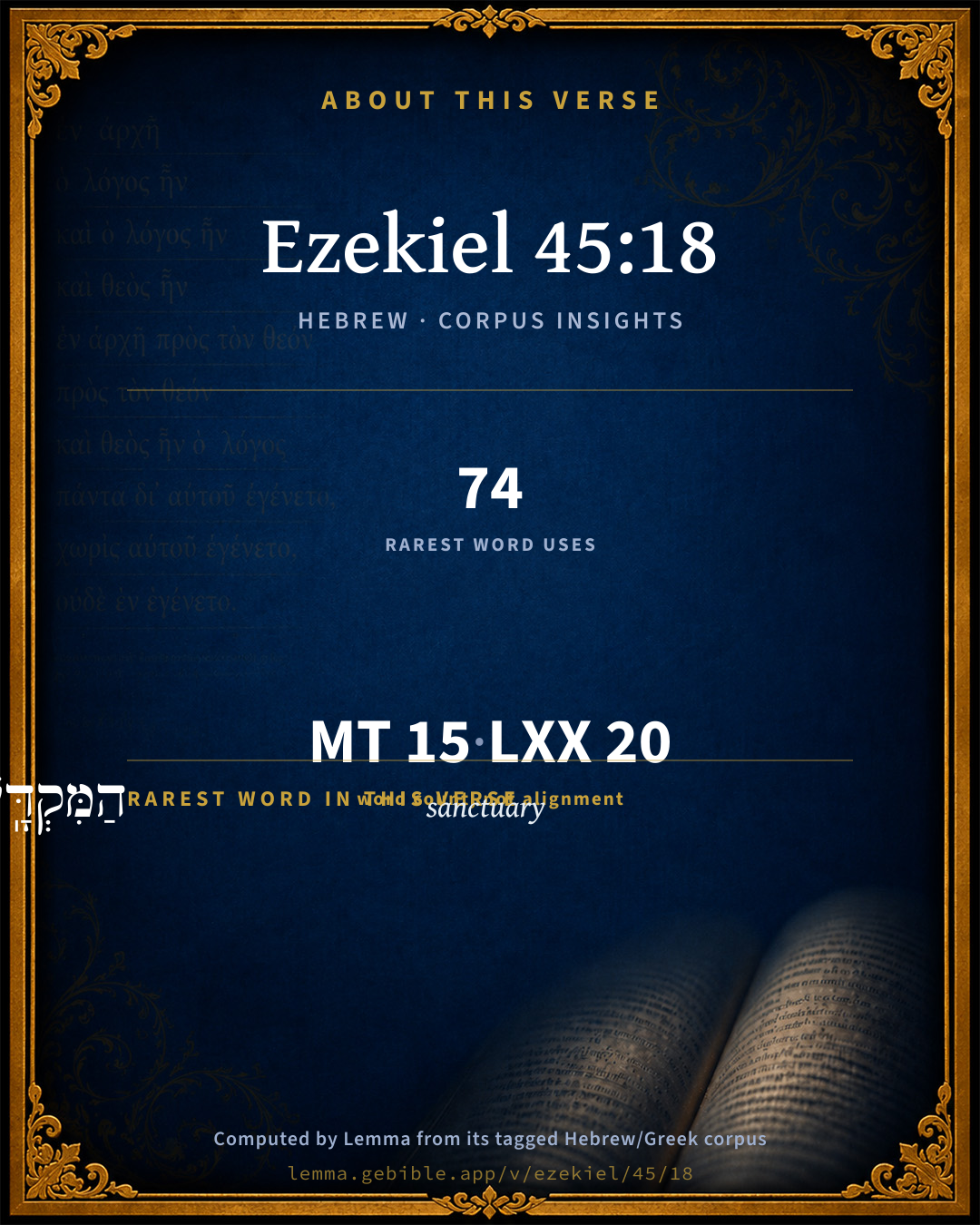
הַמִּקְדָּֽשׁ
miqdâsh
H4720
“the · sanctuary”
Particle, Definite Article + Noun, Common, Masculine, Singular, Absolute
Part of Speech
Particle + Noun
Type
Common
Gender
Masculine
Number
Singular
State
Absolute
Full BDB Definition

Origin: from H6942

TWOT: 1990f

sacred place, sanctuary, holy place - sanctuary - of the temple - of the tabernacle - of Ezekiel's temple - of Jehovah
  1. כֹּה kôh H3541 “thus” Adverb
  2. אָמַר֮ ʼâmar H559 “to say” Verb, Qal, Perfect, 3rd Person, Masculine, Singular
  3. אֲדֹנָ֣י ʼĂdônây H136 “Lord · my” Noun, Common, Masculine, Plural, Construct + Suffix, Personal, 1st Person, Common, Singular
  4. יְהוִה֒ Yᵉhôvih H3069 “LORD” Noun, Proper
  5. בָּֽרִאשׁוֹן֙ riʼshôwn H7223 “in/at the · first” Preposition, Determined + Adjective, Adjective, Masculine, Singular, Absolute
  6. בְּאֶחָ֣ד ʼechâd H259 “in/at · one” Preposition + Adjective, Cardinal number, Masculine, Singular, Absolute
  7. לַחֹ֔דֶשׁ chôdesh H2320 “to/for the · month” Preposition, Determined + Noun, Common, Masculine, Singular, Absolute
  8. תִּקַּ֥ח lâqach H3947 “to take” Verb, Qal, Imperfect, 2nd Person, Masculine, Singular
  9. פַּר par H6499 “bullock” Noun, Common, Masculine, Singular, Absolute
  10. בֶּן bên H1121 “son of” Noun, Common, Masculine, Singular, Construct
  11. בָּקָ֖ר bâqâr H1241 “cattle” Noun, Common, Both, Singular, Absolute
  12. תָּמִ֑ים tâmîym H8549 “complete” Adjective, Adjective, Masculine, Singular, Absolute
  13. וְחִטֵּאתָ֖ châṭâʼ H2398 “and · to sin” Conjunction + Verb, Piel, Sequential Perfect, 2nd Person, Masculine, Singular
  14. אֶת ʼêth H853 “-” Particle, Direct Object

About this verse

These counts appear in no published source. They are computed here, from the morphology-tagged text and Lemma’s own curated glosses. What Lemma adds →

15
words
15
distinct lemmas
Prophets
section

Grammatical profile

  • 3 verbs
  • 7 nouns
  • 3 adjectives
  • 1 adverb
  • 1 particle

Verb forms

  • אָמַר֮ Qal · Perfect
  • תִּקַּ֥ח Qal · Imperfect
  • וְחִטֵּאתָ֖ Piel · Sequential Perfect

Hebrew & Septuagint length

In English translation the verse runs 30 words from the Hebrew and 34 from the Septuagint (LXX English) — closely comparable.

A rough comparison of the two English renderings, which tokenize alike — not a word-level alignment.

Word counts can differ between the Hebrew and the Greek without any difference in meaning — e.g. the Hebrew direct-object marker אֵת has no separate Greek word, and Greek often adds the article ὁ.

In the original languages it is 15 Hebrew tokens and 20 Greek tokens — but the two are counted differently (Hebrew bundles its prefixes and suffixes into one token; the Greek is in lemma form), so that isn’t a like-for-like length.

Cross-references

14

Topical passages linked to Ezekiel 45:18 in the Treasury of Scripture Knowledge — connected by theme and wording, ordered by reader-vote popularity; previews shown in the World English Bible.

  • Leviticus 16:16 and he shall make atonement for the Holy Place, because of the uncleanness of the children of Israel, and because of their transgressions, even all their sins; and so he shall do for the Tent of Meeting, that dwells with them in the midst of their uncleanness.
  • Exodus 12:2 "This month shall be to you the beginning of months. It shall be the first month of the year to you.
  • Leviticus 16:33 Then he shall make atonement for the Holy Sanctuary; and he shall make atonement for the Tent of Meeting and for the altar; and he shall make atonement for the priests and for all the people of the assembly.
  • Leviticus 22:20 But whatever has a blemish, that you shall not offer: for it shall not be acceptable for you.
  • Ezekiel 43:22 On the second day you shall offer a male goat without blemish for a sin-offering; and they shall cleanse the altar, as they did cleanse it with the bull.
  • Hebrews 9:14 how much more will the blood of Christ, who through the eternal Spirit offered himself without blemish to God, cleanse your conscience from dead works to serve the living God?
  • Ezekiel 43:26 Seven days shall they make atonement for the altar and purify it; so shall they consecrate it.
  • Numbers 28:11–15 In the beginnings of your months you shall offer a burnt offering to Yahweh: two young bulls, and one ram, seven he-lambs a year old without blemish;
  • Matthew 6:33 But seek first God's Kingdom, and his righteousness; and all these things will be given to you as well.
  • Hebrews 7:26 For such a high priest was fitting for us: holy, guiltless, undefiled, separated from sinners, and made higher than the heavens;
  • Hebrews 9:22–25 According to the law, nearly everything is cleansed with blood, and apart from shedding of blood there is no remission.
  • Hebrews 10:3–4 But in those sacrifices there is yearly reminder of sins.
  • Hebrews 10:19–22 Having therefore, brothers, boldness to enter into the holy place by the blood of Jesus,
  • 1 Peter 1:19 but with precious blood, as of a lamb without spot, the blood of Christ;

Cross-references courtesy of OpenBible.info (CC BY 4.0).

Hebrew and Greek witnesses Masoretic Hebrew ↔ Greek Septuagint

The same verse in the two great witnesses to the Old Testament, shown verse-for-verse.

These are two independent witnesses, not word-aligned to each other, and the Septuagint is shown in lemma (dictionary) form.

Hebrew Ezekiel 45:18 Masoretic · Westminster Leningrad Codex

כֹּה אָמַר֮ אֲדֹנָ֣י יְהוִה֒ בָּֽרִאשׁוֹן֙ בְּאֶחָ֣ד לַחֹ֔דֶשׁ תִּקַּ֥ח פַּר בֶּן בָּקָ֖ר תָּמִ֑ים וְחִטֵּאתָ֖ אֶת הַמִּקְדָּֽשׁ

Thus says the Lord Yahweh: In the first [month], in the first [day] of the month, you shall take a young bull without blemish; and you shall cleanse the sanctuary.

World English Bible · Public Domain

Greek LXX Ezekiel 45:18 Septuagint · lemma form

ὅδε λέγω κύριος θεός ἐν ὁ πρῶτος μήν εἷς ὁ μήν λαμβάνω μόσχος ἐκ βοῦς ἄμωμος ὁ ἐκἱλάσκομαι ὁ ἅγιος

Thus says the Lord God; In the first month, on the first day of the month, you⌃ shall take a calf without blemish out of the herd, to make atonement for the holy place.

LXX2012 (modern English Septuagint) · Public Domain

On this verse, Dummelow's Commentary on the Holy Bible discusses the Septuagint’s reading. Read the note in Commentary ↓

Hebrew: Westminster Leningrad Codex (CC BY 4.0). Greek: Septuagint (public domain); English from LXX2012 (modern English Septuagint) (Public Domain). How the Septuagint differs from the Hebrew →

Targum (Aramaic paraphrase)

1

The Targum is the ancient Jewish Aramaic paraphrase of the Hebrew Scriptures — an interpretive translation, not the Hebrew text itself. Onkelos (literal) and Pseudo-Jonathan (expansive) render the Torah, and Jonathan the Prophets. Coverage is partial: where no permissively-licensed English translation exists for a verse, only the Aramaic is shown. This is verse-level text, not a word-by-word alignment to the Hebrew.

  1. Targum Jonathan Prophets (Joshua–Malachi)
    כִּדְנַן אֲמַר יְיָ אֱלֹהִים בְּקַדְמָאָה בְּחַד לְיַרְחָא תִּסַב תּוֹר בַּר תּוֹרֵי שְׁלִים וְתִדְכֵּי יַת מַקְדְשָׁא:

    (no public-domain English translation for this verse)

    Targum Jonathan — Aramaic: “Mikraot Gedolot” (public domain). English: “Sefaria Community Translation” (CC0 1.0 (public-domain dedication)); “London "Chaldee Paraphrase," 1871” (public domain). Text via Sefaria.

Commentary

Notes on Ezekiel 45:18 from classic Christian and Jewish commentators (each source and its license shown beneath its notes). The classic Christian expositions comment on the surrounding passage and are grouped to its opening verse, so a note may address several verses; the Jewish commentaries on the Tanakh (Rashi and others) are per-verse, so they appear only where the commentator wrote on this verse.

Lemma curates 59 commentaries, every one of them public domain or Creative Commons licensed, each selected and text-cleaned for this edition rather than reprinted as found. About our sources →

The Cambridge Bible for Schools and Colleges

gen. ed. J. J. S. Perowne

Eze_45:18-25. Offerings at the feasts

18–20. The stated atonement for the sanctuary twice in the year—on the first day of the first month (Eze_45:18); and on the first day of the seventh month (Eze_45:20). The sin-offering on both occasions shall be a young bullock to cleanse, better: to make atonement for the sanctuary (Eze_43:20).

Ch. Eze_45:18 to Eze_46:24. The offerings to be made at the feasts and other appointed seasons

(1) Eze_45:18-25. Offerings at the feasts.

(2) Eze_46:1-11. Offerings for the sabbaths and new moons.

(3) Eze_45:12. Voluntary offerings of the prince.

(4) Eze_45:13-15. The daily burnt-offering.

(5) Eze_45:16-18. Case of the prince alienating any part of his landed estate to his children or servants.

(6) Eze_45:19-24. Kitchens for boiling the offerings eaten by the priests, and those partaken of by the people.

The Cambridge Bible for Schools and Colleges (gen. ed. J. J. S. Perowne; Cambridge University Press, 1878–1918) — public domain. Text from a community e-Sword module.

Trapp's Complete Commentary

John Trapp

Eze 45:18 Thus saith the Lord GOD; In the first [month], in the first [day] of the month, thou shalt take a young bullock without blemish, and cleanse the sanctuary:

Ver. 18. Thou shalt take.] Thou, O prince, shalt.

A young bullock.] One, and no more. Ut unitas singularis sacvificii Christi intimaretur.

John Trapp, A Commentary or Exposition upon All the Books of the Old and New Testament (1647–1656) — public domain. Text from a community e-Sword module.

Albert Barnes' Notes on the Bible

This order of certain solemn services does not follow exactly the order of Moses, of Solomon, or of Ezra. The deviation can scarcely have been accidental, and furnishes a fresh indication that the whole vision is symbolic, representative of the times when, after the oblation of the one Sacrifice, reconciliation and sanctification were effected for man through the presence of God dwelling in the midst of the people.

Eze 45:18

In the first day - If this is only a special Passover for the dedication, the prolongation of the festival may be compared with that under Solomon 2Ch 7:8. But it is more probably a general ordinance, and, in this case, we have an addition to the Mosaic ritual (compare Lev 23:5). Here the “first day” is marked by the rites of expiation, which are repeated on the seventh day Eze 45:20, for the purpose of including those who transgressed from ignorance rather than willfulness.

Eze 45:23

Comparing this with the daily sacrifices of the Paschal week Num 28:19-24, and those of the daily sacrifices of the week of the Feast of tabernacles (see Num 29:12...), it will be seen that here the covenant number seven is preserved throughout to indicate a perfect, in lieu of an imperfect, covenant with God.

Eze 45:25

The Feast of tabernacles (compare the marginal references). Some think that the other great festival, the Feast of Weeks, is intended.

Albert Barnes' Notes on the Bible (1834–1885) — public domain. Text from a community e-Sword/MySword module.

Joseph Benson's Commentary

Eze 45:18-20. In the first month, &c., thou shalt take a young bullock — These words are directed to the prince, who is commanded, on the first day of the new year, (which, according to the ecclesiastical computation, began with the month Nisan, and answers to our 10th of March: see Exo 12:2,) to provide a bullock for a burnt-offering to cleanse the temple from any defilement it might have contracted, by the people’s offering their sacrifices, or coming into any of the courts belonging to it, while they were under any legal pollution. And the priest shall take of the blood, &c. — The office of the priest is here distinguished from that of the prince: the prince was to provide the sacrifices, and the priest to offer them. So shalt thou do the seventh day for every one that erreth — For all the errors of all the house of Israel through ignorance. There were particular sacrifices appointed for sins of ignorance, whether of private persons or of the whole congregation, Lev 4:13. So shall ye reconcile the house —

Cleanse it from any pollution it may have contracted through the ignorance of any of the common people.

Joseph Benson's Commentary on the Old and New Testaments (1811–1818) — public domain. Text from a community e-Sword module.

Dummelow's Commentary on the Holy Bible

J. R. Dummelow

The Offerings at the Sacred Seasons, etc

(This whole passage should be compared with Numbers 28, 29.)

(a) The Atonement for the Sanctuary (Eze_45:18-20)

This was to take place twice yearly, on the first days of the first and seventh months. These two days in Ezekiel serve the same purpose as the great Day of Atonement on the tenth day of the seventh month (Leviticus 16; Num_29:7-11).

20. The seventh day of the month] LXX 'in the seventh month, on the first day of the month'. Reconcile] RV 'make atonement for.'

(b) The Passover (Eze_45:21-24)

With these regulations cp. Exo_12:18-20; Lev_23:5-8; Num_9:2-3; Deu_16:1-8.

23. Kid of the goats] RV 'he-goat.'

(c) The Feast of Tabernacles (Eze_45:25)

This was to hold the same place in the seventh month as the Passover in the first month: cp. Lev_23:34-36; Num_29:12-38; Deu_16:13-15. Ezekiel makes no mention of the Feast of Weeks (Pentecost).

(d) The Sabbaths and New Moons (Eze_46:1-8)

On these occasions the E. gateway of the innercourt, which was shut at other times, was opened all day. The prince was allowed to enter the gateway by the porch, which was next the outer court (Eze_40:34), to prepare his offerings, and to worship at the (inner) threshold of the gateway, but not to enter the inner court. The people worshipped in the outer court, at the entrance of the same gateway: cp. with these vv. Num_28:9-25.

5, 7. Meat offering] RV 'meal offering.'

7. His hand.. unto] RV 'he is able.'

(e) Various Regulations for Worship (Eze_46:9-12)

No one was to leave the outer court by the gate by which he came in. If he entered by the N. gate he must go out by the S. and vice versa (Eze_45:9). The prince and the people were to enter and leave together (Eze_45:10). The meat offering on all sacred occasions was to be the same as that on the new moon (Eze_45:11 : cp. Eze_45:7). When the prince wished to make a free-will offering the inner E. gate was to be opened for him as on the sabbaths and new moons (Eze_45:12).

8. The prince in the midst of them.. shall go in] RV 'the prince.. shall go in in the midst of them.'

12. Voluntary] RV 'freewill offering, a.' Voluntarily] RV 'as a freewill offering.'

(f) The Daily Burnt Offering (Eze_46:13-15)

Cp. with this Exo_29:38-40; Num_28:3-8. The proportions of Ezekiel's meal offering differ from those in Ex and Nu, and he says nothing about a drink offering or an evening sacrifice.

14. Temper with] RV 'moisten', Meat offering] RV 'meal offering': so in Eze_45:15.

(g) Gifts of Land by the Prince (Eze_46:16-18)

Such gifts could only be made from the Prince's own possessions (Fig. 7, PP). If they were given to his sons they were made in perpetuity, but if to his servants, they returned to him in the year of jubilee: see Lev_25:10; Lev_27:24.

(h) The Kitchens of the Priests and the People (Eze_46:19-24)

On the W. of the holy chambers N. of the Temple (Fig. 3, GG1) Ezekiel was shown a place (L) where the priests cooked the parts of the sacrifice which they ate in the chambers (Eze_42:13). We may assume that there was a similar place (L) adjoining the holy chambers (GG1) on the S. of the Temple (Eze_45:19-20). In every corner of the outer court there was a building (M) 40 cubits by 30, where the Ternple servants (the Lévites) cooked the sacrifices to be eaten by the people (Eze_45:21-24).

22. Joined of] RV 'inclosed',

23. Places of them that boil] RV 'boiling houses.'

J. R. Dummelow, A Commentary on the Holy Bible (Macmillan, 1909) — public domain. Text from a community e-Sword module.

Whedon's Commentary on the Bible

Daniel D. Whedon

18-20. Here are given specific directions for these offerings at the great feast. Twice in the year, on the first of Abib (Eze_45:18), and on the seventh of the same month, or, with LXX., on the first of the seventh month (Eze_45:20, compare Eze_43:20; Lev_16:16-18), an atonement for the sanctuary must be made by the offering of a young bullock, whose blood must be applied to the doorposts (Eze_41:21), and the corners of “the ledge of the altar” (Eze_45:19; Eze_43:20), and to the posts of the gateway of the inner court. (Compare Exo_12:3-6; Lev_16:11-16; Lev_23:27.) This was to make “atonement for the house” (R.V., Eze_45:20) with special reference to ceremonial impurity or uncleanness contracted through the accidental mistake or ignorance of some worshiper or administrator. (Compare Leviticus 4.)

Daniel D. Whedon (gen. ed.), Commentary on the Old and New Testaments (1874–1909) — public domain. Text from a community e-Sword module.

Keil & Delitzsch

C. F. Keil & F. Delitzsch

The Sin-Offerings in the First Month

Eze 45:18. Thus saith the Lord Jehovah, In the first (month), on the first of the month, thou shalt take a bullock, a young ox without blemish, and absolve the sanctuary. Eze 45:19. And the priest shall take of the blood of the sin-offering, and put it upon the door-posts of the house, and upon the four corners of the enclosure of the altar, and upon the door-posts at the gate of the inner court. Eze 45:20. And so shalt thou do on the seventh of the month, for the sake of erring men and of folly, that so ye may make atonement for the house. - The Mosaic law had prescribed for the new moons generally the sin-offering of a he-goat, in addition to the burnt-offerings and meat-offerings (Num 28:15); and, besides, this, had also distinguished the new-moon's day of the seventh month by a special feast-offering to be added to the regular new-moon's sacrifices, and consisting of a sin-offering of a he-goat, and burnt-offerings and meat-offerings (Num 29:2-6). This distinguishing of the seventh month by a special new-moon's sacrifice is omitted in Ezekiel; but in the place of it the first month is distinguished by a sin-offering to be presented on the first and seventh days. Nothing is said in Eze 45:18-20 about burnt-offerings for these days; but as the burnt-offering is appointed in Eze 46:6-7 for the new-moon's day without any limitation, and the regulations as to the connection between the meat-offering and the burnt-offerings are repeated in Eze 46:11 for the holy days and feast days (הגּים וּמועדים) generally, and the new-moon's day is also reckoned among the מועדים, there is evidently good ground for the assumption that the burnt-offering and meat-offering prescribed for the new moon in Eze 46:6-7 were also to be offered at the new moon of the first month. On the other hand, no special burnt-offering or meat-offering is mentioned for the seventh day of the first month; so that in all probability only the daily burnt-offering and meat-offering were added upon that day (Eze 46:13.) to the sin-offering appointed for it. Moreover, the sin-offerings prescribed for the first and seventh days of the first month are distinguished from the sin-offerings of the Mosaic law, partly by the animal selected (a young bullock), and partly by the disposal of the blood. According to the Mosaic law, the sin-offering for the new moons, as well as for all the feast days of the year, the Passover, Pentecost, day of trumpets, day of atonement, and feast of tabernacles (all eight days), was to be a he-goat (Num 28:15; Num 22:30; Num 29:5, Num 29:11, Num 29:16, Num 29:19, Num 29:22, Num 29:25, Num 29:28, Num 29:31, Num 29:34, Num 29:38). Even the sin-offering for the congregation of Israel on the great day of atonement simply consisted in a he-goat (or two he-goats, Lev 16:5); and it was only for the sin-offering for the high priest, whether on that day (Lev 16:3), or when he had sinned so as to bring guilt upon the nation (Lev 4:3), or when the whole congregation had sinned (Lev 4:14), that a bullock was required. On the other hand, according to Ezekiel, the sin-offering both on the first and seventh days of the first month, and also the one to be brought by the prince on the fourteenth day of that month, i.e., on the day of the feast of Passover (Eze 45:22), for himself and for all the people, were to consist of a bullock and only the sin-offering on the seven days of the feast of Passover and tabernacles of a he-goat (Eze 45:23, Eze 45:25). The Mosaic law contains no express instructions concerning the sprinkling of the blood of the sin-offering at the new moons and feasts (with the exception of the great atoning sacrifice on the day of atonement), because it was probably the same as in the case of the sin-offerings for the high priest and the whole congregation, when the blood was first of all to be sprinkled seven times against the curtain in front of the capporeth, and then to be applied to the horns of the altar of incense, and the remainder to be poured out at the foot of the altar of burnt-offering (Lev 4:6-7, Lev 4:17-18); whereas, in the case of the great atoning sacrifice on the day of atonement, some of the blood was first of all to be sprinkled at or upon the front side of the capporeth and seven times upon the ground, and after that it was to be applied to the horns of the altar of incense and of the altar of burnt-offering (Lev 16:15-17). But according to Ezekiel, some of the blood of the sin-offerings on the first and seventh days of the first month, and certainly also on the same days of the feasts of Passover and tabernacles, was to be smeared upon the posts of the house - that is to say, the posts mentioned in Eze 41:21, not merely those of the היכל, the door into the holy place, but also those of the קדשׁ, the door leading into the most holy place, upon the horns and the four corners of the enclosure of the altar of burnt-offering (Eze 43:20), and upon the posts of the gate of the inner court. It is a point in dispute here whether שׁער החצר is only one door, and in that case whether the east gate of the inner court is to be understood as in Eze 46:2 (מזוּזת השּׁער), as Hitzig and others suppose, or whether שׁער rehtehw is to be taken in a collective sense as signifying the three gates of the inner court (Kliefoth and others). The latter view is favoured by the collective use of the word מזוּזה by itself, and also by the circumstance that if only one of the three gates were intended, the statement which of the three would hardly have been omitted (cf. Eze 46:1; Eze 44:1, etc.).

According to Eze 45:18, these sin-offerings were to serve for the absolving of the sanctuary; and according to Eze 45:20, to make atonement for the temple on account of error or folly. Both directions mean the same thing. The reconciliation of the temple was effected by its absolution or purification from the sins that had come upon it through the error and folly of the people. Sins בּשׁגגה are sins occasioned by the weakness of flesh and blood, for which expiation could be made by sin-offerings (see the comm. on Lev 4:2 and Num 15:22.). מאישׁ שׁגה, lit., away from the erring man, i.e., to release him from his sin. This expression is strengthened by מפּתי, away from simplicity or folly; here, as in Pro 7:7, as abstractum pro concreto, the simple man. - The great expiatory sacrifice on the day of atonement answered the same purpose, the absolution of the sanctuary from the sins of the people committed בּשׁגגה (Lev 16:16.).

Keil & Delitzsch — Biblical Commentary on the Old Testament (1861–1891) — public domain (CC PDM 1.0). Text via the HelloAO Bible API. (Old Testament only.)

Geneva Bible (1599)

Geneva Bible translators

Which was Nisan, containing part of March and part of April.

Geneva Bible (1599) marginal notes — public domain. Text via Bolls.life.

Jamieson, Fausset & Brown

Robert Jamieson, A. R. Fausset & David Brown

The year is to begin with a consecration service, not mentioned under the Levitical law; but an earnest of it is given in the feast of dedication of the second temple, which celebrated its purification by Judas Maccabeus, after its defilement by Antiochus.

Jamieson, Fausset & Brown — Commentary Critical and Explanatory on the Whole Bible (1871) — public domain (CC PDM 1.0). Text via the HelloAO Bible API.

Adam Clarke's Commentary

Verse 18. Thou shalt take a young bullock - and cleanse the sanctuary.] There is nothing of this in the Mosaic law; it seems to have been a new ceremony. An annual purification of the sanctuary may be intended.

Adam Clarke's Commentary on the Bible (1810–1826) — public domain. Text from a community e-Sword/MySword module.

Ellicott's Commentary for English Readers

(18) In the first month, in the first day of the month.—The rest of this and the first fifteen verses of the following chapter are occupied with the ritual of the sacrifices on certain special occasions. In each case the deviations from the Mosaic law are remarkable, as well as the omission of any mention of the Feast of Weeks (Pentecost) and of the Great Day of Atonement. Ezekiel, as a priest, must have been familiar with the law in these matters, and therefore the changes he introduces must have been intentional. Like the changes in the division of the land, they seemed designed to show that this was an ideal vision. No attempt was ever made to follow the arrangements here laid down. The Mosaic law prescribed (in addition to the burnt offerings and meat offerings) a sin offering, which was to be a he-goat (Num_28:15) for the first of every month; also on the tenth day of the seventh month, on the Great Day of Atonement, two he-goats (one for the “scape-goat”) were to be offered. Of all these Ezekiel mentions only the sin offering for the beginning of the first month, and also for the seventh day of the same, of which the Mosaic law knows nothing; but he provides for these bullocks instead of goats. In the ritual of the blood he makes a corresponding change. The law gives no special directions for the sprinkling of the blood of the sin offerings on the first of each month, because they were included in the ordinary rule (Lev_4:25; Lev_4:30, &c.) of sprinkling upon the sides of the altar of burnt offering; only in the case of the sin offering for the high priest or for the whole congregation (when the victim was a bullock) was the blood brought within the Temple itself, and sprinkled seven times before the vail, and applied to the horns of the altar of incense. On the Day of Atonement it was carried into the Holy of Holies, and sprinkled upon and before the mercyseat. All this is here changed. Some of the blood of these sin offerings (Eze_45:19) is to be put upon the “posts of the house” (see Eze_41:21), upon the “corners of the settle of the altar,” and “upon the posts of the gate of the inner court.”

A Bible Commentary for English Readers, edited by Charles John Ellicott (1878–1897) — public domain. Text from a community e-Sword module.

John Gill's Exposition

Thus saith the Lord God,.... Here begins the account of the times and seasons in which the above sacrifices should be prepared and offered; or that which was signified by them be held forth in the ministry of the word to the faith of God's people:

in the first month, in the first day of the month; the month Nisan, as Kimchi observes, who adds,

"which is the month of redemption, in which Israel were redeemed out of Egypt, and in which they shall be redeemed in time to come:''

this month answers to part of our March and part of April; it was the first month in the year with the Jews for their ecclesiastical affairs; so that the first day of this month was New Year's Day:

thou shall take a young bullock without blemish, and cleanse the sanctuary; or, "make a sin offering for it" (g); here the Jews are puzzled; since, according to the law of Moses, in the beginnings of their months, they were to offer a burnt offering of two young bullocks and a ram, &c. Num 28:11, whereas here only one bullock, and that a sin offering; wherefore R. Jochanan and R. Judah say, this must be left till Elijah comes to explain it; and as much at a loss are they how to account for it that Ezekiel should do this, whom they suppose to be the person spoken to; and therefore imagine this will be done by him after the resurrection, not being able to see that this shows the abrogation of the law of Moses; and that not the Prophet Ezekiel, but Christ the Prince and Priest, is here addressed; and whose sacrifice is designed by the young bullock without blemish; a type of him both in his strength and purity; and by which his sanctuary, his church and people, have all their sins expiated; and particularly the sins of the year past, this being represented as done on New Year's Day, which the annual atonement prefigured.

(g) "expiatoque", Piscator; "expiabis", Cocceius, Starckius.

John Gill's Exposition of the Whole Bible (1746–1763) — public domain (CC PDM 1.0). Text via the HelloAO Bible API.

Haydock's Catholic Bible Commentary

Take, or order the priests to do this annually, to prepare for the Passover, ver. 21. Moses mentions nothing of this, and it does not appear to have been put in execution. (Calmet) --- Yet it might be the first year after the dedication of the temple. The prophet does not say it was to be done every year. (Haydock)

George Leo Haydock (1774–1849), Haydock's Catholic Family Bible and Commentary, 1859 edition — public domain. Excludes Psalms (Douay-Rheims chapter numbering differs from Protestant) and Deuterocanonical books (Catholic canon only).

Matthew Poole's English Annotations

In the first month of the year, every new-year’s day; or the first new-year’s day after the temple is built, a kind of feast of dedication: the former better agreeth with the following verses.

Thou shalt take; procure, either being out of his own flock, or buy with his money; this the prince must do.

A young bullock without blemish; such the law required, both for kind and quality, in what sacrifice, or on what occasion soever the sacrifice was offered.

And cleanse the sanctuary; that by this, offered according to the law, the temple might be cleansed.

Matthew Poole's English Annotations on the Holy Bible (1683–1685) — public domain. Text from a community e-Sword/MySword module.

The Pulpit Commentary

Vers. 18-25 These verses allude to the institution of a new feast-cycle, whose deviations from that of the Pentateuch will be best exhibited in the course of exposition. Whether three festivals are referred to or only two is debated by expositors. Fairbairn, Havernick, Ewald, Keil, Schroder, and Plumptre decide for three the festival of the new year (vers. 18-20), the Passover (vers. 21-24), and the Feast of Tabernacles (ver. 25). Kliefoth, Smend, and Curtsy find only two a Passover and a Feast of Tabernacles. Hengstenberg sees in the solemnities of the first and seventh days of the new year a special consecration service for the new temple, not to be repeated, corresponding to the dedication of the tabernacle on the first day of the first month, (Exo_40:1, Exo_40:17) or of the Solomonic temple in the seventh month (1Ki_8:2; 2Ch_7:8) and in imitation of which the post-exilic temple was dedicated, probably on the first day of the. (Ezr_6:16-22) Against the notion of a special dedication service, however, stand the facts

(1) that the temple had been already consecrated by the entrance into it of the glory of the Lord; (Eze_43:4) and

(2) that the service hero described differs in respect either of time or ritual or both from every one of the three cited dedications. Between the two other views the difference is slight. If the festival of the new year (vers. 18-20) was distinct from the Passover, it was still, by the ritual of the seventh and fourteenth days of the first month (vers. 20, 22), so closely connected with the Passover as practically to form a preparation for and introduction to it. Then the circumstance that the proper ceremonial for the new moon is afterwards described (Eze_46:6) favors the proposal to regard the rites in vers. 18-20 as a part of the Passover festival; while this view, if adopted, will explain the omission from ver. 25 of all mention of the Feast of Trumpets on the first day of the seventh month (Lev_23:24; Num_29:1) and of the great Day of Atonement on the tenth day of the seventh month (Lev_23:27; Num_29:7) with which the autumn festival was usually preceded, by showing that in lieu of these a sacrificial observance had been prefixed to the Passover on the first and seventh days of the first month. Smend"s theory, that "Ezekiel"s feast-calendar divides the ecclesiastical year into two halves, each of which begins with a re. conciliation ceremony (or expiatory sacrifice) on the first days of the first and seventh months respectively," would lend confirmation to the above view, were it not that the theory in question is based on an alteration of the text in ver. 20 (see Exposition).

Thus saith the Lord God. The usual solemn introduction prefixed to Divine enactments. (comp. ver. 9; Eze_43:19 Eze_44:6, 9 46:1, 16) In the first month, in the first day of the month. (comp. Gen_8:13) That the first month, Abib, was intended is apparent from ver. 21, compared with Exo_12:2; Num_9:1. Under the Mosaic Torah, the Passover began on the tenth day of the first month by the selection of a lamb, (Exo_12:3-6) corresponding to which the great Day of Atonement in the seventh month fell upon the tenth day. (Lev_23:27) In the Torah of Ezekiel, the ceremonies introducing and leading up to the Passover should begin with the first day of the month, as under the Law the Feast of Trumpets on the first day of the seventh mouth practically began the solemnities which culminated in the Feast of Tabernacles. A young bullock without blemish should form the sacrificial offering on this first day of the year, according to the ordinance published by Ezekiel; that promulgated by the Hebrew lawgiver appointed for new moons generally, in addition to the burnt and meat offerings, a he-goat for a sin offering, (Num_28:15) and particularly for the first day of the seventh month, in addition to the regular burnt and meat offerings, one young bullock, one ram, and seven lambs for a burnt offering, meat offerings of flour and oil for each of these animals, and a he-goat for a sin offering. (Num_29:2-6) The object for which the Mosaic offerings were presented was to make atonement for the worshippers; the Ezekelian sacrifices should stand in more immediate relation to the place of worship, and be designed to cleanse the sanctuary from such defilement, to be afterwards mentioned, as might be contracted from the presence in it of erring men (ver. 20).

Vers. 18-25Sacred festivals.

The prophet here refers to some of those great "feasts of the Jews" which formed so interesting a feature of the social and religious life of the chosen people. These references are suggestive of the spiritual privileges and religious exercises of the vaster Israel of God, which he has redeemed to himself by the death of his Son and consecrated to himself by the grace of his Spirit. Among the lessons which these festivals may thus convey may be mentioned

I THE UNITY OF THE CONSECRATED PEOPLE. Never could Israel have more impressively realized and displayed their oneness in political and religious life than when they together celebrated such festivals as those of the Passover and of Tabernacles, both referred to by the prophet in this passage. A grander unity distinguishes the spiritual Israel, which is one because under the care of the one Father, because redeemed by the one Mediator, because informed, hallowed, and guided by the one Spirit. It was the prayer and the purpose of the Divine High Priest that all his people might be one as one nation, cherishing the same memories, obeying the same laws, speaking the same language, and honoring the same King.

II THE INDWELLING OF GOD AMONG THE CONSECRATED PEOPLE. It was not to celebrate a merely human community that the children of Israel kept their solemn feasts; it was in order to realize, in a striking and helpful manner, the perpetual interest and care of their glorious Lord and King. They were a chosen nation, a peculiar people, and this they both recognized and testified when they assembled to observe their festive solemnities, instituted by Divine wisdom to retain among the nation the sentiment of nearness to the unseen but mighty Head.

III THE MORAL HARMONY EXISTING BETWEEN GOD AND THE CONSECRATED, PEOPLE. The sacrifices and offerings presented were the symbolic means of preserving this harmony between Jehovah and the seed of Abraham. Offences were confessed with penitence, submission was made, prescribed observances were complied with, and the favor of God was manifested and the conscience was purged from guilt. Such harmony, only deeper and more spiritual, obtains between God and his Church on earth. The estrangement and enmity are abolished; reconciliation is effected; communion is enjoyed.

IV THE PERPETUAL REMEMBRANCE OF INSTANCES OF DIVINE MERCY, FORBEARANCE, AND DELIVERANCE. The Hebrew people were accustomed, upon occasion of their sacred festivals, to remind one another of the blessings bestowed upon their forefathers. The Passover reminded them of their deliverance from the cruel bondage of Egypt; the Feast of Tabernacles brought to their memory the wanderings in the wilderness. On such occasions they would turn their thoughts to their marvelous national history, and especially to its more instructive and memorable incidents. Similarly in. the Church of Christ, the wonderful interpositions effected by Divine power and clemency can never be forgotten; they must be held in everlasting remembrance; the mighty works which God did in old time must never lose their freshness and their wonder. The "sacred year" of the Church is filled with reminders of God"s mercy, and especially of those supremely glorious and blessed events in which the Church on earth wok its rise-events connected with the advent, the sacrifice, and the glory of Immanuel, and those connected with the gift of the Holy Spirit of God.

V THE PRIVILEGE OF UNITED AND JOYFUL PRAISE. The Hebrew festivals were occasions of social and sacred joy. With them were associated the thanksgivings and the adorations of a nation. The people gave thanks to the God of gods, the Lord of lords, to him who remembered them in their low estate, who led his people through the wilderness; for his mercy endureth forever. There is no exercise more congenial or delightful to the Church of Christ than the exercise of grateful praise. The songs of the redeemed and the righteous ever ascend to him from whom all mercies flow, to whom all praise is due. The moral nation of the saved ever lifts to heaven the tribute and offering of filial gratitude and spiritual worship. T.

Vers. 18-20Sanctity of time and place.

Human life on earth is conditioned by lime and place. It is a necessity of our existence here that we should occupy some definite place. It is a necessity that we should live during some duration of time. We are cradled amid outward circumstance. Until the soil has matured its powers, it is molded and modified by external surroundings. What these are, the character of the man, in great measure, will be.

I THE SANCTUARY IS THE FOUNTAIN-HEAD OF PUBLIC RELIGION. A man"s personal piety must be nourished in secret by meditation, faith, and prayer. But a man is not an isolated creature. He is related on many sides to others. He is part of a family, part of a community. Therefore his religion must have a public aspect, and must influence all his relationships. His religion is helped by mutual action and reaction. It is fostered by common beliefs, common sympathies, common worship. The meeting-place between man and man is also the meeting-place between men and God. Scarce any man will rise above the level of religious life prevailing in the sanctuary. Here men"s souls are fed and nourished and vitalized. What the sanctuary is the home will be, the nation will be, the world will be. If the fountain be clear and abundant in its flow, the streams will be fall and clear also. The future of our world hangs upon our sanctuary-worship.

II THE FOUNTAIN-HEAD OF PUBLIC RELIGION MUST BE KEPT PURE. So subtle and insidious is the working of sin, that it insinuates a way into the house of God. Base and selfish motives disfigure the beauty of our worship. Worldliness clogs the wheels of the soul, and prevents it from running in the way of holy duty. The priests and ministers of God are liable to temptation"s defiling touch. The channel of communication between heaven and men may become choked with avarice and earthly ambition. The face of God may be hidden by the mists and clouds of human unbelief. The ears of men may become deaf to the soft whispers of God"s voice. Sin in the sanctuary may be so subtle as to remain undetected. Our knowledge of God and of his will is so partial and imperfect that even good men sin through ignorance and error and inadvertence. Hence arises the need for the repurification of the sanctuary. No means are to be neglected by which men"s minds can be more deeply impressed with the need of purity. No expenditure is waste by which the souls of men can be cleansed and ennobled. Our very tears of repentance must be washed. The fountain of truth and piety must he kept sweet.

III THE PURIFICATION OF THE SANCTUARY DEMANDS THE FIRST MOMENTS OF OUR TIME. The holiest work must be the work first done. The dawn of the new year is the most fitting time for this sacred service. Just as every part of the nation is hallowed for God by the hallowing of a particular spot, so the whole year is hallowed by the consecration to God of its first moments. God"s claim to every part of our nature and of our possessions must be practically yielded; and we admit the obligation by bringing the first fruit of our fields, the best of our flocks, the central spot of our territory, the first moments of the year. It is by giving that we gain. None have been losers by giving freely unto God. That which we thus give we really possess. D.

The Pulpit Commentary (1880–1919), ed. H.D.M. Spence-Jones & Joseph S. Exell — public domain. Text from a community e-Sword module.

John Wesley's Explanatory Notes

Thou shalt take - Procure, this the prince must do.

John Wesley, Explanatory Notes Upon the Whole Bible (1754–1765) — public domain. Text via the GEBible commentary corpus.

Scofield Reference Notes

C. I. Scofield

first month

i.e. April. Also Eze 45:21.

The Scofield Reference Bible (1917 edition), notes by C. I. Scofield — public domain. Text from a community e-Sword module.

Kretzmann's Popular Commentary

Paul E. Kretzmann

Special Ordinances Concerning Some Offerings

v. 18. Thus saith the Lord God, In the first month, in the first day of the month, thou shalt take a young bullock without blemish, instead of the goat prescribed by Moses for similar occasions, Num 28:15, and cleanse the Sanctuary, by a sacrifice of purification according to the ancient rite;

v. 19. and the priest shall take of the blood of the sin-offering, as described in Eze 43:20, and put it upon the posts of the house, the gate-posts of the Sanctuary, and upon the four corners of the settle of the altar, its lower part and ledges, and upon the posts of the gate of the inner court.

v. 20. And so thou shalt do the seventh day of the month for every one that erreth, transgressing by reason of human frailty, and for him that is simple, foolish, easily led astray. So shall ye reconcile the house. "Thus shall the year, newly consecrated by such a beginning, most truly represent the appearance of a holy year. " (Haevernick. )

v. 21. In the first month, in the fourteenth day of the month, ye shall have the Passover, according to the ancient rule commanding its celebration, a feast of seven days; unleavened bread shall be eaten, the festival of Unleavened Bread and that of the Passover being spoken of as one as early as this.

v. 22. And upon that day shall the prince prepare for himself and for all the people of the land a bullock for a sin-offering, the idea of the Feast of Atonement thus being transferred also to the Passover.

v. 23. And seven days of the feast he shall prepare a burnt offering to the Lord, seven bullocks and seven rams without blemish daily the seven days, these sacrifices thus being much more numerous than those commanded in the Old Dispensation, Cf Numbers 28, and a kid of the goats daily for a sin-offering.

v. 24. And he shall prepare a meat-offering of an ephah for a bullock, this also being much more than that required by the Mosaic Law, and an ephah for a ram and an hin of oil for an ephah.

v. 25. In the seventh month, in the fifteenth day of the month, at the former time of the Feast of Tabernacles, shall he do the like in the feast of the seven days, according to the sin-offering, according to the burnt offering, and according to the meat-offering, and according to the oil. The entire description of the festivals is such as to remind one of the words of Luther: "In the New Testament all days are feast-days. " We are no longer under the Mosaic Law, but bring the sacrifices of our worship in a measure unhampered by the restrictions of a legalistic system.

Paul E. Kretzmann, Popular Commentary of the Bible (1921–1924) — public domain. Text from a community e-Sword module.

unfoldingWord translationNotes

Door43 World Missions Community

General Information:

Yahweh continues giving Ezekiel his message to the princes of Israel.

The Lord Yahweh says this

Yahweh speaks of himself by name to remind Ezekiel and the people that what he is saying is important. See how you translated this in Ezekiel 6:11. AT: "I, the Lord Yahweh, say this" (See: First, Second, or Third Person)

In the first month, on the first day of the month

This is the first month of the Hebrew calendar. The first day is near the end of March on Western calendars. (See: Hebrew Months and Ordinal Numbers)

you will take

The word "you" is singular and refers to whoever is the prince in Israel. (See: Forms of You)

on the seventh of the month

"on the seventh day of the first month" (See: Ordinal Numbers)

for each person's sin by accident or ignorance

"for each person who had sinned without meaning to or because he did not know he was sinning" or "for each person who had sinned by accident or because he did not now what was right"

translationWords

Lord Yahweh

day

cow

flocks

sin offering

sanctuary

priest

blood

doorpost

house

altar

gate

court

atonement

temple

unfoldingWord translationNotes — © Distant Shores Media and the Door43 World Missions Community, licensed CC BY-SA 4.0. Source: git.door43.org/Door43/en_tn.

Rashi

Rabbi Shlomo Yitzchaki (Rashi)

So says the Lord God: In the first month, on the first of the month, you shall take a young bull [and] without blemish This is the bull of investiture mentioned at the beginning of this section (43:18 27), and he teaches [us] here that the investiture should be on the first of Nissan.

and you shall purify [as translated,] and you shall purify.

Rashi on the Tanakh — English translations: “The Judaica Press complete Tanach with Rashi, translated by A. J. Rosenberg” (CC BY 4.0); “Pentateuch with Rashi's commentary by M. Rosenbaum and A.M. Silbermann, 1929-1934” (public domain); “The Metsudah Tanach series, Lakewood, N.J” (CC BY 4.0); and “The Book of Joshua, Metsudah Publications, 1997” (CC BY 4.0). Text via Sefaria.

Lesson kit

Teaching starters — assembled from the data on this page, not authored interpretation. Every prompt links to the verse data it draws on. Edit before teaching.

Ezekiel, in the Prophets, opens this verse with 15 words (15 distinct Hebrew lemmas). Its most distinctive word is miqdâsh (“sanctuary”). A historical commentator’s framing appears above. Read the whole chapter for the surrounding context.

Discussion questions

  1. How does “sanctuary” (miqdâsh) shape what this verse is saying?
  2. How does Leviticus 16:16, which shares this passage’s theme, read alongside this verse?
  3. These translations render this verse differently; the difference is in the English rendering, not the original. What questions does that raise?
  4. «אָמַר֮» is a Qal Perfect verb. How does that grammatical form shape the action described?
  5. Compare how The Cambridge Bible for Schools and Colleges and Trapp's Complete Commentary read this verse. Where do they agree or differ?

Things to notice

Reading settings

Reading text

Shown beneath each verse's original-language words.

Old Testament
Old Testament edition

Read the OT as the Masoretic Hebrew (MT) or the Greek Septuagint (LXX).

English shown for the Greek Septuagint (in the Hebrew ↔ Greek comparison).

Comparing translations? Open the Compare panel on any verse page to stack up to four side by side.