
Numbers 19:12

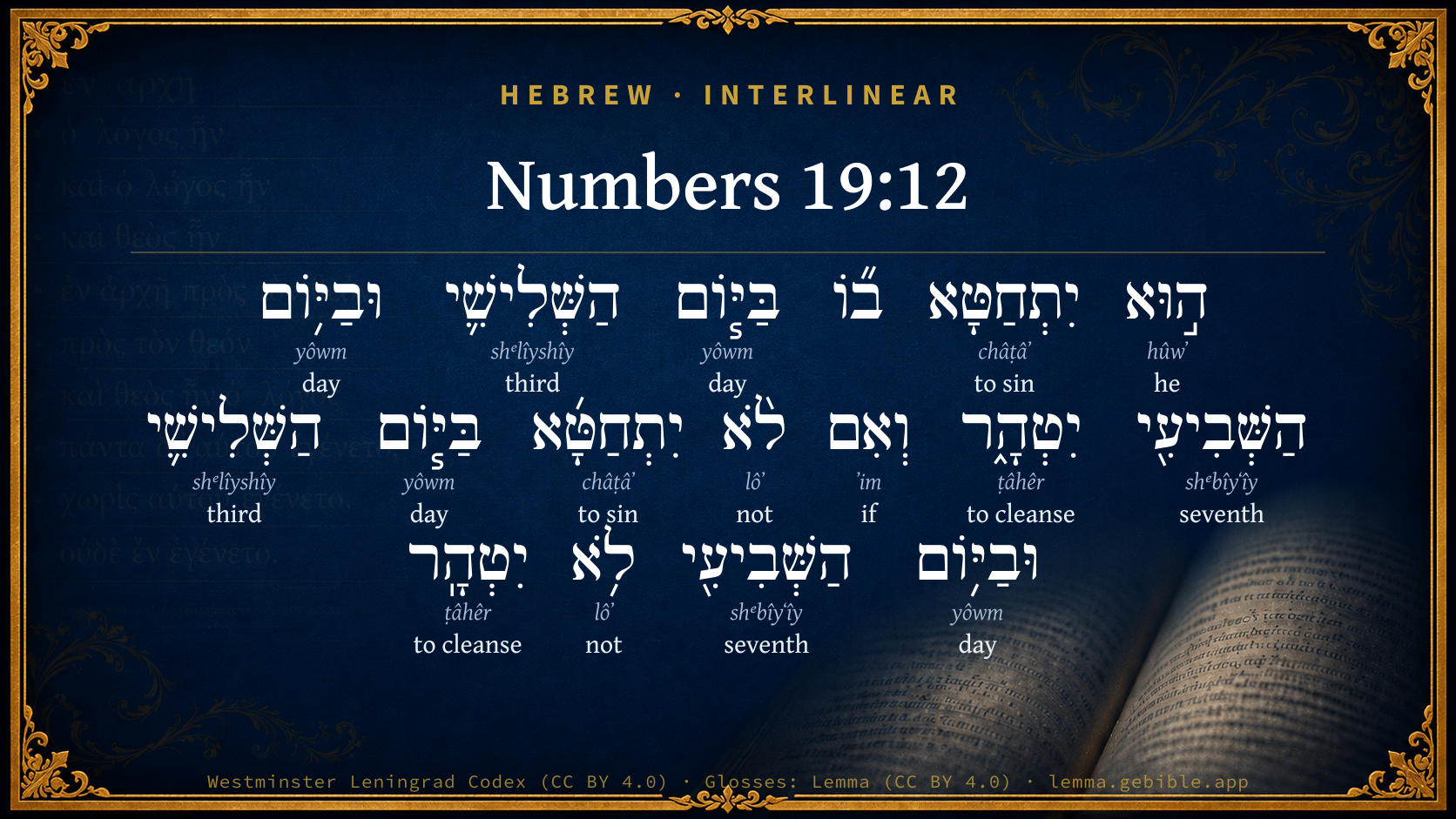
Hebrew (Westminster Leningrad Codex) Numbers 19:12 appears in the Hebrew Old Testament. The text above is from the Westminster Leningrad Codex. Each word links to its Strong’s number, a concise gloss, and parsing drawn from the Open Scriptures Hebrew Bible morphology. Click any word for its full Brown-Driver-Briggs (BDB) entry.
Download image
Cite this verse

Numbers 19:12 (World English Bible). Public Domain. Lemma interlinear Bible study tool, https://lemma.gebible.app/v/numbers/19/12.

Show BibTeX & RIS
BibTeX
RIS
English Translation
the same shall purify himself therewith on the third day, and on the seventh day he shall be clean: but if he doesn't purify himself the third day, then the seventh day he shall not be clean.
World English Bible · Public Domain
Download a study sheet

One document with this verse’s original text, its word-by-word gloss line, the meaning frame, cross-references with their text, attributed commentary, and full source and license credits — printable, and it pastes into notes with its structure intact.

This verse Autodidact and up

Study sheet (.html) Plain text (.txt)

A passage Seminary Student

Up to 50 verses in one chapter. A passage sheet keeps up to 6 commentary sources and 12 cross-references per verse, in the order this page ranks them, and says so on the sheet whenever that leaves anything out. Ask for a single verse and you get the Autodidact verse sheet above.

Everything on this page stays free to read, with no account — the sheet is a download of what is already on screen, not access to it.

Want to remove ads? Support Godless Engineer
Compare translations 3

The same verse in 3 English versions, stacked beneath the original-language interlinear above. Click any original word for its lexicon entry.

Each is an independent rendering of the whole verse — the interlinear is not word-aligned to these translations.

Highlighted words mark where these versions differ — a whole-verse word diff, not a word-by-word alignment.

  • World English Bible Public Domain
    the same shall purify himself therewith on the third day, and on the seventh day he shall be clean: but if he doesn't purify himself the third day, then the seventh day he shall not be clean.
  • King James Version Public Domain
    He shall purify himself with it on the third day, and on the seventh day he shall be clean: but if he purify not himself the third day, then the seventh day he shall not be clean.
  • unfoldingWord Literal Text CC BY-SA 4.0
    He shall purify himself with it on the third day and on the seventh day he will be clean. And if he does not purify himself on the third day, then on the seventh day he will not be clean.

unfoldingWord Literal Text — © unfoldingWord, licensed CC BY-SA 4.0. Word-aligned USFM3 via Door43 (git.door43.org/unfoldingWord/en_ult).

Versions to compare (up to 4)

3 of 4 selected

Show all 18 translations

Every available English version of this verse, each an independent rendering of the whole verse.

  • World English Bible Public Domain
    the same shall purify himself therewith on the third day, and on the seventh day he shall be clean: but if he doesn't purify himself the third day, then the seventh day he shall not be clean.
  • Berean Standard Bible Public Domain
    He must purify himself with the water on the third day and on the seventh day; then he will be clean. But if he does not purify himself on the third and seventh days, he will not be clean.
  • Majority Standard Bible Public Domain
    He must purify himself with the water on the third day and on the seventh day; then he will be clean. But if he does not purify himself on the third and seventh days, he will not be clean.
  • King James Version Public Domain
    He shall purify himself with it on the third day, and on the seventh day he shall be clean: but if he purify not himself the third day, then the seventh day he shall not be clean.
  • American Standard Version (1901) Public Domain
    the same shall purify himself therewith on the third day, and on the seventh day he shall be clean: but if he purify not himself the third day, then the seventh day he shall not be clean.
  • Revised Version (1885) Public Domain
    the same shall purify himself therewith on the third day, and on the seventh day he shall be clean: but if he purify not himself the third day, then the seventh day he shall not be clean.
  • Geneva Bible (1599) Public Domain
    Hee shall purifie himselfe therewith the third day, and the seuenth day he shall be cleane: but if he purifie not himselfe the thirde day, then the seuenth day he shall not be cleane.
  • Douay-Rheims (1899) Public Domain
    Shall be sprinkled with this water on the third day, and on the seventh, and so shall be cleansed. If he were not sprinkled on the third day, he cannot be cleansed on the seventh.
  • Young's Literal Translation Public Domain
    he doth cleanse himself for it on the third day, and on the seventh day he is clean; and if he cleanse not himself on the third day, then on the seventh day he is not clean.
  • Literal Standard Version CC BY-SA 4.0
    he cleanses himself for it on the third day and on the seventh day, [and] he is clean; and if he does not cleanse himself on the third day and on the seventh day, he is not clean.
  • Unlocked Literal Bible CC BY-SA 4.0
    Such a person must purify himself on the third day and on the seventh day. Then he will be clean. But if he does not purify himself the third day, then he will not be clean on the seventh day.
  • unfoldingWord Literal Text CC BY-SA 4.0
    He shall purify himself with it on the third day and on the seventh day he will be clean. And if he does not purify himself on the third day, then on the seventh day he will not be clean.
  • Darby Bible Public Domain
    He shall purify himself with it on the third day, and on the seventh day he shall be clean; but if he purify not himself the third day, then the seventh day he shall not be clean.
  • World Messianic Bible Public Domain
    He shall purify himself with water on the third day, and on the seventh day he shall be clean; but if he doesn’t purify himself the third day, then the seventh day he shall not be clean.
  • Webster's Bible Public Domain
    He shall purify himself with it on the third day, and on the seventh day he shall be clean: but if he shall not purify himself the third day, then the seventh day he shall not be clean.
  • Free Bible Version CC BY-SA 4.0
    You must purify yourself with the water of purification on the third day and on the seventh day, and then you will be clean. But if you don't purify yourself on the third and seventh days, you won't be clean.
  • Bible in Basic English Public Domain
    On the third day and on the seventh day he is to make himself clean with the water, and so he will be clean: but if he does not do this on the third day and on the seventh day, he will not be clean.
  • JPS Tanakh (1917) Public Domain
    the same shall purify himself therewith on the third day and on the seventh day, and he shall be clean; but if he purify not himself the third day and the seventh day, he shall not be clean.

Literal Standard Version (2020), Covenant Press — licensed CC BY-SA 4.0. Text via the HelloAO Bible API (eBible.org). Unlocked Literal Bible (unfoldingWord) — licensed CC BY-SA 4.0. Text via the HelloAO Bible API (eBible.org). unfoldingWord Literal Text — © unfoldingWord, licensed CC BY-SA 4.0. Word-aligned USFM3 via Door43 (git.door43.org/unfoldingWord/en_ult). Free Bible Version, Dr. Jonathan Gallagher — licensed CC BY-SA 4.0. Text via the HelloAO Bible API (eBible.org).

Word by word

More ways to search: Search by grammar → Find every occurrence → Compare this word →

Practice this passage: Drill this verse → Learn its vocabulary →

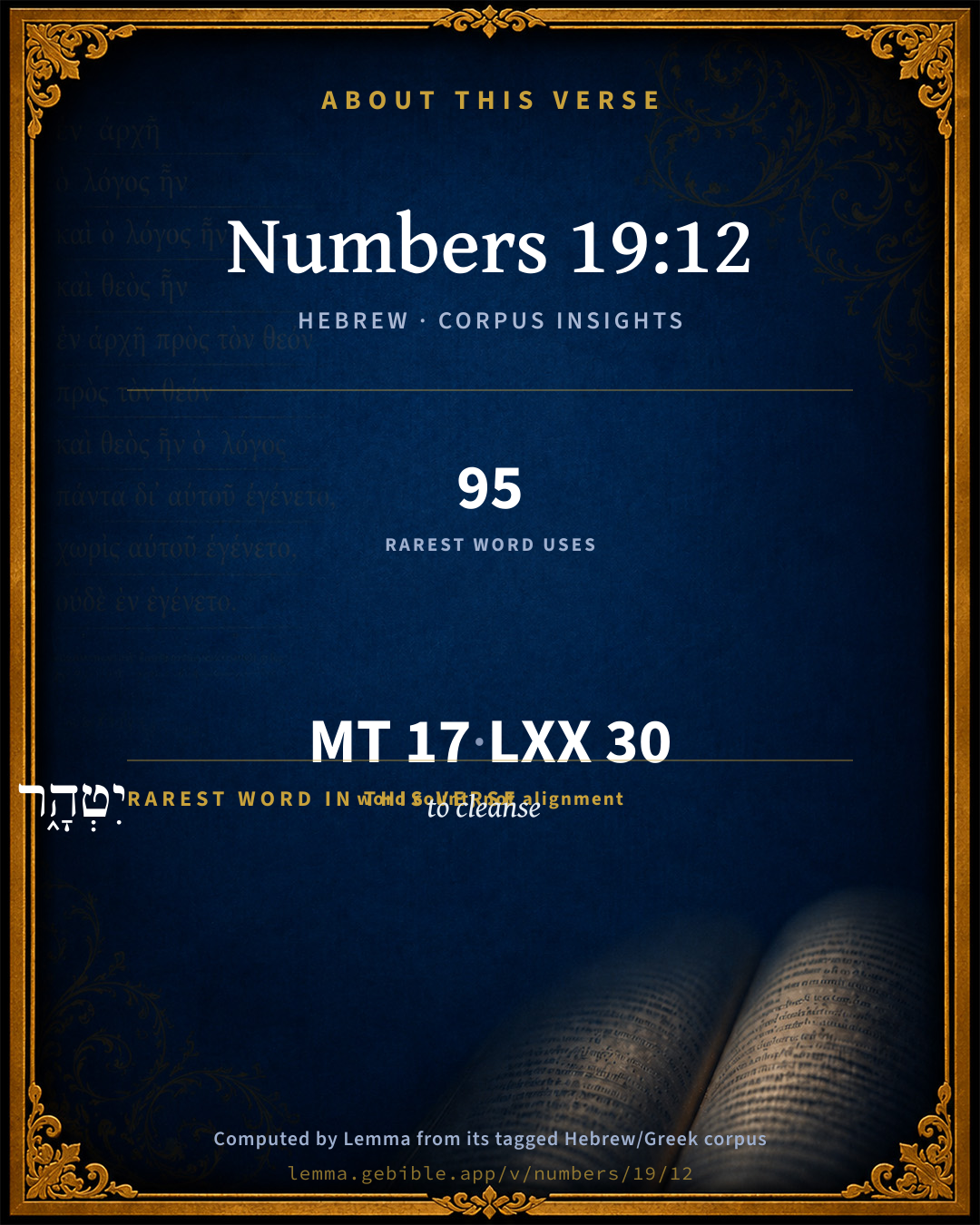
יִטְהָ֑ר
ṭâhêr
H2891
“to cleanse”
Verb, Qal, Imperfect, 3rd Person, Masculine, Singular
Part of Speech
Verb
Stem
Qal
Form
Imperfect
Person
3rd Person
Gender
Masculine
Number
Singular
Full BDB Definition

Origin: a primitive root

TWOT: 792

to be clean, be pure - (Qal) - to be clean (physically - of disease) - to be clean ceremonially - to purify, be clean morally, made clean - (Piel) - to cleanse, purify - physically - ceremonially - morally - to pronounce clean - to perform the ceremony of cleansing - (Pual) to be cleansed, be pronounced clean - (Hithpael) - to purify oneself - ceremonially - morally - to present oneself for purification
  1. ה֣וּא hûwʼ H1931 “he” Pronoun, Personal, 3rd Person, Masculine, Singular
  2. יִתְחַטָּא châṭâʼ H2398 “to sin” Verb, Hithpael, Imperfect, 3rd Person, Masculine, Singular
  3. בַּיּ֧וֹם yôwm H3117 “in/at the · day” Preposition, Determined + Noun, Common, Masculine, Singular, Absolute
  4. הַשְּׁלִישִׁ֛י shᵉlîyshîy H7992 “the · third” Particle, Definite Article + Adjective, Ordinal number, Masculine, Singular, Absolute
  5. וּבַיּ֥וֹם yôwm H3117 “and · in/at the · day” Conjunction + Preposition, Determined + Noun, Common, Masculine, Singular, Absolute
  6. הַשְּׁבִיעִ֖י shᵉbîyʻîy H7637 “the · seventh” Particle, Definite Article + Adjective, Ordinal number, Masculine, Singular, Absolute
  7. וְאִם ʼim H518 “and · if” Conjunction + Conjunction
  8. לֹ֨א lôʼ H3808 “not” Particle, Negative
  9. יִתְחַטָּ֜א châṭâʼ H2398 “to sin” Verb, Hithpael, Imperfect, 3rd Person, Masculine, Singular
  10. בַּיּ֧וֹם yôwm H3117 “in/at the · day” Preposition, Determined + Noun, Common, Masculine, Singular, Absolute
  11. הַשְּׁלִישִׁ֛י shᵉlîyshîy H7992 “the · third” Particle, Definite Article + Adjective, Ordinal number, Masculine, Singular, Absolute
  12. וּבַיּ֥וֹם yôwm H3117 “and · in/at the · day” Conjunction + Preposition, Determined + Noun, Common, Masculine, Singular, Absolute
  13. הַשְּׁבִיעִ֖י shᵉbîyʻîy H7637 “the · seventh” Particle, Definite Article + Adjective, Ordinal number, Masculine, Singular, Absolute
  14. לֹ֥א lôʼ H3808 “not” Particle, Negative
  15. יִטְהָֽר ṭâhêr H2891 “to cleanse” Verb, Qal, Imperfect, 3rd Person, Masculine, Singular

About this verse

These counts appear in no published source. They are computed here, from the morphology-tagged text and Lemma’s own curated glosses. What Lemma adds →

17
words
8
distinct lemmas
Pentateuch
section

Grammatical profile

  • 4 verbs
  • 4 nouns
  • 4 adjectives
  • 1 pronoun
  • 1 preposition
  • 1 conjunction
  • 2 particles

Verb forms

  • יִתְחַטָּא Hithpael · Imperfect
  • יִטְהָ֑ר Qal · Imperfect
  • יִתְחַטָּ֜א Hithpael · Imperfect
  • יִטְהָֽר Qal · Imperfect

Repetition

Words recur within this verse — often emphatic in Hebrew:

  • בַּיּ֧וֹם day H3117 ×4
  • יִתְחַטָּא to sin H2398 ×2
  • הַשְּׁלִישִׁ֛י third H7992 ×2
  • הַשְּׁבִיעִ֖י seventh H7637 ×2
  • יִטְהָ֑ר to cleanse H2891 ×2
  • לֹ֨א not H3808 ×2

Hebrew & Septuagint length

In English translation the verse runs 37 words from the Hebrew and 35 from the Septuagint (LXX English) — closely comparable.

A rough comparison of the two English renderings, which tokenize alike — not a word-level alignment.

Word counts can differ between the Hebrew and the Greek without any difference in meaning — e.g. the Hebrew direct-object marker אֵת has no separate Greek word, and Greek often adds the article ὁ.

In the original languages it is 17 Hebrew tokens and 30 Greek tokens — but the two are counted differently (Hebrew bundles its prefixes and suffixes into one token; the Greek is in lemma form), so that isn’t a like-for-like length.

Cross-references

11

Topical passages linked to Numbers 19:12 in the Treasury of Scripture Knowledge — connected by theme and wording, ordered by reader-vote popularity; previews shown in the World English Bible.

  • Numbers 31:19 Encamp you outside of the camp seven days: whoever has killed any person, and whoever has touched any slain, purify yourselves on the third day and on the seventh day, you and your captives.
  • Exodus 19:11 and be ready against the third day; for on the third day Yahweh will come down in the sight of all the people on Mount Sinai.
  • Exodus 19:15 He said to the people, "Be ready by the third day. Don't have sexual relations with a woman."
  • Leviticus 7:17 but what remains of the flesh of the sacrifice on the third day shall be burned with fire.
  • Numbers 19:17–19 For the unclean they shall take of the ashes of the burning of the sin-offering; and running water shall be put thereto in a vessel:
  • Psalms 51:7 Purify me with hyssop, and I will be clean. Wash me, and I will be whiter than snow.
  • Ezekiel 36:25 I will sprinkle clean water on you, and you shall be clean: from all your filthiness, and from all your idols, will I cleanse you.
  • Hosea 6:2 After two days will he revive us. On the third day he will raise us up, And we will live before him.
  • Acts 15:9 He made no distinction between us and them, cleansing their hearts by faith.
  • 1 Corinthians 15:3–4 For I delivered to you first of all that which I also received: that Christ died for our sins according to the Scriptures,
  • Revelation 7:14 I told him, "My lord, you know." He said to me, "These are those who came out of the great tribulation. They washed their robes, and made them white in the Lamb's blood.

Cross-references courtesy of OpenBible.info (CC BY 4.0).

Hebrew and Greek witnesses Masoretic Hebrew ↔ Greek Septuagint

The same verse in the two great witnesses to the Old Testament, shown verse-for-verse.

These are two independent witnesses, not word-aligned to each other, and the Septuagint is shown in lemma (dictionary) form.

Hebrew Numbers 19:12 Masoretic · Westminster Leningrad Codex

ה֣וּא יִתְחַטָּא ב֞וֹ בַּיּ֧וֹם הַשְּׁלִישִׁ֛י וּבַיּ֥וֹם הַשְּׁבִיעִ֖י יִטְהָ֑ר וְאִם לֹ֨א יִתְחַטָּ֜א בַּיּ֧וֹם הַשְּׁלִישִׁ֛י וּבַיּ֥וֹם הַשְּׁבִיעִ֖י לֹ֥א יִטְהָֽר

the same shall purify himself therewith on the third day, and on the seventh day he shall be clean: but if he doesn't purify himself the third day, then the seventh day he shall not be clean.

World English Bible · Public Domain

Greek LXX Numbers 19:12 Septuagint · lemma form

οὗτος ἁγνίζω ὁ ἡμέρα ὁ τρίτος καί ὁ ἡμέρα ὁ ἕβδομος καί καθαρός εἰμί ἐάν δέ μή ἀποἁγνίζω ὁ ἡμέρα ὁ τρίτος καί ὁ ἡμέρα ὁ ἕβδομος οὐ καθαρός εἰμί

He shall be purified on the third day and the seventh day, and shall be clean; but if he be not purged on the third day and the seventh day, he shall not be clean.

LXX2012 (modern English Septuagint) · Public Domain

On this verse, Ellicott's Commentary for English Readers discusses the Septuagint’s reading. Read the note in Commentary ↓

Hebrew: Westminster Leningrad Codex (CC BY 4.0). Greek: Septuagint (public domain); English from LXX2012 (modern English Septuagint) (Public Domain). How the Septuagint differs from the Hebrew →

Targum (Aramaic paraphrase)

2

The Targum is the ancient Jewish Aramaic paraphrase of the Hebrew Scriptures — an interpretive translation, not the Hebrew text itself. Onkelos (literal) and Pseudo-Jonathan (expansive) render the Torah, and Jonathan the Prophets. Coverage is partial: where no permissively-licensed English translation exists for a verse, only the Aramaic is shown. This is verse-level text, not a word-by-word alignment to the Hebrew.

  1. Targum Onkelos Torah (Genesis–Deuteronomy)
    הוּא יַדֵי עֲלוֹהִי בְּיוֹמָא תְלִיתָאָה וּבְיוֹמָא שְׁבִיעָאָה יִדְכֵּי וְאִם לָא יַדֵי עֲלוֹהִי בְּיוֹמָא תְלִיתָאָה וּבְיוֹמָא שְׁבִיעָאָה לָּא יִדְכֵּי

    (no public-domain English translation for this verse)

    Targum Onkelos — Aramaic: “Onkelos Genesis” (public domain); “Onkelos Exodus” (public domain); “Onkelos Leviticus” (public domain); “Onkelos Numbers” (public domain); “Onkelos Deuteronomy” (public domain). English: “Sefaria Community Translation” (CC0 1.0 (public-domain dedication)); “J.W. Etheridge. The Targums of Onkelos and Jonathan Ben Uzziel on the Pentateuch. London: Longmans, Green, 1862” (public domain). Text via Sefaria.

  2. Targum Pseudo-Jonathan Torah (Genesis–Deuteronomy)
    הוּא יַדֵי עֲלוֹי מֵי קִטְמָא הַהוּא בְּיוֹמָא תְלִיתָאָה וּבְיוֹמָא שְׁבִיעָאָה יִדְכֵּי וְאִין לָא יַדֵי עֲלוֹי בְּיוֹמָא תְלִיתָאָה יְעַכֵּב עֲלוֹי וּבְיוֹמָא שְׁבִיעָאָה לָא יִדְכֵּי

    He shall sprinkle himself with this water of the ashes on the third day, and on the seventh day he shall be clean. But if he sprinkle not himself on the third day, his uncleanness will remain upon him, and he will not be clean on the seventh day.

    Targum Pseudo-Jonathan — Aramaic: “Targum Jonathan on Genesis” (public domain); “Targum Jonathan on Exodus” (public domain); “Targum Jonathan on Leviticus” (public domain); “Targum Jonathan on Numbers” (public domain); “Targum Jonathan on Deuteronomy” (public domain). English: “The Targum of Jonathan ben Uzziel, trans. J. W. Etheridge, London, 1862” (public domain). Text via Sefaria.

Commentary

Notes on Numbers 19:12 from classic Christian and Jewish commentators (each source and its license shown beneath its notes). The classic Christian expositions comment on the surrounding passage and are grouped to its opening verse, so a note may address several verses; the Jewish commentaries on the Tanakh (Rashi and others) are per-verse, so they appear only where the commentator wrote on this verse.

Lemma curates 59 commentaries, every one of them public domain or Creative Commons licensed, each selected and text-cleaned for this edition rather than reprinted as found. About our sources →

Joseph Benson's Commentary

Num 19:12. He shall purify himself with it — With the water of separation. On the third day — To typify Christ’s resurrection on that day, by which we are cleansed or sanctified.

Joseph Benson's Commentary on the Old and New Testaments (1811–1818) — public domain. Text from a community e-Sword module.

Geneva Bible (1599)

Geneva Bible translators

With the sprinkling water.

Geneva Bible (1599) marginal notes — public domain. Text via Bolls.life.

Jamieson, Fausset & Brown

Robert Jamieson, A. R. Fausset & David Brown

He shall purify himself . . . the third day--The necessity of applying the water on the third day is inexplicable on any natural or moral ground; and, therefore, the regulation has been generally supposed to have had a typical reference to the resurrection, on that day, of Christ, by whom His people are sanctified; while the process of ceremonial purification being extended over seven days, was intended to show that sanctification is progressive and incomplete till the arrival of the eternal Sabbath. Every one knowingly and presumptuously neglecting to have himself sprinkled with this water was guilty of an offense which was punished by excommunication.

Jamieson, Fausset & Brown — Commentary Critical and Explanatory on the Whole Bible (1871) — public domain (CC PDM 1.0). Text via the HelloAO Bible API.

Adam Clarke's Commentary

Verse 12. He shall purify himself with it] יתחטא בו yithchatta bo, literally, he shall sin himself with it. This Hebrew form of speech is common enough among us in other matters. Thus to fleece, to bark, and to skin, do not signify to add a fleece, another bark, or a skin, but to take one away; therefore, to sin himself, in the Hebrew idiom, is not to add sin, but to take it away, to purify. The verb חטא chata signifies to miss the mark, to sin, to purify from sin, and to make a sin-offering. See Clarke on Ge 13:13.

THE Hebrews generally sacrificed males, no matter of what colour; but here a heifer, and a heifer of a red colour, is ordered. The reason of these circumstances is not very well known.

"The rabbins, with all their boldness," says Calmet, "who stick at nothing when it is necessary to explain what they do not understand, declare that the cause of this law is entirely unknown; and that Solomon, with all his wisdom, could not find it out."

Several fathers, as well modern as ancient, profess to understand the whole clearly.

1. The red heifer with them signifies the flesh of our Lord, formed out of an earthly substance.

2. Being without spot, c., the infinite holiness of Christ.

3. The sex of the animal, the infirmity of our flesh, with which he clothed himself.

4. The red colour, his passion.

5. Being unyoked, his being righteous in all his conduct, and never under the yoke of sin.

6. Eleazar's sacrificing the heifer instead of Aaron, Nu 19:3, signifies the change of the priesthood from the family of Aaron, in order that a new and more perfect priesthood might take place.

7. The red heifer being taken without the camp (Nu 19:3) to be slain, points out the crucifixion of our Lord without the city.

8. The complete consuming of the heifer by fire, the complete offering of the whole body and soul of Christ as a sacrifice to God for the sin of man: for as the heifer was without blemish, the whole might be offered to God and as Christ was immaculate, his whole body and soul were made a sacrifice for sin.

9. As the fire of this sacrifice ascended up to God, so it points out the resurrection and ascension of our blessed Lord.

10. And as the ashes of this victim communicated a legal purity to those who were defiled, so true repentance, signified by those ashes, is necessary for the expiation of the offences committed after baptism. A great part of this is true in itself; but how little evidence is there that all these things were intended in the ordinance of the red heifer? See Clarke on Nu 8:7.

Adam Clarke's Commentary on the Bible (1810–1826) — public domain. Text from a community e-Sword/MySword module.

Ellicott's Commentary for English Readers

(12) He shall purify himself . . . —The verse may be rendered thus: He shall purify himself with it on the third day and on the seventh day; so shall he be clean; but if he purify not himself on the third day and on the seventh day, then he shall not be clean: so the LXX. and Vulg. (See Num_19:19.)

A Bible Commentary for English Readers, edited by Charles John Ellicott (1878–1897) — public domain. Text from a community e-Sword module.

The Cambridge Bible for Schools and Colleges

gen. ed. J. J. S. Perowne

12. therewith] with the ‘water of impurity.’

It is clear that the writer of Num_19:19 understood the sprinkling to have been performed twice. But in this verse, according to R.V. , it is performed only on the third day. R.V. marg. is probably, therefore, to be preferred in both its renderings; and the verse means that the polluted man must purify himself on the third day and the seventh day; he shall be clean in that case, but not otherwise.

The Cambridge Bible for Schools and Colleges (gen. ed. J. J. S. Perowne; Cambridge University Press, 1878–1918) — public domain. Text from a community e-Sword module.

John Gill's Exposition

He shall purify himself with it,.... That is, with the ashes of the water of purification made of them: and this was to be done first

on the third day; from the time of his touching the dead body. Aben Ezra intimates, that there is a secret or mystery in this and the following number seven; it may respect the third day of Christ's resurrection, who, as he shed his blood for the expiation and purification of sinners, so he rose again the third day for the justification of them:

and on the seventh day he shall be clean; which may denote the perfect state, or sabbath of rest, which remains for the people of God, when all Christ's purified and justified ones shall be clear of all sin, and be the spirits of just men made perfect:

but if he purify not himself the third day, then the seventh day he shall not be clean; whoever is not cleansed from his sins by the blood of Christ, shed for the remission of them, and is not justified from them by him that rose from the dead the third day, will never be cleansed in the world to come, or in the eternal sabbath; but it will then be said, "let him that is filthy be filthy still", Rev 22:11.

John Gill's Exposition of the Whole Bible (1746–1763) — public domain (CC PDM 1.0). Text via the HelloAO Bible API.

Haydock's Catholic Bible Commentary

Seventh. If he neglect to be sprinkled on the third day, his purification will be protracted till the 10th. As this was the only means of removing the legal uncleanness contracted by touching a dead body, some of the ashes must have been reserved in various parts of the country, after the Israelites were dispersed. (Calmet)

George Leo Haydock (1774–1849), Haydock's Catholic Family Bible and Commentary, 1859 edition — public domain. Excludes Psalms (Douay-Rheims chapter numbering differs from Protestant) and Deuterocanonical books (Catholic canon only).

Matthew Poole's English Annotations

With it, i.e. with the water of separation.

On the third day, to typify Christ’s resurrection on that day, by which we are cleansed or sanctified.

On the seventh day he shall be clean, to teach us that our purification in this life is gradual, and not perfect till we come to that eternal sabbath, which the seventh day respected.

He shall not be clean; but was first to purify himself, and four days after that to be clean.

Matthew Poole's English Annotations on the Holy Bible (1683–1685) — public domain. Text from a community e-Sword/MySword module.

Whedon's Commentary on the Bible

Daniel D. Whedon

12. The third… the seventh day — The selection of these days was determined by the significance of the numbers themselves. The other numbers for which there is a partiality in Levitical symbolry are four, twelve, forty, and seventy. See Lev_4:6, note.

Daniel D. Whedon (gen. ed.), Commentary on the Old and New Testaments (1874–1909) — public domain. Text from a community e-Sword module.

The Pulpit Commentary

With it. wB i.e., as the sense clearly demands, with the water of separation.

The Pulpit Commentary (1880–1919), ed. H.D.M. Spence-Jones & Joseph S. Exell — public domain. Text from a community e-Sword module.

John Wesley's Explanatory Notes

With it - With the water of separation. On the third day - To typify Christ's resurrection on that day by which we are cleansed or sanctified.

John Wesley, Explanatory Notes Upon the Whole Bible (1754–1765) — public domain. Text via the GEBible commentary corpus.

Rashi

Rabbi Shlomo Yitzchaki (Rashi)

הוא יתחטא בו HE SHALL PURIFY HIMSELF WITH IT — with this ash.

Rashi on the Tanakh — English translations: “The Judaica Press complete Tanach with Rashi, translated by A. J. Rosenberg” (CC BY 4.0); “Pentateuch with Rashi's commentary by M. Rosenbaum and A.M. Silbermann, 1929-1934” (public domain); “The Metsudah Tanach series, Lakewood, N.J” (CC BY 4.0); and “The Book of Joshua, Metsudah Publications, 1997” (CC BY 4.0). Text via Sefaria.

Lesson kit

Teaching starters — assembled from the data on this page, not authored interpretation. Every prompt links to the verse data it draws on. Edit before teaching.

Numbers, in the Pentateuch, opens this verse with 17 words (8 distinct Hebrew lemmas). Its most distinctive word is ṭâhêr (“to cleanse”). A historical commentator’s framing appears above. Read the whole chapter for the surrounding context.

Discussion questions

  1. How does “to cleanse” (ṭâhêr) shape what this verse is saying?
  2. How does Numbers 31:19, which shares this passage’s theme, read alongside this verse?
  3. What does the repetition of “day” (4× in this one verse) do in this verse?
  4. These translations render this verse differently. What is at stake in choosing one wording over another?
  5. «יִתְחַטָּא» is a Hithpael Imperfect verb. How does that grammatical form shape the action described?
  6. Compare how Joseph Benson's Commentary and Geneva Bible (1599) read this verse. Where do they agree or differ?

Things to notice

Reading settings

Reading text

Shown beneath each verse's original-language words.

Old Testament
Old Testament edition

Read the OT as the Masoretic Hebrew (MT) or the Greek Septuagint (LXX).

English shown for the Greek Septuagint (in the Hebrew ↔ Greek comparison).

Comparing translations? Open the Compare panel on any verse page to stack up to four side by side.