
1 Samuel 15:30

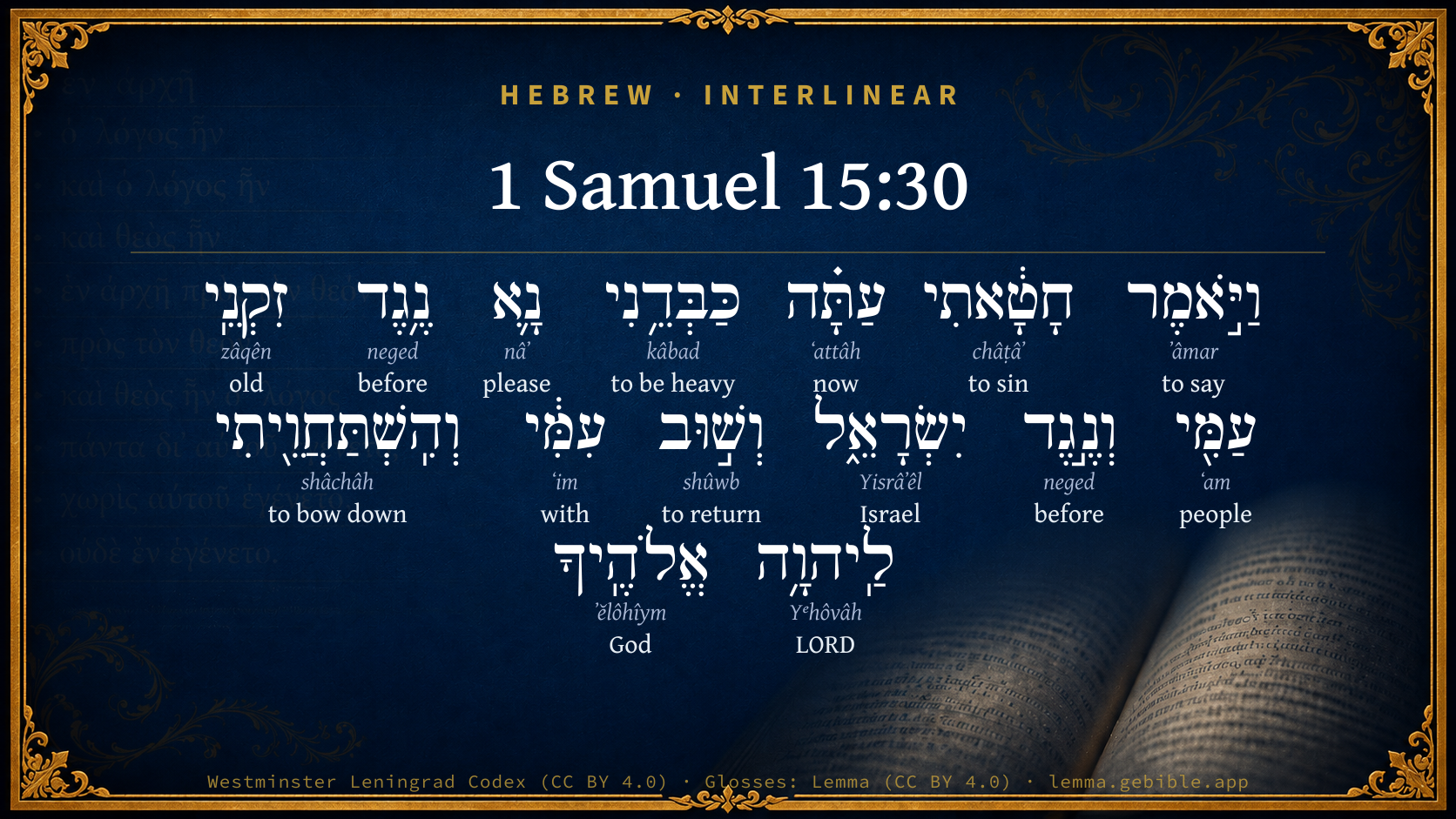
Hebrew (Westminster Leningrad Codex) 1 Samuel 15:30 appears in the Hebrew Old Testament. The text above is from the Westminster Leningrad Codex. Each word links to its Strong’s number, a concise gloss, and parsing drawn from the Open Scriptures Hebrew Bible morphology. Click any word for its full Brown-Driver-Briggs (BDB) entry.
Download image
Cite this verse

1 Samuel 15:30 (World English Bible). Public Domain. Lemma interlinear Bible study tool, https://lemma.gebible.app/v/1-samuel/15/30.

Show BibTeX & RIS
BibTeX
RIS
English Translation
Then he said, I have sinned: yet honor me now, Please, before the elders of my people, and before Israel, and turn again with me, that I may worship Yahweh your God.
World English Bible · Public Domain
Download a study sheet

One document with this verse’s original text, its word-by-word gloss line, the meaning frame, cross-references with their text, attributed commentary, and full source and license credits — printable, and it pastes into notes with its structure intact.

This verse Autodidact and up

Study sheet (.html) Plain text (.txt)

A passage Seminary Student

Up to 50 verses in one chapter. A passage sheet keeps up to 6 commentary sources and 12 cross-references per verse, in the order this page ranks them, and says so on the sheet whenever that leaves anything out. Ask for a single verse and you get the Autodidact verse sheet above.

Everything on this page stays free to read, with no account — the sheet is a download of what is already on screen, not access to it.

Want to remove ads? Support Godless Engineer
Compare translations 3

The same verse in 3 English versions, stacked beneath the original-language interlinear above. Click any original word for its lexicon entry.

Each is an independent rendering of the whole verse — the interlinear is not word-aligned to these translations.

Highlighted words mark where these versions differ — a whole-verse word diff, not a word-by-word alignment.

  • World English Bible Public Domain
    Then he said, I have sinned: yet honor me now, Please, before the elders of my people, and before Israel, and turn again with me, that I may worship Yahweh your God.
  • King James Version Public Domain
    Then he said, I have sinned: yet honor me now, I pray thee, before the elders of my people, and before Israel, and turn again with me, that I may worship the LORD thy God.
  • unfoldingWord Literal Text CC BY-SA 4.0
    And he said, “I have sinned! Now please honor me before the elders of my people and before Israel, and return with me so I may worship Yahweh your God.”

unfoldingWord Literal Text — © unfoldingWord, licensed CC BY-SA 4.0. Word-aligned USFM3 via Door43 (git.door43.org/unfoldingWord/en_ult).

Versions to compare (up to 4)

3 of 4 selected

Show all 18 translations

Every available English version of this verse, each an independent rendering of the whole verse.

  • World English Bible Public Domain
    Then he said, I have sinned: yet honor me now, Please, before the elders of my people, and before Israel, and turn again with me, that I may worship Yahweh your God.
  • Berean Standard Bible Public Domain
    “I have sinned,” Saul replied. “Please honor me now before the elders of my people and before Israel. Come back with me, so that I may worship the LORD your God.”
  • Majority Standard Bible Public Domain
    “I have sinned,” Saul replied. “Please honor me now before the elders of my people and before Israel. Come back with me, so that I may worship the LORD your God.”
  • King James Version Public Domain
    Then he said, I have sinned: yet honor me now, I pray thee, before the elders of my people, and before Israel, and turn again with me, that I may worship the LORD thy God.
  • American Standard Version (1901) Public Domain
    Then he said, I have sinned: yet honor me now, I pray thee, before the elders of my people, and before Israel, and turn again with me, that I may worship Jehovah thy God.
  • Revised Version (1885) Public Domain
    Then he said, I have sinned: yet honour me now, I pray thee, before the elders of my people, and before Israel, and turn again with me, that I may worship the LORD thy God.
  • Geneva Bible (1599) Public Domain
    Then he saide, I haue sinned: but honour mee, I pray thee, before the Elders of my people, and before Israel, and turne againe with mee, that I may worship the Lord thy God.
  • Douay-Rheims (1899) Public Domain
    Then he said: I have sinned: yet honour me now before the ancients of my people, and before Israel, and return with me, that I may adore the Lord thy God.
  • Young's Literal Translation Public Domain
    And he saith, `I have sinned; now, honour me, I pray thee, before the elders of my people, and before Israel, and turn back with me; and I have bowed myself to Jehovah thy God.'
  • Literal Standard Version CC BY-SA 4.0
    And he says, “I have sinned; now please honor me before [the] elderly of my people and before Israel, and return with me; and I have bowed myself to your God YHWH.”
  • Unlocked Literal Bible CC BY-SA 4.0
    Then Saul said, “I have sinned. But please honor me now before the elders of my people and before Israel. Turn again with me, that I may worship Yahweh your God.”
  • unfoldingWord Literal Text CC BY-SA 4.0
    And he said, “I have sinned! Now please honor me before the elders of my people and before Israel, and return with me so I may worship Yahweh your God.”
  • Darby Bible Public Domain
    And he said, I have sinned; honour me now, I pray thee, before the elders of my people, and before Israel, and turn again with me, that I may worship Jehovah thy God.
  • World Messianic Bible Public Domain
    Then he said, “I have sinned; yet please honor me now before the elders of my people and before Israel, and come back with me, that I may worship the LORD your God.”
  • Webster's Bible Public Domain
    Then he said, I have sinned: yet honor me now, I pray thee, before the elders of my people, and before Israel, and turn again with me, that I may worship the LORD thy God.
  • Free Bible Version CC BY-SA 4.0
    “Yes, I have sinned,” Saul replied. “Please honor me now before the elders of my people and before Israel—come back with me, so that I may worship the Lord your God.”
  • Bible in Basic English Public Domain
    Then he said, Great is my sin: but still, give me honour now before the heads of my people and before Israel, and come back with me so that I may give worship to the Lord your God.
  • JPS Tanakh (1917) Public Domain
    Then he said: 'I have sinned; yet honour me now, I pray thee, before the elders of my people, and before Israel, and return with me, that I may worship the LORD thy God.'

Literal Standard Version (2020), Covenant Press — licensed CC BY-SA 4.0. Text via the HelloAO Bible API (eBible.org). Unlocked Literal Bible (unfoldingWord) — licensed CC BY-SA 4.0. Text via the HelloAO Bible API (eBible.org). unfoldingWord Literal Text — © unfoldingWord, licensed CC BY-SA 4.0. Word-aligned USFM3 via Door43 (git.door43.org/unfoldingWord/en_ult). Free Bible Version, Dr. Jonathan Gallagher — licensed CC BY-SA 4.0. Text via the HelloAO Bible API (eBible.org).

Word by word

More ways to search: Search by grammar → Find every occurrence → Compare this word →

Practice this passage: Drill this verse → Learn its vocabulary →

כַּבְּדֵ֥נִי
kâbad
H3513
“be heavy · me”
Verb, Piel, Imperative, 2nd Person, Masculine, Singular + Suffix, Personal, 1st Person, Common, Singular
Part of Speech
Verb
Stem
Piel
Form
Imperative
Person
2nd Person
Gender
Masculine
Number
Singular
Full BDB Definition

Origin: a primitive root

TWOT: 943

to be heavy, be weighty, be grievous, be hard, be rich, be honourable, be glorious, be burdensome, be honoured - (Qal) - to be heavy - to be heavy, be insensible, be dull - to be honoured - (Niphal) - to be made heavy, be honoured, enjoy honour, be made abundant - to get oneself glory or honour, gain glory - (Piel) - to make heavy, make dull, make insensible - to make honourable, honour, glorify - (Pual) to be made honourable, be honoured - (Hiphil) - to make heavy - to make heavy, make dull, make unresponsive - to cause to be honoured - (Hithpael) - to make oneself heavy, make oneself dense, make oneself numerous - to honour oneself
  1. וַיֹּ֣אמֶר ʼâmar H559 “and · to say” Conjunction + Verb, Qal, Sequential Imperfect, 3rd Person, Masculine, Singular
  2. חָטָ֔אתִי châṭâʼ H2398 “to sin” Verb, Qal, Perfect, 1st Person, Common, Singular
  3. עַתָּ֗ה ʻattâh H6258 “now” Adverb
  4. נָ֛א nâʼ H4994 “please” Particle, Exhortation
  5. נֶ֥גֶד neged H5048 “before” Preposition
  6. זִקְנֵֽי zâqên H2205 “old of” Adjective, Adjective, Masculine, Plural, Construct
  7. עַמִּ֖י ʻam H5971 “people · my” Noun, Common, Masculine, Singular, Construct + Suffix, Personal, 1st Person, Common, Singular
  8. וְנֶ֣גֶד neged H5048 “and · before” Conjunction + Preposition
  9. יִשְׂרָאֵ֑ל Yisrâʼêl H3478 “Israel” Noun, Proper
  10. וְשׁ֣וּב shûwb H7725 “and · return” Conjunction + Verb, Qal, Imperative, 2nd Person, Masculine, Singular
  11. עִמִּ֔י ʻim H5973 “with · me” Preposition + Suffix, Personal, 1st Person, Common, Singular
  12. וְהִֽשְׁתַּחֲוֵ֖יתִי shâchâh H7812 “and · to bow down” Conjunction + Verb, Hishtaphel, Perfect, 1st Person, Common, Singular
  13. לַֽיהוָ֥ה Yᵉhôvâh H3068 “to/for · LORD” Preposition + Noun, Proper
  14. אֱלֹהֶֽיךָ ʼĕlôhîym H430 “God(s) · your” Noun, Common, Masculine, Plural, Construct + Suffix, Personal, 2nd Person, Masculine, Singular

About this verse

These counts appear in no published source. They are computed here, from the morphology-tagged text and Lemma’s own curated glosses. What Lemma adds →

15
words
14
distinct lemmas
Historical
section

Grammatical profile

  • 5 verbs
  • 4 nouns
  • 1 adjective
  • 3 prepositions
  • 1 adverb
  • 1 particle

Verb forms

  • וַיֹּ֣אמֶר Qal · Sequential Imperfect
  • חָטָ֔אתִי Qal · Perfect
  • כַּבְּדֵ֥נִי Piel · Imperative
  • וְשׁ֣וּב Qal · Imperative
  • וְהִֽשְׁתַּחֲוֵ֖יתִי Hishtaphel · Perfect

Repetition

A word recurs within this verse — often emphatic in Hebrew:

  • נֶ֥גֶד before H5048 ×2

Hebrew & Septuagint length

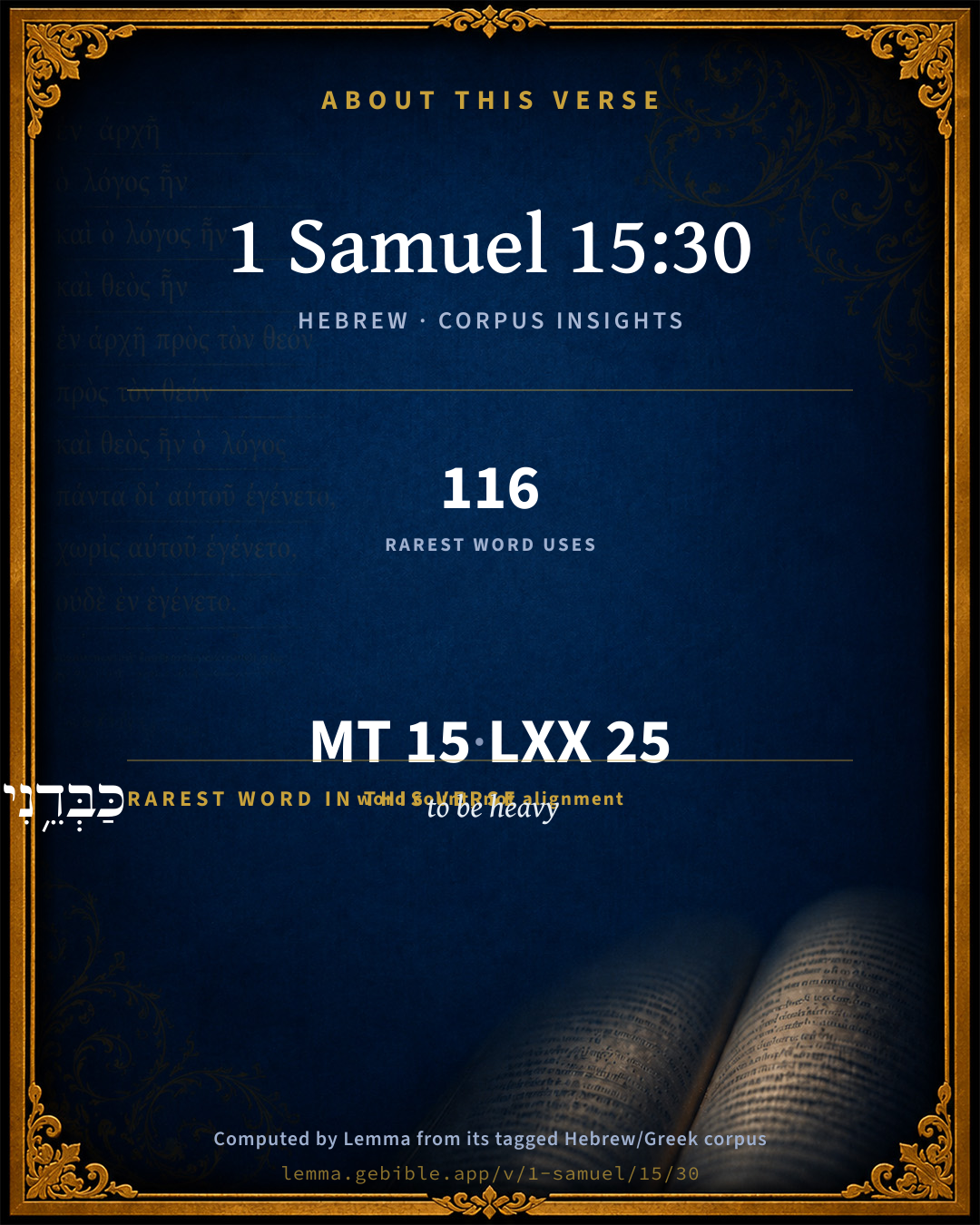
In English translation the verse runs 32 words from the Hebrew and 34 from the Septuagint (LXX English) — closely comparable.

A rough comparison of the two English renderings, which tokenize alike — not a word-level alignment.

Word counts can differ between the Hebrew and the Greek without any difference in meaning — e.g. the Hebrew direct-object marker אֵת has no separate Greek word, and Greek often adds the article ὁ.

In the original languages it is 15 Hebrew tokens and 25 Greek tokens — but the two are counted differently (Hebrew bundles its prefixes and suffixes into one token; the Greek is in lemma form), so that isn’t a like-for-like length.

Cross-references

6

Topical passages linked to 1 Samuel 15:30 in the Treasury of Scripture Knowledge — connected by theme and wording, ordered by reader-vote popularity; previews shown in the World English Bible.

  • John 5:44 How can you believe, who receive glory from one another, and you don't seek the glory that comes from the only God?
  • John 12:43 for they loved men's praise more than God's praise.
  • Isaiah 29:13 The Lord said, Because this people draw near [to me], and with their mouth and with their lips to honor me, but have removed their heart far from me, and their fear of me is a commandment of men which has been taught [them];
  • 2 Timothy 3:5 holding a form of godliness, but having denied the power thereof. Turn away from these, also.
  • Habakkuk 2:4 Behold, his soul is puffed up. It is not upright in him, but the righteous will live by his faith.
  • Luke 18:9–14 He spoke also this parable to certain people who were convinced of their own righteousness, and who despised all others.

Cross-references courtesy of OpenBible.info (CC BY 4.0).

Hebrew and Greek witnesses Masoretic Hebrew ↔ Greek Septuagint

The same verse in the two great witnesses to the Old Testament, shown verse-for-verse.

These are two independent witnesses, not word-aligned to each other, and the Septuagint is shown in lemma (dictionary) form.

Hebrew 1 Samuel 15:30 Masoretic · Westminster Leningrad Codex

וַיֹּ֣אמֶר חָטָ֔אתִי עַתָּ֗ה כַּבְּדֵ֥נִי נָ֛א נֶ֥גֶד זִקְנֵֽי עַמִּ֖י וְנֶ֣גֶד יִשְׂרָאֵ֑ל וְשׁ֣וּב עִמִּ֔י וְהִֽשְׁתַּחֲוֵ֖יתִי לַֽיהוָ֥ה אֱלֹהֶֽיךָ

Then he said, I have sinned: yet honor me now, Please, before the elders of my people, and before Israel, and turn again with me, that I may worship Yahweh your God.

World English Bible · Public Domain

Greek LXX 1 Samuel 15:30 Septuagint · lemma form

καί εἶπον σαούλ ἁμαρτάνω ἀλλά δοξάζω ἐγώ δή ἐνώπιον πρεσβύτερος ἰσραήλ καί ἐνώπιον λαός ἐγώ καί ἀναστρέφω μετά ἐγώ καί προςκυνέω ὁ κύριος θεός σύ

And Saul said, I have sinned; yet honor me, I pray you, before the elders of Israel, and before my people; and turn back with me, and I will worship the Lord your God.

LXX2012 (modern English Septuagint) · Public Domain

Hebrew: Westminster Leningrad Codex (CC BY 4.0). Greek: Septuagint (public domain); English from LXX2012 (modern English Septuagint) (Public Domain). How the Septuagint differs from the Hebrew →

Targum (Aramaic paraphrase)

1

The Targum is the ancient Jewish Aramaic paraphrase of the Hebrew Scriptures — an interpretive translation, not the Hebrew text itself. Onkelos (literal) and Pseudo-Jonathan (expansive) render the Torah, and Jonathan the Prophets. Coverage is partial: where no permissively-licensed English translation exists for a verse, only the Aramaic is shown. This is verse-level text, not a word-by-word alignment to the Hebrew.

  1. Targum Jonathan Prophets (Joshua–Malachi)
    וַאֲמַר חָבִית כְּעַן יַקְרֵינִי כְּעַן קֳדָם סָבֵי עַמִי וְקָדָם יִשְׂרָאֵל וְתוּב עִמִי וְאֶסְגוֹד קֳדָם יְיָ אֱלָהָךְ:

    (no public-domain English translation for this verse)

    Targum Jonathan — Aramaic: “Mikraot Gedolot” (public domain). English: “Sefaria Community Translation” (CC0 1.0 (public-domain dedication)); “London "Chaldee Paraphrase," 1871” (public domain). Text via Sefaria.

Commentary

Notes on 1 Samuel 15:30 from classic Christian and Jewish commentators (each source and its license shown beneath its notes). The classic Christian expositions comment on the surrounding passage and are grouped to its opening verse, so a note may address several verses; the Jewish commentaries on the Tanakh (Rashi and others) are per-verse, so they appear only where the commentator wrote on this verse.

Lemma curates 59 commentaries, every one of them public domain or Creative Commons licensed, each selected and text-cleaned for this edition rather than reprinted as found. About our sources →

Trapp's Complete Commentary

John Trapp

1Sa 15:30 Then he said, I have sinned: [yet] honour me now, I pray thee, before the elders of my people, and before Israel, and turn again with me, that I may worship the LORD thy God.

Ver. 30. I have sinned: yet honour me.] Thus he careth to hold in with men, in what terms soever he standeth with God. Not so the sincere Christian. {Rom 2:29}

John Trapp, A Commentary or Exposition upon All the Books of the Old and New Testament (1647–1656) — public domain. Text from a community e-Sword module.

The Biblical Illustrator

Joseph S. Exell

1Sa_15:30

I have sinned: yet honour me now, I pray thee, before the elders of my people.

True and false repentance

How may we discriminate between a merely seeming repentance and genuine penitence? There is hardly a passage of Scripture which could render us mere decided assistance than that portion of Sauls history which here claims attention.

I. We see that though there was confession, it was not made until Saul was actually compelled to make it, because the evidence of his sin was incontrovertibly clear. We see that the confession is wrung from him inch by inch, end if, only comes at last when, as far as the facts were concerned, it made no difference whether be confessed or not, for he was proved to be guilty. We discover at once, in this circumstance, the opposite of that state of mind which feels the weight of personal sin, and which longs to unburden itself; and, as we compare it with that scripture (Pro_28:13) we are compelled to regard Sauls action rather as a bungling attempt to cover his sin--an attempt which, after all, did not succeed--than as that unburdening of conscious guilt which is alone consistent with true penitence.

II. A second proof against Sauls real penitence is his attempt to palliate the crime which he had confessed, by throwing the blame on other persons--The people took of the spoil. According to his own view, he was more to be pitied than blamed--I feared the people, and obeyed their voice.

III. A third proof against Saul was his greater anxiety to have the forgiveness of Samuel than to receive the pardon of God--the prominent place he gave to the one above the other consideration. Now, therefore. I pray thee, pardon my sin and turn again with me that I may worship the Lord. What argued that postponement of Gods pardon till he was reconciled to man--what but that he treated it as a matter which did not press immediately, which could be arranged subsequently? Could any real mourner for sin have felt thus? with such a penitent, is not the thought of God the One exciting, all-pervading idea in his contrition? How strange the contrast presented by the case before us, to that view of sincere repentance of which the Psalmist was the subject! There was fervour, indeed, in Saul, but fervour in the wrong direction. He would press his point with the prophet, and gain forgiveness if he could, but Samuel turned about to go away.

IV. A fourth circumstance which throws suspicion on the penitence of Saul--the manner in which he showed that all his desire was to stand well in public estimation. He had evidently forfeited his claim on the good opinion of those around him. It was to be expected that, having lost the favour of God, he would lose the regard of those around him. That must be an evil state of things which would enable a wrong-doer to obtain from public opinion an award in his favour; and what must have become of the cause of integrity--of honour--of justice--of all that is excellent, where, by reason of the low state of moral feeling, the voice of society is no longer heard to pronounce its verdict, distinctly and emphatically, against evil-doers and in praise of those who do well. In this respect, every community incurs a deep responsibility. To a rightly-constituted mind, even the favourable verdict of public opinion would be of little worth, except as it, echoed the verdict of the court of heaven. This is the highest acquisition, favour with God and man; but the latter always in subordination to the former, never as a substitute for it. Saul reckoned that the people would think the better of him if he still ranked among the worshippers of God; he knew that to have given this up would have told effectually against him. There was something even beyond this. He knew that very much of the success of any effort which he might make to keep his place in the good opinion of the community would depend upon the way in which he was treated by Samuel. We blame not Saul for being anxious about, public esteem, but we do blame him for being more solicitous about this than about Gods judgment. (J. A. Miller.)

The Biblical Illustrator, edited by Joseph S. Exell (c. 1880s–1900s) — public domain. Text from a community e-Sword module.

Tyndale Open Study Notes

Tyndale Open Resources

15:30 honor me before the elders: To help Saul save face.

Tyndale Open Study Notes — © Tyndale Open Resources, licensed CC BY-SA 4.0. Text via the HelloAO Bible API.

Ellicott's Commentary for English Readers

(30) Yet honour me now, I pray thee, before the elders.—It was a strange penitence, after all, this sorrow of Saul for his great sin. He was, no doubt, terribly in earnest and in great fear; but his earnestness was based upon a desire to maintain his power and royal state, and his fear sprang from a well-grounded apprehension that if he lost the countenance of Samuel the seer, the revered and honoured servant of the Lord, he would probably forfeit his crown. “If Saul had been really penitent, he would pray to have been humble rather than to be honoured” (St. Gregory, quoted by Wordsworth).

A Bible Commentary for English Readers, edited by Charles John Ellicott (1878–1897) — public domain. Text from a community e-Sword module.

The Cambridge Bible for Schools and Colleges

gen. ed. J. J. S. Perowne

30. honour me now, &c.] Joh_5:44; Joh_12:43 point to the radical defect in Saul’s character.

The Cambridge Bible for Schools and Colleges (gen. ed. J. J. S. Perowne; Cambridge University Press, 1878–1918) — public domain. Text from a community e-Sword module.

John Gill's Exposition

Then he said, I have sinned,.... So he had said before, Sa1 15:24 but his confession there was attended with an extenuation of his sin, pleading in excuse of it that it was through fear of the people, but here it is without any; and yet by what follows it appears to be not ingenuous and sincere, but hypocritical:

yet honour me now, I pray thee, before the elders of my people, and before Israel; with his company; since should he be slighted openly by the Lord, and by his prophet, he would fall into contempt both with the principal men, and with the common people; wherefore he seemed more concerned for the loss of honour and reputation with the people, than for his sin against God, which is always the case of hypocrites:

and turn again with me, and worship the Lord thy God; See Gill on Sa1 15:25.

John Gill's Exposition of the Whole Bible (1746–1763) — public domain (CC PDM 1.0). Text via the HelloAO Bible API.

Albert Barnes' Notes on the Bible

The pertinacity with which Saul clings to Samuel for support is a striking testimony to Samuel’s integrity. With all his worldly-mindedness Saul could perceive and appreciate the purity of Samuel’s character as a man of God.

The Lord thy God - As above, 1Sa 15:15.

Albert Barnes' Notes on the Bible (1834–1885) — public domain. Text from a community e-Sword/MySword module.

Haydock's Catholic Bible Commentary

Israel. He is wholly solicitous to shun disgrace in this world. (Haydock) --- His confession was not actuated by such contrition as that he might deserve to hear, the Lord has removed thy sin. He begins by falsehood; continues making idle excuses, and throwing the blame on others, and concludes, by shewing that he is more concerned for what his subjects may think and do against him, than for the displeasure of God. He boldly ventures to offer victims. But Samuel joins not with him in prayer, looking upon him as a person excommunicated; and he only attends that he may see the word of the Lord fulfilled, and Agag treated as he deserved. (Salien, the year of the world 2965.)

George Leo Haydock (1774–1849), Haydock's Catholic Family Bible and Commentary, 1859 edition — public domain. Excludes Psalms (Douay-Rheims chapter numbering differs from Protestant) and Deuterocanonical books (Catholic canon only).

Matthew Poole's English Annotations

Here he plainly discovers his hypocrisy, and the true motive of this and his former confession; he was not solicitous for the favour of God, but for his honour and power with Israel.

Matthew Poole's English Annotations on the Holy Bible (1683–1685) — public domain. Text from a community e-Sword/MySword module.

The Pulpit Commentary

Vers. 30, 31. Then he said, I have sinned. We have here no real confession of guilt. Even in ver. 24 the words were rather an expression of vexation at the strictness with which he was held to the letter of the command, than an acknowledgment that he really had done wrong. Here Saul"s meaning seems to be, Well, granting that I have sinned, and that this sentence of exclusion kern the kingdom is passed upon me, yet at least pay me the honor due to the rank which I still continue to hold. And to this request Samuel accedes. Saul was de facto king, and would continue to be so during his lifetime. The anointing, once bestowed, was a consecration for life, and so generally it was in the days of the son that the consequences of the father"s sin came fully to pass. (1Ki 11:84, 35 14:13, etc.) Had Samuel refused the public honour due to Saul"s rank, it would have given an occasion for intrigue and resistance to all who were disaffected with Saul"s government, and been a step towards bringing back the old anarchy. Jehovah thy God. See on ver. 13.

The Pulpit Commentary (1880–1919), ed. H.D.M. Spence-Jones & Joseph S. Exell — public domain. Text from a community e-Sword module.

Keil & Delitzsch

C. F. Keil & F. Delitzsch

After this declaration as to the irrevocable character of the determination of God to reject Saul, Samuel yielded to the renewed entreaty of Saul, that he would honour him by his presence before the elders and the people, and remained whilst Saul worshipped, not merely "for the purpose of preserving the outward order until a new king should take his place" (O. v. Gerlach), but also to carry out the ban upon Agag, whom Saul had spared.

Keil & Delitzsch — Biblical Commentary on the Old Testament (1861–1891) — public domain (CC PDM 1.0). Text via the HelloAO Bible API. (Old Testament only.)

unfoldingWord translationNotes

Door43 World Missions Community

But please honor me now before the elders

Saul may have been more interested in being honored by the people than in actually worshipping God.

before the elders of my people and before Israel

Here "Israel" refers to the people of Israel. AT: "before the people of Israel and the elders who lead them" (See: Metonymy)

Turn again with me

"Come back with me" or "Return with me"

So Samuel turned again after Saul

This implies that Samuel changed his mind, and that they went together to where the people were. AT: "So Samuel finally agreed to do that, and they went together back to where the people were"

translationWords

honor

elder

Yahweh

God

turn

unfoldingWord translationNotes — © Distant Shores Media and the Door43 World Missions Community, licensed CC BY-SA 4.0. Source: git.door43.org/Door43/en_tn.

Lesson kit

Teaching starters — assembled from the data on this page, not authored interpretation. Every prompt links to the verse data it draws on. Edit before teaching.

1 Samuel, in the Historical, opens this verse with 15 words (14 distinct Hebrew lemmas). Its most distinctive word is kâbad (“to be heavy”). A historical commentator’s framing appears above. Read the whole chapter for the surrounding context.

Discussion questions

  1. The word kâbad carries the sense “to be heavy.” How does it shape the verse?
  2. How does John 5:44, which shares this passage’s theme, read alongside this verse?
  3. What does the repetition of “before” (2× in this one verse) do in this verse?
  4. The translations on this page render this verse differently — a whole-verse word diff, not a word-by-word alignment. What might account for the different wordings?
  5. «וַיֹּ֣אמֶר» is a Qal Sequential Imperfect verb. How does that grammatical form shape the action described?
  6. Compare how Trapp's Complete Commentary and The Biblical Illustrator read this verse. Where do they agree or differ?

Things to notice

Reading settings

Reading text

Shown beneath each verse's original-language words.

Old Testament
Old Testament edition

Read the OT as the Masoretic Hebrew (MT) or the Greek Septuagint (LXX).

English shown for the Greek Septuagint (in the Hebrew ↔ Greek comparison).

Comparing translations? Open the Compare panel on any verse page to stack up to four side by side.