
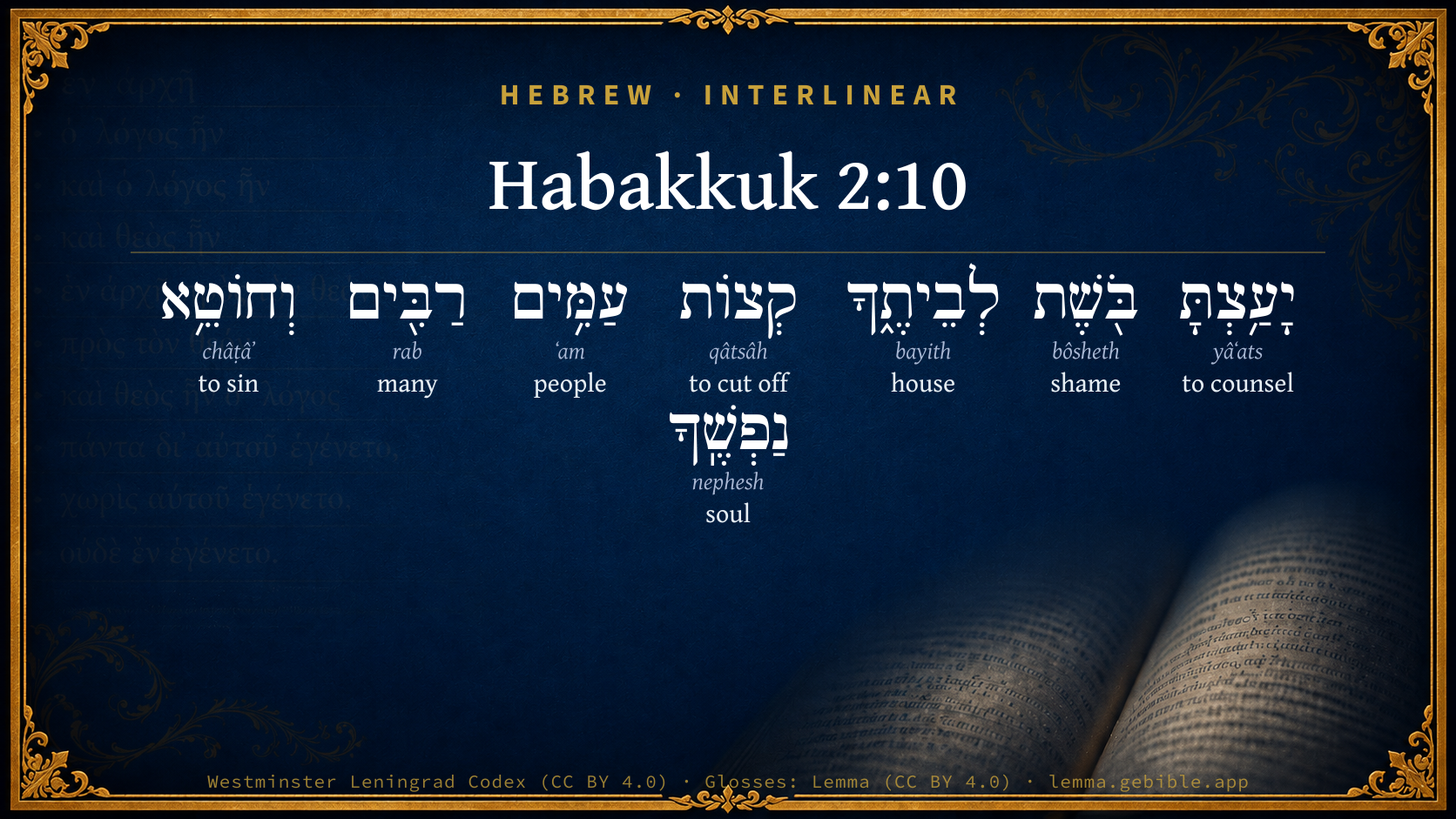
Habakkuk 2:10

Hebrew (Westminster Leningrad Codex) Habakkuk 2:10 appears in the Hebrew Old Testament. The text above is from the Westminster Leningrad Codex. Each word links to its Strong’s number, a concise gloss, and parsing drawn from the Open Scriptures Hebrew Bible morphology. Click any word for its full Brown-Driver-Briggs (BDB) entry.
Download image
Cite this verse

Habakkuk 2:10 (World English Bible). Public Domain. Lemma interlinear Bible study tool, https://lemma.gebible.app/v/habakkuk/2/10.

Show BibTeX & RIS
BibTeX
RIS
English Translation
You have devised shame to your house, by cutting off many peoples, and have sinned against your soul.
World English Bible · Public Domain
Download a study sheet

One document with this verse’s original text, its word-by-word gloss line, the meaning frame, cross-references with their text, attributed commentary, and full source and license credits — printable, and it pastes into notes with its structure intact.

This verse Autodidact and up

Study sheet (.html) Plain text (.txt)

A passage Seminary Student

Up to 50 verses in one chapter. A passage sheet keeps up to 6 commentary sources and 12 cross-references per verse, in the order this page ranks them, and says so on the sheet whenever that leaves anything out. Ask for a single verse and you get the Autodidact verse sheet above.

Everything on this page stays free to read, with no account — the sheet is a download of what is already on screen, not access to it.

Want to remove ads? Support Godless Engineer
Compare translations 3

The same verse in 3 English versions, stacked beneath the original-language interlinear above. Click any original word for its lexicon entry.

Each is an independent rendering of the whole verse — the interlinear is not word-aligned to these translations.

Highlighted words mark where these versions differ — a whole-verse word diff, not a word-by-word alignment.

  • World English Bible Public Domain
    You have devised shame to your house, by cutting off many peoples, and have sinned against your soul.
  • King James Version Public Domain
    Thou hast consulted shame to thy house by cutting off many people, and hast sinned against thy soul.
  • unfoldingWord Literal Text CC BY-SA 4.0
    You have counseled shame for your house, cutting off many peoples, and sinning against your soul.

unfoldingWord Literal Text — © unfoldingWord, licensed CC BY-SA 4.0. Word-aligned USFM3 via Door43 (git.door43.org/unfoldingWord/en_ult).

Versions to compare (up to 4)

3 of 4 selected

Show all 18 translations

Every available English version of this verse, each an independent rendering of the whole verse.

  • World English Bible Public Domain
    You have devised shame to your house, by cutting off many peoples, and have sinned against your soul.
  • Berean Standard Bible Public Domain
    You have plotted shame for your house by cutting off many peoples and forfeiting your life.
  • Majority Standard Bible Public Domain
    You have plotted shame for your house by cutting off many peoples and forfeiting your life.
  • King James Version Public Domain
    Thou hast consulted shame to thy house by cutting off many people, and hast sinned against thy soul.
  • American Standard Version (1901) Public Domain
    Thou hast devised shame to thy house, by cutting off many peoples, and hast sinned against thy soul.
  • Revised Version (1885) Public Domain
    Thou hast consulted shame to thy house, by cutting off many peoples, and hast sinned against thy soul.
  • Geneva Bible (1599) Public Domain
    Thou hast consulted shame to thine owne house, by destroying many people, and hast sinned against thine owne soule.
  • Douay-Rheims (1899) Public Domain
    Thou hast devised confusion to thy house, thou hast cut off many people, and thy soul hath sinned.
  • Young's Literal Translation Public Domain
    Thou hast counselled a shameful thing to thy house, To cut off many peoples, and sinful `is' thy soul.
  • Literal Standard Version CC BY-SA 4.0
    You have counseled a shameful thing to your house, || To cut off many peoples, and your soul [is] sinful.
  • Unlocked Literal Bible CC BY-SA 4.0
    You have devised shame for your house by cutting off many people, and have sinned against yourself.
  • unfoldingWord Literal Text CC BY-SA 4.0
    You have counseled shame for your house, cutting off many peoples, and sinning against your soul.
  • Darby Bible Public Domain
    Thou hast devised shame to thy house, by cutting off many peoples, and hast sinned against thine own soul.
  • World Messianic Bible Public Domain
    You have devised shame to your house by cutting off many peoples, and have sinned against your soul.
  • Webster's Bible Public Domain
    Thou hast consulted shame to thy house by cutting off many people, and hast sinned against thy soul.
  • Free Bible Version CC BY-SA 4.0
    Your evil schemes have brought shame upon your families, by destroying many nations you have forfeited your own lives.
  • Bible in Basic English Public Domain
    You have been a cause of shame to your house by cutting off a number of peoples, and sinning against your soul.
  • JPS Tanakh (1917) Public Domain
    Thou hast devised shame to thy house, by cutting off many peoples, and hast forfeited thy life.

Literal Standard Version (2020), Covenant Press — licensed CC BY-SA 4.0. Text via the HelloAO Bible API (eBible.org). Unlocked Literal Bible (unfoldingWord) — licensed CC BY-SA 4.0. Text via the HelloAO Bible API (eBible.org). unfoldingWord Literal Text — © unfoldingWord, licensed CC BY-SA 4.0. Word-aligned USFM3 via Door43 (git.door43.org/unfoldingWord/en_ult). Free Bible Version, Dr. Jonathan Gallagher — licensed CC BY-SA 4.0. Text via the HelloAO Bible API (eBible.org).

Word by word

More ways to search: Search by grammar → Find every occurrence → Compare this word →

Practice this passage: Drill this verse → Learn its vocabulary →

About this verse

These counts appear in no published source. They are computed here, from the morphology-tagged text and Lemma’s own curated glosses. What Lemma adds →

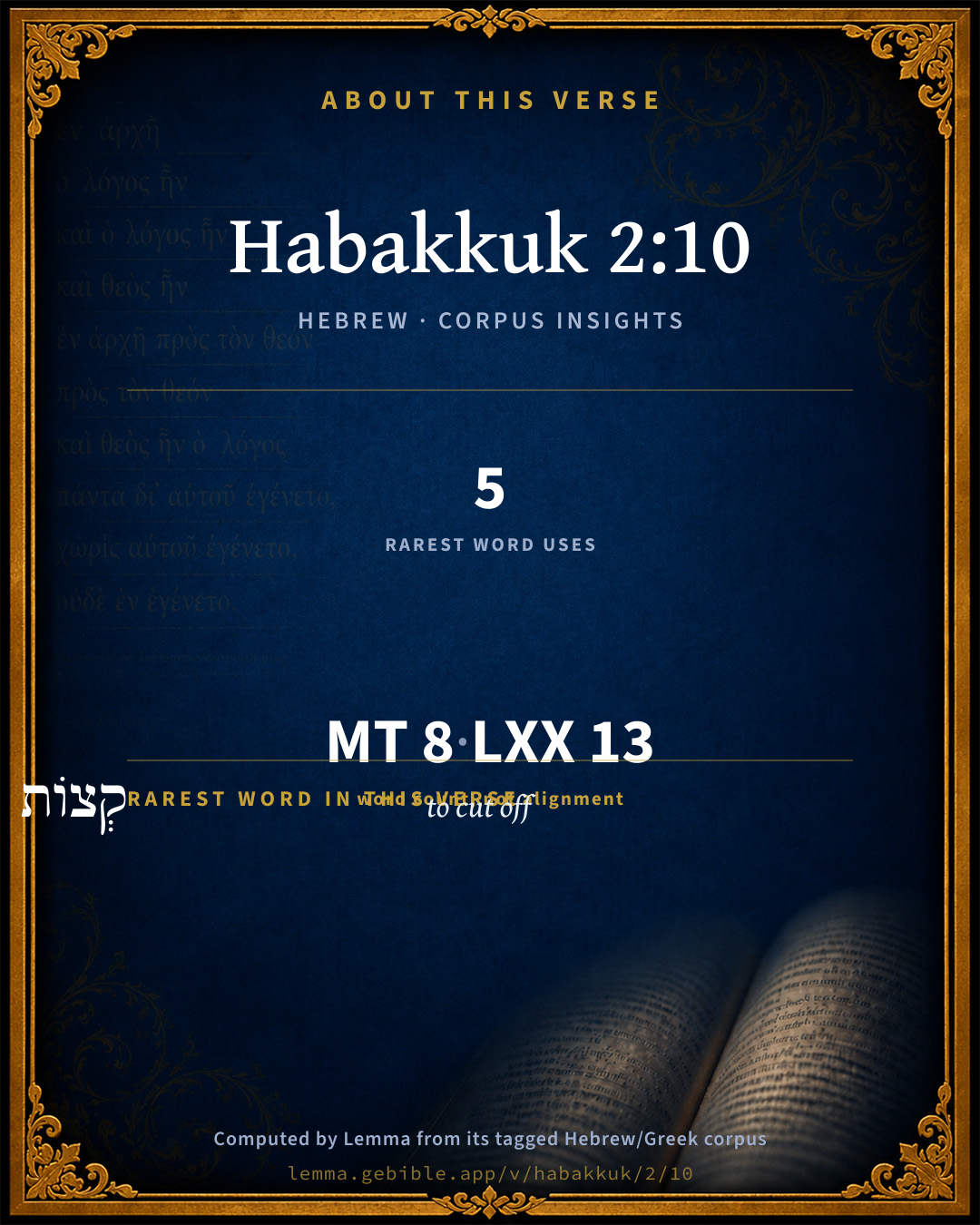
8
words
8
distinct lemmas
Prophets
section

Notable vocabulary

The rarest word here is קְצוֹת to cut off H7096 — appearing just 5 times in the whole Hebrew Bible.

Shared distinctive vocabulary

קְצוֹת to cut off H7096 occurs in 5 verses of the Hebrew Bible. Also found in:

Grammatical profile

  • 3 verbs
  • 4 nouns
  • 1 adjective

Verb forms

  • יָעַ֥צְתָּ Qal · Perfect
  • קְצוֹת Qal · Infinitive Construct
  • וְחוֹטֵ֥א Qal · Participle Active

Hebrew & Septuagint length

In English translation the verse runs 18 words from the Hebrew and 18 from the Septuagint (LXX English) — the same length.

A rough comparison of the two English renderings, which tokenize alike — not a word-level alignment.

Word counts can differ between the Hebrew and the Greek without any difference in meaning — e.g. the Hebrew direct-object marker אֵת has no separate Greek word, and Greek often adds the article ὁ.

In the original languages it is 8 Hebrew tokens and 13 Greek tokens — but the two are counted differently (Hebrew bundles its prefixes and suffixes into one token; the Greek is in lemma form), so that isn’t a like-for-like length.

Cross-references

14

Topical passages linked to Habakkuk 2:10 in the Treasury of Scripture Knowledge — connected by theme and wording, ordered by reader-vote popularity; previews shown in the World English Bible.

  • 2 Kings 9:26 Surely I have seen yesterday the blood of Naboth, and the blood of his sons, says Yahweh; and I will requite you in this plat, says Yahweh. Now therefore take and cast him into the plat [of ground], according to the word of Yahweh.
  • Nahum 1:14 Yahweh has commanded concerning you: "No more descendants will bear your name. Out of the house of your gods, will I cut off the engraved image and the molten image. I will make your grave, for you are vile."
  • Numbers 16:38 even the censers of these sinners against their own lives; and let them be made beaten plates for a covering of the altar: for they offered them before Yahweh; therefore they are holy; and they shall be a sign to the children of Israel.
  • 1 Kings 2:23 Then king Solomon swore by Yahweh, saying, God do so to me, and more also, if Adonijah has not spoken this word against his own life.
  • 2 Kings 10:7 It happened, when the letter came to them, that they took the king's sons, and killed them, even seventy persons, and put their heads in baskets, and sent them to him to Jezreel.
  • Proverbs 1:18 But these lay wait for their own blood. They lurk secretly for their own lives.
  • Proverbs 8:36 But he who sins against me wrongs his own soul. All those who hate me love death."
  • Isaiah 14:20–22 You shall not be joined with them in burial, because you have destroyed your land, you have killed your people; the seed of evil-doers shall not be named forever.
  • Isaiah 33:11 You shall conceive chaff, you shall bring forth stubble: your breath is a fire that shall devour you.
  • Jeremiah 22:30 Thus says Yahweh, Write you this man childless, a man who shall not prosper in his days; for no more shall a man of his seed prosper, sitting on the throne of David, and ruling in Judah.
  • Jeremiah 26:19 Did Hezekiah king of Judah and all Judah put him to death? Didn't he fear Yahweh, and entreat the favor of Yahweh, and Yahweh repented him of the evil which he had pronounced against them? Thus should we commit great evil against our own souls.
  • Jeremiah 36:31 I will punish him and his seed and his servants for their iniquity; and I will bring on them, and on the inhabitants of Jerusalem, and on the men of Judah, all the evil that I have pronounced against them, but they didn't listen.
  • Habakkuk 2:16 You are filled with shame, and not glory. You will also drink, and be exposed! The cup of Yahweh's right hand will come around to you, and disgrace will cover your glory.
  • Matthew 27:25 All the people answered, "May his blood be on us, and on our children!"

Cross-references courtesy of OpenBible.info (CC BY 4.0).

Hebrew and Greek witnesses Masoretic Hebrew ↔ Greek Septuagint

The same verse in the two great witnesses to the Old Testament, shown verse-for-verse.

These are two independent witnesses, not word-aligned to each other, and the Septuagint is shown in lemma (dictionary) form.

Hebrew Habakkuk 2:10 Masoretic · Westminster Leningrad Codex

יָעַ֥צְתָּ בֹּ֖שֶׁת לְבֵיתֶ֑ךָ קְצוֹת עַמִּ֥ים רַבִּ֖ים וְחוֹטֵ֥א נַפְשֶֽׁךָ

You have devised shame to your house, by cutting off many peoples, and have sinned against your soul.

World English Bible · Public Domain

Greek LXX Habakkuk 2:10 Septuagint · lemma form

βουλεύω αἰσχύνη ὁ οἶκος σύ συνπεραίνω λαός πολύς καί ἐκἁμαρτάνω ὁ ψυχή σύ

You have devised shame to your house, you have utterly destroyed many nations, and your soul has sinned.

LXX2012 (modern English Septuagint) · Public Domain

On this verse, Whedon's Commentary on the Bible discusses the Septuagint’s reading. Read the note in Commentary ↓

Hebrew: Westminster Leningrad Codex (CC BY 4.0). Greek: Septuagint (public domain); English from LXX2012 (modern English Septuagint) (Public Domain). How the Septuagint differs from the Hebrew →

Targum (Aramaic paraphrase)

1

The Targum is the ancient Jewish Aramaic paraphrase of the Hebrew Scriptures — an interpretive translation, not the Hebrew text itself. Onkelos (literal) and Pseudo-Jonathan (expansive) render the Torah, and Jonathan the Prophets. Coverage is partial: where no permissively-licensed English translation exists for a verse, only the Aramaic is shown. This is verse-level text, not a word-by-word alignment to the Hebrew.

  1. Targum Jonathan Prophets (Joshua–Malachi)
    מְלַכְתָּא בַהֲתָא לְבַיְתָךְ בַּזְתָּא עַמְמִין סַגִיאִין וְעַל נַפְשָׁךְ חֲטִיתָא:

    (no public-domain English translation for this verse)

    Targum Jonathan — Aramaic: “Mikraot Gedolot” (public domain). English: “Sefaria Community Translation” (CC0 1.0 (public-domain dedication)); “London "Chaldee Paraphrase," 1871” (public domain). Text via Sefaria.

Commentary

Notes on Habakkuk 2:10 from classic Christian and Jewish commentators (each source and its license shown beneath its notes). The classic Christian expositions comment on the surrounding passage and are grouped to its opening verse, so a note may address several verses; the Jewish commentaries on the Tanakh (Rashi and others) are per-verse, so they appear only where the commentator wrote on this verse.

Lemma curates 59 commentaries, every one of them public domain or Creative Commons licensed, each selected and text-cleaned for this edition rather than reprinted as found. About our sources →

Trapp's Complete Commentary

John Trapp

Hab 2:10 Thou hast consulted shame to thy house by cutting off many people, and hast sinned [against] thy soul.

Ver. 10. Thou hast consulted shame to thy house, &c.] Thou hast taken a wrong course both for thy house of the kingdom (so the Persians called the king’s palace, Dan 4:27), which shall be blown up; and for thine own private family and posterity; it is not all thy care, pains, plotting, and practising that can preserve it from ignominy and utter ruin. God will turn thy glory into shame, and make thy name to rot and stink as putrified flesh, Pro 10:7; Pro 10:9, "He that perverteth his ways shall be known." And when such a man is raked up in the dust his evil courses shall be cast as dung in the faces of those whom he leaveth behind him. What fools, then, are extortioners, muckworms, and cormorants, that live miserably and deal unjustly, opening the mouths of all to cry out upon their craftiness, covetousness, and cruelty, and yet think to raise up their houses and advance their names, and adorn their children with glory and estimation?

By cutting off many people] A poor glory it was to Sulla to have made such a merciless massacre at Athens (σφαγη ανηλεης), and after that, to have proscribed and slain 4700 citizens of Rome, as he caused it to be publicly recorded, videlicet ne memoria tam praeclarae rei dilueretur, saith mine author. So for Julius Caesar to have been the death of a million of men, Mahomet, the Great Turk, of 800,000. So for Stokesly, Bishop of London, to boast upon his deathbed that he had in his time brought to the fire 50 heretics, as he called them; or, for the bloody Spaniards, that they have murdered 50,000,000 of Indians in 42 years, as Acosta the Jesuit testifieth.

And hast sinned against thy soul] The worth whereof is incomparable, the loss irreparable, as Christ (who only went to the price of souls) telleth us, Mat 16:26. It was therefore no ill counsel that Francis Xaverius gave John III, King of Portugal, to meditate every day a quarter of an hour on that Divine sentence, What shall it profit a man to win the world, and lose his soul? Neither was it any evil answer that Maximilian (King of Bohemia, afterwards emperor) gave the Pope, who persuaded him to be a good Catholic with many promises of profits and preferments; the king answered, I thank your Holiness, but my soul’s health is dearer to me than all the things in the world. This pleased not the Pope, who said that it was a Lutheran form of speech; and yet that of Lewis, King of France, about the year 1152, pleased him much worse, who cast his bulls (whereby he required the fruits of vacancies of all cathedral churches of France) into the fire, saying, I had rather the Pope’s bulls should roast in the fire than that my soul should fry in hell.

John Trapp, A Commentary or Exposition upon All the Books of the Old and New Testament (1647–1656) — public domain. Text from a community e-Sword module.

The Biblical Illustrator

Joseph S. Exell

Hab_2:10

Thou hast consulted shame to thy house.

Consulting shame

The prophet again confirms the truth, that those who count themselves happy, imagining that they are like God, busy themselves in vain; for God will turn to shame whatever they think to be their glory, derived from their riches. The avaricious indeed wish, as it appears from the last verse, to prepare splendour for their prosperity, and they think to render illustrious their race by their wealth; for this is deemed to be nobility, that the richer anyone is the more he excels, as he thinks, in dignity, and the more is he to be esteemed by all. Since, then, this is the object of almost all the avaricious, the prophet here reminds them, that they are greatly deceived; for the Lord will not only frustrate their hopes, but wilt also convert their glory into shame. Hence he says that they consult shame to their family. He includes in the word consult all the industry, diligence, skill, care, and labour displayed by the avaricious. We indeed see how very sagacious they are; for if they smell any gain at a distance, they draw it to themselves, night and day they form new designs, that they may circumvent this person and plunder that person and accumulate into their heap whatever money they can find, and also that they may join fields to fields, build great palaces, and secure great revenues. This is the reason why the prophet says that they consult shame. What is the object of all their designs? For what purpose are all these things? Even for this, that their posterity may be eminent, that their nobility may be in the mouths of all, and spread far and wide. But the prophet shows that they labour in vain; for God will turn to shame whatever they in their great wisdom contrived for the honour of their families. The more provident, then, the avaricious are, the more foolish they are, for they consult nothing but disgrace to their posterity. (John Calvin.)

The Biblical Illustrator, edited by Joseph S. Exell (c. 1880s–1900s) — public domain. Text from a community e-Sword module.

Geneva Bible (1599)

Geneva Bible translators

Signifying, that the covetous man is the ruin of his own house, when as he thinketh to enrich it by cruelty and oppression.

Geneva Bible (1599) marginal notes — public domain. Text via Bolls.life.

Jamieson, Fausset & Brown

Robert Jamieson, A. R. Fausset & David Brown

Thou hast consulted shame . . . by cutting off many--MAURER, more literally, "Thou hast consulted shame . . . to destroy many," that is, in consulting (determining) to cut off many, thou hast consulted shame to thy house.

sinned against thy soul--that is, against thyself; thou art the guilty cause of thine own ruin (Pro 8:36; Pro 20:2). They who wrong their neighbors, do much greater wrong to their own souls.

Jamieson, Fausset & Brown — Commentary Critical and Explanatory on the Whole Bible (1871) — public domain (CC PDM 1.0). Text via the HelloAO Bible API.

Adam Clarke's Commentary

Verse 10. Hast sinned against thy soul.] Thy life is forfeited by thy crimes.

Adam Clarke's Commentary on the Bible (1810–1826) — public domain. Text from a community e-Sword/MySword module.

John Calvin's Commentaries

The Prophet again confirms the truth, that those who count themselves happy, imagining that they are like God, busy themselves in vain; for God will turn to shame whatever they think to be their glory, derived from their riches. The avaricious indeed wish, as it appears from the last verse, to prepare splendor for their posterity, and they think to render illustrious their race by their wealth; for this is deemed to be nobility, that the richer any one is the more he excels, as he thinks, in dignity, and the more is he to be esteemed by all. Since, then, this is the object of almost all the avaricious, the Prophet here reminds them, that they are greatly deceived; for the Lord will not only frustrate their hopes, but will also convert their glory into shame. Hence he says, that they consult shame to their family.

He includes in the word consult, all the industry, diligence, skill, care, and labor displayed by the avaricious. We indeed see how very sagacious they are; for if they smell any gain at a distance, they draw it to themselves, night and day they form new designs, that they may circumvent this person and plunder that person, and accumulate into their heap whatever money they can find, and also that they may join fields to fields, build great palaces, and secure great revenues. This is the reason why the Prophet says, that they consult shame. What is the object of all their designs? for they are, as we have said, very sharp and keen-sighted, they are also industrious, and torment themselves day and night with continual labor; for what purpose are all these things? even for this, that their posterity may be eminent, that their nobility may be in the mouth of all, and spread far and wide. But the Prophet shows that they labor in vain for God will turn to shame whatever they in their great wisdom contrived for the honor of their families. The more provident then the avaricious are, the more foolish they are, for they consult nothing but disgrace to their posterity.

He adds, though thou cuttest off many people. This seems to have been expressed for the sake of anticipating an objection; for it might have seemed incredible that the Babylonians should form designs disgraceful to their posterity, when their fame was so eminent, and Babylon itself was like an idol, and the king was everywhere regarded with great reverence and also fear. Since then the Babylonians had made such advances, who could have thought it possible that what the Prophet declares here should take place? But, as I have already said, he meets these objections, and says, “Though the Babylonians shall conquer many enemies, and overthrow strong people, yet this will be of no advantage to them; nay, even that will turn out to their disgrace which they think will be to their glory.”

To the same purpose is what he adds, thou hast sinned against thy soul. Some give this version, “Thou hast sinned licentiously” or immoderately; others, “Thy soul has sinned,” but these pervert the Prophet’s meaning; for what he intended was nothing else but the evils which the avaricious and the cruel bring on themselves, and which will return on their own heads. When therefore the Babylonians contrived ruin for the whole world, the Prophet predicts that an end, very different from what they thought, would be to them: thou hast sinned, he says, against thine own soul; that is, the evil which thou didst prepare to bring on others, shall be made by God to fall on thine own head.

And this kind of declaration ought to be carefully noticed; that is, that the ungodly, while they trouble all, and harass all, while they torment one, plunder another, oppress another, do always sin against their own souls; that is, they do not cause so much loss and sorrow to others as to themselves: for the Lord will make the evil they intend for others to return on themselves. He does not speak here of guilt, but of punishment, when he says, “Thou hast sinned against thy soul;” that is, thou shalt receive the reward due to all thy sins. We now then see what the Prophet means. It now follows—

John Calvin's Commentaries (1540-1563) — public domain. Text from the Calvin Translation Society English edition (1840s-50s) via the Christian Classics Ethereal Library (ccel.org). Calvin's coverage is partial (roughly two-thirds of the Bible); uncommented books and verses are honest gaps, never fabricated. The 19th-century editor's footnotes and remarks are omitted so the notes are faithfully Calvin's own voice.

Ellicott's Commentary for English Readers

(10) And hast sinned . . .—Literally, and sinning in thy soul. All the time the Babylonian oppressor was plundering these peoples he was involving his soul in guilt. (Comp. Hab_1:11.)

A Bible Commentary for English Readers, edited by Charles John Ellicott (1878–1897) — public domain. Text from a community e-Sword module.

The Cambridge Bible for Schools and Colleges

gen. ed. J. J. S. Perowne

10. consulted shame to thy house] The next words explain that what he consulted or purposed was to cut off many nations; but this purpose shall turn out to be to the confusion of his house; Jer_7:19. As the Assyrian was sent against an ungodly nation, so the Chaldean was appointed for chastisement, but neither of them understood the limits of his commission: “he thinketh not so, but it is in his heart to destroy and cut off nations not a few,” Isa_10:7.

By cutting off many people] Or, to cut off. The text is not quite assured, the Versions render: thou hast cut off. Cf. 2Ki_10:32.

And hast sinned] Or, whilst thou sinnest against thine own life. In his purpose to cut off many peoples and the execution of it he sins to the endangering or rather to the forfeiture of his own life. Comp. Isa_10:12-19, and particularly Isa_14:20. The construction and form of sentence are both unusual, cf. Pro_8:36; Pro_20:2, and Psa_7:10; Psa_55:20 (A.V. Pro_7:9, 55:19).

The Cambridge Bible for Schools and Colleges (gen. ed. J. J. S. Perowne; Cambridge University Press, 1878–1918) — public domain. Text from a community e-Sword module.

John Gill's Exposition

Thou hast consulted shame to thy house,.... Instead of bringing real honour and glory to their church, and that into the esteem of men, by such covetousness, ambition, and arrogance, they brought it into shame and disgrace, especially with all good men; and which they as effectually did as if they had studied it, and as if this was the thing they had in view in all their schemes and measures: this they procured

by cutting off many people; by making war with the saints, and killing great multitudes of them with the sword, as the Waldenses and Albigenses, and many of the Protestants by fire and faggot; and also by cutting off all such they called heretics and schismatics, with their anathemas and excommunications; neither of which were to their honour, but to their eternal infamy:

and hast sinned against thy soul; and exposed it to eternal damnation; that is, they sinned against the light and dictates of their own consciences, which is an aggravation of their sin, and might justly cause shame and confusion of mind.

John Gill's Exposition of the Whole Bible (1746–1763) — public domain (CC PDM 1.0). Text via the HelloAO Bible API.

Albert Barnes' Notes on the Bible

Thou hast consulted shame to thy house, the cutting off many people, and sinning against thy soul - The wicked, whether out of passion or with his whole mind and deliberate choice and will, takes that counsel, which certainly brings shame to himself and his house, according to the law of God, whereby, according to Exo 20:5, He “visits the iniquities of the fathers upon the children unto the third and fourth generation of them that hate Him,” i. e., until by righteousness and restitution the curse is cut off. Pro 15:27 : “he that is greedy of gain troubleth his own house.” So Jeremiah says Jer 7:19 : “Thus saith the Lord, Is it Me they are vexing? Is it not themselves, for the confusion of their faces?” i. e., with that end and object. Holy Scripture overlooks the means, and places us at the end of all. Whatever the wicked had in view, to satisfy ambition, avarice, passion, love of pleasure, or the rest of man’s immediate ends, all he was doing was leading on to a further end - shame and death. He was bringing about, not only these short-lived, but the lasting ends beyond, and these far more than the others, since that is the real end of a thing which abides, in which it at last ends. He consulted to cut off many people and was thereby (though he did not know it) by one and the same act, “guilty of and forfeiting his OWN soul” Pro 8:36. The contemporaneousness of the act is expressed by the participle; the pronoun is omitted as in Hab 1:5).

Albert Barnes' Notes on the Bible (1834–1885) — public domain. Text from a community e-Sword/MySword module.

Haydock's Catholic Bible Commentary

House. Thinking to establish thy family for ever, thou hast proved its ruin by avarice, &c. (Worthington) --- This is applied to Nabuchodonosor, but may be as well explained of Joakim, who oppressed his people, and was cast out like an ass. (Calmet)

George Leo Haydock (1774–1849), Haydock's Catholic Family Bible and Commentary, 1859 edition — public domain. Excludes Psalms (Douay-Rheims chapter numbering differs from Protestant) and Deuterocanonical books (Catholic canon only).

Matthew Poole's English Annotations

Thou, Nebuchadnezzar, king of Babylon,

hast consulted shame; hast mistaken thy measures, thoughtest to advance thy glory, and to illustrate thy name; but it is in very deed the shame of thy reign that it hath been bloody.

To thy house; or family, thy royal family.

By cutting off many people; destroying and impoverishing multitudes of men and cities.

Hast sinned; it was thy sin, whatever thou didst think of it.

Against thy soul; or life of thy person, and posterity, this blood and cruelty will surely ruin thy house.

Matthew Poole's English Annotations on the Holy Bible (1683–1685) — public domain. Text from a community e-Sword/MySword module.

Whedon's Commentary on the Bible

Daniel D. Whedon

10. “Man proposes, God disposes.” The Chaldean disregarded the divine purpose. He thought only of his own interest and exaltation, but in doing so he prepared the way for his fall.

Consulted [“devised”] shame — He sought to bring honor to his dynasty and nation; instead of realizing his ambition, his lust of conquest and rapacity will result in ruin and shame (Jer_7:19). LXX. reads, “I will devise.”

By cutting off many people [“peoples”] — LXX. co-ordinates this with the preceding clause and reads, “thou hast cut off many peoples.” The ordinary English translation gives good sense and is not impossible, but it would be in better accord with Hebrew usage to take the infinitive, literally, “to cut off,” as object of “devised,” so as to read “Thou hast devised shame to thy house, to cut off many peoples.”

And hast sinned against thy soul — By cutting off the many peoples he expected to receive glory and honor; in reality he endangered his very existence. Soul is used, as frequently in the Old Testament, in the sense of life. Some prefer to render the words as a circumstantial clause, “while thou art sinning against thy soul.” He devised to cut off the nations, while in reality he injured himself. The construction is peculiar and the text may be corrupt, but there can be no doubt as to the general sense.

Daniel D. Whedon (gen. ed.), Commentary on the Old and New Testaments (1874–1909) — public domain. Text from a community e-Sword module.

The Pulpit Commentary

The very means he took to secure his power shall prove his ruin. Thou hast consulted shame to thy house. By thy measures thou hast really determined upon, devised shame and disgrace for thy family; that is the result of all thy schemes, By cutting off many people (peoples). This is virtually correct. The verb in the present text is in the infinitive, and may depend upon the verb in the first clause. The versions read the past tense, suneperanav, concidisti. So the Chaldee and Syriac. This may be taken as the prophet"s explanation of the shameful means employed. Hast sinned against thy soul. (Pro_8:36 Pro_20:2) Thou hast endangered thy own life by provoking retribution. The Greek and Latin Versions have, "Thy soul hath sinned."

The Pulpit Commentary (1880–1919), ed. H.D.M. Spence-Jones & Joseph S. Exell — public domain. Text from a community e-Sword module.

John Wesley's Explanatory Notes

Thou - Nebuchadnezzar.

John Wesley, Explanatory Notes Upon the Whole Bible (1754–1765) — public domain. Text via the GEBible commentary corpus.

Rashi

Rabbi Shlomo Yitzchaki (Rashi)

With this matter, you advised shame for your house For you advised to cut off many peoples, and you caused a loss for yourself.

to cut off an expression of stripping and peeling, as in (Lev. 14: 43) “Scraping the house.”

and you have sinned against your life As in (Prov. 20:2) “He who provokes him sins against his life.” He sins to lose his life; forsfait sa arme in O.F. he forfeits his soul.

Rashi on the Tanakh — English translations: “The Judaica Press complete Tanach with Rashi, translated by A. J. Rosenberg” (CC BY 4.0); “Pentateuch with Rashi's commentary by M. Rosenbaum and A.M. Silbermann, 1929-1934” (public domain); “The Metsudah Tanach series, Lakewood, N.J” (CC BY 4.0); and “The Book of Joshua, Metsudah Publications, 1997” (CC BY 4.0). Text via Sefaria.

Lesson kit

Teaching starters — assembled from the data on this page, not authored interpretation. Every prompt links to the verse data it draws on. Edit before teaching.

Habakkuk, in the Prophets, opens this verse with 8 words (8 distinct Hebrew lemmas). Its most distinctive word is qâtsâh (“to cut off”). A historical commentator’s framing appears above. Read the whole chapter for the surrounding context.

Discussion questions

  1. What does “to cut off” (qâtsâh) contribute to the verse as a whole?
  2. How does Leviticus 14:41, which shares the word «to cut off», read alongside this verse?
  3. These translations render this verse differently. What is at stake in choosing one wording over another?
  4. «יָעַ֥צְתָּ» is a Qal Perfect verb. How does that grammatical form shape the action described?
  5. Compare how Trapp's Complete Commentary and The Biblical Illustrator read this verse. Where do they agree or differ?

Things to notice

Reading settings

Reading text

Shown beneath each verse's original-language words.

Old Testament
Old Testament edition

Read the OT as the Masoretic Hebrew (MT) or the Greek Septuagint (LXX).

English shown for the Greek Septuagint (in the Hebrew ↔ Greek comparison).

Comparing translations? Open the Compare panel on any verse page to stack up to four side by side.