
Jeremiah 33:8

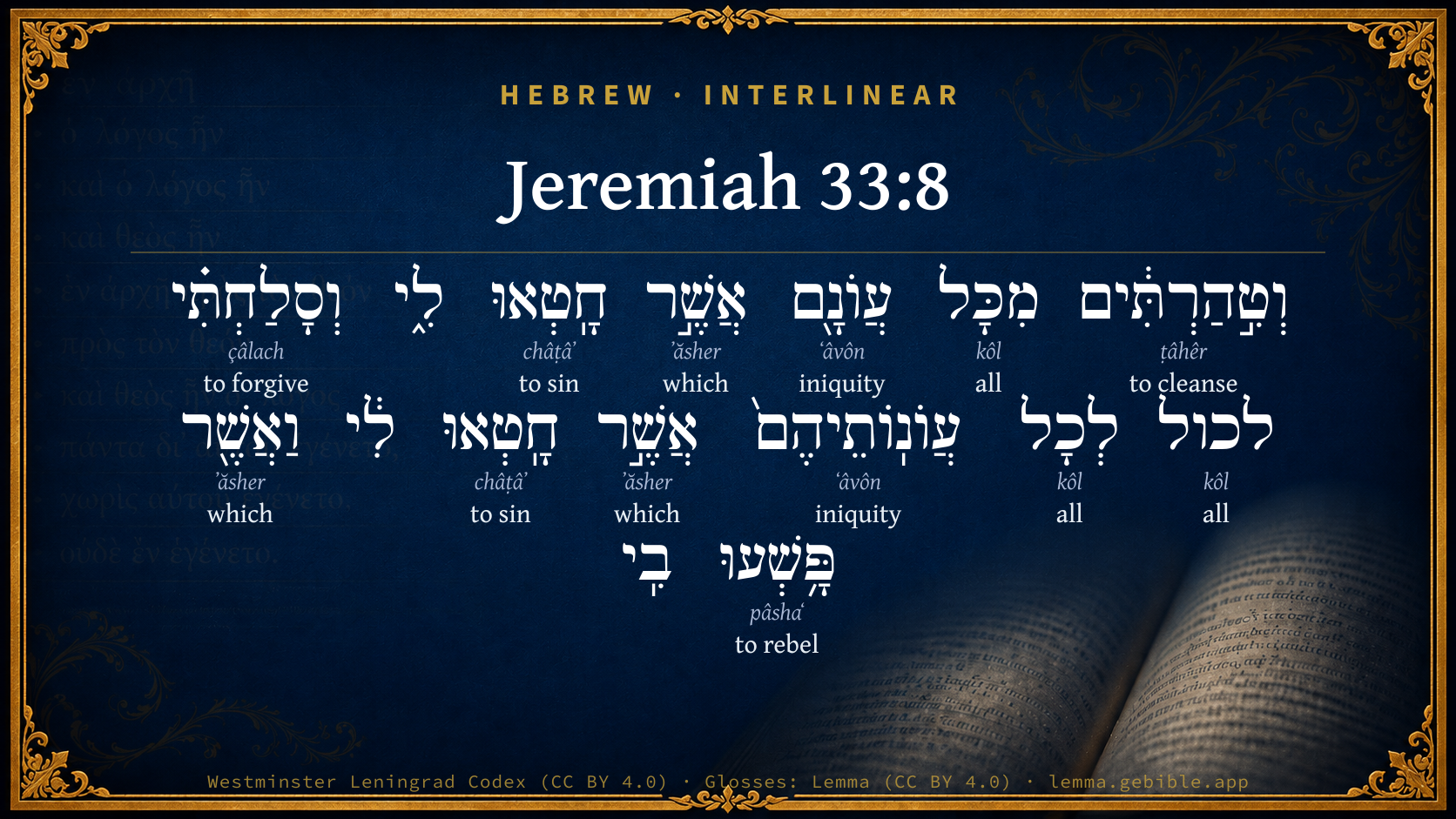
Hebrew (Westminster Leningrad Codex) Jeremiah 33:8 appears in the Hebrew Old Testament. The text above is from the Westminster Leningrad Codex. Each word links to its Strong’s number, a concise gloss, and parsing drawn from the Open Scriptures Hebrew Bible morphology. Click any word for its full Brown-Driver-Briggs (BDB) entry.
Download image
Cite this verse

Jeremiah 33:8 (World English Bible). Public Domain. Lemma interlinear Bible study tool, https://lemma.gebible.app/v/jeremiah/33/8.

Show BibTeX & RIS
BibTeX
RIS
English Translation
I will cleanse them from all their iniquity, by which they have sinned against me; and I will pardon all their iniquities, by which they have sinned against me, and by which they have transgressed against me.
World English Bible · Public Domain
Download a study sheet

One document with this verse’s original text, its word-by-word gloss line, the meaning frame, cross-references with their text, attributed commentary, and full source and license credits — printable, and it pastes into notes with its structure intact.

This verse Autodidact and up

Study sheet (.html) Plain text (.txt)

A passage Seminary Student

Up to 50 verses in one chapter. A passage sheet keeps up to 6 commentary sources and 12 cross-references per verse, in the order this page ranks them, and says so on the sheet whenever that leaves anything out. Ask for a single verse and you get the Autodidact verse sheet above.

Everything on this page stays free to read, with no account — the sheet is a download of what is already on screen, not access to it.

Want to remove ads? Support Godless Engineer
Compare translations 3

The same verse in 3 English versions, stacked beneath the original-language interlinear above. Click any original word for its lexicon entry.

Each is an independent rendering of the whole verse — the interlinear is not word-aligned to these translations.

Highlighted words mark where these versions differ — a whole-verse word diff, not a word-by-word alignment.

  • World English Bible Public Domain
    I will cleanse them from all their iniquity, by which they have sinned against me; and I will pardon all their iniquities, by which they have sinned against me, and by which they have transgressed against me.
  • King James Version Public Domain
    And I will cleanse them from all their iniquity, whereby they have sinned against me; and I will pardon all their iniquities, whereby they have sinned, and whereby they have transgressed against me.
  • unfoldingWord Literal Text CC BY-SA 4.0
    Then I will purify them from all the iniquity that they have committed against me. I will pardon all the iniquities that they have done against me, and all the ways that they rebelled against me.

unfoldingWord Literal Text — © unfoldingWord, licensed CC BY-SA 4.0. Word-aligned USFM3 via Door43 (git.door43.org/unfoldingWord/en_ult).

Versions to compare (up to 4)

3 of 4 selected

Show all 18 translations

Every available English version of this verse, each an independent rendering of the whole verse.

  • World English Bible Public Domain
    I will cleanse them from all their iniquity, by which they have sinned against me; and I will pardon all their iniquities, by which they have sinned against me, and by which they have transgressed against me.
  • Berean Standard Bible Public Domain
    And I will cleanse them from all the iniquity they have committed against Me, and will forgive all their sins of rebellion against Me.
  • Majority Standard Bible Public Domain
    And I will cleanse them from all the iniquity they have committed against Me, and will forgive all their sins of rebellion against Me.
  • King James Version Public Domain
    And I will cleanse them from all their iniquity, whereby they have sinned against me; and I will pardon all their iniquities, whereby they have sinned, and whereby they have transgressed against me.
  • American Standard Version (1901) Public Domain
    And I will cleanse them from all their iniquity, whereby they have sinned against me; and I will pardon all their iniquities, whereby they have sinned against me, and whereby they have transgressed against me.
  • Revised Version (1885) Public Domain
    And I will cleanse them from all their iniquity, whereby they have sinned against me; and I will pardon all their iniquities, whereby they have sinned against me, and whereby they have transgressed against me.
  • Geneva Bible (1599) Public Domain
    And I wil clense them from all their iniquitie, whereby they haue sinned against me: yea, I wil pardon all their iniquities, whereby they haue sinned against me, and whereby they haue rebelled against me.
  • Douay-Rheims (1899) Public Domain
    And I will cleanse them from all their iniquity, whereby they have sinned against me: and I will forgive all their iniquities, whereby they have sinned against me, and despised me.
  • Young's Literal Translation Public Domain
    And cleansed them from all their iniquity, That they have sinned against Me, And I have pardoned all their iniquities, That they have sinned against Me, And that they transgressed against Me.
  • Literal Standard Version CC BY-SA 4.0
    And cleansed them from all their iniquity || That they have sinned against Me, || And I have pardoned all their iniquities || That they have sinned against Me, || And that they transgressed against Me.
  • Unlocked Literal Bible CC BY-SA 4.0
    Then I will purify them from all the iniquity that they have committed against me. I will pardon all the iniquities that they have done against me, and all the ways that they rebelled against me.
  • unfoldingWord Literal Text CC BY-SA 4.0
    Then I will purify them from all the iniquity that they have committed against me. I will pardon all the iniquities that they have done against me, and all the ways that they rebelled against me.
  • Darby Bible Public Domain
    And I will cleanse them from all their iniquity, whereby they have sinned against me, and I will pardon all their iniquities, whereby they have sinned against me, and whereby they have transgressed against me.
  • World Messianic Bible Public Domain
    I will cleanse them from all their iniquity by which they have sinned against me. I will pardon all their iniquities by which they have sinned against me and by which they have transgressed against me.
  • Webster's Bible Public Domain
    And I will cleanse them from all their iniquity, by which they have sinned against me; and I will pardon all their iniquities, by which they have sinned, and by which they have transgressed against me.
  • Free Bible Version CC BY-SA 4.0
    I will wash away all their sins that they committed against me, and I will forgive all their guilt from when they sinned in rebelling against me.
  • Bible in Basic English Public Domain
    And I will make them clean from all their sin, with which they have been sinning against me; I will have forgiveness for all their sins, with which they have been sinning against me, and with which they have done evil against me.
  • JPS Tanakh (1917) Public Domain
    And I will cleanse them from all their iniquity, whereby they have sinned against Me; and I will pardon all their iniquities, whereby they have sinned against Me, and whereby they have transgressed against Me.

Literal Standard Version (2020), Covenant Press — licensed CC BY-SA 4.0. Text via the HelloAO Bible API (eBible.org). Unlocked Literal Bible (unfoldingWord) — licensed CC BY-SA 4.0. Text via the HelloAO Bible API (eBible.org). unfoldingWord Literal Text — © unfoldingWord, licensed CC BY-SA 4.0. Word-aligned USFM3 via Door43 (git.door43.org/unfoldingWord/en_ult). Free Bible Version, Dr. Jonathan Gallagher — licensed CC BY-SA 4.0. Text via the HelloAO Bible API (eBible.org).

Word by word

More ways to search: Search by grammar → Find every occurrence → Compare this word →

Practice this passage: Drill this verse → Learn its vocabulary →

פָּ֥שְׁעוּ
pâshaʻ
H6586
“to rebel”
Verb, Qal, Perfect, 3rd Person, Common, Plural
Part of Speech
Verb
Stem
Qal
Form
Perfect
Person
3rd Person
Gender
Common
Number
Plural
Full BDB Definition

Origin: a primitive root [identical with H6585 through the idea of expansion]

TWOT: TWOT - 1846

to rebel, transgress, revolt - (Qal) - to rebel, revolt - to transgress - (Niphal) to be rebelled against
  1. וְטִ֣הַרְתִּ֔ים ṭâhêr H2891 “and · to cleanse · them” Conjunction + Verb, Piel, Sequential Perfect, 1st Person, Common, Singular + Suffix, Personal, 3rd Person, Masculine, Plural
  2. מִכָּל kôl H3605 “from · all of” Preposition + Noun, Common, Masculine, Singular, Construct
  3. עֲוֺנָ֖ם ʻâvôn H5771 “iniquity · their” Noun, Common, Both, Singular, Construct + Suffix, Personal, 3rd Person, Masculine, Plural
  4. אֲשֶׁ֣ר ʼăsher H834 “which” Particle, Relative
  5. חָֽטְאוּ châṭâʼ H2398 “to sin” Verb, Qal, Perfect, 3rd Person, Common, Plural
  6. וְסָלַחְתִּ֗י çâlach H5545 “and · to forgive” Conjunction + Verb, Qal, Sequential Perfect, 1st Person, Common, Singular
  7. לכול kôl H3605 “to/for · all of” Preposition + Noun, Common, Masculine, Singular, Construct
  8. לְכָל kôl H3605 “to/for · all of” Preposition + Noun, Common, Masculine, Singular, Construct
  9. עֲוֺנֽוֹתֵיהֶם֙ ʻâvôn H5771 “iniquities · their” Noun, Common, Both, Plural, Construct + Suffix, Personal, 3rd Person, Masculine, Plural
  10. אֲשֶׁ֣ר ʼăsher H834 “which” Particle, Relative
  11. חָֽטְאוּ châṭâʼ H2398 “to sin” Verb, Qal, Perfect, 3rd Person, Common, Plural
  12. וַאֲשֶׁ֖ר ʼăsher H834 “and · which” Conjunction + Particle, Relative

About this verse

These counts appear in no published source. They are computed here, from the morphology-tagged text and Lemma’s own curated glosses. What Lemma adds →

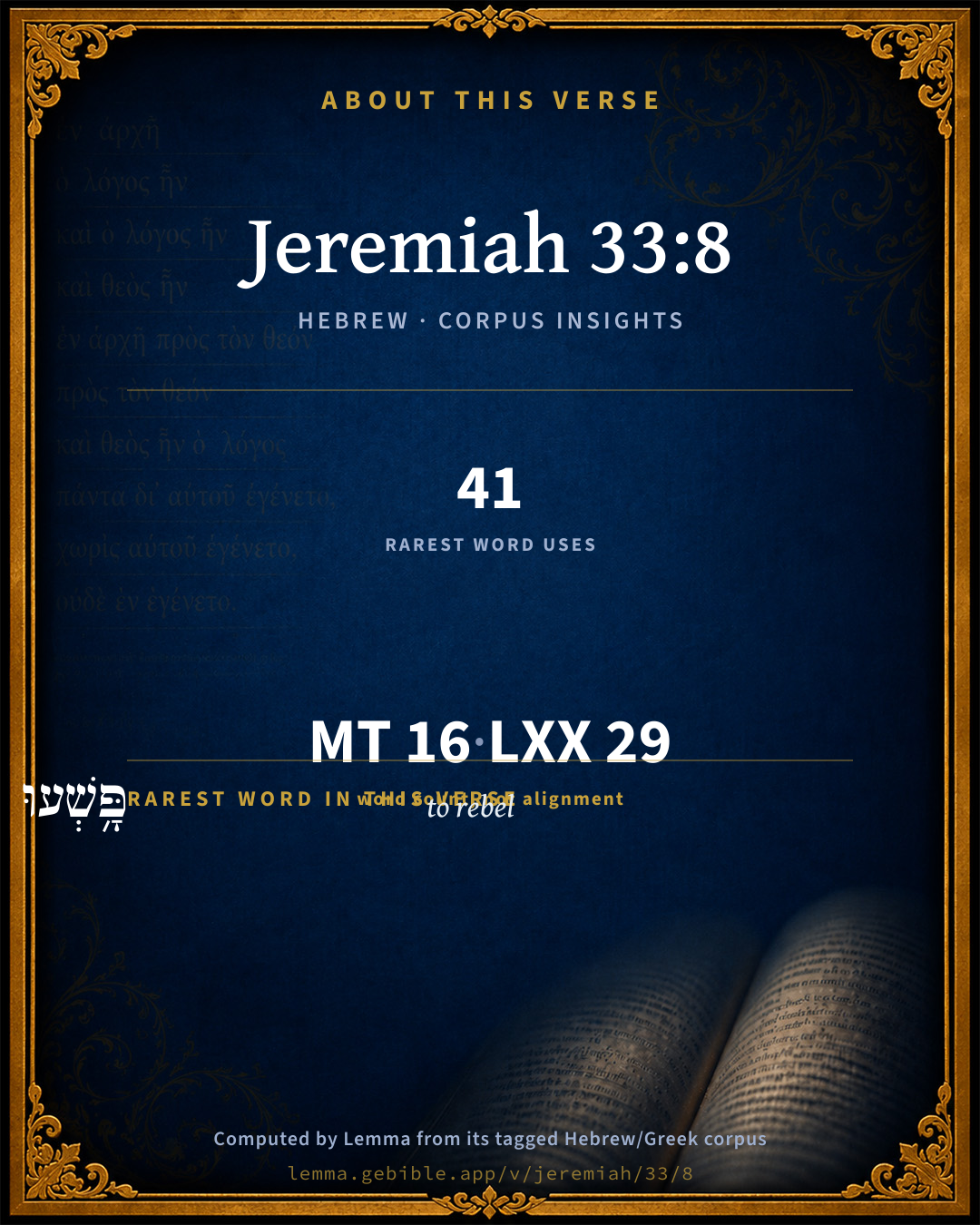
16
words
7
distinct lemmas
Prophets
section

Shared distinctive vocabulary

פָּ֥שְׁעוּ to rebel H6586 occurs in 37 verses of the Hebrew Bible. Also found in:

Grammatical profile

  • 5 verbs
  • 5 nouns
  • 3 prepositions
  • 3 particles

Verb forms

  • וְטִ֣הַרְתִּ֔ים Piel · Sequential Perfect
  • חָֽטְאוּ Qal · Perfect
  • וְסָלַחְתִּ֗י Qal · Sequential Perfect
  • חָֽטְאוּ Qal · Perfect
  • פָּ֥שְׁעוּ Qal · Perfect

Repetition

Words recur within this verse — often emphatic in Hebrew:

  • מִכָּל all H3605 ×3
  • עֲוֺנָ֖ם iniquity H5771 ×2
  • חָֽטְאוּ to sin H2398 ×2
  • אֲשֶׁ֣ר which H834 ×3

Hebrew & Septuagint length

In the original languages it is 16 Hebrew tokens and 29 Greek tokens — but the two are counted differently (Hebrew bundles its prefixes and suffixes into one token; the Greek is in lemma form), so that isn’t a like-for-like length.

Cross-references

16

Topical passages linked to Jeremiah 33:8 in the Treasury of Scripture Knowledge — connected by theme and wording, ordered by reader-vote popularity; previews shown in the World English Bible.

  • Micah 7:18–19 Who is a God like you, who pardons iniquity, And passes over the disobedience of the remnant of his heritage? He doesn't retain his anger forever, Because he delights in loving kindness.
  • Zechariah 13:1 "In that day there will be a spring opened to the house of David and to the inhabitants of Jerusalem, for sin and for uncleanness.
  • Ezekiel 36:25 I will sprinkle clean water on you, and you shall be clean: from all your filthiness, and from all your idols, will I cleanse you.
  • Psalms 51:2 Wash me thoroughly from my iniquity. Cleanse me from my sin.
  • Jeremiah 31:34 and they shall teach no more every man his neighbor, and every man his brother, saying, Know Yahweh; for they shall all know me, from the least of them to the greatest of them, says Yahweh: for I will forgive their iniquity, and their sin will I remember no more.
  • Ezekiel 36:33 Thus says the Lord Yahweh: In the day that I cleanse you from all your iniquities, I will cause the cities to be inhabited, and the waste places shall be built.
  • Revelation 1:5 and from Jesus Christ, the faithful witness, the firstborn of the dead, and the ruler of the kings of the earth. To him who loves us, and washed us from our sins by his blood;
  • Psalms 65:3 Sins overwhelmed me, But you atoned for our transgressions.
  • Isaiah 44:22 I have blotted out, as a thick cloud, your transgressions, and, as a cloud, your sins: return to me; for I have redeemed you.
  • Jeremiah 50:20 In those days, and in that time, says Yahweh, the iniquity of Israel shall be sought for, and there shall be none; and the sins of Judah, and they shall not be found: for I will pardon them whom I leave as a remnant.
  • 1 John 1:7–9 But if we walk in the light, as he is in the light, we have fellowship with one another, and the blood of Jesus Christ, his Son, cleanses us from all sin.
  • Psalms 85:2–3 You have forgiven the iniquity of your people. You have covered all their sin. Selah.
  • Hebrews 9:11–14 But Christ having come as a high priest of the coming good things, through the greater and more perfect tabernacle, not made with hands, that is to say, not of this creation,
  • Isaiah 4:2 In that day, Yahweh's branch will be beautiful and glorious, and the fruit of the land will be the beauty and glory of the survivors of Israel.
  • Isaiah 56:7 even them will I bring to my holy mountain, and make them joyful in my house of prayer: their burnt offerings and their sacrifices shall be accepted on my altar; for my house shall be called a house of prayer for all peoples.
  • Joel 3:21 I will cleanse their blood, That I have not cleansed: For Yahweh dwells in Zion."

Cross-references courtesy of OpenBible.info (CC BY 4.0).

Hebrew and Greek witnesses Masoretic Hebrew ↔ Greek Septuagint

The same verse in the two great witnesses to the Old Testament, shown verse-for-verse.

These are two independent witnesses, not word-aligned to each other, and the Septuagint is shown in lemma (dictionary) form.

Hebrew Jeremiah 33:8 Masoretic · Westminster Leningrad Codex

וְטִ֣הַרְתִּ֔ים מִכָּל עֲוֺנָ֖ם אֲשֶׁ֣ר חָֽטְאוּ לִ֑י וְסָלַחְתִּ֗י לכול לְכָל עֲוֺנֽוֹתֵיהֶם֙ אֲשֶׁ֣ר חָֽטְאוּ לִ֔י וַאֲשֶׁ֖ר פָּ֥שְׁעוּ בִֽי

I will cleanse them from all their iniquity, by which they have sinned against me; and I will pardon all their iniquities, by which they have sinned against me, and by which they have transgressed against me.

World English Bible · Public Domain

Greek LXX Structure differs

In the Septuagint, Jeremiah is about an eighth shorter than the Hebrew and arranges its material differently — the Oracles Against the Nations (Hebrew chapters 46–51) appear in the middle of the Greek book, after 25:13. Because the chapter and verse boundaries do not line up, a verse-for-verse comparison with the Hebrew is not shown.

A verse-for-verse comparison isn’t shown here because the chapters and verses don’t line up. Switch to the LXX edition with the MT / LXX toggle above to read the Greek directly.

Hebrew: Westminster Leningrad Codex (CC BY 4.0). Greek: Septuagint (public domain); English from a public-domain English Septuagint. How the Septuagint differs from the Hebrew →

Targum (Aramaic paraphrase)

1

The Targum is the ancient Jewish Aramaic paraphrase of the Hebrew Scriptures — an interpretive translation, not the Hebrew text itself. Onkelos (literal) and Pseudo-Jonathan (expansive) render the Torah, and Jonathan the Prophets. Coverage is partial: where no permissively-licensed English translation exists for a verse, only the Aramaic is shown. This is verse-level text, not a word-by-word alignment to the Hebrew.

  1. Targum Jonathan Prophets (Joshua–Malachi)
    וֶאֱדַכִּינוּן מִכָּל חוֹבֵיהוֹן דְחָבוּ קֳדָמַי וְאֶשְׁבּוֹק לְכָל חוֹבֵיהוֹן דְחָבוּ קֳדָמַי וְדִמְרָדוּ בְמֵימְרִי:

    (no public-domain English translation for this verse)

    Targum Jonathan — Aramaic: “Mikraot Gedolot” (public domain). English: “Sefaria Community Translation” (CC0 1.0 (public-domain dedication)); “London "Chaldee Paraphrase," 1871” (public domain). Text via Sefaria.

Commentary

Notes on Jeremiah 33:8 from classic Christian and Jewish commentators (each source and its license shown beneath its notes). The classic Christian expositions comment on the surrounding passage and are grouped to its opening verse, so a note may address several verses; the Jewish commentaries on the Tanakh (Rashi and others) are per-verse, so they appear only where the commentator wrote on this verse.

Lemma curates 59 commentaries, every one of them public domain or Creative Commons licensed, each selected and text-cleaned for this edition rather than reprinted as found. About our sources →

Trapp's Complete Commentary

John Trapp

Jer 33:8 And I will cleanse them from all their iniquity, whereby they have sinned against me; and I will pardon all their iniquities, whereby they have sinned, and whereby they have transgressed against me.

Ver. 8. And I will cleanse them from all their iniquity.] Which must therefore needs be a filthy and loathsome thing, else what need cleansing? Christ, for this cause, came by water and blood.

And I will pardon all their iniquities.] This clause expoundeth the former, and containeth the mother mercy.

John Trapp, A Commentary or Exposition upon All the Books of the Old and New Testament (1647–1656) — public domain. Text from a community e-Sword module.

The Biblical Illustrator

Joseph S. Exell

Jer_33:8

I will cleanse them from all their iniquity.

Our Cleanser

(with Psa_19:12):--Many think that Jesus came into the world to forgive our sins; which is true, but it is only a part of the truth; for the New Testament reveals that He came to save us from our sins. Forgiveness is a great thing; but cleansing from sin is greater. Any kindly hearted man can forgive an injury; but only an omnipotent God can wash the love of sin from our nature. The Bible reveals that God has both the will and the power to give a clean heart.

I. It is a needful prayer. Cleanse Thou me from secret faults.

1. Do not our secret thoughts need cleansing?

2. Our secret imaginations need to be cleansed. Children build fairy castles in the air, and tenant them with the pure, the brave, and the true; but as we grow older, our airy castles begin to be peopled with those whose actions are tainted with sin; and when we arrive at manhood, the unconverted soul builds castles in its imagination in which iniquity abounds without any obstacle to hinder it.

3. Our secret desires need cleansing. If there were no desire for sin, there would be no transgression; and we, therefore, need to pray continually, Lord, cleanse my sinful desires! Let my longings be washed from their bias to transgression!

4. Our secret habits need cleansing. When a man yields to a sinful habit it is difficult to break it off. You need superhuman power; and that power shall be granted to all who sincerely ask of God. The sculptor who forms a figure in marble does it gradually by thousands of chisel strokes; and in the same way, when you are forming your soul either for goodness or badness, it is a gradual work. As no man is made an angel in a moment, so no man is made a devil in a moment. It is a work of time. It is first a thought, then a picture in the mind, then a desire, then a hesitating step, and afterwards the boldness of habit. It is hard work battling against a world inclined to sin; it is more difficult to resist a loved one who tempts us; but the hardest battle ever man can fight in this world is when he struggles against his souls inclination to think or do evil. And I feel persuaded that no man can cleanse his secret faults without the help of God. But however bad your secret sins may be, you can be purified. Is there anything too hard for the Lord? Christ has unfurled the flag of liberty, and His Spirit now calls on every man who is bound by sin to cry to Him for life!

II. Unbelief hinders us from being cleansed. Some men say, Nobody can be saved from all their secret faults! But if the Lord say He will cleanse us from all our iniquity, is it not a wicked thing to doubt it? Perhaps, somebody remarks, Well, I used to think I might be cleansed from sin, and I tried, but failed every time. Now let me ask you a question. Were you not a great deal happier when you were seeking to ,conquer your secret faults than you are now? You reply, Yes, I was happier; but why did I not succeed? A man who is trying to crush down the sin of his heart is happier than he who is content with the slavery of sin. If he do not succeed, the reason is that he is trying to do for himself what cannot be done without God. Ask the Lord to cleanse. It is your work to bring your soul in faith and prayer to Him, and it is His work to cleanse it.

III. How does the Lord cleanse us? The Jews in times of old were cleansed by being sprinkled with the blood of a beast. But this is not the way in which we are cleansed from secret faults. The Spirit of Christ can enter our souls and can cleanse us from sin. (W. Birch.)

A threefold disease and a twofold cure

Jeremiah was a prisoner in the palace of the last King of Judah. The long, national tragedy had reached almost the last scene and the last act. The besiegers were drawing their net closer round the doomed city. The prophet never faltered in predicting its fall, but he as uniformly pointed to a period behind the impending ruin, when all should be peace and joy. His song was modulated from a saddened minor to triumphant jubilation. The exiles shall return, the city shall be rebuilt, its desolate streets shall ring with hymns of praise, and the voices of the bridegroom and the bride. The land shall be peopled with peaceful husbandmen, and white with flocks. There shall be again a King upon the throne; sacrifices shall again be offered. That fair vision of the future begins with the offer of healing and cure, and with the exuberant promise of my text. The first thing to be dealt with was Judahs sin; and that being taken away, all good and blessing would start into being, as flowerets will spring when the baleful shadow of some poisonous tree is removed.

I. A threefold view of the sad condition of humanity. Observe the recurrence of the same idea in our text in different words. Their iniquity whereby they have sinned against Me.. . . Their iniquity whereby they have sinned, and whereby they have transgressed against Me. You see there are three expressions which roughly may be taken as referring to the same ugly fact, but yet not meaning quite the same--iniquity, or iniquities, sin, transgression. Suppose three men are set to describe a snake. One of them fixes his attention on its slimy coils, and describes its sinuous gliding movements. Another of them is fascinated by its wicked beauty, and talks about its livid markings, and its glittering eye. The third thinks only of the swift-darting fangs, and of the poison-glands. They all three describe the snake, but they describe it from different points of view. And so it is here. Iniquity, sin, transgression are synonyms to some extent, but they do not cover the same ground. They look at the serpent from different points of view. First, a sinful life is a twisted or warped life. The word rendered iniquity, in the Old Testament, in all probability, literally means something that is not straight; that is bent, or, as I said, twisted or warped. That is a metaphor that runs through a great many languages. I suppose right means the very same thing--that which is straight and direct; and I suppose that wrong has something to do with wrung--that which has been forcibly diverted from a right line. We all know the conventional colloquialism about a man being straight, and such-and-such a thing being on the straight. All sin is a twisting of the man from his proper course. Now there underlies that metaphor the notion that there is a certain line to which we are to conform. The schoolmaster draws a firm, straight line in the childs copybook; and then the little unaccustomed hand takes up on the second line its attempt, and makes tremulous, wavering pot-hooks and hangers. There is a copyhead for us, and our writing is, alas! all uneven and irregular, as well as blurred and blotted. There is a law, and you know it; and you carry in yourself--I was going to say, the standard measure, and you know whether, when you put your life by the side of that, the two coincide. This very prophet has a wonderful illustration, in which he compares the lives of men who have departed from God to the racing about in the wilderness of a wild dromedary entangling her ways, as he says, crossing and recrossing, and getting into a maze of perplexity. Ah! is that not something like your life? All sin is deflection from the straight road, and we all are guilty of that. Let me ask you to consult the standard that you carry within yourselves. It is easy to imagine that a line is straight. But did you ever see the point of a needle under a microscope? However finely it is polished, and apparently regularly tapering, the scrutinising investigation of the microscope shows that it is all rough and irregular. The smallest departure from the line of right will end, unless it is checked, away out in the regions of darkness beyond. The second of them, rendered in our version sin, if I may recur to my former illustration, looks at the snake from a different point of view, and it declares that all sin misses the aim. The meaning of the word in the original is simply that which misses its mark. Now, there are two ways in which that thought may be looked at. Every wrong thing that we do misses the aim, if you consider what a mans aim ought to be. Mans chief end is to glorify God, and to enjoy Him for ever. That is the only aim which corresponds to our constitution, to our circumstances. And so, whatever you win, unless you win God, you have missed the aim. Anything short of knowing Him and loving Him, serving Him, being filled and inspired by Him, is contrary to the destiny stamped upon us all. Then there is another side to this. The solemn teaching of this word is not confined to that thought, but also opens out into this other, that all godlessness, all the low, sinful lives that so many of us live, miss the shabby aim which they set before themselves. I do not believe that any man or woman ever got as much good, even of the lowest kind, out of a wrong thing as they expected to get when they ventured on it. If they did they got something else along with it that took all the gilt off the gingerbread. The drunkard gets his pleasurable oblivion, his pleasurable excitement. What about the corrugated liver, the palsied hand, the watery eye, the wrecked life, the broken hearts at home, and all the other accompaniments? There is an old story that speaks of a knight and his company who were travelling through a desert, and suddenly beheld a castle into which they were invited, and hospitably welcomed. A feast was spread before them, and they each ate and drank his fill. But as soon as they left the enchanted halls they were as hungry as before they sat at the magic table. That is the kind of food that all our wrong-doing provides for us. He feedeth on ashes, and hungers after he has fed. And now, further, there is yet another word here, carrying with it important lessons. The expression which is translated in our text transgressed, literally means rebelled. And the lesson of it is, that all sin is, however little we think it, a rebellion against God. That introduces a yet graver thought than either of the former has brought us face to face with. Behind the law is the Lawgiver. When we do wrong, we not only blunder, we not only go aside from the right line, we lift up ourselves against our Sovereign King. Sins are against God; and, dear friends, though you do not realise it, this is plain truth, that the essence, the common characteristic, of all the acts which, as we have seen, are twisted and foolish, is that in them we are setting up another than the Lord our God to be our ruler. We are enthroning ourselves in His place. Does not that thought make all these apparently trivial and insignificant things terribly important? Treason is treason, no matter what the act by which it is expressed. It may be a little thing to haul down a union-jack from a flagstaff, or to tear off a barn-door a proclamation with the royal arms at the top of it, but it may be rebellion. And if it is, it is as bad as to turn out a hundred thousand men in the field, with arms in their hands.

II. The twofold bright hope which comes through this darkness. I will cleanse . . . I will pardon. If sin combines in itself all these characteristics that I have touched upon, then clearly there is guilt, and clearly there are stains; and the gracious promise of this text deals with both the one and the other. I will pardon. What is pardon? Do not limit it to the analogy of a criminal court. When the law of the land pardons, or rather when the administrator of the law pardons, that simply means that the penalty is suspended. But is that forgiveness? Certainly it is only a part of it, even if it is a part. What do you fathers and mothers do when you forgive your child? You may use the rod or you may not; that is a question of what is best for the child. Forgiveness does not lie in letting him off the punishment; but forgiveness lies in the flowing to the child, uninterrupted, of the love of the parents heart. And that is Gods forgiveness. Do you need pardon? Do you not? What does conscience say? What does the sense of remorse that sometimes blesses you, though it tortures, say? I know not any gospel that goes deep enough to touch the real sore place in human nature, except the Gospel that says to you and me and all of us, Behold the Lamb of God, that taketh away the sin of the world! But forgiveness is not enough, for the worst results of past sin are the habits of sin which it leaves within us; so that we all need cleansing. Can we cleanse ourselves? Let experience answer. Did you ever try to cure yourself of some little trick of gesture, or manner, or speech? And did you not find out then how strong the trivial habit was? You never know the force of a current till you try to row against it. You may have the stained robe washed and made lustrous white in the blood of the Lamb. Pardon and cleansing are our two deepest needs. (A. Maclaren, D. D.)

Our sins swallowed up

You see the Thames as it goes sluggishly down through the arches, carrying with it endless impurity and corruption You watch the inky stream as it pours along day and night, and you think it will pollute the world. But you have just been down to the seashore, and you have looked on the great deep, and it has not left a stain on the Atlantic. No, it has been running down a good many years and carried a world of impurity with it, but when you go to the Atlantic there is not a speck on it. As to the ocean, it knows nothing about it. It is full of majestic music. So the smoke of London goes up, and has been going up for a thousand years. One would have thought that it would have spoiled the scenery by now; but you get a look at it sometimes. There is the great blue sky which has swallowed up the smoke and gloom of a thousand years, and its azure splendour is unspoiled. It is wonderful how the ocean has kept its purity, and how the sky has taken the breath of the millions and the smoke of the furnaces, and yet it is as pure as the day God made it. It is beautiful to think that these are only images of Gods great pity for the race. Our sins, they are like the Thames, but, mind you, they shall be swallowed up--lost in the depths of the sea, to be remembered against us no more. Though our sins have been going up to heaven through the generations, yet, though thy sins are as crimson, they shall be as wool, as white as snow. (W. L. Watkinson.)

I will pardon all their iniquities.

The pardon of sin

I. The pardon of sin which Almighty God, in infinite mercy and grace, is now offering to sinners in the Gospel, is a full pardon--that is, it comprehends and extends to every sin, however sinful, and includes all sins, however numerous. It was foretold in ancient prophecy that when the Messiah should come to make His soul an offering for sin, He should, by His atoning death, finish transgressions, make an end of sins, make reconciliation for iniquity, and bring in everlasting righteousness. Our blessed Saviour having come, as it wee thus written of Him, and having suffered the just for us the unjust, the Gospel testimony of His vicarious sufferings declares that His expiatory death has made a full and perfect atonement for all the sins of His people--that He has thereby fully reconciled them to God--that His blood cleanseth them from all sin--that He is able to save to the uttermost all who come unto God through Him.

II. The pardon proclaimed in the Gospel is free--it is vouchsafed by an infinitely gracious God, suspended on no condition whatever to be performed by the sinner as the meritorious ground of its bestowal. It is this absolute freeness of the forgiveness of sin proclaimed in the Gospel that makes it worthy of an infinitely gracious Gods bestowal, and good news to poor, miserable, and wretched sinners. Were it otherwise, it could be no rest to an awakened and alarmed conscience--to a weary and heavy sin-laden soul.

III. The pardon proclaimed to sinners in the Gospel is Everlasting. This makes it a complete pardon. (A. MWatt.)

The Biblical Illustrator, edited by Joseph S. Exell (c. 1880s–1900s) — public domain. Text from a community e-Sword module.

MacLaren's Expositions of Holy Scripture

Alexander MacLaren

Jeremiah

A THREEFOLD DISEASE AND A TWOFOLD CURE.

Jer 33:8.

Jeremiah was a prisoner in the palace of the last King of Judah. The long, national tragedy had reached almost the last scene of the last act. The besiegers were drawing their net closer round the doomed city. The prophet had never faltered in predicting its fall, but he had as uniformly pointed to a period behind the impending ruin, when all should be peace and joy. His song was modulated from a saddened minor to triumphant jubilation. In the beginning of this chapter he has declared that the final struggles of the besieged will only end in filling the land with their corpses, and then, from that lowest depth, he soars in a burst of lyrical prophecy conceived in the highest poetic style. The exiles shall return, the city shall be rebuilt, its desolate streets shall ring with hymns of praise and the voices of the bridegroom and the bride. The land shall be peopled with peaceful husbandmen, and white with flocks. There shall be again a King upon the throne; sacrifices shall again be offered. ‘In those days, and at that time, will I cause the branch of righteousness to grow up unto David. . . . In those days shall Judah be saved, and Jerusalem shall dwell safely; and this is the name wherewith she shall be called, the Lord our righteousness.’ That fair vision of the future begins with the offer of healing and cure, and with the exuberant promise of my text. The first thing to be dealt with was Judah’s sin; and that being taken away, all good and blessing would start into being, as flowerets will spring when the baleful shadow of some poisonous tree is removed. Now, my text at first reading seems to expend a great many unnecessary words in saying the same thing over and over again, but the accumulation of synonyms not only emphasises the completeness of the promise, but also presents different aspects of that promise. And it is to these that I crave your attention in this sermon. The great words of my text are as true a gospel for us-and as much needed by us, God knows!-as they were for Jeremiah’s contemporaries; and we can understand them better than either he or they did, because the days that were to come then have come now, and the King who was to reign in righteousness is reigning to-day, and His Name is Christ. My object now is, as simply as I can, to draw your attention to the two points in this text: a threefold view of our sad condition, and a twofold bright hope.

Now for the first of these. There is here-

I. A threefold view of the sad condition of humanity.

Observe the recurrence of the same idea in our text in different words: ‘Their iniquity whereby they have sinned against Me.’ . . . ‘Their iniquity whereby they have sinned, and whereby they have transgressed against Me.’ You see there are three expressions which roughly may be taken as referring to the same ugly fact, but yet not meaning quite the same-’iniquity, or iniquities, sin, transgression.’ These three all speak of the same sad element in your experience and mine, but they speak it from somewhat different points of view, and I wish to try to bring out that difference for you.

Suppose that three men were to describe a snake. One of them fixes his attention on its slimy coils, and describes its sinuous gliding movements. Another of them is fascinated by its wicked beauty, and talks about its livid markings and its glittering eye. The third thinks only of the swift-darting fangs, and of the poison-glands. They all three describe the snake, but they describe it from different points of view; and so it is here. ‘Iniquity,’ ‘sin,’ ‘transgression’ are synonyms to some extent, but they do not cover the same ground. They look at the serpent from different points of view.

First, a sinful life is a twisted or warped life. The word rendered ‘iniquity,’ in the Old Testament, in all probability literally means something that is not straight, but is bent, or, as I said, twisted or warped. That is a metaphor that runs through a great many languages. I suppose ‘right’ expresses a corresponding image, and means that which is straight and direct; and I suppose that ‘wrong’ has something to do with ‘wrung’-that which has been forcibly diverted from a right line. We all know the conventional colloquialism about a man being ‘straight,’ and such-and-such a thing being ‘on the straight.’ All sin is a twisting of the man from his proper course. Now there underlies that metaphor the notion that there is a certain line to which we are to conform. The schoolmaster draws a firm, straight line in the child’s copybook; and then the little unaccustomed hand takes up on the second line its attempt, and makes tremulous, wavering pot-hooks and hangers. There is a copyhead for us, and our writing is, alas! all uneven and irregular, as well as blurred and blotted. There is a law, and you know it. You carry in yourself-I was going to say, the standard measure, and you can see whether when you put your life by the side of that, the two coincide. It is not for me to say; I know about my own, and you may know about yours, if you will be honest. The warped life belongs to us all.

The metaphor may suggest another illustration. A Czar of Russia was once asked what should be the course of the railway from St. Petersburg to Moscow, and he took up a ruler and drew a straight line upon the chart, and said, ‘There; that is the course.’ There is a straight road marked out for us all, going, like the old Roman roads, irrespective of physical difficulties in the contour of the country, climbing right over Alps if necessary, and plunging down into the deepest valleys, never deflecting one hairsbreadth, but going straight to its aim. And we-what are we? what are ‘our crooked, wandering ways in which we live,’ by the side of that straight path? This very prophet has a wonderful illustration, in which he compares the lives of men who have departed from God to the racing about in the wilderness of a wild dromedary, ‘entangling her ways,’ as he says, crossing and recrossing, and getting into a maze of perplexity. Ah, my friend, is that not something like your life? Here is a straight road, and there are the devious footpaths that we have made, with many a detour, many a bend, many a coming back instead of going forward. ‘The labour of the foolish wearieth every one of them, because he knoweth not how to go to the city.’ All sin is deflection from the straight road, and we are all guilty of that.

Let me urge you to consult the standard that you carry within yourselves. If you never have done it before, do it now; or, better, when you are alone by yourselves. It is easy to imagine that a line is straight. But did you ever see the point of a needle under a microscope? However finely it is polished, and apparently tapering regularly, the scrutinising investigation of the microscope shows that it is all rough and irregular. What would a builder do if he had not a T-square and a level? His wall would be ever so far out, whilst he thought it perfectly perpendicular. And remember that a line at a very acute angle of deflection only needs to be carried out far enough to diverge so widely from the other line that you could put the whole solar system in between the two. The smallest departure from the line of right will end, unless it is checked, away out in the regions of darkness beyond. That is the lesson of the first of the words here.

The second of them, rendered in our version ‘sin,’ if I may recur to my former illustration, looks at the snake from a different point of view, and it declares that all sin misses the aim. The meaning of the word in the original is simply ‘that which misses its mark.’ And the meaning of the prevalent word in the New Testament for ‘sin’ means, in accordance with the ethical wisdom of the Greek, the same thing. Now, there are two ways in which that thought may be looked at. Every wrong thing that we do misses the aim, if you consider what a man’s aim ought to be. We have grown a great deal wiser than the Puritans nowadays, and people make cheap reputations for advanced thought by depreciating their theology. We have not got beyond the first answer of the Shorter Catechism, ‘Man’s chief end is to glorify God, and to enjoy Him for ever.’ That is the only aim which corresponds to our constitution, to our circumstances. A palaeontologist will pick up part of a skeleton embedded in the rocks, and from the study of a bone or two will tell you whether that creature was meant to swim, or to fly, or to walk; whether its element was sea, or sky, or land. Our destination for God is as plainly stamped on heart, mind, will, practical powers, as is the destination of such a creature deducible from its skeleton. ‘Whose image and superscription hath it?’ God’s, stamped deep upon us all. And so, brother, whatever you win, unless you win God, you have missed the aim. Anything short of knowing Him and loving Him, serving Him, being filled and inspired by Him, is contrary to the destiny stamped upon us all. And if you have won God, then, whatever other human prizes you may have missed, you have made the best of life. Unless He is yours, and you are His, you have made a miss, and if I might venture to add, a mess, of yourself and of your life.

Then there is another side to this. The solemn teaching of this word is not confined to that thought, but also opens out into this other, that all godlessness, all the low, sinful lives that so many of us live, miss the shabby aim which they set before themselves. I do not believe that any men or women ever got as much good, even of the lowest kind, out of a wrong thing as they expected to get when they ventured on it. If they did, they got something else along with it that took all the gilt off the gingerbread. Take the lowest kind of gross evil-sins of lust or of drunkenness. Well, no doubt the physical satisfaction desired is secured. Yes; and what about what comes after, in addition, that was not aimed at? The drunkard gets his pleasurable oblivion, his desired excitement. What about the corrugated liver, the palsied hand, the watery eye, the wrecked life, the broken hearts at home, and all the other accompaniments? There is an old Greek legend about a certain messenger that came to earth with a box, in which were all manner of pleasant gifts, and down at the bottom was a speckled pest that, when the box was emptied, crawled out into the sunshine and infected the land. That Pandora’s box is like ‘the good things’ that sin brings to men. You gain, perhaps, your advantage, and you get something that spoils it all. Is not that your experience? I do not deny that you may satisfy your lower desires by a godless life. I know only too well how hard it is to get people to have higher tastes, and how all we ministers of religion are spending our efforts in order to win people to love something better than the world can give them. I also know that, if I could get to the very deepest recess of your hearts, you would admit that pleasures or advantages that are complete, that is to say, that satisfy you all round, and that are lasting, and that can front conscience and God who is at the back of conscience, are not to be won on the paths of sin and godlessness.

There is an old story that speaks of a knight and his company who were travelling through a desert, and suddenly beheld a castle into which they were invited and hospitably welcomed. A feast was spread before them, and each man ate and drank his fill. But as soon as they left the enchanted halls, they were as hungry as before they sat at the magic table. That is the kind of food that all our wrongdoing provides for us. ‘He feedeth on ashes,’ and hungers after he has fed. So, dear friends, learn this ancient wisdom, which is as true today as it ever was; and be sure, of this, that there is only one course in this world which will give a man true, lasting satisfaction; that there is only one life, the life of obedience to and love of God, about which, at the end, there will not need to be said, ‘This their way is their folly.’

And now, further, there is yet another word here, carrying with it important lessons. The expression which is translated in our text ‘transgressed,’ literally means ‘rebelled.’ And the lesson of it is, that all sin is, however little we think it, a rebellion against God. That introduces a yet graver thought than either of the former have brought us face to face with. Behind the law is the Lawgiver. When we do wrong, we not only blunder, we not only go aside from the right line, but also we lift up ourselves against our Sovereign King, and we say, ‘Who is the Lord that we should serve Him? Our tongues are our own. Who is Lord over us? Let us break His bands asunder, and cast away His cords from us.’ There are crimes against law; there are faults against one another. Sins are against God; and, dear friends, though you do not realise it, this is plain truth, that the essence, the common characteristic, of all the acts which, as we have seen, are twisted and foolish, is that in them we are setting up another than the Lord our God to be our ruler. We are enthroning ourselves in His place. Do you not feel that that is true, and that in some small thing in which you go wrong, the essence of it is that you are seeking to please yourself, no matter what duty-which is only a heathen name for God-says to you?

Does not that thought make all these apparently trivial and insignificant deeds terribly important? Treason is treason, no matter what the act by which it is expressed. It may be a little thing to haul down a union-jack from a flagstaff, or to tear off a barn-door a proclamation with the royal arms at the top of it, but it may be rebellion. And if it is, it is as bad as to turn out a hundred thousand men in the field, with arms in their hands. There are small faults, there are trivial crimes; there are no small sins. An ounce of arsenic is arsenic, just as much as a ton; and it is a poison just as surely.

Now I have enlarged perhaps unduly on this earlier part of my subject, and can but briefly turn to the second division which I suggested, viz.:-

II. The twofold bright hope which shines through this darkness.

‘I will cleanse . . . I will pardon.’

If sin combines in itself all these characteristics that I have touched upon, then clearly there is guilt, and clearly there are stains; and the gracious promise of this text deals with both the one and the other.

‘I will pardon.’ What is pardon? Do not limit it to the analogy of a criminal court. When the law of the land pardons, or rather when the administrator of the law pardons, that simply means that the penalty is suspended. But is that forgiveness? Certainly it is only a part of it, even if it is a part. What do you fathers and mothers do when you forgive your child? You may use the rod or you may not, that is a question of what is best for the child. Forgiveness does not lie in letting him off the punishment; but forgiveness lies in the flowing to the child, uninterrupted, of the love of the parent heart, and that is God’s forgiveness. Penalties, some of them, remain-thank God for it! ‘Thou wast a God that forgavest them, though Thou tookest vengeance of their inventions,’ and the chastisement was part of the sign of the forgiveness. The great penalty of all, which is separation from God, is taken away; but the essence of that pardon, which it is my blessed work to proclaim to all men, is, that in spite of the prodigal’s rags and the stench of the sty, the Father’s love is round about him. It is round about you, brother.

Do you need pardon? Do you not? What does conscience say? What does the sense of remorse that sometimes blesses you, though it tortures, say? There are tendencies in this generation, as always, but very strong at present, to ignore the fact that all sin must necessarily lead to tremendous consequences of misery. It does so in this world, more or less. A man goes into another world as he left this one, and you and I believe that ‘after death is the judgment.’ Do you not require pardon? And how are you to get it? ‘Himself bore our sins in His own body on the tree.’ Jesus Christ, the Son of God, died that the loving forgiveness of God might find its way to every heart, and might take all men to its bosom, whilst yet the righteousness of God remained untarnished. I know not any gospel that goes deep enough to touch the real sore place in human nature, except the gospel that says to you and me and all of us, ‘Behold the Lamb of God that taketh away the sin of the world.’

But forgiveness is not enough, for the worst results of past sin are the habits of sin which it leaves within us; so that we all need cleansing. Can we cleanse ourselves? Let experience answer. Did you ever try to cure yourself of some little trick of gesture, or manner, or speech? And did you not find out then how strong the trivial habit was? You never know the force of a current till you try to row against it. ‘Can the Ethiopian change his skin?’ No; but God can change it for him. So, again, we say that Jesus Christ who died for ‘the remission of sins that are past,’ lives that He may give to each of us His own blessed life and power, and so draw us from our evil, and invest us in His good. Dear brother, I beseech you to look in the face the fact of your rebellion, of your missing your aim, of your perverted life, and to ask yourself the question, ‘Can I deal either with the guilt of the past, or with the imperative tendency to repeated sin in the future?’ You may have your leprous flesh made ‘like the flesh of a little child.’ You may have your stained robe washed and made lustrous ‘white in the blood of the Lamb.’ Pardon and cleansing are our two deepest needs. There is one hand from which we can receive them both, and one only. There is one condition on which we shall receive them, which is that we trust in Him, ‘Who was crucified for our offences, and lives to hallow us into His own likeness.’

Alexander MacLaren, Expositions of Holy Scripture (1904–1910) — public domain. Text from a community e-Sword module.

Tyndale Open Study Notes

Tyndale Open Resources

33:8 The Lord promised to cleanse and forgive all their sins of rebellion; this was the foundation upon which the new, everlasting covenant would rest (31:34; 32:38-41).

Tyndale Open Study Notes — © Tyndale Open Resources, licensed CC BY-SA 4.0. Text via the HelloAO Bible API.

Geneva Bible (1599)

Geneva Bible translators

Declaring that there is no deliverance nor joy, but whereas we feel remission of sins.

Geneva Bible (1599) marginal notes — public domain. Text via Bolls.life.

Jamieson, Fausset & Brown

Robert Jamieson, A. R. Fausset & David Brown

cleanse-- (Eze 36:25; Zac 13:1; Heb 9:13-14). Alluding to the legal rites of purification.

all their iniquity . . . all their iniquities--both the principle of sin within, and its outward manifestations in acts. The repetition is in order that the Jews may consider how great is the grace of God in not merely pardoning (as to the punishment), but also cleansing them (as to the pollution of guilt); not merely one iniquity, but all (Mic 7:18).

Jamieson, Fausset & Brown — Commentary Critical and Explanatory on the Whole Bible (1871) — public domain (CC PDM 1.0). Text via the HelloAO Bible API.

Adam Clarke's Commentary

Verse 8. I will cleanse them] These promises of pardon and holiness must be referred to their state under the Gospel, when they shall have received Jesus as the promised Messiah.

Adam Clarke's Commentary on the Bible (1810–1826) — public domain. Text from a community e-Sword/MySword module.

John Calvin's Commentaries

He says first, that he would cleanse themfrom all iniquity, and then, that he would be propitious to all their iniquities He no doubt repeats the same thing; but the words are not superfluous, for it was necessary seriously to remind the Jews of their many vices, of which indeed they were conscious, and yet they did not repent. As then they perversely followed their own wills, it was needful for the Prophet to goad them sharply, so that they might know that they were exposed to eternal destruction, if God’s mercy, and that by no means common, came not to their aid. Here, then, he represents the greatness of their sins, that he might on the other hand extol the mercy of God.

By the word cleanse, one might understand regeneration, and this may seem probable to those who are not well acquainted with the language of Scripture; but טהר, theer, means properly to expiate. This then does not refer to regeneration, but to forgiveness, hence I have said, that the Prophet mentions two things here in the same sense, — that God would cleanse them from iniquity, — and that he would pardon all their iniquities We see now the reason why the Prophet used so many words in testifying that God would be so merciful to them as to forgive their sins, even because they, though loaded with many vices, yet extenuated their heinousness, as hypocrites always do. The favor of God, then, would never have been appreciated by the Jews had not the atrocity of their guilt been clearly made known to them. And this also was the reason why he said, I will pardon all their iniquities He had said before, I will cleanse them from all iniquity; then he added, I will pardon all their iniquities For by this change in the number the Prophet shews the mass and variety of their sins, as though he had said, that the heaps of evils were so multiplied, that there was need of no common mercy in God to receive them into favor.

He says further, By which they have sinned against me, and by which they have acted wickedly against me These words confirm what I have already said, that the Jews were severely reproved by the Prophet, in order that they might first consider and reflect on what they deserved; and secondly, that they might extol the favor of God according to its value.

We must at the same time observe, that the Jews had their attention directed to the first and chief ground of confidence, so that they might have some hope of a restoration; for the origin of all God’s blessings, or the fountain from which all good things flow, is the favor of God in being reconciled to us. He may, indeed, supply us bountifully with whatever we may wish, while yet he himself is alienated from us, as we see to be the case with the ungodly, who often abound in all good things; and hence they glory and boast as though they had God as it were, in a manner, bound to them. But whatever God grants and bestows on the ungodly, cannot, properly speaking, be deemed as an evidence of his favor and grace; but he thus renders them more unexcusable, while he treats them so indulgently. There is then no saving good, but what flows from the paternal love of God.

We must now see how God becomes propitious to us. He becomes so, when he imputes not our sins to us. For except pardon goes before, he must necessarily be adverse to us; for as long as he looks on us as we are, he finds in us nothing but what deserves vengeance. We are therefore always accursed before God until he buries our sins. Hence I have said, that the first fountain of all the good things that are to be hoped for, is here briefly made known to the Jews, even the gratuitous favor of God in reconciling them to himself. Let us then learn to direct all our thoughts to God’s mercy whenever we seek what seems necessary to us. For if we catch as it were at God’s blessings, and do not consider whence they proceed, we shall be caught by a bait: as the fish through their voracity strangle themselves, (for they snatch at the hook as though it were food) so also the ungodly, who with avidity seize on God’s blessings, and care not that he should be propitious to them; they swallow them as it were to their own ruin. That all things then may tuae to our salvation, let us learn to make always a beginning with the paternal love of God, and let us know that the cause of that love is his immeasurable goodness, through which it comes that he reconciles us freely to himself by not imputing to us our sins.

We may also gather another doctrine from this passage, — that if the grievousness of our sins terrifies us, yet all diffidence ought to be overcome, because God does not promise his mercy only to those sinners who have slightly fallen, either through ignorance or error, but even to such as have heaped sins on sins. There is therefore no reason why the greatness of our sins should overwhelm us; but we may ever venture to flee to the hope of pardon, since we see that it is offered indiscriminately to all, even to those who had been extremely wicked before God, and had not only sinned, but had also become in a manner apostates, so that they ceased not in all ways to provoke God’s vengeance. It follows, —

John Calvin's Commentaries (1540-1563) — public domain. Text from the Calvin Translation Society English edition (1840s-50s) via the Christian Classics Ethereal Library (ccel.org). Calvin's coverage is partial (roughly two-thirds of the Bible); uncommented books and verses are honest gaps, never fabricated. The 19th-century editor's footnotes and remarks are omitted so the notes are faithfully Calvin's own voice.

The Cambridge Bible for Schools and Colleges

gen. ed. J. J. S. Perowne

8. And I will cleanse them] This feature of the new covenant has been brought out strongly in Jer_31:34. We have it again, Jer_50:20.

The Cambridge Bible for Schools and Colleges (gen. ed. J. J. S. Perowne; Cambridge University Press, 1878–1918) — public domain. Text from a community e-Sword module.

John Gill's Exposition

And I will cleanse them from all their iniquity, whereby they have sinned against me,.... Even by the blood of Christ, which cleanses from all sin, of heart, lip, and life, in allusion to the purifications under the law, Jo1 1:7; see Eze 36:25;

and I will pardon all their iniquities, whereby they have sinned, and whereby they have transgressed against me; for Christ's sake, and through his stoning sacrifice, and upon the foot of full satisfaction made by him. A heap of words is here used, to express the fulness of pardoning grace through the blood of Christ, which reaches to all manner of sin; and this is the great and peculiar blessing of the new covenant; see Jer 31:34.

John Gill's Exposition of the Whole Bible (1746–1763) — public domain (CC PDM 1.0). Text via the HelloAO Bible API.

Haydock's Catholic Bible Commentary

Iniquity, by means of the captivity, which shall be a sort of baptism, chap. xxxi. 29. (Calmet)

George Leo Haydock (1774–1849), Haydock's Catholic Family Bible and Commentary, 1859 edition — public domain. Excludes Psalms (Douay-Rheims chapter numbering differs from Protestant) and Deuterocanonical books (Catholic canon only).

Matthew Poole's English Annotations

Here is but one thing expressed by two phrases; the word by us translated cleanse signifies to expiate or purify, with allusion to the legal purifications, so as cleansing must not be understood of regeneration, but of that pardon which is mentioned in the latter part of the verse.

Matthew Poole's English Annotations on the Holy Bible (1683–1685) — public domain. Text from a community e-Sword/MySword module.

Whedon's Commentary on the Bible

Daniel D. Whedon

8. Will cleanse — Transcendent grace! He not only remits the punishment, but removes the sin.

Daniel D. Whedon (gen. ed.), Commentary on the Old and New Testaments (1874–1909) — public domain. Text from a community e-Sword module.

The Pulpit Commentary

I will cleanse them, etc. Restored prosperity without spiritual purification would be of no avail; how could it give happiness? (comp. Jer_31:34)

Forgiveness and cleansing.

I FORGIVENESS AND CLEANSING MUST BE CLOSELY ASSOCIATED. When God pardons he also cleanses. The first justification that treats as righteous by forgiveness is the seed of the second justification that makes righteous. It is often noted that it would be neither just in God nor wholesome for us that sin should be pardoned without the creation of a clean heart. But we should observe further that it would not even be possible for this to happen. For the essence of forgiveness is reconciliation, not a mere remission of penalties. Even if these are remitted, while personal enmity is cherished there can be no forgiving. To forgive is to effect a mutual reconciliation after alienation through wrong doing on one side, by concession on the other. The very act of reconciliation implies such a change in the person forgiven as involves the cessation of all opposition on his side. Now, in the root of it sin is just departure from God, and its ripe fruit is enmity to God. Forgiveness must, therefore, by its very nature, imply a cleansing from this sin.

II GOD PROMISES PERFECT CLEANSING AND FORGIVENESS.

1. This is given by God. He only can forgive, since it is against him that we have sinned. He only can cleanse, since only the Creator can create anew.

2. This is given through Christ. Hints of the means only appear in the Old Testament. The gospel revelation brings it more clearly before us. (1Pe_2:24) In the sight of the cross we see the great assurance of deliverance from sin in the revelation of the means by which this is brought about. Since Christ has died for our sins we have good reason to ask for forgiveness and cleansing.

3. The promised cleansing and forgiveness are perfect; i.e.

(1) from all sins none can be too black for the "Lord of all flesh" to overcome, for "is there anything too hard for him"? and

(2) a complete deliverance a forgiveness that forgets and boars no grudge, a cleansing that leaves no stain and produces a regeneration of life.

III PERFECT FORGIVENESS AND CLEANSING ARE TO BE RECEIVED THROUGH REPENTANCE AND FAITH.

1. As God accomplishes the perfect deliverance from sin, it is foolish for us to begin a small and imperfect and certainly futile cleansing on our own account. But we must desire the justification and the pardon, else it is unreasonable to expect God to bestow them. This desire, real and active, is repentance.

2. Then must follow faith. It is not necessary for us to understand the rationale of the atonement in order to profit by the fruits of it. But it is necessary to trust in the Saviour. Faith is a very different thing from an intellectual comprehension and conviction of a complex set of doctrines. It is a personal trust. This trust is an essential condition of cleansing and forgiveness. Till we yield ourselves to the influence of God"s grace, and trust to his love, we cannot expect him to deliver us.

The Pulpit Commentary (1880–1919), ed. H.D.M. Spence-Jones & Joseph S. Exell — public domain. Text from a community e-Sword module.

Keil & Delitzsch

C. F. Keil & F. Delitzsch

This prosperity gains stability and permanence through the people's being cleansed from their sins by their being forgiven, which, according to Jer 31:34, will form the basis of the new covenant. Regarding the anomalous form לכול for לכל־ rof לכול mro, Hitzig supposes that in the scriptio continua a transcriber wished to keep the two datives לך לעונותיהם separate by inserting the ו. But the form כּוּלּם, Jer 31:34, is equally irregular, except that there the insertion of the ו may be explained in this, or in some similar way.

Keil & Delitzsch — Biblical Commentary on the Old Testament (1861–1891) — public domain (CC PDM 1.0). Text via the HelloAO Bible API. (Old Testament only.)

Lesson kit

Teaching starters — assembled from the data on this page, not authored interpretation. Every prompt links to the verse data it draws on. Edit before teaching.

Jeremiah, in the Prophets, opens this verse with 16 words (7 distinct Hebrew lemmas). Its most distinctive word is pâshaʻ (“to rebel”). A historical commentator’s framing appears above. Read the whole chapter for the surrounding context.

Discussion questions

  1. How does “to rebel” (pâshaʻ) shape what this verse is saying?
  2. How does 1 Kings 8:50, which shares the word «to rebel», read alongside this verse?
  3. What does the repetition of “all” (3× in this one verse) do in this verse?
  4. The translations on this page render this verse differently — a whole-verse word diff, not a word-by-word alignment. What might account for the different wordings?
  5. «וְטִ֣הַרְתִּ֔ים» is a Piel Sequential Perfect verb. How does that grammatical form shape the action described?
  6. Compare how Trapp's Complete Commentary and The Biblical Illustrator read this verse. Where do they agree or differ?

Things to notice

Reading settings

Reading text

Shown beneath each verse's original-language words.

Old Testament
Old Testament edition

Read the OT as the Masoretic Hebrew (MT) or the Greek Septuagint (LXX).

English shown for the Greek Septuagint (in the Hebrew ↔ Greek comparison).

Comparing translations? Open the Compare panel on any verse page to stack up to four side by side.