
Ezekiel 37:23

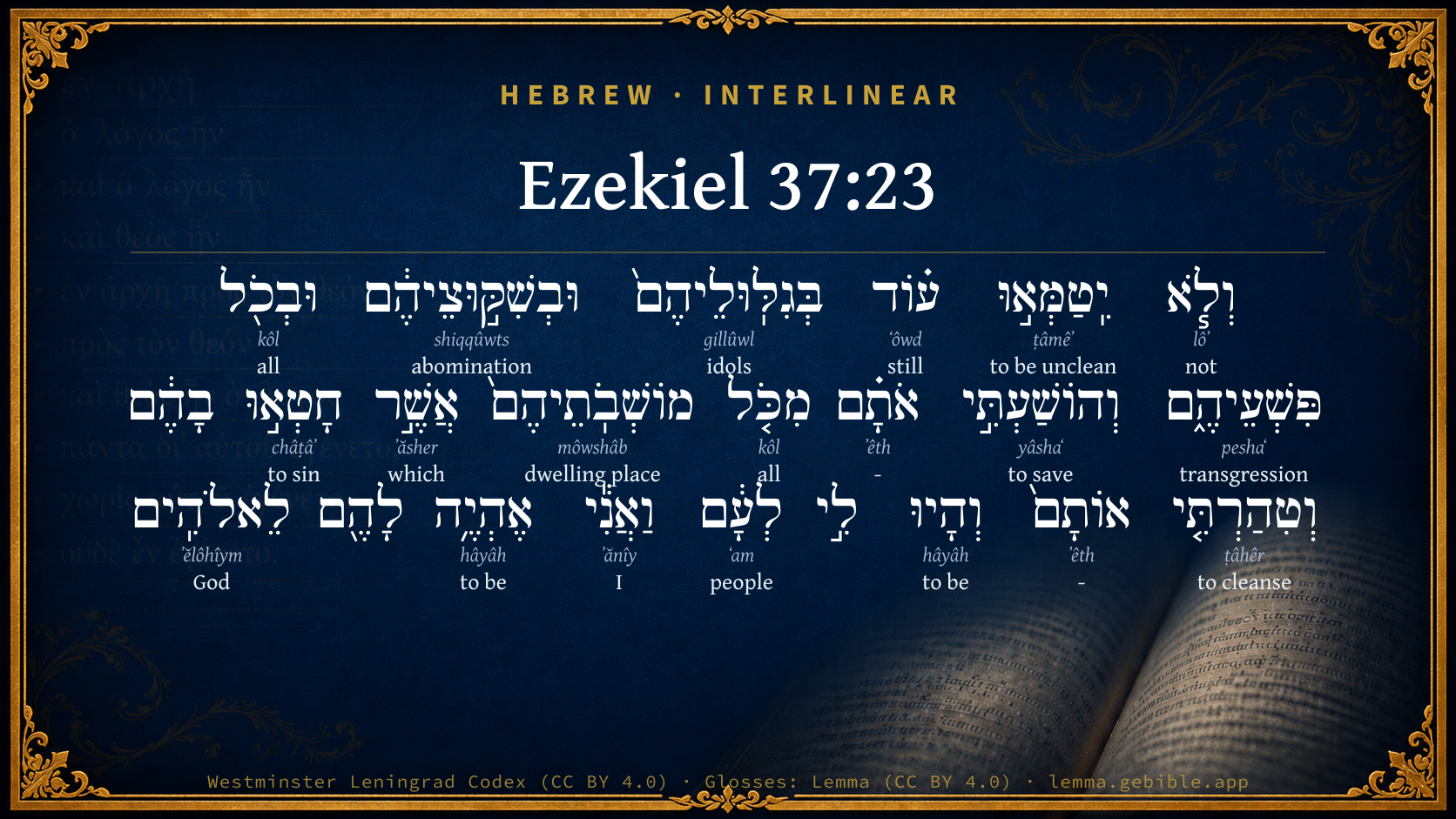
Hebrew (Westminster Leningrad Codex) Ezekiel 37:23 appears in the Hebrew Old Testament. The text above is from the Westminster Leningrad Codex. Each word links to its Strong’s number, a concise gloss, and parsing drawn from the Open Scriptures Hebrew Bible morphology. Click any word for its full Brown-Driver-Briggs (BDB) entry.
Download image
Cite this verse

Ezekiel 37:23 (World English Bible). Public Domain. Lemma interlinear Bible study tool, https://lemma.gebible.app/v/ezekiel/37/23.

Show BibTeX & RIS
BibTeX
RIS
English Translation
neither shall they defile themselves any more with their idols, nor with their detestable things, nor with any of their transgressions; but I will save them out of all their dwelling-places, in which they have sinned, and will cleanse them: so shall they be my people, and I will be their God.
World English Bible · Public Domain
Download a study sheet

One document with this verse’s original text, its word-by-word gloss line, the meaning frame, cross-references with their text, attributed commentary, and full source and license credits — printable, and it pastes into notes with its structure intact.

This verse Autodidact and up

Study sheet (.html) Plain text (.txt)

A passage Seminary Student

Up to 50 verses in one chapter. A passage sheet keeps up to 6 commentary sources and 12 cross-references per verse, in the order this page ranks them, and says so on the sheet whenever that leaves anything out. Ask for a single verse and you get the Autodidact verse sheet above.

Everything on this page stays free to read, with no account — the sheet is a download of what is already on screen, not access to it.

Want to remove ads? Support Godless Engineer
Compare translations 3

The same verse in 3 English versions, stacked beneath the original-language interlinear above. Click any original word for its lexicon entry.

Each is an independent rendering of the whole verse — the interlinear is not word-aligned to these translations.

Highlighted words mark where these versions differ — a whole-verse word diff, not a word-by-word alignment.

  • World English Bible Public Domain
    neither shall they defile themselves any more with their idols, nor with their detestable things, nor with any of their transgressions; but I will save them out of all their dwelling-places, in which they have sinned, and will cleanse them: so shall they be my people, and I will be their God.
  • King James Version Public Domain
    Neither shall they defile themselves any more with their idols, nor with their detestable things, nor with any of their transgressions: but I will save them out of all their dwellingplaces, wherein they have sinned, and will cleanse them: so shall they be my people, and I will be their God.
  • unfoldingWord Literal Text CC BY-SA 4.0
    Then they will no longer defile themselves with their idols, their disgusting things, or any of their other sins. For I will save them from all of their faithless actions with which they have sinned, and I will purify them, so they will be my people and I will be their God.

unfoldingWord Literal Text — © unfoldingWord, licensed CC BY-SA 4.0. Word-aligned USFM3 via Door43 (git.door43.org/unfoldingWord/en_ult).

Versions to compare (up to 4)

3 of 4 selected

Show all 18 translations

Every available English version of this verse, each an independent rendering of the whole verse.

  • World English Bible Public Domain
    neither shall they defile themselves any more with their idols, nor with their detestable things, nor with any of their transgressions; but I will save them out of all their dwelling-places, in which they have sinned, and will cleanse them: so shall they be my people, and I will be their God.
  • Berean Standard Bible Public Domain
    They will no longer defile themselves with their idols or detestable images, or with any of their transgressions. I will save them from all their apostasies by which they sinned, and I will cleanse them. Then they will be My people, and I will be their God.
  • Majority Standard Bible Public Domain
    They will no longer defile themselves with their idols or detestable images, or with any of their transgressions. I will save them from all their apostasies by which they sinned, and I will cleanse them. Then they will be My people, and I will be their God.
  • King James Version Public Domain
    Neither shall they defile themselves any more with their idols, nor with their detestable things, nor with any of their transgressions: but I will save them out of all their dwellingplaces, wherein they have sinned, and will cleanse them: so shall they be my people, and I will be their God.
  • American Standard Version (1901) Public Domain
    neither shall they defile themselves any more with their idols, nor with their detestable things, nor with any of their transgressions; but I will save them out of all their dwelling-places, wherein they have sinned, and will cleanse them: so shall they be my people, and I will be their God.
  • Revised Version (1885) Public Domain
    neither shall they defile themselves any more with their idols, nor with their detestable things, nor with any of their transgressions: but I will save them out of all their dwelling places, wherein they have sinned, and will cleanse them: so shall they be my people, and I will be their God.
  • Geneva Bible (1599) Public Domain
    Neither shall they bee polluted any more with their idoles, nor with their abominations, nor with any of their transgressions: but I will saue them out of all their dwelling places, wherein they haue sinned, and will clense them: so shall they be my people, and I will be their God.
  • Douay-Rheims (1899) Public Domain
    Nor shall they be defiled any more with their idols, nor with their abominations, nor with all their iniquities: and I will save them out of all the places in which they have sinned, and I will cleanse them: and they shall be my people, and I will be their God.
  • Young's Literal Translation Public Domain
    Nor are they defiled any more with their idols, And with their abominations, And with any of their transgressions, And I have saved them out of all their dwellings, In which they have sinned, And I have cleansed them, And they have been to Me for a people, And I -- I am to them for God.
  • Literal Standard Version CC BY-SA 4.0
    Nor are they defiled anymore with their idols, || And with their abominations, || And with any of their transgressions, || And I have saved them out of all their dwellings, || In which they have sinned, || And I have cleansed them, || And they have been to Me for a people, || And I am to them for God.
  • Unlocked Literal Bible CC BY-SA 4.0
    Then they will no longer defile themselves with their idols, their disgusting things, or any of their other sins. For I will save them from all of their faithless actions with which they have sinned, and I will purify them, so they will be my people and I will be their God.
  • unfoldingWord Literal Text CC BY-SA 4.0
    Then they will no longer defile themselves with their idols, their disgusting things, or any of their other sins. For I will save them from all of their faithless actions with which they have sinned, and I will purify them, so they will be my people and I will be their God.
  • Darby Bible Public Domain
    And they shall not defile themselves any more with their idols, or with their detestable things, or with any of their transgressions; and I will save them out of all their dwelling-places wherein they have sinned, and will cleanse them; and they shall be my people, and I will be their God.
  • World Messianic Bible Public Domain
    They won’t defile themselves any more with their idols, nor with their detestable things, nor with any of their transgressions; but I will save them out of all their dwelling places in which they have sinned, and will cleanse them. So they will be my people, and I will be their God.
  • Webster's Bible Public Domain
    Neither shall they defile themselves any more with their idols, nor with their detestable things, nor with any of their transgressions: but I will save them out of all their dwelling-places, in which they have sinned, and will cleanse them: so shall they be my people, and I will be their God.
  • Free Bible Version CC BY-SA 4.0
    They won't make themselves unclean anymore with their idols or disgusting images, or with any of their rebellious sins. I will save them from all their sins when they abandoned me, and I will make them clean. They will be my people, and I will be their God.
  • Bible in Basic English Public Domain
    And they will no longer make themselves unclean with their images or with their hated things or with any of their sins: but I will give them salvation from all their turning away in which they have done evil, and will make them clean; and they will be to me a people, and I will be to them a God.
  • JPS Tanakh (1917) Public Domain
    neither shall they defile themselves any more with their idols, nor with their detestable things, nor with any of their transgressions; but I will save them out of all their dwelling-places, wherein they have sinned, and will cleanse them; so shall they be My people, and I will be their God.

Literal Standard Version (2020), Covenant Press — licensed CC BY-SA 4.0. Text via the HelloAO Bible API (eBible.org). Unlocked Literal Bible (unfoldingWord) — licensed CC BY-SA 4.0. Text via the HelloAO Bible API (eBible.org). unfoldingWord Literal Text — © unfoldingWord, licensed CC BY-SA 4.0. Word-aligned USFM3 via Door43 (git.door43.org/unfoldingWord/en_ult). Free Bible Version, Dr. Jonathan Gallagher — licensed CC BY-SA 4.0. Text via the HelloAO Bible API (eBible.org).

Word by word

More ways to search: Search by grammar → Find every occurrence → Compare this word →

Practice this passage: Drill this verse → Learn its vocabulary →

וּבְשִׁקּ֣וּצֵיהֶ֔ם
shiqqûwts
H8251
“and · in/at · abominations · their”
Conjunction + Preposition + Noun, Common, Masculine, Plural, Construct + Suffix, Personal, 3rd Person, Masculine, Plural
Part of Speech
Conjunction + Preposition + Noun
Type
Common
Gender
Masculine
Number
Plural
State
Construct
Full BDB Definition

Origin: from H8262

TWOT: 2459b

detestable thing or idol, abominable thing, abomination, idol, detested thing
  1. וְלֹ֧א lôʼ H3808 “and · not” Conjunction + Particle, Negative
  2. יִֽטַמְּא֣וּ ṭâmêʼ H2930 “to be unclean” Verb, Hithpael, Imperfect, 3rd Person, Masculine, Plural
  3. ע֗וֹד ʻôwd H5750 “still” Adverb
  4. בְּגִלּֽוּלֵיהֶם֙ gillûwl H1544 “in/at · idols · their” Preposition + Noun, Common, Masculine, Plural, Construct + Suffix, Personal, 3rd Person, Masculine, Plural
  5. וּבְכֹ֖ל kôl H3605 “and · in/at · all of” Conjunction + Preposition + Noun, Common, Masculine, Singular, Construct
  6. פִּשְׁעֵיהֶ֑ם peshaʻ H6588 “transgressions · their” Noun, Common, Masculine, Plural, Construct + Suffix, Personal, 3rd Person, Masculine, Plural
  7. וְהוֹשַׁעְתִּ֣י yâshaʻ H3467 “and · to save” Conjunction + Verb, Hiphil, Sequential Perfect, 1st Person, Common, Singular
  8. אֹתָ֗ם ʼêth H853 “- · them” Particle, Direct Object + Suffix, Personal, 3rd Person, Masculine, Plural
  9. מִכֹּ֤ל kôl H3605 “from · all of” Preposition + Noun, Common, Masculine, Singular, Construct
  10. מוֹשְׁבֹֽתֵיהֶם֙ môwshâb H4186 “dwelling places · their” Noun, Common, Masculine, Plural, Construct + Suffix, Personal, 3rd Person, Masculine, Plural
  11. אֲשֶׁ֣ר ʼăsher H834 “which” Particle, Relative
  12. חָטְא֣וּ châṭâʼ H2398 “to sin” Verb, Qal, Perfect, 3rd Person, Common, Plural
  13. וְטִהַרְתִּ֤י ṭâhêr H2891 “and · to cleanse” Conjunction + Verb, Piel, Sequential Perfect, 1st Person, Common, Singular
  14. אוֹתָם֙ ʼêth H853 “- · them” Particle, Direct Object + Suffix, Personal, 3rd Person, Masculine, Plural
  15. וְהָיוּ hâyâh H1961 “and · to be” Conjunction + Verb, Qal, Sequential Perfect, 3rd Person, Common, Plural
  16. לְעָ֔ם ʻam H5971 “to/for · people” Preposition + Noun, Common, Masculine, Singular, Absolute
  17. וַאֲנִ֕י ʼănîy H589 “and · I” Conjunction + Pronoun, Personal, 1st Person, Common, Singular
  18. אֶהְיֶ֥ה hâyâh H1961 “to be” Verb, Qal, Imperfect, 1st Person, Common, Singular
  19. לֵאלֹהִֽים ʼĕlôhîym H430 “to/for · God(s)” Preposition + Noun, Common, Masculine, Plural, Absolute

About this verse

These counts appear in no published source. They are computed here, from the morphology-tagged text and Lemma’s own curated glosses. What Lemma adds →

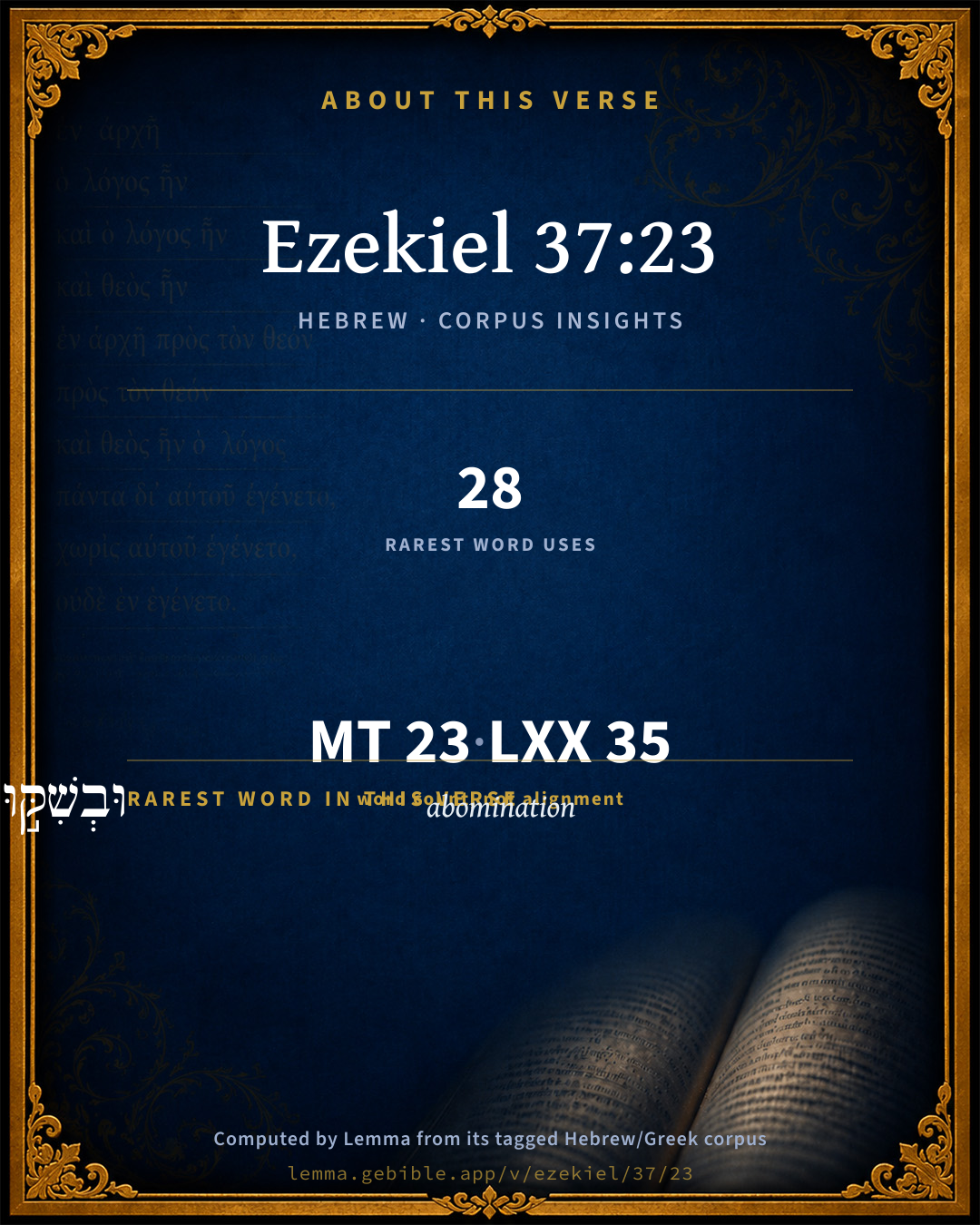
23
words
17
distinct lemmas
Prophets
section

Shared distinctive vocabulary

וּבְשִׁקּ֣וּצֵיהֶ֔ם abomination H8251 occurs in 26 verses of the Hebrew Bible. Also found in:

Grammatical profile

  • 6 verbs
  • 8 nouns
  • 1 pronoun
  • 3 prepositions
  • 1 adverb
  • 4 particles

Verb forms

  • יִֽטַמְּא֣וּ Hithpael · Imperfect
  • וְהוֹשַׁעְתִּ֣י Hiphil · Sequential Perfect
  • חָטְא֣וּ Qal · Perfect
  • וְטִהַרְתִּ֤י Piel · Sequential Perfect
  • וְהָיוּ Qal · Sequential Perfect
  • אֶהְיֶ֥ה Qal · Imperfect

Repetition

Words recur within this verse — often emphatic in Hebrew:

  • וּבְכֹ֖ל all H3605 ×2
  • וְהָיוּ to be H1961 ×2

Hebrew & Septuagint length

In English translation the verse runs 52 words from the Hebrew and 45 from the Septuagint (LXX English) — closely comparable.

A rough comparison of the two English renderings, which tokenize alike — not a word-level alignment.

Word counts can differ between the Hebrew and the Greek without any difference in meaning — e.g. the Hebrew direct-object marker אֵת has no separate Greek word, and Greek often adds the article ὁ.

In the original languages it is 23 Hebrew tokens and 35 Greek tokens — but the two are counted differently (Hebrew bundles its prefixes and suffixes into one token; the Greek is in lemma form), so that isn’t a like-for-like length.

Cross-references

27

Topical passages linked to Ezekiel 37:23 in the Treasury of Scripture Knowledge — connected by theme and wording, ordered by reader-vote popularity; previews shown in the World English Bible.

  • Revelation 21:3–4 I heard a loud voice out of heaven saying, "Behold, God's dwelling is with people, and he will dwell with them, and they will be his people, and God himself will be with them as their God.
  • Ezekiel 36:28–29 You shall dwell in the land that I gave to your fathers; and you shall be my people, and I will be your God.
  • 1 John 1:9 If we confess our sins, he is faithful and righteous to forgive us the sins, and to cleanse us from all unrighteousness.
  • Zechariah 13:1–2 "In that day there will be a spring opened to the house of David and to the inhabitants of Jerusalem, for sin and for uncleanness.
  • Ephesians 5:26–27 that he might sanctify it, having cleansed it by the washing of water with the word,
  • 1 John 1:7 But if we walk in the light, as he is in the light, we have fellowship with one another, and the blood of Jesus Christ, his Son, cleanses us from all sin.
  • Revelation 21:7 He who overcomes, I will give him these things. I will be his God, and he will be my son.
  • Hosea 14:8 Ephraim, what have I to do any more with idols? I answer, and will take care of him. I am like a green fir tree; From me your fruit is found."
  • Genesis 17:7–8 I will establish my covenant between me and you and your seed after you throughout their generations for an everlasting covenant, to be a God to you and to your seed after you.
  • Leviticus 20:7–8 "'Sanctify yourselves therefore, and be holy; for I am Yahweh your God.
  • Psalms 68:20 God is to us a God of deliverance. To Yahweh, the Lord, belongs escape from death.
  • Psalms 68:35 You are awesome, God, in your sanctuaries. The God of Israel gives strength and power to his people. Praise be to God!
  • Isaiah 2:18 The idols shall utterly pass away.
  • Jeremiah 31:1 At that time, says Yahweh, will I be the God of all the families of Israel, and they shall be my people.
  • Jeremiah 31:33 But this is the covenant that I will make with the house of Israel after those days, says Yahweh: I will put my law in their inward parts, and in their heart will I write it; and I will be their God, and they shall be my people:
  • Jeremiah 32:38–39 and they shall be my people, and I will be their God:
  • Ezekiel 20:43 There shall you remember your ways, and all your doings, in which you have polluted yourselves; and you shall loathe yourselves in your own sight for all your evils that you have committed.
  • Ezekiel 36:24–25 For I will take you from among the nations, and gather you out of all the countries, and will bring you into your own land.
  • Ezekiel 36:31 Then shall you remember your evil ways, and your doings that were not good; and you shall loathe yourselves in your own sight for your iniquities and for your abominations.
  • Ezekiel 37:27 My tent also shall be with them; and I will be their God, and they shall be my people.
  • Ezekiel 39:22 So the house of Israel shall know that I am Yahweh their God, from that day and forward.
  • Ezekiel 43:7–8 He said to me, Son of man, [this is] the place of my throne, and the place of the soles of my feet, where I will dwell in the midst of the children of Israel forever. The house of Israel shall no more defile my holy name, neither they, nor their kings, by their prostitution, and by the dead bodies of their kings [in] their high places;
  • Hosea 1:10 Yet the number of the children of Israel will be as the sand of the sea, which can't be measured nor numbered; and it will come to pass that, in the place where it was said to them, 'You are not my people,' they will be called 'sons of the living God.'
  • Micah 7:14 Shepherd your people with your staff, The flock of your heritage, Who dwell by themselves in a forest, In the midst of fertile pasture land, let them feed; In Bashan and Gilead, as in the days of old.
  • Zechariah 14:21 Yes, every pot in Jerusalem and in Judah will be holy to Yahweh of Hosts; and all those who sacrifice will come and take of them, and cook in them. In that day there will no longer be a Canaanite in the house of Yahweh of Hosts.
  • Hebrews 9:13–14 For if the blood of goats and bulls, and the ashes of a heifer sprinkling those who have been defiled, sanctify to the cleanness of the flesh:
  • Zechariah 13:9 I will bring the third part into the fire, And will refine them as silver is refined, And will test them like gold is tested. They will call on my name, and I will hear them. I will say, 'It is my people;' And they will say, 'Yahweh is my God.'"

Cross-references courtesy of OpenBible.info (CC BY 4.0).

Hebrew and Greek witnesses Masoretic Hebrew ↔ Greek Septuagint

The same verse in the two great witnesses to the Old Testament, shown verse-for-verse.

These are two independent witnesses, not word-aligned to each other, and the Septuagint is shown in lemma (dictionary) form.

Hebrew Ezekiel 37:23 Masoretic · Westminster Leningrad Codex

וְלֹ֧א יִֽטַמְּא֣וּ ע֗וֹד בְּגִלּֽוּלֵיהֶם֙ וּבְשִׁקּ֣וּצֵיהֶ֔ם וּבְכֹ֖ל פִּשְׁעֵיהֶ֑ם וְהוֹשַׁעְתִּ֣י אֹתָ֗ם מִכֹּ֤ל מוֹשְׁבֹֽתֵיהֶם֙ אֲשֶׁ֣ר חָטְא֣וּ בָהֶ֔ם וְטִהַרְתִּ֤י אוֹתָם֙ וְהָיוּ לִ֣י לְעָ֔ם וַאֲנִ֕י אֶהְיֶ֥ה לָהֶ֖ם לֵאלֹהִֽים

neither shall they defile themselves any more with their idols, nor with their detestable things, nor with any of their transgressions; but I will save them out of all their dwelling-places, in which they have sinned, and will cleanse them: so shall they be my people, and I will be their God.

World English Bible · Public Domain

Greek LXX Ezekiel 37:23 Septuagint · lemma form

ἵνα μή μιαίνω ἔτι ἐν ὁ εἴδωλον αὐτός καί ῥύομαι αὐτός ἀπό πᾶς ὁ ἀνομία αὐτός ὅς ἁμαρτάνω ἐν αὐτός καί καθαρίζω αὐτός καί εἰμί ἐγώ εἰς λαός καί ἐγώ κύριος εἰμί αὐτός εἰς θεός

that they may no more defile themselves with their idols; and I will deliver them from all their transgressions whereby they have sinned, and will cleanse them; and they shall be to me a people, and I the Lord will be to them a God.

LXX2012 (modern English Septuagint) · Public Domain

On this verse, The Cambridge Bible for Schools and Colleges discusses the Septuagint’s reading. Read the note in Commentary ↓

Hebrew: Westminster Leningrad Codex (CC BY 4.0). Greek: Septuagint (public domain); English from LXX2012 (modern English Septuagint) (Public Domain). How the Septuagint differs from the Hebrew →

Targum (Aramaic paraphrase)

1

The Targum is the ancient Jewish Aramaic paraphrase of the Hebrew Scriptures — an interpretive translation, not the Hebrew text itself. Onkelos (literal) and Pseudo-Jonathan (expansive) render the Torah, and Jonathan the Prophets. Coverage is partial: where no permissively-licensed English translation exists for a verse, only the Aramaic is shown. This is verse-level text, not a word-by-word alignment to the Hebrew.

  1. Targum Jonathan Prophets (Joshua–Malachi)
    וְלָא יִסְתָּאֲבוּן עוֹד בְּמַעֲוָתְהוֹן וּבְשִׁקוּצֵיהוֹן וּבְכָל מֵירְדֵיהוֹן וְאֶפְרוֹק יַתְהוֹן מִכָּל מוֹתְבָנֵיהוֹן דְחָבוּ קֳדָמַי בְּהוֹן וְאַדְכֵּי יַתְהוֹן וִיהוֹן קֳדָמַי לְעַם וַאֲנָא אֶהֱוֵי לְהוֹן לֵאלָהָא:

    (no public-domain English translation for this verse)

    Targum Jonathan — Aramaic: “Mikraot Gedolot” (public domain). English: “Sefaria Community Translation” (CC0 1.0 (public-domain dedication)); “London "Chaldee Paraphrase," 1871” (public domain). Text via Sefaria.

Commentary

Notes on Ezekiel 37:23 from classic Christian and Jewish commentators (each source and its license shown beneath its notes). The classic Christian expositions comment on the surrounding passage and are grouped to its opening verse, so a note may address several verses; the Jewish commentaries on the Tanakh (Rashi and others) are per-verse, so they appear only where the commentator wrote on this verse.

Lemma curates 59 commentaries, every one of them public domain or Creative Commons licensed, each selected and text-cleaned for this edition rather than reprinted as found. About our sources →

Trapp's Complete Commentary

John Trapp

Eze 37:23 Neither shall they defile themselves any more with their idols, nor with their detestable things, nor with any of their transgressions: but I will save them out of all their dwellingplaces, wherein they have sinned, and will cleanse them: so shall they be my people, and I will be their God.

Ver. 23. Neither shall they defile.] After the captivity the Jews could never endure idolatry. The Popish image worship is at this day a very great stumblingblock to them.

Out of all their dwellingplaces.] Where, being mingled among the heathen, they learned their works. {Psa 106:35}

John Trapp, A Commentary or Exposition upon All the Books of the Old and New Testament (1647–1656) — public domain. Text from a community e-Sword module.

Whedon's Commentary on the Bible

Daniel D. Whedon

23-28. The new Israel will not be defiled by idolatry, but God will cleanse them and save them from the temptations connected with their ancient dwelling places, and “from all their backslidings” (Eze_37:23, R.V., margin), and a new David, who shall live forever (Eze_37:25), shall be their shepherd-king (Eze_37:24; compare Eze_34:23-24), and they shall dwell in the land which was promised to Jacob and to Abraham before him, though he never made a sandal track in it (Act_7:5); and it shall be to them and to their children an inheritance forever, according to the new “covenant of peace” (compare Eze_34:25; Eze_16:60), and Jehovah will place them (or “give it them”) and set his sanctuary in the midst of them (Lev_26:11), and his “dwelling place” shall be with them (Eze_37:27; Eze_48:35), and the “nations” shall know that he is the Lord that doth sanctify Israel when his holy sanctuary is permitted to abide in the midst of the nation; which must therefore have been sanctified or separated unto himself as a holy possession. (Compare note Eze_37:15-22; 2Co_6:16; Rev_21:22.)

Daniel D. Whedon (gen. ed.), Commentary on the Old and New Testaments (1874–1909) — public domain. Text from a community e-Sword module.

Jamieson, Fausset & Brown

Robert Jamieson, A. R. Fausset & David Brown

(Eze 36:25).

out of . . . their dwelling-places-- (Eze 36:28, Eze 36:33). I will remove them from the scene of their idolatries to dwell in their own land, and to serve idols no more.

Jamieson, Fausset & Brown — Commentary Critical and Explanatory on the Whole Bible (1871) — public domain (CC PDM 1.0). Text via the HelloAO Bible API.

Ellicott's Commentary for English Readers

(23) Out of all their dwellingplaces.—This expression can hardly refer to their places of exile and temporary sojourn among the heathen, since these were not especially the places where they had sinned. Their sins were rather committed in their own land; the “lands of their captivity” were the places where those sins were punished. “Their dwelling places” is then to be understood of their own land of Canaan, where they had been led into idolatry and all abominations by the heathen dwelling among them; and the promise is that this land shall be purged, that all evil shall be cast out from it, and the people delivered from the temptations by which they had hitherto been overcome.

A Bible Commentary for English Readers, edited by Charles John Ellicott (1878–1897) — public domain. Text from a community e-Sword module.

The Cambridge Bible for Schools and Colleges

gen. ed. J. J. S. Perowne

23. Cf. Eze_36:25.

all their dwelling places] More probably: out of all their backslidings. So LXX., cf. Eze_36:29.

The Cambridge Bible for Schools and Colleges (gen. ed. J. J. S. Perowne; Cambridge University Press, 1878–1918) — public domain. Text from a community e-Sword module.

John Gill's Exposition

Neither shall they defile themselves any more with their idols,....

With their dung, or dunghill gods (g); either with the idols of the Gentiles, or their own: after their return from the Babylonish captivity, the Jews were no more addicted to idolatry; and the image worship of the Papists is an abhorrence to them at this day, and a stumblingblock to them in their embracing Christianity: and when they are effectually called and converted to Christ; they will no more have respect to the idols, the works of their own hands; or to the idol of their own righteousness, which they have set up, and have gone about to establish, and to make to stand; they will then see it to be as filthy rags, defiling to them, instead of justifying of them; and therefore shall reject it, and no more defile themselves with it; but seek the righteousness of Christ, which justifies from all sin, and renders pure and spotless in the sight of God,

nor with their detestable things; or "abominations" (h); the traditions of the elders, which they have preferred to the word of God, and made the rule of their faith, worship, and conversation; which has made them detestable unto God:

nor with any of their transgressions; particularly their disbelief of Christ and their blasphemy against him; nor shall they indulge themselves in those sins which now prevail among them, as pride, covetousness, uncleanness, fraud, and tricking in their trade and commerce:

but I will save them out of all their dwelling places, wherein they have sinned; as wherever they dwell they do; they are notorious for their wickedness; but God will bring them out of all these places, where they have lived in sin, and been the occasion of it to some, as well as followed the example of others:

and will cleanse them; by sprinkling clean water upon them; by applying the blood of Christ to them, which cleanses from all sin see Eze 36:25,

so they shall be my people, and will be their God; the "loammi" will be taken off, and the covenant of grace shall be renewed with them, and made manifest to them; and the blessings and promises shall be applied to them, and particularly this; see Jer 31:1.

(g) "diis stercoreis suis", Junius & Tremellius, Polanus; "stercoribus suis", Cocceius, Starckius. (h) "abominandis suis", Starckius; "abominationibus", Pagninus, Cocceius.

John Gill's Exposition of the Whole Bible (1746–1763) — public domain (CC PDM 1.0). Text via the HelloAO Bible API.

Haydock's Catholic Bible Commentary

Idols. The Jews, even many of the priests, worshipped them, under Antiochus. (Calmet) --- But the Church is never defiled. (Haydock)

George Leo Haydock (1774–1849), Haydock's Catholic Family Bible and Commentary, 1859 edition — public domain. Excludes Psalms (Douay-Rheims chapter numbering differs from Protestant) and Deuterocanonical books (Catholic canon only).

Matthew Poole's English Annotations

Defile themselves: idolatry is a very defiling sin, and the Jews in both kingdoms were exceedingly addicted to it, pertinacious in it, to the utter ruin of both kingdoms; but after the return from Babylonish captivity, we find no where that they fell to idolatry.

Their idols: it may refer to the heathen, and then it means, they shall not defile themselves with the idols the heathen did worship; or to the idols of the Jews, their own idols, with which they shall no more be defiled.

Their detestable things; the same with idols, and added to set out the loathsomeness of the sin. Their transgressions; the former obstinate, bold, daring transgressors did that which these shall not defile themselves with: see Eze 36:25,33; 11:17,18. I will save them; whilst there I preserved them, and now I will bring them safe out of the places.

Wherein they have sinned; where out of a bad fear, or worse choice, they sinned, as did the heathen with whom they dwelt.

Will cleanse them; both sanctify and make them holy, and justify and give them pardon, Eze 36:29. My people: see Eze 11:20; 36:28.

Matthew Poole's English Annotations on the Holy Bible (1683–1685) — public domain. Text from a community e-Sword/MySword module.

The Pulpit Commentary

The dwelling-places wherein they have sinned, from which Jehovah premises to save them, are in accordance with the views expressed above, not, as Hengstenberg and Hitzig conjecture, the dwelling-places of the exile in which the people then were, but the dwelling-places in Canaan in which they had formerly transgressed, but would in future be preserved from transgressing. The idea is, as Schroder suggests, the localization of transgression which is viewed as proceeding from the dwelling-places in which it is committed; or, according to Plumptre, the conception is that, as their habitations had formerly been contaminated by their detestable things, "the worship of teraphim and such like, if not worse," so Jehovah would save them from that contamination. The proposal to alter the text by the transposition of a letter, converting moshbhothehem, "dwelling-places," into meshubhothehem," defections," as in Jer_3:22, (comp. Eze_36:29) though adopted by some ancient versions and favored by Ewald and Smend, is not necessary. The fascination of idolatry.

Idolatry was a besetting sin of Israel. No sooner were the people delivered from Egypt by the great unseen God than they made a golden calf. Intercourse with the Moabites led to idolatry in a later stage of the wilderness-wanderings. (Num_25:2) The story of Micah and his god gives us a glimpse of the gross popular superstition that was to be found in Israel during the days of the judges. (Jud_1:17:4) Solomon in all his glory was lured to idolatry by foreign heathenish wives. (1Ki_11:4) The separated northern tribes emphasized their schism by setting up calves at Dan and Bethel. The prophets were compelled to denounce idolatry, and the doom of the Captivity was largely earned by this sin. (Eze_14:7) What is its essential character? and whence does it draw its singular fascination?

I THE SURVIVAL OF ANTIQUITY. Joshua reminded the people that their fathers worshipped "other gods". (Jos_24:2) The Hebrews cannot be described as an originally and naturally monotheistic race. Monotheism does not seem to be innate in any branch of the Semitic family. On the contrary, it is much more readily traced in the early history of the Aryan races. The Semitic instinct rather points to cruel and lustful nature-worship, accompanied by gross idolatry, although by the inspiration of their prophets the Hebrews were called out of this low form of religion to the worship of the holy Jehovah. Superstitions of idolatry linger long after a more spiritual worship.is established. This is seen in missionary lands; and even in Europe heathenish customs are mixed up with Christian belief. Much of the corruption of Christianity in Romanism is just the perpetuation of the old paganism under Christian names.

II THE CONTAGION OF EXAMPLE. The Jews were surrounded by heathen peoples. They were called to a lonely destiny of separation. But they did not always realize their vocation. Their later idolatry was an importation from their neighbors. Men are much influenced in religion by what is called "the spirit of the times," by the fashion of the day, by the stream of prevalent customs. It is hard to make our religion a continual protest against popular ideas and practices.

III THE CHARM OF THE SENSUOUS. Idols were visible, tangible objects. It was so much easier to offer worship to such things than to the unseen God of heaven. It is our perpetual temptation to neglect the spiritual for the material. We do not prostrate ourselves before calves of gold; but we are tempted to worship coins of gold. Our idol-temples are the marts of commerce. The British Parthenon is the Bank of England. The whole tendency of life is towards absorption in things temporal, concrete, visible eating and drinking, clothing and building, merry-making and amusements. Even in religion we tend to degenerate to the sensuous, and music and pageantry threaten to supersede worship and meditation. The visible ritual endangers the invisible devotion. All this is idolatry.

IV THE COMFORT OF A LOW IDEAL. The intellectual strain of spiritual worship is not its most exacting characteristic. God is not only unseen; he is holy, and he can only be approached with clean hands and a pure heart. The religion of Israel was a religion of holiness. This was its most marked feature in contrast with heathenism. It was possible to satisfy all the demands of idolatry and yet to remain in sin. Nay, much of the monstrous ritual of idol-worship consisted in the indulgence of licentious passions. It was much easier to worship idols than to worship the holy God. A worldly life is compatible with a low moral standard. Hence the temptation to be satisfied with this life. But Christ calls us to the loftiest ideal and to a warfare against sin. We must take up the cross if we would follow him.

The Pulpit Commentary (1880–1919), ed. H.D.M. Spence-Jones & Joseph S. Exell — public domain. Text from a community e-Sword module.

John Wesley's Explanatory Notes

I will save - I will bring them safe out of them. And will cleanse - Both justify and sanctify them.

John Wesley, Explanatory Notes Upon the Whole Bible (1754–1765) — public domain. Text via the GEBible commentary corpus.

Lesson kit

Teaching starters — assembled from the data on this page, not authored interpretation. Every prompt links to the verse data it draws on. Edit before teaching.

Ezekiel, in the Prophets, opens this verse with 23 words (17 distinct Hebrew lemmas). Its most distinctive word is shiqqûwts (“abomination”). A historical commentator’s framing appears above. Read the whole chapter for the surrounding context.

Discussion questions

  1. What does “abomination” (shiqqûwts) contribute to the verse as a whole?
  2. Deuteronomy 29:17 shares the word «abomination» with this verse. How do the two illuminate each other?
  3. “all” occurs 2× in this one verse. What is the effect of the repetition?
  4. The translations on this page render this verse differently — a whole-verse word diff, not a word-by-word alignment. What might account for the different wordings?
  5. The verb «יִֽטַמְּא֣וּ» is Hithpael Imperfect. How does its form color the action?
  6. Reading how Trapp's Complete Commentary and Whedon's Commentary on the Bible read this verse, where do the two commentators agree and where do they part?

Things to notice

Reading settings

Reading text

Shown beneath each verse's original-language words.

Old Testament
Old Testament edition

Read the OT as the Masoretic Hebrew (MT) or the Greek Septuagint (LXX).

English shown for the Greek Septuagint (in the Hebrew ↔ Greek comparison).

Comparing translations? Open the Compare panel on any verse page to stack up to four side by side.