
1 Samuel 7:6

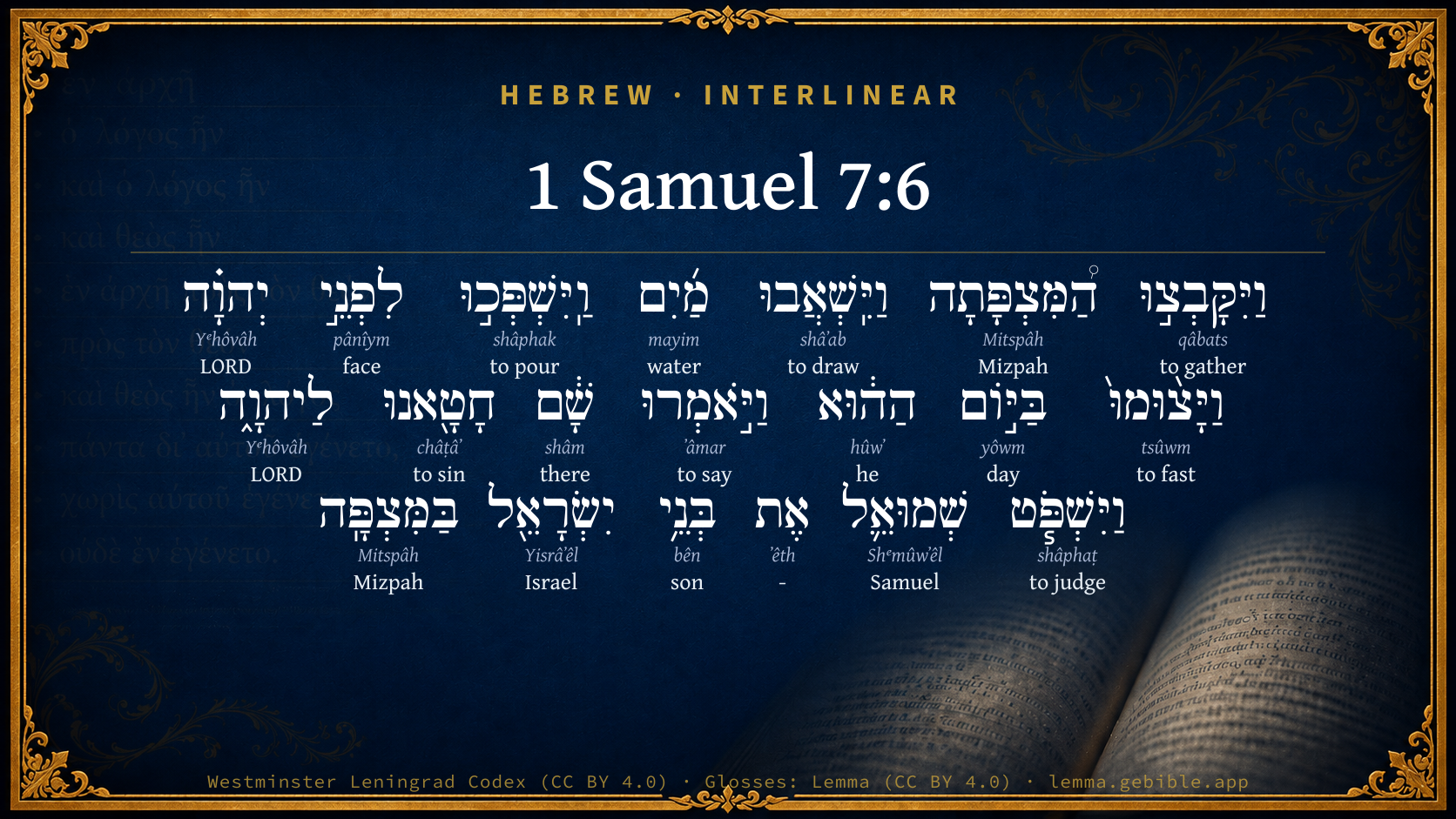
Hebrew (Westminster Leningrad Codex) 1 Samuel 7:6 appears in the Hebrew Old Testament. The text above is from the Westminster Leningrad Codex. Each word links to its Strong’s number, a concise gloss, and parsing drawn from the Open Scriptures Hebrew Bible morphology. Click any word for its full Brown-Driver-Briggs (BDB) entry.
Download image
Cite this verse

1 Samuel 7:6 (World English Bible). Public Domain. Lemma interlinear Bible study tool, https://lemma.gebible.app/v/1-samuel/7/6.

Show BibTeX & RIS
BibTeX
RIS
English Translation
They gathered together to Mizpah, and drew water, and poured it out before Yahweh, and fasted on that day, and said there, We have sinned against Yahweh. Samuel judged the children of Israel in Mizpah.
World English Bible · Public Domain
Download a study sheet

One document with this verse’s original text, its word-by-word gloss line, the meaning frame, cross-references with their text, attributed commentary, and full source and license credits — printable, and it pastes into notes with its structure intact.

This verse Autodidact and up

Study sheet (.html) Plain text (.txt)

A passage Seminary Student

Up to 50 verses in one chapter. A passage sheet keeps up to 6 commentary sources and 12 cross-references per verse, in the order this page ranks them, and says so on the sheet whenever that leaves anything out. Ask for a single verse and you get the Autodidact verse sheet above.

Everything on this page stays free to read, with no account — the sheet is a download of what is already on screen, not access to it.

Want to remove ads? Support Godless Engineer
Compare translations 3

The same verse in 3 English versions, stacked beneath the original-language interlinear above. Click any original word for its lexicon entry.

Each is an independent rendering of the whole verse — the interlinear is not word-aligned to these translations.

Highlighted words mark where these versions differ — a whole-verse word diff, not a word-by-word alignment.

  • World English Bible Public Domain
    They gathered together to Mizpah, and drew water, and poured it out before Yahweh, and fasted on that day, and said there, We have sinned against Yahweh. Samuel judged the children of Israel in Mizpah.
  • King James Version Public Domain
    And they gathered together to Mizpeh, and drew water, and poured it out before the LORD, and fasted on that day, and said there, We have sinned against the LORD. And Samuel judged the children of Israel in Mizpeh.
  • unfoldingWord Literal Text CC BY-SA 4.0
    And they gathered at Mizpah, and they drew water and poured to the face of Yahweh. And they fasted on that day, and they said there, “We have sinned against Yahweh.” And Samuel judged the sons of Israel at Mizpah.

unfoldingWord Literal Text — © unfoldingWord, licensed CC BY-SA 4.0. Word-aligned USFM3 via Door43 (git.door43.org/unfoldingWord/en_ult).

Versions to compare (up to 4)

3 of 4 selected

Show all 18 translations

Every available English version of this verse, each an independent rendering of the whole verse.

  • World English Bible Public Domain
    They gathered together to Mizpah, and drew water, and poured it out before Yahweh, and fasted on that day, and said there, We have sinned against Yahweh. Samuel judged the children of Israel in Mizpah.
  • Berean Standard Bible Public Domain
    When they had gathered at Mizpah, they drew water and poured it out before the LORD. On that day they fasted, and there they confessed, “We have sinned against the LORD.” And Samuel judged the Israelites at Mizpah.
  • Majority Standard Bible Public Domain
    When they had gathered at Mizpah, they drew water and poured it out before the LORD. On that day they fasted, and there they confessed, “We have sinned against the LORD.” And Samuel judged the Israelites at Mizpah.
  • King James Version Public Domain
    And they gathered together to Mizpeh, and drew water, and poured it out before the LORD, and fasted on that day, and said there, We have sinned against the LORD. And Samuel judged the children of Israel in Mizpeh.
  • American Standard Version (1901) Public Domain
    And they gathered together to Mizpah, and drew water, and poured it out before Jehovah, and fasted on that day, and said there, We have sinned against Jehovah. And Samuel judged the children of Israel in Mizpah.
  • Revised Version (1885) Public Domain
    And they gathered together to Mizpah, and drew water, and poured it out before the LORD, and fasted on that day, and said there, We have sinned against the LORD. And Samuel judged the children of Israel in Mizpah.
  • Geneva Bible (1599) Public Domain
    And they gathered together to Mizpeh, and drewe water and powred it out before the Lord, and fasted the same day, and sayd there, We haue sinned against the Lord. And Samuel iudged the children of Israel in Mizpeh.
  • Douay-Rheims (1899) Public Domain
    And they gathered together to Masphath: and they drew water, and poured it out before the Lord, and they fasted on that day, and they said there: We have sinned against the Lord. And Samuel judged the children of Israel in Masphath.
  • Young's Literal Translation Public Domain
    And they are gathered to Mizpeh, and draw water, and pour out before Jehovah, and fast on that day, and say there, `We have sinned against Jehovah;' and Samuel judgeth the sons of Israel in Mizpeh.
  • Literal Standard Version CC BY-SA 4.0
    And they are gathered to Mizpeh, and draw water, and pour out before YHWH, and fast on that day, and say there, “We have sinned against YHWH”; and Samuel judges the sons of Israel in Mizpeh.
  • Unlocked Literal Bible CC BY-SA 4.0
    They gathered at Mizpah, drew water and poured it out before Yahweh. They fasted that day and said, “We have sinned against Yahweh.” It was there that Samuel decided disputes for the people of Israel and led the people.
  • unfoldingWord Literal Text CC BY-SA 4.0
    And they gathered at Mizpah, and they drew water and poured to the face of Yahweh. And they fasted on that day, and they said there, “We have sinned against Yahweh.” And Samuel judged the sons of Israel at Mizpah.
  • Darby Bible Public Domain
    And they gathered together to Mizpah, and drew water, and poured it out before Jehovah, and fasted on that day, and said there, We have sinned against Jehovah. And Samuel judged the children of Israel in Mizpah.
  • World Messianic Bible Public Domain
    They gathered together to Mizpah, and drew water, and poured it out before the LORD, and fasted on that day, and said there, “We have sinned against the LORD.” Samuel judged the children of Israel in Mizpah.
  • Webster's Bible Public Domain
    And they assembled at Mizpeh, and drew water, and poured it out before the LORD, and fasted on that day, and there said, We have sinned against the LORD. And Samuel judged the children of Israel in Mizpeh.
  • Free Bible Version CC BY-SA 4.0
    Once they had gathered at Mizpah, they drew water and poured it out before the Lord. They fasted that day, and admitted, “We have sinned against the Lord.” Samuel became the leader of the Israelites at Mizpah.
  • Bible in Basic English Public Domain
    So they came together to Mizpah, and got water, draining it out before the Lord, and they took no food that day, and they said, We have done evil against the Lord. And Samuel was judge of the children of Israel in Mizpah.
  • JPS Tanakh (1917) Public Domain
    And they gathered together to Mizpah, and drew water, and poured it out before the LORD, and fasted on that day, and said there: 'We have sinned against the LORD.' And Samuel judged the children of Israel in Mizpah.

Literal Standard Version (2020), Covenant Press — licensed CC BY-SA 4.0. Text via the HelloAO Bible API (eBible.org). Unlocked Literal Bible (unfoldingWord) — licensed CC BY-SA 4.0. Text via the HelloAO Bible API (eBible.org). unfoldingWord Literal Text — © unfoldingWord, licensed CC BY-SA 4.0. Word-aligned USFM3 via Door43 (git.door43.org/unfoldingWord/en_ult). Free Bible Version, Dr. Jonathan Gallagher — licensed CC BY-SA 4.0. Text via the HelloAO Bible API (eBible.org).

Word by word

More ways to search: Search by grammar → Find every occurrence → Compare this word →

Practice this passage: Drill this verse → Learn its vocabulary →

וַיִּֽשְׁאֲבוּ
shâʼab
H7579
“and · to draw”
Conjunction + Verb, Qal, Sequential Imperfect, 3rd Person, Masculine, Plural
Part of Speech
Conjunction + Verb
Stem
Qal
Form
Sequential Imperfect
Person
3rd Person
Gender
Masculine
Number
Plural
Full BDB Definition

Origin: a primitive root

TWOT: 2299 . 1

to draw (water) - (Qal) - to draw (water) - water-drawing women (participle)
  1. וַיִּקָּבְצ֣וּ qâbats H6908 “and · to gather” Conjunction + Verb, Niphal, Sequential Imperfect, 3rd Person, Masculine, Plural
  2. הַ֠מִּצְפָּתָה Mitspâh H4709 “the · Mizpah · toward” Particle, Definite Article + Noun, Proper + Suffix, Demonstrative
  3. מַ֜יִם mayim H4325 “water(s)” Noun, Common, Masculine, Plural, Absolute
  4. וַֽיִּשְׁפְּכ֣וּ shâphak H8210 “and · to pour” Conjunction + Verb, Qal, Sequential Imperfect, 3rd Person, Masculine, Plural
  5. לִפְנֵ֣י pânîym H6440 “to/for · face(s) of” Preposition + Noun, Common, Both, Plural, Construct
  6. יְהוָ֗ה Yᵉhôvâh H3068 “LORD” Noun, Proper
  7. וַיָּצ֨וּמוּ֙ tsûwm H6684 “and · to fast” Conjunction + Verb, Qal, Sequential Imperfect, 3rd Person, Masculine, Plural
  8. בַּיּ֣וֹם yôwm H3117 “in/at the · day” Preposition, Determined + Noun, Common, Masculine, Singular, Absolute
  9. הַה֔וּא hûwʼ H1931 “the · he” Particle, Definite Article + Pronoun, Personal, 3rd Person, Masculine, Singular
  10. וַיֹּ֣אמְרוּ ʼâmar H559 “and · to say” Conjunction + Verb, Qal, Sequential Imperfect, 3rd Person, Masculine, Plural
  11. שָׁ֔ם shâm H8033 “there” Adverb
  12. חָטָ֖אנוּ châṭâʼ H2398 “to sin” Verb, Qal, Perfect, 1st Person, Common, Plural
  13. לַיהוָ֑ה Yᵉhôvâh H3068 “to/for · LORD” Preposition + Noun, Proper
  14. וַיִּשְׁפֹּ֧ט shâphaṭ H8199 “and · to judge” Conjunction + Verb, Qal, Sequential Imperfect, 3rd Person, Masculine, Singular
  15. שְׁמוּאֵ֛ל Shᵉmûwʼêl H8050 “Samuel” Noun, Proper
  16. אֶת ʼêth H853 “-” Particle, Direct Object
  17. בְּנֵ֥י bên H1121 “sons of” Noun, Common, Masculine, Plural, Construct
  18. יִשְׂרָאֵ֖ל Yisrâʼêl H3478 “Israel” Noun, Proper
  19. בַּמִּצְפָּֽה Mitspâh H4709 “in/at the · Mizpah” Preposition, Determined + Noun, Proper

About this verse

These counts appear in no published source. They are computed here, from the morphology-tagged text and Lemma’s own curated glosses. What Lemma adds →

20
words
18
distinct lemmas
Historical
section

Notable vocabulary

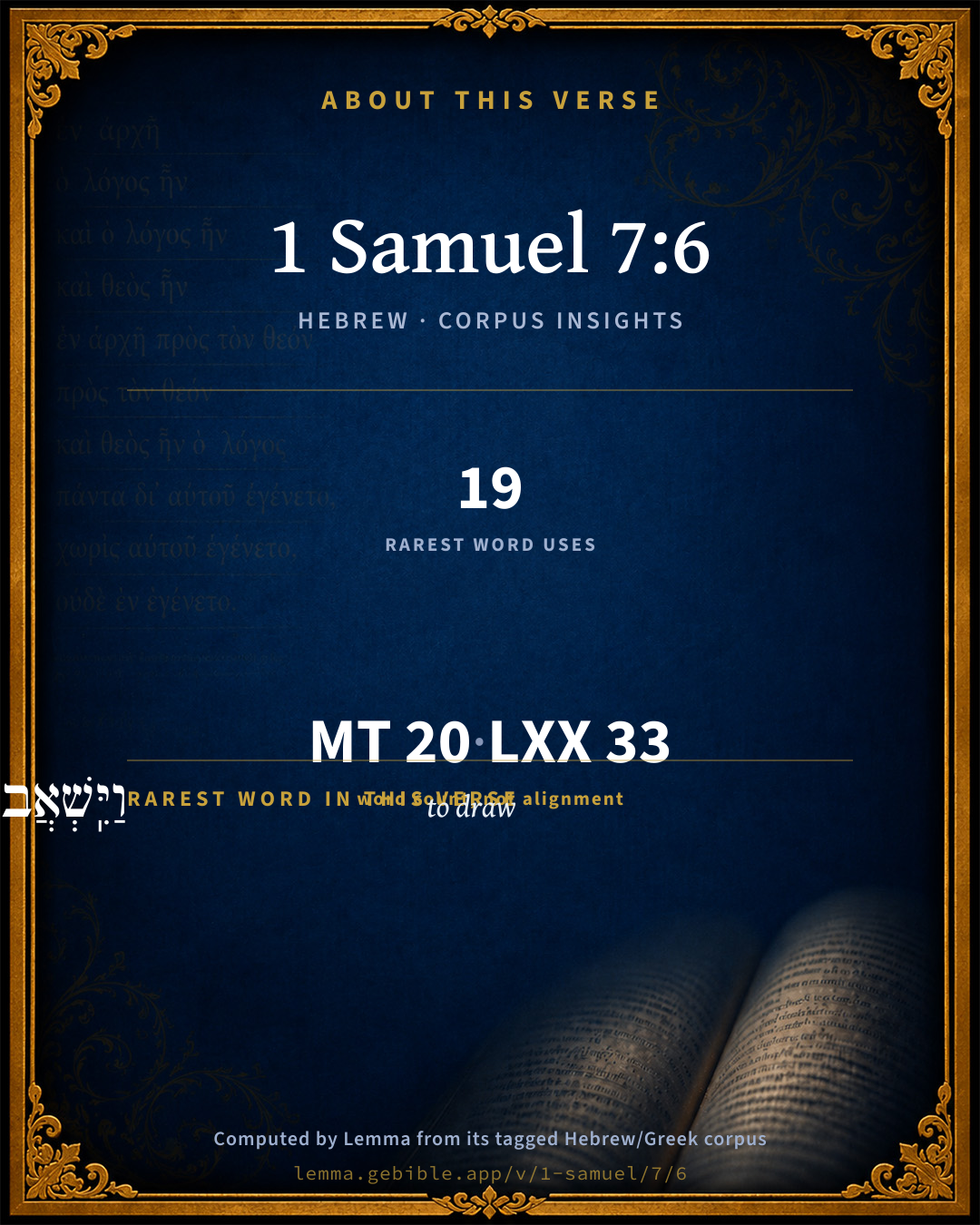
The rarest word here is וַיִּֽשְׁאֲבוּ to draw H7579 — appearing just 19 times in the whole Hebrew Bible.

Shared distinctive vocabulary

וַיִּֽשְׁאֲבוּ to draw H7579 occurs in 18 verses of the Hebrew Bible. Also found in:

Grammatical profile

  • 7 verbs
  • 10 nouns
  • 1 pronoun
  • 1 adverb
  • 1 particle

Verb forms

  • וַיִּקָּבְצ֣וּ Niphal · Sequential Imperfect
  • וַיִּֽשְׁאֲבוּ Qal · Sequential Imperfect
  • וַֽיִּשְׁפְּכ֣וּ Qal · Sequential Imperfect
  • וַיָּצ֨וּמוּ֙ Qal · Sequential Imperfect
  • וַיֹּ֣אמְרוּ Qal · Sequential Imperfect
  • חָטָ֖אנוּ Qal · Perfect
  • וַיִּשְׁפֹּ֧ט Qal · Sequential Imperfect

Repetition

Words recur within this verse — often emphatic in Hebrew:

  • הַ֠מִּצְפָּתָה Mizpah H4709 ×2
  • יְהוָ֗ה LORD H3068 ×2

Hebrew & Septuagint length

In English translation the verse runs 35 words from the Hebrew and 44 from the Septuagint (LXX English) — closely comparable.

A rough comparison of the two English renderings, which tokenize alike — not a word-level alignment.

Word counts can differ between the Hebrew and the Greek without any difference in meaning — e.g. the Hebrew direct-object marker אֵת has no separate Greek word, and Greek often adds the article ὁ.

In the original languages it is 20 Hebrew tokens and 33 Greek tokens — but the two are counted differently (Hebrew bundles its prefixes and suffixes into one token; the Greek is in lemma form), so that isn’t a like-for-like length.

Cross-references

32

Topical passages linked to 1 Samuel 7:6 in the Treasury of Scripture Knowledge — connected by theme and wording, ordered by reader-vote popularity; previews shown in the World English Bible.

  • 1 Samuel 1:15 Hannah answered, No, my lord, I am a woman of a sorrowful spirit: I have drunk neither wine nor strong drink, but I poured out my soul before Yahweh.
  • 2 Samuel 14:14 For we must needs die, and are as water split on the ground, which can't be gathered up again; neither does God take away life, but devises means, that he who is banished not be an outcast from him.
  • Judges 10:10 The children of Israel cried to Yahweh, saying, We have sinned against you, even because we have forsaken our God, and have served the Baals.
  • Psalms 62:8 Trust in him at all times, you people. Pour out your heart before him. God is a refuge for us. Selah.
  • Psalms 106:6 We have sinned with our fathers. We have committed iniquity. We have done wickedly.
  • Jeremiah 9:1 Oh that my head were waters, and my eyes a spring of tears, that I might weep day and night for the slain of the daughter of my people!
  • Joel 2:12 "Yet even now," says Yahweh, "turn to me with all your heart, And with fasting, and with weeping, and with mourning."
  • 1 Kings 8:47 yet if they shall repent themselves in the land where they are carried captive, and turn again, and make supplication to you in the land of those who carried them captive, saying, We have sinned, and have done perversely, we have dealt wickedly;
  • Job 33:27 He sings before men, and says, 'I have sinned, and perverted that which was right, And it didn't profit me.
  • Psalms 119:136 Streams of tears run down my eyes, Because they don't observe your law.
  • Lamentations 2:18–19 Their heart cried to the Lord: wall of the daughter of Zion, let tears run down like a river day and night; Give yourself no respite; don't let the apple of your eye cease.
  • Luke 15:18 I will get up and go to my father, and will tell him, "Father, I have sinned against heaven, and in your sight.
  • Leviticus 26:40 "'If they confess their iniquity, and the iniquity of their fathers, in their trespass which they trespassed against me, and also that, because they walked contrary to me,
  • Judges 3:10 The Spirit of Yahweh came on him, and he judged Israel; and he went out to war, and Yahweh delivered Cushan Rishathaim king of Mesopotamia into his hand: and his hand prevailed against Cushan Rishathaim.
  • 2 Chronicles 20:3 Jehoshaphat feared, and set himself to seek to Yahweh; and he proclaimed a fast throughout all Judah.
  • Ezra 8:21–23 Then I proclaimed a fast there, at the river Ahava, that we might humble ourselves before our God, to seek of him a straight way for us, and for our little ones, and for all our substance.
  • Ezra 9:5–10 At the evening offering I arose up from my humiliation, even with my garment and my robe torn; and I fell on my knees, and spread out my hands to Yahweh my God;
  • Nehemiah 9:1–3 Now in the twenty-fourth day of this month the children of Israel were assembled with fasting, and with sackcloth, and earth on them.
  • Nehemiah 9:27 Therefore you delivered them into the hand of their adversaries, who distressed them: and in the time of their trouble, when they cried to you, you heard from heaven; and according to your manifold mercies you gave them saviors who saved them out of the hand of their adversaries.
  • Job 16:20 My friends scoff at me. My eyes pour out tears to God,
  • Job 40:4 "Behold, I am of small account. What shall I answer you? I lay my hand on my mouth.
  • Job 42:6 Therefore I abhor myself, And repent in dust and ashes."
  • Psalms 6:6 I am weary with my groaning; Every night I flood my bed; I drench my couch with my tears.
  • Psalms 38:3–8 There is no soundness in my flesh because of your indignation, Neither is there any health in my bones because of my sin.
  • Psalms 42:3 My tears have been my food day and night, While they continually ask me, "Where is your God?"
  • Jeremiah 3:13–14 Only acknowledge your iniquity, that you have transgressed against Yahweh your God, and have scattered your ways to the strangers under every green tree, and you have not obeyed my voice, says Yahweh.
  • Jeremiah 31:19 Surely after that I was turned, I repented; and after that I was instructed, I struck on my thigh: I was ashamed, yes, even confounded, because I did bear the reproach of my youth.
  • Lamentations 2:11 My eyes do fail with tears, my heart is troubled; My liver is poured on the earth, because of the destruction of the daughter of my people, Because the young children and the infants swoon in the streets of the city.
  • Lamentations 3:49 My eye pours down, and doesn't cease, without any intermission,
  • Ezekiel 20:4 Will you judge them, son of man, will you judge them? Cause them to know the abominations of their fathers;
  • Daniel 9:3–5 I set my face to the Lord God, to seek by prayer and petitions, with fasting and sackcloth and ashes.
  • Jonah 3:1–10 The word of Yahweh came to Jonah the second time, saying,

Cross-references courtesy of OpenBible.info (CC BY 4.0).

Hebrew and Greek witnesses Masoretic Hebrew ↔ Greek Septuagint

The same verse in the two great witnesses to the Old Testament, shown verse-for-verse.

These are two independent witnesses, not word-aligned to each other, and the Septuagint is shown in lemma (dictionary) form.

Hebrew 1 Samuel 7:6 Masoretic · Westminster Leningrad Codex

וַיִּקָּבְצ֣וּ הַ֠מִּצְפָּתָה וַיִּֽשְׁאֲבוּ מַ֜יִם וַֽיִּשְׁפְּכ֣וּ לִפְנֵ֣י יְהוָ֗ה וַיָּצ֨וּמוּ֙ בַּיּ֣וֹם הַה֔וּא וַיֹּ֣אמְרוּ שָׁ֔ם חָטָ֖אנוּ לַיהוָ֑ה וַיִּשְׁפֹּ֧ט שְׁמוּאֵ֛ל אֶת בְּנֵ֥י יִשְׂרָאֵ֖ל בַּמִּצְפָּֽה

They gathered together to Mizpah, and drew water, and poured it out before Yahweh, and fasted on that day, and said there, We have sinned against Yahweh. Samuel judged the children of Israel in Mizpah.

World English Bible · Public Domain

Greek LXX 1 Samuel 7:6 Septuagint · lemma form

καί συνἄγω εἰς μασσηφαθ καί ὑδρεύω ὕδωρ καί ἐκχέω ἐνώπιον κύριος ἐπί ὁ γῆ καί νηστεύω ἐν ὁ ἡμέρα ἐκεῖνος καί εἶπον ἁμαρτάνω ἐνώπιον κύριος καί δικάζω σαμουηλ ὁ υἱός ἰσραήλ εἰς μασσηφαθ

And they were gathered together to Massephath, and they drew water, and poured it out upon the earth before the Lord. And they fasted on that day, and said, We have sinned before the Lord. And Samuel judged the children of Israel in Massephath.

LXX2012 (modern English Septuagint) · Public Domain

Hebrew: Westminster Leningrad Codex (CC BY 4.0). Greek: Septuagint (public domain); English from LXX2012 (modern English Septuagint) (Public Domain). How the Septuagint differs from the Hebrew →

Targum (Aramaic paraphrase)

1

The Targum is the ancient Jewish Aramaic paraphrase of the Hebrew Scriptures — an interpretive translation, not the Hebrew text itself. Onkelos (literal) and Pseudo-Jonathan (expansive) render the Torah, and Jonathan the Prophets. Coverage is partial: where no permissively-licensed English translation exists for a verse, only the Aramaic is shown. This is verse-level text, not a word-by-word alignment to the Hebrew.

  1. Targum Jonathan Prophets (Joshua–Malachi)
    וְאִתְכְּנִישׁוּ לְמִצְפַּיָא וּשְׁפִיכוּ לִבְּהוֹן בִּתְיוּבְתָּא כְּמַיָא קֳדָם יְיָ וְצָמוּ בְיוֹמָא הַהוּא וַאֲמַרוּ תַמָן חַבְנָא קֳדָם יְיָ וְדָן שְׁמוּאֵל יַת בְּנֵי יִשְׂרָאֵל בְּמִצְפַּיָא:

    (no public-domain English translation for this verse)

    Targum Jonathan — Aramaic: “Mikraot Gedolot” (public domain). English: “Sefaria Community Translation” (CC0 1.0 (public-domain dedication)); “London "Chaldee Paraphrase," 1871” (public domain). Text via Sefaria.

Commentary

Notes on 1 Samuel 7:6 from classic Christian and Jewish commentators (each source and its license shown beneath its notes). The classic Christian expositions comment on the surrounding passage and are grouped to its opening verse, so a note may address several verses; the Jewish commentaries on the Tanakh (Rashi and others) are per-verse, so they appear only where the commentator wrote on this verse.

Lemma curates 59 commentaries, every one of them public domain or Creative Commons licensed, each selected and text-cleaned for this edition rather than reprinted as found. About our sources →

Trapp's Complete Commentary

John Trapp

1Sa 7:6 And they gathered together to Mizpeh, and drew water, and poured [it] out before the LORD, and fasted on that day, and said there, We have sinned against the LORD. And Samuel judged the children of Israel in Mizpeh.

Ver. 6. And drew water, and poured it out before the Lord.] That is, saith the Chaldee Paraphrast, They wept abundantly, as if their hearts had been springs, and their eyes as the fish pools of Heshbon. Some think that they did really draw water and pour it out, in token that they did pour out their souls to God in prayer; {a} and by this ceremony they did further stir up themselves also so to do. They seemed to say in effect, We could wish to shed as many tears for our sins as there are drops of water in this bucket; but because we cannot do this, behold, we do what we can. Some think that by this "water poured out," they washed off the ashes that they had sprinkled on their heads, in token of their true repentance. Others, that hereby they acknowledged themselves to be in no better condition than as water spilt on the ground, &c.

{a} Hyperbolica expressio ingentis lamentationis. - Jun.

John Trapp, A Commentary or Exposition upon All the Books of the Old and New Testament (1647–1656) — public domain. Text from a community e-Sword module.

Joseph Benson's Commentary

1Sa 7:6. They drew water and poured it out — As an external sign, whereby they testified both their own filthiness and need of washing by the grace and Spirit of God, and the blood of the covenant, and their sincere desire to pour out their hearts before the Lord, in true repentance, and to cleanse themselves from all filthiness of flesh and spirit. Before the Lord — That is, in the public assembly, where God is in a special manner present. Samuel judged — That is, governed them, reformed all abuses against God or man, took care that the laws of God should be observed, and wilfil transgressions punished.

Joseph Benson's Commentary on the Old and New Testaments (1811–1818) — public domain. Text from a community e-Sword module.

Tyndale Open Study Notes

Tyndale Open Resources

7:6 drew water . . . poured it out: This type of ceremony is not mentioned elsewhere in the Old Testament. • At times Israelites went without food to express grief or to seek the Lord’s favor (2 Sam 1:12; 12:22-23; 1 Kgs 21:27; Ezra 8:21-23; Neh 9:1; Esth 4:3, 16; Joel 2:12; cp. Luke 2:37; Acts 13:2-3; 14:23). • To have Samuel as Israel’s judge was refreshing compared to Eli’s failed leadership (see 1 Sam 4:18 and corresponding study note) and the leadership of some other judges (e.g., Gideon, Judg 8:22-27; Jephthah, Judg 11:30–12:7; and Samson, Judg 13:1–16:21).

Tyndale Open Study Notes — © Tyndale Open Resources, licensed CC BY-SA 4.0. Text via the HelloAO Bible API.

Geneva Bible (1599)

Geneva Bible translators

The Chaldea text hath, that they drew water out of their heart: that is, wept abundantly for their sins.

Geneva Bible (1599) marginal notes — public domain. Text via Bolls.life.

Jamieson, Fausset & Brown

Robert Jamieson, A. R. Fausset & David Brown

Samuel judged . . . Israel in Mizpeh--At the time of Eli's death he could not have much exceeded twenty years of age; and although his character and position must have given him great influence, it does not appear that hitherto he had done more than prophets were wont to do. Now he entered on the duties of a civil magistrate.

Jamieson, Fausset & Brown — Commentary Critical and Explanatory on the Whole Bible (1871) — public domain (CC PDM 1.0). Text via the HelloAO Bible API.

Adam Clarke's Commentary

Verse 6. Drew water, and poured it out] It is not easy to know what is meant by this; it is true that pouring out water, in the way of libation, was a religious ordinance among the Hebrews, (Isa 12:3), and among most other nations, particularly the Greeks and Romans, who used, not only water, but wine, milk, honey, and blood, as we find by Homer, Virgil, Euripides, Sophocles, Porphyry, and Lucian. Our Lord seems to allude to this ceremony, Joh 7:37-38, where see the note.

The Chaldee Paraphrast understands the place differently, for he translates: "And they poured out their hearts in penitence, as WATERS, before the Lord." That deep penitential sorrow was represented under the notion of pouring out water, we have a direct proof in the case of David, who says, Ps 22:14, I am POURED OUT LIKE WATER, my heart is like wax; it is MELTED in the midst of my bowels. And to repentance, under this very similitude, the prophet exhorts fallen Jerusalem: Arise, cry out in the night; in the beginning of the watches POUR OUT thine HEART LIKE WATER before the face of the Lord; La 2:19. David uses the same image, Ps 62:8: Trust in him at all times, ye people; POUR OUT your hearts before him. The same figure is used by Hannah in 1Sa 1:15 of this book; I am a woman of a sorrowful spirit; I have POURED OUT my soul before the Lord. Perhaps the drawing and pouring out of water mentioned in the text was done emblematically, to represent the contrition of their hearts.

And Samuel judged] He gave them ordinances, heard and redressed grievances, and taught them how to get reconciled to God. The assembly, therefore, was held for religio-politico-military purposes.

Adam Clarke's Commentary on the Bible (1810–1826) — public domain. Text from a community e-Sword/MySword module.

Ellicott's Commentary for English Readers

(6) And Samuel judged the children of Israel in Mizpeh.—For some quarter of a century Samuel had been the principal personage among the people, and had, no doubt, long exercised the varied functions of the “judges” of Israel; but the tribes were scattered, their fortresses in the hand of enemies, there was scarcely any national life in that gloomy period in the people. In the first general assembly of the tribes the rank and position which Samuel had long really filled are publicly acknowledged.

A Bible Commentary for English Readers, edited by Charles John Ellicott (1878–1897) — public domain. Text from a community e-Sword module.

The Cambridge Bible for Schools and Colleges

gen. ed. J. J. S. Perowne

6. and drew water, and poured it out before the Lord] A symbolical act which has no exact parallel in the O.T., but was probably significant of the outpouring of their hearts before Jehovah in penitence and supplication. Cp. ch. 1Sa_1:15; Psa_62:8; Lam_2:19. The paraphrase of the Targum is, “And they poured out their heart in repentance before Jehovah.”

and fasted on that day] As on the great day of Atonement (Lev_16:9), in token of humiliation and contrition for their sin.

We have sinned against the Lord] They made a public confession. Cp. Jdg_10:10.

And Samuel judged, &c.] As prophet he effected the religions reformation, and then taking his place as the chief magistrate of the state, he provided for the civil and political reorganization of the people. That the assembly lasted some time is clear from 1Sa_7:7. The Philistines had time to muster their army before it dispersed.

The Cambridge Bible for Schools and Colleges (gen. ed. J. J. S. Perowne; Cambridge University Press, 1878–1918) — public domain. Text from a community e-Sword module.

John Gill's Exposition

And they gathered together to Mizpeh,.... Even all Israel, at least the heads of the people, and representatives of them:

and drew water, and poured it out before the Lord; drew it from some fountain near at hand, and poured it out as in the presence of God, who was where his people were met together. Jerom (k) relates it as tradition of the Jews, that curses were cast into this water, as in the water of jealousy, and that idolaters were tried by it; and that whatever idolater, who denied he worshipped idols, and tasted of it, his lips so stuck together that they could not be separated, and by this means was known and put to death; and therefore it is said Samuel judged now at this place: but it should be observed, this water was not drank, but poured out; and that as a token of their humiliation, as Jarchi, that they were before the Lord, as water poured out; and of the sincerity of their repentance, as the Targum, which is,"they poured out their heart in repentance, as water;''and of the atonement and expiation of their sins, which passed away as water to be remembered no more, as Kimchi, or rather signifying hereby that they thoroughly renounced idolatry, that nothing of it should remain; as water entirely poured out, there remains not so much as any smell of it in the cask, as does of honey or oil, or such kind of liquor; for what a learned writer (l) says, that this was in token of joy, like that at the feast of tabernacles, when they drew water out of the fountain of Siloah, seems not so agreeable, since this was a day of humiliation, fasting, and prayer, as follows:

and fasted on that day, and said there, we have sinned against the Lord; Samuel prayed in public for them, with whom they joined; and they fasted in a literal sense, abstaining from food, and made a confession of their sins; this was the work of that day:

and Samuel judged the children of Israel in Mizpeh; not that he now began to judge them, but went on in a more public and vigorous manner to judge them; he sat, and heard, and tried causes that came before him; explained the laws of God to them, and enforced the obedience of them; reformed abuses that were among them, and punished idolaters.

(k) Trad. Heb. in lib. Reg. fol. 75. F. (l) L'Empereur, annot. in Misn. Middot, c. 2. sect. 5. No. 7.

John Gill's Exposition of the Whole Bible (1746–1763) — public domain (CC PDM 1.0). Text via the HelloAO Bible API.

Albert Barnes' Notes on the Bible

Two rites are brought together here which belong especially to the Feast of Tabernacles and the Day of Atonement, respectively, namely, drawing and pouring out water, and fasting. Hence, some think that Samuel chose the Feast of tabernacles, and the fast which preceded it, as the occasion for assembling the people. Others explain the pouring out water as the pouring out the heart in penitence as it were water; or, as a symbolic act expressing their ruin and helplessness 2Sa 14:14; or as typifying their desire that their sins might be forgotten “as waters that pass away” Job 11:16.

And Samuel judged - This seems to denote the “commencement” of Samuel’s Judgeship civil and military, as having taken place at Mizpeh on this occasion. As civil Judge he did exactly what Moses did Exo 18:13-16; as military Judge he did what Othniel, Ehud, Barak, and Gideon had done before him, organized and marshalled the people for effectual resistance to their oppressors, and led them out to victory.

Albert Barnes' Notes on the Bible (1834–1885) — public domain. Text from a community e-Sword/MySword module.

Haydock's Catholic Bible Commentary

Lord, having purified themselves with it, Exodus xix 24. Others think that it was a kind of a protestation, that they were willing to perish if they proved faithless; (Sa) or a symbol that they rejected every vestige of idolatry, and every sin, with true repentance. (Sanctius) (Tirinus) --- Water was also the most ancient species of libation, before honey, and afterwards wine were adopted. (Porphyrius) --- Though the law did not prescribe it, there was not prohibition. On the last day of the feast of tabernacles, the people went to the pool of Silo to fetch water, and to pour it out in the temple, as a libation to the Lord; and it is thought that Jesus Christ alludes to this custom, John vii. 24. (Lamy, Introd.) See 2 Kings xxiii. 16. (Calmet) --- Fasted. They confess their sins and do penance, while Samuel sits as judge, (Salien) an had been endeavouring for twenty years to excite them to repentance, and to adhere to the one true religion. (Tirinus)

George Leo Haydock (1774–1849), Haydock's Catholic Family Bible and Commentary, 1859 edition — public domain. Excludes Psalms (Douay-Rheims chapter numbering differs from Protestant) and Deuterocanonical books (Catholic canon only).

Matthew Poole's English Annotations

To Mizpeh; not that beyond Jordan, of which Jdg 11:11,29; but another in Canaan, where the Israelites used to assemble, Jdg 20:1; 1Sa 10:17.

Drew water, and poured it out; which they did either,

1. Figuratively; they drew tears out of their hearts, and poured out of their eyes as it were rivers of water; such descriptions of penitential sorrow being not unusual. See Psa 6:7; 119:136; Jer 19:1; Lam 3:48,49. Or rather,

2. Properly, because they are said first to draw it, and then to pour it out. And this agrees well with the state of those times, wherein such rites as this were very customary. Now this course they seem to have used, either,

1. As a mean or instrument of their purification. So they washed themselves in this water, thereby acknowledging their filthiness, and cleansing themselves as the law prescribed. But this seems not probable,

1. Because here is only mention of drawing and pouring forth this water before the Lord, but not of any washing themselves with it.

2. Because this was not a fit time and place to purify themselves in this great and general assembly. Or,

2. As an external sign, whereby they testified and professed both their own great filthiness and need of washing by the grace and Spirit of God, and blood of the covenant, which are oft signified by water, and their sincere desire to pour out their very hearts before the Lord in true repentance, and to cleanse themselves from all filthiness of flesh and spirit.

Before the Lord, i.e. in the public assembly, where God is in a special manner present, as hath been noted before.

Samuel judged the children of Israel, i.e. governed them, reformed all abuses against God or man, took care that the laws of God should be observed and executed, and wilful transgressors punished.

Matthew Poole's English Annotations on the Holy Bible (1683–1685) — public domain. Text from a community e-Sword/MySword module.

Whedon's Commentary on the Bible

Daniel D. Whedon

6. Drew water, and poured it out before the Lord — Dr. Kitto thinks that this act was the confirmation of an oath — a solemn vow; and tells us that such is an oriental method of confirming an oath or a promise. But, in the absence of any analogous custom recorded in Scripture, (and we have there many forms for oaths,) we adhere to the more common interpretation, and understand this pouring out of water as a symbolical action indicating their humiliation and contrition before God. Thus the Targum paraphrases it: They poured out their heart like water in penitence before the Lord. In accordance with this imagery Hannah is said, in the sorrow of her spirit, to have poured out her soul before the Lord. 1Sa_1:15. Compare also Lam_2:19, and Psa_22:14; Psa_62:8.

Fasted — A further sign of their repentance and humiliation.

And Samuel judged… in Mizpeh — He declared to them the greatness of their sins, the necessity of their reformation, and the methods by which such reformation must be accomplished. He also, perhaps, gave judgment on individual cases of difficulty.

Daniel D. Whedon (gen. ed.), Commentary on the Old and New Testaments (1874–1909) — public domain. Text from a community e-Sword module.

The Pulpit Commentary

They drew water, and poured it out before Jehovah. While the drawing of water was a joyful act (Isa_12:3; Joh_7:37, Joh_7:38) as symbolising the winning from the depths below of the source of life and health, the pouring it out before Jehovah expressed sorrow for sin, and so it is explained by the Chaldee Paraphrast: "They poured out their heart in penitence like water before the Lord". (comp. Psa_22:14) It might here also signify weakness and powerlessness, the being "as water spilt upon the ground, which cannot be gathered up again". (2Sa_14:14) They further expressed their sorrow by fasting, enjoined "for the afflicting of their souls" upon the great day of atonement (Lev_16:29, 31 23:27, 32; Num_29:7) And to these symbolical acts they joined the confession of the mouth, acknowledging that "they had sinned against Jehovah".

And Samuel judged the children of Israel in Mizpeh. That is, he now became the acknowledged ruler of Israel in things temporal, both civil and military., as he had previously been in things spiritual by virtue of his office as prophet. This was, of course, the result of the decisive action he had taken in summoning this national convention; but the words strongly suggest that there was some direct appointment, or at the very least a national acknowledgment of Samuel"s authority, especially as they precede the history of the defeat of the Philistines. He had summoned the people together as Nabi, prophet, and when he said, "I will pray for you unto Jehovah," there was the implied meaning that he would be with them only in that capacity. But when the time came to appoint a general, who would act under him as Barak had acted under Deborah, the great chiefs, probably, who saw in him the prime mover of all that was being done, urged him also to take the command,and upon his consent he became also Shophet or judge.

Ver. 6. (MIZPAH. )

Confession of sin.

have sinned against the Lord." When any one has done wrong to another he ought to make acknowledgment and reparation to him. (Mat_5:23, Mat_5:24) We are directed to "confess our faults one to another"; (Jam_5:16) and there are cases in which we may derivebenefit from confessing our sins against the Lord to a godly man. The passage just referred to, however, affords no ground for "auricular confession" to a priest; nor does the commission given to the apostles, (Joh_20:23) since (in addition to other reasons) it simply conferred authority to declare the ordinances of the kingdom of heaven, and especially the terms or conditions according to which sins are remitted or retained; and the practice of such confession is most injurious. But we ought all to confess our sins to God. Every wrong done to men is a sin against God, and there are multitudes of sins against him that do not directly affect our fellow men. "In many things we all offend." And the word of God often enjoins the confession of all our offences before him, and declares it to be the necessary condition of obtaining forgiveness. Consider

I WHAT IT IMPLIES.

1. That we see the essential evil of sin. "Sin is the transgression of the law". (1Jn_3:4) More generally, it is whatever is contrary to the character and will of God. As he is the only perfect Being, and deserves and claims the supreme love of men, so the root of sin consists in the absence of such love, and the departure of the heart from its true rest; and whenever man departs from God he falls into selfishness, vanity, and misery. Sin is aversion to God and devotion to self (see Tulloch, "Christian Doctrine of Sin"). "Against thee, thee only, have I sinned," etc.. (Psa_51:4)

1. That we are convinced of the just desert of sin. "Howbeit, thou art just in all that is brought upon us," etc.. (Neh_9:33)

2. That we are resolved upon an entire renunciation of sin. This determination springs from a real hatred towards it, and is associated with "hunger and thirst after righteousness." Confession is of the nature of a solemn oath of abjuration. "Whoso confesseth and forsaketh his sins shall find mercy". (Pro_28:13)

II HOW IT SHOULD BE MADE.

1. Under a due impression of the greatness of our sin.

(1) In order to this we must contemplate the holy love of God, his just requirements, his merciful blessings and boundless claims; above all, we must stand before the cross and behold that great sight. (Luk_23:48) "There is no better way to obtain the gift of tears for having offended God than meditation on the greatness of God"s goodness and of his love which he has shown to man.

(2) We must, in the light that shines upon us, consider the particular transgressions we have committed in thought, word, and deed against God, our neighbour, and ourselves, sins of omission and commission, and the sinful disposition revealed by them and pervading our whole life. (Luk_18:13) General confessions of sin without personal and particular application are of little worth. "Usually, the more particular we are in the confession of sin, the more comfort we have in the sense of pardon" (M. Henry).

(3) In this manner we shall, by Divine grace, be filled with self-abasement, godly sorrow, and true repentance. "That which makes manifest is light;" and in proportion to the brightness with which the light of truth shines upon us will it manifest our sin; (1Jn_1:8) just as a sunbeam darting across a room shows us the floating dust that was not seen before. (Job_42:5, Job_42:6)

1. In sincere, frank, and unreserved acknowledgment of our sin; without any attempt to cover, excuse, or palliate it. "Pardon my iniquity, for/t is great. (Psa_25:11 Psa_32:3-5)

2. With a turning of the heart to God in faith and prayer and acts of obedience. "For thou, Lord, art good, and ready to forgive; and plenteous in mercy unto all them that call upon thee". (Psa_86:5)

Repentance is heart"s sorrow And a clear life ensuing (Shakespeare).

III BY WHOM.

1. Each individual. (Luk_15:21) "God be merciful to me a sinner". (Luk_18:13)

1. Each family. "Every family apart". (Zec_12:14)

2. The whole people. Those who have united in sinning must unite inconfessing their sin (1Sa_12:19; Ezr_9:6-15 Dan_9:4-19) "We have all sinned and come short of the glory of God.

IV WHY IT IS NECESSARY.

1. That we may give glory to God. By it we act in accordance with his will,justify him in his dealings with us, and give to him the honour which is his due. "Give glory to God, and make confession unto him". (Jos_7:19)

2. That we may be prepared to receive pardon, peace, and salvation. Untilwe open our hearts to God he will not open his heart to us. We must cease to have fellowship with idols in order that we may have fellowship with the holy One, and become the habitation of his Spirit. (2Co_6:16)

3. That we may have confidence in the fulfilment of his promises. This isconditioned by. our fulfilment of his requirements, without which our confidence is vain. "If we confess our sins," etc.. (1Jn_1:9) "And if any man sin, we have an Advocate with the Father, Jesus Christ the righteous". D. (1Jn_2:1)

The Pulpit Commentary (1880–1919), ed. H.D.M. Spence-Jones & Joseph S. Exell — public domain. Text from a community e-Sword module.

John Wesley's Explanatory Notes

Poured it out - As an external sign, whereby they testified, both their own filthiness and need of washing by the grace and Spirit of God, and blood of the covenant, and their sincere desire to pour out their hearts before the Lord, in true repentance, and to cleanse themselves from all filthiness of flesh and spirit. Before the Lord - That is, in the public assembly, where God is in a special manner present. Judged - That is, governed them, reformed all abuses against God or man, took care that the laws of God should be observed, and wilful transgressions punished.

John Wesley, Explanatory Notes Upon the Whole Bible (1754–1765) — public domain. Text via the GEBible commentary corpus.

Rashi

Rabbi Shlomo Yitzchaki (Rashi)

They drew water and poured it out. Targum Yonoson renders, "and they poured out their hearts like water, in repentance, before '." ה And according to its simple meaning, it is merely symbolic of humility, [i. e.,] we are before You like these poured out waters.

Shmuel judged. Between two litigants regarding monetary matters between them, or concerning sins which they had committed.

Rashi on the Tanakh — English translations: “The Judaica Press complete Tanach with Rashi, translated by A. J. Rosenberg” (CC BY 4.0); “Pentateuch with Rashi's commentary by M. Rosenbaum and A.M. Silbermann, 1929-1934” (public domain); “The Metsudah Tanach series, Lakewood, N.J” (CC BY 4.0); and “The Book of Joshua, Metsudah Publications, 1997” (CC BY 4.0). Text via Sefaria.

Lesson kit

Teaching starters — assembled from the data on this page, not authored interpretation. Every prompt links to the verse data it draws on. Edit before teaching.

1 Samuel, in the Historical, opens this verse with 20 words (18 distinct Hebrew lemmas). Its most distinctive word is shâʼab (“to draw”). A historical commentator’s framing appears above. Read the whole chapter for the surrounding context.

Discussion questions

  1. How does “to draw” (shâʼab) shape what this verse is saying?
  2. How does Genesis 24:11, which shares the word «to draw», read alongside this verse?
  3. What does the repetition of “Mizpah” (2× in this one verse) do in this verse?
  4. These translations render this verse differently; the difference is in the English rendering, not the original. What questions does that raise?
  5. «וַיִּקָּבְצ֣וּ» is a Niphal Sequential Imperfect verb. How does that grammatical form shape the action described?
  6. Compare how Trapp's Complete Commentary and Joseph Benson's Commentary read this verse. Where do they agree or differ?

Things to notice

Reading settings

Reading text

Shown beneath each verse's original-language words.

Old Testament
Old Testament edition

Read the OT as the Masoretic Hebrew (MT) or the Greek Septuagint (LXX).

English shown for the Greek Septuagint (in the Hebrew ↔ Greek comparison).

Comparing translations? Open the Compare panel on any verse page to stack up to four side by side.