
Jeremiah 3:25

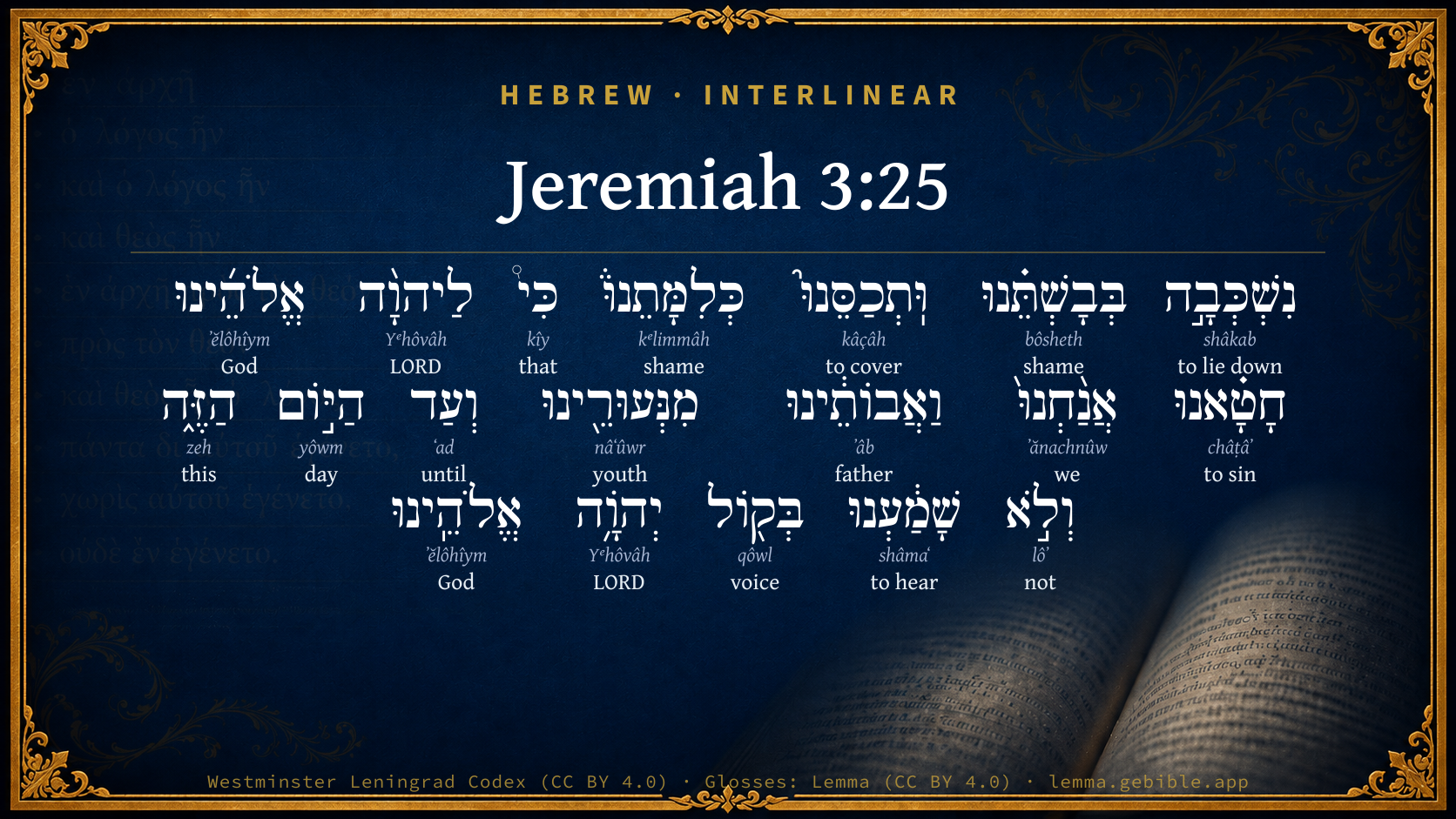
Hebrew (Westminster Leningrad Codex) Jeremiah 3:25 appears in the Hebrew Old Testament. The text above is from the Westminster Leningrad Codex. Each word links to its Strong’s number, a concise gloss, and parsing drawn from the Open Scriptures Hebrew Bible morphology. Click any word for its full Brown-Driver-Briggs (BDB) entry.
Download image
Cite this verse

Jeremiah 3:25 (World English Bible). Public Domain. Lemma interlinear Bible study tool, https://lemma.gebible.app/v/jeremiah/3/25.

Show BibTeX & RIS
BibTeX
RIS
English Translation
Let us lie down in our shame, and let our confusion cover us; for we have sinned against Yahweh our God, we and our fathers, from our youth even to this day; and we have not obeyed the voice of Yahweh our God.
World English Bible · Public Domain
Download a study sheet

One document with this verse’s original text, its word-by-word gloss line, the meaning frame, cross-references with their text, attributed commentary, and full source and license credits — printable, and it pastes into notes with its structure intact.

This verse Autodidact and up

Study sheet (.html) Plain text (.txt)

A passage Seminary Student

Up to 50 verses in one chapter. A passage sheet keeps up to 6 commentary sources and 12 cross-references per verse, in the order this page ranks them, and says so on the sheet whenever that leaves anything out. Ask for a single verse and you get the Autodidact verse sheet above.

Everything on this page stays free to read, with no account — the sheet is a download of what is already on screen, not access to it.

Want to remove ads? Support Godless Engineer
Compare translations 3

The same verse in 3 English versions, stacked beneath the original-language interlinear above. Click any original word for its lexicon entry.

Each is an independent rendering of the whole verse — the interlinear is not word-aligned to these translations.

Highlighted words mark where these versions differ — a whole-verse word diff, not a word-by-word alignment.

  • World English Bible Public Domain
    Let us lie down in our shame, and let our confusion cover us; for we have sinned against Yahweh our God, we and our fathers, from our youth even to this day; and we have not obeyed the voice of Yahweh our God.
  • King James Version Public Domain
    We lie down in our shame, and our confusion covereth us: for we have sinned against the LORD our God, we and our fathers, from our youth even unto this day, and have not obeyed the voice of the LORD our God.
  • unfoldingWord Literal Text CC BY-SA 4.0
    Let us lie down in our shame, and let our humiliation cover us, for against Yahweh our God we have sinned! Ourselves and our fathers, from our youth and to this day, and we have not listened to the voice of Yahweh our God!”

unfoldingWord Literal Text — © unfoldingWord, licensed CC BY-SA 4.0. Word-aligned USFM3 via Door43 (git.door43.org/unfoldingWord/en_ult).

Versions to compare (up to 4)

3 of 4 selected

Show all 18 translations

Every available English version of this verse, each an independent rendering of the whole verse.

  • World English Bible Public Domain
    Let us lie down in our shame, and let our confusion cover us; for we have sinned against Yahweh our God, we and our fathers, from our youth even to this day; and we have not obeyed the voice of Yahweh our God.
  • Berean Standard Bible Public Domain
    Let us lie down in our shame; let our disgrace cover us. We have sinned against the LORD our God, both we and our fathers; from our youth even to this day we have not obeyed the voice of the LORD our God.”
  • Majority Standard Bible Public Domain
    Let us lie down in our shame; let our disgrace cover us. We have sinned against the LORD our God, both we and our fathers; from our youth even to this day we have not obeyed the voice of the LORD our God.”
  • King James Version Public Domain
    We lie down in our shame, and our confusion covereth us: for we have sinned against the LORD our God, we and our fathers, from our youth even unto this day, and have not obeyed the voice of the LORD our God.
  • American Standard Version (1901) Public Domain
    Let us lie down in our shame, and let our confusion cover us; for we have sinned against Jehovah our God, we and our fathers, from our youth even unto this day; and we have not obeyed the voice of Jehovah our God.
  • Revised Version (1885) Public Domain
    Let us lie down in our shame, and let our confusion cover us: for we have sinned against the LORD our God, we and our fathers, from our youth even unto this day: and we have not obeyed the voice of the LORD our God.
  • Geneva Bible (1599) Public Domain
    Wee lie downe in our confusion, and our shame couereth vs: for we haue sinned against the Lord our God, we and our fathers from our youth, euen vnto this day, and haue not obeyed the voyce of the Lord our God.
  • Douay-Rheims (1899) Public Domain
    We shall sleep in our confusion, and our shame shall cover us, because we have sinned against the Lord our God, we and our fathers from our youth even to this day, and we have not hearkened to the voice of theLord our God.
  • Young's Literal Translation Public Domain
    We have lain down in our shame, and cover us doth our confusion, For against Jehovah our God we have sinned, We, and our fathers, from our youth even unto this day, Nor have we hearkened to the voice of Jehovah our God!
  • Literal Standard Version CC BY-SA 4.0
    We have lain down in our shame, and our confusion covers us, || For we have sinned against our God YHWH, || We, and our fathers, from our youth even to this day, || Nor have we listened to the voice of our God YHWH!”
  • Unlocked Literal Bible CC BY-SA 4.0
    Let us lie down in shame. May our shame cover us, for we have sinned against Yahweh our God! We ourselves and our ancestors, from the time of our youthfulness to this present day, have not listened to the voice of Yahweh our God!”
  • unfoldingWord Literal Text CC BY-SA 4.0
    Let us lie down in our shame, and let our humiliation cover us, for against Yahweh our God we have sinned! Ourselves and our fathers, from our youth and to this day, and we have not listened to the voice of Yahweh our God!”
  • Darby Bible Public Domain
    We lie down in our shame, and our confusion covereth us; for we have sinned against Jehovah our God, we and our fathers, from our youth even unto this day, and have not hearkened to the voice of Jehovah our God.
  • World Messianic Bible Public Domain
    Let us lie down in our shame, and let our confusion cover us; for we have sinned against the LORD our God, we and our fathers, from our youth even to this day. We have not obeyed the LORD our God’s voice.”
  • Webster's Bible Public Domain
    We lie down in our shame, and our confusion covereth us: for we have sinned against the LORD our God, we and our fathers, from our youth even to this day, and have not obeyed the voice of the LORD our God.
  • Free Bible Version CC BY-SA 4.0
    We should lie down in shame, and have our disgrace bury us. We have sinned against the Lord our God, us and our fathers. From when we were young right up to now we have not obeyed what the Lord our God told us to do.
  • Bible in Basic English Public Domain
    Let us be stretched on the earth in our downfall, covering ourselves with our shame: for we have been sinners against the Lord our God, we and our fathers, from our earliest years even till this day: and we have not given ear to the voice of the Lord our God.
  • JPS Tanakh (1917) Public Domain
    Let us lie down in our shame, and let our confusion cover us; for we have sinned against the LORD our God, we and our fathers, from our youth even unto this day; and we have not hearkened to the voice of the LORD our God.'

Literal Standard Version (2020), Covenant Press — licensed CC BY-SA 4.0. Text via the HelloAO Bible API (eBible.org). Unlocked Literal Bible (unfoldingWord) — licensed CC BY-SA 4.0. Text via the HelloAO Bible API (eBible.org). unfoldingWord Literal Text — © unfoldingWord, licensed CC BY-SA 4.0. Word-aligned USFM3 via Door43 (git.door43.org/unfoldingWord/en_ult). Free Bible Version, Dr. Jonathan Gallagher — licensed CC BY-SA 4.0. Text via the HelloAO Bible API (eBible.org).

Word by word

More ways to search: Search by grammar → Find every occurrence → Compare this word →

Practice this passage: Drill this verse → Learn its vocabulary →

כְּלִמָּתֵנוּ֒
kᵉlimmâh
H3639
“shame · our”
Noun, Common, Feminine, Singular, Construct + Suffix, Personal, 1st Person, Common, Plural
Part of Speech
Noun
Type
Common
Gender
Feminine
Number
Singular
State
Construct
Full BDB Definition

Origin: from H3637

TWOT: 987a

disgrace, reproach, shame, confusion, dishonour, insult, ignominy - insult, reproach - reproach, ignominy
  1. נִשְׁכְּבָ֣ה shâkab H7901 “to lie down” Verb, Qal, Cohortative, 1st Person, Common, Plural
  2. בְּבָשְׁתֵּ֗נוּ bôsheth H1322 “in/at · shame · our” Preposition + Noun, Common, Feminine, Singular, Construct + Suffix, Personal, 1st Person, Common, Plural
  3. וּֽתְכַסֵּנוּ֮ kâçâh H3680 “and · to cover · us” Conjunction + Verb, Piel, Imperfect, 3rd Person, Feminine, Singular + Suffix, Personal, 1st Person, Common, Plural
  4. כִּי֩ kîy H3588 “that” Conjunction
  5. לַיהוָ֨ה Yᵉhôvâh H3068 “to/for · LORD” Preposition + Noun, Proper
  6. אֱלֹהֵ֜ינוּ ʼĕlôhîym H430 “God(s) · our” Noun, Common, Masculine, Plural, Construct + Suffix, Personal, 1st Person, Common, Plural
  7. חָטָ֗אנוּ châṭâʼ H2398 “to sin” Verb, Qal, Perfect, 1st Person, Common, Plural
  8. אֲנַ֨חְנוּ֙ ʼănachnûw H587 “we” Pronoun, Personal, 1st Person, Common, Plural
  9. וַאֲבוֹתֵ֔ינוּ ʼâb H1 “and · fathers · our” Conjunction + Noun, Common, Masculine, Plural, Construct + Suffix, Personal, 1st Person, Common, Plural
  10. מִנְּעוּרֵ֖ינוּ nâʻûwr H5271 “from · youth · our” Preposition + Noun, Common, Both, Plural, Construct + Suffix, Personal, 1st Person, Common, Plural
  11. וְעַד ʻad H5704 “and · until” Conjunction + Preposition
  12. הַיּ֣וֹם yôwm H3117 “the · day” Particle, Definite Article + Noun, Common, Masculine, Singular, Absolute
  13. הַזֶּ֑ה zeh H2088 “the · this” Particle, Definite Article + Pronoun, Demonstrative, Masculine, Singular
  14. וְלֹ֣א lôʼ H3808 “and · not” Conjunction + Particle, Negative
  15. שָׁמַ֔עְנוּ shâmaʻ H8085 “to hear” Verb, Qal, Perfect, 1st Person, Common, Plural
  16. בְּק֖וֹל qôwl H6963 “in/at · voice of” Preposition + Noun, Common, Masculine, Singular, Construct
  17. יְהֹוָ֥ה Yᵉhôvâh H3068 “LORD” Noun, Proper
  18. אֱלֹהֵֽינוּ ʼĕlôhîym H430 “God(s) · our” Noun, Common, Masculine, Plural, Construct + Suffix, Personal, 1st Person, Common, Plural

About this verse

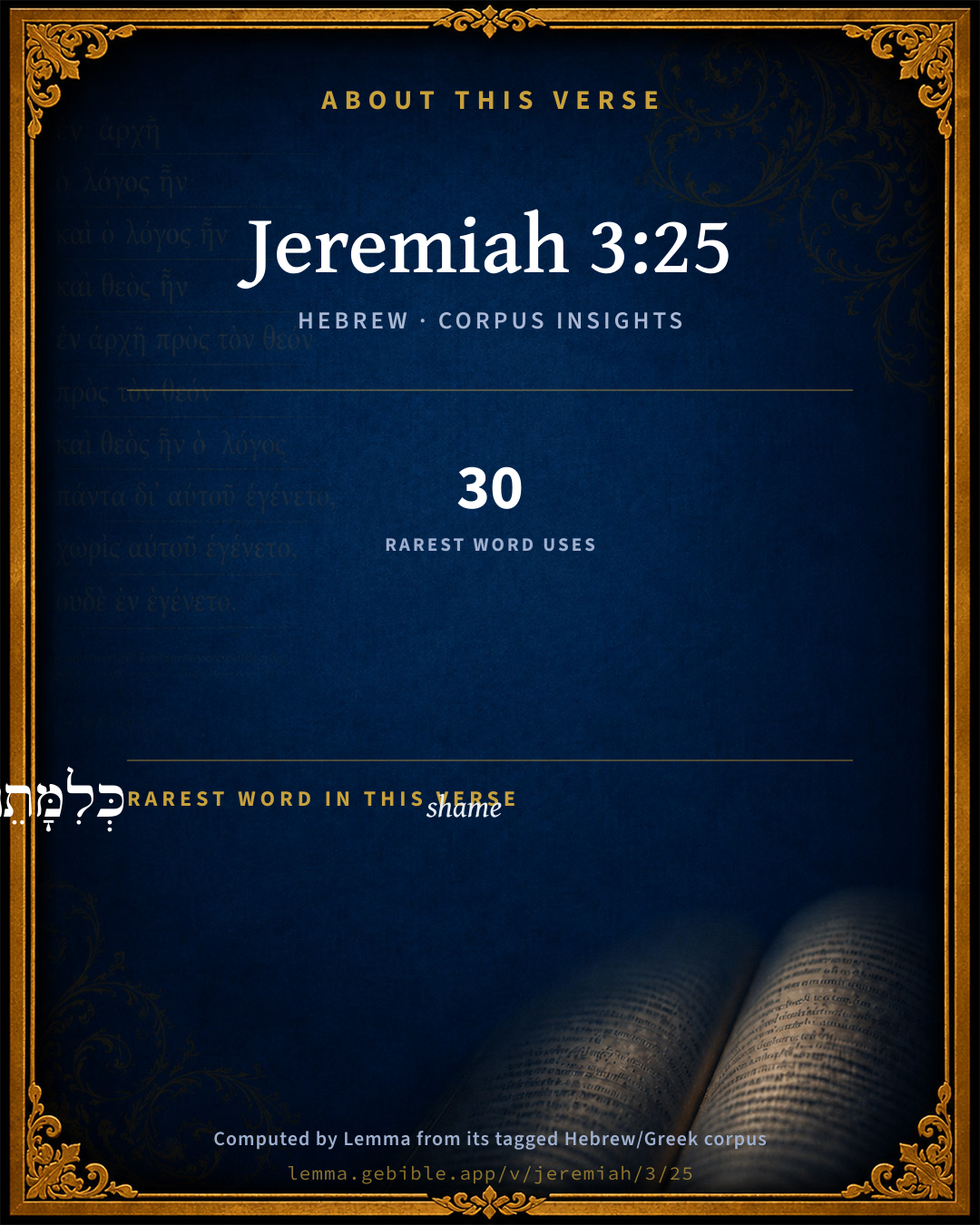
These counts appear in no published source. They are computed here, from the morphology-tagged text and Lemma’s own curated glosses. What Lemma adds →

19
words
17
distinct lemmas
Prophets
section

Shared distinctive vocabulary

כְּלִמָּתֵנוּ֒ shame H3639 occurs in 29 verses of the Hebrew Bible. Also found in:

Grammatical profile

  • 4 verbs
  • 10 nouns
  • 2 pronouns
  • 1 preposition
  • 1 conjunction
  • 1 particle

Verb forms

  • נִשְׁכְּבָ֣ה Qal · Cohortative
  • וּֽתְכַסֵּנוּ֮ Piel · Imperfect
  • חָטָ֗אנוּ Qal · Perfect
  • שָׁמַ֔עְנוּ Qal · Perfect

Repetition

Words recur within this verse — often emphatic in Hebrew:

  • לַיהוָ֨ה LORD H3068 ×2
  • אֱלֹהֵ֜ינוּ God H430 ×2

Cross-references

22

Topical passages linked to Jeremiah 3:25 in the Treasury of Scripture Knowledge — connected by theme and wording, ordered by reader-vote popularity; previews shown in the World English Bible.

  • Jeremiah 22:21 I spoke to you in your prosperity; but you said, I will not hear. This has been your manner from your youth, that you didn't obey my voice.
  • Proverbs 5:13 Neither have I obeyed the voice of my teachers, Nor turned my ear to those who instructed me!
  • Jeremiah 2:26 As the thief is ashamed when he is found, so is the house of Israel ashamed; they, their kings, their princes, and their priests, and their prophets;
  • Lamentations 5:16 The crown is fallen from our head: Woe to us! for we have sinned.
  • Ezekiel 7:18 They shall also gird themselves with sackcloth, and horror shall cover them; and shame shall be on all faces, and baldness on all their heads.
  • Deuteronomy 31:17–18 Then my anger shall be kindled against them in that day, and I will forsake them, and I will hide my face from them, and they shall be devoured, and many evils and troubles shall come on them; so that they will say in that day, Haven't these evils come on us because our God is not among us?
  • Judges 2:2 and you shall make no covenant with the inhabitants of this land; you shall break down their altars. But you have not listened to my voice: why have you done this?
  • Ezra 9:6–15 and I said, my God, I am ashamed and blush to lift up my face to you, my God; for our iniquities are increased over our head, and our guiltiness is grown up to the heavens.
  • Nehemiah 9:32–34 Now therefore, our God, the great, the mighty, and the awesome God, who keep covenant and loving kindness, don't let all the travail seem little before you, that has come on us, on our kings, on our princes, and on our priests, and on our prophets, and on our fathers, and on all your people, since the time of the kings of Assyria to this day.
  • Psalms 106:7 Our fathers didn't understand your wonders in Egypt. They didn't remember the multitude of your loving kindnesses, But were rebellious at the sea, even at the Red Sea.
  • Psalms 109:29 Let my adversaries be clothed with dishonor. Let them cover themselves with their own shame as with a robe.
  • Isaiah 50:11 Behold, all you who kindle a fire, who gird yourselves about with firebrands; walk you in the flame of your fire, and among the brands that you have kindled. This shall you have of my hand; you shall lie down in sorrow.
  • Jeremiah 2:2 Go, and cry in the ears of Jerusalem, saying, Thus says Yahweh, I remember for you the kindness of your youth, the love of your weddings; how you went after me in the wilderness, in a land that was not sown.
  • Jeremiah 2:17 Haven't you procured this to yourself, in that you have forsaken Yahweh your God, when he led you by the way?
  • Lamentations 5:7 Our fathers sinned, and are no more; We have borne their iniquities.
  • Daniel 9:6–10 neither have we listened to your servants the prophets, who spoke in your name to our kings, our princes, and our fathers, and to all the people of the land.
  • Romans 6:21 What fruit then did you have at that time in the things of which you are now ashamed? For the end of those things is death.
  • Isaiah 48:8 Yes, you didn't hear; yes, you didn't know; yes, from of old your ear was not opened: for I knew that you did deal very treacherously, and was called a transgressor from the womb.
  • Jeremiah 2:19 Your own wickedness shall correct you, and your backsliding shall reprove you: know therefore and see that it is an evil thing and a bitter, that you have forsaken Yahweh your God, and that my fear is not in you, says the Lord, Yahweh of Hosts.
  • Jeremiah 6:26 Daughter of my people, gird you with sackcloth, and wallow yourself in ashes: make you mourning, as for an only son, most bitter lamentation; for the destroyer shall suddenly come on us.
  • Ezekiel 36:32 Nor for your sake do I [this], says the Lord Yahweh, be it known to you: be ashamed and confounded for your ways, house of Israel.
  • Daniel 12:2 Many of those who sleep in the dust of the earth shall awake, some to everlasting life, and some to shame and everlasting contempt.

Cross-references courtesy of OpenBible.info (CC BY 4.0).

Hebrew and Greek witnesses Masoretic Hebrew ↔ Greek Septuagint

The same verse in the two great witnesses to the Old Testament, shown verse-for-verse.

These are two independent witnesses, not word-aligned to each other, and the Septuagint is shown in lemma (dictionary) form.

Hebrew Jeremiah 3:25 Masoretic · Westminster Leningrad Codex

נִשְׁכְּבָ֣ה בְּבָשְׁתֵּ֗נוּ וּֽתְכַסֵּנוּ֮ כְּלִמָּתֵנוּ֒ כִּי֩ לַיהוָ֨ה אֱלֹהֵ֜ינוּ חָטָ֗אנוּ אֲנַ֨חְנוּ֙ וַאֲבוֹתֵ֔ינוּ מִנְּעוּרֵ֖ינוּ וְעַד הַיּ֣וֹם הַזֶּ֑ה וְלֹ֣א שָׁמַ֔עְנוּ בְּק֖וֹל יְהֹוָ֥ה אֱלֹהֵֽינוּ

Let us lie down in our shame, and let our confusion cover us; for we have sinned against Yahweh our God, we and our fathers, from our youth even to this day; and we have not obeyed the voice of Yahweh our God.

World English Bible · Public Domain

Greek LXX Structure differs

In the Septuagint, Jeremiah is about an eighth shorter than the Hebrew and arranges its material differently — the Oracles Against the Nations (Hebrew chapters 46–51) appear in the middle of the Greek book, after 25:13. Because the chapter and verse boundaries do not line up, a verse-for-verse comparison with the Hebrew is not shown.

A verse-for-verse comparison isn’t shown here because the chapters and verses don’t line up. Switch to the LXX edition with the MT / LXX toggle above to read the Greek directly.

Hebrew: Westminster Leningrad Codex (CC BY 4.0). Greek: Septuagint (public domain); English from a public-domain English Septuagint. How the Septuagint differs from the Hebrew →

Targum (Aramaic paraphrase)

1

The Targum is the ancient Jewish Aramaic paraphrase of the Hebrew Scriptures — an interpretive translation, not the Hebrew text itself. Onkelos (literal) and Pseudo-Jonathan (expansive) render the Torah, and Jonathan the Prophets. Coverage is partial: where no permissively-licensed English translation exists for a verse, only the Aramaic is shown. This is verse-level text, not a word-by-word alignment to the Hebrew.

  1. Targum Jonathan Prophets (Joshua–Malachi)
    נִשְׁכוּב בְּבַהֲתַת חוֹבָנָא וְתַחֲפִינָנָא אִתְכְּנָעוּתָנָא אֲרֵי קֳדָם יְיָ אֱלָהָנָא חַבָנָא אֲנַחְנָא וַאֲבָהָתָנָא מִזְעוּרָנָא וְעַד יוֹמָא הָדֵין וְלָא קַבֵּילְנָא לְמֵימְרָא דַייָ אֱלָהָנָא:

    (no public-domain English translation for this verse)

    Targum Jonathan — Aramaic: “Mikraot Gedolot” (public domain). English: “Sefaria Community Translation” (CC0 1.0 (public-domain dedication)); “London "Chaldee Paraphrase," 1871” (public domain). Text via Sefaria.

Commentary

Notes on Jeremiah 3:25 from classic Christian and Jewish commentators (each source and its license shown beneath its notes). The classic Christian expositions comment on the surrounding passage and are grouped to its opening verse, so a note may address several verses; the Jewish commentaries on the Tanakh (Rashi and others) are per-verse, so they appear only where the commentator wrote on this verse.

Lemma curates 59 commentaries, every one of them public domain or Creative Commons licensed, each selected and text-cleaned for this edition rather than reprinted as found. About our sources →

Trapp's Complete Commentary

John Trapp

Jer 3:25 We lie down in our shame, and our confusion covereth us: for we have sinned against the LORD our God, we and our fathers, from our youth even unto this day, and have not obeyed the voice of the LORD our God.

Ver. 25. We lie down in our shame.] We that once had a whore’s forehead, {Jer 3:3} and seemed past grace, are now sore ashamed of former miscarriages, yea, our confusion covereth us, {as Psa 44:15} because "we have sinned against the Lord our God, we and our fathers, from our youth unto this day, and have not obeyed the voice of our God." Lo, here a dainty form and pattern of penitent confession, such as is sure to find mercy. Haec sane omni tempore Christiana est satisfactio, non meritoria aliqua Papistica atque nugivendula. {a} Only we must not acknowledge sin with dry eyes, but point every sin with a tear, &c.

{a} Zegedin.

John Trapp, A Commentary or Exposition upon All the Books of the Old and New Testament (1647–1656) — public domain. Text from a community e-Sword module.

Geneva Bible (1599)

Geneva Bible translators

They justify not themselves, or say that they would follow their fathers, but condemn their wicked doings and desire forgiveness of the same, as Ezra 9:7; Ps. 106:6; Isa. 64:6.

Geneva Bible (1599) marginal notes — public domain. Text via Bolls.life.

Jamieson, Fausset & Brown

Robert Jamieson, A. R. Fausset & David Brown

(Ezr 9:7).

Next: Jeremiah Chapter 4

Jamieson, Fausset & Brown — Commentary Critical and Explanatory on the Whole Bible (1871) — public domain (CC PDM 1.0). Text via the HelloAO Bible API.

John Calvin's Commentaries

As the Israelites say here nothing new, but continue the same subject, I propose only to touch briefly on the words, lest I should be too tedious. They say then that they were lying in their miseries; and why? because they had dealt wickedly with God We see that they are explaining what they had confessed, — even that the labor of their fathers had been consumed by their shame, that is, by their wickedness; and they ascribe to themselves what might have been put to the account of their fathers, because they knew that they were heirs to their iniquity. We have lain, they say, in our shame They here shortly confess that they were deservedly miserable, that they could not accuse God of cruelty, as that he afflicted them too severely. How so? because they were lying in their own shame, and their own disgrace covered them; as though they said, that the cause of all their evils was to be found in their sins, and that it was not to be sought anywhere else.

Because we and our fathers, they say, have done wickedly By these words they intimate that they had acted thus, not for a day only, but had been so perverse, that from early life they had imbibed the iniquity of their fathers, and thus added evils to evils. They had said before, that the labor of their fathers had been consumed from their childhood, thereby signifying the continuance of their punishment; for God had not for a day chastised them, but had often repeated his scourges, and yet without any benefit. Now they add, “As we have from our childhood dealt wickedly towards our God, so also he has warned us from our childhood to return to him; and it has been our fault that we have not returned, for he called us; but as we were obstinate, so also God has justly executed on us his vengeance.”

They afterwards say, even to this day; by which they confirm what I have already stated, — that they had been so perverse as not to cease from their vices. At the same time he points out the source of all their wickedness: they hearkened not to the voice of Jehovah Had they gone astray, and had God been silent, their fault might have been extenuated; but as God had daily sent prophets to them, who never ceased to cry in their hearing, and yet they continued deaf, their perverseness in their sinful courses was inexcusable. We then see that their sin was increased by the circumstance, that they refused to hear the voice of God; as though he had said, that God had done his part in calling them back from the way of ruin, but that they had been so obstinate as to disregard his favor, and that they thus justly suffered, not only for their impiety, but also for their ingratitude and perverse wickedness.

John Calvin's Commentaries (1540-1563) — public domain. Text from the Calvin Translation Society English edition (1840s-50s) via the Christian Classics Ethereal Library (ccel.org). Calvin's coverage is partial (roughly two-thirds of the Bible); uncommented books and verses are honest gaps, never fabricated. The 19th-century editor's footnotes and remarks are omitted so the notes are faithfully Calvin's own voice.

Ellicott's Commentary for English Readers

(25) We lie down.—Better, We will lie down—Our confusion shall cover us. The words are those of penitents accepting their punishment: “We chose the shameful thing, therefore let us bear our shame.”

A Bible Commentary for English Readers, edited by Charles John Ellicott (1878–1897) — public domain. Text from a community e-Sword module.

The Cambridge Bible for Schools and Colleges

gen. ed. J. J. S. Perowne

25. Let us lie down] Cp. for such a custom as indicative of very painful feelings 2Sa_12:16; 2Sa_13:31; 1Ki_21:4.

cover] Cp. Psa_109:29.

The Cambridge Bible for Schools and Colleges (gen. ed. J. J. S. Perowne; Cambridge University Press, 1878–1918) — public domain. Text from a community e-Sword module.

John Gill's Exposition

We lie down in our shame, and our confusion covereth us,.... As persons overwhelmed with a sense of sin, and so pressed with the guilt of it on their consciences, that they can neither stand up, nor look up, but throw themselves on the ground, and cover their faces, being ashamed of what they have done:

for we have sinned against the Lord our God; as by breaking the law of God, so by despising the Gospel; rejecting the ordinances of it; disbelieving the Messiah, and speaking reproachfully of him and his people:

we and our fathers, from our youth even unto this day; in a long series of years, from the time that Christ was upon earth, to the day of their conversion, in the latter times of the Gospel dispensation:

and have not obeyed the voice of the Lord our God; the voice of his forerunner, John the Baptist, of the Messiah himself, and of his apostles, and of his ministers, since; so the Targum,

"and have not obeyed the Word of the Lord our God.''

Christ the essential Word.

Next: Jeremiah Chapter 4

John Gill's Exposition of the Whole Bible (1746–1763) — public domain (CC PDM 1.0). Text via the HelloAO Bible API.

Albert Barnes' Notes on the Bible

We lie down ... - Or, We will lie down: we are ready to throw ourselves upon the ground in bitter humiliation.

Covereth - literally, shall cover us. We will hide our face from others.

Albert Barnes' Notes on the Bible (1834–1885) — public domain. Text from a community e-Sword/MySword module.

Haydock's Catholic Bible Commentary

Shame. We are justly punished with exile, (Calmet) and death. (Menochius)

George Leo Haydock (1774–1849), Haydock's Catholic Family Bible and Commentary, 1859 edition — public domain. Excludes Psalms (Douay-Rheims chapter numbering differs from Protestant) and Deuterocanonical books (Catholic canon only).

Matthew Poole's English Annotations

We lie down in our shame; we are perplexed and confounded within ourselves; we are such a reproach, both to God and man, that we cannot but lift up our hands for shame, even we, that had once a whore’s forehead, Jer 3:3, but must lie down in our shame; an expression to set forth tho greatness of their repentance and sorrow; as one in great perplexity, not knowing what to do, throws himself down upon his couch or bed, 1Ki 21:4.

Our confusion covereth us; a metaphor from persons muffled up in the bed-clothes, as ashamed to be seen: the like expression Psa 44:15.

We and our fathers this notes the universality of their sins, the whole generation of us, like fathers, like children. True confession wraps up our own and others’ sins, Ezr 9:7; Neh 9:33,34; Psa 106:6,7; Jer 14:20, and keeps us from all excuse by others’ examples, 2Ki 17:41, which gross guilt of theirs in this kind is described Jer 44:17.

From our youth even unto this day: as the former sets forth the universality of their sins, so this the continuance of them, Deu 9:7; 2Ki 17:34,41.

Matthew Poole's English Annotations on the Holy Bible (1683–1685) — public domain. Text from a community e-Sword/MySword module.

Whedon's Commentary on the Bible

Daniel D. Whedon

25. We lie down in our shame, etc. — We will patiently submit to this misery and disgrace which our own infamous sin has invited.

Daniel D. Whedon (gen. ed.), Commentary on the Old and New Testaments (1874–1909) — public domain. Text from a community e-Sword module.

The Pulpit Commentary

We lie down; rather, Let us lie down; said in despair, just as Hezekiah says, "Let us enter the gates of Sheol". (Isa_38:10) A prostrate position is the natural expression of deep sorrow. (2Sa_12:16 2Sa_13:31 1Ki_21:4) Our confusion covereth us; rather, Let our confusion (or reproach) cover us (like a veil). (comp. Psa_69:7)

The Pulpit Commentary (1880–1919), ed. H.D.M. Spence-Jones & Joseph S. Exell — public domain. Text from a community e-Sword module.

John Wesley's Explanatory Notes

Lie down - An expression to set forth the greatness of their repentance and sorrow in great perplexity, not knowing what to do, throws himself down upon his couch or bed.

John Wesley, Explanatory Notes Upon the Whole Bible (1754–1765) — public domain. Text via the GEBible commentary corpus.

Lesson kit

Teaching starters — assembled from the data on this page, not authored interpretation. Every prompt links to the verse data it draws on. Edit before teaching.

Jeremiah, in the Prophets, opens this verse with 19 words (17 distinct Hebrew lemmas). Its most distinctive word is kᵉlimmâh (“shame”). A historical commentator’s framing appears above. Read the whole chapter for the surrounding context.

Discussion questions

  1. The word kᵉlimmâh carries the sense “shame.” How does it shape the verse?
  2. How does Job 20:3, which shares the word «shame», read alongside this verse?
  3. What does the repetition of “LORD” (2× in this one verse) do in this verse?
  4. The translations on this page render this verse differently — a whole-verse word diff, not a word-by-word alignment. What might account for the different wordings?
  5. «נִשְׁכְּבָ֣ה» is a Qal Cohortative verb. How does that grammatical form shape the action described?
  6. Compare how Trapp's Complete Commentary and Geneva Bible (1599) read this verse. Where do they agree or differ?

Things to notice

Reading settings

Reading text

Shown beneath each verse's original-language words.

Old Testament
Old Testament edition

Read the OT as the Masoretic Hebrew (MT) or the Greek Septuagint (LXX).

English shown for the Greek Septuagint (in the Hebrew ↔ Greek comparison).

Comparing translations? Open the Compare panel on any verse page to stack up to four side by side.