

Leviticus 6:2

Hebrew (Westminster Leningrad Codex) Leviticus 6:2 appears in the Hebrew Old Testament. The text above is from the Westminster Leningrad Codex. Each word links to its Strong’s number, a concise gloss, and parsing drawn from the Open Scriptures Hebrew Bible morphology. Click any word for its full Brown-Driver-Briggs (BDB) entry.
Download image
Cite this verse

Leviticus 6:2 (World English Bible). Public Domain. Lemma interlinear Bible study tool, https://lemma.gebible.app/v/leviticus/6/2.

Show BibTeX & RIS
BibTeX
RIS
English Translation
"If anyone sins, and commits a trespass against Yahweh, and deals falsely with his neighbor in a matter of deposit, or of bargain, or of robbery, or has oppressed his neighbor,
World English Bible · Public Domain
Highlights Full analysis ↓
Download a study sheet

One document with this verse’s original text, its word-by-word gloss line, the meaning frame, cross-references with their text, attributed commentary, and full source and license credits — printable, and it pastes into notes with its structure intact.

This verse Autodidact and up

Study sheet (.html) Plain text (.txt)

A passage Seminary Student

Up to 50 verses in one chapter. A passage sheet keeps up to 6 commentary sources and 12 cross-references per verse, in the order this page ranks them, and says so on the sheet whenever that leaves anything out. Ask for a single verse and you get the Autodidact verse sheet above.

Everything on this page stays free to read, with no account — the sheet is a download of what is already on screen, not access to it.

Want to remove ads? Support Godless Engineer
Compare translations 3

The same verse in 3 English versions, stacked beneath the original-language interlinear above. Click any original word for its lexicon entry.

Each is an independent rendering of the whole verse — the interlinear is not word-aligned to these translations.

Highlighted words mark where these versions differ — a whole-verse word diff, not a word-by-word alignment.

  • World English Bible Public Domain
    "If anyone sins, and commits a trespass against Yahweh, and deals falsely with his neighbor in a matter of deposit, or of bargain, or of robbery, or has oppressed his neighbor,
  • King James Version Public Domain
    If a soul sin, and commit a trespass against the LORD, and lie unto his neighbor in that which was delivered him to keep, or in fellowship, or in a thing taken away by violence, or hath deceived his neighbor;
  • unfoldingWord Literal Text CC BY-SA 4.0
    “A person, when he sins and he trespasses a trespass against Yahweh, and he denies his fellow citizen with a deposit or with a pledge of a hand, or with robbery, or he extorts his fellow citizen,

unfoldingWord Literal Text — © unfoldingWord, licensed CC BY-SA 4.0. Word-aligned USFM3 via Door43 (git.door43.org/unfoldingWord/en_ult).

Versions to compare (up to 4)

3 of 4 selected

Show all 18 translations

Every available English version of this verse, each an independent rendering of the whole verse.

  • World English Bible Public Domain
    "If anyone sins, and commits a trespass against Yahweh, and deals falsely with his neighbor in a matter of deposit, or of bargain, or of robbery, or has oppressed his neighbor,
  • Berean Standard Bible Public Domain
    “If someone sins and acts unfaithfully against the LORD by deceiving his neighbor in regard to a deposit or security entrusted to him or stolen, or if he extorts his neighbor
  • Majority Standard Bible Public Domain
    “If someone sins and acts unfaithfully against the LORD by deceiving his neighbor in regard to a deposit or security entrusted to him or stolen, or if he extorts his neighbor
  • King James Version Public Domain
    If a soul sin, and commit a trespass against the LORD, and lie unto his neighbor in that which was delivered him to keep, or in fellowship, or in a thing taken away by violence, or hath deceived his neighbor;
  • American Standard Version (1901) Public Domain
    If any one sin, and commit a trespass against Jehovah, and deal falsely with his neighbor in a matter of deposit, or of bargain, or of robbery, or have oppressed his neighbor,
  • Revised Version (1885) Public Domain
    If any one sin, and commit a trespass against the LORD, and deal falsely with his neighbour in a matter of deposit, or of bargain, or of robbery, or have oppressed his neighbour;
  • Geneva Bible (1599) Public Domain
    If any sinne and commit a trespasse against the Lord, and denie vnto his neighbour that, which was take him to keepe, or that which was put to him of trust, or doth by robberie, or by violence oppresse his neighbour,
  • Douay-Rheims (1899) Public Domain
    Whosoever shall sin, and despising the Lord, shall deny to his neighbour the thing delivered to his keeping, which was committed to his trust; or shall by force extort any thing, or commit oppression;
  • Young's Literal Translation Public Domain
    `When any person doth sin, and hath committed a trespass against Jehovah, and hath lied to his fellow concerning a deposit, or concerning fellowship, or concerning violent robbery, or hath oppressed his fellow;
  • Literal Standard Version CC BY-SA 4.0
    “When any person sins, and has committed a trespass against YHWH, and has lied to his fellow concerning a deposit, or concerning fellowship, or concerning violent robbery, or has oppressed his fellow;
  • Unlocked Literal Bible CC BY-SA 4.0
    “If anyone sins and acts unfaithfully against Yahweh by deceiving his neighbor regarding something held in trust, or was left in his care, or about something that was stolen, or if he has oppressed his neighbor,
  • unfoldingWord Literal Text CC BY-SA 4.0
    “A person, when he sins and he trespasses a trespass against Yahweh, and he denies his fellow citizen with a deposit or with a pledge of a hand, or with robbery, or he extorts his fellow citizen,
  • Darby Bible Public Domain
    If any one sin and act unfaithfully against Jehovah, and lie to his neighbour as to an entrusted thing or a deposit or [that in which] he hath robbed or wronged his neighbour,
  • World Messianic Bible Public Domain
    “If anyone sins, and commits a trespass against the LORD, and deals falsely with his neighbor in a matter of deposit, or of bargain, or of robbery, or has oppressed his neighbor,
  • Webster's Bible Public Domain
    \\6:9\\Command Aaron and his sons, saying, This is the law of the burnt-offering: It is the burnt-offering, because of the burning upon the altar all night until the morning, and the fire of the altar shall be burning in it.
  • Free Bible Version CC BY-SA 4.0
    “If you sin against the Lord, breaking your commitment to him, then this is what must happen. You may have lied to your neighbor about something you entrusted to them, about some deposit paid, about something that was stolen, or maybe you were trying to cheat them.
  • Bible in Basic English Public Domain
    Give orders to Aaron and to his sons, saying, This is the law for the burned offering: the offering is to be on the fire-wood on the altar all night till the morning; and the fire of the altar is to be kept burning.
  • JPS Tanakh (1917) Public Domain
    (5-21) If any one sin, and commit a trespass against the LORD, and deal falsely with his neighbour in a matter of deposit, or of pledge, or of robbery, or have oppressed his neighbour;

Literal Standard Version (2020), Covenant Press — licensed CC BY-SA 4.0. Text via the HelloAO Bible API (eBible.org). Unlocked Literal Bible (unfoldingWord) — licensed CC BY-SA 4.0. Text via the HelloAO Bible API (eBible.org). unfoldingWord Literal Text — © unfoldingWord, licensed CC BY-SA 4.0. Word-aligned USFM3 via Door43 (git.door43.org/unfoldingWord/en_ult). Free Bible Version, Dr. Jonathan Gallagher — licensed CC BY-SA 4.0. Text via the HelloAO Bible API (eBible.org).

Word by word

More ways to search: Search by grammar → Find every occurrence → Compare this word →

Practice this passage: Drill this verse → Learn its vocabulary →

בִתְשׂ֤וּמֶת
tᵉsûwmeth
H8667
“in/at · pledge of”
Preposition + Noun, Common, Feminine, Singular, Construct
Part of Speech
Preposition + Noun
Type
Common
Gender
Feminine
Number
Singular
State
Construct
Full BDB Definition

Origin: from H7760

TWOT: 2243a

pledge, security, deposit
  1. נֶ֚פֶשׁ nephesh H5315 “soul” Noun, Common, Both, Singular, Absolute
  2. כִּ֣י kîy H3588 “that” Conjunction
  3. תֶחֱטָ֔א châṭâʼ H2398 “to sin” Verb, Qal, Imperfect, 3rd Person, Feminine, Singular
  4. וּמָעֲלָ֥ה mâʻal H4603 “and · to betray” Conjunction + Verb, Qal, Sequential Perfect, 3rd Person, Feminine, Singular
  5. מַ֖עַל maʻal H4604 “treachery” Noun, Common, Masculine, Singular, Absolute
  6. בַּיהוָ֑ה Yᵉhôvâh H3068 “in/at · LORD” Preposition + Noun, Proper
  7. וְכִחֵ֨שׁ kâchash H3584 “and · to deceive” Conjunction + Verb, Piel, Sequential Perfect, 3rd Person, Masculine, Singular
  8. בַּעֲמִית֜וֹ ʻâmîyth H5997 “in/at · neighbor · his” Preposition + Noun, Common, Masculine, Singular, Construct + Suffix, Personal, 3rd Person, Masculine, Singular
  9. בְּפִקָּד֗וֹן piqqâdôwn H6487 “in/at · store” Preposition + Noun, Common, Masculine, Singular, Absolute
  10. אֽוֹ ʼôw H176 “or” Conjunction
  11. יָד֙ yâd H3027 “hand” Noun, Common, Both, Singular, Absolute
  12. א֣וֹ ʼôw H176 “or” Conjunction
  13. בְגָזֵ֔ל gâzêl H1498 “in/at · plunder” Preposition + Noun, Common, Masculine, Singular, Absolute
  14. א֖וֹ ʼôw H176 “or” Conjunction
  15. עָשַׁ֥ק ʻâshaq H6231 “to oppress” Verb, Qal, Perfect, 3rd Person, Masculine, Singular
  16. אֶת ʼêth H853 “-” Particle, Direct Object
  17. עֲמִיתֽוֹ ʻâmîyth H5997 “neighbor · his” Noun, Common, Masculine, Singular, Construct + Suffix, Personal, 3rd Person, Masculine, Singular

About this verse

These counts appear in no published source. They are computed here, from the morphology-tagged text and Lemma’s own curated glosses. What Lemma adds →

18
words
15
distinct lemmas
Pentateuch
section

Notable vocabulary

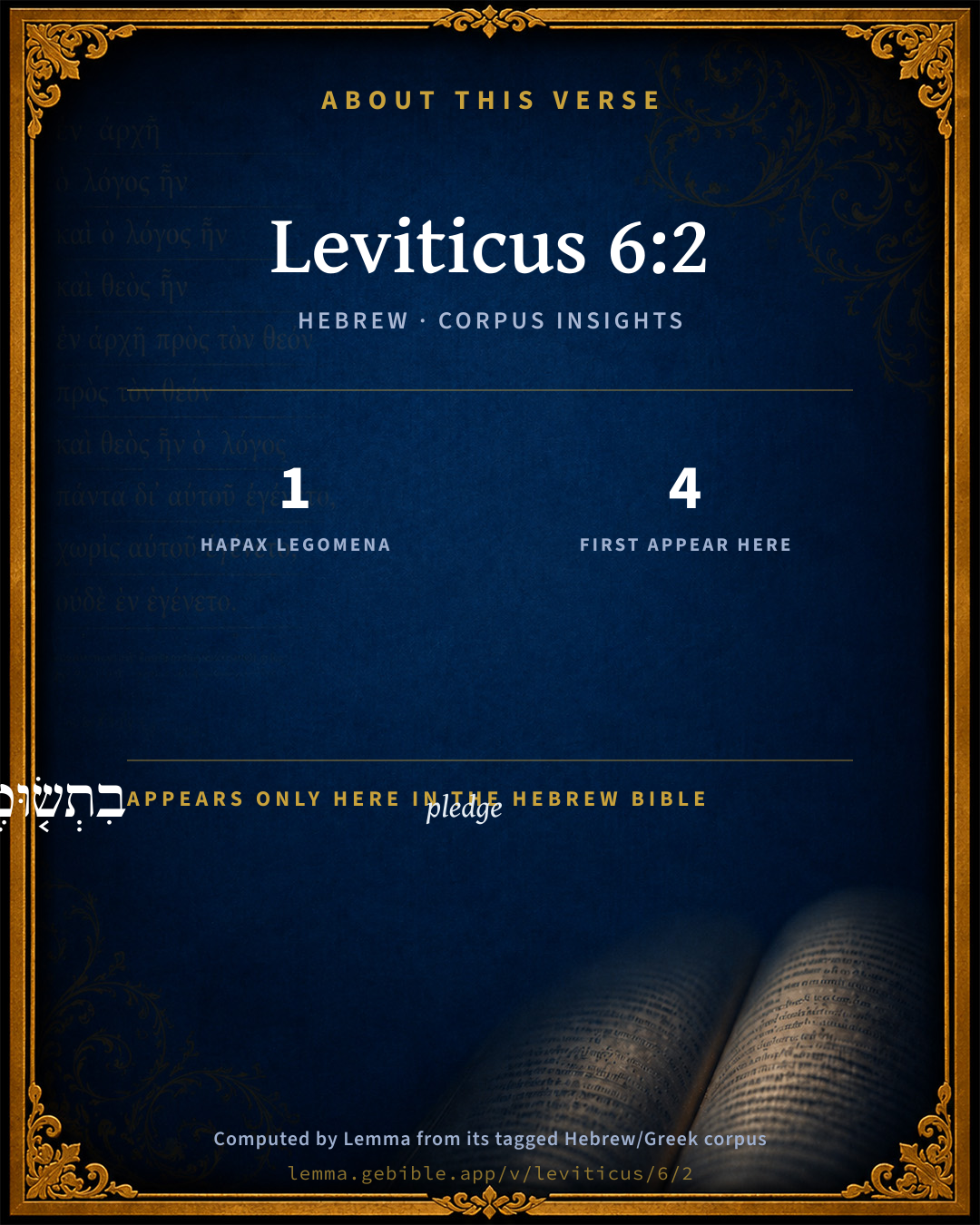
1 hapax legomenon — a word that appears only here in the entire Hebrew Bible:

  • בִתְשׂ֤וּמֶת pledge H8667

First appearance in Scripture

These words make their first canonical appearance in the Hebrew Bible here:

  • בַּעֲמִית֜וֹ neighbor H5997
  • בִתְשׂ֤וּמֶת pledge H8667
  • בְגָזֵ֔ל plunder H1498
  • עָשַׁ֥ק to oppress H6231

Shared distinctive vocabulary

בְּפִקָּד֗וֹן store H6487 occurs in 3 verses of the Hebrew Bible. Also found in:

Grammatical profile

  • 4 verbs
  • 9 nouns
  • 4 conjunctions
  • 1 particle

Verb forms

  • תֶחֱטָ֔א Qal · Imperfect
  • וּמָעֲלָ֥ה Qal · Sequential Perfect
  • וְכִחֵ֨שׁ Piel · Sequential Perfect
  • עָשַׁ֥ק Qal · Perfect

Repetition

Words recur within this verse — often emphatic in Hebrew:

  • בַּעֲמִית֜וֹ neighbor H5997 ×2
  • אֽוֹ or H176 ×3

Hebrew & Septuagint length

In English translation the verse runs 31 words from the Hebrew and 44 from the Septuagint (LXX English) — the Septuagint runs noticeably longer here. See the side-by-side →

A rough comparison of the two English renderings, which tokenize alike — not a word-level alignment.

Word counts can differ between the Hebrew and the Greek without any difference in meaning — e.g. the Hebrew direct-object marker אֵת has no separate Greek word, and Greek often adds the article ὁ.

Cross-references

22

Topical passages linked to Leviticus 6:2 in the Treasury of Scripture Knowledge — connected by theme and wording, ordered by reader-vote popularity; previews shown in the World English Bible.

  • Colossians 3:9 Don't lie to one another, seeing that you have put off the old man with his doings,
  • Exodus 22:7–10 "If a man delivers to his neighbor money or stuff to keep, and it is stolen out of the man's house; if the thief is found, he shall pay double.
  • Leviticus 5:15 "If anyone commits a trespass, and sins unwittingly, in the holy things of Yahweh; then he shall bring his trespass offering to Yahweh, a ram without blemish from the flock, according to your estimation in silver by shekels, after the shekel of the sanctuary, for a trespass offering.
  • Leviticus 19:11 "'You shall not steal; neither shall you deal falsely, nor lie to one another.
  • Numbers 5:6–8 "Speak to the children of Israel: When a man or woman commits any sin that men commit, so as to trespass against Yahweh, and that soul is guilty;
  • Proverbs 24:28 Don't be a witness against your neighbor without cause. Don't deceive with your lips.
  • Acts 5:4 While you kept it, didn't it remain your own? After it was sold, wasn't it in your power? How is it that you have conceived this thing in your heart? You haven't lied to men, but to God."
  • Genesis 26:7 The men of the place asked him about his wife. He said, "She is my sister," for he was afraid to say, "My wife," lest, he thought, the men of the place might kill me for Rebekah, because she was beautiful to look on.
  • Leviticus 5:19 It is a trespass offering. He is certainly guilty before Yahweh."
  • Psalms 51:4 Against you, and you only, have I sinned, And done that which is evil in your sight; That you may be proved right when you speak, And justified when you judge.
  • Proverbs 26:19 Is the man who deceives his neighbor and says, "Am I not joking?"
  • Isaiah 21:2 A grievous vision is declared to me; the treacherous man deals treacherously, and the destroyer destroys. Go up, Elam; besiege, Media; all the sighing of it have I made to cease.
  • Isaiah 24:16 From the uttermost part of the earth have we heard songs: Glory to the righteous. But I said, I pine away, I pine away, woe is me! the treacherous have dealt treacherously; yes, the treacherous have dealt very treacherously.
  • Isaiah 33:1 Woe to you who destroy, and you weren't destroyed; and deal treacherously, and they didn't deal treacherously with you! When you have ceased to destroy, you shall be destroyed; and when you have made an end of dealing treacherously, they shall deal treacherously with you.
  • Isaiah 59:13–15 transgressing and denying Yahweh, and turning away from following our God, speaking oppression and revolt, conceiving and uttering from the heart words of falsehood.
  • Jeremiah 9:5 They will deceive everyone his neighbor, and will not speak the truth: they have taught their tongue to speak lies; they weary themselves to commit iniquity.
  • Amos 8:5 Saying, 'When will the new moon be gone, that we may sell grain? And the Sabbath, that we may market wheat, Making the ephah small, and the shekel large, And dealing falsely with balances of deceit;
  • Micah 6:10–12 Are there yet treasures of wickedness in the house of the wicked, And a short ephah that is accursed?
  • Habakkuk 1:13 You who have purer eyes than to see evil, and who cannot look on perversity, why do you tolerate those who deal treacherously, and keep silent when the wicked swallows up the man who is more righteous than he,
  • John 8:44 You are of your Father, the devil, and you want to do the desires of your father. He was a murderer from the beginning, and doesn't stand in the truth, because there is no truth in him. When he speaks a lie, he speaks on his own; for he is a liar, and the father of it.
  • Ephesians 4:25 Therefore, putting away falsehood, speak truth each one with his neighbor. For we are members one of another.
  • Revelation 22:15 Outside are the dogs, the sorcerers, the sexually immoral, the murderers, the idolaters, and everyone who loves and practices falsehood.

Cross-references courtesy of OpenBible.info (CC BY 4.0).

Hebrew and Greek witnesses Masoretic Hebrew ↔ Greek Septuagint

The same verse in the two great witnesses to the Old Testament, shown verse-for-verse.

Here the Septuagint runs noticeably longer than the Hebrew — LXX2012 (modern English Septuagint) 44 words vs World English Bible 31. A rough length comparison of the two English translations, not a word-level alignment — read both below.

These are two independent witnesses, not word-aligned to each other, and the Septuagint is shown in lemma (dictionary) form.

Hebrew Leviticus 6:2 Masoretic · Westminster Leningrad Codex

נֶ֚פֶשׁ כִּ֣י תֶחֱטָ֔א וּמָעֲלָ֥ה מַ֖עַל בַּיהוָ֑ה וְכִחֵ֨שׁ בַּעֲמִית֜וֹ בְּפִקָּד֗וֹן אֽוֹ בִתְשׂ֤וּמֶת יָד֙ א֣וֹ בְגָזֵ֔ל א֖וֹ עָשַׁ֥ק אֶת עֲמִיתֽוֹ

"If anyone sins, and commits a trespass against Yahweh, and deals falsely with his neighbor in a matter of deposit, or of bargain, or of robbery, or has oppressed his neighbor,

World English Bible · Public Domain

Greek LXX Leviticus 6:2 Septuagint · lemma form

ἐντέλλομαι ἀαρών καί ὁ υἱός αὐτός λέγω οὗτος ὁ νόμος ὁ ὁλοκαύτωσις αὐτός ὁ ὁλοκαύτωσις ἐπί ὁ καῦσις αὐτός ἐπί ὁ θυσιαστήριον ὅλος ὁ νύξ ἕως ὁ πρωΐ καί ὁ πῦρ ὁ θυσιαστήριον καίω ἐπί αὐτός οὐ σβέννυμι

The soul which shall have sinned, and willfully overlooked the commandments of the Lord, and shall have dealt falsely in the affairs of his neighbor in the matter of a deposit, or concerning fellowship, or concerning plunder, or has in anything wronged his neighbor,

LXX2012 (modern English Septuagint) · Public Domain

On this verse, The Cambridge Bible for Schools and Colleges discusses the Septuagint’s reading. Read the note in Commentary ↓

Hebrew: Westminster Leningrad Codex (CC BY 4.0). Greek: Septuagint (public domain); English from LXX2012 (modern English Septuagint) (Public Domain). How the Septuagint differs from the Hebrew →

Targum (Aramaic paraphrase)

2

The Targum is the ancient Jewish Aramaic paraphrase of the Hebrew Scriptures — an interpretive translation, not the Hebrew text itself. Onkelos (literal) and Pseudo-Jonathan (expansive) render the Torah, and Jonathan the Prophets. Coverage is partial: where no permissively-licensed English translation exists for a verse, only the Aramaic is shown. This is verse-level text, not a word-by-word alignment to the Hebrew.

  1. Targum Onkelos Torah (Genesis–Deuteronomy)
    פַּקֵד יָת אַהֲרֹן וְיָת בְּנוֹהִי לְמֵימָר דָא אוֹרַיְתָא דַעֲלָתָא הִיא עֲלָתָא דְמִתּוֹקְדָא עַל מַדְבְּחָא כָל לֵילְיָא עַד צַפְרָא וְאֶשָׁתָא דְמַדְבְּחָא תְּהֵא יָקְדָא בֵהּ

    (no public-domain English translation for this verse)

    Targum Onkelos — Aramaic: “Onkelos Genesis” (public domain); “Onkelos Exodus” (public domain); “Onkelos Leviticus” (public domain); “Onkelos Numbers” (public domain); “Onkelos Deuteronomy” (public domain). English: “Sefaria Community Translation” (CC0 1.0 (public-domain dedication)); “J.W. Etheridge. The Targums of Onkelos and Jonathan Ben Uzziel on the Pentateuch. London: Longmans, Green, 1862” (public domain). Text via Sefaria.

  2. Targum Pseudo-Jonathan Torah (Genesis–Deuteronomy)
    פַּקֵיד יַת אַהֲרן וְיַת בְּנוֹי לְמֵימָר דָא אוֹרַיְיתָא דְעָלָתָא דְאַתְיָא לְמִכַפְּרָא עַל הִרְהוֹרֵי לִבָּא הִיא עֲלָתָא דְמִתְעַבְּדָא בְּעָלָתָא בְּטַוְורָא דְסִינַי וְקַיְמָא עַל אֲתַר בֵּית יְקִידְתָּא עַל מַדְבַּח כָּל לֵילְיָא עַד צַפְרָא בְּרַם אֵישָׁתָא דְמַדְבְּחָא תְּהֵי יוֹקְדָא בֵיהּ

    Instruct Aharon and his sons, saying, This is the law of the burnt offering which is brought to make atonement for the thoughts (errors) of the heart: it is a burnt offering, which is made in (the manner of) the burnt offering at Mount Sinai, and abideth upon the place of burning on the altar all the night until the morning: for the fire of the altar shall be burning in it.

    Targum Pseudo-Jonathan — Aramaic: “Targum Jonathan on Genesis” (public domain); “Targum Jonathan on Exodus” (public domain); “Targum Jonathan on Leviticus” (public domain); “Targum Jonathan on Numbers” (public domain); “Targum Jonathan on Deuteronomy” (public domain). English: “The Targum of Jonathan ben Uzziel, trans. J. W. Etheridge, London, 1862” (public domain). Text via Sefaria.

Commentary

Notes on Leviticus 6:2 from classic Christian and Jewish commentators (each source and its license shown beneath its notes). The classic Christian expositions comment on the surrounding passage and are grouped to its opening verse, so a note may address several verses; the Jewish commentaries on the Tanakh (Rashi and others) are per-verse, so they appear only where the commentator wrote on this verse.

Lemma curates 59 commentaries, every one of them public domain or Creative Commons licensed, each selected and text-cleaned for this edition rather than reprinted as found. About our sources →

Trapp's Complete Commentary

John Trapp

Lev 6:2 If a soul sin, and commit a trespass against the LORD, and lie unto his neighbour in that which was delivered him to keep, or in fellowship, or in a thing taken away by violence, or hath deceived his neighbour;

Ver. 2. Against the Lord.] As David in defiling his neighbour’s wife, and afterwards killing him, is said to have "despised the commandment of the Lord, and to have done evil in his sight," {2Sa 12:9} which also he penitently acknowledgeth. {Psa 51:4} Sin is properly against none but God, being a transgression of his law. Hence the manslayer was confined to the city of refuge as to a prison, during the life of the high priest; as being, saith one, {a} the chief god on earth. That was a true position of the Pelagians, Omne peccatum est contemptus Dei, that every sin is a contempt of God. {Pro 18:3}

In fellowship.] Heb., In putting of the hand. {b} It is said in Job, {Job 8:20, marg.} that "God will not take a wicked man by the hand," i.e., he will have no fellowship with him.

{a} Godw., Heb. Antiq., p. 98.

{b} Dextram coniungere dextrae.

John Trapp, A Commentary or Exposition upon All the Books of the Old and New Testament (1647–1656) — public domain. Text from a community e-Sword module.

The Biblical Illustrator

Joseph S. Exell

Lev_6:2-7

Bring his trespass-offering.

Christ the true Trespass-offering

In Christ Jesus, the true Trespass-offering, God has provided an offering after His own estimation. Restitution, compensation, and expiation--all are found in Him. When He gave His life a ransom for many, the fullest satisfaction was made to God and man. Both had been trespassed against, and both could now say, I am satisfied. I have all back and more. As God and man had shared in the wrong inflicted by the trespass of the latter, so there is this blessed community, so to speak, in the offering by which the wrong is put away. God is glorified in Christ crucified. A crucified Christ is our glory. Christ is Gods, and Gods Christ is ours. Such is the wondrous mystery of grace displayed in the aspect of redemption furnished by the trespass-offering. Well may we exclaim with the apostle, Oh, the depth of the riches, &c., both of the wisdom and knowledge of God--how unsearchable are His judgments, and His works past finding out,--how comforting is the assurance that one day we shall know these things as we cannot know them now. (F. H. White.)

Social sins and their Godward aspect

I can conceive no law more beautiful, more impartial, more fitted to do the highest good, than the very first requirement with which this chapter begins: If a soul sin, and commit a trespass against the Lord. But mark what constitutes a trespass against the Lord. It consists in lying to his neighbour, or in that which was delivered to him to keep, or in fellowship, or in taking anything away from his neighbour by violence. Now, in doing so, he commits a trespass against the Lord: the injury is done against his neighbour, but in its rebound it is sin against God. Every deed of injustice, whether it break the last six commandments or the first four, is sin against God--if it be one of the last six commandments of the law, it has in it two aspects: one aspect towards man, or injury done to man--a neighbour; and its aspect towards God, or sin committed against Him. We never sin against each other--we do injury to each other--but, when we do so, we sin always against God. And hence the distinction is so important--especially in these days when errors are abroad--that the person against whom the thing is done can forgive in the thing which relates to him: if I steal, or if I injure or wound the neighbour, he from whom I plunder can forgive me the injury, because he is injured and the owner; but the sin that underlies the injury, reaching to God, God alone can forgive. See, too, how very comprehensive the law is--shall sin in that which was delivered him to keep. Are you made a trustee?--is property deposited with you?--are you a banker?--has some client left his money in your hands? Then it is your duty to be faithful; it is your duty to remember that the least breach of that trust is injury against your neighbour and sin against your God. Or in fellowship--that is, as we call it in modern days, in partnership. Are you a partner in a house of business? You are bound to look to your co-partners interests as if they were your own; and your co-partner is bound to look to your interests just as if they were his. Or in a thing taken away by violence, or hath deceived his neighbour, such a one commits sin. Or hath found that which was lost, and lieth concerning it, and sweareth falsely. Among the Romans, it was always regarded as theft to appropriate anything you found upon the streets, whether you could find the owner of it or not: and this law here says--from which that was evidently a reflection that if you find anything of which you cannot find the owner, or if you find anything and know the owner, and either conceal it, or deny it, or swear falsely concerning it, all that is sin against God. Then it shall be, because he hath sinned and is guilty, that he shall restore that which he took violently away, or the thing which he hath deceitfully gotten, or that which was delivered him to keep, or the lost thing which he found, or all that about which he hath sworn falsely; he shall even restore it in the principal--that is, the sum itself--and shall add not as an atonement, but as what may be fairly due--the fifth part more thereto, and give it unto him to whom it appertaineth. And then, not only was he to do so, but he was also to do it at the time of his confession and his trespass-offering made by the priest. The sin was forgiven through the trespass-offering as a type of Christs atonement; the injury against the brother was rectified by returning the principal, and a fifth of the principal added to it, and receiving from that brother he had injured his forgiveness. (J. Cumming, D. D.)

All sins are against God

When a man defrauds you in weight he sins against you, not against the scales, which are only the instruments of determining true and false weight. When men sin it is against God, and not against His law, which is but the indicator of right and wrong. You care little for sins against Gods law. Now, every sin that you commit is personal to God, and not merely an infraction of His law. It is casting javelins and arrows of base desire into His loving bosom. I think no truth can be discovered which would be so powerful upon the moral sense of men as that which should disclose to them that sinning is always a personal offence against a personal God. (H. W. Beecher.)

Refusing to deceive

A young man came to a gentleman one day with a case of conscience. He was corresponding clerk in a flourishing house of business. His employers had begun to direct him to write letters to customers containing statements which he and they knew to be false. He had objected, and they said: We are responsible for these statements; it is nothing to you whether they are true or false. I said to him, Did they sign the letters, or ask you to write them in your own name? As soon as the question left my lips I saw that if there were a difference both would be wrong, and I hastened to tell him so he said, I have to sign them with my name, per Messrs. Blank. I said, Your case is clear; you must decline to do it. He said, Then I shall be dismissed; and, after a pause, I have a wife and family. I replied, My dear friend, this is a trial of faith and principle; you must do right, and trust to God to take care of you and your family. I met him some days after. Well Mr.

, I said, how are you getting on? He replied, I am still in my situation; I had an interview with the partners, and told them I could not write letters I knew to be untrue. They were very angry, and I expected to receive notice, but I have not received it yet. Months passed, and he remained in his situation. After a while he called upon me, and I saw in his face that something had happened. Well, Mr.--, I said, have you had your dismissal? No, he said, I have not, and smiled. What then? A very confidential post in their service, with a higher salary, has fallen vacant, and they have put me into it. On second thoughts these unprincipled men had come to the conclusion that a clerk who would not deceive a customer would not deceive them, and was too valuable to be lost.

Fruits of deceit

There is an old story of a Frenchman who persuaded some Missouri Indians to exchange fur for gunpowder, representing that they could obtain a fine crop by sowing it. The Indians prepared a field, and sowed the powder, and set a guard to watch it. As it did not come up they saw that they had been deceived. Some time after the partner of the deceiver visited these Indians with a large stock of goods for the purpose of trade. The Indians each took such things as pleased him, till all were gone. The Frenchman went to the head chief and demanded redress. The chief assured him that full justice should be done as soon as the harvest of gunpowder should be gathered. This was poor consolation for his loss, but such a rebuke as his partners perfidy deserved. (S. S. Chronicle.)

A boys temptation resisted

For two years had sailor Ben been off on the sea. Now his ship touched the shore, and his heart was full of joy. When he said good-bye to his mother he was a wild, careless boy; but in the rough days and stormy nights on the water he had learned not only to love his mother better, but to love and serve the God she loved. So he longed to go to her and tell her of this joy. Once on shore he hurried to buy a gift for her; a silver purse with long silver fringe, and into it he counted twenty gold dollars. Ill make your heart glad in more ways than one, mother, he said, as he snapped the clasp and bounded over the rocks to the ship, for this was to be his last night on board for many months. In his haste his foot slipped, and he fell heavily, bruising his head, spraining his wrist, and the precious purse was flung out of his hands down out of sight to the rocks below. Poor Ben! Never thinking of his bruises he climbed down, searching for his treasure till the night closed about him, then slowly with an aching heart he went back to his ship. But there was a boy whose name was Aleck, and who early every morning swung himself down among the rocks to hunt for the eggs the sea-birds leave in their nests. The next morning he caught sight of something he never saw before in any nest, and eagerly grasped it. It is Bens silver purse! No more eggs for Aleck to-day; but with his treasure safe in his pocket he climbs up the rope to show his riches to his mother. Up on the rocks he meets sailor Ben, with limping gait and anxious face, searching for his purse. My boy, Ill give you the brightest gold dollar you ever put your eyes on if youll find the purse I lost here last night. It was for my old mother. It will break my heart to go home without it! For a minute there was a battle fierce and terrible in Alecks heart. Was not the purse his? He had found it. His mother needed the gold as much as Bens mother; but would she ever touch it if she knew he had kept it from its rightful owner? No, he knew what she would bid him do, and laying the purse in Bens hands he gained the victory, the battle was over. And so while Ben was rattling along in the coach, happy to pour into his mothers lap the gold he had saved for her, in the little cottage among the trees, Aleck was telling his mother the story of his temptation. Better an honest heart, my boy, than all the gold and silver in the land. (Christian Age.)

Harm done by trespass

I. The injury wrought by trespass.

1. Trespass defined. Actual wrong and robbery.

2. Trespass conditioned. Might be wrought in ignorance.

3. Trespass weighed. By the Word of God.

4. Trespass recognised (Lev_6:4).

II. The reparation made for trespass.

1. Trespass atoned.

2. Trespass compensated.

(1) Judgment inflicted.

(2) Injury compensated.

(3) Dues exceeded.

There was in Christs obedience an excess of merit presented to God, passing beyond mans demerit. And in Christian devotedness and ministry there are blessings brought to men by man far more sacred, tender, consolatory, and helpful, which more than outweigh all the injury done to men by man. (W. H. Jellie.)

Lessons

1.Of careful attention to be given unto the Word of God (Lev_6:1).

2. To restore things that are lost (Lev_6:4).

3. Not to make a schism in the Church (Lev_6:16).

4. That in the morning we should first think of God, and give Him praise.

5. The merciful man shall obtain mercy by his prayers. (A. Willet, D. D.)

That which was delivered him to keep.--

Depositing property

I. A neighbourly convenience.

1. How helpful a neighbour may become.

2. How grand is this confidence in another.

3. How mutually dependent we are one upon another.

4. How honourable we should be in all transactions.

5. How jealously we should strive to merit implicit trust.

II. A hazardous transaction.

1. Mans reliableness is sorely discredited by continuous breaches of faith.

2. Treasure becomes often a serious anxiety to its possessor.

3. No security can be guaranteed in any earthly confidence.

III. A doubtful alternative. There was another method adopted, when a man was about to journey, if he could not trust his neighbour: he would conceal his treasures underground.

IV. A spiritual analogy. This committing treasure to a neighbour suggests Pauls imagery of the soul committed to Christ (2Ti_1:12, see also verses 14, and 1Ti_6:20).

1. Christ is faithful to our trust.

2. We cannot safely risk our souls in other keeping. (W. H. Jellie.)

Custody of treasure

To deposit valuable property with a neighbour was, and still is, a common practice in the East where no responsible establishments exist for the reception of private treasure. Hence, when a man went on a journey, he concealed his precious things underground. This was connected with the danger of forgetting the spot where they were hidden, when search and digging had to be resorted to. This not only accounts for the fact that treasure is called in Hebrew by a name which denotes hidden, or things which men are in the habit of hiding underground, but explains such allusions as hidden riches of secret places (Isa_45:3), and searchest for her as for hid treasure (Pro_2:4), dig for it more than for hid treasure (Job_3:21). To avoid this danger, men entrusted their treasure to the custody of a neighbour. It is to this practice that the text refers, and it is from this practice that the apostle took the expression in 2Ti_1:12; see also verse 14, and 1Ti_6:20). (C. D. Ginsburg, LL.D.)

Found that which was lost.--

Restoration of lost property

Nauhaught was an Indian deacon of a native Christian Church in America. He was a poor, hard-working trapper, with a sick wife and child. One night he dreamed that an angel came to him and dropped in his hand a fair, broad gold piece, in the name of God. When he rose that morning he went out into the wilderness to examine his traps; but neither beast nor bird had been caught in the toils, and poor Nauhaught grieved sorely over his misfortunes as he thought of the bare home and the needs of his sick wife, While praying that God would send the angel of his dream to help him in his dire distress, his feet touched something hard amid the grass, and there lay a purse filled with gold.

So, then, the dream was true,

The angel brought one broad piece only;

Should he take all these?

He was sorely tempted to conceal and appropriate his prize. The thing was so easy. No one need know he had found the purse, and all the wants of his needy family could be at once supplied. But his conscience stirred within him like the voice of God:--

Nauhaught, be a man.

Starve, if need be, but while you live, look out

From honest eyes on all men unashamed.

So the Indian deacon, mindful of the Divine voice, walked bravely back to the hamlet, asking, as he went, if any one had lost anything that day. I, said a voice, ten gold pieces in a silken purse. On which Nauhaught at once gave up the purse, and walked away, as poor as ever in pocket, but far richer and stronger in soul through the conflict, in which right had won the victory. The sea captain to whom the lost property had been restored, however, called him back, and begged him to accept a tithe of the prize he had found. This was one gold piece. He took it, and recognising here the very fulfilment of his dream, he gave God thanks. The people told him afterwards who this seaman was, and holy well known all around the coast. He answered, with a wise smile--to himself: I saw the angel, where they saw a man.

He shall restore it.--

Restitution

To wrong man is to dishonour God. To lie to a neighbour, or to deceive him, is to commit a trespass against the Lord. Yet how little is this thought of! Few regard in any such light as this the ten thousand little injustices and over-exactions of which men, in many of the conditions of life, are guilty towards others. But no such acts are overlooked by God. He is as observant of your conduct towards your fellow-men as towards Himself. God requires restitution to be made to Himself when defrauded or wronged by men in the sins which they commit. We therefore read (Lev_5:15-16). God is wronged by every sin of man. On every such occasion there is withheld from Him what is His due. And yet He will have tits claims met. But by whom is the fulfilment to be made? Not by the sinner himself. He is insolvent, and cannot satisfy the first and easiest demand of his Great Creditor. But what he himself is powerless to do can be done to the full by his Divine Substitute. Yes, Man--the Man Christ Jesus, makes awards for harm which those for whom He acts have done. He restores the principal, and with it gives the addition which God requires. He fulfils all righteousness, and yields to God a greater glory and pleasure by the obedience He renders and the character He exemplifies than would have been rendered by mankind at large, even had they never known sin. The restitution on which I wish specially to fix attention is that which has to be made to defrauded and injured man. It is impossible to keep ones eyes and ears open to what is going on in the worlds of politics, commerce, and social life, and not feel that there is nothing that more needs to be urged and performed than restitution. The extent to which overreaching, undue exaction, and unjust dealing are practised is almost beyond what words can express. This was very wonderfully disclosed by the results of some sermons on Restitution, which the late Dr. Finney, of America, delivered in this country some years ago. Moneys were sent to him, varying in sums from one shilling to a hundred pounds, with the names and addresses of the persons to whom they were to be delivered, and to whom they were due. So convicted and miserable were the persons who thus acted in the remembrance of the dishonesties of which they had been guilty, that they could find no relief until restitution according to the Divine command had been made. But that was not all, nor the worst. They could not gain the ear of the Most High (Mat_5:23-24). God is a God of truth, and cannot give countenance to falsehood: of justice, and cannot even seemingly make any compromise with dishonesty and oppression. He cannot give heed to the prayer of the injurer of his brethren, nor fill with good the heart and hand of the dishonest. They are the upright, says David, whom He allows to dwell in His presence (Psa_140:13), to whom He does good, and who are His delight. Men of an opposite character yield Him no pleasure, and are debarred from the privileges of His people. But let the necessary reparation be made, and the required restitution be rendered, and yours will be the privilege of those whom the Lord accepts and honours. Standing right with men, in the matter under consideration, you will have rightness of relationship to the God of justice and truth. It is thus first restitution, then reconciliation. The condition on which God admits the wrongdoer to the place of privilege in His presence, is the restoration of what he has by false means taken from another. In the ease of defrauding God, it is first sacrifice, then restitution; in the case of wronging man, it is first restitution, then sacrifice. And yet it is only when the sin which the wrong-doing implies is forgiven that the wrong-doing itself is repaired. It is accordingly only when the man who has injured his neighbour is convicted of the evil done, and sees it in the all-revealing light of the Divine presence, that he repairs to the injured with the principal and the fifth part in his hand. You may more than satisfy the man that has been wronged; but that will not satisfy God. Sin can be answered for only by the Cross; and the defilement it leaves behind on the soul can only be removed by the blood of cleansing. But bring to God the sacrifice of expiation, and offer to Him His Christ as your plea for the acceptance you require and wish, and you render to Him, in full, the restitution which He demands. (James Fleming, D. D.)

Restitution

An extensive hardware merchant in one of the Fulton Street prayer-meetings in New York appealed to his brother merchants to have the same religion for down-town as they had for up-town ; for the week-day as for the Sabbath; for the counting-house as for the communion-table. After the meeting a manufacturer with whom he had dealt largely accosted him. You did not know, said he, that I was at the meeting and heard your remarks. I have for the last five years been in the habit of charging you more for goods than other purchasers. I want you to take your books and charge back to me so much per cent on every bill of goods you have had of me for the five past years. A few days later the same hardware merchant had occasion to acknowledge the payment of a debt of several hundred dollars which had been due for twenty-eight years from a man who could as easily have paid it twenty-four years before. (Family Treasury.)

Reparation by restitution

Another way of being rid of guilt is by making handsome reparation to the injured party--a handsome, genuine recognition and reparation, such as Jacob made to Esau, or David to Bathsheba, or Zacchaeus to the widows and orphans of Judea. It is a step out of sin towards the God of truth and honesty, and towards Jesus Christ. Your agonies over cases of conscience and want of peace may lie there--that you have never made reparation. Oh, we know about it. God is not mocked. You cannot have the peace of conscience of a saint while living in dishonesty. Youll sleep better, and enjoy your food bettor, and the air of June will be round you in mid-January the day you make reparation. That will slacken the bonds of conscience, though it will not take them off it is a sweet thing to do, though desperately hard to begin. I know it because Ive done it--there are people here to whom Ive made reparation, and Im going to make more. The faith of some is scandalised by seeing you come to the prayer-meeting, he or she knowing what reparation you have made. Go and say, I have not only to pay thee for the past, but here are arrears of interest. Try it; it will make you twenty years younger. There is no more mischievous doctrine than the Antinomianism which makes men blink at common honesty and cover up falsehood with Evangelicalism. God will not do it. The minister may come and pronounce a benediction on your sophistries, but it will not do. I am dwelling long on this, though not a moment too much for some men here. Make reparation. (A. Whyte.)

Confession and restitution

We may here relate an incident from the life of a disciple of Jesus Christ who had been richly blessed. When he was a student he was absorbed in the things of this world, but soon afterwards yielded to the Spirit of God, and was led to his Redeemer. He became, in reality, another man. But, as often happens, the friends and acquaintances of his jolly student days could not understand the change, and the only conclusion they could come to was that N--had turned hypocrite. Now it happened that N--had, while he was a student, taken away from one of his friends a paper-knife, which the owner set great store by. When, after his conversion to a new life, his eye happened one day to fall on the knife, his conscience smote him for his sin in taking it. The Spirit of God gave him no rest, urging him to take back the knife to its true owner, and acknowledge his sin. Oh, said the man to us, that was a hard step to take! I was willing enough to part with the knife, and would have given up a thousand knives, but I trembled when I thought-- he regards you already as a hypocrite, and what will he think now? Bat I went to him and confessed with trembling lips, and--what happened? He took my hand, with tears in his eyes, and said, Now I see that there is something genuine in your conversion. I respect you now, and would gladly be as you are. (Otto Funcke.)

The Biblical Illustrator, edited by Joseph S. Exell (c. 1880s–1900s) — public domain. Text from a community e-Sword module.

Joseph Benson's Commentary

Lev 6:2. If a soul sin — This sin, though directly committed against man, is emphatically said to be done against the Lord, not only in general, for so every sin against man is also against the Lord, but in a special sense, because this was a violation of human society, whereof God is the author, and president, and defender; and because it was a secret sin, of which God alone was the witness and judge; and because God’s name was abused in it by perjury. In that which was delivered to keep — By breach of trust in any goods committed to his care, and by denial of the facts when brought upon his oath before the judges. Or in fellowship — Hebrew, in putting the hand; alluding to the form of making contracts, by the parties giving the hand to each other. So it may either signify, in carrying on a common trade by joint stock, or in any matter of trust, for which he gave his hand, and plighted his faith to another. In any thing taken away by violence — By robbery or stealth, for the word signifies both. Theft not being punished among the Jews with death, they tendered an oath to those who were accused or suspected of it, to clear themselves from the imputation, Exo 22:11. Or hath deceived (rather defrauded) his neighbour, as Mal 3:5, where the same word signifies to defraud a hireling of his wages, and to oppress the widow and fatherless by acts of injustice.

Joseph Benson's Commentary on the Old and New Testaments (1811–1818) — public domain. Text from a community e-Sword module.

Tyndale Open Study Notes

Tyndale Open Resources

6:2 sins against your associate . . . unfaithful to the Lord: For believers, there really is no such thing as a “secular” sin. All sin involves God, even sin directed against another person or group. In the sins requiring a guilt offering, God’s forgiveness was needed, but restitution to the injured individual had to be made first (6:5-7; cp. Matt 5:23-24). Unlike offenses against sacred property (Lev 5:14-16), both accidental and intentional offenses against secular property could be forgiven.

Tyndale Open Study Notes — © Tyndale Open Resources, licensed CC BY-SA 4.0. Text via the HelloAO Bible API.

Geneva Bible (1599)

Geneva Bible translators

By any guile, or unlawful means.

To bestow, and occupy for the use of him that gave it.

Geneva Bible (1599) marginal notes — public domain. Text via Bolls.life.

Adam Clarke's Commentary

Verse 2. Lie unto his neighbour, c.] This must refer to a case in which a person delivered his property to his neighbour to be preserved for him, and took no witness to attest the delivery of the goods such a person therefore might deny that he had ever received such goods, for he who had deposited them with him could bring no proof of the delivery. On the other hand, a man might accuse his neighbour of detaining property which had never been confided to him, or, after having been confided, had been restored again; hence the law here is very cautious on these points: and because in many cases it was impossible to come at the whole truth without a direct revelation from God, which should in no common case be expected, the penalties are very moderate; for in such cases, even when guilt was discovered, the man might not be so criminal as appearances might intimate. See the law concerning this laid down and explained, See "Ex 22:7", &c.

Adam Clarke's Commentary on the Bible (1810–1826) — public domain. Text from a community e-Sword/MySword module.

Ellicott's Commentary for English Readers

(2) And commit a trespass against the Lord.—It will be seen that the trespass against God is, strictly speaking, a violation of the rights of a neighbour’s property. As fraud and plunder are most subversive of social life, a crime of this sort is described as an insult to God, who is the founder and sovereign ruler of his people.

In that which was delivered him to keep.—To deposit valuable property with a neighbour was, and still is, a common practice in the East where no responsible establishments exist for the reception of private treasure. Hence, when a man went on a journey, he concealed his precious things underground. This was connected with the danger of forgetting the spot where they were hidden, when search and digging had to be resorted to. This not only accounts for the fact that treasure is called in Hebrew by a name which denotes hidden, or things which men are in the habit of hiding underground, but explains such allusions as “hidden riches of secret places” (Isa_45:3), “and searchest for her as for hid treasure” (Pro_2:4), “dig for it more than for hid treasure” (Job_3:21). To avoid this danger, men entrusted their treasure to the custody of a neighbour. It is to this practice which the text before us refers, and it is from this practice that the apostle took the expression when he declares, “I am persuaded that he is able to keep that which I have committed unto him against that day” (2Ti_1:12; see also Lev_6:14, and 1Ti_6:20).

Or in fellowship.—Literally, or in something that is placed in the hand; that is, put in his hand, a deposit. It is similar in nature to the trust mentioned in the preceding clause, for which reason it is not repeated in the general recapitulation of the offences in Lev_6:4-5.

Or in a thing taken away in violence.—Having specified two cases of embezzlement in connection with things voluntarily handed over to the defrauder, two other frauds are adduced, in which the offender possessed himself of his neighbour’s property by violence and extortion.

A Bible Commentary for English Readers, edited by Charles John Ellicott (1878–1897) — public domain. Text from a community e-Sword module.

The Cambridge Bible for Schools and Colleges

gen. ed. J. J. S. Perowne

2. a matter of deposit] if he has taken anything which was delivered him to keep. In ancient times when there were no banks or safe places where a man might deposit his private property, he was obliged to conceal anything of value which he possessed; sometimes he entrusted it to a friend for safe custody. Cp. Sir_42:7 with note (C. B.).

or of bargain] lit. something placed in the hand, pledge R.V. mg. The difference between this and the preceding is slight, and this latter expression is omitted in the recapitulation of Lev_6:4. The rendering of A.V., fellowship, is supported by LXX. and Syr., and means partnership in any transaction agreed to by placing the hand in that of another.

The next two offences are direct attacks on a neighbour’s goods.

The Cambridge Bible for Schools and Colleges (gen. ed. J. J. S. Perowne; Cambridge University Press, 1878–1918) — public domain. Text from a community e-Sword module.

John Gill's Exposition

If a soul sin, and commit a trespass against the Lord,.... All sin is against the Lord, contrary to his nature and will, and a transgression of his law; but some sins are more apparently so than others, and against which he expresses greater indignation and abhorrence, being attended also with very aggravating circumstances, as these that follow; which are such as are not only contrary to the will of God, but to the good of society, and tend to the subversion of it, of which he is the founder and supporter, and especially when he is sworn by, and appealed to as a witness, in a case not only injurious but false:

and lie unto his neighbour in that which was delivered him to keep; whether money or goods, or any living creature, sheep, cow, horse, &c. and should deny that ever anything was delivered to him, and take his oath upon it; which is a very grievous crime, and not to go unpunished, as was known by the light of nature, and declared by the Heathen oracle (h); and yet there was to be a trespass offering to make atonement for such a sin: Jarchi thinks, by his neighbour is meant a third person between them; but if that third person was a witness of the goods being delivered, there would have been no occasion of an oath, as follows: the case supposed seems to be, when anything was delivered to the care and custody of another, without the knowledge of any but the person that delivered it, and he to whom it was delivered; who retaining it for his own use, embezzling the goods, and acting the unfaithful part, affirms to the owner he never had anything of him, and so lies to him, and to that lie adds an oath of perjury:

or in fellowship: in partnership; as, for instance, having received money belonging to them both, denies he ever received any, and so cheats his partner of what was his due, and being put to his oath, takes it: or, "in putting of the hand" (i), as persons usually do when they enter into fellowship or partnership, they give each other their hand in token of it; or in putting anything into the hand, as money to trade with, and he denies he received any; or by way of purchase for anything bought, and the person of whom the purchase is made affirms the purchaser never put anything into his hand, or paid him anything, but insists upon being paid again; or in a way of lending, as Jarchi and Ben Gersom, because then money is put into the hand of him that receives it, and, in the case supposed, the borrower denies that ever any was put into his hand, or he borrowed any; and being called upon to swear, swears falsely:

or in a thing taken away by violence: without the will and knowledge of the owner; privately and secretly, but being suspected, is challenged with it, and denying it, is made to swear, which he does falsely:

or hath deceived his neighbour; cheated him in trade and commerce, defrauded him in business, extorted money from him; or by calumny and false accusation got anything out of his hands, see Luk 19:8 or by detaining the wages of the hireling; so Jarchi and Ben Gersom.

(h) "Spartano cuidam respondit", &c. Juvenal. Satyr. 13. prope finem. (i) "in positione manus", Montanus.

John Gill's Exposition of the Whole Bible (1746–1763) — public domain (CC PDM 1.0). Text via the HelloAO Bible API.

Haydock's Catholic Bible Commentary

Despising: interpretatively; not formally, as Numbers xv. (Estius) --- The Lord, who knows the truth, and is an avenger of all injustice, even the most secret. (Haydock) --- The law inflicts indeed a smaller punishment, as these offences are supposed to be secret, and the offender is thus invited to repent, and to repair the injury done. When the crime is public, the law is more severe. (Calmet) --- Hebrew, "if a soul transgress and sin against the Lord." Septuagint, "If any one wilfully despise the commands," &c. (Haydock) --- Trust. Hebrew and Septuagint, "or a sum given for traffic for their common benefit." --- Oppression, by any means whatsoever, detaining the wages of the labourer, &c.

George Leo Haydock (1774–1849), Haydock's Catholic Family Bible and Commentary, 1859 edition — public domain. Excludes Psalms (Douay-Rheims chapter numbering differs from Protestant) and Deuterocanonical books (Catholic canon only).

Matthew Poole's English Annotations

This sin, though directly committed against man only, is here emphatically said to be done against the Lord; not only in general, for so every sin against man is also against the Lord, whose image in man is thereby injured, and whose law, which obligeth us to love, and fidelity, and justice to other men, is thereby violated; but in a more special sense, because this was a violation of human society, whereof God is the author, and president, and defender; see Num 5:6; and because it was a secret sin, of which God alone was the witness and judge; see Act 5:4; and because God’s name was abused in it by perjury, Lev 6:3.

To keep, to wit, in trust. Or in fellowship, Heb. or in putting of the hand. Which may be either,

1. Another expression of the same thing immediately going before, which is very frequent in Scripture; and so the sense is, when one man puts any thing into another man’s hand to keep for him; and when he requires it, to restore it to him. Or,

2. A distinct branch, which seems more probable, and so it belongs to commerce or fellowship in trading, which is very usual, when one man puts any thing into another’s hand, not to keep it, as in the foregoing word or member, but to use and improve it for the common benefit of them both, in which cases of partnership it is easy for one to deceive the other, and therefore provision is here made against it. And this is called a putting of the hand, because such agreements and associations used to be confirmed by giving or joining their hands together, Jer 1:15; Gal 2:9. Compare Exo 23:1.

Taken away by violence, to wit, secretly; for he seems to speak here of such sins as could not be proved by witness.

Or hath deceived his neighbour, got any thing from him by calumny, or fraud, or circumvention; for so the word signifies.

Matthew Poole's English Annotations on the Holy Bible (1683–1685) — public domain. Text from a community e-Sword/MySword module.

The Pulpit Commentary

This verse would be better translated as follows:If a soul sin, and commit a trespass against the Lord, and falsely deny to his neighbour something that was delivered to him to keep, or something that he had received in pawn, or something that he had taken away by violence, or hath got something by oppression from his neighbour.

Cf. the injunction in Lev_19:11: "Ye shall not steal, neither deal falsely, neither lie one to another." Exo_22:7-13 contains earlier legislation on the subject of things taken in trust.

The Pulpit Commentary (1880–1919), ed. H.D.M. Spence-Jones & Joseph S. Exell — public domain. Text from a community e-Sword module.

John Wesley's Explanatory Notes

If a soul sin - This sin, though directly committed against man, is emphatically said to be done against the Lord, not only in general, for so every sin against man is also against the Lord, but in a special sense, because this was a violation of human society, whereof God is the author, and president, and defender: and because it was a secret sin, of which God alone was the witness and judge: and because God's name was abused in it by perjury. To keep - In trust. Or in fellowship - Hebrew. Or in putting of the hand: that is, commerce or fellowship in trading, which is very usual when one man puts any thing into another's hand, not to keep it, but to improve it for the common benefit of them both, in which cases of partnership it is easy for one to deceive the other, and therefore provision is made against it. And this is called a putting of the hand, because such agreements used to be confirmed by giving or joining their hands together. By violence - Secretly; for he seems to speak here of such sins as could not be proved by witness. Or hath deceived - Got any thing from him by calumny, or fraud, or circumvention; so the word signifies.

John Wesley, Explanatory Notes Upon the Whole Bible (1754–1765) — public domain. Text via the GEBible commentary corpus.

Rashi

Rabbi Shlomo Yitzchaki (Rashi)

צו את אהרן COMMAND AARON — The expression “Command …!” always implies urging on to carry out a command, implying too, that it comes into force at once, and is binding upon future generations (cf. Rashi on this passage in Kiddushin 29a). R. Simeon said: Especially must Scripture urge on the fulfilment of the commands in a case where monetary loss is involved (Sifra, Tzav, Chapter 1 1; Kiddushin 29a).

‎ 'וגו‎‎ ‎זאת תורת העולה THIS IS THE LAW OF THE BURNT OFFERING: [SUCH BURNT OFFERING SHALL REMAIN ON THE FIRE-PLACE UPON THE ALTAR ALL NIGHT] — This paragraph (vv.1—2) is intended to teach, with reference to the burning of the fat-portions and limbs of sacrifices that it is permissible during the whole night (Megillah 21a); and to teach regarding disqualified sacrifices, which of them, if already brought up on the altar, must be taken down, and which, if brought up, need not be taken down. The latter case may happen, because the term, תורה wherever it occurs in Scripture as an introduction to a group of laws (cf. Leviticus 6:7, 18; 7:1,11 etc.) is intended as an all-inclusive term (to include all of the class mentioned); here it is intended to tell us: One law applies to all animals that may be brought up on the altar, even certain disqualified ones — that if these have once been brought up on the altar they shall not be taken down again (Sifra, Tzav, Chapter 1 7; Zevachim 27b).

הוא העולה — is intended to exclude from the general law of עולה male and female cattle with which sexual sin had been committed and the like (i. e. that even if they were put on the altar they must be taken down again), because their disqualification did not occur in the Holy Place, since they were dis-qualified before they came into the forecourt (Sifra, Tzav, Chapter 1 8).

Rashi on the Tanakh — English translations: “The Judaica Press complete Tanach with Rashi, translated by A. J. Rosenberg” (CC BY 4.0); “Pentateuch with Rashi's commentary by M. Rosenbaum and A.M. Silbermann, 1929-1934” (public domain); “The Metsudah Tanach series, Lakewood, N.J” (CC BY 4.0); and “The Book of Joshua, Metsudah Publications, 1997” (CC BY 4.0). Text via Sefaria.

Ramban (Nachmanides)

Rabbi Moshe ben Nachman (Ramban / Nachmanides)

TZAV’ (COMMAND) AARON. In the [preceding] section of Vayikra, Scripture stated, Speak unto the children of Israel, for there He gave the command about the bringing of the offerings, and it is upon the Israelites to bring them. But here He states, Command Aaron and his sons, for He now speaks of the rites of the offerings and these are performed by the priests.Now Rashi wrote: “Command Aaron. The expression ‘command …’ always implies urging [to fulfill the command] at once, and also for future generations. Rabbi Shimon said: Scripture found it especially necessary to urge, in cases where fulfillment of a command involves monetary loss.” ], preceded it by the expression, ‘command’ Aaron and his sons, saying: This is the law of the burnt-offering, in order to urge them on to fulfill the commandment. — Ramban, however, argues that even from the burnt-offering the priests do derive a personal benefit, namely, the hide (further, 7:8). Accordingly he will interpret Rabbi Shimon’s statement as referring to another matter, as he explains further on. But the explanation of Rabbi Shimon was not [said] with reference to this command, for here there is no monetary loss involved to the priests to whom this command was given. Indeed, they gain profit and reward from all the offerings, Verse 9). even the burnt-offering. ) [when a Mishnah or a Beraitha cites a number of different authorities, and the first authority is mentioned annonymously, that opinion generally is referred to that of the Tanna Kamma] who said that the expression “command …” is mentioned here because it is a commandment binding at once and also for future generations, while Rabbi Shimon holds that this is not the reason for its use; instead, the reason for the expression “command …” is because in attending to the burnt-offering the priests suffer a monetary loss, and hence they have to be urged on. Ramban, however, argues that even in the case of burnt-offerings the priests incur no monetary loss, since they keep the hides, hence Rabbi Shimon also agrees with the First Sage that the reason for the use of the expression “command …” in this context is because it is a command binding at once and for future generations. Ramban then continues by saying that Rabbi Shimon’s statement has no bearing on our subject of the burnt-offering, but its meaning is as will be explained further on. Rather, the intention of the First Sage [whom Rashi quoted] in saying, “the expression ‘command …’ always implies urging [to fulfill the command] at once and also for future generations,” was to say that in those sections of the Torah where Scripture wanted to urge fulfillment, saying that they should be fulfilled immediately and that they apply throughout the generations, it uses this expression of “command …” But in other sections it will say, “speak” to the children of Israel, or “say” unto them. With this [generalization] Rabbi Shimon differed, saying that sometimes this expression [“command … “] occurs in a matter which is not to be fulfilled immediately and throughout the generations, but it is used because the command involves a monetary loss. Such [a use of the word] “command” is that found in the case of the oil of the lighting … [where, according to Rabbi Shimon, the expression “command …” is used because it applies immediately and for all generations, as well as for the reason that it involves a monetary loss], and that which Scripture states, Command the children of Israel, that they give unto the Levites of the inheritance of their possession cities to dwell in, [which is a case where the use of the expression “command” can only be because monetary loss is involved, since it did not apply at once, but only after they had taken possession of the Land].It is possible that we say that our command does involve a monetary loss to the priests, as a result of that which it says further on [in this section], This is the offering of Aaron and his sons, to that of the First Sage as to why the expression “command …” is mentioned here. However, etc. (see text). which is a continuation of this command. However, at the beginning of the Sifre,. See in Seder Vayikra Note 121. the opinions [of the First Sage and that of Rabbi Shimon] are taught in a manner indicating that they hold opposing views. with the opinion of the First Sage. [It must be noted though that the Sifra text that we have has: “Said Rabbi Shimon,” which vindicates that there is no difference of opinion between the two Sages. Ramban’s Sifra text perforce must have had the reading: “Rabbi Shimon says …” A similar reading is found in the Sifre Naso 1: “Rabbi Shimon ben Yochai says … “]

THIS IS ‘TORATH’ (THE LAW OF) THE BURNT-OFFERING. “This text is intended to teach us that the burning of the fats and limbs of offerings is valid [if performed anytime] during the whole night [following the day on which they were slaughtered]. It is also intended to teach us which of the disqualified offerings, although already brought up on to the altar, must be taken down, and which of them if already brought up need not be taken down. For all expressions of torath. [introducing a group of laws] denote inclusion — one law for all offerings that are brought up on to the altar, including some disqualified ones, namely that if they are already brought up on to the altar, they need not be taken down.” This is Rashi’s language.But this law does not [in fact] apply to everything that has already been brought up on to the altar, but only to all offerings proper, for if drink-offerings are brought on to the altar [when they are not supposed to be] they must be taken down; and even if the libations are correctly offered up and the offering is disqualified, or the offering is correctly offered up and the libations disqualified, and definitely where both are disqualified — in all these cases, the offering itself is not to be taken down again, and the libations are to be taken down! For such is the sense of the inclusive term torath ha’olah (the law of the burnt-offering), teaching, “one law for all that goeth up [as the due of the altar-fires]” but not for the drink-offerings [since they are not poured on the fires, but into a silver bowl placed at the south-west corner of the altar], Note 219). “The bowl to the west was for water and that to the east was for wine” (ibid., 48 b). nor for the blood [which was sprinkled on the sides of the altar], in accordance with the words of Rabbi Yehoshua. Now this verse [also] teaches that we should not offer the burnt-offering at night, but if it was slaughtered and its blood sprinkled [on the altar] during the daytime, we may burn its limbs all night, the same law applying to the fats of the peace-offering. And the explanation of the expression ‘hi ha’olah’ is as if it said: ‘tiheyeh’ ha’olah (the burnt-offering “shall be”) on the firewood upon the altar all night. He uses the word hi [literally: “she”] in order to exclude (law) denotes inclusion (one law for all things), so does the word hi (“she” or “it”) denote exclusion, implying that the law under consideration does not apply to everything but is limited in its scope. It is the Sages who in their interpretation of the law determine in which cases it applies and in which it does not. those things which the Rabbis have specified in the interpretation thereof. Now according to the [Rabbinical] interpretation this verse does not teach us that we are to bring up the limbs [of the offerings] from the ground to the altar at night, for this [principle] they have already derived from another verse, Neither shall the fat of My feast remain all night until the morning, [which the Sages interpreted. See also Ramban there. to mean, “Neither shall the fat of My feast remain on the stone pavement of the Court below, all night until the morning, but you should bring it up to the altar”]. For it is from that verse that the Rabbis have derived the law that [fats and limbs of the offerings] become disqualified [for the altar] if they remained upon the pavement [until the morning], but they may be brought up to the altar at any time during the night. Here Scripture speaks of those limbs which had already been brought up during daytime, [to teach] that the priest turns them over on the altar during the whole night until the morning. It is for this reason that He says hi ha’olah [using the definite article], meaning: “the one which has already come up” on the altar. It also teaches us that even those that are invalid, are not to be brought down again, [once they were taken up onto the altar], provided they became invalid in the Court of the Sanctuary [such as where they had remained overnight or had been unclean, etc.; but if they became invalid before reaching the Sanctuary Court, such as an animal that had been set apart for idolatry, or had been worshipped etc., these must be brought down]. It also teaches that [invalid] drink-offerings must come down [since they do not go upon the fires on the altar], Note 219). “The bowl to the west was for water and that to the east was for wine” (ibid., 48 b). and so also the blood [which had become invalidated], as I have written.

AND THE FIRE OF THE ALTAR SHALL BE BLAZING IN IT. Scripture is stating that it should burn on the altar during the whole night, it being a positive commandment that the priests should put on at daytime a lot of wood in order that it should not be burnt up completely and the fire [should not] become extinguished from it [during the night]. In my opinion, that which He said, Fire shall be kept burning upon the altar continually; it shall not go out, is a commandment directed to the priests to keep fire burning continually upon the altar, just as He said, and the priest shall kindle wood upon it, 5. commanding them that they should be careful about this — to set fire in order and put enough wood on it to keep the fire burning continually, all day and all night. He gave an additional caution by means of a negative commandment, [it shall not go out], meaning that it should never be allowed to become extinguished. Thus if the priests were careless and the fire became extinguished they would transgress this negative commandment. ’ (it shall not go out) which appears both in Verse 5 and Verse 6. Consequently Ramban writes here “in my opinion,” alluding to the fact that this is not in consonance with Rashi’s interpretation. It is for this reason that our Rabbis have said that [in addition to the large wood-stack burning on the altar] there was a second wood-stack solely for the purpose of keeping up the fire. And that which Scripture states, And the fire upon the altar shall be blazing in it; it shall not go out, 5. is a redundant verse, and is therefore interpreted by our Rabbis 2:7. as having reference to all people, teaching that whoever extinguishes the fire, transgresses a negative commandment. Even if he extinguishes only one of the live coals of the wood-stack, he is liable to whipping, whether he put it out on top of the altar, or whether he extinguished it below [on the pavement of the Court] after he had taken it down. It appears to me that he violates only one negative commandment. negative commandments” [i.e., ‘lo thichbeh’ (it shall not go out) mentioned in Verse 5 and again in Verse 6]. According to Ramban, however, as explained above, the second lo thichbeh is a special prohibition to the priests who look after the altar not to be careless in permitting the fire to be extinguished. Hence there is only one verse [5] referring to any person who extinguishes the fire on the altar. Hence Ramban’s expression, “It appears to me that he violates only one negative commandment.”

Ramban (Nachmanides) on the Tanakh — English translation: “Commentary on the Torah by Ramban (Nachmanides). Translated and annotated by Charles B. Chavel. New York, Shilo Pub. House, 1971-1976” (CC BY 4.0). Text via Sefaria.

Lesson kit

Teaching starters — assembled from the data on this page, not authored interpretation. Every prompt links to the verse data it draws on. Edit before teaching.

Leviticus, in the Pentateuch, opens this verse with 18 words (15 distinct Hebrew lemmas). Its most distinctive word is tᵉsûwmeth (“pledge”). The Greek Septuagint runs longer here. A historical commentator’s framing appears above. Read the whole chapter for the surrounding context.

Discussion questions

  1. The word tᵉsûwmeth carries the sense “pledge.” How does it shape the verse?
  2. This verse holds 1 word here found nowhere else in the Hebrew Bible. What might the rare word draw attention to?
  3. 4 words here appear for the first time in Scripture. What is being introduced at this debut?
  4. Genesis 41:36 shares the word «store» with this verse. How do the two illuminate each other?
  5. “neighbor” occurs 2× in this one verse. What is the effect of the repetition?
  6. Compared with the Hebrew, the Septuagint runs longer here. What questions does that raise?
  7. The translations on this page render this verse differently — a whole-verse word diff, not a word-by-word alignment. What might account for the different wordings?
  8. The verb «תֶחֱטָ֔א» is Qal Imperfect. How does its form color the action?

Things to notice

  • 1 word in this verse appears nowhere else in the Hebrew Bible.
  • 4 words make their first canonical appearance in Scripture here.
  • These translations choose different wording for 37 words in this verse.
  • “neighbor” occurs 2× in this single verse.
  • 15 distinct Hebrew lemmas span 18 words in this verse.

Reading settings

Reading text

Shown beneath each verse's original-language words.

Old Testament
Old Testament edition

Read the OT as the Masoretic Hebrew (MT) or the Greek Septuagint (LXX).

English shown for the Greek Septuagint (in the Hebrew ↔ Greek comparison).

Comparing translations? Open the Compare panel on any verse page to stack up to four side by side.