Leviticus 4:23

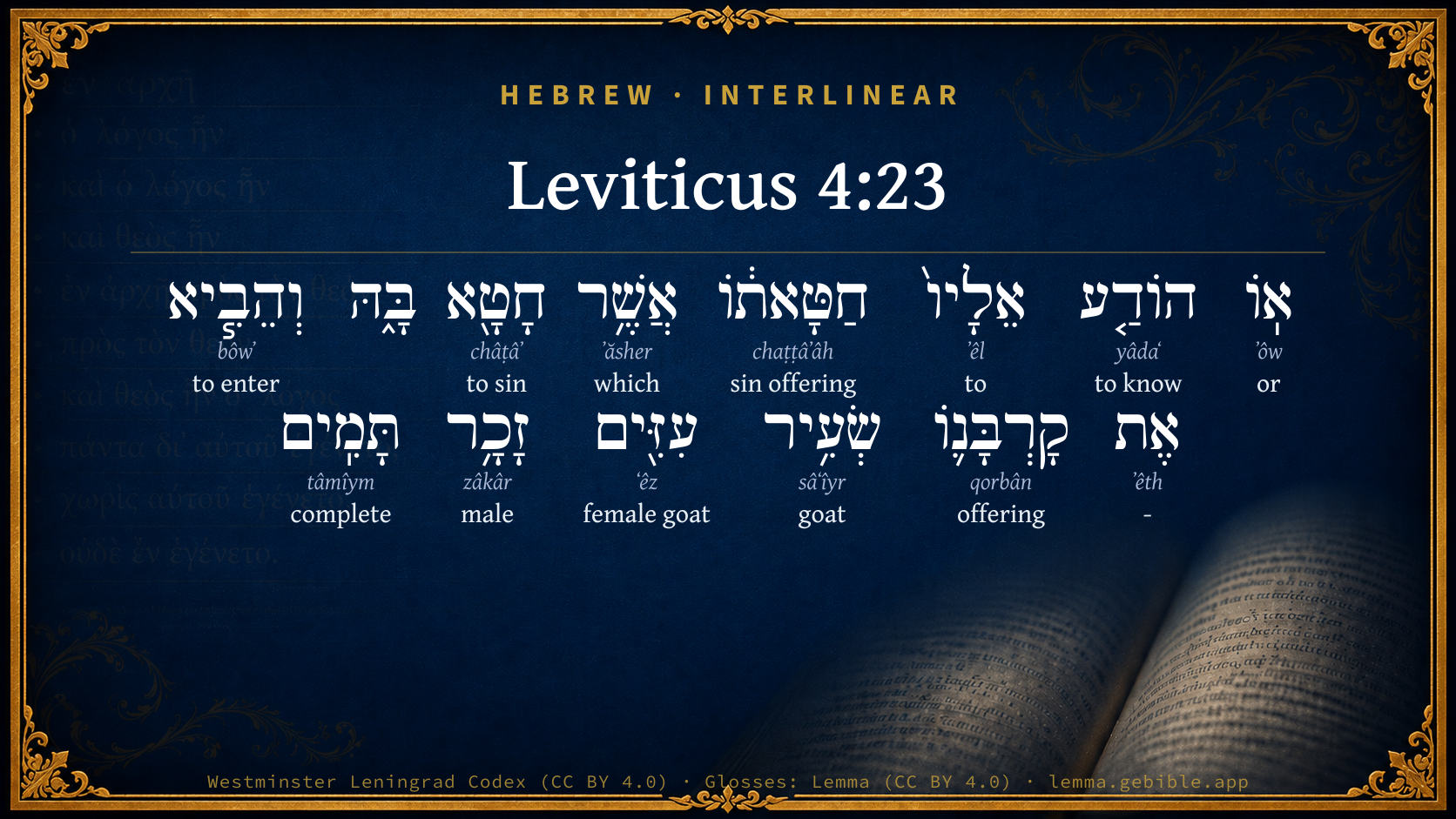
Hebrew (Westminster Leningrad Codex) Leviticus 4:23 appears in the Hebrew Old Testament. The text above is from the Westminster Leningrad Codex. Each word links to its Strong’s number, a concise gloss, and parsing drawn from the Open Scriptures Hebrew Bible morphology. Click any word for its full Brown-Driver-Briggs (BDB) entry.
Download image
Cite this verse

Leviticus 4:23 (World English Bible). Public Domain. Lemma interlinear Bible study tool, https://lemma.gebible.app/v/leviticus/4/23.

Show BibTeX & RIS
BibTeX
RIS
English Translation
if his sin, in which he has sinned, is made known to him, he shall bring as his offering a goat, a male without blemish.
World English Bible · Public Domain
Download a study sheet

One document with this verse’s original text, its word-by-word gloss line, the meaning frame, cross-references with their text, attributed commentary, and full source and license credits — printable, and it pastes into notes with its structure intact.

This verse Autodidact and up

Study sheet (.html) Plain text (.txt)

A passage Seminary Student

Up to 50 verses in one chapter. A passage sheet keeps up to 6 commentary sources and 12 cross-references per verse, in the order this page ranks them, and says so on the sheet whenever that leaves anything out. Ask for a single verse and you get the Autodidact verse sheet above.

Everything on this page stays free to read, with no account — the sheet is a download of what is already on screen, not access to it.

Want to remove ads? Support Godless Engineer
Compare translations 3

The same verse in 3 English versions, stacked beneath the original-language interlinear above. Click any original word for its lexicon entry.

Each is an independent rendering of the whole verse — the interlinear is not word-aligned to these translations.

Highlighted words mark where these versions differ — a whole-verse word diff, not a word-by-word alignment.

  • World English Bible Public Domain
    if his sin, in which he has sinned, is made known to him, he shall bring as his offering a goat, a male without blemish.
  • King James Version Public Domain
    Or if his sin, wherein he hath sinned, come to his knowledge; he shall bring his offering, a kid of the goats, a male without blemish:
  • unfoldingWord Literal Text CC BY-SA 4.0
    or his sin that he sinned with it is made known to him, then he shall bring his offering, a buck of the goats, a perfect male.

unfoldingWord Literal Text — © unfoldingWord, licensed CC BY-SA 4.0. Word-aligned USFM3 via Door43 (git.door43.org/unfoldingWord/en_ult).

Versions to compare (up to 4)

3 of 4 selected

Show all 18 translations

Every available English version of this verse, each an independent rendering of the whole verse.

  • World English Bible Public Domain
    if his sin, in which he has sinned, is made known to him, he shall bring as his offering a goat, a male without blemish.
  • Berean Standard Bible Public Domain
    When he becomes aware of the sin he has committed, he must bring an unblemished male goat as his offering.
  • Majority Standard Bible Public Domain
    When he becomes aware of the sin he has committed, he must bring an unblemished male goat as his offering.
  • King James Version Public Domain
    Or if his sin, wherein he hath sinned, come to his knowledge; he shall bring his offering, a kid of the goats, a male without blemish:
  • American Standard Version (1901) Public Domain
    if his sin, wherein he hath sinned, be made known to him, he shall bring for his oblation a goat, a male without blemish.
  • Revised Version (1885) Public Domain
    if his sin, wherein he hath sinned, be made known to him, he shall bring for his oblation a goat, a male without blemish;
  • Geneva Bible (1599) Public Domain
    If one shewe vnto him his sinne, which he hath committed, the shall he bring for his offring an hee goat without blemish,
  • Douay-Rheims (1899) Public Domain
    And afterwards shall come to know his sin, he shall offer a buck goat without blemish, a sacrifice to the Lord.
  • Young's Literal Translation Public Domain
    or his sin wherein he hath sinned hath been made known unto him, then he hath brought in his offering, a kid of the goats, a male, a perfect one,
  • Literal Standard Version CC BY-SA 4.0
    or his sin wherein he has sinned has been made known to him, then he has brought in his offering, a kid of the goats, a male, a perfect one,
  • Unlocked Literal Bible CC BY-SA 4.0
    then his sin which he has committed is made known to him, he must bring for his sacrifice a goat, a male without blemish.
  • unfoldingWord Literal Text CC BY-SA 4.0
    or his sin that he sinned with it is made known to him, then he shall bring his offering, a buck of the goats, a perfect male.
  • Darby Bible Public Domain
    if his sin, wherein he hath sinned, come to his knowledge, he shall bring his offering, a buck of the goats, a male without blemish.
  • World Messianic Bible Public Domain
    if his sin in which he has sinned is made known to him, he shall bring as his offering a goat, a male without defect.
  • Webster's Bible Public Domain
    Or if his sin, in which he hath sinned, shall come to his knowledge; he shall bring his offering, a kid of the goats, a male without blemish:
  • Free Bible Version CC BY-SA 4.0
    When he realizes his sin, he must bring a male goat without defects as his offering.
  • Bible in Basic English Public Domain
    When the sin which he has done is made clear to him, let him give for his offering a goat, a male without any mark.
  • JPS Tanakh (1917) Public Domain
    if his sin, wherein he hath sinned, be known to him, he shall bring for his offering a goat, a male without blemish.

Literal Standard Version (2020), Covenant Press — licensed CC BY-SA 4.0. Text via the HelloAO Bible API (eBible.org). Unlocked Literal Bible (unfoldingWord) — licensed CC BY-SA 4.0. Text via the HelloAO Bible API (eBible.org). unfoldingWord Literal Text — © unfoldingWord, licensed CC BY-SA 4.0. Word-aligned USFM3 via Door43 (git.door43.org/unfoldingWord/en_ult). Free Bible Version, Dr. Jonathan Gallagher — licensed CC BY-SA 4.0. Text via the HelloAO Bible API (eBible.org).

Word by word

More ways to search: Search by grammar → Find every occurrence → Compare this word →

Practice this passage: Drill this verse → Learn its vocabulary →

שְׂעִ֥יר
sâʻîyr
H8163
“goat of”
Noun, Common, Masculine, Singular, Construct
Part of Speech
Noun
Type
Common
Gender
Masculine
Number
Singular
State
Construct
Full BDB Definition

Origin: from H8175

TWOT: 2274c , 2274e

hairy (adjective) - he-goat, buck (noun masculine) - as sacrificial animal - satyr, may refer to a demon possessed goat like the swine of Gadara ( Mat 8:30-32 )
  1. אֽוֹ ʼôw H176 “or” Conjunction
  2. הוֹדַ֤ע yâdaʻ H3045 “to know” Verb, Hophal, Perfect, 3rd Person, Masculine, Singular
  3. אֵלָיו֙ ʼêl H413 “to · him” Preposition + Suffix, Personal, 3rd Person, Masculine, Singular
  4. חַטָּאת֔וֹ chaṭṭâʼâh H2403 “sin offering · his” Noun, Common, Feminine, Singular, Construct + Suffix, Personal, 3rd Person, Masculine, Singular
  5. אֲשֶׁ֥ר ʼăsher H834 “which” Particle, Relative
  6. חָטָ֖א châṭâʼ H2398 “to sin” Verb, Qal, Perfect, 3rd Person, Masculine, Singular
  7. וְהֵבִ֧יא bôwʼ H935 “and · to enter” Conjunction + Verb, Hiphil, Sequential Perfect, 3rd Person, Masculine, Singular
  8. אֶת ʼêth H853 “-” Particle, Direct Object
  9. קָרְבָּנ֛וֹ qorbân H7133 “offering · his” Noun, Common, Masculine, Singular, Construct + Suffix, Personal, 3rd Person, Masculine, Singular
  10. עִזִּ֖ים ʻêz H5795 “female goats” Noun, Common, Feminine, Plural, Absolute
  11. זָכָ֥ר zâkâr H2145 “male” Adjective, Adjective, Masculine, Singular, Absolute
  12. תָּמִֽים tâmîym H8549 “complete” Adjective, Adjective, Masculine, Singular, Absolute

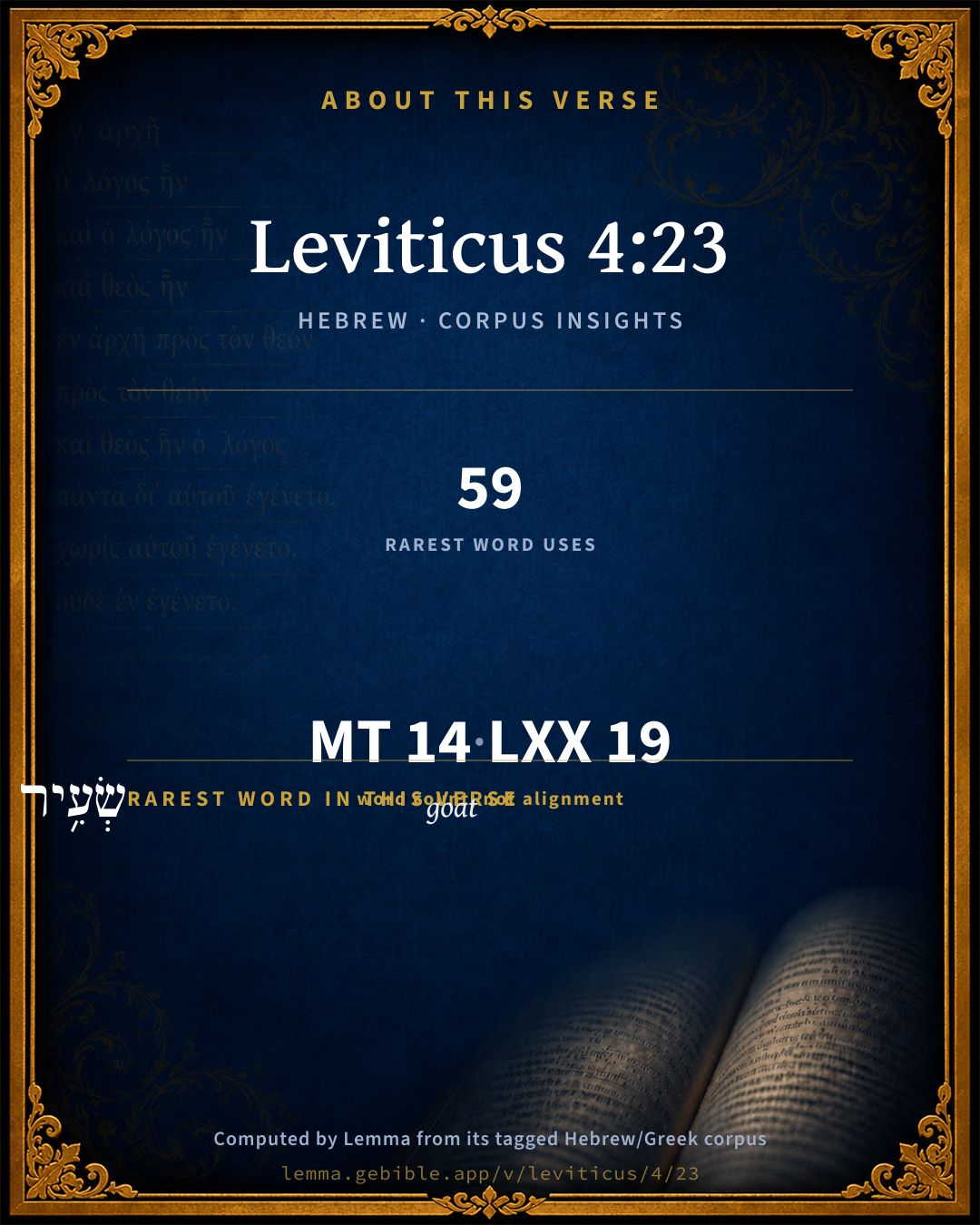
About this verse

These counts appear in no published source. They are computed here, from the morphology-tagged text and Lemma’s own curated glosses. What Lemma adds →

14
words
13
distinct lemmas
Pentateuch
section

Shared distinctive vocabulary

שְׂעִ֥יר goat H8163 occurs in 57 verses of the Hebrew Bible. Also found in:

Grammatical profile

  • 3 verbs
  • 4 nouns
  • 2 adjectives
  • 2 prepositions
  • 1 conjunction
  • 2 particles

Verb forms

  • הוֹדַ֤ע Hophal · Perfect
  • חָטָ֖א Qal · Perfect
  • וְהֵבִ֧יא Hiphil · Sequential Perfect

Hebrew & Septuagint length

In English translation the verse runs 25 words from the Hebrew and 27 from the Septuagint (LXX English) — closely comparable.

A rough comparison of the two English renderings, which tokenize alike — not a word-level alignment.

Word counts can differ between the Hebrew and the Greek without any difference in meaning — e.g. the Hebrew direct-object marker אֵת has no separate Greek word, and Greek often adds the article ὁ.

In the original languages it is 14 Hebrew tokens and 19 Greek tokens — but the two are counted differently (Hebrew bundles its prefixes and suffixes into one token; the Greek is in lemma form), so that isn’t a like-for-like length.

Cross-references

19

Topical passages linked to Leviticus 4:23 in the Treasury of Scripture Knowledge — connected by theme and wording, ordered by reader-vote popularity; previews shown in the World English Bible.

  • Leviticus 4:14 when the sin in which they have sinned is known, then the assembly shall offer a young bull for a sin offering, and bring it before the Tent of Meeting.
  • Romans 8:3 For what the law couldn't do, in that it was weak through the flesh, God did, sending his own Son in the likeness of sinful flesh and for sin, he condemned sin in the flesh;
  • Leviticus 4:3 if the anointed priest sins so as to bring guilt on the people, then let him offer for his sin, which he has sinned, a young bull without blemish to Yahweh for a sin offering.
  • Leviticus 4:28 if his sin, which he has sinned, is made known to him, then he shall bring for his offering a goat, a female without blemish, for his sin which he has sinned.
  • Leviticus 5:4 "'Or if anyone swears rashly with his lips to do evil, or to do good, whatever it is that a man might utter rashly with an oath, and it is hidden from him; when he knows of it, then he shall be guilty of one of these.
  • Leviticus 9:3 You shall speak to the children of Israel, saying, 'Take a male goat for a sin offering; and a calf and a lamb, both a year old, without blemish, for a burnt offering;
  • Leviticus 23:19 You shall offer one male goat for a sin offering, and two male lambs a year old for a sacrifice of peace offerings.
  • Numbers 7:16 one male goat for a sin offering;
  • Numbers 7:22 one male goat for a sin offering;
  • Numbers 7:28 one male goat for a sin offering;
  • Numbers 7:34 one male goat for a sin offering;
  • Numbers 15:24 then it shall be, if it be done unwittingly, without the knowledge of the congregation, that all the congregation shall offer one young bull for a burnt offering, for a sweet savor to Yahweh, with the meal-offering of it, and the drink-offering of it, according to the ordinance, and one male goat for a sin-offering.
  • Numbers 28:15 One male goat for a sin-offering to Yahweh; it shall be offered besides the continual burnt offering, and the drink-offering of it.
  • Numbers 28:30 one male goat, to make atonement for you.
  • Numbers 29:5 and one male goat for a sin-offering, to make atonement for you;
  • Numbers 29:11 one male goat for a sin-offering; besides the sin-offering of atonement, and the continual burnt offering, and the meal-offering of it, and their drink-offerings.
  • Numbers 29:16 and one male goat for a sin-offering, besides the continual burnt offering, the meal-offering of it, and the drink-offering of it.
  • Numbers 29:19 and one male goat for a sin-offering; besides the continual burnt offering, and the meal-offering of it, and their drink-offerings.
  • 2 Kings 22:10–13 Shaphan the scribe told the king, saying, Hilkiah the priest has delivered me a book. Shaphan read it before the king.

Cross-references courtesy of OpenBible.info (CC BY 4.0).

Hebrew and Greek witnesses Masoretic Hebrew ↔ Greek Septuagint

The same verse in the two great witnesses to the Old Testament, shown verse-for-verse.

These are two independent witnesses, not word-aligned to each other, and the Septuagint is shown in lemma (dictionary) form.

Hebrew Leviticus 4:23 Masoretic · Westminster Leningrad Codex

אֽוֹ הוֹדַ֤ע אֵלָיו֙ חַטָּאת֔וֹ אֲשֶׁ֥ר חָטָ֖א בָּ֑הּ וְהֵבִ֧יא אֶת קָרְבָּנ֛וֹ שְׂעִ֥יר עִזִּ֖ים זָכָ֥ר תָּמִֽים

if his sin, in which he has sinned, is made known to him, he shall bring as his offering a goat, a male without blemish.

World English Bible · Public Domain

Greek LXX Leviticus 4:23 Septuagint · lemma form

καί γιγνώσκω αὐτός ὁ ἁμαρτία ὅς ἁμαρτάνω ἐν αὐτός καί προςφέρω ὁ δῶρον αὐτός χίμαρος ἐκ αἴξ ἄρσην ἄμωμος

and his trespass wherein he has sinned, be known to him, then shall he offer for his gift a kid of the goats, a male without blemish.

LXX2012 (modern English Septuagint) · Public Domain

Hebrew: Westminster Leningrad Codex (CC BY 4.0). Greek: Septuagint (public domain); English from LXX2012 (modern English Septuagint) (Public Domain). How the Septuagint differs from the Hebrew →

Targum (Aramaic paraphrase)

2

The Targum is the ancient Jewish Aramaic paraphrase of the Hebrew Scriptures — an interpretive translation, not the Hebrew text itself. Onkelos (literal) and Pseudo-Jonathan (expansive) render the Torah, and Jonathan the Prophets. Coverage is partial: where no permissively-licensed English translation exists for a verse, only the Aramaic is shown. This is verse-level text, not a word-by-word alignment to the Hebrew.

  1. Targum Onkelos Torah (Genesis–Deuteronomy)
    אוֹ אִתְיְדַע לֵהּ חוֹבְתֵהּ דִי חַב בַּהּ וְיַיְתִי יָת קֻרְבָּנֵהּ צְפִיר בַּר עִזִין דְכַר שְׁלִים

    (no public-domain English translation for this verse)

    Targum Onkelos — Aramaic: “Onkelos Genesis” (public domain); “Onkelos Exodus” (public domain); “Onkelos Leviticus” (public domain); “Onkelos Numbers” (public domain); “Onkelos Deuteronomy” (public domain). English: “Sefaria Community Translation” (CC0 1.0 (public-domain dedication)); “J.W. Etheridge. The Targums of Onkelos and Jonathan Ben Uzziel on the Pentateuch. London: Longmans, Green, 1862” (public domain). Text via Sefaria.

  2. Targum Pseudo-Jonathan Torah (Genesis–Deuteronomy)
    אוֹ אִשְׁתְּמוֹדַע לֵיהּ חוֹבְתֵיהּ דְחַב וְיַיְתֵי קוּרְבָּנֵיהּ צְפִיר בַּר עִזֵי דְכַר שְׁלִים

    if his sin that he hath sinned be made known to him, he shall bring for his oblation a kid of the goats, a male, unblemished;

    Targum Pseudo-Jonathan — Aramaic: “Targum Jonathan on Genesis” (public domain); “Targum Jonathan on Exodus” (public domain); “Targum Jonathan on Leviticus” (public domain); “Targum Jonathan on Numbers” (public domain); “Targum Jonathan on Deuteronomy” (public domain). English: “The Targum of Jonathan ben Uzziel, trans. J. W. Etheridge, London, 1862” (public domain). Text via Sefaria.

Commentary

Notes on Leviticus 4:23 from classic Christian and Jewish commentators (each source and its license shown beneath its notes). The classic Christian expositions comment on the surrounding passage and are grouped to its opening verse, so a note may address several verses; the Jewish commentaries on the Tanakh (Rashi and others) are per-verse, so they appear only where the commentator wrote on this verse.

Lemma curates 59 commentaries, every one of them public domain or Creative Commons licensed, each selected and text-cleaned for this edition rather than reprinted as found. About our sources →

Trapp's Complete Commentary

John Trapp

Lev 4:23 Or if his sin, wherein he hath sinned, come to his knowledge; he shall bring his offering, a kid of the goats, a male without blemish:

Ver. 23. Come to his knowledge.] As David’s did, {2Sa 24:11} who saw such volumes of infirmities, and so many erratas in all that he did, that he once cried out, "Who knoweth the errors of his life? Oh, cleanse me from secret sins." {Psa 19:12} This he knew was the import of all these Levitical cleansings.

John Trapp, A Commentary or Exposition upon All the Books of the Old and New Testament (1647–1656) — public domain. Text from a community e-Sword module.

Tyndale Open Study Notes

Tyndale Open Resources

4:23 The male goat offered by a lay leader was a lesser offering than was required for the priest (a bull) but more than was required for a common person (4:28, 32). However, like all offerings used for securing atonement, the animal could have no defects (see 1:3).

Tyndale Open Study Notes — © Tyndale Open Resources, licensed CC BY-SA 4.0. Text via the HelloAO Bible API.

Geneva Bible (1599)

Geneva Bible translators

Or, the male goat of the fold.

Geneva Bible (1599) marginal notes — public domain. Text via Bolls.life.

Ellicott's Commentary for English Readers

(23) Or if his sin.—That is, if on his failing to see it himself, his sin is shown to him by another person.

A kid of the goats.—The expression here used (sâêr) properly denotes the rough, shaggy-haired he goat, and is distinguished from athud (literally, ready, vigorous), which occurs in conjunction with it (Num_7:16-17; Num_7:22-23), and which is also translated goat in point of age. The sâêr, or the shaggy or longer haired he-goat, here used is the older buck of the goat, whose hair has become long with age; whilst the athud is the same animal, younger and more vigorous. Hence the former was never killed for food, or used for burnt or thank offerings at the festivals (Lev_16:9; Lev_16:15; Lev_23:19; Num_28:15; Num_28:22; Num_28:30; Num_29:5; Num_29:11; Num_29:16), and at the consecration of the priests and sanctuary (Lev_9:3; Lev_9:15; Lev_10:16), whilst the latter was killed for food (Deu_32:14; Jer_51:40), and hence, like the bull, the ram, and the lamb, was regularly presented as burnt and thank offerings (Num_7:17; Num_7:23; Num_7:29, &c.; Isa_1:11; Isa_34:6; Eze_39:18; Pss. 1. 9, 13, Ixvi. 15). It will be seen that the first difference in the sin offering of a prince is that he is to bring a longhaired he-goat, and not a bull.

A Bible Commentary for English Readers, edited by Charles John Ellicott (1878–1897) — public domain. Text from a community e-Sword module.

The Cambridge Bible for Schools and Colleges

gen. ed. J. J. S. Perowne

23. a goat] lit. a shaggy one of goats, i.e. a hairy goat, an expression used of female goats (Lev_4:28) as well as males. The phrase occurs, with the exception of Gen_37:31, exclusively in Lev. and Ezek. of the animal brought as a Sin-Offering. Whether a particular breed with long hair is meant, or whether the long hair is due to age, seems doubtful, but the rendering of A.V. ‘kid of the goats’ is misleading.

The Cambridge Bible for Schools and Colleges (gen. ed. J. J. S. Perowne; Cambridge University Press, 1878–1918) — public domain. Text from a community e-Sword module.

John Gill's Exposition

And he shall lay his hand upon the head of the goat,.... His right hand, as the Targum of Jonathan; See Gill on Lev 1:4.

and kill it; not the prince, but the priest after mentioned, or the butcher, as the same Targum:

in the place where they hill the burnt offering before the Lord; in the court on the north side of the altar, see Lev 1:11,

it is a sin offering: an offering for his sin of ignorance, or "sin"; so Christ our offering is said to be, Co2 5:21.

John Gill's Exposition of the Whole Bible (1746–1763) — public domain (CC PDM 1.0). Text via the HelloAO Bible API.

Albert Barnes' Notes on the Bible

Or if his sin - Rather, And if his sin.

Come to his knowledge - i. e. when he had become conscious of his sin.

A kid of the goats - A shaggy he-goat, in distinction from a smooth-haired he-goat. It was the regular sin-offering at the yearly festivals Lev 16:9, Lev 16:15; Num 28:15, Num 28:22, Num 28:30, and at the consecration of the priests Lev 9:3; while the smooth-haired goat appears to have been generally offered for the other sacrifices Psa 50:9; Isa 1:11.

Albert Barnes' Notes on the Bible (1834–1885) — public domain. Text from a community e-Sword/MySword module.

Matthew Poole's English Annotations

The disjunctive or is here put for the copulative and, as it is 1Co 12:13; 13:8; 15:11; for it is evident that he speaks of the same person, and of the same sin.

Matthew Poole's English Annotations on the Holy Bible (1683–1685) — public domain. Text from a community e-Sword/MySword module.

Rashi

Rabbi Shlomo Yitzchaki (Rashi)

או הודע is the same as “IF” (אם‎) [THE THING] WAS MADE KNOWN TO HIM — There are many passages where או is used in the sense of אם, and again where אם stands in the place of או. A similar instance is: (Exodus 21:36) “או נודע כי שור נגח הוא”, which means “if it was known that the ox was wont to thrust” (cf., however, Rashi on that verse and our Note thereon).

הודע אליו IT WAS MADE KNOWN TO HIM — when he committed the sin he was under the belief that it was something permissible, afterwards it became known to him that it was a forbidden thing.

Rashi on the Tanakh — English translations: “The Judaica Press complete Tanach with Rashi, translated by A. J. Rosenberg” (CC BY 4.0); “Pentateuch with Rashi's commentary by M. Rosenbaum and A.M. Silbermann, 1929-1934” (public domain); “The Metsudah Tanach series, Lakewood, N.J” (CC BY 4.0); and “The Book of Joshua, Metsudah Publications, 1997” (CC BY 4.0). Text via Sefaria.

Lesson kit

Teaching starters — assembled from the data on this page, not authored interpretation. Every prompt links to the verse data it draws on. Edit before teaching.

Leviticus, in the Pentateuch, opens this verse with 14 words (13 distinct Hebrew lemmas). Its most distinctive word is sâʻîyr (“goat”). A historical commentator’s framing appears above. Read the whole chapter for the surrounding context.

Discussion questions

  1. What does “goat” (sâʻîyr) contribute to the verse as a whole?
  2. How does Genesis 27:11, which shares the word «goat», read alongside this verse?
  3. These translations render this verse differently; the difference is in the English rendering, not the original. What questions does that raise?
  4. «הוֹדַ֤ע» is a Hophal Perfect verb. How does that grammatical form shape the action described?
  5. Compare how Trapp's Complete Commentary and Tyndale Open Study Notes read this verse. Where do they agree or differ?

Things to notice

Reading settings

Reading text

Shown beneath each verse's original-language words.

Old Testament
Old Testament edition

Read the OT as the Masoretic Hebrew (MT) or the Greek Septuagint (LXX).

English shown for the Greek Septuagint (in the Hebrew ↔ Greek comparison).

Comparing translations? Open the Compare panel on any verse page to stack up to four side by side.