Daniel 9:5

Hebrew (Westminster Leningrad Codex) Daniel 9:5 appears in the Hebrew Old Testament. The text above is from the Westminster Leningrad Codex. Each word links to its Strong’s number, a concise gloss, and parsing drawn from the Open Scriptures Hebrew Bible morphology. Click any word for its full Brown-Driver-Briggs (BDB) entry.
Download image
Cite this verse

Daniel 9:5 (World English Bible). Public Domain. Lemma interlinear Bible study tool, https://lemma.gebible.app/v/daniel/9/5.

Show BibTeX & RIS
BibTeX
RIS
English Translation
we have sinned, and have dealt perversely, and have done wickedly, and have rebelled, even turning aside from your precepts and from your ordinances;
World English Bible · Public Domain
Download a study sheet

One document with this verse’s original text, its word-by-word gloss line, the meaning frame, cross-references with their text, attributed commentary, and full source and license credits — printable, and it pastes into notes with its structure intact.

This verse Autodidact and up

Study sheet (.html) Plain text (.txt)

A passage Seminary Student

Up to 50 verses in one chapter. A passage sheet keeps up to 6 commentary sources and 12 cross-references per verse, in the order this page ranks them, and says so on the sheet whenever that leaves anything out. Ask for a single verse and you get the Autodidact verse sheet above.

Everything on this page stays free to read, with no account — the sheet is a download of what is already on screen, not access to it.

Want to remove ads? Support Godless Engineer
Compare translations 3

The same verse in 3 English versions, stacked beneath the original-language interlinear above. Click any original word for its lexicon entry.

Each is an independent rendering of the whole verse — the interlinear is not word-aligned to these translations.

Highlighted words mark where these versions differ — a whole-verse word diff, not a word-by-word alignment.

  • World English Bible Public Domain
    we have sinned, and have dealt perversely, and have done wickedly, and have rebelled, even turning aside from your precepts and from your ordinances;
  • King James Version Public Domain
    We have sinned, and have committed iniquity, and have done wickedly, and have rebelled, even by departing from thy precepts and from thy judgments:
  • unfoldingWord Literal Text CC BY-SA 4.0
    We have sinned and done wrong. We have acted wickedly and rebelled, turning aside from your commandments and ordinances.

unfoldingWord Literal Text — © unfoldingWord, licensed CC BY-SA 4.0. Word-aligned USFM3 via Door43 (git.door43.org/unfoldingWord/en_ult).

Versions to compare (up to 4)

3 of 4 selected

Show all 18 translations

Every available English version of this verse, each an independent rendering of the whole verse.

  • World English Bible Public Domain
    we have sinned, and have dealt perversely, and have done wickedly, and have rebelled, even turning aside from your precepts and from your ordinances;
  • Berean Standard Bible Public Domain
    we have sinned and done wrong. We have acted wickedly and rebelled. We have turned away from Your commandments and ordinances.
  • Majority Standard Bible Public Domain
    we have sinned and done wrong. We have acted wickedly and rebelled. We have turned away from Your commandments and ordinances.
  • King James Version Public Domain
    We have sinned, and have committed iniquity, and have done wickedly, and have rebelled, even by departing from thy precepts and from thy judgments:
  • American Standard Version (1901) Public Domain
    we have sinned, and have dealt perversely, and have done wickedly, and have rebelled, even turning aside from thy precepts and from thine ordinances;
  • Revised Version (1885) Public Domain
    we have sinned, and have dealt perversely, and have done wickedly, and have rebelled, even turning aside from thy precepts and from thy judgments:
  • Geneva Bible (1599) Public Domain
    We haue sinned, and haue committed iniquitie and haue done wickedly, yea, we haue rebelled, and haue departed from thy precepts, and from thy iudgements.
  • Douay-Rheims (1899) Public Domain
    We have sinned, we have committed iniquity, we have done wickedly, and have revolted: and we have gone aside from thv commandments, and thy judgments.
  • Young's Literal Translation Public Domain
    we have sinned, and done perversely, and done wickedly, and rebelled, to turn aside from Thy commands, and from Thy judgments:
  • Literal Standard Version CC BY-SA 4.0
    we have sinned, and done perversely, and done wickedly, and rebelled, to turn aside from Your commands, and from Your judgments:
  • Unlocked Literal Bible CC BY-SA 4.0
    We have sinned and have done what is wrong. We have acted wickedly and we have rebelled, turning aside from your commands and decrees.
  • unfoldingWord Literal Text CC BY-SA 4.0
    We have sinned and done wrong. We have acted wickedly and rebelled, turning aside from your commandments and ordinances.
  • Darby Bible Public Domain
    we have sinned, and have committed iniquity, and have done wickedly, and have rebelled, even turning aside from thy commandments and from thine ordinances.
  • World Messianic Bible Public Domain
    we have sinned, and have dealt perversely, and have done wickedly, and have rebelled, even turning aside from your precepts and from your ordinances.
  • Webster's Bible Public Domain
    We have sinned, and have committed iniquity, and have done wickedly, and have rebelled, even by departing from thy precepts and from thy judgments:
  • Free Bible Version CC BY-SA 4.0
    But we have sinned, we have done wrong. We have acted wickedly, we have rebelled against you. We have turned away from your commandments and your laws.
  • Bible in Basic English Public Domain
    We are sinners, acting wrongly and doing evil; we have gone against you, turning away from your orders and from your laws:
  • JPS Tanakh (1917) Public Domain
    we have sinned, and have dealt iniquitously, and have done wickedly, and have rebelled, and have turned aside from Thy commandments and from Thine ordinances;

Literal Standard Version (2020), Covenant Press — licensed CC BY-SA 4.0. Text via the HelloAO Bible API (eBible.org). Unlocked Literal Bible (unfoldingWord) — licensed CC BY-SA 4.0. Text via the HelloAO Bible API (eBible.org). unfoldingWord Literal Text — © unfoldingWord, licensed CC BY-SA 4.0. Word-aligned USFM3 via Door43 (git.door43.org/unfoldingWord/en_ult). Free Bible Version, Dr. Jonathan Gallagher — licensed CC BY-SA 4.0. Text via the HelloAO Bible API (eBible.org).

Word by word

More ways to search: Search by grammar → Find every occurrence → Compare this word →

Practice this passage: Drill this verse → Learn its vocabulary →

וְעָוִ֖ינוּ
ʻâvâh
H5753
“and · to twist”
Conjunction + Verb, Qal, Perfect, 1st Person, Common, Plural
Part of Speech
Conjunction + Verb
Stem
Qal
Form
Perfect
Person
1st Person
Gender
Common
Number
Plural
Full BDB Definition

Origin: a primitive root

TWOT: 1577

to bend, twist, distort - (Niphal) to be bent, be bowed down, be twisted, be perverted - (Piel) to twist, distort - (Hiphil) to do perversely - to commit iniquity, do wrong, pervert - (Qal) to do wrong, commit iniquity - (Hiphil) to commit iniquity
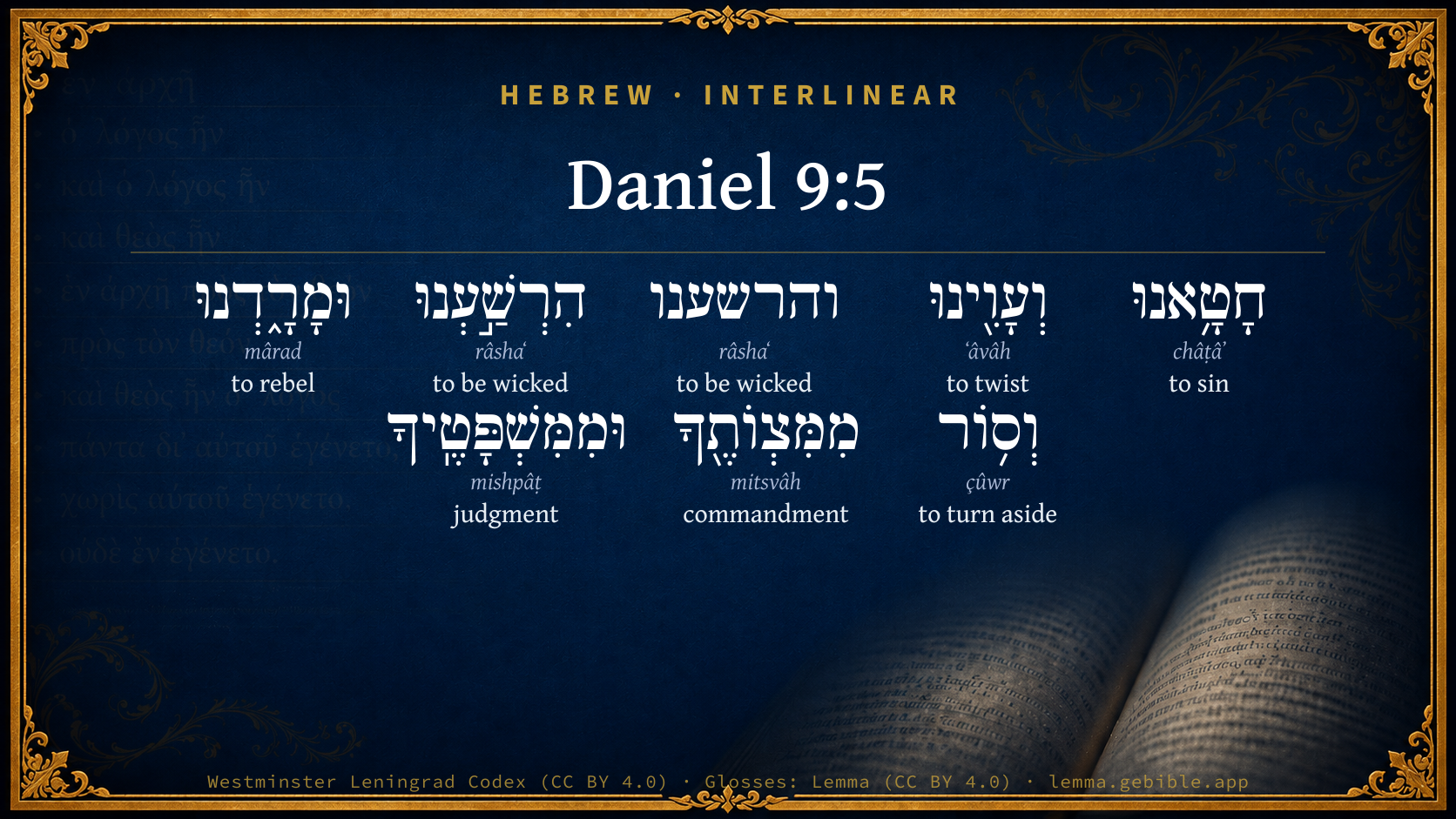
  1. חָטָ֥אנוּ châṭâʼ H2398 “to sin” Verb, Qal, Perfect, 1st Person, Common, Plural
  2. והרשענו râshaʻ H7561 “and · to be wicked” Conjunction + Verb, Hiphil, Perfect, 1st Person, Common, Plural
  3. הִרְשַׁ֣עְנוּ râshaʻ H7561 “to be wicked” Verb, Hiphil, Perfect, 1st Person, Common, Plural
  4. וּמָרָ֑דְנוּ mârad H4775 “and · to rebel” Conjunction + Verb, Qal, Perfect, 1st Person, Common, Plural
  5. וְס֥וֹר çûwr H5493 “and · to turn aside” Conjunction + Verb, Qal, Infinitive Absolute
  6. מִמִּצְוֺתֶ֖ךָ mitsvâh H4687 “from · commandments · your” Preposition + Noun, Common, Feminine, Plural, Construct + Suffix, Personal, 2nd Person, Masculine, Singular
  7. וּמִמִּשְׁפָּטֶֽיךָ mishpâṭ H4941 “and · from · judgments · your” Conjunction + Preposition + Noun, Common, Masculine, Plural, Construct + Suffix, Personal, 2nd Person, Masculine, Singular

About this verse

These counts appear in no published source. They are computed here, from the morphology-tagged text and Lemma’s own curated glosses. What Lemma adds →

8
words
7
distinct lemmas
Prophets
section

Notable vocabulary

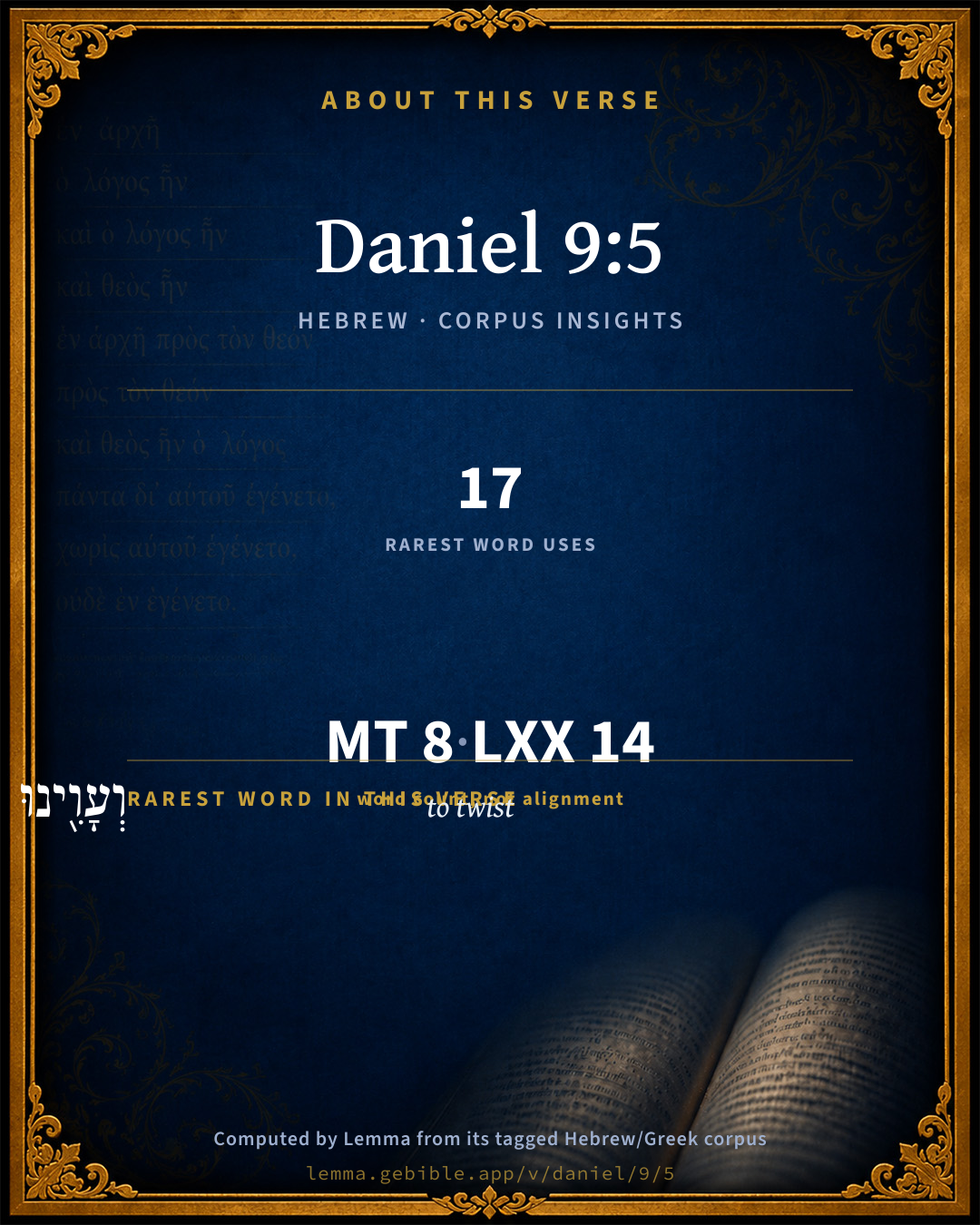
The rarest word here is וְעָוִ֖ינוּ to twist H5753 — appearing just 17 times in the whole Hebrew Bible.

Shared distinctive vocabulary

וְעָוִ֖ינוּ to twist H5753 occurs in 17 verses of the Hebrew Bible. Also found in:

Grammatical profile

  • 6 verbs
  • 2 nouns

Verb forms

  • חָטָ֥אנוּ Qal · Perfect
  • וְעָוִ֖ינוּ Qal · Perfect
  • והרשענו Hiphil · Perfect
  • הִרְשַׁ֣עְנוּ Hiphil · Perfect
  • וּמָרָ֑דְנוּ Qal · Perfect
  • וְס֥וֹר Qal · Infinitive Absolute

Repetition

A word recurs within this verse — often emphatic in Hebrew:

  • והרשענו to be wicked H7561 ×2

Hebrew & Septuagint length

In English translation the verse runs 24 words from the Hebrew and 21 from the Septuagint (LXX English) — closely comparable.

A rough comparison of the two English renderings, which tokenize alike — not a word-level alignment.

Word counts can differ between the Hebrew and the Greek without any difference in meaning — e.g. the Hebrew direct-object marker אֵת has no separate Greek word, and Greek often adds the article ὁ.

In the original languages it is 8 Hebrew tokens and 14 Greek tokens — but the two are counted differently (Hebrew bundles its prefixes and suffixes into one token; the Greek is in lemma form), so that isn’t a like-for-like length.

Cross-references

20

Topical passages linked to Daniel 9:5 in the Treasury of Scripture Knowledge — connected by theme and wording, ordered by reader-vote popularity; previews shown in the World English Bible.

  • Malachi 3:7 From the days of your fathers you have turned aside from my ordinances, and have not kept them. Return to me, and I will return to you," says Yahweh of Hosts. "But you say, 'How shall we return?'
  • Daniel 9:11 Yes, all Israel have transgressed your law, even turning aside, that they should not obey your voice: therefore has the curse been poured out on us, and the oath that is written in the law of Moses the servant of God; for we have sinned against him.
  • Daniel 9:15 Now, Lord our God, who has brought your people forth out of the land of Egypt with a mighty hand, and have gotten you renown, as at this day; we have sinned, we have done wickedly.
  • Psalms 106:6 We have sinned with our fathers. We have committed iniquity. We have done wickedly.
  • Psalms 18:21 For I have kept the ways of Yahweh, And have not wickedly departed from my God.
  • Isaiah 64:5–7 You meet him who rejoices and works righteousness, those who remember you in your ways: behold, you were angry, and we sinned: in them [have we been] of long time; and shall we be saved?
  • Jeremiah 14:7 Though our iniquities testify against us, work you for your name's sake, Yahweh; for our backslidings are many; we have sinned against you.
  • Lamentations 1:20 See, Yahweh; for I am in distress; my heart is troubled; My heart is turned within me; for I have grievously rebelled: Abroad the sword bereaves, at home there is as death.
  • Hebrews 3:12 Beware, brothers, lest perhaps there be in any one of you an evil heart of unbelief, in falling away from the living God;
  • Nehemiah 1:6–8 Let your ear now be attentive, and your eyes open, that you may listen to the prayer of your servant, which I pray before you at this time, day and night, for the children of Israel your servants while I confess the sins of the children of Israel, which we have sinned against you. Yes, I and my father's house have sinned:
  • Psalms 119:102 I have not turned aside from your ordinances, For you have taught me.
  • Isaiah 53:6 All we like sheep have gone astray; everyone has turned to his own way; and Yahweh has laid on him the iniquity of us all.
  • Jeremiah 3:25 Let us lie down in our shame, and let our confusion cover us; for we have sinned against Yahweh our God, we and our fathers, from our youth even to this day; and we have not obeyed the voice of Yahweh our God.
  • Ezekiel 6:9 Those of you that escape shall remember me among the nations where they shall be carried captive, how that I have been broken with their lewd heart, which has departed from me, and with they eyes, which play the prostitute after their idols: and they shall loathe themselves in their own sight for the evils which they have committed in all their abominations.
  • Hosea 1:2 When Yahweh spoke at the first by Hosea, Yahweh said to Hosea, "Go, take for yourself a wife of prostitution and children of unfaithfulness; for the land commits great adultery against from Yahweh."
  • 1 Kings 8:47–50 yet if they shall repent themselves in the land where they are carried captive, and turn again, and make supplication to you in the land of those who carried them captive, saying, We have sinned, and have done perversely, we have dealt wickedly;
  • 2 Chronicles 6:37–39 yet if they shall repent themselves in the land where they are carried captive, and turn again, and make supplication to you in the land of their captivity, saying, We have sinned, we have done perversely, and have dealt wickedly;
  • Ezra 9:6 and I said, my God, I am ashamed and blush to lift up my face to you, my God; for our iniquities are increased over our head, and our guiltiness is grown up to the heavens.
  • Nehemiah 9:33–34 However you are just in all that is come on us; for you have dealt truly, but we have done wickedly;
  • Isaiah 59:13 transgressing and denying Yahweh, and turning away from following our God, speaking oppression and revolt, conceiving and uttering from the heart words of falsehood.

Cross-references courtesy of OpenBible.info (CC BY 4.0).

Hebrew and Greek witnesses Masoretic Hebrew ↔ Greek Septuagint

The same verse in the two great witnesses to the Old Testament, shown verse-for-verse.

These are two independent witnesses, not word-aligned to each other, and the Septuagint is shown in lemma (dictionary) form.

Hebrew Daniel 9:5 Masoretic · Westminster Leningrad Codex

חָטָ֥אנוּ וְעָוִ֖ינוּ והרשענו הִרְשַׁ֣עְנוּ וּמָרָ֑דְנוּ וְס֥וֹר מִמִּצְוֺתֶ֖ךָ וּמִמִּשְׁפָּטֶֽיךָ

we have sinned, and have dealt perversely, and have done wickedly, and have rebelled, even turning aside from your precepts and from your ordinances;

World English Bible · Public Domain

Greek LXX Daniel 9:5 Septuagint · lemma form

ἁμαρτάνω ἀδικέω ἀσεβέω καί ἀποἵστημι καί παραβαίνω ὁ ἐντολή σύ καί ὁ κρίμα σύ

we have done iniquity, we have transgressed, and we have departed and turned aside from your commandments and from your judgments:

LXX2012 (modern English Septuagint) · Public Domain

Hebrew: Westminster Leningrad Codex (CC BY 4.0). Greek: Septuagint (public domain); English from LXX2012 (modern English Septuagint) (Public Domain). How the Septuagint differs from the Hebrew →

Commentary

Notes on Daniel 9:5 from classic Christian and Jewish commentators (each source and its license shown beneath its notes). The classic Christian expositions comment on the surrounding passage and are grouped to its opening verse, so a note may address several verses; the Jewish commentaries on the Tanakh (Rashi and others) are per-verse, so they appear only where the commentator wrote on this verse.

Lemma curates 59 commentaries, every one of them public domain or Creative Commons licensed, each selected and text-cleaned for this edition rather than reprinted as found. About our sources →

Trapp's Complete Commentary

John Trapp

Dan 9:5 We have sinned, and have committed iniquity, and have done wickedly, and have rebelled, even by departing from thy precepts and from thy judgments:

Ver. 5. We have sinned, and have committed iniquity, and have done wickedly, and have rebelled.] Mark how full in the mouth the good prophet is, and how he exaggerateth, confessing against himself and his people, laying on load. Good men extenuate not their offences; every sin swelleth as a toad in their eyes.

John Trapp, A Commentary or Exposition upon All the Books of the Old and New Testament (1647–1656) — public domain. Text from a community e-Sword module.

Joseph Benson's Commentary

Dan 9:5. We have sinned, and have committed iniquity — Daniel uses the same confession here that is prescribed, in Solomon’s consecration prayer, to be used by the Jews in the land of their captivity; with a promise subjoined, of a favourable answer that God would make to their supplications presented to him on such an occasion: see the margin. And being one of the Jewish nation, he speaks of their sins as his own; and, though certainly a most holy man, puts himself among the greatest sinners. There seems to be a kind of gradation in the prophet’s confessions here, beginning with sins in general, and rising to rebellion and apostacy.

Joseph Benson's Commentary on the Old and New Testaments (1811–1818) — public domain. Text from a community e-Sword module.

Tyndale Open Study Notes

Tyndale Open Resources

9:5 Daniel used four different words meaning sin: The people had sinned (literally missed the mark), done wrong (i.e., committed a bent or twisted act), rebelled against the covenant, and scorned (literally turned away from) the Lord’s instructions.

Tyndale Open Study Notes — © Tyndale Open Resources, licensed CC BY-SA 4.0. Text via the HelloAO Bible API.

Jamieson, Fausset & Brown

Robert Jamieson, A. R. Fausset & David Brown

Compare Nehemiah's confession (Neh. 9:1-38).

sinned . . . committed iniquity . . . done wickedly . . . rebelled--a climax. Erred in ignorance . . . sinned by infirmity . . . habitually and wilfully done wickedness . . . as open and obstinate rebels set ourselves against God.

Jamieson, Fausset & Brown — Commentary Critical and Explanatory on the Whole Bible (1871) — public domain (CC PDM 1.0). Text via the HelloAO Bible API.

John Calvin's Commentaries

Daniel here continues his confession of sin. As we have already stated, he ought to begin here, because we must remark in general the impossibility of our pleasing God by our prayers, unless we approach him as criminals, and repose all our hopes on his mercy. But there was a special reason for the extraordinary nature of the Prophet’s prayers, and his use of fasting, sackcloth, and ashes. This was the usual method of confession by which Daniel united himself with the rest of the people, for rite purpose of testifying throughout all ages the justice of the judgment which God had exercised in expelling the Israelites from the promised land, and totally disinheriting them. Daniel, therefore, insists upon this point. Here we may notice, in the first place, how prayers are not rightly conceived, unless founded on faith and repentance, and thus not being according to law, they cannot find either grace or favor before God. But great weight is to be attached to the phrases where Daniel uses more than a single word in saying the people acted impiously. He puts חטאנו, chetanu, we have sinned, in the first place, as the word does not imply any kind of fault, but rather a serious crime or offense. We, therefore, have sinned; then we have done wickedly; afterwards we have acted impiously; for רשע, reshegn, is stronger than חטא, cheta. We have done wickedly, we have been rebellious, says he, in transgressing thy statutes and commandments Whence this copiousness of expression, unless Daniel wished to stimulate himself and the whole people to penitence? For although we are easily induced to confess ourselves guilty before God, yet scarcely one in a hundred is affected with serious remorse; and those who excel others, and purely and reverently fear God, are still very dull and cold in recounting their sins. First of all, they acknowledge scarcely one in a hundred; next, of those which do come into their minds, they do not fully estimate their tremendous guilt, but rather extenuate their magnitude; and, although they perceive themselves worthy of a hundred deaths, yet they are not touched with their bitterness, and fear to humble themselves as they ought, nay, they are scarcely displeased with themselves, and do not loathe their own iniquities. Daniel, therefore, does not accumulate so many words in vain, when he wishes to confess his own sins and those of the people. Let us learn then how far we are from penitence, while we only verbally acknowledge our guilt; then let us perceive the need we have of many incentives to rouse us up from our sloth; for although any one may feel great terrors and tremble before God’s judgments, yet all those feelings of dread vanish away too soon. It therefore becomes necessary to fix God’s fear in our hearts with some degree of violence. Daniel shews us this when using the phrase, The people have sinned; they have acted unjustly; they have conducted themselves wickedly and become rebellious, and declined from the statutes and commandments of God This doctrine, therefore, must be diligently noticed, because, as I have said, all men think they have discharged their duty to God, if they mildly profess themselves guilty before him, and acknowledge their fault in a single word. But as real repentance is a sacred thing, it is a matter of far greater moment than a fiction of this kind. Although the multitude do not perceive how they are only deceiving themselves when they confess a fault, yet in the meantime they are only trifling with God like children, while some say they are but men, and others shelter themselves in the crowd of offenders. “What could I do? I am but a man; I have only followed the example of the many.” Lastly, if we examine carefully the confessions of men in general, we shall always find some latent hypocrisy, and that there are very few who prostrate themselves before God as they ought. We must understand, therefore, this confession of Daniel’s as stimulating himself and others to the fear of God, and as laying great stress upon the sins of the people, that every one may feel for himself real and serious alarms.

John Calvin's Commentaries (1540-1563) — public domain. Text from the Calvin Translation Society English edition (1840s-50s) via the Christian Classics Ethereal Library (ccel.org). Calvin's coverage is partial (roughly two-thirds of the Bible); uncommented books and verses are honest gaps, never fabricated. The 19th-century editor's footnotes and remarks are omitted so the notes are faithfully Calvin's own voice.

Ellicott's Commentary for English Readers

(5) We have sinned.—It has been remarked that four stages of sin are pointed out by the prophet, corresponding to the four different words which he uses. “Sin” refers especially to sins of deed, “committing iniquity” to sins of word, “done wickedly” to sins of thought, “rebelled” implies the person against whom the sin has been committed. The whole result of sin under these several aspects is expressed by the words “departing from Thy precepts.”

A Bible Commentary for English Readers, edited by Charles John Ellicott (1878–1897) — public domain. Text from a community e-Sword module.

The Cambridge Bible for Schools and Colleges

gen. ed. J. J. S. Perowne

5. We have sinned, and have dealt perversely, and have done wickedly] from 1Ki_8:47, with extremely slight differences, indicated in R.V. by the substitution of done for dealt, and of dealt for done. Psa_106:6 is based similarly on 1Ki_8:47.

and have turned aside from thy commandments] Cf. Deu_17:20; Psa_119:102. ‘Even’ with the partic. is quite false; the construction of the Heb. is one with which every tyro is familiar (Gen_41:43, Exo_8:11, &c.).

judgements] i.e. ordinances, as the word is sometimes rendered (Jos_24:25; 2Ki_17:34; 2Ki_17:37; Isa_58:2). Properly a judicial decision, which being made legally binding, becomes a standing ordinance; the word being then generalized, it is applied to moral and religious ordinances, as well as to statutes of the civil and criminal law, Exo_21:1). See e.g. Lev_18:4-5; Lev_18:26; Deu_4:1; Deu_4:5; Deu_4:8; Deu_4:14, &c.

The Cambridge Bible for Schools and Colleges (gen. ed. J. J. S. Perowne; Cambridge University Press, 1878–1918) — public domain. Text from a community e-Sword module.

John Gill's Exposition

We have sinned, and have committed iniquity, and have done wickedly, and have rebelled,.... Some think there is a gradation in these words; that they had committed some sins through error and ignorance; others through infirmity and obliquity, or in the perverseness of their spirits, and the crookedness of their ways; and others wilfully and in malice, in the wickedness of their hearts; and others were open acts of hostility against God, casting off his yoke, and refusing obedience to him, and obstinately persisting therein. Jacchiades refers them to sins of actions, words, and thoughts, which they proudly and presumptuously committed. This heap of phrases seems to be used to take in all kind of sin committed by them, and rather to exaggerate than to extenuate them, and to confess them with all their aggravated circumstances; and Daniel puts in himself among the body of the people, as being a member of it, and as well knowing he was not without sin; and therefore willingly took his part in the blame of it, in confession of it, and confusion for it:

even by departing from thy precepts, and from thy judgments; both of a moral and positive nature, which were enjoined by the law of Moses, as the rule of their conduct; but from this they swerved.

John Gill's Exposition of the Whole Bible (1746–1763) — public domain (CC PDM 1.0). Text via the HelloAO Bible API.

Albert Barnes' Notes on the Bible

We have sinned - Though Daniel was alone, he spake in the name of the people in general - doubtless recounting the long series of crimes in the nation which had preceded the captivity, and which were the cause of the ruin of the city and temple.

And have committed iniquity ... - These varied forms of expression are designed to give “intensity” to what he says. It is equivalent to saying that they had sinned in every way possible. The mind, in a state of true repentance, dwells on its sins, and recounts the various forms in which iniquity has been done, and multiplies expressions of regret and sorrow on account of transgression.

From thy precepts - Thy commands; thy laws.

Thy judgments - Thy laws - the word “judgments” in the Scripture denoting what God judges to be right for us to do, as well as what it is right for him to inflict.

Albert Barnes' Notes on the Bible (1834–1885) — public domain. Text from a community e-Sword/MySword module.

Matthew Poole's English Annotations

As if he had said, We are not only sinners, but our sin is wickedness aggravated to the height: thus much the gradation here intimates, by

doing wickedly and rebelling. In our confessions of sin to God there must be no mincing nor cloaking of sin, but a full and naked discovery, with selfjudging and self-abhorrence. Note here, all along after, this holy man Daniel puts himself in the number of the greatest sinners: so when we are suppliants and penitents, we must include ourselves in the general petition.

Matthew Poole's English Annotations on the Holy Bible (1683–1685) — public domain. Text from a community e-Sword/MySword module.

The Pulpit Commentary

We have sinned, and have committed iniquity, and have done wickedly, and have rebelled, even by departing from thy precepts and from thy judgments. While otherwise close, neither of the Greek versions retains the change of construction before the last clause, which is exhibited in the English versions. The Peshitta fails in this way ale, but uses participles all through. This verso has a strong resemblance to Neh_1:6, Neh_1:7, only in Nehemiah there is more elaboration and all the signs of a later development. There is a climax here from simple sin to rebellion; at the same time, this heaping up of terms so nearly synonymous is more liturgic than literary; these words may have been used in the synagogue service in Babylon.

The Pulpit Commentary (1880–1919), ed. H.D.M. Spence-Jones & Joseph S. Exell — public domain. Text from a community e-Sword module.

unfoldingWord translationNotes

Door43 World Missions Community

General Information:

Daniel continues praying to the Lord about the people of Israel.

We have sinned and have done what is wrong

These two phrases express one idea in two different ways for emphasis. (See: Parallelism)

We have acted wickedly and we have rebelled

These two phrases express one idea in two different ways for emphasis. (See: Parallelism)

your commands and decrees

The words "commands" and "decrees" share similar meanings and refer to the whole law. (See: Doublet)

We have not listened to your servants

Here "not listened" means they did not obey their message. AT: "We have not obeyed the message of your prophets" (See: Metonymy)

spoke in your name

Here "name" refers to God's authority. AT: "spoke with your authority" or "spoke as your representative" (See: Metonymy)

the people of the land

Here "land" refers to Israel. AT: "the Israelite people"

translationWords

sin

evil

rebel

turn

command

decree

servant

prophet

king

unfoldingWord translationNotes — © Distant Shores Media and the Door43 World Missions Community, licensed CC BY-SA 4.0. Source: git.door43.org/Door43/en_tn.

Rashi

Rabbi Shlomo Yitzchaki (Rashi)

turning away We were constantly turning away from Your commandments, tolant in Old French, turning away.

Rashi on the Tanakh — English translations: “The Judaica Press complete Tanach with Rashi, translated by A. J. Rosenberg” (CC BY 4.0); “Pentateuch with Rashi's commentary by M. Rosenbaum and A.M. Silbermann, 1929-1934” (public domain); “The Metsudah Tanach series, Lakewood, N.J” (CC BY 4.0); and “The Book of Joshua, Metsudah Publications, 1997” (CC BY 4.0). Text via Sefaria.

Lesson kit

Teaching starters — assembled from the data on this page, not authored interpretation. Every prompt links to the verse data it draws on. Edit before teaching.

Daniel, in the Prophets, opens this verse with 8 words (7 distinct Hebrew lemmas). Its most distinctive word is ʻâvâh (“to twist”). A historical commentator’s framing appears above. Read the whole chapter for the surrounding context.

Discussion questions

  1. What does “to twist” (ʻâvâh) contribute to the verse as a whole?
  2. How does 1 Samuel 20:30, which shares the word «to twist», read alongside this verse?
  3. What does the repetition of “to be wicked” (2× in this one verse) do in this verse?
  4. These translations render this verse differently; the difference is in the English rendering, not the original. What questions does that raise?
  5. «חָטָ֥אנוּ» is a Qal Perfect verb. How does that grammatical form shape the action described?
  6. Compare how Trapp's Complete Commentary and Joseph Benson's Commentary read this verse. Where do they agree or differ?

Things to notice

Reading settings

Reading text

Shown beneath each verse's original-language words.

Old Testament
Old Testament edition

Read the OT as the Masoretic Hebrew (MT) or the Greek Septuagint (LXX).

English shown for the Greek Septuagint (in the Hebrew ↔ Greek comparison).

Comparing translations? Open the Compare panel on any verse page to stack up to four side by side.