
Deuteronomy 19:15

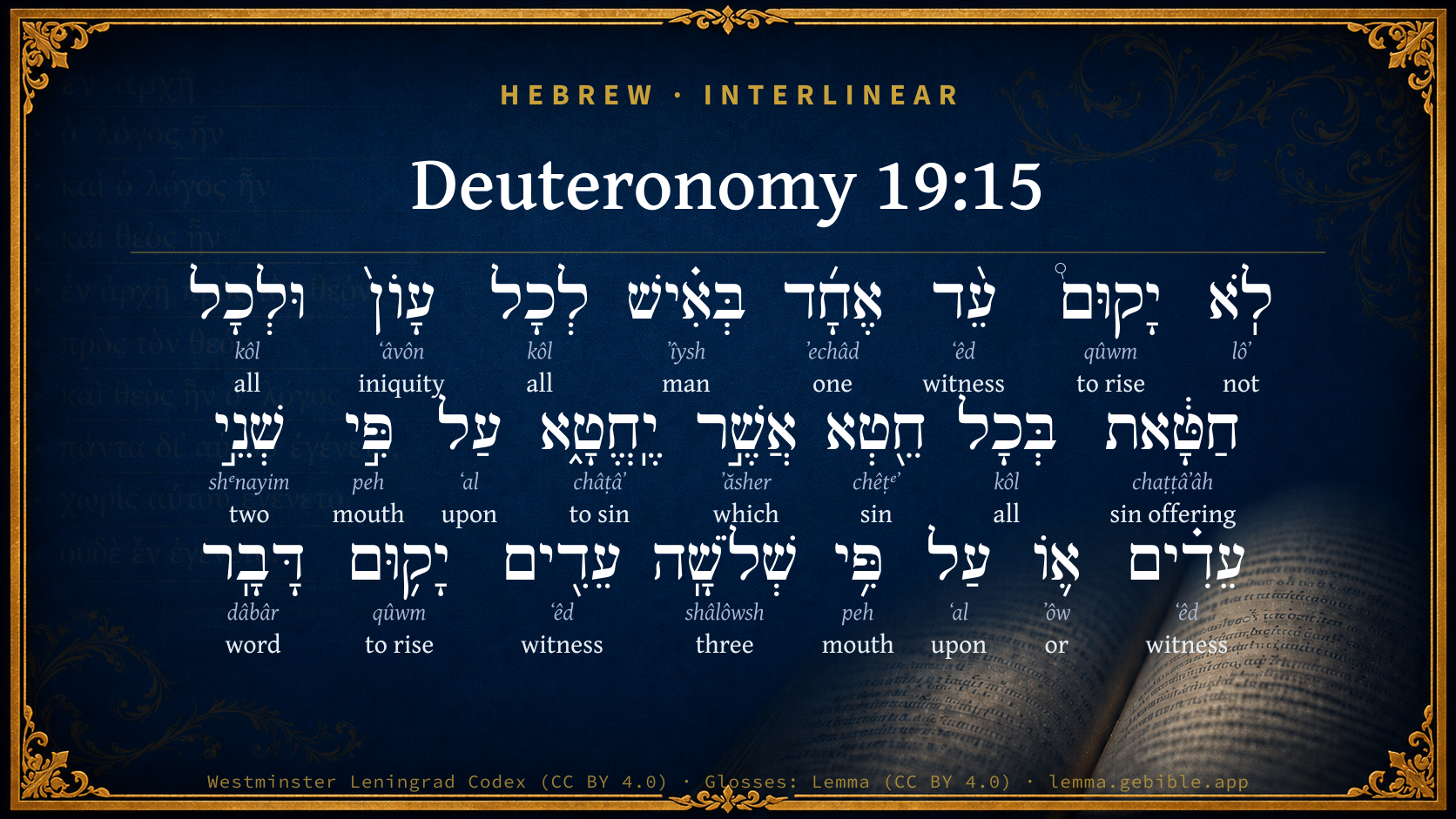
Hebrew (Westminster Leningrad Codex) Deuteronomy 19:15 appears in the Hebrew Old Testament. The text above is from the Westminster Leningrad Codex. Each word links to its Strong’s number, a concise gloss, and parsing drawn from the Open Scriptures Hebrew Bible morphology. Click any word for its full Brown-Driver-Briggs (BDB) entry.
Download image
Cite this verse

Deuteronomy 19:15 (World English Bible). Public Domain. Lemma interlinear Bible study tool, https://lemma.gebible.app/v/deuteronomy/19/15.

Show BibTeX & RIS
BibTeX
RIS
English Translation
One witness shall not rise up against a man for any iniquity, or for any sin, in any sin that he sins: at the mouth of two witnesses, or at the mouth of three witnesses, shall a matter be established.
World English Bible · Public Domain
Download a study sheet

One document with this verse’s original text, its word-by-word gloss line, the meaning frame, cross-references with their text, attributed commentary, and full source and license credits — printable, and it pastes into notes with its structure intact.

This verse Autodidact and up

Study sheet (.html) Plain text (.txt)

A passage Seminary Student

Up to 50 verses in one chapter. A passage sheet keeps up to 6 commentary sources and 12 cross-references per verse, in the order this page ranks them, and says so on the sheet whenever that leaves anything out. Ask for a single verse and you get the Autodidact verse sheet above.

Everything on this page stays free to read, with no account — the sheet is a download of what is already on screen, not access to it.

Want to remove ads? Support Godless Engineer
Compare translations 3

The same verse in 3 English versions, stacked beneath the original-language interlinear above. Click any original word for its lexicon entry.

Each is an independent rendering of the whole verse — the interlinear is not word-aligned to these translations.

Highlighted words mark where these versions differ — a whole-verse word diff, not a word-by-word alignment.

  • World English Bible Public Domain
    One witness shall not rise up against a man for any iniquity, or for any sin, in any sin that he sins: at the mouth of two witnesses, or at the mouth of three witnesses, shall a matter be established.
  • King James Version Public Domain
    One witness shall not rise up against a man for any iniquity, or for any sin, in any sin that he sinneth: at the mouth of two witnesses, or at the mouth of three witnesses, shall the matter be established.
  • unfoldingWord Literal Text CC BY-SA 4.0
    One witness shall not rise up against a man for any iniquity, or for any sin, in any sin that he sins; upon the mouth of two witnesses or upon the mouth of three witnesses a matter may be raised.

unfoldingWord Literal Text — © unfoldingWord, licensed CC BY-SA 4.0. Word-aligned USFM3 via Door43 (git.door43.org/unfoldingWord/en_ult).

Versions to compare (up to 4)

3 of 4 selected

Show all 18 translations

Every available English version of this verse, each an independent rendering of the whole verse.

  • World English Bible Public Domain
    One witness shall not rise up against a man for any iniquity, or for any sin, in any sin that he sins: at the mouth of two witnesses, or at the mouth of three witnesses, shall a matter be established.
  • Berean Standard Bible Public Domain
    A lone witness is not sufficient to establish any wrongdoing or sin against a man, regardless of what offense he may have committed. A matter must be established by the testimony of two or three witnesses.
  • Majority Standard Bible Public Domain
    A lone witness is not sufficient to establish any wrongdoing or sin against a man, regardless of what offense he may have committed. A matter must be established by the testimony of two or three witnesses.
  • King James Version Public Domain
    One witness shall not rise up against a man for any iniquity, or for any sin, in any sin that he sinneth: at the mouth of two witnesses, or at the mouth of three witnesses, shall the matter be established.
  • American Standard Version (1901) Public Domain
    One witness shall not rise up against a man for any iniquity, or for any sin, in any sin that he sinneth: at the mouth of two witnesses, or at the mouth of three witnesses, shall a matter be established.
  • Revised Version (1885) Public Domain
    One witness shall not rise up against a man for any iniquity, or for any sin, in any sin that he sinneth: at the mouth of two witnesses, or at the mouth of three witnesses, shall a matter be established.
  • Geneva Bible (1599) Public Domain
    One witnes shall not rise against a man for any trespasse, or for any sinne, or for any fault that hee offendeth in, but at the mouth of two witnesses or at the mouth of three witnesses shall the matter be stablished.
  • Douay-Rheims (1899) Public Domain
    One witness shall not rise up against any man, whatsoever the sin or wickedness be: but in the mouth of two or three witnesses every word shall stand.
  • Young's Literal Translation Public Domain
    `One witness doth not rise against a man for any iniquity, and for any sin, in any sin which he sinneth; by the mouth of two witnesses, or by the mouth of three witnesses, is a thing established.
  • Literal Standard Version CC BY-SA 4.0
    One witness does not rise against a man for any iniquity and for any sin, in any sin which he sins; by the mouth of two witnesses or by the mouth of three witnesses is a thing established.
  • Unlocked Literal Bible CC BY-SA 4.0
    One sole witness must not rise up against a man for any iniquity, or for any sin, in any matter that he sins; at the mouth of two witnesses, or at the mouth of three witnesses, must any matter be confirmed.
  • unfoldingWord Literal Text CC BY-SA 4.0
    One witness shall not rise up against a man for any iniquity, or for any sin, in any sin that he sins; upon the mouth of two witnesses or upon the mouth of three witnesses a matter may be raised.
  • Darby Bible Public Domain
    One witness shall not rise up against a man for any iniquity, and for any sin, in any sin that he sinneth: at the mouth of two witnesses, or at the mouth of three witnesses, shall a matter be established.
  • World Messianic Bible Public Domain
    One witness shall not rise up against a man for any iniquity, or for any sin that he sins. At the mouth of two witnesses, or at the mouth of three witnesses, shall a matter be established.
  • Webster's Bible Public Domain
    One witness shall not rise up against a man for any iniquity, or for any sin, in any sin that he sinneth; at the mouth of two witnesses, or at the mouth of three witnesses, shall the matter be established.
  • Free Bible Version CC BY-SA 4.0
    The evidence given by a single witness is not enough to prove a sin or a crime against someone, never mind what offense they are alleged to have committed. The facts must be confirmed by the evidence given by two or three witnesses.
  • Bible in Basic English Public Domain
    One witness may not make a statement against a man in relation to any sin or wrongdoing which he has done: on the word of two or three witnesses a question is to be judged.
  • JPS Tanakh (1917) Public Domain
    One witness shall not rise up against a man for any iniquity, or for any sin, in any sin that he sinneth; at the mouth of two witnesses, or at the mouth of three witnesses, shall a matter be establishment

Literal Standard Version (2020), Covenant Press — licensed CC BY-SA 4.0. Text via the HelloAO Bible API (eBible.org). Unlocked Literal Bible (unfoldingWord) — licensed CC BY-SA 4.0. Text via the HelloAO Bible API (eBible.org). unfoldingWord Literal Text — © unfoldingWord, licensed CC BY-SA 4.0. Word-aligned USFM3 via Door43 (git.door43.org/unfoldingWord/en_ult). Free Bible Version, Dr. Jonathan Gallagher — licensed CC BY-SA 4.0. Text via the HelloAO Bible API (eBible.org).

Word by word

More ways to search: Search by grammar → Find every occurrence → Compare this word →

Practice this passage: Drill this verse → Learn its vocabulary →

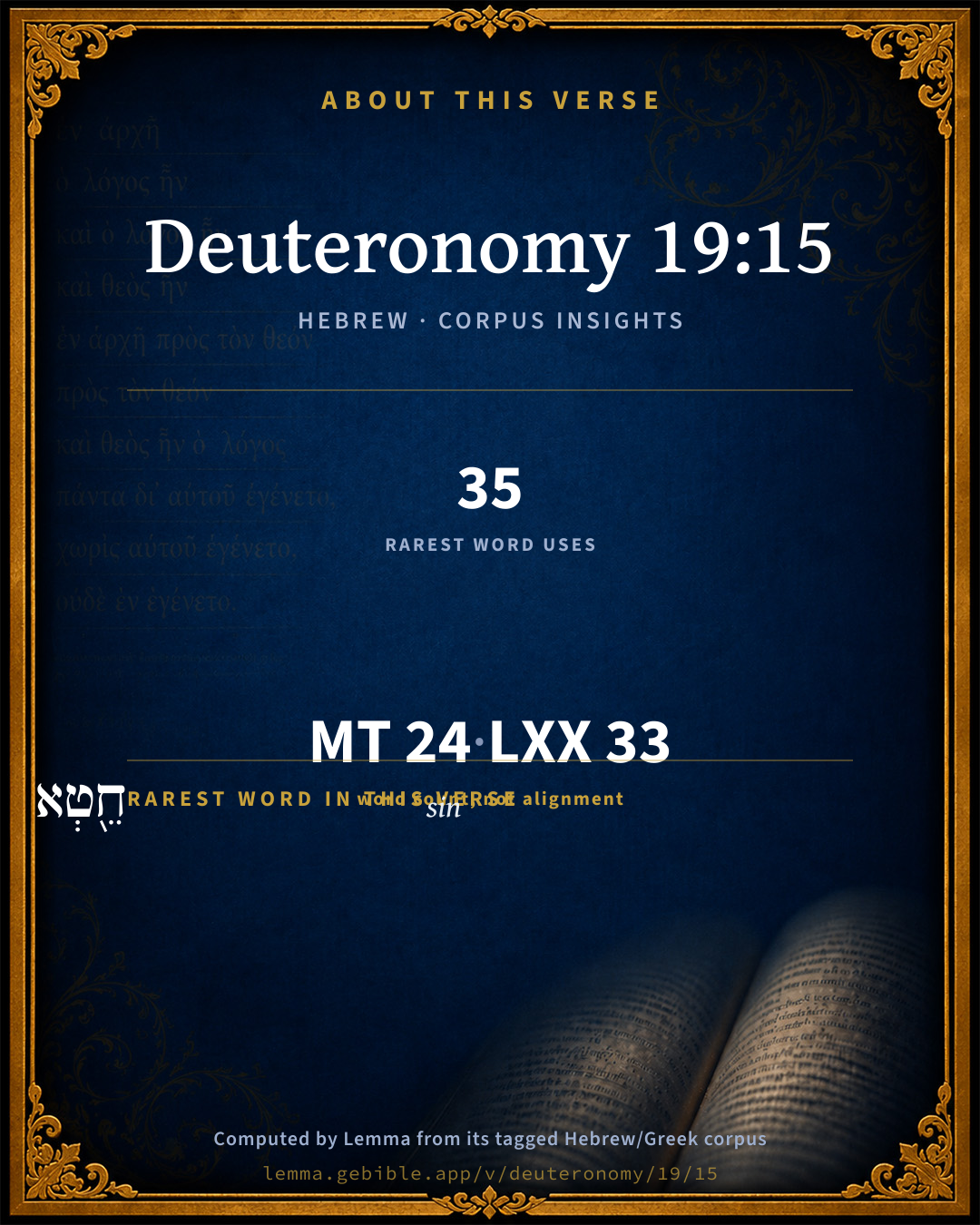
חֵ֖טְא
chêṭᵉʼ
H2399
“sin”
Noun, Common, Masculine, Singular, Absolute
Part of Speech
Noun
Type
Common
Gender
Masculine
Number
Singular
State
Absolute
Full BDB Definition

Origin: from H2398

TWOT: 638a

sin - sin - guilt for sin - punishment for sin
  1. לֹֽא lôʼ H3808 “not” Particle, Negative
  2. יָקוּם֩ qûwm H6965 “to rise” Verb, Qal, Imperfect, 3rd Person, Masculine, Singular
  3. עֵ֨ד ʻêd H5707 “witness” Noun, Common, Masculine, Singular, Absolute
  4. אֶחָ֜ד ʼechâd H259 “one” Adjective, Cardinal number, Masculine, Singular, Absolute
  5. בְּאִ֗ישׁ ʼîysh H376 “in/at · man” Preposition + Noun, Common, Masculine, Singular, Absolute
  6. לְכָל kôl H3605 “to/for · all of” Preposition + Noun, Common, Masculine, Singular, Construct
  7. עָוֺן֙ ʻâvôn H5771 “iniquity” Noun, Common, Both, Singular, Absolute
  8. וּלְכָל kôl H3605 “and · to/for · all of” Conjunction + Preposition + Noun, Common, Masculine, Singular, Construct
  9. חַטָּ֔את chaṭṭâʼâh H2403 “sin offering” Noun, Common, Feminine, Singular, Absolute
  10. בְּכָל kôl H3605 “in/at · all of” Preposition + Noun, Common, Masculine, Singular, Construct
  11. אֲשֶׁ֣ר ʼăsher H834 “which” Particle, Relative
  12. יֶֽחֱטָ֑א châṭâʼ H2398 “to sin” Verb, Qal, Imperfect, 3rd Person, Masculine, Singular
  13. עַל ʻal H5921 “upon” Preposition
  14. פִּ֣י peh H6310 “mouth of” Noun, Common, Masculine, Singular, Construct
  15. שְׁנֵ֣י shᵉnayim H8147 “two” Adjective, Cardinal number, Masculine, Dual, Construct
  16. עֵדִ֗ים ʻêd H5707 “witnesses” Noun, Common, Masculine, Plural, Absolute
  17. א֛וֹ ʼôw H176 “or” Conjunction
  18. עַל ʻal H5921 “upon” Preposition
  19. פִּ֥י peh H6310 “mouth of” Noun, Common, Masculine, Singular, Construct
  20. שְׁלֹשָֽׁה shâlôwsh H7969 “three” Adjective, Cardinal number, Masculine, Singular, Absolute
  21. עֵדִ֖ים ʻêd H5707 “witnesses” Noun, Common, Masculine, Plural, Absolute
  22. יָק֥וּם qûwm H6965 “to rise” Verb, Qal, Imperfect, 3rd Person, Masculine, Singular
  23. דָּבָֽר dâbâr H1697 “word” Noun, Common, Masculine, Singular, Absolute

About this verse

These counts appear in no published source. They are computed here, from the morphology-tagged text and Lemma’s own curated glosses. What Lemma adds →

24
words
17
distinct lemmas
Pentateuch
section

Shared distinctive vocabulary

חֵ֖טְא sin H2399 occurs in 34 verses of the Hebrew Bible. Also found in:

Grammatical profile

  • 3 verbs
  • 13 nouns
  • 3 adjectives
  • 2 prepositions
  • 1 conjunction
  • 2 particles

Verb forms

  • יָקוּם֩ Qal · Imperfect
  • יֶֽחֱטָ֑א Qal · Imperfect
  • יָק֥וּם Qal · Imperfect

Repetition

Words recur within this verse — often emphatic in Hebrew:

  • עֵ֨ד witness H5707 ×3
  • לְכָל all H3605 ×3
  • יָקוּם֩ to rise H6965 ×2
  • עַל upon H5921 ×2
  • פִּ֣י mouth H6310 ×2

Hebrew & Septuagint length

In English translation the verse runs 40 words from the Hebrew and 43 from the Septuagint (LXX English) — closely comparable.

A rough comparison of the two English renderings, which tokenize alike — not a word-level alignment.

Word counts can differ between the Hebrew and the Greek without any difference in meaning — e.g. the Hebrew direct-object marker אֵת has no separate Greek word, and Greek often adds the article ὁ.

In the original languages it is 24 Hebrew tokens and 33 Greek tokens — but the two are counted differently (Hebrew bundles its prefixes and suffixes into one token; the Greek is in lemma form), so that isn’t a like-for-like length.

Cross-references

11

Topical passages linked to Deuteronomy 19:15 in the Treasury of Scripture Knowledge — connected by theme and wording, ordered by reader-vote popularity; previews shown in the World English Bible.

  • Numbers 35:30 Whoever kills any person, the murderer shall be slain at the mouth of witnesses: but one witness shall not testify against any person that he die.
  • Deuteronomy 17:6 At the mouth of two witnesses, or three witnesses, shall he who is to die be put to death; at the mouth of one witness he shall not be put to death.
  • 2 Corinthians 13:1 This is the third time I am coming to you. "At the mouth of two or three witnesses shall every word established."
  • Matthew 18:16 But if he doesn't listen, take one or two more with you, that at the mouth of two or three witnesses every word may be established.
  • Hebrews 10:28 A man who disregards Moses' law dies without compassion on the word of two or three witnesses.
  • John 8:17 It's also written in your law that the testimony of two people is valid.
  • 1 Timothy 5:19 Don't receive an accusation against an elder, except at the word of two or three witnesses.
  • 1 Kings 21:10 and set two men, base fellows, before him, and let them testify against him, saying, You did curse God and the king. Then carry him out, and stone him to death.
  • 1 Kings 21:13 The two men, the base fellows, came in and sat before him: and the base fellows bore witness against him, even against Naboth, in the presence of the people, saying, Naboth did curse God and the king. Then they carried him forth out of the city, and stoned him to death with stones.
  • Matthew 26:60–61 and they found none. Even though many false witnesses came forward, they found none. But at last two false witnesses came forward,
  • Revelation 11:3–7 I will give power to my two witnesses, and they will prophesy one thousand two hundred sixty days, clothed in sackcloth."

Cross-references courtesy of OpenBible.info (CC BY 4.0).

Hebrew and Greek witnesses Masoretic Hebrew ↔ Greek Septuagint

The same verse in the two great witnesses to the Old Testament, shown verse-for-verse.

These are two independent witnesses, not word-aligned to each other, and the Septuagint is shown in lemma (dictionary) form.

Hebrew Deuteronomy 19:15 Masoretic · Westminster Leningrad Codex

לֹֽא יָקוּם֩ עֵ֨ד אֶחָ֜ד בְּאִ֗ישׁ לְכָל עָוֺן֙ וּלְכָל חַטָּ֔את בְּכָל חֵ֖טְא אֲשֶׁ֣ר יֶֽחֱטָ֑א עַל פִּ֣י שְׁנֵ֣י עֵדִ֗ים א֛וֹ עַל פִּ֥י שְׁלֹשָֽׁה עֵדִ֖ים יָק֥וּם דָּבָֽר

One witness shall not rise up against a man for any iniquity, or for any sin, in any sin that he sins: at the mouth of two witnesses, or at the mouth of three witnesses, shall a matter be established.

World English Bible · Public Domain

Greek LXX Deuteronomy 19:15 Septuagint · lemma form

οὐ ἐνμένω μάρτυς εἷς μαρτυρέω κατά ἄνθρωπος κατά πᾶς ἀδικία καί κατά πᾶς ἁμάρτημα καί κατά πᾶς ἁμαρτία ὅς ἄν ἁμαρτάνω ἐπί στόμα δύο μάρτυς καί ἐπί στόμα τρεῖς μάρτυς ἵστημι πᾶς ῥῆμα

One witness shall not stand to testify against a man for any iniquity, or for any fault, or for any sin which he may commit; by the mouth of two witnesses, or by the mouth of three witnesses, shall every word be established.

LXX2012 (modern English Septuagint) · Public Domain

Hebrew: Westminster Leningrad Codex (CC BY 4.0). Greek: Septuagint (public domain); English from LXX2012 (modern English Septuagint) (Public Domain). How the Septuagint differs from the Hebrew →

Targum (Aramaic paraphrase)

2

The Targum is the ancient Jewish Aramaic paraphrase of the Hebrew Scriptures — an interpretive translation, not the Hebrew text itself. Onkelos (literal) and Pseudo-Jonathan (expansive) render the Torah, and Jonathan the Prophets. Coverage is partial: where no permissively-licensed English translation exists for a verse, only the Aramaic is shown. This is verse-level text, not a word-by-word alignment to the Hebrew.

  1. Targum Onkelos Torah (Genesis–Deuteronomy)
    לָא יְקוּם סָהִיד חַד בִּגְבַר לְכָל עַוָיָן וּלְכָל חוֹבִין בְּכָל חֵט דִי יֶחְטֵי עַל מֵימַר תְּרֵין סָהֲדִין אוֹ עַל מֵימַר תְּלָתָא סָהֲדִין יִתְקַיַם פִּתְגָמָא

    (no public-domain English translation for this verse)

    Targum Onkelos — Aramaic: “Onkelos Genesis” (public domain); “Onkelos Exodus” (public domain); “Onkelos Leviticus” (public domain); “Onkelos Numbers” (public domain); “Onkelos Deuteronomy” (public domain). English: “Sefaria Community Translation” (CC0 1.0 (public-domain dedication)); “J.W. Etheridge. The Targums of Onkelos and Jonathan Ben Uzziel on the Pentateuch. London: Longmans, Green, 1862” (public domain). Text via Sefaria.

  2. Targum Pseudo-Jonathan Torah (Genesis–Deuteronomy)
    לָא יִתְקַיֵּים סַהֲדוּ דְּחַד בִּגְבַר לְכָל סָרְחָן נְפָשׁ וּלְכָל חוֹב מָמוֹן וּלְכָל חֵט דְּיֶחֱטֵי בְּרַם עַל מֵימְרָא דַיְיָ לְמִתְפַּרְעָא עַל טוּמְרַיָא עַל מַיָא סָהִיד חָד יוֹמֵי לְמִכְפּוֹר יַת מַה דְּמַסְהִיד עֲלוֹי וְעַל מֵימַר תְּרֵין סַהֲדִין אוֹ תְּלָתָא סַהֲדִין יִתְקַיֵּים פִּתְגָּמָא

    The testimony of one (witness) shall not be valid against a man for any crime (regarding the taking) of life, or guilt concerning money, or any sin with which one may be charged with sinning; but, by the Word of the Lord, (to insure) retribution upon secret crimes, (while) one witness may swear to deny what hath been attested against him, the sentence shall be confirmed upon the mouth of two witnesses, or of three.

    Targum Pseudo-Jonathan — Aramaic: “Targum Jonathan on Genesis” (public domain); “Targum Jonathan on Exodus” (public domain); “Targum Jonathan on Leviticus” (public domain); “Targum Jonathan on Numbers” (public domain); “Targum Jonathan on Deuteronomy” (public domain). English: “The Targum of Jonathan ben Uzziel, trans. J. W. Etheridge, London, 1862” (public domain). Text via Sefaria.

Commentary

Notes on Deuteronomy 19:15 from classic Christian and Jewish commentators (each source and its license shown beneath its notes). The classic Christian expositions comment on the surrounding passage and are grouped to its opening verse, so a note may address several verses; the Jewish commentaries on the Tanakh (Rashi and others) are per-verse, so they appear only where the commentator wrote on this verse.

Lemma curates 59 commentaries, every one of them public domain or Creative Commons licensed, each selected and text-cleaned for this edition rather than reprinted as found. About our sources →

Jamieson, Fausset & Brown

Robert Jamieson, A. R. Fausset & David Brown

TWO WITNESSES REQUIRED. (Deu 19:15)

One witness shall not rise up against a man for any iniquity--The following rules to regulate the admission of testimony in public courts are founded on the principles of natural justice. A single witness shall not be admitted to the condemnation of an accused person.

Jamieson, Fausset & Brown — Commentary Critical and Explanatory on the Whole Bible (1871) — public domain (CC PDM 1.0). Text via the HelloAO Bible API.

Ellicott's Commentary for English Readers

Deu_19:15-21. FALSE TESTIMONY.

The law of retaliation is sternly laid down here; but it must be administered by the judges, not by men acting on their own behalf.

(17) Both the men . . . shall stand before the Lord, before the priests and the judges.—This appears to mean that all cases of suspected false testimony were to go before the supreme court (see Deu_17:9); that the matter was not to be lightly decided.

(21) Eye for eye, tooth for tooth.—This is to be effected by the award of the judges, not as a matter of private revenge. But manifestly it rests with the injured party to press the case.

A Bible Commentary for English Readers, edited by Charles John Ellicott (1878–1897) — public domain. Text from a community e-Sword module.

The Cambridge Bible for Schools and Colleges

gen. ed. J. J. S. Perowne

15. By Deu_17:6 (cp. P, Num_35:30), a man may not be put to death save on the evidence of more than one witness. Here the same is enforced for all cases.

One witness shall not rise up] Or, stand, that is, of course, as a valid effectual witness; the vb is the same as at the end of the v., shall a matter be established. But in the next v. rise up simply means appear, offer himself.

in any sin that he sinneth] Luc. omits.

15–21. Of Witnesses

Two or three witnesses are necessary for a conviction (Deu_19:15). If a witness, forcing his evidence, accuse a man of defection from the law, the two shall stand before God in the supreme court (Deu_19:16 f.), the judges shall investigate, and if the witness be found false, he shall have done to him what he devised for his brother; so shall evil be removed from Israel (Deu_19:18 f.) and others take warning (Deu_19:20); ruthlessly shall like for like be exacted (Deu_19:21).—Sg. (except for one slip into the Pl. in Deu_19:19) with the use of the term brother and other terms usual in Sg. passages. There are no deuteronomic formulas beyond the legal ones.

On the subject of this law cp. E, Exo_23:1, Exo_20:16, Deu_5:20 (the 9th commandment), and other passages cited below. By the Code of Ḫammurabi §§ 3 f., false evidence is punished on the same principle of like for like as here, Deu_19:19. In Arabia at least two witnesses are necessary; if their charge is not brought home they must flee from the vengeance of the accused’s relatives, with whom however they may come to an arrangement (Musil, Ethn. Ber. 337).

The Cambridge Bible for Schools and Colleges (gen. ed. J. J. S. Perowne; Cambridge University Press, 1878–1918) — public domain. Text from a community e-Sword module.

Trapp's Complete Commentary

John Trapp

Deu 19:15 One witness shall not rise up against a man for any iniquity, or for any sin, in any sin that he sinneth: at the mouth of two witnesses, or at the mouth of three witnesses, shall the matter be established.

Ver. 15. One witness shall not rise up.] Yet, if this one be a faithful witness, Mαρτυς δε πιστος, και εις χρησιμος, saith Aristotle; {a} one faithful witness in some case may suffice, in private offences howsoever: and that our Saviour speaketh of such, {Mat 18:19} Basil and others are of opinion; if thy brother, a Jew, shall trespass against thee, being a Jew, right thyself by degrees. (1.) Deal with him fraternally, "tell him his fault betwixt thee and him alone"; {Mat 18:15} (2.) Deal with him legally, "take with thee one or two more"; {Deu 19:15} (3.) Deal with him Jewishly; "tell the Church," {Deu 19:17} complain to the Sanhedrim; (4.) If he shall neglect to hear them, deal with him heathenishly, i.e., " let him be unto thee as a heathen and a publican"; make benefit of Roman sovereignty, let Caesar’s justice end the difference between you. {b}

{a} Arist., Rhetor., lib. ii.

{b} Mr Lightfoot’s Harmony, p. 143.

John Trapp, A Commentary or Exposition upon All the Books of the Old and New Testament (1647–1656) — public domain. Text from a community e-Sword module.

Joseph Benson's Commentary

Deu 19:15-17. One witness shall not rise up — Or, be established, as the same word is rendered in the end of the verse; that is, shall not be accepted or owned as sufficient. If a false witness rise up — A single witness, though he speak truth, is not to be accepted for the condemnation of another man; but if he be convicted of bearing false witness, it is sufficient for his own condemnation. Both the men shall stand before the Lord — That is, shall come to the supreme court, which consisted partly of priests, and partly of other great persons, who, it seems, in Moses’s time, sat at the door of the tabernacle, and so the men, in standing before them, might properly be said to stand before the Lord.

Joseph Benson's Commentary on the Old and New Testaments (1811–1818) — public domain. Text from a community e-Sword module.

Keil & Delitzsch

C. F. Keil & F. Delitzsch

The Punishment of a False Witness. - To secure life and property against false accusations, Moses lays down the law in Deu 19:15, that one witness only was not "to rise up against any one with reference to any crime or sin, with every sin that one commits" (i.e., to appear before a court of justice, or be accepted as sufficient), but everything was to be established upon the testimony of two or three witnesses. The rule laid down in Deu 17:6 and Num 35:30 for capital crimes, is raised hereby into a law of general application (see at Num 35:30). קוּם (in Deu 19:15), to stand, i.e., to acquire legal force. - But as it was not always possible to bring forward two or three witnesses, and the statement of one witness could not well be disregarded, in Deu 19:16-18 Moses refers accusations of this kind to the higher tribunal at the sanctuary for investigation and decision, and appoints the same punishment for a false witness, which would have fallen upon the person accused, if he had been convicted of the crime with which he was charged. סרה בּו לענות, "to testify against his departure," sc., from the law of God, not merely falling away into idolatry (Deu 13:6), but any kind of crime, as we may gather from Deu 19:19, which would be visited with capital punishment.

Keil & Delitzsch — Biblical Commentary on the Old Testament (1861–1891) — public domain (CC PDM 1.0). Text via the HelloAO Bible API. (Old Testament only.)

Tyndale Open Study Notes

Tyndale Open Resources

19:15 The word of one witness alone would count no more than the word of the accused. However, two or three witnesses would confirm or discount each other’s testimony. For New Testament references to this law, see Matt 18:15-20; John 8:17-18; 2 Cor 13:1-2 and study note.

Tyndale Open Study Notes — © Tyndale Open Resources, licensed CC BY-SA 4.0. Text via the HelloAO Bible API.

Adam Clarke's Commentary

Verse 15. One witness shall not rise up, &c.] See Clarke on Nu 35:30.

Adam Clarke's Commentary on the Bible (1810–1826) — public domain. Text from a community e-Sword/MySword module.

John Gill's Exposition

If a false witness rise up against any man,.... In a court of judicature:

to testify against him: that which is not true of him, let it be in what case it will; Aben Ezra instances in idolatry, but it holds good of any other.

John Gill's Exposition of the Whole Bible (1746–1763) — public domain (CC PDM 1.0). Text via the HelloAO Bible API.

Haydock's Catholic Bible Commentary

One would suffice to make an enquiry into the affair, and to oblige the person accused, in pecuniary matters, to take an oath that he owed nothing. (Maimonides) --- Stand. This expression was become proverbial, to denote the certainty of a thing, Matthew xviii. 16., and 2 Corinthians xiii. 1. Two witnesses can not so easily carry on a cheat, (Calmet) as was seen in the case of Susanna. [Daniel xiii.] (Haydock) --- The law is satisfied with moral certainty. (Calmet)

George Leo Haydock (1774–1849), Haydock's Catholic Family Bible and Commentary, 1859 edition — public domain. Excludes Psalms (Douay-Rheims chapter numbering differs from Protestant) and Deuterocanonical books (Catholic canon only).

Matthew Poole's English Annotations

Shall not rise up, or, not stand, or, not be established, accepted, owned as sufficient: it is the same word which in the end of the verse is rendered be established.

Matthew Poole's English Annotations on the Holy Bible (1683–1685) — public domain. Text from a community e-Sword/MySword module.

Whedon's Commentary on the Bible

Daniel D. Whedon

15. At the mouth of three witnesses — In Deu_17:6, the rule had been laid down that in capital offences the decision should not be made on the testimony of a single witness. The same rule is here extended so as to apply to all cases that come before the courts.

Daniel D. Whedon (gen. ed.), Commentary on the Old and New Testaments (1874–1909) — public domain. Text from a community e-Sword module.

The Pulpit Commentary

Vers. 15-21. To secure against injury to life or property through inadequate or false attestation, it is enacted that more than one witness must appear before anything can be established; and that, should a witness be found on trial to have testified falsely against his neighbor, he was to be punished by having done to him what he thought to have done to his neighbor. (cf. Deu_17:6; Num_35:30)

The rule in Deu_17:6, regarding accusations of idolatry, is here extended to accusations of every kind before a court of justice; a single witness was not to be admitted as sufficient to convict a man of any offence, either civil or criminal.

Vers. 15-21. Bulwark against perjury.

tongue is an unruly member, and cannot easily be restrained." Private slander is base enough, but its basest utterance is when, in the sacred halls of justice, it swears away a man"s reputation or his life. It is doubtful if a deed so black is done in hell.

I PERJURY IS SO COMMON AS TO NECESSITATE A PUBLIC STIGMA ON HUMANITY. "One witness shall not rise up against a man." If every man had been known as truthful, the testimony of one witness on any accusation would be ample. The narration of one eye-witness or earwitness ought to be enough. For a truthful man would always speak within the limits of truth, and would promptly express his doubt, if certainty could not be reached. But the common experience of humanity has been that the bulk of men will prevaricate and conceal the truth, even under the solemn sanction of an oath. Hence it has been found wise to condemn no man judicially, unless more than one witness can be found. Cumulative evidence is required to obtain a valid sentence. This can be interpreted in no other way than a public testimony to the depravity of man. The prisoner obtains the benefit.

II PERJURY IS A CRIME, TO BE TRIED IN THE HIGHEST COURT OF THE REALM. The accused and the accuser in such a case shall "stand before the Lord." This is not so much a sin against man as a sin against God. The sacred person of Truth has been publicly violated, and the wisest and holiest in the land are commissioned by God to be the judges. As often as we violate the truth, we insult the God of truth, and stand before God for judgment. Hence it is of the first importance that we cultivate truthfulness in our thoughts and in our speech.

III IN PROPORTION TO THE GRAVITY OF THE CHARGE SHOULD BE THE THOROUGHNESS OF THE SCRUTINY. Although we may expect to know the will of God in any particular ease by laying our own minds open to the action of God"s Spirit, we are still bound to pursue the most diligent and thorough inquiry. God rewards, not the indolent, but the patient searcher after truth. He that does the truth will discover the truth. "God helps those who help themselves.

IV INTENDED MISCHIEF IS TREATED AS ACTUAL CRIME. The character and quality of a deed depend upon the moral intention. Whether the intention becomes an overt act will often depend upon outward opportunity and circumstance. But God sees the incipient motive and purpose; in his court, judgment passes upon the offender. Human courts are to be, as far as possible, copies of the court of heaven. Hence the perjured witness, who seeks to visit judicial penalties upon the head of the innocent, is himself as guilty as if his base project had succeeded. "Into the pit which he had digged for another he shall fall himself." The gallows which Haman prepared for Mordecai, served for his own doom. This is God"s law of retribution.

V THE END SOUGHT IN THIS JUDICIAL EXECUTION IS THE PUBLIC GOOD. The sacrifice of one life is intended to bring advantage to the many. The moral effect is most precious, viz. regard for righteousness public abstinence from crime. Every man should be filled with this patriotic sentiment the higher virtue of the nation. We may do good in our circle, either intensively on the minds of a few, or extensively on the minds of the many. In doing good to others we do good to ourselves. "We are members one of another. D.

The Pulpit Commentary (1880–1919), ed. H.D.M. Spence-Jones & Joseph S. Exell — public domain. Text from a community e-Sword module.

John Wesley's Explanatory Notes

Rise - Or be established, accepted, owned as sufficient: it is the same word which in the end of the verse is rendered, be established.

John Wesley, Explanatory Notes Upon the Whole Bible (1754–1765) — public domain. Text via the GEBible commentary corpus.

unfoldingWord translationNotes

Door43 World Missions Community

General Information:

Moses is still speaking to the people of Israel.

One sole witness

"A single witness" or "Only one witness"

must not rise up against a man

Here "rise up" means to stand up in court and speak against someone to a judge. AT: "must not speak to the judges about something bad that a man did" (See: Idiom)

in any matter that he sins

"anytime that a man does something bad"

at the mouth of two witnesses, or at the mouth of three witnesses

Here "mouth" represents what the witnesses say. It is implied that there must be at least two or three witnesses. AT: "at the testimony of at least two or three people" or "based on what at least two or three people say happened" (See: Metonymy and Assumed Knowledge and Implicit Information)

must any matter be confirmed

This can be stated in active form. AT: "will you confirm that the man is guilty" (See: Active or Passive)

Suppose that

"When" or "If"

an unrighteous witness

"a witness who intends to harm someone else"

rises up against any man to testify against him of wrongdoing

Here "rise up" means to stand up in court and speak against someone to a judge. AT: "tells the judge that a man sinned in order to get the man in trouble" or "tells the judge that a man sinned, so the judge will punish him" (See: Idiom)

translationWords

testimony

iniquity

sin

confirm

righteous

testimony

wrong

unfoldingWord translationNotes — © Distant Shores Media and the Door43 World Missions Community, licensed CC BY-SA 4.0. Source: git.door43.org/Door43/en_tn.

Rashi

Rabbi Shlomo Yitzchaki (Rashi)

עד אחד ONE WITNESS [SHALL NOT RISE UP AGAINST A MAN FOR ANY INIQUITY] — This is the classic passage from which the general principle is derived that wherever the term “witness” (עד) occurs in the Torah, it means two witnesses, unless it specifically mentions in connection with it the word אחד (Sanhedrin 30a).

לכל עון ולכל חטאת [ONE WITNESS SHALL NOT RISE UP AGAINST A PERSON] FOR ANY INIQUITY OR ANY SIN — i.e. that his fellow man should be punished on account of his evidence either by bodily punishment or by a monetary punishment; but he may rise up against his fellow men to compel him to take an oath. If, for instance, one says to his fellow, “Return me the maneh which I lent you”, and he replies “I have nothing of yours in my possession”, and one witness testifies that he has, he (the defendant) must take an oath to satisfy him (Shevuot 40a; cf. Sifrei Devarim 188:9).

על פי שני עדים [AT THE MOUTH OF TWO WITNESSES... SHALL THE MATTER BE ESTABLISHED] — at their mouth, but not that they may write their evidence down in a letter and send it to the court, nor that an interpreter stand between the witnesses and the judges (Sifrei Devarim 188:10).

Rashi on the Tanakh — English translations: “The Judaica Press complete Tanach with Rashi, translated by A. J. Rosenberg” (CC BY 4.0); “Pentateuch with Rashi's commentary by M. Rosenbaum and A.M. Silbermann, 1929-1934” (public domain); “The Metsudah Tanach series, Lakewood, N.J” (CC BY 4.0); and “The Book of Joshua, Metsudah Publications, 1997” (CC BY 4.0). Text via Sefaria.

Lesson kit

Teaching starters — assembled from the data on this page, not authored interpretation. Every prompt links to the verse data it draws on. Edit before teaching.

Deuteronomy, in the Pentateuch, opens this verse with 24 words (17 distinct Hebrew lemmas). Its most distinctive word is chêṭᵉʼ (“sin”). A historical commentator’s framing appears above. Read the whole chapter for the surrounding context.

Discussion questions

  1. How does “sin” (chêṭᵉʼ) shape what this verse is saying?
  2. How does Genesis 41:9, which shares the word «sin», read alongside this verse?
  3. What does the repetition of “witness” (3× in this one verse) do in this verse?
  4. These translations render this verse differently. What is at stake in choosing one wording over another?
  5. «יָקוּם֩» is a Qal Imperfect verb. How does that grammatical form shape the action described?
  6. Compare how Jamieson, Fausset & Brown and Ellicott's Commentary for English Readers read this verse. Where do they agree or differ?

Things to notice

Reading settings

Reading text

Shown beneath each verse's original-language words.

Old Testament
Old Testament edition

Read the OT as the Masoretic Hebrew (MT) or the Greek Septuagint (LXX).

English shown for the Greek Septuagint (in the Hebrew ↔ Greek comparison).

Comparing translations? Open the Compare panel on any verse page to stack up to four side by side.