
1 Samuel 12:23

Hebrew (Westminster Leningrad Codex) 1 Samuel 12:23 appears in the Hebrew Old Testament. The text above is from the Westminster Leningrad Codex. Each word links to its Strong’s number, a concise gloss, and parsing drawn from the Open Scriptures Hebrew Bible morphology. Click any word for its full Brown-Driver-Briggs (BDB) entry.
Download image
Cite this verse

1 Samuel 12:23 (World English Bible). Public Domain. Lemma interlinear Bible study tool, https://lemma.gebible.app/v/1-samuel/12/23.

Show BibTeX & RIS
BibTeX
RIS
English Translation
Moreover as for me, far be it from me that I should sin against Yahweh in ceasing to pray for you: but I will instruct you in the good and the right way.
World English Bible · Public Domain
Download a study sheet

One document with this verse’s original text, its word-by-word gloss line, the meaning frame, cross-references with their text, attributed commentary, and full source and license credits — printable, and it pastes into notes with its structure intact.

This verse Autodidact and up

Study sheet (.html) Plain text (.txt)

A passage Seminary Student

Up to 50 verses in one chapter. A passage sheet keeps up to 6 commentary sources and 12 cross-references per verse, in the order this page ranks them, and says so on the sheet whenever that leaves anything out. Ask for a single verse and you get the Autodidact verse sheet above.

Everything on this page stays free to read, with no account — the sheet is a download of what is already on screen, not access to it.

Want to remove ads? Support Godless Engineer
Compare translations 3

The same verse in 3 English versions, stacked beneath the original-language interlinear above. Click any original word for its lexicon entry.

Each is an independent rendering of the whole verse — the interlinear is not word-aligned to these translations.

Highlighted words mark where these versions differ — a whole-verse word diff, not a word-by-word alignment.

  • World English Bible Public Domain
    Moreover as for me, far be it from me that I should sin against Yahweh in ceasing to pray for you: but I will instruct you in the good and the right way.
  • King James Version Public Domain
    Moreover as for me, God forbid that I should sin against the LORD in ceasing to pray for you: but I will teach you the good and the right way:
  • unfoldingWord Literal Text CC BY-SA 4.0
    Also, me, profane to me from sinning against Yahweh by ceasing to pray for you! And I will instruct you in the good and straight way.

unfoldingWord Literal Text — © unfoldingWord, licensed CC BY-SA 4.0. Word-aligned USFM3 via Door43 (git.door43.org/unfoldingWord/en_ult).

Versions to compare (up to 4)

3 of 4 selected

Show all 18 translations

Every available English version of this verse, each an independent rendering of the whole verse.

  • World English Bible Public Domain
    Moreover as for me, far be it from me that I should sin against Yahweh in ceasing to pray for you: but I will instruct you in the good and the right way.
  • Berean Standard Bible Public Domain
    As for me, far be it from me that I should sin against the LORD by ceasing to pray for you. And I will continue to teach you the good and right way.
  • Majority Standard Bible Public Domain
    As for me, far be it from me that I should sin against the LORD by ceasing to pray for you. And I will continue to teach you the good and right way.
  • King James Version Public Domain
    Moreover as for me, God forbid that I should sin against the LORD in ceasing to pray for you: but I will teach you the good and the right way:
  • American Standard Version (1901) Public Domain
    Moreover as for me, far be it from me that I should sin against Jehovah in ceasing to pray for you: but I will instruct you in the good and the right way.
  • Revised Version (1885) Public Domain
    Moreover as for me, God forbid that I should sin against the LORD in ceasing to pray for you: but I will instruct you in the good and the right way.
  • Geneva Bible (1599) Public Domain
    Moreouer God forbid, that I should sinne against the Lord, and cease praying for you, but I will shewe you the good and right way.
  • Douay-Rheims (1899) Public Domain
    And far from me be this sin against the Lord, that I should cease to pray for you, and I will teach you the good and right way.
  • Young's Literal Translation Public Domain
    `I, also, far be it from me to sin against Jehovah, by ceasing to pray for you, and I have directed you in the good and upright way;
  • Literal Standard Version CC BY-SA 4.0
    I, also, far be it from me to sin against YHWH, by ceasing to pray for you, and I have directed you in the good and upright way;
  • Unlocked Literal Bible CC BY-SA 4.0
    As for me, far be it from me that I should sin against Yahweh by ceasing to pray for you. Instead, I will teach you the way that is good and right.
  • unfoldingWord Literal Text CC BY-SA 4.0
    Also, me, profane to me from sinning against Yahweh by ceasing to pray for you! And I will instruct you in the good and straight way.
  • Darby Bible Public Domain
    Moreover, as for me, far be it from me that I should sin against Jehovah in ceasing to pray for you; and I will teach you the good and right way.
  • World Messianic Bible Public Domain
    Moreover, as for me, far be it from me that I should sin against the LORD in ceasing to pray for you; but I will instruct you in the good and the right way.
  • Webster's Bible Public Domain
    Moreover as for me, Far be it from me that I should sin against the LORD in ceasing to pray for you: but I will teach you the good and the right way:
  • Free Bible Version CC BY-SA 4.0
    As for me, how could I sin against the Lord by no longer praying for you? I will also continue to teach you the way of goodness and right.
  • Bible in Basic English Public Domain
    And as for me, never will I go against the orders of the Lord by giving up my prayers for you: but I will go on teaching you the good and right way.
  • JPS Tanakh (1917) Public Domain
    Moreover as for me, far be it from me that I should sin against the LORD in ceasing to pray for you; but I will instruct you in the good and the right way.

Literal Standard Version (2020), Covenant Press — licensed CC BY-SA 4.0. Text via the HelloAO Bible API (eBible.org). Unlocked Literal Bible (unfoldingWord) — licensed CC BY-SA 4.0. Text via the HelloAO Bible API (eBible.org). unfoldingWord Literal Text — © unfoldingWord, licensed CC BY-SA 4.0. Word-aligned USFM3 via Door43 (git.door43.org/unfoldingWord/en_ult). Free Bible Version, Dr. Jonathan Gallagher — licensed CC BY-SA 4.0. Text via the HelloAO Bible API (eBible.org).

Word by word

More ways to search: Search by grammar → Find every occurrence → Compare this word →

Practice this passage: Drill this verse → Learn its vocabulary →

חָלִ֤ילָה
châlîylâh
H2486
“God forbid”
Particle, Interjection + Suffix, h
Part of Speech
Particle
Type
Interjection
Full BDB Definition

Origin: a directive from H2490

TWOT: 661c

far be it (from me), God forbid that, let it not be
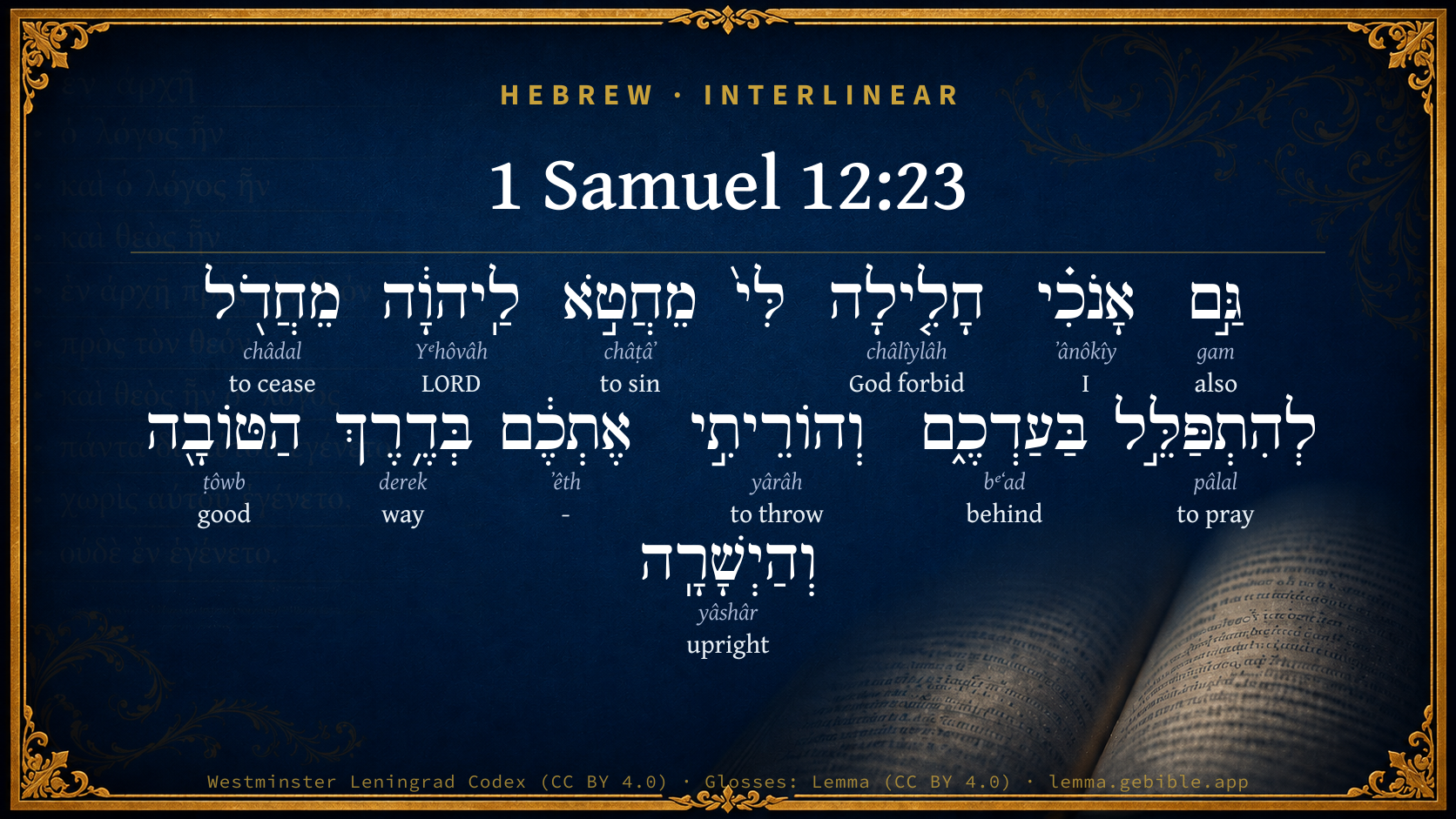
  1. גַּ֣ם gam H1571 “also” Particle, Accusative
  2. אָנֹכִ֗י ʼânôkîy H595 “I” Pronoun, Personal, 1st Person, Common, Singular
  3. מֵחֲטֹ֣א châṭâʼ H2398 “from · to sin” Preposition + Verb, Qal, Infinitive Construct
  4. לַֽיהוָ֔ה Yᵉhôvâh H3068 “to/for · LORD” Preposition + Noun, Proper
  5. מֵחֲדֹ֖ל châdal H2308 “from · to cease” Preposition + Verb, Qal, Infinitive Construct
  6. לְהִתְפַּלֵּ֣ל pâlal H6419 “to pray” Preposition + Verb, Hithpael, Infinitive Construct
  7. בַּעַדְכֶ֑ם bᵉʻad H1157 “behind · you” Preposition + Suffix, Personal, 2nd Person, Masculine, Plural
  8. וְהוֹרֵיתִ֣י yârâh H3384 “and · to throw” Conjunction + Verb, Hiphil, Sequential Perfect, 1st Person, Common, Singular
  9. אֶתְכֶ֔ם ʼêth H853 “- · you” Particle, Direct Object + Suffix, Personal, 2nd Person, Masculine, Plural
  10. בְּדֶ֥רֶךְ derek H1870 “in/at · way of” Preposition + Noun, Common, Both, Singular, Construct
  11. הַטּוֹבָ֖ה ṭôwb H2896 “the · good” Particle, Definite Article + Adjective, Adjective, Feminine, Singular, Absolute
  12. וְהַיְשָׁרָֽה yâshâr H3477 “and · the · upright” Conjunction + Particle, Definite Article + Adjective, Adjective, Feminine, Singular, Absolute

About this verse

These counts appear in no published source. They are computed here, from the morphology-tagged text and Lemma’s own curated glosses. What Lemma adds →

14
words
13
distinct lemmas
Historical
section

Notable vocabulary

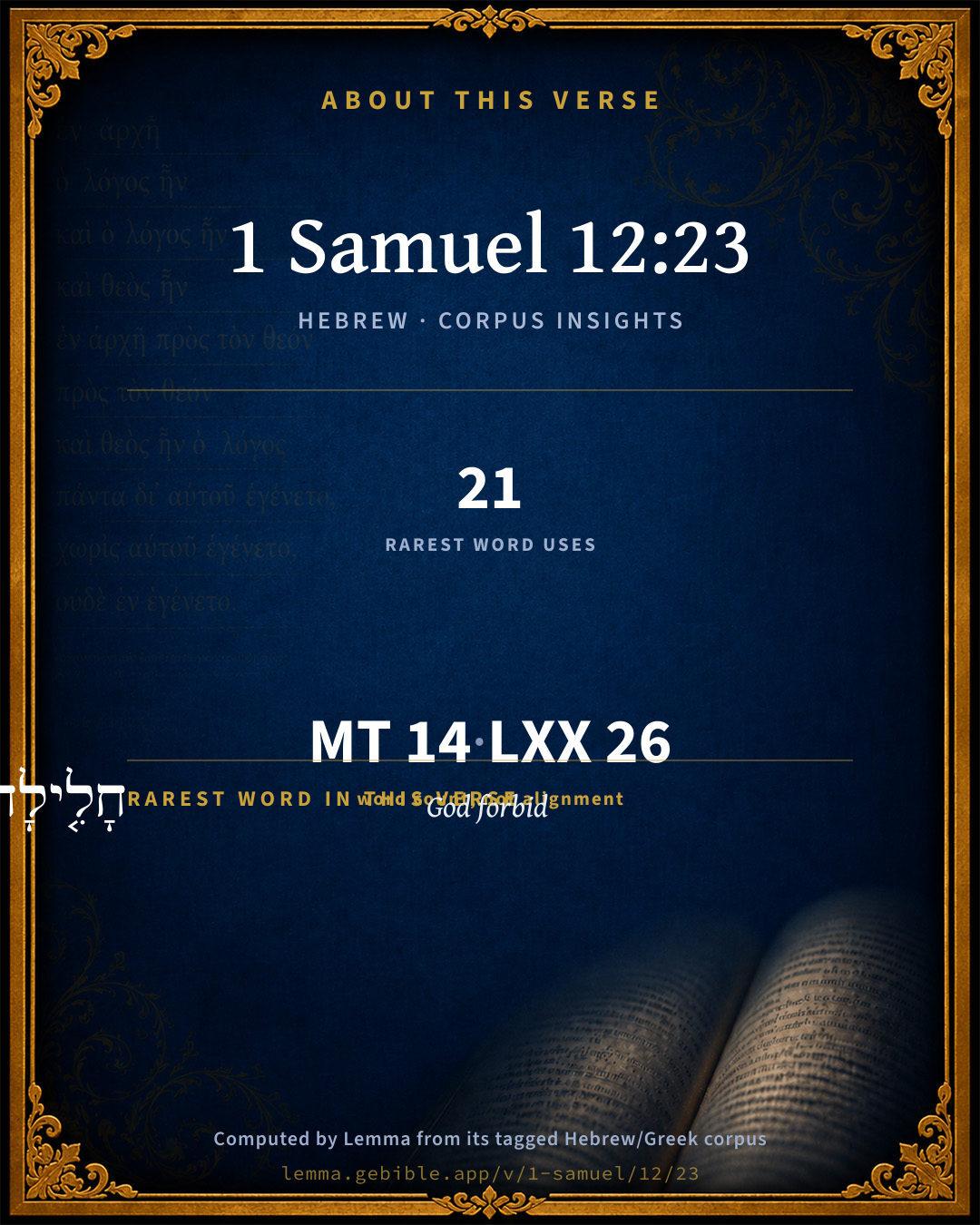
The rarest word here is חָלִ֤ילָה God forbid H2486 — appearing just 21 times in the whole Hebrew Bible.

Shared distinctive vocabulary

חָלִ֤ילָה God forbid H2486 occurs in 19 verses of the Hebrew Bible. Also found in:

Grammatical profile

  • 4 verbs
  • 2 nouns
  • 2 adjectives
  • 1 pronoun
  • 2 prepositions
  • 3 particles

Verb forms

  • מֵחֲטֹ֣א Qal · Infinitive Construct
  • מֵחֲדֹ֖ל Qal · Infinitive Construct
  • לְהִתְפַּלֵּ֣ל Hithpael · Infinitive Construct
  • וְהוֹרֵיתִ֣י Hiphil · Sequential Perfect

Hebrew & Septuagint length

In English translation the verse runs 33 words from the Hebrew and 32 from the Septuagint (LXX English) — closely comparable.

A rough comparison of the two English renderings, which tokenize alike — not a word-level alignment.

Word counts can differ between the Hebrew and the Greek without any difference in meaning — e.g. the Hebrew direct-object marker אֵת has no separate Greek word, and Greek often adds the article ὁ.

In the original languages it is 14 Hebrew tokens and 26 Greek tokens — but the two are counted differently (Hebrew bundles its prefixes and suffixes into one token; the Greek is in lemma form), so that isn’t a like-for-like length.

Cross-references

13

Topical passages linked to 1 Samuel 12:23 in the Treasury of Scripture Knowledge — connected by theme and wording, ordered by reader-vote popularity; previews shown in the World English Bible.

  • Colossians 1:9 For this cause, we also, since the day we heard this, don't cease praying and making requests for you, that you may be filled with the knowledge of his will in all spiritual wisdom and understanding,
  • Romans 1:9 For God is my witness, whom I serve in my spirit in the Gospel of his Son, how unceasingly I make mention of you always in my prayers,
  • 2 Timothy 1:3 I thank God, whom I serve as my forefathers did, with a pure conscience. How unceasing is my memory of you in my petitions, night and day
  • 1 Thessalonians 3:10 night and day praying exceedingly that we may see your face, and may perfect that which is lacking in your faith?
  • 1 Kings 8:36 then hear in heaven, and forgive the sin of your servants, and of your people Israel, when you teach them the good way in which they should walk; and send rain on your land, which you have given to your people for an inheritance.
  • Acts 12:5 Peter therefore was kept in the prison, but constant prayer was made by the assembly to God for him.
  • Psalms 34:11 Come, you children, listen to me. I will teach you the fear of Yahweh.
  • Jeremiah 6:16 Thus says Yahweh, Stand you in the ways and see, and ask for the old paths, where is the good way; and walk therein, and you shall find rest for your souls: but they said, We will not walk [therein].
  • 2 Chronicles 6:27 then hear in heaven, and forgive the sin of your servants, and of your people Israel, when you teach them the good way in which they should walk; and send rain on your land, which you have given to your people for an inheritance.
  • Colossians 1:28 whom we proclaim, admonishing every man and teaching every man in all wisdom, that we may present every man perfect in Christ Jesus;
  • Proverbs 4:11 I have taught you in the way of wisdom. I have led you in straight paths.
  • Ecclesiastes 12:10 The Preacher sought to find out acceptable words, and that which was written blamelessly, words of truth.
  • Acts 20:20 how I didn't shrink from declaring to you anything that was profitable, teaching you publicly and from house to house,

Cross-references courtesy of OpenBible.info (CC BY 4.0).

Hebrew and Greek witnesses Masoretic Hebrew ↔ Greek Septuagint

The same verse in the two great witnesses to the Old Testament, shown verse-for-verse.

These are two independent witnesses, not word-aligned to each other, and the Septuagint is shown in lemma (dictionary) form.

Hebrew 1 Samuel 12:23 Masoretic · Westminster Leningrad Codex

גַּ֣ם אָנֹכִ֗י חָלִ֤ילָה לִּי֙ מֵחֲטֹ֣א לַֽיהוָ֔ה מֵחֲדֹ֖ל לְהִתְפַּלֵּ֣ל בַּעַדְכֶ֑ם וְהוֹרֵיתִ֣י אֶתְכֶ֔ם בְּדֶ֥רֶךְ הַטּוֹבָ֖ה וְהַיְשָׁרָֽה

Moreover as for me, far be it from me that I should sin against Yahweh in ceasing to pray for you: but I will instruct you in the good and the right way.

World English Bible · Public Domain

Greek LXX 1 Samuel 12:23 Septuagint · lemma form

καί ἐγώ μηδαμῶς ὁ ἁμαρτάνω ὁ κύριος ἀναἵημι ὁ προςεὔχομαι περί σύ καί δουλεύω ὁ κύριος καί δεικνύω σύ ὁ ὁδός ὁ ἀγαθός καί ὁ εὐθύς

And far be it from me to sin against the Lord in ceasing to pray for you: but I will serve the Lord, and show you the good and the right way.

LXX2012 (modern English Septuagint) · Public Domain

Hebrew: Westminster Leningrad Codex (CC BY 4.0). Greek: Septuagint (public domain); English from LXX2012 (modern English Septuagint) (Public Domain). How the Septuagint differs from the Hebrew →

Targum (Aramaic paraphrase)

1

The Targum is the ancient Jewish Aramaic paraphrase of the Hebrew Scriptures — an interpretive translation, not the Hebrew text itself. Onkelos (literal) and Pseudo-Jonathan (expansive) render the Torah, and Jonathan the Prophets. Coverage is partial: where no permissively-licensed English translation exists for a verse, only the Aramaic is shown. This is verse-level text, not a word-by-word alignment to the Hebrew.

  1. Targum Jonathan Prophets (Joshua–Malachi)
    אַף אֲנָא חַס לִי מִלְמֶחְטֵי קֳדָם יְיָ מִלְאִתְמְנָעָא לְצַלָאָה עֲלֵיכוֹן וְאַלֵיף יַתְכוֹן דִתְהָכוּן בְּאוֹרַח תַּקְנָא וְכַשְׁרָא:

    (no public-domain English translation for this verse)

    Targum Jonathan — Aramaic: “Mikraot Gedolot” (public domain). English: “Sefaria Community Translation” (CC0 1.0 (public-domain dedication)); “London "Chaldee Paraphrase," 1871” (public domain). Text via Sefaria.

Commentary

Notes on 1 Samuel 12:23 from classic Christian and Jewish commentators (each source and its license shown beneath its notes). The classic Christian expositions comment on the surrounding passage and are grouped to its opening verse, so a note may address several verses; the Jewish commentaries on the Tanakh (Rashi and others) are per-verse, so they appear only where the commentator wrote on this verse.

Lemma curates 59 commentaries, every one of them public domain or Creative Commons licensed, each selected and text-cleaned for this edition rather than reprinted as found. About our sources →

Trapp's Complete Commentary

John Trapp

1Sa 12:23 Moreover as for me, God forbid that I should sin against the LORD in ceasing to pray for you: but I will teach you the good and the right way:

Ver. 23. In ceasing to pray for you: but I will teach you.] I will faithfully perform the office of a prophet in preaching unto you, and praying for you. See Deu 33:18 Act 6:4. Whether a minister shall do more good to others by his prayers or preaching, I will not determine, saith one; {a} but he shall certainly by his prayers reap more comfort to himself.

{a} Dr Tho. Taylor’s Saints’ Progr., p. 172.

John Trapp, A Commentary or Exposition upon All the Books of the Old and New Testament (1647–1656) — public domain. Text from a community e-Sword module.

The Biblical Illustrator

Joseph S. Exell

1Sa_12:23

God forbid that I should sin against the Lord in ceasing to pray for you.

Samuel: An example of intercession

It is a very great privilege to be permitted to pray for our fellow men Such prayers are often of unspeakable value to those for whom they are offered. Intercessory prayer is a benefit to the man who exercises it, and is often a better channel of comfort than any other means of grace. The Lord turned again the captivity of Job when he prayed for his friends. I would have you stirred up to diligent supplication by the example of Samuel, who is worthy to be placed in the very forefront of intercessors.

I. Let us dwell upon his habit of intercession, for it was most manifest in Samuel. We gather this from the text. He says, God forbid that I should sin against the Lord in ceasing to pray for you. It is clear, therefore, that he had been in the continual habit and practice of praying for Israel as to the success of Samuels prayers, read his life, and you will find that he wrought great deliverances for the people. In the seventh chapter of this book we find that the Philistines grievously oppressed Israel, and Samuel bravely called the people together, to consider their condition, and bade them turn from idolatry, and worship the only true God, and promised them his prayers as a boon which they greatly valued. These are his words: Gather all Israel to Mizpeh, and I will pray for you unto the Lord. Samuels prayers were so prevalent that the very elements were controlled by him.

II. Notice in Samuels case his provocation to cease from intercession, which provocation he patiently endured.

1. The first provocation was the slight which they put upon himself.

2. Beyond the provocation which came from their slight upon himself he felt wounded by their utter rejection of his solemn protest.

III. Notice Samuel in his persevering intercession. Though the people thus provoked him he did not cease from prayer for them. When the prophet knew that Saul was hopelessly rejected he did not cease to pray for the nation, but went down to Bethlehem and anointed David, and when David was pursued by the malice of Saul we find him harbouring David at Ramah, and exhibiting the power of prayer in his own house and in the holy place. I pray you, therefore, still persevere in supplication, and be supported in your perseverance by the knowledge that it would be a sin to cease to pray for those who have been the subjects of your petitions. Samuel confesses that it would have been sinful on his part to abstain from intercession. How so? Why, if he ceased to pray for the people, he would be neglecting his office, for God had made him a prophet to the nation, and he must intercede for them or neglect his duty. It would have been a neglect of the Divine glory; for whatever the people might be, Gods name was wrapped up in them, and if they did not prosper the Lord would not be glorified in the eyes of the heathen. He could not give up praying for them, for their cause was the cause of God. It would have been a cruelty to souls if he who possessed such a power in prayer had restrained it.

IV. Samuel showed his sincerity in intercession by corresponding action, for he says in the words of the text, God forbid that I should sin against the Lord in ceasing to pray for you; but I will teach you the good and the right way. So far from leaving off praying, he would be doubly diligent to teach them; and he did so. After praying for your friends, do try as well as you can to answer your own prayer by using the means which God ordinarily blesses. Some persons make idle prayers, for they use no effort for obtaining their requests. If a husbandman asks for a harvest, he also ploughs and sows, for else his supplications would be hypocritical. If we wish to see our neighbours converted, we shall labour for it in all ways. A man who wishes to shoot birds will, after a while, become expert in the sport, because he will give his mind to it: he will after a little practice become a noted marksman and know all about guns and dogs. A man who wants to catch salmon has his heart set upon his angling, and becomes absorbed in the pursuit. He soon learns how to use his rod and how to manage his fish. So he who longs to win souls, and puts his heart into it, finds out the knack of it by some means, and the Lord gives him success. There is a power in your gifts; there is a power in your speech; use these powers. (C. H. Spurgeon.)

Intercessory prayer

I. Its efficacy generally acknowledged. They felt that his words, if weak on earth, were mighty in heaven. Now this feeling implies their belief in the efficacy of intercessory prayer, and I make three remarks concerning this belief.

1. It is very common. There is nothing peculiar in the belief that one man on earth may have power in heaven to help his fellow men. In truth, it is so common that I am almost disposed to regard it as one of the intuitive faiths of humanity. Priesthoods are everywhere, and this faith is the foundation of all priesthoods.

2. Divinely warranted. In truth, if it be an inborn faith, it must be Divinely warranted; for Heaven evermore encourages all that is truly natural. We find the Divine warrant in the numerous exhortations addressed to us in the Word of God to pray for our fellow men.

3. Sadly abused. It is abused by those who trust to it irrespective of their own efforts

II. Its neglect deprecated as a sin:--God forbid that I should sin against the Lord in ceasing to pray for you. It is the ordinance of God that man should assist his fellow man, not merely by bringing his best influences to bear upon his mind, but by offering up his best desires to heaven on his behalf. This being the law, to neglect it is a sin.

1. It serves to impress society with the solemnity of mans existence. Surely, here in a world where the millions are grubbing in what is material and drudging with their hands, it is something to elevate us into stately seriousness to feel that there are men like Samuel endowed with powers to touch the heart of God, and so move the springs of history.

2. It serves to unite men together in spiritual interest. Mutual intercessory prayers are, of all influences, the most socially uniting.

3. It serves to nurture the deepest philanthropy. True intercession is philanthropy exercising itself in the very presence of God. Where can it get a higher inspiration or a stronger impulse? (Homilist.)

Ceasing to pray for others is a sin against the Lord

The sentiments of the text are, that prayer for others is a duty, and the neglect of it is a sin. We will therefore inquire--

I. Who are the individuals for whom we should pray?

1. For our families.

2. For the Church of God.

3. For our country.

4. For the world.

What an awful state is the world in, notwithstanding all the attempts which are made to mend it!

II. State the arguments for the adoption of such practice.

1. We are related to each other, and therefore we should pray for one another.

2. We are dependent on each others exertions for a subsistence. Some talk of being independent, but this is absurd. The king himself is served by the field (Ecc_5:9).

3. The practice of praying for others will serve to keep alive in our hearts the most benevolent feelings towards them.

4. This practice may promote their salvation.

III. We may omit to pray for others. The text is sufficiently indicative of this.

1. We may omit to pray for others through unconcern about our own salvation.

2. We may do it through unbelief in reference to the efficacy of prayer.

3. We may do it through prejudice.

IV. That our ceasing to pray for others is a sin against the Lord.

1. It is a sin against the precepts of the Lord (1Ti_2:1-2).

2. Against the spirit of the Lord. The Holy Ghost works in our hearts feelings of benevolence and love, which give birth to prayer.

3. Against the example of the Lord.

Learn--

1. What straits people are brought into by their sinful conduct.

2. None can help us in our distress but God.

3. People in affliction are glad to have the prayers of those whom they have treated with insult before.

4. Good men pray for those who have despitefully used them. (Sketches of four hundred sermons.)

The sin of prayerlessness

The sainted Robert Murray MCheyne wrote to his church at Dundee, during his last illness: You have hindered Gods work by your want of prayer. When God gives grace to souls, it is in answer to the prayers of His children . . . When God puts it into the hearts of His children to pray, it is certain that He is going to pour down His spirit in abundance . . . The salvation of those around you depends upon your asking . . . I often think it strange that ever we should be in heaven, and so many in hell through our soul-destroying carelessness . . . Plead and wrestle with God, showing Him that the cause is His own, and that it is all for His own glory to arise and have mercy upon Zion.

But I will teach you the good and the right way.

Duties of ministers and people. The Chartists visit to the Parish Church

I. First, then, let us consider the duties inculcated; and they are two fold.

1. With respect to the ministers of God. Samuel, the prophet of the Lord, considering the state of the people, exclaimed, God forbid that I should sin against the Lord in ceasing to pray for you: but I will teach you the good and the right way. To a similar effect the apostle declared, We will give ourselves continually to prayer and to the ministry of the Word. These are the peculiar duties of the ministers of God,--prayer, and the ministry of the Word. Sweet is the work to those who know it, delightful is the duty of intercessory prayer. Of all those men of God whose histories are recorded in Holy Scripture, there is not one who did not delight in this duty.

2. The ministry of the Word: I will teach you the good and the right way So said the inspired prophet Samuel; so said a long line of faithful men of God, many of whom sealed their testimony with their blood; so said the apostles of Jesus Christ; and so say the ministers of God to this day. And is there presumption or affectation in saying, We will teach you the good and the right way? It would indeed be presumption if we conceived that we had chalked out that way for ourselves, or if it were the notions of man we had to teach you; but we know the good and the right way, and are able to testify to you that which we have seen, and that which we have believed. Revelation has taught us, and we know there is but one way, one good way, one true way; and that all other ways lead to the chambers of darkness and despair. And if these are our duties, what are yours? Mark the exhortation of the prophet in the text, Only fear the Lord, and serve Him in truth with all your heart. This brief sentence contains the whole duty of man! Only fear the Lord, said he to the tumultuous people; we stop to inculcate no other principle; if we gain your heart, we gain the whole man; we know all must follow; we know that the man who fears God has the grand principle of moral duty in him. If he wants the fear of God, he wants everything! he wants the cement of social society, that which binds man to man, which gives peace and comfort him, and gilds the grave itself with hope. This is the standing or falling principle, Only fear the Lord; then your conscience shall be enlightened by the Spirit of God, your heart shall bend to the will of God. The noble testimony of Josephs steward, to the trembling brethren is our guarantee, I fear God! Such a man will be a lover of justice, a lover of truth, and of everything that is honourable and of good report; whereas all others are as garnished sepulchres--they have sweet words in their mouths, but war in their hearts. Here is our security and our comfort; only fear God. The other expressions in the text are but expletives of this duty: Only fear the Lord, and serve Him. If a man fears God, he will be the servant of God, and he will serve Him in prayer and praise; he will serve Him with the best member that he has, with his body, soul, and spirit, consecrating all he has to His glory, not with hypocrisy, but in truth.

II. Let us then consider the inspiring motive which is implied in the text, for the cheerful discharge of these duties. Ofttimes the strongest appeal to the feelings and the affection is contained in one short sentence, or a suggestion conveyed by a single word; thus in the text: Consider how great things the Lord hath done for you! Now, let me transfer this appeal to you; let me apply it to your hearts and consciences as a motive; and I know of no stronger; if this fail, the treasury of God Himself is exhausted! He asks you to love Him, to fear and serve Him; and He does not place before you the terrors of hell, nor the fearful things of judgment to come, nor a world in flames; nor does He upbraid you by the stings of a guilty conscience; but He appeals to your love and affection! and He says, Consider how great things the Lord hath done for you! Hard must be that mans heart, ungrateful his bosom, who can look back over a whole life and not see one trace of the goodness of God, who can discern no token of Divine love, no sweet things mingled with his bitterness, nothing to allay his afflictions. Think of the spiritual mercies also which you have received at his hands. There are very few who are altogether unconscious of Gods mercies to them in this respect. But the argument of Samuel on this occasion was a national argument: his exhortation was a national exhortation; and, therefore, I shall avail myself of it, and consider the words of the text in this point of view applicable to us all as a nation. Consider, I pray you, how great things the Lord hath done for you. And is it, possible that anyone can be so ignorant or so wilfully blind as to deny that there has been a special providence over Great Britain, and that special mercies have been poured down on her? Has not our little island been floating on a see of mercy? (F. Clogs, M. A.)

The Biblical Illustrator, edited by Joseph S. Exell (c. 1880s–1900s) — public domain. Text from a community e-Sword module.

Tyndale Open Study Notes

Tyndale Open Resources

12:23 I will continue to teach you: Samuel was both intercessor and educator. • Although this address marked the end of Samuel’s political leadership, he continued his spiritual ministry for some time (e.g., 19:24).

Tyndale Open Study Notes — © Tyndale Open Resources, licensed CC BY-SA 4.0. Text via the HelloAO Bible API.

Adam Clarke's Commentary

Verse 23. God forbid that I should sin] They had earnestly begged him, 1Sa 12:19, to pray to God for them, that they might not die; and he tells them that he should consider himself a sinner, should he cease to be their intercessor.

But I will teach you the good and the right way] I will show you, as long as I am with you, what true religion is; it is the way to happiness and heaven. It is right-there is no crookedness in it; it is good - there is no evil in it.

Adam Clarke's Commentary on the Bible (1810–1826) — public domain. Text from a community e-Sword/MySword module.

Ellicott's Commentary for English Readers

(23) Moreover, as for me.—“In this he sets a glorious example to all rulers, showing them that they should not be led astray by the ingratitude of their subordinates or subjects; and give up on that account all interest in their welfare, but should rather persevere all the more in their anxiety for them.”—Berleb. Bible, quoted in Lange. Moses and Samuel, wrote S. Gregory, are especially brought forward by the Prophet Jeremiah (Jer_15:1) as having extraordinary power with Him, and why? because they prayed for their enemies. Samuel’s impassioned answer when the Elders asked his prayers, “Pray for you!” God forbid that I should sin against the Lord in ceasing to pray for you.

I will teach you.—The old man felt that in the future, although his powers as Judge were not abrogated yet, there would be, comparatively speaking, save on special occasions, but little opportunity for their exercise. In the presence of the regular authority of a king surrounded by armed men, such authority as he had wielded as Judge over the hearts of Israel must fall into abeyance.

But one, and that a still higher office, still remained to him untouched by the great constitutional change that had passed over Israel—that of prophet. In this sphere, while he lived, he said he would work ceaselessly on; and the words he used on this solemn occasion tell out to all ages that the true function of the prophet or the preacher of the Eternal is to teach the people the good and the right way; and Samuel’s own life of brave self-denial and noble self-effacement showed men that this teaching must be pressed home by something more than mere words. “Only a Samuel could thus quit office, proudly challenging all to convict him of one single injustice in his past career; and by the act of resignation gaining, not losing, greatness. No longer judge and ruler, but simple prophet, he is able now to discourse with greater freedom of the monarchy about to be introduced, and he seizes the moment to cast a more distant glance into all the past and future of the community.”—Ewald: History of Israel, Book III., 1-3.

A Bible Commentary for English Readers, edited by Charles John Ellicott (1878–1897) — public domain. Text from a community e-Sword module.

John Gill's Exposition

Moreover, as for me,.... As he had given them reason to believe that God would forgive their sin, by which they had offended him, rejecting him as their King, so he likewise forgave their offence against him in rejecting him as their governor under him, and so neither need fear the Lord nor him with a servile fear; and as God would still be gracious to them, if they abode by his service, so he, Samuel, would do all the good offices for them that lay in his power:

God forbid that I should sin against the Lord, in ceasing to pray for you; for since they had returned to the Lord, and acknowledged their sin, it would have been an evil in him not to pray for them, that they might share in the pardoning grace and mercy of God, and have all good things bestowed upon them they stood in need of; this he judged to be his duty to do, and therefore abhorred the thought of being indifferent to it, negligent of it, or of dropping it:

but I will teach you the good and the right way; would not only pray for them, but instruct them in the way of their duty; a way that was a good one, agreeable to the will and word of God, and in walking in which good things were enjoyed, and which being a good way, must needs be a right way; though Samuel ceased to be a judge and chief magistrate among them, he should not cease to act the part of a prophet to them, both by his prayers and by his instructions.

John Gill's Exposition of the Whole Bible (1746–1763) — public domain (CC PDM 1.0). Text via the HelloAO Bible API.

Haydock's Catholic Bible Commentary

The Lord. For a pastor to neglect instruction, is not only detrimental to the people, but injurious to God. (Haydock) --- Way. None contributed more than Samuel to keep the people within due bounds, during the reign of Saul. (Calmet)

George Leo Haydock (1774–1849), Haydock's Catholic Family Bible and Commentary, 1859 edition — public domain. Excludes Psalms (Douay-Rheims chapter numbering differs from Protestant) and Deuterocanonical books (Catholic canon only).

Matthew Poole's English Annotations

Think not that because you have so highly disobliged and rejected me, that I will revenge myself by neglecting to pray for you, or by praying against you, as I have now done for your conviction and humiliation, and so for your preservation; I am sensible it is my duty, as I am a man, a Israelite, a minister, a prophet, to pray for you.

But I will teach you, Heb. and I will, &c., i.e. I will not only pray for you, which is one branch of my duty; but will also teach and instruct you, which is the other branch of it. And though you have cast me off from being your judge and ruler, yet I will not cease to be your instructer and monitor, to keep you from sin and destruction.

Matthew Poole's English Annotations on the Holy Bible (1683–1685) — public domain. Text from a community e-Sword/MySword module.

Whedon's Commentary on the Bible

Daniel D. Whedon

23. God forbid that I should sin… in ceasing to pray for you — What a grandeur and sublime excellency of character and heart is indicated by this declaration! Though rejected by an ungrateful people, yet for them shall his prayers unceasingly ascend. To do otherwise would, in his mind, be to sin against Jehovah.

Daniel D. Whedon (gen. ed.), Commentary on the Old and New Testaments (1874–1909) — public domain. Text from a community e-Sword module.

The Pulpit Commentary

God forbid, Hebrew, "Far be it from me." That I should sin... in ceasing to pray for you. In no character of the Old Testament does this duty of intercessory prayer stand forward so prominently as in Samuel (see ver. 19); nor does he rest content with this, but adds, I will teach you the good and the right way. This was a far higher office than that of ruler; and not only was Samuel earnest in discharging this prophetic office of teaching, but he made provision for a supply of teachers and preachers for all future time by founding the schools of the prophets.

Ver. 23. (GILGAL.) Intercessory prayer. "God forbid that I should sin against the Lord in ceasing to pray for you. bless God," said Mr. Flavel, the Puritan, on the death of his father, "for a religious and tender father, who often poured out his soul to God for me; and this stock of prayers I esteem the fairest inheritance on earth." And another eminent man said that he "set a greater worth upon the intercessions of the good than upon all the wealth of the Indies." The people of Israel esteemed the prayers of Samuel on their behalf in like manner. They had experience. of their amazing power and worth; (1Sa_7:8, 1Sa_7:9) they were in great need of them; they appear to have thought that he might cease to offer them on account of their past treatment of him, and they entreated him, saying, "Pray for thy servants," etc. (ver. 19). His reply was, "Moreover as for me," etc. Every true Christian, as "a priest unto God," an intercessor with God for his fellow men, ought to adopt this language as his own. It expresses

I AN ACKNOWLEDGED OBLIGATION, which

1. Arises out of the fact that it is one of the principal means of doing good to others obtaining invaluable blessings for them. Of the fact there can be no doubt. (Jam_5:16) Why it should have been ordained as such a means we cannot fully tell; but it is plainly in accordance with the intimate relationship and mutual dependence of men; teaches them to feel a deeper interest in each other, and puts signal honour upon eminent piety. The principle of mediation pervades all things, human and Divine.

2. Is an essential part of the duty of love which we owe to others; the force of the obligation being determined by the nearness of their relationship, and the extent of their claims upon our love and service our kindred and friends, our country, mankind.

3. Is often expressly enjoined in the word of God. "Pray one for another" (Luk_11:5; 1Ti_2:1) "If any man see his brother sin a sin which is not unto death, he shall ask (of God), and he shall give him life for them that sin not unto death". (1Jn_5:16)

4. Is inculcated by the example of the best men Abraham, Moses, Job, (Job_42:8, Job_42:10) Samuel and all the prophets; above all, by the example of our Lord himself, who has prayed for us all, and through whose intercession we present our prayers and hope for their acceptance.

II A POSSIBLE OMISSION. Intercessory prayer may cease to be offered. It is sometimes omitted from

1. Want of consideration of others; the worth of their souls, their lost condition, the love of God to them, the ransom that has been given for them. Attention is so absorbed in other objects that they are uncared for. The more we think of them, the more we shall feel and pray for them. "Love for souls as souls is not a passion of earthly growth. It is a holy fire from heaven. But bow can we have it; how can it be begotten in our hard hearts? The only true method is to draw near to them, and to look at them to look on them in the light of reason and revelation, of immortality andof God" (C. Morris).

1. Deficiency of love and desire for their salvation.

2. Unbelief.

3. Delay in the fulfilment of our requests, and apparent denial of them. But remember that sincere prayer is never offered in vain, and "pray without ceasing." God knows best when and how to answer our petitions.

III A DEPRECATED SIN. "God forbid that I should" (far be it from me to) "sin against the Lord," etc. The sin of its omission is spoken of in direct relation to him, and consists in

1. Disregarding his benevolent designs concerning others. "The Lord will not forsake his people," etc. (ver. 22) If he loves them and seeks their welfare, we should do the same.

2. Disobeying his declared will concerning ourselves. He has not only commanded us to intercede for others, but the very position in which he has placed us is a plain indication of his will. "Ye who remember Jehovah, leave yourselves no rest, and give him no rest," etc.. (Isa_62:6, Isa_62:7)

3. Burying in the earth the greatest talent that he has intrusted to us.

4. Grieving the Holy Spirit, who is ever inciting those in whom he dwells to "cry unto God day and night." "Quench not the Spirit. Whilst the devout should be urged by these considerations to "continue instant in prayer," others should remember that it is possible to place an improper reliance on the intercessions of the good, especially in expecting to obtain benefit from their prayers whilst they neglect to pray for themselves or walk in "the good and right way. D.

HOMILIES BY D. FRASER Ver. 23.

The good man"s weapons.

There was a vein of misgiving evident in the words of Samuel. Perhaps the new king and his triumphant soldiers ascribed it to the timorousness of old age; but the seer looked further into the future than they, and if he felt bound to warn them of the danger they would incur by rebelling against the commandment of the Lord, he gave them at the same time an assurance that he would do all in his power to preserve them from such wickedness and its inevitable consequences. The man of God could never forget Israel. But what could he do in old age for this intractable people? The reins of government had been taken out of his hands; and it had never been his duty, now less than ever, to go out to battle. What remained for him to do? Must he not let king and people take their own course sow as they pleased, and then reap what they sowed? Nay. Samuel would not, under a plea of helplessness, withdraw himself from all care for Israel"s future. There remained to him the two greatest weapons for moral effect prayer and teaching. The one points to God in heaven, the other to men on the earth. Such are a prophet"s weapons, and they are mightier than a king"s sceptre or a warrior"s sword. That the intellectual and the moral are the highest forms of greatness and usefulness is a truth which has established itself throughout all history. The most illustrious and influential of the Hebrew race were the prophets. Moses, Samuel, Elijah, Elisha, Isaiah, Jeremiah, and Ezekiel, none of the kings compare with these, except David and Solomon, and they because they had qualities resembling those of the prophets the one of them a poet, and the other a sage. In like manner the greatest of the Greeks were not their warriors or rulers, but such as Socrates, Plato, and Aristotle the men who thought and who taught. That unique and ancient people, the Chinese, regard as by far their most important man the sage Confucius. Their most powerful emperors have been comparatively little men. Our modem nations too have had their characters moulded by their thinkers and teachers far more than by their princes and soldiers; and a nation"s character makes its history as much as its history shapes its character. There is a supreme illustration of this truth. Unspeakably the greatest effect ever produced by one personality on the human race has been exerted by the man Christ Jesus. The widest, deepest, and most beneficial influence has issued from him; and he began that mighty movement, which has outlasted many governments, and shows no symptom of weakness or decay, by the very instruments or weapons which were named and used by the prophet Samuel, viz., prayer and instruction. Jesus prayed; Jesus taught. How weak in comparison were the men of the sword Herod, and Pontius Pilate, and Pilate"s imperial master at Rome I Jesus had no worldly title, and used no carnal weapon. If he was a king, it was to bear witness to the truth. The weapons by which he overcame were these he prayed, and so prevailed with God; he taught, and so prevailed with men. In the same manner he continues to animate and strengthen the Church. He makes continual intercession in heaven; and by the abiding of his words and the living guidance of his Spirit he gives continual instruction on earth. In the very beginning of the Church the apostles showed their deep appreciation of this truth, and refused to be drawn aside from that way of highest usefulness which their Master had shown to them. They would concentrate their energies on moral and spiritual work. "We will give ourselves to the word of God and to prayer." Paul was of the same mind in his apostolate. He relied on weapons "not carnal, but mighty through God." He foresaw, and it is evident from the writings of Peter and John that they too in old age foreboded, evil days, as Samuel did in his declining years; but those apostles knew no better course to recommend to the faithful than that which Samuel followed to pray always, and to teach sound doctrine. Evil might come, even apostasy might ensue; but the elect would be proved and purified, and after troubled days the kingdom would ultimately be set up in "the sure mercies of David," and the confusion of the time of Saul would be past forever. No emphasis is laid on rite or ceremony. Samuel was a priest, and lived in a dispensation of religion which gave great scope for ritual. But we are left to assume that the rites prescribed through Moses were observed at this period. We hear wonderfully little about them. Samuel was intent on teaching that "to obey is better than sacrifice, and to hearken than the fat of rams." How weak and puerile to lay the stress of our religion on the observance of ritual, or the performances of a priesthood! The way to make and keep a people Christian is not to sing masses for them, or multiply altar ceremonies and celebrations, but to pray, and to "teach the good and the right way," of obedience to conscience and to God. Whoso would serve his own generation well, let him pray, and let him by example, and persuasive speech or writing, preach righteousness. These are the good man"s weapons, and these through God are mighty. Mischief may go on, as Saul went on to distress the people of God; but prayer and teaching quietly counteract the mischief, and prepare the way for a revival of piety and the reign of the "King of kings and Lord of lords. F.

The Pulpit Commentary (1880–1919), ed. H.D.M. Spence-Jones & Joseph S. Exell — public domain. Text from a community e-Sword module.

Keil & Delitzsch

C. F. Keil & F. Delitzsch

Samuel then promised the people his constant intercession: "Far be it from me to sin against the Lord, that I should cease to pray for you, and to instruct you in the good and right way," i.e., to work as prophet for your good. "In this he sets a glorious example to all rulers, showing them that they should not be led astray by the ingratitude of their subordinates or subjects, and give up on that account all interest in their welfare, but should rather persevere all the more in their anxiety for them" (Berleb. Bible).

Keil & Delitzsch — Biblical Commentary on the Old Testament (1861–1891) — public domain (CC PDM 1.0). Text via the HelloAO Bible API. (Old Testament only.)

Rashi

Rabbi Shlomo Yitzchaki (Rashi)

And as for me, far be it from me. Since you will do your part by returning to 'ה, I also, far be it from me to stop praying on your behalf.

Rashi on the Tanakh — English translations: “The Judaica Press complete Tanach with Rashi, translated by A. J. Rosenberg” (CC BY 4.0); “Pentateuch with Rashi's commentary by M. Rosenbaum and A.M. Silbermann, 1929-1934” (public domain); “The Metsudah Tanach series, Lakewood, N.J” (CC BY 4.0); and “The Book of Joshua, Metsudah Publications, 1997” (CC BY 4.0). Text via Sefaria.

Lesson kit

Teaching starters — assembled from the data on this page, not authored interpretation. Every prompt links to the verse data it draws on. Edit before teaching.

1 Samuel, in the Historical, opens this verse with 14 words (13 distinct Hebrew lemmas). Its most distinctive word is châlîylâh (“God forbid”). A historical commentator’s framing appears above. Read the whole chapter for the surrounding context.

Discussion questions

  1. The word châlîylâh carries the sense “God forbid.” How does it shape the verse?
  2. Genesis 18:25 shares the word «God forbid» with this verse. How do the two illuminate each other?
  3. These translations render this verse differently. What is at stake in choosing one wording over another?
  4. The verb «מֵחֲטֹ֣א» is Qal Infinitive Construct. How does its form color the action?
  5. Reading how Trapp's Complete Commentary and The Biblical Illustrator read this verse, where do the two commentators agree and where do they part?

Things to notice

Reading settings

Reading text

Shown beneath each verse's original-language words.

Old Testament
Old Testament edition

Read the OT as the Masoretic Hebrew (MT) or the Greek Septuagint (LXX).

English shown for the Greek Septuagint (in the Hebrew ↔ Greek comparison).

Comparing translations? Open the Compare panel on any verse page to stack up to four side by side.