Job 7:20

Hebrew (Westminster Leningrad Codex) Job 7:20 appears in the Hebrew Old Testament. The text above is from the Westminster Leningrad Codex. Each word links to its Strong’s number, a concise gloss, and parsing drawn from the Open Scriptures Hebrew Bible morphology. Click any word for its full Brown-Driver-Briggs (BDB) entry.
Download image
Cite this verse

Job 7:20 (World English Bible). Public Domain. Lemma interlinear Bible study tool, https://lemma.gebible.app/v/job/7/20.

Show BibTeX & RIS
BibTeX
RIS
English Translation
If I have sinned, what do I do to you, you watcher of men? Why have you set me as a mark for you, So that I am a burden to myself?
World English Bible · Public Domain
Highlights
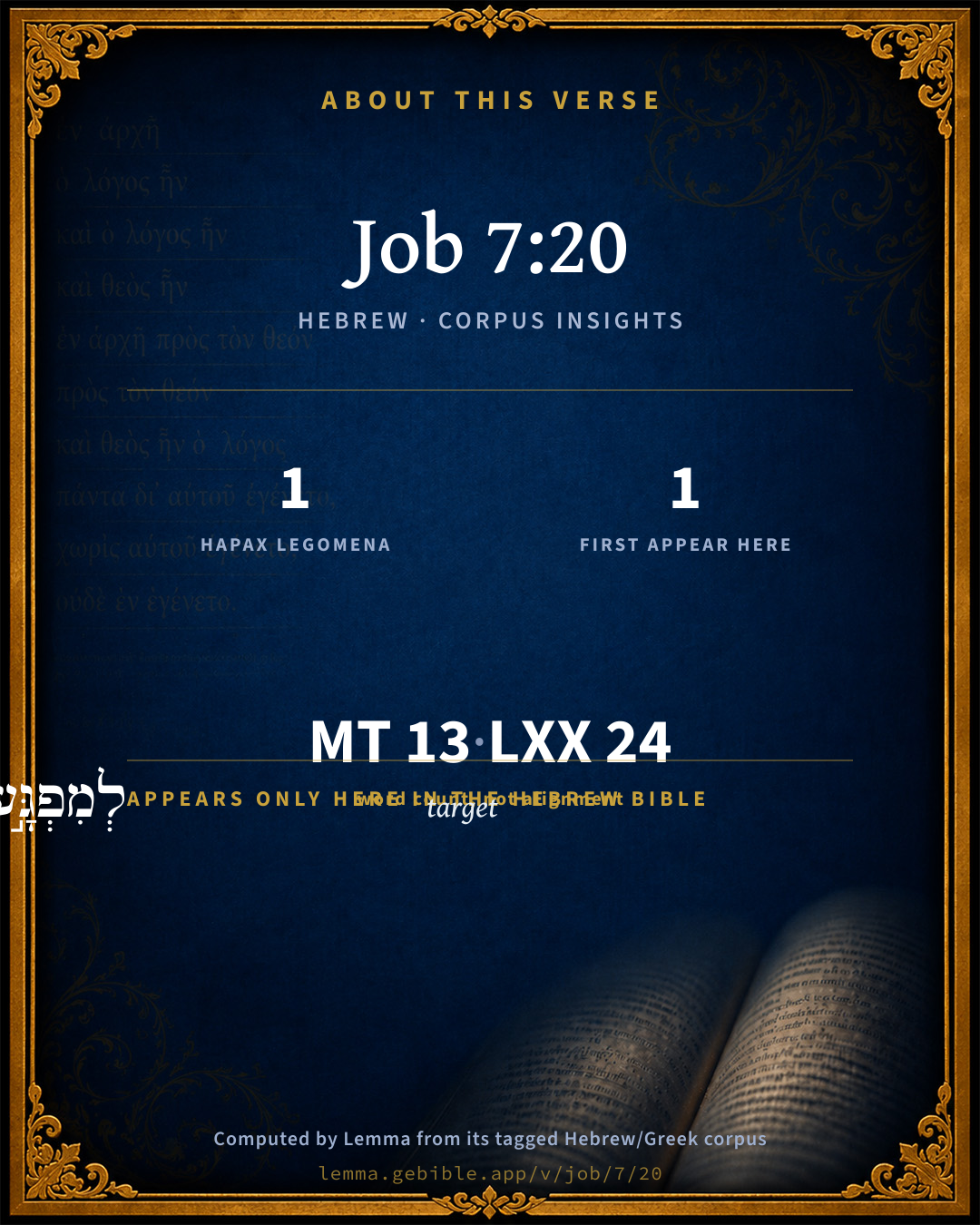
  • 1 hapax legomenon — only here in the Hebrew Bible
  • 1 first appearance in the Hebrew Bible
Full analysis ↓
Download a study sheet

One document with this verse’s original text, its word-by-word gloss line, the meaning frame, cross-references with their text, attributed commentary, and full source and license credits — printable, and it pastes into notes with its structure intact.

This verse Autodidact and up

Study sheet (.html) Plain text (.txt)

A passage Seminary Student

Up to 50 verses in one chapter. A passage sheet keeps up to 6 commentary sources and 12 cross-references per verse, in the order this page ranks them, and says so on the sheet whenever that leaves anything out. Ask for a single verse and you get the Autodidact verse sheet above.

Everything on this page stays free to read, with no account — the sheet is a download of what is already on screen, not access to it.

Want to remove ads? Support Godless Engineer
Compare translations 3

The same verse in 3 English versions, stacked beneath the original-language interlinear above. Click any original word for its lexicon entry.

Each is an independent rendering of the whole verse — the interlinear is not word-aligned to these translations.

Highlighted words mark where these versions differ — a whole-verse word diff, not a word-by-word alignment.

  • World English Bible Public Domain
    If I have sinned, what do I do to you, you watcher of men? Why have you set me as a mark for you, So that I am a burden to myself?
  • King James Version Public Domain
    I have sinned; what shall I do unto thee, O thou preserver of men? why hast thou set me as a mark against thee, so that I am a burden to myself?
  • unfoldingWord Literal Text CC BY-SA 4.0
    I have sinned, what have I done to you, the one watching man? Why have you made me a target for you? Indeed, am I a burden to myself?

unfoldingWord Literal Text — © unfoldingWord, licensed CC BY-SA 4.0. Word-aligned USFM3 via Door43 (git.door43.org/unfoldingWord/en_ult).

Versions to compare (up to 4)

3 of 4 selected

Show all 18 translations

Every available English version of this verse, each an independent rendering of the whole verse.

  • World English Bible Public Domain
    If I have sinned, what do I do to you, you watcher of men? Why have you set me as a mark for you, So that I am a burden to myself?
  • Berean Standard Bible Public Domain
    If I have sinned, what have I done to You, O watcher of mankind? Why have You made me Your target, so that I am a burden to You?
  • Majority Standard Bible Public Domain
    If I have sinned, what have I done to You, O watcher of mankind? Why have You made me Your target, so that I am a burden to You?
  • King James Version Public Domain
    I have sinned; what shall I do unto thee, O thou preserver of men? why hast thou set me as a mark against thee, so that I am a burden to myself?
  • American Standard Version (1901) Public Domain
    If I have sinned, what do I unto thee, O thou watcher of men? Why hast thou set me as a mark for thee, So that I am a burden to myself?
  • Revised Version (1885) Public Domain
    If I have sinned, what do I unto thee, O thou watcher of men? why hast thou set me as a mark for thee, so that I am a burden to myself?
  • Geneva Bible (1599) Public Domain
    I haue sinned, what shall I do vnto thee? O thou preseruer of me, why hast thou set me as a marke against thee, so that I am a burden vnto my selfe?
  • Douay-Rheims (1899) Public Domain
    I have sinned: what shall I do to thee, O keeper of men? why hast thou set me opposite to thee, and I am become burdensome to myself?
  • Young's Literal Translation Public Domain
    I have sinned, what do I to Thee, O watcher of man? Why hast Thou set me for a mark to Thee, And I am for a burden to myself -- and what?
  • Literal Standard Version CC BY-SA 4.0
    I have sinned, what do I do to You, || O watcher of man? Why have You set me for a mark to You, || And I am for a burden to myself—and what?
  • Unlocked Literal Bible CC BY-SA 4.0
    Even if I have sinned, what would that do to you, you who watch men? Why have you made a target of me, so that I am a burden for you?
  • unfoldingWord Literal Text CC BY-SA 4.0
    I have sinned, what have I done to you, the one watching man? Why have you made me a target for you? Indeed, am I a burden to myself?
  • Darby Bible Public Domain
    Have I sinned, what do I unto thee, thou Observer of men? Why hast thou set me as an object of assault for thee, so that I am become a burden to myself?
  • World Messianic Bible Public Domain
    If I have sinned, what do I do to you, you watcher of men? Why have you set me as a mark for you, so that I am a burden to myself?
  • Webster's Bible Public Domain
    I have sinned; what shall I do to thee, O thou preserver of men? why hast thou set me as a mark against thee, so that I am a burden to myself?
  • Free Bible Version CC BY-SA 4.0
    What have I done wrong? What have I done to you, Watcher of Humanity? Why have you made me your target, so that I'm a burden even to myself?
  • Bible in Basic English Public Domain
    If I have done wrong, what have I done to you, O keeper of men? why have you made me a mark for your blows, so that I am a weariness to myself?
  • JPS Tanakh (1917) Public Domain
    If I have sinned, what do I unto Thee, O Thou watcher of men? Why hast Thou set me as a mark for Thee, so that I am a burden to myself?

Literal Standard Version (2020), Covenant Press — licensed CC BY-SA 4.0. Text via the HelloAO Bible API (eBible.org). Unlocked Literal Bible (unfoldingWord) — licensed CC BY-SA 4.0. Text via the HelloAO Bible API (eBible.org). unfoldingWord Literal Text — © unfoldingWord, licensed CC BY-SA 4.0. Word-aligned USFM3 via Door43 (git.door43.org/unfoldingWord/en_ult). Free Bible Version, Dr. Jonathan Gallagher — licensed CC BY-SA 4.0. Text via the HelloAO Bible API (eBible.org).

Word by word

More ways to search: Search by grammar → Find every occurrence → Compare this word →

Practice this passage: Drill this verse → Learn its vocabulary →

לְמִפְגָּ֣ע
miphgâʻ
H4645
“to/for · target”
Preposition + Noun, Common, Masculine, Singular, Absolute
Part of Speech
Preposition + Noun
Type
Common
Gender
Masculine
Number
Singular
State
Absolute
Full BDB Definition

Origin: from H6293

TWOT: 1731b

thing hit, mark, target, object of assault
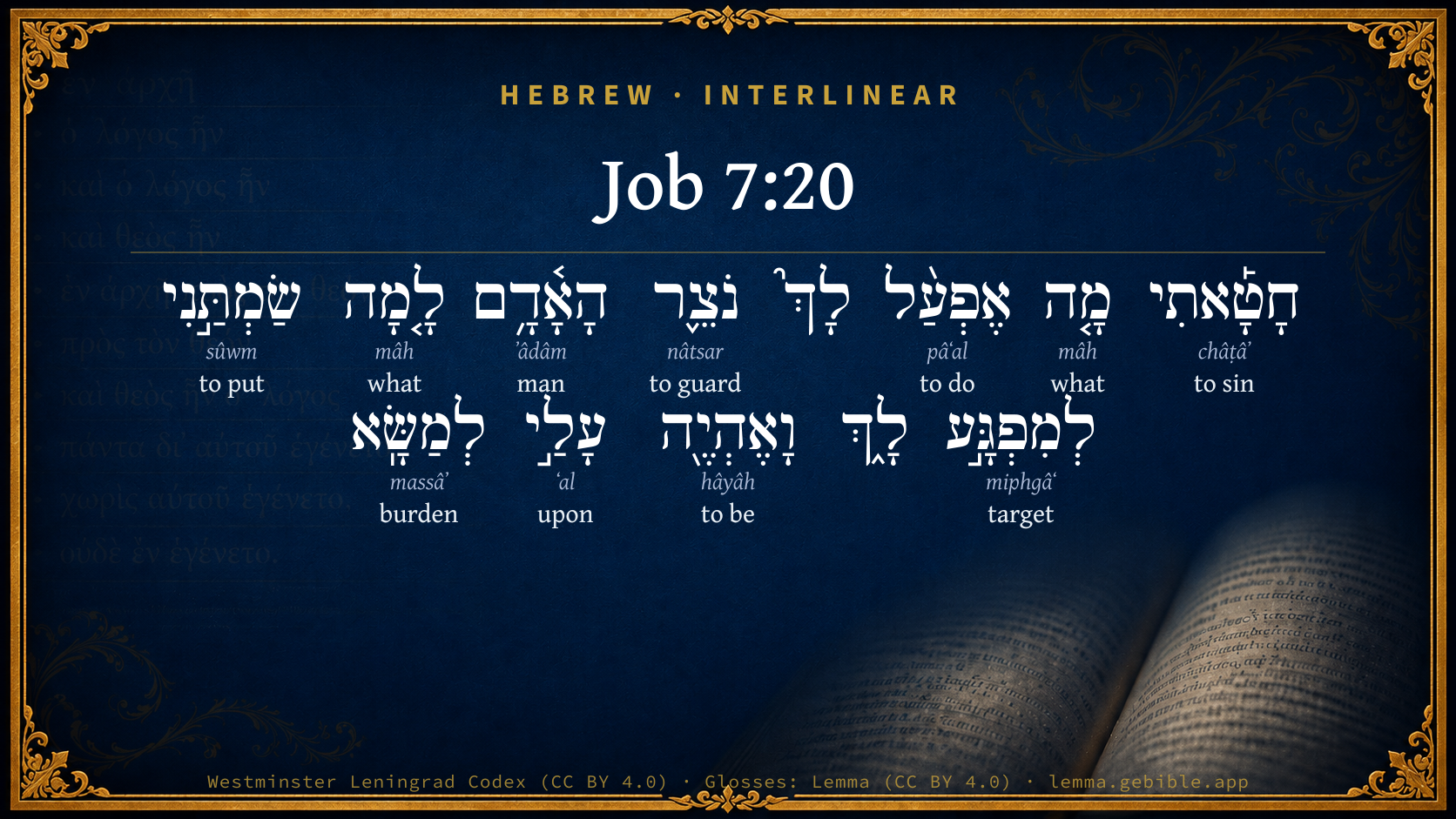
  1. חָטָ֡אתִי châṭâʼ H2398 “to sin” Verb, Qal, Perfect, 1st Person, Common, Singular
  2. מָ֤ה mâh H4100 “what” Particle, Interrogative
  3. אֶפְעַ֨ל pâʻal H6466 “to do” Verb, Qal, Imperfect, 1st Person, Common, Singular
  4. נֹצֵ֪ר nâtsar H5341 “guarding” Verb, Qal, Participle Active, Masculine, Singular, Construct
  5. הָאָ֫דָ֥ם ʼâdâm H120 “the · man” Particle, Definite Article + Noun, Common, Masculine, Singular, Absolute
  6. לָ֤מָה mâh H4100 “to/for · what” Preposition + Particle, Interrogative
  7. שַׂמְתַּ֣נִי sûwm H7760 “to put · me” Verb, Qal, Perfect, 2nd Person, Masculine, Singular + Suffix, Personal, 1st Person, Common, Singular
  8. וָאֶהְיֶ֖ה hâyâh H1961 “and · to be” Conjunction + Verb, Qal, Sequential Imperfect, 1st Person, Common, Singular
  9. עָלַ֣י ʻal H5921 “upon · me” Preposition + Suffix, Personal, 1st Person, Common, Singular
  10. לְמַשָּֽׂא massâʼ H4853 “to/for · burden” Preposition + Noun, Common, Masculine, Singular, Absolute

About this verse

These counts appear in no published source. They are computed here, from the morphology-tagged text and Lemma’s own curated glosses. What Lemma adds →

13
words
10
distinct lemmas
Wisdom
section

Notable vocabulary

1 hapax legomenon — a word that appears only here in the entire Hebrew Bible:

  • לְמִפְגָּ֣ע target H4645

First appearance in Scripture

This word makes its first canonical appearance in the Hebrew Bible here:

  • לְמִפְגָּ֣ע target H4645

Shared distinctive vocabulary

אֶפְעַ֨ל to do H6466 occurs in 55 verses of the Hebrew Bible. Also found in:

Grammatical profile

  • 5 verbs
  • 3 nouns
  • 3 prepositions
  • 2 particles

Verb forms

  • חָטָ֡אתִי Qal · Perfect
  • אֶפְעַ֨ל Qal · Imperfect
  • נֹצֵ֪ר Qal · Participle Active
  • שַׂמְתַּ֣נִי Qal · Perfect
  • וָאֶהְיֶ֖ה Qal · Sequential Imperfect

Repetition

A word recurs within this verse — often emphatic in Hebrew:

  • מָ֤ה what H4100 ×2

Hebrew & Septuagint length

In English translation the verse runs 32 words from the Hebrew and 35 from the Septuagint (LXX English) — closely comparable.

A rough comparison of the two English renderings, which tokenize alike — not a word-level alignment.

Word counts can differ between the Hebrew and the Greek without any difference in meaning — e.g. the Hebrew direct-object marker אֵת has no separate Greek word, and Greek often adds the article ὁ.

In the original languages it is 13 Hebrew tokens and 24 Greek tokens — but the two are counted differently (Hebrew bundles its prefixes and suffixes into one token; the Greek is in lemma form), so that isn’t a like-for-like length.

Cross-references

17

Topical passages linked to Job 7:20 in the Treasury of Scripture Knowledge — connected by theme and wording, ordered by reader-vote popularity; previews shown in the World English Bible.

  • Lamentations 3:12 He has bent his bow, and set me as a mark for the arrow.
  • Job 3:24 For my sighing comes before I eat, My groanings are poured out like water.
  • Job 7:11–12 "Therefore I will not keep silent. I will speak in the anguish of my spirit. I will complain in the bitterness of my soul.
  • Psalms 36:6 Your righteousness is like the mountains of God. Your judgments are like a great deep. Yahweh, you preserve man and animal.
  • Nehemiah 9:6 You are Yahweh, even you alone; you have made heaven, the heaven of heavens, with all their host, the earth and all things that are thereon, the seas and all that is in them, and you preserve them all; and the host of heaven worships you.
  • Job 6:4 For the arrows of the Almighty are within me, My spirit drinks up their poison. The terrors of God set themselves in array against me.
  • Job 9:29–31 I shall be condemned; Why then do I labor in vain?
  • Job 13:26 For you write bitter things against me, And make me inherit the iniquities of my youth:
  • Job 14:16 But now you number my steps. Don't you watch over my sin?
  • Job 16:12–14 I was at ease, and he broke me apart. Yes, he has taken me by the neck, and dashed me to pieces. He has also set me up for his target.
  • Job 22:5 Isn't your wickedness great? Neither is there any end to your iniquities.
  • Job 31:33 If like Adam I have covered my transgressions, By hiding my iniquity in my heart,
  • Job 33:9 'I am clean, without disobedience. I am innocent, neither is there iniquity in me:
  • Job 33:27 He sings before men, and says, 'I have sinned, and perverted that which was right, And it didn't profit me.
  • Job 35:6 If you have sinned, what effect do you have against him? If your transgressions are multiplied, what do you do to him?
  • Psalms 21:12 For you will make them turn their back, When you aim drawn bows at their face.
  • Psalms 80:4 Yahweh God of hosts, How long will you be angry against the prayer of your people?

Cross-references courtesy of OpenBible.info (CC BY 4.0).

Hebrew and Greek witnesses Masoretic Hebrew ↔ Greek Septuagint

The same verse in the two great witnesses to the Old Testament, shown verse-for-verse.

These are two independent witnesses, not word-aligned to each other, and the Septuagint is shown in lemma (dictionary) form.

Hebrew Job 7:20 Masoretic · Westminster Leningrad Codex

חָטָ֡אתִי מָ֤ה אֶפְעַ֨ל לָךְ֮ נֹצֵ֪ר הָאָ֫דָ֥ם לָ֤מָה שַׂמְתַּ֣נִי לְמִפְגָּ֣ע לָ֑ךְ וָאֶהְיֶ֖ה עָלַ֣י לְמַשָּֽׂא

If I have sinned, what do I do to you, you watcher of men? Why have you set me as a mark for you, So that I am a burden to myself?

World English Bible · Public Domain

Greek LXX Job 7:20 Septuagint · lemma form

εἰ ἐγώ ἁμαρτάνω τίς δύναμαι σύ πράσσω ὁ ἐπιἵστημι ὁ νοῦς ὁ ἄνθρωπος διά τίς τίθημι ἐγώ κατεντευκτής σύ εἰμί δέ ἐπί σύ φορτίον

If I have sinned, what shall I be able to do, O you that understand the mind of men? why have you made me as your accuser, and why am I a burden to you?

LXX2012 (modern English Septuagint) · Public Domain

On this verse, Adam Clarke's Commentary discusses the Septuagint’s reading. Read the note in Commentary ↓

Hebrew: Westminster Leningrad Codex (CC BY 4.0). Greek: Septuagint (public domain); English from LXX2012 (modern English Septuagint) (Public Domain). How the Septuagint differs from the Hebrew →

Commentary

Notes on Job 7:20 from classic Christian and Jewish commentators (each source and its license shown beneath its notes). The classic Christian expositions comment on the surrounding passage and are grouped to its opening verse, so a note may address several verses; the Jewish commentaries on the Tanakh (Rashi and others) are per-verse, so they appear only where the commentator wrote on this verse.

Lemma curates 59 commentaries, every one of them public domain or Creative Commons licensed, each selected and text-cleaned for this edition rather than reprinted as found. About our sources →

Adam Clarke's Commentary

Verse 20. I have sinned; what shall I do] Dr. Kennicott contends that these words are spoken to Eliphaz, and not to GOD, and would paraphrase them thus: "You say I must have been a sinner. What then? I have not sinned against thee, O thou spy upon mankind! Why hast thou set up me as a butt or mark to shoot at? Why am I become a burden unto thee? Why not rather overlook my transgression, and pass by mine iniquity? I am now sinking to the dust! To-morrow, perhaps, I shall be sought in vain!" See his vindication of Job at the end of these notes on this book. Others consider the address as made to God. Taken in this light, the sense is plain enough.

Those who suppose that the address is made to GOD, translate the 20th verse Job 7:20 thus: "Be it that I have sinned, what injury can I do unto thee, O thou Observer of man? Why hast thou set me up as a mark for thee, and why am I made a burden to thee?" The Septuagint is thus: Ει εγω ἡμαρτον, τι δυνησομαι πραξαι, ὁ επισταμενος τον νουν των ανθρωπων; If I have sinned, what can I do, O thou who knowest the mind of men? Thou knowest that it is impossible for me to make any restitution. I cannot blot out my offenses; but whether I have sinned so as to bring all these calamities upon me, thou knowest, who searchest the hearts of men.

Adam Clarke's Commentary on the Bible (1810–1826) — public domain. Text from a community e-Sword/MySword module.

Trapp's Complete Commentary

John Trapp

Job 7:20 I have sinned; what shall I do unto thee, O thou preserver of men? why hast thou set me as a mark against thee, so that I am a burden to myself?

Ver. 20. I have sinned] Or, Have I sinned? Have I fallen into any foul offence, as these men charge me? Am I guilty of anything more than involuntary failings, unavoidable infirmities? although I know that these also are downright sins, fruits of the flesh properly so called, missings of the mark, as the word here signifieth, and for such I humbly confess them, I put myself into the hands of thy justice in hope of thy mercy; and what wilt thou more of thy poor creature?

What shall I do unto thee] No sooner had Job confessed his sin, but he is desirous to know a remedy. Reprobates can cry Peccavi, I have sinned; but then they proceed not to say, as here, What shall I do? They open their wound, but lay not on a plaster, and so the wounds made by sin are more putrefied, and grow more dangerous. Job would be directed what to do for remedy; he would have pardoning grace and prevailing grace upon any terms; and more than this, what can I do unto thee? δυνησομαι πραξαι, as the Septuagint render this text.

O thou preserver of men?] Of all men, but especially of them that believe, 1Ti 4:10. The Grecians called their Jupiter ελευθεριος, the deliverer or preserver of their persons; and again, ερκειος, from ερκος, a wall, as if he were the watch and defender of their houses. Some render it, O thou observer of men. But these are praises proper to the true God, the keeper of his Israel, Psa 121:4. The preserver of the faithful, Psa 31:23. Whom he keepeth as the apple of his eye, Psa 17:8, that tenderest piece of the tenderest part, most diligently and strongly guarded by nature with tunicles. It is the wisdom of a Christian in his addresses unto God to make choice of fit and appropiate titles and attributes; for the strengthening of his faith, and increasing of his fervency.

Why hast thou set me as a mark against thee] As a bulwark, as an object, or as a rock of offence, against which thou mayest always dash; so Vatablus rendereth it; to the same sense Job asketh, Job 19:11; Job 13:24. Wherefore holdest thou me for thine enemy? So Lam 3:12 Job 16:13. Job conceived that God dealt with him in no other way than the Turks did with the great crucifix of Constantinople, upon the head whereof they put a Turk’s cap, and so setting it up in derision, shot at it with their arrows, calling it the God of the Christians: or, as the same Turks at the taking of Tripoli, in Barbary, dealt with one John de Chabas, a Frenchman, who in the time of the siege had shot off the hand of the clerk general of the army. They brought him into the town, saith the story, and when they had cut off his hands and nose, they put him quick into the ground to the waist, and there for their pleasure shot at him with their arrows, and afterwards cut his throat.

So that I am a burden to myself?] How can he be otherwise who is a butt mark for Almighty God, who cleft his very reins asunder, and poured out his gall upon the ground, Job 16:13. Job had once before complained that the poison of God’s arrows had drunk up his spirits, Job 6:4 Neither did anything lie so heavy upon him, or was so burdensome to him, as this, that God seemed to frown upon him, and to fight against him with his own hand. The Septuagint and Talmudists read thus, So that I am a burden unto thee, viz. with my complaints and expostulations; this, say they, was the ancient reading.

John Trapp, A Commentary or Exposition upon All the Books of the Old and New Testament (1647–1656) — public domain. Text from a community e-Sword module.

The Biblical Illustrator

Joseph S. Exell

Job_7:20

I have sinned; what shall I do unto Thee, O Thou Preserver of men!

The sinners surrender to his Preserver

I.

A confession. I have sinned. In words this is no more than a hypocrite, nay, a Judas, might say. Do not many call themselves miserable sinners who are indeed despicable mockers? Yet seeing Jobs heart was right his confession was accepted.

1. It was very brief, but yet very full. It was more full in its generality than if he had descended to particulars. We may use it as a summary of our life. I have sinned. What else is certain in my whole career? This is most sure and undeniable.

2. It was personal. I have sinned, whatever others may have done.

3. It was to the Lord. He addresses the confession not to his fellow men but to the Preserver of men.

4. It was a confession wrought by the Spirit. See verse 18, where he ascribes his grief to the visitation of God.

5. It was sincere. No complimentary talk, or matter of ritualistic form, or passing acknowledgment. His heart cried, I have sinned, and he meant it.

6. It was feeling. He was cut to the quick by it. Read the whole chapter. This one fact, I have sinned, is enough to brand the soul with the mark of Cain, and burn it with the flames of hell.

7. It was a believing confession. Mingled with much unbelief, Job still had faith in Gods power to pardon. An unbelieving confession may increase sin.

II. An inquiry. What shall I do unto Thee? In this question we see--

1. His willingness to do anything, whatever the Lord might demand, thus proving his earnestness.

2. His bewilderment: he could not tell what to offer, or where to turn; yet something must be done.

3. His surrender at discretion. He makes no conditions, he only begs to know the Lords terms.

4. The inquiry may be answered negatively. What can I do to escape Thee? Thou art all around me. Can past obedience atone? Alas! as I look back I am unable to find anything in my life but sin. Can I bring a sacrifice? Would grief, fasting, long prayers, ceremonies, or self-denial avail? I know they would not.

5. It may be answered evangelically. Confess the sin. Renounce it. Obey the message of peace: believe in the Lord Jesus, and live.

III. A title. O Thou Preserver of men! Observer of men, therefore aware of my case, my misery, my confession, my desire for pardon, my utter helplessness. Preserver of men. By His infinite long-suffering refraining from punishment. By daily bounties of supply keeping the ungrateful alive. By the plan of salvation delivering men from going down to the pit. By daily grace preventing the backsliding and apostasy of believers. Address upon the point in hand--

1. The impenitent, urging them to confession.

2. The unconcerned, moving them to inquire, What must I do to be saved?

3. The ungrateful, exhibiting the preserving goodness of God as a motive for love to Him. (C. H. Spurgeon.)

What to do in case of sin

1. What to do in case of sin is a point of the highest consideration.

2. Sincere confession of sin makes the soul very active and inquisitive about the remedies of sin.

3. A soul truly sensible of sin is ready to submit to any terms which God shall put upon him.

4. God is to be consulted and inquired after in all doubtful cases, especially in our sin cases. (J. Caryl.)

Complaining to God

It is his God whom the pious Job is thus apostrophising. I, the poor pismire in the dust, will my error or my wrong-doing affect Omnipotence? Ah! pardon my transgression, whatever it be, ere it be too late! A little while, and I shall lie down in the dust, and even Thy keen eye will look for me in vain. What are we to say to such language? It is a monotone that you will hardly find monotonous. Where is the patience, the submission, so calm, so dutiful, so beautiful of the Job whom we knew before? Is there a trace of it left? Surely from first to last we have not as yet one touch of such meek acquiescence in suffering, as we have seen, some of us, on beds of pain--such as we would pray earnestly to attain unto, in some measure, in our own hour of trial. We see nothing of the frame of mind in which a Moslem, whose very name implies submission, or a Stoic, a Marcus Aurelius, to say nothing of a Christian, would wish to meet the sharpest pang. We feel--do we not? that the very object of these wild cries is partly to intensify our sense of the woes that fell on Job, yet mainly to make us feel how boundless is his bewilderment at finding this terrible measure of suffering meted out as the seeming recompense for a life of innocence. And yet we are intended to feel with him. Admirable, pious, well-intentioned as are the words of Eliphaz, they seem to belong to another spiritual world than that of Jobs cries. We cannot but feel the sharp contrast between them, and you will feel with me that some great question must be at stake, some vital problem stirring in the air, or we should not be called on to listen, on the one hand, to the calm, well-rounded, unimpeachable teaching of Eliphaz, and, on the other, to the bitter, impassioned complaints, the almost rebellious cries of one whose praise is in all the Churches. This, then, is the one question which will be pressed on us more and more as we read the book, How is it that the saint, the saintly hero, who stands in the forefront of the drama, uses language which we dare not use, which we would pray to be preserved from using in our bitterest hour of suffering. How is it that, thus far at least, the foremost of his opponents speaks nothing which is not to be found on the lips of psalmist or prophet, little that is not worthy of lips which have been touched by a still higher teaching? How is it that, for all this, we shall, as we know, in due time have the highest of all authorities for holding that he and they, in their insight into the highest truths, fall below the Job whom they rebuke, and whom we ourselves cannot but reprove? Surely, so far, the great Judge of this debate must be listening with full approval to the good Eliphaz; with stern, if pitiful displeasure to the wild cries of Job. (Dean Bradley.)

The Biblical Illustrator, edited by Joseph S. Exell (c. 1880s–1900s) — public domain. Text from a community e-Sword module.

Joseph Benson's Commentary

Job 7:20. I have sinned — Although I am free from those crying sins for which my friends suppose thou hast sent this uncommon judgment upon me; yet I freely confess that I am a sinner, and therefore obnoxious to thy justice. And what shall I do unto thee? — To satisfy thy justice, or regain thy favour. I can do nothing to purchase or deserve it, and therefore implore thy mercy to pardon my sins; O thou Preserver of men — O thou, who, as thou wast the Creator of man, delightest to be, and to be called, the Preserver and Saviour of men; and who waitest to be kind and gracious to men, from day to day: do not deal with me in a way contrary to thy own nature and name, and to the manner of thy dealing with all the rest of mankind. As Job had expressed himself before as if he thought he was treated with severity, Schultens chooses to render נצר, notzer, observer, rather than preserver. This indeed seems to be more agreeable to the context, which intimates that the eye of God was upon Job to observe and watch him as an offender; and this construction may be justified from Jer 4:16, where the same word, in the plural number, is rendered watchers. According to this translation the meaning is, O thou observer of men, who dost exactly know and diligently observe all men’s inward motions and outward actions; if thou shalt be severe to mark mine iniquities, as thou seemest to be, I have not what to say or do unto thee. Why hast thou set me as a mark, &c. — Into which thou wilt shoot all the arrows of thy indignation? So that I am a burden to myself — I am weary of myself and of my life, being no way able to resist or endure the strokes of so potent an adversary.

Joseph Benson's Commentary on the Old and New Testaments (1811–1818) — public domain. Text from a community e-Sword module.

Tyndale Open Study Notes

Tyndale Open Resources

7:20 watcher of all humanity: Rather than praising God for his goodness expressed in watchfulness (Deut 32:10; Ps 25:21; Prov 24:12), Job blamed God for hostile surveillance, which actually characterizes Satan’s activity (Job 1:7). • Why is from the language of lament (see study note on 3:11-24). • your target: See 6:4; Lam 3:12.

Tyndale Open Study Notes — © Tyndale Open Resources, licensed CC BY-SA 4.0. Text via the HelloAO Bible API.

Geneva Bible (1599)

Geneva Bible translators

After all tentations faith bursteth forth and leadeth Job to repentance: yet it was not in such perfection, that he could bridle himself from reasoning with God, because that he still tried his faith.

Geneva Bible (1599) marginal notes — public domain. Text via Bolls.life.

Jamieson, Fausset & Brown

Robert Jamieson, A. R. Fausset & David Brown

I have sinned--Yet what sin can I do against ("to," Job 35:6) thee (of such a nature that thou shouldst jealously watch and deprive me of all strength, as if thou didst fear me)? Yet thou art one who hast men ever in view, ever watchest them--O thou Watcher (Job 7:12; Dan 9:14) of men. Job had borne with patience his trials, as sent by God (Job 1:21; Job 2:10); only his reason cannot reconcile the ceaseless continuance of his mental and bodily pains with his ideas of the divine nature.

set me as a mark--Wherefore dost thou make me thy point of attack? that is, ever assail me with new pains? [UMBREIT] (Lam 3:12).

Jamieson, Fausset & Brown — Commentary Critical and Explanatory on the Whole Bible (1871) — public domain (CC PDM 1.0). Text via the HelloAO Bible API.

Ellicott's Commentary for English Readers

(20) I have sinned—i.e., “Putting the case that I have sinned, yet what then can I do unto Thee, O thou keeper of men? “with a possible allusion to Job_7:12, though the verb is not the same.

O thou preserver of men.—“Why hast Thou set me as a mark for Thee to expend all Thine arrows upon?” or, “Why hast Thou made me to be Thy stumbling-block, so that Thou ever comest into collision against me, so that I am become a burden to myself?”

A Bible Commentary for English Readers, edited by Charles John Ellicott (1878–1897) — public domain. Text from a community e-Sword module.

The Cambridge Bible for Schools and Colleges

gen. ed. J. J. S. Perowne

20. The first half of the verse reads,

Have I sinned: what do I unto thee, O thou watcher of men?

I have sinned] Rather as above, have I sinned; the words being put as a supposition, equivalent to, if I have sinned. Job makes the supposition, he hardly concedes the fact, which is not meantime the point. His object is to pursue the idea that even sin (supposing it) on man’s part cannot affect God, and ought not to be the reason for such unsparing pains as man has to suffer. In ch. Job_14:3-4, where Job is calmer and more self-possessed, the same argument occurs, but is there supported by a reference to the universal sinfulness of mankind, which descends to the individual by inheritance and makes him more excusable and pitiable. Here the moral relations of men and God are less before his mind, it is God’s natural Greatness in contrast with the natural littleness of man that engages his attention, and he thinks that in this there is a reason why men even if sinful should be less severely reckoned with.

what shall I do unto thee?] Rather, what do I unto thee? that is, how do I affect thee by my sin? The idea is repeatedly expressed in the Poem that God is too high to be affected by men’s actions, whether sinful or righteous, cf. ch. Job_22:2 seq., Job_35:5 seq.

thou preserver of men] Rather, thou watcher, or keeper, of men. “Watcher” or keeper, elsewhere a word of comfort to the godly (Deu_32:10; Psa_31:23; Psa_121:4), is here used in an invidious sense to express the constant espionage exercised by God over men, that He may detect their sin and bring them to a reckoning, cf. ch. Job_13:27, Job_14:16.

a mark against thee] lit. unto thee. The word mark here does not mean a target at which to discharge arrows (ch. Job_6:4, Job_16:4), but a stumbling-block or obstacle against which one strikes. Job feels that he is continually in the way of God, an obstacle against which the Almighty is always of set purpose striking Himself. The thought is one of unprecedented boldness.

am a burden to myself] Or, am become a burden, &c., that is, weary of myself and of my life, cf. 2Sa_15:33. The Septuagint seems to have read, “a burden unto thee”; and according to Jewish tradition this was the original reading, but was corrected by the scribes as savouring of impiety.

20, 21. Third, Job makes the supposition that he has sinned, and asks, how such a thing can affect God? and, why He does not take away his sin instead of plaguing him unto death because of it?

The Cambridge Bible for Schools and Colleges (gen. ed. J. J. S. Perowne; Cambridge University Press, 1878–1918) — public domain. Text from a community e-Sword module.

John Gill's Exposition

I have sinned,.... Some render it, "if I have sinned" (w); be it so that I have, as my friends say, yet since there is forgiveness with thee, why should I be so afflicted as I am? but there is no need of such a supplement, the words are an affirmation, I have sinned, or I am a sinner; not that he owned that he had been guilty of any notorious sin, or had lived a sinful course of life, on account of which his afflictions came upon him, as his friends suggested; but that he was not without sin, was daily guilty of it, as men, even the best of men, ordinarily are; and being a sinner was not a match for a holy God; he could not contend with him, nor answer him for one sin of a thousand committed by him in thought, word, or deed; and therefore desires him to desist and depart from him, see Luk 5:8,

what shall I do unto thee? this he said, not as one in distress of mind on account of sin, and under the load of the guilt of it, inquiring what he must do to make satisfaction for it, how and what way he could be saved from it; for he knew that nothing done by him in a ceremonial way by sacrifices, nor in a moral way by the performance of duties, could take away sin, or atone for it, or save him from it; he knew this was only by his living Redeemer, and whom he knew and determined should be his salvation, and he only; see Job 9:30; but rather as it may be rendered, "what can or ought I do unto thee?" (x) that is, more than I have done, namely, to confess my sin unto thee; what more dost thou require of me? or what more can be done by me, than to repent of my sin, acknowledge it, and beg pardon for it? as he does in Job 7:21, or "what can I do unto thee?" thou art all over match for me, I cannot struggle and contend with thee, a sinful man with an holy God:

O thou preserver of men? as he is in a providential way, the supporter of men in their lives and beings; or, "O thou keeper of men" (y), as he is, not only of Israel, but of all others, and that night and day; perhaps Job may refer to his setting and keeping a watch over him, Job 7:12; and enclosing and hedging him all around with afflictions, so that he could not get out of the world as he desired; or, "O thou observer of men" (z), of their words, ways, works, and actions, and who kept such a strict eye upon him while wrestling with him, and therefore what could he do? or, "O thou Saviour of men" (a), by whom only I can be saved from the sins I have been and am daily guilty of:

why hast thou set me as a mark against thee? as a butt to shoot thine arrows at, one affliction after another, thick and fast, see Job 16:12 Lam 3:12; the words I think may be rendered, "why hast thou appointed me to meet thee", or "for a meeting with thee?" (b) as one man challenge, another to meet him in such a place and fight him: alas! I am not equal to thee, I am a mere worm, not able to contend with thee the mighty God, or to meet thee in the way of thy judgments, and to endure the heavy strokes of thy angry hand; and so Bar Tzemach paraphrases it,"thou hast hated me, and not loved me; that thou hast set, or appointed me to meet thee, as a man meets his enemy in the time of his wrath, and he stirs up against him all his fury:''and to the same sense, and much in the same words, Jarchi interprets it:

so that I am a burden to myself? weary of his life, through the many pressing and heavy afflictions upon him, as Rebekah was of hers, because of the daughters of Heth, Gen 27:46. The reading which we follow, and is followed by the Targum, and by most interpreters, Jewish and Christian, is a correction of the scribes, and one of the eighteen places corrected by them; which is no argument of the corruption of the Hebrew text, but of the contrary; since this was only placed in the margin of the Bible, as the Masorites afterwards did with their various readings, showing only what was their sense of this, and the like passages; and as an instruction how in their opinion to understand them, still retaining the other reading or writing; and which, according to Aben Ezra, may be rightly interpreted, and is, "so that I am a burden to thee" (c); and which is followed by some, signifying, as Job thought at least, that he was so offensive to him that he could not bear him, but treated him as an enemy; was weary of him, as God is said to be of sinners and their sins, and of the services and duties of carnal professors, see Isa 1:14; so Abendana interprets it,"thou hast set me for a mark unto thee, as if I was a burden to thee.''

(w) Vatablus, Drusius, Schmidt; so Sept. Syr. & Ar. (x) "quid faciam aut facere possum tibi", Michaelis; "debeam", Schmidt. (y) "custos hominum". V. L. Pagninus, Junius & Tremellius, Piscator, Mercerus. (z) "Observator", Schultens. (a) "Sospitatur", Codurcus; "servator", Drusius, Schmidt, Michaelis. Vid. Witsii Oeconom. Foeder. l. 4. c. 3. sect. 30. (b) "in occursum tibi", Pagninus, Montanus, Mercerus, Drusius. (c) , Sept. "et tibi", Beza, Grotius.

John Gill's Exposition of the Whole Bible (1746–1763) — public domain (CC PDM 1.0). Text via the HelloAO Bible API.

Albert Barnes' Notes on the Bible

I have sinned - חטאתי châṭâ'tı̂y. This is a literal translation, and as it stands in the common version it is the language of a penitent - confessing that he had erred, and making humble acknowledgment of his sins. That such a confession became Job, and that he would be willing to admit that he was a sinner, there can be no doubt; but the connection seems rather to require a different sense - a sense implying that though he had sinned, yet his offences could not be such as to require the notice which God had taken of them. Accordingly this interpretation has been adopted by many, and the Hebrew will bear the construction. It may be rendered as a question, “Have I sinned; what did I against thee” Herder. Or, the sense may be, “I have sinned. I admit it. Let this be conceded. But what can that be to a being like God, that he should take such notice of it? Have I injured him? Have I deserved these heavy trials? Is it proper that he should make me a special mark, and direct his severest judgments against me in this manner?” compare the notes at –Job 35:6-8. The Syriac renders it in this manner, “If I have sinned, what have I done to thee?” So the Arabic, according to Walton. So the Septuagint, Εἰ ἐγὼ ἥμαρτον Ei egō hēmarton - “if I have sinned.” This expresses the true sense. The object is not so much to make a penitent confession, as it is to say, that on the worst construction of the case, on the admission of the truth of the charge, he had not deserved the severe inflictions which he had received at the hand of God.

What shall I do unto thee? - Or, rather, what have I done unto thee? How can my conduct seriously affect thee? It will not mar thy happiness, affect thy peace, or in any way injure a being so great as God. This sentiment is often felt by people - but not often so honestly expressed.

O thou Preserver of men - Or, rather, “O thou that dost watch or observe men.” The word rendered “Preserver” נצר notsēr is a participle from נצר nâtsar which means, according to Gesenius, to watch, to guard, to keep, and is used here in the sense of observing one’s faults; and the idea of Job is, that God closely observed the conduct of people; that he strictly marked their faults, and severely punished them; and he asks with impatience, and evidently with improper feeling, why he thus closely watched people. So it is understood by Schultens, Rosenmuller, Dr. Good, Noyes, Herder, Kennicott, and others. The Septuagint renders it, “who knowest the mind of men?”

Why hast thou set me as a mark? - The word rendered “mark” מפגע mı̂phgâ‛, means properly that which one impinges against - from פגע pâga‛, to impinge against, to meet, to rush upon anyone - and here means, why has God made me such an object of attack or assault? The Septuagint renders it, κατεντευκτήν σου katenteuktēn sou, “an accuser of thee.”

So that I am a burden to myself - The Septuagint renders this, ἐπὶ σοὶ φορτίον epi soi phortion, a burden to thee. The copy from which they translated evidently had עליך ‛alēykā - to thee, instead of עלי ‛ālay - to me, as it is now read in the Hebrew. “The Masoretes also place this among the eighteen passages which they say were altered by transcribers.” Noyes. But the Received Text is sustained by all the versions except the Septuagint and by all the Hebrew manuscripts hitherto examined, and is doubtless the true reading. The sense is plain, that life had become a burden to Job. He says that God had made him the special object of his displeasure, and that his condition was insupportable. That there is much in this language which is irreverent and improper no one can doubt, and it is not possible wholly to vindicate it. Nor are we called to do it by any view which we have of the nature of inspiration. He was a good, but not a perfect man. These expressions are recorded, not for our imitation, but to show what human nature is. Before harshly condemning him, however, we should ask what we would be likely to do in his circumstances; we should remember also, that he had few of the truths and promises to support him which we have.

Albert Barnes' Notes on the Bible (1834–1885) — public domain. Text from a community e-Sword/MySword module.

Haydock's Catholic Bible Commentary

Sinned. I acknowledge my frailty. (Menochius) --- How may I obtain redress? (Calmet) --- Job’s friends maintained that he was guilty. But he does not acquiesce in their conclusion, that these sufferings were precisely in punishment of some crime, though he acknowledges that he is not without his faults. (Haydock) --- Shall. Hebrew also, "what have I done to thee?" I have only hurt myself. But this reasoning is nugatory. Though God loses nothing by our sins, they are not less offensive to him, as the rebel does his utmost to disturb the order which he has established. The sinner indeed resembles those brutal people, who hurl darts against the sun, which fall upon their own heads, chap. iii. 8. (Calmet) --- Opposite, as a butt to shoot at. (Haydock) --- Myself. Hebrew was formerly "to thee," till the Jews changed it, as less respectful. (Cajetan) --- Septuagint still read, "and why am I a burden to thee?" (Haydock) as I am under the necessity of complaining, in my own defence. (Calmet) --- I throw my grief upon the Lord, that He may support me, Psalm liv. 23., and 1 Peter v. 7. (Pineda)

George Leo Haydock (1774–1849), Haydock's Catholic Family Bible and Commentary, 1859 edition — public domain. Excludes Psalms (Douay-Rheims chapter numbering differs from Protestant) and Deuterocanonical books (Catholic canon only).

Matthew Poole's English Annotations

I have sinned: although I am innocent and free from those crying sins, for which my friends suppose thou hast sent this uncommon judgment upon me; yet if thou be strict to mark what is amiss, I freely confess that I am a sinner, and therefore obnoxious to thy justice, and I humbly beg thy pardon for it, as it follows, Job 3:21; and therefore accept of this confession.

What shall I do unto thee, to satisfy thy justice, or regain thy favour? I can do nothing to purchase or deserve it, and therefore implore thy mercy to pardon my sins. O thou preserver of men; O thou who, as thou wast the Creator of man, delightest to be, and to be called, the Preserver and Saviour of men; and that waitest to be kind and gracious to men from day to day, as occasion requires; do not deal with me in a way contrary to thy own nature and name, and to the manner of thy dealing with all the rest of mankind. Otherwise, O thou observer of men; thou who dost exactly know and diligently observe all men’s inward motions and outward actions; and therefore if thou shalt be severe to mark mine iniquities, as thou seemest to be, I have not what to say or do unto thee: compare Job 9:3,15,29; 14:4.

As a mark against thee; into which thou wilt shoot all the arrows of thy indignation.

I am a burden to myself, i.e. I am weary of myself, and of my life, being no way able to resist or endure the assaults of so potent an adversary.

Matthew Poole's English Annotations on the Holy Bible (1683–1685) — public domain. Text from a community e-Sword/MySword module.

Whedon's Commentary on the Bible

Daniel D. Whedon

20. I have sinned — “If I have sinned, what shall I be able to do,” etc. — Septuagint. Many regard it as hypothetical, thus: Have I sinned? what do I unto thee, (in what way can it affect thee,) thou observer (נצד) of men? as if he referred to the sin to which Eliphaz seems to allude. Compare Job_35:6. The English version is a literal rendering of the original. The context, however, demands a conditional reading: Be it that I have sinned, what reparation or satisfaction can I make unto thee? “If I have deserved thy wrath, it is useless for thee to pour it forth on me.” — Hitzig. There is no question in Job’s mind as to his having been a sinner. The question at issue is one of specific sin. Sin belongs to man as man. The cry of the world is a twofold one: “I have sinned,” and, “What shall I do unto thee?” The thought of sin involves the thought of God, as darkness that of light, and death that of life. “Against thee, thee only, have I sinned.” Psa_51:4. The Semitic mind was keenly alive to the nature of sin. Its varied ritual unceasingly pictured in characters of blood the enormity of moral guilt. “There is no philosophy from which the moral element is more entirely absent than the Hindu. Yet the confession of human sin finds acknowledgment even there. MULLEN’S Relig. Aspects of Hindu Philos., p. 224. The older hymns of the Vedas clearly recognised sin as an evil to be deprecated. “Deliver me from sin, as from a rope; let us obtain thy path of righteousness.… Varuna, take all fear away from me; be kind to me, O just king! Take away my sin… for afar from thee I am not the master even of a twinkling of the eye.” — Rig Veda, 2:28, 5: see also 2:29. 1. A mark against thee — Job regards himself as a mark, מפגע, a butt or target for God, (לךְ, for thee, not against thee,) against which the arrows of the Almighty were directed. Job_6:4. A burden to myself — The Septuagint version renders, A burden to thee. The Masorites place this among the eighteen passages which they say were altered by transcribers. But the text agrees with the other Versions, and with most of the MSS. that have come down to us. The heaviest burden which sinful man is called to bear is himself.

Daniel D. Whedon (gen. ed.), Commentary on the Old and New Testaments (1874–1909) — public domain. Text from a community e-Sword module.

The Pulpit Commentary

I have sinned. This is not so much a confession as a concession, equivalent to "Granting that I have sinned," or, "Suppose that I have sinned." In that case, What shall I do unto thee? or, What can I do for thee? How is it in my power to do anything? Can I undo the past? Or can I make compensation in the future? Neither seems to Job to be possible. O thou Preserver of men; rather, thou Observer of men. A continuation of the complaint that God"s eye is always upon him. Why hast thou set me as a mark against thee? "A mark" (gpm) is either "a butt," "a target for arrows," or else "an obstacle," "a stumbling-block," which God, by repeated blows, is removing out of his way. The latter meaning is preferred by Schultens and Professor Lee; the former by Rosenmuller and our Revisers. So that I am a burden to myself. (comp. Psa_38:4)

The Pulpit Commentary (1880–1919), ed. H.D.M. Spence-Jones & Joseph S. Exell — public domain. Text from a community e-Sword module.

John Wesley's Explanatory Notes

Sinned - Although I am free from those crying sins, for which my friends suppose thou hast sent this judgment upon me, yet, I freely confess I am a sinner, and therefore obnoxious to thy justice. What, &c. - To satisfy thy justice, or regain thy favour? Who dost know and diligently observe all mens inward motions, and outward actions; and therefore, if thou shalt be severe to mark mine iniquities, I have not what to say or do unto thee. My case is singular, none is shot at as I am.

John Wesley, Explanatory Notes Upon the Whole Bible (1754–1765) — public domain. Text via the GEBible commentary corpus.

Keil & Delitzsch

C. F. Keil & F. Delitzsch

20 Have I sinned - what could I do to Thee?!

O Observer of men,

Why dost Thou make me a mark to Thee,

And am I become a burden to Thee?

21 And why dost Thou not forgive my transgression,

And put away my iniquity?

For now I will lay myself in the dust,

And Thou seekest for me, and I am no more.

"I have sinned" is hypothetical (Ges. 155, 4, a): granted that I have sinned. According to Ewald and Olsh., אפעל־לך מה defines it more particularly: I have sinned by what I have done to Thee, in my behaviour towards Thee; but how tame and meaningless such an addition would be! It is an inferential question: what could I do to Thee? i.e., what harm, or also, since the fut. may be regulated by the praet.: what injury have I thereby done to Thee? The thought that human sin, however, can detract nothing from the blessedness and glory of God, underlies this. With a measure of sinful bitterness, Job calls God האדם נצר, the strict and constant observer of men, per convicium fere, as Gesenius not untruly observes, nevertheless without a breach of decorum divinum (Renan: O Espion de l'homme), since the appellation, in itself worthy of God (Isa 27:3), is used here only somewhat unbecomingly. מפגּע is not the target for shooting at, which is rather מטּרה (Job 16:12; Lam 3:12), but the object on which one rushes with hostile violence (בּ פּגע). Why, says Job, hast Thou made me the mark of hostile attack, and why am I become a burden to Thee? It is not so in our text; but according to Jewish tradition, עלי, which we now have, is only a סופרים תקון, correctio scribarum,

(Note: Vid., the Commentary on Habakkuk, S. 206-208; comp. Geiger, Urschrift und Uebersetzungen der Bibel, S. 308ff.)

for אליך, which was removed as bordering on blasphemy: why am I become a burden to Thee, so that Thou shouldest seek to get rid of me? This reading I should not consider as the original, in spite of the tradition, if it were not confirmed by the lxx, εἰμὶ δὲ ἐπὶ σοὶ φορτίον.

It is not to be objected, that he who is fully conscious of sin cannot consider the strictest divine punishment even of the smallest sin unjust. The suffering of one whose habitual state is pleasing to God, and who is conscious of the divine favour, can never be explained from, and measured according to, his infirmities: the infirmities of one who trusts in God, or the believer, and the severity of the divine justice in the punishment of sin, have no connection with one another. Consequently, when Eliphaz bids Job regard his affliction as chastisement, Job is certainly in the wrong to dispute with God concerning the magnitude of it: he would rather patiently yield, if his faith could apprehend the salutary design of God in his affliction; but after his affliction once seems to him to spring from wrath and enmity, and not from the divine purpose of mercy, after the phantom of a hostile God is come between him and the brightness of the divine countenance, he cannot avoid falling into complaint of unmercifulness. For this the speech of Eliphaz is in itself not to blame: he had most feelingly described to him God's merciful purpose in this chastisement, but he is to blame for not having taken the right tone.

The speech of Job is directed against the unsympathetic and reproving tone which the friends, after their long silence, have assumed immediately upon his first manifestation of anguish. He justifies to them his complaint (ch. 3) as the natural and just outburst of his intense suffering, desires speedy death as the highest joy with which God could reward his piety, complains of his disappointment in his friends, from whom he had expected affectionate solace, but by whom he sees he is now forsaken, and earnestly exhorts them to acknowledge the justice of his complaint (ch. 6). But can they? Yes, they might and should. For Job thinks he is no longer an object of divine favour: an inward conflict, which is still more terrible than hell, is added to his outward suffering. For the damned must give glory to God, because they recognise their suffering as just punishment: Job, however, in his suffering sees the wrath of God, and still is at the same time conscious of his innocence. The faith which, in the midst of his exhaustion of body and soul, still knows and feels God to be merciful, and can call him "my God," like Asaph in Ps 73, - this faith is well-nigh overwhelmed in Job by the thought that God is his enemy, his pains the arrows of God. The assumption is false, but on this assumption Job's complaints (ch. 3) are relatively just, including, what he himself says, that they are mistaken, thoughtless words of one in despair. But that despair is sin, and therefore also those curses and despairing inquiries!

Is not Eliphaz, therefore, in the right? His whole treatment is wrong. Instead of distinguishing between the complaint of his suffering and the complaint of God in Job's outburst of anguish, he puts them together, without recognising the complaint of his suffering to be the natural and unblamable result of its extraordinary magnitude, and as a sympathizing friend falling in with it. But with regard to the complaints of God, Eliphaz, acting as though careful for his spiritual welfare, ought not to have met them with his reproofs, especially as the words of one heavily afflicted deserve indulgence and delicate treatment; but he should have combated their false assumption. First, he should have said to Job, "Thy complaints of thy suffering are just, for thy suffering is incomparably great." In the next place, "Thy cursing thy birth, and thy complaint of God who has given thee thy life, might seem just if it were true that God has rejected thee; but that is not true: even in suffering He designs thy good; the greater the suffering, the greater the glory." By this means Eliphaz should have calmed Job's despondency, so as to destroy his false assumption; but he begins wrongly, and consequently what he says at last so truly and beautifully respecting the glorious issue of a patient endurance of chastisement, makes no impression on Job. He has not fanned the faintly burning wick, but his speech is a cold and violent breath which is calculated entirely to extinguish it.

After Job has defended the justice of his complaints against the insensibility of the friends, he gives way anew to lamentation. Starting from the wearisomeness of human life in general, he describes the greatness of his own suffering, which has received no such recognition on the part of the friends: it is a restless, torturing death without hope (Job 7:1-6). Then he turns to God: O remember that there is no second life after death, and that I am soon gone for ever; therefore I will utter my woe without restraint (Job 7:7-11). Thus far (from Job 6:1 onwards) I find in Job's speech no trace of blasphemous or sinful despair. When he says (Job 6:8-12), How I would rejoice if God, whose word I have never disowned, would grant me my request, and end my life, for I can no longer bear my suffering, - I cannot with Ewald see in its despair rising to madness, which (Job 7:10) even increases to frantic joy. For Job's disease was indeed really in the eyes of men as hopeless as he describes it. In an incurable disease, however, imploring God to hasten death, and rejoicing at the thought of approaching dissolution, is not a sin, and is not to be called despair, inasmuch as one does not call giving up all hope of recovery despair.

Moreover, it must not be forgotten that the book of Job is an oriental book, and therefore some allowance must be made of the intensity and strength of conception of the oriental nature: then that it is a poetical book, and that frenzy and madness may not be also understood by the intensified expression in which poetry, which idealizes the real, clothes pain and joy: finally, that it is an Old Testament book, and that in the Old Testament the fundamental nature of man is indeed sanctified, but not yet subdued; the spirit shines forth as a light in a dark place, but the day, the ever constant consciousness of favour and life, has not yet dawned. The desire of a speedy termination of life (Job 6:8-12) is in Job 7:7-11 softened down even to a request for an alleviation of suffering, founded on this, that death terminates life for ever. In the Talmud (b. Bathra, 16, a) it is observed, on this passage, that Job denies the resurrection of the dead (המתים בתחיים איוב שׁכפר מכאן); but Job knows nothing of a resurrection of the dead, and what one knows not, one cannot deny. He knows only that after death, the end of the present life, there is no second life in this world, only a being in Sheôl, which is only an apparent existence = no existence, in which all praise of God is silent, because He no longer reveals himself there as to the living in this world (Psa 6:6; Psa 30:10; Psa 88:11-13; Psa 115:17). From this chaotic conception of the other side of the grave, against which even the psalmists still struggle, the doctrine of the resurrection of the dead had not been set forth at the time of Job, and of the author of the book of Job. The restoration of Israel buried in exile (Ezek 37) first gave the impulse to it; and the resurrection of the Prince of Life, who was laid in the grave, set the seal upon it. The resurrection of Jesus Christ was first of all the actual overthrow of Hades.

Mortis seu inferni, observes Brentius, in accordance with Scriptures, ea conditio est, ut natura sua quoscunque comprehenderit tantisper teneat nec dimittat, dum Christus, filius Dei, morte ad infernum descenderit, h.e. perierit; per hunc enim devicta morte et inferno liberantur quotquot fide renovati sunt. This great change in the destiny of the dead was incomplete, and the better hope which became brighter and brighter as the advent of death's Conqueror drew near was not yet in existence. For if after death, or what is the same thing, after the descent into Shel, there was only a non-existence for Job, it is evident that on the one hand he can imagine a life after death only as a return to the present world (such a return does, however, not take place), on the other hand that no divine revelation said anything to him of a future life which should infinitely compensate for a return to the present world. And since he knows nothing of a future existence, it can consequently not be said that he denies it: he knows nothing of it, and even his dogmatizing friends have nothing to tell him about it. We shall see by and by, how the more his friends torment him, the more he is urged on in his longing for a future life; but the word of revelation, which could alone change desire into hope, is wanting. The more tragic and heart-rending Job's desire to be freed by death from his unbearable suffering is, the more touching and importunate is his prayer that God may consider that now soon he can no longer be an object of His mercy. Just the same request is found frequently in the Psalms, e.g., Psa 89:48, comp. Psa 103:14-16 : it involves nothing that is opposed to the Old Testament fear of God. Thus far we can trace nothing of frenzy and madness, and of despair only in so far as Job has given up the hope (נואשׁ) of his restoration, - not however of real despair, in which a man impatiently and forcibly snaps asunder the bond of trust which unites him to God. If the poet had anywhere made Job to go to such a length in despair, he would have made Satan to triumph over him.

Now, however, the last two strophes follow in which Job is hurried forward to the use of sinful language, Job 7:12-16 : Am I a sea or a sea-monster, etc.; and Job 7:17-21 : What is man, that thou accountest him so great, etc. We should nevertheless be mistaken if we thought there were sin here in the expressions by which Job describes God's hostility against himself. We may compare e.g., Lam 3:9, Lam 3:10 : "He hath enclosed my ways with hewn stone, He hath made any paths crooked; He is to me as a bear lying in wait, a lion in the thicket." It is, moreover, not Job's peculiar sin that he thinks God has changed to an enemy against him; that is the view which comes from his vision being beclouded by the conflict through which he is passing, as is frequently the case in the Psalms. His sin does not even consist in the inquiries, How long? and Wherefore? The Psalms in that case would abound in sin. But the sin is that he dwells upon these doubting questions, and thus attributes apparent mercilessness and injustice to God. And the friends constantly urge him on still deeper in this sin, the more persistently they attribute his suffering to his own unrighteousness. Jeremiah (in Lamentations 3), after similar complaints, adds: Then I repeated this to my heart, and took courage from it: the mercies of Jehovah, they have no end; His compassions do not cease, etc. Many of the Psalms that begin sorrowfully, end in the same way; faith at length breaks through the clouds of doubt. But it should be remembered that the change of spiritual condition which, e.g., in Psa 6:1-10, is condensed to the narrow limits of a lyric composition of eleven verses, is here in Job worked out with dramatical detail as a passage of his life's history: his faith, once so heroic, only smoulders under ashes; the friends, instead of fanning it to a flame, bury it still deeper, until at last it is set free from its bondage by Jehovah himself, who appears in the whirlwind.

Keil & Delitzsch — Biblical Commentary on the Old Testament (1861–1891) — public domain (CC PDM 1.0). Text via the HelloAO Bible API. (Old Testament only.)

Rashi

Rabbi Shlomo Yitzchaki (Rashi)

as a mark for You As an object that a man strikes when he is angry and vents upon it the entire act of his hatred (other editions: his sin).

so that I have become a burden to myself [Etz Chayim ms: Like “and I have become a burden to You.”] This is one of the words in which Scripture euphemized, and they are known as the emendation of the scribes.

Rashi on the Tanakh — English translations: “The Judaica Press complete Tanach with Rashi, translated by A. J. Rosenberg” (CC BY 4.0); “Pentateuch with Rashi's commentary by M. Rosenbaum and A.M. Silbermann, 1929-1934” (public domain); “The Metsudah Tanach series, Lakewood, N.J” (CC BY 4.0); and “The Book of Joshua, Metsudah Publications, 1997” (CC BY 4.0). Text via Sefaria.

Lesson kit

Teaching starters — assembled from the data on this page, not authored interpretation. Every prompt links to the verse data it draws on. Edit before teaching.

Job, in the Wisdom, opens this verse with 13 words (10 distinct Hebrew lemmas). Its most distinctive word is miphgâʻ (“target”). A historical commentator’s framing appears above. Read the whole chapter for the surrounding context.

Discussion questions

  1. How does “target” (miphgâʻ) shape what this verse is saying?
  2. This verse holds 1 word here found nowhere else in the Hebrew Bible. What might the rare word draw attention to?
  3. The word “target” first appears here in Scripture. What is being introduced at this debut?
  4. Exodus 15:17 shares the word «to do» with this verse. How do the two illuminate each other?
  5. “what” occurs 2× in this one verse. What is the effect of the repetition?
  6. The translations on this page render this verse differently — a whole-verse word diff, not a word-by-word alignment. What might account for the different wordings?
  7. The verb «חָטָ֡אתִי» is Qal Perfect. How does its form color the action?
  8. Reading how Adam Clarke's Commentary and Trapp's Complete Commentary read this verse, where do the two commentators agree and where do they part?

Things to notice

  • 1 word in this verse appears nowhere else in the Hebrew Bible.
  • 1 word makes its first canonical appearance in Scripture here.
  • This verse counts 13 Hebrew ↔ 24 Greek words.
  • These translations choose different wording for 17 words in this verse.
  • “what” occurs 2× in this single verse.

Reading settings

Reading text

Shown beneath each verse's original-language words.

Old Testament
Old Testament edition

Read the OT as the Masoretic Hebrew (MT) or the Greek Septuagint (LXX).

English shown for the Greek Septuagint (in the Hebrew ↔ Greek comparison).

Comparing translations? Open the Compare panel on any verse page to stack up to four side by side.