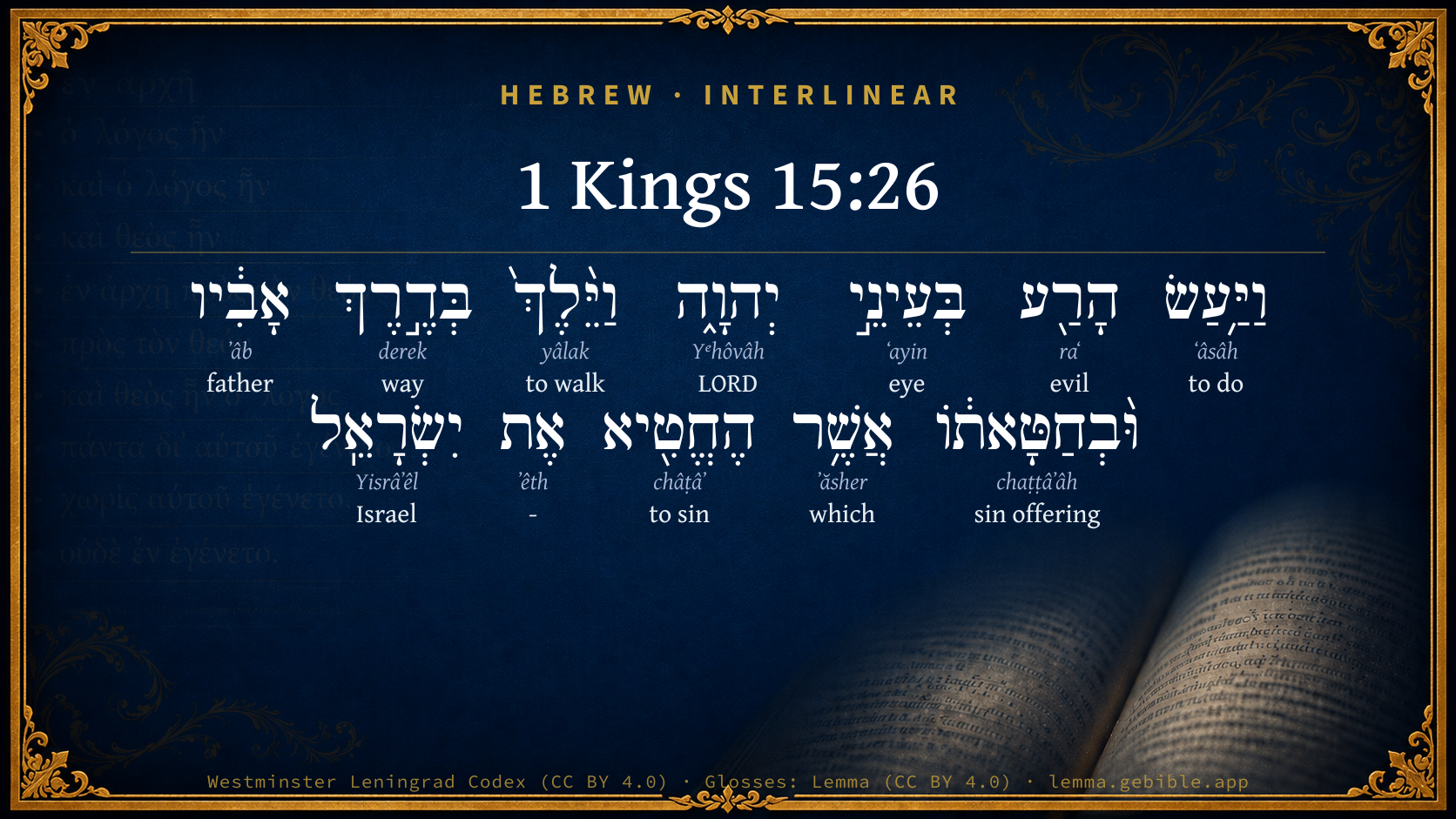
1 Kings 15:26

Hebrew (Westminster Leningrad Codex) 1 Kings 15:26 appears in the Hebrew Old Testament. The text above is from the Westminster Leningrad Codex. Each word links to its Strong’s number, a concise gloss, and parsing drawn from the Open Scriptures Hebrew Bible morphology. Click any word for its full Brown-Driver-Briggs (BDB) entry.
Download image
Cite this verse

1 Kings 15:26 (World English Bible). Public Domain. Lemma interlinear Bible study tool, https://lemma.gebible.app/v/1-kings/15/26.

Show BibTeX & RIS
BibTeX
RIS
English Translation
He did that which was evil in the sight of Yahweh, and walked in the way of his father, and in his sin with which he made Israel to sin.
World English Bible · Public Domain
Download a study sheet

One document with this verse’s original text, its word-by-word gloss line, the meaning frame, cross-references with their text, attributed commentary, and full source and license credits — printable, and it pastes into notes with its structure intact.

This verse Autodidact and up

Study sheet (.html) Plain text (.txt)

A passage Seminary Student

Up to 50 verses in one chapter. A passage sheet keeps up to 6 commentary sources and 12 cross-references per verse, in the order this page ranks them, and says so on the sheet whenever that leaves anything out. Ask for a single verse and you get the Autodidact verse sheet above.

Everything on this page stays free to read, with no account — the sheet is a download of what is already on screen, not access to it.

Want to remove ads? Support Godless Engineer
Compare translations 3

The same verse in 3 English versions, stacked beneath the original-language interlinear above. Click any original word for its lexicon entry.

Each is an independent rendering of the whole verse — the interlinear is not word-aligned to these translations.

Highlighted words mark where these versions differ — a whole-verse word diff, not a word-by-word alignment.

  • World English Bible Public Domain
    He did that which was evil in the sight of Yahweh, and walked in the way of his father, and in his sin with which he made Israel to sin.
  • King James Version Public Domain
    And he did evil in the sight of the LORD, and walked in the way of his father, and in his sin wherewith he made Israel to sin.
  • unfoldingWord Literal Text CC BY-SA 4.0
    And he did evil in the eyes of Yahweh. And he walked in the way of his father and in his sin that he caused Israel to sin.

unfoldingWord Literal Text — © unfoldingWord, licensed CC BY-SA 4.0. Word-aligned USFM3 via Door43 (git.door43.org/unfoldingWord/en_ult).

Versions to compare (up to 4)

3 of 4 selected

Show all 18 translations

Every available English version of this verse, each an independent rendering of the whole verse.

  • World English Bible Public Domain
    He did that which was evil in the sight of Yahweh, and walked in the way of his father, and in his sin with which he made Israel to sin.
  • Berean Standard Bible Public Domain
    And he did evil in the sight of the LORD and walked in the way of his father and in his sin, which he had caused Israel to commit.
  • Majority Standard Bible Public Domain
    And he did evil in the sight of the LORD and walked in the way of his father and in his sin, which he had caused Israel to commit.
  • King James Version Public Domain
    And he did evil in the sight of the LORD, and walked in the way of his father, and in his sin wherewith he made Israel to sin.
  • American Standard Version (1901) Public Domain
    And he did that which was evil in the sight of Jehovah, and walked in the way of his father, and in his sin wherewith he made Israel to sin.
  • Revised Version (1885) Public Domain
    And he did that which was evil in the sight of the LORD, and walked in the way of his father, and in his sin wherewith he made Israel to sin.
  • Geneva Bible (1599) Public Domain
    And he did euill in the sight of the Lord, walking in the way of his father, and in his sinne wherewith he made Israel to sinne.
  • Douay-Rheims (1899) Public Domain
    And he did evil in the sight of the Lord, and walked in the ways of his father, and in his sins, wherewith he made Israel to sin.
  • Young's Literal Translation Public Domain
    and doth the evil thing in the eyes of Jehovah, and goeth in the way of his father, and in his sin that he made Israel to sin.
  • Literal Standard Version CC BY-SA 4.0
    and does evil in the eyes of YHWH, and goes in the way of his father, and in his sin that he made Israel to sin.
  • Unlocked Literal Bible CC BY-SA 4.0
    He did what was evil in the sight of Yahweh and walked in the way of his father, and in his own sin, by which he led Israel to sin.
  • unfoldingWord Literal Text CC BY-SA 4.0
    And he did evil in the eyes of Yahweh. And he walked in the way of his father and in his sin that he caused Israel to sin.
  • Darby Bible Public Domain
    And he did evil in the sight of Jehovah, and walked in the way of his father, and in his sin with which he made Israel sin.
  • World Messianic Bible Public Domain
    He did that which was evil in the LORD’s sight, and walked in the way of his father, and in his sin with which he made Israel to sin.
  • Webster's Bible Public Domain
    And he did evil in the sight of the LORD, and walked in the way of his father, and in his sin with which he made Israel to sin.
  • Free Bible Version CC BY-SA 4.0
    He did what was evil in the Lord's sight. He followed the ways of his father and committed the same sins his father had made Israel commit.
  • Bible in Basic English Public Domain
    He did evil in the eyes of the Lord, copying the evil ways of his father, and the sin which he did and made Israel do.
  • JPS Tanakh (1917) Public Domain
    And he did that which was evil in the sight of the LORD, and walked in the way of his father, and in his sin wherewith he made Israel to sin.

Literal Standard Version (2020), Covenant Press — licensed CC BY-SA 4.0. Text via the HelloAO Bible API (eBible.org). Unlocked Literal Bible (unfoldingWord) — licensed CC BY-SA 4.0. Text via the HelloAO Bible API (eBible.org). unfoldingWord Literal Text — © unfoldingWord, licensed CC BY-SA 4.0. Word-aligned USFM3 via Door43 (git.door43.org/unfoldingWord/en_ult). Free Bible Version, Dr. Jonathan Gallagher — licensed CC BY-SA 4.0. Text via the HelloAO Bible API (eBible.org).

Word by word

More ways to search: Search by grammar → Find every occurrence → Compare this word →

Practice this passage: Drill this verse → Learn its vocabulary →

הֶחֱטִ֖יא
châṭâʼ
H2398
“to sin”
Verb, Hiphil, Perfect, 3rd Person, Masculine, Singular
Part of Speech
Verb
Stem
Hiphil
Form
Perfect
Person
3rd Person
Gender
Masculine
Number
Singular
Full BDB Definition

Origin: a primitive root

TWOT: 638

to sin, miss, miss the way, go wrong, incur guilt, forfeit, purify from uncleanness - (Qal) - to miss - to sin, miss the goal or path of right and duty - to incur guilt, incur penalty by sin, forfeit - (Piel) - to bear loss - to make a sin-offering - to purify from sin - to purify from uncleanness - (Hiphil) - to miss the mark - to induce to sin, cause to sin - to bring into guilt or condemnation or punishment - (Hithpael) - to miss oneself, lose oneself, wander from the way - to purify oneself from uncleanness
  1. וַיַּ֥עַשׂ ʻâsâh H6213 “and · to do” Conjunction + Verb, Qal, Sequential Imperfect, 3rd Person, Masculine, Singular
  2. הָרַ֖ע raʻ H7451 “the · evil” Particle, Definite Article + Adjective, Adjective, Masculine, Singular, Absolute
  3. בְּעֵינֵ֣י ʻayin H5869 “in/at · eyes of” Preposition + Noun, Common, Both, Dual, Construct
  4. יְהוָ֑ה Yᵉhôvâh H3068 “LORD” Noun, Proper
  5. וַיֵּ֨לֶךְ֙ yâlak H3212 “and · to walk” Conjunction + Verb, Qal, Sequential Imperfect, 3rd Person, Masculine, Singular
  6. בְּדֶ֣רֶךְ derek H1870 “in/at · way of” Preposition + Noun, Common, Both, Singular, Construct
  7. אָבִ֔יו ʼâb H1 “father · his” Noun, Common, Masculine, Singular, Construct + Suffix, Personal, 3rd Person, Masculine, Singular
  8. וּ֨בְחַטָּאת֔וֹ chaṭṭâʼâh H2403 “and · in/at · sin offering · his” Conjunction + Preposition + Noun, Common, Feminine, Singular, Construct + Suffix, Personal, 3rd Person, Masculine, Singular
  9. אֲשֶׁ֥ר ʼăsher H834 “which” Particle, Relative
  10. אֶת ʼêth H853 “-” Particle, Direct Object
  11. יִשְׂרָאֵֽל Yisrâʼêl H3478 “Israel” Noun, Proper

About this verse

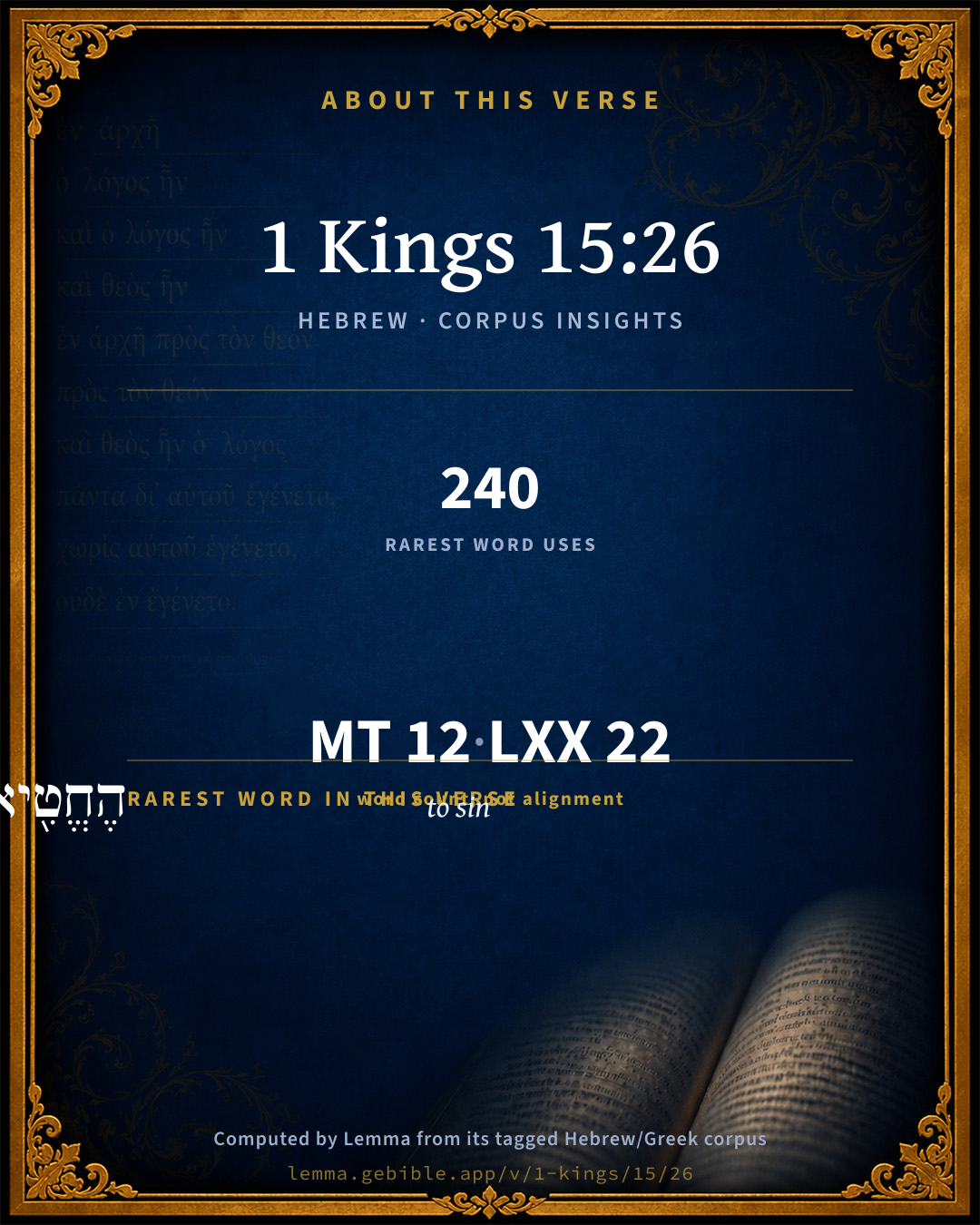
These counts appear in no published source. They are computed here, from the morphology-tagged text and Lemma’s own curated glosses. What Lemma adds →

12
words
12
distinct lemmas
Historical
section

Grammatical profile

  • 3 verbs
  • 6 nouns
  • 1 adjective
  • 2 particles

Verb forms

  • וַיַּ֥עַשׂ Qal · Sequential Imperfect
  • וַיֵּ֨לֶךְ֙ Qal · Sequential Imperfect
  • הֶחֱטִ֖יא Hiphil · Perfect

Hebrew & Septuagint length

In English translation the verse runs 30 words from the Hebrew and 31 from the Septuagint (LXX English) — closely comparable.

A rough comparison of the two English renderings, which tokenize alike — not a word-level alignment.

Word counts can differ between the Hebrew and the Greek without any difference in meaning — e.g. the Hebrew direct-object marker אֵת has no separate Greek word, and Greek often adds the article ὁ.

In the original languages it is 12 Hebrew tokens and 22 Greek tokens — but the two are counted differently (Hebrew bundles its prefixes and suffixes into one token; the Greek is in lemma form), so that isn’t a like-for-like length.

Cross-references

20

Topical passages linked to 1 Kings 15:26 in the Treasury of Scripture Knowledge — connected by theme and wording, ordered by reader-vote popularity; previews shown in the World English Bible.

  • 1 Kings 14:16 He will give Israel up because of the sins of Jeroboam, which he has sinned, and with which he has made Israel to sin.
  • 1 Kings 15:30 for the sins of Jeroboam which he sinned, and with which he made Israel to sin, because of his provocation with which he provoked Yahweh, the God of Israel, to anger.
  • 1 Kings 15:34 He did that which was evil in the sight of Yahweh, and walked in the way of Jeroboam, and in his sin with which he made Israel to sin.
  • 1 Kings 12:28–33 Whereupon the king took counsel, and made two calves of gold; and he said to them, It is too much for you to go up to Jerusalem: see your gods, Israel, which brought you up out of the land of Egypt.
  • 1 Kings 13:33–34 After this thing Jeroboam didn't return from his evil way, but made again from among all the people priests of the high places: whoever would, he consecrated him, that there might be priests of the high places.
  • Genesis 20:9 Then Abimelech called Abraham, and said to him, "What have you done to us? How have I sinned against you, that you have brought on me and on my kingdom a great sin? You have done deeds to me that ought not to be done!"
  • Exodus 32:21 Moses said to Aaron, "What did these people do to you, that you have brought a great sin on them?"
  • 1 Samuel 2:24 No, my sons; for it is no good report that I hear: you make Yahweh's people to disobey.
  • 1 Kings 16:7 Moreover by the prophet Jehu the son of Hanani came the word of Yahweh against Baasha, and against his house, both because of all the evil that he did in the sight of Yahweh, to provoke him to anger with the work of his hands, in being like the house of Jeroboam, and because he struck him.
  • 1 Kings 16:19 for his sins which he sinned in doing that which was evil in the sight of Yahweh, in walking in the way of Jeroboam, and in his sin which he did, to make Israel to sin.
  • 1 Kings 16:25–26 Omri did that which was evil in the sight of Yahweh, and dealt wickedly above all who were before him.
  • 1 Kings 16:30 Ahab the son of Omri did that which was evil in the sight of Yahweh above all that were before him.
  • 1 Kings 21:22 and I will make your house like the house of Jeroboam the son of Nebat, and like the house of Baasha the son of Ahijah for the provocation with which you have provoked me to anger, and have made Israel to sin.
  • 1 Kings 22:52 He did that which was evil in the sight of Yahweh, and walked in the way of his father, and in the way of his mother, and in the way of Jeroboam the son of Nebat, in which he made Israel to sin.
  • 2 Kings 3:3 Nevertheless he cleaved to the sins of Jeroboam the son of Nebat, with which he made Israel to sin; he didn't depart from it.
  • 2 Kings 21:11 Because Manasseh king of Judah has done these abominations, and has done wickedly above all that the Amorites did, who were before him, and has made Judah also to sin with his idols;
  • 2 Kings 23:15 Moreover the altar that was at Bethel, and the high place which Jeroboam the son of Nebat, who made Israel to sin, had made, even that altar and the high place he broke down; and he burned the high place and beat it to dust, and burned the Asherah.
  • Jeremiah 32:35 They built the high places of Baal, which are in the valley of the son of Hinnom, to cause their sons and their daughters to pass through [the fire] to Molech; which I didn't command them, neither did it come into my mind, that they should do this abomination, to cause Judah to sin.
  • Romans 14:15 Yet if because of food your brother is grieved, you walk no longer in love. Don't destroy with your food him for whom Christ died.
  • 1 Corinthians 8:10–13 For if a man sees you who have knowledge sitting in an idol's temple, won't his conscience, if he is weak, be emboldened to eat things sacrificed to idols?

Cross-references courtesy of OpenBible.info (CC BY 4.0).

Hebrew and Greek witnesses Masoretic Hebrew ↔ Greek Septuagint

The same verse in the two great witnesses to the Old Testament, shown verse-for-verse.

These are two independent witnesses, not word-aligned to each other, and the Septuagint is shown in lemma (dictionary) form.

Hebrew 1 Kings 15:26 Masoretic · Westminster Leningrad Codex

וַיַּ֥עַשׂ הָרַ֖ע בְּעֵינֵ֣י יְהוָ֑ה וַיֵּ֨לֶךְ֙ בְּדֶ֣רֶךְ אָבִ֔יו וּ֨בְחַטָּאת֔וֹ אֲשֶׁ֥ר הֶחֱטִ֖יא אֶת יִשְׂרָאֵֽל

He did that which was evil in the sight of Yahweh, and walked in the way of his father, and in his sin with which he made Israel to sin.

World English Bible · Public Domain

Greek LXX 1 Kings 15:26 Septuagint · lemma form

καί ποιέω ὁ πονηρός ἐνώπιον κύριος καί πορεύομαι ἐν ὁδός ὁ πατήρ αὐτός καί ἐν ὁ ἁμαρτία αὐτός ὅς ἐκἁμαρτάνω ὁ ἰσραήλ

And he did that which was evil in the sight of the Lord, and walked in the way of his father, and in his sins wherein he caused Israel to sin.

LXX2012 (modern English Septuagint) · Public Domain

Hebrew: Westminster Leningrad Codex (CC BY 4.0). Greek: Septuagint (public domain); English from LXX2012 (modern English Septuagint) (Public Domain). How the Septuagint differs from the Hebrew →

Targum (Aramaic paraphrase)

1

The Targum is the ancient Jewish Aramaic paraphrase of the Hebrew Scriptures — an interpretive translation, not the Hebrew text itself. Onkelos (literal) and Pseudo-Jonathan (expansive) render the Torah, and Jonathan the Prophets. Coverage is partial: where no permissively-licensed English translation exists for a verse, only the Aramaic is shown. This is verse-level text, not a word-by-word alignment to the Hebrew.

  1. Targum Jonathan Prophets (Joshua–Malachi)
    וַעֲבַד דְבִישׁ קֳדָם יְיָ וַאֲזַל בְּאוֹרַח אֲבוּהִי וּבְחוֹבֵיהּ דְחַיֵב יַת יִשְׂרָאֵל:

    (no public-domain English translation for this verse)

    Targum Jonathan — Aramaic: “Mikraot Gedolot” (public domain). English: “Sefaria Community Translation” (CC0 1.0 (public-domain dedication)); “London "Chaldee Paraphrase," 1871” (public domain). Text via Sefaria.

Commentary

Notes on 1 Kings 15:26 from classic Christian and Jewish commentators (each source and its license shown beneath its notes). The classic Christian expositions comment on the surrounding passage and are grouped to its opening verse, so a note may address several verses; the Jewish commentaries on the Tanakh (Rashi and others) are per-verse, so they appear only where the commentator wrote on this verse.

Lemma curates 59 commentaries, every one of them public domain or Creative Commons licensed, each selected and text-cleaned for this edition rather than reprinted as found. About our sources →

Trapp's Complete Commentary

John Trapp

1Ki 15:26 And he did evil in the sight of the LORD, and walked in the way of his father, and in his sin wherewith he made Israel to sin.

Ver. 26. And he did evil.] See on 1Ki 14:23.

John Trapp, A Commentary or Exposition upon All the Books of the Old and New Testament (1647–1656) — public domain. Text from a community e-Sword module.

Ellicott's Commentary for English Readers

(26) Did evil in the sight of the Lord.—This constantly-recurring phrase signifies (as, indeed, the context here shows) perseverance in the idolatrous system introduced by Jeroboam.

A Bible Commentary for English Readers, edited by Charles John Ellicott (1878–1897) — public domain. Text from a community e-Sword module.

The Cambridge Bible for Schools and Colleges

gen. ed. J. J. S. Perowne

26. he did evil] R.V. (as always for this definite expression) he did that which was evil. Nadab followed the same worship of the calves which his father had introduced. This was a most insidious fashion of idolatry, for it did not disown Jehovah, only acted against His law in making a representation for purposes of worship.

The Cambridge Bible for Schools and Colleges (gen. ed. J. J. S. Perowne; Cambridge University Press, 1878–1918) — public domain. Text from a community e-Sword module.

John Gill's Exposition

And he did evil in the sight of the Lord,.... As Nadab did, whom he slew:

and walked in the way of Jeroboam; whose family he destroyed:

and in his sin wherewith he made Israel to sin; in worshipping the golden calves; so that it was not out of dislike to idolatry, but out of malice and ambition, that he slew the family of Jeroboam.

Next: 1 Kings Chapter 16

John Gill's Exposition of the Whole Bible (1746–1763) — public domain (CC PDM 1.0). Text via the HelloAO Bible API.

Matthew Poole's English Annotations

i.e. In the worship of the calves which his father had made.

Matthew Poole's English Annotations on the Holy Bible (1683–1685) — public domain. Text from a community e-Sword/MySword module.

The Pulpit Commentary

And he did evil in the sight of the Lord, and walked in the way of his father Jeroboam begat all his sons, save one, "in his own likeness", and in his sin wherewith he made Israel to sin. Ie., not the rebellion, but the schism (1Ki_12:30 1Ki_14:16; cf. vers. 30, 34; 16:2, 13, 19, etc.; see Homiletics, p. 274). All the successors of Jeroboam it is clear, either thought themselves compelled, by the exigencies of their position, to adhere to his ecclesiastical policy, or found themselves more and more entangled in its toils.

The Pulpit Commentary (1880–1919), ed. H.D.M. Spence-Jones & Joseph S. Exell — public domain. Text from a community e-Sword module.

John Wesley's Explanatory Notes

In his sin - In the worship of the calves which his father had made.

John Wesley, Explanatory Notes Upon the Whole Bible (1754–1765) — public domain. Text via the GEBible commentary corpus.

Lesson kit

Teaching starters — assembled from the data on this page, not authored interpretation. Every prompt links to the verse data it draws on. Edit before teaching.

1 Kings, in the Historical, opens this verse with 12 words (12 distinct Hebrew lemmas). Its most distinctive word is châṭâʼ (“to sin”). A historical commentator’s framing appears above. Read the whole chapter for the surrounding context.

Discussion questions

  1. How does “to sin” (châṭâʼ) shape what this verse is saying?
  2. How does 1 Kings 14:16, which shares this passage’s theme, read alongside this verse?
  3. These translations render this verse differently. What is at stake in choosing one wording over another?
  4. «וַיַּ֥עַשׂ» is a Qal Sequential Imperfect verb. How does that grammatical form shape the action described?
  5. Compare how Trapp's Complete Commentary and Ellicott's Commentary for English Readers read this verse. Where do they agree or differ?

Things to notice

Reading settings

Reading text

Shown beneath each verse's original-language words.

Old Testament
Old Testament edition

Read the OT as the Masoretic Hebrew (MT) or the Greek Septuagint (LXX).

English shown for the Greek Septuagint (in the Hebrew ↔ Greek comparison).

Comparing translations? Open the Compare panel on any verse page to stack up to four side by side.