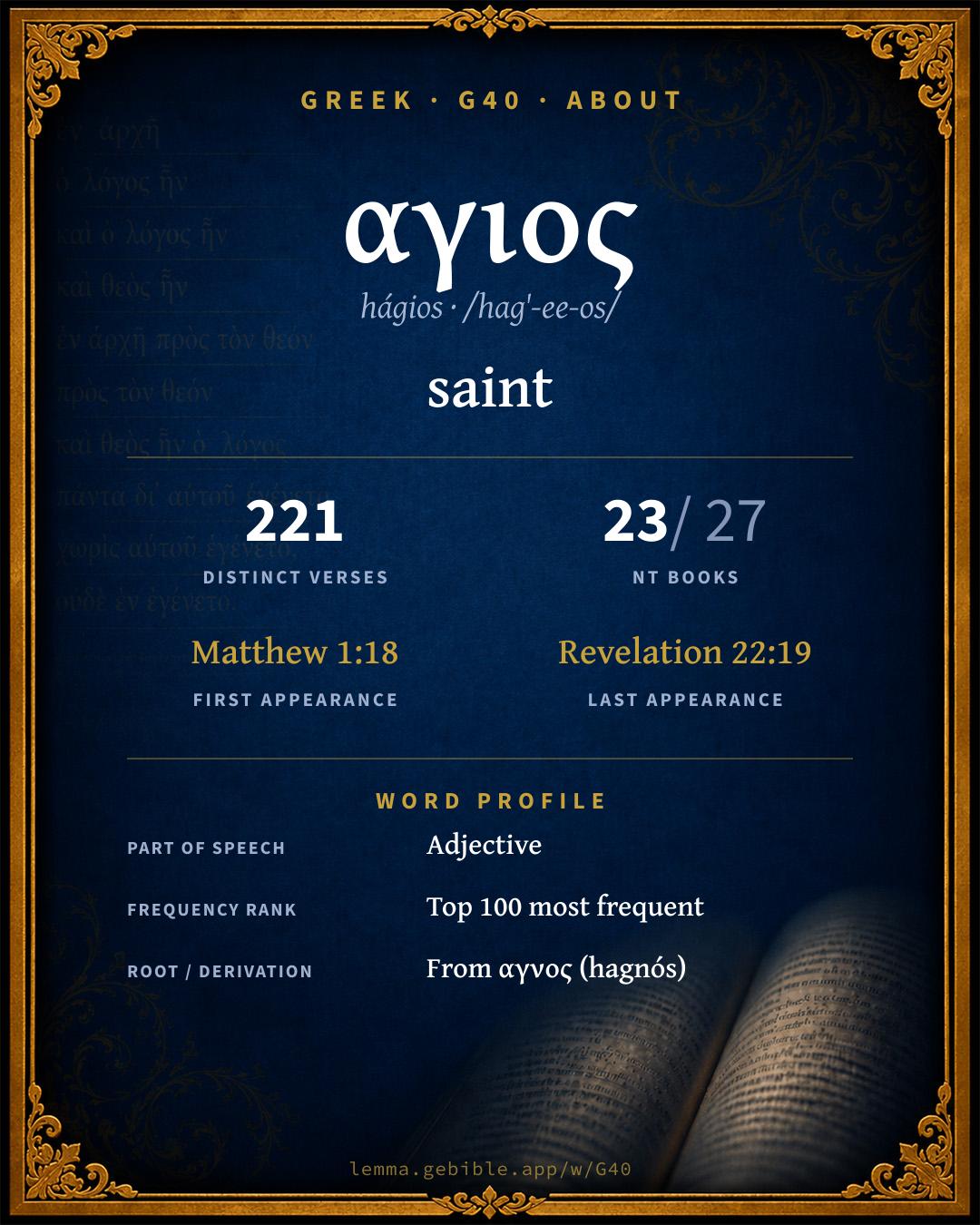
ἅγιος
saint
Full lexicon entry — Thayer's Greek Lexicon
From Thayer's Greek Lexicon
Where this word appears
See every Genitive-case word in the Greek New Testament →
Grammar key — what these labels mean
Part of speech
- Adjective
- A word that describes or qualifies a noun.
Case
- Genitive
- The case of source, possession, or “of” — answers “whose / from what.”
- Dative
- The case of the indirect object, means, or location — “to / for / with / in.”
- Nominative
- The case of the subject (and the predicate nominative).
- Accusative
- The case of the direct object and of extent.
- Vocative
- The case of direct address (“O Lord”).
Gender
- Neuter
- Grammatically neuter.
- Masculine
- Grammatically masculine.
- Feminine
- Grammatically feminine.
Number
- Singular
- One.
- Plural
- More than one.
Degree
- Superlative
- Expresses the greatest degree (“greatest,” “most”).
Grammatical forms 24 distinct
- Adjective, Genitive, Singular, Neuter 38 times (16%)
- Adjective, Genitive, Plural, Masculine 34 times (15%)
- Adjective, Dative, Singular, Neuter 25 times (11%)
- Adjective, Nominative, Singular, Neuter 20 times (9%)
- Adjective, Accusative, Singular, Neuter 19 times (8%)
- Adjective, Dative, Plural, Masculine 19 times (8%)
- Adjective, Nominative, Singular, Masculine 13 times (6%)
- Adjective, Accusative, Plural, Masculine 12 times (5%)
+16 more forms (53 occurrences)
Parsed forms decoded from the imported morphology (Robinson–Tischendorf, public domain), counted across 233 parsed occurrences — not distinct verses.
Page 1 of 2 — showing verses 1–200 of 221 distinct verses where G40 appears, across 23 books. Click any verse to open its interlinear word-by-word view. Verse text shown in the World English Bible for context — . Each verse’s Greek form is shown with its reference; the English is not keyword-highlighted, since the data carries no word-level English alignment. Use “Compare translations” on any verse to read it across multiple English versions. This concordance covers the Greek New Testament; Septuagint (Greek Old Testament) occurrences of this word are not indexed here.
Matthew 10 verses
- Matthew 1:18 ἁγίου adj gen sg neut Now the birth of Jesus Christ was like this; for after his mother, Mary, was engaged to Joseph, before they came together, she was found pregnant by the Holy Spirit.
- Matthew 1:20 ἁγίου adj gen sg neut But when he thought about these things, behold, an angel of the Lord appeared to him in a dream, saying, "Joseph, son of David, don't be afraid to take to yourself Mary, your wife, for that which is conceived in her is of the Holy Spirit.
- Matthew 3:11 ἁγίῳ adj dat sg neut I indeed baptize you in water for repentance, but he who comes after me is mightier than I, whose shoes I am not worthy to carry. He will baptize you in the Holy Spirit.
- Matthew 4:5 ἁγίαν adj acc sg fem Then the devil took him into the holy city. He set him on the pinnacle of the temple,
- Matthew 7:6 ἅγιον adj acc sg neut "Don't give that which is holy to the dogs, neither throw your pearls before the pigs, lest perhaps they trample them under their feet, and turn and tear you to pieces.
- Matthew 12:32 ἁγίου adj gen sg neut Whoever speaks a word against the Son of Man, it will be forgiven him; but whoever speaks against the Holy Spirit, it will not be forgiven him, neither in this age, nor in that which is to come.
- Matthew 24:15 ἁγίῳ adj dat sg masc "When, therefore, you see the abomination of desolation, which was spoken of through Daniel the prophet, standing in the holy place (let the reader understand),
- Matthew 27:52 ἁγίων adj gen pl masc The tombs were opened, and many bodies of the saints who had fallen asleep were raised;
- Matthew 27:53 ἁγίαν adj acc sg fem and coming out of the tombs after his resurrection, they entered into the holy city and appeared to many.
- Matthew 28:19 ἁγίου adj gen sg neut Therefore go, and make disciples of all nations, baptizing them in the name of the Father and of the Son and of the Holy Spirit,
Mark 7 verses
- Mark 1:8 ἁγίῳ adj dat sg neut I baptized you in water, but he will baptize you in the Holy Spirit."
- Mark 1:24 ἅγιος adj nom sg masc saying, "Ha! What do we have to do with you, Jesus, you Nazarene? Have you come to destroy us? I know you who you are: the Holy One of God!"
- Mark 3:29 ἅγιον adj acc sg neut but whoever may blaspheme against the Holy Spirit never has forgiveness, but is guilty of an eternal sin"
- Mark 6:20 ἅγιον adj acc sg masc for Herod feared John, knowing that he was a righteous and holy man, and kept him safe. When he heard him, he did many things, and he heard him gladly.
- Mark 8:38 ἁγίων adj gen pl masc For whoever will be ashamed of me and of my words in this adulterous and sinful generation, the Son of Man also will be ashamed of him, when he comes in the glory of his Father with the holy angels."
- Mark 12:36 ἁγίῳ adj dat sg neut For David himself said in the Holy Spirit, 'The Lord said to my Lord, Sit at my right hand, Until I make your enemies the footstool of your feet.'
- Mark 13:11 ἅγιον adj nom sg neut When they lead you away and deliver you up, don't be anxious beforehand, or premeditate what you will say, but say whatever will be given you in that hour. For it is not you who speak, but the Holy Spirit.
Luke 19 verses
- Luke 1:15 ἁγίου adj gen sg neut For he will be great in the sight of the Lord, and he will drink no wine nor strong drink. He will be filled with the Holy Spirit, even from his mother's womb.
- Luke 1:35 ἅγιον ἅγιον adj nom sg neut adj nom sg neut The angel answered her, "The Holy Spirit will come on you, and the power of the Most High will overshadow you. Therefore also the holy one who is born from you will be called the Son of God.
- Luke 1:41 ἁγίου adj gen sg neut It happened, when Elizabeth heard Mary's greeting, that the baby leaped in her womb, and Elizabeth was filled with the Holy Spirit.
- Luke 1:49 ἅγιον adj acc sg neut For he who is mighty has done great things for me. Holy is his name.
- Luke 1:67 ἁγίου adj gen sg neut His father, Zacharias, was filled with the Holy Spirit, and prophesied, saying,
- Luke 1:70 ἁγίων adj gen pl masc (As he spoke by the mouth of his holy prophets who have been from of old),
- Luke 1:72 ἁγίας adj gen sg fem To show mercy towards our fathers, To remember his holy covenant,
- Luke 2:23 ἅγιον adj acc sg neut (as it is written in the law of the Lord, "Every male who opens the womb shall be called holy to the Lord"),
- Luke 2:25 ἅγιον adj nom sg neut Behold, there was a man in Jerusalem whose name was Simeon. This man was righteous and devout, looking for the consolation of Israel, and the Holy Spirit was on him.
- Luke 2:26 ἁγίου adj gen sg neut It had been revealed to him by the Holy Spirit that he should not see death before he had seen the Lord's Christ.
- Luke 3:16 ἁγίῳ adj dat sg neut John answered them all, "I indeed baptize you with water, but he comes who is mightier than I, the latchet of whose sandals I am not worthy to loosen. He will baptize you in the Holy Spirit and fire,
- Luke 3:22 ἅγιον adj nom sg neut and the Holy Spirit descended in a bodily form as a dove on him; and a voice came out of the sky, saying "You are my beloved Son. In you I am well pleased."
- Luke 4:1 ἁγίου adj gen sg neut Jesus, full of the Holy Spirit, returned from the Jordan, and was led by the Spirit into the wilderness
- Luke 4:34 ἅγιος adj nom sg masc saying, "Ah! what have we to do with you, Jesus of Nazareth? Have you come to destroy us? I know you who you are: the Holy One of God!"
- Luke 9:26 ἁγίων adj gen pl masc For whoever will be ashamed of me and of my words, of him will the Son of Man be ashamed, when he comes in his glory, and the glory of the Father, and of the holy angels.
- Luke 10:21 ἁγίῳ adj dat sg neut In that same hour Jesus rejoiced in the Holy Spirit, and said, "I thank you, O Father, Lord of heaven and earth, that you have hidden these things from the wise and understanding, and revealed them to little children. Yes, Father, for so it was well-pleasing in your sight."
- Luke 11:13 ἅγιον adj acc sg neut If you then, being evil, know how to give good gifts to your children, how much more will your heavenly Father give the Holy Spirit to those who ask him?"
- Luke 12:10 ἅγιον adj acc sg neut Everyone who speaks a word against the Son of Man will be forgiven, but those who blaspheme against the Holy Spirit will not be forgiven.
- Luke 12:12 ἅγιον adj nom sg neut for the Holy Spirit will teach you in that same hour what you must say."
John 5 verses
- John 1:33 ἁγίῳ adj dat sg neut I didn't recognize him, but he who sent me to baptize in water, he said to me, 'On whomever you will see the Spirit descending, and remaining on him, the same is he who baptizes in the Holy Spirit.'
- John 6:69 ἅγιος adj nom sg masc We have come to believe and know that you are the Christ, the Son of the living God."
- John 14:26 ἅγιον adj nom sg neut But the Counselor, the Holy Spirit, whom the Father will send in my name, he will teach you all things, and will remind you of all that I said to you.
- John 17:11 ἅγιε adj voc sg masc I am no more in the world, but these are in the world, and I am coming to you. Holy Father, keep them through your name which you have given me, that they may be one, even as we are.
- John 20:22 ἅγιον adj acc sg neut When he had said this, he breathed on them, and said to them, "Receive the Holy Spirit!
Acts 52 verses
- Acts 1:2 ἁγίου adj gen sg neut until the day in which he was received up, after he had given commandment through the Holy Spirit to the apostles whom he had chosen.
- Acts 1:5 ἁγίῳ adj dat sg neut For John indeed baptized in water, but you will be baptized in the Holy Spirit not many days from now."
- Acts 1:8 ἁγίου adj gen sg neut But you will receive power when the Holy Spirit has come upon you. You will be witnesses to me in Jerusalem, in all Judea and Samaria, and to the uttermost parts of the earth."
- Acts 1:16 ἅγιον adj nom sg neut "Brothers, it was necessary that this Scripture should be fulfilled, which the Holy Spirit spoke before by the mouth of David concerning Judas, who was guide to those who took Jesus.
- Acts 2:4 ἁγίου adj gen sg neut They were all filled with the Holy Spirit, and began to speak with other languages, as the Spirit gave them the ability to speak.
- Acts 2:33 ἁγίου adj gen sg neut Being therefore exalted by the right hand of God, and having received from the Father the promise of the Holy Spirit, he has poured out this, which you now see and hear.
- Acts 2:38 ἁγίου adj gen sg neut Peter said to them, "Repent, and be baptized, everyone of you, in the name of Jesus Christ for the forgiveness of sins, and you will receive the gift of the Holy Spirit.
- Acts 3:14 ἅγιον adj acc sg masc But you denied the Holy and Righteous One, and asked for a murderer to be granted to you,
- Acts 3:21 ἁγίων adj gen pl masc whom heaven must receive until the times of restoration of all things, which God spoke long ago by the mouth of his holy prophets.
- Acts 4:8 ἁγίου adj gen sg neut Then Peter, filled with the Holy Spirit, said to them, "You rulers of the people, and elders of Israel,
- Acts 4:25 ἁγίου adj gen sg neut who by the mouth of your servant, David, said, 'Why do the nations rage, And the peoples plot a vain thing?
- Acts 4:27 ἅγιον adj acc sg masc For truly, in this city against your holy servant, Jesus, whom you anointed, both Herod and Pontius Pilate, with the Gentiles and the people of Israel, were gathered together
- Acts 4:30 ἁγίου adj gen sg masc while you stretch out your hand to heal; and that signs and wonders may be done through the name of your holy Servant Jesus."
- Acts 4:31 ἁγίου adj gen sg neut When they had prayed, the place was shaken where they were gathered together. They were all filled with the Holy Spirit, and they spoke the word of God with boldness.
- Acts 5:3 ἅγιον adj acc sg neut But Peter said, "Ananias, why has Satan filled your heart to lie to the Holy Spirit, and to keep back part of the price of the land?
- Acts 5:32 ἅγιον adj acc sg neut We are His witnesses of these things; and so also is the Holy Spirit, whom God has given to those who obey him."
- Acts 6:5 ἁγίου adj gen sg neut These words pleased the whole multitude. They chose Stephen, a man full of faith and of the Holy Spirit, Philip, Prochorus, Nicanor, Timon, Parmenas, and Nicolaus, a proselyte of Antioch;
- Acts 6:13 ἁγίου adj gen sg masc and set up false witnesses who said, "This man never stops speaking blasphemous words against this holy place and the law.
- Acts 7:33 ἁγία adj nom sg fem The Lord said to him, 'Take your sandals off of your feet, for the place where you stand is holy ground.
- Acts 7:51 ἁγίῳ adj dat sg neut "You stiff-necked and uncircumcised in heart and ears, you always resist the Holy Spirit! As your fathers did, so you do.
- Acts 7:55 ἁγίου adj gen sg neut But he, being full of the Holy Spirit, looked up steadfastly into heaven, and saw the glory of God, and Jesus standing on the right hand of God,
- Acts 8:15 ἅγιον adj acc sg neut who, when they had come down, prayed for them, that they might receive the Holy Spirit;
- Acts 8:17 ἅγιον adj acc sg neut Then they laid their hands on them, and they received the Holy Spirit.
- Acts 8:19 ἅγιον adj acc sg neut saying, "Give me also this power, that whoever I lay my hands on may receive the Holy Spirit."
- Acts 9:13 ἁγίοις adj dat pl masc But Ananias answered, "Lord, I have heard from many about this man, how much evil he did to your saints at Jerusalem.
- Acts 9:17 ἁγίου adj gen sg neut Ananias departed, and entered into the house. Laying his hands on him, he said, "Brother Saul, the Lord, who appeared to you on the road by which you came, has sent me, that you may receive your sight, and be filled with the Holy Spirit."
- Acts 9:31 ἁγίου adj gen sg neut So the assemblies throughout all Judea and Galilee and Samaria had peace, and were built up. They were multiplied, walking in the fear of the Lord and in the comfort of the Holy Spirit.
- Acts 9:32 ἁγίους adj acc pl masc It happened, as Peter went throughout all those parts, he came down also to the saints who lived at Lydda.
- Acts 9:41 ἁγίους adj acc pl masc He gave her his hand, and raised her up. Calling the saints and widows, he presented her alive.
- Acts 10:22 ἁγίου adj gen sg masc They said, "Cornelius, a centurion, a righteous man and one who fears God, and well spoken of by all the nation of the Jews, was directed by a holy angel to invite you to his house, and to listen to what you say."
- Acts 10:38 ἁγίῳ adj dat sg neut even Jesus of Nazareth, how God anointed him with the Holy Spirit and with power, who went about doing good and healing all who were oppressed by the devil, for God was with him.
- Acts 10:44 ἅγιον adj nom sg neut While Peter was still speaking these words, the Holy Spirit fell on all those who heard the word.
- Acts 10:45 ἁγίου adj gen sg neut They of the circumcision who believed were amazed, as many as came with Peter, because the gift of the Holy Spirit was also poured out on the Gentiles.
- Acts 10:47 ἅγιον adj acc sg neut "Can any man forbid the water, that these who have received the Holy Spirit as well as we should not be baptized?"
- Acts 11:15 ἅγιον adj nom sg neut As I began to speak, the Holy Spirit fell on them, even as on us at the beginning.
- Acts 11:16 ἁγίῳ adj dat sg neut I remembered the word of the Lord, how he said, 'John indeed baptized in water, but you will be baptized in the Holy Spirit.'
- Acts 11:24 ἁγίου adj gen sg neut For he was a good man, and full of the Holy Spirit and of faith, and many people were added to the Lord.
- Acts 13:2 ἅγιον adj nom sg neut As they served the Lord and fasted, the Holy Spirit said, "Separate Barnabas and Saul for me, for the work to which I have called them."
- Acts 13:4 ἁγίου adj gen sg neut So, being sent out by the Holy Spirit, they went down to Seleucia. From there they sailed to Cyprus.
- Acts 13:9 ἁγίου adj gen sg neut But Saul, who is also called Paul, filled with the Holy Spirit, fastened his eyes on him,
- Acts 13:52 ἁγίου adj gen sg neut The disciples were filled with joy with the Holy Spirit.
- Acts 15:8 ἅγιον adj acc sg neut God, who knows the heart, testified about them, giving them the Holy Spirit, just like he did to us.
- Acts 15:28 ἁγίῳ adj dat sg neut For it seemed good to the Holy Spirit, and to us, to lay no greater burden on you than these necessary things:
- Acts 16:6 ἁγίου adj gen sg neut When they had gone through the region of Phrygia and Galatia, they were forbidden by the Holy Spirit to speak the word in Asia.
- Acts 19:2 ἅγιον ἅγιον adj acc sg neut adj nom sg neut He said to them, "Did you receive the Holy Spirit when you believed?" They said to him, "No, we haven't even heard that there is a Holy Spirit."
- Acts 19:6 ἅγιον adj nom sg neut When Paul had laid his hands on them, the Holy Spirit came on them, and they spoke with other languages and prophesied.
- Acts 20:23 ἅγιον adj nom sg neut except that the Holy Spirit testifies in every city, saying that bonds and afflictions wait for me.
- Acts 20:28 ἅγιον adj nom sg neut Take heed, therefore, to yourselves, and to all the flock, in which the Holy Spirit has made you overseers, to shepherd the assembly of the Lord and God which he purchased with his own blood.
- Acts 21:11 ἅγιον adj nom sg neut Coming to us, and taking Paul's belt, he bound his own feet and hands, and said, "Thus says the Holy Spirit: 'So will the Jews at Jerusalem bind the man who owns this belt, and will deliver him into the hands of the Gentiles.'"
- Acts 21:28 ἅγιον adj acc sg masc crying out, "Men of Israel, help! This is the man who teaches all men everywhere against the people, and the law, and this place. Moreover, he also brought Greeks into the temple, and has defiled this holy place!"
- Acts 26:10 ἁγίων adj gen pl masc This I also did in Jerusalem. I both shut up many of the saints in prisons, having received authority from the chief priests, and when they were put to death I gave my vote against them.
- Acts 28:25 ἅγιον adj nom sg neut When they didn't agree among themselves, they departed after Paul had spoken one word, "The Holy Spirit spoke rightly through Isaiah, the prophet, to our fathers,
Romans 18 verses
- Romans 1:2 ἁγίαις adj dat pl fem which he promised before through his prophets in the holy Scriptures,
- Romans 1:7 ἁγίοις adj dat pl masc to all who are in Rome, beloved of God, called to be saints: Grace to you and peace from God our Father and the Lord Jesus Christ.
- Romans 5:5 ἁγίου adj gen sg neut and hope doesn't disappoint us, because God's love has been poured out into our hearts through the Holy Spirit who was given to us.
- Romans 7:12 ἅγιος ἁγία adj nom sg masc adj nom sg fem Therefore the law indeed is holy, and the commandment holy, and righteous, and good.
- Romans 8:27 ἁγίων adj gen pl masc He who searches the hearts knows what is on the Spirit's mind, because he makes intercession for the saints according to God.
- Romans 9:1 ἁγίῳ adj dat sg neut I tell the truth in Christ. I am not lying, my conscience testifying with me in the Holy Spirit,
- Romans 11:16 ἁγία ἁγία adj nom sg fem adj nom sg fem If the first fruit is holy, so is the lump. If the root is holy, so are the branches.
- Romans 12:1 ἁγίαν adj acc sg fem Therefore I urge you, brothers, by the mercies of God, to present your bodies a living sacrifice, holy, acceptable to God, which is your spiritual service.
- Romans 12:13 ἁγίων adj gen pl masc contributing to the needs of the saints; given to hospitality.
- Romans 14:17 ἁγίῳ adj dat sg neut for the Kingdom of God is not eating and drinking, but righteousness, peace, and joy in the Holy Spirit.
- Romans 15:13 ἁγίου adj gen sg neut Now may the God of hope fill you with all joy and peace in believing, that you may abound in hope, in the power of the Holy Spirit.
- Romans 15:16 ἁγίῳ adj dat sg neut that I should be a servant of Christ Jesus to the Gentiles, ministering as a priest the Gospel of God, that the offering up of the Gentiles might be made acceptable, sanctified by the Holy Spirit.
- Romans 15:25 ἁγίοις adj dat pl masc But now, I say, I am going to Jerusalem, serving the saints.
- Romans 15:26 ἁγίων adj gen pl masc For it has been the good pleasure of Macedonia and Achaia to make a certain contribution for the poor among the saints who are at Jerusalem.
- Romans 15:31 ἁγίοις adj dat pl masc that I may be delivered from those who are disobedient in Judea, and that my service which I have for Jerusalem may be acceptable to the saints;
- Romans 16:2 ἁγίων adj gen pl masc that you receive her in the Lord, in a way worthy of the saints, and that you assist her in whatever matter she may need from you, for she herself also has been a helper of many, and of my own self.
- Romans 16:15 ἁγίους adj acc pl masc Greet Philologus and Julia, Nereus and his sister, and Olympas, and all the saints who are with them.
- Romans 16:16 ἁγίῳ adj dat sg neut Greet one another with a holy kiss. The assemblies of Christ greet you.
1 Corinthians 12 verses
- 1 Corinthians 1:2 ἁγίοις adj dat pl masc to the assembly of God which is at Corinth; those who are sanctified in Christ Jesus, called to be saints, with all who call on the name of our Lord Jesus Christ in every place, both theirs and ours:
- 1 Corinthians 3:17 ἅγιός adj nom sg masc If anyone destroys the temple of God, God will destroy him; for God's temple is holy, which you are.
- 1 Corinthians 6:1 ἁγίων adj gen pl masc Dare any of you, having a matter against his neighbor, go to law before the unrighteous, and not before the saints?
- 1 Corinthians 6:2 ἅγιοι adj nom pl masc Don't you know that the saints will judge the world? And if the world is judged by you, are you unworthy to judge the smallest matters?
- 1 Corinthians 6:19 ἁγίου adj gen sg neut Or don't you know that your body is a temple of the Holy Spirit which is in you, which you have from God? You are not your own,
- 1 Corinthians 7:14 ἅγιά adj nom pl neut For the unbelieving husband is sanctified in the wife, and the unbelieving wife is sanctified in the husband. Otherwise your children would be unclean, but now are they holy.
- 1 Corinthians 7:34 ἁγία adj nom sg fem There is also a difference between a wife and a virgin. The unmarried woman cares about the things of the Lord, that she may be holy both in body and in spirit. But she who is married cares about the things of the world--how she may please her husband.
- 1 Corinthians 12:3 ἁγίῳ adj dat sg neut Therefore I make known to you that no man speaking by God's Spirit says, "Jesus is accursed." No one can say, "Jesus is Lord," but by the Holy Spirit.
- 1 Corinthians 14:33 ἁγίων adj gen pl masc for God is not a God of confusion, but of peace. As in all the assemblies of the saints,
- 1 Corinthians 16:1 ἁγίους adj acc pl masc Now concerning the collection for the saints, as I commanded the assemblies of Galatia, you do likewise.
- 1 Corinthians 16:15 ἁγίοις adj dat pl masc Now I beg you, brothers (you know the house of Stephanas, that it is the first fruits of Achaia, and that they have set themselves to minister to the saints),
- 1 Corinthians 16:20 ἁγίῳ adj dat sg neut All the brothers greet you. Greet one another with a holy kiss.
2 Corinthians 7 verses
- 2 Corinthians 1:1 ἁγίοις adj dat pl masc Paul, an apostle of Christ Jesus through the will of God, and Timothy our brother, to the assembly of God which is at Corinth, with all the saints who are in the whole of Achaia:
- 2 Corinthians 6:6 ἁγίῳ adj dat sg neut in pureness, in knowledge, in patience, in kindness, in the Holy Spirit, in sincere love,
- 2 Corinthians 8:4 ἁγίους adj acc pl masc begging us with much entreaty to receive this grace and the fellowship in the service to the saints.
- 2 Corinthians 9:1 ἁγίους adj acc pl masc It is indeed unnecessary for me to write to you concerning the service to the saints,
- 2 Corinthians 9:12 ἁγίων adj gen pl masc For this service of giving that you perform not only makes up for lack among the saints, but abounds also through many givings of thanks to God;
- 2 Corinthians 13:12 ἁγίῳ ἅγιοι adj dat sg neut adj nom pl masc Greet one another with a holy kiss.
- 2 Corinthians 13:13 ἁγίου adj gen sg neut All the saints greet you.
Ephesians 15 verses
- Ephesians 1:1 ἁγίοις adj dat pl masc Paul, an apostle of Christ Jesus through the will of God, to the saints who are at Ephesus, and the faithful in Christ Jesus:
- Ephesians 1:4 ἁγίους adj acc pl masc even as he chose us in him before the foundation of the world, that we would be holy and without blemish before him in love;
- Ephesians 1:13 ἁγίῳ adj dat sg neut in whom you also, having heard the word of the truth, the Gospel of your salvation,--in whom, having also believed, you were sealed with the Holy Spirit of promise,
- Ephesians 1:15 ἁγίους adj acc pl masc For this cause I also, having heard of the faith in the Lord Jesus which is among you, and the love which you have toward all the saints,
- Ephesians 1:18 ἁγίοις adj dat pl masc having the eyes of your hearts enlightened, that you may know what is the hope of his calling, and what are the riches of the glory of his inheritance in the saints,
- Ephesians 2:19 ἁγίων adj gen pl masc So then you are no longer strangers and foreigners, but you are fellow citizens with the saints, and of the household of God,
- Ephesians 2:21 ἅγιον adj acc sg masc in whom the whole building, fitted together, grows into a holy temple in the Lord;
- Ephesians 3:5 ἁγίοις adj dat pl masc which in other generations was not made known to the children of men, as it has now been revealed to his holy apostles and prophets in the Spirit;
- Ephesians 3:8 ἁγίων adj gen pl masc To me, the very least of all saints, was this grace given, to preach to the Gentiles the unsearchable riches of Christ,
- Ephesians 3:18 ἁγίοις adj dat pl masc may be strengthened to comprehend with all the saints what is the breadth and length and height and depth,
- Ephesians 4:12 ἁγίων adj gen pl masc for the perfecting of the saints, to the work of serving, to the building up of the body of Christ;
- Ephesians 4:30 ἅγιον adj acc sg neut Don't grieve the Holy Spirit of God, in whom you were sealed for the day of redemption.
- Ephesians 5:3 ἁγίοις adj dat pl masc But sexual immorality, and all uncleanness, or covetousness, let it not even be mentioned among you, as becomes saints;
- Ephesians 5:27 ἁγία adj nom sg fem that he might present the assembly to himself gloriously, not having spot or wrinkle or any such thing; but that it should be holy and without blemish.
- Ephesians 6:18 ἁγίων adj gen pl masc with all prayer and requests, praying at all times in the Spirit, and being watchful to this end in all perseverance and requests for all the saints:
Philippians 3 verses
- Philippians 1:1 ἁγίοις adj dat pl masc Paul and Timothy, servants of Jesus Christ; To all the saints in Christ Jesus who are at Philippi, with the overseers and deacons:
- Philippians 4:21 ἅγιον adj acc sg masc Greet every saint in Christ Jesus. The brothers who are with me greet you.
- Philippians 4:22 ἅγιοι adj nom pl masc All the saints greet you, especially those who are of Caesar's household.
Colossians 6 verses
- Colossians 1:2 ἁγίοις adj dat pl masc to the saints and faithful brothers in Christ at Colossae: Grace to you and peace from God our Father, and the Lord Jesus Christ.
- Colossians 1:4 ἁγίους adj acc pl masc having heard of your faith in Christ Jesus, and of the love which you have toward all the saints,
- Colossians 1:12 ἁγίων adj gen pl masc giving thanks to the Father, who made us fit to be partakers of the inheritance of the saints in light;
- Colossians 1:22 ἁγίους adj acc pl masc yet now he has reconciled in the body of his flesh through death, to present you holy and without blemish and blameless before him,
- Colossians 1:26 ἁγίοις adj dat pl masc the mystery which has been hidden for ages and generations. But now it has been revealed to his saints,
- Colossians 3:12 ἅγιοι adj nom pl masc Put on therefore, as God's chosen ones, holy and beloved, a heart of compassion, kindness, lowliness, humility, and perseverance;
1 Thessalonians 5 verses
- 1 Thessalonians 1:5 ἁγίῳ adj dat sg neut and that our Gospel came to you not in word only, but also in power, and in the Holy Spirit, and with much assurance. You know what kind of men we showed ourselves to be among you for your sake.
- 1 Thessalonians 1:6 ἁγίου adj gen sg neut You became imitators of us, and of the Lord, having received the word in much affliction, with joy of the Holy Spirit,
- 1 Thessalonians 3:13 ἁγίων adj gen pl masc to the end he may establish your hearts blameless in holiness before our God and Father, at the coming of our Lord Jesus with all his saints.
- 1 Thessalonians 4:8 ἅγιον adj acc sg neut Therefore he who rejects doesn't reject man, but God, who has also given his Holy Spirit to you.
- 1 Thessalonians 5:26 ἁγίῳ adj dat sg neut Greet all the brothers with a holy kiss.
2 Thessalonians 1 verse
1 Timothy 1 verse
2 Timothy 2 verses
- 2 Timothy 1:9 ἁγίᾳ adj dat sg fem who saved us and called us with a holy calling, not according to our works, but according to his own purpose and grace, which was given to us in Christ Jesus before times eternal,
- 2 Timothy 1:14 ἁγίου adj gen sg neut That good thing which was committed to you, guard through the Holy Spirit who dwells in us.
Titus 1 verse
Philemon 2 verses
Hebrews 17 verses
- Hebrews 2:4 ἁγίου adj gen sg neut God also bearing witness with them, both by signs and wonders, and by various works of power, and by gifts of the Holy Spirit, according to his own will?
- Hebrews 3:1 ἅγιοι adj voc pl masc Therefore, holy brothers, partakers of a heavenly calling, consider the Apostle and High Priest of our confession, Jesus;
- Hebrews 3:7 ἅγιον adj nom sg neut Therefore, even as the Holy Spirit says, "Today if you will hear his voice,
- Hebrews 6:4 ἁγίου adj gen sg neut For concerning those who were once enlightened and tasted of the heavenly gift, and were made partakers of the Holy Spirit,
- Hebrews 6:10 ἁγίοις adj dat pl masc For God is not unrighteous, so as to forget your work and the labor of love which you showed toward his name, in that you served the saints, and still do serve them.
- Hebrews 8:2 ἁγίων adj gen pl neut a minister of the sanctuary, and of the true tabernacle, which the Lord pitched, not man.
- Hebrews 9:1 ἅγιον adj acc sg neut Now indeed even the first covenant had ordinances of divine service, and an earthly sanctuary.
- Hebrews 9:2 ἅγια adj nom pl neut For there was a tabernacle prepared. In the first part were the lampstand, the table, and the show bread; which is called the Holy Place.
- Hebrews 9:3 ἅγια ἁγίων adj nom pl neut adj gen pl neut After the second veil was the tabernacle which is called the Holy of Holies,
- Hebrews 9:8 ἁγίου ἁγίων adj gen sg neut adj gen pl neut The Holy Spirit is indicating this, that the way into the Holy Place wasn't yet revealed while the first tabernacle was still standing;
- Hebrews 9:12 ἅγια adj acc pl neut nor yet through the blood of goats and calves, but through his own blood, entered in once for all into the Holy Place, having obtained eternal redemption.
- Hebrews 9:24 ἅγια adj acc pl neut For Christ hasn't entered into holy places made with hands, which are representations of the true, but into heaven itself, now to appear in the presence of God for us;
- Hebrews 9:25 ἅγια adj acc pl neut nor yet that he should offer himself often, as the high priest enters into the holy place year by year with blood not his own,
- Hebrews 10:15 ἅγιον adj nom sg neut The Holy Spirit also testifies to us, for after saying,
- Hebrews 10:19 ἁγίων adj gen pl neut Having therefore, brothers, boldness to enter into the holy place by the blood of Jesus,
- Hebrews 13:11 ἅγια adj acc pl neut For the bodies of those animals, whose blood is brought into the holy place by the high priest as an offering for sin, are burned outside of the camp.
- Hebrews 13:24 ἁγίους adj acc pl masc Greet all of your leaders and all the saints. The Italians greet you.
1 Peter 6 verses
- 1 Peter 1:12 ἁγίῳ adj dat sg neut To them it was revealed, that not to themselves, but to you, did they minister these things, which now have been announced to you through those who preached the Gospel to you by the Holy Spirit sent out from heaven; which things angels desire to look into.
- 1 Peter 1:15 ἅγιον ἅγιοι adj acc sg masc adj nom pl masc but just as he who called you is holy, you yourselves also be holy in all of your behavior;
- 1 Peter 1:16 ἅγιοι ἅγιος adj nom pl masc adj nom sg masc because it is written, "You shall be holy; for I am holy."
- 1 Peter 2:5 ἅγιον adj acc sg neut You also, as living stones, are built up as a spiritual house, to be a holy priesthood, to offer up spiritual sacrifices, acceptable to God through Jesus Christ.
- 1 Peter 2:9 ἅγιον adj nom sg neut But you are a chosen race, a royal priesthood, a holy nation, a people for God's own possession, that you may show forth the excellencies of him who called you out of darkness into his marvelous light:
- 1 Peter 3:5 ἅγιαι adj nom pl fem For this is how the holy women before, who hoped in God, also adorned themselves, being in subjection to their own husbands:
2 Peter 5 verses
- 2 Peter 1:18 ἁγίῳ adj dat sg neut This voice we heard come out of heaven when we were with him in the holy mountain.
- 2 Peter 1:21 ἁγίου adj gen sg neut For no prophecy ever came by the will of man: but holy men of God spoke, being moved by the Holy Spirit.
- 2 Peter 2:21 ἁγίας adj gen sg fem For it would be better for them not to have known the way of righteousness, than, after knowing it, to turn back from the holy commandment delivered to them.
- 2 Peter 3:2 ἁγίων adj gen pl masc that you should remember the words which were spoken before by the holy prophets, and the commandments of us, the apostles of the Lord and Savior:
- 2 Peter 3:11 ἁγίαις adj dat pl fem Therefore since all these things are thus to be destroyed, what manner of persons ought you to be in holy living and godliness,
1 John 1 verse
Jude 3 verses
- Jude 1:3 ἁγίοις adj dat pl masc Beloved, while I was very eager to write to you about our common salvation, I was constrained to write to you exhorting you to contend earnestly for the faith which was once for all delivered to the saints.
- Jude 1:14 ἁγίαις adj dat pl fem About these also Enoch, the seventh from Adam, prophesied, saying, "Behold, the Lord came with ten thousands of his holy ones,
- Jude 1:20 ἁγιωτάτῃ ἁγίῳ adj dat sg fem supl adj dat sg neut But you, beloved, keep building up yourselves on your most holy faith, praying in the Holy Spirit.
Revelation 23 verses
- Revelation 3:7 ἅγιος adj nom sg masc "To the angel of the assembly in Philadelphia write: "He who is holy, he who is true, he who has the key of David, he who opens and no one can shut, and who shuts and no one opens, says these things:
- Revelation 4:8 ἅγιος ἅγιος ἅγιος adj nom sg masc adj nom sg masc adj nom sg masc The four living creatures, each one of them having six wings, are full of eyes around about and within. They have no rest day and night, saying, "Holy, holy, holy, holy, holy, holy, holy, holy, holy is the Lord God, the Almighty, who was and who is and who is to come!"
About this entry
At a glance — auto-summarized from this page’s data, not written by a person. Every figure links to its source below. This summary describes the numbers; it doesn’t interpret them.
At its core, αγιος (hágios) means “saint.” First canonically at Matthew 1:18, it enters the text early. With 221 verses in 23 books, it is a common word in the Greek New Testament. From the same root come αγνος, αγνεια and αγνιζω. Each statement above links to its evidence; the full detail follows below.
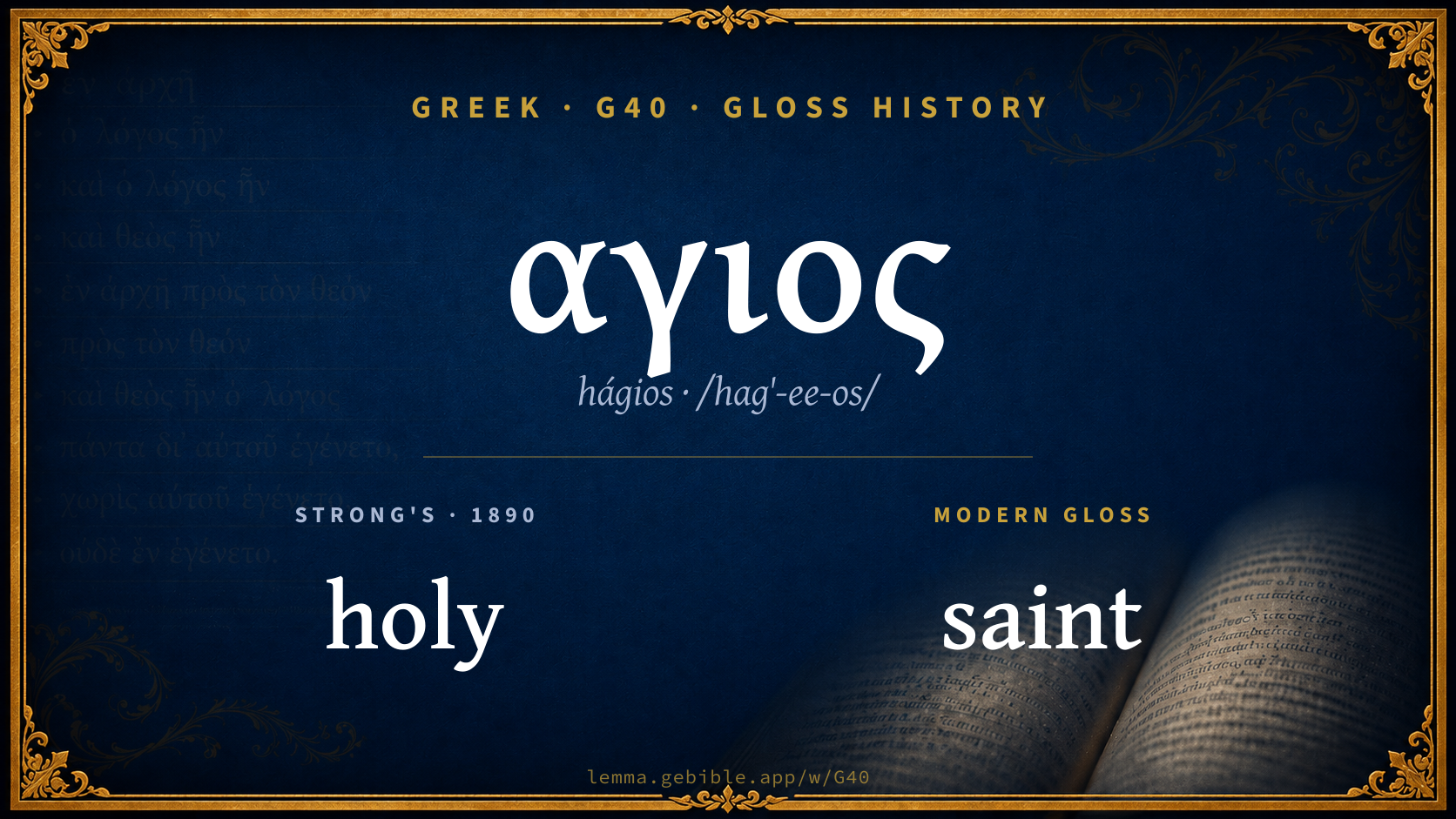
Gloss history
Strong's 1890 vs modern scholarship
About this word
Strong's G40 catalogs a Greek word from the Greek New Testament.
These counts are not copied from any lexicon or concordance. They are computed here, from the morphology-tagged Greek New Testament. What Lemma adds →
- 221
- distinct verses
- The word appears in 221 distinct verses.
- 23 / 27
- NT books
- The word appears in 23 of 27 New Testament books.
- #68
- by frequency
- Top 100 most frequent Greek words (rank 68 of 5,347 Greek words by occurrence).
View all 221 occurrences in the concordance →
Most concentrated in
- Acts 52 verses 24%
- Revelation 23 verses 10%
- Luke 19 verses 9%
By section of the New Testament
By traditional corpus
Conventional, traditional groupings — biblical authorship is debated, so this is a traditional corpus grouping, not an authorship claim. Some books belong to more than one corpus (Luke is in both the Gospels and the Lukan corpus, and so on), so these shares overlap and need not total 100%. Each figure is a share of the word’s 221 distinct verses.
- Pauline corpus 73 verses · 33%
- Lukan (Luke–Acts) 71 verses · 32%
- Gospels 41 verses · 19%
- Johannine 29 verses · 13%
- Revelation 23 verses · 10%
- Hebrews 17 verses · 8%
- General (Catholic) Epistles 15 verses · 7%
How translations render this word
Counts come from each version’s own published word-to-Strong’s tagging or interlinear alignment — an approximate guide to how each version renders this word, not a word-level alignment the data otherwise carries. Because each total is that version’s own tagged count, the per-version totals vary from one another and need not match the appearance or distinct-verse counts above. These counts may also differ from a printed concordance because Lemma counts each distinctly tagged rendering and does not collapse phrase taggings into a single head-word total. This is a fixed set of word-tagged versions (KJV, ASV, BSB, ULT) and does not change with the reading translation you choose elsewhere. Each version’s license is shown beside its name below (and on Sources).
- King James Version: Holy 150×, Saints 58×, Holy one 4×
- American Standard Version: Holy 139×, Saints 55×, Is holy 5×
- Berean Standard Bible: Holy 157×, Saints 60×, Holy place 5×
- unfoldingWord Literal Text: Holy 159×, Saints 60×, Places 6×
King James Version Public Domain
Renders G40 across 229 tagged occurrences — most commonly:
Plus 8 renderings that appear only once — usually multi-word phrases or single function words the recovered tagging swept in, not distinct renderings.
American Standard Version Public Domain
Renders G40 across 227 tagged occurrences — most commonly:
Plus 16 renderings that appear only once — usually multi-word phrases or single function words the recovered tagging swept in, not distinct renderings.
Berean Standard Bible Public Domain
Renders G40 across 231 tagged occurrences — most commonly:
Plus 4 renderings that appear only once — usually multi-word phrases or single function words the recovered tagging swept in, not distinct renderings. Not rendered by a distinct English word in 2 further occurrences.
unfoldingWord Literal Text CC BY-SA 4.0
Renders G40 across 250 tagged occurrences — most commonly:
Plus 6 renderings that appear only once — usually multi-word phrases or single function words the recovered tagging swept in, not distinct renderings.
Senses in Thayer's
The 1 sense Thayer's distinguishes for this word, in lexicon order (not ranked by frequency or importance). The full entry — with sub-senses — is in the Lexicon Entry tab.
- most holy thing, a saint
Word origin
Derived from αγνος (hagnós) (G53) — sacred.
Forms in the corpus
The 19 distinct written forms G40 takes in the Greek New Testament, most frequent first — each parse links to that case’s occurrences in the concordance.
Same root — word family
Other Thayer's entries built from the same root as G40, grouped by Strong’s listed origin. These share a root / origin per the lexicon — not necessarily a shared meaning. Each links to that word’s own entry.
Derives from
Shares the same root
- αγνεια hagneía G47 purity
- αγνιζω hagnízō G48 unclean
- αγνοτης hagnótēs G54 purity
- αγνως hagnōs G55 pure
Derived from this word
- αγιαζω hagiázō G37 to hallow
- αγιον hágion G39 holy
- αγιοτης hagiótēs G41 holiness
- αγιωσυνη hagiōsýnē G42 holiness
- αγνος hagnós G53 sacred
Compare all same-root words → Showing 4 of 10 — not the complete family. They share a root, not necessarily a meaning.
Septuagint usage
The same Greek word αγιος appears 634 times in the Greek Old Testament (Septuagint), across 531 verses in 32 books.
- 634
- LXX occurrences
- Tagged occurrences of this Greek word in the Septuagint.
- 531
- verses
- Distinct Septuagint verses containing this word.
- 32 / 39
- OT books
- The word appears in 32 of the 39 Old Testament books.
Sample Septuagint occurrences
- Exodus 3:5 ἅγιος
- Leviticus 2:3 ἅγιος
- Numbers 3:28 ἅγιος
- Deuteronomy 7:6 ἅγιος
- Joshua 5:15 ἅγιος
- Judges 13:7 ἅγιος
- 1 Samuel 2:2 ἅγιος
- 1 Kings 6:16 ἅγιος
- 2 Kings 4:9 ἅγιος
- 1 Chronicles 6:34 ἅγιος
- 2 Chronicles 3:8 ἅγιος
- Ezra 2:63 ἅγιος
Septuagint occurrences (same lexeme)
Every verse where the same Strong’s number (G40) appears in the Greek Septuagint — showing the first 50 of 531. Verse text shown in the World English Bible for context; the Greek form is the matched word — the English is not keyword-highlighted.
- Exodus 3:5 ἅγιος He said, "Don't come close. Take off your sandals from off your feet, for the place you are standing on is holy ground."
- Exodus 12:16 ἅγιος In the first day there shall be to you a holy convocation, and in the seventh day a holy convocation; no manner of work shall be done in them, except that which every man must eat, that only may be done by you.
- Exodus 15:11 ἅγιος Who is like you, Yahweh, among the gods? Who is like you, glorious in holiness, Fearful in praises, doing wonders?
- Exodus 15:13 ἅγιος "You, in your loving kindness, have led the people that you have redeemed. You have guided them in your strength to your holy habitation.
- Exodus 16:23 ἅγιος He said to them, "This is that which Yahweh has spoken, 'Tomorrow is a solemn rest, a holy Sabbath to Yahweh. Bake that which you want to bake, and boil that which you want to boil; and all that remains over lay up for yourselves to be kept until the morning."
- Exodus 19:6 ἅγιος and you shall be to me a kingdom of priests, and a holy nation.' These are the words which you shall speak to the children of Israel."
- Exodus 22:30 ἅγιος You shall do likewise with your oxen and with your sheep. Seven days it shall be with its mother, then on the eighth day you shall give it me.
- Exodus 23:22 ἅγιος But if you indeed listen to his voice, and do all that I speak, then I will be an enemy to your enemies, and an adversary to your adversaries.
- Exodus 26:33 ἅγιος You shall hang up the veil under the clasps, and shall bring the ark of the testimony in there within the veil: and the veil shall separate the holy place from the most holy for you.
- Exodus 26:34 ἅγιος You shall put the mercy seat on the ark of the testimony in the most holy place.
- Exodus 28:2 ἅγιος You shall make holy garments for Aaron your brother, for glory and for beauty.
- Exodus 28:3 ἅγιος You shall speak to all who are wise-hearted, whom I have filled with the spirit of wisdom, that they make Aaron's garments to sanctify him, that he may minister to me in the priest's office.
- Exodus 28:4 ἅγιος These are the garments which they shall make: a breastplate, and an ephod, and a robe, and a coat of checker work, a turban, and a sash: and they shall make holy garments for Aaron your brother, and his sons, that he may minister to me in the priest's office.
- Exodus 28:29 ἅγιος Aaron shall bear the names of the children of Israel in the breastplate of judgment on his heart, when he goes in to the holy place, for a memorial before Yahweh continually.
- Exodus 28:30 ἅγιος You shall put in the breastplate of judgment the Urim and the Thummim; and they shall be on Aaron's heart, when he goes in before Yahweh: and Aaron shall bear the judgment of the children of Israel on his heart before Yahweh continually.
- Exodus 28:35 ἅγιος It shall be on Aaron to minister: and the sound of it shall be heard when he goes in to the holy place before Yahweh, and when he comes out, that he not die.
- Exodus 28:38 ἅγιος It shall be on Aaron's forehead, and Aaron shall bear the iniquity of the holy things, which the children of Israel shall make holy in all their holy gifts; and it shall be always on his forehead, that they may be accepted before Yahweh.
- Exodus 28:43 ἅγιος They shall be on Aaron, and on his sons, when they go in to the tent of meeting, or when they come near to the altar to minister in the holy place; that they don't bear iniquity, and die: it shall be a statute forever to him and to his descendants after him.
- Exodus 29:29 ἅγιος "The holy garments of Aaron shall be for his sons after him, to be anointed in them, and to be consecrated in them.
- Exodus 29:30 ἅγιος Seven days shall the son who is priest in his place put them on, when he comes into the tent of meeting to minister in the holy place.
- Exodus 29:31 ἅγιος "You shall take the ram of consecration, and boil its flesh in a holy place.
- Exodus 29:33 ἅγιος They shall eat those things with which atonement was made, to consecrate and sanctify them: but a stranger shall not eat of it, because they are holy.
- Exodus 29:37 ἅγιος Seven days you shall make atonement for the altar, and sanctify it: and the altar shall be most holy; whatever touches the altar shall be holy.
- Exodus 30:10 ἅγιος Aaron shall make atonement on its horns once in the year; with the blood of the sin offering of atonement once in the year he shall make atonement for it throughout your generations. It is most holy to Yahweh."
- Exodus 30:13 ἅγιος They shall give this, everyone who passes over to those who are numbered, half a shekel after the shekel of the sanctuary; (the shekel is twenty gerahs;) half a shekel for an offering to Yahweh.
- Exodus 30:24 ἅγιος and of cassia five hundred, after the shekel of the sanctuary; and a hin of olive oil.
- Exodus 30:25 ἅγιος You shall make it a holy anointing oil, a perfume compounded after the art of the perfumer: it shall be a holy anointing oil.
- Exodus 30:29 ἅγιος You shall sanctify them, that they may be most holy. Whatever touches them shall be holy.
- Exodus 30:31 ἅγιος You shall speak to the children of Israel, saying, 'This shall be a holy anointing oil to me throughout your generations.
- Exodus 30:32 ἅγιος It shall not be poured on man's flesh, neither shall you make any like it, according to its composition: it is holy. It shall be holy to you.
- Exodus 30:35 ἅγιος and you shall make incense of it, a perfume after the art of the perfumer, seasoned with salt, pure and holy:
- Exodus 30:36 ἅγιος and you shall beat some of it very small, and put some of it before the testimony in the tent of meeting, where I will meet with you. It shall be to you most holy.
- Exodus 31:11 ἅγιος the anointing oil, and the incense of sweet spices for the holy place: according to all that I have commanded you they shall do."
- Exodus 31:14 ἅγιος You shall keep the Sabbath therefore; for it is holy to you. Everyone who profanes it shall surely be put to death; for whoever does any work therein, that soul shall be cut off from among his people.
- Exodus 31:15 ἅγιος Six days shall work be done, but on the seventh day is a Sabbath of solemn rest, holy to Yahweh. Whoever does any work on the Sabbath day shall surely be put to death.
- Exodus 35:2 ἅγιος 'Six days shall work be done, but on the seventh day there shall be a holy day for you, a Sabbath of solemn rest to Yahweh: whoever does any work in it shall be put to death.
- Exodus 35:19 ἅγιος the finely worked garments, for ministering in the holy place, the holy garments for Aaron the priest, and the garments of his sons, to minister in the priest's office.'"
- Exodus 35:21 ἅγιος They came, everyone whose heart stirred him up, and everyone whom his spirit made willing, and brought Yahweh's offering, for the work of the tent of meeting, and for all of its service, and for the holy garments.
- Exodus 35:35 ἅγιος He has filled them with wisdom of heart, to work all manner of workmanship, of the engraver, of the skillful workman, and of the embroiderer, in blue, in purple, in scarlet, and in fine linen, and of the weaver, even of those who do any workmanship, and of those who make skillful works.
- Exodus 36:1 ἅγιος "Bezalel and Oholiab shall work with every wise-hearted man, in whom Yahweh has put wisdom and understanding to know how to work all the work for the service of the sanctuary, according to all that Yahweh has commanded."
- Exodus 36:3 ἅγιος and they received from Moses all the offering which the children of Israel had brought for the work of the service of the sanctuary, with which to make it. They brought yet to him freewill-offerings every morning.
- Exodus 36:4 ἅγιος All the wise men, who performed all the work of the sanctuary, each came from his work which they did.
- Exodus 36:6 ἅγιος Moses gave commandment, and they caused it to be proclaimed throughout the camp, saying, "Let neither man nor woman make anything else for the offering for the sanctuary." So the people were restrained from bringing.
- Exodus 36:8 ἅγιος All the wise-hearted men among those who did the work made the tent with ten curtains; of fine twined linen, blue, purple, and scarlet, with cherubim, the work of the skillful workman, they made them.
- Exodus 36:37 ἅγιος He made a screen for the door of the tent, of blue, purple, scarlet, and fine twined linen, the work of an embroiderer;
- Exodus 38:25 ἅγιος The silver of those who were numbered of the congregation was one hundred talents, and one thousand seven hundred seventy-five shekels, after the shekel of the sanctuary:
- Exodus 39:1 ἅγιος Of the blue, purple, and scarlet, they made finely worked garments, for ministering in the holy place, and made the holy garments for Aaron; as Yahweh commanded Moses.
- Exodus 39:3 ἅγιος They beat the gold into thin plates, and cut it into wires, to work it in the blue, in the purple, in the scarlet, and in the fine linen, the work of the skillful workman.
- Exodus 39:12 ἅγιος and the third row, a jacinth, an agate, and an amethyst;
- Exodus 39:18 ἅγιος The other two ends of the two braided chains they put on the two settings, and put them on the shoulder-pieces of the ephod, in the front of it.
These are occurrences of the same Greek lexeme (G40) in the Septuagint — not a translation of any one Hebrew word. The store carries no word-level Hebrew↔Greek alignment, so no Hebrew original is asserted here. Counts come from the recovered LXX Strong's tagging — high-frequency vocabulary is well covered, while rare or late forms may be untagged — so they reflect tagged occurrences and may slightly undercount.