Ephesians 2:21

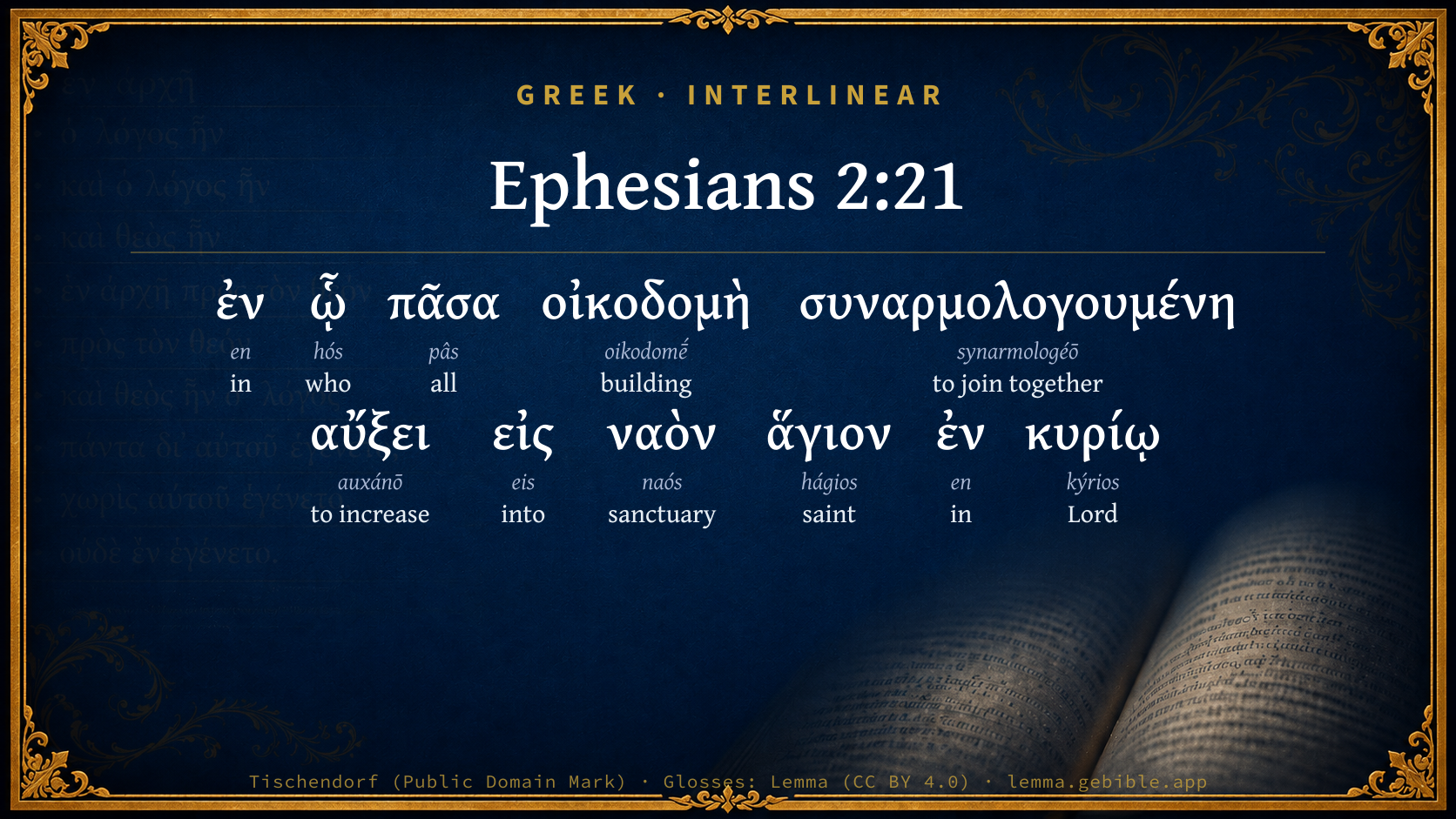
Greek (Tischendorf 8th ed.) Ephesians 2:21 appears in the Greek New Testament. The text above is from the Tischendorf 8th edition. Each word links to its Strong’s number and a concise gloss. Click any word for its full Thayer’s Greek Lexicon entry.
Download image
Cite this verse

Ephesians 2:21 (World English Bible). Public Domain. Lemma interlinear Bible study tool, https://lemma.gebible.app/v/ephesians/2/21.

Show BibTeX & RIS
BibTeX
RIS
English Translation
in whom the whole building, fitted together, grows into a holy temple in the Lord;
World English Bible · Public Domain
Highlights
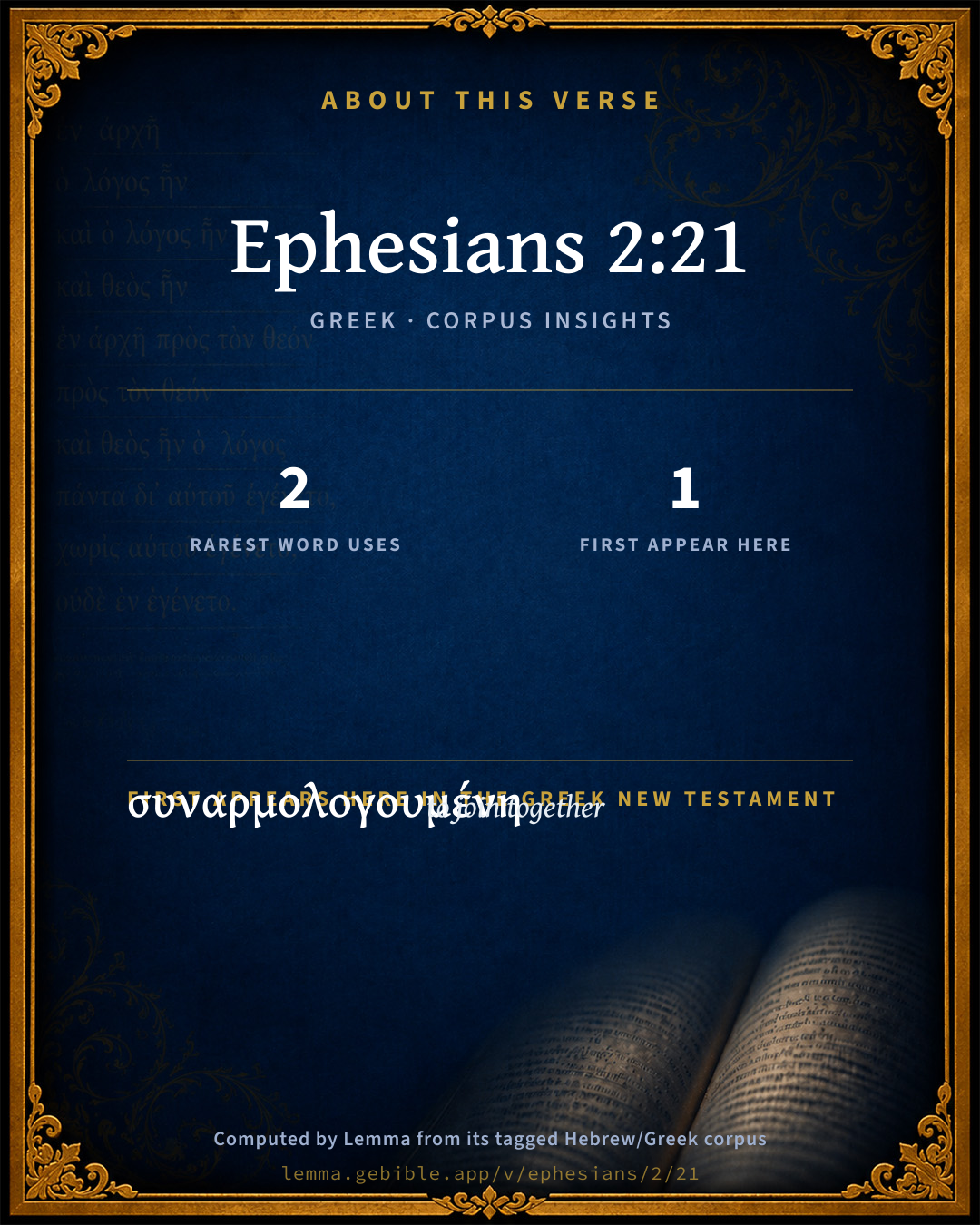
  • 1 first appearance in the Greek New Testament
Full analysis ↓
Download a study sheet

One document with this verse’s original text, its word-by-word gloss line, the meaning frame, cross-references with their text, attributed commentary, and full source and license credits — printable, and it pastes into notes with its structure intact.

This verse Autodidact and up

Study sheet (.html) Plain text (.txt)

A passage Seminary Student

Up to 50 verses in one chapter. A passage sheet keeps up to 6 commentary sources and 12 cross-references per verse, in the order this page ranks them, and says so on the sheet whenever that leaves anything out. Ask for a single verse and you get the Autodidact verse sheet above.

Everything on this page stays free to read, with no account — the sheet is a download of what is already on screen, not access to it.

Want to remove ads? Support Godless Engineer
Compare translations 3

The same verse in 3 English versions, stacked beneath the original-language interlinear above. Click any original word for its lexicon entry.

Each is an independent rendering of the whole verse — the interlinear is not word-aligned to these translations.

Highlighted words mark where these versions differ — a whole-verse word diff, not a word-by-word alignment.

  • World English Bible Public Domain
    in whom the whole building, fitted together, grows into a holy temple in the Lord;
  • King James Version Public Domain
    In whom all the building fitly framed together groweth unto an holy temple in the Lord:
  • unfoldingWord Literal Text CC BY-SA 4.0
    in whom the whole building, being fit together, grows into a holy temple in the Lord,

unfoldingWord Literal Text — © unfoldingWord, licensed CC BY-SA 4.0. Word-aligned USFM3 via Door43 (git.door43.org/unfoldingWord/en_ult).

Versions to compare (up to 4)

3 of 4 selected

Show all 19 translations

Every available English version of this verse, each an independent rendering of the whole verse.

  • World English Bible Public Domain
    in whom the whole building, fitted together, grows into a holy temple in the Lord;
  • Berean Standard Bible Public Domain
    In Him the whole building is fitted together and grows into a holy temple in the Lord.
  • Majority Standard Bible Public Domain
    In Him the whole building is fitted together and grows into a holy temple in the Lord.
  • King James Version Public Domain
    In whom all the building fitly framed together groweth unto an holy temple in the Lord:
  • American Standard Version (1901) Public Domain
    in whom each several building, fitly framed together, groweth into a holy temple in the Lord;
  • Revised Version (1885) Public Domain
    in whom each several building, fitly framed together, groweth into a holy temple in the Lord;
  • Geneva Bible (1599) Public Domain
    In whom all the building coupled together, groweth vnto an holy Temple in the Lord.
  • Douay-Rheims (1899) Public Domain
    In whom all the building, being framed together, groweth up into an holy temple in the Lord.
  • Young's Literal Translation Public Domain
    in whom all the building fitly framed together doth increase to an holy sanctuary in the Lord,
  • Literal Standard Version CC BY-SA 4.0
    in whom all the building fitly framed together increases to a holy temple in the LORD,
  • Unlocked Literal Bible CC BY-SA 4.0
    In him the whole building fits together and grows as a temple in the Lord.
  • unfoldingWord Literal Text CC BY-SA 4.0
    in whom the whole building, being fit together, grows into a holy temple in the Lord,
  • Darby Bible Public Domain
    in whom all [the] building fitted together increases to a holy temple in the Lord;
  • World Messianic Bible Public Domain
    in whom the whole building, fitted together, grows into a holy temple in the Lord;
  • Webster's Bible Public Domain
    In whom all the building fitly framed together, groweth to a holy temple in the Lord:
  • Free Bible Version CC BY-SA 4.0
    In him the whole building is joined together, growing to form a holy temple for the Lord.
  • Bible in Basic English Public Domain
    In whom all the building, rightly joined together, comes to be a holy house of God in the Lord;
  • Text-Critical English NT CC BY 4.0
    In him the whole building is joined together and rises to become a holy temple in the Lord.
  • Tyndale New Testament (1534) Public Domain
    in whom every bildynge coupled togedder groweth vnto an holy temple in the lorde

Literal Standard Version (2020), Covenant Press — licensed CC BY-SA 4.0. Text via the HelloAO Bible API (eBible.org). Unlocked Literal Bible (unfoldingWord) — licensed CC BY-SA 4.0. Text via the HelloAO Bible API (eBible.org). unfoldingWord Literal Text — © unfoldingWord, licensed CC BY-SA 4.0. Word-aligned USFM3 via Door43 (git.door43.org/unfoldingWord/en_ult). Free Bible Version, Dr. Jonathan Gallagher — licensed CC BY-SA 4.0. Text via the HelloAO Bible API (eBible.org).

Word by word

More ways to search: Search by grammar → Find every occurrence → Compare this word →

Practice this passage: Drill this verse → Learn its vocabulary →

συναρμολογουμένη
synarmologéō
G4883
“to join together”
Verb, Present, Passive, Participle, Nominative, Singular, Feminine
Part of Speech
Verb
Tense
Present
Voice
Passive
Mood
Participle
Case
Nominative
Number
Singular
Gender
Feminine
Full Thayer's Definition

Origin: from G4862 and a derivative of a compound of G719 and G3004 (in its original sense of laying)

TDNT: 21:15,1

1. to join closely together 2. to frame together a. parts of a building b. the members of the body
  1. ἐν en G1722 “in” Preposition
  2. ᾧ hós G3739 “who” Relative pronoun, Dative, Singular, Masculine
  3. πᾶσα pâs G3956 “all” Adjective, Nominative, Singular, Feminine
  4. οἰκοδομὴ oikodomḗ G3619 “building” Noun, Nominative, Singular, Feminine
  5. αὔξει auxánō G837 “to increase” Verb, Present, Active, Indicative, 3rd person, Singular
  6. εἰς eis G1519 “into” Preposition
  7. ναὸν naós G3485 “sanctuary” Noun, Accusative, Singular, Masculine
  8. ἅγιον hágios G40 “saint” Adjective, Accusative, Singular, Masculine
  9. ἐν en G1722 “in” Preposition
  10. κυρίῳ kýrios G2962 “Lord” Noun, Dative, Singular, Masculine

About this verse

These counts appear in no published source. They are computed here, from the morphology-tagged text and Lemma’s own curated glosses. What Lemma adds →

11
words
10
distinct lemmas
Pauline Epistles
section

Notable vocabulary

The rarest word here is συναρμολογουμένη to join together G4883 — appearing just 2 times in the whole Greek New Testament.

First appearance in Scripture

This word makes its first canonical appearance in the Greek New Testament here:

  • συναρμολογουμένη to join together G4883

Shared distinctive vocabulary

συναρμολογουμένη to join together G4883 occurs in 2 verses of the Greek New Testament. Also found in:

Repetition

A word recurs within this verse:

Cross-references

10

Topical passages linked to Ephesians 2:21 in the Treasury of Scripture Knowledge — connected by theme and wording, ordered by reader-vote popularity; previews shown in the World English Bible.

  • 1 Corinthians 3:16–17 Don't you know that you are a temple of God, and that God's Spirit lives in you?
  • 1 Corinthians 3:9 For we are God's fellow workers. You are God's farming, God's building.
  • 2 Corinthians 6:16 What agreement has a temple of God with idols? For you are a temple of the living God. Even as God said, "I will dwell in them, and walk in them; and I will be their God, and they will be my people."
  • Ephesians 4:13–16 until we all attain to the unity of the faith, and of the knowledge of the Son of God, to a full grown man, to the measure of the stature of the fullness of Christ;
  • 1 Kings 6:7 The house, when it was in building, was built of stone made ready at the quarry; and there was neither hammer nor axe nor any tool of iron heard in the house, while it was in building.
  • Hebrews 3:3–4 For he has been counted worthy of more glory than Moses, inasmuch as he who built the house has more honor than the house.
  • Exodus 26:1–37 "Moreover you shall make the tent with ten curtains; of fine twined linen, and blue, and purple, and scarlet, with cherubim. The work of the skillful workman you shall make them.
  • Psalms 93:5 Your statutes stand firm. Holiness adorns your house, Yahweh, forevermore.
  • Ezekiel 42:12 According to the doors of the chambers that were toward the south was a door at the head of the way, even the way directly before the wall toward the east, as one enters into them.
  • Ezekiel 40:1–42 In the five and twentieth year of our captivity, in the beginning of the year, in the tenth [day] of the month, in the fourteenth year after that the city was struck, in the same day, the hand of Yahweh was on me, and he brought me there.

Cross-references courtesy of OpenBible.info (CC BY 4.0).

Commentary

Notes on Ephesians 2:21 from classic Christian and Jewish commentators (each source and its license shown beneath its notes). The classic Christian expositions comment on the surrounding passage and are grouped to its opening verse, so a note may address several verses; the Jewish commentaries on the Tanakh (Rashi and others) are per-verse, so they appear only where the commentator wrote on this verse.

Lemma curates 59 commentaries, every one of them public domain or Creative Commons licensed, each selected and text-cleaned for this edition rather than reprinted as found. About our sources →

Tyndale Open Study Notes

Tyndale Open Resources

2:21 Joined together in Christ, Gentile and Jewish Christians become a holy temple for the Lord, because the Lord himself is among his people (see Matt 18:20; 28:20; 1 Cor 3:16; 1 Pet 2:4-5).

Tyndale Open Study Notes — © Tyndale Open Resources, licensed CC BY-SA 4.0. Text via the HelloAO Bible API.

Bengel's Gnomon

Johann Albrecht Bengel

Eph 2:21. Ἐν ᾧ, in whom) In Christ. This, by Anaphora [repetition to mark beginnings], is repeated in the following verse.—συναρμολογουμένη αὔξει, fitly framed together, groweth) Words that have relation to a living mass, ch. Eph 3:18, note; and 1Pe 2:5. So συναρμολογούμενον, fitly joined together, ch. Eph 4:16.[38] So the branch and the house are combined, Zec 6:12.—ναὸν, a temple) It is a house, and that too a holy house, to which the temple of Diana of Ephesus must yield.—ἅγιον, holy) i.e. of God, Eph 2:22 [which answers to ἅγιον, Eph 2:21].—ἘΝ ΚΥΡΊῼ, in the Lord) in Christ. To this expression [Eph 2:21], the words, [through or] in the Spirit, correspond in Eph 2:22. So also ch. Eph 3:17; Eph 3:16.

[38] It occurs nowhere else in New Test. The two images here are combined of a building and of a living growing organism.—ED.

—————

Bengel's Gnomon of the New Testament — English translation (T&T Clark, Edinburgh, 1860) — public domain. Text from a community e-Sword module.

Meyer's Critical & Exegetical Commentary

Heinrich August Wilhelm Meyer

Eph_2:21. An elucidation to ὄντος ἀκρογ. αὐτοῦ Ἰ. Χ., bearing on the matter in hand, and placing in yet clearer light the thought of Eph_2:19 f.; in whom each community, in whom also yours (Eph_2:22), organically developes itself unto its holy destination.[161]

ἐν ᾧ] means neither by whom (Castalio, Vatablus, Menochius, Morus, and others, including Flatt), nor upon whom (Estius, Koppe, and others), but: in whom, so that Christ (for ᾧ applies neither to ἀκρογ., as Castalio, Estius, and Koppe suppose, nor to τῷ θεμελίῳ, as Holzshausen would have it, but to the nearest and emphatic αὐτοῦ Ἰησοῦ Χ.) appears as that wherein the joining together of the building has its common point of support (comp. Eph_1:10).

πᾶσα οἰκοδομή] not: the whole building (Oecumenius, Harless, Olshausen, Baumgarten-Crusius, de Wette, Bleek), which would be at variance with linguistic usage, and would absolutely require the reading (on that account preferred by Matthies, Winer, and others) πᾶσα ἡ οἰκοδομή (see the critical remarks), but: every building. The former interpretation, moreover, the opposition of which to linguistic usage is rightly urged also by Reiche,[162] is by no means logically necessary, since Paul was not obliged to proceed from the conception of the whole body of Christians to the community of the readers (Eph_2:22), but might pass equally well from the conception every community to the conception also ye (Eph_2:22), and thus subordinate the particular to the general. The objection that there is only one οἰκοδομή (de Wette) is baseless, since the collective body of Christians might be just as reasonably, as every community for itself, conceived as a temple-building. The latter conception is found, as in 1Co_3:16, so also here, where the former is linguistically impossible. Chrysostom, however, is wrong in holding that by πᾶσα οἰκοδ. is signified every part of the building (wall, roof, etc.), since οἰκοδομή rather denotes the aggregate of the single parts of the building, the edifice, and since not a wall, a roof, etc., but only the building as a whole which is thought of, can grow unto a temple.

συναρμολ.] becoming framed together; for the present participle represents the edifice as still in the process of building, as indeed every community is engaged in the progressive development of its frame of Christian life until the Parousia (comp. on 1Co_3:15). The participle is closely connected with ἐν ᾧ: every building, while its framing together, i.e. the harmonious combination of its parts into the corresponding whole, takes place in Christ, grows, etc. The compound συναρμολογεῖν (with classical writers συναρμόζειν) is met with only here and Eph_4:16, but ἁρμολογεῖν in Philipp. Thess. 78.

αὔξει] On this form of the present, read in the N.T. only here and at Col_2:19, but genuinely classical, see Matthiae, p. 541.

εἰς ναὸν ἅγιον] Final result of this growth. It is not, however, to be translated: unto a holy temple, for the conception of several temples was foreign to the apostle with his Jewish nationality, but: unto the holy temple, in which there was no need of the article (see on 1Co_3:16). To realize the idea of the one templethat is the goal unto which every community, while its organic development of life has its firm support in Christ, groweth up.

ἐν κυρίῳ] By this not God is meant, as Michaelis, Koppe, Rosenmüller, Holzshausen, and others suppose, but Christ (see the following ἐν ᾧ). By the majority it is connected with ἅγιον, in which case it would not have, with Beza, Koppe, Rosenmüller, Flatt, to be taken for the dative, but (so also de Wette, Hofmann, Bleek) would have to be explained of the ἁγιότης of the temple, having its causal ground in Christ, thus specifically Christian. But the holiness of the temple lies in the dwelling of God therein (see Eph_2:22); it does not, therefore, first come into existence in Christ, but is already existent, and the church becomes in Christ that which the holy temple is, inasmuch as in this church the idea of the holy temple realizes itself. Others have rightly, therefore, connected it with αὔξει, although ἐν is not, with Grotius, Wolf, et al., to be translated by per. In the case of every building which is framed together in Christ, the growing into the holy temple takes place also in Christ (as the one on whom this further development depends). The being framed together and the growing up of the building to its sacred destinationboth not otherwise than in the Lord.

[161] Observe the apostles view of the church, as a whole and in its single parts, as one living organism. Comp. Thiersch, die Kirche im apost. Zeitalt. p. 154, 162; Ehrenfeuchier, prakt. Theol. I. p. 55 ff.

[162] The admissibility of the anarthrous form πᾶσα αἰκοδομή, in the sense of the whole building, cannot be at all conceded, since οἰκοδομή is neither a proper name, nor to be regarded as equivalent to such. See Winer, p. 101 [E. T. 140]; Buttmann, neut. Gram. p. 78 [E. T. 86]. In general πᾶς in the sense of whole can only be without an article, when the substantive to which it belongs would not need the article even without πᾶς (Krüger, § 50, 11. 9). Hence πᾶσα οἰκοδ. can only signify either every building, or else a building utterly. In the latter sense Chrysostom appears, very unsuitably, no doubt (see above), to have taken it. According to Hofmann, II. 2, p. 123, πᾶσα οἰκοδ. is meant to signify whatever becomes a constituent part of a building (thus also the Gentiles who become Christians). As if οἰκοδομή could mean constituent part of a building! It signifies, even in Mat_24:1, Mar_13:1 f., edifice. And as if πᾶσα, every part of the building, when in fact only two constituent parts, namely Jews and Gentiles, could be thought of, were in harmony with this relation! The rendering is linguistically and logically incorrect.

Meyer — Critical and Exegetical Commentary on the New Testament — English translation by Peter Christie, edited by Frederick Crombie (T&T Clark, 1880) — public domain. Text from a community e-Sword module.

Expositor's Greek Testament

ed. W. Robertson Nicoll

Eph 2:21 . ἐν ᾧ πᾶσα ἡ οἰκοδομὴ συναρμολογουμένη αὔξει εἰς ναὸν ἅγιον ἐν Κυρίῳ : in whom each several building (RV text; “every building,” RV marg.), fitly framed together, groweth into a holy temple in the Lord . The relative refers naturally to the nearest subject, what is also the leading subject, Χριστῷ Ἰησοῦ , not to the ἀκρογωνιαίου , far less to the remoter θεμελίῳ ; the ἐν also has its full sense of in , not by or on . That is to say, it is in Christ Jesus , and only by connection with Him, that the οἰκοδομή is what it is here declared to be. The word οἰκοδομή appears to be confined to late Greek, no certain instance of it having been found in classical Greek. It occurs in Diod., Philo, Plut., Joseph., the LXX, Macc., etc. It is used both for οἰκοδόμησις and οἰκοδόμημα . In the NT it has sometimes the literal sense of οἰκοδόμημα ( e.g. , Mat 24:1 ; Mar 13:1 ; 2Co 5:1 ); and sometimes the figurative sense of edification (Rom 14:19 ; Rom 15:2 ; 2Co 13:10 ; Eph 4:20 ), or, as here, that of a body of Christian believers . The question of the text here is important. There is considerable support for πᾶσα ἡ οἰκοδομή ( [188] [189] [190] , Arm., etc.), and it is conceivable that itacism might have caused the omission of the ἡ . But diplomatic evidence is decidedly in favour of πᾶσα οἰκοδομή ( [191] [192] [193] [194] [195] [196] [197] , etc.). Adopting this reading (with LTTrWHRV) we have to ask whether the phrase is to be rendered the whole building or every building . The former rendering is certainly the one that first suggests itself, while the latter seems at first difficult to relate to the context. The former is defended as legitimate by some weighty authorities; e.g. , Winer, on the ground that the subject is “the Church of Christ as a whole,” and Ellicott, who takes it to be a case of grammatical laxity. But the distinction between πᾶς with the article and πᾶς without it is so well maintained in the NT that only an absolutely intolerable sense can justify us in departing from it. The only exceptions to the general rule appear to be those that hold good also for ordinary Greek in general and unqualified statements, with proper names, and with nouns which have acquired so stated a meaning that they can drop the article, etc. ( cf. Win.-Moult., p. 138, and especially Buttm., Gram. of N. T. Greek , pp. 119, 120; Blass, Gram. of N. T. Greek , pp. 161, 162). The present instance does not come within the scope of these exceptions. It is not like πᾶς οἶκος Ἰσραήλ (Act 2:36 ), nor is it really analogous even to such cases as the πᾶσα γῆ of Thucyd., ii., 43, or the πᾶσα ἐπιστολή of Ignat., Eph. , 12. Hence the rendering here must be “every building” or “every several building”. The present participle συναρμολογουμένη (the verb occurs in the NT only here and in Eph 4:16 , and corresponds to the classical συναρμόζειν ) describes the joining together as a process now going on. The pres. αὔξει (a form occurring in the NT only here and in Col 2:19 , but common in Soph., Thucyd., Pind., etc.) in like manner expresses what is happening now, or, it may be, what is normal . The phrase νάον ἅγιον is sufficiently rendered “ a holy temple” or “sanctuary”. Some ( e.g. , Mey.), supposing that Paul has the Jewish temple in view and means to say that the Christian Church is now the true Temple of God, the house made His own sanctuary by His dwelling in it, would render it “ the holy temple”. The ἐν Κυρίῳ is connected by some (Harl., etc.) immediately with ἅγιον , = a temple that is holy as being in the Lord; by others with ναὸν ἅγιον (Ell.); by others with αὔξει (Mey.). But it really qualifies the whole statement of the joining and growing . All this is in the Lord, i.e., in Christ , as both the context and the general NT application of Κύριος show. The sense of the whole, therefore, is this in Christ the Lord every several building that goes to make up the ideal Temple of God, every Christian community, the one now addressed not less than others, is at present being surely framed and fitted together, and is growing and harmoniously developing so that it may form part of the great mystical Body of Christ, the vast spiritual fellowship of believers which is God’s true Temple.

[188] Codex Sinaiticus (sæc. iv.), now at St. Petersburg, published in facsimile type by its discoverer, Tischendorf, in 1862.

[189] Codex Alexandrinus (sæc. v.), at the British Museum, published in photographic facsimile by Sir E. M. Thompson (1879).

[190] Codex Ephraemi (sæc. v.), the Paris palimpsest, edited by Tischendorf in 1843.

[191] Codex Vaticanus (sæc. iv.), published in photographic facsimile in 1889 under the care of the Abbate Cozza-Luzi.

[192] Autograph of the original scribe of א .

[193] Autograph of the original scribe of א .

[194] Codex Claromontanus (sæc. vi.), a Græco-Latin MS. at Paris, edited by Tischendorf in 1852.

[195] Codex Boernerianus (sæc. ix.), a Græco-Latin MS., at Dresden, edited by Matthæi in 1791. Written by an Irish scribe, it once formed part of the same volume as Codex Sangallensis ( δ ) of the Gospels. The Latin text, g, is based on the O.L. translation.

[196] Codex Mosquensis (sæc. ix.), edited by Matthæi in 1782.

[197] Codex Angelicus (sæc. ix.), at Rome, collated by Tischendorf and others.

The Expositor's Greek Testament, edited by W. Robertson Nicoll (1897–1910) — public domain. Text from a community e-Sword module.

Hodge's Commentary on Romans, Ephesians & First Corinthians

Charles Hodge

Eph_2:21

Christ being the cornerstone, everything depends on union with him. Therefore the apostle adds, In whom all the building fitly framed together groweth unto a holy temple in the Lord. Christ is the principle at once of support and of growth. He not only sustains the building, but carries it on to its consummation. The words ἐν ᾧ are not to be rendered, on which, referring to the foundation, but, in whom, referring to Christ. Union with him is the sole essential condition of our being parts of that living temple of which he is the cornerstone.

The words πᾶσα ἡ οἰκοδομὴ, even without the article, which, because wanting in the oldest manuscripts, many critics omit, must here mean the whole, and not every building. It would destroy the whole consistency of the figure to represent every congregation, as a temple by itself resting on Christ as the cornerstone. Christ has but one body, and there is but one temple composed of Jews and Gentiles, in which God dwells by his Spirit.

All the parts of this temple are fitly framed together, συναρμολογουμένη. Intimate union by faith with Christ is the necessary condition of the increase spoken of immediately afterwards. The building however is not only thus united with the cornerstone, but the several parts one with another, so as to constitute a well compacted whole. This union, as appears from the nature of the building, is not external and visible, as a worldly kingdom under one visible head, but spiritual.

Groweth unto a holy temple, αὔξει εἰς ναὸν ἅγιον, i.e. increases so as to become a holy temple. A temple is a building in which God dwells. Such a temple is holy, as sacred to him. It belongs to him, is consecrated to his use, and can neither be appropriated by any other, nor used for anything but his service, without profanation. This is true of the church as a whole, and of all its constituent members. The moneychangers of the world cannot, with impunity, make the church a place of traffic, or employ it in any way to answer their sordid or secular ends. The church does not belong to the state, and cannot lawfully be controlled by it. It is sacred, set apart for God. It is his house in which he alone has any authority.

The words ἐν Κυρίῳ, in the Lord, at the end of this verse, admit of different constructions. They may be connected with the word temple immediately preceding, and be taken as equivalent to the genitive Temple in the Lord, for Temple of the Lord. But as the word Lord must refer to Christ, and as the temple is the house of God, this explanation produces confusion. They may be connected with the word holy; holy in the Lord, i.e. holy in virtue of union with the Lord, which gives a very good sense. Or they may be referred to the verb, Grows by, or better, in union with the Lord. This has in its favor the parallel passage, Eph_4:16. The church compacted together in him, grows in him, in virtue of that union, into a holy temple.

Charles Hodge — Commentary on Romans (1835), First Corinthians (1857), and Ephesians (1856) — public domain. Text from a community e-Sword module.

Geneva Bible (1599)

Geneva Bible translators

So that God is the workman not only of the foundation, but also of the whole building.

Geneva Bible (1599) marginal notes — public domain. Text via Bolls.life.

Jamieson, Fausset & Brown

Robert Jamieson, A. R. Fausset & David Brown

In whom--as holding together the whole.

fitly framed--so as exactly to fit together.

groweth--"is growing" continually. Here an additional thought is added to the image; the Church has the growth of a living organism, not the mere increase of a building. Compare Pe1 2:5; "lively stones . . . built up a spiritual house." Compare Eph 4:16; Zac 6:12, "The Branch shall build the temple of the Lord," where similarly the growth of a branch, and the building of a temple, are joined.

holy--as being the "habitation of God" (Eph 2:22). So "in the Lord" (Christ) answers to "through the Spirit" (Eph 2:22; compare Eph 3:16-17). "Christ is the inclusive Head of all the building, the element in which it has its being and now its growth" [ALFORD].

Jamieson, Fausset & Brown — Commentary Critical and Explanatory on the Whole Bible (1871) — public domain (CC PDM 1.0). Text via the HelloAO Bible API.

Adam Clarke's Commentary

Verse 21. In whom] By which foundation corner stone, Christ Jesus, all the building, composed of converted Jews and Gentiles, fitly framed together, συναρμολογουμενη, properly jointed and connected together, groweth unto a holy temple-is continually increasing, as new converts from Judaism or heathenism flock into it. It is not a finished building, but will continue to increase, and be more and more perfect, till the day of judgment.

Adam Clarke's Commentary on the Bible (1810–1826) — public domain. Text from a community e-Sword/MySword module.

John Calvin's Commentaries

21. In whom all the building groweth. If this be true, what will become of Peter? When Paul, in writing to the Corinthians, speaks of Christ as a “Foundation,” he does not mean that the church is begun by him and completed by others, but draws a distinction arising out of a comparison of his own labors with those of other men. It had been his duty to found the church at Corinth, and to leave to his successors the completion of the building.

“According to the grace of God which is given to me, as a wise master-builder, I have laid the foundation, and another buildeth on it.” (1 Corinthians 3:10.)

With respect to the present passage, he conveys the instruction, that all who are fitly framed together in Christ are the temple of the Lord. There is first required a fitting together, that believers may embrace and accommodate themselves to each other by mutual intercourse; otherwise there would not be a building, but a confused mass. The chief part of the symmetry consists in unity of faith. Next follows progress, or increase. Those who are not united in faith and love, so as to grow in the Lord, belong to a profane building, which has nothing in common with the temple of the Lord.

Groweth unto an holy temple. Individual believers are at other times called “temples of the Holy Ghost,” (1 Corinthians 6:19; 2 Corinthians 6:16,) but here all are said to constitute one temple. In both cases the metaphor is just and appropriate. When God dwells in each of us, it is his will that we should embrace all in holy unity, and that thus he should form one temple out of many. Each person, when viewed separately, is a temple, but, when joined to others, becomes a stone of a temple; and this view is given for the sake of recommending the unity of the church.

John Calvin's Commentaries (1540-1563) — public domain. Text from the Calvin Translation Society English edition (1840s-50s) via the Christian Classics Ethereal Library (ccel.org). Calvin's coverage is partial (roughly two-thirds of the Bible); uncommented books and verses are honest gaps, never fabricated. The 19th-century editor's footnotes and remarks are omitted so the notes are faithfully Calvin's own voice.

Ellicott's Commentary for English Readers

(21) In whom all the building fitly framed together groweth unto an holy temple in the Lord.—There is some difficulty about the rendering-”all the building.” Generally the best MSS. omit the article in the original. But the sense seems to demand the rendering of the text, unless, indeed, we adopt the only other possible rendering, “in whom every act of building”—that is, every addition to the building—“is bonded to the rest, and grows,” &c. The clause agrees substantially, and almost verbally with Eph_4:16—“From whom the whole body, fitly joined (framed) together and compacted . . . maketh increase of the body unto the edifying (building up) of itself.” In this latter passage the leading idea is of the close union of the body to the head, to which, indeed, the metaphor more properly applies than to the relation of the building to the corner-stone. For we note that St. Paul, apparently finding this relation too slight to express the full truth of the unity of the Church with Christ, first speaks of the whole building as compacted together in the corner-stone, and growing—that is, being gradually built up—in that closely compacted union; and next, calls the temple so built up a “temple holy in the Lord” (i.e., the Lord Jesus Christ), deriving, therefore, all its sacredness as a temple from a pervading unity with Him. The corner-stone is only a part, though a dominant part, of the building. Christ not only “keeps all together, whether you speak of roof, or wall, or any other part whatsoever” (Chrys.), but by contact with Himself makes the building to be a temple.

A Bible Commentary for English Readers, edited by Charles John Ellicott (1878–1897) — public domain. Text from a community e-Sword module.

The Cambridge Bible for Schools and Colleges

gen. ed. J. J. S. Perowne

21. in whom] In close and vital connexion with Whom. See last note.

all the building] R. V., “each several building;” as if the great Temple were viewed for the moment in its multiplicity of porches, courts, and towers; each connected with the great bond of the substructure, in and on which the whole architecture was rising.—An interesting grammatical question arises over the reading here and this rendering, and will occur again Eph_3:15 :—does the Greek phrase, in the best attested reading, demand the rendering of the R. V. as against that of the A. V.? We incline to the reply that it does not. The law of the definite article (the absence of which here occasions the question) is undoubtedly somewhat less exact in the Greek of the Scriptures than in that of the classics. And this leaves us free to use (with caution) the context to decide problems which in the classics would be decided by pure grammar. Such a case we take this to be; and the question to ask is, does the context favour the imagery of detail or that of total? Surely the latter. The idea points to one great building, getting completed within itself, rising to its ideal. We retain accordingly the A. V. See further, next note.

fitly framed together] One word, a present participle, in the Greek. The same occurs below, Eph_4:16 (“fitly joined together”), and nowhere else in N. T. The idea is not of a completed but of a progressive work, a “framing together” of the structure ever more closely and firmly. The building shrinks into greater solidity, binds itself into more intense coherence, as it grows. The spiritual union of the saints needs but to be more believed and realized to tell more on their actual closeness of connexion.—The idea conveyed by this word, which is of course in the singular number, is (see last note) far rather that of one great building growing in internal solidity than of many buildings growing in contact.

groweth] with the perpetual addition of new “living stones” (1Pe_2:5) and the resulting new connexions. Observe two distinct ideas in harmony; growth in compactness, growth in extension.

unto a holy temple] R. V., margin, “into an holy sanctuary.” The Greek (nâos) is not the temple-area with its courts and porches (hiëron), but the temple-house; the place of the Presence.—The phrase, “unto,” “into,” suggests (like that in the next verse) a sanctuary not yet complete and ready for the Presence. The true Church, indeed, is already (1Co_3:16; 2Co_6:16; and cp. 1Co_6:19 of its individual members) “the sanctuary of the living God.” But it is this as a still imperfect thing, and still imperfectly; the absolute and final in the matter is yet to come; and this will so transcend the partial and actual that it is spoken of as if the Indwelling were not yet. We may faintly illustrate by an unfinished cathedral, used already for Divine worship, but not yet ideally prepared for it.—See Rev_21:22 for another side of truth in temple-imagery. There, in the final state, there is “no sanctuary,” for God and the Lamb “are the sanctuary of” the holy City. All, absolutely all, is hallowed by Their Presence indwelling; Sanctuary and Shechinah are, as it were, one; and nothing is there that is not Sanctuary.

Great indeed is the conception in this passage. The saints, in their community “in the Lord,” are preparing, through an Indwelling partial though real, for an Indwelling complete and eternal; the two being, in continuity, one. In no mere figure of speech, their God already “dwells” in their bodies, and in their community; dwells there as in a Sanctuary—in manifested Light, in Peace of covenant and propitiation, in Oracle-speech of “the Spirit’s witness,” in eternal Life. And this precious present fact is germinating to the future result of a heavenly and everlasting Indwelling (likewise in individuals and in community), when the Sanctuary shall reflect without a flaw its Indweller’s glory; when our union and communion with Him, in other words, shall be perfect, absolute, ideal. “We shall be like Him; for we shall see Him as He is.”

in the Lord] The Lord Christ. We have “God” in the next verse, in a way which indicates this distinctive reference here. The imagery leaves the precise idea of the Corner Stone, to present the Lord as the living bond and principle, the secret both of growth and sanctity.

The Cambridge Bible for Schools and Colleges (gen. ed. J. J. S. Perowne; Cambridge University Press, 1878–1918) — public domain. Text from a community e-Sword module.

John Gill's Exposition

In whom all the building fitly framed together,.... This building is to be understood of all the saints, and people of God; of the whole universal church, which is God's building; and is a building of a spiritual nature, and will abide for ever: and this is fitly framed together; it consists of various parts, as a building does; some saints are comparable to beams, some to rafters, others to pillars, &c. and these are joined and united to one another, and are set in an exact symmetry and proportion, and in a proper subserviency to each other; and so as to make for the good, the strength, and beauty of the whole. And it all centres in Christ; he has a great concern in this building; he is the master builder, and the foundation and cornerstone; and it being knit together in him,

groweth unto an holy temple in the Lord: it grows by an accession of new stones, or of souls called by grace, and added to it; for this building is not yet openly and visibly completed, as it will be; in order to which the ministry of the word, and administration of ordinances are continued; and this will be in the latter day, when the number of God's elect, among Jews and Gentiles, shall be gathered in: and this growth may be understood also of an increase of those, who are openly laid in the building; of their spiritual growth into their head, Christ; and of an, increase of grace in them; which the word and ordinances are means of, under a divine blessing: and this building grows unto an "holy temple", the Gospel church state, called a "temple", in allusion to the temple at Jerusalem; whose materials were stones made ready and hewn, before they were brought thither; and whose magnificence, beauty, and glory, were very great; and it was the place of public worship, and of the divine abode, and was a very significant emblem of the church of God; see Co2 6:16, which is an "holy" one, set apart for holy uses, and internally sanctified by the Spirit of God; and which is discovered by external holiness of life, and conversation in the members of it: and this is said to be "in the Lord"; which phrase may refer to the word "groweth", and denotes that growth and increase, both of persons and grace, the church has in, and from the Lord Jesus Christ; or to the word "holy", and intimates, that the holiness of the church, and every member of it, is also in and from the Lord; or to the word "temple", which is built for him to dwell in.

John Gill's Exposition of the Whole Bible (1746–1763) — public domain (CC PDM 1.0). Text via the HelloAO Bible API.

Trapp's Complete Commentary

John Trapp

21 In whom all the building fitly framed together groweth unto an holy temple in the Lord:

Ver. 21. Fitly framed together] Or, perfectly joined together by the cement of the Holy Spirit, working in the saints faith in Christ and love one toward another, which the apostle calleth the bond of perfection.

John Trapp, A Commentary or Exposition upon All the Books of the Old and New Testament (1647–1656) — public domain. Text from a community e-Sword module.

Albert Barnes' Notes on the Bible

In whom - That is, “by” whom, or “upon” whom. It was in connection with him, or by being reared on him as a foundation.

All the building - The whole church of Christ.

Fitly framed together - The word used here means “to joint together,” as a carpenter does the frame-work of a building. The materials are accurately and carefully united by mortises and tenons. so that the building shall be firm. Different materials may be used, and different kinds of timber may be employed, but one part shall be worked into another, so as to constitute a durable and beautiful edifice. So in the church. The different materials of the Jews and Gentiles; the people of various nations, though heretofore separated and discordant, become now united, and form an harmonious society. They believe the same doctrines; worship the same God; practice the same holiness; and look forward to the same heaven.

Groweth unto an holy temple in the Lord - see the 1Co 3:17 note; 2Co 6:16 note.

Albert Barnes' Notes on the Bible (1834–1885) — public domain. Text from a community e-Sword/MySword module.

Matthew Poole's English Annotations

In whom; or upon whom, viz. Christ the foundation.

All the building; whatsoever is built on Christ the foundation, and so all particular believers, as the several parts of the building.

Fitly framed together; joined and united both to Christ the foundation by faith, and to each other by love.

Groweth; either:

1. Ariseth; the building goeth on till it comes to be a temple. Or:

2. It notes the stones or materials of the house to be living ones, receiving life from Christ, 1Pe 2:5. Growth supposeth life. The verb is in the present tense, to signify that the builders are still at work, and this temple not yet finished.

Unto an holy temple; in allusion to the temple at Jerusalem; whereas the holy of holies was a type of heaven, so the temple itself was a type of the church, both as it was the place of God’s presence, and of his worship.

In the Lord: either this must be joined to

groweth, and then it is a pleonasm, the antecedent being here repeated, though the relative had been expressed, and it implies the growth of believers (the materials of this spiritual building) to be from Christ; or it may be joined with holy, and then it signifies that they have their holiness from Christ; or it may be read, holy to the Lord, and then it expresses the nature of this temple, that it is undefiled, consecrated to the Lord, and meet for him.

Matthew Poole's English Annotations on the Holy Bible (1683–1685) — public domain. Text from a community e-Sword/MySword module.

Whedon's Commentary on the Bible

Daniel D. Whedon

21. All the building—The four walls, fastened by the corner stone, as different races are firmly bound into the Church by one common Christ.

Fitly framed together—Adjusted and united by one common gospel of peace.

Groweth—It is an ever growing building, expanding in time and space over the earth.

Holy temple—Not a temple of idolatry and sorcery, like the great fane of the Ephesian Artemis, but a spiritual temple more worthy than even the edifice on Moriah.

Daniel D. Whedon (gen. ed.), Commentary on the Old and New Testaments (1874–1909) — public domain. Text from a community e-Sword module.

The Pulpit Commentary

In whom all the building. Not even the figure of a building can keep the apostle from his favorite idea of vital fellowship with Christ as the soul of all Christianity whom." Pasa oijkodomh is rendered in R.V. "each several building." But surely the want of the article does notmake imperative a rendering which is out of keeping with the apostle"s object, viz. to illustrate the organic unity of believers, Jewish and Gentile, as one great body. (comp. Eph_4:4, "There is one body If there had been many several or separate buildings in the apostle"s view, why not a Jewish building and a Gentile building? Or how could the separate buildings have their lines directed by the one chief Cornerstone? Inl (Act_2:36 pav oikov Israh) is not "every house of Israel," but "all the house of Israel." Fitly framed together. There is a jointing and joining of the various parts to each other, forming a symmetrical, compact, well-ordered building. The Church has many members in one body, and all members have not the same office. It is a co-operative body, each aiding in his own way and with his own talent. The Church is not a collection of loose stones and timbers; its members are in vital union with Christ, and ought to be in living and loving and considerate fellowship with each other. Groweth into a holy temple in the Lord. Increase is an essential property of the Church; wherever there is life there is growth. But the growth of the Church is not mere increase of members or size; the growth is towards a temple, of which the character is holy, and it is in the Lord. The world-famed temple of Diana at Ephesus may have been in the apostle"s mind its symmetry, its glory, the relation of each several part to the rest and to the whole, as a suitable external emblem of the spiritual body which is being built up in Christ; but the Christian Church is a holy temple, dedicated to God, purified by his Spirit, entirely foreign to those defilements which disgraced the temple of Diana. The ejn w at the beginning of the verse is followed by ejn Kuriw at the end, as if the union of the Church to Christ could not be too often brought out. In him we are born into it; in him we grow in it; in him the whole temple grows towards the final consummation, when the topstone shall be brought out with shouts of "Grace, grace unto it.

Vers. 21, 22.

The Church a holy temple.

It is elsewhere called" a spiritual house," composed of "living stones," built upon him who is a living Stone laid in Zion, elect, precious, though rejected of men. (1Pe_2:4, 1Pe_2:5) Each believer is a living stone, dug out of the quarry of nature, hewn by the Word and ministry, laid in the foundation, and built into the heavenly structure. The Church is God"s building, not man"s. There are four things observable in the apostle"s account of this blessed structure.

I IT HAS A GOOD FOUNDATION. Built on the foundation of apostles and prophets, Jesus Christ himself being the chief Cornerstone." It is built on the foundation that apostles and prophets laid, namely, on Jesus Christ himself, who is at once Foundation and Cornerstone: Other foundation can no man lay than that is laid, which is Christ Jesus". (1Co_3:11) This was the Foundation which the apostle was always laying: "I have laid the foundation, and another buildeth thereon". (1Co_3:10) But it was God himself who laid this stone in Zion: "Behold, I lay in Zion a chief Cornerstone, elect, precious". (1Pe_2:6) The foundation is not, therefore, in man, but in God, not in Rome, but in heaven. Therefore it is an indestructible building. Jesus Christ is called "the chief Cornerstone," which has its true supporting-place in the foundation, because it is the binding-stone of the building, holding two walls because it is built into both. Perhaps there is a reference to the union of Jews and Gentiles in Christ, who has made both one, and thus builds the whole number of believers into the glorious temple, and bears the weight of the whole structure.

II IT IS FITLY FRAMED TOGETHER. It is not a mere heap or mass of heterogeneous materials.

1. The materials must be prepared for their place in the building so as to promote its unity and compactness. All the members of the Church must first be joined to Christ as the Foundation, and then cemented to one another by love. Thus their unity gives beauty as well as strength to the structure. Happy, indeed, the stones that God chooses to be living stones in this spiritual temple; though they be hammered and hewed to be polished for it by afflictions and the inward work of mortification and repentance.

2. The members are to have each their proper place in the building. Thus only can it become a compact structure. Some have a higher, some a lower place; some are appointed to teach, others to be taught; some to lead, others to be led; some to counsel, some to execute; but all the stones are to keep their due place, and thus grow up into a holy temple, "edifying itself in love". (Eph_4:16) The Lord requires stones of all sorts and sizes, the smallest as well as the largest, for his temple; and it ought to reconcile us to our respective positions, that it is the Lord"s own hand which not only fits us into our place, but keeps us there.

III IT IS IMPERFECT BUT STILL GROWING. "It groweth into a holy temple." It is growing by the accession of new stones, or by the addition of new members, and by the addition of new graces in the individual members. Provision is made for a vast increase in its size and height, but as it is fitly framed together in its growing dimensions, it will lose nothing in symmetry and strength by its continuous elevation.

IV THE END OR DESIGN OF THE BUILDING. "For a habitation of God." When we build houses, it is that men may dwell in them. Thus the Church is the temple of God. "Know ye not that ye are the temple of God, and that the Spirit of God dwelleth in you?". (1Co_3:16) "I will dwell in them, and walk in them". (2Co_6:16) Thus "we will be filled with all the fullness of God". (Eph_3:19) Thus we have the true temple of the Father, built in the Son, inhabited in the Spirit, the offices of the three blessed Persons being distinctly pointed out: God the Father in all his fullness dwells in, fills the Church; that Church is constituted to him a holy temple in the Son; is inhabited by him in the ever-present indwelling of the Holy Spirit.

PRACTICAL LESSONS.

1. Think of the safety and glory of the church. Christ is its Foundation. All the stones are knit to the Cornerstone. It is well proportioned, because the Holy Spirit is the Architect; it is vast in its proportions, for it is spread over the earth; and it is inviolable, for it is devoted to the Lord.

2. Think of God dwelling in the Church. The Christian is an epitome of the Church. He is himself a temple of the Holy Ghost.

(1) What condescension in God to dwell in human hearts! It is a marvel that the habitation he has chosen for himself is an impure cue.

(2) What a fearful thing it would be to be in collision with such a God!

(3) How careful we ought to be not to defile this temple! We ought to live purer lives, to breathe a sweeter air, to open our hearts to all that is heavenly.

(4) What an awful thought, that the holy God dwells in our unholy hearts, watching us in our secret moments, and reading our very thoughts!

(5) Yet let us remember with gratitude and love that "the high and lofty One who inhabiteth eternity, whose name is Holy," selects his dwelling-place "with him that is of a contrite and humble spirit. T.C.

The Pulpit Commentary (1880–1919), ed. H.D.M. Spence-Jones & Joseph S. Exell — public domain. Text from a community e-Sword module.

John Wesley's Explanatory Notes

On whom all the building fitly framed together - The whole fabric of the universal church rises up like a great pile of living materials. Into an holy temple in the Lord - Dedicated to Christ, and inhabited by him, in which he displays his presence, and is worshipped and glorified. What is the temple of Diana of the Ephesians, whom ye formerly worshipped, to this?

John Wesley, Explanatory Notes Upon the Whole Bible (1754–1765) — public domain. Text via the GEBible commentary corpus.

The People's New Testament

B. W. Johnson

21. In whom. In Christ himself. All the building fitly framed together. The several parts, or buildings, are united in him, so as to form one holy temple. That is, all races, Jews and Gentiles, are compacted in one church.

B. W. Johnson's The People's New Testament with Notes (1889–1891) — public domain. Electronic text from the Christian Classics Ethereal Library (CCEL) ThML edition.

Cambridge Greek Testament for Schools and Colleges

21. ἐν ᾧ. Cf. 1Pe 2:4 πρὸς ὃν προσερχόμενοι. The secret of harmonious growth is in the personal link which, however mediated, unites each part of the fabric with the chief Corner Stone.

πᾶσα οἰκοδομὴ. Not ‘all the building’ regarded as a completed whole, nor ‘every building’ as if the whole structure was, like the Temple at Jerusalem, composed of a collection of buildings each in a measure complete in itself, but ‘each course in the building,’ or even every stone in itself. Cf. Mar 13:1 f. ποταποὶ λίθοι καὶ ποταπαὶ οἰκοδομαι … βλέπεις ταύτας τὰς οἰκοδομάς; οὐ μὴ ἀφεθῇ λίθος ἐπὶ λίθον.

συναρμολογουμένη. Cf. Eph 4:16. The word fits both the body and the building; but the meaning is in the first instance drawn from building. See Robinson’s note (pp. 260 ff.).

αὔξει. Cf. Eph 4:15 f. Here the thought of the living organism comes to the surface. Cf. ‘like some tall palm the noiseless fabric sprang.’

εἰς ναὸν ἅγιον ἐν κυρίῳ. See above. The fabric constitutes a shrine, a meeting place for God and man, the visible token of the presence of God upon earth, the spiritual reality of which the Temple at Jerusalem had been the type. Cf. 2Co 6:16; Rev 21:3. ἅγιον ἐν κυρίῳ. The shrine owes its consecration not to any independent sanctity of the associated parts, but to the connexion of each and all with the Corner Stone now regarded as Lord.

Cambridge Greek Testament for Schools and Colleges (Cambridge University Press, 1896; 21 vols, various authors incl. Carr, Maclear, Plummer, Farrar, Lumby, Moule, M. R. James, Simcox) — public domain. Text from a community e-Sword module.

Alford’s Greek Testament

Henry Alford

21.] in whom (ὁ τὸ πᾶν συνέχων ἐστὶν ὁ χριστός, Chr.: not only so, but He is in reality the inclusive Head of the building: it all ἐν αὐτῷ συνέστηκεν, is squared and ruled by its unity to and in Him) all the building (more properly πᾶσα ἡ οἰκοδ.: and to a classical Greek ear, any other rendering of πᾶσα οἰκ. than ‘every building,’ seems preposterous enough. But ‘every building’ here is quite out of place, inasmuch as the Apostle is clearly speaking of but one vast building, the mystical Body of Christ: and πᾶσα οἰκ. cannot have Meyer’s sense ‘every congregation thus built in:’ nor would it be much better to take refuge in the proper sense of οἰκοδομή, and render ‘all building,’ i.e. ‘every process of building,’ for then we should be at a loss when we come to αὔξει below. Are we then to render ungrammatically, and force words to that which they cannot mean? Certainly not: but we seem to have some light cast here by such an expression as πρωτότοκος πάσης κτίσεως, Col 1:15, which though it may be evaded by rendering ‘of every creature,’ yet is not denied by most Commentators to be intended to bear this sense ‘of all creation:’ cf. also ib. ver. 23, ἐν πάσῃ κτίσει τῇ ὑπʼ οὐρανόν. The account to be given of such later usages is, that gradually other words besides proper names became regarded as able to dispense with the article after πᾶς, so that as they said first πᾶσα Ἱεροσόλυμα (Mat 2:3), and then πᾶς οἶκος Ἰσραήλ (Act 2:36), so they came at length to say πᾶσα κτίσις (as we ourselves ‘all creation,’ for ‘all the creation’) and πᾶσα οἰκοδομή, when speaking of one universal and notorious building. Ellic. adds to the examples, πᾶσα γῆ, Thucyd. ii. 43, πᾶσα ἐπιστολή, Ignat. Eph. § 12, p. 656.

οἰκοδομή itself is a late form, censured by Phryn. (Lob. p. 421) and the Atticists) being framed exactly together (the verb (= συναρμόζω) sufficiently explains itself, being only found in these two places (ref.). Wetst. quotes ἡρμολόγησε τάφον from Anthol. iii. 32. 4, and Palm and Rost refer for ἁρμολογέω to Philip of Thessalonica, Ep. 78) is growing (there seems no reason why the proper sense of the present should not be retained. Both participle and verb imply that the fitting together and the growing are still going on: and the only way which we in English have to mark this so as to avoid the chance of mistake, is by the auxiliary verb substantive, and the participle. The bare present, ‘groweth,’ is in danger of being mistaken for the abstract quality, and the temporal development is thus lost sight of: whereas the other, in giving prominence to that temporal development, also necessarily implies the ‘normal, perpetual, unconditioned nature of the organic increase’ (Ellic.)) to (so ‘crescere in cumulum,’ Claudian in Piscator) an holy temple in the Lord (i.e. according to apostolic usage, and the sense of the whole passage, ‘in Christ.’ The ἐν ᾧ—ἐν κυρίῳ.—ἐν ᾧ,—like the frequent repetitions of the name χριστός in vv. 12, 13, are used by the Apostle to lay all stress on the fact that Christ is the inclusive Head of all the building, the element in which it has its being and its growth. I would join ἐν κυρίῳ with ναὸν ἅγιον, as more accordant with the Apostle’s style than if it were joined with αὔξει (αὔξει ἐν κυρ. εἰς ναὸν ἅγ.), or with ἅγιον (εἰς ναὸν ἐν κυρίῳ ἅγ.). The increase spoken of will issue in its being a holy temple in Christ),

Henry Alford, The Greek Testament (1849–1861) — public domain. Text from a community e-Sword module.

International Critical Commentary

21. ἑ͂ν ᾧ, i.e. ἐν Χρ. Ἰησοῦ, not ἀκρογωνιαίῳ, as Theophylact, Beza, al.

πᾶσα οἰκοδομή. Rec. πᾶσα ἡ οἰκ.

The reading is difficult.

πᾶσα οἰκοδομή, א* B D G K L and most others, Chrys (Comment.), Theodoret.

πᾶσα ἡ οἰκοδομή, אc A C P, Arm., Chrys. (text; but this is probably a copyist’s error or correction). Thus the balance of documentary evidence is strongly against the insertion of the article. Before deciding in favour of this reading, we must consider the comparative likelihood of the article being either omitted or inserted in error. Reiche, for instance, thinks it probable that copyists either neglected the article from lack of exact knowledge of Greek, “quod in codicibus, qui articulo hic carent, saepe observatur,” or misinterpreted the words of the apostle as referring to individual churches, or (as Chrysostom) to the various parts of each edifice (Comment. Crit. in loc.). He thinks ἡ might more easily be omitted because of the homoeoteleuton οἰκοδομή, and because in 4:12, 16 the same word is without the article. But this is not a case of possible omission from homoeoteleuton; if the scribe’s eye leaped from η to η, οικοδομη would be the word omitted. Itacism would be a more plausible explanation. In fact, the accidental omission of the article in cases where it is grammatically required is extremely rare, even in single MSS. Even where homoeoteleuton or other sources of parablepsy might have been expected to cause omission in one or two MSS., we find no variation, as in Mat 25:7, πᾶσαι αἰ, or ὁ before words beginning with o, as πᾶς ὁ ὄχλο̈ς Mat 13:2; Luk 6:19. Intentional variation in the addition or omission of the article is pretty frequent, especially with such words as Θεός, Χριστός, πίστις. That the variation is intentional appears further from the grouping of the MSS. on each side, those to which the preference is given by recent critics being usually on the side of omission (not Rom 15:14 or Col 3:16). Nor does any reason appear for the intentional omission of the article in these cases. Where the article was omitted by the first scribe of א and D (Epp.), it is generally supplied by a corrector. A remarkable instance of (probably) erroneous omission is in Eph 6:16, τά before πεπυρωμένα (om. B D* G). On the other hand, a striking example of the article (probably) added erroneously after πᾶς occurs Rom 15:14, πάσης τῆς γνωσέως (א B R, but om. A C D and most). In Mat 3:5, πᾶσα ἡ Ἰουδαία, ἡ is om. by Μ Γ Δ and about twenty others, It is unnecessary before the proper name. In the present case, intentional addition is much more likely than intentional omission, since with the article the meaning is obvious, and without it there is a difficulty. Such a consideration as Reiche suggests does not seem sufficiently obtrusive to influence the scribes.

The word οἰκοδομή belongs to later Greek, and is condemned by Phrynichus. It is used both for οἰκοδόμημα and οἰκοδόμησις. For the former see 1Ch 29:1; for the latter, Eze 16:61, Eze 17:17, where it represents the Hebrew infinitive. In the N.T. it seems to have a sort of intermediate sense, like the English “building.” Thus in 1Co 3:9, “ye are God’s husbandry (γεώργιον), ye are God’s building (οἰκοδομή),” the word is not equivalent either to οἰκοδόμημα or to οἰκοδόμησις. As γεώργιον there is that which is cultivated by God, so οἰκ. is that which is builded up by God. In Mat 24:1 and Mar 13:1, Mar 13:2, it is used of the buildings of the temple: ποταποὶ λίθοι καὶ ποταπαὶ οἰκοδομαί … βλέπεις ταύτας τὰς μεγάλας οἰκοδομάς. Here it does not appear to mean “edifices,” for the temple could not properly be said to consist of several edifices. The separate λίθοι were not οἰκοδομαί, but every combination of them might be called an οἰκ. Just so we might say, “what carvings,” “what outlines,” or of a picture, “what harmonies.” The Vulgate has in Mat 24:1 and Mar 13:2, “aedificationes”; in Mar 13:1, “structurae.” In 2Co 5:1, “we have a building from God,” the word is nearly equivalent to “structure,” yet it is plain that οἰκοδόμημα would not have been so suitable. It is “a house that God builds,” not “has built.” The English words “building, construction, structure” all have a similar ambiguity. The most common meaning of the word in the N.T. is the figurative one, “edification”; that sense it has in this Eph 4:12; Eph 4:16. The meaning in 4:29 is analogous.

Now let us turn to the text; and first, if the reading with the article is adopted, there is no obvious difficulty, “the whole building,” that is, the whole organised body of believers. When we look closer, indeed, we find something strange in the expressions. συναρμολογουμένη is present. It seems strange that the whole building should be spoken of thus as in course of being framed together. Still more unexpected is αὔξει. The whole building is growing into a temple. The ambiguity of the English “building” disguises this strangeness, which is apparent when we substitute “edifice.” “The whole edifice is growing into a temple.” The words, “the whole building or edifice,” express the conception of a thing completed. If the reading were well established, we might explain this as due to a want of precision in the metaphor; but, as we have seen, this reading is not so well supported as the other, to which we now turn.

Many expositors, including Eadie, Ellicott (more doubtfully), Barry, Moule, Meyrick, not Findlay, Macpherson, nor the Revisers, hold that πᾶσα οἰκοδομή may be rendered as if it were πᾶσα ἡ οἰκ., and they refer especially to Luk 4:13, πάντα πειρασμόν: Act 2:36, πᾶς οἶκος Ἰσραήλ: 7:22, πᾶσα σοφία Αἰγυπτίων: Homer, Il. xxiv. 407, πᾶσαν ἀληθείην. None of these passages bear out the assertion. πάντα πειρασμόν is not “all the temptation,” but “every temptation,” as RV., i.e. “every form of temptation.” See on Luk 4:13. So in Act 7:22, although the English version sufficiently expresses the sense, what is meant is not the totality of the wisdom of Egypt, but the wisdom in all its branches. In Hom. Il. xxiv. 407, ἄγε δή μοι πᾶσαν ἀληθείην κατάλεξον, the meaning clearly is: “Come, tell me the exact truth, nothing but the truth.” The article here would not be appropriate. Similarly in Josephus, Antiq. iv. 5. I, ποταμὸς διὰ πάσης ἐρήμου ῥέων is a river flowing through a country which is all desert.

οἶκος Ἰσραήλ in Act 2:36 is an expression borrowed from the O.T., where it occurs with πᾶς in Jer 9:26, Eze 36:10, Eze 37:11, and is treated as a proper name, as it is without πᾶς in 39:12, 22, 23, etc. So, too, οἶκος Κυρίου. So in classical writers γῆ, for example, is treated as a proper name. The general rule is that a word cannot be used with πᾶς without the article when the sense is “the whole,” unless it is such that without πᾶς it can be employed definitely, or does not require the article to give it definiteness. A somewhat similar rule holds good in English, where we can say, not only “all England,” but “all town,” “all school,” “all college,” “all parliament”; but by no means “all house.” It is, no doubt, immemorial use that has enabled such words to dispense with the article, when the thing meant, though only one of many, is marked out by its familiarity. We can also say “all night, “all day,” as the Greeks did. Nor does it appear that π. οἰκ. would, to a reader of St. Paul’s time, be any more likely to suggest “the whole building” than would “all building” to an English reader. We must therefore acquiesce in some such rendering as “every building,” or “each several building,” RV., modified, perhaps, as will be presently mentioned.

But what is meant by “every building”? Hardly “every church”; for to speak of the several local churches, or of the Jews and Gentiles as so many several buildings, would not be in accordance with the figure in ver. 20, or with St. Paul’s language elsewhere. Moreover, he has just used a forcible figure to express the unity of the whole Church, and it would be strange if he now weakened it by speaking of several buildings. The individual believer, again, is spoken of in 1Co 3:16 as ναὸς Θεοῦ; but there the figure is explained by the context, as founded on the conception of the indwelling of the Spirit. This is very different from calling each believer an οἰκοδομή. The passages above referred to in Matthew and Mark suggest that what is intended is “everything that from time to time is builded in,” “every constituent element of the building.” The English words “all the building” would admit of being understood in this way, but are ambiguous. The image is that of an extensive pile of buildings in process of construction at different points on a common plan. The several parts are adjusted to each other so as to preserve the unity of design. So Findlay, who remarks that an author of the second century, writing in the interests of Catholic unity, would scarcely have omitted the article.

Hofmann compares πάσης κτίσεως, Col 1:15, which he says does not mean “the whole creation,” nor “every creature,” but “all that is created,” as πᾶσα σοφία καὶ φρόνησις in 1:8 is “all that is wisdom”; πᾶν θέλημα τοῦ Θεοῦ, Col 4:12, “all God’s will,” to which we may add πᾶσα γραφή, 2Ti 3:16; π. ἀναστροφή, 1Pe 1:15. Soden’s view is similar. Comp. 4:16.

συναρμολογουμένη, “fitly joined together,” present participle, because this harmonious framing together is a process still going on. The compound verb occurs only here and 4:16. The simple verb ἁρμολογέω seems to be equally rare. The classical word is συναρμόζω. None of these is found in the Sept.

αὔξει, “groweth,” the present, as in the former word, indicating the perpetual growth. The verb is neither rare nor poetical, as is sometimes stated; on the contrary, it is more frequent than αὐξάνω in the best Attic prose (Thuc. Xen. Plato), but the use of the active in an intransitive sense is later (Aristot. Polyb. Diod.). It occurs also in Col 2:19.

εἰς ναὸν ἅγιον ἐν Κυρίῳ. “Unto a holy temple (or sanctuary) in the Lord.” Κύριος, according to the Pauline usage, must be Christ. ἐν Κ. seems best connected with ἅγιος, “holy in the Lord”; to join it with αὔξει alone would be a tautology.

International Critical Commentary — older volumes (1896–1929), various authors — public domain. Text from a community e-Sword module.

Vincent's Word Studies in the New Testament

Marvin R. Vincent

All the building [πασα οικοδομη] . Lit., every building. Rev., each several building. But the reference is evidently to one building, and the rendering of A. V. should be retained though the article is wanting. Fitly framed together [συναρμολογουμενη] . The present participle indicates the framing as in progress.

Temple [ναον] . Sanctuary. See on Mt 4:5. The more sacred portion of the structure is chosen for the figure.

Marvin R. Vincent, Word Studies in the New Testament (1887–1900) — public domain. Text from a community e-Sword/MySword module.

Lesson kit

Teaching starters — assembled from the data on this page, not authored interpretation. Every prompt links to the verse data it draws on. Edit before teaching.

Ephesians, in the Pauline Epistles, opens this verse with 11 words (10 distinct Greek lemmas). Its most distinctive word is synarmologéō (“to join together”). A historical commentator’s framing appears above. Read the whole chapter for the surrounding context.

Discussion questions

  1. How does “to join together” (synarmologéō) shape what this verse is saying?
  2. This is the first place “to join together” appears in Scripture (first appears here). What does its debut here establish?
  3. How does Ephesians 4:16, which shares the word «to join together», read alongside this verse?
  4. What does the repetition of “in” (2× in this one verse) do in this verse?
  5. The translations on this page render this verse differently — a whole-verse word diff, not a word-by-word alignment. What might account for the different wordings?
  6. Compare how Tyndale Open Study Notes and Bengel's Gnomon read this verse. Where do they agree or differ?

Things to notice

  • 1 word makes its first canonical appearance in Scripture here.
  • These translations choose different wording for 10 words in this verse.
  • “in” occurs 2× in this single verse.
  • 10 distinct Greek lemmas span 11 words in this verse.

Reading settings

Reading text

Shown beneath each verse's original-language words.

Old Testament
Old Testament edition

Read the OT as the Masoretic Hebrew (MT) or the Greek Septuagint (LXX).

English shown for the Greek Septuagint (in the Hebrew ↔ Greek comparison).

Comparing translations? Open the Compare panel on any verse page to stack up to four side by side.