
Acts 8:17

Greek (Tischendorf 8th ed.) Acts 8:17 appears in the Greek New Testament. The text above is from the Tischendorf 8th edition. Each word links to its Strong’s number and a concise gloss. Click any word for its full Thayer’s Greek Lexicon entry.
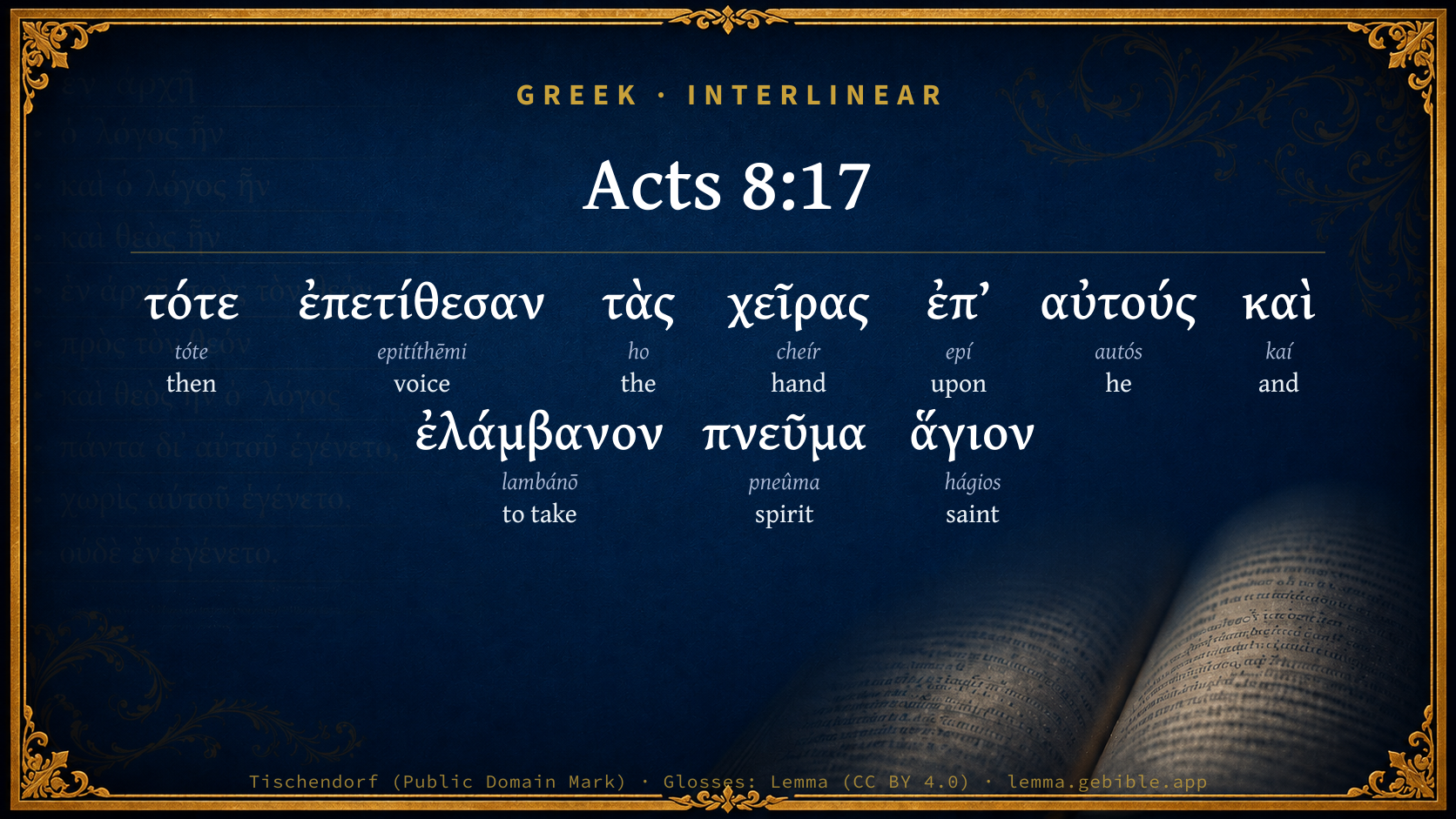
Download image
Cite this verse

Acts 8:17 (World English Bible). Public Domain. Lemma interlinear Bible study tool, https://lemma.gebible.app/v/acts/8/17.

Show BibTeX & RIS
BibTeX
RIS
English Translation
Then they laid their hands on them, and they received the Holy Spirit.
World English Bible · Public Domain
Download a study sheet

One document with this verse’s original text, its word-by-word gloss line, the meaning frame, cross-references with their text, attributed commentary, and full source and license credits — printable, and it pastes into notes with its structure intact.

This verse Autodidact and up

Study sheet (.html) Plain text (.txt)

A passage Seminary Student

Up to 50 verses in one chapter. A passage sheet keeps up to 6 commentary sources and 12 cross-references per verse, in the order this page ranks them, and says so on the sheet whenever that leaves anything out. Ask for a single verse and you get the Autodidact verse sheet above.

Everything on this page stays free to read, with no account — the sheet is a download of what is already on screen, not access to it.

Want to remove ads? Support Godless Engineer
Compare translations 3

The same verse in 3 English versions, stacked beneath the original-language interlinear above. Click any original word for its lexicon entry.

Each is an independent rendering of the whole verse — the interlinear is not word-aligned to these translations.

Highlighted words mark where these versions differ — a whole-verse word diff, not a word-by-word alignment.

  • World English Bible Public Domain
    Then they laid their hands on them, and they received the Holy Spirit.
  • King James Version Public Domain
    Then laid they their hands on them, and they received the Holy Ghost.
  • unfoldingWord Literal Text CC BY-SA 4.0
    Then they were laying hands on them, and they were receiving the Holy Spirit.

unfoldingWord Literal Text — © unfoldingWord, licensed CC BY-SA 4.0. Word-aligned USFM3 via Door43 (git.door43.org/unfoldingWord/en_ult).

Versions to compare (up to 4)

3 of 4 selected

Show all 19 translations

Every available English version of this verse, each an independent rendering of the whole verse.

  • World English Bible Public Domain
    Then they laid their hands on them, and they received the Holy Spirit.
  • Berean Standard Bible Public Domain
    Then Peter and John laid their hands on them, and they received the Holy Spirit.
  • Majority Standard Bible Public Domain
    Then Peter and John laid their hands on them, and they received the Holy Spirit.
  • King James Version Public Domain
    Then laid they their hands on them, and they received the Holy Ghost.
  • American Standard Version (1901) Public Domain
    Then laid they their hands on them, and they received the Holy Spirit.
  • Revised Version (1885) Public Domain
    Then laid they their hands on them, and they received the Holy Ghost.
  • Geneva Bible (1599) Public Domain
    Then layd they their handes on them, and they receiued the holy Ghost.
  • Douay-Rheims (1899) Public Domain
    Then they laid their hands upon them, and they received the Holy Ghost.
  • Young's Literal Translation Public Domain
    then were they laying hands on them, and they received the Holy Spirit.
  • Literal Standard Version CC BY-SA 4.0
    then they were laying hands on them, and they received the Holy Spirit.
  • Unlocked Literal Bible CC BY-SA 4.0
    Then Peter and John placed their hands on them, and they received the Holy Spirit.
  • unfoldingWord Literal Text CC BY-SA 4.0
    Then they were laying hands on them, and they were receiving the Holy Spirit.
  • Darby Bible Public Domain
    Then they laid their hands upon them, and they received [the] Holy Spirit.
  • World Messianic Bible Public Domain
    Then they laid their hands on them, and they received the Holy Spirit.
  • Webster's Bible Public Domain
    Then they laid their hands on them, and they received the Holy Spirit.
  • Free Bible Version CC BY-SA 4.0
    The apostles placed their hands on them, and they received the Holy Spirit.
  • Bible in Basic English Public Domain
    Then they put their hands on them, and the Holy Spirit came on them.
  • Text-Critical English NT CC BY 4.0
    Then Peter and John laid their hands on the Samaritan believers, and they received the Holy Spirit.
  • Tyndale New Testament (1534) Public Domain
    Then layde they their hondes on them and they receaved the holy goost.

Literal Standard Version (2020), Covenant Press — licensed CC BY-SA 4.0. Text via the HelloAO Bible API (eBible.org). Unlocked Literal Bible (unfoldingWord) — licensed CC BY-SA 4.0. Text via the HelloAO Bible API (eBible.org). unfoldingWord Literal Text — © unfoldingWord, licensed CC BY-SA 4.0. Word-aligned USFM3 via Door43 (git.door43.org/unfoldingWord/en_ult). Free Bible Version, Dr. Jonathan Gallagher — licensed CC BY-SA 4.0. Text via the HelloAO Bible API (eBible.org).

Word by word

More ways to search: Search by grammar → Find every occurrence → Compare this word →

Practice this passage: Drill this verse → Learn its vocabulary →

About this verse

These counts appear in no published source. They are computed here, from the morphology-tagged text and Lemma’s own curated glosses. What Lemma adds →

10
words
10
distinct lemmas
Acts
section

Shared distinctive vocabulary

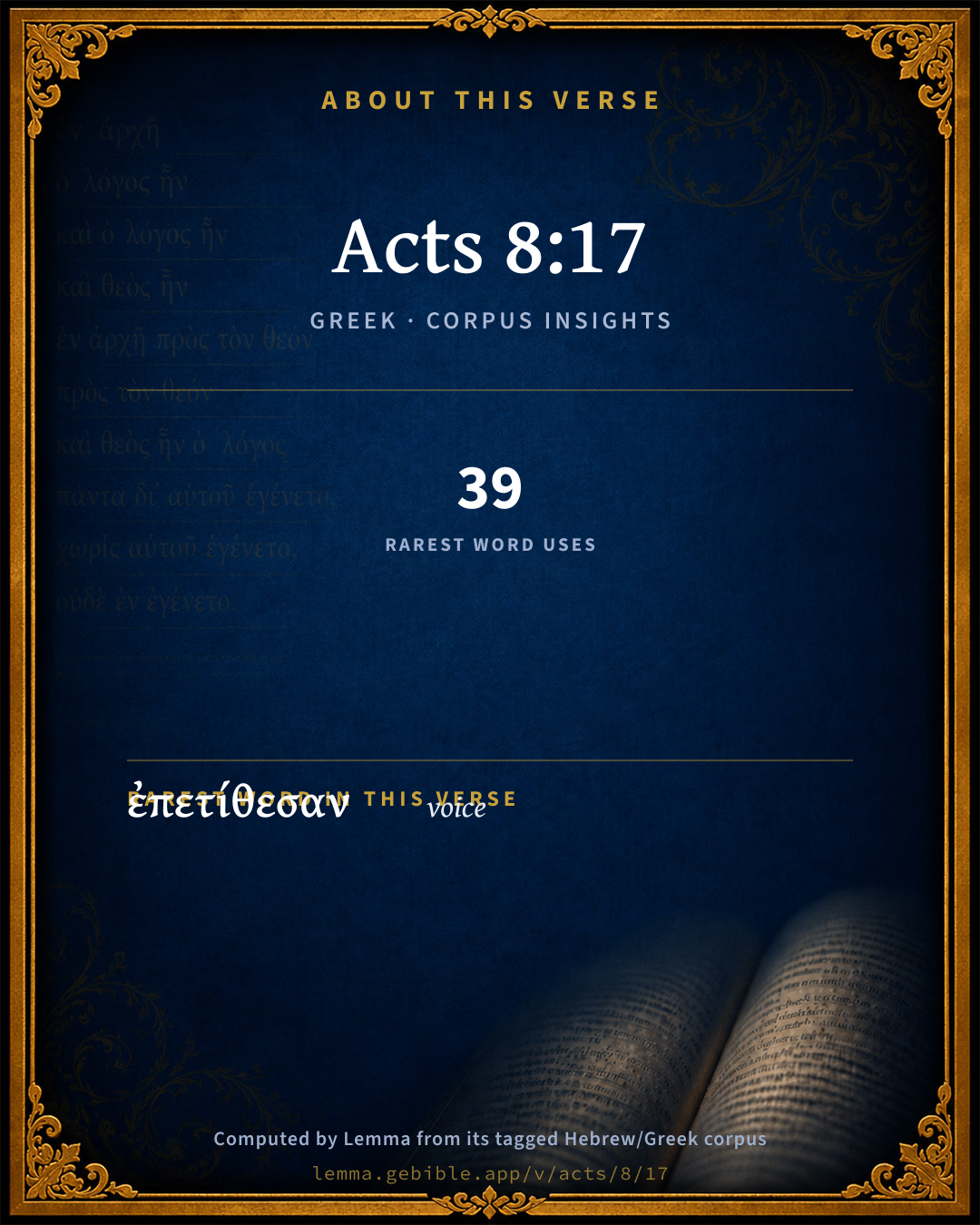
ἐπετίθεσαν voice G2007 occurs in 38 verses of the Greek New Testament. Also found in:
Cross-references

13

Topical passages linked to Acts 8:17 in the Treasury of Scripture Knowledge — connected by theme and wording, ordered by reader-vote popularity; previews shown in the World English Bible.

  • Acts 19:6 When Paul had laid his hands on them, the Holy Spirit came on them, and they spoke with other languages and prophesied.
  • Acts 6:6 whom they set before the apostles. When they had prayed, they laid their hands on them.
  • 2 Timothy 1:6 For this cause, I remind you that you should stir up the gift of God which is in you through the laying on of my hands.
  • Acts 8:18 Now when Simon saw that the Holy Spirit was given through the laying on of the apostles' hands, he offered them money,
  • Acts 2:4 They were all filled with the Holy Spirit, and began to speak with other languages, as the Spirit gave them the ability to speak.
  • Numbers 8:10 You shall present the Levites before Yahweh. The children of Israel shall lay their hands on the Levites,
  • Numbers 27:18 Yahweh said to Moses, Take Joshua the son of Nun, a man in whom is the Spirit, and lay your hand on him;
  • Acts 9:17 Ananias departed, and entered into the house. Laying his hands on him, he said, "Brother Saul, the Lord, who appeared to you on the road by which you came, has sent me, that you may receive your sight, and be filled with the Holy Spirit."
  • Hebrews 6:2 of the teaching of baptisms, of laying on of hands, of resurrection of the dead, and of eternal judgment.
  • Romans 1:11 For I long to see you, that I may impart to you some spiritual gift, to the end that you may be established;
  • 1 Timothy 4:14 Don't neglect the gift that is in you, which was given to you by prophecy, with the laying on of the hands of the elders.
  • 1 Timothy 5:22 Lay hands hastily on no one, neither be a participant in other men's sins. Keep yourself pure.
  • Galatians 3:2–5 I just want to learn this from you. Did you receive the Spirit by the works of the law, or by hearing of faith?

Cross-references courtesy of OpenBible.info (CC BY 4.0).

Commentary

Notes on Acts 8:17 from classic Christian and Jewish commentators (each source and its license shown beneath its notes). The classic Christian expositions comment on the surrounding passage and are grouped to its opening verse, so a note may address several verses; the Jewish commentaries on the Tanakh (Rashi and others) are per-verse, so they appear only where the commentator wrote on this verse.

Lemma curates 59 commentaries, every one of them public domain or Creative Commons licensed, each selected and text-cleaned for this edition rather than reprinted as found. About our sources →

The Biblical Illustrator

Joseph S. Exell

Act_8:17

Then they laid their hands on them, and they received the Holy Ghost.

Confirmation

According to--

I. Its origin. No sacramental institution of our Lord, but a time-honoured ordinance of the Church.

II. Its import. No substitution for, or repetition of baptism, but a ratification of baptismal confession and grace.

III. Its effect. No infallible communication of the Spirit, as here by the apostles, but an incalculable spiritual blessing for susceptible hearts. (K. Gerok.)

The Biblical Illustrator, edited by Joseph S. Exell (c. 1880s–1900s) — public domain. Text from a community e-Sword module.

Expositor's Greek Testament

ed. W. Robertson Nicoll

Act 8:17 . There cannot be any reason to doubt the validity of St. Philip’s baptism, and it is therefore evident that the laying on of hands ( cf. Act 19:6 ) is here distinct from baptism, and also from the appointment to any Church office (as in Act 6:6 , Act 13:3 ), or the bestowal of any special power of healing as in the person of Ananias, Act 9:12 ; Act 9:17 , although gifts of healing might no doubt accompany it. But both here and in Act 19:6 ( cf. Heb 6:2 ) it follows closely upon baptism, and is performed by Apostles, to whom alone the function belongs, although it is reasonable to suppose that the prophets and teachers who were associated with them in their Apostolic office, and who could lay on hands in Act 13:1-3 , could do so in other cases also for the reception of the Holy Ghost (Gore, Church and the Ministry , p. 258). The question why St. Philip did not himself “lay hands” upon his converts has been variously discussed, but the narrative of Acts supplies the answer, inasmuch as in the only two parallel cases, viz. , the verse before us and Act 19:6 , the higher officers alone exercise this power, and also justifies the usual custom of the Church in so limiting its exercise (“Confirmation,” Dict. of Christian Antiq. (Smith & Cheetham), i., p. 425; B.D. 1 , iii., App. ; and Hooker, Eccles. Pol. , v., ch. lxvi. 5, and passage cited; Jerome, Advers. Lucif., c. 4, and St. Cyprian, Epis. 73, ad Jubaianum (reference to the passage before us)). Undoubtedly there are cases of baptism, Act 2:41 ; Act 16:15 ; Act 16:33 , where no reference is made to the subsequent performance of this rite, but in these cases it must be remembered that the baptiser was an Apostle, and that when this was the case its observance might fairly be assumed. For the special case of Cornelius see below on Act 10:44 , see further “Confirmation,” B.D. 2 , i., 640]. Weizsâcker contrasts this account in 8., Act 5:16 , which he describes as this crude conception of the communication of the Spirit solely by the imposition of the Apostles’ hands ( Apostolic Age , ii., 254 and 299, E.T.), and which represents baptism as being thus completed, with the account of baptism given us by St. Paul in 1Co 1:14-17 . But in the first place we should remember that Acts does not describe baptism as being completed by the laying on of hands; the baptism was not invalid, the Samaritan converts became by its administration members of the Church; and the laying on of hands was not so much a completion of baptism as an addition to it. And, in the next place, Heb 6:2 certainly indicates that this addition must have been known at a very early period (see Westcott, in loco ). It may also be borne in mind that 2Co 1:21 is interpreted of confirmation by many of the Fathers ( cf. too Westcott’s interpretation of 1Jn 2:20 ; 1Jn 2:27 ), and that St. Paul is writing a letter and not describing a ritual. ἐλάμβανον : Dr. Hort, who holds that the reception of the Holy Spirit is here explained as in Act 10:44 by reference to the manifestation of the gift of tongues, etc., points out that the verb is not ἔλαβον , but imperfect ἐλάμβανον , and he therefore renders it “showed a succession of signs of the Spirit” (sec also above). But this interpretation need not conflict with the belief in the gift of the Spirit as a permanent possession, and it is well to remember that ἐπετίθεσαν ( ἐπετίθουν ) is also imperfect. Both verbs may therefore simply indicate the continuous administration of the laying on of hands by the Apostles, and the continuous supernatural result (not necessarily external manifestation) which followed upon this action; cf. ἐβαπτίζοντο in Act 8:12 , imperfect, and so in Act 18:8 .

The Expositor's Greek Testament, edited by W. Robertson Nicoll (1897–1910) — public domain. Text from a community e-Sword module.

Adam Clarke's Commentary

Verse 17. Then laid they their hands on them] Probably only on some select persons, who were thought proper for public use in the Church. They did not lay hands on all; for certainly no hands in this way were laid on Simon.

Adam Clarke's Commentary on the Bible (1810–1826) — public domain. Text from a community e-Sword/MySword module.

John Calvin's Commentaries

17. When they had laid their hands. The laying on of hands followeth prayers, whereby they testify that the grace of the Spirit is not included in the external ceremony, which they crave humbly at the hands of another. And yet when they confess that God is the author, they neglect not the ceremony which was delivered them by God to this use; and because they usurp it not rashly, the effect is also annexed. This is the profit and efficacy of signs, because God worketh in them, and yet he remaineth the only giver of grace and distributeth the same according to his good pleasure; but let us remember that the laying on of hands was the instrument of God, at such time as he gave the visible graces of the Spirit to his, and that since the Church was deprived of such riches, it is only a vain visor without any substance.

John Calvin's Commentaries (1540-1563) — public domain. Text from the Calvin Translation Society English edition (1840s-50s) via the Christian Classics Ethereal Library (ccel.org). Calvin's coverage is partial (roughly two-thirds of the Bible); uncommented books and verses are honest gaps, never fabricated. The 19th-century editor's footnotes and remarks are omitted so the notes are faithfully Calvin's own voice.

Ellicott's Commentary for English Readers

(17) Then laid they their hands on them.—The act had already appeared as at once the symbol and the channel of the communication of spiritual gifts and offices in the appointment of the Seven. (See Note on Act_6:6.) Historically, the act here recorded has the interest of being the starting-point of what afterwards developed into the rite known as Confirmation. Taking the narrative of the Acts by itself, a question might be raised how far what we read of was normal or exceptional, connected, for a time only, with the bestowal of new and marvellous powers, or powerful, through the whole history of the Church, as a means of grace strengthening the spiritual life after those powers had been withdrawn. In any case it was probable that no hard and fast line marked the disappearance of the special and marvellous forms of spiritual power which were at first manifested in connection with the laying-on of hands, and so the practice had time to become part of the fixed order of the Church. When they ceased altogether we can understand the reluctance of men to give up a rite that had come down from the days of the Apostles. They would feel that the prayer of faith was still mighty to prevail; that the Spirit would still be given in answer to prayer joined with the symbolic act, though no longer in the same form, and would confirm and strengthen the work which had been begun in baptism, and so the primitive laying-on of hands passed into Confirmation, and was accompanied by other symbolic acts, such as anointing. The thought that it is so called because in it adults confirm the promises made for them when baptised as infants, is entirely modern, and cannot be traced further back than the sixteenth century.

A Bible Commentary for English Readers, edited by Charles John Ellicott (1878–1897) — public domain. Text from a community e-Sword module.

The Cambridge Bible for Schools and Colleges

gen. ed. J. J. S. Perowne

17. Then laid they their hands on them] That there might be some outward sign of this imparted grace. So Ananias (Act_9:17) laid his hands on Saul, and he received the Holy Ghost. But on Cornelius and his companions (Act_10:44) the same gift was bestowed while Peter spake unto them.

The Cambridge Bible for Schools and Colleges (gen. ed. J. J. S. Perowne; Cambridge University Press, 1878–1918) — public domain. Text from a community e-Sword module.

John Gill's Exposition

And when Simon saw,.... Whence it appears, that the Holy Ghost, or his gifts, which were received by imposition of hands, were something visible and discernible; and so something external, and not internal; otherwise they would have been out of Simon's reach, and would not have fallen under his notice; but he saw,

that through laying on of the apostles' hands, the Holy Ghost was given: he saw, that upon this men began to prophesy, and to speak with divers tongues they had never learned, and to work miracles, cure men of their diseases, and the like: and when he observed this,

he offered them money; to purchase such a power of conferring the like gifts, on whomsoever he should lay his hands: hence buying and selling spiritual things, or what relate thereunto, are commonly called "simony": a vice which has greatly prevailed in the church of Rome, and among its popes; and who therefore may be more properly called the successors of Simon Magus, than of Simon Peter.

John Gill's Exposition of the Whole Bible (1746–1763) — public domain (CC PDM 1.0). Text via the HelloAO Bible API.

Trapp's Complete Commentary

John Trapp

17 Then laid they their hands on them, and they received the Holy Ghost.

Ver. 17. Then laid they their hands on them] After the manner of the priests, who laid their hands on the beast that was to be sacrificed, and so consecrated them to God.

John Trapp, A Commentary or Exposition upon All the Books of the Old and New Testament (1647–1656) — public domain. Text from a community e-Sword module.

Albert Barnes' Notes on the Bible

Then laid they their hands ... - This was an act of “prayer,” expressing an invocation to God that he would impart the blessing to “them.” On “how many” they laid their hands is not said. It is evident that it was not on “all,” for they did not thus lay hands on Simon. Perhaps it was done on a few of the more prominent and leading persons, who were to be employed particularly in bearing witness to the truth of the gospel. It was customary to lay the hands on any person when a “favor” was to be conferred or a blessing imparted. See notes on Mat 9:18.

Albert Barnes' Notes on the Bible (1834–1885) — public domain. Text from a community e-Sword/MySword module.

Haydock's Catholic Bible Commentary

They received the Holy Ghost. Not but that they had received the grace of the Holy Ghost at their baptism; but not that plentitude of grace, and those gifts, which they received from bishops in the sacrament of confirmation. This sacrament, as St. John Chrysostom observes,[2] St. Philip, the deacon, had not the power to give. (Witham)

===============================

[BIBLIOGRAPHY]

St. John Chrysostom, hom. xviii. Greek: oude gar eichen exousian.

George Leo Haydock (1774–1849), Haydock's Catholic Family Bible and Commentary, 1859 edition — public domain. Excludes Psalms (Douay-Rheims chapter numbering differs from Protestant) and Deuterocanonical books (Catholic canon only).

Matthew Poole's English Annotations

That this laying on of the hands of the apostles was not intended here as any rite whereby the apostles did confirm some, or ordain others, seems evident from the context.

They received the Holy Ghost; the power of speaking with tongues, and working of miracles; which throughout this book is so often spoken of in this acceptation.

Matthew Poole's English Annotations on the Holy Bible (1683–1685) — public domain. Text from a community e-Sword/MySword module.

Godbey's Commentary on the New Testament

William B. Godbey

17. “Then they laid hands on them, and they continued to receive the Holy Ghost.” Why the church has utterly ignored this positive, clear and unequivocal Apostolical precedent, confirmatory of the second work of grace in the plan of salvation, is to all ages an enigma indissoluble, recognized by none but the fragmentary holiness movements since the fatal Constantinian apostasy of the fourth century, thus elucidating to all Bible readers the indisputable fact that all human ecclesiasticisms in all ages are actual departures from the New Testament church, following human dogmatism off on endless diversity of sidetracks, into the darkness and morasses of Satan’s bewilderment; while the irregular Holy Ghost revivals in the different ages, anathematized, persecuted and martyred by the popular churches, are really the survival of the apostles and primitive saints through all the intervening ages, daring to preach the unadulterated truth and walk in the precepts of the Apostolic church. How signally you see this fact verified at the present day. In vain do you ransack the popular ecclesiasticisms to find a verification of this Apostolical precedent. But I am happy to say you find it everywhere among the different phases of the holiness movement, this day girdling the globe, and, without financial resources, preaching the gospel to more heathens than all the popular churches with their millions of money. No church can possibly sustain a claim to orthodoxy and ignore New Testament precedent. Here we have a clear and unequivocal illustration of the gospel plan of salvation transmitted to us by the infallible history of the Holy Ghost. No one will dare discount those “roaring” demonstrative conversions under the preaching of Philip. But you see this is not enough in the judgment of the inspired apostles. Therefore they unhesitatingly send out Peter and John to preach to them the second work of grace, that they may all receive the Holy Ghost. What think you of the churches and preachers who not only ignore this procedure, but antagonize it? Rest assured, they will have trouble in the judgment day. No wonder God is raising up the holiness movement in every nation under heaven and pushing it to the ends of the earth. In connection with this movement He is raising up a grand army of evangelists, male and female, endued with Pentecostal heroism, fearlessly of men and devils to preach and practice the gospel in its New Testament simplicity, from the heads of the rivers to the ends of the earth, thus ushering in the millennium and preparing the nations for our Lord’s return.

William B. Godbey, Commentary on the New Testament (1896–1900) — public domain. Text from a community e-Sword module.

McGarvey & Pendleton's Commentaries

J. W. McGarvey

See notes on verse 14

J. W. McGarvey (with Philip Y. Pendleton), Commentaries on the New Testament (The Fourfold Gospel, 1914; Acts; and the epistles) — public domain. Text from a community e-Sword/MySword module.

Cambridge Greek Testament for Schools and Colleges

17. τότε ἐπετίθεσαν κ.τ.λ., then they laid their hands on them, that there might be some outward sign of this imparted grace. So Ananias (Act 9:17) laid his hands on Saul, and he received the Holy Ghost. But on Cornelius and his companions (Act 10:44) the same gift was bestowed while Peter spake unto them.

Cambridge Greek Testament for Schools and Colleges (Cambridge University Press, 1896; 21 vols, various authors incl. Carr, Maclear, Plummer, Farrar, Lumby, Moule, M. R. James, Simcox) — public domain. Text from a community e-Sword module.

Lesson kit

Teaching starters — assembled from the data on this page, not authored interpretation. Every prompt links to the verse data it draws on. Edit before teaching.

Acts, in the Acts, opens this verse with 10 words (10 distinct Greek lemmas). Its most distinctive word is epitíthēmi (“voice”). A historical commentator’s framing appears above. Read the whole chapter for the surrounding context.

Discussion questions

  1. What does “voice” (epitíthēmi) contribute to the verse as a whole?
  2. How does Matthew 9:18, which shares the word «voice», read alongside this verse?
  3. These translations render this verse differently. What is at stake in choosing one wording over another?
  4. Compare how The Biblical Illustrator and Expositor's Greek Testament read this verse. Where do they agree or differ?

Things to notice

Reading settings

Reading text

Shown beneath each verse's original-language words.

Old Testament
Old Testament edition

Read the OT as the Masoretic Hebrew (MT) or the Greek Septuagint (LXX).

English shown for the Greek Septuagint (in the Hebrew ↔ Greek comparison).

Comparing translations? Open the Compare panel on any verse page to stack up to four side by side.